Valencia Audiotour: Verborgen Paleizen & Legendes van Ciutat Vella
Een gemaskerd bal van een edelman ontketende ooit een schandaal zo hevig dat de fluisteringen nog steeds echoën achter stenen bogen in Valencia's Ciutat Vella. Voorbij de zonovergoten pleinen en bruisende cafés verbergt een doolhof van paleizen verraad, verboden allianties en geruchten die diep in oude trappenhuizen zijn gebeiteld. Deze zelfgeleide audiotour opent deuren waar de meeste reizigers aan voorbijgaan, en nodigt je uit om voetsporen te volgen door machtsstrijd, geheime renovaties en verdwenen familiewapens. Waarom diende het Paleis van de Generalitat zowel als gevangenis als als zetel van de macht? Welke schimmige eigenaar van de Catalá de Valeriola kocht in één gedurfde zet een heel stadsblok op? Welk mysterieus symbool ligt vergeten bovenop de roemruchte toren van de Markies de la Scala? Dwaal door smalle straatjes waar rebellie smeulde onder festivalvlaggen en politieke rivalen streden om controle. Laat verschuivend zonlicht verborgen mozaïeken en vervaagde wapenschilden onthullen, waardoor elke stap een sprong door de eeuwen heen wordt. Klaar om te ontdekken wat deze statige stenen verbergen? Begin nu met verkennen – de geheimen van Ciutat Vella wachten op je.
Tourvoorbeeld
Over deze tour
- scheduleDuur 40–60 minsGa op je eigen tempo
- straighten2.6 km wandelrouteVolg het geleide pad
- location_on
- wifi_offWerkt offlineEén keer downloaden, overal gebruiken
- all_inclusiveLevenslange toegangOp elk moment opnieuw afspelen, voor altijd
- location_onStart bij Paleis van de Catalá de Valeriola
Stops op deze tour
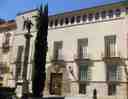
You should be looking at a large, pale yellow building resting on a solid stone base, featuring prominent wrought-iron balconies jutting out from the second floor. This is the…Meer lezenToon minder
Open eigen pagina →
Palau dels Català de Valeriola, façanaPhoto: Joanbanjo, Wikimedia Commons, CC BY-SA 3.0. Cropped & resized. ...
Look to your left for the wide, pale plastered brick facade featuring a flat stone doorway topped with a carved crest, standing just behind a tall stone column crowned with a…Meer lezenToon minder
Open eigen pagina →Look to your left for the wide, pale plastered brick facade featuring a flat stone doorway topped with a carved crest, standing just behind a tall stone column crowned with a bronze statue. This is the Palace of the Marquis de la Scala.
Well, I say palace, but you are actually looking at two separate manor houses joined together at the hip. If you stepped through that flat stone doorway, you would find yourself in a zaguán, which is a traditional grand vestibule designed to impress visitors the second they arrive. From there, the space opens into a shared courtyard linking the two homes.
Built originally in the sixteenth century, the building is an elegant architectural mutt, blending its original Valencian Gothic roots with a Renaissance upper gallery of small arches and later Baroque modifications. Inside, one of its grand staircases features an alfarje, a stunning style of geometric carved wooden ceiling with deep Moorish roots.
It is quite the flex in real estate. In fact, we will be heading to the Palace of the Generalitat Valenciana next, but there was a time when the Marquis living right here actually held more political weight than the regional government itself. Power, it seems, preferred this address.
And that bronze fellow on the column out front? That is a monument by sculptor Pío Mollar Franch depicting a Spanish conquistador. But the column he is standing on is entirely recycled, salvaged from a Renaissance era hospital.
This massive double mansion stands as a fantastic testament to Valencia's heavily layered history. Take as much time as you like here, and whenever you are ready, we can walk on over to our next stop.
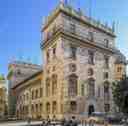
Right in front of you is a massive pale stone complex dominated by a square tower, featuring a classic arched entryway at its base and a striking black wrought-iron balcony…Meer lezenToon minder
Open eigen pagina →
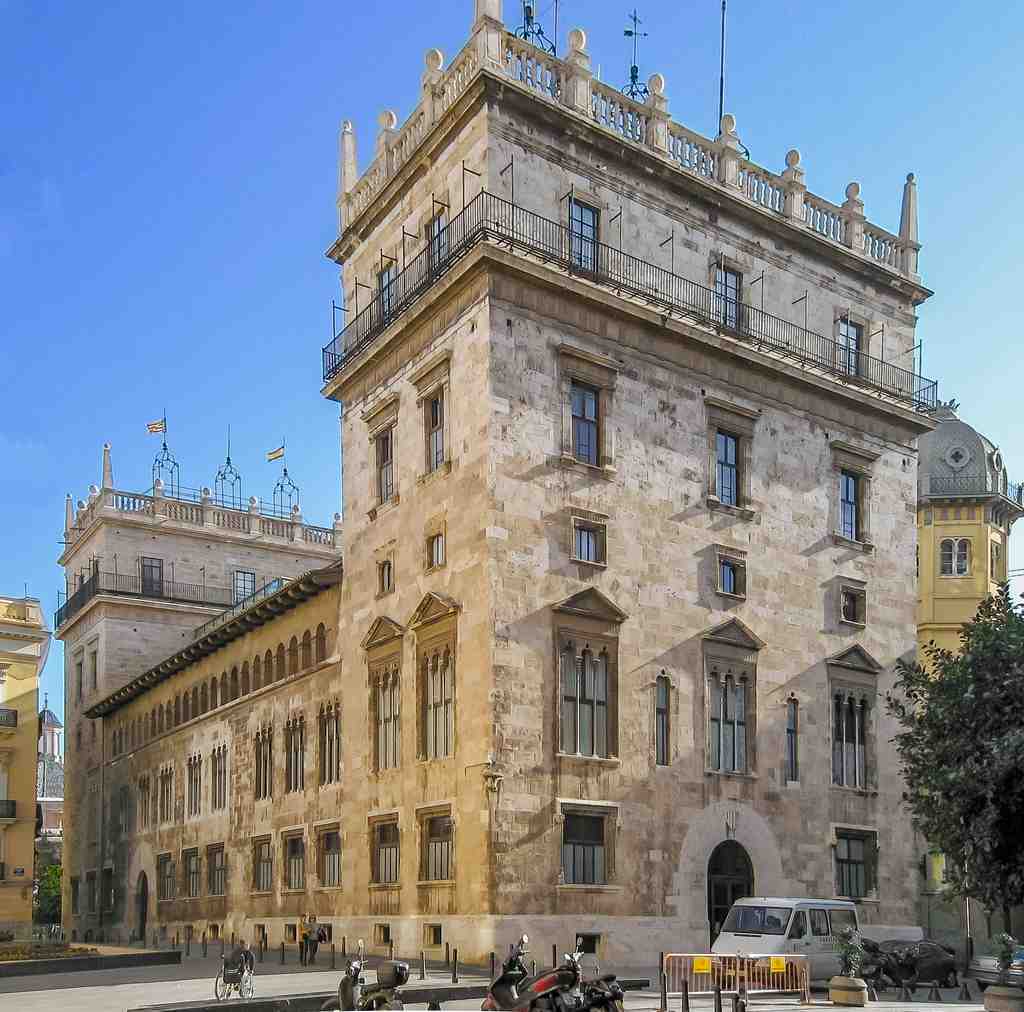
The imposing exterior of the Palace of the Generalitat Valenciana, featuring its classic arched entryway and stone towers (2022).Photo: Ymblanter, Wikimedia Commons, CC BY-SA 4.0. Cropped & resized. Right in front of you is a massive pale stone complex dominated by a square tower, featuring a classic arched entryway at its base and a striking black wrought-iron balcony wrapping around the upper level. Just a short walk ago we were admiring the Palace of the Marquis de la Scala, but this building is the undisputed historic heavyweight of the city. Welcome to the Palace of the Generalitat Valenciana. Today, this is the headquarters of the regional government, but its story goes all the way back to fourteen twenty-one. Back then, the deputies in charge of collecting regional taxes decided they were tired of moving around to different temporary offices. They rented a couple of rooms in a modest local house right about where you are standing. Apparently, tax collection was a pretty steady business, because within a year they bought the entire house, and over the next few centuries, they just kept expanding.

A historic glimpse of the Palace as it appeared in 1911, showing its evolution and earlier architectural footprint.Photo: Desconegut, Wikimedia Commons, Public domain. Cropped & resized. What you are looking at today is a complex mix of eras. It is a blend of Mediterranean Gothic, which you can spot in those elegant pointed arches, heavily layered with later Renaissance additions that brought in more symmetrical, classical features. The construction dragged on for generations, with the city's finest master builders leaving their mark. If you tap the image in your app, you can slide between how this looked in nineteen eleven and today to see how much the building has evolved over the last century.

The modern western tower, a brilliant architectural illusion constructed in the 1950s using salvaged 16th-century stones (2013).Photo: Enfo, Wikimedia Commons, CC BY-SA 3.0. Cropped & resized. You might notice the building has a very balanced, imposing look now, but it definitely did not start out that way. That grand tower you see on the eastern side is the original, finally topped off in the late fifteen hundreds. But the matching tower on the western side? That is actually a bit of an architectural magic trick. It was built in the nineteen fifties by an architect named Luis Albert. He managed to seamlessly blend the new addition with the old by using authentic sixteenth-century stones, which were salvaged from a bombed palace in a nearby town.

A rare 1911 archival view of the intricate, gold-leafed wooden ceiling found inside the Sala Dorada.Photo: Desconegut, Wikimedia Commons, Public domain. Cropped & resized. While the outside is certainly impressive, the real showstoppers are hidden behind those thick stone walls. Inside, there is a central open-air courtyard with a beautiful floating staircase that leads up to the main floor. The interior also boasts the Sala Dorada, or Golden Room. It earns its name from an incredibly rich, gold-leafed wooden ceiling intricately carved by the master craftsman Ginés Linares in fifteen thirty-four. Then there is the Hall of the Cortes. The Cortes was the traditional regional parliament where the three main social classes of the kingdom met to make decisions. The walls of that monumental hall are covered in vast Renaissance paintings by Juan Sariñena and other prominent artists. They actually painted the sixteenth-century deputies directly from life, creating a permanent, highly realistic record of the city's power players.

The original eastern tower standing proudly over the bustling plaza, a testament to centuries of civic history (2016).Photo: Enric, Wikimedia Commons, CC BY-SA 4.0. Cropped & resized. It is still a working government building today, though visitors can often peek inside Monday through Friday from eight in the morning until eight in the evening, and on Saturdays from nine to two. Feel free to admire the details before we head to the next stop.
Toon 12 stops meerToon minder stopsexpand_moreexpand_less
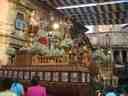
Turn your attention to a massive, intricately carved wooden carriage, crowned with a gleaming golden chalice and detailed religious statues. This is the House of Rocks, sitting…Meer lezenToon minder
Open eigen pagina →Turn your attention to a massive, intricately carved wooden carriage, crowned with a gleaming golden chalice and detailed religious statues. This is the House of Rocks, sitting just a short three-minute stroll from our next destination, the Torres de Serranos. Approved by the city back in 1435, this building was wedged between the city's oldest wall and a newer fourteenth-century wall. Its sole purpose was to serve as a giant medieval garage for the theatrical props and floats used in the Corpus Christi procession, a major Catholic festival celebrating the Eucharist.
The inventory inside is wonderfully bizarre. Beyond the eleven massive wooden floats, the oldest being the San Miguel carriage from 1528, the collection includes symbolic eagles, towering giants, and a mythical beast known as the Dragon of Saint George.
But this strange collection almost washed away. In 1957, a catastrophic river flood hit Valencia, and the water inside this very building rose to four meters high, completely submerging the historic wooden floats. The city scrambled to save them, approving an emergency budget of 150,000 pesetas for the recovery. Adjusted for inflation, that is roughly sixteen thousand dollars today.
Thankfully, the city successfully restored both the building and the surviving floats, officially reopening the space in 2006. If you want to check out the dragons and historic carriages yourself, the museum opens Monday through Saturday in the mornings and late afternoons, but stays closed on Sundays. Take a moment to appreciate the scale of these creations. When you have had your fill of dragons and floats, let us continue our walk.
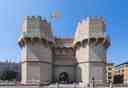
Ahead on your right, you will spot a massive medieval gateway made of solid limestone blocks, featuring two giant polygonal towers flanking a central arched entrance. We just…Meer lezenToon minder
Open eigen pagina →
A spectacular view of the massive Torres de Serranos from the north, showcasing its medieval grandeur (2022).Photo: Ymblanter, Wikimedia Commons, CC BY-SA 4.0. Cropped & resized. Ahead on your right, you will spot a massive medieval gateway made of solid limestone blocks, featuring two giant polygonal towers flanking a central arched entrance. We just walked over from the House of Rocks a minute ago, but while that building stores the history of local festivals, this towering structure is the grand stage for it. These are the Torres de Serranos. Back in the late fourteenth century, Valencia was entering its golden age. Trade was booming, the city was rich, and the local government decided they needed a front door that properly showed off their wealth. So, in 1392, they hired master builder Pere Balaguer. They even paid him one hundred and sixty-five sueldos for travel expenses, which is roughly a couple thousand dollars today, just to tour around Catalonia and Aragon and gather inspiration from other gothic monuments.

A close-up of the solid limestone blocks and the imposing polygonal shape of the towers (2022).Photo: Ymblanter, Wikimedia Commons, CC BY-SA 4.0. Cropped & resized. Balaguer was a bit of a perfectionist. He personally visited the stone quarries along the coast, selecting the perfect limestone and having it precisely cut before it was ever shipped by boat to Valencia. The result is what you see now. The towers are polygonal on the outside, a clever design choice that eliminated blind spots for defenders. But their real purpose was theater. This was the main entrance for kings and foreign ambassadors arriving from the north. The city wanted them intimidated and impressed before they even set foot inside.

An archival photo of the Torres de Serranos from 1870, showing the towers before modern urban expansion (1870).Photo: Jean Laurent, Wikimedia Commons, Public domain. Cropped & resized. Oddly enough, the very thing that saved these towers from destruction was a downgrade in their status. In 1586, they were converted into a prison for nobles and knights. When a later civil governor ordered the old city walls torn down to make room for urban expansion, the Torres de Serranos were spared simply because the city still needed a secure place to put its aristocratic inmates. The app has a neat side-by-side showing what this place looked like back in 1870 compared to today, so you can see how much the surrounding streetscape has completely transformed.

The interior vaulted ceilings of the towers, where priceless art was protected by a massive concrete shell during the Spanish Civil War (2022).Photo: Francesco Bini, Wikimedia Commons, CC BY-SA 4.0. Cropped & resized. These resilient walls served another crucial purpose during the Spanish Civil War in 1936. When priceless masterpieces from the Prado Museum in Madrid were evacuated to Valencia, they were hidden right inside these towers. To protect the art from aerial bombings, engineers built a massive concrete vault over the first floor, topped it with a thick layer of rice husks to act as a shock absorber, and then piled a meter of soil on top of that.

The vibrant atmosphere during the Crida, the official opening of the Fallas festival, held right at the gates of the towers (2023).Photo: Distritofallas, Wikimedia Commons, CC BY-SA 4.0. Cropped & resized. Today, the towers are the centerpiece of the city's biggest party. On the last Sunday of February, the fallera mayor, the elected queen of the festival, stands on a grandstand right in front of this gate for the crida, which is the official public proclamation that kicks off the famous Fallas celebrations. You can actually go inside and climb to the top for a spectacular view of the city, and they are generally open Monday through Saturday from ten in the morning to seven in the evening, and until two in the afternoon on Sundays. Enjoy the view of this formidable gateway before we stroll over to our next destination, the Rationists' Hall.
Notice the striking exposed brick building on your left, featuring a massive semi-circular arch and a prominent metal cross perched at its peak. We just walked from the imposing…Meer lezenToon minder
Open eigen pagina →Notice the striking exposed brick building on your left, featuring a massive semi-circular arch and a prominent metal cross perched at its peak. We just walked from the imposing Torres de Serranos, but this building... well, it was built for a very different kind of defense. This is the Rationists' Hall, designed in 1886 by architect Joaquín María Arnau Miramón. Back then, the local silk industry crashed, leaving thousands of weavers unemployed. The Count of Trigona commissioned this grand space to distribute food rations to those desperate families, even including a preschool. To fit everyone inside, Miramón created a massive nave, which is simply an architectural term for a long, soaring central hall. To support that huge roof without cluttering the floor with pillars, he used laminated iron trusses, making this one of Valencia's earliest examples of modern metal construction. Today, it survives as a school sports pavilion, trading the quiet hum of charity for the chaotic echoes of gym class. It is a beautiful piece of local history that stepped up when the city needed it most. Let's keep wandering to our next stop.
Peer down this dark-paved narrow street on your right, lined with tall brick facades, wrought-iron balconies, and an ornate stone tower rising in the distance. Unlike the…Meer lezenToon minder
Open eigen pagina →
A view down the narrow, historic Carrer de na Jordana in the El Carme neighborhood (2011).Photo: Joanbanjo, Wikimedia Commons, CC BY-SA 3.0. Cropped & resized. Peer down this dark-paved narrow street on your right, lined with tall brick facades, wrought-iron balconies, and an ornate stone tower rising in the distance. Unlike the Rationists' Hall we saw earlier, Calle Na Jordana holds a totally different legacy.
The name actually comes from a historical bakery run by a woman whose husband was named Jordà. Locals called her Jordana, the feminine version of his name. Add Na, an old Valencian courtesy title for a lady, and you have Na Jordana. This street is legendary for Las Fallas, the festival where massive, satirical sculptures called fallas are built and burned. The Na Jordana group boasts a hundred and twenty-five years of history, winning the top prize twelve times.

The tight confines and wrought-iron balconies of the street, which the massive Fallas monuments eventually outgrew (2013).Photo: Joanbanjo, Wikimedia Commons, CC BY-SA 3.0. Cropped & resized. Eventually, their grand monuments grew so enormous they outgrew this tight space. In nineteen eighty-three, they moved to the wider Plaza del Portal Nou nearby so the giant sculptures wouldn't get stuck between balconies. Their commission building here is typically open Tuesday and Thursday evenings.

The historic Carme Centre, our next destination after exploring the alleyways.Photo: Pere prlpz, Wikimedia Commons, CC BY-SA 3.0. Cropped & resized. It is incredible to imagine those colossal figures wedged into this narrow alley. Take your time looking around, then we can head toward the Carme Centre.
Just ahead on your left is the Carme Centre, a space where you will find a striking interior featuring pristine white columns, elegant arched vaults, and large grid-patterned…Meer lezenToon minder
Open eigen pagina →
Carmen4Photo: Un valencià, Wikimedia Commons, Public domain. Cropped & resized. Just ahead on your left is the Carme Centre, a space where you will find a striking interior featuring pristine white columns, elegant arched vaults, and large grid-patterned skylights illuminating the polished floors. We are just a minute's walk from our last stop at Na Jordana, but stepping up to this building feels like stepping through several centuries all at once. This complex started its life way back in 1280, when the King granted the Carmelite monks permission to build a monastery here. Over the centuries, the monks kept adding to it, creating a rather beautiful blend of styles. There is a medieval chapel, a Gothic cloister-which is a covered walkway typically wrapping around an open courtyard-and a newer Renaissance cloister added in the fifteen hundreds. The attached church also boasts a highly decorative Baroque facade. Check the app to compare a historic 1870 photo of this intricately carved facade with how it looks today.

Església del Carme de València, 1870, LaurentPhoto: Jean Laurent, Wikimedia Commons, Public domain. Cropped & resized. By the nineteenth century, the monks were gone, and the building began a new life serving the arts. It housed the Royal Academy of Fine Arts, and during the Spanish Civil War, it played a crucial role as a massive vault. Just as we learned at the Torres de Serranos, invaluable masterpieces from the Prado Museum were also secretly brought here to keep them safe.

Valencia Renaissance cloister of the Convent del Carme from the first floorPhoto: Ymblanter, Wikimedia Commons, CC BY-SA 4.0. Cropped & resized. But the drama did not end in the twentieth century. In 2017, the space was rebranded as the Centre del Carme Cultura Contemporania, aiming to push the boundaries of modern art. And push boundaries they did. In 2019, the museum authorized an artist duo to paint a massive, thousand square meter graffiti mural directly onto the walls of that historic Renaissance cloister.

Graffiti Artist Carrer MuseuPhoto: Francesc Fort, Wikimedia Commons, CC BY-SA 4.0. Cropped & resized. You can imagine the reaction. Cultural associations and art historians were absolutely furious. It sparked a massive legal battle over the protection of historical heritage. Ultimately, the museum's director was taken to court and convicted of reckless damage to the city's heritage, resulting in a fine of over a thousand euros. The mural was removed, and the director was later abruptly dismissed by a new political administration in 2023, causing yet another wave of public uproar.

Detalle del interior del Centro del CarmenPhoto: 19Tarrestnom65, Wikimedia Commons, CC BY-SA 4.0. Cropped & resized. Today, the museum remains proudly provocative and deeply rooted in social activism. It hosts projects like the VIHsibles festival, blending art and community to promote sexual health and HIV awareness. They also focus heavily on feminist art, hosting exhibitions that highlight the women's rights movement and the crucial role of rural women in Spanish society. It is a vibrant, living space where centuries old stone meets the sharpest edge of modern culture. The museum is open Tuesday through Sunday from 10 AM to 8 PM, if you want to explore the cloisters yourself. Take your time here, then we will take a short walk over to our next stop at Carmen Square.
Here on your left is a wide paved plaza fronting a large, flat-faced brick building with a grand double wooden door, shaded by leafy green trees growing directly out of the stone.…Meer lezenToon minder
Open eigen pagina →Here on your left is a wide paved plaza fronting a large, flat-faced brick building with a grand double wooden door, shaded by leafy green trees growing directly out of the stone. This is Carmen Square. We just wandered over from the Carme Centre, which actually ties directly into the story of this space.
For centuries, this plaza has been the beating heart of the neighborhood. It has almost always been called Carmen Square, save for four fleeting years in the 1840s when it was briefly rebranded Museum Square after the local convent was temporarily turned into a public art gallery.
That imposing brick building in front of you is the Palace of Pineda. It was built starting in 1728 for Francisco Salvador Pineda. He was the Intendant... essentially the king's supreme financial and military administrator for the entire region. Power radiated from those very doors. Over the years, the building has been a school, a convent, and even sat completely abandoned before being beautifully restored.
But the most intense chapter of this square's life happened entirely out of sight. During the Spanish Civil War in 1936, the ground right beneath your feet was hollowed out. A massive subterranean air raid shelter was constructed down there, packed with terrified locals seeking refuge from the bombs falling from above.
Today, thankfully, the heaviest things falling here are leaves from the trees onto the statue of the Renaissance painter Joan de Joanes in the center. It is a quiet survivor of a loud history. Enjoy the peace of the square before we take a short walk over to the Angels Tower.
On your left is Angels Tower, a rugged semicircular stone structure with a heavy barred window, standing stubbornly among peeling plaster walls. We were just in the open space of…Meer lezenToon minder
Open eigen pagina →On your left is Angels Tower, a rugged semicircular stone structure with a heavy barred window, standing stubbornly among peeling plaster walls. We were just in the open space of Carmen Square a few minutes ago, but here things get delightfully cramped.
This is the Torre de l'Àngel, one of the extremely rare surviving pieces of Valencia's ancient Islamic defensive wall. Built centuries ago, it is made of solid masonry... meaning it was constructed by thickly binding heavy stone and brick with mortar so it could withstand a siege. Over the years, the city simply grew right around it. Today, it is literally landlocked by private, everyday residential courtyards. Imagine having a massive, battle hardened military tower acting as your backyard property line. It definitely beats putting up wooden privacy fences.
Named for the nearby Angel Street, this stubborn relic is now officially protected as a Cultural Heritage site. It is a silent witness just watching the centuries roll by. Appreciate this hidden piece of history before we wander over to the Portal of the Valldigna.
On your right, you will see a semi-circular stone archway set into a yellow wall, topped by a large framed painting and dark painted lettering. Just a short walk from Angels…Meer lezenToon minder
Open eigen pagina →On your right, you will see a semi-circular stone archway set into a yellow wall, topped by a large framed painting and dark painted lettering. Just a short walk from Angels Tower, we are stepping right into a medieval boundary line. This arch, the Portal of the Valldigna, was literally punched through the city's eleventh-century Islamic wall around the year 1400. Back then, it served as the border crossing that separated the Christian city from the walled Moorish quarter.
Above the opening sits a reproduction of a retablo, which is a traditional Spanish devotional altarpiece, depicting King James the Second of Aragon. It looks quite peaceful now... but this exact spot witnessed a brutal scene in 1409. A local friar named Joan Gilabert Jofré threw himself in front of an angry mob that was violently stoning a mentally ill man. The friar successfully stopped the attack, but he was so shaken he completely rewrote his next public sermon. His impassioned preaching directly inspired Valencia to build the world's first dedicated psychiatric hospital that very same year.
This little gateway also saw the Iberian Peninsula's first printing press set up right next door in 1474. Yet, despite being the backdrop to all this human drama, developers actually tried to demolish the arch in 1944 just to build a new house. Fortunately, a local arts director fought to get it declared a protected monument right in the nick of time.
It is amazing how close the city came to losing the very stones where so much history happened. Take your time looking around, and then we will head over to the L'Iber Lead Soldier Museum.
Notice the grand, pale peach stucco facade on your left featuring neat rows of wrought-iron balconies and a bright blue vertical banner hanging near the corner. We are standing…Meer lezenToon minder
Open eigen pagina →Notice the grand, pale peach stucco facade on your left featuring neat rows of wrought-iron balconies and a bright blue vertical banner hanging near the corner. We are standing outside the L'Iber Lead Soldier Museum, just a quick walk from the Portal of the Valldigna we saw a moment ago.
This elegant building is the Palace of the Marquis of Malferit, originally a Gothic manor house from the turn of the fifteenth century. But inside is something entirely unexpected. It houses the largest and most complete museum of historical miniature figures in the entire world.
This staggering collection is the result of one man's lifelong obsession. Álvaro Noguera Giménez was a Valencian businessman who spent decades building this collection, fulfilling a childhood dream. He amassed over a million miniature figures. He passed away in 2006, just a year before the museum finally opened, but his son, a historian and archaeologist, took the reins to share this incredible tiny world with the public.
Today, there are over ninety-five thousand figures on display across sixteen massive rooms. The museum is actually a heartfelt tribute to the Valencian toy industry, which relied heavily on lead soldier manufacturing from the nineteen sixties through the nineteen eighties. But if you think this is just endless rows of generic green army men, you are in for quite a surprise.
The level of detail in here borders on madness. Take the Battle of Almansa exhibit. This diorama, which is a three-dimensional miniature model, features over ten thousand individual figures recreating a decisive battle of the Spanish War of Succession. The creators were so dedicated to historical accuracy that they even painted tiny, individual leaves onto the three-cornered hats of the specific soldiers who historically wore them for camouflage.
Then there is the Napoleonic room. It contains incredibly rare pieces by a maker named Lucotte. These were the very first fully rounded, three-dimensional lead soldiers ever made, and the museum has pieces from the exact same series that Napoleon Bonaparte himself gave to his own son.
The museum goes far beyond military history, too. The very first room you enter celebrates Tirant lo Blanch, a famous Valencian chivalric novel published in 1490, showing knights in a grand tournament. There is a Prehistory room featuring a mammoth hunt, a display recreating the assassination of Julius Caesar, and even a room dedicated to everyday life and pop culture. That one features figures of Charlie Chaplin, Marvel superheroes, and high fashion icons like Balenciaga.
If you want to explore these tiny worlds yourself, the museum is closed on Mondays but generally open mid-days and late afternoons the rest of the week.
Feel free to admire the miniature history here before we head to the next stop, the Palace of the Merchants.
You will spot the Palace of the Merchants right in front of you, a smooth ochre colored facade marked by a massive dark wooden double door set in a flat stone frame, and a…Meer lezenToon minder
Open eigen pagina →You will spot the Palace of the Merchants right in front of you, a smooth ochre colored facade marked by a massive dark wooden double door set in a flat stone frame, and a distinct row of small arched gallery windows running just beneath the roofline.
We just stepped away from the tiny armies at the L Iber Lead Soldier Museum, but the political maneuvering that happened inside this building was entirely life sized. The man who built this legacy was Berenguer Mercader, born in fourteen seventy one. His family originally hailed from Great Britain but settled in Valencia after the Repartiment. That was the official dividing up of lands and properties by King James the First after he took the city from Moorish rule in the thirteenth century.
The Mercaders did quite well for themselves. Berenguer was not just a nobleman holding the titles of Lord of Bunol and Cheste. He was a power player. He served as chamberlain to King Alfonso the Magnanimous and worked as a high level ambassador, bouncing between royal courts in Naples, Milan, Florence, and Castile. You get the sense he had an impressive collection of frequent traveler miles for the Renaissance era.
Look closely just above the flat stone beam over the main door, an architectural feature known as a lintel. You will find the carved Mercader family crest. In its prime, it featured three gold marks on a bright red background, bordered by a rather confident motto in the local language, ni res li fall, which translates to, nothing is lacking.
It is a fitting motto, especially considering his social life. In his later years, Mercader turned this palace into the ultimate intellectual hotspot. He hosted tertulias, which were popular literary and philosophical salon gatherings for the city elite. The Valencian writer Joan Rois de Corella famously documented these sessions, describing the local statesmen escaping into the flowery green fields of poetry to leave behind the anchors of lazy leisure. The humanist philosopher Joan Lluis Vives also set one of his written dialogues right on this street, with characters casually strolling past this very building, debating whether it was more dignified to ride mules or walk through the narrow alleys.
The structure itself has some hidden depths. While the facade was smoothed out during eighteenth century renovations, the building actually has Gothic bones from the late thirteen hundreds. If you were to walk through those heavy doors, you would find a central courtyard defined by elegant arches and a sweeping Gothic staircase leading to the upper floors. But the real prize is at the very back. This is the only palace on the entire street that manages to hide a private open air garden deep inside its walls.
Today, the building serves as the headquarters for the Union of Agricultural Cooperatives of Valencia, and you can peek inside from noon to five PM, Wednesday through Sunday. It stands as a quiet reminder of a diplomat who clearly knew how to live well. Take a look at the facade, and then we will make our way toward the Prehistory Museum of Valencia.
On your right, you will spot a long, tan stucco building characterized by its neat rows of rectangular windows and the large exhibition banners hanging vertically from the facade.…Meer lezenToon minder
Open eigen pagina →
A large Bronze Age storage vessel from Puntal de Cambra, showcased at the Prehistory Museum of Valencia (2013).Photo: Joanbanjo, Wikimedia Commons, CC BY-SA 3.0. Cropped & resized. On your right, you will spot a long, tan stucco building characterized by its neat rows of rectangular windows and the large exhibition banners hanging vertically from the facade. Just a short walk from the Palace of the Merchants, we have arrived at the Prehistory Museum of Valencia. This expansive structure was not always dedicated to ancient history. It actually began in 1841 as the Old House of Charity, a refuge for the city's vulnerable. If you were to walk through it, you would see the complex wraps around five distinct courtyards and holds a striking church built in 1881 in the Byzantine style, an architectural form inspired by the Eastern Roman Empire that often features rich mosaics and soaring domes. Today, that historic church cleverly serves as the museum's main entrance hall. Architect Rafael Rivera led a massive restoration in 1995 to properly house a staggering collection. The artifacts span from the Paleolithic era... the early stone age... all the way to the Visigoths, the Germanic tribes who ruled Spain after the Romans fell. You really have the Prehistory Research Service to thank for all these treasures. Back in 1927, a man named Isidro Ballester Tormo founded the service to unearth and protect Valencia's archaeological heritage, and his teams have been digging ever since. At one of their excavation sites, the Bolomor Cave, archaeologists uncovered the absolute oldest human remains ever found in the Valencian lands. The materials they have unearthed over the decades, like the highly prized Font de Mussa mosaic, elevated this institution to one of the most important museums of its kind in Spain. The building is open Tuesday through Sunday from 10 AM to 8 PM, should you wish to explore the first floor's Stone Age tools or the second floor's Roman galleries. This ancient history gives us a wonderful sense of scale before we completely switch gears. Enjoy this glimpse into antiquity before we head to our final stop at the modern art museum just down the street.
Coming from the Prehistory Museum just a few minutes ago, you will see a modern building across the street to your right made of pale stone blocks, featuring a large flat…Meer lezenToon minder
Open eigen pagina →
Artist José María Yturralde stands before the public artwork 'Hathor', displayed on the striking pale stone façade of the IVAM building in 2021.Photo: Miguel Lorenzo, Wikimedia Commons, CC BY-SA 4.0. Cropped & resized. Coming from the Prehistory Museum just a few minutes ago, you will see a modern building across the street to your right made of pale stone blocks, featuring a large flat overhanging roof and a recessed glass entrance flanked by towering exhibition banners. Welcome to the Institut Valencià d'Art Modern, or IVAM for short. Opened in 1989, this was actually Spain's very first center dedicated to modern art. They were so eager to get started that the government began acquiring the core collection, featuring works by the pioneering sculptor Julio González, before the building even existed. Talk about putting the cart before the horse.

Artist Mona Hatoum alongside her installation 'Impenetrable' in 2021, the same year she was awarded the museum's prestigious Julio González prize.Photo: Miguel Lorenzo, Wikimedia Commons, CC BY-SA 4.0. Cropped & resized. Today, the museum holds over ten thousand pieces of twentieth-century art, but its foundations go back much further. If you head down to the basement gallery, known as the Hall of the Wall, you will find temporary exhibitions housed right alongside the remains of Valencia's medieval fortifications. It is quite the contrast between centuries-old defense walls and cutting-edge contemporary photography.

Curators and artists participate in a lively panel discussion at IVAM in 2016, reflecting the passionate and occasionally dramatic behind-the-scenes dialogue that shapes the museum's programming.Photo: Juan García, Wikimedia Commons, CC BY-SA 4.0. Cropped & resized. Of course, modern art is not without its modern drama. For a while, the behind-the-scenes politics here were as colorful as the paintings. A former director named Consuelo Císcar was ousted after a decade when artists and critics loudly complained about a glaring lack of professionalism and low-quality programming. More recently, Nuria Enguita took the helm to rebuild the museum's international reputation, though she resigned in early 2024, citing a lack of government support. A new director, Blanca de la Torre, steps in to guide the institution starting in April 2025. If you want to view the art inside, the museum is open Tuesday through Sunday from ten to seven, and closed on Mondays.
Veelgestelde vragen
Hoe begin ik de tour?
Download na aankoop de AudaTours-app en voer je inwisselcode in. De tour is direct klaar om te starten – tik gewoon op afspelen en volg de GPS-geleide route.
Heb ik internet nodig tijdens de tour?
Nee! Download de tour voordat je begint en geniet er volledig offline van. Alleen de chatfunctie vereist internet. We raden aan om te downloaden via wifi om mobiele data te besparen.
Is dit een groepsrondleiding met gids?
Nee - dit is een audiotour met eigen gids. Je verkent zelfstandig op je eigen tempo, met audiovertelling via je telefoon. Geen tourguide, geen groep, geen schema.
Hoe lang duurt de tour?
De meeste tours duren 60-90 minuten, maar jij bepaalt het tempo volledig. Pauzeer, sla stops over of neem pauzes wanneer je wilt.
Wat als ik de tour vandaag niet kan afmaken?
Geen probleem! Tours hebben levenslange toegang. Pauzeer en hervat wanneer je wilt – morgen, volgende week of volgend jaar. Je voortgang wordt opgeslagen.
Welke talen zijn beschikbaar?
Alle tours zijn beschikbaar in meer dan 50 talen. Selecteer je voorkeurstaal bij het inwisselen van je code. Let op: de taal kan niet worden gewijzigd na het genereren van de tour.
Waar vind ik de tour na aankoop?
Download de gratis AudaTours-app uit de App Store of Google Play. Voer je inwisselcode in (verzonden per e-mail) en de tour verschijnt in je bibliotheek, klaar om te downloaden en te starten.
Als je niet tevreden bent met de tour, betalen we je aankoop terug. Neem contact met ons op via [email protected]
Veilig afrekenen met