
Sanremo Audiotour: Glamour, Legendes en Riviera Wonderen
Een roulettewiel draaide ooit onder glinsterende kroonluchters terwijl geheime afspraken door de gangen van het Casino van Sanremo fluisterden. Achter de palmen en pastelkleurige gevels verbergt San Remo een labyrint van machtsstrijd, spirituele botsingen en glinsterende intriges. Zet je koptelefoon op voor een zelfgeleide audiotour door stille kapellen, grote co-kathedralen en zonovergoten pleinen. Volg voetstappen waar de meeste bezoekers aan voorbijgaan en laat elke stop een verhaal onthullen dat verloren is gegaan in de tijd. Welke verborgen crisis verbrijzelde bijna de vrede in de Co-kathedraal van San Siro? Waarom herbergt de Kerk van Christus de Verlosser een geheim gehuld in goud en schaduw? Wie riskeerde alles voor één enkele, noodlottige hand binnen de casinomuren? Wandel door eeuwen van rebellie, openbaring en adembenemend schandaal. Laat de gevels wegvallen en ontmoet San Remo alsof je de ziel ervan bij maanlicht ziet. Druk op afspelen en stap binnen in de best bewaarde geheimen van de stad – wachtend net onder de oppervlakte.
Tourvoorbeeld
Over deze tour
- scheduleDuur 40–60 minsGa op je eigen tempo
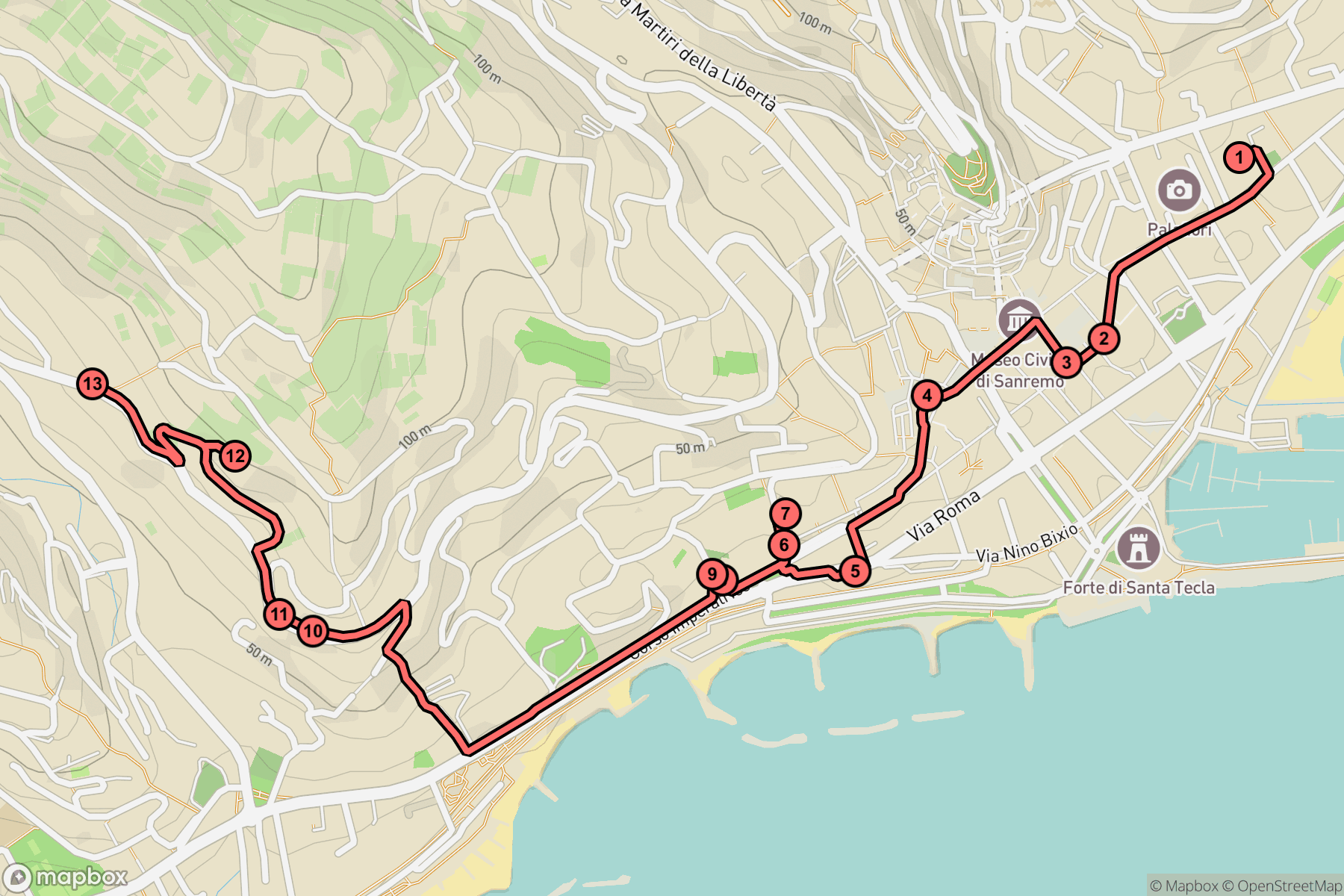
- straighten3.4 km wandelrouteVolg het geleide pad
- location_on
- wifi_offWerkt offlineEén keer downloaden, overal gebruiken
- all_inclusiveLevenslange toegangOp elk moment opnieuw afspelen, voor altijd
- location_onStart bij Weerstation van Sanremo
Stops op deze tour
Look for a modest building with instruments on the roof or nearby, often surrounded by scientific gadgets and perhaps a tall white shelter with a little antenna-keep your eyes…Meer lezenToon minder
Look for a modest building with instruments on the roof or nearby, often surrounded by scientific gadgets and perhaps a tall white shelter with a little antenna-keep your eyes peeled for weather gear and a practical, slightly official look right near the city center. Now that you’re here, standing next to the Sanremo weather station, imagine yourself as a weather detective on the Ligurian coast. This isn’t just any building-it’s Sanremo’s official sky-watcher, quietly at work just 15 meters above sea level. Picture the breeze brushing past as old-fashioned thermometers, wind vanes, and rain gauges recorded everything for over fifty years. Every January, the average temperature would hover just above 10 degrees Celsius-no need for a heavy coat here! And by July, you’d be caught in the warm embrace of 24 degrees, feeling the sun dance on your skin. This station has seen only a frosty 0.8 days of ice each year. So, if you ever see someone in Sanremo investing in a snow shovel, you might want to give them a heads-up! Imagine dedicated meteorologists watching the clouds, jotting down numbers, saving thousands of sunrises and thunderstorms in their records. This spot is where the mysteries of Sanremo’s skies are unlocked-your very own backstage pass to the city’s everlasting spring.
Open eigen pagina →Look for the brightly lit ARISTON Theatre with bold red neon letters and a glass-fronted entrance; it’s right in front of you, shining like a beacon on the bustling street. Okay,…Meer lezenToon minder
Look for the brightly lit ARISTON Theatre with bold red neon letters and a glass-fronted entrance; it’s right in front of you, shining like a beacon on the bustling street. Okay, music fans, you’re standing outside the one and only Teatro Ariston, the beating heart of Italian pop culture and the legendary home of the Sanremo Music Festival! Imagine: every year, this building transforms into a whirlwind of TV cameras, cheering fans, and sparkling dresses. If the walls could sing, they’d belt out the history of Italy’s greatest hits, because this is where stars are born and legacies are written, all under those dazzling lights. Back in the dark days after World War II, Sanremo wanted a way to lift spirits and put itself on the cultural map. The idea? A festival for new Italian songs-something fresh, bold, and full of hope. The first event wasn’t exactly a star-studded spectacle-just three contestants bravely took the stage at the Sanremo Casino, right down the road. You had Nilla Pizzi, Achille Togliani, and Duo Fasano, bringing life to twenty brand new songs. There was no TV broadcast then-just people huddled around radios, straining to catch every note on RAI’s Rete Rossa. By 1955, the magic went live on TV, and suddenly all of Italy was watching, hearts pounding to the tempo of the music. The festival just kept growing. Until 1976, all the drama and glory happened at the Casino, but when that glamorous venue needed a facelift, the torch passed to the Ariston Theatre. Since then-except for one year-this has been the main stage for the music showdown that conquers millions. Now, what makes the Sanremo Music Festival truly special? Unlike other awards, this is a battle of brand new songs-no “Greatest Hits,” no lifetime achievements. Each year, singers throw brand new tunes into the musical ring, and only the freshest voices and catchiest choruses survive. But it’s not just about solo artists: there have been duets, sometimes even with international superstars-imagine Louis Armstrong, Stevie Wonder, Cher, or even Kiss belting it out, right here on a Sanremo night! The festival was also a testing ground for musical experiments. There were years when every song was sung twice, by different artists and in different styles, to show off the songwriter’s true power. This made room for big surprises and unexpected stardom-a system that let obscure artists and international titans share center stage. Picture the tension: would the audience swoon for the Italian version, or did the international guest strike gold? And let’s not forget the legendary feuds when the Critics’ Award, now named for the brilliant Mia Martini, stirred up passionate debates and launched musical careers with a single announcement. Don’t be fooled-sometimes Sanremo itself became a character in world affairs. The winning tunes often rocketed to global fame: “Volare” (“Nel blu, dipinto di blu”) was born here and soared up the US charts, taking home the very first Grammy for Record of the Year, while Laura Pausini, Eros Ramazzotti, and Andrea Bocelli all rose to international fame from this very stage. Even Elvis Presley, Whitney Houston (the only one to ever get an encore!), and Freddie Mercury couldn’t resist the Sanremo allure-even though Freddy, ever the rebel, broke the miming rules and moved his mic away just to make a point. You’ve got to love rockstar mischief! From backstage nerves to the roar of the crowd as suspense builds on live TV, there’s almost a sense of magic in the air-one moment you’re a newcomer with sweaty palms, the next you could be a global phenomenon. And the fun doesn’t stop with music; Sanremo’s stories sneak into books, movies, and even legal battles over where the festival’s home should be. Plot twist: after months of negotiation, Sanremo proudly keeps its crown, so the glam endures for years to come. So as you stand here, surrounded by neon glow and the echoes of epic applause, just imagine the thunder of the crowd, the glitter of confetti, and the dreams, big and small, soaring out from the Ariston onto radios and TV screens across the world. Sanremo-it’s more than a festival. It’s Italy’s symphony of hope, heartbreak, and irresistible drama! Fascinated by the winners, notable foreign duet singers or the international successes? Let's chat about it
Open eigen pagina →To spot the Palazzo Borea d'Olmo, just look to your right for a grand baroque facade with warm yellow stone, heavy iron-grilled windows, and a tall marble doorway topped by a…Meer lezenToon minder
To spot the Palazzo Borea d'Olmo, just look to your right for a grand baroque facade with warm yellow stone, heavy iron-grilled windows, and a tall marble doorway topped by a delicate statue of the Madonna looking serenely out over Via Matteotti. Now that you’re in front of the Palazzo Borea d’Olmo, let your imagination wander back through the centuries. This isn’t just any palazzo-behind its baroque facade lurks the drama of centuries! Originally, it was a medieval stronghold, but like any house in desperate need of a makeover, it kept growing and changing between the 1600s and 1700s, until it became the magnificent palace you see today. If these walls could talk, they’d probably whisper about the grand parties thrown here-where princes, kings, and even a pope passed through those massive doors. Imagine Queen Elizabeth of Spain sweeping up the marble steps, her dress rustling like a silk wave. King Charles Emmanuel III surely strutted in with a royal entourage, while artists and painters mingled in the golden candlelight, maybe taking too many breadsticks from the buffet. And don’t forget, this place stayed in the hands of one noble family-the Borea d’Olmo. Somehow, they managed not to lose the keys for centuries, which is more than most of us can say about our apartments! Famous visitors, including the painter Fragonard and even Prince Philip of Edinburgh, graced these halls, probably trying not to trip on the marble staircase or bump their heads on the lavish cornices. On your left, note the marble doorway crowned by the Madonna, carefully sculpted by a student of Michelangelo himself. If you could step inside (and hey, imagine you could!), you’d find soaring vaulted ceilings, marble columns, and frescoes swirling with color and stories from long ago, painted by masters like Carrega and Merano. Somewhere deep inside is even a tiny chapel with a marble altar-an oasis of calm after so many royal comings and goings. Today, the palazzo no longer holds the city’s museum, but as you stand here, you can still feel the air of old secrets and the echoes of fancy footsteps. Not a bad history for a house on Via Matteotti!
Open eigen pagina →
Toon 10 stops meerToon minder stopsexpand_moreexpand_less
To spot the Co-cathedral of San Siro, just look for the large, pale stone church with its tall arched doorway and the tall, round campanile rising above the rooftops-right in…Meer lezenToon minder
To spot the Co-cathedral of San Siro, just look for the large, pale stone church with its tall arched doorway and the tall, round campanile rising above the rooftops-right in front of you on the piazza. Welcome to the Co-cathedral of San Siro! Take a moment to admire those thick, ancient stones-they've been standing since the 1100s, and if you listen closely, you might almost hear echoes of the Middle Ages. This is actually the oldest religious building in Sanremo and one of the best examples of Romanesque architecture on the western Ligurian coast. The church’s story begins all the way back in 811 AD, at a time when people didn’t even have alarm clocks-thank goodness for church bells, right? According to tradition, the first Christian church here was built on the spot where Siro, the Bishop of Genoa (and soon-to-be Saint Siro), used to give mass. Things got off to an eventful start: for a while, even Saint Romulus, another holy local celebrity, was buried right at this spot. The structure you see today, with its sturdy walls and strong arches, was crafted by skilled stoneworkers called the Maestri Comacini, around the early 12th century, blending Romanesque power with just a touch of Gothic drama. By the mid-1100s, the church was already on the town records-a real historic VIP. Life around the cathedral has always been lively-and sometimes downright dramatic. Picture this: in 1297, there was a grand ceremony here, with the archbishop of Genoa handing over the city’s rights to the powerful Doria and De Mari families-just imagine the rumbles and whispers in the crowd! But the peace didn't last forever. In 1544, the notorious pirate Barbarossa and his Turkish corsairs landed in Sanremo. They stormed up to the church for a good old-fashioned raid, but found themselves outwitted: all the valuable treasures had been hidden inside the thick walls. All they could smash was the altar! Smarter than the average pirate, those parishioners. But wait, there's more chaos to come! In 1745, an English naval squadron under Admiral Rowley bombarded Sanremo, taking out part of the roof and the front of the cathedral. And if that wasn’t enough excitement, in 1753, the faithful bell of San Siro-lovingly known by locals as “Bacì”-became the town’s call to action. Its ringing launched a bold rebellion against the Republic of Genoa. Unfortunately, the rebellion was crushed, and as punishment, the Genovese commander knocked down the bell tower and carted the famous bell off to Genoa, where it stayed as a war trophy until it was finally returned (in pieces) decades later. The tower you see now is a baroque reconstruction, a result of dramatic votes, passionate letters, and, I suspect, more than a few heated arguments! Inside, the cathedral is a treasure chest of stories, legends, and mysteries. The oldest doors on either side sport sculpted bas-reliefs-on the left, there’s a donkey calmly munching between two palm trees, while the right-hand bas-relief features the Virgin Mary, Baby Jesus, Bishop Siro, and Bishop Romulus, all chilling under a caper plant. Some superstitious folks whispered that if the caper plant bloomed, it meant a lucky year ahead. Art lovers will want to peek inside for masterpieces by Anton Maria Maragliano: one is a crucifix described as so lifelike you can nearly feel the suffering and love in Christ’s face, and the other is a Madonna of the Rosary, gracefully seated, holding a laughing baby Jesus-who, in a charming twist, is handing a cluster of grapes to an angel, making even holy sculptures playful! And then there’s the Black Crucifix, shrouded in mystery. In 1543, as word of a looming Saracen attack spread, the town gathered for mass. Legend goes, in the flickering candlelight, the crucifix shone and turned its head to smile at the mayor, blessing the defenders. Inspired and perhaps just a little bit spooked, the defenders marched out and won the battle-with the crucifix banner leading the way! Every stone here has survived a little chaos-fires, bombshells, revolts, even French soldiers camping outside during the Revolution (who, let’s be honest, probably didn’t tidy up after themselves). After years of damage, a massive restoration kicked off in 1901 to bring back that original Romanesque look. Work stopped and started, with budget woes and big debates, until everything was finally finished in 1948-celebrated with a marble plaque on the wall. So, as you stand here beneath this weathered façade, listen for the twelve modern bells-restored, proud, and ringing out a story of faith and resilience. Even today, if those walls could talk, I’d bet they’d have a few medieval punchlines up their sleeve. And don’t forget-keep an eye out for any blooming caper plants. You never know when luck might turn in Sanremo!
Open eigen pagina →To spot the landmark, look for the stretch of road that twists and curves-right at your feet, you’re standing where the old San Remo Grand Prix circuit once roared through…Meer lezenToon minder
To spot the landmark, look for the stretch of road that twists and curves-right at your feet, you’re standing where the old San Remo Grand Prix circuit once roared through town. Alright, start your engines-or at least your imagination! You’re now at the legendary site of the San Remo Grand Prix, a place where the spirit of racing is as thick as tire smoke after a tricky corner. Picture it: the year is 1937. The streets around you are packed with people eager to see some of the fastest cars in Italy thunder past. The Maserati engines growl, and when the flag drops-watch out!- the roar of the race drowns out every other sound. The Grand Prix began right here, weaving through San Remo on what locals called the San Remo Circuit. But in 1947, the race shifted just a little down the coast, twisting onto the Ospedaletti circuit, the very one that once wrapped around this very spot. The circuit stretched, morphed, and grew, until it became a wild 3.38-kilometer beast. Now imagine it: Astonishing driving legends-Louis Chiron, Stirling Moss, and José Froilán González-sliced through the cool coastal air, fighting for every fraction of a second on the clock, hoping their wheels wouldn’t betray them at the next tight curve. But it wasn’t all just cars-oh, no! After 1952, the motorcycles took over, tearing around corners with sidecars barely hanging on. Some years saw the racing magic pause, but the passion never faded. Even today, you might catch the distant echo of a vintage engine or the laughter of fans gathering for a classic meet, keeping San Remo’s racing heart beating. So take a deep breath-can you smell the gasoline and the excitement of years gone by? That’s the thrill of San Remo, always ready for another lap!
Open eigen pagina →To spot the Sanremo Casino, just look for the tall, grand white building right ahead with two elegant towers, palm trees out front, and a big sign that reads “CASINO SANREMO”…Meer lezenToon minder
To spot the Sanremo Casino, just look for the tall, grand white building right ahead with two elegant towers, palm trees out front, and a big sign that reads “CASINO SANREMO” above its stylish entrance. Now, step closer and imagine yourself in front of one of Italy’s most dazzling landmarks-where every night once echoed with mystery, elegance, and the odd clink of champagne glasses. Welcome to the Sanremo Casino! Opened way back in 1905, this building in all its Liberty-style glory was a dream realized by the famous French architect Eugène Ferret. Back then, people didn’t even call it a casino-it was the Kursal, a palace of parties, concerts, and spectacular theater shows that made the air in Sanremo shimmer with excitement and fancy perfume. But wait, what’s a grand opening without a twist? On one of those early glamorous nights, with laughter bubbling and orchestras playing, Dr. Andrea Fileti was tragically murdered under suspicious circumstances. Mystery, drama-the casino sure didn’t start out boring! For the first years, Ferret himself ran the show, and parties roared on while games, both big and small, carried on in lavish halls, legal-looking but without any official blessing except a wink from the local government. The first croupiers-the folks spinning roulette wheels and charming the tables-were imported from Belgium, home to a legendary croupier school. Over time, Sanremo’s own croupiers would become some of the best in the world, their fingers practically dancing across green felt tablecloths. Fast-forward to 1927: Sanremo’s leader, Pietro Agosti, worked some political magic-I picture lots of long lunches and even a word put in with Benito Mussolini. Suddenly, it was all official. The casino could open year-round, and gambling was legal at last. Cue the fanfare! On January 21, 1928, the place swung open its doors for a gala night you can almost hear echoing down the decades-think of strings playing, glasses clinking, and an air of “let’s make history.” Expansion followed, with two big new wings, grand cupolas on the façade, and a main hall worthy of Italian princes. Inside, it wasn’t just gambling; chess tournaments, classy musical Mondays, operettas, and dances made the place a magnet for the artistic and adventurous. They even had their own tram stop right out front, so the fashionable could arrive in style-just in time for a late-night game or a swirling ballroom. Of course, the story takes plenty of turns. During World War II, the casino was forced to close, its golden lights dimmed by the shadow of conflict. But on December 31, 1945, just as the New Year bells were about to ring, the Sanremo Casino came back to life in style-imagine the revelry as old regulars and new dreamers walked up the steps again, sure that Lady Luck was smiling at last. And if you think the casino is just about gambling, think again! In 1951, inside that stunning ballroom, the very first Sanremo Music Festival took the stage, launching a musical tradition beloved across Italy and beyond. That event grew so popular it eventually needed a bigger home, moving to the Teatro Ariston in 1977. Through decades that followed-filled with company changes, scandals, and even movie shoots (yes, several classic films have been filmed right where you’re standing)-the Sanremo Casino kept reinventing itself. Today, it’s more than just a gaming house: it’s a place where you might stumble into an international event, a book festival, or the aroma of gourmet cuisine from its renowned restaurant. So next time you hear the words “try your luck,” remember that at this iconic spot, history, glamour, and a little bit of mystery are always part of the game. Now, who’s feeling lucky?
Open eigen pagina →To spot Villa Noseda, simply look for a delicate cream-colored building with intricate white neo-Gothic details and tall, arched green shutters right at the beginning of Corso…Meer lezenToon minder
To spot Villa Noseda, simply look for a delicate cream-colored building with intricate white neo-Gothic details and tall, arched green shutters right at the beginning of Corso degli Inglesi, just across from the side entrance of the Sanremo Casino. Now, while you’re taking in those fanciful arches and all that elegant trim, let’s step back to the mysterious late 1800s. Imagine Sanremo growing with new hopes, palm trees swaying, and a certain German baron named Adolph Thiem sweeping up the drive to his villa in a smart hat and a twinkle in his eye. This place, Villa Noseda, was his pride before he decided-like any good collector of art and secrets-that space was just too tight for his treasures. No one knows the exact year this villa first graced Sanremo, but it was spotted on a map as early as 1882, already elegantly perched here like a slice of creamy cake waiting for a special guest. The villa’s neo-Gothic style, with all its pointed angles and tall shutters, might feel a bit dramatic, don’t you think? Almost as if it’s daring the casino across the street to out-glamour it. After Baron Thiem moved on to build his even grander Villa Virginia, Villa Noseda continued to watch over the avenue-a silent witness to the city’s glamour, gossip, and those windy nights when secrets just might slip out through the shutters. If these walls could talk, I bet you’d hear stories of fine art, laughter, and maybe even a mischievous ghost or two hoping for a game across the street!
Open eigen pagina →To spot the Church of Christ the Savior, just look for the striking building ahead with its ornate façade and colorful onion-shaped domes that tower above the trees-it’s hard to…Meer lezenToon minder
To spot the Church of Christ the Savior, just look for the striking building ahead with its ornate façade and colorful onion-shaped domes that tower above the trees-it’s hard to miss! Now, as you stand right here, imagine the early 1900s, when Sanremo wasn’t just a hotspot for sunbathers and palm trees, but also played host to a flourishing Russian community. In fact, there were so many Russians enjoying the Riviera life that a plan was hatched to build an Orthodox church as beautiful and unique as their traditions. Picture the old train station nearby, the sea breeze swirling with the sounds of carriages and eager voices. The very first stone for this church was placed in 1912, at the start of the elegant Promenade named after Tsarina Maria Aleksandrovna-whose love of Sanremo brought those famous palms still lining the avenue. Now, here’s a plot twist worthy of a Russian novel: the original design was dreamed up by the famous Russian architect Aleksej Scusev, but he never actually made it to Italy! Talk about working remotely. So, it was the local engineer Pietro Agosti who took on the job-and, trust me, he added just the right Italian flair to those iconic Russian domes. Have a peek into the courtyard and you’ll spot two busts: Italy’s King Vittorio Emanuele III and Queen Elena, who was originally of Orthodox faith and brought a royal touch to the church’s story. And deep below, beneath your feet, the crypt once held the remains of King Nikola and Queen Milena of Montenegro before they journeyed home in 1989-a bit of a royal round trip, if you ask me. Think the church’s history is all calm and peaceful? Think again! During World War II, a bomb hit the building and crashed straight through the floor-thankfully, no mystery novel endings there. After a careful restoration in 1961, the church was declared a historic monument and became a beloved symbol of Sanremo’s unique mix of cultures. So take in those onion domes and imagine the stories they’ve witnessed-a dazzling slice of Russia by the Ligurian Sea!
Open eigen pagina →To spot the Riviera Palace, look ahead for a grand, cream-colored building with ornate balconies, tall bay windows, and lush palm trees brushing against its richly decorated…Meer lezenToon minder
To spot the Riviera Palace, look ahead for a grand, cream-colored building with ornate balconies, tall bay windows, and lush palm trees brushing against its richly decorated facade-it stands out like a palace among the hotels! Now, let’s step back to the year 1903. Imagine the sound of horse-drawn carriages and stylish visitors arriving, because this magnificent building was born to be the fanciest hotel in Sanremo! Designed by the clever architect Francesco Sappia, the Riviera Palace quickly became a symbol of both elegance and invention-almost like it wanted to show off just how airy and beautiful a hotel could be. But in 1936, chaos struck! The city wanted a wider Corso Imperatrice, and the whole building was given a giant, polite shove backward-a whopping four and a half meters, to be precise. Not an easy task when you’ve got all those balconies, bay windows, and ornate decorations to worry about! The builders had to reconstruct its dreamy facade so it’d look just like it always had. Fast forward through the war years, and the palace switched from a stylish hotel to a fancy residence and then back again, finally becoming today’s Hotel Lolli Palace. If you listen closely, you can almost hear the clink of glasses from elegant parties long ago-maybe even the walls remember all the excitement of being pushed down the street just to make room for more beauty. Who says buildings never move, eh?
Open eigen pagina →Look straight ahead for a grand two-story villa with grey stone walls, yellow-trimmed windows, and lush spiky plants standing guard along its decorative iron fence. Welcome to…Meer lezenToon minder
Look straight ahead for a grand two-story villa with grey stone walls, yellow-trimmed windows, and lush spiky plants standing guard along its decorative iron fence. Welcome to Villa Fiorentina-no, you’re not in Florence, and you haven’t stepped into a page from a fairy tale, though it might feel that way! Picture the year 1884: the Asquasciati family has the wild idea to build a showstopper, so they call in architect Pio Soli. Soli gets playful, mixing grand ideas from famous French architects Garnier and Viollet-le-Duc with a sprinkle of his own creative magic-he adds touches of neo-Gothic drama and swirls of Renaissance Florence flair. You can almost hear him saying, “More stone! More wrought iron! And don’t forget the fleur-de-lis for good luck!” As you stand here, imagine the stonemasons sweating in the Ligurian sun, fitting each block of grey stone, making it look as if the villa sprang right from a Florentine dream. Look for the rustic stone, meant to remind you of “pietra serena”-a type of stone that whispers secrets of old Florence. The villa’s wooden eaves and iron balconies look elegant enough for secret midnight meetings-or maybe just for showing off fancy new hats. Villa Fiorentina isn’t just a house-it’s where art, history, and a little bit of architectural mischief mingled to leave a mark on Sanremo. It’s been guarding its stories for over a century… but who knows, maybe if you listen carefully, you’ll catch one!
Open eigen pagina →To your right, peeking out from lush greenery, you’ll find a tall, dramatic villa with deep terracotta walls, playful creamy-white trim, and colorful floral details running along…Meer lezenToon minder
To your right, peeking out from lush greenery, you’ll find a tall, dramatic villa with deep terracotta walls, playful creamy-white trim, and colorful floral details running along the roofline-just look for the building with the tower-like corner and big shuttered windows, rising behind palm trees like it’s on a secret treasure hunt! Now, take a breath and let yourself drift back to the late 1800s, when Sanremo’s hills were buzzing with new dreams, exotic plants, and a touch of competition over who could build the most grand villa on Corso degli Inglesi. Enter Baron Adolph Thiem, a German baron with a taste for luxury and an art collection that could put most museums to shame-Rembrandt, Van Dyck, you name it! This place, which you see before you now as Villa Virginia, began as his answer to a delightful problem: “I simply don’t have enough room for all my masterpieces!” So, between 1883 and 1885, thanks to architect Pio Soli, the villa sprang up in an extravagant style-two striking shapes forming a “T,” and a façade so lively it almost winks at you with its painted frieze and intricate cornices. Peek up and you’ll spot the distinguished little tower and balcony, perfect for the baron to scan the horizon-and maybe check if any rivals were building someplace even fancier nearby! Inside, imagine a massive salon where sunlight once poured through a now-vanished glass ceiling, warming the famous paintings and statues as if nature itself applauded their beauty. But then, the drumbeats of World War I echoed through Sanremo, and the baron, perhaps missing the comforting clink of his art collection, left the city. Many of his treasures followed him out, eventually landing in Berlin’s Bode-Museum. After the war, the villa found new life through engineer Pippo Pedriali, who named it “Virginia” to woo his beloved wife-not a bad anniversary present, right? Today, the villa’s ornate stained glass and grand staircase remind us of its colorful past. And although art masterpieces no longer fill the rooms, the house’s own dramatic beauty and a little whiff of old European romance make Villa Virginia an artwork all its own. If only these walls could gossip!
Open eigen pagina →To spot Devachan Castle, look up the hillside for a grand, rectangular stone villa with arched columns at the front entrance and a sweeping driveway curling through lush…Meer lezenToon minder
To spot Devachan Castle, look up the hillside for a grand, rectangular stone villa with arched columns at the front entrance and a sweeping driveway curling through lush gardens. Now, let your imagination wander back in time as you stand before the mysterious Devachan Castle. Picture the year 1909: the air carries the scent of fresh-cut stone from Capo Nero, and builders hustle under the watchful eye of architect Pietro Agosti as the castle begins to rise on these green hills. Its stone walls almost shimmer in the sunlight, looking both sturdy and somehow enchanted. This castle has had a life as dramatic as any soap opera. It was first called Villa Sylvia Mexborough-quite a mouthful-named after the wife of a British nobleman, John Horace Savile. He had been to the East, picked up a taste for adventure, and even converted to Buddhism, which was wildly exotic for a British count at that time! But fate, as it does, swooped in when Sylvia passed away. Heartbroken, our count, now seventy-two and still chasing happiness, married again, this time to the young widow Anne Ritche. Just six months after their wedding bells, the count left this world, and the villa’s name changed to “Devachan”-a word from Tibetan teachings that means a state of blissful illusion between death and reincarnation. It’s almost as if the castle itself was preparing for a life of endless transitions. Devachan Castle didn’t just house nobles and mournful widows-it once found itself at the beating heart of history, too! Picture April 1920: the castle is buzzing, its corridors echoing with the voices of world leaders debating the fate of lands after World War I. The future of empires is being negotiated right where you stand! Italy, hoping to solve its troubles over Fiume, waits anxiously. One famous poet called this place “an ugly villa in poor taste” (ouch!)-but, fun twist, he later bought some of the fancy Louis XVI furniture at auction. I guess taste changes with opportunity! In the wild years that followed, this castle switched hands like a hot potato-from a Russian opera singer’s husband to British colonels, and through the shadowy days of World War II, even the SS took command here. Each owner left a mark, a story, maybe even a secret or two in the corridors. Today, thankfully, it’s a peaceful holiday residence-but who knows? Maybe some echoes from those historic days still whisper along the stone walls when the breeze picks up.
Open eigen pagina →To spot Villa Bel Respiro, look for a grand yellow villa with elegant green shutters, tall windows, and a stately balcony at the corner, surrounded by lush gardens and crowned…Meer lezenToon minder
To spot Villa Bel Respiro, look for a grand yellow villa with elegant green shutters, tall windows, and a stately balcony at the corner, surrounded by lush gardens and crowned with a dramatic octagonal tower right ahead of you. Alright, take a deep breath of that flower-scented air-because you’re looking at Villa Bel Respiro, a place whose name literally means “Beautiful Breath.” Built in 1893 by the ambitious architect Pio Soli, this villa isn’t just a pretty face-it’s a magnet for stories. Imagine the 1920s here: on warm summer nights, the gardens were alive with laughter, sparkling glasses, and the shuffle of jazz shoes on the terrace as Count Paolo Ruggeri Laderchi-the villa’s legendary host-welcomed artists, politicians, and dreamers from all over Europe. Picture crystal chandeliers shimmering above as gossip and grand secrets swirled in the air, probably thicker than the cologne of half the guests! Before that, this mansion belonged to an antique-loving Brit who couldn’t resist filling its rooms with odd treasures-some locals say there’s still an old suit of armor somewhere, waiting for a midnight duel. But here’s the twist: since 1953, the villa has traded parties for petals, as it became home to the Experimental Institute for Floriculture. Now, brilliant scientists wander its loggias and shady terraces, conjuring up new colors of flowers instead of cocktails. Who knew the spirit of beauty would be so... well, literal? Isn’t it poetic, standing where history, parties, and petals all collide?
Open eigen pagina →
Veelgestelde vragen
Hoe begin ik de tour?
Download na aankoop de AudaTours-app en voer je inwisselcode in. De tour is direct klaar om te starten – tik gewoon op afspelen en volg de GPS-geleide route.
Heb ik internet nodig tijdens de tour?
Nee! Download de tour voordat je begint en geniet er volledig offline van. Alleen de chatfunctie vereist internet. We raden aan om te downloaden via wifi om mobiele data te besparen.
Is dit een groepsrondleiding met gids?
Nee - dit is een audiotour met eigen gids. Je verkent zelfstandig op je eigen tempo, met audiovertelling via je telefoon. Geen tourguide, geen groep, geen schema.
Hoe lang duurt de tour?
De meeste tours duren 60-90 minuten, maar jij bepaalt het tempo volledig. Pauzeer, sla stops over of neem pauzes wanneer je wilt.
Wat als ik de tour vandaag niet kan afmaken?
Geen probleem! Tours hebben levenslange toegang. Pauzeer en hervat wanneer je wilt – morgen, volgende week of volgend jaar. Je voortgang wordt opgeslagen.
Welke talen zijn beschikbaar?
Alle tours zijn beschikbaar in meer dan 50 talen. Selecteer je voorkeurstaal bij het inwisselen van je code. Let op: de taal kan niet worden gewijzigd na het genereren van de tour.
Waar vind ik de tour na aankoop?
Download de gratis AudaTours-app uit de App Store of Google Play. Voer je inwisselcode in (verzonden per e-mail) en de tour verschijnt in je bibliotheek, klaar om te downloaden en te starten.
Als je niet tevreden bent met de tour, betalen we je aankoop terug. Neem contact met ons op via [email protected]
Veilig afrekenen met 


