

Stuttgart Audiotour: Een Audiogids Door Kunst, Geschiedenis en Architectuur
Onder het trotse hert bovenop de groene koepel van het Kunstgebäude en de weidse grandeur van het Nieuwe Paleis van Stuttgart, weerklinken geheimen door marmeren zalen en levendige pleinen. Deze zelfgeleide audiotour pelt lagen van elegantie af om verhalen te onthullen die voor het oog verborgen zijn – verhalen die je mist tenzij je beter luistert en doelgericht ronddwaalt. Waarom eiste een koning dat zijn paleis werd gebouwd met een vleugje jaloezie en rebellie? Welk fantoom blijft hangen na de brand en politieke chaos in het Kunstgebouw? En welk beroemd plein bruiste ooit van verloren parades en uitbundige WK-feesten onder nietsvermoedende voeten? Beweeg tussen imposante gevels en verstilde hoeken terwijl de intrige bij elke stap toeneemt. Voel koninklijke macht, artistieke ambitie, uitbundige vieringen en gefluisterde samenzweringen die het hart van Stuttgart voor je ogen transformeren. Het verleden van de stad is geschreven in steen en schaduw. Druk op play om te ontdekken wat achter elk monument wacht – als je durft te kijken voorbij het voor de hand liggende.
Tourvoorbeeld
Over deze tour
- scheduleDuur 30–50 minsGa op je eigen tempo
- straighten1.7 km wandelrouteVolg het geleide pad
- location_on
- wifi_offWerkt offlineEén keer downloaden, overal gebruiken
- all_inclusiveLevenslange toegangOp elk moment opnieuw afspelen, voor altijd
- location_onStart bij Nieuw Paleis, Stuttgart
Stops op deze tour
Now, let’s dive into some history with a sprinkle of fun! The New Palace dates back to the 18th century, making it one of the last large city palaces built in Southern Germany.…Meer lezenToon minder
Now, let’s dive into some history with a sprinkle of fun! The New Palace dates back to the 18th century, making it one of the last large city palaces built in Southern Germany. Picture this - Duke Carl Eugen of Württemberg wanted to show off his royal dignity, so he needed a palace that screamed "royalty" louder than your alarm clock on a Monday morning. He didn’t just want any palace; he wanted it right here in Stuttgart, boosting the city's pride and power. The inception of the New Palace was a bit of a European collaboration. Charles commissioned Nikolaus Friedrich Thouret initially, but many other architects jumped in, like Leopoldo Retti, Philippe de La Guêpière, and Reinhard Heinrich Ferdinand Fischer, adding their unique touches to the design. Think of it as the architectural equivalent of a potluck dinner - everyone brought something good to the table. Construction faced some hiccups, particularly during World War II, when the palace was bombed and left a mere shell of its former self. But no worries - in 1957, the decision was made to rebuild it, restoring its grandeur. In its prime, this palace was the residence for the kings of Württemberg before they moved out, and it became a government building. So, while you might be dreaming of a royal tour inside, it’s mostly off-limits unless you strike a special arrangement. So, as you stand here, taking in its impressive façades and the intricate Baroque details, imagine dukes, kings, and officials bustling about in its grand halls. And maybe, just maybe, you'll feel a bit like royalty yourself. Enjoy your regal stroll through Stuttgart!
Open eigen pagina →As you approach the Art Building, also known as the "Kunstgebäude," take a glance to your left. You can't miss it - look for the distinctive rotunda with a green dome perched on…Meer lezenToon minder
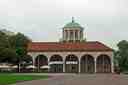
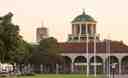
As you approach the Art Building, also known as the "Kunstgebäude," take a glance to your left. You can't miss it - look for the distinctive rotunda with a green dome perched on top, crowned by a majestic golden stag. The building’s façade features an elegant arcade of arches supporting the roof, giving it a classic and inviting feel. Now, let's dive into the delightful history of this landmark! The Kunstgebäude am Schloßplatz in Stuttgart was constructed between 1910 and 1913 based on the designs of the architect Theodor Fischer, with construction supervised by Hans Daiber. Opening its doors on May 8, 1913, its façade and columned hallway boast detailed sculptures created by Jakob Brüllmann and Josef Zeitler. At this location once stood the Neues Lusthaus, built between 1584 and 1593 for the Dukes of Württemberg by court architect Georg Beer under Duke Ludwig. It served various purposes, transforming into the Royal Court Theatre in 1811 and 1845 but succumbed to a fire in 1902. A fragment of its staircase now resides in the nearby Mittlerer Schlossgarten. During the Kapp Putsch on March 18, 1920, the building hosted the National Assembly. World War II brought significant destruction to the Kunstgebäude, leaving only its dome intact. The building was rebuilt between 1956 and 1961 following designs by Paul Bonatz and Günter Wilhelm, complete with a new annex - the Viereckssaal, a 36m x 36m white cube. Today, home to the Württembergischer Kunstverein, boasting over 4,000 members, this remarkable building continues to stand out. For decades, the rooms circling the dome showcased the Städtische Galerie's permanent collection, now displayed at the Kunstmuseum Stuttgart. Until 2012, the Kunstgebäude hosted the Württembergischer Kunstverein's exhibits, with its grand dome hall hosting events and special exhibitions. Upstairs, the Stuttgarter Künstlerbund e.V. continues to thrive with its club and exhibition rooms. Originally housing a billiard room, reading room, and a large event hall with an elevated stage, the building also featured a bowling alley designed by Theodor Fischer in its basement. Though the reconstruction added a Café Künstlerbund, restoring the tradition of members' exhibitions. Pro tip: Take a moment to soak in the architectural elegance and rich history as you pass by - and don’t be surprised if you feel a sudden urge to express your inner artist! Yearning to grasp further insights on the vorbebauung, geschichte or the fassadenplastik? Dive into the chat section below and ask away.
Open eigen pagina →Alright, let's get you in the right spot! As you walk towards Schlossplatz, you'll know you're there when you see a vast open square. Look for the eye-catching Jubilee Column…Meer lezenToon minder
Alright, let's get you in the right spot! As you walk towards Schlossplatz, you'll know you're there when you see a vast open square. Look for the eye-catching Jubilee Column right in the center. This column is tall and topped with a statue of Concordia, the goddess of harmony, holding a laurel wreath. You'll also spot the grandiose building of Neues Schloss behind it. Now, let me tell you about this fantastic place! Schlossplatz is the largest square in Stuttgart Mitte and home to the Neues Schloss, which was built between 1746 and 1807. Initially used as a military parade ground, it wasn’t open to the public until the mid-1800s. Today, it stands proudly next to two other popular squares in Stuttgart, Karlsplatz to the south and Schillerplatz to the southwest. The bustling Königstraße, or King Street, slices right through the plaza from north to south. The Neues Schloss, or “New Palace”, became public property in 1918. Unfortunately, like much of Stuttgart Mitte, it took quite a hit during WWII but was restored between 1958 and 1964 with a modernized interior. It now houses the ministries of Culture and the Treasury for the government of Baden-Württemberg. Here's a fun fact: up until the 1960s, Königstraße carried auto and truck traffic across the plaza. However, now it's a pedestrian-friendly zone with an underground station and tunnels redirecting traffic away from the plaza. The entire square had a grand overhaul in 1977 to mark the Federal Garden Show (Bundesgartenschau), and the lawns and flowerbeds were refreshed in 2006 for the World Cup Finals. Schlossplatz is a hive of activity and regularly hosts major outdoor events, such as open-air concerts, children’s fairs, and the Weihnachten market with an outdoor ice rink. During the 2006 World Cup Finals, it accommodated over 40,000 spectators watching matches on giant screens! One of the most colorful moments here was in summer 2008 when it featured the United Buddy Bears exhibition, an array of 144 two-meter-high sculptures designed by different artists, symbolizing cultural understanding, tolerance, and mutual trust. So take a deep breath, soak in the vibrant atmosphere, and enjoy the majestic views right here at Schlossplatz!
Open eigen pagina →


Toon 5 stops meerToon minder stopsexpand_moreexpand_less
Great, you’re now approaching the Württemberg Art Association Stuttgart! Look out for a building with a prominent green dome, and a statue of a deer perched on top of it. It's…Meer lezenToon minder
Great, you’re now approaching the Württemberg Art Association Stuttgart! Look out for a building with a prominent green dome, and a statue of a deer perched on top of it. It's quite eye-catching, with its mix of traditional and modern architectural elements. You’ll also notice several tall flagpoles in front of it. Now, let's dive into the interesting history of this place: The Württemberg Art Association Stuttgart was founded way back in 1827, making it one of Germany's oldest art societies. With approximately 3,000 members today, it focuses on promoting contemporary art. It's headquartered in the Art Building Stuttgart, which you now see before you. The association was initially led by Carl Urban Keller, a lawyer and painter, who also served as the honorary curator. The aim was to engage the citizens with art, procured artworks by local artists, and hosted exhibitions. Membership was linked to purchasing shares, which allowed members to participate in art raffles and eventually own pieces of art. In 1913, the association moved into the Art Building designed by Theodor Fischer, turning it into a hub for contemporary art discussions. However, during the 1930s, the association, like many others, came under the control of the Nazi regime. In a notable incident in March 1933, a retrospective exhibition featuring Oskar Schlemmer's major work, "Bauhaustreppe," was shut down before it could even open. The Art Building was almost completely destroyed during World War II. It wasn’t until 1961 that its reconstruction was completed, incorporating modern elements designed by Paul Bonatz and Günther Wilhelm. The building was shared with the Stuttgart City Gallery until 2005, when the gallery moved to a new location. Since 2012, the Württemberg Art Association has permanently occupied the new complex within the Art Building. The association is a vital center for contemporary painting, graphics, photography, video art, installation, performance, and architecture. It regularly organizes exhibitions, lectures, conferences, and even awards scholarships. Members also get the chance to showcase their works in annual themed exhibitions. Noteworthy is the exhibition "The Beast is the Sovereign," organized in partnership with the Museu d’Art Contemporani de Barcelona in 2015, which was voted Exhibition of the Year by the German Art Critics Association (AICA). So, next time you’re in need of an art overdose, you know where to head in Stuttgart!
Open eigen pagina →Alright, my friend, you're almost at stop number 5, the Schiller Monument! As you walk, keep an eye to your right. Look for a majestic, white statue that stands out against the…Meer lezenToon minder
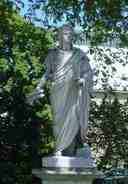
Alright, my friend, you're almost at stop number 5, the Schiller Monument! As you walk, keep an eye to your right. Look for a majestic, white statue that stands out against the backdrop of trees and the buildings. What you're approaching is a grand marble statue of Friedrich Schiller, the famed German playwright, poet, and philosopher. This piece was designed by none other than the talented Stuttgart sculptor Adolf von Donndorf and crafted in marble by Richard Schönfeld. It was erected back in 1913. The statue represents an idealized Schiller with an air of grandeur. Donndorf's intention was to depict him as the "immortal Schiller, descending from Olympus with his golden lyre.” The statue stands proudly between the transition of the Great House and the administrative building of the Staatstheater in the Oberer Schlossgarten. Schiller has his back to the Little House and looks past the front entrance of the Great House. Imagine Schiller looking valiantly into the horizon, his free-flowing robe and confident demeanor embodying his creative genius. His head, crowned with laurels, has “Schiller curls” cascading to his shoulders. His eyes of marble gaze ahead with resolute intensity, evoking the spirit of the thinker and poet he was. The statue stands on a square pedestal, making it up close and personal - you almost feel you could shake his hand. Notable is the contrast in statues around you: just steps away is Karl Donndorf's Fate Fountain, and if you look further, you will notice Wander Bertoni's modern abstract steel sculpture called Ikarus, glittering in the sunlight. It's like a gathering of artistic titans! And here we are, face-to-face with Friedrich Schiller in all his glory. Take a moment to enjoy the sculpted details and the historic aura it brings. Now, let’s continue to our next stop when you're ready! If you're keen on discovering more about the lage, beschreibung or the geschichte, head down to the chat section and engage with me.
Open eigen pagina →As you're approaching the Staatsoper Stuttgart, keep an eye to your left. Spot the large, imposing building with tall Corinthian columns and arched windows. Notice the statues…Meer lezenToon minder
As you're approaching the Staatsoper Stuttgart, keep an eye to your left. Spot the large, imposing building with tall Corinthian columns and arched windows. Notice the statues perched on top, keeping watch over all the drama within. The building's light stone façade and the grand entrance with steps leading up to it will help you identify it easily. It’s right next to a peaceful pond, adding a serene touch to this bustling cultural hub. Now, let’s dive into the fascinating history of the Staatsoper Stuttgart - which isn’t just about operas, it’s a full-fledged cultural saga! Opera, ballet, and plays have graced this area since the 17th century, starting in the hall of Neues Lusthaus. Picture this: in 1660, the first opera, a singspiel, was directed by Samuel Capricornus. Only four years later, a dedicated stage was set up. Fast forward to 1750, and the building got a stylish makeover to become Stuttgart's opera house. By 1811, it was dubbed the Königliches Hoftheater, a royal touch fit for opera royalty! But alas, in 1902, a fire meant the opera had to find a temporary home. Fear not, for from 1909 to 1912, the current opera house was constructed under the direction of Munich architect Max Littmann. It stood proud with two halls: Großes Haus and Kleines Haus. Post-monarchy in 1918, the theaters were renamed Württembergische Landestheater. The Kleines Haus saw the premiere of Ariadne auf Naxos by Richard Strauss but was later destroyed in WWII. Nowadays, the Staatsoper Stuttgart is part of the grand Staatstheater Stuttgart, which hosts not just opera, but also plays and ballet. With 1,404 seats and drawing a crowd of around 250,000 each season, it’s a cultural powerhouse. Notable premieres, like Carl Orff’s operas, and collaborations with renowned figures such as Wieland Wagner and Philip Glass, have cemented its place in the annals of opera history. It’s a real gem, consistently winning the Opera House of the Year award and embracing modern works and new staging concepts. So, enjoy this historic haven of high notes and dramatic flair. And remember: even the statues seem to be enjoying the show!
Open eigen pagina →

Veelgestelde vragen
Hoe begin ik de tour?
Download na aankoop de AudaTours-app en voer je inwisselcode in. De tour is direct klaar om te starten – tik gewoon op afspelen en volg de GPS-geleide route.
Heb ik internet nodig tijdens de tour?
Nee! Download de tour voordat je begint en geniet er volledig offline van. Alleen de chatfunctie vereist internet. We raden aan om te downloaden via wifi om mobiele data te besparen.
Is dit een groepsrondleiding met gids?
Nee - dit is een audiotour met eigen gids. Je verkent zelfstandig op je eigen tempo, met audiovertelling via je telefoon. Geen tourguide, geen groep, geen schema.
Hoe lang duurt de tour?
De meeste tours duren 60-90 minuten, maar jij bepaalt het tempo volledig. Pauzeer, sla stops over of neem pauzes wanneer je wilt.
Wat als ik de tour vandaag niet kan afmaken?
Geen probleem! Tours hebben levenslange toegang. Pauzeer en hervat wanneer je wilt – morgen, volgende week of volgend jaar. Je voortgang wordt opgeslagen.
Welke talen zijn beschikbaar?
Alle tours zijn beschikbaar in meer dan 50 talen. Selecteer je voorkeurstaal bij het inwisselen van je code. Let op: de taal kan niet worden gewijzigd na het genereren van de tour.
Waar vind ik de tour na aankoop?
Download de gratis AudaTours-app uit de App Store of Google Play. Voer je inwisselcode in (verzonden per e-mail) en de tour verschijnt in je bibliotheek, klaar om te downloaden en te starten.
Als je niet tevreden bent met de tour, betalen we je aankoop terug. Neem contact met ons op via [email protected]
Veilig afrekenen met 


