

Aachen Audiotour: Echo's en Legendes van Eilendorfs Verborgen Juwelen
Een stille fluit echoot door de oude straten van Eilendorf terwijl schaduwen zich verzamelen aan de voet van plechtige gedenktekens en oude stenen. Hier in Aachens verborgen wijk liggen geheimen gekerfd in kerkwanden en gefluisterd naast vergeten sculpturen. Volg deze zelfgeleide audiotour om verhalen en verrassingen te ontdekken die alleen bekend zijn bij de lokale bevolking en enthousiaste wandelaars. Vind de lagen waar de meeste reizigers zo voorbijlopen terwijl je gedenktekens, openbare kunst en heilige plaatsen op je eigen tempo verkent. Welke tragedie ontvouwde zich ooit onder de torenhoge spits van de Sint-Severinuskerk? Wie eert de enigmatische fluitspeler, en welke geheimen omringen zijn creatie? Welke huiveringwekkende gebeurtenis wordt voor altijd herdacht bij het oorlogsmonument van Eilendorf? Glijd door steegjes en langs verweerde beelden, en laat verhalen over rebellie, verlies en kunstzinnigheid elke stap van je vormen. Volg een pad door het levende geheugen van Eilendorf en zie de stad transformeren bij elke bocht. Begin de reis en laat de verborgen verhalen van Eilendorf zich ontvouwen.
Tourvoorbeeld
Over deze tour
- scheduleDuur 30–50 minsGa op je eigen tempo
- straighten2.4 km wandelrouteVolg het geleide pad
- location_on
- wifi_offWerkt offlineEén keer downloaden, overal gebruiken
- all_inclusiveLevenslange toegangOp elk moment opnieuw afspelen, voor altijd
- location_onStart bij Sint-Severinuskerk
Stops op deze tour
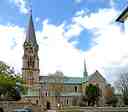
To find St. Severin, look out for a grand church with rough stone walls and a striking pointed tower topped with a golden rooster, rising just above the trees and roofs…Meer lezenToon minder
To find St. Severin, look out for a grand church with rough stone walls and a striking pointed tower topped with a golden rooster, rising just above the trees and roofs nearby. As you stand in front of St. Severin, imagine the sound of footsteps on stone as monks from Kornelimünster, way back in 1293, stepped through these doors. The church you see today isn’t the original-oh no, this one was dreamt up by architects Heinrich Wiethase and August Essenwein in 1864, with its walls built from hefty, rugged stones, almost as if the building itself wanted to prove how strong faith could be. But the fancy tower? That took its sweet time to join the party, only finishing up in 1908… talk about fashionably late! Now, cross the centuries in your mind: in the 1940s, bombs thundered overhead during the war, leaving parts of St. Severin in ruins. Miraculously, by 1953, the community had put every stone back, healing their beloved basilica. And what a basilica it is-a three-aisled Romanesque beauty, with arches and little turrets decorating its four-story tower. You might even notice the organ inside peeking through the windows-crafted in 1997, it fills the church with music from 28 registers, bursting with song as soon as anyone dares touch the keys. Beneath all this grandeur, there’s a quiet mystery: dozens of graves resting under your feet, belonging to nobles who once called this village home. It sounds like the setup for a historical crime novel, doesn’t it? So today, as part of Aachen’s official monuments, St. Severin towers over Eilendorf-a living witness to centuries of hope, destruction, laughter, and music. And don’t worry, there’s no test on the architecture… unless you’d like to quiz the rooster atop the spire!
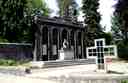
Open eigen pagina →To spot the War Memorial, look ahead for a dark brick wall with five tall arches, and a solemn statue of a man sitting at its center next to a stained-glass cross. Alright, take…Meer lezenToon minder
To spot the War Memorial, look ahead for a dark brick wall with five tall arches, and a solemn statue of a man sitting at its center next to a stained-glass cross. Alright, take a deep breath and let’s step back in time together! Picture it: the year is 1927, and Eilendorf is searching for a way to honor its 377 sons lost in the chaos of World War I. After some back-and-forth, plans, rejections, and even a little financial drama-yes, budgets weren’t any easier a century ago-they finally commission Fritz Neumann to design a monument, right here where you stand now. Imagine the sound of footsteps echoing on these steps, villagers gathering with heavy hearts. At the center you see the statue of Saint Sebastian, the brave figure leaning on his shield, struck by an arrow-he seems just moments away from slipping gently into forever. Why Sebastian, you wonder? It’s a nod to Christian tradition, though some folks back in the day weren’t so sure about picking a Roman soldier for a German war memorial! If you look up at the brick wall behind him, it’s like you’re standing by the side of an ancient church, five gothic arches rising in memory. Four of these arches hold limestone plaques, each etched with the names of those who never returned home. Now, hold onto your hat, because things got dramatic! In 1934, someone shattered the statue’s head with a large stone, but-plot twist!-it didn’t fall, thanks to some clever engineering. The culprits? A mix of mischief and politics, with only one spending a short time in jail-all the others got away scot-free since they had friends in high places. And as if that wasn’t enough, just days later, vandals attacked again, smearing the whole memorial with tar. The darkness of the night, the sound of something splattering--and yet, the monument survived, patched back together every time. But here’s a quirky twist: during renovations in 2015, workers found a hidden chimney shaft running up next to the cross on top. What was it for? Maybe a plan to let smoke waft up from an eternal flame, though, in the end, it was left unfinished-like a forgotten secret whispering through the years. So now, every Totensonntag, Eilendorf’s people return to these steps, laying wreaths in quiet gratitude, their memories echoing where you’re standing now. It’s more than a monument-it’s a living story, still unfolding with each new visitor.
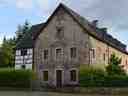
Open eigen pagina →To spot the Pannhaus, look for a large, rugged stone building with a steep slate roof and rows of small wooden windows-it’s right ahead of you, with its old stones giving it…Meer lezenToon minder
To spot the Pannhaus, look for a large, rugged stone building with a steep slate roof and rows of small wooden windows-it’s right ahead of you, with its old stones giving it away! Now, let’s step back in time! Imagine it’s the year 1427, and the air is buzzing with stories from the past. The Pannhaus you see before you is the most famous quarry stone house in all of Eilendorf-tough as a castle, but with a mischievous secret. Long ago, this was no ordinary home; it was the stern seat of the local court, complete with a chilly arrest cell and even a pillory out front-nobody wanted to be put on display there! Later, the Pannhaus switched from justice to joy: it became Eilendorf’s forced brewery, so named because “pann” means “pan,” the key tool where the beer was brewed right here since the 15th century. Monks from the Kornelimünster Abbey granted brewing rights and Oh, how the scents of hops must have floated through the village! In the 1600s, the Meessen family, with Martin Meessen as both brewer and ruler, kept the ale flowing-and likely, the stories too. The house has grown over the centuries, a number on its wall-1622-proves some parts came later. And right behind it, engraved in stone, you'll spot “1845 PIO,” a little signature from one of its facelifts. Today, the Pannhaus and its old tithe barn are protected pieces of history-no secret judges or surprise jail stays, just tales, laughter, and a whole lot of character. Quite a journey for one building, wouldn’t you say?
Open eigen pagina →
Toon 7 stops meerToon minder stopsexpand_moreexpand_less
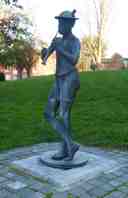
In front of you is a life-sized bronze statue of a barefoot boy playing the flute, balanced on a circular stone base-look slightly to your right by the cobblestone path to spot…Meer lezenToon minder
In front of you is a life-sized bronze statue of a barefoot boy playing the flute, balanced on a circular stone base-look slightly to your right by the cobblestone path to spot it. Imagine yourself in the 1920s, hearing soft flute music drifting across a garden in the heart of Aachen. That’s when the artist Matthias Corr created this charming sculpture, which once stood proudly at the edge of a tranquil pond in Elisengarten. The round pool sparkled in the sun, and right in the center, a water fountain shot up as if trying to dance along with the boy’s magical tune. But the best part? Even in the winter, the fountain gushed cheerfully because, thanks to Aachen’s thermal springs, the water was always warm! Over the years, people gathered here, listening and relaxing, until in 2008 the fountain and statue were carefully taken down so the garden could change. Just when our little friend thought his performing days were over, in 2010, he made his grand comeback right here in Eilendorf! Now he’s piping his tunes for all-perhaps you-and with a bit of imagination, you might still hear that old, warm fountain bubbling nearby.
Open eigen pagina →Directly in front of you at the corner of Von-Coels-Straße and Lindenstraße, you’ll spot a towering stone cross standing proudly behind a decorative iron fence, topped with a…Meer lezenToon minder
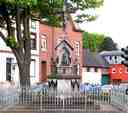
Directly in front of you at the corner of Von-Coels-Straße and Lindenstraße, you’ll spot a towering stone cross standing proudly behind a decorative iron fence, topped with a detailed crucifix and framed by leafy trees and brick houses. Now imagine this spot more than two centuries ago-storms of fear and hope mingling in the air, as locals would gather at the very place you’re standing, casting nervous glances at a modest wooden cross that once stood under the old linden trees. They were praying, not for sunshine or good harvest, but for their very lives. Around 1652, a dreadful plague swept through Eilendorf, taking many with it. As a result, the villagers built a humble chapel nearby, dedicated to St. Rochus of Montpellier, the patron saint believed to protect against the plague. An act of hope during really tough times. Fast forward to 1908, and the simple wooden cross was replaced with this grand monument, crafted in the ornate Gründerzeit style. Imagine a mini cathedral of stone and metal, gleaming with gothic details like tiny towers and swirling ornaments. Peer into that niche-there sits a statue of St. Rochus, showing his leg marked by the plague, with a loyal dog by his side. Legend has it that the dog brought him bread while he was sick and shunned by others. If you look closely at the metal corpus, you’ll spot an inscription that was hidden until 1980: a gift from Leonhard Geulen, a local with a generous heart and a sense for dramatic surprises. This cross wasn’t just a landmark-it was a blessing station where locals gathered each year for processions, hoping for peace, health, and perhaps, a little break from life’s mischiefs. And today, you’re part of that story, standing where prayers and perseverance met at the corner of faith and daily life!
Open eigen pagina →To spot the Church of Reconciliation, look for a striking modern building with high brick walls and a tall, white bell tower that stands proudly against the sky. Now, imagine…Meer lezenToon minder
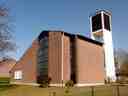
To spot the Church of Reconciliation, look for a striking modern building with high brick walls and a tall, white bell tower that stands proudly against the sky. Now, imagine you’re standing here in the late 1960s, when the air buzzed with excitement and the ground rumbled as foundations were laid for this church. The neighborhood’s population was growing faster than a baker’s batch of rolls, and the local pastor, Hans Freyberger, liked to joke, “We could finally afford it, and, boy, did we need it!” Designed by architect Otto Gercke, this church opened its doors just in time for Christmas in 1971, a perfect holiday gift to the community. As the congregation grew, so did the church’s responsibilities, eventually forming its own parish center in 1979, just as the neighboring Stolberg community branched off. Fast-forward to 1988, and picture the shimmering pipes of a brand-new organ, built by Orgelbau Schumacher, coming to life and flooding the hall with music. Since 2009, this church has continued welcoming all, now as part of Aachen’s bustling North Parish. So, whether you’re here for the architecture or the echoes of hymns past, this is a place where history, harmony, and a hint of good humor all meet.
Open eigen pagina →Right in front of you, you’ll spot a weathered wooden crucifix standing against the trunk of a chestnut tree, nestled behind a small iron fence at the edge of…Meer lezenToon minder
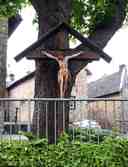
Right in front of you, you’ll spot a weathered wooden crucifix standing against the trunk of a chestnut tree, nestled behind a small iron fence at the edge of Von-Coels-Straße. Now, let’s imagine this very spot back in 1829, when the ‘Cockerill’schen Straße’-as Von-Coels-Straße was called back then-was newly upgraded and muddy boots were all the rage! The Kind family, proud owners of a lively tavern right here, decided to place this wayside cross outside their pub. Good marketing, if you ask me-nothing says “welcoming inn” quite like a new cross! Over the years, the cross got nudged closer and closer to the road, keeping up with the changing street layout, until 1911 when Nirmer Straße met Von-Coels-Straße just as you see it today. But there’s drama too! In the 1930s, during Nazi times, some very unwelcome party members tried to remove the cross-but the pub’s owner chased them off with an axe. Now, that’s what you call fiercely protective! After many makeovers and a shiny new cross in 1955, standing tall on a crisp autumn day in 1988, it enjoyed another careful restoration. Now it rests peacefully against its chestnut, guarding number 199, watching over passersby and serving as a lively landmark with stories that just won’t quit.
Open eigen pagina →Just ahead of you, you’ll see a small, charming stone chapel with a wooden door and a tiny bell tower perched on its roof-look to the side of the road, where the sunlight falls on…Meer lezenToon minder
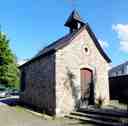
Just ahead of you, you’ll see a small, charming stone chapel with a wooden door and a tiny bell tower perched on its roof-look to the side of the road, where the sunlight falls on its rough, old stones and the rounded blue-stone-framed entrance. Let’s take a journey together-imagine it’s the year 1774, and some bold locals of the “Oberdorf” area are quietly putting up this little chapel on their own, hoping nobody important notices. Well, the parish priest gave a cautious thumbs-up, but they definitely forgot to tell the big boss at Kornelimünster Abbey! Three years later, the administrator, Carl Casper Freiherr von der Horst, finally found out… but instead of handing out punishments, he offered a very German “official permission slip.” Well, better late than never, right? And by 1780, the Archbishop of Cologne made everything proper with a blessing, officially making this the place to honor Apollonia of Alexandria-the legendary patroness of dentists, whose statue inside still holds her famous tools: tooth, pliers, and palm branch. Watch out, or she might check if you’ve been flossing! For a long time, this was the heart of religious life in Eilendorf’s upper village. Imagine villagers, dressed in their Sunday best, streaming here for mass (well, whenever the chapel wasn’t being fixed up, or, of course, during those rather inconvenient world wars). Even after the main parish church was built, the Apollonia Chapel kept its starring role each year on February 9th, when the festival of St. Apollonia bursts into life and her sacred relics are formally brought to visit. During the grand Corpus Christi procession, this chapel’s little courtyard would become a second festive altar, buzzing with celebration. The Schützenbruderschaft, Eilendorf’s local marksmen’s brotherhood, made this their spiritual clubhouse in 1926-imagine moustachioed fellows in green jackets, gathering here, eventually starting a fund for repairs (because, let’s face it, old chapels aren’t exactly low-maintenance). Over the years, everything from the battered benches to the little lamp hanging inside got replaced, donated, or lovingly restored; and in 2010, a new group, the Apollonia Chapel Preservation Society, took stewardship, ensuring that the ancient altar (stocked with not just one, but three saints’ relics!) and all the quirky fittings would survive for future generations. In 2016, the chapel was hooked up to the electric grid-finally, no more “medieval mood lighting”-and old benches were swapped out for new chairs in 2020. Today, the stone walls might look nearly the same as they did 250 years ago, but like all the best characters in history, this little chapel has plenty of stories tucked into every nook and cranny. And who knew, in Eilendorf, you’d discover a place where a tiny bell tower, a hidden altar, and some very determined parishioners made an everlasting mark!
Open eigen pagina →In front of you, you’ll spot the Wayside cross rising from a small patch of flowers and greenery, with a life-sized figure of Christ under a wooden roof-just look toward the…Meer lezenToon minder
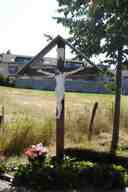
In front of you, you’ll spot the Wayside cross rising from a small patch of flowers and greenery, with a life-sized figure of Christ under a wooden roof-just look toward the grassy area opposite the Müselter Weg junction. Now, let’s travel back in time for a moment. Imagine muddy roads and clattering hooves-because until 1908, this cross stood at a busy old crossroads, right next to a water trough where thirsty cows would gossip after a hard day’s graze. Along with a public pump, it was the social media hub of Eilendorf… until roadwork in 1908 uprooted the whole scene, sending the cross on its very own journey to Bruchstraße! It thought it could settle down, but no-by 1978, construction chaos forced it to move again. Not one to complain, the cross got a proper spa day in 1980, as Eilendorf’s history buffs rolled up their sleeves for restoration. Before modern streets crisscrossed the area, this spot marked the entrance to the tiny hamlet of “Im Bruch” and the old road to Stolberg-so there’s a pretty good chance a cross watched over travelers here nearly 200 years ago. In 2015, vandals damaged it badly, but after weeks of repairs, the cross stood tall again, ready to keep watch. This cross has definitely earned its roots-let’s hope it’s finally found a forever home!
Open eigen pagina →To spot St. Apollonia, just look for the striking, modern church with light brown brick walls and a tall, rectangular bell tower with a white top right beside the main…Meer lezenToon minder
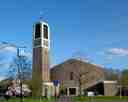
To spot St. Apollonia, just look for the striking, modern church with light brown brick walls and a tall, rectangular bell tower with a white top right beside the main entrance-it's the largest building around! Now that you’re standing before St. Apollonia, picture this: a humble village on the edge of Aachen, way back in 1774, where the townsfolk decided they needed a little more spiritual style in Eilendorf. They built a small chapel dedicated to Apollonia of Alexandria, and-wouldn’t you know it-the priest said, “Why not?” but the official permission took three more years! Back then, getting the proper paperwork for holiness required a certain patience, and perhaps a few prayers for speedier mail delivery. Fast forward, the little chapel became the heart of the village-rumor has it, it was the only one of five to survive the test of time and now it’s protected as a monument. By the 1920s, locals busted out their best handshakes and formed a church-building club, even starting a marksman’s society named after St. Apollonia. In true German style, they mixed efficiency and celebration-holding parish festivals to raise money for their big dream: a new church! When the new church finally rose between 1959 and 1961, it didn’t skimp on style-just look at those stunning stained-glass windows designed by Ludwig Schaffrath and the contemporary metal work by Albert Sous. And those church bells? Four were cast in the Eifel region and still sing out over Eilendorf today. This church isn’t just a building; it’s a story woven with determination, creativity, and an unspoken rivalry with construction permits. Today, St. Apollonia stands not just as a church, but as a memory keeper for the whole neighborhood-always ready for the next chapter!
Open eigen pagina →
Veelgestelde vragen
Hoe begin ik de tour?
Download na aankoop de AudaTours-app en voer je inwisselcode in. De tour is direct klaar om te starten – tik gewoon op afspelen en volg de GPS-geleide route.
Heb ik internet nodig tijdens de tour?
Nee! Download de tour voordat je begint en geniet er volledig offline van. Alleen de chatfunctie vereist internet. We raden aan om te downloaden via wifi om mobiele data te besparen.
Is dit een groepsrondleiding met gids?
Nee - dit is een audiotour met eigen gids. Je verkent zelfstandig op je eigen tempo, met audiovertelling via je telefoon. Geen tourguide, geen groep, geen schema.
Hoe lang duurt de tour?
De meeste tours duren 60-90 minuten, maar jij bepaalt het tempo volledig. Pauzeer, sla stops over of neem pauzes wanneer je wilt.
Wat als ik de tour vandaag niet kan afmaken?
Geen probleem! Tours hebben levenslange toegang. Pauzeer en hervat wanneer je wilt – morgen, volgende week of volgend jaar. Je voortgang wordt opgeslagen.
Welke talen zijn beschikbaar?
Alle tours zijn beschikbaar in meer dan 50 talen. Selecteer je voorkeurstaal bij het inwisselen van je code. Let op: de taal kan niet worden gewijzigd na het genereren van de tour.
Waar vind ik de tour na aankoop?
Download de gratis AudaTours-app uit de App Store of Google Play. Voer je inwisselcode in (verzonden per e-mail) en de tour verschijnt in je bibliotheek, klaar om te downloaden en te starten.
Als je niet tevreden bent met de tour, betalen we je aankoop terug. Neem contact met ons op via [email protected]
Veilig afrekenen met 


