
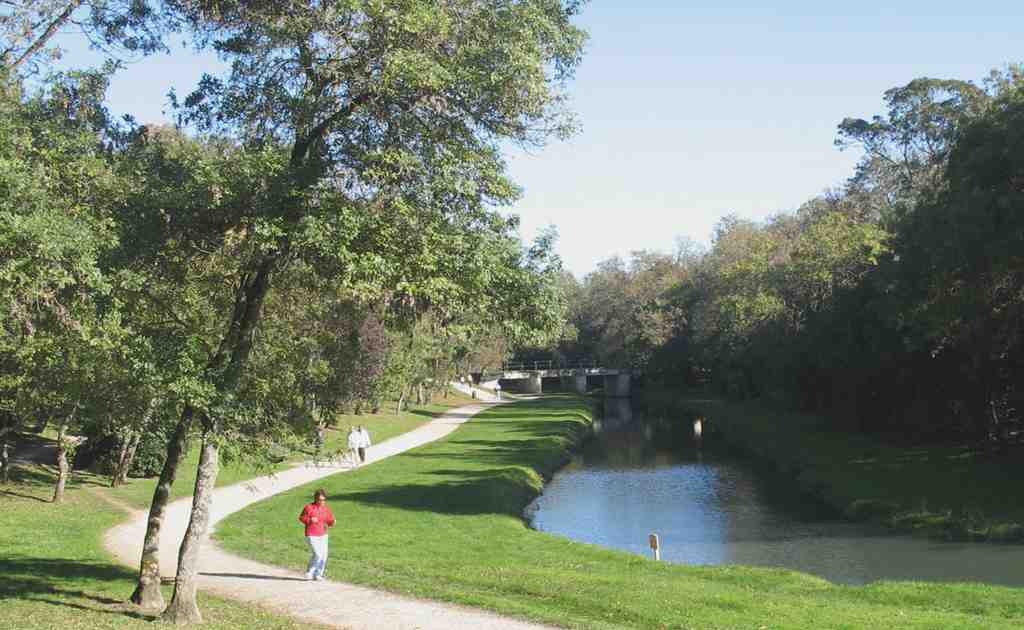
On your left, Charruyer Park shows itself as a long green ribbon with curving pale gravel paths, tall tree canopies, and a raised earth-backed line that hides old stone ramparts.
This is La Rochelle doing something quietly radical. Instead of more walls, more drills, more guarded ground, the city made a park. And not by royal decree either... by the will of a woman named Adèle Charruyer.
Adèle Charruyer was the daughter of shipowner Étienne Charruyer, and her gift was more complicated than the tidy legend suggests. She did not simply hand over family land. In her handwritten will and codicil, dated the twenty-seventh of July and the twenty-fourth of August, eighteen eighty-one, she left one hundred thousand francs to the city, a substantial modern sum. La Rochelle used that money to buy, drain, clean up, and beautify these former military marshes at the western edge of the old defenses.
So this refuge began as wet, strategic ground at the foot of the city fortifications from sixteen eighty-five. Then, from the sixth of May, eighteen eighty-seven to the end of eighteen ninety, workers reshaped it into an English-style park, which means winding paths, irregular planting, and the polite illusion that nature just happened to arrange itself this well. It rarely does.
At first they called it Parc Monceau, a local nod to Paris. Then in eighteen eighty-eight, they gave Adèle her due and renamed it Parc Charruyer.
Here’s the question that slips in with the greenery: what happens to a city when land once reserved for defense becomes a place for strolling, children, and public rest? In La Rochelle, that change says a lot. Power does not only speak through cannons and customs houses. Sometimes it speaks through shade, benches, and the right to wander.
Two little streams, the Fétilly and the Lafond, run through the park on their way to the ocean. Hidden in this calm are scraps of the older city: the redoubt called Le Paté, a fortified outwork; the Porte des Deux-Moulins; Porte Neuve; and the old walls themselves, covered with earth so their upper edge could become the rempart path.
Even the park’s gentleness has had its skirmishes. Around the turn of the twentieth century, telephone workers hacked back branches threatening the wires. The cuts wounded the trees, disease crept in, and modern convenience left a botanical bill. Progress, as usual, charged interest.
Animals belonged here from the start, with aviaries early on and a small animal park developing after the war, officially created in nineteen fifty and later named for Charles-Édouard Beltrémieux, a museum conservator and former mayor. Today the park still shelters local breeds and even injured city wildlife... squirrels, hedgehogs, owls, birds.
When you’re ready, turn back toward stone and sea. The Lantern Tower, about eight minutes away, keeps an older, sharper memory of La Rochelle’s shoreline. And this park, helpfully, never closes.




