
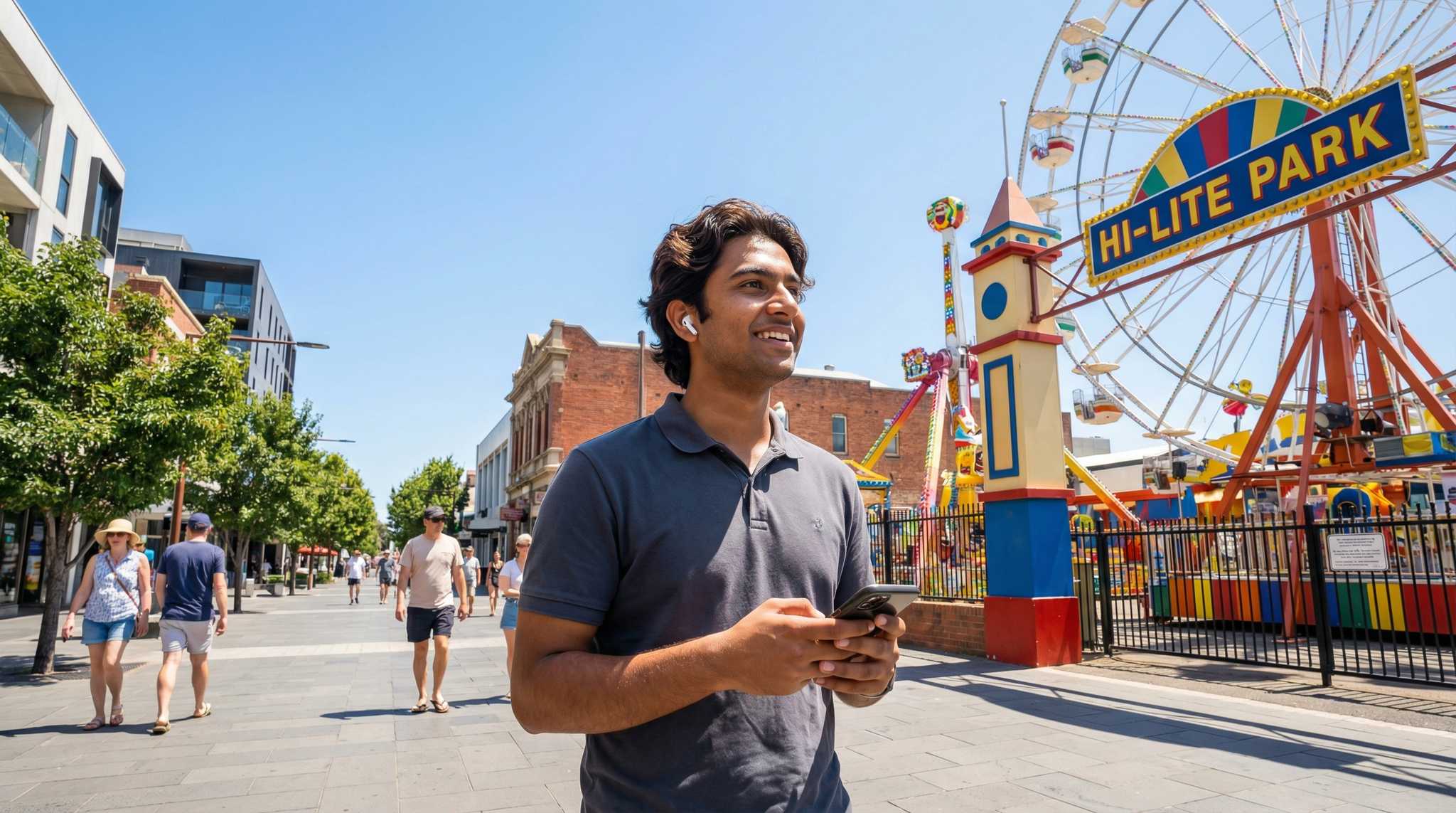
Audiotour Geelong: Historische en Culturele Odyssee van Geelong
Een enkele draai aan de waterkant van Geelong verlichtte de stad ooit net zo helder als haar energiecentrales. Duik onder de levendige façades met deze zelfgeleide audiotour en ontdek de geheimen waar de meeste bezoekers aan voorbijlopen. Welke politieke intriges ontvouwden zich achter de blauwstenen zuilen van het douanehuis van Geelong tijdens de goudkoorts? Wie vocht – en bracht bijna ten val – een familie-imperium in Hi-Lite Park onder de neon gloed? Waarom waren nachtelijke batterijen diep verborgen in de energiecentrale van Geelong, en welke mysterieuze schakelaar besliste hun lot? Loop door echoënde industriële hallen, langs waterkanten getint met schandaal en gelach, en langs gebouwen die nog steeds barsten van onverteld drama. Elke stap onthult nieuwe lagen – verloren attracties, getransformeerde bezienswaardigheden en herinneringen gevoed door rebellie en heruitvinding. Ga terug in de tijd waar reuzenraden de lucht raakten en stromen van verandering elke straat vormden. Ben je klaar om het ware verhaal van Geelong tot leven te laten komen? Druk op play om te beginnen.
Tourvoorbeeld
Over deze tour
- scheduleDuur 40–60 minsGa op je eigen tempo
- straighten3.9 km wandelrouteVolg het geleide pad
- location_on
- wifi_offWerkt offlineEén keer downloaden, overal gebruiken
- all_inclusiveLevenslange toegangOp elk moment opnieuw afspelen, voor altijd
- location_onStart bij Hi-Lite Park
Stops op deze tour
Alright, as you're approaching Hi-Lite Park, keep an eye out for the area near Eastern Beach, at the corner of Bellarine Street and Ritchie Boulevard. You'll be heading towards…Meer lezenToon minder
Alright, as you're approaching Hi-Lite Park, keep an eye out for the area near Eastern Beach, at the corner of Bellarine Street and Ritchie Boulevard. You'll be heading towards the waterfront. Picture a lively shoreline where the Eastern Beach tram terminus used to be. Look for the bustling activity and vibrant atmosphere that once marked this famous spot. Hi-Lite Park was Geelong's very own amusement paradise, opening its gates in 1956 and delighting visitors until around 1985. This spot, comparable to Melbourne’s Luna Park, was where countless smiles and laughs were created. People from far and wide came to enjoy its many attractions. But it’s not all in the past. In December 2006, a giant Ferris wheel, the largest non-permanent wheel in the southern hemisphere, was set up right here! It was renovated locally by Phoenix Fabrication & Welding, making it an even more thrilling ride with its 36 enlarged gondolas seating six people each. Reaching a peak height of 50 meters, each spin around the wheel gave riders a 10-12 minute adventure with stunning views of the area. The Ferris wheel installation was a nostalgic nod to the original park, run by the Verfurth family. The family’s first-generation showman, Emile Francis Verfurth, relished bringing joy to the masses, moving Hi-Lite Amusements to various sites around Victoria. So, as you stand here, imagine the laughter, the excitement, and the fun-filled memories that were made in this very spot. It was a place where dreams spun high in the sky, just like that Ferris wheel!
Open eigen pagina →Alright, as you're walking, keep an eye out to your left for a distinct, classical-looking building made of bluestone and freestone. You'll notice impressive columns and large…Meer lezenToon minder
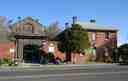
Alright, as you're walking, keep an eye out to your left for a distinct, classical-looking building made of bluestone and freestone. You'll notice impressive columns and large rectangular windows - that's the Geelong Customs House. Look for its solid, sturdy structure that gives off a sense of importance and history. Now, about this fascinating building: The Geelong Customs House is a stately classical-style public building constructed in 1855. It originally replaced a small timber structure from 1838, which has since been relocated to the Geelong Botanic Gardens. The Customs House, designed by John James Clark and erected by William Crocker Cornish, was built near the foreshore to serve the colonial administration's needs during the bustling gold rush era. Listed on the Victorian Heritage Register and the City of Greater Geelong Heritage Overlay, this gem has had quite a journey. Though it no longer serves its original purpose, it was lovingly restored in 2012, earning a National Trust Award. Once home to offices and the 'Customs House Restaurant and Wine Bar,' the building will soon undergo a refurbishment to become a new Design and Creative Hub, which the City of Greater Geelong announced would be ready by September 2024. Isn’t it impressive to think of all the changes this place has witnessed? If these walls could talk, they'd probably say, "We've seen it all!"
Open eigen pagina →As you walk towards the Geelong Power Station on your right, you'll notice a prominent structure with a tall, tapering brick chimney that stands like a sentinel over the area. The…Meer lezenToon minder
As you walk towards the Geelong Power Station on your right, you'll notice a prominent structure with a tall, tapering brick chimney that stands like a sentinel over the area. The building itself is quite large, with a mix of architectural styles reflecting its long history. The lower part is built with classic red bricks and arched windows, while the upper part has a simpler, more industrial look. Now, here's a fun tidbit about this historical landmark: Geelong was once home to two coal-fired power stations - Geelong A and Geelong B. The journey to electrify Geelong began back in 1898, with three companies competing for the right to light up the city. Eventually, two merged to become the Electric Lighting and Traction Company of Australia, which built the Geelong A power station. By 1901, Geelong's skyline was forever changed with the establishment of this new powerhouse. Imagine the excitement on May 3, 1901, when the city was bathed in electric light for the first time! Initially, the power station's operations were daytime-only, leaving batteries to handle the night shift. Fast forward to the roaring twenties, and Geelong A got a face lift with new equipment, including mighty boilers and turbo-alternators that ramped up its generating capacity. The station switched from black coal to brown briquettes in 1931, a testament to the ever-evolving technology of the time. By the 1960s, despite its valiant efforts, Geelong A's glory days were numbered, and operations were gradually phased out. So, as you stand before this remarkable piece of industrial history, take a moment to appreciate the light it brought into Geelong's life. It’s an electrifying story, wouldn’t you agree?
Open eigen pagina →
Toon 11 stops meerToon minder stopsexpand_moreexpand_less
As you approach Westfield Geelong, look to your left and you can't miss it! You'll see a large, modern building with a sleek facade and prominent signage bearing the name…Meer lezenToon minder
As you approach Westfield Geelong, look to your left and you can't miss it! You'll see a large, modern building with a sleek facade and prominent signage bearing the name "Westfield". The entrance is flanked by large glass windows offering a peek into the retail wonderland inside. It's a bustling hub with shoppers coming and going, and it’s just opposite the Market Square Shopping Complex across Malop Street. Alright, ready for a fun fact? Here we go: Westfield Geelong, a true cornerstone of Geelong's CBD shopping scene, opened its grand doors in 1988. But it wasn’t always called Westfield Geelong! Originally, it was known as Westfield Bay City, following a major redevelopment in 2008, but it began its retail life as Bay City Plaza before being acquired by the Westfield Group in 2003. Imagine this: you're standing on a historical treasure trove. Long before fashion boutiques and food courts, this site had Blakiston Street, Corio Street, and Macks Lane threading through it like arteries. The site also once buzzed with the hum of the Geelong Power Station and echoed with the clangs of trams at the local depot. Even Morris Jacobs' store was the talk of the town in the 1850s, which Myer finally took over in the '50s. It's fascinating that the land was earmarked for an epic shopping centre as early as the 1980s. Although only a scaled-down version of the original grand plan was realized, the Westfield Geelong we see today is a testament to those urban renewal dreams. The Myer store, by the way, has survived all the transformations and remains a stalwart amidst the modern updates. So, take a moment to appreciate how this vibrant, bustling shopping centre evolved from a smorgasbord of historical parcels to a contemporary retail giant. And if you're feeling peckish or ready for a retail treasure hunt, you know where the action is!
Open eigen pagina →You should be on Gheringhap Street now, and you can spot the Geelong Town Hall on your right. Look for an imposing cream-colored building with a classic facade featuring six tall…Meer lezenToon minder
You should be on Gheringhap Street now, and you can spot the Geelong Town Hall on your right. Look for an imposing cream-colored building with a classic facade featuring six tall columns that create a grand entrance. The building is topped with a triangular pediment and an Australian flag flying high above. There are steps leading up to the entrance, flanked by large statues on either side. Now, let's dive into its history! Geelong City Hall is a grand civic building located on Gheringhap Street in central Geelong, Victoria. It was initially built for the City of Geelong, which later became the City of Greater Geelong in 1993. The council acquired the land for the City Hall in 1854. This plot, spanning two acres, sits on the corner of Little Malop and Gheringhap Streets. A design competition received 12 entries, and the winning design came from Melbourne architect Joseph Reed. The estimated cost was a whopping 34,533 pounds ($69,066), but they decided to construct only the southern wing along Little Malop Street. The foundation stone was laid on April 9, 1855, by then-Mayor Dr. William Baylie, and the wing was completed shortly thereafter. For many years, this single wing stood alone until the early 1900s, when proposals were made to relocate the Town Hall. A 1914 referendum even suggested moving to the former Geelong Grammar building on Moorabool Street, but the proposal was defeated. The original design was ultimately completed and opened in June 1917. And there it stands today, a testament to Geelong's history, with only minor additions made at the rear over the years. Quite an intriguing past for such a dignified building, don't you think? Ready for the next stop? Let's go!
Open eigen pagina →Alright, traveller! As you walk, keep an eye on the right side of the street. You'll notice a grand, classical building with tall columns and a portico. There are steps leading up…Meer lezenToon minder
Alright, traveller! As you walk, keep an eye on the right side of the street. You'll notice a grand, classical building with tall columns and a portico. There are steps leading up to the entrance, flanked by two large, vibrant artworks. These striking visuals should help you spot the Geelong Art Gallery with ease! Now, let's delve into the heart of the Geelong Art Gallery, also known as Geelong Gallery. This isn't just any art gallery; it's a treasure trove with over 6,000 works of art. This grand old gallery forms part of Geelong's cultural precinct, rubbing shoulders with the Geelong Library and Heritage Centre, Geelong Arts Centre, and the Geelong Courthouse. The journey of this gallery began way back in 1895 when some forward-thinking folks from the Geelong Progress League petitioned for an art space. In 1900, they were given the go-ahead to start hanging artworks on the walls of the Geelong City Hall. The gallery’s formal opening was on May 31, 1900, at the City Hall with great fanfare and speeches. Through the years, the gallery has housed works from legendary artists like Frederick McCubbin, Clarice Beckett, and Emily Kame Kngwarreye among others. One of the earliest prized pieces was McCubbin's "A Bush Burial," which was quite a steal back then at 100 guineas (about $210 USD). By 1915, the gallery got its own space as a memorial to George M. Hitchcock. Over the years, the gallery has expanded and evolved, with major renovations in 2001 and 2017. If you have time, don't miss checking out the impressive “Colin Holden Print Collection” and works by Eugène von Guérard, Stanhope Forbes, and Russell Drysdale, just to name a few. And in 2021, Geelong Gallery hosted a comprehensive exhibit of Rone’s career, bridging the world of street art and gallery installations. So, step inside and get ready to be wowed - every corner here holds a story, a piece of history, and a dash of artistic magic!
Open eigen pagina →As you approach the Geelong Arts Centre, look to your left. You’ll know you’ve found it when you spot a modern, concrete building pairing minimalist design with large glass…Meer lezenToon minder
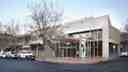
As you approach the Geelong Arts Centre, look to your left. You’ll know you’ve found it when you spot a modern, concrete building pairing minimalist design with large glass windows, which offer a peek into the bustling interiors. You’ll notice the signage on the building, advertising the vibrant arts scene within! Geelong Arts Centre, formerly the Geelong Performing Arts Centre (GPAC), is a performing arts, functions, and events venue smack-dab in central Geelong, Victoria. The centre sprawls between Little Malop and Ryrie Streets, and it’s not just one venue but a whole complex of them! A long time ago in the 1970s, folks dreamt of bringing a performing arts centre to life here. The place where it stands had a bunch of older buildings. One was a temperance hall, put up in 1858/59, which served as a grammar school later and had some fancy architectural details. It was knocked down in 1978 to make way for GPAC. Interestingly, the stones from that hall were stored for future use, but let’s just hope they didn’t lose the instructions on how to put it together again! Another historical building on the site was a Mechanics' Institute, originally from 1846. It hit the snooze button early on due to a fire in 1926 and came back as Plaza Theatre. Part of its facade is still up and about within the current centre. The Ryrie Street Presbyterian Church, also part of this ensemble, had its grand opening in 1857! The congregation must have had wanderlust because they moved in 1914, leaving behind the church that would become part of today’s Arts Centre. Construction on the new centre kicked off in 1978, with a Brutalist design using a lot of exposed concrete. It opened in style in 1981. Over the years, the centre has gone through various redevelopments, evolving into what we now know as Geelong Arts Centre. Even as you’re standing here, the centre is undergoing a massive redevelopment! By late 2023, it’s expected to unveil a 500-seat theatre, a 250-seater, a black box theatre, outdoor atrium, restaurants, and more. Look out for the exciting new facilities when it’s all wrapped up! So here you are, in front of a venue that’s a blend of history, community spirit, and cutting-edge modern design - a true cultural hub of Geelong! Enjoy exploring! Yearning to grasp further insights on the sponsorship, description and governance or the programs? Dive into the chat section below and ask away.
Open eigen pagina →Alright, you’re almost at the Old Geelong Post Office! Look to your right, and focus on spotting a grand and imposing building with a tall clock tower standing proudly on the…Meer lezenToon minder
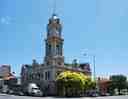
Alright, you’re almost at the Old Geelong Post Office! Look to your right, and focus on spotting a grand and imposing building with a tall clock tower standing proudly on the corner of the street. The structure is a beautiful example of classic architecture, featuring lots of large arched windows and intricate detailing along its façade. The clock faces on the tower are particularly striking. If you hear loud chimes, you're definitely in the right place! Now, let’s dive into its history: The current Geelong Post Office, which opened in 1994, is located on the corner of Gheringhap and Little Myers Streets. But the tale of postal services in Geelong stretches way back! The very first post office, opened around June 1840, was nothing more than a corner in a store in Barwon Terrace, South Geelong. Fancy that, huh? If you think working from home is a recent trend, think again! By August 1842, things had leveled up a bit when the Geelong Advertiser office doubled up as a post office. A more permanent post office was completed in 1857 on the corner of Ryrie and Gheringhap Streets, thanks to contractor William Crocker Cornish, but it was demolished in 1889 to make way for what you see today. The new building, which opened in 1891, had one major hiccup: the clock tower was missing its clock! Seems like someone forgot to set the time. But don’t fret, because by July 1911, a London firm provided the clock and chimes as a memorial to the late King Edward VII. The clock faces are a whopping 2.5 meters in diameter, with hour hands measuring a meter and minute hands at 1.25 meters! Those chimes you hear are thanks to five bells, the largest weighing a solid 760 kg, first activated on December 2, 1911. These days, while the main Geelong post office has moved to newer premises, this grand old building found a second life as a vibrant youth services hub, courtesy of the City of Greater Geelong. That’s history ticking away right in front of you! So, next time you hear those grand chimes, think of the journey this building has had from postal cornerstone to a modern youth haven. Enjoy the view, and don’t forget to say hi to the clock tower!
Open eigen pagina →As you approach Christ Church, Geelong, look to your left and you’ll spot a charming gothic revival structure built with sandstone. Note the square bell tower with its…Meer lezenToon minder
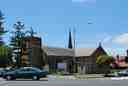
As you approach Christ Church, Geelong, look to your left and you’ll spot a charming gothic revival structure built with sandstone. Note the square bell tower with its crusader-like battlements and the pointed arch windows that are characteristic of this historic church. The tall spire in the background adds a touch of vertical elegance to the overall structure. The grounds may have a neatly maintained garden and notice boards with information about the church. Now, let’s dive into a bit of history: Welcome to Christ Church, an Anglican gem in Geelong, Victoria, Australia. You’re standing by the oldest Anglican church in Victoria that’s still on its original site, designed by the noteworthy Edmund Blacket. It’s been hosting services non-stop since 1847 and was listed on the Victorian Heritage Register in 1974. Why is it so special? Well, not only is it drenched in history, it’s also a unique piece of architecture. It seems to be the only surviving example of Bishop Broughton's church designs in Victoria. Plus, it’s the only church in Victoria designed by Blacket, a prolific New South Wales architect whose early works are quite the sight. When it comes to aesthetics, you’re in for a treat. The stained glass windows here are extraordinary, showcasing artistic advancements from the early 1870s right up to the late 20th century. If you peer inside, you’ll find some vibrant pieces by Ferguson and Urie that could leave you mesmerized. And here’s a fun tidbit - the mural inside is the work of Christian Waller, a significant artist, commemorating Walter Charles Kernot. It’s a rare piece of Waller’s work and adds another layer of charm to this place. The church’s significance doesn’t end there. The Geelong parish outdates the Diocese of Melbourne, having been founded in 1843. With its foundation stone laid by the Bishop of Australia, William Grant Broughton, it has quite the historical tapestry. The church underwent an expansion in 1855, incorporating transepts and a sanctuary, and was later consecrated in 1859. So, take a moment to bask in the historical and architectural wonders of Christ Church, Geelong-I promise, it won’t disappoint!
Open eigen pagina →Alright, as you're strolling down Yarra Street, keep your eyes peeled to the left. You can't miss St Mary of the Angels Basilica. Look for a majestic Gothic revival building…Meer lezenToon minder
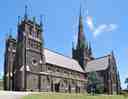
Alright, as you're strolling down Yarra Street, keep your eyes peeled to the left. You can't miss St Mary of the Angels Basilica. Look for a majestic Gothic revival building constructed from bluestone, adorned with numerous pointed arch windows, and a strikingly tall spire that seems to touch the sky. Now, here's the fun scoop about this breathtaking landmark: St Mary of the Angels Basilica, formerly known as St Mary's Church, is a real gem in the heart of Geelong, Victoria. Completed in 1937, this beauty boasts the tallest bluestone spire in all of Australia at a whopping 150 feet (46 meters). And guess what? It's also the fourth-tallest non-cathedral spire in the country. In 2004, after getting the Vatican's thumbs-up, it became Australia’s fifth basilica. Quite a promotion, eh? Standing proud at 210 feet (64 meters) tall from the pavement, it’s the tallest building in Geelong. The journey of St Mary’s began with a humble wooden chapel back in 1842, but the gold rush's optimism soon led to grander visions. Although the work hit a few bumps along the road, like a boom slowing down and construction stops, it all came together splendidly by 1937. The finishing touches even included an 8-foot phosphor bronze cross atop the spire, casting bronze waves into the sky since 1935. So, look up and behold this architectural marvel, which stands as a testament to resilience, faith, and the dreams that define the vibrant history of Geelong.
Open eigen pagina →You are now approaching HM Prison Geelong, which will be on your left. Look out for the imposing, gothic-style gatehouse made of grey bluestone-it almost looks like it could be…Meer lezenToon minder
You are now approaching HM Prison Geelong, which will be on your left. Look out for the imposing, gothic-style gatehouse made of grey bluestone-it almost looks like it could be part of an old castle! You’ll see a large archway with a keystone, flanked by flags and high, red-brick walls on either side. Above the archway, there are barred windows, which give you a hint of its former function as a prison. Now, let's talk about HM Prison Geelong! Built between 1849 and 1864, HM Prison Geelong was constructed based on the Panopticon design, similar to Pentonville Prison in England. The idea was to allow a central guard to see all the prisoners without them seeing him. Talk about having eyes in the back of your head! This place has quite the history. Initially a maximum security prison, it was later used for various purposes, including as an industrial school for girls, a hospital gaol, and even as an army detention barracks during and after World War II. The prisoners who built it lived on high-security barges on Corio Bay. The prison closed its doors in 1991, and the inmates were transferred to HM Prison Barwon. Today, it stands as a museum where you can explore its chilling history. The three-story cruciform building is practically a time capsule; with east and west wings for cells, a north wing as an administration block, and a south wing as a kitchen and hospital. One of the major highlights of the museum includes the gallows exhibit, which recreates the 1863 hanging of James Murphy, convicted of battering a constable to death. You can also find Cell 47, adorned with a mural titled "Window of Freedom," painted by a former inmate. Some notable inmates who spent time here include Angus Murray, a gangster associate, and the infamous bushranger Frank McCallum, alias Captain Melville. In more recent times, the prison even served as a filming location for films and TV shows like "Everynight... Everynight" and "Total Drama Presents: The Ridonculous Race." In 2021, buildings from the 1970s were removed to restore a more historic look to the site. The gaol is now open to the public on weekends and during school holidays, offering guided tours to those brave enough to explore its dark and intriguing past. So, are you ready to step inside and experience a piece of Geelong's grim history? Don't worry, they won't be booking you in for an extended stay!
Open eigen pagina →You're now approaching the last stop on our tour, the University Hospital Geelong. As you walk along Ryrie Street, keep an eye out on your left for a modern building with a…Meer lezenToon minder
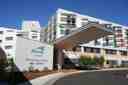
You're now approaching the last stop on our tour, the University Hospital Geelong. As you walk along Ryrie Street, keep an eye out on your left for a modern building with a prominent angular design featuring horizontal white slats and large glass windows. The entrance is marked by a large sign reading "Barwon Health The Geelong Hospital Main Entrance" and an overhang that juts out over the entrance, providing a bit of shade and shelter. It’s hard to miss with its distinctive architecture! University Hospital Geelong, formerly known simply as Geelong Hospital, is a vital landmark in Geelong. Situated on Ryrie Street, it stands as the largest hospital in regional Victoria and the only tertiary hospital outside the Melbourne Metropolitan area. Part of Barwon Health, this hospital offers comprehensive healthcare services and is also a key teaching facility thanks to its partnership with Deakin University, which led to its renaming in 2014. With a catchment area covering over 350,000 people, and certain specialties reaching up to 500,000, this hospital is critical in providing specialized care for the region. It all started back in 1852, when it was known as the Geelong Infirmary and Benevolent Asylum, treating 344 inpatients in its first year. Dramatic increases in patient numbers soon followed, from 2,450 in 1862 to many more as the years progressed. Fun fact: in the 1890s, there was a proposal to relocate the hospital to Eastern Park, but the local city council blocked it to preserve the parkland - a decision that solidified the hospital's current location. Over the years, the hospital expanded with numerous additions such as the boiler house, Kardinia Ward, Baxter House Maternity Hospital, Birdsey Wing, and the Andrew Love Cancer Centre, among others. One interesting piece of history is the Gala Day festival, which started in 1927 and became a significant fundraiser for the hospital. The historical evolution of the hospital includes the establishment of various specialized wings and the inclusion of a new helipad for faster emergency access. The latest state budget has allocated $500 million for expanding operation theaters and pediatric and maternity units, highlighting its continual growth and importance. So, while admiring this grand institution, take a moment to appreciate its multifaceted role in healthcare, education, and the community. And that wraps up our Geelong tour! If your feet are tired, just remember, you’ve traversed through a fascinating blend of history and modernity. Great job!
Open eigen pagina →



Veelgestelde vragen
Hoe begin ik de tour?
Download na aankoop de AudaTours-app en voer je inwisselcode in. De tour is direct klaar om te starten – tik gewoon op afspelen en volg de GPS-geleide route.
Heb ik internet nodig tijdens de tour?
Nee! Download de tour voordat je begint en geniet er volledig offline van. Alleen de chatfunctie vereist internet. We raden aan om te downloaden via wifi om mobiele data te besparen.
Is dit een groepsrondleiding met gids?
Nee - dit is een audiotour met eigen gids. Je verkent zelfstandig op je eigen tempo, met audiovertelling via je telefoon. Geen tourguide, geen groep, geen schema.
Hoe lang duurt de tour?
De meeste tours duren 60-90 minuten, maar jij bepaalt het tempo volledig. Pauzeer, sla stops over of neem pauzes wanneer je wilt.
Wat als ik de tour vandaag niet kan afmaken?
Geen probleem! Tours hebben levenslange toegang. Pauzeer en hervat wanneer je wilt – morgen, volgende week of volgend jaar. Je voortgang wordt opgeslagen.
Welke talen zijn beschikbaar?
Alle tours zijn beschikbaar in meer dan 50 talen. Selecteer je voorkeurstaal bij het inwisselen van je code. Let op: de taal kan niet worden gewijzigd na het genereren van de tour.
Waar vind ik de tour na aankoop?
Download de gratis AudaTours-app uit de App Store of Google Play. Voer je inwisselcode in (verzonden per e-mail) en de tour verschijnt in je bibliotheek, klaar om te downloaden en te starten.
Als je niet tevreden bent met de tour, betalen we je aankoop terug. Neem contact met ons op via [email protected]
Veilig afrekenen met 


