AudaTours logoAudaTours

Adelaide Audiotour: Tour door groene ruimtes en artistieke inspiratie

Audiogids14 stops

Goudkleurige torenspitsen snijden door de lucht van Adelaide, terwijl geheimen blijven hangen in tuinen langs de rivier en achter statige ijzeren hekken. Dit is niet zomaar een stad van brede boulevards – de geschiedenis borrelt onder je voeten. Ontgrendel de verborgen verhalen van Adelaide met deze zelfgeleide audiotour, die verder gaat dan ansichtkaartgezichten om over het hoofd geziene hoeken, rebelse hartslagen en momenten die het lot van de stad voor altijd veranderden, te ontdekken. Waarom galmde schandaal door Government House op een mistige nacht? Wiens uitdagende daad bij de Herdenkingstuin voor Pioniersvrouwen golft nog steeds door generaties heen? Wat is het meest ongebruikelijke voorwerp dat ooit achter de serene façade van Elder Park is opgeborgen? Voel de stad om je heen verschuiven terwijl elke bezienswaardigheid tot leven komt met vergeten drama en levendige personages. Loop waar rebellen zich verzamelden, doorkruis ruimtes gevormd door stille heldendaden, en zie een bekende skyline veranderen in een tapijt van spanning en verrassing. Ontdek wat er onder het kalme oppervlak van Adelaide ligt. Begin nu met verkennen.

Tourvoorbeeld

map

Over deze tour

  • schedule
    Duur 40–60 minsGa op je eigen tempo
  • straighten
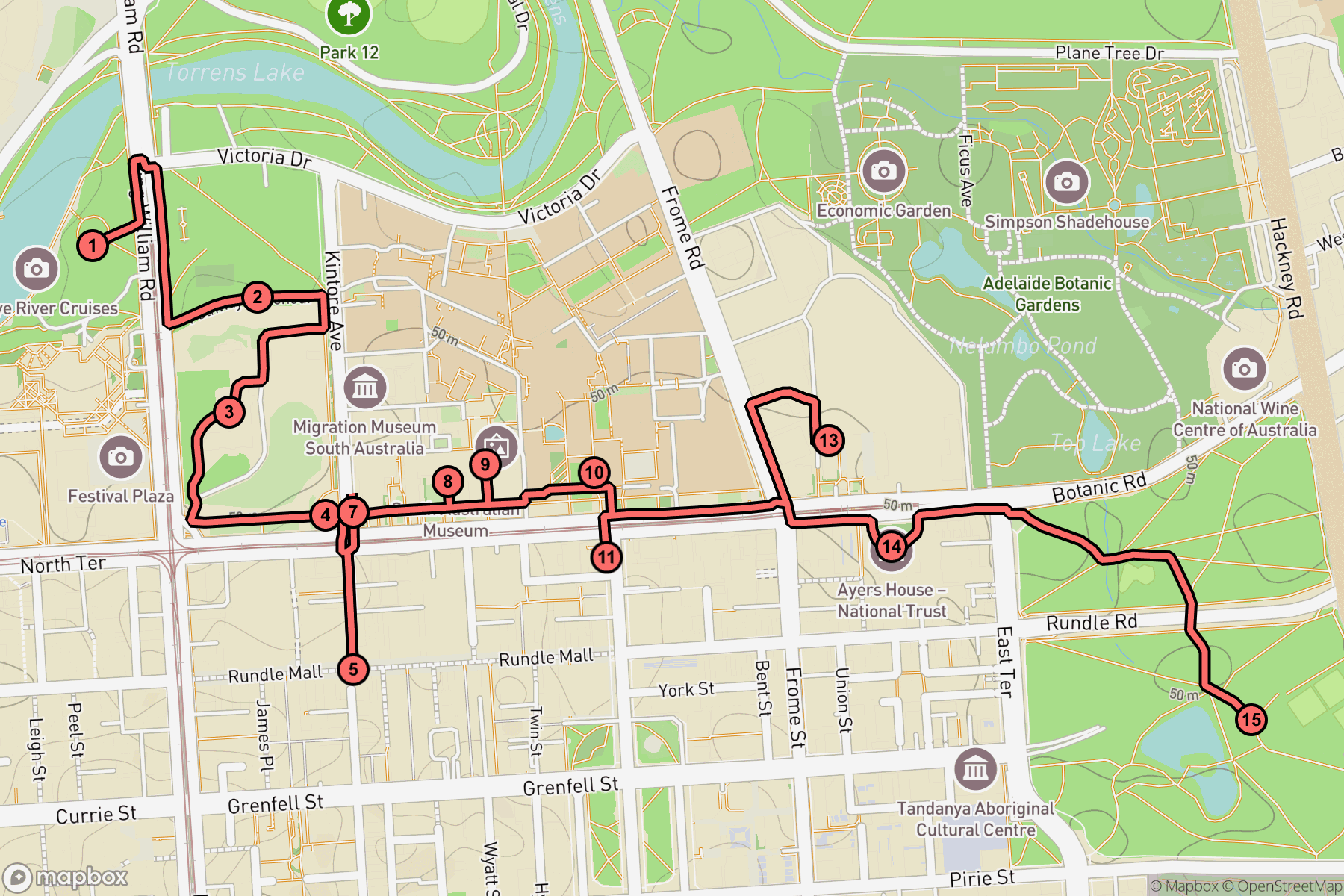
    4.8 km wandelrouteVolg het geleide pad
  • location_on
  • wifi_off
    Werkt offlineEén keer downloaden, overal gebruiken
  • all_inclusive
    Levenslange toegangOp elk moment opnieuw afspelen, voor altijd
  • location_on
    Start bij Gouverneurshuis, Adelaide

Stops op deze tour

  1. Keep your eyes peeled for a grand, cream-colored mansion with tall palm trees out front and beautifully kept gardens-the impressive building right ahead is Government…Meer lezenToon minder

    Keep your eyes peeled for a grand, cream-colored mansion with tall palm trees out front and beautifully kept gardens-the impressive building right ahead is Government House. Alright, take a deep breath of that fresh Adelaide air, and let’s step back in time together! You’re standing at the very heart of South Australia’s history, right at the corner of North Terrace and King William Road. Just imagine-where this grand house sits today, there used to be nothing but dust, hope, and a remarkable sense of adventure. In 1837, the first “Government Hut” was far from regal. Picture Governor John Hindmarsh and his family all huddled together in a mud-and-thatch hut-so cramped that everyone, even the governor himself, lay side by side on the floor. Let’s just say if you’d visited back then, you definitely wouldn’t have gotten lost in the house! But things were about to change. Along came Lieutenant Colonel George Gawler in 1838-a man determined to give Adelaide something a little more impressive than a glorified garden shed. He set his sights on a mansion of solid stone, with grand rooms and sturdy walls. There were hiccups though: ambitious architectural plans from England quickly ballooned over budget-imagine a government project being expensive, who would’ve thought? George Strickland Kingston, a local man who knew a thing about architecture, trimmed the plans, and the first stone wing appeared in 1840. It wasn’t all smooth sailing; Gawler’s spending got him called back to England, but his dream house remained. Now, the oldest part you see in front of you-the stately east wing-has been standing here since those early days, making this one of South Australia’s oldest continuously lived-in homes. In fact, only the humble Walkley Cottage narrowly beats it in age. As the house expanded, so did its reputation. Guests walked through elegant drawing rooms, lively morning rooms, and dined in style-while upstairs, governors, families, and even their servants tried not to bump into each other in the hallways. But luxury had its limits. There were years when saving every penny was the name of the game. Even so, the grand house became the stage for history, hosting official ceremonies, prestigious awards, and community celebrations that echoed across its lawns. The grounds themselves have seen change too. Only recently, the eastern fence line was pushed back to build the Anzac Centenary Memorial Walk-a tribute connecting Adelaide’s past with its future. Of course, even governors need a holiday! Adelaide summers could get rather toasty, so once upon a time, governors would retreat to their summer residences-first at Old Government House in what’s now Belair National Park, and later at the magnificent Marble Hill. But when Marble Hill was lost to a bushfire in 1955, the summer getaways came to an end and the governors were forced to sweat it out in the city just like the rest of us. Art, ceremony, and history still swirl around these walls. In 2019, Government House even started its own arts residency-proving that a place with such a proud past can always find space for new creativity. And if you look up, you might spot four flags fluttering proudly. In 2022, new flagpoles were installed on the lawn so that, for the first time, the Aboriginal and Torres Strait Islander flags could fly permanently beside the Australian and South Australian flags. It's a symbol of unity, visible from both King William Street and North Terrace. So as you stand here, take in the grand facade, the palm trees nodding in the breeze and the flowers spilling over the gardens-you’re not just looking at an old house, but at living history. If only these walls could talk, I bet they’d have a few more wild tales to share about mischievous governors and long summer nights! But don’t worry, I’ll keep the stories coming as we move on to our next stop. Ready to stroll through more of Adelaide’s secrets? Let’s go!

    Open eigen pagina →
  2. To spot the National War Memorial, look for a tall, grey stone arch with rough, blocky sides and striking marble and bronze figures, standing proudly above several wide steps at…Meer lezenToon minder

    To spot the National War Memorial, look for a tall, grey stone arch with rough, blocky sides and striking marble and bronze figures, standing proudly above several wide steps at the corner of North Terrace and Kintore Avenue. Welcome to one of Adelaide’s most solemn and impressive sights-don’t worry, though, I promise the story will have its lighter moments! Imagine yourself transported back to the early 20th century. The city is abuzz, new ideas are buzzing around like flies at a summer picnic, and yet a somber purpose fills the air: to honor the sacrifice of almost 35,000 South Australians who served in the First World War, and over 5,000 who never returned. When the war ended, emotions ran high-there was grief, pride, gratitude, and a sense of urgency to create a memorial that wasn’t just a list of names but a place alive with meaning. Here on the corner of North Terrace and Kintore Avenue, Parliament debated some pretty creative ideas-someone even floated a carillon of bells and another suggested turning Anzac Highway into the “Way of Honour” complete with triumphal arches! Imagine popping out for groceries past an arch celebrating victory. So what did they settle on? A monument not for triumph, but for the spirit’s victory; a frame that would hold hope, grief, duty, and compassion. But-cue dramatic music-trouble struck early! In 1924, as architects hustled to submit 26 designs…the building holding their precious plans burned down. Gone, just like that! It was as if the war’s unpredictability had followed them home. They had to start all over again-talk about perseverance. The next competition, restricted to locals, drew 18 entries. The winning design, by Woods, Bagot, Jory & Laybourne-Smith, was hailed as a masterpiece the moment it was announced. Here’s a fun twist: The architects refused all but expenses for their prize money, insisting the rest go into a trust fund for the memorial’s upkeep. Now there’s true community spirit! Construction began in 1928, using South Australian marble-some of which was so stubbornly tough, it probably considered itself the real hero of the project. Rayner Hoff, a brilliant sculptor, designed the stunning reliefs. The figures you see-one side showing the “Spirit of Duty” inspiring ordinary people to serve, and the other a compassionate angel helping a wounded youth-aren’t here to boast about military might. They’re about ordinary people swept up by extraordinary circumstances, and their willingness to risk everything for others. By the time it opened in 1931, three years of hard work (with a touch of drama from striking stonemasons and financial troubles for the main contractor), the city was ready. Picture a crowd of nearly 75,000 people packed onto these grounds on Anzac Day-with so many, the overflow gathered at another memorial nearby. The memorial wasn’t just another monument-it was alive with the emotions of a generation. The design itself is full of special touches. The structure stands at an unusual 45-degree angle, precisely so the dawning sun lights the facade and so it lines up with other important Adelaide landmarks. Each side of the memorial tells a story: One is the prelude to war, with a farmer, student, and young woman all answering a call far bigger than themselves; turn around and the reverse takes you to the heartbreak of war’s aftermath, an angel-crafted in marble-lifting a fallen youth, water flowing quietly from a lion’s mouth below (representing the unending flow of memory and our connection to the British Commonwealth). If you listen closely, you might just hear the gentle trinkle of water. Inside, the shrine is lined with bronze plaques listing every South Australian who served and those who did not return-a roll call so long it wraps around the walls. Imagine running your finger over those names, thinking of the lives behind each one. Throughout the year, especially on Anzac Day and Remembrance Day, the memorial comes alive with crowds again, as people gather to reflect, remember, and hope for a future without such sacrifice. Over the years, other plaques and small memorials have joined, making this space a living record of South Australians’ service far beyond World War I. As you stand here, imagine yourself as one of those ordinary people, faced with extraordinary choices-would you answer that call? And as you move on, take with you the spirit of the place: not stone and marble, but compassion, service, and memory that endures in quiet dignity. Up next, something just as inspiring-let’s go! Seeking more information about the themes, design or the nearby memorials? Ask away in the chat section and I'll fill you in.

    Open eigen pagina →
  3. Picture yourself here back in 1938. Adelaide was growing fast, but some people noticed the stories of its pioneering women weren’t being given a proper home. Enter Miss Phebe…Meer lezenToon minder

    Picture yourself here back in 1938. Adelaide was growing fast, but some people noticed the stories of its pioneering women weren’t being given a proper home. Enter Miss Phebe Watson and Adelaide Miethke from the Pioneer Women’s Memorial Trust. I imagine them walking up King William Road with determined steps, hatching a plan to turn this very patch of land into a “garden of memory.” Their vision was for something beautiful but meaningful: a formal garden, a sundial to mark the passing of time, and-right at the heart-a sculpture to honor women’s lasting contributions. Of course, nothing ever happens without a bit of drama. They had to convince the city bigwigs, including the all-important Town Clerk, W.C.D. Veale. Plans were tossed about, debate grew as thick as the poplar trees, but the Trust stood firm. In the end, their champion, Elsie Cornish (an extraordinary landscape designer with a green thumb and nerves of steel), won out. Can you imagine her here, bricks in hand, personally building the low walls? Talk about hands-on! And speaking of those walls, look around at the garden’s neat rectangle. It’s edged with the very bricks Cornish placed herself. There’s a magic here-every flower and tree was chosen for what it symbolized. The five tall Lombardy poplars? Each represents a founding woman from the Trust. The holly oak and myrtle whisper tales of love and protection. The lilacs and honeysuckles aren’t just pretty: they stand for memory, generosity, youth, and devotion. I’d say it’s a little like the ultimate group hug from the past. Right in the middle, elevated on a plinth, stands Ola Cohn’s statue-a graceful woman, head bowed as if deep in thought or remembrance. When the statue was unveiled in 1941 by Lady Muriel Barclay-Harvey, the city came together to honor the spirit of women who paved the way. The original plans even called for a “floral clock” to keep time, but it seems the council wasn’t keen on winding flowers daily. (Personally, I still think a clock made of daisies would have been a hit.) As you stroll, you’ll notice four benches along the garden’s west side. Each is dedicated to a remarkable woman: Carol Rowntree, passionate about people and justice; Elizabeth Webb Nicholls, a suffragette who helped lead the fight for women’s rights; Colonel Sybil Irving, leader and role model in women’s wartime service; and Catherine Jean Cleave, remembered for her caring, joyful spirit. These aren’t just names-they’re beacons for future generations, and this garden is their stage. The garden’s purpose has changed with the seasons. On a quiet day, it’s a place for city dwellers to escape-an oasis of calm amid the buzz of central Adelaide. But come March, something magical happens: Adelaide Writers’ Week transforms the lawns into a festival of words, laughter, and inspiration. Imagine storytellers from around the world, readers lounging under the poplars, and the spirit of pioneering women hovering happily above, maybe catching up on the latest novels. On the rise over by King William Street, there’s another memorial-this one dedicated to servicewomen. It links the garden to the broader tapestry of remembrance that stretches all the way to the National War Memorial. So linger a little longer, feel the history under your feet, and remember: this garden isn’t just a patch of flowers, it’s a living memory bank-a celebration of resilience, shared dreams, and the countless women whose quiet courage helped Adelaide bloom. And if you happen to spot an especially proud-looking magpie, it might just be Elsie Cornish herself, checking to see if her poplars are still standing tall! Ready to continue? Let’s wander on. Eager to learn more about the design, pioneer women or the uses and events? Simply drop your inquiries in the chat section and I'll provide the details you need.

    Open eigen pagina →
Toon 11 stops meerToon minder stopsexpand_moreexpand_less
  1. To spot Elder Park, just look ahead for the fancy, domed rotunda with delicate ironwork perched proudly above the sloping grass by the river-almost like a crown for the park…Meer lezenToon minder

    To spot Elder Park, just look ahead for the fancy, domed rotunda with delicate ironwork perched proudly above the sloping grass by the river-almost like a crown for the park itself. Now, standing here, take a deep breath and picture yourself over a century ago. The river glistens under the sun, and the cheerful clang of iron on iron rings out as builders set up this beautiful pavilion, fresh from the Saracen Foundry in far-off Glasgow. Originally, the area was called Rotunda Park, but in 1907, it was renamed after Sir Thomas Elder-a man who loved Adelaide so much that he gifted this elegant rotunda to us. Imagine him tipping his hat, hoping his generosity would bring music and gatherings to the heart of the city. Elder Park isn’t just grass and paths; it’s where kids squeal with excitement chasing paddleboats, and the Popeye motorboat lazily chugs along, carrying passengers upstream to see the animals at Adelaide Zoo. Each December, it lights up with thousands of candles for Carols by Candlelight, and some nights it shivers with the sound of orchestras under the stars. The combination of history and celebration fills this place with a kind of gentle magic-you can almost hear echoes of laughter and music lingering on the breeze. And who knows, maybe you’ll spot a duck trying to upstage the musicians, because in Elder Park, everyone gets a stage.

    Open eigen pagina →
  2. If you look straight ahead, you’ll spot Rundle Mall by its grand building fronts with ornate gold-trim, topped by statues and seals, and a historic green cast-iron fountain…Meer lezenToon minder

    If you look straight ahead, you’ll spot Rundle Mall by its grand building fronts with ornate gold-trim, topped by statues and seals, and a historic green cast-iron fountain bubbling just outside Adelaide Arcade. Welcome to the beating heart of Adelaide-Rundle Mall! If shopping were an Olympic sport, this place would be going for gold: a pedestrian paradise stretching half a kilometre, lined with more than 1,000 shops and some seriously dazzling facades. Take a deep breath and smell that blend of roasting coffee, sizzling street food, and-if you’re especially lucky-a hint of fresh rain on the old pavers. But before all the hustle, you’d have heard the clatter of horse-drawn trams here in the late 1800s, making their way along Rundle Street. Back then, the biggest ‘traffic jam’ might have involved a few snorting horses and the odd brewer’s cart heading to Kent Town. When electric lights blinked to life at Beehive Corner in 1895, people gathered just to marvel-imagine the oohs and aahs as the city’s edge sparkled for the very first time. Fast forward, and you can still see Beehive Corner’s fairytale spires at the mall’s end, a Neo-gothic gem, but don’t worry: bees optional, window-shopping required. Music to your ears today is probably a busker with a guitar, but in the early 1900s, Rundle Street’s cinemas made all the noise. The Pavilion Theatre-“The Pav”-let moviegoers stay all day, munching sweets while grand organs thundered. Talk about Netflix and chill, but with a side of three-penny candy and special “lady attendants” to keep rowdy kids in check. When it was all too much excitement, the Pav even turned into a mini-golf course, before coming back as the Rex Theatre and later, vanishing under a department store. The only drama left is from mothers trying to persuade their teenagers to go shoe shopping. Theatre wasn’t alone: the Sturt and Regent were rivals for Adelaide’s glitziest spot to watch a film. Regent Theatre especially was the peacock of the pack-Moroccan details, gold and marble everywhere, and a staircase big enough to make you feel like royalty. When you duck into Regent Arcade now, see if you can spot the whispers of its glitzy past. Maybe you’ll even feel a breeze from long-gone applause. Rundle Mall as you see it now really took shape in the 1970s, when Premier Don Dunstan boldly shut the street to cars-a bit controversial-so that shoppers could stroll at will and shop till they, quite literally, dropped. (He probably saved a few shoppers from angry drivers too.) The plan worked: today, Rundle Mall is Australia’s busiest, seeing more than 800,000 visitors every week and spending well over a billion dollars a year. If Adelaide had a piggy bank, it’d look just like this street! Speaking of pigs, meet Horatio, Truffles, Augusta and Oliver-the life-sized bronze pigs snuffling about a rubbish bin. Created by a mischievous artist, these statues aren’t just for show: everyone sits, snaps photos, and yes-sometimes tries to ride them. No judgment! If you’re a fan of quirky, don’t miss the “Mall’s Balls”-two shining orbs that mirror the crowds all day and serve as the most popular meeting point in town. Local legend says, “Let’s meet at the balls,” and everyone nods knowingly, because where else would you try to spot your friends among 54 million annual visitors? Nearby, look out for the Rundle Fountain. This grand piece originally guarded the old Jubilee Exhibition, but was moved here, painted Victorian green, and now splashes quietly while shoppers debate which luxury brand to try next-Gucci, Dior, or maybe just one more donut from the bakery. Modern Rundle Mall is Adelaide’s living room: there are plazas and arcades branching out like secret passages, from Renaissance Arcade’s indie boutiques to Adelaide Arcade, where electric lights once wowed a crowd. Listen for the tram’s gentle clang on the Glenelg line nearby, or the occasional gasps as the illuminated Rundle Lantern blazes to life at night-turning a regular corner into a digital wonder. So whether you’re tickling the noses of bronze pigs, hunting for bargains, or just soaking in the chatter of Australia’s busiest street, Rundle Mall is an adventure for every sense… and, if you’re lucky, even your funny bone. Just watch out-rumor has it a giant bronze cockroach roams the mall at night, trying to join the next big shop opening. Truly, only in Adelaide! Yearning to grasp further insights on the description, buildings and tenants or the tram stop? Dive into the chat section below and ask away.

    Open eigen pagina →
  3. To spot the State Library of South Australia, just look ahead for the striking modern glass cube with bold rainbow stripes and the big white ‘SA’ logo-it stands out brilliantly…Meer lezenToon minder

    To spot the State Library of South Australia, just look ahead for the striking modern glass cube with bold rainbow stripes and the big white ‘SA’ logo-it stands out brilliantly between two classic stone buildings. Ah, you’ve found it: the State Library of South Australia! You’re standing at the gateway to an enormous treasure trove of stories, secrets, and a dash of South Australian mystery-if you listen closely, you just might hear a page turning deep inside. Today, this library is a dazzling combination of sleek glass and historic charm, but its journey began nearly two centuries ago-back when even the idea of Adelaide was still ink drying on a map in far-off London. Imagine it’s the 1830s. Tiny Adelaide hasn’t even sprouted its first General Store, but a crew of dreamers, led by adventurers and thinkers like Robert Gouger and Richard Hanson, start imagining a library for the new colony. They packed up books on the good ship Tam O’Shanter and sent them halfway around the world to seed a future library-who says you can’t travel with heavy baggage? Once they arrived in December 1836, what followed was a dash of highbrow book clubs, ambitious lectures, and more organizational drama than a reality TV show. By 1847, the library world here was a tug-of-war between upper-middle-class science societies and the always-enthusiastic Adelaide Mechanics’ Institute-think night-time lectures, heated arguments, and probably a spilled cup of tea or two. These groups jostled, merged, split, and re-merged so many times that if libraries could be described as “lively,” this one was positively rowdy! But in 1856, civilization arrived: Parliament passed a law to make this a public institution, and, suddenly, the library belonged to everyone-artisans, workmen, and the odd ambitious kid looking for adventure, all squeezed in for nightly reading sessions. Now picture the 19th century library not just as a home for books but a community hub crammed with lectures, science societies, even a choral society! By 1861, it had moved into North Terrace-right where you’re standing now. Books from Britain poured in; fiction and fact jostled for precious shelf space. For the keen observer (or eavesdropper), you could almost sense the voices of those early readers echoing under the old vaulted ceilings. One of the true jewels of the library is its Mortlock Wing, a French Renaissance marvel that first opened its doors in 1884. With its sparkling glass dome and wrought iron balconies, this wing still stuns visitors-Travel + Leisure even ranked it among the top twenty most beautiful libraries in the world, and in 2025 it was declared the world’s second finest by the "1000 Libraries" global initiative. Fancy that-a building that took over eighteen years to build thanks to changing plans, a condemned foundation, and probably more than a few headaches. But the result? Pure storybook magic. Inside, the Mortlock Wing glows with natural light by day, and by night, its original sunburner gas lamps-two still survive-cast a golden warmth over the books. In the vaults and galleries here, over four million items whisper tales of South Australia’s journey from pre-European settlement to right now. There’s the “South Australiana” collection, a treasure chest recording every twist and turn of the region’s past-maps, manuscripts, photos, sound recordings, and even cricket bats from the legendary Bradman Collection. There’s more than rare books; there are children’s comics and toys, microfilms, and digital archives. Libraries aren’t quiet places of the past-they’re living, evolving storytellers! Recent decades have seen dramatic change, with digital collections, collaborations, and a powerhouse for statewide library services. Today, if you picture a librarian, don’t think of someone just shelving books. The former director Geoff Strempel, for example, helped link every public library in the state, launched the “One Card Network”, digitized vintage newspapers for Trove, and even snapped up the entire photo archive of aerial photographer Douglas Darian Smith. And what’s coming up? In 2025, you can catch film memorabilia from Scott Hicks’ archive-it’s a blockbuster waiting to happen. So, the next time you stroll past these glittering glass doors, remember: you’re not just beside a modern building, but standing on a foundation built by generations of eager readers, visionaries, and dreamers-each leaving behind a little piece of Adelaide’s soul. Step inside and let the stories find you. For further insights on the mortlock wing, collections or the collaborations, feel free to navigate to the chat section below and inquire.

    Open eigen pagina →
  4. Straight ahead you’ll spot the South Australian Museum-a striking blend of grand old red-brick walls with arched windows and a modern glass entryway; just look for the big “SAM”…Meer lezenToon minder

    Straight ahead you’ll spot the South Australian Museum-a striking blend of grand old red-brick walls with arched windows and a modern glass entryway; just look for the big “SAM” sign on the sand-coloured stone out front. You’re standing in front of a treasure chest-though no need for a map or pirate hat! If museums could talk, this one would definitely have stories to shout about. Imagine the year 1856: the city’s still young, horse hooves clatter on dirt roads, and there’s excitement about a shiny new idea-creating a government-funded cultural home for all things fascinating. The South Australian Museum began its journey right here, outgrowing the cramped shelves and flickering lamps of early mechanics’ institutes to become a powerhouse of research, collections, and discovery. Inside these walls, you’ll find over five million objects-enough fossils, minerals, and scientific wonders to make anyone feel like a time traveler. The museum’s proudest claim to fame might be its collection of Australian Aboriginal cultural materials, the largest and most comprehensive collection in the world. Imagine-30,000 objects, each with a story. Sometimes it feels like the walls themselves are humming with the voices of thousands of years of ingenuity and culture. And if you hear a gentle, respectful silence, that’s the museum working together with Aboriginal elders to return ancestors’ remains-after all, sometimes the truest treasures don’t belong behind glass. The atmosphere here is a mix of old and new, mystery and marvel, as if a Victorian explorer peered over your shoulder every time you’re on the edge of a scientific breakthrough. If you listen closely, there’s the faint echo of Frederick George Waterhouse, the museum’s very first curator, bustling about, arranging neat rows of bones and minerals in the early days. But every great institution has its share of drama-curators occasionally butted heads, and when the museum finally got its own name in 1939, historians probably popped the corks on their inkwells in celebration! Today, as you lean against the modern glass exterior, you’re also gazing at a home for explorers. The museum packs the Antarctic adventures of Sir Douglas Mawson and fellow South Aussies into its halls, with the Australian Polar Collection showing off icy boots, battered diaries, and even some of the very first color photos taken in the Antarctic. There’s a little Antarctic chill in the air-unless you’re planning to attempt a polar trek, I’d recommend sticking to the exhibits! Fancy a bit more wonder? There’s a mineral collection with 1,500 different species-including the famous Virgin Rainbow opal, which is so dazzling it makes a disco ball jealous-and a fossil collection with creatures older than your wildest guess. Think of it: around 50,000 fossil specimens, some from the mysterious Ediacaran biota, whose stories even seasoned scientists are still trying to unravel. Then there’s the enormous marine mammal collection-so if you suddenly hear the swish of a whale’s tail or a mysterious whale song in your imagination, don’t be startled! Along with science and nature, the museum is a place for art and ideas. For years, the Waterhouse Art Prize has celebrated art inspired by science, often making visitors wonder if that’s a painting or just a particularly beautiful chunk of fossilized wood. And the museum’s always looking for new adventures-in 2025, it launched an exhibition all the way from the Viking Age, featuring treasures from the Galloway Hoard, proof that curiosity knows no borders. Of course, there’s never been a quiet moment behind the scenes: new leaders step up, passionate community members keep an eye on museum plans, and even the state government sometimes pops in to make sure everything runs smoothly. In the rare moments when things get a little heated-a leadership shake-up here, a policy debate there-you can imagine heated whispers echoing after hours among the corridors. The important thing is, this museum’s heart just keeps beating, serving as Adelaide’s keeper of marvellous mysteries and guardian of stories old, new, and not yet discovered. So next time you stroll through those glass doors, think about all the explorers, scientists, artists, and everyday people whose legacies live right here-you may not spot an ancient marine reptile splashing across the lawn, but you’re definitely standing at the crossroads of adventure. Don’t forget to look over your shoulder-a Victorian naturalist in a tweed jacket might just be following you in, still searching for his lost fossil! Wondering about the management and governance, collections or the repatriation of human remains? Feel free to discuss it further in the chat section below.

    Open eigen pagina →
  5. To spot the Art Gallery of South Australia, look for a grand sandstone building with tall columns and an impressive, shiny, egg-shaped sculpture gleaming out front, right across…Meer lezenToon minder

    To spot the Art Gallery of South Australia, look for a grand sandstone building with tall columns and an impressive, shiny, egg-shaped sculpture gleaming out front, right across the open square from the tram stop. Welcome to the Art Gallery of South Australia! You’re standing before a building that’s seen more dramatic twists and turns than an episode of your favourite soap opera. If this gallery could talk, it would probably start by telling you how in 1881 it began with just 22 artworks, and-like a kid in a lolly shop-grew to nearly 45,000 pieces. That’s enough art to keep even the most energetic art fan busy for years... not that I’m counting! Now, picture the sandstone around you-solid and stately, designed in Classical Revival style by C. E. Owen Smyth back in 1900 thanks to a generous bequest from Sir Thomas Elder (he left £25,000 for art, which was a small fortune, and a strong “I love art” statement for the ages!). The building’s portico, with its Doric columns, now stands open and welcoming-but fun fact: That wasn’t the original look. Early visitors in 1900 would have entered through an enclosed portico, and it wasn’t until 1936 that the open-air entrance and grand façade you see now made their grand debut. This gallery has been a lifeline for artists as well as art-lovers. When times were tough in the late 1800s, the building process itself provided work for skilled tradesmen during a nasty economic slump. Over the decades, it just kept growing-adding new wings in the ’60s, ’70s, and again in ’96. Even the sun helps out nowadays; on the roof sits a solar battery setup that quietly slashes the building’s reliance on the grid. Imagine: the art inside runs partly on sunshine! Step closer to the gleaming sculpture on the forecourt-Lindy Lee’s "The Life of Stars." By day, its polished skin mirrors every passerby, while at night, 30,000 tiny perforated holes burst with light, mapping out our galaxy. It’s not just a selfie magnet; it’s a cosmic tribute to AGSA’s former director Nick Mitzevich-among many, he helped double visitor numbers and fill the gallery with everything from classic masterpieces to wild contemporary works. Speaking of directors, AGSA seems to collect them as eagerly as it collects art. There have been visionaries, dreamers, even Australia’s first female director here. Each one left a mark, from dazzling outdoor video projections during the Adelaide Fringe, to a headless horse sculpture dangling from the ceiling (don’t worry, it’s art, not a prank gone wrong). Inside, you’ll find rooms overflowing with Australian history-colonial paintings, Indigenous masterpieces, and even the first-ever Australian gallery acquisition by an Aboriginal artist back in 1939. European art? There’s plenty: landscapes by Pissarro, striking paintings by Pre-Raphaelites, and sculpture by masters like Rodin and Barbara Hepworth. Fancy a trip to Japan or the Middle East without leaving Adelaide? The Asian art displays here are among the best in the nation, including Australia’s only permanent Islamic art exhibit. AGSA isn’t just about gazing at masterpieces, though. Wait for the buzz when the Tarnanthi Festival takes over the gallery, bringing in contemporary Aboriginal and Torres Strait Islander art and filling Adelaide with creative energy. Or catch the Adelaide Biennial, Australia’s longest-running contemporary art fest-a place where artists and ideas collide like fireworks in a paintbox. And if you’ve ever dreamed of winning Australia’s richest art prize under 40, well, better grab your paintbrush-AGSA awards the massive Ramsay Art Prize here every two years, thanks to the generosity of the James & Diana Ramsay Foundation (brought to you, in part, by those famous Kiwi boot polish millions-who knew a good shine could buy so much art?). So, as you gaze at this timeless façade or stride through its stone columns, imagine the millions who’ve stood where you are-artists, dreamers, and curious wanderers-each adding a new chapter to the story of South Australia’s art. Inside and out, there’s a spark of the extraordinary: history and creativity in one fabulous package. Ready to step in and see what inspires you next? For a more comprehensive understanding of the collection, exhibitions and collaborations or the sponsorship and prizes, engage with me in the chat section below.

    Open eigen pagina →
  6. Look for a grand, castle-like sandstone building with tall arched windows and two impressive towers standing proudly on either end-it sits just across the lawn and is hard to…Meer lezenToon minder

    Look for a grand, castle-like sandstone building with tall arched windows and two impressive towers standing proudly on either end-it sits just across the lawn and is hard to miss. Now that you’re right in front of Bonython Hall, take a deep breath and imagine the buzz of excitement that must fill the air every time students file into this “great hall” for their graduation ceremonies, exams, and lectures. The hall itself was the generous gift of Sir John Langdon Bonython-imagine handing over more than fifty thousand pounds just to give generations of students a place for big moments! Construction started in 1933, smack in the middle of the Great Depression, but the work pushed through, and by 1936, Adelaide had its own academic cathedral. When the hall opened, it wasn’t just the bricks and mortar that turned heads-the whole city paused to celebrate. The Governor-General cut the ribbon, and just a week later, minds gathered for the first public lecture. But here’s where things get quirky. Folklore whispers that Bonython had some strict requests. He wanted the hall built right here-opposite Pulteney Street-not just for a lovely view, but to make sure a busy road would never cut through the university grounds. Clever thinking, right? Even more curious, it’s rumored that the Bonython family hated the idea of Bonython Hall turning into a wild dance hall, so they had the floor built on a slant. Try waltzing up a slope! That’s one way to keep things academic. In recent years, the Hall has been given a modern makeover, and not just any old fix-up-renovations here nabbed the University an award from UNESCO for their dedication to culture and heritage. So whether you’re snapping photos or imagining the echo of applause from a University ceremony, Bonython Hall stands as both a proud stage and a living piece of Adelaide’s history-with just a dash of drama tucked in the foundations.

    Open eigen pagina →
  7. Look for a charming stone church with tall, narrow arched windows and a striking spire rising from one corner-right at the busy corner of North Terrace and Pulteney Street, it…Meer lezenToon minder

    Look for a charming stone church with tall, narrow arched windows and a striking spire rising from one corner-right at the busy corner of North Terrace and Pulteney Street, it stands out from its city surroundings like something straight out of an old storybook. Welcome to Scots Church! As you stand before it, imagine it’s the early 1850s: dusty roads, the clatter of horse hooves, and a wild sense of optimism in the air. Adelaide was just a fresh, young city, and on this very corner, a group of passionate Scottish immigrants were about to shape its skyline and spirit forever. They had sailed all the way from Scotland, braving wild seas and, no doubt, the world’s blandest ship meals, carrying more than trunks and tartans-they brought with them the fire of the Free Church movement. This church began its life as Chalmers Church, named for the great Scottish leader Rev. Thomas Chalmers, the original moderator of the Free Church of Scotland. Imagine Reverend John Gardner, newly arrived from Scotland in 1850, stepping off the ship amid the cries of gulls and the smells of salty air, determined to plant a new community right here. With zeal-and probably the odd grumble about the price of real estate even then-Gardner set about buying this land from none other than John Morphett, a name big enough to make any local historian’s ears perk up. Gardner called upon the skills of Thomas English and his brother-in-law Henry Brown, both presumably wielding hammers and handshakes, to design and build the church. On a September day in 1850, they laid the foundation stone, and less than a year later, the first echoes of hymns and sermons filled this space. Here’s a fun detail: the church was over budget right from the start! They tried swapping out fancy slate tiles for simple shingles, yet the final bill soared to £2,572. That might not sound like much today, but I assure you, it was enough to make the trustees' eyebrows jump halfway up their foreheads! Even the loan came at a steep 12.5% interest-talk about a leap of faith! Of course, no grand church would be complete without a towering spire. In 1858, for an extra £200, a 120-foot spire was added, like a pointing finger showing heaven the way to Adelaide. They even imported a bell from England, thanks to Thomas Elder, which rang out across the city and probably startled a few sleepy cows. The church soon became the heart of the Free Presbyterian community, and over time, other branches joined forces-sometimes with a bit of drama, as not everyone agreed on unity. The spiritual landscape was as lively as any soap opera! As you look today, you’re seeing the legacy of multiple churches and congregations, especially after 1929, when Chalmers Church and Flinders Street Presbyterian Church merged to form what’s now Scots Church. Even the beautiful bluestone on the western side, the glorious stained glass, and the grand organ made the move from Flinders Street, giving this church not just one home’s worth of history, but two! In 1977, Scots Church was part of another grand union, becoming part of the Uniting Church in Australia-a blend of Presbyterian, Methodist, and Congregational traditions. Such a mix that if you listen closely, you might hear hymn tunes and bagpipes echoing in the sandstone, all united in one amazing tradition. Scots Church stands here today as the second-oldest church in the city, listed on the Heritage Register, a living link to dreams, hard work, and a whole lot of Scottish determination-with a little fun and drama thrown in for good measure!

    Open eigen pagina →
  8. To spot Lot Fourteen, look for the large, modern silver sculpture spelling out its name right in front of a handsome red-brick building with tall windows on the corner of North…Meer lezenToon minder

    To spot Lot Fourteen, look for the large, modern silver sculpture spelling out its name right in front of a handsome red-brick building with tall windows on the corner of North Terrace. Now, welcome to Lot Fourteen-a place where the old world of medicine collides with the rocket-fuelled pulse of today’s technology! Imagine yourself here, standing where, just a blink ago in historical terms, the old Royal Adelaide Hospital once bustled with doctors in crisp white coats and nurses dashing about. If these red brick walls could talk, they’d have tales of 19th-century medicine, of hopeful families and urgent footsteps echoing through the corridors. Fast forward to today, and the scene couldn’t be more different! After the hospital shifted to its shiny new digs in 2017, this seven-hectare spot quickly transformed from a site for healing bodies to a space where people are trying to heal the planet and solve impossible problems. The government saw the opportunity and leapt in-luring trailblazers, startups, and dreamers with promises of funding and innovation. If you listen carefully, you might even hear the buzz of ambitious chatter as techies, artists, and entrepreneurs cross paths on their way to change the world. Lot Fourteen is named after the fourteenth plot in Colonel William Light’s original 1837 plan for Adelaide. Imagine Colonel Light, blueprint in hand, laying out this land surrounded by what’s now the cultural heart of the city-the Botanic Garden just next door, universities and museums all around, and the hum of progress in every direction. But don’t let all this history fool you-Lot Fourteen is as forward-looking as they come. Some of these beautifully refurbished old hospital buildings are now home to Australia’s biggest technology heroes. Want to chat with a rocket scientist or someone who builds satellites? Pop into the McEwin Building, headquarters of the Australian Space Agency. There, you’ll also find companies like SmartSat CRC, working on turning Australia into a mini “Houston Down Under.” If you peek inside the Eleanor Harrald Building (once the nurses’ quarters) you’ll find the Australian Cyber Collaboration Centre alongside firms cooking up new ways to protect your passwords-and maybe even your fridge, if it’s smart enough! Fancy a dabble in artificial intelligence? The south-west corner is dedicated to the Australian Institute for Machine Learning-a partnership between the state government and the University of Adelaide. Their mission? To make computers almost as clever as your nan, only with less tea and more algorithms. And the magic doesn’t stop at science. Lot Fourteen plans to set hearts and minds alight with the Aboriginal Art and Cultures Centre, also called Tarrkarri, which means “the future” in the Kaurna language. If this centre reaches its potential, it will house the world’s most comprehensive collection of Aboriginal cultural treasures. And yes, if you ever wondered where the South Australian Museum stashed 30,000 artefacts, this could be their dazzling new home-complete with virtual reality story-telling and performance spaces. It’s been a journey-so many plans and revisions, budgets ballooning and shrinking, but hey, a masterpiece takes time! By the way, companies like Google Cloud, Microsoft, and even Airbus also call Lot Fourteen home now. For a moment, close your eyes and imagine the gentle hum of computer servers, bursts of excited conversation, and the clink of endless coffee mugs, fueling the next big idea. The site preserves not just dreams but heritage: take the charming Sheridan Kiosk, built in the roaring ‘20s as a spot for snacks and gossip right beside the old wards, now lovingly restored. Or the new sculpture, “One: all that we can see,” a glowing steel ring that stands near the Australian Space Discovery Centre-capturing the spirit of possibility. As the city weaves its next chapter, Lot Fourteen remains both a lively modern worksite and a living link to Adelaide’s past. From haunted hospital corridors to launchpads for the future, Lot Fourteen has tried a little bit of everything-hotels, apartments, cyber hubs, and even a proposal for an International Centre for Food, which was, alas, scrapped (guess Adelaide will have to carry on with its regular brunches for now). As you look up at those geometric steel letters and handsome windows, know you’re standing at the boundary between memory and invention. Somewhere out there, a start-up could be building the next Mars rover-and the keyboard clicking you hear? That might just be history in the making. For further insights on the background, timeline or the tarrkarri, feel free to navigate to the chat section below and inquire.

    Open eigen pagina →
  9. To spot the Royal Adelaide Hospital, just look straight ahead for a sleek, modern building with large glass windows and striking patterned panels along the front-its bold sign…Meer lezenToon minder

    To spot the Royal Adelaide Hospital, just look straight ahead for a sleek, modern building with large glass windows and striking patterned panels along the front-its bold sign proudly reads “Royal Adelaide Hospital,” so you can’t miss it. Now, take a deep breath and imagine you’re standing before Australia’s largest and most expensive hospital-a place so impressive that they simply call it “the RAH” (pronounced like “rah-rah!”). This extraordinary building isn’t just a shiny new fixture on Adelaide’s skyline; it’s a storybook, with pages stretching all the way back to 1840, when the very first Adelaide Hospital rose at the city’s eastern edge. Back then, think horses, dust, and the foundation stone being laid with great ceremony-Governor Gawler likely adjusting his coat, while curious onlookers whispered and construction tools clanked in the background. Those old walls saw everything: the invention of the X-ray (they installed a machine just four years after its discovery!), the arrival of the hospital’s first telephone in 1901 (imagine the thrill of that first ring echoing down the corridors), pioneering surgeries performed in raised-seating theatres where students would lean in wide-eyed, hoping not to faint. And don’t get me started on the hospital’s official knighthood-it was crowned “Royal” in 1939, making the staff walk a little taller and the stethoscopes practically sparkle. But with age came change. The hospital expanded time and again, growing like a living organism-one moment helping birth the city’s medical schools, the next opening a world-class burns unit or a state-of-the-art hyperbaric oxygen chamber (that’s right, divers with the bends, this place has your back). By 2017, the time had come to retire the venerable old buildings, and the move west began. Fancy a hospital migration? They did it over four days, with a whole parade of stretchers, beeping monitors, and determined nurses weaving their way into fresh new corridors. Now here you are in front of the new Royal Adelaide Hospital, the gleaming centerpiece of Adelaide’s futuristic BioMed City. The numbers alone are staggering-a price tag over $2 billion makes it Australia’s priciest building, second in the world only to a colossal hospital in the United States. Inside these walls, more than 6,000 staff bustle around, serving everyone from the city center to far-flung corners of South Australia. Every single patient room is a private suite, proving that even a hospital stay can feel a bit like a luxury hotel (well, minus the room service pizza). The technology inside is so advanced you almost expect to see robots whizzing by-and yes, there actually are automated delivery vehicles buzzing through secret underground tunnels, ferrying your lunch tray or medical supplies with a cheerful beep. The hospital even embraced eco-conscious design before it was cool: half the greenhouse emissions of your average hospital, smart energy systems, water recycling, and buildings all angled just-so to invite daylight and keep out the harsh summer sun. Even the future is taking shape here, with a tram stop right on the doorstep to whisk you around the city, and new medical research towers rising up nearby, promising next-generation breakthroughs in everything from proton therapy for cancer to health innovation hubs. All the while, the soul of the RAH remains-born in the dreams of Adelaide’s founders, and carried forward by doctors, nurses, inventors, and pioneers who have walked its halls for nearly two centuries. So if you’re ever feeling run-down, remember: you’re standing beside a building that has seen more comebacks than an action hero-adapted, evolved, and is now ready for whatever the next century throws its way. Even if that’s just a really persistent flu season.

    Open eigen pagina →
  10. To spot Ayers House as you walk, just look for a grand two-storey bluestone mansion with distinctive round towers, cream trim, and deep green shutters, set back from North Terrace…Meer lezenToon minder

    To spot Ayers House as you walk, just look for a grand two-storey bluestone mansion with distinctive round towers, cream trim, and deep green shutters, set back from North Terrace with sweeping lawns and old-fashioned street lamps leading right up to its entrance. Alright, time to dust off your imaginary top hat-because you’re standing in front of one of Adelaide’s grandest survivors! Welcome to Ayers House, a place where the walls have seen more drama and glamour than most soap operas. Imagine the year is 1855: horse-drawn carriages are rattling by, and this mansion is just a modest brick home, nine rooms in total. In steps Sir Henry Ayers, future five-time Premier of South Australia and a man with enough ambition to fill all forty rooms he would eventually create here. Back when Ayers moved in, this house looked pretty ordinary-just a nice, solid house for a successful chemist named William Paxton. But, like every good episode of Home Makeover: Victorian Edition, Sir Henry wasn't satisfied. He hired some of the best minds of the era-architect George Strickland Kingston, inspired by the famous Robert Kerr in Britain-and set about transforming the place into something fit for a king or, at least, a premier who liked throwing grand balls. What began as a simple home blossomed into a Regency-style mansion, complete with hand-painted ceilings, elegant stencilled woodwork, and rooms stuffed with the memorabilia of the Ayers family. Each room, Ayers decided, would have a job: some for cabinet meetings (talk about bringing your work home with you), others for dinners so lavish you could practically smell the roasted duck through time, and a glittering ballroom that echoed with laughter and the swish of skirts. Ayers House wasn’t just about luxury. Adelaide summers can be fierce, so Sir Henry came up with a clever escape: a shady basement, possibly the coolest party spot-literally-in town. And speaking of cool, this house was also a trendsetter: one of the very first in the whole city to get gas lighting. Imagine the magic of flickering gasoliers illuminating fancy guests beneath the ceiling’s painted flourishes as the premier discreetly checks how hot it is-after all, he kept notes on the temperature in each room! But the curtain didn’t fall when Sir Henry left the building. The story of Ayers House took wild twists-ballrooms and dance halls, parties and even a stint as a nurses’ dormitory for the hospital just across the street. In the early 1900s, after a particularly lively Adelaide Club dance (I bet those gentlemen kicked up their heels), the idea to turn the house into a club surfaced… and then fizzled. Next up? Ownership by Austral Gardens Ltd, which figured, “Why not add a dance hall and entertainment zone to this already stately home?” The result was “The Palais Royal” next door, with music and laughter that surely lingered long after the parties ended. When World War I arrived, this mansion became a sanctuary, offering rest and care to injured soldiers. If you listen closely, maybe you’ll hear the echoes of friendly banter drifting from its open-air café days, when it served as a sunny meeting spot from 1914 to 1932. The government took over in 1926, and for decades, nurses filled its halls, sharing stories and sneaking midnight snacks (or so I like to imagine). Ayers House nearly vanished in the 1960s when demolition loomed large-Adelaide would have lost its last North Terrace mansion. But thanks to a campaign led by the National Trust, and a little dramatic override from Premier Don Dunstan in 1970, this beauty was saved at the eleventh hour. A wave of restoration swept through, returning much of the house to its original glory. Soon, the bedrooms became the sought-after Henry Ayers Restaurant, the stables hosted a bistro, and the mansion filled with costume displays, art, and even a 300-kilogram chandelier. Who says you can’t dine like a premier? The 21st century brought fresh drama: government shakeups, evictions, and triumphant homecomings. After a stint where the National Trust was booted from the premises for being a little too outspoken, they finally made a grand return, and in 2024, the government sealed the deal-Ayers House would be the Trust’s permanent home, with a handsome budget set aside for yet another upgrade. So, as you stand here today, picture the swirling gowns, clinking gas-lit glasses, heated parliamentary debates, soldiers’ quiet recovery, and dishes clattering from restaurant kitchens. Ayers House has truly seen it all-a mansion surviving with style, spirit, and a story worth every stone it’s built from. And let me tell you, if these walls could talk, they'd probably ask for another round of restoration and a good old-fashioned party.

    Open eigen pagina →
  11. Straight ahead, you’ll spot Rymill Park by its sparkling lake lined with lush green trees, their reflections perfectly mirrored in the calm water and framed by wide grassy…Meer lezenToon minder

    Straight ahead, you’ll spot Rymill Park by its sparkling lake lined with lush green trees, their reflections perfectly mirrored in the calm water and framed by wide grassy lawns. Welcome to Rymill Park, also known by its Kaurna name, Murlawirrapurka-a place where the soft splash of oars on the water mixes with laughter and birdsong, and history ripples beneath the tranquil surface. Close your eyes for a second and picture this spot hundreds of years ago: before the shouts of rowers or the hum of the O-Bahn bus tunnel below, these eastern parklands were a vital camping and meeting ground for the Kaurna people. Family fires sent up smoke under starlit skies, storytelling and community life passed between generations long before Adelaide was even on the map. Move forward to the days after European settlement. The parklands became home, albeit for only a while, to a mix of Aboriginal peoples, including the Ngarrindjeri, like the legendary Poltpalingada Booboorowie. Known to settlers as Tommy Walker, he and others-sometimes called “fringe-dwellers”-set up camp right here until they were eventually pushed out, first to the Botanic Gardens, and then all the way to Glenelg. It’s a story full of both warmth and sorrow, a reminder that every pretty corner in a city has deeper roots. Now, imagine you’re back in the 1800s. Instead of today’s lush lawns and lakes, this place was called “bare and swampy in winter,” a patch of rough ground that hosted more cows than people-certainly not a place you’d bring a first date for a romantic stroll! But Adelaide’s dreamers had other plans. In the late 1950s, things started to change, all thanks to a globe-trotting town clerk named William Veale, who thought, “Why not add a lake?” And, just like that, in 1959-60, Rymill Park gained its calm waters, a playground, a rose garden, and the Adelaide Bowling Club even moved in, right off Dequetteville Terrace. Local families flocked to the new facilities, and some of Adelaide’s most beloved memories began right here-with children’s laughter, paddling rowboats, and the soft slap of ball against bowling green. The park’s name gives away its next hero: Sir Arthur Rymill. A Lord Mayor with a knack for supporting big green spaces, Rymill believed in making Adelaide beautiful and accessible for everyone. Thanks to him, and other tireless supporters, this spot went from a cow-patch to a picnic haven. Would you believe the rose gardens sit where the Bartels Road rubbish tip once was? Talk about “blooming” where you're planted! But even paradise needs a little maintenance. In 2007, the lake started leaking an Olympic swimming pool’s worth of water every week, so it had to be drained and patched up. When it refilled in 2008, the ducks and rowboats returned, and once again, the lake mirrored Adelaide’s ever-changing sky. The Kaurna name, Murlawirrapurka, was added later as part of Adelaide’s reconciliation journey, chosen to honor a wise Kaurna elder whose presence and land defined the area for centuries. Did you know ‘Murlawirrapurka’ combines words meaning “dry forest” and “elder”? This dual identity echoes through the park, reminding us to look beyond the green lawns and see the full story beneath our feet. Then, in true Adelaide fashion, a plan to send the O-Bahn busway right underneath the park sparked fierce debates-trees and old landscapes at risk, determined campaigners fighting to “Save Rymill Park!” Eventually, a tunnel was built under your very feet, with traffic quietly rushing by below, and today the lawns and lakes above remain just as peaceful. The lake enjoyed yet another facelift, reopening in April 2024 after a multi-million dollar eco-upgrade that pipes water all the way from Victoria Park. The playground and the rose gardens gleam again, and the hunt is on for a café brand new enough to rival the old days of bustling kiosk and pop-ups-maybe next time you visit, you’ll enjoy a coffee courtesy of the “Peter Rabbit” café people. Rymill Park is never quiet for long-Fringe events in “Gluttony” hub, the Equestrian Festival, Carnevale, and even aerobics competitions all bring life and color here. Statues like John Dowie’s quirky “Alice” and the “Piccaninny” drinking fountain mark the park’s playful edges, and if you listen as the sun sets, you’re likely to hear the flap of possums in the trees or the quack of ducks bobbing on the lake. So as you stand here, soaked in sunlight, you’re feeling the heart of Adelaide-a place of old stories and new adventures, always changing, forever welcoming. Thanks for wandering with me today, and remember: the best stories are often hiding in plain sight.

    Open eigen pagina →

Veelgestelde vragen

Hoe begin ik de tour?

Download na aankoop de AudaTours-app en voer je inwisselcode in. De tour is direct klaar om te starten – tik gewoon op afspelen en volg de GPS-geleide route.

Heb ik internet nodig tijdens de tour?

Nee! Download de tour voordat je begint en geniet er volledig offline van. Alleen de chatfunctie vereist internet. We raden aan om te downloaden via wifi om mobiele data te besparen.

Is dit een groepsrondleiding met gids?

Nee - dit is een audiotour met eigen gids. Je verkent zelfstandig op je eigen tempo, met audiovertelling via je telefoon. Geen tourguide, geen groep, geen schema.

Hoe lang duurt de tour?

De meeste tours duren 60-90 minuten, maar jij bepaalt het tempo volledig. Pauzeer, sla stops over of neem pauzes wanneer je wilt.

Wat als ik de tour vandaag niet kan afmaken?

Geen probleem! Tours hebben levenslange toegang. Pauzeer en hervat wanneer je wilt – morgen, volgende week of volgend jaar. Je voortgang wordt opgeslagen.

Welke talen zijn beschikbaar?

Alle tours zijn beschikbaar in meer dan 50 talen. Selecteer je voorkeurstaal bij het inwisselen van je code. Let op: de taal kan niet worden gewijzigd na het genereren van de tour.

Waar vind ik de tour na aankoop?

Download de gratis AudaTours-app uit de App Store of Google Play. Voer je inwisselcode in (verzonden per e-mail) en de tour verschijnt in je bibliotheek, klaar om te downloaden en te starten.

verified_user
Tevredenheid gegarandeerd

Als je niet tevreden bent met de tour, betalen we je aankoop terug. Neem contact met ons op via [email protected]

Veilig afrekenen met

Apple PayGoogle PayVisaMastercardPayPal

AudaTours: Audiotours

Vermakelijke, budgetvriendelijke wandeltours met eigen gids

Probeer de app arrow_forward

Geliefd bij reizigers wereldwijd

format_quote Deze tour was een geweldige manier om de stad te zien. De verhalen waren interessant zonder te gekunsteld aan te voelen, en ik vond het heerlijk om op mijn eigen tempo te verkennen.
Jess
Jess
starstarstarstarstar
Tbilisi-tour arrow_forward
format_quote Dit was een prima manier om Brighton te leren kennen zonder je als toerist te voelen. De vertelling had diepgang en context, maar overdreef het niet.
Christoph
Christoph
starstarstarstarstar
Brighton-tour arrow_forward
format_quote Begon deze tour met een croissant in de ene hand en nul verwachtingen. De app gaat gewoon mee met je, geen druk, gewoon jij, je koptelefoon en gave verhalen.
John
John
starstarstarstarstar
Marseille-tour arrow_forward

Onbeperkte audiotours

Ontgrendel toegang tot ELKE tour wereldwijd

0 tours·0 steden·0 landen
all_inclusive Onbeperkt verkennen

