
글래스고 오디오 투어: 철, 예술, 숨겨진 골목의 메아리
글래스고의 웅장한 돌과 밝은 상점가 아래에서, 도시는 여전히 오래된 논쟁과 미완의 비밀들로 웅성거립니다. 조지 광장에서는 한때 권력이 초상화를 위해 포즈를 취했고, 그 가장자리에서는 불안이 속삭였습니다. 이 셀프 가이드 오디오 투어는 여러분을 그레이터 글래스고와 글래스고 왕립 의사 및 외과 의사 대학으로 안내하며, 대부분의 방문객들이 그냥 지나치는 정치적 싸움, 반란, 스캔들, 그리고 잊혀진 순간들을 드러냅니다. 조지 광장에서 어떤 집회가 폭력의 위기에 처했고, 누가 그것을 빠르게 진압하려 했는가. 왕립 대학의 어떤 조용한 복도가 시신, 칼날, 그리고 명성의 미스터리를 숨기고 있는가. 왜 유독 특정한 악기 하나가 트로피처럼 전시되었고, 그것이 누군가에게 어떤 대가를 치르게 했는가. 시민의 웅장함부터 개인의 야망까지, 이야기가 조여지고 풀리는 거리를 따라가 보세요. 급커브, 아슬아슬한 순간, 그리고 갑작스러운 아름다움을 기대하세요. 마지막 코너를 돌면 글래스고는 다르게 보일 것입니다. 재생을 누르고 도시의 돌이 다시 이야기하게 하세요.
투어 미리보기
이 투어에 대하여
- schedule소요 시간 60–80 mins나만의 속도로 이동
- straighten7.0 km 도보 경로안내 경로 따라가기
- location_on
- wifi_off오프라인 작동한 번 다운로드, 어디서든 사용
- all_inclusive평생 이용언제든지 다시 재생 가능
- location_on아치스에서 시작
이 투어의 정류장
So you’re here at The Arches, tucked under Glasgow Central Station where the trains roll in overhead like a constant, low thunder. It’s a funny location when you think about it: a…더 보기간략히 보기
So you’re here at The Arches, tucked under Glasgow Central Station where the trains roll in overhead like a constant, low thunder. It’s a funny location when you think about it: a place built for movement and commuting, turned into a home for staying out far too late. Back in the late 1980s, this stretch under the station was basically dead space-dark, a bit damp, and not exactly where you’d bring your mum for a nice afternoon. It got a sudden glow-up when Glasgow became European City of Culture, and the area was cleaned up to host an exhibition called “Glasgow’s Glasgow.” When that wrapped up, a man named Andy Arnold saw potential in all this brick and shadow. In 1991 he opened The Arches, aiming first at theatre. Here’s the catch: theatre costs money, and money is famously shy. Arnold’s solution was pure Glasgow practicality-run nightclub nights to bankroll the arts. And it worked. The Arches became a not-for-profit that used dance floors and bar tabs to pay for daring performances, building a reputation that spread well beyond Scotland. The space itself helped. You had around 7,800 square meters across two levels and seven big brick arches-industrial, echoing, and atmospherically grim in the best way. Productions leaned into that. Imagine watching Arthur Miller’s The Crucible down in a dark basement, the audience on church pews, feeling like you’re part of the accusation. Or a promenade version of Fritz Lang’s Metropolis with a cast of 100, where the building’s scale wasn’t a limitation-it was the point. For the fifteenth anniversary, Arnold staged “Spend A Penny,” a string of one-on-one monologues performed inside toilet cubicles. That’s either inspired, unhinged, or both. Glasgow tends to reward both. Then there was the clubbing. The Arches hosted Fridays and big monthly nights that became legendary. Slam ran through the 1990s, and yes-Daft Punk played here in 1997 for their first United Kingdom appearance, which is the kind of fact that makes electronic music fans go quiet for a second. Pressure followed, pulling in heavyweight names across techno and house. By 2007, DJs voting for DJ Magazine ranked The Arches the 12th best club on the planet. Not bad for a venue under the railway. In 2008 Arnold left, and Jackie Wylie took over the arts side, sharpening The Arches into a talent engine-supporting new Scottish performers and commissioning shows that toured internationally. The place wasn’t just hosting culture; it was exporting it. But then came the hard part. In 2015 the venue lost its nightclub license, and the fallout went global-petitions, open letters, big Scottish cultural names pushing to keep it alive. A couple months later, The Arches went into administration and closed. Since 2018, the building has lived on as Platform, a food market-less sweat on the walls, more street food in your hands. And in 2021, a book called Brickwork: A Biography of The Arches gathered memories from everyone involved, from DJs to bar staff, because places like this don’t vanish neatly. When you’re set, the Royal College of Physicians and Surgeons of Glasgow is a 10-minute walk heading north.
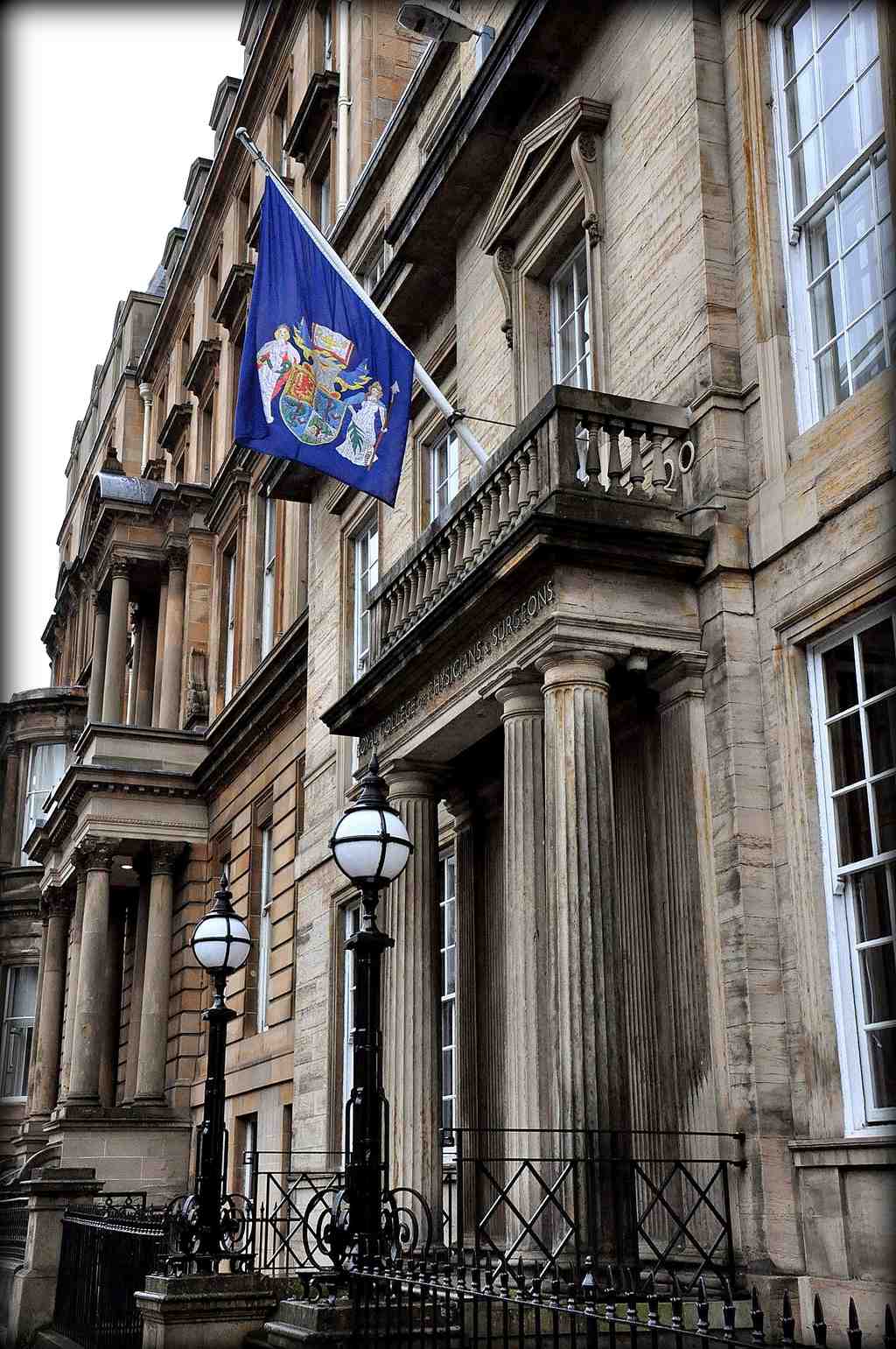
전용 페이지 열기 →On your right, look for the grand sandstone building with tall classical columns over the entrance, a small balcony above, and a bold blue flag hanging out front. You’re standing…더 보기간략히 보기
On your right, look for the grand sandstone building with tall classical columns over the entrance, a small balcony above, and a bold blue flag hanging out front. You’re standing beside the Royal College of Physicians and Surgeons of Glasgow-one of those places that sounds like it should come with a Latin spell and a stern handshake. And honestly, it kind of does. This institution traces its roots back to 1599, when King James VI granted a royal charter to a man named Peter Lowe, a surgeon trained in France who also wrote a no-nonsense surgical manual with the wonderfully blunt title The Whole Course of Chirurgerie. Lowe teamed up with a Scottish physician, Robert Hamilton, and together they set out to solve a pretty basic problem: if someone in Glasgow said they were a doctor, how could you be sure they weren’t just confident? Back then, “medical regulation” wasn’t a buzzword-it was survival. The charter even names an apothecary, William Spang, and gives him authority to inspect and control what drugs were being sold in town. Picture it: seventeenth-century Glasgow, muddy streets, crowded closes, and Spang popping into shops like an early version of a health inspector, except with more plague in the background. The College-first known simply as “the Faculty”-was unusual from the start because it didn’t just cover physicians and surgeons. It also included barbers and apothecaries. That’s not a joke: barbers were doing minor surgical work, and if you’ve ever wondered why the barber pole looks vaguely medical, well, there you go. But the harmony didn’t last. By the early 1700s, barbers and surgeons had fallen out badly enough that they split in 1722, like a messy band breakup-only with scalpels. The institution moved around the city as it grew: a property on the Trongate in the late 1600s, then a purpose-built hall there in 1698-the same year the Faculty Library began. Later came St Enoch Square, and finally this current home on St Vincent Street in 1862, part of the city’s smarter “New Town” development. The building fits the part: solid stone, disciplined lines, and just enough grandeur to suggest, politely, that standards matter here. Names changed as prestige piled up. In 1909 it gained the right to call itself “Royal,” and in 1962 it became the Royal College of Physicians and Surgeons of Glasgow-the only multi-disciplinary medical royal college in the United Kingdom. For a long stretch, it helped provide a key route into practice through Scotland’s “Triple Qualification,” a joint diploma with Edinburgh’s physician and surgeon colleges-an alternative to university degrees that survived into the late 1990s. These days the focus is postgraduate education: exams and training that lead to Memberships and Fellowships for doctors, surgeons, dental surgeons, and even podiatrists-plus specialist diplomas in fields like dermatology, child health, travel medicine, and more. It’s still, at heart, an engine for professional standards-just with fewer barbers. And if you like milestones: the College awarded its first female fellow in 1912, appointed its first female president in 2019, and more recently has taken on issues like climate and health through a sustainability group. Ready for Theatre Royal, Glasgow? Just walk east for about 12 minutes.
전용 페이지 열기 →On your right, look for the long, pale cream building with rows of rectangular windows and a green canopy jutting out over the sidewalk, with “THEATRE” written high up near the…더 보기간략히 보기
On your right, look for the long, pale cream building with rows of rectangular windows and a green canopy jutting out over the sidewalk, with “THEATRE” written high up near the roofline. This is the Theatre Royal, the grand old survivor of Glasgow showbiz: the city’s oldest theatre, and the longest continuously running one in Scotland. It’s been entertaining crowds here since 1867-back when “a night out” meant gaslight, top hats, and trying not to get trampled by a horse on the way home. It actually opened under a different name: the Royal Colosseum and Opera House, launched by an impresario named James Baylis. Baylis wasn’t exactly timid-he also ran other lively venues nearby-so he filled this place with whatever sold: pantomimes, comedies, plays, harlequinades, and yes, opera. That last bit matters, because the Theatre Royal later became the home of Scottish Opera in 1975. It’s like the building picked a specialty early on, then took a century-long detour through absolutely everything else. Two years after opening, the name “Theatre Royal” arrived when new managers, Glover and Francis, brought it over from an earlier Theatre Royal on Dunlop Street-demolished to make way for St Enoch railway station. Glasgow has always had a talent for swapping culture for infrastructure, then building more culture anyway. Now, theatre buildings are magnets for drama in more ways than one. In 1879, a fire wiped out the auditorium. The rebuild gave the theatre its most recognizable look: a classical French Renaissance design by the famed theatre architect Charles J. Phipps. He added a third gallery and reoriented the entrance to face Hope Street. Today, it’s considered the largest surviving example of Phipps’s theatre work in Britain-basically, his greatest hit. In the late 1880s, a local power broker, Baillie Michael Simons, helped hand the reins to two actor-managers, James Howard and Fred Wyndham. Their company, Howard and Wyndham, turned this place into a pantomime powerhouse-starting with The Forty Thieves-and grew into a major theatre empire for decades. Then came another reinvention: in 1957 the building was sold for television, becoming a Scottish Television theatre and studio. Live music, dance, and comedy beamed out from here across Scotland and beyond-until, in 1969, another fire broke out, tragically killing a firefighter. The big comeback arrived in 1974 when Scottish Television moved next door and Scottish Opera bought the building with public support, transforming it into Scotland’s first national opera house. The foyer expanded, the orchestra pit grew to fit around 100 players, and the auditorium was restored in cream, gold, and pale blue-plus a dash of William Morris wallpaper, because opera deserves good wallpaper. It reopened in 1975 with Die Fledermaus, broadcast live, and has kept singing ever since-now seating about 1,541. When you’re ready for Celtic Connections, just walk south for about 6 minutes.
전용 페이지 열기 →
17개 정류장 더 보기정류장 적게 보기expand_moreexpand_less
On your left is Celtic Connections, and if you happen to be in Glasgow in January, this isn’t just a festival you “catch” in town. It sort of catches you. The city goes dark…더 보기간략히 보기
On your left is Celtic Connections, and if you happen to be in Glasgow in January, this isn’t just a festival you “catch” in town. It sort of catches you. The city goes dark early, the air has that cold, sharp edge, and suddenly there’s fiddles and accordions pouring out of doorways like someone forgot to put the music back in the case. Celtic Connections kicked off in 1994, and its origin story is wonderfully practical: Colin Hynd looked at the Glasgow Royal Concert Hall’s post-Christmas calendar and saw a quiet stretch that needed a bit of life. So he built a festival to fill the gap. Not with one polite weekend of concerts, either-he aimed for something broad enough to pull in die-hard trad fans and also folks who just wanted a good night out. BBC Radio Scotland helped spread the word, and the first year brought in around 33,000 people-pretty strong for something that was basically a “January is bleak, let’s fix it” idea. At the start, everything happened inside the concert hall, and there weren’t even workshops yet. But it grew fast. By 1995 there were 130 events over seventeen days, with more than 100 acts, spilling into nearby spaces. And by 1996, it had properly burst out across Glasgow-new venues, a late-night club, and programming that loved to smash up musical borders. One of the early calling cards was pairing traditions that don’t always share a stage-like fiddler Aly Bain playing with the Scottish Ensemble, stitching folk and classical together so neatly it felt obvious, even if it wasn’t. That “connections” idea became the point: Scotland’s traditional roots, yes-but also the way those roots tangle with Ireland, Appalachia, Brittany, Spain, and just about anywhere else musicians tell stories with strings, pipes, or a voice that can raise the hairs on your arms. You’d get local heroes like Capercaillie alongside visitors from all over, and suddenly Glasgow in January feels less like the edge of winter and more like the middle of the world. One of the most beloved traditions happens after the official gigs end: the Festival Club. It runs into the small hours, and no, they don’t announce a lineup in advance. That’s the thrill and the mild chaos of it. Musicians who’ve played big stages across the city turn up and start trading tunes, harmonies, and ideas-one-off collaborations you’ll never hear the same way again. It’s part concert, part musical dare. The festival’s also serious about bringing new players through. There’s the Danny Kyle Open Stage-free to attend-where emerging acts play short sets, and the best get invited back with support slots the following year. And the New Voices commissions have helped composers build new suites of music based on traditional themes-proof that “traditional” doesn’t mean “stuck,” it means “still working.” Then there’s the education program, which is honestly the secret engine of the whole thing. Thousands of schoolkids come to free morning concerts-often their first live music experience-hearing everything from Robert Burns-inspired material to spiritual and blues. By 2020, more than 200,000 children had taken part over the years. That’s not just entertainment; that’s a handoff from one generation to the next. By the late 2000s, Celtic Connections was pulling in worldwide visitors and making a real economic splash-about £5.8 million in 2007, roughly around £9 million today. In 2006, Donald Shaw-founding member of Capercaillie-took over as artistic director, guiding it into an era of 300-plus events and a mad sprawl of venues across the city. Ready for Greater Glasgow? Just walk southeast for 4 minutes.
전용 페이지 열기 →Right in front of you is “Greater Glasgow” - which sounds like a grand, official title, like the city showed up one day wearing a sash. But here’s the twist: Greater Glasgow isn’t…더 보기간략히 보기
Right in front of you is “Greater Glasgow” - which sounds like a grand, official title, like the city showed up one day wearing a sash. But here’s the twist: Greater Glasgow isn’t a council area, and it’s not a separate government. It’s basically a way of saying, “All the places that have grown right up against Glasgow until there’s no real break between them.” Scotland’s National Records folks draw these lines for census and stats, not politics. And they do it in a very twenty-first-century way: by looking at continuously built-up postcodes. If the homes and streets connect without meaningful gaps, it counts as one urban patch. If there’s a little break of open ground-just enough to stop the chain-that’s the difference between “in” and “out.” It’s a bit like deciding who’s part of your friend group based on whether they’re standing close enough in a photo. Those definitions have real effects on the numbers. Back in the 2001 census, Greater Glasgow clocked in at about 1.2 million people, making it Scotland’s biggest urban area and one of the largest in the United Kingdom. Then the statisticians tightened the rules. By 2016, the “settlement” number dropped to just under a million-around 985,000-mostly because some places east of the city were removed due to small gaps between populated postcodes. Motherwell and Wishaw, Coatbridge and Airdrie, Hamilton-closely tied to Glasgow in everyday life, but no longer “physically continuous” in the strict, map-nerd sense. And here’s another quirk: planned “new towns” like Cumbernauld and East Kilbride were never counted in those Greater Glasgow settlement figures, even though plenty of people there commute, shop, and live their lives orbiting Glasgow. The reason’s simple: clear separation. They’re not welded to the city’s edge in the way older suburbs are. By 2020, with nearly the same boundaries as 2016 (and with Barrhead added back in), Greater Glasgow nudged back up to just over a million. So yes, Glasgow’s population can “change” without anyone actually moving-just because the definitions do. If you zoom out even further, you’ll hear people talk about the Glasgow City Region: eight councils working together on big-picture growth, with over 1.7 million people. It’s a partnership, not a single new mega-city. Since 2015, the council leaders have even sat together in a joint cabinet-like a group project, except the homework is transport, jobs, and infrastructure. And transport is where Greater Glasgow really feels like one organism. The area’s got Scotland’s only subway, two international airports, and a suburban rail network so extensive it’s the biggest in the United Kingdom outside London. No matter what line a map draws, the daily movement tells the truth: this is one connected city at full scale. When you’re set, St George’s Tron Church is a 0-minute walk heading north.
전용 페이지 열기 →Right in front of you is a solid, honey-brown stone church with a tall clock tower and sharp little spires-look up to the clock face to make sure you’ve got St George’s…더 보기간략히 보기
Right in front of you is a solid, honey-brown stone church with a tall clock tower and sharp little spires-look up to the clock face to make sure you’ve got St George’s Tron. Now, take a second and listen to the street around you: the shuffle of shoppers, the hiss of buses, the general Buchanan Street bustle. And planted smack in the middle of all that modern motion is one of the area’s oldest holdouts, opened back in 1808. The city leaders commissioned it, and architect William Stark gave it that confident, no-nonsense look-like it’s been expecting Glasgow to grow up around it, and it absolutely did. This spot sits on Nelson Mandela Place, which tells you something about Glasgow’s habit of making its streets argue with history. It used to be St George’s Place, but the name changed, and now the church’s address carries a quiet nod to global justice right along the shopfronts. The building also lines up as a kind of visual “full stop” at the end of West George Street-your eye gets pulled right to that tower, whether you meant to or not. The congregation’s story has a few plot twists, too. It began as St George’s Parish Church, with roots in the old Wynd Church over in the Merchant City. In 1815, a minister named Thomas Chalmers arrived-later a major leader in the evangelical side of the Church of Scotland and a key figure around the dramatic Disruption of 1843, when church politics in Scotland got seriously heated. Then in 1940, a merger with the Tron St Anne congregation helped create the double-barrel name “St George’s Tron,” which sounds a bit like a band, but was really just practical Glasgow branding. In more recent decades, it’s been known for strong preaching ministries-and for keeping its doors open in a very literal way. There was a refurbishment from 2007 to 2009 that uncovered original details and dealt with weaknesses in the tower, trading fussy partitions for a more open, contemporary interior. That openness made room for community work too: an artist-in-residence painted a “Last Supper” scene featuring men going through hard times, inspired by a café run as a social enterprise with Glasgow City Mission. Even on weekend nights, Glasgow Street Pastors have used the church as a “safe zone”-a calm, well-lit base in a city center that can get a little rowdy after dark. When you’re set, The Lighthouse is a 4-minute walk heading southwest.
전용 페이지 열기 →Look to your right for a tall, honey-brown sandstone building with a chunky corner tower that rises above the street like it’s keeping watch. This is The Lighthouse, and it…더 보기간략히 보기
Look to your right for a tall, honey-brown sandstone building with a chunky corner tower that rises above the street like it’s keeping watch. This is The Lighthouse, and it started life with a very different job: it was built in 1895 as the offices of The Glasgow Herald newspaper, designed by the city’s rock star architect, Charles Rennie Mackintosh. If you imagine the late-Victorian newsroom inside-ink, paper, shouting, deadlines, and probably a fair bit of cigarette smoke-you’re not far off. But Mackintosh didn’t just design a box to hold desks. He gave Glasgow a building with attitude: strong lines, smart details, and that tower that seems to say, “Yes, I’m functional, but I also have taste.” In 1999, the building was reborn as Scotland’s Centre for Design and Architecture, opened during Glasgow’s time as the United Kingdom City of Architecture and Design. The idea was simple and surprisingly modern: design and architecture aren’t niche hobbies-they shape daily life, jobs, education, culture, the whole lot. The place even made it onto a Clydesdale Bank twenty-pound note back then-twenty pounds in 1999 is roughly about forty pounds today, or around fifty US dollars-so, not bad for a building that used to run on printer’s ink. Behind the scenes, it had its drama: the Lighthouse Trust hit financial trouble in 2009, staff were shifted to new organizations, and Glasgow City Council kept the building going with exhibitions, events, shops, and workspaces. Then Covid shut the center in 2020, and by 2025 the council agreed to lease it as a climate-tech hub-because apparently the future also needs good design. If you can, come back for the views: the Mackintosh Tower’s spiral stair leads to a broad, uninterrupted sweep over Glasgow, and there’s also a newer viewing platform reached by lift. When you’re set, Royal Exchange Square is a 3-minute walk heading east.
전용 페이지 열기 →Look to your right for a grand, temple-like stone building with tall columns and a domed tower above it, often framed by strings of sparkling lights across the square. You’ve…더 보기간략히 보기
Look to your right for a grand, temple-like stone building with tall columns and a domed tower above it, often framed by strings of sparkling lights across the square. You’ve just stepped into Royal Exchange Square, one of those places that makes Glasgow look like it’s dressed up for an important meeting. And honestly, it is. This handsome open space sits between the city’s big shopping streets, but its story starts long before window displays and takeaway coffees. Back in 1778, right around here, tobacco magnate William Cunninghame built himself a mansion with gardens facing Queen Street. The timing wasn’t subtle: Glasgow’s mercantile wealth was booming, and the city was starting to outshine much of Scotland. Picture the rustle of ledgers, the clop of carriage wheels, and a certain confidence that comes from doing very well indeed. A few years later, the Royal Bank of Scotland opened its first-ever branch outside Edinburgh, right here in Glasgow. Under a local powerhouse named David Dale, the Glasgow operation quickly outpaced the bank’s other business. In 1817, the bank bought Cunninghame’s mansion-because when you’re successful, you upgrade your office the way other people upgrade their kettle. The square’s centerpiece-the former Royal Exchange-came next: a dignified, Graeco-Roman design by architect David Hamilton, created so merchants could gather daily to trade contracts. Not trendy tech stocks, either: we’re talking cotton, linen, chemicals, coal, iron, steel, timber-the gritty ingredients of an industrial city. There would’ve been plenty of sharp suits, sharper elbows, and deals made face-to-face before the markets moved elsewhere. By 1949, the building’s role shifted from trading noise to library hush when it became Stirling’s Library, and today it’s the Gallery of Modern Art-still a place for ideas, just with fewer arguments over coal prices. Take in the Georgian terraces around the edges, and the imposing former Royal Bank of Scotland office anchoring the west end. And yes, cafés and restaurants now soften the scene-proof Glasgow can do grand and sociable at the same time. Ready for Gallery of Modern Art, Glasgow? Just head east for 0 minutes; it’ll be on your right.
전용 페이지 열기 →On your right, look for a grand, grey neoclassical building with a long row of tall Corinthian columns and a domed cupola on top, sitting proudly at the edge of Royal Exchange…더 보기간략히 보기
On your right, look for a grand, grey neoclassical building with a long row of tall Corinthian columns and a domed cupola on top, sitting proudly at the edge of Royal Exchange Square. This is the Gallery of Modern Art, or GoMA-Glasgow’s main stage for contemporary art, the kind that can make you laugh, frown, or quietly argue with yourself all the way home. The funny part is the building itself looks like it’s expecting Roman senators to show up at any moment. That’s because it began life in 1778 as a private townhouse for William Cunninghame of Lainshaw, one of Glasgow’s Tobacco Lords-wealthy men whose fortunes were entangled with the triangular slave trade. So yes: today’s bright, questioning modern gallery lives inside a shell funded by an older world with some very dark receipts. The building kept reinventing itself. In 1817 it was bought by the Royal Bank of Scotland, and later it became the Royal Exchange-basically, Glasgow’s place for big-money dealmaking. In the late 1820s and early 1830s, architect David Hamilton reshaped it for that role, adding the grand Queen Street-facing pillars, the cupola above you, and a much larger hall behind the original house. The whole makeover was designed to say, “We’re serious people doing serious business,” which is exactly the kind of sentence modern artists like to poke at. Then, in 1949, the city bought the building for £105,000-about £3 million today-and in 1954 it turned into a library space, with a huge ornamented hall, towering display units, and enough specialist collections to keep curious Glaswegians busy for years. Eventually, after the books moved back out, the building was refurbished again-this time for art-and GoMA opened in 1996. Today it’s a lively mix of temporary exhibitions, workshops, talks, and big projects that tackle present-day social issues head-on. You’ll also spot some sparkle outside: that mirrored strip high on the front is Niki de Saint Phalle’s work, and she carried the shine into the entrance too-like the building decided to check itself in the mirror before letting you in. When you’re set, the Equestrian statue of the Duke of Wellington is a 0-minute walk heading east.
전용 페이지 열기 →Look for the bronze horse and rider on a big stone pedestal outside the Gallery of Modern Art-then look up, because there’s a bright orange-and-white traffic cone perched on the…더 보기간략히 보기
Look for the bronze horse and rider on a big stone pedestal outside the Gallery of Modern Art-then look up, because there’s a bright orange-and-white traffic cone perched on the rider’s head like a very Glaswegian crown. This is Field Marshal Arthur Wellesley, the 1st Duke of Wellington: war hero, Napoleonic Wars finisher, and-thanks to the locals-accidental patron saint of street furniture. The statue’s been standing here since 1844, cast in bronze and set on a chunky pedestal of Peterhead granite from northeast Scotland. If it feels grand, that’s because it was meant to: the idea was first floated in 1840, and the funding came from ordinary people chipping in. Around 10,000 donors put money into it, which is a pretty solid turnout for a 19th-century crowdfunding campaign. The sculptor was Carlo Marochetti-Italian-born, French-based, and a slightly spicy choice at the time. Some folks were not thrilled about a non-British artist memorializing a British military hero. But Marochetti got the job, made the statue over in France, and delivered a monument that’s still doing its job nearly two centuries later: Wellington sits upright in full field marshal uniform, medals and honors on display, on his favorite horse, Copenhagen. The pair look calm and controlled, like they’ve never had to negotiate Buchanan Street on a Saturday. Down on the sides of the pedestal, you’ve got bronze relief scenes of Wellington’s big moments-battles like Assaye and Waterloo-plus smaller panels showing a soldier coming home and getting back to everyday work. There’s even a time-capsule vibe: commemorative papers and medals were sealed in crystal glass bottles and tucked beneath the monument, like a little Victorian message in a bottle, only with more granite involved. The unveiling on 8 October 1844 was a proper spectacle: about 20,000 people, former soldiers who’d served under Wellington, military bands, cannon fire, the whole loud, proud production. And then-fast-forward to at least the 1980s-Glasgow adds its own finishing touch: the traffic cone. It’s become such a tradition that travel guides have called it one of the world’s weirdest monuments, and the city once floated a plan to raise the plinth to stop cone-related antics. Public reaction was… let’s call it “unenthusiastic,” and the idea was dropped, because you don’t casually take away a city’s favorite joke. When you’re ready, the Turing Institute is a 4-minute walk heading east.
전용 페이지 열기 →Look to your left for a chunky, sand-colored office block with big square window grids wrapping the corner-more “serious paperwork” than “storybook castle.” This unassuming…더 보기간략히 보기
Look to your left for a chunky, sand-colored office block with big square window grids wrapping the corner-more “serious paperwork” than “storybook castle.” This unassuming building once hosted one of Glasgow’s most ambitious brains-and-bolts experiments: the Turing Institute, an artificial intelligence lab that ran from 1983 to 1994. And yes, it’s named for Alan Turing-the wartime codebreaker and computing pioneer-because one of its founders, Donald Michie, had actually worked alongside him at Bletchley Park. That’s a pretty direct line from cracking ciphers to teaching machines to learn. The Institute was set up in 1983 by Michie, Peter Mowforth, and Tim Niblett, growing out of the Machine Intelligence Research Unit at the University of Edinburgh. The big idea was bold and very Scottish in its practicality: do serious AI research, but also get it out the door and into real companies. With backing from the Scottish Development Agency and a push from Sir Graham Hills, it moved to Glasgow and built a strong partnership with the University of Strathclyde. The board and staff mixed high-level names with hands-on builders-like Stephen Muggleton, who became a key figure in an approach called inductive logic programming, basically getting computers to form rules from examples instead of being spoon-fed instructions. In 1984, the Institute became an official training center under the United Kingdom’s Alvey programme, which tried to give British AI a fighting chance. Under Judith Richards, major companies seconded people here-IBM, British Airways, Shell, Unilever-sending their own staff to learn how to turn AI into something that actually worked on a Monday morning. And then there was the library-quietly radical. Starting in 1983, it built an electronic database pulling material from AI labs worldwide. Subscribers would dial in (yes, with the old squeal-and-hiss modem sound) and get weekly updates of new items, which they could order or download as abstracts. It was like a brainy newsletter service for the pre-web world-proof that “information superhighway” began as more of a narrow, noisy lane. The research itself was a mix of daring and peculiar. They helped Westinghouse improve nuclear plant efficiency using machine-learned rules-then used that momentum to launch “Freddy 3,” an advanced robotics project exploring robot learning and even robot social interaction. Elsewhere, they worked on everything from credit card scoring to seed sorting, and even wrote code-using a rule-learning system called Rulemaster-for a Space Shuttle auto-lander project based on NASA simulator training examples. If that sounds like a lot to ask of 1980s computers, well… it was. But they did it anyway. They also partnered with Sun Microsystems on new interface tools, and one researcher, Arthur van Hoff, later helped create core early Java tooling. The Institute even ran the first Robot Olympics in 1990-Glasgow hosting robots awkwardly competing, which honestly feels like the most believable sports event ever invented. Then came the hard part: funding dried up, the broader United Kingdom mood cooled on AI, and by 1994 the Institute closed-amid political questions and plenty of bitterness. A place built to prove the future arrived a bit too early, then got told to pay rent. Ready for Glasgow City Chambers? Just walk east for about 2 minutes.
전용 페이지 열기 →On your left, look for a grand pale-stone palace of a building draped in columns, arches, and sculpture, facing straight onto the edge of George Square. This is the Glasgow City…더 보기간략히 보기
On your left, look for a grand pale-stone palace of a building draped in columns, arches, and sculpture, facing straight onto the edge of George Square. This is the Glasgow City Chambers, and it was built to look like a city that had arrived and fully intended to stay. Glasgow’s government had been outgrowing its old digs for ages. Back in the eighteenth century, the town ran things from the Tolbooth at Glasgow Cross, but Glasgow kept swelling with industry, money, and responsibilities, and the Tolbooth started to feel like trying to run a modern airport out of a garden shed. In 1814, the Tolbooth was sold off-minus its steeple, which still stands-then the council bounced around: first to public buildings near Glasgow Green, then to a site between Wilson Street and Ingram Street in 1844. By the early 1880s, the city architect, John Carrick, basically said, “Right, enough moving house,” and picked this prime spot on the east side of George Square. A design competition brought in architect William Young, and construction kicked off in 1882. Queen Victoria herself came to inaugurate it in August 1888-always nice when your building gets the royal seal of approval-and the first council meeting followed in October 1889. Over the decades it kept adapting: an extension linked by archways over John Street arrived in 1912, and more office space was added in the 1980s. The exterior is pure statement-making Beaux-Arts: Renaissance-style confidence with Italian flair, and decoration that practically clears its throat before introducing itself. Sculptor James Alexander Ewing loaded it with symbolism. Up top, the big central pediment ended up celebrating Victoria’s Golden Jubilee: the Queen enthroned, surrounded by the nations of the United Kingdom and figures representing the Empire. Above that are sculptures titled Truth, Riches, and Honour. “Truth” is the one people remember-Glasgow’s own not-quite-Statue-of-Liberty, striking a similar pose to her famous New York cousin, just on a more sensible scale. If you ever get inside, the entrance hall floor holds a mosaic of Glasgow’s coat of arms, tied to Saint Mungo’s legends: the bird, the tree, the bell, and the fish-each one a little riddle turned into civic branding. Deeper in, there’s a massive banqueting hall with murals by the Glasgow Boys, and it’s hosted everyone from Nelson Mandela to Sir Alex Ferguson receiving the Freedom of the City. It’s also been a handy film set: Moscow embassy, the Vatican, and even a cameo in Outlander. Turns out, when you build something this dramatic, the cameras show up. Ready for George Square? Just walk south for 1 minute.
전용 페이지 열기 →On your right, look for the big open square of red paving and lawns, framed by grand stone buildings, with the Glasgow City Chambers rising like a wedding cake with a clock tower…더 보기간략히 보기
On your right, look for the big open square of red paving and lawns, framed by grand stone buildings, with the Glasgow City Chambers rising like a wedding cake with a clock tower and dome. This is George Square, Glasgow’s main civic living room-where the city shows off, argues with itself, celebrates, mourns, and occasionally gets rented out for things people complain about later. It was named for King George the Third, and was first laid out in 1781, though Glasgow took its time filling it in-kind of like buying a fancy notebook and waiting twenty years to write on the first page. Before all this polish and symmetry, this area was part of a scrappier Glasgow. In medieval days, cattle were marched along a muddy track called Cow Lone-yes, literally the cow lane-out to common pasture. When the weather turned, it was apparently a disaster, and in 1766 the city did what cities always do when embarrassed: it rebranded. Cow Lone became Queen Street, named after Queen Charlotte, and it got paved. That one change alone tells you a lot about Glasgow’s trajectory: from hoofprints to hardstone, from rural routine to urban ambition. By the late 1700s, money from tobacco, sugar, and cotton was pouring in, and the city stretched west with new gridded streets. A surveyor named James Barrie drew plans in the 1770s and 1780s, and by 1782 the council adopted a neat grid that included this big square-an orderly statement that Glasgow intended to be taken seriously. Around the edges, terraces went up: some “plain dwellings” that critics said looked like barracks, and some genuinely elegant townhouses that made visitors admit, grudgingly, that Glasgow could do style. The square’s center used to be less “civic pride” and more “spare dirt and stagnant pool,” fenced off and even used for grazing sheep. Then in 1825, the city brought in Stewart Murray from the Botanic Gardens to civilize it: winding paths, trees, shrubs, iron railings, and flower shows in tents. That’s when George Square begins to feel like a place designed for people, not just plans. Look around and you’ll see why it became the city’s outdoor hall of fame. A massive column in the middle honors Sir Walter Scott, finished in 1837-an early monument for him, even before Edinburgh got its famous one. Statues ring the space too: poet Robert Burns, inventor James Watt, political figures like Robert Peel, and others who helped shape Scotland’s story. The cenotaph here, designed by Sir John James Burnet and unveiled in 1924, is where the city gathers to remember those lost in the First World War. And George Square isn’t just about marble and ceremony. In 1919, it turned into a pressure cooker during the protests for a 40-hour work week. Thousands gathered-contemporary estimates suggest about 20 to 25,000-and clashes with police led to the riot act being read. The government got nervous about revolution; troops were sent, and tanks even arrived days later, though they never actually rolled into action. Glasgow, as ever, knew how to make a point. The square has kept evolving. It even played “Philadelphia” in the 2011 film World War Z, because apparently these buildings can pull off American finance district when you squint. And redevelopment plans have sparked plenty of debate-most recently, major Avenues project works beginning in 2025, with statues removed for restoration and scheduled to return from 2027 onward. When you’re set, Tobacco Merchant’s House is a 3-minute walk heading west.
전용 페이지 열기 →On your left, look for a neat, honey-colored stone house with a symmetrical front, pale blue windows, and a little triangular pediment above the central doorway reached by a short…더 보기간략히 보기
On your left, look for a neat, honey-colored stone house with a symmetrical front, pale blue windows, and a little triangular pediment above the central doorway reached by a short flight of steps. This is the Tobacco Merchant’s House at 42 Miller Street, and it’s a bit of a survivor. Glasgow once had plenty of grand homes tied to the Virginia tobacco trade, but this is the last one still standing-an 18th-century city villa from 1775 that somehow dodged demolition, fashion, and a few near-misses. It was built by John Craig, a Glasgow architect designing a place for himself-always a bold move, like writing your own performance review. Craig bought the land from Robert Hastie, an American merchant, and styled the building as a simplified Palladian townhouse: balanced, polite, and confident without shouting about it. Craig even described himself as “architect to His Royal Highness the Prince of Wales,” which is the Georgian version of dropping a famous name into conversation and hoping nobody asks follow-up questions. In 1782 Craig sold the house to Robert Findlay of Easterhill, a tobacco importer. Back then, Miller Street was a high-status address: private homes for men whose money arrived by ship and whose decisions traveled just as far. Findlay’s son later developed the nearby Virginia Buildings, offices for early-1800s tobacco traders, and the house shifted from home-life to business-life-more ledgers, fewer dinner parties. Then came a chaotic stretch in the 1820s: a revolving door of tenants-merchants, lawyers, insurers, accountants-each one leaving a faint paper trail, like a long-running drama where the cast keeps changing but the set stays. By the time a trading firm went bankrupt, the place ended up in banking hands, and later hosted everything from coal and cotton concerns to the City and Suburban Gas Company. In the late 1800s, the architecture firm Honeyman and Keppie made alterations-yes, the same office where a young Charles Rennie Mackintosh worked-adding details like a mansard roof that later got removed. By the 1990s it was derelict, but a major restoration in 1994-95 cost about £500,000 at the time-roughly £1.0-£1.1 million today (around $1.3-$1.4 million USD)-and brought it back to life. Now it’s the Scottish Civic Trust’s headquarters, which feels fitting: the building that outlasted everyone now helps protect everyone else’s buildings. When you’re set, Britannia Music Hall is a 4-minute walk heading south.
전용 페이지 열기 →Look to your left for the pale, Italianate stone building with rows of arched windows and heavy classical detailing above the street-level shops-that’s the Britannia, hiding its…더 보기간략히 보기
Look to your left for the pale, Italianate stone building with rows of arched windows and heavy classical detailing above the street-level shops-that’s the Britannia, hiding its stage upstairs like it’s got a secret. This place is a bit of a Glasgow magic trick: from the pavement, it reads like a respectable commercial block on Trongate. But step back and take in the ornate front-those carved swags, cherub faces, and Grecian flourishes-and you’re seeing a 1857-58 showpiece commissioned by builder Archibald Blair and designed by Thomas Gildard and Robert MacFarlane. Down at street level it was all business, with multiple shop units leased out. Upstairs, though, it became something much more fun. On Christmas Day 1859, the Britannia Music Hall opened under its first lessee, John Brand-who, in a plot twist that feels very music-hall, had recently been discharged bankrupt. Inside, it was mostly wood: stalls and a horseshoe balcony wrapped around the room, built to pack people in-up to 1,700, with talk of even more if extra levels were used. And unlike a lot of halls that grew out of pubs, this one wasn’t just a “have-a-drink-and-watch-a-turn” side room. It was designed as a proper entertainment engine. Over the decades the hall kept reinventing itself. In the early 1860s, long wooden pews appeared in the balcony-because comfort was apparently optional. A major refresh came in 1869, including a staircase entry that helped shape the place into the form it’s best known for. Then in 1896, under manager William Kean, it got one of the upgrades that must’ve felt like science fiction at the time: electric light throughout the building-years before that became normal. Not long after, it joined Scotland’s earliest cinema venues, adding a cinematograph so moving pictures could share the bill with live acts. In 1906, A. E. Pickard took over and renamed it the “Panopticon,” a Greek-rooted word meaning, basically, “see everything.” He wasn’t shy about taking that literally. He brought in American-style museum displays and waxworks, cut the seating down to around 500, and even dug out space for an indoor zoo-his “Noah’s Ark and Glasgow Zoo” opened in 1908. Imagine coming for a song, staying because there’s a caged animal downstairs. Glasgow has always been efficient with its entertainment. The bill could be anything: amateur nights, clog-dancing contests, film clips with live turns in between, boxing demonstrations-heavyweight Jem Mace even made his last public appearance here in 1910. And in 1906, a young Stan Laurel first stepped onstage on amateur night-long before anyone paired him with a certain Oliver. The Panopticon finally closed in 1938 when the building changed hands. The hall was gutted for storage, a false ceiling was slapped in, and for decades the magic stayed sealed up. Then, in 2003, that false ceiling came down-and suddenly Glasgow could see its old music hall again. Now a dedicated trust is conserving it and keeping the tradition alive with regular shows. It’s been Category A listed since 1977, which is a very formal way of saying: “No, you may not turn this into just another shop.” When you’re set, St Andrew’s Cathedral is about a 6-minute walk heading south.
전용 페이지 열기 →On your right, look for the warm honey-colored stone church with a big pointed-arch window above a carved doorway, flanked by two chunky little towers that look like they’re…더 보기간략히 보기
On your right, look for the warm honey-colored stone church with a big pointed-arch window above a carved doorway, flanked by two chunky little towers that look like they’re wearing stone crowns. This is Saint Andrew’s Cathedral-officially the Metropolitan Cathedral Church of Saint Andrew-and it’s the main Catholic cathedral for Glasgow: the “mother church” of the Archdiocese, and the seat of the Archbishop of Glasgow. It sits here on the north bank of the River Clyde, which is fitting, because Glasgow has always been a city that moves-people, goods, ideas, and, in this case, faith-along the water. What you’re looking at is Neo-Gothic, designed in 1814 by James Gillespie Graham. You can see the style doing its best medieval impression: pointed arches, tracery in the windows, and that upright, structured symmetry. But here’s the twist-this building was intentionally kept modest. Notice what’s missing? No tall spire, no big bell tower. That wasn’t an architectural “less is more” moment. It was politics. After the Scottish Reformation in 1560, Catholics in Glasgow spent generations worshipping quietly, carefully, and often behind closed doors. Even after the Roman Catholic Relief Act of 1791 restored some rights and allowed worship more openly, there were still limits on how prominent a Catholic church could look from the street. So Saint Andrew’s had to be a cathedral that didn’t shout. And it wasn’t exactly welcomed with open arms. During construction, workers would build by day-and then, at night, saboteurs would tear down what they could. Imagine showing up in the morning with your tools and discovering somebody had “un-built” your hard work. Eventually, guards had to be posted to protect the site. Still, in one of those quietly decent Glasgow moments, other Christian congregations chipped in money to help get the project finished, a practical show of solidarity when things got rough. The church was completed in 1816. The location carries its own layered story. The land was bought from people tied into Glasgow’s tobacco and sugar trade with the Americas and the West Indies-commerce that helped build the city’s wealth, and also ties it to the darker history of exploitation that came with those industries. Glasgow’s streets have long memories, even when the buildings look polite. Over time, Saint Andrew’s status rose with the fortunes of Catholic life in the city. In 1878, Pope Leo the Thirteenth restored the Scottish hierarchy; by 1884, Saint Andrew’s became a pro-cathedral and got a major renovation by Pugin and Pugin. In 1947, after new dioceses were created nearby, Glasgow regained its metropolitan status-and Saint Andrew’s became the full metropolitan cathedral. Inside, music has its own saga: the cathedral’s pipe organ originally came from another church, built in 1903 by Henry Willis and Sons, then moved here in 1981. During the 2009 to 2011 restoration, it was dismantled and stored, and an electronic organ took over duties while fundraising continues. The same renovation brought upgrades like heating and lighting, restored gilding, new bronze doors, and a newly commissioned artwork by Peter Howson showing the martyrdom of Saint John Ogilvie-an unapologetically intense reminder that faith here was never only decorative. When you’re set, Glasgow Tolbooth is about an 11-minute walk heading southeast.
전용 페이지 열기 →On your right is the Glasgow Tolbooth Steeple, the bit that refused to go quietly. What you’re seeing is the surviving tower of what was once the city’s all-in-one municipal…더 보기간략히 보기
On your right is the Glasgow Tolbooth Steeple, the bit that refused to go quietly. What you’re seeing is the surviving tower of what was once the city’s all-in-one municipal machine: council meeting place, courthouse, jail, and-because Glasgow has always liked to multitask-a tavern too. There’s been a tolbooth on this spot since at least the mid-1300s, but the big statement version went up in the 1600s. Starting in 1626 and finished in 1634, it was designed by John Boyd in that tough, castle-like Scottish baronial style. Picture clean-cut ashlar stone, a five-storey main block stretching along the street, and this seven-stage steeple anchoring the east end. Up higher, the tower’s small leaded windows give way to clock faces near the top, crowned with a spire and a gilded weather vane-done by decorative painter Valentine Jenkin, who basically got the job of making sure the wind looked classy. But the Tolbooth had a dark side. In the 1600s and 1700s it functioned as a prison and courthouse, and 22 executions were carried out here. Covenanters like Donald Cargill and Robert Ker of Kersland were held in grim, cramped conditions-religious politics with real consequences. By 1814, the authorities moved out. The building went commercial: renovated, turned into a drapery warehouse, then auctioneers’ offices. By the early 1900s it was falling apart, and in 1921 the main block was demolished-leaving this steeple standing like a stubborn exclamation point. In 2021, it even became a modern billboard for the Climate Clock, counting down our carbon deadlines in light. When you’re set, Livingstone Tower is a 10-minute walk heading south.
전용 페이지 열기 →Look to your left for a tall, slim concrete-and-glass tower rising above the campus buildings, the kind of high-rise that’s easy to spot because it’s basically trying to be seen…더 보기간략히 보기
Look to your left for a tall, slim concrete-and-glass tower rising above the campus buildings, the kind of high-rise that’s easy to spot because it’s basically trying to be seen from half of the East End. This is Livingstone Tower, part of the University of Strathclyde’s John Anderson Campus, and it’s the big vertical exclamation point of this area. It sits up on Rottenrow’s little hillock of land, which is why it pops into view from far away-Glasgow didn’t exactly hide it behind a shrub. The tower went up in the early 1960s, from 1962 to 1964, when Glasgow was in one of those determined “modern city” moods. Back then it wasn’t even a university building. It started life as “Alec House,” planned as commercial offices through a partnership that included the city and the then-Royal College of Science and Technology. The ground you’re standing near had been a row of houses and a church, cleared as Townhead was reshaped under big postwar redevelopment plans. It’s a familiar story in this part of town: old streets swept away, new concrete optimism poured in. And optimism is kind of the aesthetic here. The structure is reinforced concrete, but it dressed up for the occasion with a curtain wall and dark green glass panels, held in place by orange metal uprights. It’s very “International Style,” while the surrounding buildings lean more Brutalist-chunky, heavy, and not especially interested in flirting with sunlight. The tower, by comparison, at least pretends to be sleek. It also came with the sort of tech swagger that made 1960s developers feel futuristic. The lifts were Otis Autotronic high-speed models-four of them-designed to respond to traffic patterns during the day. In other words, even the elevators were trying to be efficient, which is more than you can say for most of us before coffee. Inside, staircases sat in a central service core, and when Strathclyde took over, a third staircase was added for the lower floors once those spaces became classroom-heavy. Here’s the twist: after the University of Strathclyde was created in 1964, the shiny new office tower struggled to attract private tenants. So in 1965 the university leased it for 99 years and renamed it after David Livingstone-yes, that David Livingstone-the explorer and missionary, and also a former medical student at Anderson’s College, the ancestor institution of Strathclyde. The name quickly shortened to “Livingstone Tower,” and students, being students, made it “Livvy Tower.” Over the years it kept evolving. A rooftop penthouse was added in 1967 as a residence for the Principal-nothing says “campus life” like living above everyone else, literally. In the early 1970s the ground-level layout got reworked, with entrances moved and new buildings filling in what had been an open plaza. Then in 2000, the roof space was expanded again for the Hunter Centre for Entrepreneurship, funded by Sir Tom Hunter’s five million pound endowment-about nine to ten million pounds in today’s money, depending on how you measure it. Later it shifted out, the departments shifted in, and by 2010 the tower had a major refurbishment: new exterior panels, internal reshuffling, and even a bit of floor-number gymnastics. It’s so recognizable that a Strathclyde alumnus, game developer Chris Sawyer, turned it into a skyscraper sprite in Transport Tycoon. Not every building gets immortality as pixel architecture. When you’re set, Buchanan bus station is about an 11-minute walk heading west-just go west along Richmond Street.
전용 페이지 열기 →On your right is Buchanan Bus Station-Glasgow’s big departure lounge, where the city keeps one foot on the pavement and the other on the road out. Even if you’re not catching a…더 보기간략히 보기
On your right is Buchanan Bus Station-Glasgow’s big departure lounge, where the city keeps one foot on the pavement and the other on the road out. Even if you’re not catching a coach today, you can feel the place doing its job: engines grumbling, doors wheezing open, a quick chorus of rolling suitcase wheels, and that particular bus-station smell-diesel, raincoats, coffee, and “I hope I’m at the right stance.” This is the main bus terminus for Glasgow, sitting on the northeast side of the city centre between Townhead and Cowcaddens. It’s the largest bus station in Scotland, and it runs like a small city: roughly 1,700 buses depart every day, carrying more than 40,000 passengers daily. That’s a lot of reunions, job interviews, football away-days, and dramatic “I’m never coming back” exits that, historically speaking, often end with “Actually, I forgot my charger.” The current station opened in 1977. Before that, buses piled into smaller stations nearby-Killermont Street and Dundas Street-and spilled onto surrounding streets. It got so cramped that in the 1960s they carved out extra parking by demolishing a block on a nearby corner. But that was just a temporary bandage. The 1970s brought a full-on redevelopment that wiped away old buildings and street layouts, and this larger station rose a bit east of the older facilities. The land itself tells a very Glasgow story: part of it had been on Parliamentary Road, and part had belonged to a goods depot for Buchanan Street railway station-shut in the 1960s during the Beeching cuts, when Britain’s rail network got a brutal trim. Roads were later realigned again in the 1980s to make space for major neighbours like the Glasgow Royal Concert Hall and the Buchanan Galleries development. Convenient? Not always. Ambitious? Absolutely. In its early days, this was the terminus for a whole roster of regional operators-Alexander fleets, Highland services, long-distance coaches like National Express-while another bus station over at Anderston handled other routes. The idea was to keep many services stopping at the edge of the centre, forcing a change onto city buses. It helped manage congestion and protect revenue, but for passengers it was… let’s call it “character-building.” After deregulation, routes got reshuffled, “bus wars” flared and faded, and when Anderston closed in 1993, Buchanan became the city’s lone bus station-now mostly for express and longer-distance runs. These days you’ll see names like Megabus, Scottish Citylink, FlixBus, and the airport express among the departures. And for a little pop culture garnish: local musician Roddy Frame romanticised this place in Aztec Camera’s song “Killermont Street,” turning the bus station into a launchpad for escape-proof that sometimes the quickest route to reinvention is just buying a ticket and showing up. When you’re set, Glasgow School for Business and Society is a 6-minute walk heading west.
전용 페이지 열기 →On your left is the Glasgow School for Business and Society, part of Glasgow Caledonian University. It’s a fairly young outfit by Glasgow standards, set up in 2002 when it was…더 보기간략히 보기
On your left is the Glasgow School for Business and Society, part of Glasgow Caledonian University. It’s a fairly young outfit by Glasgow standards, set up in 2002 when it was called the Caledonian Business School-new enough that some of the city’s older buildings still act like that was yesterday. What’s interesting here is the mix: business, yes, but also law and the social sciences-because money and people have a habit of colliding. Behind the scenes, they team up across three research centers with very Glasgow concerns: the Moffat Centre digs into tourism and travel (how a city tells its story, and who pays for it), the WiSE Centre for Economic Justice studies women’s contribution to Scotland’s economy, and the Yunus Centre looks at how “social business” can actually improve health, not just balance sheets. Six departments sit under one roof-from finance and risk to media and journalism-because modern problems don’t stay in tidy little boxes.
전용 페이지 열기 →
리뷰
자주 묻는 질문
투어는 어떻게 시작하나요?
구매 후 AudaTours 앱을 다운로드하고 교환 코드를 입력하세요. 투어를 바로 시작할 수 있습니다 - 재생을 탭하고 GPS 안내 경로를 따라가시면 됩니다.
투어 중 인터넷이 필요한가요?
아닙니다! 시작 전에 투어를 다운로드하면 완전히 오프라인으로 즐길 수 있습니다. 채팅 기능만 인터넷이 필요합니다. 모바일 데이터 절약을 위해 WiFi에서 다운로드하시는 것을 권장합니다.
이것은 가이드가 안내하는 단체 투어인가요?
아닙니다 - 이것은 셀프 가이드 오디오 투어입니다. 폰을 통해 오디오 나레이션을 들으며 나만의 속도로 독립적으로 탐험합니다. 투어 가이드도, 단체도, 일정도 없습니다.
투어는 얼마나 걸리나요?
대부분의 투어는 60-90분이 소요되지만, 속도는 전적으로 본인이 조절합니다. 원할 때 언제든지 일시정지하거나, 정류장을 건너뛰거나, 휴식을 취하세요.
오늘 투어를 끝낼 수 없으면 어떻게 하나요?
괜찮습니다! 투어는 평생 이용이 가능합니다. 원할 때 언제든지 일시정지하고 다시 시작하세요 - 내일, 다음 주, 또는 내년에도. 진행 상황이 저장됩니다.
어떤 언어를 이용할 수 있나요?
모든 투어는 50개 이상의 언어로 이용 가능합니다. 코드를 교환할 때 원하는 언어를 선택하세요. 참고: 투어 생성 후에는 언어를 변경할 수 없습니다.
구매 후 투어는 어디에서 이용하나요?
App Store 또는 Google Play에서 무료 AudaTours 앱을 다운로드하세요. 교환 코드(이메일로 전송됨)를 입력하면 라이브러리에 투어가 나타나며, 다운로드하여 시작할 수 있습니다.
투어가 마음에 들지 않으시면 환불해 드립니다. 문의: [email protected]
안전한 결제 


