
케임브리지 오디오 투어: 시대를 초월한 발명품과 울려 퍼지는 전설
케임브리지의 심장부에서 전설은 돌 회랑과 목재 아치를 통해 얽혀 있습니다. 모든 상징적인 랜드마크 뒤에는 비밀이 숨겨져 있습니다. 일부는 학자들이 속삭이고, 다른 일부는 나무 다리의 조용한 곡선에 숨겨져 있거나 반짝이는 유리창에 그려져 있습니다. 이 셀프 가이드 오디오 투어는 여러분이 원하는 속도로 거닐며 대부분의 방문객이 결코 듣지 못하는 이야기를 풀어낼 수 있도록 초대합니다. 왜 라이벌 왕들은 킹스 칼리지 예배당을 놓고 수십 년간 전쟁을 벌여 도시를 혼란에 빠뜨렸을까요? 수학 다리에는 어떤 흥미로운 비밀이 얽혀 있을까요? 정말 볼트 하나 없이 만들어졌을까요? 반란의 시대에 누가 신성한 공간에 금지된 흔적을 새겼을까요? 격동하는 강과 솟아오른 둥근 천장을 지나 거닐다 보면 스캔들, 과학적 탁월함, 유령 전설이 매 순간 여러분을 맞이할 것입니다. 각 정류장은 여러분을 수세기 동안의 미스터리와 경이로움 속으로 더 깊이 끌어들여 케임브리지를 보는 방식을 영원히 바꿀 것입니다. 앞으로 나아가세요—표면 아래의 진실을 발견하고 케임브리지가 숨겨진 심장을 드러내도록 하세요.
투어 미리보기
이 투어에 대하여
- schedule소요 시간 30–50 mins나만의 속도로 이동
- straighten0.8 km 도보 경로안내 경로 따라가기
- location_on
- wifi_off오프라인 작동한 번 다운로드, 어디서든 사용
- all_inclusive평생 이용언제든지 다시 재생 가능
- location_on수학 다리에서 시작
이 투어의 정류장
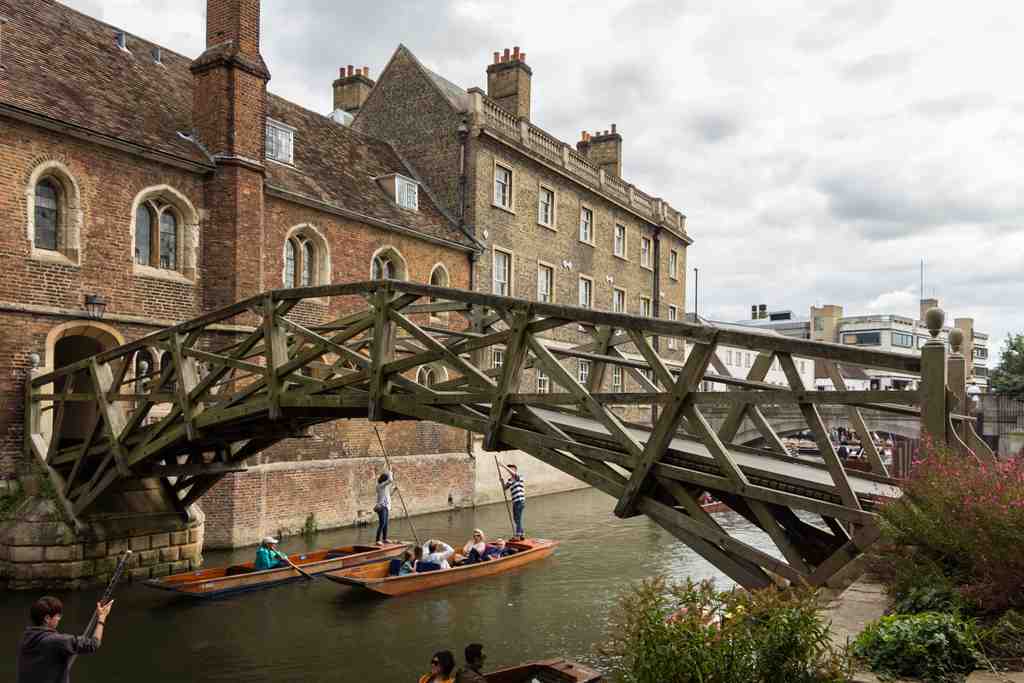
On your left, stretching over the River Cam between the old brick buildings, you’ll spot a striking wooden bridge, its straight timbers zig-zagging together into a gentle…더 보기간략히 보기
On your left, stretching over the River Cam between the old brick buildings, you’ll spot a striking wooden bridge, its straight timbers zig-zagging together into a gentle arch. Welcome to the Mathematical Bridge, one of Cambridge’s most mysterious and iconic sights! Picture yourself standing here in 1749-horses clip-clopping in the distance, the air full of the scent of fresh timber and river water, and the quiet buzz of students chattering as craftsmen work with saws and hammers. Built by James Essex from a cutting-edge design by William Etheridge, this bridge was no ordinary feat. To everyone’s surprise, the bridge looks curved, but not a single curved piece was used! Every one of those wooden beams is perfectly straight. It’s like a magician’s trick, and the secret is hidden in its clever geometric arrangement-tangents and spokes locked tightly together, creating an elegant arch strong enough to carry eager students racing across between classes. As you stand here, you might hear the gentle splash of a punt pole dipping in the Cam below. But listen closely-the bridge has its own stories to whisper! One of the wildest myths is that the great Isaac Newton himself built the bridge, using nothing but sheer genius-no nuts, no bolts, and definitely no glue. The tale goes that students once tried to take it apart, convinced it was all magic, but of course, when they tried to put it back together again, it promptly collapsed into a pile of awkward timber! The truth is a bit less dramatic, but just as clever. Bolts were hidden away in the joints with iron spikes, so from the inside they were nearly invisible. That’s more a sign of engineering flair than wizardry. Imagine the tension as those students realized-maybe, just maybe, their professors did know a thing or two after all! And no, Newton couldn’t have been responsible-he’d already left this world a good two decades before the bridge appeared. But the myth sticks around, perhaps because everyone wants a slice of Cambridge magic. Today, this bridge still connects two sides of Queens' College and stands as a reminder that sometimes the simplest-seeming things are the most ingeniously designed. So next time someone asks you if the Mathematical Bridge is held together by mysterious forces, you can smile and say, “Only if you count bolts as magical!”
전용 페이지 열기 →On your left, stretching over the River Cam between the old brick buildings, you’ll spot a striking wooden bridge, its straight timbers zig-zagging together into a gentle…더 보기간략히 보기
On your left, stretching over the River Cam between the old brick buildings, you’ll spot a striking wooden bridge, its straight timbers zig-zagging together into a gentle arch. Welcome to the Mathematical Bridge, one of Cambridge’s most mysterious and iconic sights! Picture yourself standing here in 1749-horses clip-clopping in the distance, the air full of the scent of fresh timber and river water, and the quiet buzz of students chattering as craftsmen work with saws and hammers. Built by James Essex from a cutting-edge design by William Etheridge, this bridge was no ordinary feat. To everyone’s surprise, the bridge looks curved, but not a single curved piece was used! Every one of those wooden beams is perfectly straight. It’s like a magician’s trick, and the secret is hidden in its clever geometric arrangement-tangents and spokes locked tightly together, creating an elegant arch strong enough to carry eager students racing across between classes. As you stand here, you might hear the gentle splash of a punt pole dipping in the Cam below. But listen closely-the bridge has its own stories to whisper! One of the wildest myths is that the great Isaac Newton himself built the bridge, using nothing but sheer genius-no nuts, no bolts, and definitely no glue. The tale goes that students once tried to take it apart, convinced it was all magic, but of course, when they tried to put it back together again, it promptly collapsed into a pile of awkward timber! The truth is a bit less dramatic, but just as clever. Bolts were hidden away in the joints with iron spikes, so from the inside they were nearly invisible. That’s more a sign of engineering flair than wizardry. Imagine the tension as those students realized-maybe, just maybe, their professors did know a thing or two after all! And no, Newton couldn’t have been responsible-he’d already left this world a good two decades before the bridge appeared. But the myth sticks around, perhaps because everyone wants a slice of Cambridge magic. Today, this bridge still connects two sides of Queens' College and stands as a reminder that sometimes the simplest-seeming things are the most ingeniously designed. So next time someone asks you if the Mathematical Bridge is held together by mysterious forces, you can smile and say, “Only if you count bolts as magical!”
전용 페이지 열기 →To spot King’s College Chapel, look to your left for an enormous stone building with towers topped by intricate pinnacles and a huge, arched window filled with delicate…더 보기간략히 보기
To spot King’s College Chapel, look to your left for an enormous stone building with towers topped by intricate pinnacles and a huge, arched window filled with delicate glasswork. Now that you’re standing before King’s College Chapel, take a moment and let your mind travel back through the centuries-it’s hard not to feel something special here. Imagine it: the year is 1446, and instead of undergraduates hurrying to lectures, the green lawns are bustling with builders in woolen tunics, the air humming with the sharp tap of chisels and the grumble of carts hauling stone. The first stone for this chapel was laid by King Henry VI himself, who was dreaming big-he wanted a chapel that would outshine anything else in Cambridge, something that would make people stop, look up, and say “Wow, that’s a chapel fit for a king!” But as anyone who’s ever tackled a home renovation knows, things didn’t go entirely to plan. Not just bad weather or someone forgetting to order bricks-no, this was much bigger. The whole country was thrown into the madness of the Wars of the Roses! Construction would stall for years at a time, and the half-finished chapel stood here like a stony skeleton, year after year, through three different kings’ reigns. It took almost seventy years to finally finish the building, with bits started under Henry VI, more work done when Richard III stopped fighting long enough to lend a hand, and some heroic teamwork by Henry VII, who left behind money in his will just to make sure those masons got paid. If you ever need inspiration for perseverance, look no further than these walls. But oh, what patience produced! Just step inside-or at least peer through those massive windows-because above your head soars the world’s largest fan vault. It’s like looking up into a stone forest, each rib fanning out in perfect symmetry. The original architect, Reginald Ely, probably wouldn’t have believed it-he’d envisioned a simpler vault, but those daring masons under John Wastell went wild and created a ceiling that still amazes people 500 years later. And speaking of amazed, look at those windows! There are twelve along each side and massive showstoppers at each end, filled with stained glass crafted by legendary Flemish glaziers between 1515 and 1531-a rainbow of saints, kings, and Bible scenes lighting up the floor whenever the sun shines. But this chapel has seen more than peace and prayers. During the English Civil War, many churches were smashed up by Puritan soldiers who thought stained glass and statues were a bit too fancy. King’s Chapel was luckier-some say Oliver Cromwell himself, a former student here, ordered its protection. If you look close to the altar, you can still find graffiti scratched into the stone by bored Parliamentarian troops using the chapel as their training ground. And when World War II rolled around, those precious medieval windows were gently taken out and hidden away for safekeeping. And then there’s the painting: towering above the altar is a gigantic work by Rubens, The Adoration of the Magi, added in 1968. Moving it here turned into a proper Cambridge drama-at first, it looked like someone had stuck a postage stamp under a cathedral window! After much huffing and puffing, an architect came up with the idea to add plain shutters to give it the right shape, and now it fits in, as if it belonged all along. Listen closely-all that history is still alive, not just in stone and glass, but in sound. Today, the choir of King’s College still sings under those vaults, their voices soaring up and echoing through the arches, filling the chapel with music during special services and concerts. And every Christmas Eve, the world tunes in to hear a solo voice sing "Once in Royal David’s City" as part of the Nine Lessons and Carols-a tradition broadcast by the BBC to millions. So as you stand here, look up and imagine all those kings, architects, masons, and choirmasters gazing with pride-or possibly a little exhaustion-at what they created. Whether you come for the beauty, the music, or just to snap a great photo, King’s College Chapel stands as a symbol of Cambridge: enduring, uplifting, and full of stories. Now, who’s up for starting a building project that’ll outlast a few civil wars? No takers? Interested in a deeper dive into the construction, great windows or the rood screen? Join me in the chat section for an insightful conversation.
전용 페이지 열기 →
자주 묻는 질문
투어는 어떻게 시작하나요?
구매 후 AudaTours 앱을 다운로드하고 교환 코드를 입력하세요. 투어를 바로 시작할 수 있습니다 - 재생을 탭하고 GPS 안내 경로를 따라가시면 됩니다.
투어 중 인터넷이 필요한가요?
아닙니다! 시작 전에 투어를 다운로드하면 완전히 오프라인으로 즐길 수 있습니다. 채팅 기능만 인터넷이 필요합니다. 모바일 데이터 절약을 위해 WiFi에서 다운로드하시는 것을 권장합니다.
이것은 가이드가 안내하는 단체 투어인가요?
아닙니다 - 이것은 셀프 가이드 오디오 투어입니다. 폰을 통해 오디오 나레이션을 들으며 나만의 속도로 독립적으로 탐험합니다. 투어 가이드도, 단체도, 일정도 없습니다.
투어는 얼마나 걸리나요?
대부분의 투어는 60-90분이 소요되지만, 속도는 전적으로 본인이 조절합니다. 원할 때 언제든지 일시정지하거나, 정류장을 건너뛰거나, 휴식을 취하세요.
오늘 투어를 끝낼 수 없으면 어떻게 하나요?
괜찮습니다! 투어는 평생 이용이 가능합니다. 원할 때 언제든지 일시정지하고 다시 시작하세요 - 내일, 다음 주, 또는 내년에도. 진행 상황이 저장됩니다.
어떤 언어를 이용할 수 있나요?
모든 투어는 50개 이상의 언어로 이용 가능합니다. 코드를 교환할 때 원하는 언어를 선택하세요. 참고: 투어 생성 후에는 언어를 변경할 수 없습니다.
구매 후 투어는 어디에서 이용하나요?
App Store 또는 Google Play에서 무료 AudaTours 앱을 다운로드하세요. 교환 코드(이메일로 전송됨)를 입력하면 라이브러리에 투어가 나타나며, 다운로드하여 시작할 수 있습니다.
투어가 마음에 들지 않으시면 환불해 드립니다. 문의: [email protected]
안전한 결제 


