
Brighton Audio Tour: Below the Promenade
Brighton's seafront looks like a holiday but is a working town in disguise. This self-guided audio tour walks the engine-shed, the kitchen, the service stair and the shingle beach that built Britain's pleasure resort — from Brighton Station, where two thousand men once built the locomotives that brought the visitors in, through the Pavilion kitchen where Carême cooked thirty courses while servants moved invisibly through Dutch-tiled corridors, past the Hippodrome where Charlie Chaplin and Sarah Bernhardt did two shows a night, the Town Hall basement where the first English chief constable was murdered at his own desk, the Grand Hotel where a 1984 night porter dug himself out of rubble, the Birch piers where one-legged divers ate breakfast on the water, and finally the shingle where Brighton's eighty-boat fishing fleet once landed mackerel by capstan and sold it by Dutch auction. Walk slowly. The Brighton you came to see was built by people you never saw.
투어 미리보기
이 투어에 대하여
- schedule소요 시간 40–60 mins나만의 속도로 이동
- straighten6.1 km 도보 경로안내 경로 따라가기
- location_on
- wifi_off오프라인 작동한 번 다운로드, 어디서든 사용
- all_inclusive평생 이용언제든지 다시 재생 가능
- location_onBrighton railway station에서 시작
이 투어의 정류장
In front of you is a long cream-stone station frontage with tall arched windows and a broad curved iron-and-glass roof rising behind it, marked by the entrance clock. This is…더 보기간략히 보기
전용 페이지 열기 →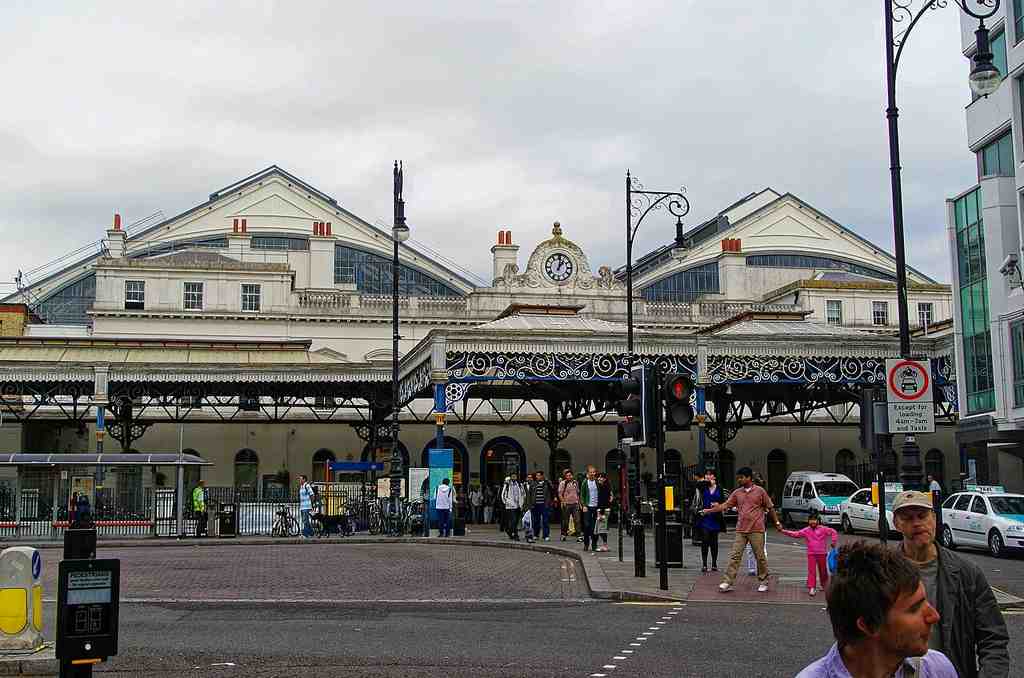
Brighton railway stationPhoto: Txllxt TxllxT, Wikimedia Commons, CC BY-SA 4.0. Cropped & resized. In front of you is a long cream-stone station frontage with tall arched windows and a broad curved iron-and-glass roof rising behind it, marked by the entrance clock.
This is Brighton’s front door... and, for a long time, its workshop. The station arrived in two acts. First came David Mocatta’s Italianate forebuilding in eighteen forty to eighteen forty-one, the handsome early terminus that still survives behind later additions. Then, four decades on, H-E Wallis gave the platforms their great double-spanned curved roof in eighteen eighty-two to eighteen eighty-three, carried on cast-iron columns. Some of those columns still bear the makers’ stamp: “Patent Shaft and Axletree Co, eighteen eighty-two, Wednesbury.” Very Victorian, very confident, and not remotely shy about branding.
Brighton made its money less by making things than by looking after people who came here to enjoy themselves. Chambermaids, footmen, gardeners, pier hands, hotel staff, deckchair attendants, fortune-tellers, seafront workers... this town learned to serve the visitor. And this station delivered the visitors by the trainload.
Before you move on, try a little treasure hunt: look up and see if you can spot one of those iron supports and its cast lettering. If you want a closer look, the roof-detail image in the app makes the engineering easier to read.
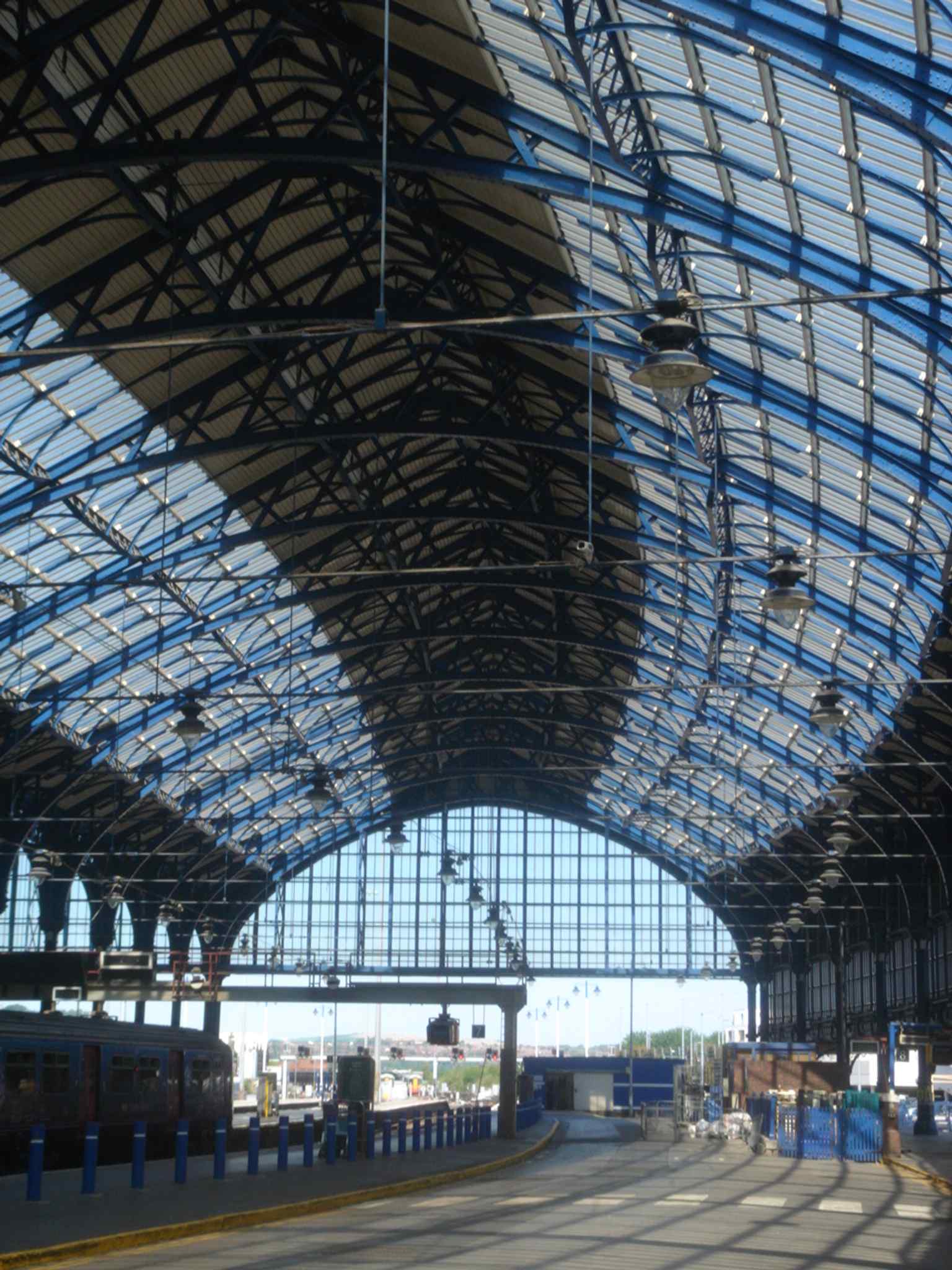
A close-up of the station roof structure, highlighting the iron-and-glass engineering that replaced the earlier separate platform sheds.Photo: Hassocks5489, Wikimedia Commons, CC0. Cropped & resized. Right beside the station stood Brighton Locomotive Works, founded in eighteen forty. Over its life, the works built more than one thousand two hundred locomotives. At its peak in the eighteen nineties, more than two thousand two hundred people worked there; by the nineteen fifty-two centenary, about six hundred and fifty remained. William Stroudley, superintendent from eighteen seventy to eighteen eighty-nine, became the star name. His best-known engines were the A-one “Terriers,” fifty compact tank engines built here between eighteen seventy-two and eighteen eighty. People nicknamed them Terriers because their exhaust had a sharp little bark. We’ll come back to them later.
The human story matters just as much as the machines. Apprenticeship here was almost hereditary: if your father worked there, you had a way in. Boys could start at fourteen and pass through the boiler shop, erecting shop, fitting shop, plating shop, welding shop, coppersmith, and brass foundry. Harsh work, dangerous work... but also work people took fierce pride in.
And the station kept evolving with the town it fed. If you fancy it, have a quick look at the before-and-after image; the forecourt changed from a sparse early nineteen sixties gateway into the busier entrance you see now.
The works produced engines, but they also helped power Brighton’s glamour. The Brighton Belle Pullman ran between London Victoria and Brighton from nineteen thirty-three to nineteen seventy-two, turning arrival into a small ceremony. Then the long fade: locomotive building stopped in nineteen fifty-seven, the works closed in nineteen sixty-two, and demolition followed in nineteen sixty-nine. The New England Quarter stands there now, though old support columns survive on the greenway, and names like Stroudley Road and Billinton Road keep the railway men in circulation.
When you’re ready, head south down Queens Road for about eleven minutes toward the Royal Pavilion quarter; the domes and minarets ahead and to the left will help guide you. Your next stop is the Royal Pavilion.
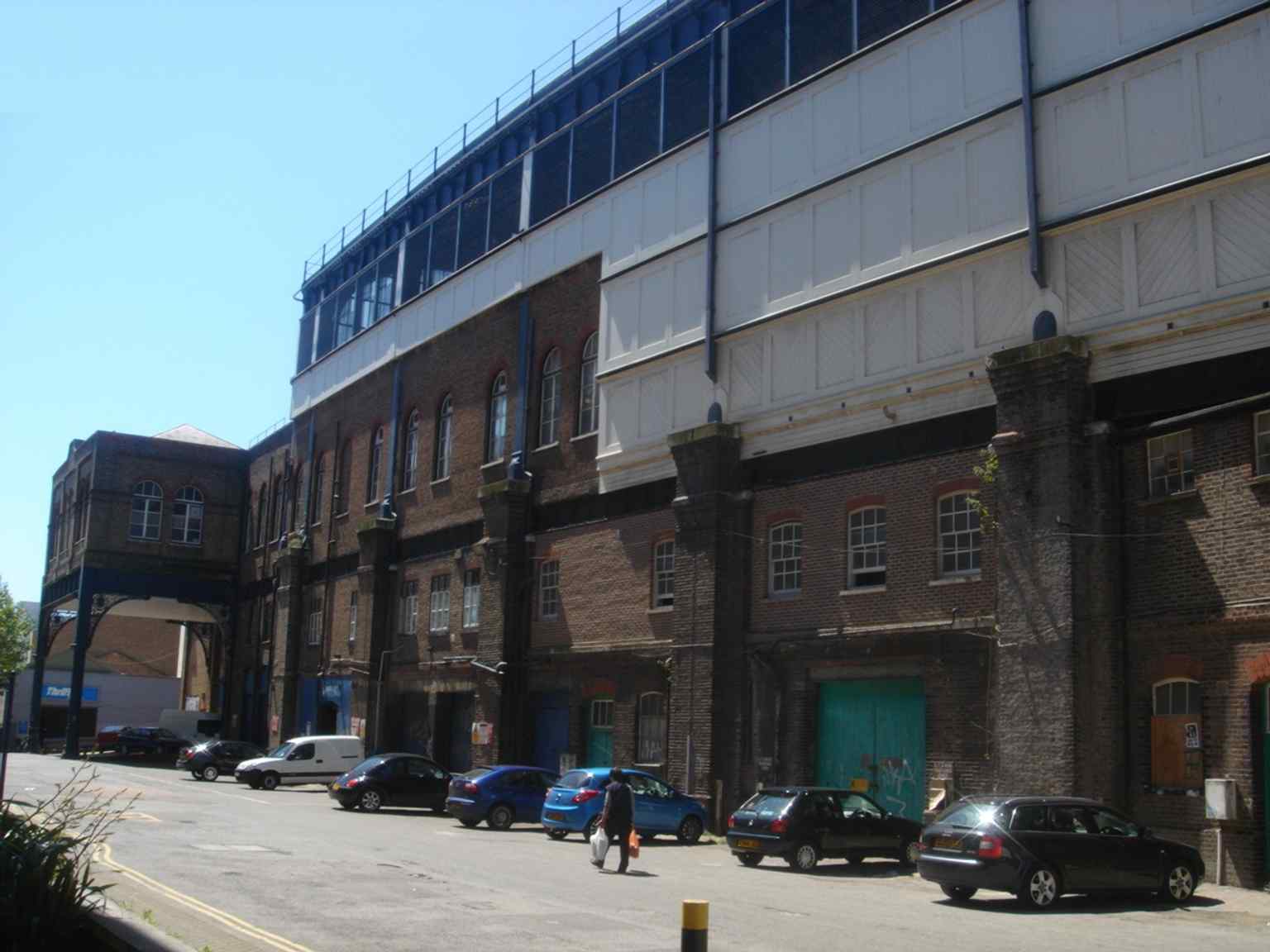
The southeast corner of the station, a good view of the main building where Brighton’s original Italianate terminus survives behind later additions.Photo: Hassocks5489, Wikimedia Commons, CC0. Cropped & resized. 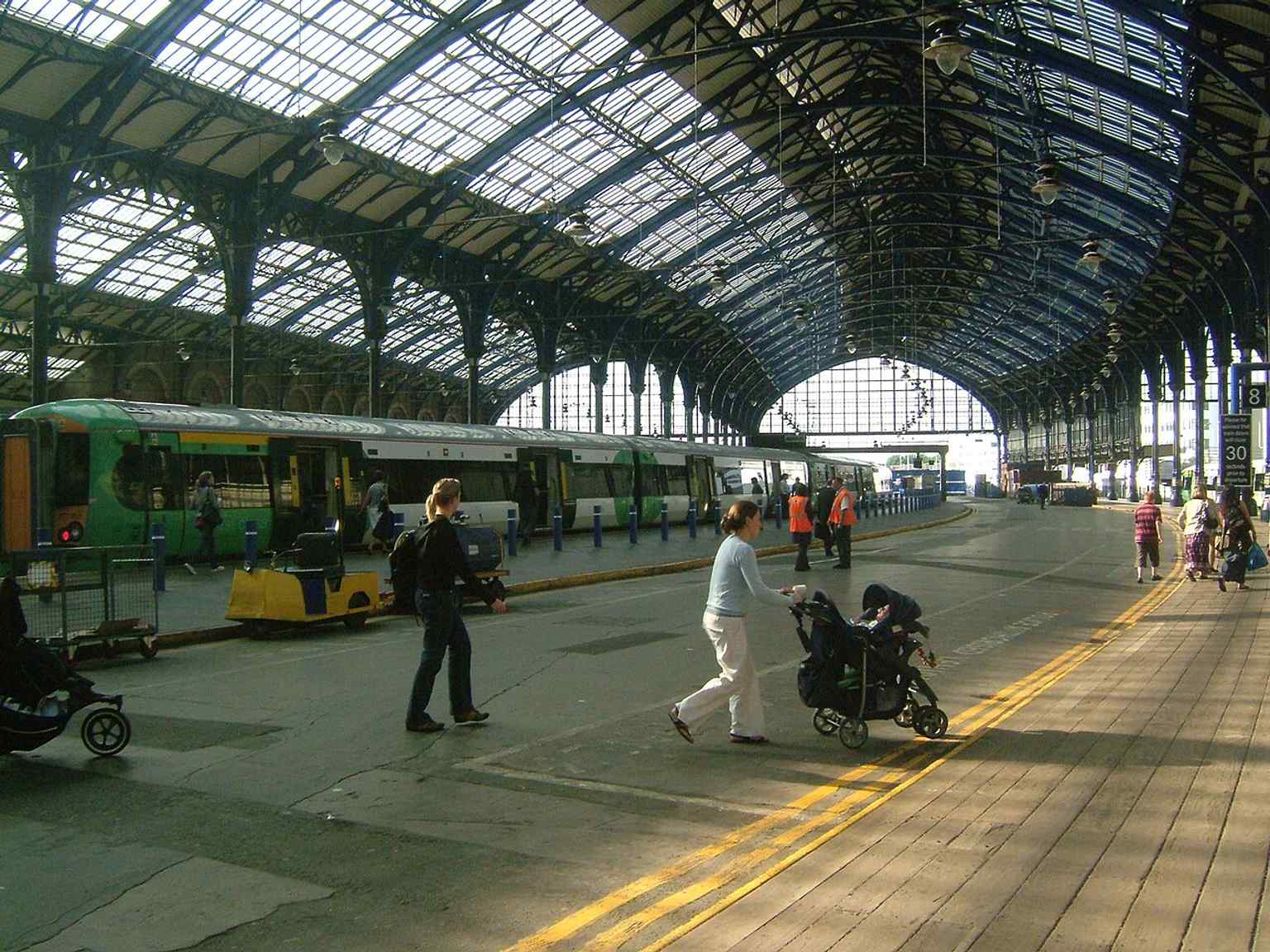
Platforms 7 and 8 beneath the great curved roof — the busiest end of the station for East Coastway services and football traffic.Photo: Clem Rutter, Rochester Kent, Wikimedia Commons, CC BY-SA 3.0. Cropped & resized. 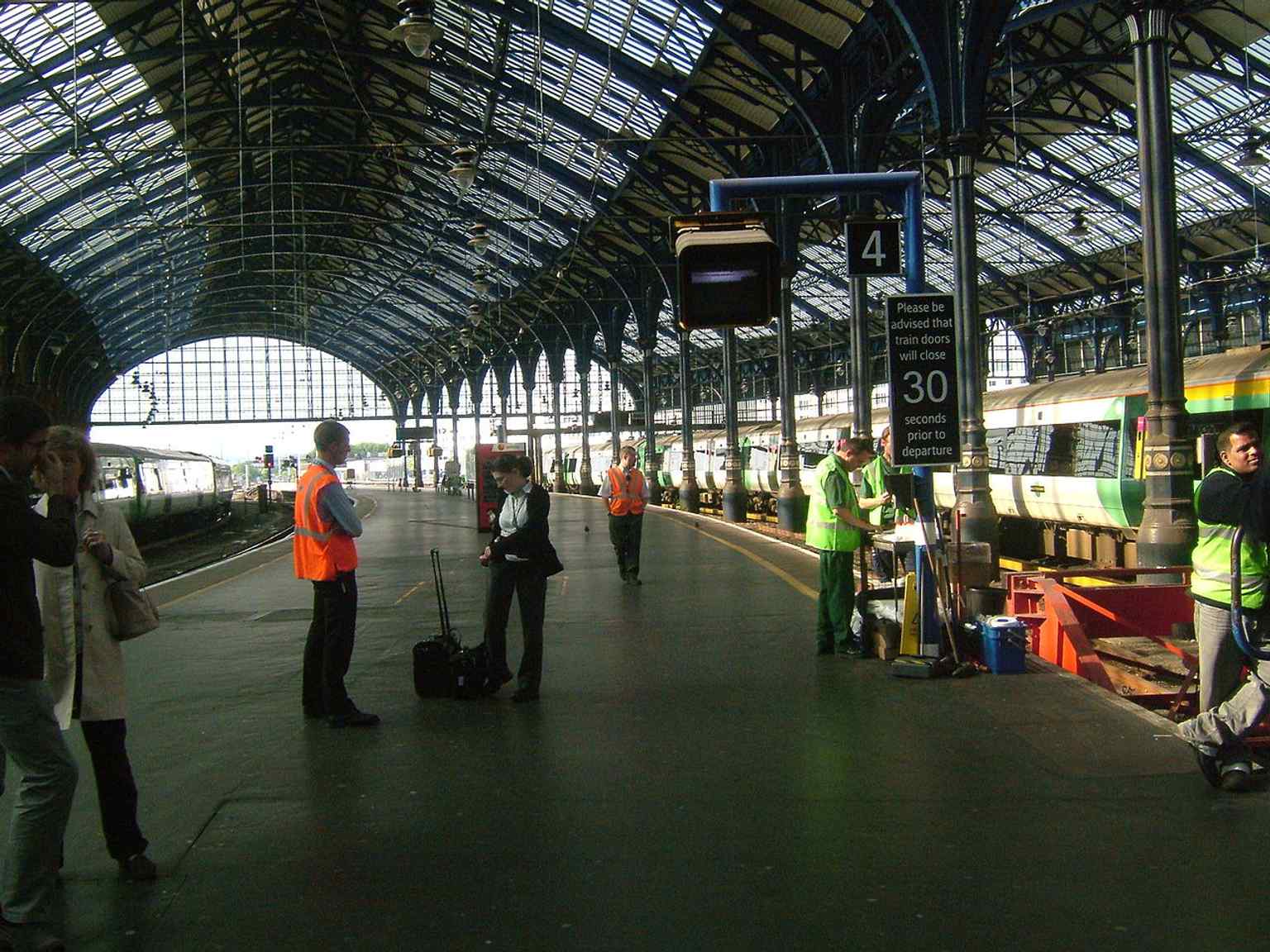
Platform 3 and 4 under the cast-iron and glass shed, the key through-platform where different routes can share space.Photo: Clem Rutter, Rochester Kent, Wikimedia Commons, CC BY-SA 3.0. Cropped & resized. 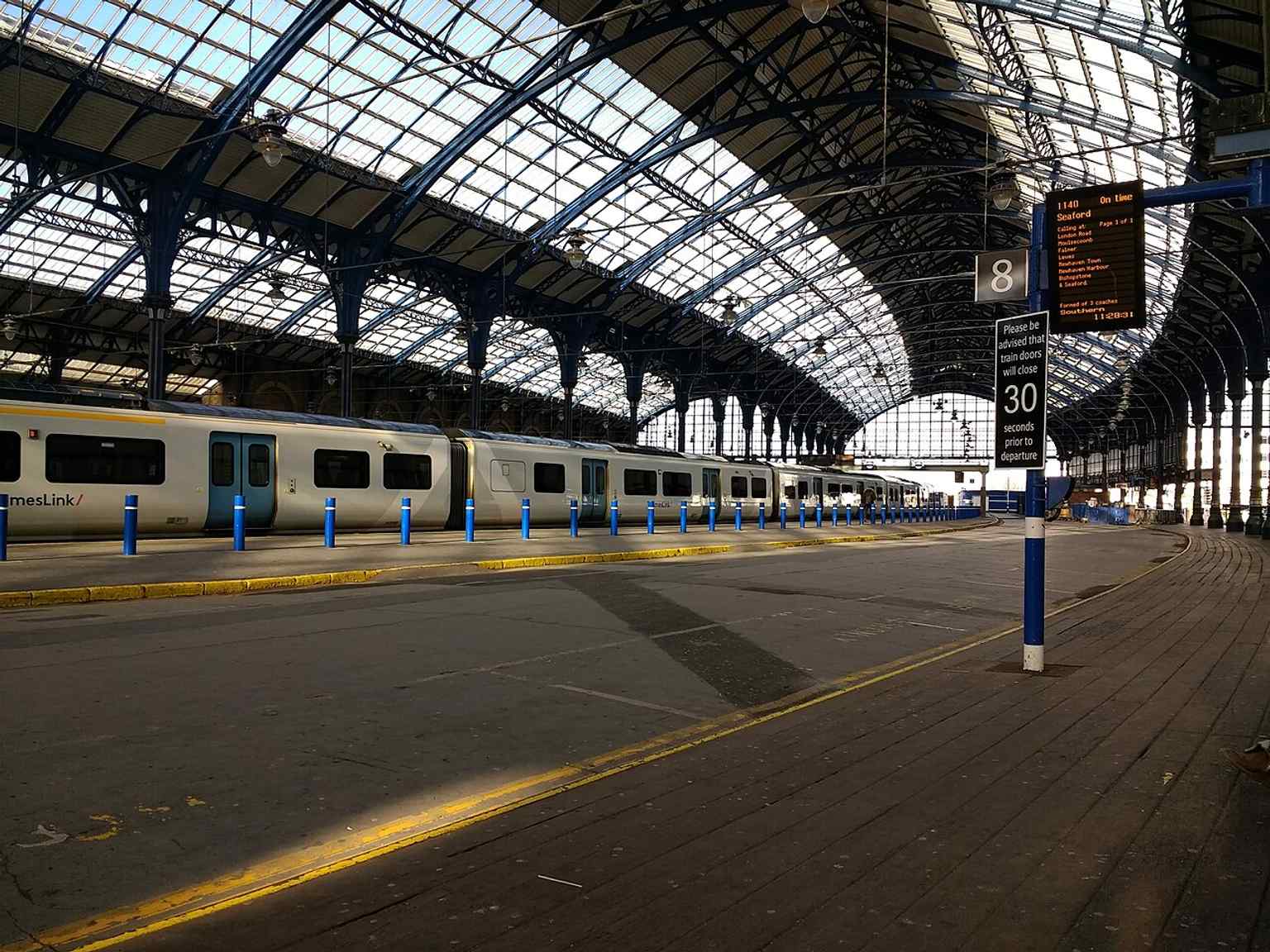
Platform 8 with a modern Class 700, showing how Brighton’s long platforms now handle today’s Thameslink and Southern services.Photo: My name is not dave, Wikimedia Commons, CC BY-SA 4.0. Cropped & resized. 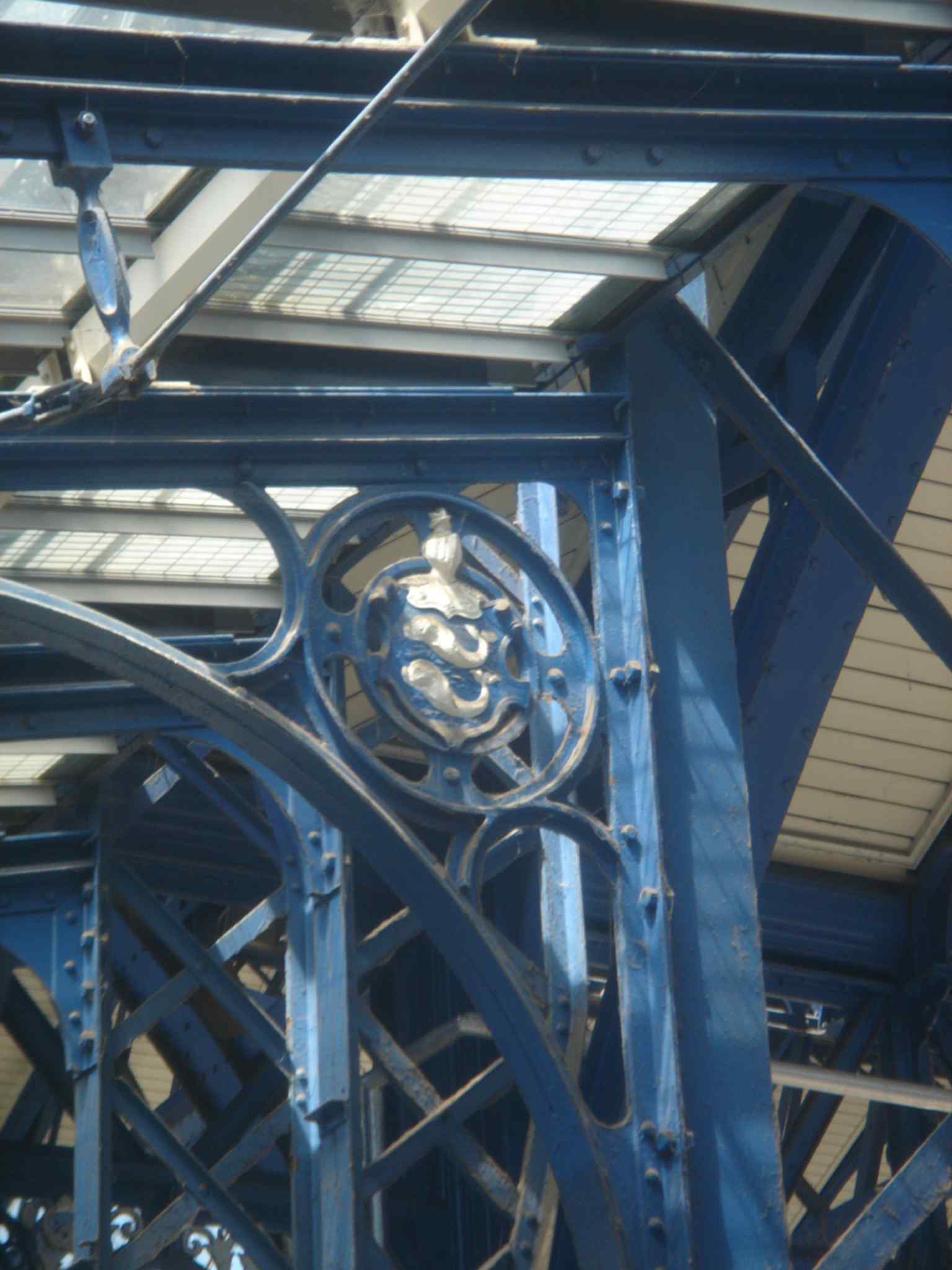
Roof ornament and coat-of-arms detail inside the station — a reminder that Brighton’s terminus was built to impress as well as function.Photo: Hassocks5489, Wikimedia Commons, CC0. Cropped & resized. 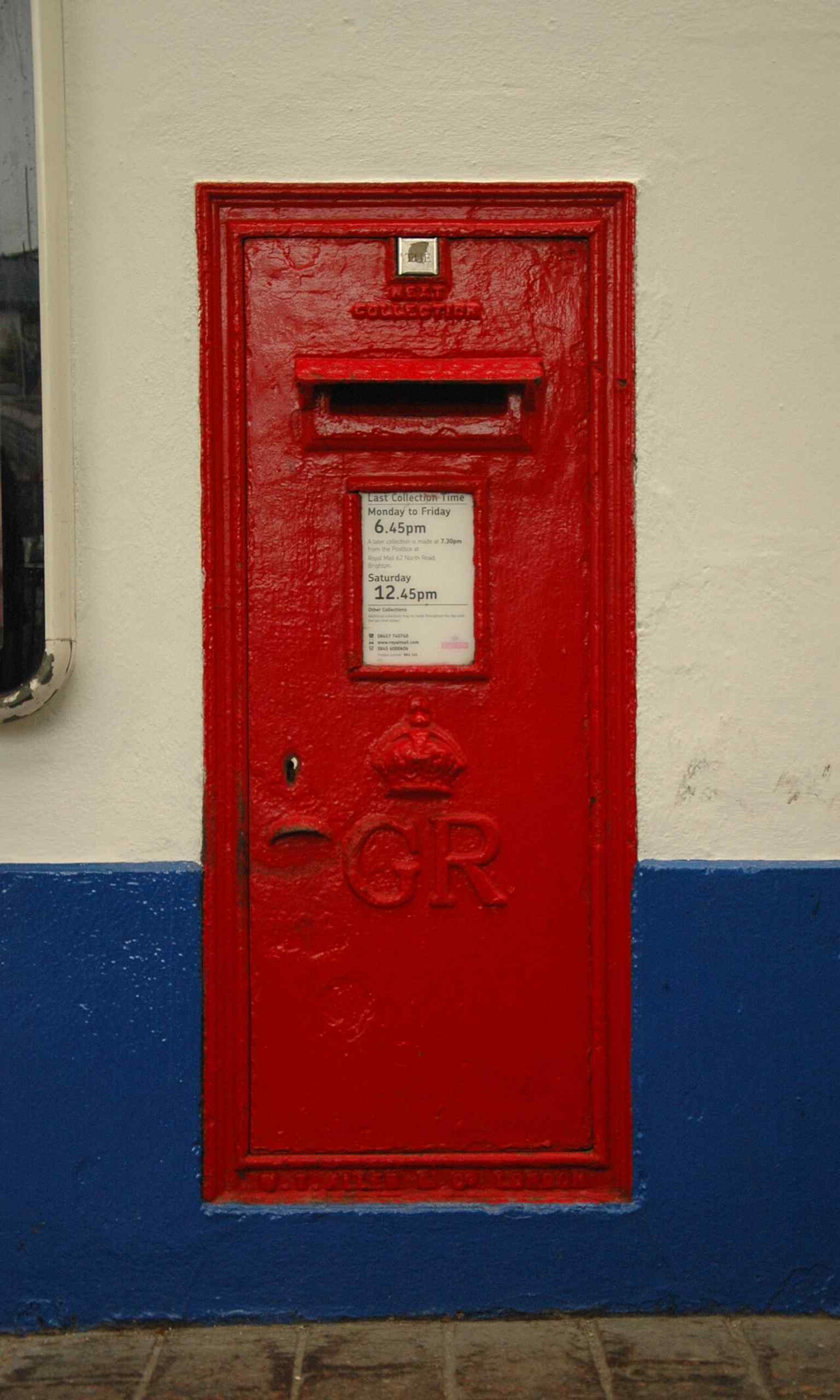
A George V wall-mounted post box inside the station, one of the small everyday features tucked into this busy terminus.Photo: Motacilla, Wikimedia Commons, CC BY-SA 3.0. Cropped & resized. On your left, look for a long pale stucco façade with two short square towers and a stepped central pediment rising above the entrance canopy. Brighton gave this place a very…더 보기간략히 보기
전용 페이지 열기 →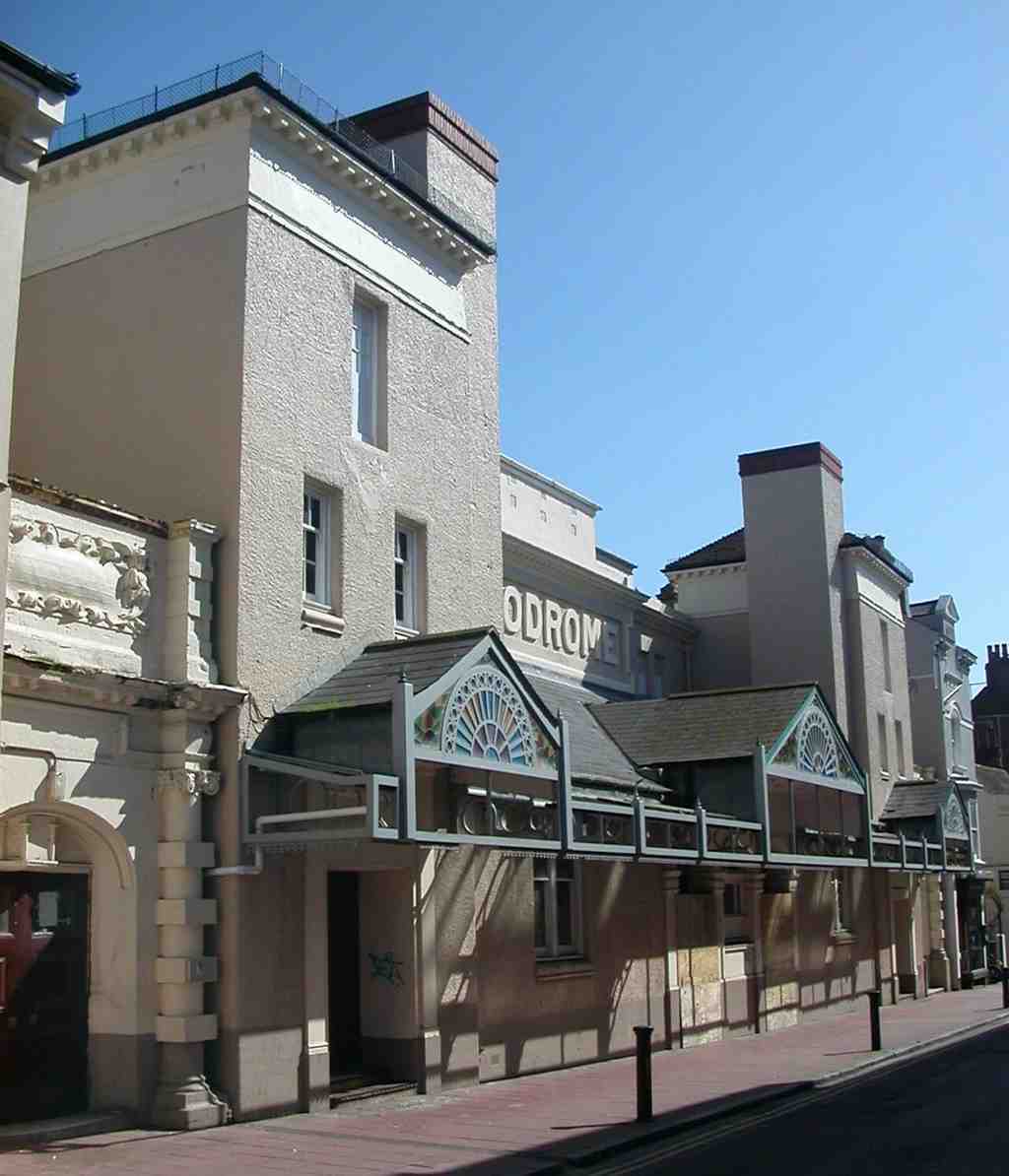
Brighton HippodromePhoto: The Voice of Hassocks, Wikimedia Commons, Public domain. Cropped & resized. On your left, look for a long pale stucco façade with two short square towers and a stepped central pediment rising above the entrance canopy.
Brighton gave this place a very different job when architect Lewis Karslake opened it in eighteen ninety-seven as an ice-skating rink. That idea slid nowhere fast. So in nineteen oh-one, the great theatre architect Frank Matcham came in and turned the building into a circus. A year later, architect Bertie Crewe changed it again, replacing the circus ring with seating, and on the twenty-second of December, nineteen oh-two, the Hippodrome reopened as a variety theatre. Brighton, apparently, liked reinvention almost as much as applause.
Inside, Matcham left behind one of his finest interiors: a huge auditorium, horseshoe-shaped, with Rococo decoration - that means lavish curling plasterwork, all flourish and confidence. Capacity sat somewhere around one thousand two hundred and fifty to one thousand five hundred. Not tiny, not enormous... just big enough to demand hard labor from everyone who worked it.
And this was a workplace. The bills brought in the touring elite: Harry Houdini, W. C. Fields, Lillie Langtry, Sarah Bernhardt, Bill "Bojangles" Robinson. One of Charlie Chaplin's first jobs here was only a bit part in Fred Karno's comedy Saturday to Monday. Brighton's own Max Miller kept returning between nineteen twenty-eight and nineteen sixty. For audiences, it looked glamorous. For performers, it could be punishing.
A typical week might mean two evening shows a night, six nights a week, plus matinées - afternoon performances - if managers demanded them. Some artistes earned only thirty shillings to three pounds a week, roughly the low hundreds of pounds in today's money. For that schedule, it was no princely sum. Those conditions helped spark something bigger here. On the eighteenth of February, nineteen oh-six, performers founded the Variety Artistes' Federation in direct response to this kind of grind. By the Music Hall Strike of nineteen oh-seven, the complaint was blunt: managers wanted extra shows without extra pay. Within weeks, the union had four thousand members. So this building did not just host entertainment; it helped expose how the entertainment business treated its workers.
The Hippodrome adapted for decades after variety declined. But the theatre itself closed on the twenty-second of November, nineteen sixty-four. In nineteen sixty-seven, it became Mecca Bingo. That kept it alive, in a way, until the bingo hall closed in August of two thousand and six.
Since then, the place has hovered in that miserable category called Heritage at Risk: important enough to protect, expensive enough to neglect. It carries Grade Two Star listing status, meaning it is particularly important. Matsim Properties bought it in September two thousand and twenty, and Brighton and Hove News reported in April twenty twenty-six that restoration plans now aim to raise capacity from one thousand eight hundred to two thousand three hundred, with three million pounds set aside for a new acoustic roof. So the old worker may yet clock in again.
When you're ready, head west toward King's Road. Your next stop is Brighton Bandstand.
12개 정류장 더 보기정류장 적게 보기expand_moreexpand_less
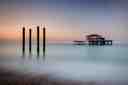
On your left, the West Pier looks like a rusted iron skeleton stretching in a straight line over the sea, ending in a broken lacework of metal. Eugenius Birch designed this…더 보기간략히 보기
전용 페이지 열기 →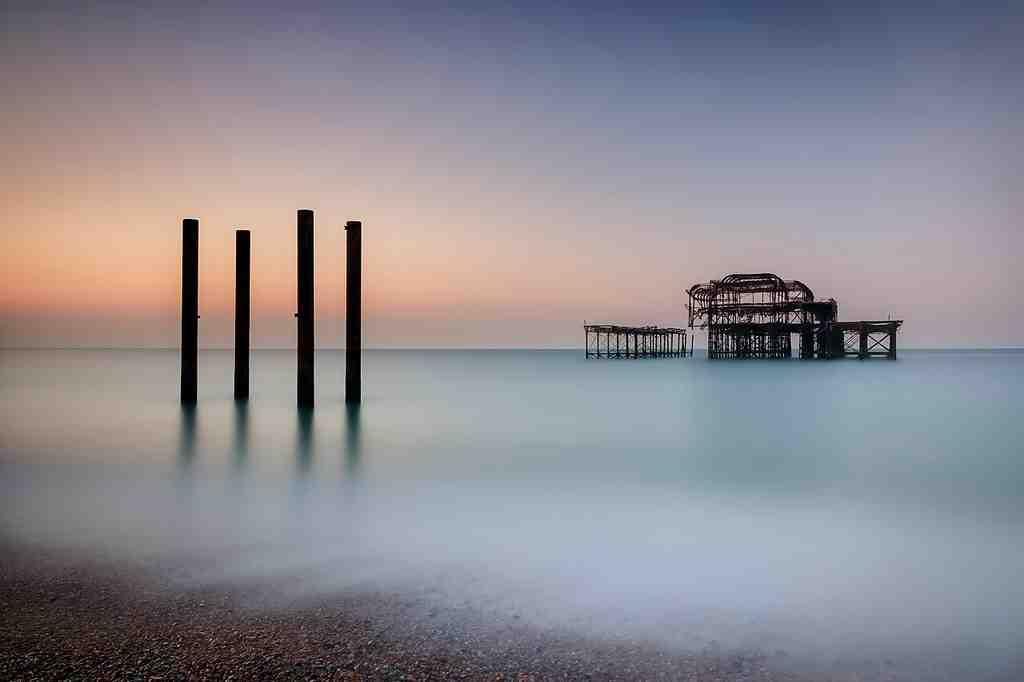
West PierPhoto: Christerajet, Wikimedia Commons, CC BY-SA 4.0. Cropped & resized. On your left, the West Pier looks like a rusted iron skeleton stretching in a straight line over the sea, ending in a broken lacework of metal.
Eugenius Birch designed this pier, and it opened in eighteen sixty-six as the West End Pier. At eleven hundred and fifteen feet long, it was a serious piece of Victorian ambition, and later it became the first pier in England to gain Grade One listing - the highest level of historic protection, which is a little grimly ironic given what you’re looking at now.
Brighton’s two great pleasure piers were not just ornaments on the horizon. They were workplaces: ticket-takers, concert-hall staff, deckchair attendants, fortune-tellers like Eva Petulengro on Palace Pier, Punch and Judy operators on the beach, and here on West Pier, even paid professional divers.
At first, Birch sold healthy sea air. Then entertainment took over. In eighteen ninety-three, Birch’s nephew Peregrine supervised an extension and added a pavilion at the pierhead. In nineteen sixteen, local architects Clayton and Black replaced the old bandstand with an eight-sided concert hall of cast-iron arches. It opened on the twentieth of April, nineteen sixteen, with the King’s Royal Rifles silver band, made up of war veterans. By the years after the First World War, the pier pulled in around two million visitors. Not bad for a structure standing on screwed-in iron columns over salt water.
And then there were the “Professors”... the pier’s star divers. Captain Camp, the one-legged swimmer, famously prepared and ate his breakfast on the water. There were Professor Reddish and Professor Cyril, Professor Powsey, Gladys Powsey diving in a Bovril costume, Zoe Brigden - a Brighton swimming champion turned professional in nineteen thirteen - and Walter Tong, born in Bolton in eighteen ninety-two, who performed the Moleberg Dive: a backward somersault from forty to fifty feet. Health and safety had not yet reached its full majestic bloom.
The danger was real. Professor Cyril, whose real name was Albert Huggins Heppell, died in May nineteen twelve while attempting a bicycle dive. He slipped, struck the deck, and fractured his skull.
If you glance at the before-and-after image, the change from a complete pleasure pier in nineteen seventy to this stripped frame is startling.
The end came in slow blows, then sudden ones. Brighton Corporation declined to buy the pier, and it closed in nineteen seventy-five. The West Pier Trust formed in nineteen seventy-eight and bought it from the Crown Commissioners for one hundred pounds in nineteen eighty-four. But the Great Storm of nineteen eighty-seven damaged it badly, and access from shore ended in nineteen ninety-one. Then came the final cruelty: arson fires. On the twenty-eighth of March, two thousand and three, fire destroyed the pavilion. On the eleventh of May, another fire tore through the concert hall, already weakened by storm damage.
Now the shoreline works differently. At the pier root stands the Brighton i-three-sixty, the one-hundred-and-sixty-two-meter tower by Marks Barfield, the same designers who gave London the Eye, opening in early August two thousand and sixteen. Different machinery, same old Brighton instinct: charge admission for a view.
Now turn back east along the seafront. Palace Pier is farther on - the long, lit-up pier with the helter-skelter at its end - but first, in about four minutes, we’ll stop at The Grand Brighton.
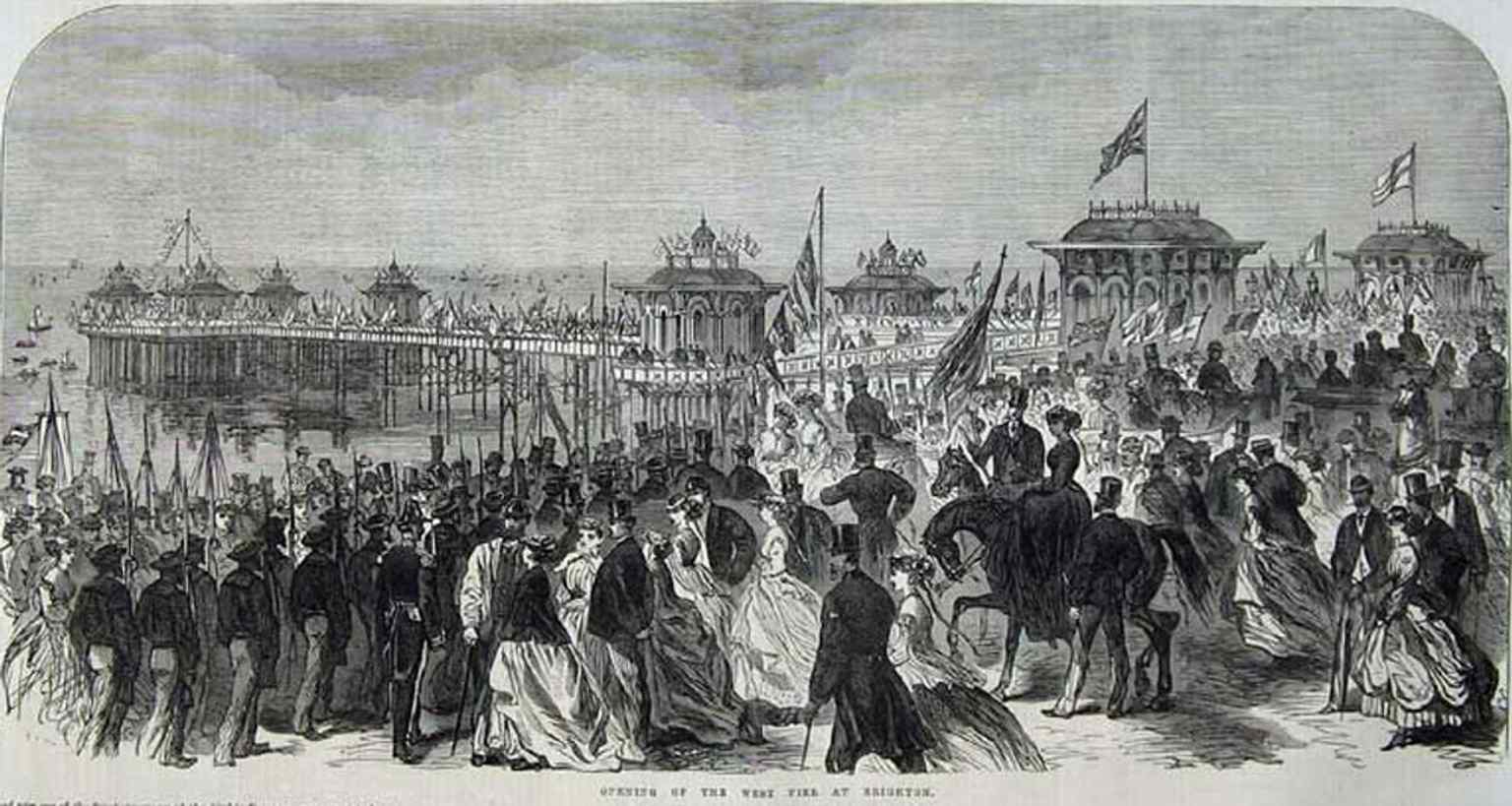
The pier’s grand opening in 1866, with the original ornamental houses and weather screens that made it Birch’s seaside ‘masterpiece’.Photo: Unknown authorUnknown author, Wikimedia Commons, Public domain. Cropped & resized. 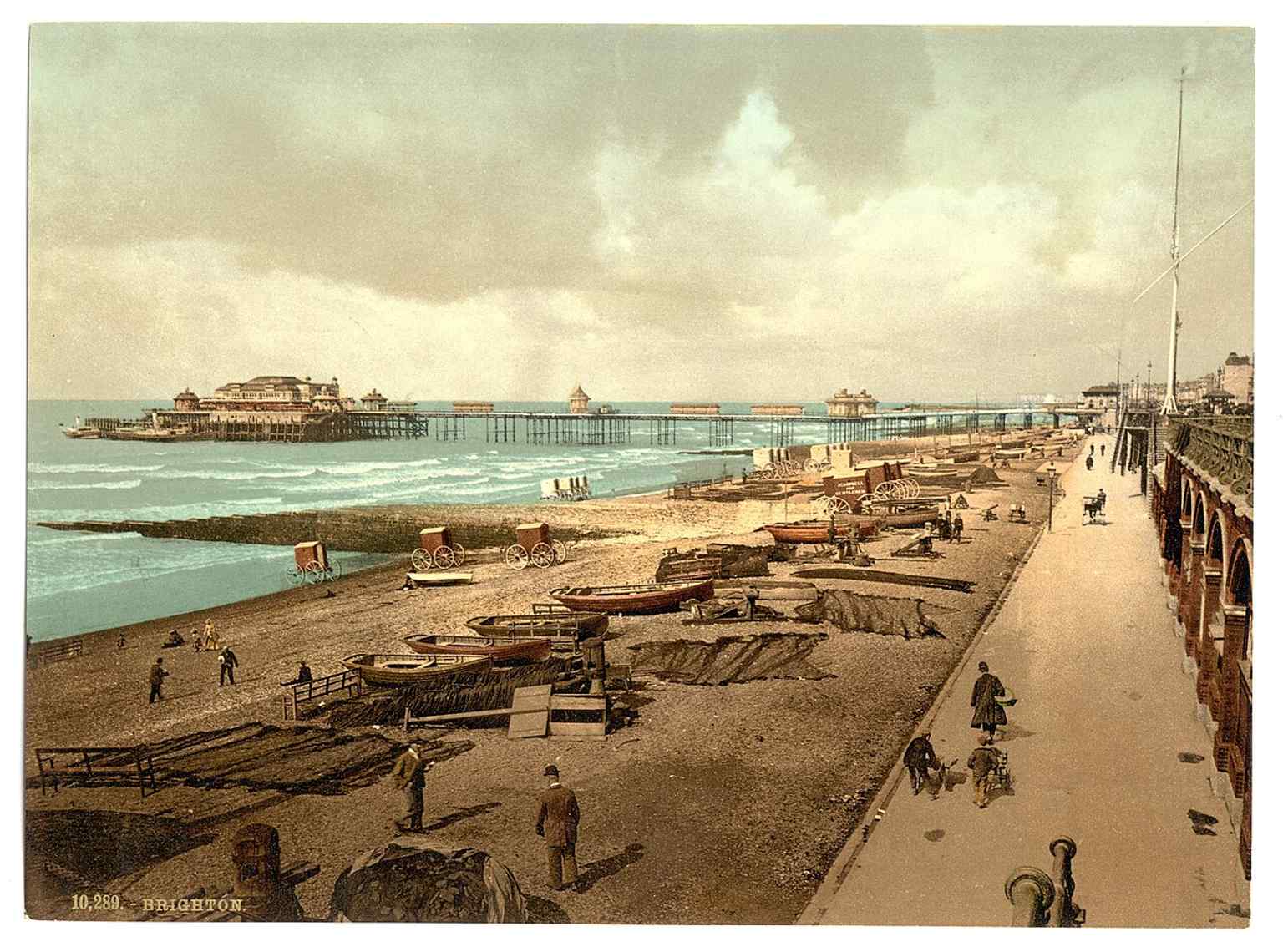
A Victorian photochrom view from the east showing West Pier in its early glory, when Brighton had only just gained its second pier.Photo: Photochrom Print Collection, Wikimedia Commons, Public domain. Cropped & resized. 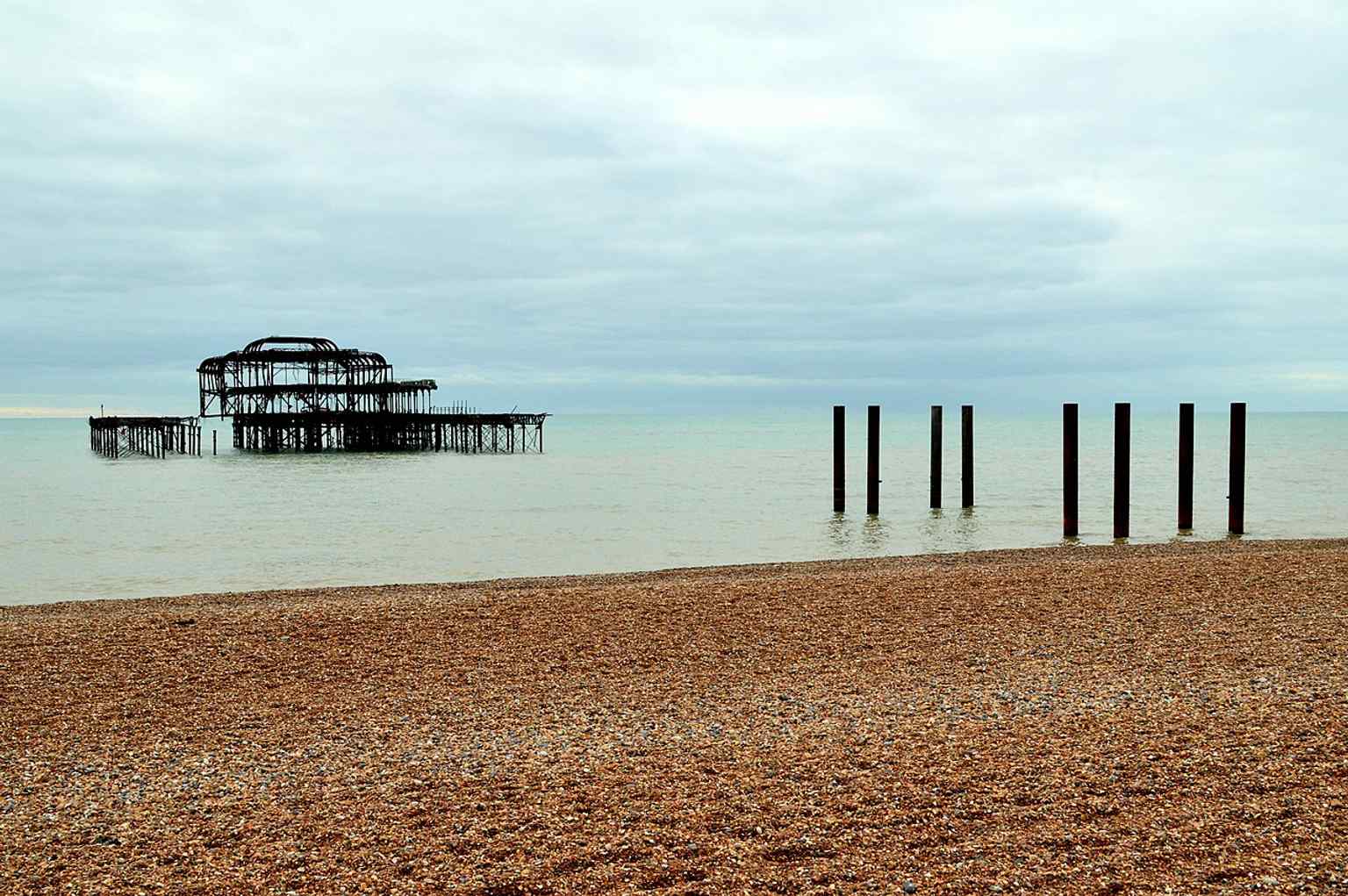
A wide view of the derelict West Pier skeleton, showing how storms and collapse turned it into an icon of Brighton’s seafront.Photo: FeinFinch, Wikimedia Commons, CC BY-SA 4.0. Cropped & resized. 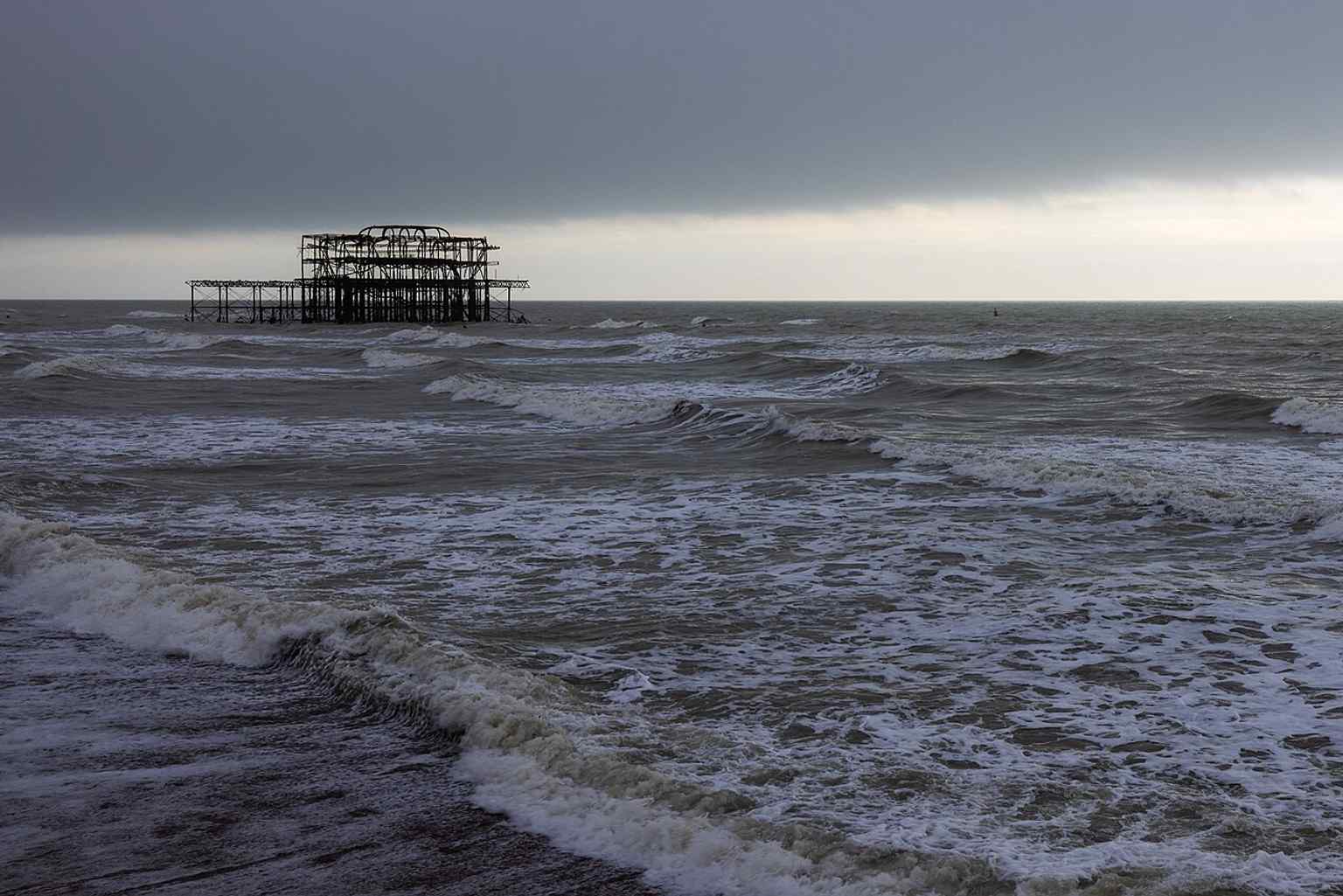
The remains of West Pier in 2024, a stark metal frame left after fire, storms, and partial demolition for the i360 site.Photo: The wub, Wikimedia Commons, CC BY-SA 4.0. Cropped & resized. 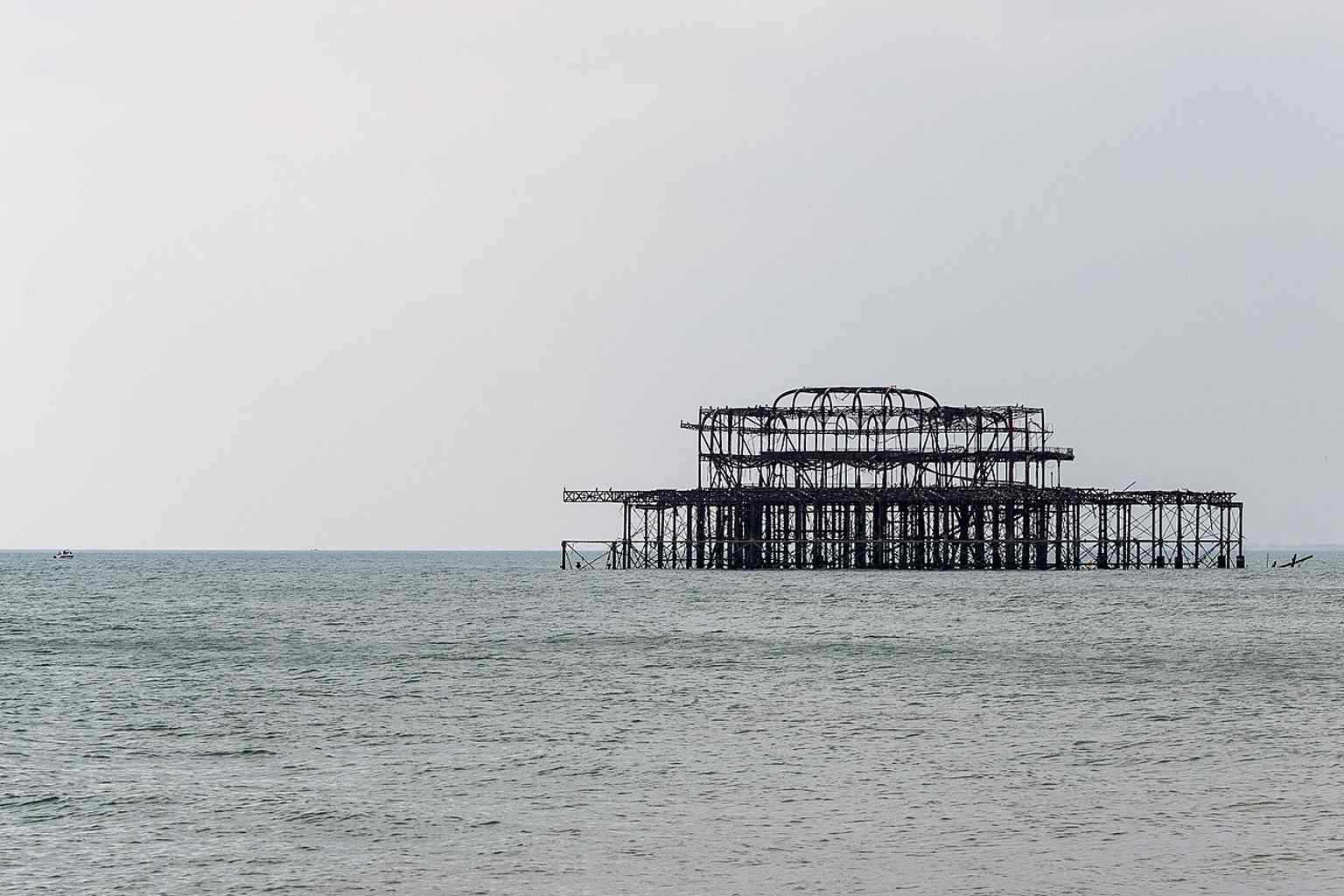
A close look at the rusting ironwork of the ruined pier, echoing the Grade I-listed structure’s long battle with the sea.Photo: MrsEllacott, Wikimedia Commons, CC BY-SA 3.0. Cropped & resized. 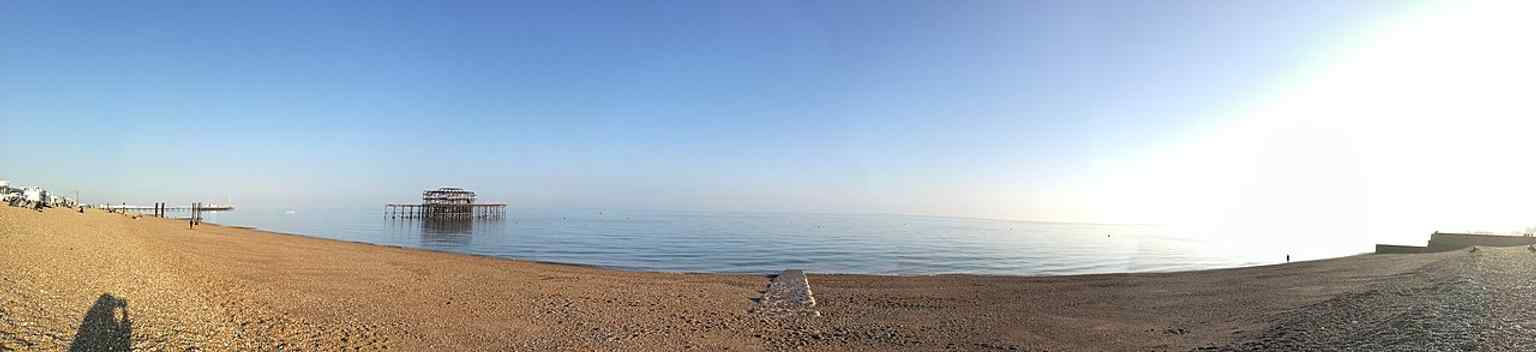
A panoramic seafront view with West Pier ruins stretching into the water, useful for showing the pier’s place on Brighton’s shoreline.Photo: Lewek-rafek, Wikimedia Commons, CC BY-SA 4.0. Cropped & resized. 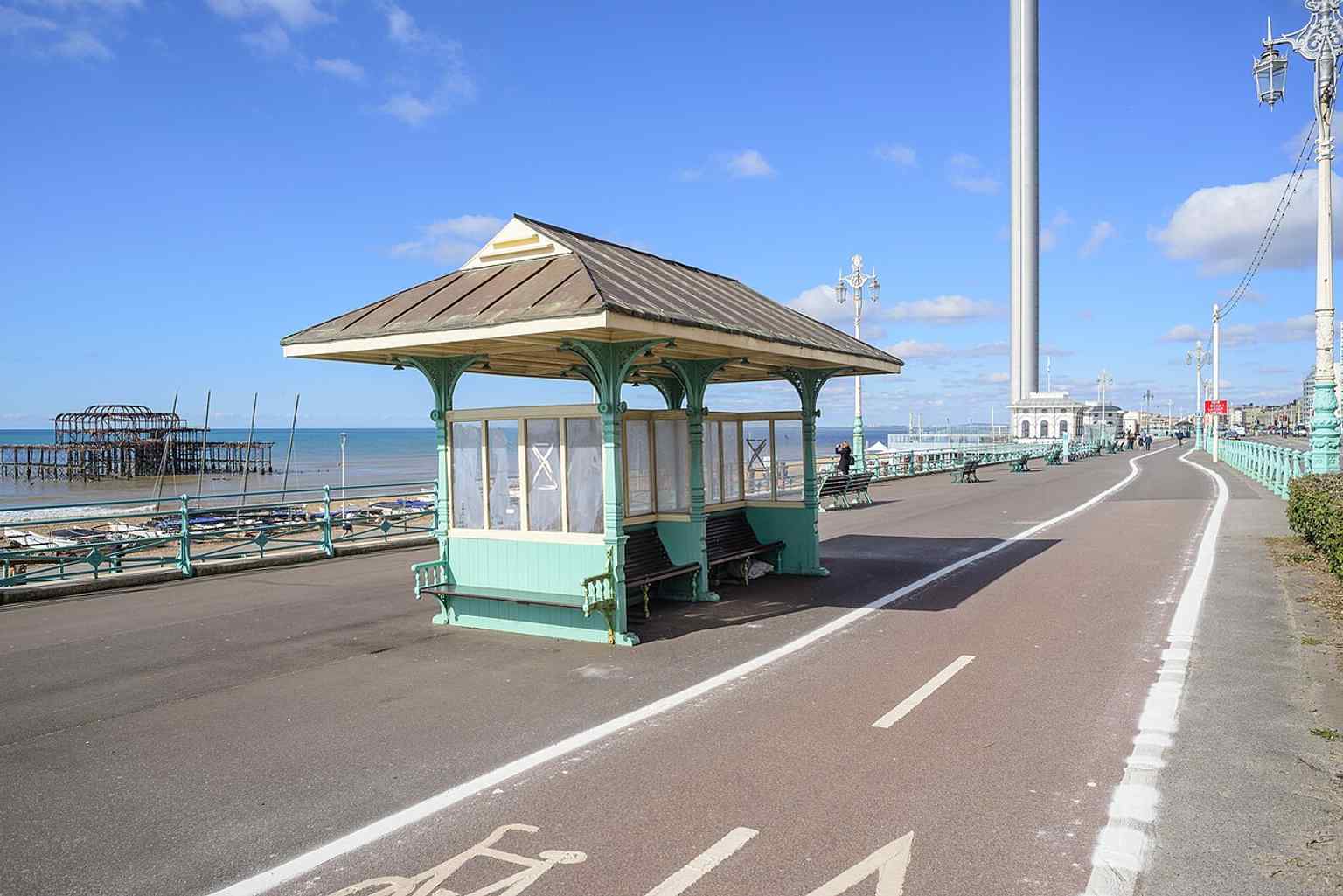
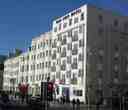
West Pier with the i360 in the background, linking the ruined landmark to modern seafront development.Photo: Arild Vågen, Wikimedia Commons, CC BY-SA 4.0. Cropped & resized. On your left, the Old Ship Hotel shows itself as a long pale-stucco seafront frontage, with orderly sash windows and a rounded corner block turning into Ship Street. This place…더 보기간략히 보기
전용 페이지 열기 →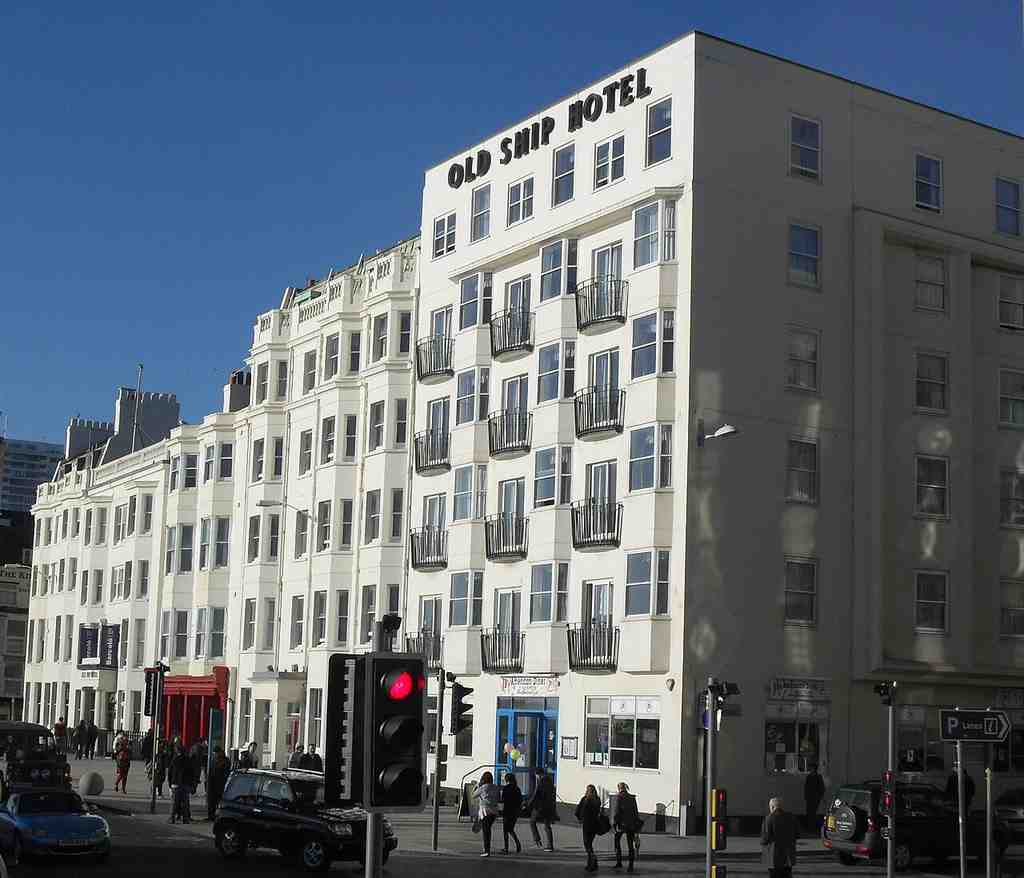
Old Ship HotelPhoto: Hassocks5489, Wikimedia Commons, CC0. Cropped & resized. On your left, the Old Ship Hotel shows itself as a long pale-stucco seafront frontage, with orderly sash windows and a rounded corner block turning into Ship Street.
This place started small... very small. Around fifteen fifty-nine, Richard and John Gilham owned an unnamed house here, probably the seed of what became the Old Ship. The first clear record turns up in sixteen sixty-five, and that makes this Brighton’s oldest hotel. It did not even face the sea at first. Only in seventeen ninety-four did the inn gain its proper promenade presence, when the owners folded two seafront houses into the building and gave it the frontage you’re looking at now.
That changed everything, because the Old Ship became a machine for movement. For about a hundred years, coaches arrived and left from here for London and other major cities. One service carried the splendidly overconfident name The Flying Machine. It left at five thirty in the morning and reached London that same evening... which, in coaching terms, counted as blistering speed. Behind the respectable frontage, a whole workforce kept the show on the road: ostlers, the men who fed and watered horses; postilions, who rode and controlled the lead horses; chambermaids, hall-porters, and the head waiter trying to keep the dining room from becoming civilized chaos. Even the stable yard had a sideline in mischief: smugglers once spirited away thirty kegs of Dutch gin from here.
Then there were the Assembly Rooms behind the hotel, added in seventeen sixty-seven after the nearby Castle Inn raised the social stakes. Robert Golden designed them in the Adam style, inspired by Robert Adam, with a first-floor ballroom, plus card and tea rooms. That meant another army at work: orchestra musicians, wait staff weaving through crowds, and the master of ceremonies making sure the right people bowed to the right people. Those rooms later welcomed Niccolo Paganini for a violin recital on the ninth of December, eighteen thirty-one. In eighteen forty-one, Charles Dickens stayed here and read his own work aloud in the ballroom. William Makepeace Thackeray also stayed while working on Vanity Fair, and even sent a honeymooning couple from the novel to the Ship Inn.
If you like, have a look at the before-and-after image; this frontage has barely flinched while Brighton moved from horse-drawn coaches to modern traffic.
Today the hotel belongs to the Cairn Hotel Group, one of the ten historic hotels in the Cairn Collection, launched in June two thousand and seventeen, and fittingly, it still keeps inn hours: open twenty-four hours a day.
When you’re ready, head inland to Brighton Place. The Lanes are about a three-minute walk from here.
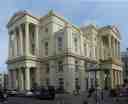
On your right, Brighton Town Hall stands out with its pale stucco façade, a strong row of classical columns, and a triangular pediment over the entrance. This patch of ground…더 보기간략히 보기
전용 페이지 열기 →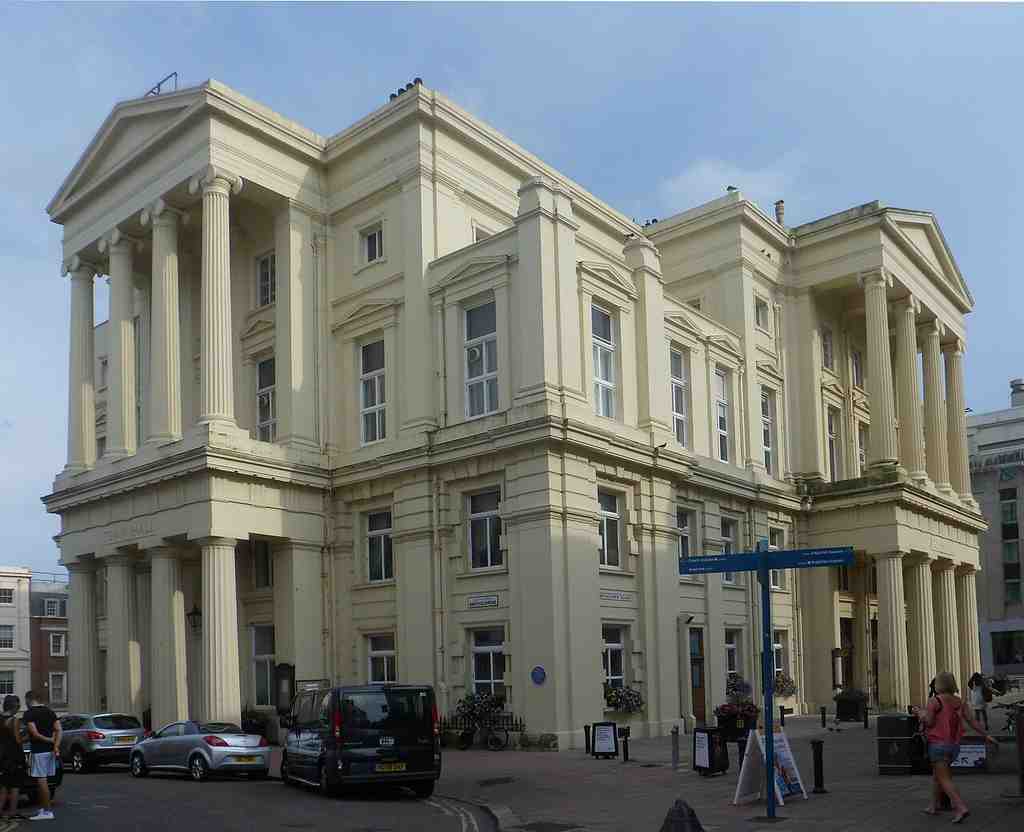
Brighton Town Hall, EnglandPhoto: Hassocks5489, Wikimedia Commons, CC0. Cropped & resized. On your right, Brighton Town Hall stands out with its pale stucco façade, a strong row of classical columns, and a triangular pediment over the entrance.
This patch of ground has had three working lives... and none of them were dull. In the thirteenth century, St Bartholomew's Grange stood here, one of early Brighthelmstone's first buildings, founded by St Pancras Priory in Lewes. Monks farmed this site until June fifteen fourteen, when French raiders burned the grange down along with almost the whole town. One day's work ended in a night of fire.
Then came the civic version. Thomas Cooper designed this town hall in the Greek Revival style - all columns, symmetry, and a slightly stern face for public business. Thomas Read Kemp laid the foundation stone in April eighteen thirty, and the building opened in eighteen thirty-two. For years it hosted the quarter sessions, the local criminal court that met several times a year, until hearings moved to Edward Street in nineteen sixty-seven. If you glance at the app, image one shows that full civic swagger nicely.
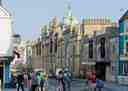
Then the basement took over the story. Brighton formed its first police force in eighteen thirty-eight and put the station and cells down below. Its first Chief Constable, Henry Solomon, had originally been a London watchmaker... which feels oddly precise training for policing. On the thirteenth of March, eighteen forty-four, while questioning John Lawrence over a stolen roll of carpet, Lawrence struck Solomon on the temple with a poker. Solomon died the next morning, surrounded by his wife and nine children. Queen Victoria gave fifty pounds to the widow's appeal - about six thousand pounds today. The cells stayed in use until nineteen sixty-five, and opened as a museum on the fourth of May, two thousand and five. For a visual nudge toward the older streets around this site, have a look at image ten.
From here, Brighton Dome is about five minutes away. As a practical note, the town hall keeps weekday hours, roughly nine to five, and closes on weekends.
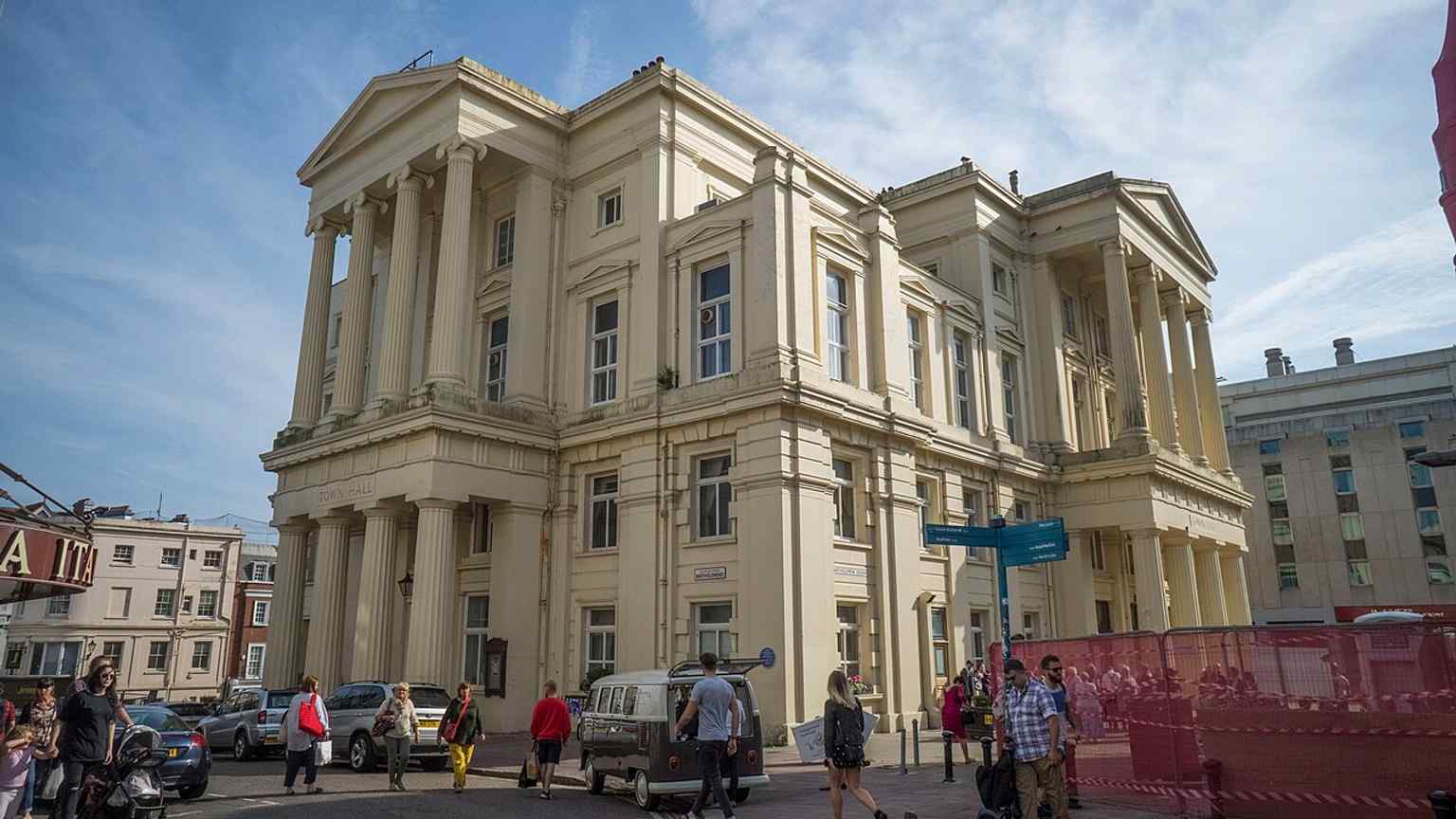
A clear modern view of the town hall from the street, tying the 19th-century landmark to Brighton’s busy city centre today.Photo: Jwslubbock, Wikimedia Commons, CC BY-SA 4.0. Cropped & resized. 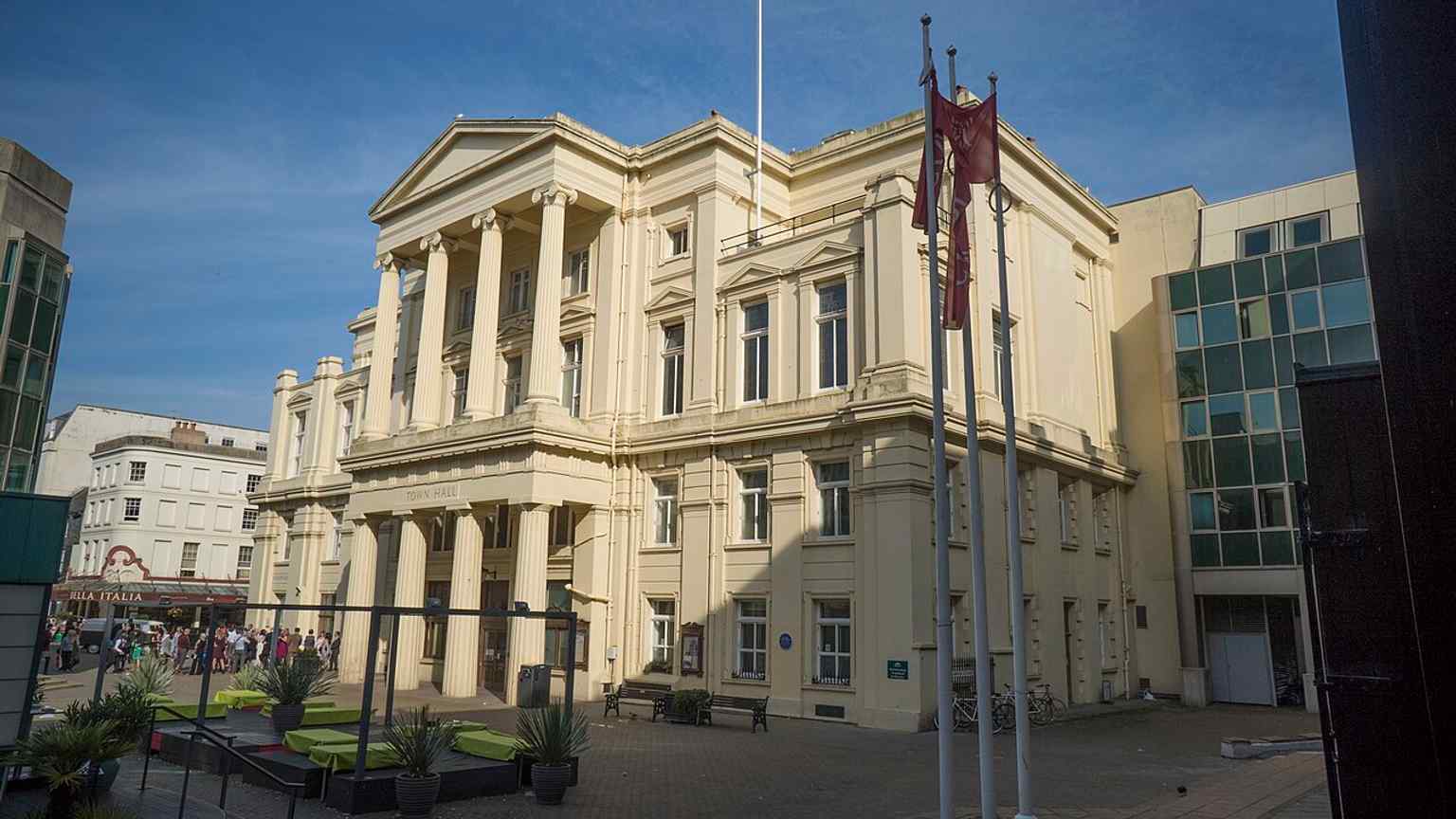
Another exterior angle showing the building’s grand civic scale, opened in 1832 after construction began in 1830.Photo: Jwslubbock, Wikimedia Commons, CC BY-SA 4.0. Cropped & resized. On your right, look for a pale stone-and-stucco frontage with a broad arched porch, a rounded dome rising behind it, and a silhouette borrowed from an Indian mosque. Brighton…더 보기간략히 보기
전용 페이지 열기 →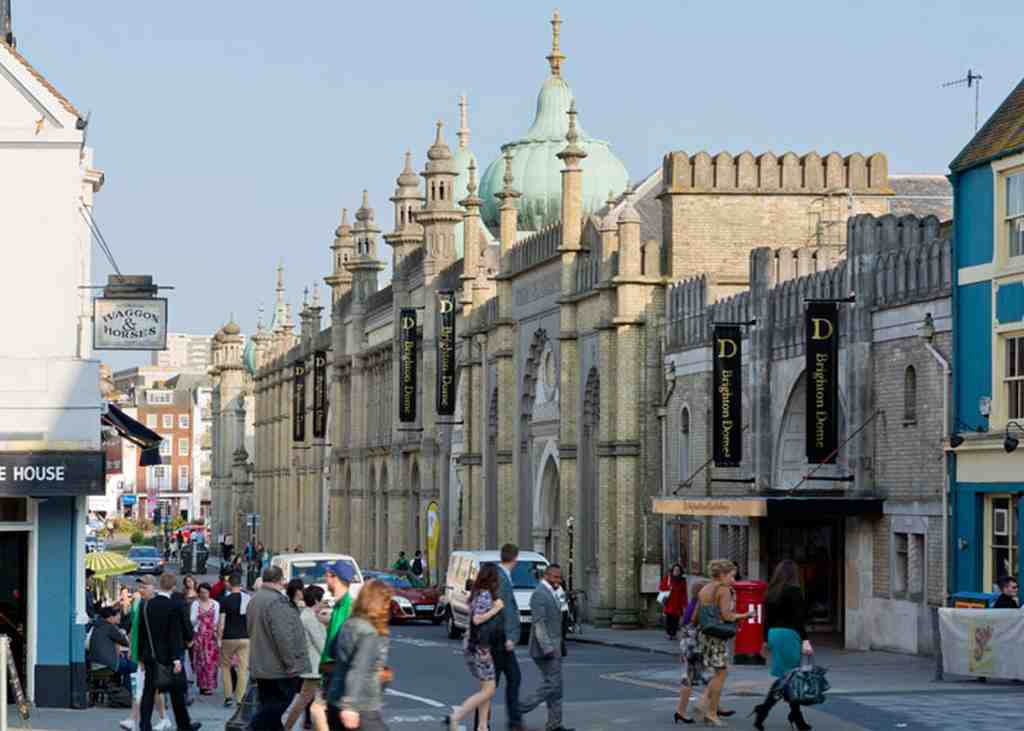
Brighton DomePhoto: Brighton Dome & Brighton Festival, Wikimedia Commons, CC BY-SA 3.0. Cropped & resized. On your right, look for a pale stone-and-stucco frontage with a broad arched porch, a rounded dome rising behind it, and a silhouette borrowed from an Indian mosque.
Brighton Dome began life with a rather less glamorous job description than its name suggests. Between eighteen oh three and eighteen oh eight, William Porden designed this place for the Prince Regent, later George the Fourth, as a serious piece of royal horse management. The outside took its cue from Indian mosque architecture, while the inside worked like a stable yard on a grand, faintly absurd scale. Beneath that central dome - eighty feet across and sixty-five feet high - Porden arranged forty-four horse stalls, five coach houses, and living quarters for the stable staff.
So don’t picture a dreamy prince drifting through with a sugar cube and a riding crop. Picture a working community. Grooms slept in balcony quarters above the horses. Ostlers handled feeding and mucking out - the unglamorous but essential business end of horse care. Blacksmiths kept the ironwork right. Coachmen managed carriages and teams. All of that labor kept a household of saddle-horses and coaches ready for one prince who, frankly, did not live here all that often. Regency life had a talent for extravagance... especially when someone else was doing the sweeping.
Next door, the Riding House - what we now call the Corn Exchange - stretched to one hundred and seventy-four feet long, fifty-eight feet wide, and thirty-four feet high. It, too, started as a practical machine for the royal estate.
Then the building changed jobs. In eighteen sixty-seven, architect and Borough Surveyor Phillip Lockwood converted the stables into a concert hall and assembly rooms. A year later, in October eighteen sixty-eight, the old Riding House became the town’s corn market. That is a very Brighton move: royal horses out, public culture and trade in. If you fancy it, have a quick look at the before-and-after image in the app - the frontage looks noticeably neater a few years on, part of the Dome’s steady habit of reinventing itself without losing its face.
Its most moving change came during the First World War. From the first of December, nineteen fourteen, to the fifteenth of February, nineteen sixteen, the Dome and Corn Exchange turned into wards for the Indian Military Hospital. More than four thousand wounded Indian soldiers recovered across this estate. Three operating theatres went in, and one of them stood inside the Dome itself. The complex also adapted its kitchens so Muslim soldiers could receive halal food - meat prepared under Islamic dietary rules. So yes... from horses to halal kitchens, this building covered some ground.
And then, because Brighton rarely resists a dramatic final act, the Dome helped stage one of pop history’s biggest nights. On the sixth of April, nineteen seventy-four, A-B-B-A won the Eurovision Song Contest here with “Waterloo,” while the venue’s technicians, riggers, orchestra players, and backstage crew pulled off a show seen by around five hundred million people.
When you’re ready, walk south out of the Pavilion Gardens onto the wide green Old Steine. Cross to the long lawned area in the centre, and we’ll continue at the Royal Pavilion.
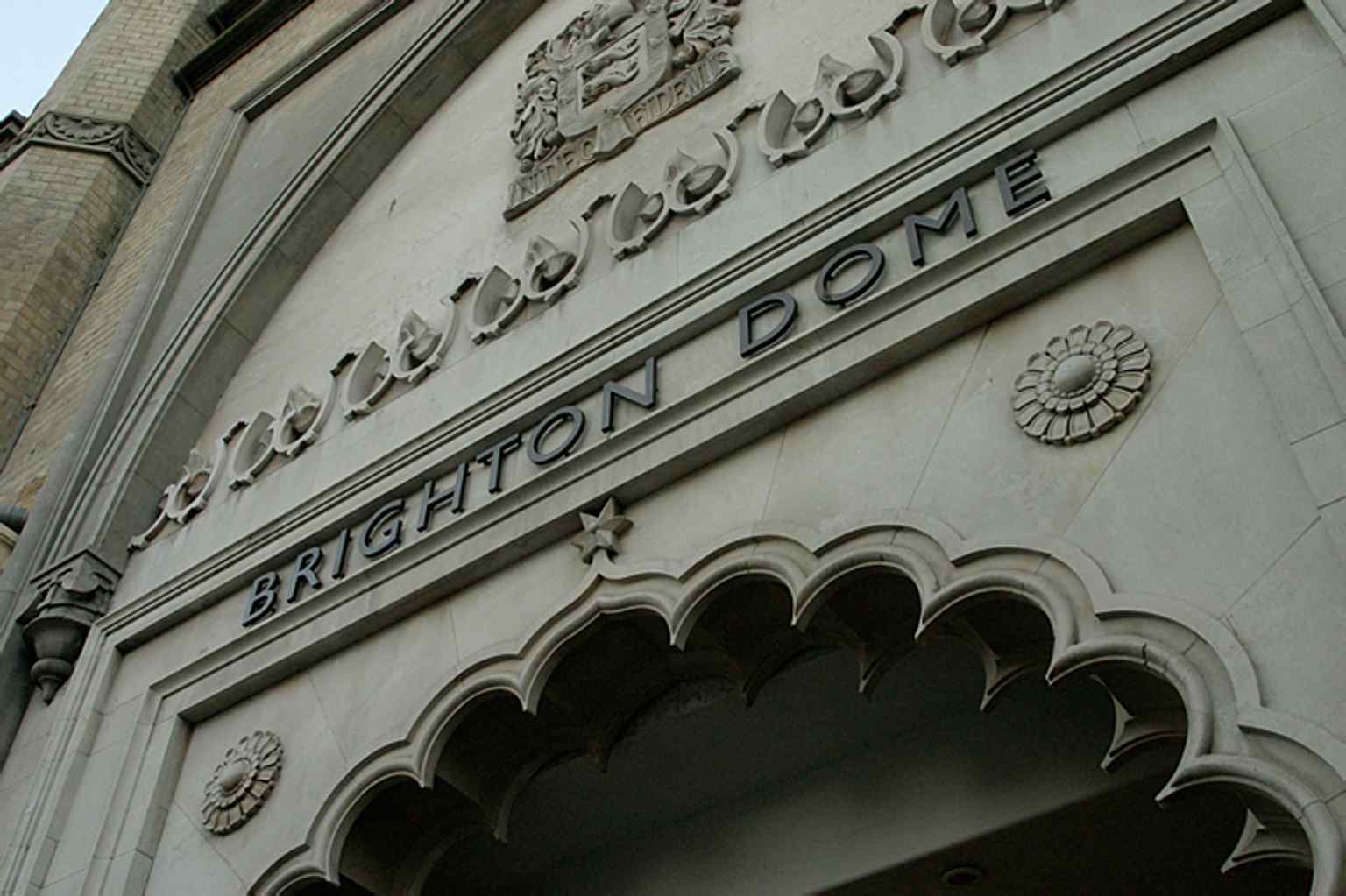
The entrance to the Brighton Dome complex, showing the public face of the building that was refurbished in the early 2000s.Photo: Anders Almaas, Wikimedia Commons, CC BY-SA 3.0. Cropped & resized. Ahead of you is a pale stucco palace crowned with bulbous onion domes, thin minarets, and scalloped arches - John Nash’s Mughal-flavored fantasy in the middle of Brighton. If…더 보기간략히 보기
전용 페이지 열기 →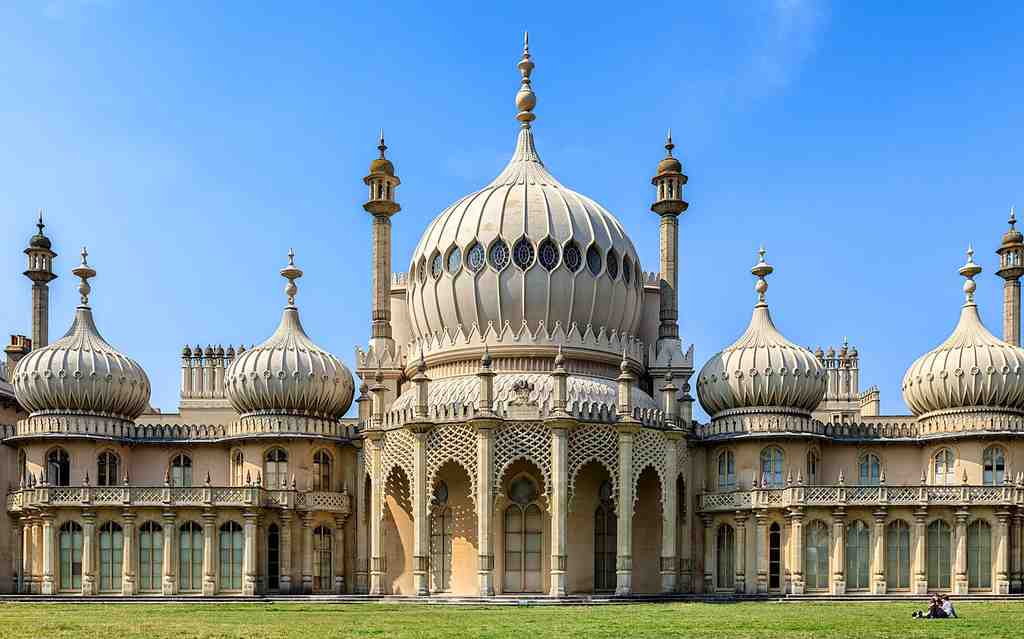
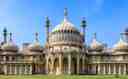
Royal PavilionPhoto: Qmin, Wikimedia Commons, CC BY-SA 3.0. Cropped & resized. Ahead of you is a pale stucco palace crowned with bulbous onion domes, thin minarets, and scalloped arches - John Nash’s Mughal-flavored fantasy in the middle of Brighton.
If you want the real story here, follow the Royal Pavilion household and hospital staff, not the silk waistcoats. This was George the Fourth’s pleasure palace, then, in the First World War, a six-hundred-bed Indian Military Hospital. In both lives, the real work happened out of sight.
Inside, Nash’s Great Kitchen, finished between eighteen fifteen and eighteen eighteen, was startlingly modern. Four cast-iron columns rose through the room, decorated with painted copper palm leaves, and at the center stood a steam table to keep dishes hot - Regency technology trying very hard to impress. For a brief, intense spell in eighteen sixteen to eighteen seventeen, the kitchen belonged to Marie-Antoine Carême, the most famous chef in Europe. His line to the Prince Regent was perfect: “Your Highness, my concern is to tempt your appetite; yours is to curb it.”
That did not happen often. On the eighteenth of January, eighteen seventeen, Carême’s team produced more than one hundred and twenty dishes across nine courses for Grand Duke Nicholas of Russia - later Tsar Nicholas the First. Forty entrées. Thirty-two desserts. As Pavilion keeper David Beevers puts it, dinner started at six o’clock and went on for several hours. If you check the dining room image on your screen, you can picture the sort of room built to receive that edible avalanche.
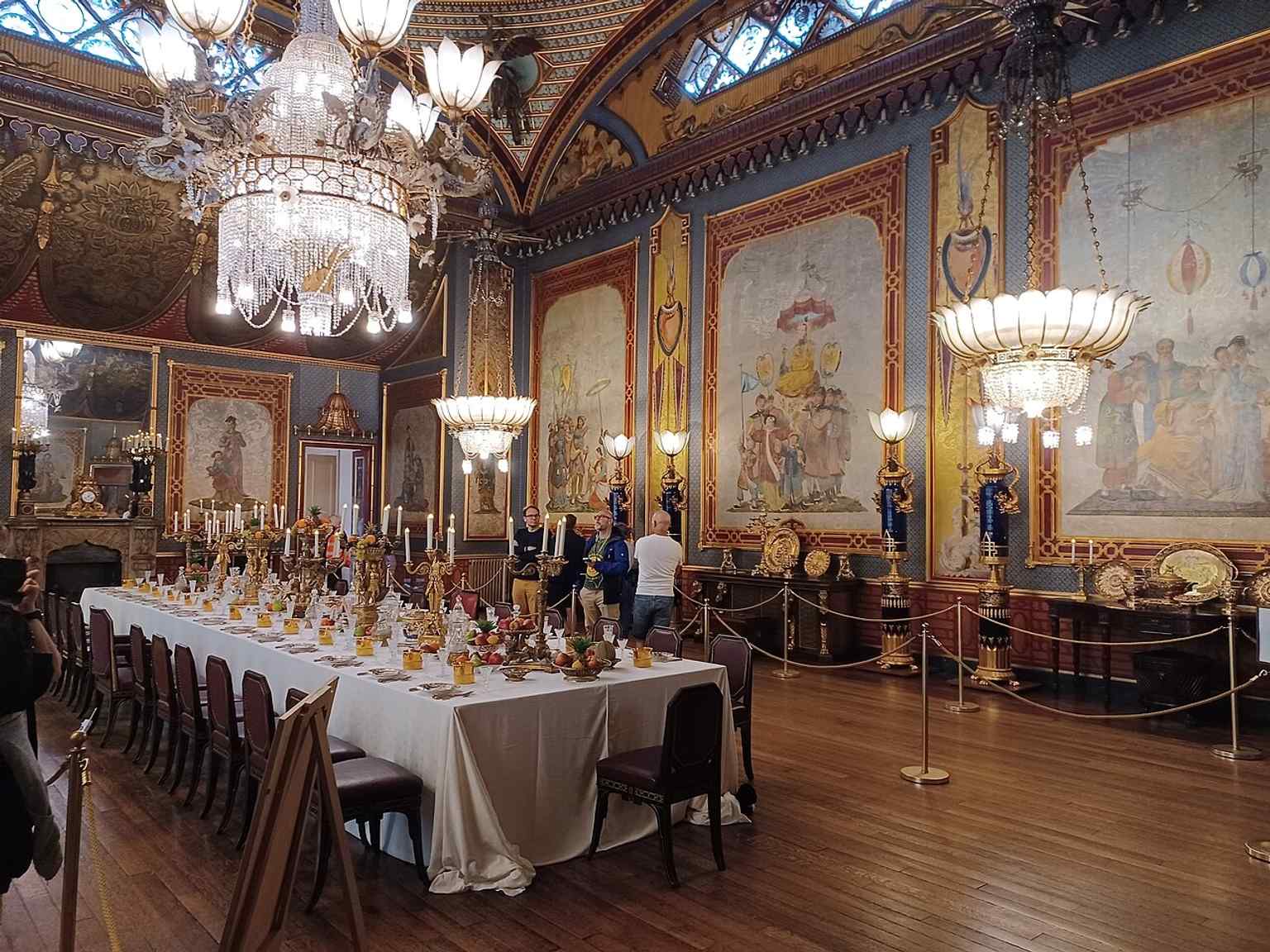
The dining room recalls the spectacular royal dinners served here, including elaborate multi-course banquets prepared under chef Marie-Antoine Carême.Photo: Simon Burchell, Wikimedia Commons, CC BY-SA 4.0. Cropped & resized. But the glamour sat on top of a hidden machine. Beneath the state rooms, builders created a large basement so servants could move from one end of the house to the other without being seen. The corridors were lined with Dutch tiles, hard-wearing and easy to clean, a seamless service world designed so George would never have to clap eyes on the people carrying the trays. One detail survives like a slap: one man spent all day in a windowless room shoveling coal in overwhelming heat.
Then the building changed its purpose completely. From December nineteen fourteen to January nineteen sixteen, this became the Royal Pavilion Indian Military Hospital. More than two thousand three hundred Indian soldiers were treated here in six hundred beds, and eighteen died. The Great Kitchen became one of two operating theatres. The hospital staff also reorganized food with extraordinary care: nine kitchens served Muslim patients, meat-eating Hindu and Sikh patients, and vegetarian Hindu and Sikh patients separately. Beef and pork were banned from the grounds. By June nineteen fifteen, the female nurses of Queen Alexandra’s Imperial Military Nursing Service had been replaced by male orderlies. If you want a visual jolt, open the wartime theatre photo in the app.
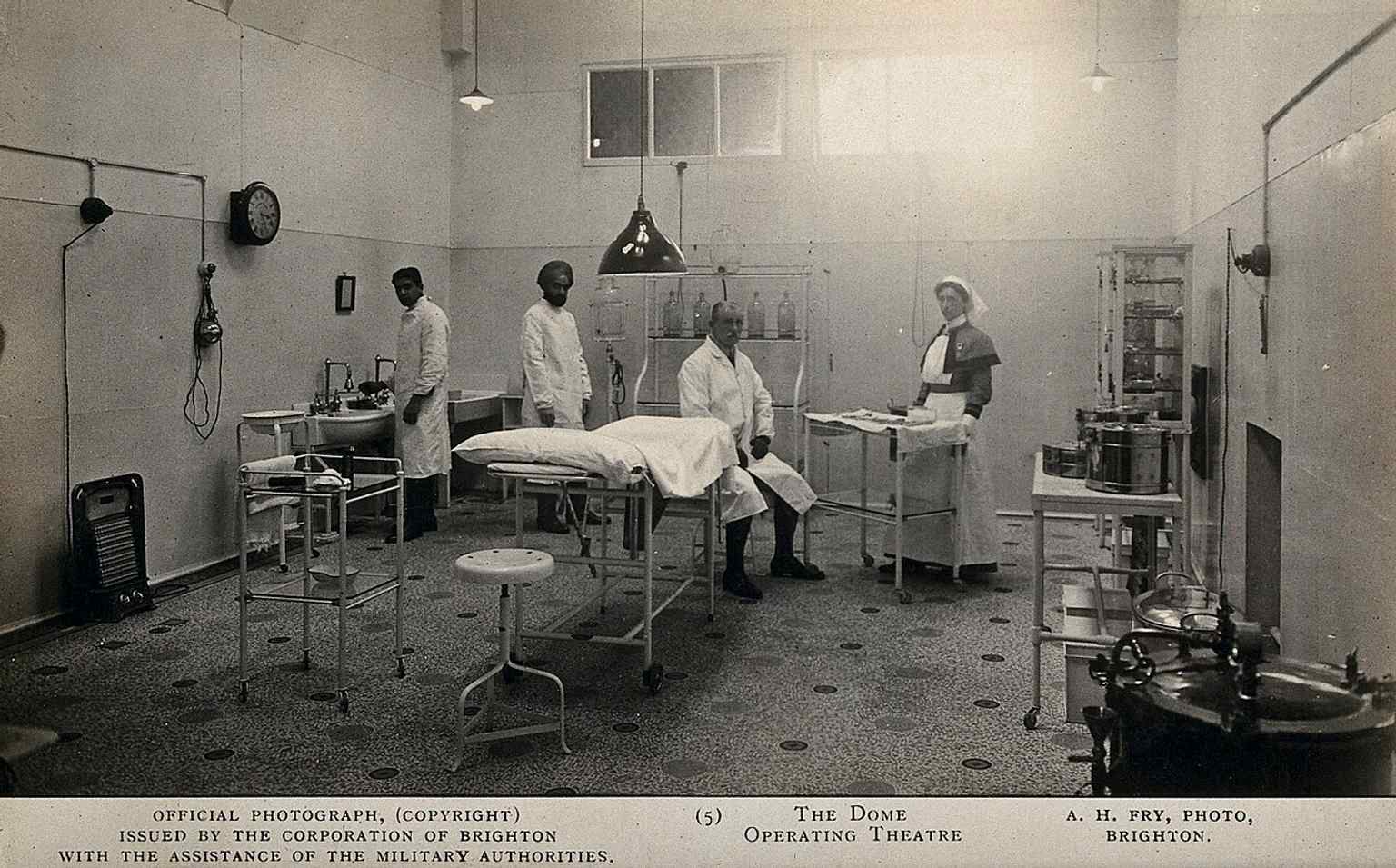
A wartime operating theatre in the Dome, recalling how the Pavilion complex was transformed into a hospital for Indian soldiers during the First World War.Photo: Allen Hastings Fry, Wikimedia Commons, CC BY 4.0. Cropped & resized. One wounded sepoy, Isar Singh, wrote home that “men in hospital are tended like flowers.” The same kitchen that once fed a tsar’s brother became a room for saving broken bodies. That is this place in a nutshell: extravagant above stairs, relentless below them.
If you want to come back inside later, the Pavilion usually opens daily from nine thirty in the morning to five forty-five in the afternoon. Walk west across the Pavilion gardens - about a minute. The big dome ahead of you, the one that looks like an Indian mosque, is the old Royal Stables; use that as your marker, then continue to Old Steine, about five minutes away.
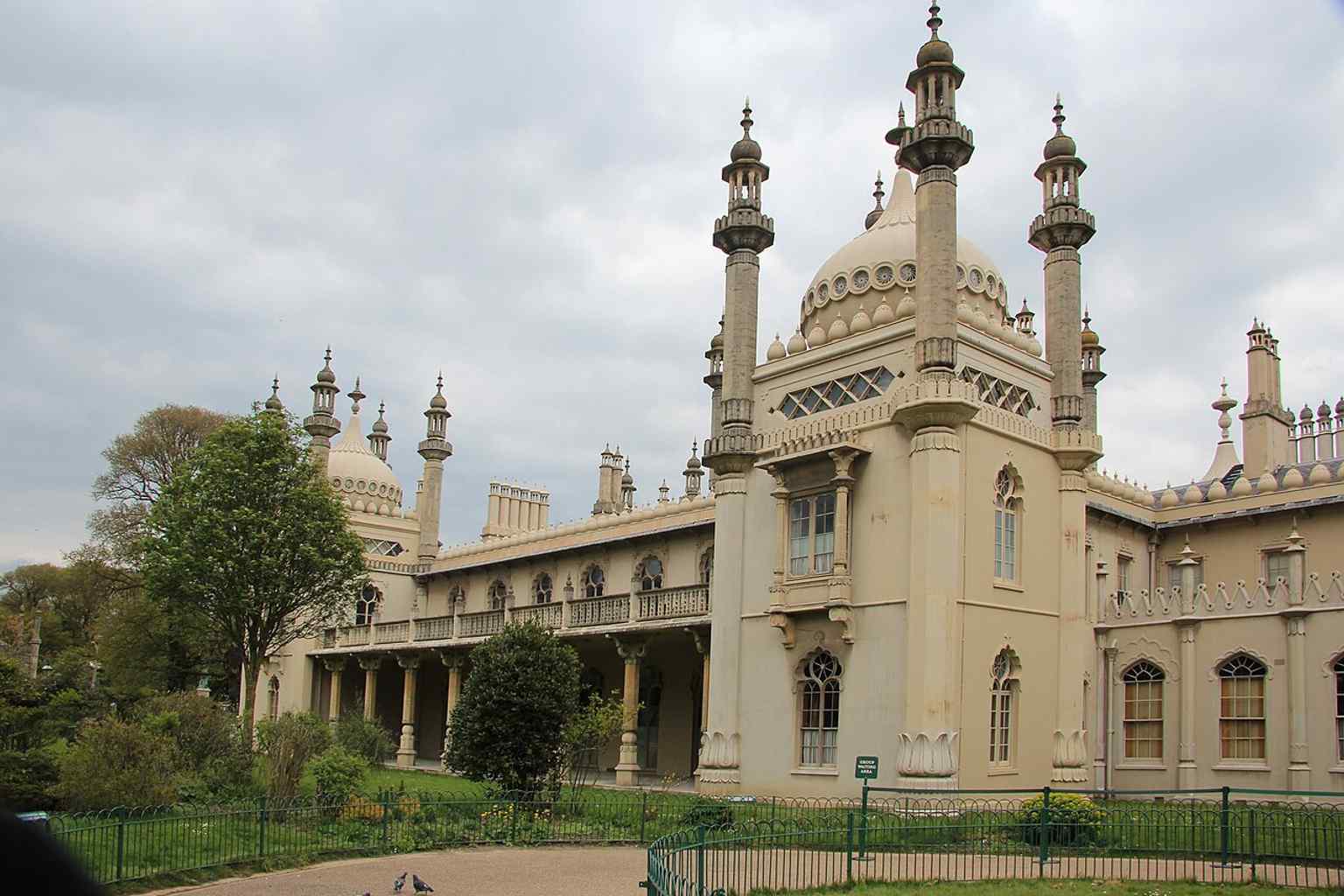
A sharp full-height view of the Royal Pavilion’s Mughal-style domes and minarets, showing the Indo-Saracenic look John Nash created in the 1810s.Photo: Karl Gruber, Wikimedia Commons, CC BY 3.0 at. Cropped & resized. 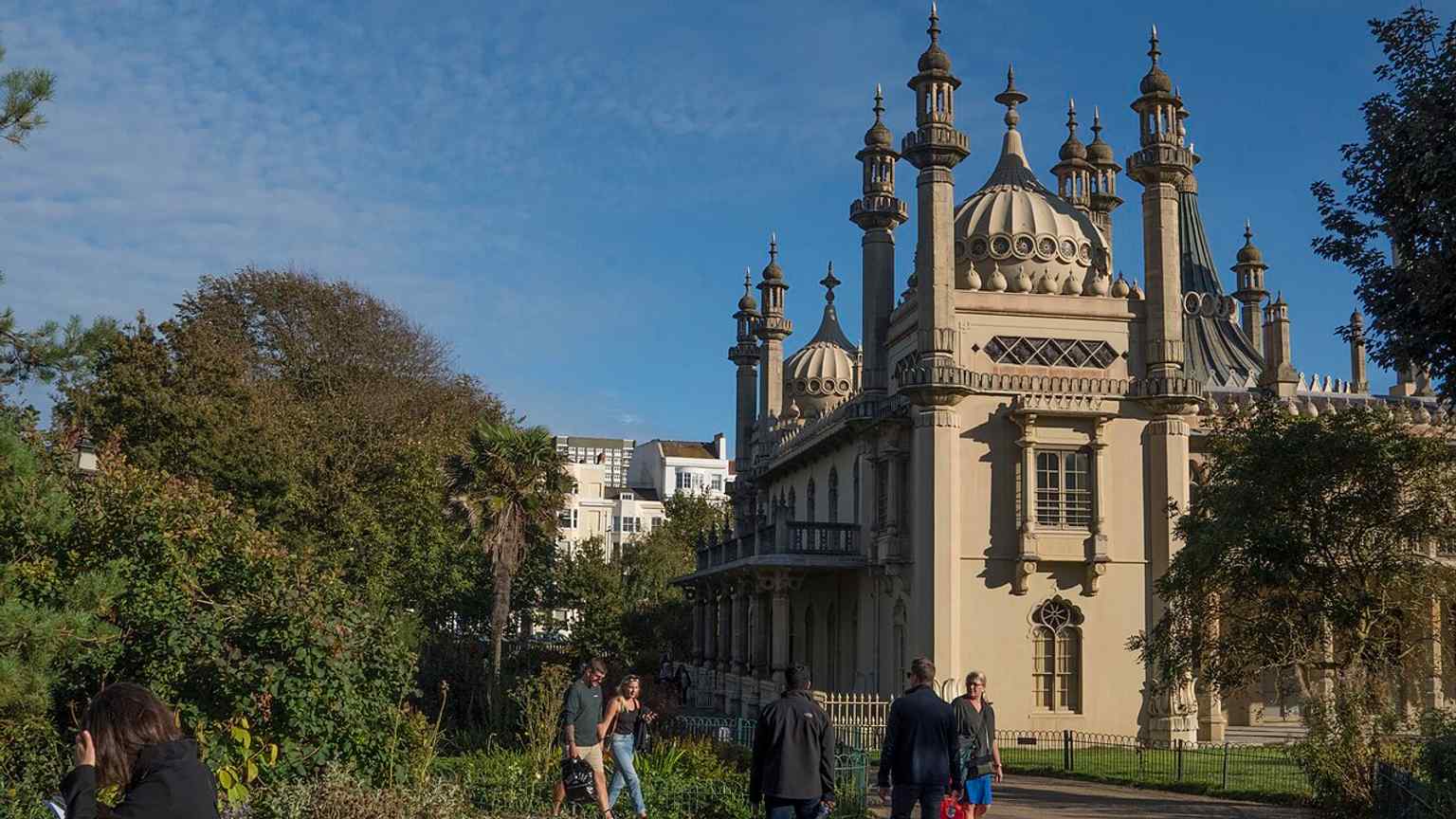
A modern wide exterior that captures the Pavilion as a landmark in the centre of Brighton, far from its original life as a private royal retreat.Photo: Jwslubbock, Wikimedia Commons, CC BY-SA 4.0. Cropped & resized. 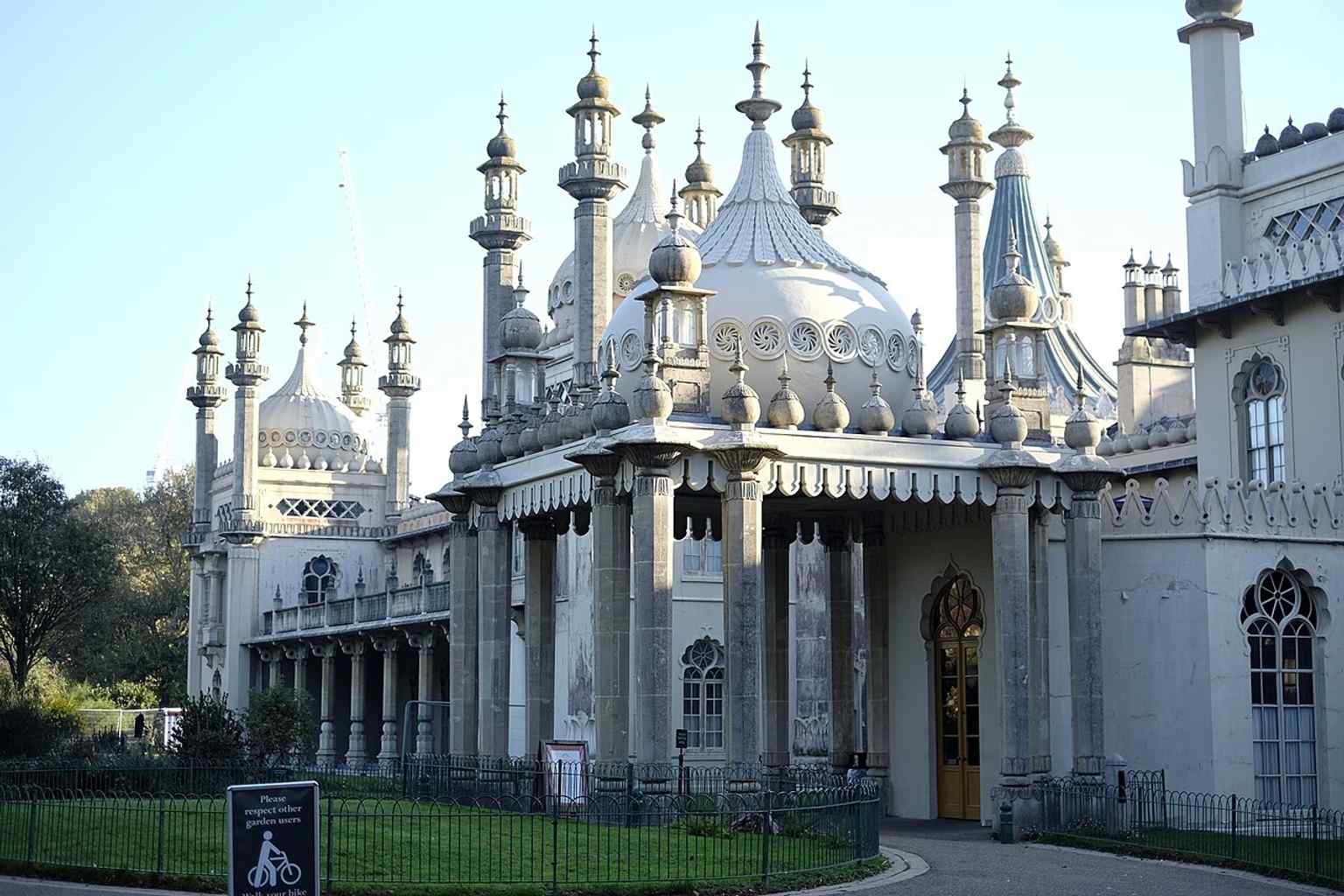
The visitor entrance, linking the former royal residence to its present life as a public attraction visited by hundreds of thousands each year.Photo: Jonas Magnus Lystad, Wikimedia Commons, CC BY-SA 4.0. Cropped & resized. 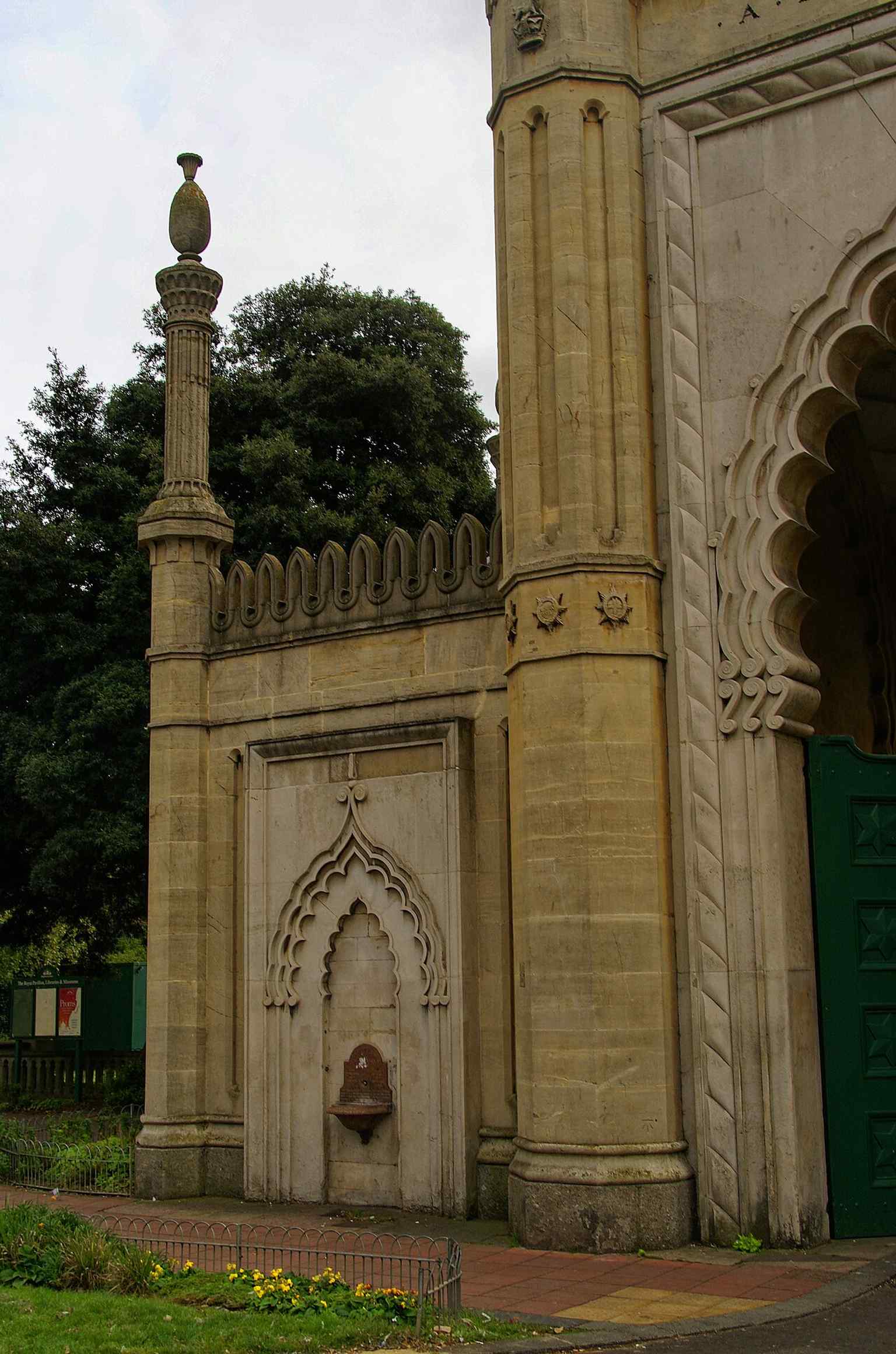
An early street view of the entrance gate on Marlborough Place, useful for showing how the Pavilion sits within Brighton’s historic streetscape.Photo: Txllxt TxllxT, Wikimedia Commons, CC BY-SA 4.0. Cropped & resized. 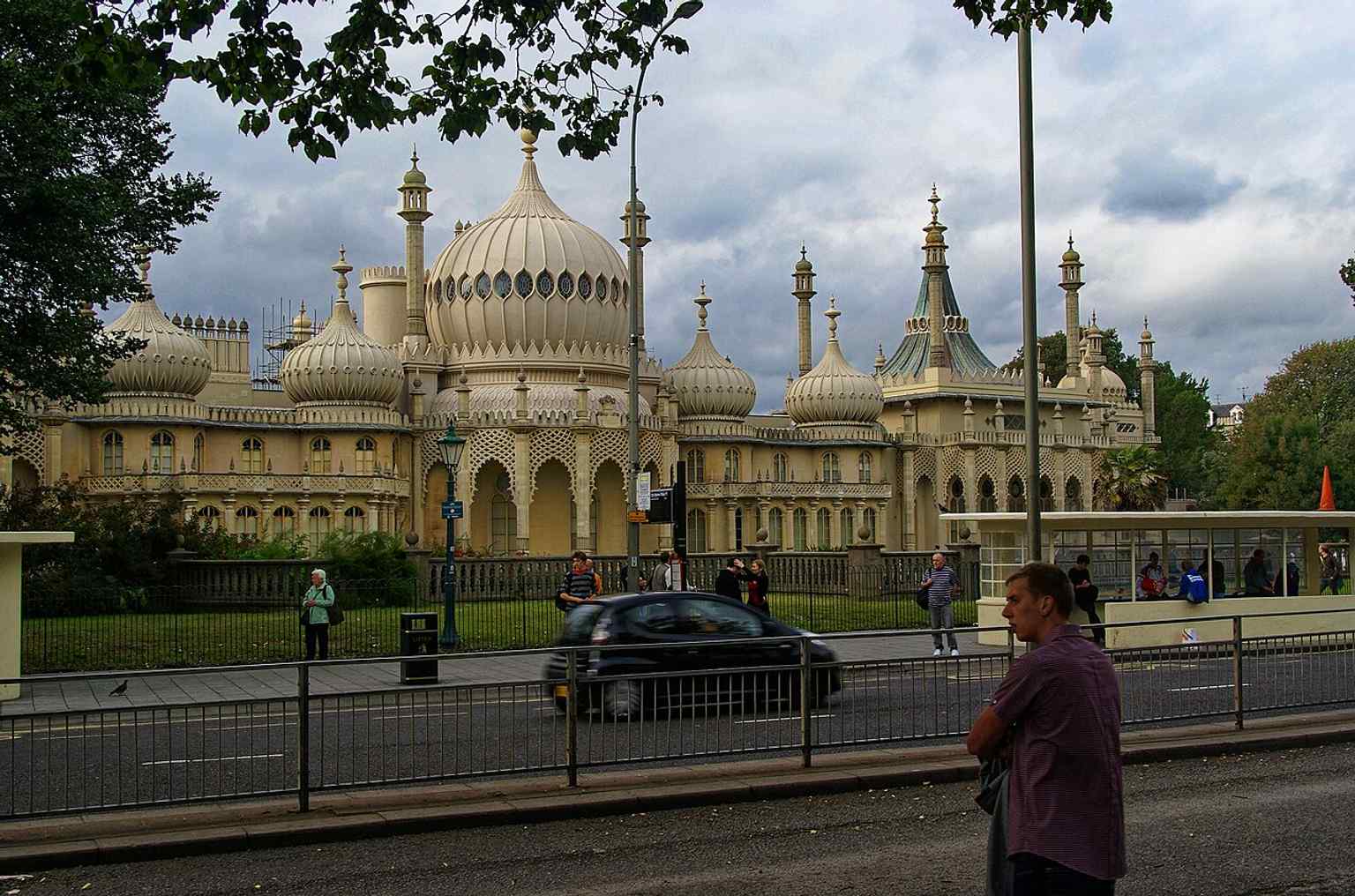
A historic view from Old Steine, close to the promenade where the Prince Regent first rented the modest house that became the Pavilion.Photo: Txllxt TxllxT, Wikimedia Commons, CC BY-SA 4.0. Cropped & resized. 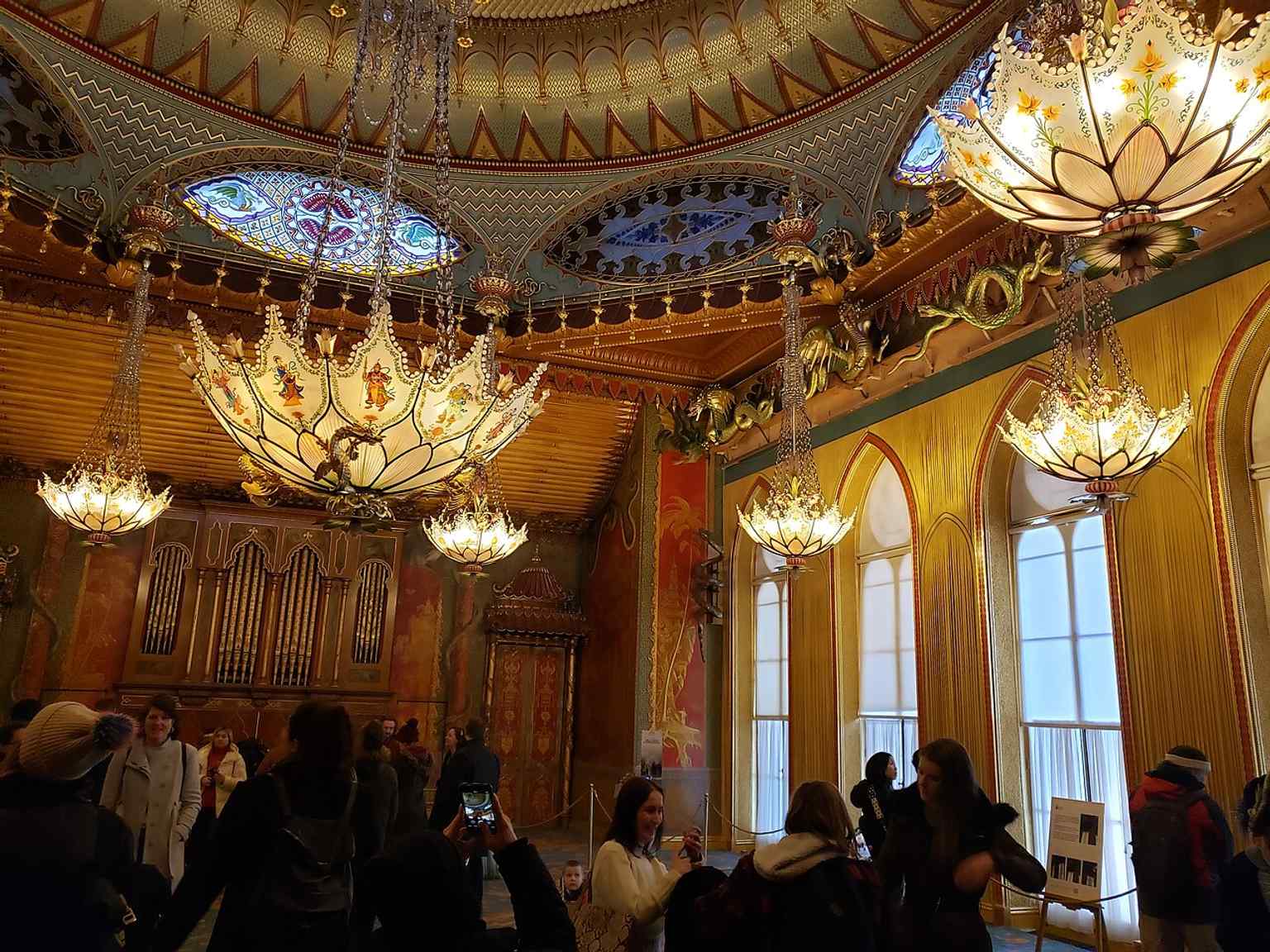
The Music Room, one of the Pavilion’s grand ceremonial interiors, reflecting the lavish Regency entertainment that George IV loved.Photo: Andy Li, Wikimedia Commons, CC0. Cropped & resized. 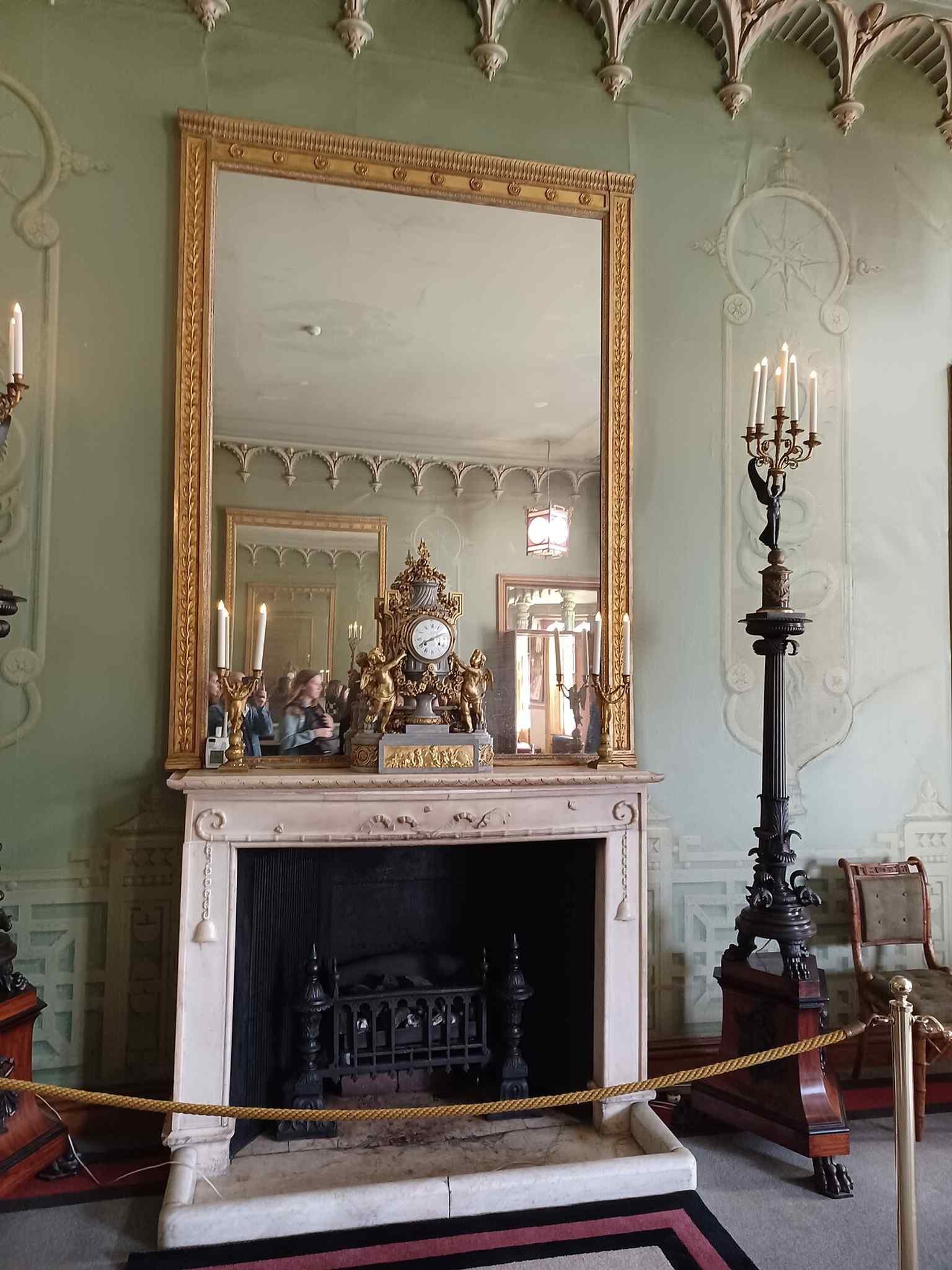
An interior shot with a fireplace, helping show the richly decorated rooms that were later stripped and then painstakingly restored.Photo: Simon Burchell, Wikimedia Commons, CC BY-SA 4.0. Cropped & resized. 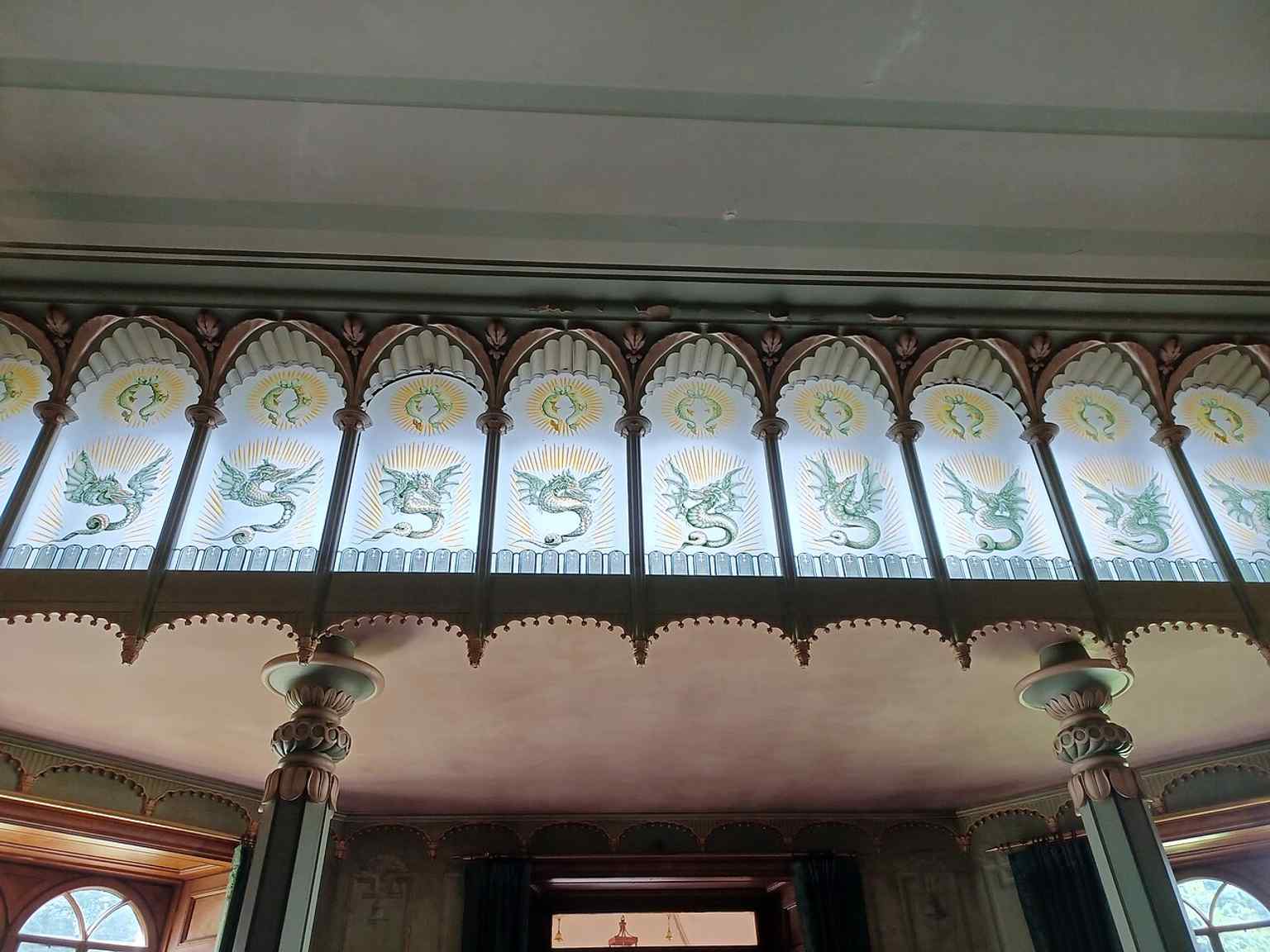
A richly decorated interior detail that captures the Pavilion’s Chinese and Indian-inspired fantasy style inside, not just on the façade.Photo: Simon Burchell, Wikimedia Commons, CC BY-SA 4.0. Cropped & resized. 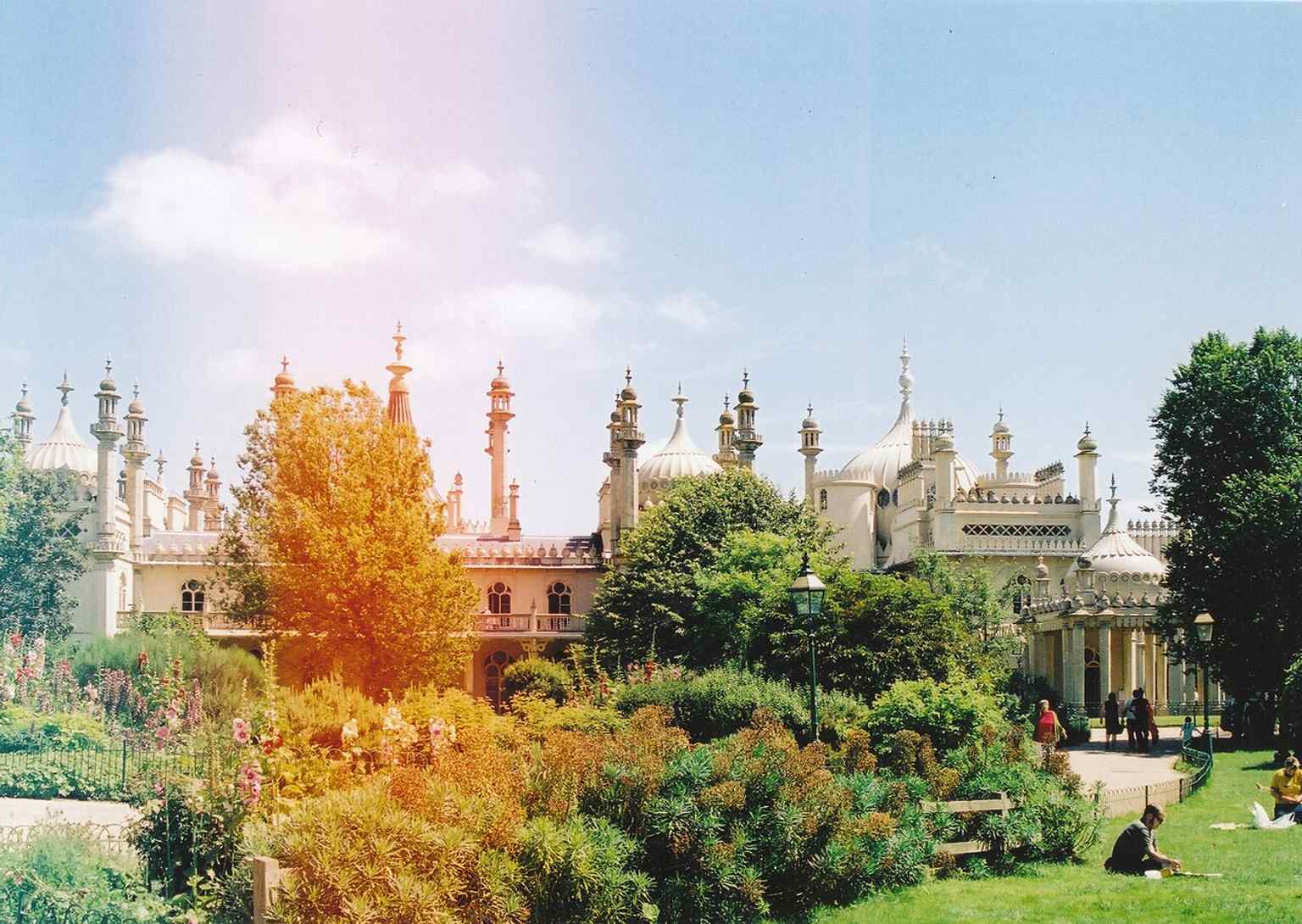
An elevated view of the Pavilion and its gardens, showing the building as part of the landscaped Regency setting around Old Steine.Photo: Gunnar Klack, Wikimedia Commons, CC BY-SA 4.0. Cropped & resized. On your left, look for a long white-stone frontage with arched entrances and a balustraded roofline, gathered around a sunken entrance court below the road. Designed by the…더 보기간략히 보기
전용 페이지 열기 →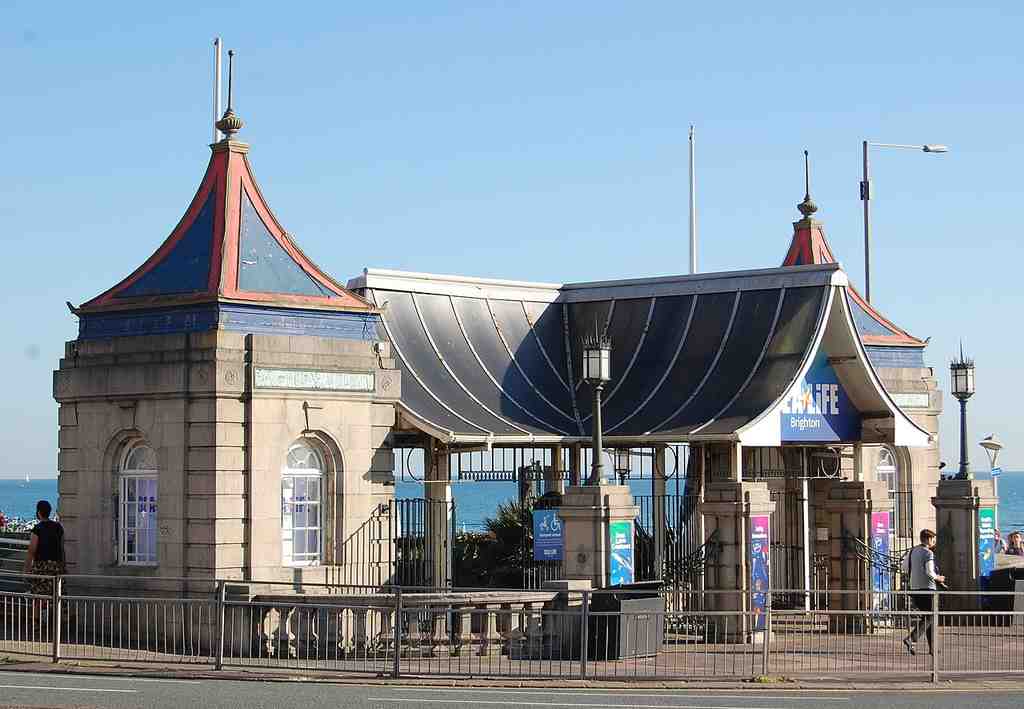
Sea Life BrightonPhoto: Hassocks5489, Wikimedia Commons, CC0. Cropped & resized. On your left, look for a long white-stone frontage with arched entrances and a balustraded roofline, gathered around a sunken entrance court below the road.
Designed by the engineer Eugenius Birch, who also built the West Pier, this place began as a very Victorian idea: science, spectacle, and paid admission, all under one roof. Birch started work in eighteen sixty-nine and finished in eighteen seventy-two. Prince Arthur, Duke of Connaught and Strathearn, opened it on Easter Monday, the first of April that year, and then Brighton gave it the full civic treatment on the tenth of August, when Mayor John Cordy Burrows formally inaugurated Brighton Aquarium.
One small correction, because history likes a technicality: this is not the world’s first commercial aquarium. London Zoo’s Fish House beat it in eighteen fifty-three. But this is the oldest continuously operating aquarium in the world, which is a sturdier claim and, frankly, more impressive.
What you see outside mostly comes from the big rebuild in the nineteen twenties. David Edwards, the Brighton Borough Surveyor, led that work, and Brighton Corporation spent one hundred and seventeen thousand pounds on it - roughly eight million pounds in today’s money - using lots of white artificial stone in a Louis Sixteenth style. Not Art Deco, however often people try that label on for size. The Duke of York, later George the Sixth, ceremonially reopened it on the twelfth of June, nineteen twenty-nine. And because Brighton never really believed in doing things by halves, the rebuild added a miniature rifle range, public baths, a lift from Marine Parade, and the Princes Dance Hall upstairs. Fish below, dancing above... a practical arrangement only if everyone kept to their own floor.
If you glance at the before-and-after image in the app, you can see how the old Victorian frontage gave way to this smoother seafront face while the building kept its grand sense of arrival.
The real magic, though, is inside. Much of the original High Victorian Gothic interior survives: an aisled hall twenty-one bays long, with double aisles in the center, and deep quadripartite vaults - roof vaults divided into four ribbed sections - carried on polished granite columns. Visitors called it an “undersea cathedral” and a “vast underground extravaganza,” which sounds theatrical until you see it and realize they were actually being restrained. There’s an interior image on your screen if you want a preview of those vaults.
And this building created a new kind of seaside working life. One of its first scientific stars was Henry Lee, the aquarium’s naturalist from eighteen seventy-two, later also a director. He ran hands-on experiments on the migration of smelts and the habits of herring, whitebait, and crayfish. So alongside clerks, cooks, waiters, and musicians, you had a resident scientist trying to turn curiosity into knowledge. Lee died in Brixton on the thirty-first of October, eighteen eighty-eight, after years of poor health, but his job here had already helped define what an aquarium could be.
Sea Life took over in nineteen ninety-one and restored the place again. So the same vaulted hall that Henry Lee filled with crayfish in eighteen seventy-two now has Sea Life divers feeding fish in front of paying schoolchildren. Different uniforms, same basic bargain: wonder, organized by staff.
Walk a little further east on Madeira Drive. The narrow-gauge railway track running along the seafront is Volk’s Electric Railway - the small station and engine arch is ahead. If you plan to come back inside later, Sea Life usually opens daily from ten A-M to five P-M.
Look for the narrow steel rails, the low platform edge, and the modest station building marked for Volk's Electric Railway. Here you’re standing beside a small miracle of…더 보기간략히 보기
전용 페이지 열기 →Look for the narrow steel rails, the low platform edge, and the modest station building marked for Volk's Electric Railway.
Here you’re standing beside a small miracle of workshop thinking. On the fourth of August, eighteen eighty-three, Magnus Volk, a self-taught engineer and the son of a German clockmaker, opened the world’s oldest operating electric railway. Not bad for a tradesman’s son with a restless mind. Before this line, he had already lit his own house with electricity, helped create Brighton’s first telephone system, and fitted electric lighting in the Royal Pavilion.
The first stretch ran only a quarter of a mile. Then Volk pushed it farther in eighteen eighty-four to Paston Place, now called Halfway, where an arch built into the cliff became the power plant and has served as the depot since eighteen eighty-four. In nineteen oh-one, he extended the line to Black Rock. If you like, have a glance at the before-and-after image; it shows how this end of the line tidied itself up between nineteen eighty and twenty eleven without losing its character.
Volk also invented Pioneer, better known as Daddy Long Legs: a carriage like a tiny pier building on four twenty-three-foot legs that ran through shallow sea water from eighteen ninety-six to nineteen oh-one. The sea did not finish it off; council beach-protection works did, and Volk could not afford the diversion.
Today, V-E-R-A, the Volk's Electric Railway Association, formed in nineteen ninety-five, keeps the track, cars, and electrical systems going, and even trains volunteer drivers. Magnus Volk drove the first train out of the new Black Rock station in May nineteen thirty-seven, then died peacefully thirteen days later. If you want a ride, services usually start around ten fifteen or eleven fifteen and run until about five fifteen, or six fifteen on weekends.
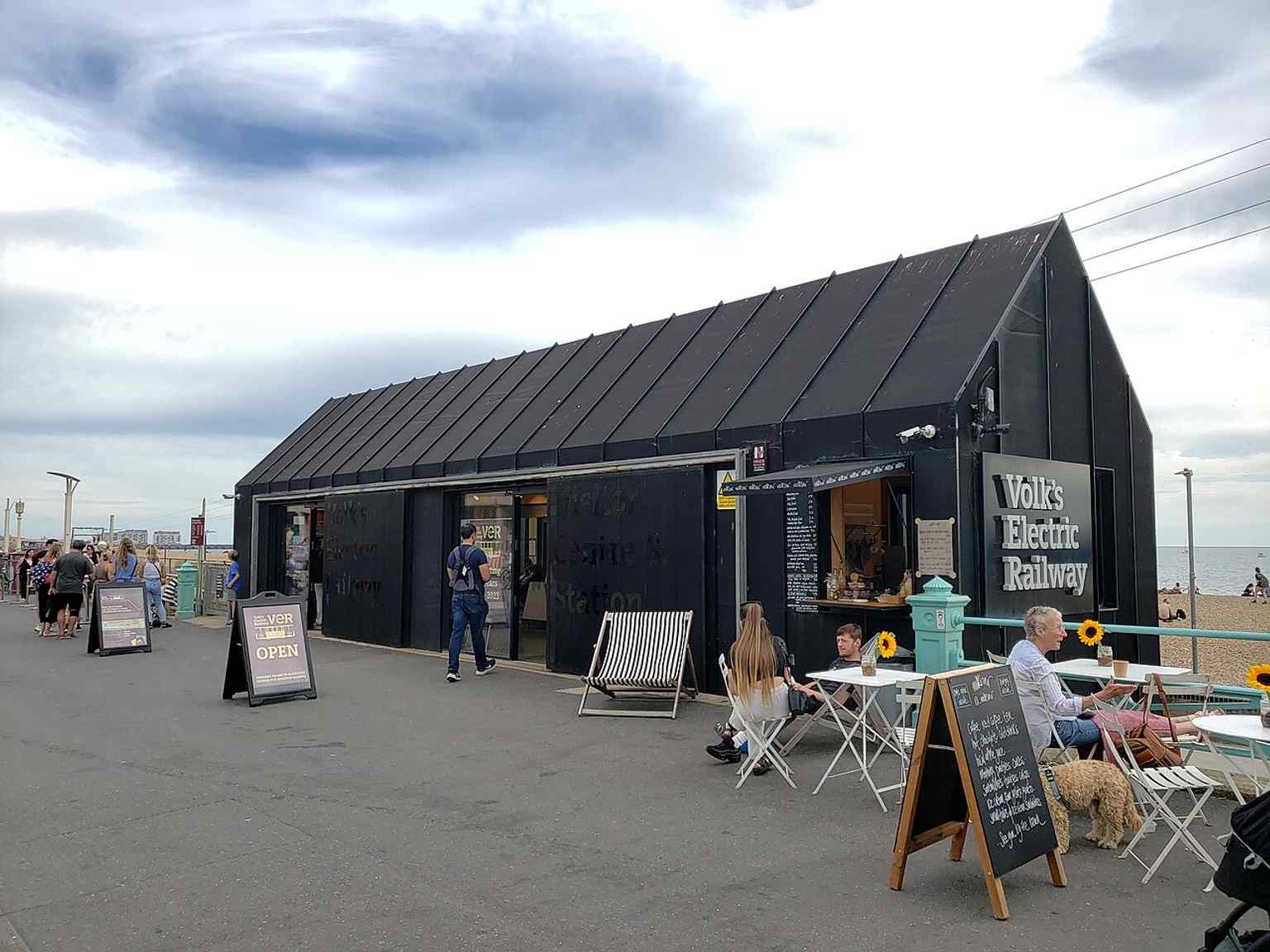
The modern Visitor Centre and station at the seafront line’s southern end, where the world’s oldest operating electric railway still welcomes passengers.Photo: Andy Li, Wikimedia Commons, CC0. Cropped & resized. Ahead of you is a long cast-iron pier with a straight timber deck, an ornate entrance building, and the distinctive clock tower added in the nineteen twenties. Building began on…더 보기간략히 보기
전용 페이지 열기 →Ahead of you is a long cast-iron pier with a straight timber deck, an ornate entrance building, and the distinctive clock tower added in the nineteen twenties.
Building began on this one-thousand-seven-hundred-and-sixty-foot pier in eighteen ninety-one, and it opened on the twentieth of May, eighteen ninety-nine. R. St George Moore designed it, and he meant it to replace the old Chain Pier from eighteen twenty-three, after storms destroyed that earlier pier in December of eighteen ninety-six. If you glance at the image on your screen, you can see just how far this structure runs into the sea... less a jetty than a full-time business district on stilts.
That working life started early. At the far end, a fifteen-hundred-seat theatre opened on the third of April, nineteen oh-one. By nineteen eleven, the pier had become a serious entertainment address; even Stan Laurel and Charlie Chaplin performed here before Hollywood got hold of them. Then came October of nineteen seventy-three, when a barge used during demolition of the unused landing stage drifted into the pier and caused one-hundred-thousand pounds of damage. The theatre never recovered. In nineteen eighty-six, owners removed it and put in a domed amusement arcade instead. Brighton chose slot machines over Shakespeare... and, commercially speaking, Brighton probably knew its audience.
Today, this place still runs as a workplace first and a postcard second. The company says the pier welcomes some four million visitors a year. It operates two arcades with over three hundred machines, nineteen funfair rides, plus food and drink outlets all along the deck. In twenty twenty-three, the average headcount was six-hundred-and-eighty-four staff: six-hundred-and-fifty-two operational, thirty-two administration. One ticket office, hundreds of workers, millions of customers... that is not nostalgia, that is payroll.
If you want a closer look at the pier’s modern character, check the app image of the arcade interior. It shows what the old theatre gave way to: a louder, brighter kind of stage.
And then there were the people who gave the place its face. Eva Petulengro, the Romany fortune-teller, worked from a booth on the Palace Pier and later the seafront arches. She spent more than fifty years predicting fortunes here, for clients ranging from the Beatles to politicians and members of the royal family, before her death in twenty twenty-four at the age of eighty-five. Down on the beach beneath the pier, Punch and Judy professors kept another old trade alive. Sergeant Mike Stone, called Britain’s longest-serving Punch and Judy man, worked Brighton for thirty years and did two seasons on the pier. Professor Glyn Edwards has performed for more than fifty years, starting on Brighton beach in the nineteen sixties.
So this pier is still doing the job it took on in eighteen ninety-nine: a cast-iron deck carrying Brighton’s pleasure economy, almost without interruption, for one-hundred-and-twenty-seven years. For practical purposes, it generally opens from ten in the morning, closing around seven or eight in the evening depending on the day.
Walk back off the pier and head east along Madeira Drive. Keep going for the Brighton Fishing Museum, about ten minutes away.
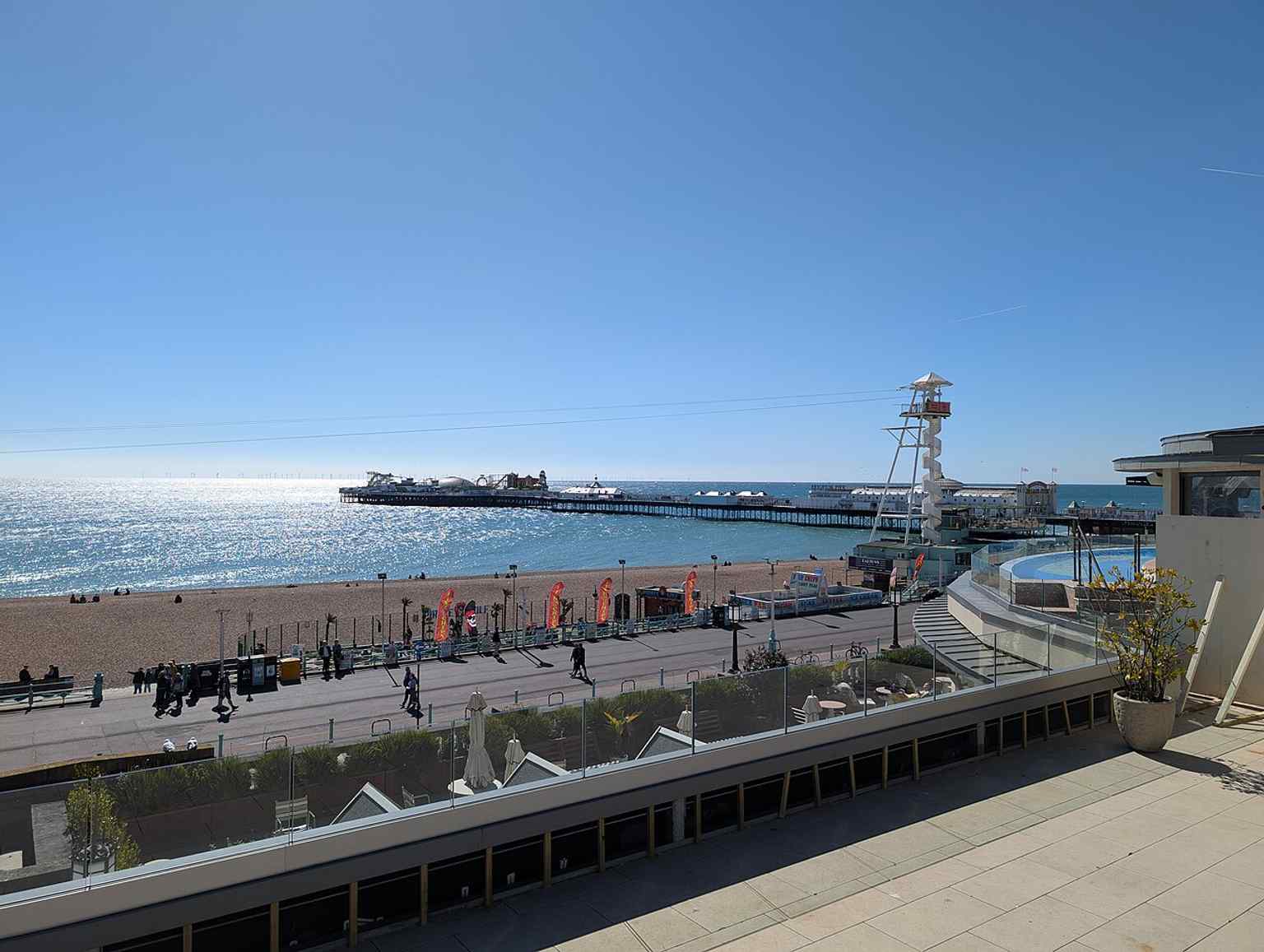
A sweeping modern view from Madeira Drive showing the pier stretching into the sea, matching its role as Brighton’s most famous seafront landmark.Photo: Andy Li, Wikimedia Commons, CC0. Cropped & resized. 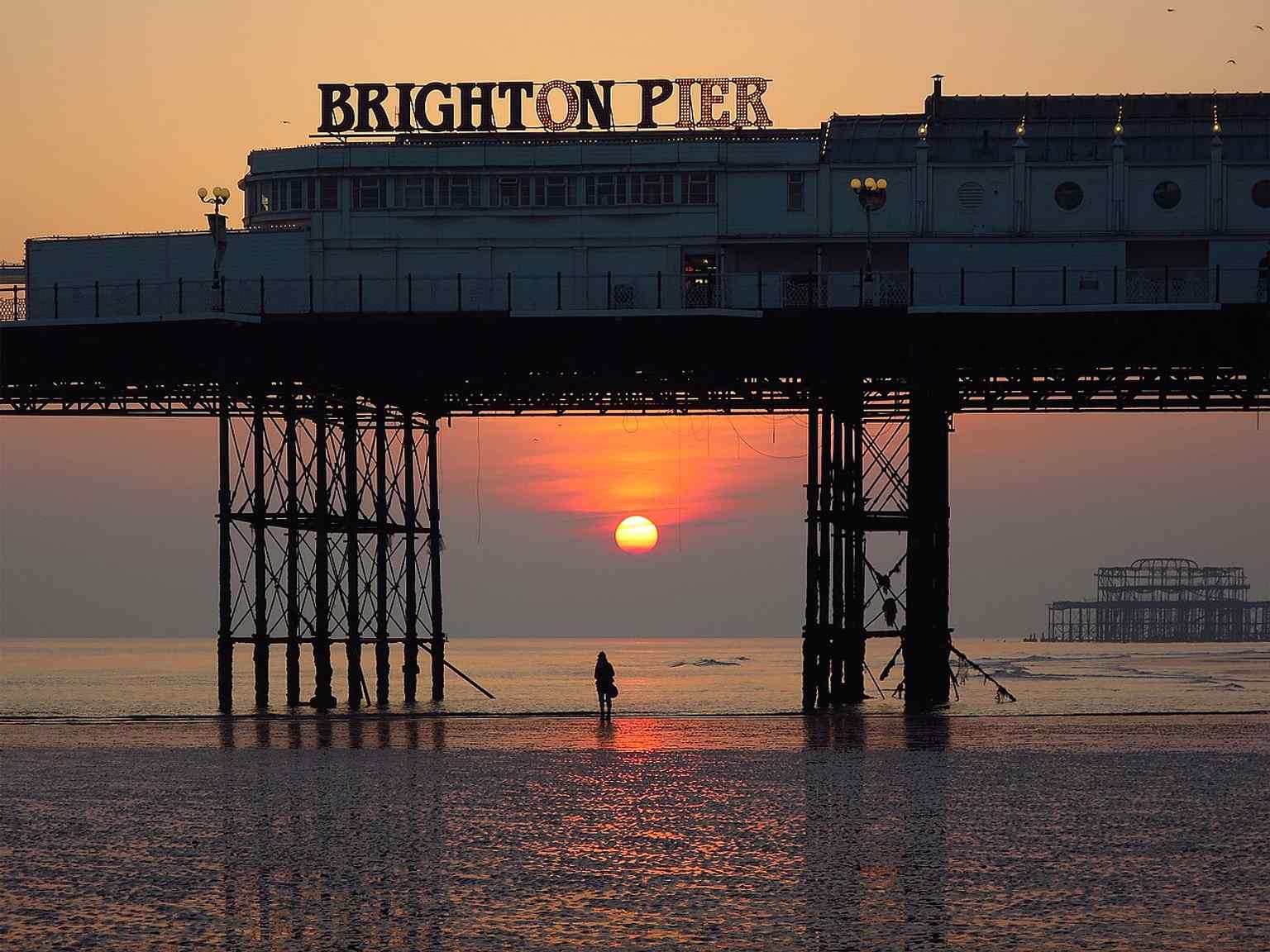
The Palace Pier in full daylight, a clear look at the Victorian-era structure that opened in 1899 and still draws millions of visitors.Photo: Michael Coppins, Wikimedia Commons, CC BY-SA 4.0. Cropped & resized. 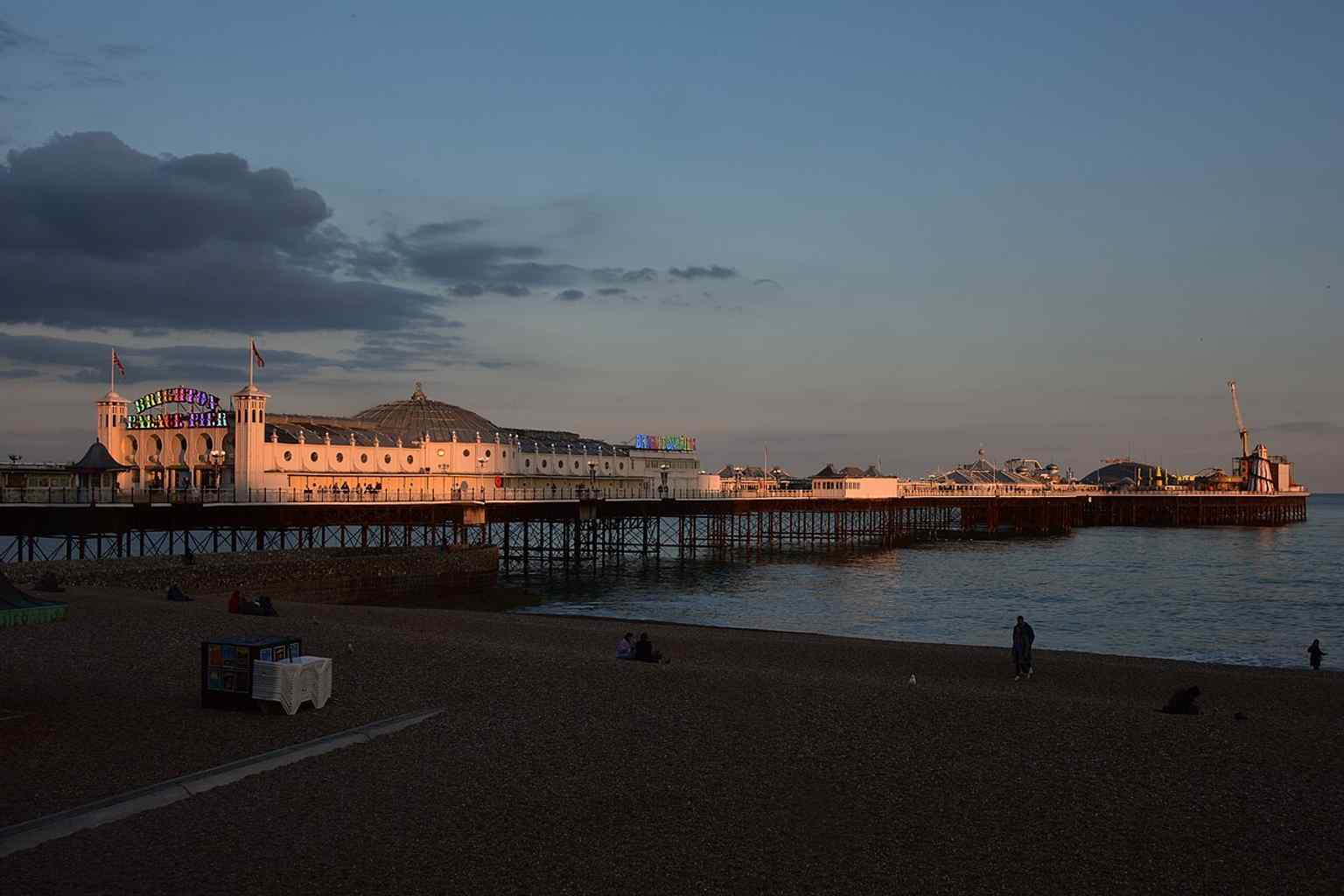
Golden-hour light gives this view a classic seaside feel, echoing the pier’s long-running popularity as an evening attraction.Photo: August Schwerdfeger, Wikimedia Commons, CC BY 4.0. Cropped & resized. 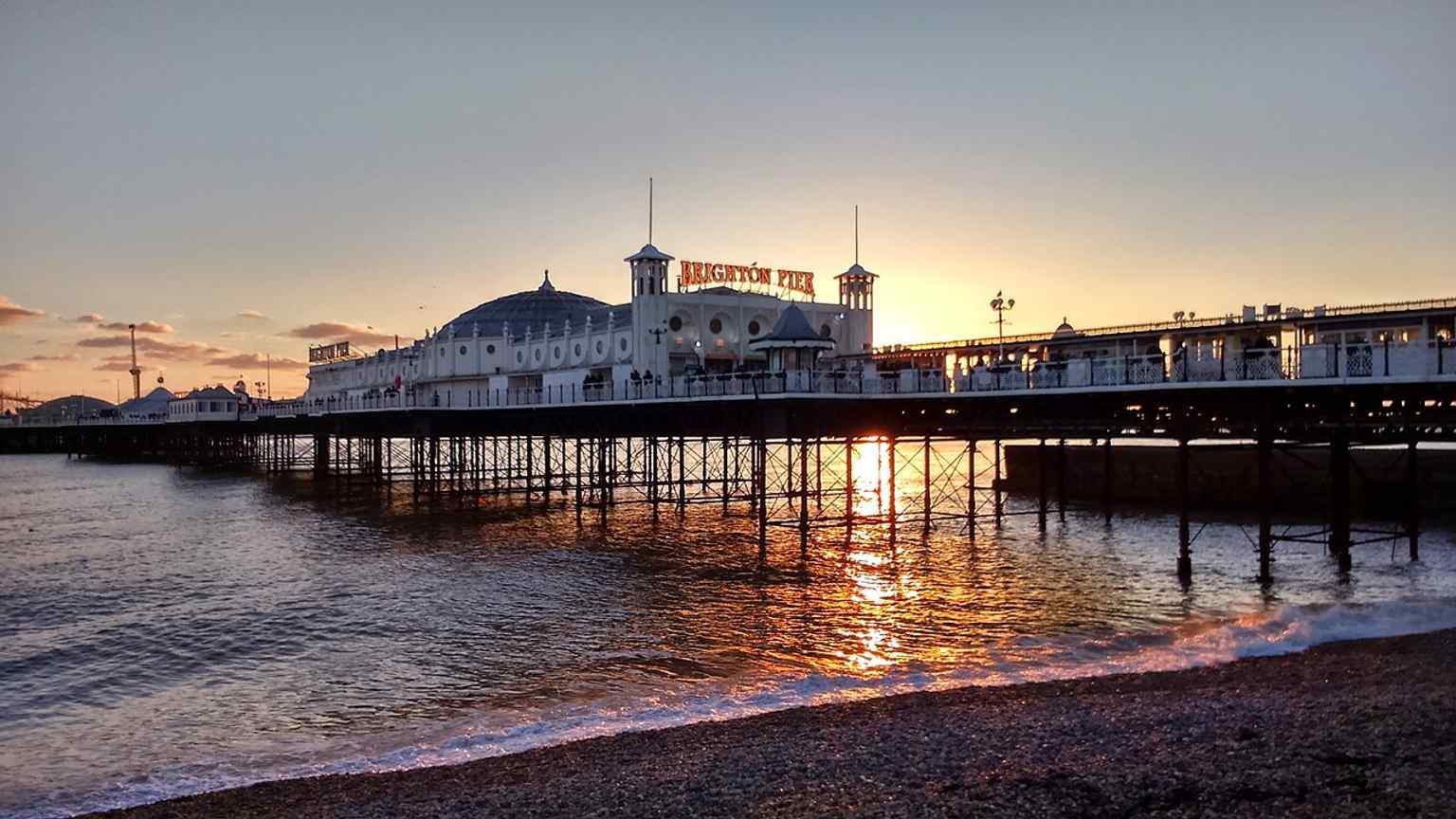
Sunset over the pier captures its famous illuminated promenade, part of the nightly glow from tens of thousands of bulbs.Photo: Fanfwah, Wikimedia Commons, CC BY-SA 4.0. Cropped & resized. 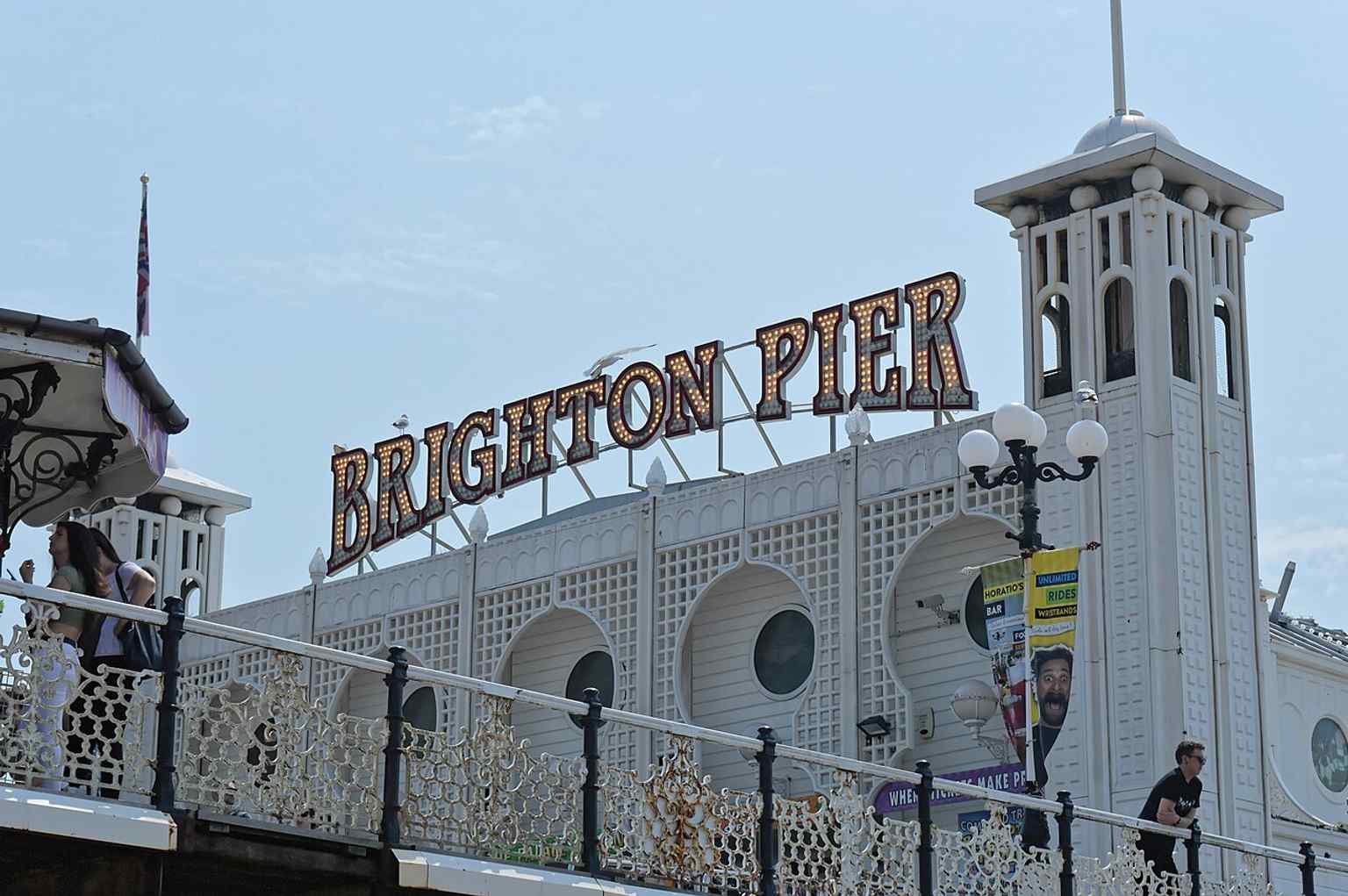
A closer look at the seaward pavilion area, where the pier’s entertainment focus shifted from theatre to amusement rides after the 1980s.Photo: IanDWheatley, Wikimedia Commons, CC BY-SA 4.0. Cropped & resized. 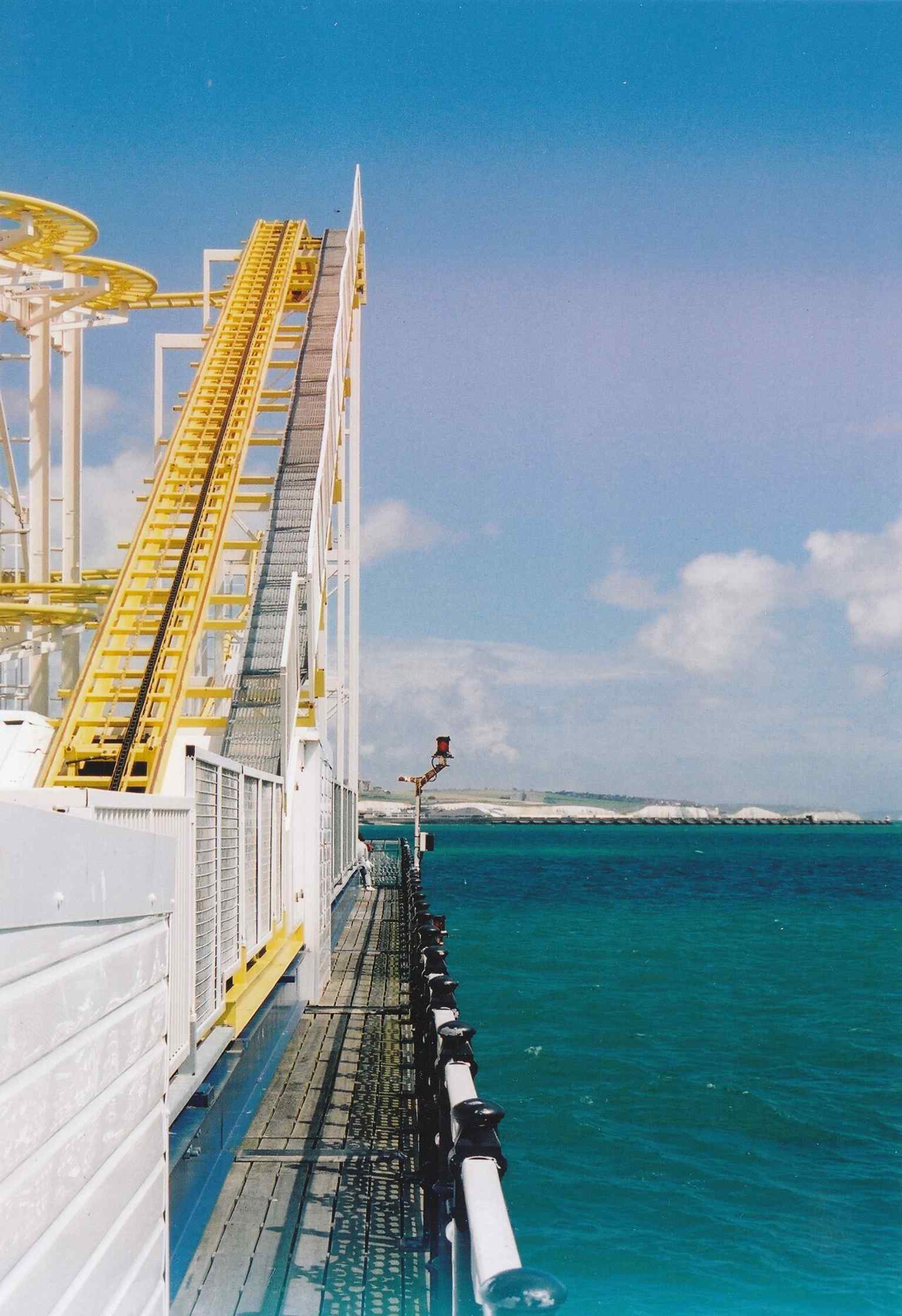
The Crazy Mouse ride adds the thrill-rides side of the pier’s story, part of the amusement park built out on the seaward end.Photo: Gunnar Klack, Wikimedia Commons, CC BY-SA 4.0. Cropped & resized. 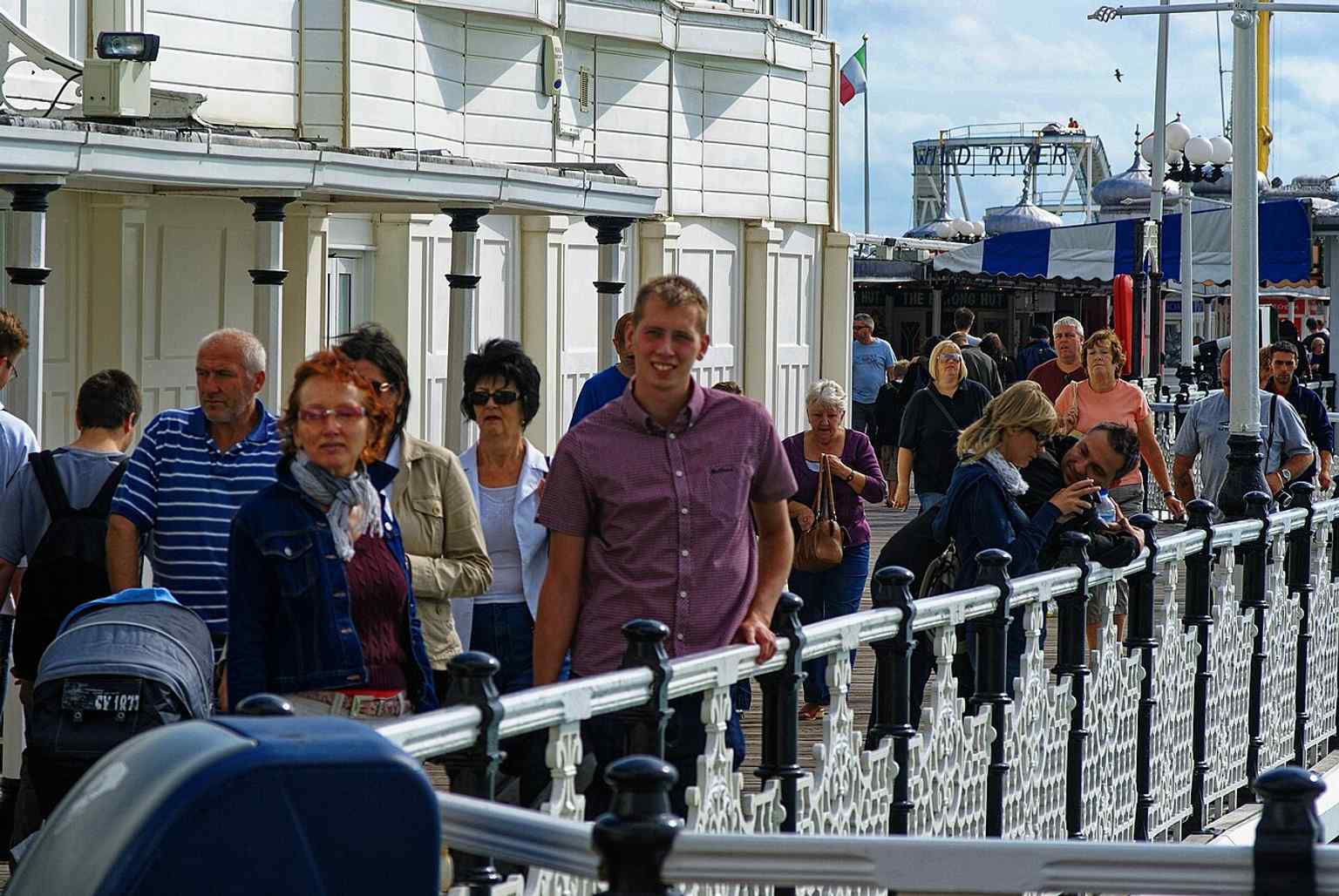
A 2009 view of the pier under its earlier Brighton Pier name, reflecting the debated rename that began in 2000.Photo: Txllxt TxllxT, Wikimedia Commons, CC BY-SA 4.0. Cropped & resized. 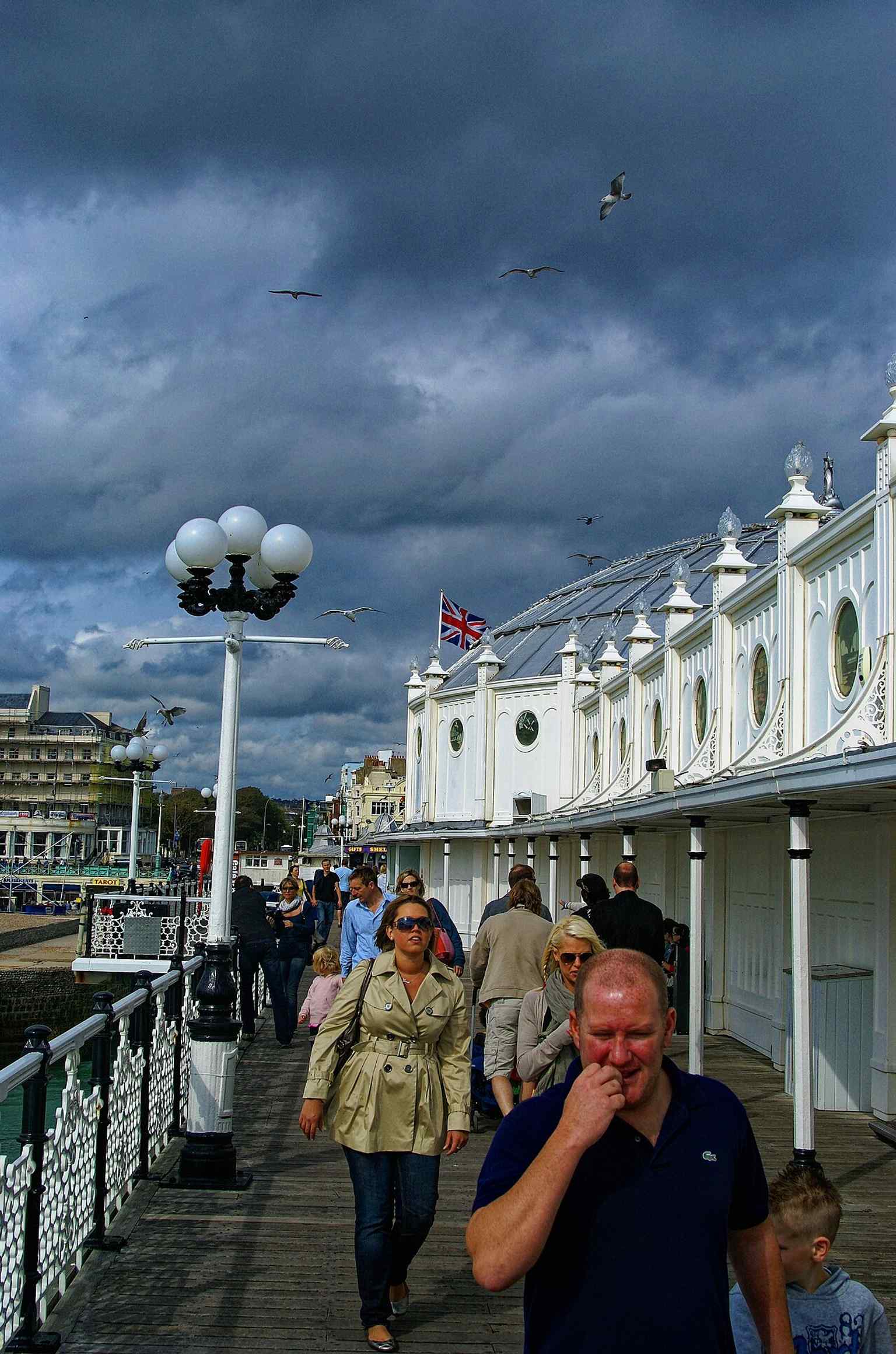
Another 2009 archival view, valuable as a dated record of the pier’s long, narrow profile and traditional amusement frontage.Photo: Txllxt TxllxT, Wikimedia Commons, CC BY-SA 4.0. Cropped & resized. 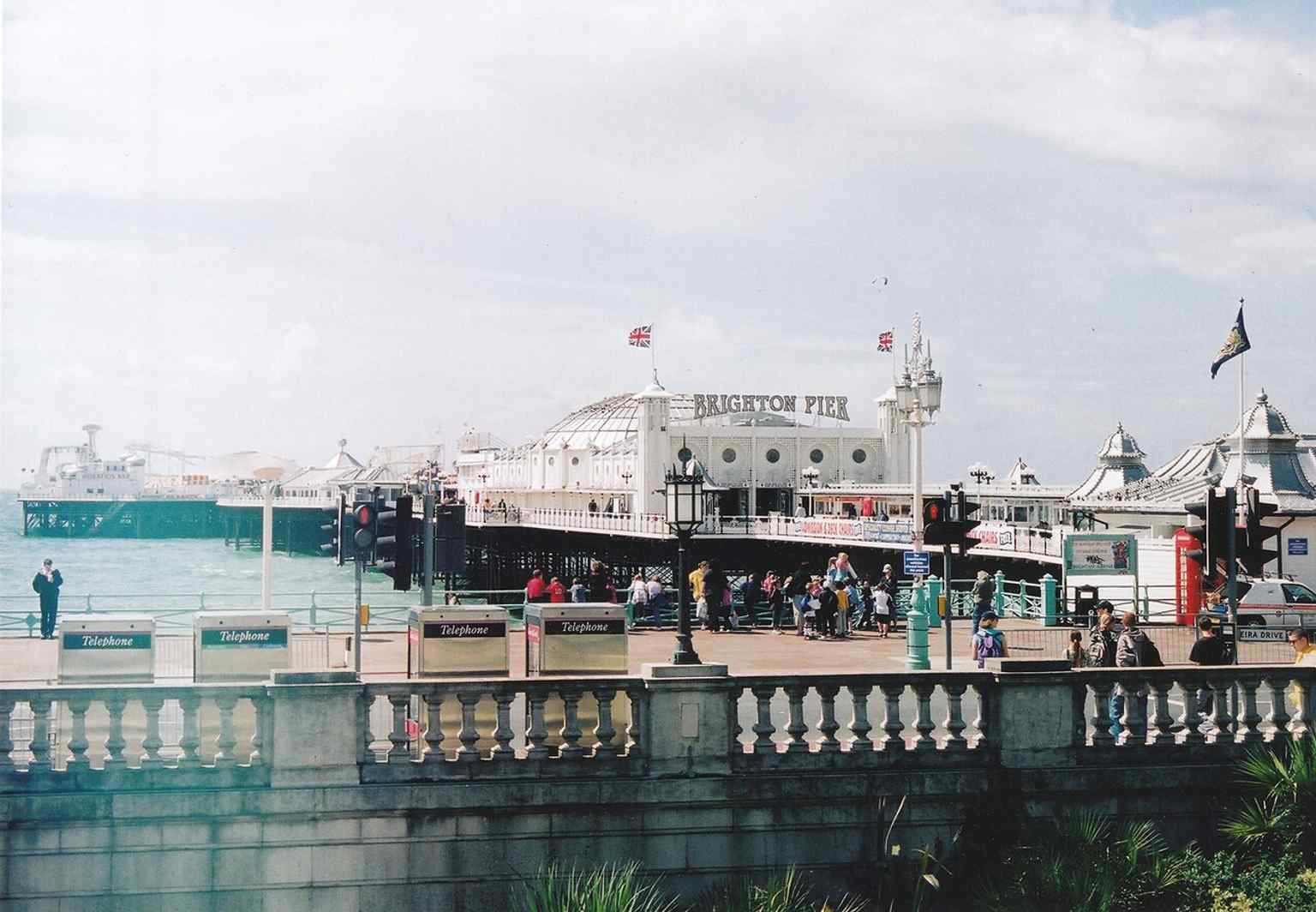
A 2002 photograph of Brighton Palace Pier, offering a snapshot from the years when the seaward end was dominated by rides and arcades.Photo: Gunnar Klack, Wikimedia Commons, CC BY-SA 4.0. Cropped & resized.
자주 묻는 질문
투어는 어떻게 시작하나요?
구매 후 AudaTours 앱을 다운로드하고 교환 코드를 입력하세요. 투어를 바로 시작할 수 있습니다 - 재생을 탭하고 GPS 안내 경로를 따라가시면 됩니다.
투어 중 인터넷이 필요한가요?
아닙니다! 시작 전에 투어를 다운로드하면 완전히 오프라인으로 즐길 수 있습니다. 채팅 기능만 인터넷이 필요합니다. 모바일 데이터 절약을 위해 WiFi에서 다운로드하시는 것을 권장합니다.
이것은 가이드가 안내하는 단체 투어인가요?
아닙니다 - 이것은 셀프 가이드 오디오 투어입니다. 폰을 통해 오디오 나레이션을 들으며 나만의 속도로 독립적으로 탐험합니다. 투어 가이드도, 단체도, 일정도 없습니다.
투어는 얼마나 걸리나요?
대부분의 투어는 60-90분이 소요되지만, 속도는 전적으로 본인이 조절합니다. 원할 때 언제든지 일시정지하거나, 정류장을 건너뛰거나, 휴식을 취하세요.
오늘 투어를 끝낼 수 없으면 어떻게 하나요?
괜찮습니다! 투어는 평생 이용이 가능합니다. 원할 때 언제든지 일시정지하고 다시 시작하세요 - 내일, 다음 주, 또는 내년에도. 진행 상황이 저장됩니다.
어떤 언어를 이용할 수 있나요?
모든 투어는 50개 이상의 언어로 이용 가능합니다. 코드를 교환할 때 원하는 언어를 선택하세요. 참고: 투어 생성 후에는 언어를 변경할 수 없습니다.
구매 후 투어는 어디에서 이용하나요?
App Store 또는 Google Play에서 무료 AudaTours 앱을 다운로드하세요. 교환 코드(이메일로 전송됨)를 입력하면 라이브러리에 투어가 나타나며, 다운로드하여 시작할 수 있습니다.
투어가 마음에 들지 않으시면 환불해 드립니다. 문의: [email protected]
안전한 결제 


%20(4).JPG)
%20(1).JPG)


%20(3).JPG)


%2009.jpg)


%2001.jpg)
%2002.jpg)


