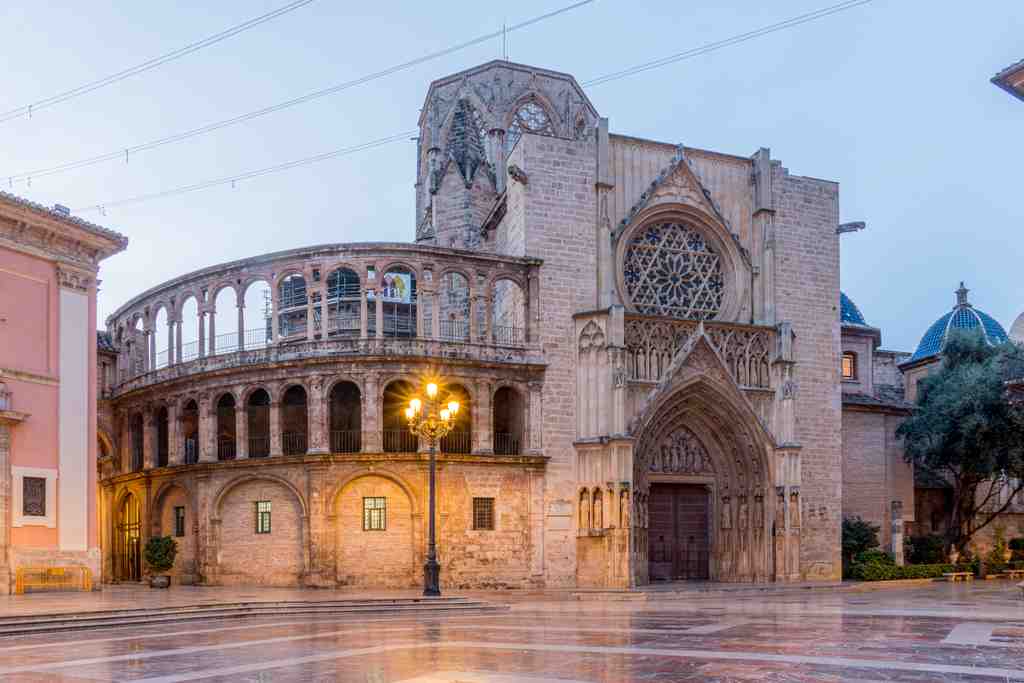
발렌시아 오디오 투어: 라 세우의 역사 속 속삭임
반란군이 발렌시아의 심장부를 습격할 때 미겔레테에서 종소리가 한 번 울렸고, 그 그림자는 수세기 동안 권력과 비밀을 엮어냈습니다. 이 셀프 가이드 오디오 투어는 라 세우의 진정한 층을 풀어내어, 대부분의 방문객이 그냥 지나치는 대성당 탑, 대리석 안뜰, 숨겨진 예배당을 안내합니다. 발걸음 아래에서 잊혀진 드라마의 메아리를 들어보세요. 헤네랄리타트 궁전의 금지된 홀 안에서 감히 왕에게 도전한 사람은 누구였을까요? 발렌시아 대성당의 돌에는 어떤 한밤중의 음모가 아직도 얼룩져 있을까요? 한 전설적인 종 제작자의 비밀 재료는 왜 그렇게 스캔들이었을까요? 자갈길에서 솟아오른 첨탑까지 이어지는 길을 따라 혁명, 미스터리, 경외감의 맥박을 추적해보세요. 어떤 가이드북도 드러내지 않는 속삭임을 발견하고 모든 전환점에서 도시 생활을 재해석하며 발렌시아를 탐험하세요. 한때 호기심이 탑을 밝혔듯이, 이제 여러분의 여정에 불꽃을 지펴보세요. 역사의 가장 대담한 순간들이 여전히 공중에 남아있는 이곳에서 이 모험을 시작하세요.
투어 미리보기
이 투어에 대하여
- schedule소요 시간 40–60 mins나만의 속도로 이동
- straighten1.2 km 도보 경로안내 경로 따라가기
- location_on
- wifi_off오프라인 작동한 번 다운로드, 어디서든 사용
- all_inclusive평생 이용언제든지 다시 재생 가능
- location_on발렌시아 헤네랄리타트 궁전에서 시작
이 투어의 정류장
You’re looking for a grand, ornately edged stone building with two solid towers and rows of tall gothic windows-just scan around the edge of Plaza de Manises, where the sunlight…더 보기간략히 보기
You’re looking for a grand, ornately edged stone building with two solid towers and rows of tall gothic windows-just scan around the edge of Plaza de Manises, where the sunlight glints off its creamy walls and you can’t miss those black iron balconies crowning the top floors. Now, take in the Palace of the Generalitat of Valencia-it's more than just a pretty face! Imagine yourself back in the late 1400s, when knights and notaries hurried through these very streets, their boots clapping on cobblestones. The palace began as a modest house, intended simply as a spot for local deputies to argue about taxes (as you do). But those debates clearly needed more space, and over time, this Medieval meeting place transformed into the sprawling palace before you, thanks to expanding budgets and a lot of artistic flair. The oldest parts show off its Mediterranean Gothic bones-look for the pointed arches and heavy, brooding towers. In the 1500s, the city’s best stonemasons worked magic here, bringing in Renaissance touches. Suddenly, the palace boasted sunlit patios and elegant stairways, the kind of place where you’d expect a dramatic duel-or a secret handshake over city secrets. If you spot windows topped with decorative curves or triangles, that’s the Renaissance showing off. Life inside wasn’t always peaceful. At one point, these golden halls held Valencia’s rulers, but they also shifted from housing the local government, to hosting courtrooms, and even sheltering a committee during Spain’s Civil War. So if these walls had a business card, it would need several pages. But no matter who was in charge, the building’s golden “sala dorada” always stood out. The legend goes that wealthy visitors actually gasped at all the gold on the ceiling panels-while less fancy guests pretended not to stare. The Palace has weathered more plot twists than a telenovela. Plagues, reforms, and even a bomb-damaged stone tower in the 20th century changed its shape-though local architects always did their best to make the repairs blend in. Want to spot a leftover from the 1940s restoration? Some stones were scavenged from an old, ruined noble house outside town. Waste not, want not! Wander past the main entrance, and imagine the clank of armor as guards opened the huge wooden doors at dawn. Inside the courtyard, artists, carpenters, and masons bustled at all hours, trying to outdo each other: “Your ceiling is nice, but mine has more cherubs!” Today, this palace is where the president of the Valencian government works-so sadly, there’s no pet dragon in the basement (that we know of). Look up-see the towers with their elegant railings? Long ago, you’d have spotted lookouts keeping an eye on neighboring palaces, rival families, and rogue pigeons. Peer at the facade and you’ll find a patchwork of different styles-Gothic, Renaissance, even a bit of classical influence with squared-off windows. It’s like a time capsule, showing off everything the city’s builders learned in five long centuries. So take a moment here, soaked in sunlight and history, and imagine the drama: urgent messengers scattering into the plaza, artists arguing about tile colors, important government secrets whispered in the echoing corridors. This palace saw medieval power grabs, royal intrigues, and the occasional prank-Valencians say you’ll have good luck if you spot the oldest gargoyle. Go ahead, try to find it… but don’t trip over a bicycle first!
전용 페이지 열기 →It all began in the early 1300s, after King James the Conqueror captured Valencia. He set aside this exact area to house the city's government. By 1302, the first version was…더 보기간략히 보기
It all began in the early 1300s, after King James the Conqueror captured Valencia. He set aside this exact area to house the city's government. By 1302, the first version was built, but the council quickly realized they needed more space-turns out, running a city takes more than just a tea room. So, like a house with too many shoes at the door, they expanded again and again for over two hundred years. By the late 1300s and 1400s, there was a courtroom, a prison (yes, really-a free tour and a free stay!), chambers for the council, archives, tax offices, and even a glittering chapel. Picture the grandeur: the main hall was a huge rectangle, so tall and wide it rivaled the throne room of the Catholic Monarchs in Zaragoza. At over 9 meters high, you’d have needed to shout for someone across the room to hear you. On top of that were its famous towers topped with decorative spheres-Valencia’s original answer to skyscrapers. The front door boasted an inscription in Latin: “SPQV”-which basically means, “The Senate and People of Valencia.” Even the city itself got a shoutout! But all was not peaceful. In 1423, disaster struck-a huge fire erupted, possibly sparked in the room for city scribes. The blaze raged through the wooden ceilings. Imagine the sound of beams cracking and old parchment curling up in the heat. The city's response? Grab the archives and hurl them out the windows to save important documents. The flames spared the golden hall just in time, and after many debates and a lot of indecision on building materials, the repairs transformed the space, filling the ceiling with painted angels. So, the next time your attic needs a makeover, just remember: angels, not insulation! Over the centuries, Casa de la Ciudad gained more than just rooms and angels. The city’s finest artists painted breathtaking murals and religious scenes. The building’s crowning jewel was a golden-wooden chamber decorated so beautifully that its ceiling was rescued and is now found in La Lonja-like historical home recycling at its best. Sadly, disaster struck again-another grand fire in 1586, this time blamed on prisoners beneath the main hall setting the mood with a little arson. Once more, the city council rushed to save documents and relics, evacuating treasures, and sending prisoners off to Valencia’s famous towers-which, let’s be honest, sounds like an upgrade. But, as centuries passed, the old house fell into ruin. Between 1854 and 1860, the decision was made: demolition. To the sound of hammers and falling stones, the grand building came down, replaced by gardens and a new city hall. And what about its treasures? Odd bits survived: a set of kingly portraits painted in the 1400s can be found in the Museu Nacional d’Art de Catalunya, and fragments of a glorious triptych depicting heaven and hell are split between two museums in Valencia. So, if you ever want to see the full scene, you’ll have to visit both-which is the city’s sneaky way of making sure you keep coming back. Even the reja, a sturdy iron grill from one of its chapels, now guards a corner of La Lonja, and pieces of its carved angels live on in festive parades every year, riding atop floats. Not many buildings get reincarnated, but Casa de la Ciudad still finds ways to join the party! So as you stand here, just imagine: turbaned jurors, grumpy jailers, masterpieces on every wall, grand fires, great rescues, and more than a few angels overhead-Valencia’s own medieval soap opera, right beneath your feet. And be glad you’re not carrying armfuls of paperwork out the window. That’s what I call a city council meeting with extra drama!
전용 페이지 열기 →Look for a grand, cream-colored mansion with arched windows at the top and two main doors set side by side, right across from the statue-topped column in Plaza de Manises-this is…더 보기간략히 보기
Look for a grand, cream-colored mansion with arched windows at the top and two main doors set side by side, right across from the statue-topped column in Plaza de Manises-this is the Palace of the Marquis of La Scala. Alright, imagine yourself standing here in the Plaza de Manises, the sun warming your face as you gaze up at the stately Palace of the Marquis of La Scala. It’s easy to believe this place has secrets, with its twin mansions blended into one, balconies popping out from the main floor and upper gallery, and-if you look closely-a remarkable square tower capped with round balls, something you’d almost never see elsewhere in Valencia! Back in the 16th century, this spot would have echoed with the clatter of carriages and noble boots, but over centuries, the palace has donned new styles like an old countess changing hats: a touch of Valencian Gothic, a flourish of Renaissance arches, and some flamboyant 18th-century Baroque. Step up and you’ll spy a solid stone doorway surrounded by long brick walls, with a row of Renaissance arches peeking above like watchful eyes. If we could tiptoe inside (and not get caught!), you’d find a wide entry hall with heavy wooden beams-sturdy enough to make any carpenter jealous. Beyond that lies a sunlit courtyard where hints of Gothic design still linger, and a magnificent staircase that hangs so gracefully you’d swear it’s floating. Even the main staircase upstairs was once crowned by a floral fresco beneath an oval dome. And here’s a fun fact for you-this palace was once so important, it rivaled the power of the Generalitat, the Valencian government itself! Even today, the plaza is bursting with history. Right beside you is the Bailía, and the neoclassical Casa de Vallier, all watched over by a column topped with a rugged “conquistador” statue, a tribute to Spanish heritage. I say, if these old walls could talk, they’d definitely have a few stories to argue about whose party was the best!
전용 페이지 열기 →
11개 정류장 더 보기정류장 적게 보기expand_moreexpand_less
To spot Plaza de la Virgen, just look ahead for a wide, open space surrounded by grand old buildings, a domed basilica on your left, and right in the center-a stunning, splashing…더 보기간략히 보기
To spot Plaza de la Virgen, just look ahead for a wide, open space surrounded by grand old buildings, a domed basilica on your left, and right in the center-a stunning, splashing fountain with bronze figures lounging around it. Now, imagine you’ve landed right at the heart of ancient Valencia. The stones beneath your feet have seen more footsteps than a marathon route! Plaza de la Virgen is not just a square-it’s the city’s living room. This spot has been buzzing for thousands of years, back to the days when Roman sandals first ticked across the forum at the crossing of two mighty Roman streets. If these cobbles could talk, they’d probably have more stories than your favorite grandma! Surrounding you, there’s a patchwork of history: to your east, the fiery pink Basílica de la Virgen de los Desamparados; to the west, the leafy gardens of the grand Palace of the Generalitat; to the south, the mighty stonework of Valencia Cathedral, and some private homes that have watched all these tales unfold. And let’s not forget the Casa Vestuario, where water judges in black capes gather with their serious faces just before they settle age-old disputes about irrigation. But, the real showstopper right now is the Fountain of Turia. Take a closer look at the lounging bronze river god-doesn’t he seem a little too relaxed for all the chaos he’s seen over the centuries? Around him, eight women, each representing an ancient irrigation canal, keep him company, quietly celebrating the life-giving water that keeps Valencia green and gorgeous. On festival days, this place bursts into color as thousands of Valencians parade in, arms overflowing with flowers to dress a giant statue of the Virgin during Las Fallas. The scent of blooms fills the air, laughter echoes, and the square transforms into a sea of petals and music. And every Thursday-yes, just before lunchtime-the legendary Water Court gathers here. Picture black-caped judges deciding age-old water feuds with simply a word. The tension is real-but so are the traditions, unchanged for centuries, as onlookers hold their breath and the city pauses to listen. So, while you might hear the stresses of daily life echoing from the narrow streets, here in Plaza de la Virgen, you’re standing where empires, pilgrims, and partygoers have mingled for over two thousand years. Not bad for a city square-just don’t let the lounging river god trick you into napping on a bench!
전용 페이지 열기 →To find the Edificio Cánovas, look up and spot the tall, yellowish building with five floors, lots of windows, and elegant curved corners right on the edge of Navellos…더 보기간략히 보기
To find the Edificio Cánovas, look up and spot the tall, yellowish building with five floors, lots of windows, and elegant curved corners right on the edge of Navellos street-trust me, you can't miss those sweeping lines! Now, picture yourself in Valencia back in the early 1930s. The jazz age is giving way to something new, and the city’s heart is about to get a touch of modern flair. Luis Albert Ballesteros, a local architect, had a tough decision-should he dress his new creation in old-fashioned style or take a risk with the “rationalist” look everyone was talking about? After a few years of back-and-forth (and, no doubt, a few cups of strong Valencian coffee), he picked a bold, geometric design with dramatic curves. It's as if the building decided to do a little tango right on the corner! The façade facing Navellos street has an almost theatrical vibe with its expressionist features, while the other sides tone it down with smooth, sharp rationalist lines-talk about a building with more than one personality. Inside, you’d find hints of art deco, with details that make you want to throw on a vintage suit and say, “darling, shall we dance?” Originally built for both homes and offices, Edificio Cánovas still stands as a symbol of a time when Valencia dared to dream in modern shapes.
전용 페이지 열기 →To spot the Palacio de los Catalá de Valeriola, look to your right for a stately building with creamy brick walls, tall wooden windows, and elegant balconies that jut out over a…더 보기간략히 보기
To spot the Palacio de los Catalá de Valeriola, look to your right for a stately building with creamy brick walls, tall wooden windows, and elegant balconies that jut out over a stone base on the corner of Plaza de Nules. Now, let’s step back in time and imagine the centuries breathing quietly through these sturdy walls. Picture Valencia in the 1400s-horse hooves echo off cobblestones, nobles sweep past in velvet cloaks, and sunlight filters softly into the grand patio inside, the beating heart of this palace. The original owners, the Catalá de Valeriola family, designed their home with the spirit of Valencian Gothic, centering everything around that hidden courtyard, with a zigzag-patterned staircase so stylish even modern designers would be jealous! But life here wasn’t always calm and neat. Over the centuries, this house morphed in bursts-like a palace putting on new coats for every era. In 1727, things got dramatic: a next-door house was bought, the building was turned to face this very plaza, and a brand-new façade went up. Four layers stacked up on each other-starting with a semi-basement for storage (maybe even a few secret barrels of wine), then a service floor, a noble residence dripping with grandeur, and rooms above for servants and attic secrets. The balconies you see today were added to give the palace that extra flourish; I wonder how many stories those old iron railings have overheard at night! Inside, echoes of Gothic arches survive, like a few clues from a medieval mystery book. In the 1800s, a new family crest appeared-the Escofets had arrived! Even more changes came in the early 2000s, when restoration works uncovered painted wooden ceilings and breathed color back onto faded walls. Now, this grand building houses the offices of the Vice President of Valencia, but you can still sense the layered centuries whispering just behind those elegant balconies. Wouldn’t you love to overhear one of those walls gossiping about the past?
전용 페이지 열기 →Take a good look at the grand building before you-that’s not just any palace, that’s the Corts Valencianes, or Les Corts, the very heart of Valencian decision-making! Standing…더 보기간략히 보기
Take a good look at the grand building before you-that’s not just any palace, that’s the Corts Valencianes, or Les Corts, the very heart of Valencian decision-making! Standing outside, you might catch a faint echo of lively debates and centuries-old negotiations bouncing off the ancient stones. Can you picture it? Medieval cloaks sweeping across mosaicked floors, urgent voices discussing matters of life, law, and the little details-oh, and sometimes, who had to pay extra taxes. Yes, even back then no one liked talking about taxes! It all started way back in the 13th century, when King James I of Aragon-the guy who loved a good meeting-needed a little help funding his kingdom’s dreams and defending its borders. So, he called together the three big groups: the nobles, the church, and the townsfolk. Imagine the clinking of armor, the rustle of embroidered robes, and the shuffling of city representatives carrying ledgers thicker than ancient tomes. Here, in 1261, James I convened a legendary gathering, and on a bright April day, in a room filled with tension, he announced the Furs of Valencia-a set of rules so important, they were basically the local constitution. But, of course, nothing comes for free, not even in the Middle Ages! The king exchanged his shiny new legal system for a sum of 48,000-a fortune at the time-chipped in by Valencia and neighboring towns like Castelló, Llíria, and even Gandia. You could say it was history’s earliest ‘crowdfunding’ campaign, but with fewer perks and more pressure. From these beginnings, meetings became a tradition. Kings couldn’t start their reign without organizing a grand assembly, right here in Valencia, sometimes in spaces so packed that even the Cathedral had to double as a parliament. And as the decades rolled by, more towns sent their delegates-each with its own tales and troubles. By 1510, towns from Alicante to Xàtiva joined the bustling debate club, all hoping their voices would echo through these halls. The excitement didn’t stop there. Some rulers thought, "Let’s make this regular!" so by the early 1300s, the Corts were meeting at least every three years. Picture All Saints’ Day in 1336: the city humming with anticipation, representatives scurrying through narrow streets, and citizens whispering about what laws might change next. “Maybe this year, they’ll finally fix the potholes!” they’d hope-just like today. But even in such powerful rooms, fortunes change. As Spain grew, the Corts lost their punch. Meetings dwindled, and in 1645, the candles flickered for their last gathering. After the War of the Spanish Succession, along came the big, royal eraser: the 1707 decree that wiped out Valencia’s rights and institutions for nearly 300 years. For centuries, the only sounds here might have been the creaking of empty corridors and the echo of old arguments. Now, leap ahead to the 1980s-a new chapter! Democracy returned, and with it, a brand-new Corts Valencianes under the 1982 Statute of Autonomy. Suddenly, this palace-officially the Palace of the Borgias-buzzed again with election drama, impassioned speeches, and the ticking of vote-counting machines. Political parties from every corner of the Valencian Community would send their hopefuls-Alicante, Castellón, Valencia itself-all vying for a seat. Election nights could make your heart pound, with coalitions, upsets, and the occasional “Did my cousin really vote for them?” Even the rules got spiced up: you needed five percent of the vote just to join the parliamentary party, and those who didn’t make the cut were left out in the cool Mediterranean air. Today, 99 deputies debate everything from budgets to local fiestas-and let’s face it, the arguments over paella recipes can get pretty heated! So, as you stand here, imagine the laughter, tension, and triumphs of centuries unfolding within these storied walls. Valencia’s voice, past and present, still finds its power in the halls of Les Corts. And remember-whether in armor or Armani, everyone comes here ready to make history… or at least a little noise.
전용 페이지 열기 →Take a look just above the main doorway on the street-you’ll spot an ornate stone shield, decorated with mysterious symbols and crowned by a knight’s helmet, marking the entrance…더 보기간략히 보기
Take a look just above the main doorway on the street-you’ll spot an ornate stone shield, decorated with mysterious symbols and crowned by a knight’s helmet, marking the entrance to number 9 on Salvador Street. Ah, welcome to the secret world of the Romeu family! Imagine it’s a warm afternoon in medieval Valencia, and you’re making your way to a grand palace, sunlight glinting off this very coat of arms above you. This shield is not just any decoration; it’s the Romeu family’s badge of honor-and what a family they were! Now, pay attention to the details carved here: an eagle, chains, bars, and a noble cross all sharing the stone surface. Each symbol tells a story older than a grandmother’s favorite recipe. The Romeu name popped up around Europe as far back as 1150, right at the time when knights wore armor that looked a lot like the helmet you see on top of this shield. Historians will argue about exactly where the Romeus started-was it under a regal sky in Catalonia with Count Ramon Berenguer IV, or in the company of bold knights serving kings at the epic siege of Cuenca? Wherever they began, these folks didn’t just twiddle their thumbs; they charged alongside kings, helped conquer cities, and really put their family name on the map. Fast forward to the 1300s, and you’ll find a certain Gil Jiménez Romeu walking these very streets, taking his seat not at dinnertime but in the grand Valencian Parliament! His son, Juan, must have made some impressive choices-he married Ramona Catalá, his heirs went on to rule over villages and become barons. If you squint at this shield, you can almost see their stories-eagles that once soared above Catalonia, golden crosses, and chains that held stories of power. They say there are as many versions of the Romeu shield as socks in an old castle, but the one above you comes straight from the Catalonian branch: a bold black eagle, golden stakes, and a cross adorned with the drama of a knight’s tale. Legend has it that anyone passing under this stone shield gets a sprinkle of noble luck. So, next time you’re searching for treasure-either gold or just a really good pastry-remember, you’ve walked where knights and barons once lingered, and you stand beneath the stone-etched pride of the Romeu family. Now, isn’t that a story worth carrying with you?
전용 페이지 열기 →You’re looking for a tall, weathered building with faded yellow walls and a string of balconies-just across from the Antiguo Almudín-and you’ll know you’ve found it when you spot…더 보기간략히 보기
You’re looking for a tall, weathered building with faded yellow walls and a string of balconies-just across from the Antiguo Almudín-and you’ll know you’ve found it when you spot the old ceramic panel with a depiction of Jesus on the cross right on the façade. Alright, you’ve arrived at the Birthplace of Saint Louis Bertrand-and oh, what stories these old walls could tell if they could just cough up a sentence or two! Picture yourself stepping into the early 16th century, on a modest, busy street, the hum of the city in the air, but there’s something special about this spot: inside, in a very ordinary room, a baby boy named Luis Bertrán was born. Who could’ve guessed this little fellow, surrounded by the aromas of Valencian cooking and the hush of prayers from the nearby Church of San Esteban, would one day become a saint? The house itself looks pretty humble, doesn’t it? It hasn’t seen much love from city planners lately-protected for its historical value but waiting, a bit like a character in a telenovela, for its grand makeover since 1993. The façade is marked by patches of peeling paint and aging stone, but the real crown jewel is that beautiful ceramic panel. This panel is older than most people’s great-grandparents and is considered a local treasure. You can imagine how, over centuries, generations would stop and gaze up at it, perhaps murmuring a quick prayer-or at least a quiet “wow.” Now, let’s go back in time for a moment. After Saint Louis was born here in 1526, the house became a place of pilgrimage. In 1608, when the news arrived that Luis had been beatified, the family and local nobles got together and decided, “This isn’t just any house-let’s build a chapel!” So, they did. They announced it for all to see with an inscription over the lintel: “Casa Natalicia de San Luis Beltrán.” Inside, a tiny rectangular chapel squeezed into the side of the building, crowned with painted angels overhead, became the focal point for worshipers. Portraits and paintings inside would tell visitors the tale of Saint Louis, from his earliest years to his days preaching and, ultimately, being canonized as a full-fledged saint. The atmosphere outside these walls might seem a bit run-down now, but, oh, the drama of history played out here! In 1848, even the Marquis of Cruïlles (with quite a fancy name for a fan of ruins) noted the place was already getting pretty shabby, thanks to Valencia’s ever-shifting streets and growing city. The building’s lost some rooms, shuffled its alignment, and seen its chapel size shrink. Yet, every year, especially in October, people gather here for solemn ceremonies, their footsteps echoing over tiles that once welcomed a saint as a child. So stand for a moment and let the scene sink in: centuries of whispers, prayers, hope, and a touch of neglect-waiting, perhaps, for a miracle of restoration. If these walls start talking, just promise you’ll let me listen in, too!
전용 페이지 열기 →Take a moment to look up at the dignified facade in front of you - you’re standing before the Museo de la Ciudad de Valencia, nestled in the elegant old Palace of the Marquis de…더 보기간략히 보기
Take a moment to look up at the dignified facade in front of you - you’re standing before the Museo de la Ciudad de Valencia, nestled in the elegant old Palace of the Marquis de Campo. If these walls could talk, I think they'd have a lot to say about centuries of lost treasures, close calls, and a few dusty secrets. Imagine we’ve slipped back in time to the early 1800s. Post-reconquista enthusiasm is still in the air. There was a growing urge in Valencia to gather everything that told the city’s story: ancient archives, historic banners, keys to the city, even the sword of King James I - you know, the kind of sharp artifact you’d only hand over to a responsible adult. Everyone wanted a museum, but, like my homemade paella, the ‘recipe’ kept failing - plans went up in smoke, funding fizzled, and more than one meeting ended with someone saying “mañana, mañana.” For years, many priceless relics were stashed wherever space could be found, from dark corners of the city hall to personal collections. Some were rescued from the ruins of the original Casa de la Ciudad, which, sadly, fell victim to destruction and looting in the 19th century. It wasn’t until the 1920s that two determined visionaries, Maximiliano Thous and Enric Durán i Tortajada, began to stir the pot again. Now, imagine Valencia’s council rooms: stacks of paintings, sculptures peeking through the dust, all with labels that might as well have read “If lost, return to Valencia.” Here’s where the location comes in: The palatial home you see was once known as the Palace of the Counts of Berbedel. By 1974, it wasn’t just a snazzy address, but a historical monument in desperate need of TLC and, well, a new job! That’s when the city decided it would become a museum - the kind that actually had a roof and didn’t double as someone’s living room. After a round of urgent repairs (think banging, clanking, and the occasional worried “uh-oh” from the builders ), the new Museo de la Ciudad officially opened its doors in 1989. The inaugural exhibition dove into Valencia’s Roman roots, showing off ancient finds dug up from right beneath the city. Step inside, and each floor is a treasure chest. The collections come from all over: old palaces, accidental finds during construction, archaeological expeditions, and the odd generous donation. First up: the Stonework Section, which is home to architectural fragments, noble coats of arms, and mysterious old inscriptions that might have meant “No parking” in Latin. The Archaeology Section holds artifacts unearthed from all kinds of surprising places. There’s a Painting Section, almost a thousand works strong, including a “Judgement Day” piece by Van der Stock and fragments from the Capitol of the Jurors. Fun fact: some paintings arrived during the Spanish Civil War and, like my Uncle Miguel at a fiesta, never found their way home. But wait! There’s more: the Sculpture Section owes a huge thanks to the Martí Esteve heirs, who parted with their collection, while the Print Room features 18th and 19th-century engravings by Valencia’s finest. There’s even a stash of ceramics discovered accidentally in 1947 when, during city works, the workers found themselves with a jackpot of pottery shards. The collection grew even more with purchases like Francisco Mora Gallego’s treasure trove. As you wander, look out for the Religious Artifacts Section, glittering with precious metals, mostly rescued from the chaos of wartime. The Decorative Arts include everything from forged iron gates to miniature masterpieces. Then, for the number nerds, there’s the Coin Collection - most of it thanks to José de Llano and White, and, you guessed it, Martí Esteve again! Even the scales and measures, which might look a bit boring, have their own stories, donated by Juan Antonio Gómez-Trénor. So before you step inside, have fun imagining all the people, drama, and discoveries hiding behind these palace doors. After all, this isn’t just a museum - it’s Valencia’s attic, basement, and treasure vault all rolled into one. Now, if only they’d let us borrow that sword…
전용 페이지 열기 →You’re looking for a grand, peachy-pink palace with ornate balconies and a striking square tower at the top-just scan around the plaza for a stately building with brick walls,…더 보기간략히 보기
You’re looking for a grand, peachy-pink palace with ornate balconies and a striking square tower at the top-just scan around the plaza for a stately building with brick walls, stone bases, and a balcony above a richly decorated central door. Welcome to the Palacio Arzobispal de Valencia-home to more bishops and archbishops than you can shake a crozier at! Imagine you’re stepping into a place where the echoes of power and faith are as thick as the stone beneath your feet. Now, if you’d visited during the days of King Jaime I of Aragón, you wouldn’t have found this glorious palace. Instead, you’d be facing a quirky bunch of nine houses jammed together, just hoping not to topple over! But soon, those little dwellings couldn’t keep up with the ambitions of the archbishops, so the estate grew bigger, swallowing up nearly everything between here and the now vanished church of Santo Tomás. Back in the 1300s, there was a bit of drama-Bishop Hugo de Fenollet built an arch linking this palace to the cathedral. The city’s jurors weren’t thrilled. “Who let the church in?” they might’ve grumbled, but after a bit of medieval negotiating (and probably some wine), they finally allowed it in 1357. Fast forward to the 18th century, the palace keeps getting glammed up: imagine elegant halls, a sculpture of Santo Tomás de Villanueva appearing in the courtyard, and a library so impressive that locals boasted it was the oldest in the city-a reader’s paradise, until a Spanish war broke out and parts of it went up in smoke! Thankfully, the archbishops rebuilt, and even added collections of old coins, paintings, and sculptures. This house was truly full of treasures and secrets. Then, disaster struck during the Spanish Civil War in 1936. The palace was set on fire, and by the time the conflict ended, it was knocked down and rebuilt by 1946. And here’s where things get a twist-the current palace was designed by Vicente Traver, giving it that grand, historicist baroque style you see now, with pink bricks, stately stone, and that eye-catching triangular pediment. In modern times, this place has welcomed not just archbishops, but popes themselves-including Pope John Paul II and Benedict XVI, making it quite the heavenly hotel! So as you stand here, close your eyes and picture it all: the medieval arguments, the shimmer of vanished treasures, the scent of burning books, and the footsteps of saints and pontiffs wandering these echoing halls. Not bad for just another day in Valencia, right?
전용 페이지 열기 →Right in front of you, rising above the nearby rooftops, you’ll see the Miguelete: a tall, octagonal stone tower topped with ornate Gothic arches and a small turret, making it…더 보기간략히 보기
Right in front of you, rising above the nearby rooftops, you’ll see the Miguelete: a tall, octagonal stone tower topped with ornate Gothic arches and a small turret, making it easy to spot against the sky from almost anywhere in the plaza. Now, let your imagination run wild as you stand before this mighty tower. The Miguelete-or the “Micalet” as locals call it-has watched over Valencia for more than 600 years. Picture the scene back in 1381: the sound of chisels against stone, workers shouting instructions, and dust swirling around, as Bishop Jaime of Aragón decided it was time to give the cathedral a proper campanile. No one knew then that it would take nearly fifty years, three master builders, and a whole lot of patience-and probably a few “Are we there yet?” moments-to wheel this Gothic beauty into existence. It started life as the “New Bell Tower,” standing proud to outshine the “Old Bell Tower” whose remains still linger in the city’s shadows. Work began with the architect Andrés Juliá, but his slow pace threatened to make the tower as eternal as the city itself. The cathedral chapter, not known for their patience, swapped him out and ramped up the workforce-think hustle and bustle, cranes, and pulleys creaking under the Mediterranean sun. By 1413, they’d made serious progress. But the crown jewel needed a final touch, and for that, in came Pedro Balaguer-the genius behind the Serranos Towers. He took inspiration from distant towers in Lérida and Narbonne, determined that the Miguelete would stand apart from every other Spanish campanile. Even as plans for a grand needle spire were drawn up by Antonio Dalmau, fate would leave the tower crowned only by its signature Gothic balustrade. The needle idea? Well, it’s still on display-safe and sound in the city’s museum, never touched by the Valencia skyline. Miguelete wasn’t just a giant bell tower, though. Its position meant it doubled as a medieval early-warning system-sentinels used smoke signals from its summit to warn of oncoming trouble. When no enemies showed up, the tower became a beacon for ships at sea, guiding them toward Valencia's bustling port. And if you imagine the rooftop fireworks of local fiestas, you get a sense of the mayhem up there-although all those fire tricks once led to a little too much excitement (hint: flames, smoke, and frantic feet). Eventually, they just decided, “Let’s use this terrace for the bells instead!” Climb inside (if you're brave enough for over 200 steps), and you’ll pass through centuries-old chambers. One was even a medieval refuge, giving sanctuary to outlaws who threw themselves on the mercy of the church. Think of fugitives-hearts pounding, breathless, hiding away in the tower, hoping the law wouldn’t reach that high. There’s more: at the very top is the famous campana “Micalet,” after which the whole tower is named-a thunderous bell from 1539 that still marks the hours for the city. And what a mix-up of bells! Some moved here with a dramatic exit from other towers, some never ring at all, and the biggest even has its own calendar of public performances. If you visited in the twentieth century, you’d see the bell ringers-the campaners-scaling the spiral stairs, ducking through doors, little graffiti scrawled on walls by memories from centuries past. With every restoration, new stories piled on top of old ones, as iron railings replaced wooden doors, electronic controls replaced ropes, and the bell’s mighty swing became an electric affair-though with a habit of breaking down just when a festival needed them most! Even now, the manual bell ringers perform on special days, each swing and chime echoing Valencia’s heartbeat. Their ancient tunes mark not only the hours, but the city’s joys, sorrows, storms, and even the closing of her medieval walls. So go on, gaze up! You’re standing next to the city’s tallest storyteller, still ringing out the soul of Valencia with every chime. Ready to delve deeper into the description, bell room and bells or the modifications and restorations of the twentieth century? Join me in the chat section for an enriching discussion.
전용 페이지 열기 →Right ahead of you, you’ll see a large, stone cathedral with an impressive circular section of arches and a pointed Gothic doorway, crowned by a huge rose window-just look for the…더 보기간략히 보기
Right ahead of you, you’ll see a large, stone cathedral with an impressive circular section of arches and a pointed Gothic doorway, crowned by a huge rose window-just look for the towering octagonal dome and intricate carvings to know you’ve arrived at Valencia Cathedral. Now, imagine you’re standing here centuries ago, the air heavy with tension and the scents of fresh-cut limestone and distant incense wafting through the square. This is the Metropolitan Cathedral-Basilica of the Assumption of Our Lady of Valencia, but don’t worry, you can just call it Valencia Cathedral-or if you want to sound impressive, you could try its former name, St Mary’s Cathedral! It was consecrated in 1238, right after the Christian Reconquista, when a triumphant procession led by the first bishop of the “new” Valencia declared the site sacred. In fact, before this, you’d have found the rumble of a Visigothic church here, and under the rule of the Moors, it was a mosque echoing with prayers in Arabic. So, standing here, you’re on a spot layered with centuries of faith, conflict, and rebirth. Legend has it that when Bishop Pere d’Albalat took over after King James I, also known as James the Conqueror (he loved his dramatic titles), they were in such a hurry to plant their Christian flag that they built the first version of this cathedral at lightning speed. Just imagine the clatter of chisels, the barking of orders, and the odd shout of, “Mind the cornerstone!” As the plans unfolded, they kept on building. The architects weren’t shy about mixing their styles-a little Gothic here, a spritz of Renaissance there, a touch of Baroque, and even some Neoclassical for when they felt fancy. The bones are mostly Gothic, though: tall, solid, and a little bit dramatic, with a cruciform plan and stunning ribbed vaults. But check out the details-a Renaissance altar painted by some of the greats, including artists brought in by a local boy who made it big: Pope Alexander VI! He was so keen on decorating his old home’s cathedral, it’s almost like he never left. Oh, and here’s a twist worthy of a mystery novel: some say the real Holy Grail-the actual cup shared at the Last Supper-is hidden away in one of these chapels. Popes have used it, kings have marveled at it, and it’s been guarded inside these thick stone walls since 1436 thanks to King Alfonso V of Aragon. No one’s found the secret portal to Camelot yet, but hey, keep an eye out just in case. Construction never really stopped here. Over centuries, the cathedral grew-sometimes quickly, sometimes at a snail’s pace, as styles and tastes swung about as wildly as the ringing of the biggest bell up in El Miguelete. There were times of drama, too: during the Spanish Civil War, flames ate away much of the decoration, and the choir stalls had to be dragged and re-assembled, probably with a lot of muttering from the choirboys. And not all discoveries are legendary! When builders went poking beneath the floors and walls, they dredged up Roman ruins, lost streets, even hidden religious paintings veiled behind the altar for centuries-it’s almost like the cathedral is showing off its own collection of historical souvenirs. If you stand quietly, you might just hear the echoes of sacred music, the proud voices of Renaissance composers, and the hustle and bustle of medieval masons. So take a moment. Look up at the imposing rose window, step close to the doors, and let your imagination run. How many pilgrims, kings, musicians, and everyday folks have stood right where you are-awed, hopeful, maybe even a little nervous, like someone who’s stumbled onto one of history’s secret passages? Ready to move on? Valencia Cathedral is more than just stone and stained glass. It’s a living chronicle, one shrouded in legend, layered with style, and-who knows-maybe just a little bit of ancient magic still lingering in the air. Fascinated by the construction, relics or the discoveries? Let's chat about it
전용 페이지 열기 →To spot Queen’s Square, look straight ahead for a broad, stone-paved plaza opening between palm trees and modern lamp posts, with the grand Miguelete tower rising just beyond the…더 보기간략히 보기
To spot Queen’s Square, look straight ahead for a broad, stone-paved plaza opening between palm trees and modern lamp posts, with the grand Miguelete tower rising just beyond the crowds at its far side. Alright, take a deep breath and step into one of Valencia’s liveliest hearts! Queen’s Square-Plaza de la Reina if you want to sound like a local-is buzzing with life right beneath your feet, and it has been a stage for drama, celebration, and a fair share of complaints about a lack of shade for quite some time. Imagine the plaza not as it is today, but back in the late 1800s: there’s the clang of a silver pickaxe as the Marqués del Tremolar ceremoniously knocks down the old convent of Santa Tecla, his actions cheered on by a gathering crowd in fancy hats. They did all this on the wedding day of King Alfonso XII and Queen María de las Mercedes, whose name graces this square-well, off and on, to be honest. You see, naming this place has been as tricky as getting a sunhat here on a hot July day! It started as Plaza de la Reina María de las Mercedes, then flipped to Plaza de la Región Valenciana, briefly dabbled in being called Plaza de Zaragoza, before everyone decided, "You know what? Let’s just go back to Plaza de la Reina." Locals are stubbornly loyal to tradition-and who can blame them? Try changing your grandmother’s favorite recipe and see what happens. Now, look around you. The plaza is not just a space, it’s a living timeline. Picture the early 20th century when city planners scratched their heads over how to shape this buzzing center. Debates raged and, honestly, a few failed blueprints later, demolition finally made way for today’s open square. Over the decades, the square saw markets, tram rails set into the earth, and even the city’s very first traffic light-a huge novelty in 1930, switched by hand by a sharply dressed officer. Not exactly high tech, but hey, every legend has humble beginnings. As you stand where drama, candy shops, sewing machine offices, and even the Tómbola of Archbishop Marcelino once thrived, picture the bustle of sweet scents from Eugenio Burriel’s confitería and the elegant swirl of gowns from the city’s best hair salon. In fact, the money raised by the Tómbola’s raffles helped build a whole neighborhood for families who needed it most-talk about sweet luck! Modern times brought more controversy: some folks love this open space, celebrating nearly 12,000 square meters of freedom where parades, concerts, and falleros march. Others? Well, they call it “a bit too much cement, not enough shade!” Still, the redesign made the whole square unified for the first time. Now, when you gaze across, you see the grand Miguelete, the Santa Catalina tower, and the Cathedral’s baroque door-all highlighted rather than hidden. On summer days, you might wish for a portable palm tree, but there’s no denying you’re standing on a plaza that the whole city revolves around-literally! Queen’s Square is kilometer zero for Valencia’s roads. Every address in the city starts its count right here, not at Town Hall like most people think. Oh, and if you hear a mysterious rumbling below your feet, remember: during recent renovations, workers dug up all sorts of treasures-Roman ovens, Islamic ceramics, a Visigothic wall, rails, and even coins from when knights in chainmail marched through town. Most of those finds have been covered up again, but imagine… just beneath you, Valencia’s buried secrets are still waiting. So, whether you’re here for history, people-watching, or searching for the elusive perfect shady bench, you’re finishing our tour where old legends, city life, and a thousand footsteps meet. Thanks for exploring La Seu with me-may your legs rest and your curiosity roam on! If you're keen on discovering more about the name of the position, historic shops located in plaça de la reina or the kilometre zero of the roads of the generalitat valenciana, head down to the chat section and engage with me.
전용 페이지 열기 →
자주 묻는 질문
투어는 어떻게 시작하나요?
구매 후 AudaTours 앱을 다운로드하고 교환 코드를 입력하세요. 투어를 바로 시작할 수 있습니다 - 재생을 탭하고 GPS 안내 경로를 따라가시면 됩니다.
투어 중 인터넷이 필요한가요?
아닙니다! 시작 전에 투어를 다운로드하면 완전히 오프라인으로 즐길 수 있습니다. 채팅 기능만 인터넷이 필요합니다. 모바일 데이터 절약을 위해 WiFi에서 다운로드하시는 것을 권장합니다.
이것은 가이드가 안내하는 단체 투어인가요?
아닙니다 - 이것은 셀프 가이드 오디오 투어입니다. 폰을 통해 오디오 나레이션을 들으며 나만의 속도로 독립적으로 탐험합니다. 투어 가이드도, 단체도, 일정도 없습니다.
투어는 얼마나 걸리나요?
대부분의 투어는 60-90분이 소요되지만, 속도는 전적으로 본인이 조절합니다. 원할 때 언제든지 일시정지하거나, 정류장을 건너뛰거나, 휴식을 취하세요.
오늘 투어를 끝낼 수 없으면 어떻게 하나요?
괜찮습니다! 투어는 평생 이용이 가능합니다. 원할 때 언제든지 일시정지하고 다시 시작하세요 - 내일, 다음 주, 또는 내년에도. 진행 상황이 저장됩니다.
어떤 언어를 이용할 수 있나요?
모든 투어는 50개 이상의 언어로 이용 가능합니다. 코드를 교환할 때 원하는 언어를 선택하세요. 참고: 투어 생성 후에는 언어를 변경할 수 없습니다.
구매 후 투어는 어디에서 이용하나요?
App Store 또는 Google Play에서 무료 AudaTours 앱을 다운로드하세요. 교환 코드(이메일로 전송됨)를 입력하면 라이브러리에 투어가 나타나며, 다운로드하여 시작할 수 있습니다.
투어가 마음에 들지 않으시면 환불해 드립니다. 문의: [email protected]
안전한 결제 




