
코르도바 오디오 투어: 센트로의 숨겨진 보석들의 메아리와 수수께끼
혁명으로 한때 침묵했던 광장 시계, 비밀이 메아리치는 시청, 그리고 말할 수 없는 이야기를 간직한 박물관의 돌들—코르도바의 센트로 지구는 겉으로 보이는 것보다 더 많은 것을 숨기고 있습니다. 이 셀프 가이드 오디오 투어를 따라 도시의 활기찬 거리들 사이에 자리 잡은 드라마와 음모의 층들을 풀어보세요. 어두운 골목과 웅장한 랜드마크를 발견하고, 대부분의 방문객들이 그냥 지나치는 사건들의 메아리를 포착하세요. 아윤타미엔토(시청)의 어떤 연설이 코르도바를 뒤흔든 불안의 물결을 촉발했을까요? 플라자 데 라스 텐디야스(Tendillas 광장)의 빛나는 표면 아래에는 어떤 미해결 미스터리가 남아있을까요? 그리고 고고학 박물관(Museo Arqueológico) 안에 있는 어떤 잊혀진 물건이 한때 스페인 전역에 스캔들을 일으켰을까요? 역사가 비밀을 속삭이는 동안 번화한 광장과 조용한 복도를 지나보세요. 발밑에서 수세기가 충돌하는 것을 느끼고 대담한 계시로 인해 익숙한 풍경이 변화하는 것을 목격하세요. 코르도바의 숨겨진 흐름을 추적할 준비가 되셨나요? 재생 버튼을 누르고 각 단서가 여러분을 도시의 잊을 수 없는 심장부로 더 깊이 이끌게 하세요.
투어 미리보기
이 투어에 대하여
- schedule소요 시간 40–60 mins나만의 속도로 이동
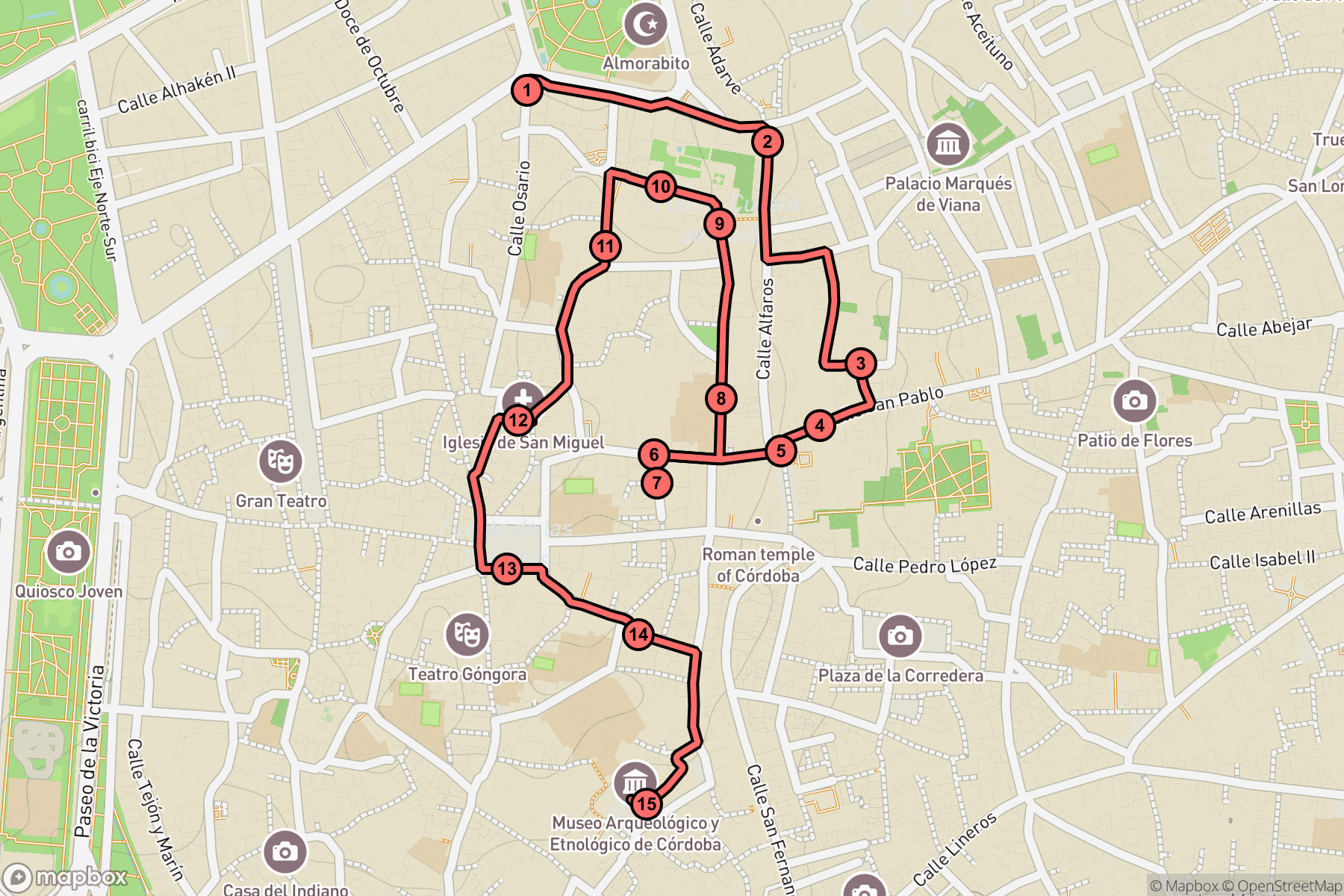
- straighten2.7 km 도보 경로안내 경로 따라가기
- location_on
- wifi_off오프라인 작동한 번 다운로드, 어디서든 사용
- all_inclusive평생 이용언제든지 다시 재생 가능
- location_on납골당 문에서 시작
이 투어의 정류장
Keep your eyes peeled for two tall, squared stone towers with rugged battlements on top, standing side-by-side and joined by a wide arch-right at the end of Calle Osario where it…더 보기간략히 보기
Keep your eyes peeled for two tall, squared stone towers with rugged battlements on top, standing side-by-side and joined by a wide arch-right at the end of Calle Osario where it meets Plaza de Colón. That’s the spot where the mighty Ossuary Gate once watched over Córdoba! Now, let’s step into our time machine-no seatbelts required, just a good imagination. Picture the bustling streets of ancient Córdoba, where this grand gate was first cut into the city’s northern walls by the Romans. Back then, it marked the end of the cardo maximus, the city’s main north-south road. The stones would echo under the sandals of Roman traders and the hooves of chariots whizzing by. A few centuries later, after the Islamic conquest, the gateway took on a bit of an identity crisis-it was known as the Gate of the Jews, or Bab al-Yahud, and at one point as Bab al-Hudá, the Gate of the Right Path. The air here must have been thick with whispers and secrets, especially during times when the city’s Jewish community was under threat under the Almohad rule. Imagine arriving at sunset, feeling the tension in the crowd and the shadow of the tall towers stretching across the road-an entrance, or perhaps a warning. But here comes the plot twist. After Córdoba was taken by Christian forces in 1236, the gate was rebuilt from two massive towers. And why “Ossuary”? Well, it’s not because the place was dead boring, but because heaps of old bones were dug up here, hinting at an ancient cemetery just outside the walls. So, if you feel a chilly breeze, don’t worry-it’s just the spirits saying hello! In the centuries that followed, the towers hosted hermits seeking a quiet retreat in exchange for some rent and a few repairs. By the 20th century, the Ossuary Gate had sadly become a dusty memory, toppled down to make room for a changing city. But now that you’re here, you’re standing right at the spot where countless stories-and a few ghostly jokes-once passed through!
전용 페이지 열기 →Look ahead into the small, quiet plaza-right where the cobblestones meet a low fence, you’ll see a tall stone crucifix surrounded by eight black iron lanterns that seem to guard…더 보기간략히 보기
Look ahead into the small, quiet plaza-right where the cobblestones meet a low fence, you’ll see a tall stone crucifix surrounded by eight black iron lanterns that seem to guard it like loyal watchmen. Welcome! You’ve found yourself in front of the Christ of the Lanterns, a spot where history, candles, and perhaps a few ghost stories all meet under the twinkle of these famous lanterns. Picture it: the year is 1794, and the streets are hushed as the Capuchin friar Diego José de Cádiz walks through the night, his cloak swirling in the chilly Cordoban air. He was searching for a way to bring a sense of calm and mercy to the city. So, he worked with Juan Navarro León, a sculptor with a keen eye and steady hands, to create this beautiful crucifix right here in the Plaza de los Capuchinos. But why all these lanterns, you ask? Imagine old Cordoba at night-back then, the only light flickered from oil lamps and candles, so eight iron lanterns stood proudly, casting a warm glow over Christ’s figure. Locals say the lanterns make the statue look almost like it’s standing guard over the city, chasing away fear and darkness. Over the centuries, a fence sprang up and the lanterns took on a darker style in 1984, but their magic remains. Some even say the shadows can play tricks on your mind here at night. Don’t worry, though-I promise, the only thing lurking around is a deep sense of wonder!
전용 페이지 열기 →To spot the Tower of the Rincon Gate, look for a strong, weathered stone tower with an octagonal shape rising above the meeting point of Alfaros and Isabel Losa streets-the…더 보기간략히 보기
To spot the Tower of the Rincon Gate, look for a strong, weathered stone tower with an octagonal shape rising above the meeting point of Alfaros and Isabel Losa streets-the structure almost hugs the corner where two ancient walls meet. Alright, friend, take a good look at this old tower-it might seem quiet now, but let your imagination run for a moment. Picture the 1300s: the smell of damp stone, echoes of boots on cobblestones, and the tension in the air as guards keep watch from this very spot. The Tower of the Rincon Gate was built in the 14th century, probably by Christians, but it’s like a cake with many historical layers. Archaeologists believe that even older towers once stood here, guarding the city walls since the days of the Romans-yes, all the way back to when Claudius Marcellus founded Corduba in the 2nd century BC! This sturdy, octagonal tower clings to the northeastern wall of the old city, helping to bridge the sharp drop between the neighborhoods of the Villa and the Ajerquía. Imagine the lookouts peering nervously into the night, always wondering if friend or foe would approach next. Over centuries, walls fell and cities changed, but this tower stubbornly stayed put-like a grandparent who refuses to leave the family home. So as you stand here, you’re actually meeting one of Córdoba’s oldest survivors, bearing the secrets and struggles of empires, knights, and all those who dreamed inside these walls.
전용 페이지 열기 →
12개 정류장 더 보기정류장 적게 보기expand_moreexpand_less
Directly ahead, you’ll spot the Convento de Santa Marta by its richly carved stone entrance, standing grand with a tall wooden door decorated with sturdy metal studs-just look for…더 보기간략히 보기
Directly ahead, you’ll spot the Convento de Santa Marta by its richly carved stone entrance, standing grand with a tall wooden door decorated with sturdy metal studs-just look for the elegant gothic archway and the flicker of lantern light above. Now, let’s step back in time together as you stand in front of these ancient stones and imagine, for a moment, Córdoba way back in the 15th century. Picture narrow cobbled lanes shrouded in the soft hush of dawn, when this spot was nothing but a humble gathering of devout women living outside the rules of monastic life. They prayed, worked, and dreamed in a place called Corral de los Cárdenas, a house generously gifted by Catalina López de Morales in 1455. Pretty grand, right? Suddenly, their little beaterio-sort of a spiritual club for ladies-transformed into something even bigger: an official convent, thanks to a papal bull from Pope Paul II in 1465. Not long after, the nuns gained a luxurious bonus: the mysterious Casa del Agua, a palace once belonging to nobility, with its hidden courtyards and cool stone floors. Imagine the sparkle in their eyes! The Córdoba aristocracy showered them with gifts, and soon, the first and second Counts of Cabra, real heavyweights of their time, found this place so special that they ended up being buried right here. But it wasn’t just comfort and nobility; there was some delayed drama, too. When construction began in 1479, master builder Gonzalo Rodríguez had ambitious plans for a soaring nave roofed with intricate cross vaults-like a stone forest overhead. After he passed away, his son, Hernán Ruiz I, took up the chisel and finished the work, concluding with the main doorway you see before you in 1511. The style, caught between the drama of Gothic and the tidy order of the Renaissance, gave Córdoba something truly unique. For almost a hundred years, however, the church was retablo-less-just plain niches and modest decorations. That is, until a long negotiation ended in 1592 with the arrival of a stunning Renaissance altar made by sculptor Andrés de Ocampo and painter Baltasar del Águila. It’s one of the rarest, oldest altarpieces in the city. And if the spirit of St. Jerome (whose statue now stands at its center) could talk, he’d probably say, “Better late than never!” Today, the hidden entrance courtyard joins the lively Festival de los Patios, filling the air with laughter and blooming fragrance each spring. So here, within these silent halls and sunny patios, stories and secrets of old Córdoba are patiently waiting for you to listen.
전용 페이지 열기 →To spot the Iglesia de San Pablo, look for a large, weathered stone facade with an eye-catching circular rose window above an arched doorway-its intricate stonework and the…더 보기간략히 보기
To spot the Iglesia de San Pablo, look for a large, weathered stone facade with an eye-catching circular rose window above an arched doorway-its intricate stonework and the statues flanking the entrance make it hard to miss as you stroll down the street. Now, take a moment and imagine yourself centuries back, right in front of this very spot. The Iglesia de San Pablo stands before you, every stone whispering tales of empires, conquerors, and monks. Picture this: the site was once so important, the Romans themselves built a circus here-no, not the kind with clowns or elephants, but a place for thrilling chariot races and roaring crowds. Fast forward, and you’d see something completely different. The ground beneath you trembles just a little as the powerful Almohad Muslims erect a palace, its white walls and shimmering tiles reflecting the fierce Andalusian sun. You can almost hear the distant sound of horses and the swirl of flowing robes-. But as time marches on and swords clash during the Christian conquest, Ferdinand III, the king known for picking up cities like a magpie finding shiny treasures, decides this patch of land is too good to let go. He gifts it to the Dominican friars in 1241, who must have done a little happy dance (though, sadly, historical records don’t specify their choreography). Thanks to Ferdinand’s generosity, not only could they build a grand convent, but they also got enough land to plant themselves a lush orchard-irrigated by the fresh water, straight from the king’s own hand. As your eyes move up the facade, you can spot two very different architectural styles playing a game of “spot the century”: the exuberant Baroque entrance from 1706, with its curly columns and a marble Saint Paul calmly greeting you from a little niche, and above, a majestic rose window shining like a sunburst, added during an ambitious 20th-century restoration. Now, take a glance at those statues reclining on the pediment-Faith and Hope, just hanging out up there, because even stone figures need to rest. Hidden among these details is a world of changing tastes and eras: every century left a mark, from cheerful Gothic flourishes to the sometimes overly enthusiastic Baroque swirls (honestly, the Baroque period was the ‘more is more’ era of architecture). Walk inside, and you’ll find a space divided into three long naves, their rooftops covered with the kind of magical Moorish woodwork called Mudéjar-imagine honeycomb patterns, all carved by hand, catching motes of light. The church’s main altarpiece is framed by three chapels with roofs shaped like upturned bowls and a central pentagonal altar that looks like it could double as a knight’s shield. Now, here’s where the plot thickens like a medieval stew: during Spain’s French occupation in 1810, the Dominican convent was taken over and turned into a military barracks. You can almost hear the sound of boots, rifles clattering, and voices echoing through halls built for prayer and meditation. The church, though, stood firm in its sacred mission, never missing a beat. Eventually, the convent fell on hard times and was torn down in the 1800s, leaving only the echoes and a few cloister arches. As you pass the entrance on Calle Capitulares, you might glimpse marble relics peeking out-surreal reminders of what once was. And above, reaching towards the sky, a bell tower that starts as a solid stone base and then unexpectedly transforms into a wooden structure-half fortress, half fairy tale treehouse. The 20th century brought rescue missions by heroic restorers, who scraped away the old Baroque decorations and brought back the clean lines of the original church. Even today, the building is alive with the spirit of its community, run by the Claretian missionaries-still ringing with voices, prayers, and the occasional sound of someone marveling at how this much history can fit behind a single stone door. And just to make things even more interesting, the church has served as home to some of Cordoba’s most heartfelt brotherhoods-the Hermandad de la Expiración and the filial Hermandad de Nuestra Señora del Rocío. Imagine processions winding through the ancient streets, incense wafting through the air, and candlelight flickering against sandstone walls. So, as you stand here, don’t just see a church-hear the clatter of Roman chariots, the quiet meditation of monks, the shouts of soldiers, and the pure, ringing notes of modern-day bells. The Iglesia de San Pablo isn’t just part of Cordoba’s history-it’s played almost every role in the city’s story, and it’s inviting you to step inside and become part of it, too.
전용 페이지 열기 →You’re now standing in front of the Ayuntamiento de Córdoba-the City Hall, the true house of power for Cordoba! But don’t worry, this isn’t the kind of power that zaps you like an…더 보기간략히 보기
You’re now standing in front of the Ayuntamiento de Córdoba-the City Hall, the true house of power for Cordoba! But don’t worry, this isn’t the kind of power that zaps you like an electric fence. Instead, it’s the place where important decisions are made, and perhaps a few cups of strong Spanish coffee are consumed to keep the politicians awake during long meetings. Imagine you’re here in the sixteenth century. King Philip II of Spain orders the original City Hall to be built. He wanted a grand building to match his royal ambitions. Picture marble floors echoing footsteps, chatter about city plans, and maybe an impatient noble tapping his foot, waiting for an audience with the city council. But fast forward! The current building you see now wasn’t officially opened until February 28, 1985. And it’s not just modern history you’re standing on. When they were building this place in the 1950s, workers started digging…and what did they find? Surprise! Remains of an ancient Roman temple, plus a section of the city’s Roman wall. I guess you could say the builders uncovered a “concrete” connection to the past. Part of that old Roman wall is now built right into the City Hall itself. So, if you listen closely, you might just hear the faint whispers of Roman senators complaining about taxes. For many years, the lobby also showed off “The Education of Nero,” a famous sculpture by Eduardo Barrón, on loan from the Prado Museum. Imagine Roman emperors and modern mayors sharing the same space-now that’s a time-travel story with political drama! And today, Mayor José María Bellido, from the Popular Party, leads the way. With 10 administrative districts throughout Cordoba, City Hall really is the command center of local life. So, take a breath and glance around. If you ever wanted to feel both the present and the ancient world in one spot, you’re definitely standing on the right stones.
전용 페이지 열기 →As you walk along Calle Carbonell y Morand, look for a tall, light brick building with a striking two-story stone-faced entrance-just above the archway, you'll spot a small statue…더 보기간략히 보기
As you walk along Calle Carbonell y Morand, look for a tall, light brick building with a striking two-story stone-faced entrance-just above the archway, you'll spot a small statue of the Virgin Mary tucked into a curving niche, keeping careful watch over all who pass. Now, let’s imagine ourselves back in the bustling streets of Córdoba, almost 300 years ago. The year is 1725. The air smells of citrus and baking bread wafts from nearby homes. Horses clatter over cobblestones, vendors shout out their wares, and amid all this, workers are raising the walls of a brand new convent-a place destined for both quiet contemplation and lively stories! Welcome, my friend, to the Monasterio Cisterciense de la Inmaculada Concepción, also known locally as the Convento del Císter. Oh, and don’t worry if the name feels like a mouthful-just imagine having to announce it every morning at breakfast! This convent, with its beautiful baroque church, single main nave, and cross-shaped floor plan, quickly became a spiritual heart in Córdoba. Its façade, which you’re gazing at now, is wrapped in soft stone and topped by an elegant curved pediment-right where that statue rests, like a lookout on the city’s history. But let’s zoom even further back, because this story begins well before any bricks were laid here. Our tale stars Don Luis Fernández de Córdoba-a man so determined, he would’ve made an excellent marathon runner if monks allowed that sort of thing. Born to a powerful family, with brothers who were also priests, Don Luis became the dean of Córdoba’s cathedral in the late 1500s. He wasn’t content just to sit and twiddle his rosary beads; no, Don Luis was on a mission to reform and renew spiritual life. He had a knack for monastic startups-think of him as the Steve Jobs of convents! His first attempt at founding a convent was for Carmelite nuns in Guadalcázar, his family’s estate town, but he dreamed even bigger. In 1620, legal papers in hand, he pushed for another foundation: a Cistercian monastery for nuns, inspired by the strict, spiritual Cistercian reforms he’d seen elsewhere. Sadly, just as the dream was within reach, Don Luis was whisked away by fate-appointed archbishop in Seville, he passed away before he saw his vision become reality. And as with any good drama, there were delays and plot twists, with legal documents bouncing between bishops and more determined family members than at a Spanish wedding! But you can’t keep a good idea down. In 1650, a small but mighty group of nuns-Sor María de la Santísima Trinidad and her band of faithful sisters-set out from Málaga on a journey worthy of an epic. Picture them, their habits brushing the dusty roads, their hearts full of hope (and possibly a bit of dread about the local cooking). They stayed for a while at the convent of Santa Marta before finally opening the doors of their first home in Guadalcázar. Yet all was not serene in the cloistered garden. Economic hardships, poor health conditions, and plain bad luck soon forced the nuns to rethink their plans. Within just three years, they packed their chests and made their way into Córdoba, settling into this very building where you now stand. And thus began a centuries-long legacy. Over the years, the convent became a hub of community life and spirituality. The nuns lived lives of quiet devotion-imagine nearly four centuries of whispered prayers, candlelit evenings, the smell of beeswax polish, and the gentle sounds of singing and laughter echoing from these walls. In the 1970s, the convent even became home to the “Hermandad del Císter,” a brotherhood of capataces and costaleros devoted to elaborate Holy Week processions. Talk about multitasking: nuns praying, local men lifting floats, and the whole neighborhood buzzing with anticipation. But time, as we know, has a way of changing even the quietest places. In recent years, the community of Cistercian nuns grew older, and eventually, the majority were transferred to a residence in Toledo, better equipped for their needs. A new chapter opened here: the “Esclavos de la Eucaristía,” a male religious order, took up residence, promising to maintain the building’s spiritual pulse. The famous Hermandad de la Sangre also returned to keep the traditions alive, ensuring that these ancient halls never go silent. So as you stand here, listen closely. Imagine generations of devoted women-often seeking safety or higher purpose-crossing this threshold; the echo of their footsteps, their dreams, and faith lingering. And if you feel a sudden sense of peace, well, maybe it’s just the spirit of Don Luis, finally satisfied that his dream lives on. And a final tip: if you misplace your map, just follow the trail of good intentions and heavenly chants-you’ll always end up somewhere interesting!
전용 페이지 열기 →To spot the Bailiff’s House, just look for a tall white building with a striking, ornate stone doorway framed by two small iron balconies and a dark wooden door, right at the top…더 보기간략히 보기
To spot the Bailiff’s House, just look for a tall white building with a striking, ornate stone doorway framed by two small iron balconies and a dark wooden door, right at the top of the sloping street in front of you. Now that you’re standing here, picture this: centuries ago, the sound of horses’ hooves echoed up this very slope as armored knights made their way to grand feasts and secret meetings inside. This was more than a fancy address-this palace was the home of Pedro Núñez de Herrera, a powerful “bailío” of the Order of Saint John. And what’s a bailío, you ask? Think of him as the medieval version of the boss-someone important, with a title that meant both dignity and a touch of mystery (and possibly a pretty nice sword collection)! After the Christians took Córdoba, King Ferdinand III handed this patch of land to the Fernández de Córdoba family, starting a story full of drama, intrigue, and handovers that would make a real estate agent dizzy. Over the centuries, the house passed from noble families like the Corbachos and the Cárcamos to the Marquises of Almunia. At one point, part of it was sold to the bishopric so they could build a hospital and a church-imagine the daily life: the clip-clop of carriages, whispers of secrets behind thick stone walls, and the lively chatter of visitors. Later on, this palace saw all kinds of uses-serving as the post office and even a base for public works. Can you imagine popping in to pick up your mail where knights once plotted their next adventure? Check out that spectacular entrance-it’s late Gothic with loads of delicate Plateresque decoration, probably crafted by the renowned architect Hernán Ruiz II (or maybe his dad-those family arguments must have been legendary). Today, this place is split between a luxurious hotel and the Living Library of al-Andalus, echoing centuries of stories in the air. If only these walls could talk, they’d probably ask for a glass of Córdoba’s finest wine and spin you a tale or two!
전용 페이지 열기 →Right in front of you, you’ll spot a grand building with warm reddish-pink and ochre walls, intricate window frames, and a stately porch upheld by white columns-look just beyond…더 보기간략히 보기
Right in front of you, you’ll spot a grand building with warm reddish-pink and ochre walls, intricate window frames, and a stately porch upheld by white columns-look just beyond the palm trees and garden, and you’ll see the entrance tucked behind that row of columns. Welcome to the Torres Cabrera Palace, a place where Cordoba’s whispers of nobility and the echoes of royal footsteps practically bounce off the garden walls! Take a deep breath and imagine yourself back in the bustling streets of 17th-century Spain, where this magnificent house-palace first started taking shape. Behind these elegant iron gates and ornate columns lies a story peppered with intrigue, transformation, and some serious star power. The palace was originally raised by Andrés Fernández de Córdoba y Cabrera, the second Count of Torres Cabrera. He wanted something special-after all, “Go big or go home” could’ve been his motto. The design followed the classic Baroque style, with a dramatic, almost theatrical flair: just look at those lofty arches and the symmetry of those terraces! But if you’d peeked in a few centuries later, you’d find things had changed. Fast-forward to the 19th century, and it was time for a glow-up! Ricardo Martel y Fernández de Córdoba, the ninth count, took the reins. He was inspired by the Italian country villas he admired and gave the house its present look-a romantic fusion of styles that borrowed a little bit from everywhere, a sort of “palace à la carte.” Now, let’s talk about drama. Picture this: It’s 1877, and the air is buzzing with excitement. The king-yes, King Alfonso XII himself-is coming to visit Córdoba. But where does royalty stay when in town? At the palace, of course! The count, hoping to impress, decided to build a whole new Throne Room just for this royal guest. The room sparkled with golden paneling, lush red silk damask, and mirrored flourishes, all fit for a king. And it wasn’t just Alfonso XII who paid a visit. Imagine distinguished guests gliding through those galleries: King Alfonso XIII, the kings of Jordan, famous politicians, poets, the dukes of Montpensier, and aristocrats who arrived with luggage-and sometimes, egos-almost as large as the palace itself. But things weren’t always so fancy. By 1935, the palace became a place of learning when it was rented out to the Marist Brothers as the Cervantes School. No joke-imagine homework in a Throne Room! Eventually, in 1940, Rafael Cruz-Conde bought the palace. He gave the school a couple of years to finish up before moving his family into the grand halls. The Cruz Conde family remained tied to these walls for decades, and just a few years ago, in 2017, the property was up for sale again…for a cool twelve million euros. That’s a lot of pockets to search for spare change! As you stand near the entrance, look at the garden-protected by its wrought iron fence, it’s a slice of paradise with palm trees that seem to wave hello. The main doorway opens beneath a stately portico with three arches resting on pairs of white columns. Stroll in further, and you’d find yourself in a glorious rectangular Baroque patio, where brick arches and white stone columns are perched dramatically atop black granite plinths. The patio even hides a small surprise: a dainty marble fountain shaped like a flower, all set to serenade the nobility with the soft sound of trickling water. Head upstairs-in your imagination, unless they’re giving tours today!-and you’d meet the closed upper gallery, with balconies stacked in perfect rhythm with the arches below. Inside, the Throne Room is as lavish as ever, dripping with red damask silk, painted moldings, mirrors with ornate plaster frames, and a grand decorative fireplace facing the central balcony. Even the stairway is pure drama: two wide flights of marble steps, a chunky central pillar halfway up, and a landing bursting with glossy black and white marble, capped by a dome dazzling with painted rocaille ovals. From its Baroque bones and Italian villa spirit, to kings sipping morning coffee, poets dreaming up verses, and children solving arithmetic beneath its gilded ceilings, the Torres Cabrera Palace is living proof that in Córdoba, history isn’t just something you visit-sometimes, it’s something you walk right into. Now, take a little extra time to soak in the view. Who knows? There just might be an echo of royal laughter waiting around the next column.
전용 페이지 열기 →To spot San Miguel, just look straight ahead for a striking sandy-colored church with a giant round rose window above a deeply carved arched doorway and almost square,…더 보기간략히 보기
To spot San Miguel, just look straight ahead for a striking sandy-colored church with a giant round rose window above a deeply carved arched doorway and almost square, fortress-like walls on a cozy plaza corner. Now, imagine yourself in Córdoba nearly eight hundred years ago-the air is buzzing with excitement, and King Ferdinand III has just taken over the city. He’s on a mission: build not one, but twelve grand churches to show everyone this place is under new management. San Miguel rises up, with sturdy stone walls blending the old Romanesque look with hints of the new Gothic style sweeping Europe. Step inside in your mind for a second-hear the echo of your footsteps on ancient stone, feel a cool hush under a high ceiling carved like a wooden puzzle, and notice there’s no giant cross-shaped transept, just one long aisle and cozy side passages leading to sharp-angled apses. Now, here’s a twist: peek at the side entrance and you might spot a horseshoe arch, a mysterious leftover from Córdoba’s days under the powerful Caliphate. Stories whisper that even in the 1700s, the place was buzzing-so much so the main altar got a marble makeover fit for a king. So as you stand here, let your imagination fill the air with the clang of old swords, the shimmer of candles, and maybe, just maybe, the ghost of a builder or two still polishing those timeless stones. Go ahead, give the walls a wink-they’ve seen centuries of stories, and you’re now a part of them too!
전용 페이지 열기 →Look straight ahead and you’ll spot the Plaza de las Tendillas by its elegant open square, boxed in by grand cream-and-white buildings, swaying palm trees, and right at the…더 보기간략히 보기
Look straight ahead and you’ll spot the Plaza de las Tendillas by its elegant open square, boxed in by grand cream-and-white buildings, swaying palm trees, and right at the center, a statue-topped fountain glinting in the sun. Welcome to the Plaza de las Tendillas! Right now, you stand on the pulse of Córdoba, in a spot buzzing with the stories, secrets, and rhythms of the city for over 700 years. Imagine you’re back in the 1300s: around you aren’t the buildings and cafés you see now but the humble shops-tendillas in Spanish-that gave this plaza its name. Merchants from the mighty Order of Calatrava set up their little stalls here, after being gifted the land for helping conquer the city. So, next time you haggle over a souvenir, remember you’re following a centuries-old tradition! The houses of those noble knights survived until 1860, before being swept away for the Hotel Suizo-a glittering 19th-century hotel of 2,000 square meters and 75 lush rooms, run by some ambitious Swiss brothers. Now, think of the tension: the city council desperately plotting for years to buy and demolish the hotel, finally paying a fortune-565,000 pesetas-for it in 1919! Four years later, the bulldozers came rumbling through and Córdoba began dreaming of a brand-new plaza. Look at the glorious buildings circling you-the cream stone, the grand balconies, the turreted rooftops. In the 1920s, all this sprang up like a theater set, with each new building more modern and elegant than the last. To your left, the showy La Unión y el Fénix building: all fin-de-siècle curves and even home to a civil war siren-imagine that blaring through the square! At the far end, notice the white palace-like Casa Colomera, a mash-up of lordly mansion below and apartments above, built for the Counts of Colomera. Not bad for a starter home! Centrally, you’ll see the dramatic bronze monument with sword raised high: that’s the Gran Capitán, Córdoba’s own homegrown hero, who led Spanish troops in Italy and now keeps watch over the modern hustle and bustle. There was drama even in placing his statue-when it was moved here in 1927, the neighbors nearly mutinied! No revolution happened, but the argument rumbled louder than an old flamenco stomp. And speaking of flamenco, prepare for a twist: in the 1940s and ‘50s, the people of Córdoba began to gather here for New Year’s Eve, ready to gobble up their lucky twelve grapes at midnight. But the original plaza clock was so unreliable that locals joked about it instead of trusting it! By 1961, a new clock was installed above the corner with Calle Gondomar, but this was no ordinary clock. Instead of bells, it played the notes of an actual Spanish guitar built by master luthier Manuel Reyes Maldonado and played by a local star, Juan Serrano. So, each hour, the guitar’s sunny, soulful tones ripple across the plaza, the only one of its kind in Spain-perfect for a city with rhythm in its bones! Of course, the plaza has never stayed still. In the 1960s and ’70s, this was the place to see and be seen-Córdoba’s so-called “tontódromo”-the cool kids would circle endlessly, hoping to catch someone’s eye (or, let’s be honest, show off their new shoes). The fountains you see, dancing cheerfully in the sunlight, are another new invention-added after a local mayor saw them on a trip and insisted Córdoba needed some playful splashing of its own. Don’t miss the elegant black marble fountain around the Gran Capitán’s statue, surrounded by neat orange trees and shady benches-a peaceful spot after so many centuries of hustle and drama. Today, cars are gone and people rule the square, wandering, meeting, and celebrating. At Christmas, a sparkling market pops up, making the air taste of sweets and mulled wine, while Córdoba’s modern adventures unfold. Maybe, if you close your eyes, you can still hear the distant clatter of horseshoes, the toll of that old guitar-clock, and the eager chatter of shoppers-past and present-mingled together on this timeless, sun-baked square. So linger here a while, soak it all in, and remember: in the Plaza de las Tendillas, you’re not just seeing a landmark; you’re stepping into centuries of swirling life, drama, and a bit of musical magic. Shall we stroll on to our next stop?
전용 페이지 열기 →To spot the Royal Academy of Sciences, Fine Arts and Fine Letters of Cordoba, look for a grand, stone-framed doorway with bold letters above dark wooden doors, topped by a small…더 보기간략히 보기
To spot the Royal Academy of Sciences, Fine Arts and Fine Letters of Cordoba, look for a grand, stone-framed doorway with bold letters above dark wooden doors, topped by a small iron balcony-it's right in front of you! Alright, here we are! Stop for a moment and imagine the stories these thick old doors could tell-if only they weren't too busy creaking. This place started its journey back in 1810, during a time when people wore more capes and powdered wigs than we see today. A group of clever Cordobans decided they needed a new home for their bright ideas, breaking away from the Real Sociedad Económica Cordobesa de Amigos del País. With a little paperwork (and a lot of hope), they got approval from the town’s prefect, Domingo Badía. Leading the way was Manuel María de Arjona y Cubas, a cathedral canon who probably spent as much time with books as with people. Now, this wasn’t just a club for science geeks. Oh no! From the very beginning, the Academy set out to unite brains from all fields: science, history, art, poetry-and those so-called “noble arts.” Later, in 1915, King Alfonso XIII slapped the royal “Real” in front of their name, a bit like knighthood for buildings. And let’s just say, the Academy didn’t rest on its laurels. Gold medals from the city, the University of Córdoba, plus a fine spot in the Spanish research council-this place is basically the superhero lair of Cordoban knowledge. Once you step inside (if you get the chance on another day), you’d find locals gathering on Thursdays. First comes a serious, private meeting, then the doors open for the public, and anyone could step in to listen to readings, poetry, lively debates or book launches. The air buzzes with, so you’d best mind your volume if you snack on chips in the back. This Academy is more than weekly meetings, though. Its members travel to villages to share inspiration, and the library isn’t just dusty scrolls-it actually houses art from Ancient Egypt (mummies not included), along with a treasure trove of sculptures and paintings donated by the very academics who debate within these stone walls. They even run special institutes, like the Institute of Góngora Studies-dedicated to the brilliant but witty poet Luis de Góngora. In May, imagine, a motley group of poets gathers to pay homage, reading words that once echoed through Cordoba’s winding lanes. Every year since 1922, the Academy has published its own “Boletín,” a mighty reference for historians and artists across Spain. It even has a sibling publication, Al-Mulk, appearing like clockwork once a year. If you’re a history buff or just nosy about Cordoba, these are priceless. And, if that wasn’t enough, the Academy keeps growing. In 2017, a new foundation was set up to boost their work and shine a light on science, letters, and arts for everyone in Córdoba. So, next time you hear some professors getting passionate in a café nearby, remember-they just might be plotting the next great event for this legendary Academy. Now, let’s resist the urge to become accidental academics and continue on our tour!
전용 페이지 열기 →It all began in the early 1930s, in a time when radios still felt magical and families would gather close around them, hanging onto every word from distant voices in the ether.…더 보기간략히 보기
It all began in the early 1930s, in a time when radios still felt magical and families would gather close around them, hanging onto every word from distant voices in the ether. Picture two local radio enthusiasts, Rafael Muñoz and Pepe Posadillo, crouched over coils of wire and glass tubes, soldering together Córdoba's very first homemade transmitter. Their mission wasn’t just to make gadgets talk to each other, but to connect an entire city. To raise some money, they even published a magazine as the official voice of their radio club-a bit like crowdfunding, but with more ink smudges. A local businessman, Federico Algarra Ramírez, recognized the power of this new “talking box” for advertising his ventures, and soon became the director and owner. The very first broadcasts used the code “EAR-213” and, trust me, having an EAR in your name is perfect for radio-unless you’re a nose for news, then I guess it’s a bit off. The excitement and novelty of radio exploded during Spain’s Second Republic, especially after a 1932 decree allowed stations to begin airing sponsored messages. Radio suddenly had the power not only to entertain but to sustain itself (well, up to 10 minutes of ads per hour-enough time to hear about every sale in town). By 1933, Radio Córdoba gained its official license as “EAJ-24” and made its grand debut at the Conservatory of Music. That first night, the air crackled with anxious anticipation as local officials, dignitaries, and the city’s best musicians marked a new chapter in Córdoba’s cultural life. Fast forward to a far more somber day-July 18, 1936-when a military coup swept across Spain. In Córdoba, Radio Córdoba suddenly became an improvised command post; soldiers took over the microphones and sent urgent messages across the city: “Atención, atención, this is Lieutenant Aragón, serving the Patria…” Radio, you see, wasn’t just for songs or stories now; it had become the voice of revolution, a lifeline and even a weapon. During the chaos of the Spanish Civil War, the station was placed under military control. Meanwhile, rebel forces would hunt down any hidden “Republican” radios in the city, smashing antennas to stop unwanted messages-Silencing the “competition” was less about ratings, more about, well, survival. After the war, in the late 1940s, the airwaves brought comfort during times of crisis. When a devastating munitions explosion struck Cádiz in 1947, many parents in Córdoba agonized over the safety of their children at a summer camp nearby. With press censorship hiding the full story, Radio Córdoba linked arms (or, rather, signals) with stations in Cádiz, Sevilla, and Jerez, trading updates into the small hours. For 72 hours straight, the staff worked tirelessly, relaying every last piece of news to terrified families, turning radio into an urgent chain of hope. For one legendary broadcaster, Rafael López Cansinos, this was his start-a heroic marathon for a truly human cause. But radio is also about joy, and in Córdoba, nothing beat “Discos Dedicados.” Imagine mornings when the air was filled with song requests and dedications-mothers, lovers, friends, all sharing their feelings through music, and hoping for that magic moment when their tune, and their message, floated through the city. These musical greetings ran for over 30 years, and during holidays or Saint Raphael’s Day, you’d hear crackling jotas aragonesas-thanks to a local sponsor who loved a good song more than anyone. Before TV and the internet, radio was the pulse of this city. From live bullfights to Sunday football, to suspenseful serials and roaring competitions, everyone tuned in. So popular was the club of loyal listeners that, at one point, being a Radio Córdoba “Friend” meant more than some bank loyalty card today-you got music with your name on it, special access to shows, and occasional prize draws (everything except a branded mug, sadly). Throughout its long life, Radio Córdoba changed homes, affiliations, and technologies. It moved from makeshift rooms on Alfonso XIII street to its modern home right here in García Lovera, and in 1987, settled into these studios to keep broadcasting, now as part of the Cadena SER family. In fact, Radio Córdoba helped make SER Spain’s number one network-and today, if you flip through the dial, you’ll catch programs from all over Spain, spiced with that unmistakable, heartwarming Cordoban flavor. So, as you stand here, just imagine all the laughter, music, tears, and breaking news that have filled this building and the city beyond. Who knows-maybe somewhere, someone’s still dedicating a song to you right now!
전용 페이지 열기 →To spot the Torre de Santo Domingo de Silos, just look for a tall, square tower with soft pink edges and Baroque decorations standing right at the Plaza de la Compañía-the one…더 보기간략히 보기
To spot the Torre de Santo Domingo de Silos, just look for a tall, square tower with soft pink edges and Baroque decorations standing right at the Plaza de la Compañía-the one with distinctive corner details and windows stacked three levels high. Welcome to one of Córdoba’s true time-travel stops-the Torre de Santo Domingo de Silos! Imagine: you’re standing where Ferdinand III must have stood after conquering the city, ordering this tower built alongside one of the 14 new parish churches meant to stamp his mark on old Córdoba. Back then, the square would have been buzzing with monks, merchants, children playing, and maybe the odd tired traveler stopping for a break. The rest of the church has long slipped into history, but this tower endures, your own personal piece of medieval Córdoba! Its chunky lower floor feels almost defensive, as if it’s hiding secrets. Climb it in your imagination, and notice the changing details: the windows up above let in slivers of sunlight, framed by Gothic-Mudejar patterns and topped by little pointy hats-triangular pediments, if you want to sound fancy at dinner later. Some windows are decorated with shields, perhaps hinting at the church’s powerful patrons. Not far off, you can spot the Capilla de la Concepción, another survivor, now hiding inside the Archives of Córdoba. Between you and me, if these walls could talk, they’d whisper stories of monks, of baroque craftsmen in powdered wigs splashing bright paint on the tower’s surface, and even of later architects coming in the 18th century-like Francisco Vázquez-who gave the tower its final dramatic makeover. True story: before it became a peaceful monument, the tower’s changing face must have sparked many a town rumor. Is it a watchtower? A bell tower? A very ambitious chimney? Whatever you decide, know that since 2001 this quirky survivor is officially recognized as a cultural treasure. Take a moment to soak up the sunlight, the sense of survival, and imagine Córdoba as Ferdinand III first rebuilt it-full of sounds, smells, and stories just waiting for you!
전용 페이지 열기 →To spot the Museo Arqueológico y Etnológico de Córdoba, look ahead for a grand old stone building with a richly decorated façade featuring sculptures, niches, and columns-like a…더 보기간략히 보기
To spot the Museo Arqueológico y Etnológico de Córdoba, look ahead for a grand old stone building with a richly decorated façade featuring sculptures, niches, and columns-like a stage set for ancient legends, right in front of you. Now, take a deep breath and step closer to this historic masterpiece, because you’re about to uncover layers upon layers of Córdoba’s ancient secrets, all hidden inside the palatial walls of the old Páez de Castillejo Palace. Imagine, for a moment, being whisked back through time, the air swirling with the dust of centuries. You’re standing not just in front of a museum, but at the very crossroad where Córdoba’s storylines tangle together: palaces, ruins, new architecture-even a slice of Rome. The adventure began way back in the days when Spain’s governments were seizing property from monasteries and convents, creating a wild treasure hunt for art and artifacts. Córdoba, being the clever collector it is, gathered a mountain of objects-everything from prehistoric tools to Roman mosaics, Visigothic statues, and tombstones from ancient gladiators (yes, real ones, not just the ones in movies!). At first, the museum didn’t have its own home. Picture a great archaeological collection constantly on the move-trudging through the city, from a stately school to the provincial council, to a hospital, then back again. I like to think the artifacts got more exercise in those early years than most archaeologists do in a lifetime! There was even a failed attempt to grab an old oratory as a home, but no dice: treasures piled up, spaces kept shrinking, and the hunt for a perfect museum lair continued. It wasn’t until the mid-1900s that a hardworking director named Samuel de los Santos Gener finally set the collection down for good in this Renaissance palace-imagine breathing a sigh of relief as the last piece is put on its shelf. This was no ordinary building: the palace itself dates from the 16th century, its stone walls ring with history, and inside, grand rooms echo with the stories of Córdoba’s past rulers and citizens. But the museum didn’t just stop growing there-oh, no. In the 20th and 21st centuries, the collection overflowed the palace. So, Córdoba did what any enterprising city would do: it built a crisp new annex right next door, and while digging the foundations, workers made an astonishing discovery. Beneath your feet lies the skeleton of the great Roman theatre of Colonia Patricia Corduba, buried all these centuries, its stones now on proud display in the museum’s basement. You can almost hear the whispers of Roman actors and the cheers of the ancient crowd if you listen carefully. And you’re not just looking at a museum-since its opening, the place has become a buzzing beehive of activity: scholars scribbling notes, children’s laughter during workshops, and regular folks like yourself gasping at the sight of mosaics, coins, and artifacts that saw Córdoba shift from a Roman stronghold to a Muslim capital. The most famous exhibit is “Córdoba, Meeting of Cultures,” where every object has a tale to tell: a sword from a medieval knight, a fragment of a Roman inscription, a piece of pottery that once held olives… It’s a full-on banquet of history, served with a side of local mystery and intrigue. And here’s the twist-this museum is not done changing! Restoration and new excavations are constantly revealing more secrets, making it the place to visit again and again. So, if you ever hear about a mysterious box arriving or new mosaics being uncovered, you know Córdoba’s story is still being written. As you stand in front of its storied façade, listen for the echoes of the past meeting the present. One last riddle: with over 33,000 pieces, do you think you could ever see them all? Well, there’s only one way to find out-come inside, and let the ages come alive before your very eyes!
전용 페이지 열기 →
자주 묻는 질문
투어는 어떻게 시작하나요?
구매 후 AudaTours 앱을 다운로드하고 교환 코드를 입력하세요. 투어를 바로 시작할 수 있습니다 - 재생을 탭하고 GPS 안내 경로를 따라가시면 됩니다.
투어 중 인터넷이 필요한가요?
아닙니다! 시작 전에 투어를 다운로드하면 완전히 오프라인으로 즐길 수 있습니다. 채팅 기능만 인터넷이 필요합니다. 모바일 데이터 절약을 위해 WiFi에서 다운로드하시는 것을 권장합니다.
이것은 가이드가 안내하는 단체 투어인가요?
아닙니다 - 이것은 셀프 가이드 오디오 투어입니다. 폰을 통해 오디오 나레이션을 들으며 나만의 속도로 독립적으로 탐험합니다. 투어 가이드도, 단체도, 일정도 없습니다.
투어는 얼마나 걸리나요?
대부분의 투어는 60-90분이 소요되지만, 속도는 전적으로 본인이 조절합니다. 원할 때 언제든지 일시정지하거나, 정류장을 건너뛰거나, 휴식을 취하세요.
오늘 투어를 끝낼 수 없으면 어떻게 하나요?
괜찮습니다! 투어는 평생 이용이 가능합니다. 원할 때 언제든지 일시정지하고 다시 시작하세요 - 내일, 다음 주, 또는 내년에도. 진행 상황이 저장됩니다.
어떤 언어를 이용할 수 있나요?
모든 투어는 50개 이상의 언어로 이용 가능합니다. 코드를 교환할 때 원하는 언어를 선택하세요. 참고: 투어 생성 후에는 언어를 변경할 수 없습니다.
구매 후 투어는 어디에서 이용하나요?
App Store 또는 Google Play에서 무료 AudaTours 앱을 다운로드하세요. 교환 코드(이메일로 전송됨)를 입력하면 라이브러리에 투어가 나타나며, 다운로드하여 시작할 수 있습니다.
투어가 마음에 들지 않으시면 환불해 드립니다. 문의: [email protected]
안전한 결제 


