
아요라 오디오 투어: 은둔처, 성, 신성한 돌을 지나는 여정
햇살 가득한 언덕 위로 외로운 종소리가 울려 퍼지며 아요라의 숨겨진 심장이 드러납니다. 이 셀프 가이드 오디오 투어는 엽서 같은 외관을 넘어 수세기 동안의 맹렬한 헌신과 잊혀진 음모 속으로 안내하며, 모든 예배당과 돌멩이마다 이야기가 살아 숨 쉬고 있습니다. 산타 바르바라 은둔처의 생존을 촉발시킨 신성한 맹세는 무엇이었을까요? 무어식 오븐 거리(Moorish Oven Street)에 그림자를 드리우고 성 루시아 은둔처에서 운명을 재편한 사람은 누구였을까요? 성모 승천 교회 내부의 단 한 번의 붓질이 왜 스캔들과 반란의 속삭임을 담고 있을까요? 좁은 골목과 탁 트인 광장을 거닐며 아요라의 과거가 겹겹이 펼쳐집니다. 영웅들이 충돌하고, 공동체가 단결하며, 하얗게 칠해진 아치 아래에는 미스터리가 남아 있습니다. 한 걸음 한 걸음 내딛을 때마다 벽에 새겨지고 신앙에 엮인 이야기 속으로 더 깊이 빠져들게 될 것입니다. 지금 시작하여 아요라의 종소리가 시대를 초월한 침묵 뒤에 숨겨진 진실로 당신을 더 가까이 이끌게 하세요.
투어 미리보기
이 투어에 대하여
- schedule소요 시간 30–50 mins나만의 속도로 이동
- straighten2.7 km 도보 경로안내 경로 따라가기
- location_on
- wifi_off오프라인 작동한 번 다운로드, 어디서든 사용
- all_inclusive평생 이용언제든지 다시 재생 가능
- location_on아요라의 산타 바르바라 은둔처에서 시작
이 투어의 정류장
As you're approaching the Hermitage of Santa Barbara de Ayora, keep your eyes peeled for a charming little white building with a rustic feel. You’ll spot a series of steps leading…더 보기간략히 보기
As you're approaching the Hermitage of Santa Barbara de Ayora, keep your eyes peeled for a charming little white building with a rustic feel. You’ll spot a series of steps leading up to a dusty brown wooden door under a small, quaint gable roof. Above the entrance, there's a distinctive bell tower with a rounded arch that holds a single, petite bell. Two pyramid-shaped stones flank the bell, while a small iron cross perches at the top. Now, let me sweep you back to the 16th century, where this fascinating landmark has its roots! Built on a small hillock just outside the then town of Ayora, the Hermitage of Santa Barbara quickly became a beloved local spot, just like your favorite coffee shop. The neighborhood of "El Barrio" grew around it as the population expanded, and eventually, this area merged with the main urban area of Ayora. To keep up with the growing devotion, two more archways were added around 1640. Over the years, this historic site has seen a few facelifts, including a roof renovation, to keep it looking pretty for all you curious wanderers. Notice the stone steps leading from the street up to the small square in front of the hermitage. They invite you right into what's essentially the living room of local history. Inside, the hermitage keeps it humble but elegant with white-painted walls and checkerboard floor tiles. The altar, hosting an image of Santa Barbara, showcases some fine plasterwork and is supported by four columns. Lining the walls, you’ll find reproductions of various saintly portraits. And of course, there’s a tidy little sacristy tucked away somewhere too. The Hermitage is part of the "Ruta de las Ermitas de Ayora," which allows you to hop from one charming hermitage to another. In December, this place becomes especially vibrant with celebrations in honor of Santa Barbara. So, now you’re standing at a spot that’s not just brick and mortar, but a tapestry of centuries of faith and community life. How cool is that?
전용 페이지 열기 →Alright! As you're approaching, you should see a charming neoclassical building ahead. This is the Hermitage of Saint Lucia. It's a relatively simplistic structure with white…더 보기간략히 보기
Alright! As you're approaching, you should see a charming neoclassical building ahead. This is the Hermitage of Saint Lucia. It's a relatively simplistic structure with white walls and a gray door, framed by soft reddish-brown trim. Above the door, you'll spot a niche containing an image of Saint Lucia herself, and the top of the façade is crowned by a striking bell gable that features three arches, one of which houses a bell. The nook on either side of the front door is guarded by two classic lanterns. Nestled outside the main urban area of Ayora, in the Comunidad Valenciana, you'll find the Hermitage of Saint Lucia. According to local historian, Don Eufrosino Martínez Azorín, this delightful hermitage stands proudly in the Solana neighborhood, the town's largest, on the exact spot where an ancient mosque once stood. Back in the day, the street was known as the Moorish Oven Street, but now it's named after the very hermitage you're looking at. Built in 1607, it got a face-lift in 1898 thanks to Rafael Perades Gumiel, and was completed under the keen eye of master mason García Barberán by March 12, 1900. The building boasts a neoclassical style with a rectangular nave and a distinctively arranged diamond-patterned floor. Now, here’s a fun tidbit-six side altars grace the walls between pilasters, dedicated to saints like Saint Anthony, Saint Pascual Bailón, the Immaculate Conception, young Saint John, the Virgin of Carmen, and Saint Roch. The main altar is a bit of a showstopper with a painted altarpiece by Don Casimiro Escribá, showcasing Saint Lucia right at the center. It's like stepping back in time, right here in front of this quaint and historic hermitage! Enjoy this delightful spot before we move on to our next destination.
전용 페이지 열기 →As you walk, keep an eye to your right and look for the impressive stone structure with a striking clock tower - that’s the Church of the Assumption of Our Lady in Ayora! This…더 보기간략히 보기
As you walk, keep an eye to your right and look for the impressive stone structure with a striking clock tower - that’s the Church of the Assumption of Our Lady in Ayora! This stunning church stands proudly in the center of Ayora, occupying almost an entire block. It's an exquisite blend of architecture from the 16th and 17th centuries, featuring Renaissance and Mannerist styles. The church holds a treasure trove of history, including the parish archive and a sacred art museum, and has been declared a Cultural Interest Site since May 21, 1981. Construction spanned from 1508 to 1739, reflecting a rich tapestry of Valencian architecture. Pay close attention to its nave, covered by a hidden ribbed vault that combines Gothic tradition with Renaissance influence in the molding of its profiles and arches. The main facade is a rare example of Herrerianism, uncommon in Valencian architecture. The bell tower, with its unique Roman-style dome, and the Baroque communion chapel, with its elliptical dome and elegantly crafted chamber, are true marvels. Don't miss the intricate tiling preserved in the communion chapel's flooring (18th century) and the sacristy (16th-17th centuries), likely originating from the old choir once located in the center of the church. The initial construction phase (1508-1577) gave birth to the octagonal apse, altar, presbytery, and ribbed vault. The second phase (1595-1628) completed the central nave, bell tower, and facade. Phase three (1693-1746) saw the addition of the Baroque chapel with its crypt, a curious elliptical chamber inspired by Central European architecture (1739), and the larger sacristy (1745-1746). Although an earthquake in 1748 caused significant damage, 19th-century modifications concealed the crevices. Restoration work in 1992 unveiled the previously hidden Gothic vault. The church’s single nave extends 42 meters in length, 13 meters in width, and 23.6 meters in height, divided into five sections with chapels nestled between the buttresses. Corinthian capital pilasters separate these lateral chapels, supporting the vault ribs. Inside, you'll find splendid panels by Yáñez de Almedina, a Venetian-trained painter under Leonardo da Vinci's disciples, along with oils such as "The Angel Protector of Ayora" by Vicente López, and a 16th-century Valencian Gothic altarpiece. It's an architectural masterpiece combining Gothic ribbed vaults with Renaissance moldings, a structure as rich in history as it is in artistry. Enjoy exploring this magnificent landmark!
전용 페이지 열기 →


4개 정류장 더 보기정류장 적게 보기expand_moreexpand_less
As you approach the next stop, take a look to your left. You'll spot the Castillo de Ayora, a stunning, albeit weathered, fortress. The remnants of the castle are quite prominent,…더 보기간략히 보기
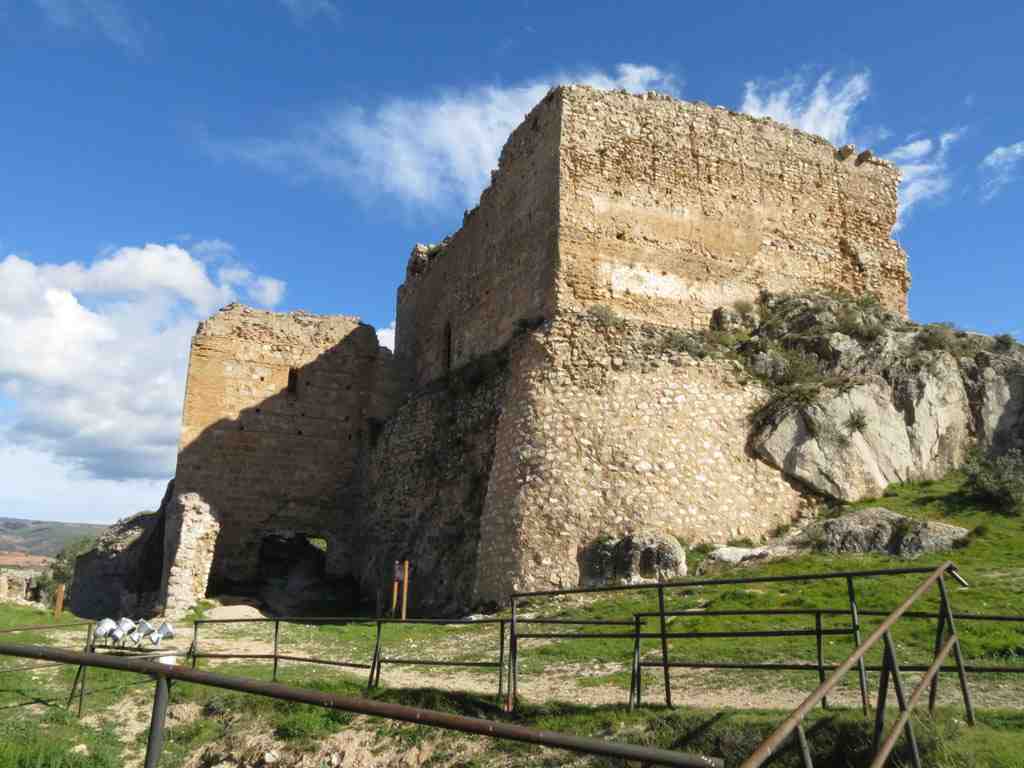
As you approach the next stop, take a look to your left. You'll spot the Castillo de Ayora, a stunning, albeit weathered, fortress. The remnants of the castle are quite prominent, with their sturdy stone walls rising directly from the rocky terrain. Look for the large quadrangular structure, featuring a mix of stone and exposed rammed-earth construction. The Castle of Ayora sits proudly at 552 meters (1,811 feet) above sea level, right in the heart of Ayora. This grand structure likely dates back to the mid-13th century, built after the Reconquista on top of an ancient Arabian building. Imagine a massive architectural ensemble that consisted of a four-storey residence-palace, a couple of fortified towns, and a large keep surrounded by defensive walls stretching about 0.62 miles (1,000 meters). It even had aljibes - those ingenious medieval cisterns for collecting rainwater. The castle has quite a history. It was reduced to ruins by Philip V’s troops during the War of the Spanish Succession. Despite the destruction, the keep, the distinctive Puerta Falsa (Fake Door) with the coat of arms of the Marchioness of Cenete, defensive walls, towers, buckets, moats, and cisterns still stand out. Declared a property of cultural interest in 2006, the castle's timeline is a bustling narrative of power shifts. From the Aragonese capturing it in the 13th century, to the Treaty of Almizra handing it to the Castilians, and the Treaty of Elche placing it back under Aragonese control in 1305 - Ayora has seen it all. The 16th century brought its transformation into a palace, commissioned by Lady Mencía de Mendoza. However, in 1707, the castle was taken by assault, looted, and set ablaze by Philip V’s troops, leaving it largely in ruins. The site was revisited and described as ruined by botanist Antonio José Cavanilles in 1797, and further damaged by French forces in 1812. Wandering around this historical site, try to visualize its bustling past - from its strategic defensive role to its once opulent halls and lush gardens, surrounded by vast walls. The stories these ruins could tell would make any historian's heart race!
전용 페이지 열기 →Alright, you're currently approaching the Church of Saint Mary Major, also known as the Hermitage of San Blas! As you walk, keep an eye to your left. The church is situated at the…더 보기간략히 보기
Alright, you're currently approaching the Church of Saint Mary Major, also known as the Hermitage of San Blas! As you walk, keep an eye to your left. The church is situated at the foot of the castle and is framed by its historical Gothic architecture. Now, let me paint you a picture: picture a beautiful, rustic church with a single nave covered by a wooden ceiling supported by diaphragm arches. The church's structure goes way back to the 13th century, but it was expanded in the 15th century and got a facelift in the 18th century. You’re standing in front of a building that’s seen centuries pass by! Declared a Cultural Interest Site on September 28, 2007, it has this fancy Spanish Ministry of Culture identifier: RI-510012138. Fancy, right? This old parish church has an intriguing architectural style typical of the reconquista period, featuring a single nave with a wooden framework resting on those striking diaphragm arches. It stretches out in four sections with chapels nestled between the buttresses, and a unique trapezoidal apse that adds a twist to the design. Take a look inside-note the pointed diaphragm arches that separate the sections; some of them are a bit askew due to renovations over time. The lateral chapels are accessed via round arches, and a couple of them feature ribbed vaults, while the rest have vaulted ceilings. Look closely at the wooden ceiling of the trapezoidal apse, and you’ll spot a depiction of the Virgin Mary flanked by two angels holding the village’s coat of arms. Externally, marveled with Arab tiles; the nave is covered with a gabled roof, transitioning to a three-sided roof at the head. Oh, and those initial four segments match perfectly because they likely form part of the original construction in the 13th century, pieced together over time. This little treasure served as the main local church until another church, dedicated to the Assumption of Our Lady, took over in the 16th century. Talk about being replaced by a younger model! Since then, it has seen various dedications until finally settling as the Hermitage of San Blas. Enjoy soaking in the historical vibes of this marvelous church!
전용 페이지 열기 →As you approach stop number 6, the Covered Cross of Ayora, keep an eye on your right and look for a structure that stands out due to its distinct architectural elements. You'll…더 보기간략히 보기
As you approach stop number 6, the Covered Cross of Ayora, keep an eye on your right and look for a structure that stands out due to its distinct architectural elements. You'll spot a stone cross gracefully encased within a square pavilion. This pavilion has a charming, traditional look with a four-sided tiled roof resting on sturdy wooden beams supported by four stone pillars. Now, let me tell you about this fascinating landmark in a fun way: The Covered Cross of Ayora, or the Cross of Saint Anthony, is a Gothic stone cross proudly standing in Ayora, Valencia. Imagine a medieval monument protected by a charming little house - that's what we're looking at! This beautiful cross is housed in a square structure with a classic four-sided tiled roof, wooden beams, and stone pillars - quite the sturdy shelter for such an ancient artifact. Back in 2011, the local cultural heritage authorities recognized its historical significance and took steps to protect it as a Cultural Interest Asset. This cross, also known as the Cross of Saint Anthony, can be found on the road to Almansa, just as you leave town. Standing over two meters tall, the stone column supporting the cross is hexagonal in shape. The cross itself is finely carved, featuring a depiction of Christ crucified on one side and an image of the Virgin Mary on the other. It rests on a three-tier circular stone podium, which adds to its majestic height, making the whole structure tower over three meters tall. Constructed in the 15th century and attributed to the artist Miguel Molsós, this monument stood the test of time, silently witnessing the ebb and flow of history while being a symbolic protector for the townspeople. So, as you admire this historic gem, you’re really looking at a distinguished guard from the past!
전용 페이지 열기 →As you make a sharp right turn, look for a charming, modest building with a whitewashed facade. The Hermitage of Saint Anthony the Abbot stands out thanks to its simple design and…더 보기간략히 보기
As you make a sharp right turn, look for a charming, modest building with a whitewashed facade. The Hermitage of Saint Anthony the Abbot stands out thanks to its simple design and the small bell tower perched on the roof, topped with a single bell. You'll also notice the green door flanked by two benches. Let me tell you a bit about this delightful spot: The Hermitage of Saint Anthony the Abbot is situated just outside the urban core of Ayora, at the entrance to the town if you're coming from Almansa. It's recognized as a Site of Local Relevance with identifier number 46.19.044-006. The exact construction date of the hermitage is a mystery, but it was mentioned in parish records as early as December 18, 1555. The hermitage suffered destruction during the Spanish Civil War and was later completely reconstructed. The building has a single elongated nave. At the foot of the nave, you'll find a narthex with a single-sloped roof supported by wooden beams. Inside, four Gothic stone arches rise from the floor, holding up a flat-coffered ceiling in the center, with beams creating a dual-pitched roof-a nod to the mendicant style. The presbytery, with newly built clay flooring, features a neo-Gothic altarpiece with a niche for the statue of Saint Anthony. Also worth noting is the pulpit on the Gospel side, crafted atop an octagonal stone pillar adorned with geometric designs. I hope you've enjoyed your journey through Ayora! This hermitage marks the end of our tour, but its serene aura is the perfect spot for a moment of reflection. Until next time, happy travels!
전용 페이지 열기 →


자주 묻는 질문
투어는 어떻게 시작하나요?
구매 후 AudaTours 앱을 다운로드하고 교환 코드를 입력하세요. 투어를 바로 시작할 수 있습니다 - 재생을 탭하고 GPS 안내 경로를 따라가시면 됩니다.
투어 중 인터넷이 필요한가요?
아닙니다! 시작 전에 투어를 다운로드하면 완전히 오프라인으로 즐길 수 있습니다. 채팅 기능만 인터넷이 필요합니다. 모바일 데이터 절약을 위해 WiFi에서 다운로드하시는 것을 권장합니다.
이것은 가이드가 안내하는 단체 투어인가요?
아닙니다 - 이것은 셀프 가이드 오디오 투어입니다. 폰을 통해 오디오 나레이션을 들으며 나만의 속도로 독립적으로 탐험합니다. 투어 가이드도, 단체도, 일정도 없습니다.
투어는 얼마나 걸리나요?
대부분의 투어는 60-90분이 소요되지만, 속도는 전적으로 본인이 조절합니다. 원할 때 언제든지 일시정지하거나, 정류장을 건너뛰거나, 휴식을 취하세요.
오늘 투어를 끝낼 수 없으면 어떻게 하나요?
괜찮습니다! 투어는 평생 이용이 가능합니다. 원할 때 언제든지 일시정지하고 다시 시작하세요 - 내일, 다음 주, 또는 내년에도. 진행 상황이 저장됩니다.
어떤 언어를 이용할 수 있나요?
모든 투어는 50개 이상의 언어로 이용 가능합니다. 코드를 교환할 때 원하는 언어를 선택하세요. 참고: 투어 생성 후에는 언어를 변경할 수 없습니다.
구매 후 투어는 어디에서 이용하나요?
App Store 또는 Google Play에서 무료 AudaTours 앱을 다운로드하세요. 교환 코드(이메일로 전송됨)를 입력하면 라이브러리에 투어가 나타나며, 다운로드하여 시작할 수 있습니다.
투어가 마음에 들지 않으시면 환불해 드립니다. 문의: [email protected]
안전한 결제 


