
올덴부르크 오디오 투어: 바흐호프스피어텔의 혁신, 아이콘 및 산업
올덴부르크의 아르데코 양식 외관과 웅장한 은행 아래, 조용한 거리에는 비밀 코드와 스캔들 같은 이야기가 숨 쉬고 있습니다. 바흐호프스피어텔의 모든 구석에는 겉보기보다 더 많은 것이 담겨 있습니다. 이 셀프 가이드 오디오 투어는 엽서 속 이미지 너머로 올덴부르크의 가장 흥미로운 랜드마크의 중심으로 여러분을 안내합니다. 숨겨진 역사와 예상치 못한 이야기가 눈에 띄지 않는 곳에서 기다리고 있으며, 가장 노련한 여행자조차 놀라게 할 준비가 되어 있습니다. 올덴부르크 주립은행의 웅장한 복도를 한때 어떤 위기가 뒤흔들었을까요? 호르스트 얀센 박물관은 왜 작품들이 결코 드러내지 않는 미스터리로 가득할까요? 구식 컴퓨터를 둘러싼 어떤 기이한 대결이 도시의 디지털 운명을 영원히 바꾸어 놓았을까요? 그림 같은 골목길, 화려한 기관, 그리고 독특한 박물관을 가로질러 보세요. 반항아, 예술가, 규칙을 깨는 사람들의 시선을 통해 올덴부르크의 에너지와 야망을 느껴보세요. 모든 발걸음은 서스펜스와 비밀스러운 드라마를 밝혀냅니다. 올덴부르크의 진정한 정신을 잠금 해제하세요—최고의 이야기들이 거의 사라질 뻔했던 곳을 탐험하기 시작하세요.
투어 미리보기
이 투어에 대하여
- schedule소요 시간 30–50 mins나만의 속도로 이동
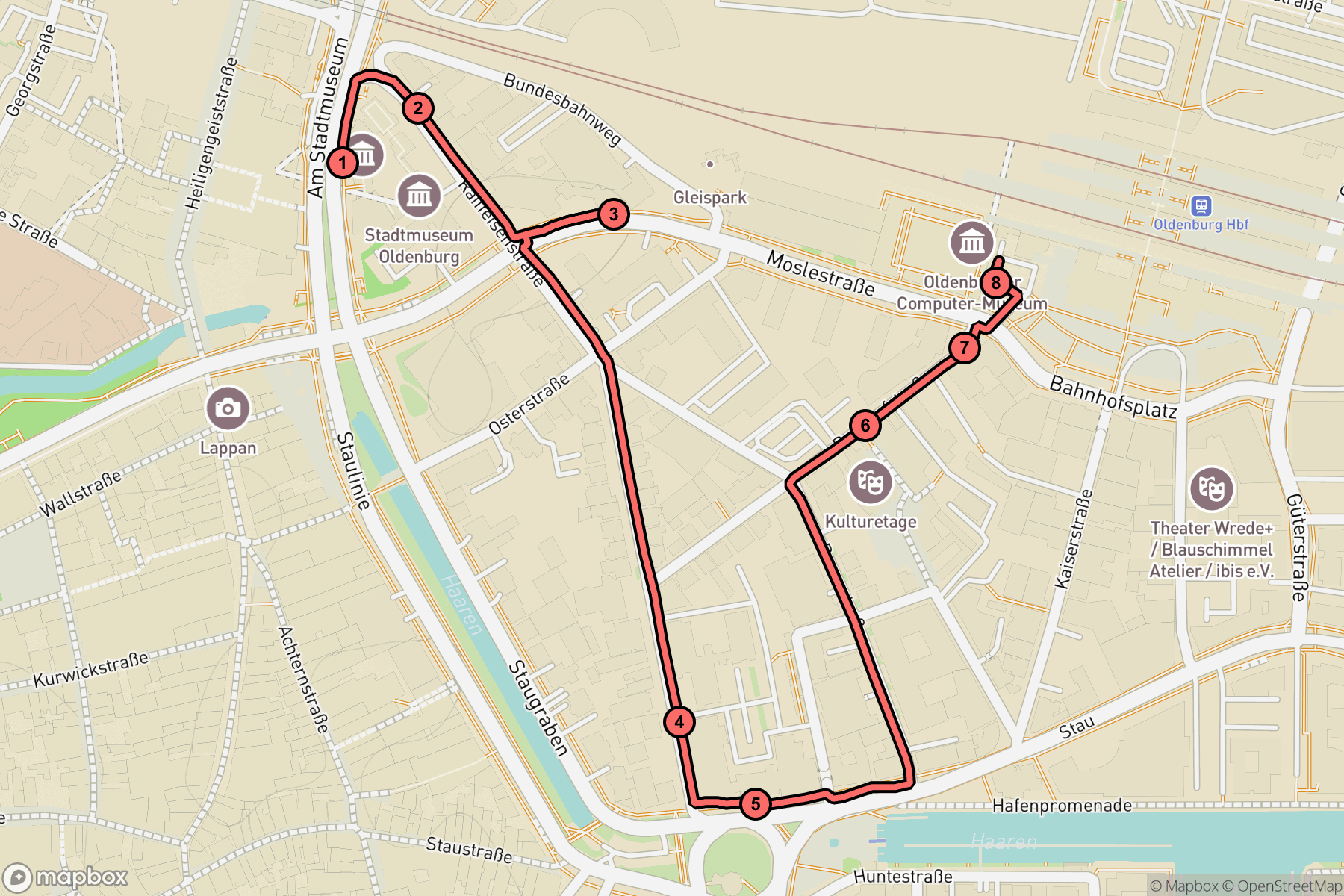
- straighten1.2 km 도보 경로안내 경로 따라가기
- location_on
- wifi_off오프라인 작동한 번 다운로드, 어디서든 사용
- all_inclusive평생 이용언제든지 다시 재생 가능
- location_on호르스트 얀센 박물관에서 시작
이 투어의 정류장
If you’re looking for the Horst Janssen Museum, just spot the large, sweeping white building with curving walls and a modern glass entrance, proudly signed “Horst Janssen Museum”…더 보기간략히 보기
If you’re looking for the Horst Janssen Museum, just spot the large, sweeping white building with curving walls and a modern glass entrance, proudly signed “Horst Janssen Museum” near the top-look to your right as you walk down the street, and you can’t miss it! Welcome! You’re now standing before a building that’s more than just a museum-it’s a living tribute to one of Germany’s most imaginative artists, Horst Janssen. Imagine the year is 2000, and the doors of this unusually curved, ultra-modern creation swing open for the very first time. Inside, 1800 unique works from the collection of Carin and Carl Vogel are on dazzling display, with thanks to the Oldenburg businessman Claus Hüppe-who secured the heart of the museum back in 1995 by snapping up the Vogels’ collection for a cool 1.5 million Deutsche Marks. I guess you could say he was drawn to it! This museum isn’t just a treasure chest of art, but an adventure in creativity, thanks to its brilliant architects Peter Reinig, Meike Dreyer, and Carl Deters. Step inside (in your imagination for now), and you’d find not one, not two, but three exhibition floors spiraling through the building. On the first level, wander through the permanent exhibition “Horst Janssen - Newly Discovered!”-where you can hear the scratch of pencils, the shuffle of visitors, and maybe even Janssen’s own voice echoing from interactive listening stations. Janssen was not just a master of pencils, but of etching, graphic art, lithography, and even woodcuts. You’ll get to peek behind the scenes at his ingenious techniques-discovering how the seemingly magical world of etching comes to life, sometimes as a complicated dance of acid and ink. There are stations here to listen, feel, and even get your hands dirty in a drawing workshop. If you’re lucky, you’ll catch a glimpse of original pieces, swapped out three times a year, so every visit promises a new surprise. The museum doesn’t just stick to Janssen, either. Over the years, it has brought together the work of modern pioneers-names like Man Ray, Salvador Dalí, Jean Tinguely, and many more. Alongside art, you’ll find a library with a whopping 25,000 art books, including almost everything Janssen ever published. At times, curiosity gets rewarded with the Horst Janssen Graphics Prize, where up-and-coming artists light up these halls with new ideas. So as you stand here, let yourself imagine all the quiet discoveries, the rustle of pages, and the laughter of inspiration echoing through these futuristic halls. The Horst Janssen Museum has always believed that drawing is a universal human expression, so who knows? Maybe someday your own masterpiece could wind up hanging on these very walls!
전용 페이지 열기 →To spot the Cooperative Association Weser-Ems, look straight ahead for a red-brick building with a grand archway over a staircase leading up to glass doors-almost like a massive…더 보기간략히 보기
To spot the Cooperative Association Weser-Ems, look straight ahead for a red-brick building with a grand archway over a staircase leading up to glass doors-almost like a massive brick tunnel welcoming you in! Now, let’s dive into the story-no arch-villains, just big ideas! Imagine the year is 1890. Picture Oldenburg as a bustling hub of farmers, merchants, and dreamers. Suddenly, a new force arrives: the Cooperative Association Weser-Ems, which opened its doors to unite local cooperatives. Its job? To keep an eye on all kinds of clubs-banks, trading groups, dairies, and even cattle sellers. If you think keeping up with 53 banks, 71 energy co-ops, and a crowd of milk, grain, and livestock folks sounds tough, you’d be right! Luckily, this association had a secret weapon: teamwork. Their mission wasn’t just paperwork and number-crunching. The air would’ve crackled with heated debates about milk prices, brainstorms about fair business, and the laughter of new friends learning together at their very own training academy. The best part? It was the state itself, all the way back in 1890, that gave them the right to check the books and make sure everyone played fair-a bit like an official detective agency for good business. More than a century later, the association is still here, celebrating a legacy of fairness and community spirit. So, next time you walk past, imagine a chorus of “Moo!” and “Cha-ching!” echoing from inside-they’re all part of the same big cooperative family!
전용 페이지 열기 →This story starts a few decades back, when EWE Energie AG realized that Oldenburg, surrounded by rich salt layers and the perfect underground formations, could be the ideal place…더 보기간략히 보기
This story starts a few decades back, when EWE Energie AG realized that Oldenburg, surrounded by rich salt layers and the perfect underground formations, could be the ideal place to store gas. So, they spun off EWE Gasspeicher GmbH, which is still 100% owned by EWE AG, and got busy turning Oldenburg into a secret superhero of energy security. Picture gigantic salt caverns - as big as cathedrals! Gas is pumped down from far-off places, stored ready for the coldest, chilliest Oldenburg winters, or for moments when, let’s be honest, your neighbor forgets to turn off their heating. There are about 2.1 billion cubic meters of working gas stored across different sites - that’s enough to fill over 840,000 Olympic swimming pools. Talk about a deep breath! Sites in Huntorf and Nüttermoor near here, and Rüdersdorf by Berlin, all feed into major gas networks not just for Germany, but also for our Dutch friends next door. And get this: in one spot, Nüttermoor alone, there are 21 underground caverns, each ready to switch from storing lighter L-gas to heavier H-gas depending on what the market and the future need. In true dramatic fashion, the network is constantly evolving. In Jemgum, new caverns are being carved out of ancient salt domes as we speak-almost like energy treasure chests, buried right beneath us. So the next time you hear a rustle in the bushes or feel a mysterious warmth in the wind, just smile-you’re standing on one of Germany’s hidden energy powerhouses, keeping the lights (and heating) on for millions. Don’t worry, you won’t float away - but thanks to EWE, if you ever need a really, REALLY big hot air balloon, you’ll know where to ask!
전용 페이지 열기 →
5개 정류장 더 보기정류장 적게 보기expand_moreexpand_less
Enter a man with a name tailor-made for a period drama: Carl Wilhelm Siebold. Working far from here as a financial adviser in Frankfurt, Siebold plotted the idea for a brand-new…더 보기간략히 보기
Enter a man with a name tailor-made for a period drama: Carl Wilhelm Siebold. Working far from here as a financial adviser in Frankfurt, Siebold plotted the idea for a brand-new bank that could ride the wave of economic energy sweeping through Oldenburg. He teamed up with the prestigious Frankfurt banking house Erlanger & Söhne, and in 1869, the OLB swung open its doors for the first time over on Ritterstraße 9. Imagine it then: horse-drawn carriages rattling past, newsboys hawking papers, the promise of Oldenburg’s prosperity echoing in the air. Lorenz Zuckermandel, the first director, was probably so serious you’d think his mustache alone kept the vault locked at night. The OLB started strong, with a note-issuing license so generous it’s a banker’s dream. They could pump out banknotes worth four times their capital-making life a whole lot lighter, literally. Back then, carrying gold coins around could leave you with biceps, but these fresh banknotes meant lighter pockets, happier backs, and easier business. Yet, every great story needs a twist. In 1875, a new bank law came along-imagine it as the financial equivalent of a diet: strict, limiting, and not altogether fun. But OLB handled it with panache, moving away from issuing notes to focus on regular banking. As the 20th century rolled in, Dresdner Bank bought up Erlanger & Söhne, pulling OLB into the orbit of Germany’s financial heavyweights. Fast forward to the chaos between World Wars. After the wild economic rollercoaster of the early 1930s, OLB merged with its old rival, the Oldenburgische Spar- und Leihbank. It was like Batman teaming up with Superman-Oldenburg’s financial scene would never be the same. But then came the Second World War and the devastation that followed. In 1948, after the currency reform, OLB was forced to press the restart button yet again. You can picture the flurry of rebuilding - endless paperwork, new loans, and a steady line of townspeople hoping to get started again. Rebuilding paid off: the 1950s brought expansion, with branches popping up faster than you could say “interest rate.” OLB became the financial anchor for the region as Oldenburg flourished, its network stretching across Weser-Ems. But let’s not leave out the boardroom battles! In the 1970s and 80s, shares changed hands in a financial tug-of-war, with Dresdner Bank eventually seizing a controlling stake. Later on, insurance giant Allianz took the helm, before the reins ultimately passed in 2018 to Bremer Kreditbank, which soon merged right into OLB itself. You could say OLB is the financial world’s version of a Russian nesting doll; just when you think you’ve seen it all, there’s another surprise inside. Recently, the French financial group Crédit Mutuel, through its Targobank arm, made moves to take over OLB, planning an exciting new chapter where OLB remains a standalone brand while getting some major international backup. So what does OLB actually do these days? Picture a busy beehive - a world of private banking, digital services, loans for everything from houses to entire businesses, and specialist financing like football clubs. If it involves numbers, they’ve probably got it covered! Thanks to their digital branch and a physical network across northwestern Germany, you can bank from Berlin to Bremen… or just pop in right here in Oldenburg. Let’s not skip the icing on the cake: the OLB Foundation, founded in 1994 on the bank’s 125th birthday, supports culture and science in the region-proof that even bankers have a soft spot for art. Standing here, imagine the thousands of Oldenburgers who have entered these doors-wide-eyed homebuyers, ambitious entrepreneurs, or perhaps someone just wondering if their piggy bank is sufficiently “liquid.” With such a history, one thing’s for sure: the OLB is more than a bank. It's a living, breathing part of Oldenburg’s story, adapting through war, peace, mergers, and the march of technology. Stick around long enough, and you might just witness the next twist in its adventurous tale.
전용 페이지 열기 →Look down at your feet! No, you haven’t suddenly stepped into Hollywood, but you are standing right at Oldenburg’s own slice of movie-star magic: the OLB Walk of Fame. Right here…더 보기간략히 보기
Look down at your feet! No, you haven’t suddenly stepped into Hollywood, but you are standing right at Oldenburg’s own slice of movie-star magic: the OLB Walk of Fame. Right here in the inner courtyard of the Oldenburgische Landesbank, you’ll find a row of shining plaques in the pavement - each with a brilliant star and the name of an actor who’s left their mark on Oldenburg’s International Film Festival. Imagine all the glitz and glamour of Los Angeles, squeezed into this cozy corner of Oldenburg, minus the palm trees and the traffic jams. Every year, the town goes starry-eyed for the International Filmfest, and lucky actors are honored by adding their names to this walk, forever capturing a moment of cinema history. If you listen closely, maybe you can almost hear the applause, the camera flashes, and perhaps a director hollering, “And... cut!” Who knows, maybe you’re standing where a future Oscar winner once nervously admired their new star, wondering just how many festival pretzels they could eat before going back to the after party. Keep your eyes peeled - if you spot a suspiciously well-dressed someone with a big grin and sunglasses, maybe it’s this year’s honoree! And don’t forget to snap a Hollywood-style selfie. After all, fame sometimes starts with a good walk. Shall we continue our tour?
전용 페이지 열기 →To spot the Culture Floor, just look for the modern glass and concrete building ahead with people gathering outside-the music and energy coming from inside might help point the…더 보기간략히 보기
To spot the Culture Floor, just look for the modern glass and concrete building ahead with people gathering outside-the music and energy coming from inside might help point the way! You’re now standing in front of one of Oldenburg’s true powerhouses for imagination and creativity-the Culture Floor. This center first opened its doors in 1986, back when windbreakers were cool and big hair required a weather warning. Back then, it called itself the Farbmühle, and from the very start, it was more than a building-it was a meeting place for artists, dreamers, and anyone who felt a spark for the arts. Today, over 50,000 visitors come here each year, making it one of the busiest cultural beehives in town. As you stand here, imagine what it’s like during the Oldenburger Kultursommer-a wild, colorful summer festival that’s been running since the late ‘70s. More than 80 events burst into life, from concerts that make the floor shake to theater, films, readings, wild cabaret, and epic discussions. If walls could sing, these ones would belt out every song and laughter from those memorable nights. And hey, don’t be surprised by a bit of magic in the air. Legendary performances-like Herr Holm’s hilarious tales, the poetic lines of Max Goldt, or the voice of Sophie Hunger-have been captured live here. Even when it’s calm, you can almost hear echoes of applause and tapping feet. Whether you’ve come for a show, a festival, or just to peek inside, know you’re standing on the edge of Oldenburg’s artistic heart, where every night is an adventure waiting for an audience. Ready for the next act?
전용 페이지 열기 →You are now standing in front of the Oldenburg Labour Court-one of fifteen labour courts in all of Lower Saxony. If you listen carefully, you might just hear the steady rhythm of…더 보기간략히 보기
You are now standing in front of the Oldenburg Labour Court-one of fifteen labour courts in all of Lower Saxony. If you listen carefully, you might just hear the steady rhythm of important footsteps echoing from inside. In this very building on Bahnhofstraße, workers, employers, judges, and lawyers meet to settle disputes and decide what is fair when it comes to workplaces in Oldenburg and the surrounding regions. Each year, around 4,000 new cases are brought through these doors. That means a lot of handshakes, a few heated debates, and possibly even more coffee breaks! Let’s crack open a bit of history together. Imagine the year is 1927. Everyone is wearing hats, the city is bustling, and just last year, Germany passed a brand-new law to create special courts for work disputes. Here in Oldenburg, this building housed the first-ever labour court for the free state-complete with separate chambers for workers, clerks, tradespeople, and even a special chamber just for railway employees. You could almost hear the sound of loose change and train whistles as railway workers came in to sort out their troubles. But history was not all smooth talk and tidy paperwork. After World War II, when Germany was occupied by the Allies, all the courts were shut down-no exceptions! For a while, if you had a squabble with your boss, you had to go to an ordinary court and hope the judge knew the difference between a lunch break and overtime pay. It wasn’t until 1946 that labour courts returned, with the Oldenburg Labour Court beginning its work anew. So picture all the tension, relief, and sometimes even a little laughter as people came here searching for justice at work. If you ever find yourself arguing over who left the dirty coffee mug in the office kitchen, just remember: this is the place where workplace mysteries get solved.
전용 페이지 열기 →To spot the Oldenburg Computer Museum, look for the bold orange-and-green sign with large pixelated white letters spelling “OCM” right ahead-it’s hard to miss and pops out like an…더 보기간략히 보기
To spot the Oldenburg Computer Museum, look for the bold orange-and-green sign with large pixelated white letters spelling “OCM” right ahead-it’s hard to miss and pops out like an 8-bit arcade screen come to life! Welcome, digital explorer, to a true playground for geeks and game lovers alike-the Oldenburg Computer Museum! Take a moment to imagine yourself stepping up to a doorway where history hums with electricity and curiosity, even before you’ve crossed the threshold. Inside these walls, the air practically vibrates with the cheerful bleeps of ancient computers and the unmistakable buzz of an arcade game booting up. The story of this museum starts way back in the early 2000s, not in a laboratory or some top-secret bunker, but in the home of a passionate collector named Thiemo Eddiks. His love for old computers grew so much, it began to overflow from his living room-and thank goodness it did! What started as a private collection soon spilled over into temporary public exhibitions at places like the OFFIS Institute for Computer Science and the University of Oldenburg. But there were just too many blinking lights, too many joysticks, and far too much 8-bit music to keep hidden away, so in November 2008, the museum found its forever home and became the Oldenburg Computer Museum. You won’t find any dusty “look-but-don’t-touch” exhibits here. The guiding mission of this museum is that home computing isn’t just something to see-it’s something to feel under your fingertips. The exhibits, from the chunky keyboards of the Commodore C64 and the sleek lines of the Apple II to the delightfully clunky Amiga 500, are all alive and beeping, just asking to be explored. Where else can you write code on a PDP-8/e, try your hand at Space Invaders, or relive the drama of floppy disks failing just when you needed them most? If you listen closely… you might hear a vintage printer grinding out a test page in the distance. And, let’s be honest, the real stars of this place aren’t just the computers-they’re the games! Whether you fancy a round of Atari Pong at a coffee table or want to outscore your friends on Pac-Man, the museum floor hums with the excitement of the 1970s, 80s, and 90s. The collection, which stretches over a whopping 1,000 square meters, is a living archive: the first home computers, arcade cabinets you once might have found in smoky pubs, and consoles that marked friendships and rivalries the world over. There’s a Magnavox Odyssey from the era when people still thought the “television game” was just a passing fad; the legendary Nintendo NES and Sega Mega Drive; and futuristic-seeming icons like the Sony PlayStation and Microsoft Xbox. And for those moments when you want a break from the digital chaos, you can marvel at the elegant, blinking towers of a PDP-11/34 or the satisfyingly heavy action of a Gottlieb Count Down pinball machine. Every gadget in here tells its own wild story-some about technical brilliance, others about glitches that became features, and a few about epic high scores that still haven’t been beaten. The Oldenburg Computer Museum isn’t just about nostalgia. By letting visitors actually play, code, and tinker with these relics, it gives everyone-from sleepy students dragged in by their teachers to die-hard gamers-a fresh sense of just how far technology has come. Here, history isn’t quietly gathering dust, it’s plugged in, purring, and waiting for you to press “Start.” So go on-pull up a chair, grab a joystick, and become part of the living history of home computing. Just don’t be surprised if you get a little bit lost in time!
전용 페이지 열기 →
자주 묻는 질문
투어는 어떻게 시작하나요?
구매 후 AudaTours 앱을 다운로드하고 교환 코드를 입력하세요. 투어를 바로 시작할 수 있습니다 - 재생을 탭하고 GPS 안내 경로를 따라가시면 됩니다.
투어 중 인터넷이 필요한가요?
아닙니다! 시작 전에 투어를 다운로드하면 완전히 오프라인으로 즐길 수 있습니다. 채팅 기능만 인터넷이 필요합니다. 모바일 데이터 절약을 위해 WiFi에서 다운로드하시는 것을 권장합니다.
이것은 가이드가 안내하는 단체 투어인가요?
아닙니다 - 이것은 셀프 가이드 오디오 투어입니다. 폰을 통해 오디오 나레이션을 들으며 나만의 속도로 독립적으로 탐험합니다. 투어 가이드도, 단체도, 일정도 없습니다.
투어는 얼마나 걸리나요?
대부분의 투어는 60-90분이 소요되지만, 속도는 전적으로 본인이 조절합니다. 원할 때 언제든지 일시정지하거나, 정류장을 건너뛰거나, 휴식을 취하세요.
오늘 투어를 끝낼 수 없으면 어떻게 하나요?
괜찮습니다! 투어는 평생 이용이 가능합니다. 원할 때 언제든지 일시정지하고 다시 시작하세요 - 내일, 다음 주, 또는 내년에도. 진행 상황이 저장됩니다.
어떤 언어를 이용할 수 있나요?
모든 투어는 50개 이상의 언어로 이용 가능합니다. 코드를 교환할 때 원하는 언어를 선택하세요. 참고: 투어 생성 후에는 언어를 변경할 수 없습니다.
구매 후 투어는 어디에서 이용하나요?
App Store 또는 Google Play에서 무료 AudaTours 앱을 다운로드하세요. 교환 코드(이메일로 전송됨)를 입력하면 라이브러리에 투어가 나타나며, 다운로드하여 시작할 수 있습니다.
투어가 마음에 들지 않으시면 환불해 드립니다. 문의: [email protected]
안전한 결제 


