
에페르네 오디오 투어: 샴페인 트레일 & 시대를 초월한 보물
에페르네의 우아한 거리 아래에는 수세기 동안의 야망, 음모, 그리고 빛나는 승리로 가득 찬 비밀스러운 혈관처럼 셀러들이 뻗어 있습니다. 거품 너머에는 숨겨진 이야기들이 시야 밖에서 기다리고 있습니다. 이 셀프 가이드 오디오 투어를 통해 자신만의 속도로 돌아다니며, 에페르네의 간과된 구석들과 매혹적인 전설들을 발견하세요. 모든 전환점마다 소수의 여행자만이 발견하는 이야기가 드러납니다. 위험한 시기에 에페르네 유대교 회당의 벽을 통해 어떤 비밀 메시지가 전달되었을까요? 샴페인 모엣 샹동의 셀러는 왜 대담한 도둑들과 과감한 반란을 끌어들였을까요? 샤토 페리에의 홀에는 어떤 특이한 컬렉션이 조용히 잠들어 있으며, 현지인들 사이에서만 속삭여질까요? 세련된 외관을 지나 도시의 겹겹이 쌓인 심장부로 들어가면서, 걸음마다 드라마, 경이로움, 그리고 놀라움을 발견하세요. 반짝이는 스캔들, 조용한 기적, 그리고 역사가 여전히 울려 퍼지는 곳에서 역사를 목격하는 스릴을 기대하세요. 지금 바로 여정을 시작하고 에페르네의 진정한 이야기들이 수면 위로 떠오르게 하세요.
투어 미리보기
이 투어에 대하여
- schedule소요 시간 30–50 mins나만의 속도로 이동
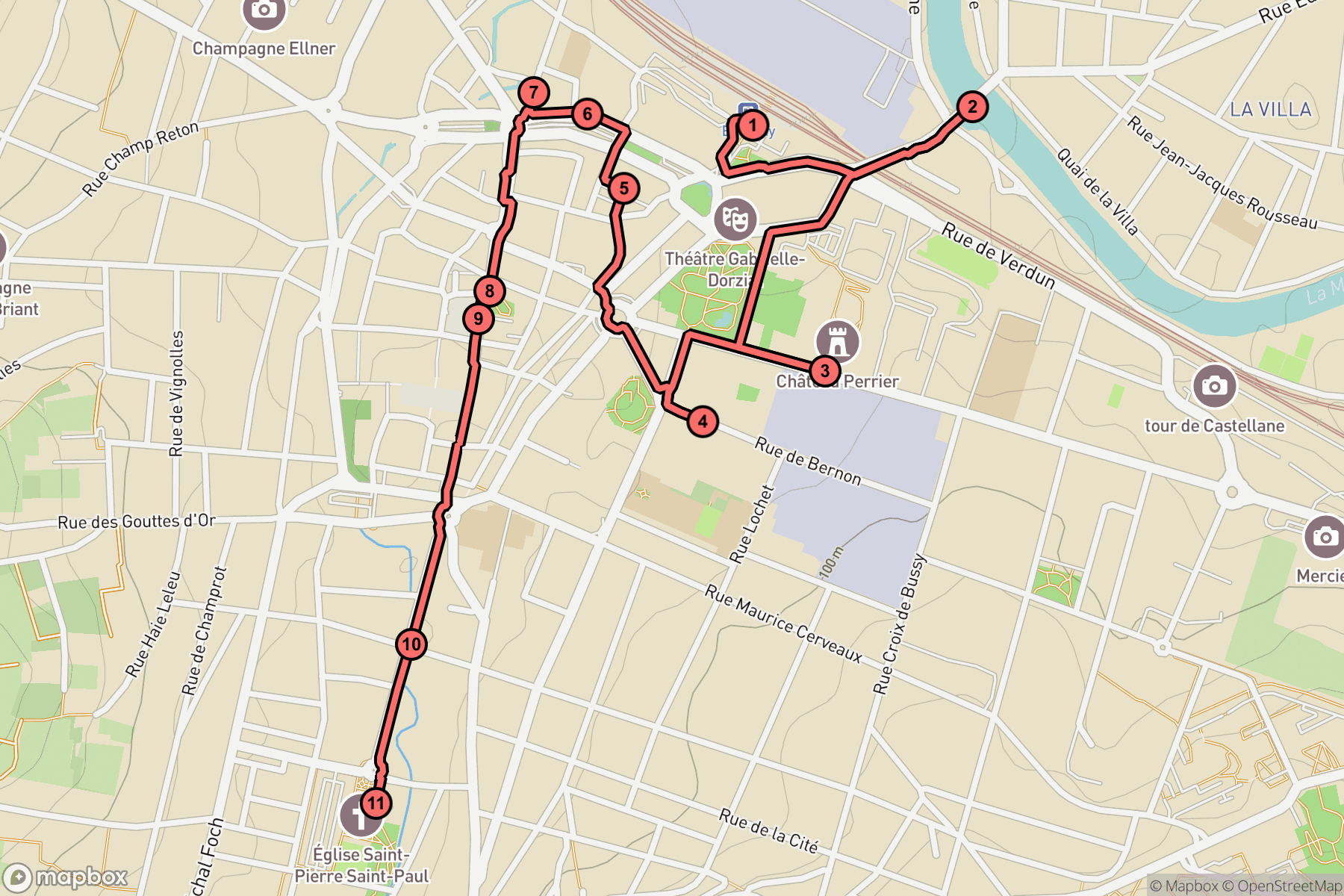
- straighten3.4 km 도보 경로안내 경로 따라가기
- location_on
- wifi_off오프라인 작동한 번 다운로드, 어디서든 사용
- all_inclusive평생 이용언제든지 다시 재생 가능
- location_on에페르네 역에서 시작
이 투어의 정류장
To spot Épernay station, just look for a grand cream-colored building with a small clock at the top and an iron-and-glass canopy stretching out over the entrance, right across…더 보기간략히 보기
To spot Épernay station, just look for a grand cream-colored building with a small clock at the top and an iron-and-glass canopy stretching out over the entrance, right across from a row of green shrubs and the road. Ah, you’ve arrived at the famous Épernay station! Imagine yourself here more than a hundred years ago, the distant whistle of a steam engine echoing across the Champagne hills, the air alive with excitement and a little bit of coal smoke-talk about an unusual perfume for Épernay! This station isn’t just any stop; it’s a gateway, linking Paris to Strasbourg and Reims. As you stand outside, picture travelers bustling through these doors, some with suitcases dreaming of Parisian adventure, others with baskets ready to return home, maybe even with a secretly-stashed bottle of bubbly tucked away. The building, elegant and proud, has watched countless reunions, tearful goodbyes, and probably its fair share of lost hats. Today, Épernay’s station still welcomes explorers like you, serving local TER Grand Est trains buzzing off to Reims, Paris, and Châlons-en-Champagne. So while you might not hear the clacking of steam-powered wheels anymore, the spirit of travel is very much alive-just listen for the next train rumbling in, and you’ll feel it in your bones! Ready to roll on? Let’s follow the tracks of history to our next stop!
전용 페이지 열기 →Look to your right for a stone building with a striking round window above the entrance-this window is filled with a Star of David made from stone, making the Synagogue of Épernay…더 보기간략히 보기
Look to your right for a stone building with a striking round window above the entrance-this window is filled with a Star of David made from stone, making the Synagogue of Épernay easy to spot as it watches over the boulevard. Welcome to the Synagogue of Épernay! If you listen closely, you might almost hear the echo of footsteps from 1890, as the townspeople gathered for its grand opening. Picture Épernay in the late 1800s-bustling, hopeful, and suddenly, in the heart of town, the walls of a brand-new synagogue rising beneath the hands of architect Henry Clouet. The first synagogue, opened only 25 years before, had become too small for the city’s growing Jewish community, so a new home was needed. Take in that magnificent round window-it’s more than just glass and stone. Right in the center, a beautiful Star of David catches the light, shining down on all who pass by. This is pure neo-Byzantine style, and just below the rose window, there’s a Hebrew inscription. Maybe you can spot it? Those ancient letters come from the Bible: “How beautiful are your tents, O Jacob, your dwelling places, O Israel!” It’s a message of welcome and peace, carved for all to see. Originally, you’d have entered through the main door, right in front, but times change-even synagogues like a little makeover. The entrance now is tucked around the side on rue Placet, like a secret passage for those in the know. Speaking of secrets, stories of Épernay’s Jewish presence stretch back to the Middle Ages, when the community was important enough to fill three streets, including the still-existing Rue de la Juiverie. But not all tales here are cheerful. Before the Second World War, the Jewish community was small but vibrant. After the tragedy of the Holocaust, only a handful of families remain. The building itself is rarely used nowadays, mostly opening its doors to curious visitors during European Heritage Days. Imagine the synagogue quiet, its echoes lingering, as if waiting for the next chapter. Even outside of town, down the Avenue de Champagne, you’ll find a Jewish cemetery dating back to the 1860s-another piece of history, both proud and somber, as shadows and memories dance together beneath these Épernay skies. So, as you stand here, you’re not just looking at a building, but at a story carefully stitched together by faith, family, hope, and, on the tough days, resilience as strong as the Star of David shining bright in the window.
전용 페이지 열기 →To spot the Protestant Temple of Épernay, just look for its simple stone façade with rounded windows, a big arched door, and the words "CHAPELLE PROTESTANTE" carved above the…더 보기간략히 보기
To spot the Protestant Temple of Épernay, just look for its simple stone façade with rounded windows, a big arched door, and the words "CHAPELLE PROTESTANTE" carved above the entrance, right under a small stone cross on the rooftop. Now, let’s dive into its story! Picture yourself here in the late 1800s, standing outside a newly purchased stone building at 2 rue de la Poterne. Back then, the local Protestants didn’t have a permanent home-they relied on a borrowed space from the city hall and probably tiptoed around, trying not to disturb the mayor’s meetings! Suddenly, after the defeat of 1871, new Protestant families arrived from Alsace and Moselle, and suddenly the tiny borrowed room just wasn’t big enough for all those extra Sunday hats and hymnbooks. So, by 1880, they put their francs together-7,000 francs, to be precise-and bought this place. You’ll notice above the door a special detail: a stone bible with an inscription inviting everyone to “search the Scriptures.” Imagine the as a hopeful community steps inside, finally with a space to call their own! From 1880 until 1891, Épernay’s parish was still managed from Reims, but the locals wanted their own identity. It took a petition with 200 determined signatures before Épernay finally got its own pastor-talk about a spiritual “DIY!” The building even survived the First World War with just a scratch or two. But here comes a twist-some parishioners whispered that the building once housed a Masonic lodge! No proof, but it sure adds a bit of secret-society mystery, right? You can almost feel the of centuries gone by. In 2000, with fewer parishioners, Épernay’s and Reims’ congregations joined forces again. They share a pastor now-half the time here, half in Reims-proof that even the sturdiest roots sometimes need a little teamwork to keep growing.
전용 페이지 열기 →
8개 정류장 더 보기정류장 적게 보기expand_moreexpand_less
Straight ahead, you’ll spot a grand stone church with a dazzling rose window and a dramatic, pointed tower stretching up-look for its tall central spire reaching high above all…더 보기간략히 보기
Straight ahead, you’ll spot a grand stone church with a dazzling rose window and a dramatic, pointed tower stretching up-look for its tall central spire reaching high above all the rooftops! Welcome to the Church of Notre-Dame d’Épernay! Imagine standing here in the early 1900s, as the sound of hammers echoes through the air, craftsmen building these thick stone walls and elegant arches. But then, during World War I, German bombs came raining down, and this church nearly got a new set of holes more complicated than the rose windows! It took years of hard work and hope to repair the damage, and by 1925, it stood tall again-just like the resilient people of Épernay. Step close and you’ll notice the church is shaped like a Latin cross, with a tower at the crossing topped by a polygonal spire. That spire? It soars 77 meters into the sky-so high, I bet even the birds need directions to find their nests up there! Inside, sunlight glows through magical stained glass from the 16th century, painting colored patterns on ancient stone. The air sometimes rings with music from a historic organ, crafted by Cavaillé-Coll and Mutin, once gifted by Paul Chandon de Briailles, a man who probably wished every church could sound as grand as his champagne tasted. And for a final mysterious twist: in the church lies the tombstone of Marshal Pierre Strozzi, a lord of Épernay-his secrets gently resting beneath your feet as you stand in the shadow of this noble, resilient landmark.
전용 페이지 열기 →If you look straight ahead, you’ll spot the Pont d’Épernay stretching across the Marne-a graceful stone bridge with wide arches and a little house perched at one end, almost as if…더 보기간략히 보기
If you look straight ahead, you’ll spot the Pont d’Épernay stretching across the Marne-a graceful stone bridge with wide arches and a little house perched at one end, almost as if a gatekeeper is welcoming you across the river. Now, let’s take a step back in time together. Imagine standing here in 1567, watching stonemasons stacking giant blocks to form this very bridge. Back then, bridges weren’t just for crossing-they were lifelines, and sometimes battlegrounds. In the late 16th century, after the siege of Épernay, the bridge needed to be patched up, like a tired old sock after a long adventure. And just when it thought life would get easier, here came 1814-sudden clatter, soldiers on the run, and the bridge was cut right in the middle during the wild days of the Napoleonic wars. Then, the city rolled up its sleeves and said, “Let’s build it better.” Between 1820 and 1823, new arches rose over the Marne, and wider sidewalks were added. You can almost hear the echo of footsteps, from merchants with barrels of bubbly to children bursting with laughter. But the bridge wasn’t done meeting trouble-World War II came along, and in 1944 it was cut yet again before rising, stubborn as ever, from the rubble. Today, this bridge isn’t just stones and mortar; it’s a monument to Épernay’s resilience, listed as a historic landmark. As you stand here, picture centuries of stories floating just above the water-some sparkling, some stormy, but all part of Épernay’s remarkable journey.
전용 페이지 열기 →To spot the Château Perrier, look directly in front of you for a grand, ornate mansion with red brick and white stone stripes, tall arched windows, and a statue of a hunter on…더 보기간략히 보기
To spot the Château Perrier, look directly in front of you for a grand, ornate mansion with red brick and white stone stripes, tall arched windows, and a statue of a hunter on horseback proudly standing in the central courtyard. Ah, welcome to the magnificent Château Perrier! Take a moment to drink in-pun intended-the sight of this palace of polychrome elegance, one of France’s earliest examples of the neo-Louis XIII style. Picture this: it’s the 1850s. The air smells faintly of cut stone and newly uncorked dreams, as Charles Nicolas Perrier, the son of the founder of Perrier-Jouët Champagne, decides to go big-really big-with a château that basically says “I have arrived, and yes, please do admire my bricks.” The walls are a checkerboard of red brick and creamy white stone, and the roof throws its slatey peaks heavenward. You’re standing outside a slice of 19th-century ambition-four different façades, each with its own personality, yet woven together with a splash of color and bursts of sculpted stone. Let’s take you back to the grand beginnings. The construction began in 1852, starting with a dig-the champagne caves went in first, naturally, so even if the roof wasn’t ready, the bubbles would be! The main house followed swiftly, and by 1854, the date still inscribed above the attic window, the bricklayers finally put down their trowels. Three more years and about a million francs later, the place was ready-a sparkling jewel along the avenue: close to the new Paris-Strasbourg railway, and front row on the royal road for showing off to visitors. Talk about location, location, location. Now, the château wasn’t just a pretty face. Step a bit closer in your mind-you might hear, way back in the day, the clip-clop of horses and laughter at garden parties. That’s right, Charles Perrier was living the high life. His estate included lush gardens, bubbling fountains, even an orangerie and hothouses filled with tropical orchids, pineapples-28 varieties, if you can believe it!-café plants, and towering camellias. In fact, the garden was so impressive it won not just medals, but bragging rights across the region. Imagine gardeners fussing over orchids while the distant sound of a passing train blended with birdsong. But time doesn’t stand still, and neither did the château. After Charles and his wife Octavie passed, it was inherited by Henri Gallice, Octavie’s nephew-a man who loved horses and hunting. To prove it, he installed the iron statue of “le Veneur”-the hunter on horseback-right here where you’re standing, his silhouette dramatic against the grand mansion. Through war and peace, this mansion played host to all sorts of drama. Believe it or not, during the First World War, the elegant champagne cellars below your feet were transformed into a military hospital. Listen closely-can you almost hear the echo of boots and the fervent whispers of nurses as they cared for the wounded? Italian inscriptions from those years still linger as ghostly graffiti hidden in the walls. By World War II, the château hopped between nationalities like a diplomatic game of musical chairs-British headquarters, German stronghold, American base, sometimes all in the same decade! Then, in 1942, Épernay’s town council saw a new future for this palace and snapped it up for their municipal museum and library. The deal was official in 1943, and rooms that once echoed with champagne toasts and society gossip now held countless stories-first books and local treasures, later the sparkling history of champagne itself, and even prehistory. There was a little hiccup with the reopening after the latest renovations-thanks, COVID-but the Musée du vin de Champagne et d’Archéologie régionale finally opened its doors in May 2021. And what a trove you’ll find: artifacts from vineyard to cellar, the saga of bubbles, and echoes of Épernay’s storied past. Look up at those intricate carvings, the balustrades, the lush roofline. Think of the parties, the worry during war, and then…the gentle hush of a library. If these walls could pop open like a bottle of Perrier-Jouët, imagine all the stories that would fizz out! Now, as we get ready to head to our next stop, take one last look at this château-proof that even in a city famous for champagne, sometimes the bubbles have to compete with a really, really extraordinary house. Eager to learn more about the architecture, garden or the museum? Simply drop your inquiries in the chat section and I'll provide the details you need.
전용 페이지 열기 →Right in front of you, look for the elegant building with a grand golden crest-Moët & Chandon’s façade is impossible to miss, especially as it sits proudly at the heart of…더 보기간략히 보기
Right in front of you, look for the elegant building with a grand golden crest-Moët & Chandon’s façade is impossible to miss, especially as it sits proudly at the heart of Épernay’s Avenue de Champagne, glimmering with sophistication like a champagne bottle on a festive night. Now, take a moment and imagine it’s the year 1743. The streets of Épernay aren’t as busy as today, but there’s a certain energy in the air. Enter Claude Moët, a clever young wine merchant who had one mission: to fill Parisian glasses with the sparkling magic of this very region. He launches Moët et Cie right here, and Épernay’s fate is forever changed. His unrivaled champagne quickly sweeps into the salons of Paris, catching the eye of nobles, aristocrats, and even royalty. Just picture the constant as crate after crate of Moët sets off north to Paris, where King Louis XV himself is known for his taste in the latest craze-sparkling wine. Moët’s secret? It’s not just in the bubbles. It’s in their relentless ambition to refine, innovate, and delight. Soon the family tree grows: Claude’s son and then his grandson join in, building not just a business, but a legend. By 1833, the company takes on the name Moët & Chandon, thanks to Pierre-Gabriel Chandon joining the cause as a partner. This partnership brings new energy-and a dash of that old-fashioned French savoir-faire-to the House of Moët. Fast-forward to the 19th century. Moët is at the forefront, introducing the vintage concept in 1840, then releasing its first vintage champagne in 1842. The “Brut Imperial,” the bottle that’s now a global icon, launches in the 1860s. And then-drum roll, please-comes Dom Pérignon, that mysterious monk found on so many wish lists and rap lyrics. Though he never quite discovered how to make champagne himself, Dom Pierre Pérignon was a monk of endless curiosity-a bit like a mad scientist with grapes-and he inspired the first “prestige cuvée.” Every bottle of Dom Pérignon you see today comes from one special harvest year, making each vintage unique, luxurious, and slightly mysterious. You can practically hear the gentle through the centuries, marking every celebration since. But the story doesn't stop at drinking. Moët & Chandon is everywhere: splashed across pop songs, toasted by tennis stars like Roger Federer, showered over victorious Formula One drivers, mentioned in operas by Strauss, and casually sipped in glitzy hip hop lyrics-by Queen, Snoop Dogg, Mariah Carey, and more. They even held a royal warrant as a supplier to Queen Elizabeth II, so you know you’re in good company here. Over the years, these bubbles have gone global: into the Napa Valley with Domaine Chandon in the 1970s, across Argentina, Australia, even China and India. Each outpost brings its own flair but always sends a little piece of Épernay around the world. Enter Chandon, the ever-adventurous offshoot, popping up wherever the sun shines bright and the grapes grow sweet. By the 1980s, Moët & Chandon merges with Hennessy Cognac, then the mighty Louis Vuitton to form the luxurious powerhouse known as LVMH-a group so vast, it makes billionaires blush. Oh, and here’s a pro tip: Don’t forget to pronounce it “Mo-ET” with a crisp “t” at the end. It’s not just polite; it’s the proper nod to Claude Moët’s Dutch roots, and might even impress a local or two. But not every story is bubbly-there’s excitement and, yes, a little drama. Rare limited editions are festooned with Swarovski crystals, while elsewhere, a scandal (with a dash of danger) strikes when a tainted bottle shocks the wine world in 2022. So as you stand here, you’re not just at a stately building; you’re at the heartbeat of centuries of celebration, invention, and, honestly, a bit of rock ‘n’ roll. Raise an imaginary glass, listen for the distant fizz, and take in the charm. Just remember: in Épernay, champagne isn’t just a drink-it’s the story of the town, poured into every glass, sparkling with history and a pinch of mischief. Eager to learn more about the dom pérignon, domaine chandon or the sponsorships? Simply drop your inquiries in the chat section and I'll provide the details you need.
전용 페이지 열기 →To spot the Portal of Saint-Martin, look just ahead for a grand, weathered stone archway with intricate carvings and columns, standing strikingly alone across a small patch of…더 보기간략히 보기
To spot the Portal of Saint-Martin, look just ahead for a grand, weathered stone archway with intricate carvings and columns, standing strikingly alone across a small patch of green, like the gateway to a secret garden. Now, let’s drift back in time together-picture Épernay in the year 1540. Imagine a team of stone carvers, dust flying, chiseling away as they build a grand side entrance for the local abbey church. Above the arch they place a proud statue of Saint Martin on horseback-a real medieval superhero! It’s said the sculptor was probably Pierre Jacques, though honestly, I think he might have just enjoyed seeing his work watched over by a saint. This arch stood cheerfully as the monks prayed and sang… until history went a bit sideways. In 1790, Épernay shook with change: the government abolished the old monastic vows, and suddenly monks became history themselves as they marched quietly out. Two years later, the grand old church behind this portal stopped echoing with hymns and started filling up with hay bales-it was used as a storage warehouse! Not exactly what the stone carvers had imagined. But our plucky portal endured. When the vaults of the church collapsed in 1824-imagine the crash!-they built a new church nearby. The Portal of Saint-Martin was battered, losing even its statue, and then moved and set into a bell tower, peering out onto Saint-Martin Street. But wait, there’s more moving! In 1909, as the old abbey was finally torn down, the portal was shifted one more time, set up right here in the leafy square you see, facing Place Hugues-Plomb like a grand old storyteller. Through revolutions, ruin, and relocations, this majestic portal survived, finally becoming one of France’s first historical monuments in 1840. So take a moment under this ancient arch and let your imagination walk you through centuries. Who knows-maybe the spirit of Saint Martin is still keeping an eye out, hoping his statue will someday come home! Now, onwards to our next adventure…
전용 페이지 열기 →Right ahead of you, you’ll spot Place Hugues-Plomb by its large circular fountain with a sculpted figure on top, surrounded by leafy trees and historic buildings-the gentle splash…더 보기간략히 보기
Right ahead of you, you’ll spot Place Hugues-Plomb by its large circular fountain with a sculpted figure on top, surrounded by leafy trees and historic buildings-the gentle splash of water is a giveaway if your eyes need help! Now, picture this: over two centuries ago, you wouldn’t be standing in a bustling square at all, but treading through the lush gardens of an ancient abbey. In 1790, the gardens vanished and the site became known as the Place de la Liberté-a fitting name for those revolutionary days. The edge of the square once hugged the grand Notre-Dame church, the old town hall, and even the city’s police station, all tucked inside the former abbey’s walls. Fast-forward, and you can imagine the sound of cobblestones being laid down in 1844, transforming muddy pathways into the elegant setting beneath your feet. But the square’s real star showed up in 1863-thanks to a generous citizen named Legée-Laherte, the very fountain gurgling before you became its centerpiece, and it’s been cooling sun-weary travellers ever since! The square nearly changed forever after a certain Mr. Hugues Plomb offered an eye-popping million francs to build a new city hall, but the First World War tossed all those plans upside-down. Today, you’re surrounded by stories-look around for the post office built in 1923, the historic Saint-Martin portal, and the Simone Veil library. You’re right in Épernay’s memory box, with every splash echoing a different tale!
전용 페이지 열기 →Picture this: it’s the late 1800s, and Épernay is in full swing. The population is exploding-rising from just over 7,000 in 1851 to a bustling 18,000 by 1891. People are pouring…더 보기간략히 보기
Picture this: it’s the late 1800s, and Épernay is in full swing. The population is exploding-rising from just over 7,000 in 1851 to a bustling 18,000 by 1891. People are pouring into the southern quarters, conversations spilling out of cafés, and everyone is thirsty... not just for fizz, but for bigger spaces. Even the local church, Notre-Dame, can no longer handle the number of worshippers. Imagine the weekly shuffle, people squeezing for a spot at mass, the sound of shuffling feet mixing with whispered prayers. A solution pops up in the form of Paul Chandon de Briailles-yes, of the Moët & Chandon family, the fizz behind the fame. In 1893, Paul steps up with all the generosity of a champagne cork popping-he donates nearly 5,000 square meters of land, an area known as the Marais de Grandpierre, to build a new church for Épernay’s swelling south side. But Paul didn’t stop there. He and his sons, Gaston and Jean, commit to covering every last franc for constructing this church. Talk about putting your money where your bubbles are! Now here’s the twist: a church is no good if you can’t get to it. So, Paul Chandon donates another 100,000 francs-imagine that in today’s money-to build the avenue you’re standing on now. In 1895, the city council drew the first lines of this grand path and, in a fit of gratitude (and perhaps a hint of flattery), they named it after their benefactor-Avenue Paul-Chandon. But building wasn’t simple. Picture the workers setting up from 1898 to 1904, laboring to reroute and cover a section of the Cubry River. All this so churchgoers wouldn’t need to row their way to services! The generosity doesn’t stop there-a family tradition, it seems. In 1905, Paul’s son Raoul includes a whopping 100,000-franc bequest in his will for the city. In 1909, this gift is transformed into a promenade, aptly named the Square Raoul-Chandon, that encircles the proud new church at the end of your walk: the Église Saint-Pierre-Saint-Paul. As you stroll, take in the charming houses and surprises that dot the avenue, like the gorgeous brick-and-stone former Courrier du Nord-Est printing house at No. 1, or the Tuscan-style villa with its impressive tower at No. 43-more Mediterranean than Marne, and impossible to miss. So, as you walk down Avenue Paul-Chandon, you’re following in the footsteps-and perhaps the celebratory toasts-of Épernay’s most generous patrons, moving from the lively center city to the majestic church that Paul Chandon made possible. Kindness, ingenuity, and-let’s be honest-a good investment in real estate all come together here. Makes you wonder: if every street had this much character, would GPS navigation be a lot more fun?
전용 페이지 열기 →To spot the Church of Saint-Pierre-Saint-Paul in Épernay, look for a striking pale stone church with a tall, ornate central tower capped by a rounded dome and flanked by two…더 보기간략히 보기
To spot the Church of Saint-Pierre-Saint-Paul in Épernay, look for a striking pale stone church with a tall, ornate central tower capped by a rounded dome and flanked by two smaller turret-like domes, standing proudly at the edge of a tree-lined square. Ah, you’ve found it-the grand finale of our tour, the Church of Saint-Pierre-Saint-Paul! Now, let’s step out of the present for a moment and stroll back to the late 1800s, a time when Épernay was bursting at the seams. Imagine the city suddenly doubling in size, like one too many corks popping off bottles of champagne. The old Notre-Dame church was stuffed full, and locals were petitioning, “Please-give us more room for prayers, and maybe a bit less elbowing during Sunday service!” Enter Paul Chandon de Briailles. Picture him as the town’s fairy godfather, though instead of a magic wand, he offered a hefty plot of land known as the “Marais de Grandpierre.” Not only did he donate the ground, but together with his sons, Gaston and Jean, he also footed the bill for this gleaming new church, ensuring Épernay’s southern quarters felt just as heavenly as the north. Ground was broken on May 12th, 1895--but fate had a twist: Paul himself passed away a month later. Yet, his legacy would soon tower above the city for generations. Walk closer and let your eyes wander-the architecture is a delicious blend. The rounded domes and intricate mosaics tell you it’s romano-byzantine at heart, but those arched windows and stonework details? That’s your dash of Romanesque and Gothic coming through. The exterior’s built from solid brick and finely carved stone, and the plan is clever-a Latin cross, with two rounded chapels hugging the entrance, all under sweeping, slate roofs. If you peek up at that main tower, notice the lantern perched up top-it’s not just pretty, it also guides eyes and spirits upward. If you step inside, sunlight will pour through a kaleidoscope of stained glass, splashing color across the granite and limestone columns. These are no ordinary pillars-they’re topped by leafy, ornate capitals so lively you almost expect a squirrel to scamper by. The choir, a feast for your eyes, glows with red mosaics: bunches of grapes and wheat, a proud pelican, a serene lamb, and, of course, Saints Peter and Paul themselves-two legends watching over Épernay. There’s a bit of drama here, as the mosaics, attributed to Henri Rapin, didn’t appear until 1929, decades after the first plans. Talk about a delayed renovation! Ah, but let’s not forget the music. Look up at the loft by the entrance-you’ll spot the famous organ, crafted by Aristide Cavaillé-Coll and later finished by Charles Mutin. This showstopper hasn’t changed since 1898, and it once charmed none other than Paul Chandon himself. The musicians’ perch is lined with fun details: you’ll see a tiny stone carving of architect Édouard Deperthes, compass in hand. Across from him, his colleague Henri Piquart is forever immortalized, perhaps critiquing the acoustics. As for treasures, the church is loaded. The limestone main altar has copper details and faces of the Evangelists peeking from its corners. Around the choir and side chapels, wrought ironwork twirls into the Chandon family’s crest. There’s a pair of bronze statues of Peter and Paul, each almost as tall as a person, sitting royally-works of Blondeau, Sénart & Co.-so precious they’re now historical monuments. Don’t miss the touching older piece: a painted wooden crucifix from the 16th century, looking somber but stubborn, like it’s weathered one too many storms and still refuses to leave. Now, just imagine the kaleidoscopic windows as beams of evening light stream through-these stained-glass marvels were crafted between 1897 and 1904. If you look closely, you’ll spot stories of saints, heroes, and miracles: Joan of Arc crowning Charles VII, Saint Remi baptizing Clovis, or Saint Vincent consoling prisoners. The artistry doesn’t stop with saints-donors’ coats of arms hide in the glass, a Chapel’s “thank you” in technicolor. Now, as birds flutter above and the last sunbeams catch the slate domes, remember, you’re standing before a church more than bricks and glass. It’s a living story, a place where the rush of Épernay’s growth, the generosity of a family, and the hopes of thousands are etched into every stone. Thank you for joining me through the wonders of Épernay! And remember, the best stories are those we pass on-so go ahead, tell someone you met a church with as many secrets as a champagne cellar.
전용 페이지 열기 →
자주 묻는 질문
투어는 어떻게 시작하나요?
구매 후 AudaTours 앱을 다운로드하고 교환 코드를 입력하세요. 투어를 바로 시작할 수 있습니다 - 재생을 탭하고 GPS 안내 경로를 따라가시면 됩니다.
투어 중 인터넷이 필요한가요?
아닙니다! 시작 전에 투어를 다운로드하면 완전히 오프라인으로 즐길 수 있습니다. 채팅 기능만 인터넷이 필요합니다. 모바일 데이터 절약을 위해 WiFi에서 다운로드하시는 것을 권장합니다.
이것은 가이드가 안내하는 단체 투어인가요?
아닙니다 - 이것은 셀프 가이드 오디오 투어입니다. 폰을 통해 오디오 나레이션을 들으며 나만의 속도로 독립적으로 탐험합니다. 투어 가이드도, 단체도, 일정도 없습니다.
투어는 얼마나 걸리나요?
대부분의 투어는 60-90분이 소요되지만, 속도는 전적으로 본인이 조절합니다. 원할 때 언제든지 일시정지하거나, 정류장을 건너뛰거나, 휴식을 취하세요.
오늘 투어를 끝낼 수 없으면 어떻게 하나요?
괜찮습니다! 투어는 평생 이용이 가능합니다. 원할 때 언제든지 일시정지하고 다시 시작하세요 - 내일, 다음 주, 또는 내년에도. 진행 상황이 저장됩니다.
어떤 언어를 이용할 수 있나요?
모든 투어는 50개 이상의 언어로 이용 가능합니다. 코드를 교환할 때 원하는 언어를 선택하세요. 참고: 투어 생성 후에는 언어를 변경할 수 없습니다.
구매 후 투어는 어디에서 이용하나요?
App Store 또는 Google Play에서 무료 AudaTours 앱을 다운로드하세요. 교환 코드(이메일로 전송됨)를 입력하면 라이브러리에 투어가 나타나며, 다운로드하여 시작할 수 있습니다.
투어가 마음에 들지 않으시면 환불해 드립니다. 문의: [email protected]
안전한 결제 


