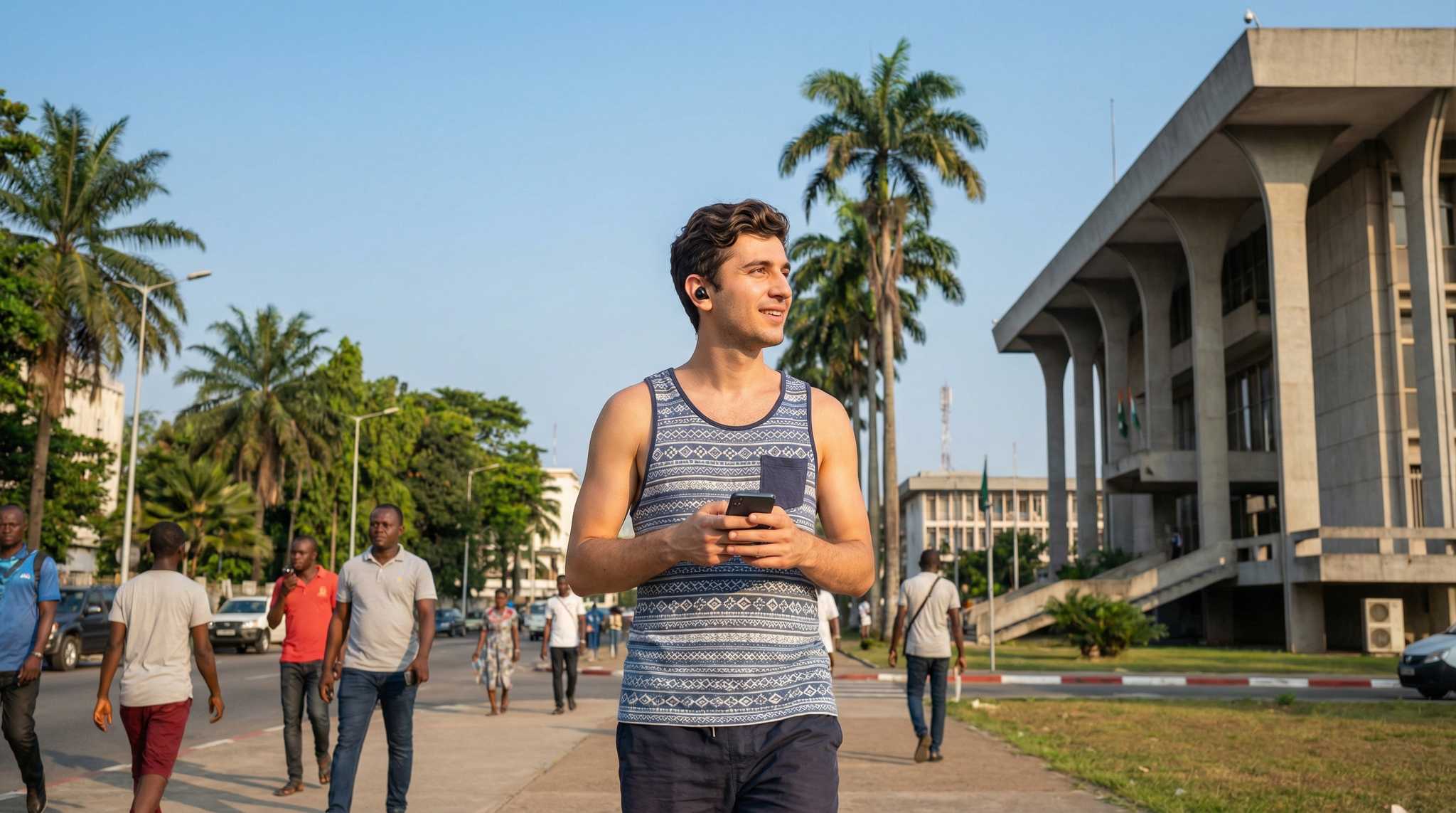
아비장 오디오 투어: 랜드마크와 유산을 통한 여정
아비장의 햇살 가득한 대로변에서, 외교관의 문 뒤로 권력이 속삭이고 콘크리트 복도에서는 비밀이 울려 퍼집니다. 이 셀프 가이드 오디오 투어를 통해 도시의 정치적 핵심부를 탐험하며 소수의 방문객만이 들을 수 있는 이야기를 발견하세요. 각 정류장은 간과되었던 구석과 현대 생활에 얽힌 흥미로운 역사를 드러냅니다. 모든 것이 위태로웠을 때 프랑스 대사관 벽 안에서 밤늦게까지 이어진 위기 회담을 부추긴 것은 무엇이었을까요? 10년 전의 격변기 동안 외무부에서 사라져 소문만 남긴 사람은 누구였을까요? 아제루트(Ageroute)의 잠긴 캐비닛 하나가 왜 아는 사람들로부터 그토록 호기심 어린 시선을 끄는 걸까요? 각 랜드마크가 아비장의 계속되는 드라마 속으로 당신을 더 깊이 끌어들이는 동안 외교관, 음모가, 그리고 알려지지 않은 영웅들의 발자취를 따라가 보세요. 역사가 눈에 보이지 않는 곳에서 기다리는 거리를 걸으며 긴장감, 놀라움, 그리고 스릴을 느껴보세요. 숨겨진 층을 잠금 해제하세요—숨겨진 아비장을 통한 당신의 여정이 지금 시작됩니다.
투어 미리보기
이 투어에 대하여
- schedule소요 시간 30–50 mins나만의 속도로 이동
- straighten3.9 km 도보 경로안내 경로 따라가기
- location_on
- wifi_off오프라인 작동한 번 다운로드, 어디서든 사용
- all_inclusive평생 이용언제든지 다시 재생 가능
- location_on아비장 대통령궁에서 시작
이 투어의 정류장
As you stand in front of the Presidential Palace of Abidjan, take a moment to soak in its grand presence. This isn’t just any building-it’s the official residence of the President…더 보기간략히 보기
As you stand in front of the Presidential Palace of Abidjan, take a moment to soak in its grand presence. This isn’t just any building-it’s the official residence of the President of Côte d’Ivoire! The Palace was conceived right as the country gained its independence, built at the wish of President Félix Houphouët-Boigny. Imagine Abidjan in 1961: excitement in the air, new beginnings, and a colossal white palace rising in the Plateau district, offering sweeping views of the Ébrié Lagoon. They didn’t just put up four walls and call it a day-oh no-the place is a creative extravaganza. Paintings by Bernard Buffet, sculptures inside by Louis Dideron, and tapestries from Jean Lurçat. Even René Collamarini contributed with stunning sculptures on the exterior. Though a shiny new palace eventually rose in Yamoussoukro after 1983, this Abidjan landmark remains the beating heart of presidential power-sort of like having two palaces in your Monopoly set. The place has seen its fair share of drama, too: during the crisis of 2010-2011, it was partially destroyed and needed weeks of repairs so President Alassane Ouattara could move in. Talk about a fixer-upper! Even today, this palace stands elegant, historic, and the real-life “House of Cards” of Abidjan.
전용 페이지 열기 →The Ministry is the guardian of Côte d’Ivoire’s conversations with the rest of the world. It doesn’t just organize fancy state dinners and official trips-though, rumor has it,…더 보기간략히 보기
The Ministry is the guardian of Côte d’Ivoire’s conversations with the rest of the world. It doesn’t just organize fancy state dinners and official trips-though, rumor has it, they do have great snacks at those meetings! Its mission runs deep: from negotiating business deals to securing peace, and even protecting Ivorians stranded far away from Abidjan. Think of them as Côte d’Ivoire’s global family, always making sure their doorstep-and their heart-remains open. This immense task is led by the Minister of Foreign Affairs, currently Kacou Adom, who took charge in October 2023. Alongside him is Wautabouna Ouattara, handling the important portfolio of African integration and the Ivorian diaspora. These leaders coordinate dozens of teams, each diving into a corner of international relations. The structure of the Ministry is a bit like a well-organized beehive. There’s an inspection team, a group for financial affairs, another for strategic analysis, and a unit that literally deals with ceremonies-just imagine the practice bows and rehearsed handshakes! For the scholars and polyglots, there’s even a team for translation and interpretation, ensuring nothing gets lost in translation-or in diplomacy. In the middle of it all sits the Secretary General, a high-ranking ambassador who’s a bit like the Ministry’s traffic cop-making sure everything runs smoothly, everyone behaves, and destinations are reached without drama. This person ensures that the work going on at home in Abidjan resonates and coordinates with the embassies and consulates in more than 53 locations around the globe. Talk about frequent flyer miles! Speaking of distant lands, the Ministry’s reach stretches from the heart of Abidjan to offices in places as far flung as Japan and Canada. Each embassy, staffed by diplomats in crisp suits, is a tiny slice of Côte d’Ivoire overseas-like sending a taste of home in every suitcase. And when Ivorians abroad need help-lost passport, tricky paperwork, or homesick for attiéké-it’s this Ministry that jumps into action. Now, let’s press rewind and set the mood back to 1961. The air buzzes with optimism, the country is still young, and the first President, Félix Houphouët-Boigny, decides he will personally be Côte d’Ivoire’s first voice to the world. You can picture him landing in Paris in a sharp suit, shaking hands with Charles de Gaulle, signing groundbreaking treaties-sometimes negotiating military assistance one day, and sharing a laugh over baguettes the next. Two weeks in the U.S., visiting John F. Kennedy and jetting off to Britain, Israel, Germany-the pace was dizzying, but this president was determined to make Côte d’Ivoire not just seen, but heard. A few years later, in 1963, Houphouët-Boigny hands over the daily grind to Camille Alliali, the newly minted Minister Delegate. Alliali masters the balancing act-Soviet Union on one hand, the West on the other, and all of Africa in between! By 1966, Arsène Usher Assouan, who honed his diplomatic chops at the UN, takes the baton as the first full minister dedicated to foreign affairs. The job only grows more complex, with Siméon Aké later following in his exact diplomatic footsteps-both as UN representatives and as Foreign Ministers. Imagine all the air miles racked up! Fast forward to recent times, the Ministry now mixes old-school protocol with the challenges of today-regional integration, supporting Ivorians living anywhere from Bamako to Paris, and managing everything from trade deals to humanitarian crises. And don’t forget, the Ministry isn’t just about global handshake deals-it’s also about African community and unity, weaving Côte d’Ivoire’s story into Africa’s bigger tapestry. So, as you stand here, think about how many major decisions, career-defining negotiations, and a couple of international fashion faux pas might have happened inside. Now, if you feel a sudden urge to wave to passing diplomats, go right ahead-they’re used to grand entrances! Let’s keep moving-the world (and our next stop) awaits.
전용 페이지 열기 →Here you are, standing before the headquarters of Ageroute, one of the unsung heroes behind Côte d'Ivoire’s everyday journeys. Let’s paint the scene a little. Imagine the tropical…더 보기간략히 보기
Here you are, standing before the headquarters of Ageroute, one of the unsung heroes behind Côte d'Ivoire’s everyday journeys. Let’s paint the scene a little. Imagine the tropical warmth buzzing with activity, the hum of engines, and the calls of street vendors-this is Abidjan, a city crisscrossed by roads that make everything possible. But these roads don’t take care of themselves, and that’s where Ageroute, or the Road Management Agency, rolls into action. Ageroute wasn’t always here, of course. Go back to the 1980s and 1990s-a time when Côte d’Ivoire faced a tough economic recession. Budgets shrank, roads crumbled, potholes grew deep enough to have their own postal addresses, and the nation’s travelers spent more time stuck than moving. The government tried a few fixes, and even launched a big Program for Transport Sector Adjustment in 1998, but let’s just say the road to recovery was, well, full of bumps. Everything changed in 1997, when the Ivorian state officially created Ageroute. Tasked to monitor, maintain, and expand the highway and road network, Ageroute swooped in to do some serious repair work. Right from day one, it wasn’t just about patching up the old; they had eyes on the future too. They work alongside the Road Maintenance Fund, which makes sure there’s money for all those shovels, asphalt, and those bright orange cones everyone loves. So, what does Ageroute actually do? Think of them as the ultimate road doctors. From surveying potholes to launching full-scale construction, they’re all over Côte d’Ivoire. They build gleaming new highways, repair bridges, and upgrade intersections. They handle calls for tender, supervise the workers, and even crunch the stats on how busy and healthy the roads are. With thousands of kilometers under their care-almost everything outside village and city streets-it’s a legal marathon just keeping the country connected. Let’s take a quick tour of their greatest hits. Remember the Henri-Konan-Bédié bridge? Opened in 2014, it links Cocody and Marcory with style, complete with two shiny new interchanges. The expressway from Abidjan to Grand-Bassam? It boosted not only local traffic, but cross-border trade with Ghana-talk about an international effort. Or the Riviera 2 interchange, finished in 2014, where traffic jams were so bad, even the pigeons started looking for alternate routes. There’s more-recent projects like the Macaci junction, opened in October 2023, and the Abobo town hall roundabout circulating since January 2024, remind us that innovation is always under construction. They even tackled monumental challenges like the new Bouaflé bridge, opened in 2015, updating a vital crossing first built in 1953. And the Mohammed VI Expressway, inaugurated in 2015, connects Abobo to Anyama and is named after the King of Morocco, proving that good roadwork travels fast. So, next time you glide across a smooth stretch or zip across a bridge, remember the folks at Ageroute-Côte d’Ivoire’s road warriors, always ready with a solution for every bumpy situation. And if you’re ever late to a party, you can just blame roadwork-courtesy of Ageroute! Fascinated by the historical, missions or the network? Let's chat about it
전용 페이지 열기 →
5개 정류장 더 보기정류장 적게 보기expand_moreexpand_less
You’re now looking at Angoulvant Boulevard, which cuts right through the heart of Abidjan like a confident runway model. Try to imagine the sounds of scooters, laughter, and a sea…더 보기간략히 보기
You’re now looking at Angoulvant Boulevard, which cuts right through the heart of Abidjan like a confident runway model. Try to imagine the sounds of scooters, laughter, and a sea of commuters on a typical week - this boulevard doesn’t believe in quiet afternoons. The air here is a lively blend of city aromas: fresh baked bread from local vendors, the faint tang of car exhaust, and maybe-if you’re lucky-a whiff of blooming flowers from nearby parks balancing it all out. Now, the name Angoulvant might sound a bit fancy, but it actually comes from Gabriel Angoulvant, a French colonial administrator. Back in the days when dapper French officials strutted around these streets, Angoulvant was the guy in charge-probably the type who’d always tell you to mind your manners and stand up straight! The boulevard was named to honor his role in shaping the early colonial administration. You could say it’s a lasting reminder of days when Abidjan was growing, changing, and finding its own rhythm. Keep your eyes on the architecture as you walk-this stretch is surrounded by striking buildings and memorable city scenes, each with its own story. Who knows, maybe on your next trip someone will name a boulevard after you-just don’t boss people around like Gabriel did!
전용 페이지 열기 →Gazing up at the impressive Postel Tower 2001, you can’t help but notice its sharp, modern lines standing proudly along Jessie Owens Street. Imagine it’s the 1980s. The Plateau…더 보기간략히 보기
Gazing up at the impressive Postel Tower 2001, you can’t help but notice its sharp, modern lines standing proudly along Jessie Owens Street. Imagine it’s the 1980s. The Plateau district is buzzing with ambition, and this sleek skyscraper’s silhouette is fresh on the skyline, rising more than 105 meters high-taller than most birds dare to fly in central Abidjan! Built in 1984, Postel 2001 was one of the last grand office towers dreamed up by the Ivorian government. For years, the building’s halls echoed with the footsteps of ministers and busy officials. Four ministries packed their offices in here-Economy, Transport, Artisans and Small Enterprises, and Post and ICT. Who knew the elevator was such a hotspot for government secrets? Here’s a fun twist: people often mix up the tower’s name, calling it Postel 2000 instead of 2001. Why? Apparently, "2000" was the trendy number back then-this tower just wanted to be unique. But even the strongest giants have their troubles. After some years, neglected maintenance and a suspicious vanishing act of repair funds left Postel 2001 a little worse for wear. By 2013, the government declared it unsafe, and offices began emptying out. To bring it back to glory, a hefty 14 billion CFA francs will need to be invested. Stand by for a comeback-let’s hope 2001 is luckier than 2000.
전용 페이지 열기 →To spot the Coffee-Cocoa Council, look for a bright sign with three bold icons: a cocoa pod, the head of an elephant, and coffee beans, all framed in green, orange, and…더 보기간략히 보기
To spot the Coffee-Cocoa Council, look for a bright sign with three bold icons: a cocoa pod, the head of an elephant, and coffee beans, all framed in green, orange, and white. Alright, fellow explorer, welcome to the aroma-filled heart of Côte d’Ivoire’s biggest secret: the Coffee-Cocoa Council! Imagine the scent of cocoa and fresh roasted coffee drifting through the air as you stand here-after all, you are at the headquarters of the nation’s “bean counter” and “bean dreamer,” ruling over the world’s top cocoa production. In 2012, before this place existed, the fate of coffee and cocoa in Côte d’Ivoire was a bit like a traffic jam-run by four different organizations, each doing its own thing and often getting nowhere fast. But then came the Coffee-Cocoa Council, blending all those groups into one mighty bean team for smoother operations and better decisions. Think of them as bean wizards, brewing up rules to make sure prices are fair, producers are protected, and the country stays a superstar on the global chocolate and coffee stage. The Council weathered storms too! Not long ago, accusations flew about misusing COVID-19 funds, but after a dramatic investigation, they were cleared-the only thing richer than cocoa here was their reputation! Today, with its headquarters right here in the Plateau, the Council is run by a blend of government and professionals, whisking up strategies to keep the cocoa-creamy economy steady, making sure that bean growers always have a safety net beneath them, and launching programs so smooth you’d think they were made of chocolate mousse. So, next time you sip Ivorian coffee or bite into silky chocolate, just remember: it all starts with the steady hands and clever minds right in this building. Now, how about we whistle a happy tune and press onward?
전용 페이지 열기 →Take a good look at the grand building in front of you-the French Embassy in Ivory Coast. Can you sense the subtle hum of diplomatic activity, the soft shuffle of official shoes,…더 보기간략히 보기
Take a good look at the grand building in front of you-the French Embassy in Ivory Coast. Can you sense the subtle hum of diplomatic activity, the soft shuffle of official shoes, the swish of French suits and Ivorian fabrics as they pass by each day? Welcome to one of the most influential outposts of France in West Africa, nestled right here in Abidjan-the country’s economic heart, even though the official political capital switched to Yamoussoukro in the 1980s. This embassy is much more than just a place for paperwork and fancy receptions. Since 2020, it’s been under the watchful eye of Ambassador Jean-Christophe Belliard, and it also houses the French Consulate General, which helps French citizens with everything from new passports to lost-in-translation adventures, and probably the occasional emergency involving baguettes. But this place isn’t just for the diplomats and forms-more than 17,000 French citizens were registered in Abidjan in 2016, making it a true slice of France in the bustling heart of Ivory Coast. The embassy is the nerve center, yet there are also honorary consuls posted in Bouaké, San Pédro, and Daloa, doing their fair share of Franco-Ivorian bridge-building. And here’s a fun fact to impress your friends: The French in Côte d’Ivoire get to elect their own advisors-four of them, each serving for six whole years. They don’t just sit there; their voices echo all the way to the French Senate. Now, the drama! After 2004, the French community here got a lot smaller, but those who stayed became even more tight-knit-a living link between two nations. So, whether you’re dreaming of diplomatic immunity or just enjoying the idea of a miniature France with Côte d’Ivoire’s tropical flair, you’re standing at the crossroads of cultures, history, and a few excellent croissants.
전용 페이지 열기 →To spot the Roman Catholic Archdiocese of Abidjan, look ahead for a dramatic building with a sweeping, curving roof and a strikingly tall, white cross rising above the lush green…더 보기간략히 보기
To spot the Roman Catholic Archdiocese of Abidjan, look ahead for a dramatic building with a sweeping, curving roof and a strikingly tall, white cross rising above the lush green hillside-like a giant reaching for the sky! Now, imagine yourself in the late 1800s, when this site was more jungle than city, with the future archdiocese just a hope in the hearts of a few daring missionaries. The story starts in 1895, when it was nothing more than an Apostolic Prefecture, carved from the neighboring Gold Coast-today’s Ghana. Fast-forward through a whirlwind of change: in 1911, it became an Apostolic Vicariate, and by 1940, Abidjan finally had its name shining on the ecclesiastical map. The suspense kept building until 1955, when, like an underdog in a football story, it rose to become a Metropolitan Archdiocese! Here, leaders came and went-kind of like coaches, but with more incense. Archbishop Boivin saw it through thick and thin; Cardinal Bernard Yago called plays from the altar for decades; then came Bernard Agré and Jean-Pierre Kutwa, rising to cardinals themselves. Today, Archbishop Ignace Bessi Dogbo takes up the baton. Behind the modern facade and dramatic curves of St. Paul’s Cathedral, this archdiocese watches over Abidjan with a history as layered and lively as the city itself.
전용 페이지 열기 →
자주 묻는 질문
투어는 어떻게 시작하나요?
구매 후 AudaTours 앱을 다운로드하고 교환 코드를 입력하세요. 투어를 바로 시작할 수 있습니다 - 재생을 탭하고 GPS 안내 경로를 따라가시면 됩니다.
투어 중 인터넷이 필요한가요?
아닙니다! 시작 전에 투어를 다운로드하면 완전히 오프라인으로 즐길 수 있습니다. 채팅 기능만 인터넷이 필요합니다. 모바일 데이터 절약을 위해 WiFi에서 다운로드하시는 것을 권장합니다.
이것은 가이드가 안내하는 단체 투어인가요?
아닙니다 - 이것은 셀프 가이드 오디오 투어입니다. 폰을 통해 오디오 나레이션을 들으며 나만의 속도로 독립적으로 탐험합니다. 투어 가이드도, 단체도, 일정도 없습니다.
투어는 얼마나 걸리나요?
대부분의 투어는 60-90분이 소요되지만, 속도는 전적으로 본인이 조절합니다. 원할 때 언제든지 일시정지하거나, 정류장을 건너뛰거나, 휴식을 취하세요.
오늘 투어를 끝낼 수 없으면 어떻게 하나요?
괜찮습니다! 투어는 평생 이용이 가능합니다. 원할 때 언제든지 일시정지하고 다시 시작하세요 - 내일, 다음 주, 또는 내년에도. 진행 상황이 저장됩니다.
어떤 언어를 이용할 수 있나요?
모든 투어는 50개 이상의 언어로 이용 가능합니다. 코드를 교환할 때 원하는 언어를 선택하세요. 참고: 투어 생성 후에는 언어를 변경할 수 없습니다.
구매 후 투어는 어디에서 이용하나요?
App Store 또는 Google Play에서 무료 AudaTours 앱을 다운로드하세요. 교환 코드(이메일로 전송됨)를 입력하면 라이브러리에 투어가 나타나며, 다운로드하여 시작할 수 있습니다.
투어가 마음에 들지 않으시면 환불해 드립니다. 문의: [email protected]
안전한 결제 


