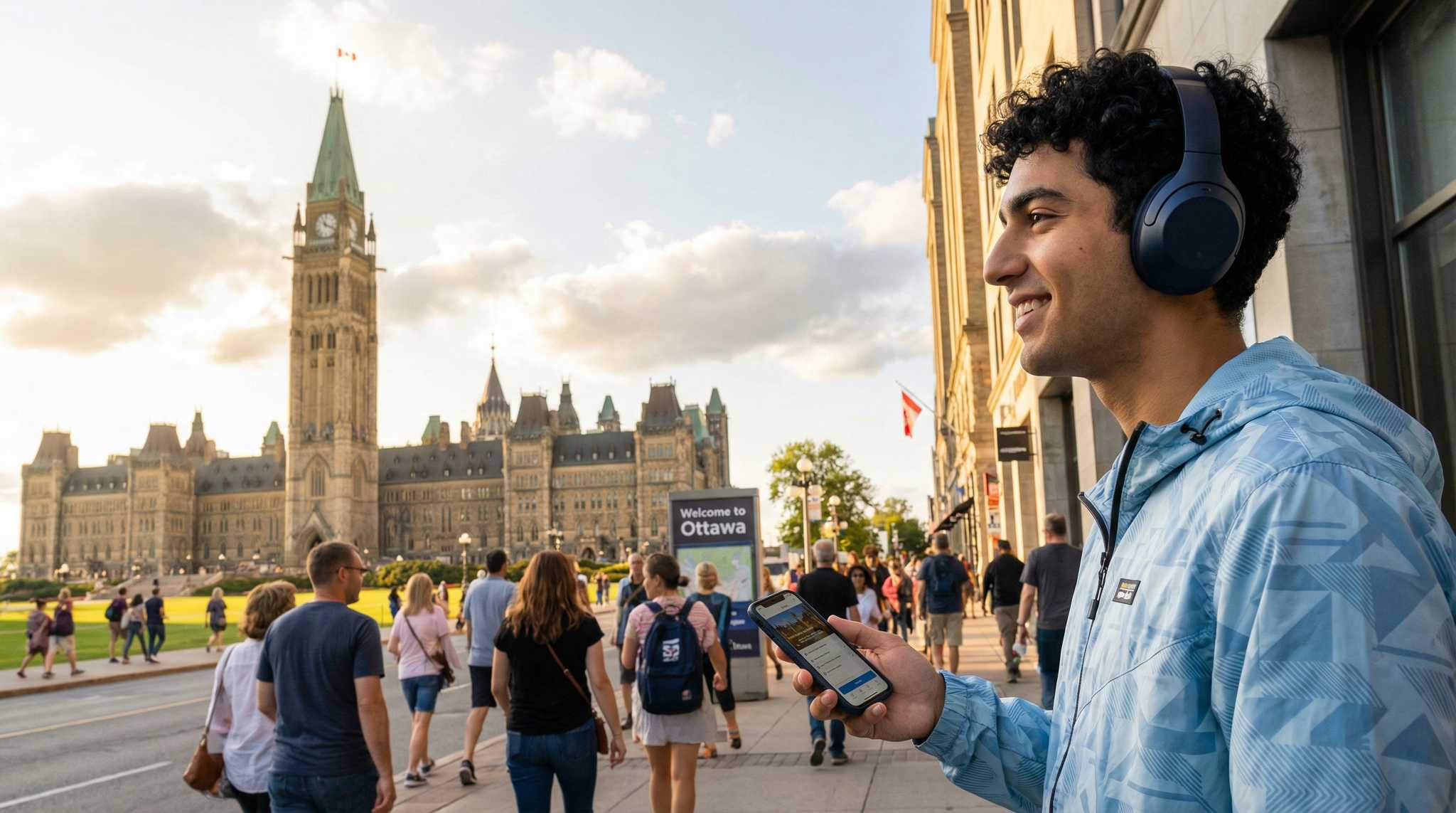
오타와 오디오 투어: 캐나다의 상징, 이야기, 그리고 놀라운 비밀
이 매혹적인 투어를 통해 오타와의 풍부한 역사와 멋진 건축물을 발견해보세요. 캐나다 영웅들에게 바치는 엄숙한 헌사인 국립 전쟁 기념관에서 시작하여 깊은 명예와 추모의 마음을 느껴보세요. 다음으로, 캐나다 통치의 심장부를 엿볼 수 있는 캐나다 상원 건물의 웅장함을 탐험해보세요. 마지막으로, 우아함과 유산이 깃든 웅장한 성 같은 호텔인 상징적인 샤토 로리에에 감탄해보세요. 이 투어는 캐나다의 활기찬 수도에서 문화, 역사, 그리고 숨 막히는 경치의 완벽한 조화를 선사합니다!
투어 미리보기
이 투어에 대하여
- schedule소요 시간 50–70 mins나만의 속도로 이동
- straighten3.4 km 도보 경로안내 경로 따라가기
- location_on
- wifi_off오프라인 작동한 번 다운로드, 어디서든 사용
- all_inclusive평생 이용언제든지 다시 재생 가능
- location_on국립 예술 센터에서 시작
이 투어의 정류장
To spot the National Arts Centre as you walk, look for a striking modern building made of brown concrete and glass with tall, geometric windows and a unique hexagonal tower rising…더 보기간략히 보기
To spot the National Arts Centre as you walk, look for a striking modern building made of brown concrete and glass with tall, geometric windows and a unique hexagonal tower rising at the corner of Elgin Street and the Rideau Canal. Now, as you stand right here in front of the National Arts Centre, imagine a city growing, changing, making bold decisions about its future. The story begins in 1928, when a grand old theatre-the Russell Theatre-stood just around the corner, until the landscape of Ottawa was dramatically shifted. The theatre was demolished to make way for Confederation Square, and suddenly, the city that was supposed to represent the arts and heart of Canada was left without a world-class stage. Performers, orchestras, and artists, when they came to Ottawa, had no home of their own-just a cinema built for movies and vaudeville, barely suited for grand symphonic performances or passionate theatre. For decades, this city lived in the echo of what it had lost, until two determined visionaries-G. Hamilton Southam and Levi Pettler-decided enough was enough. In the early 1960s, with a stubborn spark and relentless ambition, they formed the National Capital Arts Alliance. Their goal was simple, but enormous: convince the city and the government to build a new beacon for the performing arts, right here, on Elgin Street by the quiet waters of the Rideau Canal. After years of persuasions and pleas, the dream was at last embraced as part of the grand celebrations for Canada’s centenary in 1967. The government chose this very spot-where City Hall once stood-and Ottawa donated the land for the future of the nation’s culture. Imagine the energy in the air when the National Arts Centre finally opened its doors to the public on May 31, 1969-after a massive $46 million investment-in a year when the whole country was searching for ways to mark a hundred years of confederation. Picture the hum of the crowds waiting nervously outside, while the finishing touches were put in place inside this avant-garde fortress for Canadian creativity. But this is no ordinary building. Take a good look at those sharp angles, those geometric lines-it was designed by architect Fred Lebensold in a style called Brutalism, drawing shapes from triangles and hexagons, concrete echoing the strength of the Canadian Shield itself. Much of the exterior is clad in brown Laurentian granite, with windows carved into the walls like tall, slender eyes watching the city. Even the insides seem formed by nature: hexagons appear overhead, underfoot, and in the very shape of light fixtures and ceilings, like honeycombs for artists and audiences. The National Arts Centre was built not only on land, but upon music, drama, and the generosity of a grateful world. One of its most mysterious treasures-a concert organ-was not planned at the start, but given as a gift. On the 25th anniversary of the Netherlands’ liberation in 1970, the Dutch people presented two magnificent organs to Canada, in gratitude for a freedom won by Canadian soldiers during World War II. The concert organ, built in the Netherlands and echoing with emotion, first sang for an audience here in 1973, its notes soaring into the hearts of all who listened. This centre is more than stone and glass-it’s alive with stories. In 2010, Queen Elizabeth II herself unveiled a statue of the great jazz pianist Oscar Peterson right outside, underlining the connection between Canada’s leaders and its artists. Over time, the building has evolved, too: a $110 million renovation for Canada’s 150th anniversary reimagined its presence, opening windows to Parliament Hill and creating new entryways, but always respecting the vision that first guided its creation. Inside, the National Arts Centre holds four stages of wonder: Southam Hall-home to orchestras and ballet-Babs Asper Theatre for drama and dance, Azrieli Studio for intimate musical encounters, and the cozy Fourth Stage for community voices. On these stages, stories are spun in every language, every emotion, every season. Look up at the multi-level terrace and the gardens open to anyone, the city sloping down towards the canal, and remember this: where you are standing was once a void, a space waiting to be filled by courage, art, and community. Now, every night, you might hear the footsteps of opening-night audiences, the bracing notes of a rehearsal, or the silent expectation before the curtain rises. This is the National Arts Centre-a historic site, a living dream, and the heartbeat of Canada’s creative spirit, right before your eyes.
전용 페이지 열기 →To spot the landmark, look ahead to where a bronze figure sits comfortably at a piano bench beside the sidewalk, his hands resting lightly on the keys, and a welcoming space open…더 보기간략히 보기
To spot the landmark, look ahead to where a bronze figure sits comfortably at a piano bench beside the sidewalk, his hands resting lightly on the keys, and a welcoming space open beside him. You are now standing in front of the Oscar Peterson statue, a tribute to one of Canada’s most celebrated jazz pianists. Notice how Oscar sits patiently at the piano, a small smile stretching across his face as if he’s just finished a show and is waiting for you to join him. The statue is life-size, making it feel as though he’s truly there, inviting you to sit down next to him, ready to share a story, a song, or just a quiet moment. The statue is the work of Canadian sculptor Ruth Abernethy, crafted entirely out of bronze, giving it a timeless, solid presence. And if you look carefully at the piano, you’ll see something unusual: it has 97 keys instead of the usual 88. This is no mistake. It’s modeled after one of Oscar’s favorite Austrian pianos and stands as a playful symbol of his endless creativity, always pushing musical boundaries and reimagining what could be done with the instrument. Oscar wasn’t just a master of the piano-he wanted to reinvent it. When the statue was unveiled here, at the busy corner of Elgin and Albert, it was a moment of national pride. Queen Elizabeth II, herself, did the honors in June of 2010. The air was alive with excitement; the Montreal Jubilation Choir sang Peterson’s “Hymn to Freedom,” and Oscar’s family stood nearby, tears in their eyes, describing it as if Oscar himself had stepped back onto the street. But life is never without its complications. In 2014, the statue was marked with golden tears, a moment of unexpected emotion and perhaps even protest. Instead of this being a story of only grandeur and respect, it became one about memory and the public’s relationship with art. In 2015, music returned to the sidewalk here as people gathered to celebrate what would have been Oscar’s 90th birthday. So, as you stand here, take a moment not only to look but to listen-perhaps you can almost hear a faint hint of jazz swirling through the city air, the legacy of Oscar Peterson still echoing in Ottawa.
전용 페이지 열기 →To spot Confederation Park, look ahead for a wide, flat expanse of green surrounded by city buildings, and focus on the large central stone fountain encircled by paved walkways…더 보기간략히 보기
To spot Confederation Park, look ahead for a wide, flat expanse of green surrounded by city buildings, and focus on the large central stone fountain encircled by paved walkways and benches. Now, as you stand right here at the edge of Confederation Park, take in the orderly trees, the open lawn, and the low granite fountain that watches over the heart of Ottawa, quietly hinting at stories that have shaped the capital over generations. Imagine, for a moment, stepping back in time-where you now see carving bicyclists and wandering office workers, this land once rattled with the clatter of boatbuilders’ workshops and, later, the cheers of hockey fans. The original Ottawa Senators ice hockey team played just nearby at The Arena until 1927, and though those raucous games have faded into history, you can almost hear the distant as the echoes linger beneath the modern city’s bustle. This square of green is not only a break in the urban landscape but a chapter book of Ottawa’s ambitions, disappointments, and celebrations. In the late 1940s, as part of a grand vision to beautify Canada’s capital-the Greber Plan-federal authorities swept aside rows of elegant apartments, including the Roxborough Apartments, once home to prime ministers and socialites. The dream was to install a sprawling cultural park adorned with public buildings along the canal. Yet, plans shifted over the years. The land morphed into a candidate for a National Museum of Science, and when those blueprints evaporated, it finally became parkland in 1967, marking Canada’s 100th birthday. Take a close look at the central fountain in front of you. Its granite base traveled all the way from London’s Trafalgar Square, where it soaked the hustle of Victorian England for over a century before crossing the Atlantic to start its second life, honoring Colonel John By. Its twin quietly lives in distant Regina now, but this fountain’s cool water is forever linked to both the grandeur of Europe and the ambition of a young, growing Canada. Stroll further and you’ll spot a totem pole-a proud sentinel carved in wood, a gift from British Columbia for its own centennial. You’ll also see the National Aboriginal Veterans Monument, a solemn gathering of bronze figures and animals, reminding everyone of a legacy of courage and sacrifice not always celebrated as it should be. Alongside, find a statue for the Boer War and, if you look closer, the Animals in War Memorial. Picture the quiet dignity of the bronze dog, a permanent tribute created by David Clendining, as it stands patiently next to three plaques, stories etched in metal for future generations. Commemorations don’t end there. In a quiet corner, a plaque from 1964 honors the bravery of Canadian airmen who, during World War II, flew perilous missions with the Polish Home Army-some never to return. Nearly thirty years later, their memory invited a Polish decoration, and now, a replica cross and a plaque complete the memorial. It’s easy to underestimate Confederation Park as just another patch of green. But listen and look-at festival time, music seeps from every corner as jazz fans fill the lawns and children weave between temporary sculptures during Winterlude. Canada Day brings bustling crowds and a jubilant energy, but year-round, the park offers a shortcut for commuters-a moment of calm before stepping back into the city’s flurry. Yet, it hasn’t always been calm. During the “Occupy Ottawa” protests in 2011, tents sprung up across the lawns and hundreds gathered, their voices raised for change. The park became a living testament to democracy-with arguments, laughter, speeches, and, at nightfall, the quiet murmurs of determined souls planning for the dawn. Confederation Park is also a garden of debate. From the controversy over Ed Zelenak’s “Traffic” sculpture-a giant brown tube that puzzled and divided the city-to the recent tug-of-war over the possible placement of the central library, it has always been more than a city park. It is a place where ideas, memories, and ambitions intertwine-as changeable as the seasons, as solid as the granite at its heart. So pause here, listen for the gentle sounds of the fountain, take in the vivid colors of the season, and know you stand at a crossroads of stories-living history beneath Ottawa’s sky. Ready to delve deeper into the situation, events or the occupy ottawa? Join me in the chat section for an enriching discussion.
전용 페이지 열기 →
14개 정류장 더 보기정류장 적게 보기expand_moreexpand_less
You are now standing before the National Aboriginal Veterans Monument, a powerful tribute to courage and sacrifice, and a place filled with a deep, solemn energy. Picture the…더 보기간략히 보기
You are now standing before the National Aboriginal Veterans Monument, a powerful tribute to courage and sacrifice, and a place filled with a deep, solemn energy. Picture the bronze figures before you, set atop cool marble brought all the way from Shawinigan, Quebec-they stand proudly, facing in four directions, each one a symbol of First Nations, Inuit, and Métis peoples. It’s as if you can almost feel the whispers of the past swirling in the air: the call of distant drums, the crackle of old radios, stories told around fires under sweeping northern skies. Look up to the very top of the monument. A golden eagle spreads its wings, watching over all. It’s more than just a bird here: it’s the messenger between the Creator and humankind, a symbol of the spirit and resilience of Aboriginal peoples. The eagle stands vigil, reminding every visitor that peace-so often the hard-won treasure of war-is the heart of this story. You’ll notice more than just soldiers among the four human figures. The sculptor, Lloyd Pinay, made sure to include both men and women. There is recognition here for women who served, for the caregivers and for those who kept families together when loved ones went off to distant, dangerous front lines. They hold not only weapons, but spiritual objects-an eagle feather fan, a peace pipe. Even in war, tradition and hope remain. Take a moment to look at the corners, where four animals stand as spirit guides. The wolf, the buffalo, the elk, and the bear-each chosen for a special trait: family, tenacity, caution, and healing power. Imagine the long, dark nights of battle or the tense quiet of peacekeeping missions, and how those who served would have drawn strength from these spirits. Unveiled in 2001, on National Aboriginal Day by Governor General Adrienne Clarkson, this monument carries stories from World War I, through D-Day, and into missions all the way to the present. As you stand here, remember: for so many, the fight wasn’t just about war-it was a struggle, above all, for peace.
전용 페이지 열기 →To spot the Lord Elgin Hotel, look directly ahead for a large, twelve-storey limestone building with a steep copper roof that rises above the street and faces Confederation…더 보기간략히 보기
To spot the Lord Elgin Hotel, look directly ahead for a large, twelve-storey limestone building with a steep copper roof that rises above the street and faces Confederation Park. As you stand here, take a good look at the Lord Elgin Hotel-its solid stone walls, flattened oriel windows, and that unmistakable copper roof that glimmers above, especially striking in the evening lights. Imagine yourself in July 1941, when the doors first opened, the city buzzing with military officials, secretaries, and politicians rushing in and out. Ottawa was changing fast back then, with the Second World War in full swing. The Lord Elgin was not built for glamour or grand balls, but as a reliable spot for the government and military folks who needed a place to rest after long days of paperwork, decision-making, and sometimes, worry about news from overseas. When it first opened, the hotel didn’t have fancy ballrooms or lavish dining halls; instead, the rooms were practical and compact to fit as many short-stay guests as possible. You’d hear the constant murmur of typewriters, footsteps creaking through the hallways, and conversations about both public duty and private longing. The nearby grand Russell Hotel had burned down just a few years earlier, leaving a void that the Lord Elgin hurried to fill. If you look up at the hotel’s copper roof, know that it wasn’t merely a design choice. William Lyon Mackenzie King, the Prime Minister at the time, insisted on the roof to echo Parliament’s own copper crown, tying the hotel to the essence of Canada’s political heart. Over the decades, fortunes turned. In the 1970s and 80s, as guests started to look elsewhere, the hotel’s elegant facade hid quieter times within. Yet, through significant renovations and determination, the Lord Elgin found its new rhythm-new rooms, modern amenities, but always carrying the echoes of official secrets, hurried business, and the weight of history. Inside, if you ever step through the doors, you’ll see busts of James Bruce, for whom the hotel is named, and his wife, reminders that history isn’t only in architecture, but in the people who moved through its halls year after year.
전용 페이지 열기 →To spot the Central Post Office, look ahead for a grand stone building with a green-topped roof and a prominent clock set high above its tall arched windows, right where Sparks…더 보기간략히 보기
To spot the Central Post Office, look ahead for a grand stone building with a green-topped roof and a prominent clock set high above its tall arched windows, right where Sparks Street ends. Now, as you stand before this impressive structure, picture the year 1939. Sparks Street would have buzzed with activity as the city prepared for something new-a building to replace the old Second Empire-style post office that once stood in what’s now Confederation Square. Imagine the sense of anticipation in the air, mixed with a hint of mourning as workers brought down not only the former post office, but also the sturdy Royal Bank of Canada building that had stood here for decades. Out of the dust rose this creation by architect W.E. Noffke, who wove together the whimsical turrets and dormers of Canadian Chateauesque style with the crisp, bold lines of Art Deco-making the structure feel both noble and thoroughly modern. If you glance along the base, you might spot the carved stone lions, looking fierce and proud, as if they’ve been guarding these doors forever. For many Ottawans, this building meant more than mail-it was the face of government, a symbol of order when the world outside sometimes felt chaotic. Today, the main floor still offers the simple pleasure of sending a letter, while upper floors house important government offices. Even now, the Central Post Office remains a place where histories meet-past and present sharing one elegant home.
전용 페이지 열기 →In front of you is a modern office building with sharp, reflective glass walls and a line of Canadian flags near its base-look for the shimmering windows and bold flags to spot it…더 보기간략히 보기
In front of you is a modern office building with sharp, reflective glass walls and a line of Canadian flags near its base-look for the shimmering windows and bold flags to spot it easily. As you stand here on Sparks Street, imagine the city buzzing with the energy of people coming and going, their reflections bouncing off the endless glass of the Thomas D'Arcy McGee Building. This striking tower, finished in 1981, first opened its doors as the Royal Bank Centre, a place full of the everyday shuffle of bankers, shoppers, and government workers. Picture the clatter of heels and the hushed talks over briefcases as Ottawa changed around it. But this is not just an ordinary office hub. Breathe in and listen closely: the air here hums with stories of the past, for nearby, in 1868, the famed Thomas D'Arcy McGee-one of Canada’s very own Fathers of Confederation-was gunned down in the night, a shocking crime that rattled the city. In 2002, in tribute, the government gave the building his name, hoping his legacy might echo louder than the gunshot that cut his life short. Peek into the lower floors, and you’ll find shops much like the old hat stores and busy merchants who once claimed this very ground. Today, the Royal Bank logo still shines proudly above, a reminder that here, history mixes with everyday life, inviting you to step through Ottawa’s past and present all at once.
전용 페이지 열기 →To spot the Portrait Gallery of Canada, look for a pale stone building with tall windows and ornamental columns on its facade, standing just behind the trees lining the street in…더 보기간략히 보기
To spot the Portrait Gallery of Canada, look for a pale stone building with tall windows and ornamental columns on its facade, standing just behind the trees lining the street in front of you. Now, let us step into a space shaped as much by longing and imagination as by stone or glass. You’re looking at a building whose exterior might hint at a grand collection of Canadian faces within, but the Portrait Gallery of Canada, at this very moment, does not truly exist behind these walls. It’s a powerful idea, housed in spirit rather than in bricks and mortar-a gallery not yet realized but fiercely imagined by many. Let’s wind time back. The story of this gallery begins not with its construction, but with a dream-one that stretches back to 1904, when the Dominion Archives first began to gather portraits. Imagine the quiet click of old cameras, the rustle of canvases, and the scratching of pens listing the great and ordinary among Canadians-capturing over a century of faces, stories, and hopes. These images, now numbering in the millions at Library and Archives Canada, built the foundation for what many hoped would become a true portrait gallery, a place where the country could see itself, past and present. There was a time, in 1998, when this dream looked as if it would finally become brick and stone. The elegant building before you-once the American embassy-was meant to be transformed into the Portrait Gallery of Canada, its Beaux-Arts columns opening into halls of faces. Blueprints were drawn, and world-class architects were selected. Modern wings, lecture theaters, even a rooftop café overlooking Parliament Hill were all planned. Just imagine the anticipation as workers prepared to transform the building’s hushed chambers into galleries filled with Canadians staring back at their own country. But as often happens, reality intervened. Costs spiraled, asbestos lurked inside the walls, and the echo of construction was suddenly replaced by silence. In 2006, the government called a halt: budgets had doubled, and the vision slipped behind locked doors again. The story then shifts, as determined as those early photographers, to something less tangible-advocacy, resilience, and hope. For years, advocates pushed, writing to prime ministers and gathering public support. Twice, private members' bills tried to revive the gallery. Crowds voted in public consultations, and art lovers wrote impassioned letters. But other plans for this space-most importantly, a new Indigenous Peoples Space-prevailed. The chances of a national portrait gallery in this spot faded once more, but the spirit behind the idea did not. In 2017, that energy took a new form. A dedicated group, led by artists, historians, and supporters, registered the Portrait Gallery of Canada as a not-for-profit. With no home and no collection of its own, this gallery became a promise suspended online. Visit portraitcanada.ca, and you’ll find digital exhibitions featuring the work of artists from every corner of the country. Instead of walking through marble hallways, you scroll through portraits on your screen-even participating in traveling exhibitions and events in cities across Canada. Today, the portrait gallery exists everywhere and nowhere. Donations and volunteer initiatives keep it alive, aiming for a future where, someday, you might walk into a real building-perhaps even this very one-and see the faces of Canada speaking to you from the walls. Until then, the Portrait Gallery of Canada continues to grow its online exhibitions, collecting the stories and visages of past and present Canadians, always looking for new ways to bring them to life for you, wherever you are. As you stand here, take a moment to imagine children’s footsteps echoing inside, the murmur of visitors, the brush of a hand against canvas, all waiting for their chance to become reality. The Portrait Gallery of Canada is a museum still searching for its walls, a reflection of Canadian persistence and creativity-an unfinished portrait of a nation still young, still dreaming.
전용 페이지 열기 →In front of you, look for a round stone fountain with bronze shields set into its rim and a bright flame flickering right at its center, even in the coldest weather. Imagine…더 보기간략히 보기
In front of you, look for a round stone fountain with bronze shields set into its rim and a bright flame flickering right at its center, even in the coldest weather. Imagine standing here on a crisp January day in 1967, when a crowd gathered on Parliament Hill, their breath steaming in the air, hats pulled down tight, waiting for a sign that Canada had truly arrived at its centennial moment. The Prime Minister at the time, Lester B. Pearson, stood near the fountain with other dignitaries-John Diefenbaker, the opposition leader and a former Prime Minister, and Judy LaMarsh, the Secretary of State-all wrapped against the cold, ready to ignite something new. With a solemn motion, the flame jumped to life, and a wave of gasps rolled through the crowd. The Centennial Flame became the centerpiece of Ottawa’s 100th birthday celebrations-a symbol, originally meant to be temporary, but swiftly beloved by the Canadian people. The flame itself burns atop a fountain that never freezes, not even when snow banks up all around it. It was first lit with methane, and since 2021, burns carbon-neutral biogas. Around the edge, shields for every province and territory in Canada are attached to the stone-Nunavut, you might notice, is there now, but wasn’t added until 2017 because Nunavut didn’t exist in 1967. The water flows outward below the fire, and even on the iciest winter morning, you can see steam rising and hear the gentle splash. The idea was for the flame to last just one year, part of the grand vision Ottawa had for its 100th birthday, when celebrations across Canada were in full swing-some people even built a replica destroyer out of matchsticks, and re-enacted historic battles. But here on Parliament Hill, people grew attached. It was the kind of attachment that builds slowly, with parents holding children up to see the flicker, friends tossing coins in, and people gathering near the warmth when the wind off the Ottawa River bites through. There’s something practical to the magic as well. If you look closely, you’ll see coins glinting under the water. These are donations-thrown in not for luck alone, but to support people with disabilities. The coins are gathered, cleaned, and collected by maintenance staff, then the funds go to the Centennial Flame Research Award-a grant given each year to a Canadian with a disability who wants to shine a light on the experiences and achievements of others. It is a flame of memory, research, and hope. Sometimes people mistake the Centennial Flame for an eternal flame-one that never goes out. But in truth, it needs care. Wild weather or maintenance can force it to go dark for a time. During the G8 protests in 2002, Prime Minister Jean Chrétien ordered the flame covered and shielded-a steel lid clanged down onto the fountain until peace returned to the Hill. Today, it endures as a living symbol-always burning, always humming with the movement of history and people around it, a tribute to Canada’s first century and a gesture to the future in every dancing flicker.
전용 페이지 열기 →In front of you on Wellington Street, look for a grand, light brown sandstone building with a dark mansard roof, ornate dormer windows, and rows of arched windows-this is the…더 보기간략히 보기
In front of you on Wellington Street, look for a grand, light brown sandstone building with a dark mansard roof, ornate dormer windows, and rows of arched windows-this is the Office of the Prime Minister and Privy Council. Imagine it's the late 1800s-the air is alive with the sound of horse-drawn carriages -and a team of masons is carefully stacking sandstone blocks shipped all the way from New Brunswick. This spectacular building, completed in 1889, was Ottawa’s first major federal government office outside Parliament Hill itself. Back then, its dramatic Second Empire style-with its tall, sloped roofs and carved stonework-stood out, a bold statement next to the gothic towers across the street. Designed by Thomas Fuller, the same architect who created the iconic Parliament Buildings, this was a headquarters for shaping the young nation. Ministries like Agriculture, Indian Affairs, and the Post Office bustled here; in the echoing halls, decisions were made that affected every inch of Canada. Yet for more than a century, the building carried the name of Hector-Louis Langevin, one of the Fathers of Confederation, who played a key role in both Canada’s founding and-much more darkly-the residential school system that separated Indigenous children from their families. In summer, crowds gather nearby, the buzz of conversation mixing with the ringing of the Centennial Flame. Inside, the rooms that once oversaw vast prairies and plans for national expansion gradually shifted purpose. By the 1970s, following a major renovation, the Prime Minister and the Privy Council made this building their nerve center-a place where the highest levels of Canadian power quietly shape the country’s future. If you look carefully, you’ll notice a glass bridge on one side, connecting to a modern neighbor at 13 Metcalfe Street; a subtle reminder that the business of government has its bridges both in architecture and in history. The building’s name changed in 2017, following a call from the Assembly of First Nations, to recognize its complex legacy. On June 21-National Indigenous Peoples Day-it officially became the Office of the Prime Minister and Privy Council, marking a step toward honoring Canada’s history, both remarkable and deeply painful. Standing here, let your mind wander through more than a century of decisions, struggles, and moments both triumphant and fraught, as the flags overhead ripple in the Ottawa breeze.
전용 페이지 열기 →Directly ahead, you will see an imposing granite arch crowned with bronze figures and flanked by marching Canadian soldiers, standing at the heart of Confederation Square. As you…더 보기간략히 보기
Directly ahead, you will see an imposing granite arch crowned with bronze figures and flanked by marching Canadian soldiers, standing at the heart of Confederation Square. As you stand in front of the National War Memorial, titled "The Response," take in the tall, steadfast granite arch, the heavy silence broken only by the shuffle of feet or the echo of distant city sounds. It rises some seventy feet, crowned by allegorical bronze figures symbolizing peace and freedom-two winged forms forever poised above the chaos of human conflict. At its base, a powerful scene unfolds: twenty-two bronze servicemembers, their bodies a third larger than life, surge forward through the arch, expressions etched with pride, defiance, resolve, and sorrow. Each soldier is rendered in striking Canadian uniform, yet none bears a specific regional or ethnic trait-here, only unity stands. From where you are, try to imagine Ottawa nearly a century ago. The First World War had barely ended, and grief lingered like a heavy mist. Even before the last battle ceased, the desire for a national memorial was stirring: a grand monument in the capital to honor the thousands who responded to the call of duty. There was tension, debate-should the cost be spared while soldiers’ families still struggled? Was grandeur necessary, or could it be replaced by a simple hall? In the midst of these questions, the government insisted: remembrance was vital for a nation’s spirit. Parliament grudgingly granted the first $10,000, and the artist Vernon March, chosen from among more than a hundred hopefuls, set to work from far-off England. Construction was anything but smooth. March passed away before completion, leaving his family to finish the work, and as wars erupted again overseas, the monument’s meaning shifted. Was it only for those lost in the First World War, or was it for all Canadians fallen in service, present and future? Public opinion began to shape the monument’s power, and the debate itself showed the raw nerves around war and sacrifice. Listen now to the imagined sound of bronze tools against stone and metal, as artisans from the March family in England carefully sculpt the figures, shaping each fold of cloth and line of worry. The artists intended every detail to ring true: a Lewis gunner to one side, a kilted infantryman with a machine gun to the other, a naval sailor, a pilot, mounted cavalry, dispatch riders, two brave nurses, stretcher bearers, artillery, and the humble laborers who kept the army moving. After slow work and endless debate over its rightful place, the arch was finally completed and dedicated in 1939, just as peace in Europe slipped away again. King George VI himself attended the ceremony, banners waving, voices solemn as thousands watched. He reminded Canada that this was more than just a pile of stone and bronze-this was the soul of a nation, a silent guardian of memory. Yet the stories did not end there. Over time, new conflicts stained the pages of history. The Second World War. The Korean War. Later, the War in Afghanistan and even the Second Boer War. Each chapter demanded new dates carved into the stone, a quiet acknowledgment of continuing loss. In 2000, the Tomb of the Unknown Soldier was added at your feet, a place where Canadians still pause, heads bowed in the cold November wind during Remembrance Day. Here the governor general, veterans, diplomats, and ordinary families all come, laying wreaths in solemn unity. Through every year, the square is transformed for the Remembrance Day ceremony-sound cables snaking across pavement, television cameras whirring, flower beds covered to brace for the gathering crowd. Any mementos left behind-a photo, a note, a poppy-are carefully preserved in the national museum, reminders that memory itself is precious. And on days when the monarch, a royal visitor, or a foreign leader stops in Ottawa, wreaths are placed at the foot of this arch. Not just for war, but for peace, for hope, for a future where these sacrifices may never be repeated. Today, you stand in a space heavy with echoes and meaning, where the only language spoken is silent respect. The stones bear witness, and the bronze gazes out-always moving forward, holding the torch high for generations to come. For a more comprehensive understanding of the context and use, design or the commemoration, engage with me in the chat section below.
전용 페이지 열기 →As you stand here, look for the towering, pale stone building lined with impressive columns and large arched windows to spot the striking Senate of Canada Building right in front…더 보기간략히 보기
As you stand here, look for the towering, pale stone building lined with impressive columns and large arched windows to spot the striking Senate of Canada Building right in front of you. Now, imagine the echo of footsteps on marble floors and the distant murmur of travelers’ voices-this building before you, now the temporary home of Canada’s Senate, was once the beating heart of Ottawa’s railway scene. When it first opened its doors in 1912, the grand hall teemed with arriving families, businesspeople hauling leather suitcases, and the clatter of trains rolling in along the Rideau Canal. It was called Union Station then, built by the Grand Trunk Railway, and stood as Ottawa’s main gateway to the rest of Canada. The very stones of this place remember a rich tapestry of arrivals and departures. Think of the bustling early 20th-century Ottawa: steam engines whistling in the winter air, porters wheeling carts beneath the high, arched ceilings, the air filled with the scent of coal smoke and excitement. But this station was more than a building-it was a bridge between eras and a showcase of the city’s ambition. A tunnel beneath the street still links it with the Chateau Laurier hotel, built at the same time and just across the canal. The dream for a central station began decades earlier, driven by powerful figures like John Rudolphus Booth-a lumber baron frustrated by endless rivers of timber and slow distribution. Ottawa, in those days, was a crossroads of rail lines and industry, but only with the arrival of this grand hall did the city unite its many railways under one stunning roof. Broad columns in the Roman Revival style-echoing ancient Rome-offered a sense of importance, a sign that this was no ordinary waystation. Even the departures hall was inspired by the grandeur of Rome’s Baths of Caracalla. There’s a flicker of solemnity here too. The station’s opening in 1912 was overshadowed by tragedy-a planned celebration faded when Charles Melville Hays, the railway’s general manager, perished on the Titanic just two months before. For more than fifty years, this building welcomed travelers from coast to coast. Through its doors strode Canadians from every walk of life, their journeys woven into the country’s growth. By the late 1960s though, progress was relentless-for better or worse. As modern highways and a new train station pulled the rail lines east, Union Station grew quiet. There were plans to tear it down, but in 1967, as Canada marked its centennial, the halls thrummed once again with celebration instead of train whistles. That could have been the end, but the building found new life as the Government Conference Centre. Behind its dignified façade, politicians and dignitaries gathered, sometimes making history in surprising ways. In 1981, the now-famous “Kitchen Accord”-a deal shaping Canada’s Constitution-was struck not in the grand rotunda, but in a cramped kitchen here, as voices rose and fell late into the night. There was humor and curiosity too; for some years a piece of the Berlin Wall stood just inside the main entrance, little noticed in the busy shuffle. Ideas for museums and even a sports hall of fame came and went. Still, the structure endured, its imposing columns standing watch over the city, unused train platforms giving way to scenic drives. Then in the 2010s, transformation came again. The Centre Block of Parliament faced years of repair, and the government saw an opportunity-the old station, storied and solid, could shelter the Senate itself. Teams worked to reinforce the structure, restore its stunning stonework, update aging systems, and make it welcoming for all. Layers of the past peeled away, revealing new potential, even as the echoes of travelers and city-builders remained. Today, as you stand beneath these columns with the sweep of the Rideau Canal at your side, remember that you’re not just seeing a building-you’re standing at a crossroads of history, where the tracks of the past and the debates of the present overlap in the stone, the air, and the stories that linger here.
전용 페이지 열기 →To spot the Transportation Building, look for a tall, creamy stone office tower with rows of big arched windows and a striking green roof edge, standing proudly at the bustling…더 보기간략히 보기
To spot the Transportation Building, look for a tall, creamy stone office tower with rows of big arched windows and a striking green roof edge, standing proudly at the bustling corner just across from the Rideau Centre. As you stand before the Transportation Building, imagine Ottawa in 1916-a city on the grow, filled with the clang and whistle of trains arriving at Union Station just across the street. The building before you, with its bold Gothic details and modern lines, was dreamed up by architect John Albert Ewart and built by C. Jackson Booth, the son of a legendary lumber baron. It earned its name thanks to its close neighbor, Union Station, becoming a beacon for travelers and workers alike. But this building’s story takes an unexpected turn-one night in 1931, Ottawa's city hall went up in dramatic flames, crackling in the dark while stunned officials scrambled to save years of documents and tradition. In the chaos, the Transportation Building became a refuge, suddenly home to the city’s leaders and their urgent decisions. Soon, the rhythm of daily city business, footsteps echoing on marble floors, filled these rooms until 1958. After the city moved on, yet another surprise awaited-the federal government claimed the building, packing it with public servants and the quiet shuffle of paperwork. And now, the bottom floors have melted into the Rideau Centre, mixing retail buzz with echoes of past dramas. This old tower has seen fire, fate, and the pulse of a city; as you stand here, you’re part of its living memory.
전용 페이지 열기 →To spot the Château Laurier, look for the massive, castle-like building straight ahead of you, with pointed copper rooftops, conical turrets, and creamy stone walls rising…더 보기간략히 보기
To spot the Château Laurier, look for the massive, castle-like building straight ahead of you, with pointed copper rooftops, conical turrets, and creamy stone walls rising dramatically beside the Rideau Canal. Now, as you stand before the Château Laurier, take a moment to imagine the atmosphere here more than a century ago. The year is 1912. The air is filled with a sense of ambition and luxury-Ottawa is growing, and railroads are weaving Canada together. The man behind this grand vision, Charles Melville Hays, president of the Grand Trunk Railway, wanted a hotel as magnificent as Parliament itself. Workers in dusty boots set massive Indiana limestone blocks, shaping a hotel that looked straight out of a French fairytale, complete with hand-carved flowers, copper roofs, and gleaming Tiffany stained-glass windows. When it first opened, the hotel was the talk of the nation. You could rent a room for just $2 a night-though if you were a prominent guest, you might enjoy a private bath, while others shared washstands and communal bathrooms. The lobby sparkled with Belgian marble, and inside, the dining rooms were works of art: the Wedgewood-blue Adam Room, the Laurier Room with its Roman columns, and a glittering ballroom draped in rich fabrics. The elegant aroma of roast beef would have beckoned you to the Canadian Grill, and in the evenings, the sound of live bands playing beneath the stained-glass windows drifted through the halls. But this place also holds a note of tragedy. Only days before its planned opening, Hays set sail on the Titanic to return for the celebration. The grand opening never happened as intended. Instead, there was only a subdued ceremony, heavy with loss, attended by Sir Wilfrid Laurier, the hotel’s namesake. Still, the Château Laurier was ready to embrace its future. It soon became more than a hotel-housing radio stations on its top floors and the legendary photographer Yousuf Karsh’s studio-a place where moments in Canadian history were both made and captured. In the 1920s, the Canadian National Railway took the helm, expanding the hotel with an east wing. Now, the hotel was even more impressive, a hive of activity where statesmen and socialites crowded the ballrooms. The kitchens were so modern that they could serve thousands at a time, while the indoor Art Deco pool echoed with splashes and laughter. Ottawa’s elite and travelling celebrities alike wove their way through the grand halls. Prime Minister R. B. Bennett even made his home here during his term, and radio star Alex Trebek got his start wandering these same corridors. As the decades passed, the hotel adapted, sometimes reluctantly. The 1960s saw new competition, and even a quirky union dispute-a protest when the Jasper Lounge became the Cock and Lion tavern, with female waitresses in eye-catching uniforms replacing the traditional male staff. Here, too, came melodies of the era: Imagine a young Graham Nash listening to Joni Mitchell play her latest songs in one of the suites, music that would soon become famous. Despite cycles of decline and revival, the hotel survived. It was named a National Historic Site in 1981. A massive renovation restored its former glory, bringing elegant new restaurants and grand views of Ottawa’s most famous sights. By the 1990s, Wilfrid’s Restaurant became the place to admire the Parliament Buildings, and Zoe’s Lounge-named for Sir Wilfrid Laurier’s wife-offered stylish relaxation. Ownership changed over the years, and the Fairmont name now sits above the grand entrance. The Château Laurier has witnessed political drama, celebrations, heartbreak, and everyday moments-earning its reputation as Ottawa’s “third chamber of Parliament.” Even today, you can sense the layers of history: the faded glamour, the echoes of lavish parties, and the whispers of grand designs both celebrated and controversial. Not every change has been welcomed. Recent expansions were met with public outcry, as Ottawa residents fought to preserve the hotel’s iconic silhouette. Even UNESCO has shown concern for the view. Yet, the Château Laurier keeps standing strong-a castle from another age, where the rivers meet and the heart of the city beats on. Take in the view now-the pointed rooftops, the delicate carvings, the imposing towers-imagine all the footsteps, laughter, and secrets these walls have known. This is a place where history lingers, as grand and unforgettable as the city itself.
전용 페이지 열기 →You are now standing before the Canada Revenue Agency, the nerve center of one of Canada’s most powerful institutions. Imagine you are at the gates of a modern fortress, the air…더 보기간략히 보기
You are now standing before the Canada Revenue Agency, the nerve center of one of Canada’s most powerful institutions. Imagine you are at the gates of a modern fortress, the air alive with the sense of countless transactions passing invisibly around you. Look up at its facade-behind these walls, more than 59,000 people work each day to keep the gears of Canadian taxation and benefits turning smoothly. Let’s go back in time, to the Canada of 1867. Back then, tax collection was not a polished science but a patchwork effort, handled by two separate departments: Customs, and Inland Revenue. It was customs duties on things like imported sugar and spirits, rather than income taxes, that filled the federal coffers. But times would change. The First World War hit, and the demands for government funds exploded. To help the war effort, a supposedly temporary “personal income tax” was unveiled in 1917. It was meant to be a stopgap, but as with many government measures, “temporary” became “permanent”-today, personal income tax is the government’s largest source of revenue. Over decades, customs and Inland Revenue merged, political winds shifted, and the bureaucracy morphed. By 1927, the Department of National Revenue was created-a new name, but with the familiar job: gathering each precious nickel for public works and programs. By this time, revenue officers sorted through paper ledgers and handwritten forms, each record a personal story from across Canada. Imagine the endless rustle of documents, the tapping of ledgers, and every so often, an exasperated sigh from a clerk realizing a decimal point was misplaced. With every passing decade, the landscape kept changing. New responsibilities arrived: Canada Pension Plan, Employment Insurance, and the Goods and Services Tax. In 1993, Canadians were introduced to EFILE, a small revolution-a way to send in taxes electronically, and perhaps, to avoid the annual dread of missing forms lost in the mail. Picture thousands of anxious Canadians crossing their fingers at computer screens, hoping the new system would not crash on deadline day. Then, in 1999, a major transformation: Revenue Canada became the Canada Customs and Revenue Agency. The goal was innovation, efficiency, and adapting to modern partnerships with provinces and Indigenous governments. But by 2003, the division of labor changed again; border responsibilities spun off to the Canada Border Services Agency, leaving the modern CRA with a sharp new focus: tax law enforcement and delivering billions in benefits. Inside these headquarters in Ottawa, an intricate world exists. Imagine an enormous hive, buzzing with activity as tax audits, benefit payments, and phone calls move through a maze of five program branches and seven corporate branches. The Agency’s reach extends to every corner of Canada, from busy regional offices in Toronto and Vancouver, to outposts as remote as Whitehorse, Yellowknife, and Iqaluit. Every year, Canadians send in their taxes with a mix of resignation and hope for a refund-over 90% opt for electronic filing, proof that paper returns are becoming a relic of the past. In recent years, the tension grew fierce during the COVID-19 pandemic. As offices emptied and Ottawa fell silent, the CRA’s mission shifted overnight. They were in charge of distributing emergency benefits to millions of Canadians-if you closed your eyes, you could almost hear the constant “ping” of new applications, the relentless whir of servers processing requests far into the night. The Agency does not always inspire fondness-after all, who enjoys a tax audit? Picture the scene: a stern auditor knocking at a business owner’s door, ledger in one hand, a polite but serious look on their face. They have the right to search books, examine property, and require answers-cooperation, or else. Yet, there’s also a touch of generosity: through programs like the Canada Child Benefit, the CRA delivers real support for millions of families, and through its Voluntary Disclosures Program, it gives Canadians a second chance to make things right. Behind every modern policy, you’ll find echoes of the past-days of ration books, war bonds, and tax inspectors traveling by train to remote towns. Today, the CRA manages an immense flow of funds, collecting over $430 billion for governments, and administering nearly $34 billion in benefits each year. The agency’s leadership is answerable directly to Parliament, and its Board of Management-a curious gathering of appointees from across the provinces-sets its yearly goals but is forbidden from seeing a cent of your private tax information. Before you walk on, imagine these halls at dusk: computer screens still glowing, muffled phone conversations in French and English, and the endless quest to keep Canada running-one calculation at a time. Curious about the structure, operations or the compliance? Don't hesitate to reach out in the chat section for additional details.
전용 페이지 열기 →Look straight ahead for a red-brick building with tall windows, a peaked roof, and several Canadian flags atop the front, with the words “ByWard Market” written above the main…더 보기간략히 보기
Look straight ahead for a red-brick building with tall windows, a peaked roof, and several Canadian flags atop the front, with the words “ByWard Market” written above the main entrance. As you stand before the ByWard Market, let your imagination wander back to the heartbeat of Ottawa’s old Lower Town. Listen for a moment-can you hear the low hum of voices, the rustle of produce stands, the jingle of coins being exchanged? The ByWard Market has always been a place where stories mingle with the aroma of baked bread and the vibrant clamor of daily life. Established east of Parliament, this bustling district takes its name from Colonel John By, the engineer and original surveyor whose hand shaped much of Ottawa’s earliest map. Once, this neighborhood was the stronghold of Ottawa’s French and Irish communities. Imagine the clang of hammers and the laughter of workers, their lives centered around the grand Notre-Dame Cathedral Basilica not far from here. The cathedral’s stately silhouette not only lorded over the neighborhood but also inspired the soaring glass angles of the National Gallery of Canada across Sussex Drive. All the while, the Market continued to shift and reshape itself-sometimes stubborn and old-fashioned, sometimes leaping toward bold new trends. Today the ByWard Market’s open-air courtyards are alive with musicians, flower sellers, and the scent of coffee drifting under strings of lights. Tables spill out onto cobblestone lanes lined with park benches and fountains, crowds drifting past historical houses that have seen centuries of change. This was never just a place for groceries-over the years, it’s become a magnet for both travelers and locals. By day, you’ll glimpse young professionals hunting for specialty spices, families sharing maple-drenched treats, and street performers drawing laughter from passing crowds. Yet as dusk falls, a new energy crackles here. The bars and nightclubs fill with the boisterous spirit of university students and late-night wanderers, blending English and French, history and hip-hop. The four-block perimeter around you contains the city’s highest concentration of eateries and clubs-a far cry from the quieter days when merchants haggled over potatoes and winter apples. On the west side of Sussex Drive stands the heavy presence of the United States Embassy, its architecture sharply discussed by locals-a reminder that even in tradition, the Market faces outward, eyes always on the next wave of change. The neighborhood has welcomed the broadcast studios of CHUM and Bell Media, even providing a new home when disaster struck a television station elsewhere. Like the ebb and flow of crowds here every evening, the Market absorbs stories and reinvents itself, holding the city’s pulse steady all year round. Whether you’re here for a cup of coffee, a taste of local produce, or to simply watch the world go by, ByWard Market remains one of Ottawa’s oldest-and boldest-living traditions.
전용 페이지 열기 →In front of you stands a large, stone building with grey walls, a sloped metal roof, tall windows barred with iron, and a prominent entrance covered by a white portico-look for…더 보기간략히 보기
In front of you stands a large, stone building with grey walls, a sloped metal roof, tall windows barred with iron, and a prominent entrance covered by a white portico-look for the imposing stone façade and the faded signs marking its historic past. Standing in front of the Ottawa Jail Hostel, imagine yourself back in the cold, grey 19th century, the air heavy with a stillness that comes from thick stone walls and iron bars. This building, which now greets weary travelers, was once the Carleton County Gaol-a place filled with dread, desperation, and whispered secrets. Designed by Henry Horsey in 1862, the jail was Ottawa’s primary place of incarceration for over a hundred turbulent years. The echo of footsteps on flagstone floors, the clang of metal doors, and the distant cries of prisoners were once the only sounds within these walls. Over five thousand people crowded into Ottawa’s streets to witness its first famous execution: Patrick J. Whelan, said to have killed Thomas D’Arcy McGee, met his fate here in a public hanging so notorious that people still talk about it today. Some claim that Whelan’s unsettled spirit never left-staff and guests have reported sightings of his ghost at the foot of their beds or peering from dark corners of his death-row cell. The jail was a place of grim reality for all: men, women, and even children, sometimes imprisoned for nothing more than drunkenness or petty theft, were packed into tiny, airless cells. Up to 150 people would endure cold Ottawa winters together in just 60 minuscule cells and a handful of larger ones, with only the luckiest avoiding the dreaded solitary confinement units. Death waited for some not just in sentences, but in the harshness of daily life. Modern excavations have uncovered the somber evidence of unmarked graves right beneath your feet-a stark reminder of the suffering that happened here. As you stand here, you are facing a building that has not forgotten its dark history. When it shut down in 1972, Hostelling International transformed the jail, but left the original structure largely untouched, allowing adventurous guests to, quite literally, spend a night “in jail.” The top floor, once home to death row, remains hauntingly preserved. The gallows are still intact, their presence unsettling to this day, and the stories of supernatural happenings draw both skeptics and believers. For a time, Ottawa’s notorious past mingled with lively present in Mugshots, the hostel’s bar, which even had its own outdoor courtyard. The jail has appeared in ghost-hunting television shows, adding to its legend as one of Canada’s most haunted places. Whether you believe in restless spirits or not, it is impossible to stand here and not feel the weight of history-the echoes of lost voices, and the pulse of stories that refuse to be forgotten.
전용 페이지 열기 →
자주 묻는 질문
투어는 어떻게 시작하나요?
구매 후 AudaTours 앱을 다운로드하고 교환 코드를 입력하세요. 투어를 바로 시작할 수 있습니다 - 재생을 탭하고 GPS 안내 경로를 따라가시면 됩니다.
투어 중 인터넷이 필요한가요?
아닙니다! 시작 전에 투어를 다운로드하면 완전히 오프라인으로 즐길 수 있습니다. 채팅 기능만 인터넷이 필요합니다. 모바일 데이터 절약을 위해 WiFi에서 다운로드하시는 것을 권장합니다.
이것은 가이드가 안내하는 단체 투어인가요?
아닙니다 - 이것은 셀프 가이드 오디오 투어입니다. 폰을 통해 오디오 나레이션을 들으며 나만의 속도로 독립적으로 탐험합니다. 투어 가이드도, 단체도, 일정도 없습니다.
투어는 얼마나 걸리나요?
대부분의 투어는 60-90분이 소요되지만, 속도는 전적으로 본인이 조절합니다. 원할 때 언제든지 일시정지하거나, 정류장을 건너뛰거나, 휴식을 취하세요.
오늘 투어를 끝낼 수 없으면 어떻게 하나요?
괜찮습니다! 투어는 평생 이용이 가능합니다. 원할 때 언제든지 일시정지하고 다시 시작하세요 - 내일, 다음 주, 또는 내년에도. 진행 상황이 저장됩니다.
어떤 언어를 이용할 수 있나요?
모든 투어는 50개 이상의 언어로 이용 가능합니다. 코드를 교환할 때 원하는 언어를 선택하세요. 참고: 투어 생성 후에는 언어를 변경할 수 없습니다.
구매 후 투어는 어디에서 이용하나요?
App Store 또는 Google Play에서 무료 AudaTours 앱을 다운로드하세요. 교환 코드(이메일로 전송됨)를 입력하면 라이브러리에 투어가 나타나며, 다운로드하여 시작할 수 있습니다.
투어가 마음에 들지 않으시면 환불해 드립니다. 문의: [email protected]
안전한 결제 



