
エディンバラ・オーディオツアー:旧市街のモニュメント、神話、驚異
黒ずんだ尖塔がゴシック様式の短剣のようにエディンバラの中心から突き出し、足元には何世紀も前の踏み石が秘密をささやく。この街は、彫刻された顔と煙が立ち込める路地の裏に、語られざる千の物語を隠している。 このセルフガイド・オーディオツアーは、記念碑的な伝説と静かな片隅を巡る曲がりくねった道をたどる。忠実な地元の人々でさえめったに発見しない、街の鼓動と物語を掘り起こそう。 なぜ悲しみに暮れる犬が政治家や詩人と同じくらい有名になったのか?ヨーロッパ中で見出しを飾った墓地にはどんな影が潜んでいるのか?どの色あせた反乱がニューカレッジの誇り高き石にその痕跡を刻んだのか? 渦巻く霧とこだまする路地を歩こう。手のひらに石の感触を、ブーツの下に街全体のドラマを感じよう。各停留所では、エディンバラが闇と光、希望と陰謀と永遠に格闘する都市として明らかになるだろう。一歩ごとにあなたの視点が変わることを期待してほしい。 旅を始め、街の秘密が目の前に霧のように立ち上るのを感じよう。
ツアーのプレビュー
このツアーについて
- schedule所要時間 30–50 mins自分のペースで進める
- straightenウォーキングルート 1.9kmガイド付きパスに沿って進む
- location_on
- wifi_offオフライン対応一度のダウンロードでどこでも使える
- all_inclusive無期限アクセスいつでも、ずっと再生可能
- location_onスコット記念塔から開始
このツアーのスポット
Rising above Princes Street Gardens, the Scott Monument looks like a dramatic, spiky, blackened Gothic rocket-if you look up and see a towering structure covered in pointed arches…もっと読む折りたたむ
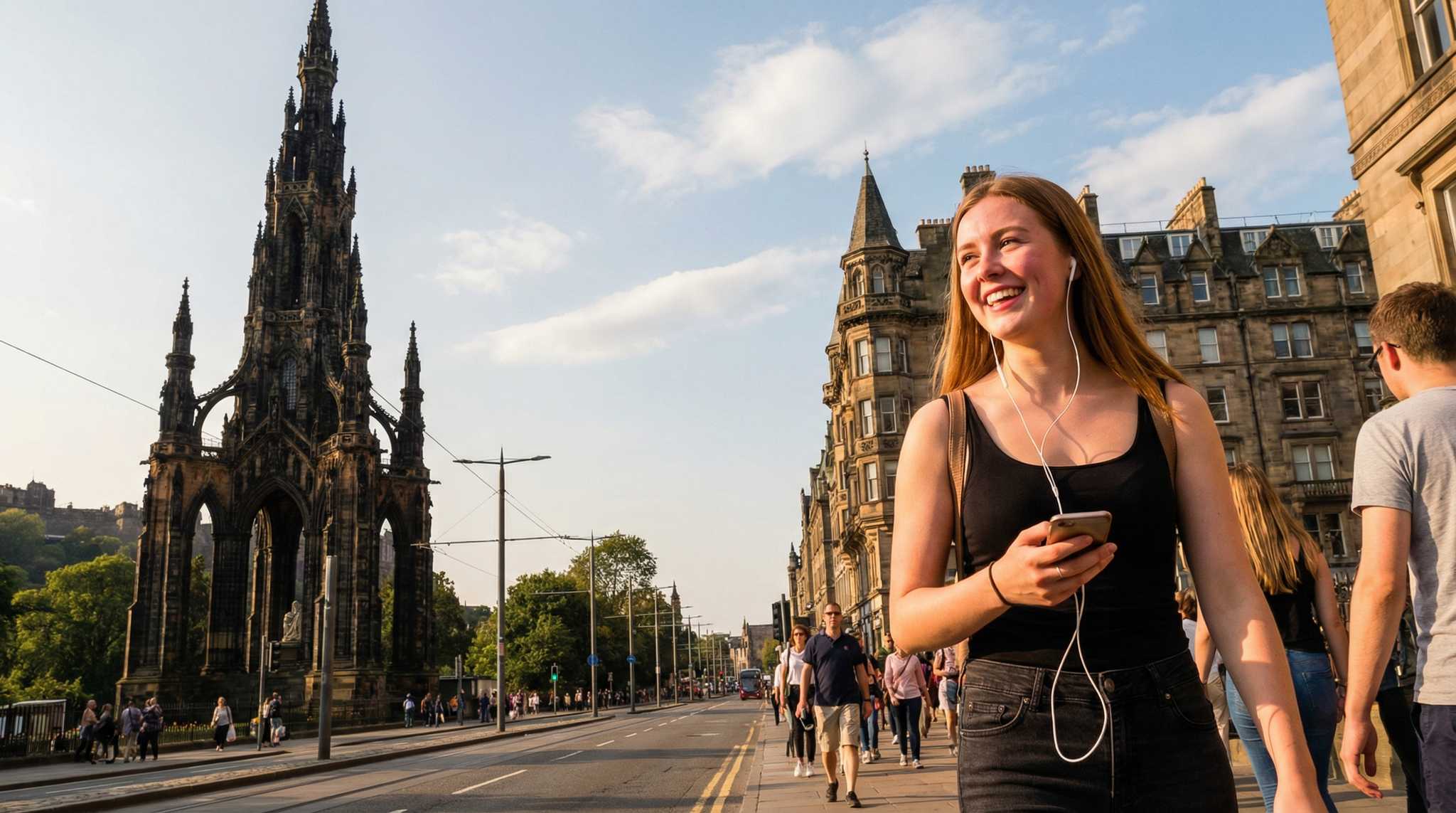
Rising above Princes Street Gardens, the Scott Monument looks like a dramatic, spiky, blackened Gothic rocket-if you look up and see a towering structure covered in pointed arches and statues, you’ve found it! Now, as you stand in its long shadow, imagine the sound of boots crunching on gravel and tools clinking in the dawn air. In the heart of Victorian Edinburgh, workers gathered to build something enormous, their cheeks stung by wind swirling through open gardens. The year is 1840 and there’s a buzz of anticipation-across the city, word has spread that the foundations are going down for a monument unlike any other. Sir Walter Scott, Scotland’s beloved storyteller, had only recently died and Edinburgh was determined to honour him as only the Scots could: with grandeur, literature, and the tallest Gothic tower the city would ever see. But the competition to design this monument took a curious turn. The chosen entry came from someone calling himself "John Morvo"-except, that was a riddle. The real man behind the pen was George Meikle Kemp, a joiner and self-taught architect who worried no one would trust a person of humble background with such a colossal job. Thankfully, his secret identity and bold design won the judges’ hearts, and soon Kemp was overseeing a mammoth tower, one that would eventually challenge the city’s skyline and eclipse all but Havana’s tribute to José Martí. With every block of tough Binny sandstone quarried from West Lothian, with every figure sculpted by Scotland’s greatest carvers, the Scott Monument grew. The risk was real-those masons prepping the ornate details and characters from Scott’s novels weren’t just battling exhaustion, but also deadly clouds of stone dust. Many never saw the finished monument, felled by silicosis, which the Victorians called phthisis. It’s said that twenty-three of Edinburgh’s finest hewers died, making these stones bear silent witness to a hard sacrifice. As the monument soared upward-over 200 feet!-it became the city’s focal point, perfectly lined up with South St. David Street. Edinburgh’s Old Town could hide no longer, peeking from behind its tall, smoky silhouette. The drama didn’t end there: just before the monument opened in 1846, tragedy struck. Kemp, the unlikely hero, fell into the Union Canal in a fog and never returned. Yet his work stood triumphant, completed by his own son, a bittersweet ending. Peer through the lacework arches today and your eyes will fall on Sir Walter Scott himself, calmly seated in white Carrara marble, with his loyal dog Maida at his feet. Around him cluster 64 sculpted figures from his novels, so don’t be shy-play a little game of “spot the character” while you’re here! Look up again and see heads of Scotland’s most famous poets and even royalty staring down at you, from Robert Burns to Mary, Queen of Scots. It’s a dark, brooding tower, but in the evenings, warm LED lights now wash over its sharply carved faces, picking out every fantastical figure, every weather-worn nook. In films and paintings this Gothic spire represents not just Scott’s genius, but Scotland’s wild spirit-restless, enduring, imaginative. And whether rain streaks the stone or the sun glints off its pinnacles, you’re standing at a place where fiction and history meet high above the Edinburgh streets, a monument as grand and improbable as the stories that inspired it. So, ready to imagine climbing those 287 stairs to the very top? Don’t worry-I won’t ask for a doctor’s note! You might just get the best view in the whole city. Wondering about the design and concept, the stone masons and the scott monument or the foundation stone? Feel free to discuss it further in the chat section below.
専用ページを開く →Look ahead for a long, low building in creamy sandstone, with tall columns and grand banners that say “National Gallery”-you’ll spot it right at the heart of The Mound, nestled…もっと読む折りたたむ
Look ahead for a long, low building in creamy sandstone, with tall columns and grand banners that say “National Gallery”-you’ll spot it right at the heart of The Mound, nestled between the greenery and Princes Street. Take a moment and breathe in the cool Edinburgh air-because you’re standing before a building that’s not just a gallery, but a time capsule full of stories, ambition, and the occasional building mix-up! This grand temple-like structure is the Scottish National Gallery, though officially, these days, it’s known simply as The National. It was born from the dreams of Victorian Edinburgh back in the 1850s, when folks in top hats and bonnets roamed these cobbled streets and longed for Scotland’s own treasure trove of art. Imagine wheels rumbling, porters shouting, and the crackle of a foundation stone being laid in 1850 by none other than Prince Albert-yes, Queen Victoria’s chap! The building’s architect, William Henry Playfair, took inspiration directly from ancient Greek temples-think Ionic columns, elegant porticoes, and a serious bit of classical flair. He famously had less money to spend than on his neighbor, the Royal Scottish Academy, so the design looks a bit more modest, but imagine it as a cake baked with half the ingredients but all the heart. By 1859, when the doors finally swung open, you can bet crowds were pressing their noses to the windows, eager to see the paintings gathered from all around Scotland and Europe. Inside these sandstone walls lies Scotland’s national collection of fine art: works from the blossoming of the Renaissance right up to the early 20th century. You’ve got Rubens, Rembrandts, Titians, Constables, luminous Turners, and even the famous “Monarch of the Glen”-a stag so majestic that I’m surprised he didn’t step off the canvas and stroll down Princes Street himself. There are Scottish jewels too: brooding landscapes by Alexander Nasmyth, striking portraits by Sir Henry Raeburn, and the cheeky “Skating Minister” gliding forever across the frozen loch. But here’s a twist worthy of a detective novel-the gallery’s history isn’t just about calm contemplation. In the 1800s, two rival camps fought over who should hold Scotland’s art: the Royal Institution and the rebellious artists of the Academy. Picture meetings as dramatic as a tempest on the Firth of Forth! Eventually, Playfair’s cunning design split the building down the middle-the eastern half for the showy Royal Scottish Academy exhibitions, the western half for the National Gallery’s own treasures. People still get muddled about which grand building is which-the RSA is just next door, and boy, they look like siblings who wear each other’s clothes. Of course, all great buildings evolve. The late 20th and early 21st centuries saw construction projects beneath your feet-literally! Below the gallery, there’s a hidden world: the Weston Link, a sleek underground corridor connecting to the RSA, packed with a lecture theatre, café, and shops. There’s even a new entrance from Princes Street Gardens, handy for anyone hoping to skip the rain-or just get to the scones faster. Behind the scenes, dusty tomes and over 30,000 delicate prints and drawings sleep in the collection, ready for scholars to unearth secrets, and the library downstairs is a dreamland for research, stretching from the 1300s to the Victorian age. So, as you stand under the mighty columns and gaze up at “The National,” remember: this is a place where history meets beauty, ambition meets artistry, and the odd squabble is settled by masterpieces hanging side by side. Not to mention, it’s the only place you’re likely to see a Highland stag, a Dutch still-life, and a Scottish rebel artist all in one afternoon. Just don’t ask the staff which building is which-chances are, they’re still arguing about it, even after all these years! For a more comprehensive understanding of the building, research or the collection, engage with me in the chat section below.
専用ページを開く →Here you are, standing beside the proud and storied Church of Scotland, affectionately known to locals as “the Kirk.” Take a look up-these stones have matched wits with kings,…もっと読む折りたたむ
Here you are, standing beside the proud and storied Church of Scotland, affectionately known to locals as “the Kirk.” Take a look up-these stones have matched wits with kings, queens, reformers and the odd rioting mob since before your great-great-granny’s time. The Kirk isn’t just a church; it’s a living, breathing slice of Scottish identity, complete with centuries of passionate debate, political arm-twisting, theological wrangles, and-believe it or not-the occasional flying stool. Let’s start right at the heart: the Kirk is Presbyterian, which means that just like a good ceilidh, no one is truly in charge. Unlike the Church of England where the monarch calls the shots, in the Church of Scotland, only the Lord God is considered the head. Everyone else is answerable to each other, with elders sitting together to make decisions-think of it as the ultimate committee meeting, minus the tea and biscuits. Legend takes us all the way back to Saint Ninian, out with his sandals around 400 AD, and Saint Columba, paddling over from Ireland two centuries later to spread Christianity on the misty isle of Iona. By 1192, with a nicely worded letter from the Pope (a papal bull, if you’re keeping track), Scotland had its own national church, independent of England’s Archbishop of York. But the real fireworks started in 1560, thanks to one John Knox-a man so fiery he could make your hair curl. Knox and his fellow reformers were inspired by the ideas of John Calvin during a stint in Geneva. Scotland’s break from Rome was sharp and, let’s face it, not always polite. Picture Parliament made up of lairds and burghers, boldly scrapping papal authority and dreaming up a new church run by the people, for the people. Of course, power hates a vacuum, and soon battles broke out over who could boss the church around: the monarch, the bishops, or those fiercely independent Presbyterians. At one point, King James VI declared, “No bishop, no king!” and guess who won that round? James did-for a while, at least. Bishops and archbishops strutted back into the church, and assemblies met only with royal approval. But the Scots have never been ones for quiet compliance. The drama boiled over in 1637 when Charles I, disliking the simplicity of Scottish worship, introduced a new Scottish Prayer Book-without asking anyone first. Cue mayhem! Edinburgh’s St Giles' Cathedral erupted. Famously, Jenny Geddes, unimpressed with the new prayers, hurled her stool (let’s call it an early form of Yelp review) at the preacher. Riots broke out across Scotland. This led to the signing of the National Covenant, abolishing bishops and setting the church firmly on a Presbyterian path-whether kings liked it or not. These were the days of the “Wars of the Three Kingdoms,” where religion, politics and rebellion made for extremely lively dinner conversation. The church went through more ups and downs: reigning monarchs tried to pull it back to episcopacy, but after 1690, Presbyterian governance was finally guaranteed by law. But don’t think that ended all the splits-Oh no! The centuries since have seen a wild collection of denominations springing up: the Free Church, the United Free, and the delightfully named “Wee Frees.” (And if you’re really curious, ask a local about the Free Presbyterians and the Associated Presbyterians and...well, you get the idea.) Even in modern times, the Kirk hasn’t shied from controversy. It’s wrestled with issues from slavery’s legacy to same-sex marriage, and it was a key player in Scotland’s drive for its own parliament-ironically, the new Scottish Parliament met in the Church’s Assembly Hall while their own building was being finished. Ministers here have braved changing times: in 1968, women could finally wear the clerical collar; in May 2022, ministers were allowed to conduct same-sex marriages. Through all that, the Kirk still proclaims, in the words of its motto: “Yet it was not consumed.” Today, membership has dwindled-fewer bums on pews, as they’d say-but the Kirk remains the national church in spirit. It welcomes all, sings glorious psalms, and insists faith is for everyone. Whether you come for worship or just the stories, the Kirk still holds a special place at the heart of Scotland...and perhaps, after today, in yours as well. If you're keen on discovering more about the theology and practice, social and political issues or the position in scottish society, head down to the chat section and engage with me.
専用ページを開く →
さらに7件のスポットを表示表示するスポットを減らすexpand_moreexpand_less
In front of you is a huge, striking Gothic building with tall, spiky towers made of dark stone; just look up and spot the fortress-like spires reaching for the Edinburgh…もっと読む折りたたむ
In front of you is a huge, striking Gothic building with tall, spiky towers made of dark stone; just look up and spot the fortress-like spires reaching for the Edinburgh sky. Now, as you stand outside New College, let’s imagine it’s a stormy Edinburgh evening back in the 1840s. The city’s debates about religion are as fierce as the weather. This building, towering over The Mound and looking out across Princes Street Gardens, was, believe it or not, born from one of Scotland’s greatest church splits-the Disruption of 1843. Imagine hundreds of clergy and their supporters storming out of St. Andrew’s Church, determined to build a new society, one free from state interference, answering only to a higher power. In the early days, New College opened its doors to 168 students. Those first students walked straight through these doors, probably shivering under their cloaks, wondering what on earth they’d signed up for under the watchful eye of Thomas Chalmers, their passionate first principal. But Chalmers had a grand vision. When it came to constructing a building worthy of this vision, there was even a design contest. The winning designs were tossed out and the runner-up, the famous architect William Henry Playfair, got the job instead-proving that even losing can sometimes land you a Gothic castle of your own! Between 1845 and 1850 workers hauled stone and scaffolding, raising these high towers. The resulting masterpiece became a home for contested ideas, fiery church debates, and generations of theological dreamers from around the globe. Originally serving the Free Church, New College later joined the University of Edinburgh, creating an academic alliance so potent you might joke that even the saints would envy their networking skills. And just think, before the 1929 church reunion, if you fancied being a minister, you either trained here at New College if you were “free”, or across the city if you belonged to the “old” Church of Scotland. But soon rival students would walk these hallways together-probably arguing over who got the comfiest library chair. Step inside today and you’ll find what is widely agreed to be the largest single-site theological library in the UK. It’s stuffed with treasures: rare manuscripts, scribbled sermons, and the musty scent of centuries-old knowledge. The east wing was once a sanctuary, and if the stained glass could whisper, you’d hear tales of dramatic readings and hushed scholarship. Down a corridor you’ll find Rainy Hall, a dining room fit for a medieval feast-gothic arches, decorated shield crests, and a hammerbeam roof, making every student sandwich just a little more epic. New College even contains the General Assembly Hall, the annual stage of the Church of Scotland’s biggest decisions. In modern times, it even pulled double duty as the first Scottish Parliament debating chamber at the dawn of the new millennium. With nearly 40 academic staff, students from more than 30 countries, and famous visitors (Martin Luther King Jr. once considered joining, before deciding Boston had fewer bagpipes), New College has seen more bright minds than a torch shop in a power cut. And as of its 175th birthday, it adopted the motto "Quaerite et Invenietis"-"Seek and You Shall Find". Generations have come here chasing big answers, sometimes finding more questions instead. Whether the future holds a pulpit, a classroom, or an archive room, every student and scholar who walks into New College has joined a story that’s equal parts drama, devotion, and a dash of divine comedy. So, look up to those towers and imagine all the debates, discoveries, and late-night study sessions echoing within. New College is proof that sometimes, seeking is just as thrilling as finding-especially in a building that looks like it might just take flight during the next Scottish gale! To delve deeper into the academics, facilities or the people, simply drop your query in the chat section and I'll provide more information.
専用ページを開く →Right in front of you, you’ll see an octagonal stone monument decorated with colorful crests and topped by a tall column crowned with a proud unicorn-just look for the tall pillar…もっと読む折りたたむ
Right in front of you, you’ll see an octagonal stone monument decorated with colorful crests and topped by a tall column crowned with a proud unicorn-just look for the tall pillar standing boldly in the open square near St Giles’ Cathedral. Welcome to the heart of historic Edinburgh-it's the Mercat Cross, where stories, secrets, and a fair bit of mischief have echoed for centuries! Picture yourself hundreds of years ago, standing in this very spot, the air thick with the smell of market stalls, horses, and city life, and the voices of townsfolk all around. Above you, that unicorn glints on top of the cross, keeping a dignified watch over all who gather here. The cross you see now dates from Victorian times, but the first Mercat Cross was here way back in the 1300s-a time when armor was in fashion and a bad haircut could truly be fatal! It’s called the ‘market cross’ because this was the buzzing center of trade. But the Mercat Cross was far more than just a fancy signpost for shoppers. Imagine town criers with their scrolls, trumpets blaring, as they shouted out royal proclamations, new kings, or the latest rules for the city. When a new monarch takes the throne, even today it’s proclaimed right here-no pressure for the poor herald who has to get the name right. Now, don’t be fooled by its peaceful look! This square has seen drama that would put soap operas to shame. Dark tales of executions, hangings, and even the burning of seditious books played out right where you’re standing. Back in the 1500s, after a Scottish defeat at the Battle of Flodden, a demon-yes, a demon named Plotcock-was said to have read out the names of doomed soldiers here at the cross. Richard Lawson, clever chap, threw a coin at the base as if to say “not me, mate!” and survived. The cross was the place for public embarrassment too. In the days of eggs and rotten fruit, you might be tied to the pillar and pelted for hours if you’d offended the wrong people-ask Sir James Tarbet, who spent an unfortunate afternoon covered in yolk for saying the wrong kind of mass. During the wild years of religious upheaval, things got even nastier. Here, you’d hear the clang of swords and the prayers of the condemned. Lady Warriston, after a plot gone murderously wrong, was granted a ‘nicer’ beheading instead of the usual burning or drowning-if that’s what you consider nice! The 1600s brought high drama: beheadings of noblemen and the hanging of war chiefs, with their hanged bodies displayed above the crowd. It was also here that the heads of traitors decorated spikes, a grim warning for all to see. Even moments of national joy or outrage took place here-after the death of Charles I, Scotland had the nerve (and the bagpipes!) to declare his son Charles II as king right here at the cross. But it wasn’t all doom and gloom. This was where townsfolk gathered for celebrations, feasts, or even to cheer on new laws-okay, maybe not all the laws. In 1745, cheering (and some very vocal ladies waving handkerchiefs) greeted Bonnie Prince Charlie’s proclamation proclaiming his father the King of Scotland-though a few gents were suspiciously absent from the windows. Though today, its crowds are more eager tourists than raging revolutionaries, the Mercat Cross remains the voice of Edinburgh’s history. Its stonework even hides bits of the old cross, medals once rescued by Sir Walter Scott, and layers of stories in every mark and weathered crest. Close your eyes a moment and listen-you just might hear a whisper of old proclamations, or the soft clinking of coins as a clever citizen tries to trick fate again.
専用ページを開く →Right in front of you stands St Giles' Cathedral, a grand and stony gothic church crowned by its unique crown-shaped spire-just look for the dramatic stonework and the tall…もっと読む折りたたむ
Right in front of you stands St Giles' Cathedral, a grand and stony gothic church crowned by its unique crown-shaped spire-just look for the dramatic stonework and the tall windows; there’s nothing else on the Royal Mile that looks quite as impressive or regal. Now, as you stand here at the heart of Edinburgh’s Old Town, let me transport you back nearly nine centuries-imagine the echoing clatter of horse hooves and townsfolk bustling through narrow medieval lanes, the smell of peat smoke in the air, and, of course, this mighty church already at the city’s centre. St Giles’ began as a humble Romanesque building back in the 12th century, probably founded by King David I, and dedicated to Saint Giles, the patron saint of lepers-talk about an unusual resume! Even his relic, an arm bone, was supposedly brought here from France (now that’s what you call a strong arm of faith). The church you see now started to take its current form in the 14th century, rising in grandeur as Edinburgh grew. By the late 1400s, St Giles’ was so important it became a collegiate church, bustling with priests, choristers, and beedles rushing about. During those times, locals held great processions for St Giles’ Day. Picture crowds swirling around, the very bones of Saint Giles held high in honor-until, well, some of those bones mysteriously disappeared, possibly borrowed a bit too long by grateful worshipers. But this old kirk really buzzed with drama during the Scottish Reformation. In 1559, John Knox-Scotland’s own firebrand preacher-stormed in and led passionate sermons right here, filling the air with the fiery sound of his voice. Out went the Catholic altars, in came Protestant simplicity, and St Giles’ became a hotbed for radical ideas. The church was even partitioned off into different sections-part congregation, part parliament, occasional prison, and, in case you get too rowdy, a room for sinners to cool down! In the 1600s, the church was rocked by more royal drama when King Charles I tried to push an English-style prayer book. That didn’t go down well with the locals. Legend has it, Jenny Geddes, a market trader, hurled her stool at the minister-giving “throwing a wobbly in church” a whole new meaning-and sparking a full-blown riot. That was the spark for the Covenanters’ Rebellion, helping shape Scotland’s religious future-so you could argue Scotland’s love of a good protest started right here! Despite being battered by time, wars, and even a few fires-with burn marks reportedly still visible centuries later-St Giles’ was always rebuilt and reinvented. During the Victorian era, ambitious city leaders tried to make it into a sort of Scottish Westminster Abbey, adding memorials to notable Scots and filling the church with color and stained glass once again. If you’re a royal fan, you’ll appreciate knowing St Giles’ has hosted kings, queens, and national events for centuries, from George IV visiting in a kilt (not a sight you’d easily forget) to the Honours of Scotland being presented to King Charles III right here. And don’t forget: below your feet lies what was once the city’s principal kirkyard, where citizens from every walk of life rested for over 450 years... Not to worry, though, most of the human remains were respectfully relocated next door to Greyfriars. So enjoy a moment to imagine all the secrets these ancient stones could tell-the sermons, the squabbles, the celebrations, and the revolts. St Giles’ is still an active parish, still at the heart of Edinburgh’s story, and these days, with well over a million visitors a year, it’s probably seen more selfies than saints. But hey, history is all about keeping up with the times, right? To delve deeper into the name and dedication, location or the architecture, simply drop your query in the chat section and I'll provide more information.
専用ページを開く →Take a moment to feast your eyes on the Thistle Chapel, tucked alongside the majestic St Giles’ Cathedral. At first glance, the exterior might whisper quietly of grandeur-those…もっと読む折りたたむ
Take a moment to feast your eyes on the Thistle Chapel, tucked alongside the majestic St Giles’ Cathedral. At first glance, the exterior might whisper quietly of grandeur-those soaring buttresses and gabled features blending in perfectly with the cathedral next door. But inside, it’s like walking straight into a jeweler’s box-tiny, intricate, and absolutely jaw-dropping. Now, imagine it’s the early 20th century. The Order of the Thistle-Scotland’s greatest order of chivalry-has been searching for a new home for over two centuries. The original plan was for the knights to meet at Holyrood Abbey, refitted by decree of James VII in 1687. Sadly, James lost the throne before the Order even held one meet-up, and an angry mob did what mobs do best: they trashed the newly decorated chapel before the knights had so much as a group photo. For over 200 years, people floated all sorts of ideas about where the Order might base itself: the ruined St Rule’s Church in St Andrews, the south transept of St Giles’, a dramatic restoration of Holyrood Abbey-none of which quite worked out. By the early 1900s, the Order was still homeless, but a generous gift from the sons of the 11th Earl of Leven spurred a new plan. They offered a whopping £24,000-a downright fortune in those days-to create a permanent home right here in St Giles’. After so much back-and-forth, one suspects even the knights may have sighed in relief. Enter the architect Robert Lorimer, armed with a pencil, a passion for the Gothic, and a keen sense of Scottish pride. Lorimer set about gathering the best craftspeople Scotland could offer-no ordinary job lot, either. We’re talking stained glass artists like Douglas Strachan, brilliant stone carvers, and the brothers William and Alexander Clow, whose oak woodwork looks like it’s straight from a medieval legend. Phoebe Anna Traquair added shimmer and color with jewel-like enamel stall plates, while even the metalwork had a touch of magic, thanks to the smiths of Edinburgh and a bronze touch from a famed English guild. It took just over a year to build, a blink of an eye compared to the centuries of waiting-and, as a thank-you for his work, Lorimer was knighted by King George V himself. I suppose that makes him a Sir Stitch-in-Time! As you peer at the chapel, you’ll notice its height-it might be snug, at only 18 feet wide and 36 feet long, but it soars 42 feet tall, as if Lorimer wanted to remind everyone that grandeur isn’t just about size-sometimes, it’s all about reaching for the sky. And what a sight once you step inside: pointed windows glimmer with heraldic stained glass, and the ceiling is a riot of stonework, sprouting angels and flowers, entwined with Scottish thistles and the emblems of the Order. There are 98 bosses in the ceiling alone-some weighing more than a small car, and each one meticulously crafted. Up above, musical angels strike up a silent chord; perhaps they’re practicing for the yearly Knightly singalong. The Knights themselves meet here at least once a year-cloaks swishing, crests gleaming, gathered in stalls that are works of art in their own right. Each stall topped lavishly with coronet and crest, if you look closely, you’d see every knight’s story etched into wood and stone, their heraldry frozen in a parade of color and history. And after one knight leaves this earthly realm, their plate stays, while the newcomer’s is added-a layered family tree for Scotland’s noblest. But the Thistle Chapel isn’t just a pretty face; it was built at a time when Scottish architects craved to revive a distinctly Scottish style, a bold mix of national pride and Gothic flair. When it opened in 1911, the threat of suffragette protest meant police had to hide in the boiler room below. Who knew knighthood ceremonies required a secret agent or two? So have a good look around, let your imagination play-think of the centuries’ worth of grand ideas, of lost chapels and wild Scottish weather, all ending up in a pocket-sized masterpiece. Whoever said good things come to those who wait must’ve had the Thistle Chapel in mind... or maybe they were just waiting to be knighted themselves! Intrigued by the architecture, stonework or the woodwork? Explore further by joining me in the chat section below.
専用ページを開く →Right in front of you, you’ll spot a huge, stone fortress of knowledge with clean rectangular lines, a sand-coloured exterior, and Scottish flags flying from the roof - that’s the…もっと読む折りたたむ
Right in front of you, you’ll spot a huge, stone fortress of knowledge with clean rectangular lines, a sand-coloured exterior, and Scottish flags flying from the roof - that’s the National Library of Scotland, standing proudly on George IV Bridge, impossible to miss! Now, let me sweep you into the story of this magnificent building, where the endless pursuit of knowledge feels almost like a Scottish adventure. Imagine walking past these heavy stone walls in the late 1950s, the air vibrating with anticipation as Edinburgh’s greatest library finally swung its doors open. Today, visitors enter not just to gaze at books, but to stroll through exhibitions, peek at rare manuscripts, or maybe just to sit with a coffee and ponder the mysteries tucked inside. But the journey to create this book-loving behemoth stretches back much further. Before the National Library of Scotland was officially born, Edinburgh boasted the Advocates Library. This was the treasure trove of the mighty Faculty of Advocates-imagine men in wigs with serious faces, building a collection so grand that, by a twist of law, every book published in Britain would find a copy here. By the 1920s, though, they had a problem as classic as a forgotten late fee: too many books and not enough space! Enter Sir Alexander Grant, the secret superhero of the cake world-he ran McVitie & Price, the company behind the digestive biscuit. Not only did he have a taste for snacks, but he had a big heart for books. His whopping donations helped create this beautiful building you see today. If these walls could smell, they’d remember the scent of fresh paper mingling with stone dust when work began in 1938. But everything ground to an anxious halt during the Second World War. Only after all that turmoil was the job finished-just in time for new generations of Scots to fall in love with reading. This building is more than a pretty face on the bridge. It is the legal deposit library for Scotland, meaning it’s required by law to receive a copy of every book published in the United Kingdom. Think about it: over 24 million items! If you tried to read just one a day, you’d be at it for over 65,000 years. There are rows upon rows of books, illuminated manuscripts, scribbled notes from the geniuses of old, telegrams, photographs, and even silent, flickering films in the Moving Image Archive-Scotland’s own blockbuster collection of over 46,000 videos and movies. Wander up to the reading rooms and you’ll find researchers, students, and the crow-like curious, all pecking away at history’s secrets. The General Reading Room buzzes with the soft turning of pages; deeper still is the Special Collections Room, with unique treasures: Shakespeare’s First Folio, Charles Darwin’s own letter about On the Origin of Species, the last desperate words of Mary Queen of Scots written before her execution-enough drama to keep Netflix running for years. But not everything is high drama and high-brow. The library battled a burst water main in 2009-imagine firefighters, books, and frantic librarians all ducking out from streams of water on the twelfth floor! And there’s innovation, too: in the past decade, the Library became the first institution in Scotland to hire a Wikipedian in Residence (now you know who to thank if you’ve ever enjoyed a late-night down-the-rabbit-hole session on Wikipedia). The library is also a proud guardian of Scottish Gaelic materials, holding the largest collection of this kind in the world. It safeguards maps of lost worlds, letters from mountain climbers, and even the cardboard giant-sized set for a Scottish stage play, ‘The Cheviot, the Stag, and the Black, Black Oil’-the largest book in the entire library! So, next time you grumble about organizing your own bookshelf at home, spare a thought for those who keep these 24 million stories in order. Now, if you’re ready, let’s wander off to your next stop-but don’t worry, there won’t be a reading test! Ready to delve deeper into the buildings, national library of scotland employees or the archives and collections? Join me in the chat section for an enriching discussion.
専用ページを開く →To spot the Cowgate, look down the narrow, winding street right ahead-in front of you is a bustle of cars bordered by tall, rough-hewn stone buildings, with reddish and grey…もっと読む折りたたむ
To spot the Cowgate, look down the narrow, winding street right ahead-in front of you is a bustle of cars bordered by tall, rough-hewn stone buildings, with reddish and grey Victorian brickwork rising to your left and right, all snug beneath the higher bridges and looming urban stonework above. Welcome to the Cowgate! Right now, you’re standing at street level, but here in Edinburgh’s Old Town, that’s sometimes practically underground. The Cowgate cuts through the city’s stone core about 500 meters from the castle, running beneath the grand arches of South Bridge and George IV Bridge. It’s like standing in a secret canyon, a street that’s been here since the days people wore chainmail and herded cows-yes, real cows-right through where you’re walking! The word “gate” in Scots means “way,” so, this is literally Cow Way. If you’re feeling a sudden urge to moo, that’s just the atmosphere getting to you. Back in the 1300s, the Cowgate was Edinburgh’s first city expansion, stretching out to meet the growing needs and muddy feet of the townsfolk. Imagine the sound of hooves and clattering carts over cobblestones, the shouts of herders driving cattle to market, and a constant dance of people weaving between puddles caused by a stream that once ran on the north side. That burn (the Scottish word for a stream) got filled in around 1490 after people got fed up with all the muddy splashes-and probably the cow-related mishaps. But the Cowgate wasn’t always just for livestock. By the late 1500s, wealthy families and city councillors made homes here, their fine houses lining the street-if you tilt your head and squint, you might sense the old grandeur behind the crumbling facades. Mary, Queen of Scots, Edinburgh’s ultimate VIP drama queen, even stayed here in 1566-hosting the royal court with bread, wine, beer, and enough pewter plates to throw a feast fit for a palace. It’s rumored she snuck through the neighbouring houses, orchestrating secret meetings with the mysterious Earl of Bothwell. Cowgate was the backdrop for many a royal plot, perhaps a little like a medieval soap opera, just with more swords and a lot less WiFi. As centuries rolled on, the Cowgate’s fortunes rose and fell. By the nineteenth century, it was packed with people, mostly Irish immigrants, and gained the nickname “Little Ireland.” Picture crammed tenements, bustling pubs, and the bittersweet clash of music, laughter, and tough struggles. In fact, the famous revolutionary James Connolly was born right here at number 107, and you can spot a tribute to him under the George IV Bridge-a gold plaque that’s well worth a glance on your way. Overhead, you might catch the rich tones of a piano from St Cecilia’s Hall, an elegant concert hall since the 1700s, now filled with rare instruments. Not far off, the Magdalen Chapel, squeezed between buildings, is the oldest structure here, an almshouse chapel from the 1500s-built for care, solace, and perhaps the odd whispered scandal. But the Cowgate isn’t just frozen in the past. It got a rattling shake-up in 2002 when a fierce fire broke out above a nightclub. The ancient stone streets became a “rabbit warren” of confusion for firefighters. Clubs, university buildings, and even relics of early artificial intelligence research were lost to the flames. But resilience runs deep here: within years, the Cowgate rose from ash with new shops, hotels, and hangouts, stitching old stones with fresh energy and stories. And even now, the Cowgate keeps making news-sometimes rowdy, sometimes tragic, always dramatic. Students protest luxury hotels, musicians play secret gigs, and you never quite know what story will unfold next on this ever-changing street. So next time you pass, listen for echoes-a cow’s bellow, distant music, royal gossip, the laughter of children in “Little Ireland,” or even a whispered secret from Queen Mary herself. In the Cowgate, every stone has a story, and you’re standing right in the thick of it!
専用ページを開く →To spot Greyfriars Kirk, look for a tall, rectangular stone church just ahead of you, its pale walls topped with four small spires and large, pointed arched windows, surrounded by…もっと読む折りたたむ
To spot Greyfriars Kirk, look for a tall, rectangular stone church just ahead of you, its pale walls topped with four small spires and large, pointed arched windows, surrounded by gravestones and the open green of Greyfriars Kirkyard. Now, let me set the scene. Imagine this ground hundreds of years ago, with monks in grey robes shuffling along narrow muddy paths, before the world’s hustle and bustle had fully claimed Edinburgh. Greyfriars Kirk took its name from these very monks-the “Grey Friars”-devoted Franciscans who showed up from the Netherlands way back in the mid-1400s. Their friary once stood right here, and they were well-connected, even inviting royalty and sheltering an exiled English king! At the time, it was all cows, fields, and, perhaps, the odd ill-tempered goose. But times change, especially when the Scottish Reformation swept everything up like a wild Edinburgh wind. Suddenly, monks were out, and so was their friary-bricks repurposed, statues snatched for processions, and the old land turned into a graveyard. By the late 1500s, Edinburgh’s population was bursting out of its seams. The city council, apparently tired of crowded pews and elbows in ribs, decided the growing congregation needed a bigger home, so work on Greyfriars Kirk began in earnest in 1602. They hammered and hauled, sometimes pausing for years-if only they’d had modern planning permission, eh? By 1620, the church opened its doors-and what doors! Built from stone filched from the old Convent of Catherine of Siena, its buttresses bristled with little ball-topped spikes, and its walls soared up above the grassy kirkyard. It was a daring architectural blend-Gothic but with a pinch of Baroque, more “survival style” than modern fashion, but absolutely grand for its day. Stepping forward just a bit, picture a cold day in 1638. Inside these very walls, tempers were running high. The National Covenant, a defiant declaration that would shape Scotland’s destiny, was signed here-right in this kirk. Imagine muffled gasps, the shuffling of feet, and the fevered scratch of quills as nobles pledged their allegiance. The echoes of that moment still hang in the air. Of course, Greyfriars Kirk has seen more than its share of drama. In the mid-1600s, Oliver Cromwell’s troops barged in-nothing like a bunch of unwanted houseguests! They set up barracks, broke things, probably left muddy boots everywhere, and the church barely survived. Yet it did, only to lose its tower in a 1718 gunpowder explosion that rocked the whole neighbourhood in the middle of the night. They fixed that too, patching up the church, dividing it so two congregations could meet under one roof-Old Greyfriars in the east and New Greyfriars in the west. It was the world’s least competitive split; no one fought over the thermostat. By the 1800s, disaster struck again-a fire, fierce and hot, tore through the kirk. Some blamed it on divine displeasure, others pointed fingers at the new-fangled innovations, but one thing is for sure: the restoration brought with it stained glass and the first church organ in a Scottish parish since the Reformation! The minister, Robert Lee, shook things up with new worship practices. If you think church pews are strict today, imagine being told to stand, kneel, or say brand-new prayers. Lee’s “Greyfriars Revolution” sparked a quiet transformation through all of Scotland. And as you gaze up at the austere nave and peer into windows that glow with centuries-old glass, remember that Greyfriars Kirk is still alive. With Gaelic services, community projects, and a tradition of welcoming all, it’s no mere relic, but a living heart of Edinburgh-a place where history isn’t just in the past, but humming softly beneath your feet. You’ve just walked through one of Scotland’s most dramatic centuries, all in just a few steps. Now, who’s up for a tale of Greyfriars Bobby while we’re here? If you're keen on discovering more about the setting and kirkyard, architecture or the features, head down to the chat section and engage with me.
専用ページを開く →
よくある質問
ツアーはどうやって始めますか?
購入後、AudaToursアプリをダウンロードして引き換えコードを入力してください。ツアーはすぐに開始できます。再生ボタンをタップして、GPSガイド付きルートに従うだけです。
ツアー中にインターネットは必要ですか?
いいえ!開始前にツアーをダウンロードしておけば、完全にオフラインで楽しめます。チャット機能のみインターネットが必要です。モバイルデータを節約するため、WiFi環境でのダウンロードをお勧めします。
これは団体ツアーですか?
いいえ、これはセルフガイド式のオーディオツアーです。ガイドや団体、決まったスケジュールに縛られることなく、スマホから流れるナレーションを聴きながら自分のペースで自由に探索できます。
ツアーの所要時間は?
ほとんどのツアーは60〜90分で完了しますが、ペースは完全に自由です。好きな時に一時停止したり、スポットを飛ばしたり、休憩を取ったりできます。
今日中にツアーを終えられない場合は?
問題ありません!ツアーには無期限でアクセスできます。明日、来週、あるいは来年でも、好きな時に再開できます。進行状況は保存されます。
どの言語が利用可能ですか?
すべてのツアーが50以上の言語に対応しています。コードを引き換える際にお好みの言語を選択してください。注意:ツアー生成後に言語を変更することはできません。
購入後、どこからツアーにアクセスできますか?
App StoreまたはGoogle Playから無料のAudaToursアプリをダウンロードしてください。メールで届いた引き換えコードを入力すると、ライブラリにツアーが表示され、ダウンロードして開始できるようになります。
もしツアーを楽しめなかった場合は、返金いたします。お問い合わせ先: [email protected]
以下の決済で安全にチェックアウト 


