
ケンブリッジ・オーディオツアー:時代を超えた発明と鳴り響く伝説
ケンブリッジの中心部では、伝説が石の回廊や木造のアーチを巡っています。象徴的なランドマークの裏には秘密が隠されています。それは学者によって囁かれたり、木製の橋の静かな曲線に隠されたり、きらめくガラスの窓に描かれたりしています。このセルフガイド・オーディオツアーは、ご自身のペースで散策し、ほとんどの訪問者が聞くことのない物語を解き明かすよう誘います。 なぜ敵対する王たちはキングス・カレッジ礼拝堂を巡って数十年にわたる戦いを繰り広げ、街を不安定な状態に陥れたのでしょうか?数学橋にはどのような奇妙な秘密が織り込まれているのでしょうか。本当に一本のボルトも使わずに作られたのでしょうか?反乱の時代に、聖なる場所に禁断の印を刻んだのは誰だったのでしょうか? 渦巻く川やそびえ立つ丸天井を散策すると、スキャンダル、科学的輝き、そして幽霊の伝説があらゆる場所であなたを待ち受けています。各停留所はあなたを何世紀にもわたる謎と驚異の奥深くへと引き込み、ケンブリッジの見方を永遠に変えるでしょう。 さあ、一歩踏み出して表面の下に隠された真実を発見し、ケンブリッジがその隠された心臓部を明かすのを見届けましょう。
ツアーのプレビュー
このツアーについて
- schedule所要時間 30–50 mins自分のペースで進める
- straightenウォーキングルート 0.8kmガイド付きパスに沿って進む
- location_on
- wifi_offオフライン対応一度のダウンロードでどこでも使える
- all_inclusive無期限アクセスいつでも、ずっと再生可能
- location_on数学橋から開始
このツアーのスポット
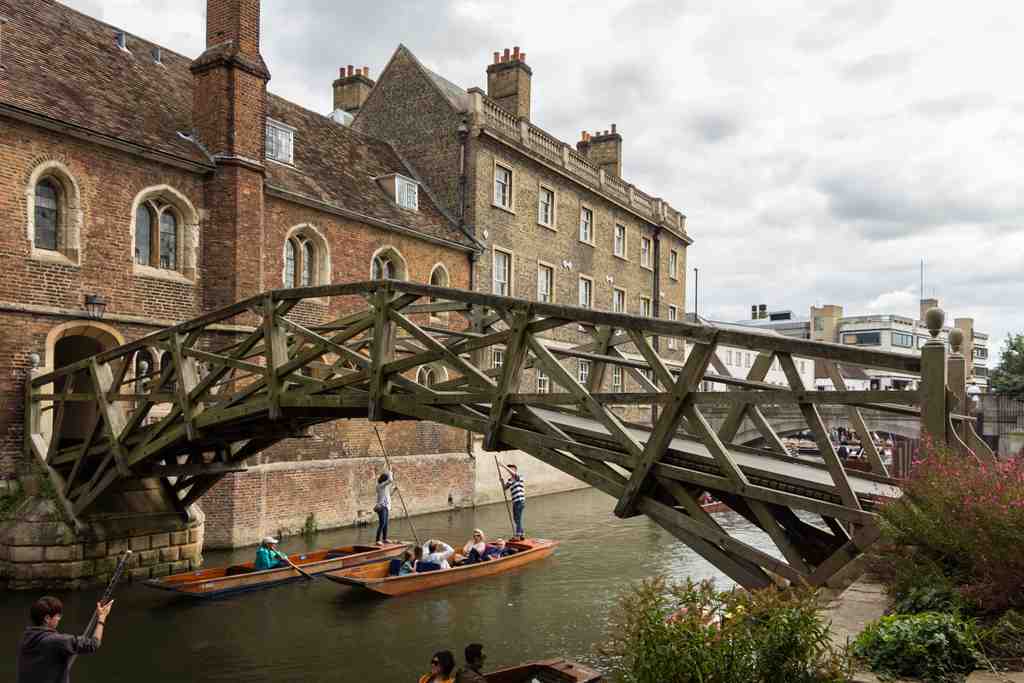
On your left, stretching over the River Cam between the old brick buildings, you’ll spot a striking wooden bridge, its straight timbers zig-zagging together into a gentle…もっと読む折りたたむ
On your left, stretching over the River Cam between the old brick buildings, you’ll spot a striking wooden bridge, its straight timbers zig-zagging together into a gentle arch. Welcome to the Mathematical Bridge, one of Cambridge’s most mysterious and iconic sights! Picture yourself standing here in 1749-horses clip-clopping in the distance, the air full of the scent of fresh timber and river water, and the quiet buzz of students chattering as craftsmen work with saws and hammers. Built by James Essex from a cutting-edge design by William Etheridge, this bridge was no ordinary feat. To everyone’s surprise, the bridge looks curved, but not a single curved piece was used! Every one of those wooden beams is perfectly straight. It’s like a magician’s trick, and the secret is hidden in its clever geometric arrangement-tangents and spokes locked tightly together, creating an elegant arch strong enough to carry eager students racing across between classes. As you stand here, you might hear the gentle splash of a punt pole dipping in the Cam below. But listen closely-the bridge has its own stories to whisper! One of the wildest myths is that the great Isaac Newton himself built the bridge, using nothing but sheer genius-no nuts, no bolts, and definitely no glue. The tale goes that students once tried to take it apart, convinced it was all magic, but of course, when they tried to put it back together again, it promptly collapsed into a pile of awkward timber! The truth is a bit less dramatic, but just as clever. Bolts were hidden away in the joints with iron spikes, so from the inside they were nearly invisible. That’s more a sign of engineering flair than wizardry. Imagine the tension as those students realized-maybe, just maybe, their professors did know a thing or two after all! And no, Newton couldn’t have been responsible-he’d already left this world a good two decades before the bridge appeared. But the myth sticks around, perhaps because everyone wants a slice of Cambridge magic. Today, this bridge still connects two sides of Queens' College and stands as a reminder that sometimes the simplest-seeming things are the most ingeniously designed. So next time someone asks you if the Mathematical Bridge is held together by mysterious forces, you can smile and say, “Only if you count bolts as magical!”
専用ページを開く →On your left, stretching over the River Cam between the old brick buildings, you’ll spot a striking wooden bridge, its straight timbers zig-zagging together into a gentle…もっと読む折りたたむ
On your left, stretching over the River Cam between the old brick buildings, you’ll spot a striking wooden bridge, its straight timbers zig-zagging together into a gentle arch. Welcome to the Mathematical Bridge, one of Cambridge’s most mysterious and iconic sights! Picture yourself standing here in 1749-horses clip-clopping in the distance, the air full of the scent of fresh timber and river water, and the quiet buzz of students chattering as craftsmen work with saws and hammers. Built by James Essex from a cutting-edge design by William Etheridge, this bridge was no ordinary feat. To everyone’s surprise, the bridge looks curved, but not a single curved piece was used! Every one of those wooden beams is perfectly straight. It’s like a magician’s trick, and the secret is hidden in its clever geometric arrangement-tangents and spokes locked tightly together, creating an elegant arch strong enough to carry eager students racing across between classes. As you stand here, you might hear the gentle splash of a punt pole dipping in the Cam below. But listen closely-the bridge has its own stories to whisper! One of the wildest myths is that the great Isaac Newton himself built the bridge, using nothing but sheer genius-no nuts, no bolts, and definitely no glue. The tale goes that students once tried to take it apart, convinced it was all magic, but of course, when they tried to put it back together again, it promptly collapsed into a pile of awkward timber! The truth is a bit less dramatic, but just as clever. Bolts were hidden away in the joints with iron spikes, so from the inside they were nearly invisible. That’s more a sign of engineering flair than wizardry. Imagine the tension as those students realized-maybe, just maybe, their professors did know a thing or two after all! And no, Newton couldn’t have been responsible-he’d already left this world a good two decades before the bridge appeared. But the myth sticks around, perhaps because everyone wants a slice of Cambridge magic. Today, this bridge still connects two sides of Queens' College and stands as a reminder that sometimes the simplest-seeming things are the most ingeniously designed. So next time someone asks you if the Mathematical Bridge is held together by mysterious forces, you can smile and say, “Only if you count bolts as magical!”
専用ページを開く →To spot King’s College Chapel, look to your left for an enormous stone building with towers topped by intricate pinnacles and a huge, arched window filled with delicate…もっと読む折りたたむ
To spot King’s College Chapel, look to your left for an enormous stone building with towers topped by intricate pinnacles and a huge, arched window filled with delicate glasswork. Now that you’re standing before King’s College Chapel, take a moment and let your mind travel back through the centuries-it’s hard not to feel something special here. Imagine it: the year is 1446, and instead of undergraduates hurrying to lectures, the green lawns are bustling with builders in woolen tunics, the air humming with the sharp tap of chisels and the grumble of carts hauling stone. The first stone for this chapel was laid by King Henry VI himself, who was dreaming big-he wanted a chapel that would outshine anything else in Cambridge, something that would make people stop, look up, and say “Wow, that’s a chapel fit for a king!” But as anyone who’s ever tackled a home renovation knows, things didn’t go entirely to plan. Not just bad weather or someone forgetting to order bricks-no, this was much bigger. The whole country was thrown into the madness of the Wars of the Roses! Construction would stall for years at a time, and the half-finished chapel stood here like a stony skeleton, year after year, through three different kings’ reigns. It took almost seventy years to finally finish the building, with bits started under Henry VI, more work done when Richard III stopped fighting long enough to lend a hand, and some heroic teamwork by Henry VII, who left behind money in his will just to make sure those masons got paid. If you ever need inspiration for perseverance, look no further than these walls. But oh, what patience produced! Just step inside-or at least peer through those massive windows-because above your head soars the world’s largest fan vault. It’s like looking up into a stone forest, each rib fanning out in perfect symmetry. The original architect, Reginald Ely, probably wouldn’t have believed it-he’d envisioned a simpler vault, but those daring masons under John Wastell went wild and created a ceiling that still amazes people 500 years later. And speaking of amazed, look at those windows! There are twelve along each side and massive showstoppers at each end, filled with stained glass crafted by legendary Flemish glaziers between 1515 and 1531-a rainbow of saints, kings, and Bible scenes lighting up the floor whenever the sun shines. But this chapel has seen more than peace and prayers. During the English Civil War, many churches were smashed up by Puritan soldiers who thought stained glass and statues were a bit too fancy. King’s Chapel was luckier-some say Oliver Cromwell himself, a former student here, ordered its protection. If you look close to the altar, you can still find graffiti scratched into the stone by bored Parliamentarian troops using the chapel as their training ground. And when World War II rolled around, those precious medieval windows were gently taken out and hidden away for safekeeping. And then there’s the painting: towering above the altar is a gigantic work by Rubens, The Adoration of the Magi, added in 1968. Moving it here turned into a proper Cambridge drama-at first, it looked like someone had stuck a postage stamp under a cathedral window! After much huffing and puffing, an architect came up with the idea to add plain shutters to give it the right shape, and now it fits in, as if it belonged all along. Listen closely-all that history is still alive, not just in stone and glass, but in sound. Today, the choir of King’s College still sings under those vaults, their voices soaring up and echoing through the arches, filling the chapel with music during special services and concerts. And every Christmas Eve, the world tunes in to hear a solo voice sing "Once in Royal David’s City" as part of the Nine Lessons and Carols-a tradition broadcast by the BBC to millions. So as you stand here, look up and imagine all those kings, architects, masons, and choirmasters gazing with pride-or possibly a little exhaustion-at what they created. Whether you come for the beauty, the music, or just to snap a great photo, King’s College Chapel stands as a symbol of Cambridge: enduring, uplifting, and full of stories. Now, who’s up for starting a building project that’ll outlast a few civil wars? No takers? Interested in a deeper dive into the construction, great windows or the rood screen? Join me in the chat section for an insightful conversation.
専用ページを開く →
よくある質問
ツアーはどうやって始めますか?
購入後、AudaToursアプリをダウンロードして引き換えコードを入力してください。ツアーはすぐに開始できます。再生ボタンをタップして、GPSガイド付きルートに従うだけです。
ツアー中にインターネットは必要ですか?
いいえ!開始前にツアーをダウンロードしておけば、完全にオフラインで楽しめます。チャット機能のみインターネットが必要です。モバイルデータを節約するため、WiFi環境でのダウンロードをお勧めします。
これは団体ツアーですか?
いいえ、これはセルフガイド式のオーディオツアーです。ガイドや団体、決まったスケジュールに縛られることなく、スマホから流れるナレーションを聴きながら自分のペースで自由に探索できます。
ツアーの所要時間は?
ほとんどのツアーは60〜90分で完了しますが、ペースは完全に自由です。好きな時に一時停止したり、スポットを飛ばしたり、休憩を取ったりできます。
今日中にツアーを終えられない場合は?
問題ありません!ツアーには無期限でアクセスできます。明日、来週、あるいは来年でも、好きな時に再開できます。進行状況は保存されます。
どの言語が利用可能ですか?
すべてのツアーが50以上の言語に対応しています。コードを引き換える際にお好みの言語を選択してください。注意:ツアー生成後に言語を変更することはできません。
購入後、どこからツアーにアクセスできますか?
App StoreまたはGoogle Playから無料のAudaToursアプリをダウンロードしてください。メールで届いた引き換えコードを入力すると、ライブラリにツアーが表示され、ダウンロードして開始できるようになります。
もしツアーを楽しめなかった場合は、返金いたします。お問い合わせ先: [email protected]
以下の決済で安全にチェックアウト 


