
コルドバ オーディオツアー:グアダルキビル川沿いの橋、塔、伝説
かつてコルドバのモスク・カテドラルでは、千ものオイルランプが灯り、想像を絶する勝利と裏切りを目撃したアーチにその光が揺らめいていました。 このセルフガイドオーディオツアーは、主要な道から離れて、街の太陽に焼かれた石の下に隠された角や語られざる物語を発見する旅へとあなたを誘います。自分のペースで散策し、ほとんどの訪問者が見たり聞いたりすることのないものを見つけてください。 アルカサル・デ・ロス・レジェス・クリスティアノスの壁の中で、なぜ権力はこれほど激しく移り変わったのでしょうか?サン・ラファエル勝利の塔の頂上にある常に監視する像は、どんな秘密を守っているのでしょうか?遠い昔のある夜、禁断のメッセージはどのようにしてこの混雑した通りを通り抜けたのでしょうか? 中庭の影からそびえ立つ塔へと移動しながら、カリフ、征服者、詩人、反逆者たちの足跡をたどってください。すべての物語でコルドバの鼓動を感じ、それぞれのランドマークが目の前で変貌するのを見てください。 今すぐ始めて、他の人が見過ごすコルドバの魅力を発見しましょう。
ツアーのプレビュー
このツアーについて
- schedule所要時間 40–60 mins自分のペースで進める
- straightenウォーキングルート 2.9kmガイド付きパスに沿って進む
- location_on
- wifi_offオフライン対応一度のダウンロードでどこでも使える
- all_inclusive無期限アクセスいつでも、ずっと再生可能
- location_onミラフローレス橋(コルドバ)から開始
このツアーのスポット
To spot the Triumph of San Rafael, look just to the side of the Roman bridge where you'll see a tall stone angel with a shimmering halo, standing on a pedestal above a cluster of…もっと読む折りたたむ
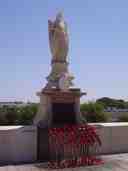
To spot the Triumph of San Rafael, look just to the side of the Roman bridge where you'll see a tall stone angel with a shimmering halo, standing on a pedestal above a cluster of red candles. Right in front of you is one of Córdoba’s oldest secrets-San Rafael himself, watching over the city from the Roman bridge with a stern look and a stone scroll, as if he’s deciding whether to bless you for crossing. Imagine the year is 1651: the bridge is bustling with travelers, merchants, and soldiers, and Bernabé Gómez del Río, the sculptor, is working away, stone dust flying in the breeze. The people of the Campo de la Verdad neighborhood absolutely adore this angel-he's not just a statue, he’s their eternal guardian. Even today, locals keep the devotion alive by lighting candles, their flames flickering like tiny stars by his feet. They say if you pause and listen, you might just hear the soft whispers of old prayers carried by the wind. Those plaques? One is from 1789, an offering from the tanners’ guild when they welcomed King Carlos IV. And as you gaze at this beautiful monument, remember-you’re standing in a spot that’s not only full of life and faith, but also part of the UNESCO World Heritage site. Now, who needs a guardian angel more than someone crossing an ancient bridge?
専用ページを開く →
さらに10件のスポットを表示表示するスポットを減らすexpand_moreexpand_less
Right in front of you, rising above the orange trees and the cobbled square, you’ll see an ornate, towering monument crowned by a statue of an angel on a slender marble…もっと読む折りたたむ
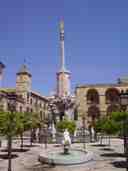
Right in front of you, rising above the orange trees and the cobbled square, you’ll see an ornate, towering monument crowned by a statue of an angel on a slender marble column-simply look towards the Puerta del Puente and you can’t miss it! Welcome to the Triumph of San Rafael at the Puerta del Puente! If you think this looks like the world’s fanciest toothpick holder, you’re not alone-except this “toothpick” happens to be over 27 meters tall and topped with the city’s very own guardian angel, San Rafael. Now, let’s turn back the clock and set the scene. Imagine it’s the early 1700s here in Córdoba. The city is bustling, history hangs in the air, and there’s a wild idea floating around among church officials: they want to put up a massive monument to San Rafael, the archangel who watches over Córdoba. After all, who wouldn’t want such heavenly security? So in 1736, two officials, Juan Antonio del Rosal and Diego Manrique de Aguayo, send a letter all the way to Rome-because where else would you find top-notch monument designers? But when the design comes back, the Córdoba council is not impressed. Maybe too much marble? Not enough dramatic flair? They promptly toss the design and ask for another. This time, they choose a famous painter (who probably preferred canvas to castles) and a sculptor with royal connections, and things look promising. The new design gets the green light in 1738, and excitement bubbles up-until, just as quickly, the key officials sadly pass away. The project stalls with only the foundations dug, leaving Córdoba with an invisible monument for decades. Fast forward to 1756. A new bishop, Martín de Barcia, arrives and quickly becomes Córdoba’s biggest San Rafael fan. So much so, in 1765, he insists: it’s monument time! Work starts again, right here on ground that once housed a 13th-century hospital. Digging deep into the earth, workers unearth an old tombstone inscribed “Don Pascual, Bishop of Córdoba”-a mysterious nod from the past. Soon after, they track down the bishop’s other relics, which, in classic Córdoba fashion, were previously used as a fountain in a nearby convent. Why just have a monument when you can also have a treasure hunt? The monument’s construction is led by a Frenchman, Miguel Verdiguier, who tweaks the plans just enough to add an extra bit of French flair. But trouble strikes again: the devout bishop Martín dies in 1771 with the angel still unfinished. The money runs out. The whole project, a monument decades in the making, is put on pause once more. Finally, in 1779, a large sum is released and the monument rises up, completed in 1781 after nearly half a century of starts and stops. Now, take a closer look! The monument is a drama in marble: a black marble base, rough mountain-like shapes rising up, topped with a little fortress of red jasper-turrets and all. There’s a column streaked with color, and high above, San Rafael stands vigil, one hand lifted skyward. Around the base are white marble statues of Córdoba’s martyr saints: San Acisclo, Santa Victoria, and Santa Bárbara, all keeping a watchful eye. If you glance toward the street, you’ll spot a stone lion holding a shield that basically says, “Hey evil, keep moving!” Oh, and tucked among the rocks, there’s an eagle with a ribbon in its beak proclaiming, “I swear by Christ that I am Rafael, the angel set by God to guard this city.” With secret symbols, statues, and a tale of dedication (and frustration!), no wonder San Rafael looks so steadfast up there-he probably had to wait ages for the scaffolding to come down! Today, as you stand here with the scent of orange blossoms on the breeze and the city’s ancient walls behind you, picture all the determination and even a little drama that shaped this masterpiece-built not just for beauty, but as a symbol of Córdoba’s unwavering spirit and its watchful protector. Now, ready for the next adventure? Let’s keep moving!
専用ページを開く →To spot the landmark, look for a long, sandy-colored stone building with small balconies, iron-barred windows, and a sturdy, fortress-like facade right in front of you, with a few…もっと読む折りたたむ
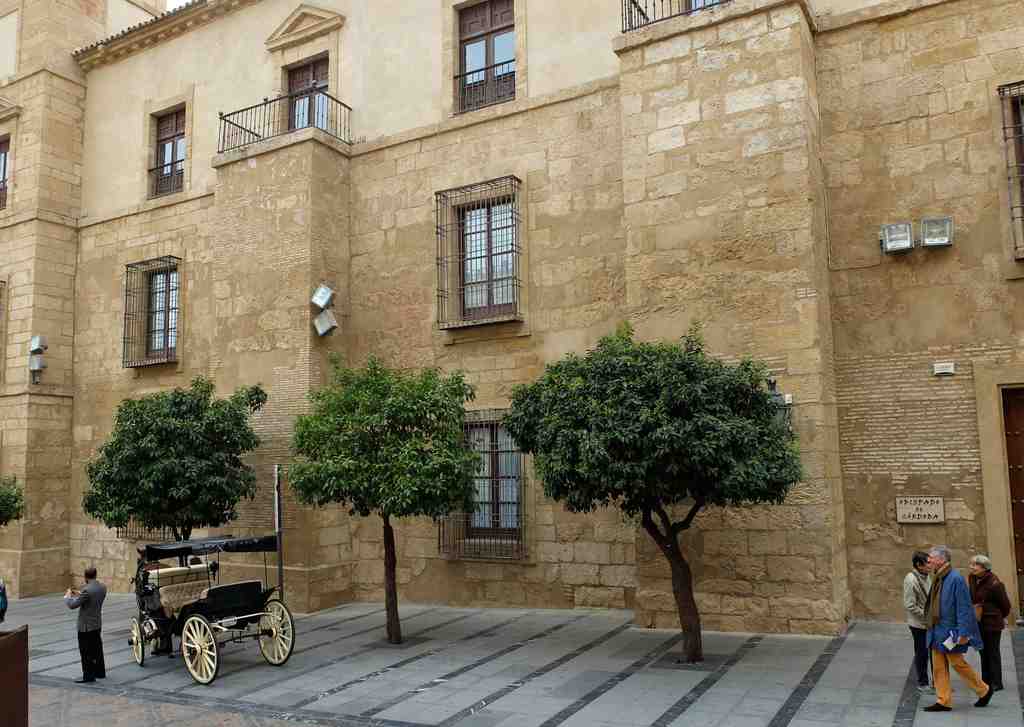
To spot the landmark, look for a long, sandy-colored stone building with small balconies, iron-barred windows, and a sturdy, fortress-like facade right in front of you, with a few leafy orange trees and an old-fashioned carriage underneath. Welcome to the mighty Alcázar of the Caliphs! Now, you’ll have to squint a little and let your imagination do some heavy lifting, because today, much of what you see has been built over, transformed, and stitched together from centuries of history, like a royal quilt with a few missing patches. Still, stand here for a moment, breathe in the air, and picture a time when the very ground you stand on was part of one of the glitziest, most powerful palace-fortresses in medieval Europe. Travel back with me to the 8th century - this was once the heart and brain of Al-Andalus, home of emirs and caliphs, the place where audacious rulers plotted and prayed, where secrets whispered through cool marble halls, and where the destinies of countries were decided. At its height, the Alcázar was a sprawling complex with grand gardens, audience halls, government offices, baths, and even a royal cemetery lurked within its walls. And oh yes, the architects of the past were keen on showing off: imagine Caliph Abd ar-Rahman III strolling along the palace walls, looking down from his balcony as armies marched below or festivals and executions were held in the square. Of course, getting into this fortress wasn’t easy. The palace was protected by thick walls and secured by grand gates - each with its own tale, like the “Gate of the Lion” (which, disappointingly, had more to do with security than actual roaring lions), and the “Iron Gate” with door knockers supposedly taken from plundered lands. One gate, the “Gate of Justice,” was where people would come to plead their cases before the emir. Picture tense moments: anxious citizens standing outside, hoping for decisions that could change their lives forever, while guards watched from above, probably trying not to fall asleep on duty. Inside, this place was buzzing with activity. Scribes hustled between the offices of the viziers, couriers crisscrossed the halls, and the aroma of blossoming orange trees drifted over exquisite courtyards. At night, lamps glimmered like fireflies, and deep beneath it all, steaming water warmed the bathhouses - the Caliphal Baths - which you can still visit today! The Alcázar even boasted one of the greatest libraries in Western Europe, though I hear overdue book fines were rather steep back then... And it had indoor plumbing! Abd ar-Rahman II oversaw improvements to the city’s water supply, even inventing waterwheels (or “norias”) along the Guadalquivir River. Imagine the low, steady creak of the Albolafia wheel drawing water up for the thirsty palace gardens. But history is never simple, and this palace saw its share of drama. After reaching its height under the Umayyad caliphs, Cordoba’s government briefly moved to a shiny new palace, Madinat al-Zahara, just outside the city. Yet when that rival palace was destroyed, rulers and the powerful came rushing back, clinging to this place like moths to a royal flame. Then in 1236, the Christian conquest swept in like a plot twist in a long-running series. The Alcázar’s story changed: part became a bishop’s palace-if you look closely, you’ll spot traces of ancient walls now stitched into church buildings-while the rest grew into the Alcazar of the Christian Kings, a castle still standing proud today. Yet, for all the twists and turns, little of the original Islamic palace remains except, delightfully, those famous Caliphal Baths (the hammam) hidden nearby, and perhaps a haunting echo of voices past drifting through the stone. What stories these walls could tell-of scholars and soldiers, plots and poetry, laughter in sunlit courtyards and tense whispers behind thick doors! So as you stand here, let yourself drift on the scents and sounds of centuries, knowing you’re in the very heart of old Cordoba’s secrets and splendor.
専用ページを開く →To spot the Andalusian Alcazar of Cordoba, look for a structure with beautifully carved columns of red and black marble topped with ornate capitals, supporting elegant horseshoe…もっと読む折りたたむ
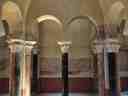
To spot the Andalusian Alcazar of Cordoba, look for a structure with beautifully carved columns of red and black marble topped with ornate capitals, supporting elegant horseshoe arches-if you see these striking arches and pillars, you’re right at the heart of history! Alright, my friend, let’s slip back in time, just for a moment-because right where you’re standing once stood one of the grandest, most secretive power centers in all of Al-Andalus! Picture this: it’s almost thirteen centuries ago, and all around you, the gardens are bursting with citrus trees and bubbling fountains, peacocks strut through the courtyards, and the scent of jasmine drifts through the air. At the center of it all is the Alcázar Andalusí, also called the Umayyad Alcázar-a vast fortress-palace, wrapped in thick walls and filled with a dizzying labyrinth of palatial halls, secret passageways, and bustling offices. But did you know this place wasn’t always the stronghold of powerful Muslim rulers? First, the Visigoths had their own swanky villa here-think less “Game of Thrones,” more “Romanesque Ruins with a Spanish twist.” Then, after 711, when the Muslims swept into Spain, the palace fell into new hands. Strangely enough, the early Muslim governors preferred Sevilla-but one, a fellow named al-Hurr, thought, “Hey, let’s live a little closer to the river!” and moved to the old Visigothic palace right here. If walls could talk, they’d probably have some wild stories about those first years. Now, after the mighty Umayyad dynasty of Damascus was overthrown, a survivor named Abd al-Rahman I dashed across North Africa, dodged assassins, and made Córdoba the capital of an independent Emirate. He also became Córdoba’s top real estate renovator. Soon, he moved out of his country mansion and started building up this new Alcázar. But this was no ordinary fortress-this was a palace fit for legends. Its private wings were home to the emir, the caliph, and their families; its sprawling administrative heart kept the machinery of government ticking, and official state business was handled in grand offices protected by those thick palace walls. All told, the Alcázar covered a whopping 39,000 square meters, bigger than some small towns. And this place had everything-lavish gardens, the city’s largest hammam bathhouse (where you could soak your troubles away, though perhaps not your political rivalries), and fountains supplied by clever waterwheels from the Guadalquivir, including the famous Albolafia noria, creaking away by the riverside. Try to imagine water sparkling in the sun, trickling through channels like music all around the palace. There was even a gigantic library, said to be the biggest in Western Europe-forget a Kindle, you’d need a camel just to carry all the scrolls! The Alcázar and the mosque next door were connected by a secret passage (the "sabat")-perfect for an emir or caliph to slip into the mosque unseen. There were many grand entrances: can you picture the iron-studded Gate of the Hierro, whose knockers were trophies from as far away as Narbonne? Or the riverside Gate of the Embarcadero, where rulers watched military parades from a balcony, while enemies learned the hard way that you never cross the caliph. Inside, the air would be heavy with secrets. Ministers and viziers hurried to the “House of the Ministers” for a quick word of advice (or maybe some juicy palace gossip). Servants slipped through winding corridors. Emirs met in the luminous Audience Chamber or strolled the rauda, a serene garden that also doubled as the royal graveyard. Kings, queens, poets, and plotters alike walked these very stones. But every story gets a plot twist. In the 900s, Caliph Abd al-Rahman III built the dazzling city of Medina Azahara out of town, making it his new base. But when that city fell to ruin, Córdoba’s Alcázar reclaimed its old glory-hosting new rulers, including a king so poetic (al-Mutamid) he probably left love notes hidden in the masonry. And after the Christian conquest in 1236, parts of the Alcázar were transformed: a bishop moved in, the king of Castile took his share, and traces of this mighty palace are woven into nearly every brick of the modern city. So if you spot an old arch here, a sunlit courtyard there, or those famous caliphal baths still echoing with ghostly laughter-let your imagination run wild. This was the beating heart of a city that once outshone the medieval world, where history, mystery, and a dash of royal drama were all just part of the daily spectacle. Now, tell me, did you bring your own royal robe? No? Well, don’t worry-you’ll always have a crown in my tour!
専用ページを開く →Ahead of you, you’ll see a lush finger of greenery snaking through the water, flanked by tall willows, reeds, and wildflowers beside the shimmering Guadalquivir River-just look…もっと読む折りたたむ
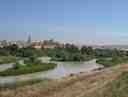
Ahead of you, you’ll see a lush finger of greenery snaking through the water, flanked by tall willows, reeds, and wildflowers beside the shimmering Guadalquivir River-just look toward the riverbank between the Roman Bridge and the San Rafael Bridge to spot the Albolafia Groves. Welcome to the Albolafia Groves, a natural wonder that’s more like a green fairytale come to life than a typical city park. If you listen closely, you might just hear the soft rustle of willow leaves and the distant calls of wild birds. This stretch of nature hugs the Guadalquivir River, stretching across 21 hectares, creating secret little islands, rippling sandbars, and a safe haven for every creature you can imagine. Long ago, this was simply one more wet and wild part of the river, but today, it’s a protected sanctuary right in the city’s heart-imagine if your backyard was full of otters! Keep your eyes peeled for flashes of color: every year, more than 110 species of birds swing by, and you might even spot the rare purple swamphen or the exceptionally stylish cattle egret. The air is thick with the buzz of insects, the gentle splash of water, and-if you’re lucky-the playful dash of an otter. All around, ancient mills stand watch, like silent guardians of this living museum, their stones worn down by centuries of curious eyes, busy hands, and flowing water. Just for a moment, take a deep breath and soak it all in. The city’s right behind you, but in front-here in the groves-it feels like you’ve traveled to another world.
専用ページを開く →To spot the Alegría watermill, look right over the riverbank ahead of you for a large, square-shaped building made of stone and light brick, with rows of small square and arched…もっと読む折りたたむ
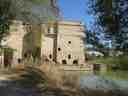
To spot the Alegría watermill, look right over the riverbank ahead of you for a large, square-shaped building made of stone and light brick, with rows of small square and arched windows, rising above the greenish waters and separated from the swooping trees by patches of wild grass. Now, let’s imagine you’re standing here hundreds of years ago. The sun is bright overhead, but the mill’s thick stone walls offer welcome shade by the water’s edge. You feel the air growing cooler as you approach, and the steady splash and churn of the Guadalquivir River fill your ears, broken only by the occasional call of a heron swooping past. Right in front of you is the Alegría watermill-whose name means “joy”-though don’t expect it to burst into song. That’s my job! But this place really has seen it all. Long ago, when Córdoba was under Moorish rule, this weir was already famous and called the Azuda de la Alhadra-“the green”-a hint that the city was already bustling with life, color, and, well, a lot of water technology! The weir itself formed a powerful barrier, splitting the river’s flow and feeding water right under the future site of Alegría’s mighty grinding wheels. The mill sits right between two spillways; if you close your eyes, maybe you can imagine millers with flour-dusted faces running to keep up with the current. After the Christians conquered Córdoba in 1236, the Diocese-never one to turn down a lucrative property-quickly pounced on these mills through donations, holding onto them for centuries. During the fifteenth century, most of those mills, once busy turning wheat into soft, white flour, were converted into fulling mills instead. Fulling mills were used to clean and thicken woolen cloth, so you could say fashion swept through this riverfront! Soggy cloaks and all, six different mills once chugged away on this very weir-three for flour, three for fulling. Of course, technologies changed-the “Regolfo” made a splash in the 1600s, and by the 1700s, you’d hear people grumbling about the “Tripas” mill. Just as you figure out how something works, it goes out of style, right? Fast forward to 1780. Antonio Luque, hunting for opportunity or, more likely, a challenge, bought the crumbling ruins of this watermill from the Cathedral Chapter. He rolled up his sleeves and rebuilt it, giving the place its cheerful new name, Alegría. By the late 1800s, what you see today-a handsome facade with three levels-was taking shape. At ground level, you’ll spot rough, sturdy stone; above, brickwork from the 19th century. Sneak a look behind the walls, and you’d find three long chambers, each once echoing with the grind of huge millstones powered by racing water. Four of those old stones are still here, preserved as echoes of the past, while a lone turbine shaft hints at the factory’s next chapter. In the twentieth century, the mill sprouted new floors-suddenly it was a three-story flour factory, rebranded as San José. It worked hard, spinning two sets of millstones and a water turbine tall enough to impress even the nosiest river fish. The mill soon whirred its way through various owners-from flour companies to Cordoba’s electricity firms, each chasing the spirit of industry and maybe a bit of luck. At last, as dust settled on its gears, the city decided to transform Alegría into something truly unique. Carefully restored at the turn of this century, the building’s upper floors became the Roberto Wagner Museum of Paleobotany, part of Córdoba’s Botanical Garden. In 2002, it threw open its doors as Spain’s first museum of plant fossils-talk about a building with deep roots! So next time you hear the river’s quiet song at this spot, think of Alegría: the mill that’s been a flour factory, fashion lab, power plant, fossil house, and a place brimming with stories. If these old stones could talk, I think they’d tell you, “Stick around-you never know what’s coming next!”
専用ページを開く →In front of you, you’ll spot the San Rafael Bridge by looking out for a long, grey stone bridge stretching across the Guadalquivir River, with a series of eight wide arches and…もっと読む折りたたむ
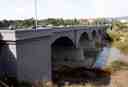
In front of you, you’ll spot the San Rafael Bridge by looking out for a long, grey stone bridge stretching across the Guadalquivir River, with a series of eight wide arches and cars gliding along its top-just peer toward the water and you can’t miss it. Now, let’s step back in time to April 29th, 1953. Imagine the city buzzing with excitement, as families lined the riverbanks, waving and chattering, all eager to see Córdoba’s brand-new bridge come to life. The San Rafael Bridge was the second ever built in this city, a true game changer-finally, there was another way to cross the mighty Guadalquivir besides the ancient Roman bridge. Designed by Santiago García Gallego, who probably dreamed of bridges even in his sleep, this massive stone beauty covers 217 meters with its eight enormous arches. For decades, the bridge carried everyone from morning commuters to wandering lovers, with four busy lanes and wide sidewalks for strolls at sunset. Back when it was new, it even had plaques proudly boasting about its opening, but those vanished mysteriously in 2004-cue a bit of local mystery! Not to worry though, because after a big makeover in 2006, the bridge looks as sturdy and handsome as ever. Just imagine the stories whispered in the arches below, as the waters flow and time rolls on!
専用ページを開く →
よくある質問
ツアーはどうやって始めますか?
購入後、AudaToursアプリをダウンロードして引き換えコードを入力してください。ツアーはすぐに開始できます。再生ボタンをタップして、GPSガイド付きルートに従うだけです。
ツアー中にインターネットは必要ですか?
いいえ!開始前にツアーをダウンロードしておけば、完全にオフラインで楽しめます。チャット機能のみインターネットが必要です。モバイルデータを節約するため、WiFi環境でのダウンロードをお勧めします。
これは団体ツアーですか?
いいえ、これはセルフガイド式のオーディオツアーです。ガイドや団体、決まったスケジュールに縛られることなく、スマホから流れるナレーションを聴きながら自分のペースで自由に探索できます。
ツアーの所要時間は?
ほとんどのツアーは60〜90分で完了しますが、ペースは完全に自由です。好きな時に一時停止したり、スポットを飛ばしたり、休憩を取ったりできます。
今日中にツアーを終えられない場合は?
問題ありません!ツアーには無期限でアクセスできます。明日、来週、あるいは来年でも、好きな時に再開できます。進行状況は保存されます。
どの言語が利用可能ですか?
すべてのツアーが50以上の言語に対応しています。コードを引き換える際にお好みの言語を選択してください。注意:ツアー生成後に言語を変更することはできません。
購入後、どこからツアーにアクセスできますか?
App StoreまたはGoogle Playから無料のAudaToursアプリをダウンロードしてください。メールで届いた引き換えコードを入力すると、ライブラリにツアーが表示され、ダウンロードして開始できるようになります。
もしツアーを楽しめなかった場合は、返金いたします。お問い合わせ先: [email protected]
以下の決済で安全にチェックアウト 


