
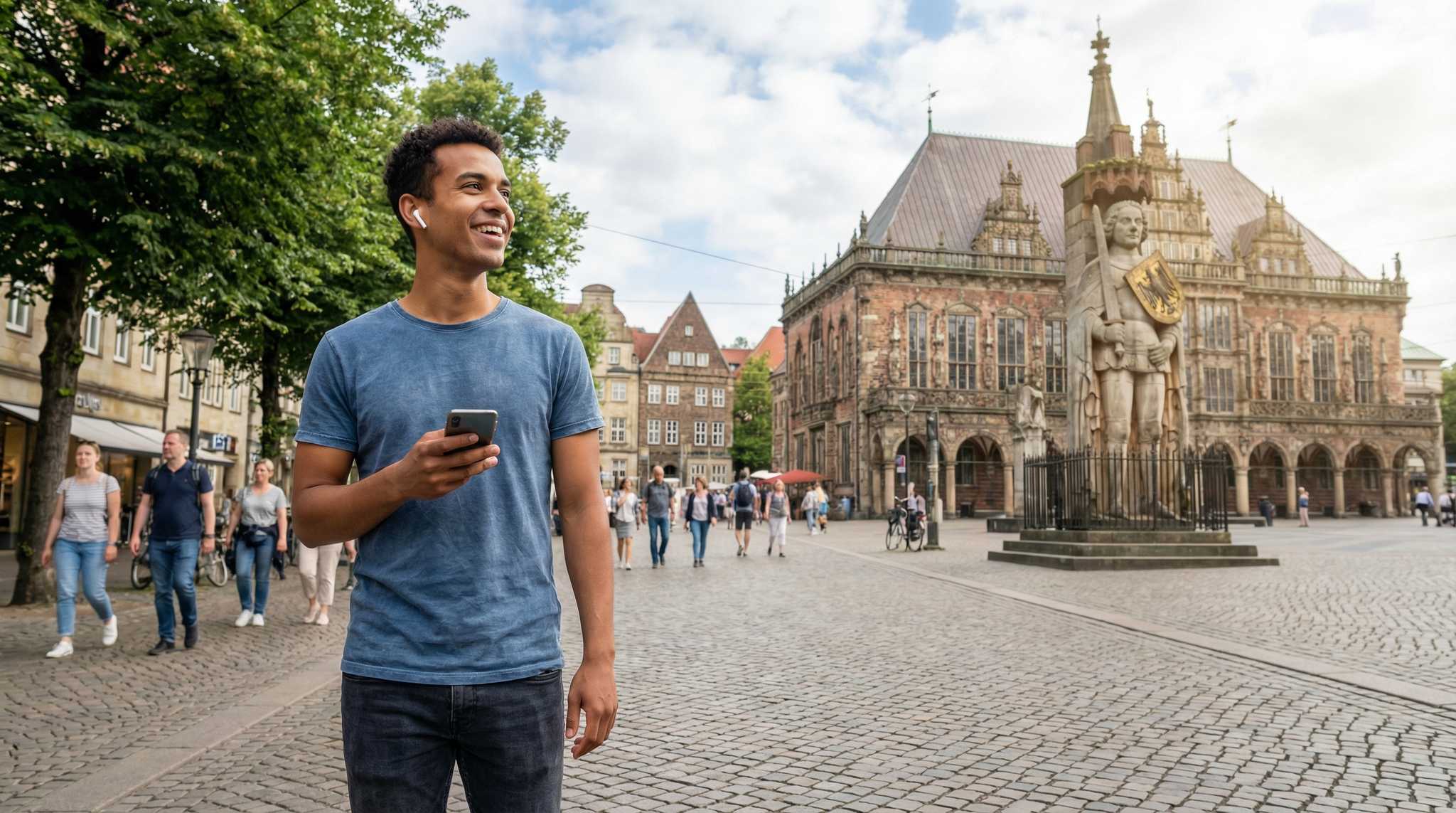
ブレーメン・オーディオツアー:商人、市場、そして中世の残響
ブレーメンは、ほとんどの旅行者が想像する以上に、ガラス、レンガ、鋼の裏に多くの秘密を隠しています。この街の活気ある表面の下には、消え去った富、スキャンダラスな野心、そして歴史を永遠に変えかけた瞬間のささやきが脈打っています。 このセルフガイド・オーディオツアーでは、メルヒャーズの世界規模のビジネス帝国から、伝説的なアム・ブリルの交差点、そしてグリーンシル銀行の衝撃的な破綻の影へと誘います。道中、地元の人々さえ見過ごしている物語を発見してください。 たった一週間の目まぐるしい間に、ブレーメンで最も影響力のある金融業者を誰が妨害したのでしょうか?アム・ブリルの石畳の下には、夕暮れが戻るのを待つ、どんな呪われた伝説が残っているのでしょうか?遠く離れたハワイの小さな会社の決定が、なぜブレーメンの運命を何十年も変えたのでしょうか? 何世紀にもわたる政治的陰謀、大胆な脱出、都市全体の変革、そして落ち着かない幽霊たちを巡り、一歩ごとに足元で新たな章が開かれるのを感じてください。ブレーメンを、その最も大胆な冒険家や隠された陰謀家の目を通して見る準備はできていますか?秘密は今、始まります。
ツアーのプレビュー
このツアーについて
- schedule所要時間 50–70 mins自分のペースで進める
- straightenウォーキングルート 4.0kmガイド付きパスに沿って進む
- location_on
- wifi_offオフライン対応一度のダウンロードでどこでも使える
- all_inclusive無期限アクセスいつでも、ずっと再生可能
- location_onメルヒャーズ(企業)から開始
このツアーのスポット
To spot Am Brill, look for the striking glass-fronted Sparkasse Bremen building with its modern, sleek façade and red umbrellas on the sidewalk, standing right in front of you at…もっと読む折りたたむ
To spot Am Brill, look for the striking glass-fronted Sparkasse Bremen building with its modern, sleek façade and red umbrellas on the sidewalk, standing right in front of you at the lively city intersection. Now that you're at Am Brill, let’s take you on a little journey that will boggle your mind more than a local’s attempt to count how many trams pass through here every day! Picture yourself in the middle of Bremen’s bustling heartbeat, surrounded by modern glass and stone, cars and bicycles zipping past, and trams gliding along their tracks. But if you close your eyes (just for a second-watch out for those bikes!), you can almost hear echoes from hundreds of years ago, when things were a lot less busy, and a whole lot more mysterious. Back in the Middle Ages, this spot wasn’t a busy crossroads-it was a literal gate in Bremen’s old city wall, controlling who could enter or leave the city. Imagine watchful guards, stone fortifications, and perhaps a dog or two snoozing in the sun. The name “Brill” actually means “hole” or “opening”-not the most glamorous way to be remembered, right? At that time, the area outside the gate, called Stephaniviertel, wasn’t even part of the city proper. So, you’d have passed from bustling medieval life through the “Brill” and found yourself suddenly outside, surrounded by open countryside. Fast forward to the 17th century and the scene changes-a small but barely noteworthy square started to take shape. People would travel down the newly made “Neue Weg,” which eventually split in two directions: Hutfilterstraße-say that three times fast!- and Hinter dem Brill. But the real action didn’t pick up until the 1800s. In 1874, a new street was carved from here all the way to the main train station. Cars hadn’t been invented yet, but with more people and traffic, Am Brill’s importance shot up, becoming one of Bremen’s hottest places for public transport-a bragging right it still holds today. By the early 1900s, the area underwent another big change. Imagine the dust and noise as buildings were torn down to widen the square. In 1906, the majestic Sparkasse Bremen headquarters emerged right here, designed by Wilhelm Martens-imagine him as the “starchitect” of his day. The new building had a style mashup of baroque, renaissance, and art nouveau, and was so impressive that even Kaiser Wilhelm II himself came to take a peek in 1907. If only Instagram had existed back then! The original copper mansard roof sparkled in the sun, though later renovations kept only a single corner tower. World War II left its scars, and the area experienced even more dramatic changes. A new road, the “Martinidurchbruch,” slashed its way through the old town, splitting up ancient streets and reshaping the neighborhood. The cozy old Molkenstraße disappeared, replaced by Martinistraße, and Am Brill suddenly became the grand connector to the Faulenstraße. Then came the swinging ‘60s-well, swinging if you liked underground tunnels! The Brilltunnel popped up underneath, with shiny shops, kiosks, and escalators leading down into the depths. For a while, it was the place to be-kids munching on snacks, grown-ups zipping between tram stops-but over the years, it faded. By 2010, it was closed, leaving behind only memories (and perhaps a ghostly echo of shuffling feet and distant laughter). Since then, Am Brill has kept reinventing itself. The Sparkasse building to your right? Partly new, partly old! The shimmering glass and soaring ceiling were added in 2001, blending the modern world with the grand history next door. In front, the bronze “Affentor” sculpture has been keeping watch since 2007, looking for all the world like it’s just daring someone to swing by and take a selfie. To your left and right are office blocks, hotels, and restaurants, some dating from the post-war boom, others gleaming with modern steel and glass. Am Brill acts like the central nervous system of Bremen’s transportation, bustling all day with trams, buses, and unstoppable city energy. Try counting the connections-if you manage to get them all right, you definitely deserve a spot in Bremen’s Hall of Fame! So there you have it: a place that’s gone from medieval gate, to bustling crossroads, to shopping tunnel, and now a sparkling city plaza. Am Brill never really sleeps-so if you feel the urge to do a happy little dance in the middle, don’t worry, you’ll just be following in the energetic footsteps of centuries before you!
専用ページを開く →As you stand before the shuttered facade of the Greensill Bank, take a deep breath and let your imagination whisk you back nearly a century. Picture Bremen in 1927: a wind-swept…もっと読む折りたたむ
As you stand before the shuttered facade of the Greensill Bank, take a deep breath and let your imagination whisk you back nearly a century. Picture Bremen in 1927: a wind-swept port city, bustling with the distant clatter of tramways and the hopeful hum of reawakening industry after the trauma of hyperinflation. That year, a group of sharp-minded men gathered their courage and their 200,000 Reichsmark and founded the Norddeutsche Finanzierungs-AG - what would become the Greensill Bank. Its first mission? Financing brand-new automobiles and other modern wonders, a beacon for progress in the grey drizzle of the Weimar years. If you listen closely, you might almost hear footsteps echoing in marble hallways, documents being signed with the flourish of a fountain pen, and the muted jangle of keys as vaults opened for business. Fast-forward to 1948; the war’s rubble has barely been swept away, and the bank, now called NordFinanz, shifts its focus to more everyday matters-consumer credits. By the 1950s, Sparkasse Bremen and Bremer Landesbank were in on the act, helping bump up the capital to half a million D-Mark. Imagine the whir of typewriters, the click of ink stamps, and the ever-present aroma of coffee as the bank buzzed with plans for a new era. And oh, the things they financed: not just cars anymore, but hopes and dreams, new beginnings hammered out on the steel floors of Bremen’s workshops. But pit stops were rare on this rollercoaster. By the roaring sixties, a new idea rolled in-factoring. That’s banker-speak for buying up invoices before they’re paid, a clever way to keep cash flowing. In the seventies, the bank spun off the Factoring Bank, which still exists today under a shiny new name. The big numbers kept rising: five million D-Mark in capital by 1973, and a business world that lurched and swerved with each new owner, each new dreamer at the helm. The eighties sounded like a soap opera: new companies, new investors, fortunes made and lost faster than you can say “diversified portfolio.” At one point, two Bremen politicians, a finance senator and an interior senator-both moonlighting as not-so-mysterious shareholders-snuck in for a slice of power. Let’s just say, questions about where the money came from were met with shrugs. Every bank has its secrets! Banking in Bremen never was just about numbers; it was about stories. From the fever-pitch 1990s-when capital tripled and roller-coaster takeovers made headlines-to the early 2000s, when things took a darker turn. Insolvencies loomed, dreams burst, lawsuits flew, and ownership tags changed faster than Bremen’s infamous weather. Then, a windswept day in 2014: with the bank in financial trouble yet again, in swoops the Anglo-Australian Greensill Group. The globe-trotting financier Lex Greensill, as dashing as any international man of mystery, bought 80% of the shares. Out with the old-NordFinanz was dead, long live Greensill Bank! The new name glinted in the river fog, and with it came a shiny new business model: deposit-taking, working capital finance, and a special fondness for something called “reverse factoring.” Translation: the bank would pay suppliers quickly, then collect what was owed from big companies, all with a tidy profit margin. You could say they put the ‘fun’ back in ‘funding supply chains.’ The numbers grew as fast as the stories. By the end of 2019, the balance sheet ballooned from 338 million to nearly four billion euros. Customers flocked, lured by interest rates so high that even Bremen’s seagulls perked up. If it all sounds a bit too good to be true, well...you know what comes next! As one might expect, the bank’s parent company, Greensill Capital, got a little too creative. Allegedly, a few of those “paper” assets in the books weren’t quite as solid as a Bremen brick. The German bank supervisor, BaFin, got wind of things and shut everything down in March 2021 with dramatic flair. Picture the tense hush of meeting rooms and the sharp click of official seals as the moratorium was announced. And so, the curtain fell. Account holders-more than 20,500 of them-ultimately received billions in compensation. Meanwhile, investigators combed through piles of documents, and Bremen’s banking community whispered about “Greensill” in much the same way one might mutter about a lost ship at sea. Today, the name on the door is more of a warning than a welcome: in the world of high finance, things can change overnight, and even a century-old legacy can vanish in the mist. So, as you stand here, picturing all those stories passing through these walls, remember: in banking, as in comedy, timing is everything. And sometimes, the punchline is a little too costly! Eager to learn more about the greensill bank since 2014, business purposes or the key figures? Simply drop your inquiries in the chat section and I'll provide the details you need.
専用ページを開く →

さらに16件のスポットを表示表示するスポットを減らすexpand_moreexpand_less
To spot the Sloman Neptun Schiffahrts AG, look across the water to where a large cargo ship, painted in dark blue with the company name “Sloman Neptun” on its side, floats near…もっと読む折りたたむ
To spot the Sloman Neptun Schiffahrts AG, look across the water to where a large cargo ship, painted in dark blue with the company name “Sloman Neptun” on its side, floats near the quay in front of a long industrial warehouse. Alright, you’ve made it to the legendary Sloman Neptun! Take a moment and imagine yourself standing beside the bustling wharves of Bremen, the salty wind whipping around you, and before you - the enormous presence of the Sloman Neptun shipyard, where mighty ships have set out to conquer the world’s oceans. It all started way back in 1793-no smartphones, no traffic jams, just wooden ships and wild ambition! William Sloman, a daring English captain, packed up his courage (and maybe a suitcase of snacks) and moved to Hamburg. What did he do? He founded what would become Germany’s oldest shipping company! At first, it was a humble family business, passing from father to son like a treasured secret recipe. But soon, it wasn’t just about England anymore; they sailed to New York, Australia, Brazil, and even the mysterious ports of North Africa. The Sloman ships became floating bridges across the world-pretty cool for an idea hatched before the light bulb was invented! Close your eyes and picture the early days: the clanging of ship bells, the shouts of deckhands, and the anxious excitement of emigrants bound for a new life in America. In the 1850s, the Sloman company launched the Helena Sloman, a revolutionary steamship that cut the transatlantic trip to just 30 days-imagine crossing the ocean in roughly the time it takes to binge-watch a TV series! But sailing wasn’t always smooth. The emigrant journeys could be grim: packed decks, meager food, and sometimes tragedy. On one infamous voyage, the tall ship Leipzig carried over 500 people, but bad luck and poor conditions led to hunger, thirst, and heartbreak. Newspapers cried out in horror, and the ship earned the dreadful nickname “Pesthole.” Yet, Sloman pressed on, refitting vessels and learning from the rough seas. Sloman wasn’t just a pioneer in carrying people. Their ships hauled cargo everywhere: from fresh fruit in the Mediterranean to coal in industrial Britain, and after 1850, even specialized refrigerated ships joined the fleet-proof that someone always needs a banana, no matter the century! The company quickly became a giant, peaking at 21 ships and bustling port offices in Italy, Spain, and even Australia. Now, switch scenes a bit and let’s jump over to the Neptun story. In 1869, a pair of clever Bremen tobacco dealers realized that sailing under the neutral Swedish flag kept their ships safe from pirates-talk about thinking on your toes! The Neptun company grew quickly, running trusted ships up and down the rivers, across the North and Baltic Seas, and later around all Europe and beyond. But even the mightiest fleets faced trouble. Both Sloman and Neptun lost nearly all their ships in the world wars, leaving dockworkers and captains staring at empty water. Yet, like movie heroes, they rebuilt: new ships, new routes, and a partnership that would finally bring them together. Since 1974, Sloman Neptun has called Bremen home, flying a flag of blue and white with four stars and a proud “tor” (that’s a gate, not a bull!), and painting their smokestacks with distinctive blue and yellow stripes. Nowadays, the company operates hi-tech tankers and heavy-lift ships, transporting gas and chemicals from Bremen to Antwerp, England, and North Africa. The adventure continues-less pirates, more paperwork, but hey, that’s progress! The sound of diesel engines has replaced the snap of sails, but the sense of journey, daring, and discovery is the same. So, as you stand here, feel the weight of more than 200 years of maritime history swirling around you. The next time you see a ship with “Sloman Neptun” painted on its side, you’ll know-inside those steel walls, there’s a story that’s crossed centuries, continents, and oceans. Don’t let the modern look fool you; adventure is still out there, floating downstream.
専用ページを開く →Take a look just ahead of you, and you’ll spot the Teerhof by its long row of modern red-brick apartment buildings with arched windows, stretching out on the narrow spit of land…もっと読む折りたたむ
Take a look just ahead of you, and you’ll spot the Teerhof by its long row of modern red-brick apartment buildings with arched windows, stretching out on the narrow spit of land along the river, their reflections shimmering in the water below. Picture this: over 400 years ago, the Teerhof glistened with thick black tar, not shiny glass and brick. Back then, every breeze carried the sharp, sticky scent of pitch as shipbuilders covered hulls and ropes, making them watertight right on this narrow peninsula. Workers shuffled around with their sleeves rolled up, dodging drips and splashes-if anyone dared to drop a white shirt here, well, let’s just say it wouldn’t last long! The name “Teerhof” literally means “tarring yard,” and it was as gritty as it sounds. As Bremen grew, the Teerhof morphed into a jumble of tiny factories, homes, and even a coffee factory-imagine waking up to both the smell of fresh grounds and, well, hot tar! By the 1930s, the place had warehouses, buzzing workshops, and people calling it home. But then came the Second World War, shaking Teerhof to its bones. Nearly everything was flattened, except for one stubborn survivor-the Weserburg coffee factory. It limped back to life after the war, filling the air again with that rich coffee aroma until it finally closed in the seventies. But the story doesn’t end there! The city scooped up the old coffee building, using it for wild art happenings and noisy artist studios, until a new adventure began: it became a collectors’ museum, the first in Europe. Fancy that! And through all sorts of wild ideas and neglect, the latest transformation brought those lovely red-brick apartments you see now, echoing the old warehouses, and a modern art museum that has become the beating heart of Teerhof. So next time you sip coffee or walk these quiet river paths, remember-this spot used to be stickier and noisier, but it’s always been full of surprises.
専用ページを開く →Take a good look around you - you’re standing in front of a landmark that has played a very important part in the lives of almost a million people across Germany: the…もっと読む折りたたむ
Take a good look around you - you’re standing in front of a landmark that has played a very important part in the lives of almost a million people across Germany: the Handelskrankenkasse, also known as hkk. Now, if you listen carefully and stretch your imagination back to a chilly January morning in 1904, you can almost hear the distant footsteps of shopkeepers, young clerks, and business owners gathering here in Bremen, wrapped up in heavy coats, eager to build something together. Back then, folks didn’t just gather to swap stories or grumble about the weather. They rolled up their sleeves and founded a place to look after each other’s health - quite literally! They called it the Handelskrankenkasse, which, in those days, only welcomed people in commercial professions. Apprentices and employees from the world of commerce found shelter under these roofs, planning a safer, healthier future while, I imagine, enjoying some strong Bremen coffee. Now, there’s a funny thing about German health insurance: it’s a bit like a family dinner. Over the years, people join, others leave, and sooner or later two families decide to merge. That’s exactly what happened in 2008, when hkk joined with the IKK Weser-Ems, creating an even bigger family, whose main job was to make sure people could feel safe - no matter what life threw at them. Today, more than 990,000 members are cared for by hkk. And if you’re curious about numbers, here’s a big one for you: their team handles over 3.4 billion euros a year for health insurance, and another billion for nursing care. Not bad for a group that started with a handshake and a dream! But let’s talk about the building itself. This isn’t just any old office-no, sir! The “Haus der Handelskrankenkasse” first opened its doors in 1915, back when Bremen was alive with the sounds of the steamships brought in by the mighty Dampfschifffahrts-Gesellschaft “Hansa.” Sadly, the building was heavily damaged during the war. For those years it may have whispered stories through broken glass and empty halls, until it rose again in 1953 - rebuilt, restored, and ready for the future. So here’s a little secret: if these walls could talk, they’d have quite the story to tell - of resilience, community, and a sense of humor needed to face each year’s social election
専用ページを開く →To spot Obernstraße, look ahead for a wide street lined with grand historic facades stretching towards a distant church tower, bustling with people-a true pedestrian zone in the…もっと読む折りたたむ
To spot Obernstraße, look ahead for a wide street lined with grand historic facades stretching towards a distant church tower, bustling with people-a true pedestrian zone in the heart of Bremen. Welcome to Obernstraße, Bremen’s shopping superstar-even if it came dead last out of 63 in a German “busiest shopping streets” ranking, with just 3534 passersby an hour. But hey, who needs crowds when you’ve got centuries of stories bursting from every cobblestone? Imagine yourself here in medieval times, about 900 years ago: merchants are bartering loudly, townsfolk hurry past, and the air is alive with the sounds of Bremen’s famous city musicians practicing their pipes and drums in their little side streets. Obernstraße means “upper street,” and it’s not just a fancy name! This street runs along the top of the city’s old Bremen dune-a sandy ridge that kept Obernstraße dry and, in medieval times, much holier than its neighbor, the much lower “Tiefer” street by the river Weser. You’re standing where the first main roads of Bremen came together, arching from the marketplace all the way toward St. Stephani. Originally, the road connected two church parishes: Unser Lieben Frauen and St. Stephani, with Ansgarii rising as a gothic masterpiece-until tragedy struck in 1944, when the church tower collapsed in a wartime bombing, leaving only a memory. Today, if you look around, you’ll spot a simple stone slab set into the square, quietly reminding us of where that mighty spire once reached up to the sky. The street names here are a story in themselves. Take Pieperstraße, for example-it’s named for the pipers who lived here in the Middle Ages, Bremen’s official city musicians! Or Papenstraße: that comes from the Low German word for “pastor,” or priest. It turns out, Obernstraße wasn’t just a place to shop or grab a coffee; it was where everyone from pipers to priests, bankers to bookbinders, set up shop and made history. Now, picture Obernstraße in 1823: lined with stately homes and sometimes, let’s say, unexpected residents. Picture the infamous Gesche Gottfried, Bremen’s most notorious poisoner. She took up residence here, and let’s just say-tea at her house was never boring (or safe). These homes slowly disappeared, replaced in the 19th century by grand banks and ever more elaborate storefronts. The famous Sparkasse moved into number 11, before expanding across the street, while the Karstadt department store, built around 1930, replaced an entire side of houses, its grand façade now protected as a historic landmark. Of course, the years weren’t always kind. In 1944, nearly everything you see around you was destroyed in World War II air raids, except for a lucky few buildings-like the peek behind the Peek & Cloppenburg store, which still carries the banking bones of North Germany’s credit empire. After the war, Bremen rose from the ashes. Some survived facades were rebuilt, streets swept clean, and by 1963, Obernstraße found new life as a pedestrian paradise, with only the cheerful clang of the tram-still running today on lines 2 and 3-punctuating the hum of shoppers and city life. Stretching from the Marktplatz to the Ansgarikirchhof, Obernstraße’s impressive businesses tell a story with every address: House Rohlandseck at the Fruen-Kirchhof, Carl Haake’s elegant 1800s furnishing shop, and the flamboyant silverware of Koch & Bergfeld. The corner brings you to the striking Karstadt and the grand Schröder-Bank-all nodding to their own chapters in Bremen’s commercial history. Stop and listen for a moment: you might catch the echo of hoofbeats on cobbles, the bustling chatter of traders, or even the lyrical notes of a piper who just won’t leave the street he once called home. You’re exploring not only a shopping street, but a living timeline of Bremen itself. So, take your time-maybe peek into a shop or pause near one of the bronze animal fountains at the Sai-Straße corner. You never know which century you might accidentally wander into!
専用ページを開く →Look ahead to your right for an ornate Renaissance building with tall gables and decorative details - that’s the Gewerbehaus, facing out onto the open square of the…もっと読む折りたたむ
Look ahead to your right for an ornate Renaissance building with tall gables and decorative details - that’s the Gewerbehaus, facing out onto the open square of the Ansgarikirchhof. Alright, you’ve made it to the Ansgarikirchhof - a place where if cobblestones could talk, they’d definitely have stories to tell! Look around you: today, the square is surrounded by shops, offices, and the stately Gewerbehaus with its striking twin gables, but hidden just beneath the surface is a history packed with drama, triumph, and even a touch of mathematical genius. Let’s rewind to the Middle Ages. Right where you’re standing once stood the grand St. Ansgarii Church, a towering Gothic marvel built back in the 13th century and dedicated to Ansgar - the so-called “Apostle of the North.” It was a familiar sight in Bremen for centuries and its spire soared higher than any other in the city. The church wasn’t just a pretty face, either. In 1522, it became the stage for one of the most spine-tingling religious shake-ups Bremen had ever seen: the monk Heinrich von Zütphen delivered a stirring Reformation sermon right here, firing up the city’s move toward Protestantism. But this place isn’t only about sermons and high drama. The Ansgarikirchhof played a part in science too. Imagine Carl Friedrich Gauß-the “prince of mathematicians”-hauling his equipment up the church’s dizzyingly high tower. In the 1800s, Gauß used that very spire as a vital measuring point for the first full survey of Bremen’s lands. There’s even a plaque here to remind us of his achievement, just in front of the modern Bremer Carrée. Yet fate is never kind for too long to any one building. During World War II, air raids razed the St. Ansgarii Church to the ground, leaving only rubble and echoes where the faithful once gathered. In the 1950s, even the ruins disappeared-carted away as the city rebuilt itself. If you’re curious where the church once stood, you can spot the tall Ansgar Column, erected in 1965 in tribute to the archbishop and as a marker for the lost church. But don’t think Ansgarikirchhof was left in ruins. Oh no, it dusted itself off and got a makeover. In the early 1960s, a Hertie department store rose from the ashes. For years, it bustled with shoppers-until it was itself replaced in the 1980s by the Bremer Carrée, the glassy modern block you see to the east. Around you, the Lloydhof to the north and the Hanseatenhof close by created new corners for shops, life, and all the little everyday dramas that make a city tick. Now, swing your gaze west to the Gewerbehaus. Doesn’t it look like something out of a fairy tale? This Renaissance gem was built way back in the early 1600s as a guild hall for the city’s cloth merchants-no medieval textiles, no party! It became so well-known for celebrations that folks even called it the “house for weddings and feasts.” Over time, it passed from the merchants’ hands to those of Bremen’s craftsmen. Today, it’s the proud home of the Handwerkskammer-the Chamber of Crafts. During the war, almost the whole building was destroyed, except for its impressive arched portal; but Bremen’s spirit is stubborn, and the house was beautifully reconstructed. As you stand here, take in the layers of history packed into the Ansgarikirchhof. Each side street-Obernstraße, Hutfilterstraße, Wandschneiderstraße, and Ansgaritorstraße-used to be bustling arteries of medieval Bremen, closed now to cars as if just waiting for another parade of guildsmen or a festival to light up the square. The Ansgar Column, the craft guild’s splendor, memories of a lost church, and the ghosts of mathematicians on rooftops… It’s enough to make anyone wish these stones really could talk! Ready for the next stop? Let's keep exploring-because the next tale is just around the corner.
専用ページを開く →To spot the Gewerbehaus, look for a striking Renaissance building right in front of you, with two ornate stone gables and rows of large windows lining its sand-colored facade-just…もっと読む折りたたむ
To spot the Gewerbehaus, look for a striking Renaissance building right in front of you, with two ornate stone gables and rows of large windows lining its sand-colored facade-just across the open square. Welcome to the Gewerbehaus-one of Bremen’s most dazzling survivors from centuries past. Take a breath, and let your eyes wander up and down this majestic landmark. Feel the cobblestones beneath your feet-once, silk merchants, craftsmen, and city leaders hurried over them, their footsteps echoing against this beautifully sculpted stonework. Imagine the gleam of nearly 400 years of history-but watch out, if these statues start talking, we might be here all day! Now, let’s set the scene. In the bustling 1600s, Bremen's streets were alive with merchants and master tailors in colorful garb, bolts of imported cloth slung over their shoulders. That’s when the wealthy “Wandschneider” guild-cloth dealers-decided it was time to show off a little. They wanted a grand hall, fit for their feasts and full of guild pride. So in 1619, craftsmen began carving and stacking stone, building not one but two winged houses at a dramatic right angle, with showstopping gables and an entrance decorated with figures from myth: Justitia for justice, Minerva for wisdom, and the muscle-bound Hercules for, well, just in case any troublemakers turned up at a wedding. If you close your eyes, you might sense the laughter and music of old wedding guests here. See those gables above? Originally, one sported the winged god Mercury, the other Venus. Guests in silks and ruffs paraded up, perhaps nervously eyeing the marble columns-they say if the statues frown, your party will be rained out! The halls inside-one stretching an enormous 25 meters, with a gorgeous beamed ceiling-saw not only guild meetings and lavish receptions, but the odd “Cana Wedding” painting gracing the wall (yes, that painting now hangs in the Focke Museum nearby). But no feast lasts forever. By the late 1600s, the tailors’ guild found itself in financial hot water. Repairs, parties, and a very large mortgage took their toll-turns out, even Renaissance bankers weren’t forgiving! To raise money, Bremen’s city council even commanded that all city weddings be held here, though judging by the noise, that only led to more expense. Eventually, in 1685, the proud Wandschneider sold the place to the Kramer, the rival merchants’ guild, who made the building their headquarters-so much competition, the very stones under your feet might still be whispering secrets. And if you think only local celebrities graced these halls-think again! In 1709, none other than Tsar Peter the Great spent the night right here. Imagine the excitement-Russian bodyguards bustling about, kettles boiling in the kitchen, Bremen’s dignitaries lining up for a quick handshake. The building, by now lovingly nicknamed “Kramer-Amtshaus,” was a place for auctions, concerts-even tightrope walkers, who gave Bremen’s stuffy elders a run for their money. As centuries rolled by, wars came and went, and one cold night in 1944, bombs shattered the Gewerbehaus almost to ruin. Miraculously, the statue-heavy entrance survived, protected by thick emergency walls. Can you picture the city’s heartbreak, seeing the Renaissance masterpiece smoldering in the moonlight? Yet, Bremen’s spirit wasn’t broken. By 1948, reconstruction had begun, with workers chiseling new stones, guided by old plans and anything salvaged from the rubble. Over the next decade, the Gewerbehaus was stitched back together, carefully blending rescued baroque elements with new craftsmanship, much like a tailor mending a precious cloak. The southern gable was reimagined from fragments of bombed-out townhouses. Little by little, mosaic by mosaic, Bremen’s guild house regained its grandeur. By 1959, it stood proudly once more-housing Germany’s oldest chamber of crafts, the Handwerkskammer Bremen, fiercely protecting the spirit of Bremen’s artisans to this very day. So as you stand here, look up: the stone figures high on the facade represent not only ancient gods but Bremen’s enduring virtues-justice, wisdom, and strength. Even the statues of a stonemason and a bricklayer, gazing back at you, are a nod to the city’s tenacious builders. The square out front holds the Ansgar column, honoring both a lost medieval church and the city’s memory. All told, the Gewerbehaus isn't just a building; it's a living storybook of triumphs, parties, bankruptcies, and rebirth. It teaches us that even if the world shakes your foundation, with enough stubborn Bremen spirit-and maybe a little help from Hercules-you can always build yourself back up again.
専用ページを開く →To spot Am Wall, just look ahead for a long, elegant street lined on one side with stately, pale-colored historic buildings and green parkland sprawling along the other side-if…もっと読む折りたたむ
To spot Am Wall, just look ahead for a long, elegant street lined on one side with stately, pale-colored historic buildings and green parkland sprawling along the other side-if you see gentle rows of trees and quiet gardens backed by classic townhouses, you’re in the right place! Now, close your eyes for a moment and let me whisk you back through time-imagine the clop of carriage wheels and the soft chatter of townsfolk. The street you’re standing on, Am Wall, was once the sturdy backbone of Bremen’s medieval defenses, encircling the pear-shaped Altstadt with thick city walls, gates, and towers. Every so often you’ll notice the street bends, as if it’s whispering its secrets about Bremen’s old city gates-the Stephanitor for traders, the Doventor for those who couldn’t quite find the main road, and the Herdentor, which, believe it or not, was the on-ramp for herds of cattle making their way to market! But why are you strolling alongside peaceful parkland instead of towering fortifications? Well, by the 18th century, all those impressive battlements were about as useful in battle as a chocolate teapot. The city’s big thinkers decided, “Let’s take down the walls, and put up... a garden!” Not just any garden, but an English landscape park, where Bremen’s citizens could amble, picnic, and hopefully avoid bumping into their neighbors’ cows. By 1811, the old walls had been transformed into gentle green spaces, and Am Wall became the fashionable parade for town houses, following-of course-a strict rulebook. Seriously, Bremen had more building regulations than a LEGO set: no stairs sticking out, no gutters dumping rainwater onto the wall, and definitely, absolutely no overhanging window shutters! Even the width of each house had to keep within a neat, respectful ten to fourteen meters. That’s curb appeal with a capital “C.” Look closer at the houses standing watch over the gardens. Some shimmer with classical elegance, their plastered facades painted in respectable, stylish whites and pale tones. Once, 234 grand houses proudly adorned the street, and while many were lost to war or fashion-chasing builders, you can still sense the order and harmony that once reigned here. Around you, several addresses like number 73 once hid the heavy vaults of Bremen’s lottery office-imagine the suspenseful click of tumblers as fortunes turned in those walls! Lawyers, mayors, and city senators all called Am Wall home; great minds and ambitious hearts pacing these very pavements. And if you hear a sudden patter, don’t worry-it could be the ghostly echo of herds being driven through the Herdentor, or sows trundling along Sögestraße. Even Bremen never took its livestock too seriously. Of course, Am Wall isn’t just handsome homes. It brushes up against the secrets of the city’s old gates-the Abbentor, where towers once loomed until the mid-1500s, or the Bischofsnadel, that mysterious “bishop’s needle,” a secretive, narrow passageway just wide enough for the most dignified bishop to slip through with all his robes intact. As Bremen grew, so did the street’s personality. After the devastation of war, newer houses popped up-some plain, some bold, sometimes a little forgettable, but never without a trace of Bremen’s determination to keep living, building, and inviting its people to stroll beneath leafy canopies. Grand insurance companies, bustling shops, and cheerful cafés now nestle among the old stones. Even the city’s police found a new home nearby, turning an old romantic-looking stronghold into a “Wall-Forum”-shops, a library, and, if you’re lucky, the murmur of a centuries-old tale or two. Every so often, Bremen honors its creative minds and sturdy souls with statues and monuments-a horse tamer here, a heroic mayor there. They all seem to watch over Am Wall, a nod to its journey from fortress to promenade. So as you stand here, just imagine the layers of footsteps, hooves, laughter, and city hustle that have filled Am Wall over the centuries. Breathe in, and for a split second, you might catch that old mix of lamp oil, sweet garden breezes, and the barely-there whiff of adventure on the air. Not bad for a street that once kept out invaders and now welcomes all of Bremen to stroll!
専用ページを開く →Look to your right-you’ll spot the Sparkasse Bremen as an eye-catching, modern glass-and-metal building with sleek vertical lines and large windows overlooking the tram…もっと読む折りたたむ
Look to your right-you’ll spot the Sparkasse Bremen as an eye-catching, modern glass-and-metal building with sleek vertical lines and large windows overlooking the tram tracks. Let’s pause here and imagine: it’s the year 1825. Bremen is a city of bustling merchants, cramped alleys, and all the slightly anxious excitement of the Industrial Age. There’s no online banking-just a single room in the old stock exchange, open for a couple of hours every Monday, and that’s where Sparkasse Bremen’s story begins. Picture Bremen’s mayor, Simon Hermann Nonnen, rolling up his sleeves and gathering ninety-six of the city’s most influential people-three mayors, sixteen senators, top merchants, and some determined housefathers and housemothers-ready to spark a revolution in money management. The first ever deposit? Just over 2,000 talers-handed over by none other than the famous astronomer Wilhelm Olbers! Back then, the Sparkasse was created for ordinary folks: guardians, tradespeople, and families wanting a safe place for their hard-earned coins. Mondays were busy times, with people nervously queuing, clutching their savings books, hoping for a little bit of security in a rapidly changing world. Fast-forward to 1848 and the Sparkasse is facing its first real crisis: revolution sweeps across Europe; people rush in, desperate to pull out their savings, and for a moment, it looked like the great experiment might collapse. But, with a bit of Bremen grit and a lot of number crunching, the Sparkasse survived-and thrived. Imagine the growth: by 1900, the population triples, new businesses pop up everywhere, and Sparkasse adapts, opening daily, expanding into new neighborhoods, and even financing wind turbines in the 1990s-decades before it was cool to go green! But the Sparkasse wasn’t just about numbers. No, it was a bit of a local hero, helping build affordable homes, donating to parks, libraries, and hospitals, and even providing the first savings clubs for kids-imagine a world where your piggy bank could win you prizes! When the times got tough-world wars, inflation, wild economic swings-the Sparkasse simply rolled up its sleeves again, restored bombed-out buildings, and even ran mobile branches so people could still save, even when their neighborhoods were in ruins. And here’s a fun twist: right around this spot, from the 19th century to the 1980s, the Sparkasse kept changing shape-relocating, rebuilding, and once even borrowing a fancy rococo façade from another building that had been destroyed. Over the centuries, as Bremen grew into a modern city, so did the bank, finally moving its headquarters here in 2020-now an innovative hub for over 1,200 employees, with digital advice, 60 branches, and a financial network reaching into every corner of local life. Of course, it hasn’t all been smooth sailing. Between financial crises, wars, and technology advances that bewildered some of the older staff ("Why do I need a computer if my abacus never fails?" someone probably grumbled in 1970), the Sparkasse always adapted. It’s even remained independent-owned by a local foundation, with its own board and, these days, a rather impressive CEO lineup. So, as you stand here, gazing at the shimmering glass and steel, remember: this is more than a building. It’s nearly 200 years of Bremen’s hopes, crises, innovations, and dreams in one place-the people’s bank, brimming with stories. It’s seen it all: from talers and groats to Euro and online banking, from Monday morning worry lines to today’s click-of-a-button convenience. And just think-when you next walk by a child with a piggy bank in Bremen, you’ll know this bank helped inspire that savings habit. Now, are you ready for the next chapter of Bremen’s story? Let’s head to the next stop-there’s plenty more history around each corner!
専用ページを開く →Picture yourself back in 1945. The Second World War has just ended, Bremen is now under American administration, and the city is reeling from change. But what do you do in a city…もっと読む折りたたむ
Picture yourself back in 1945. The Second World War has just ended, Bremen is now under American administration, and the city is reeling from change. But what do you do in a city covered in rubble and hungry for hope? If you’re the Americans, you set up a radio station! They rolled in one of their portable broadcasting vans-straight from Normandy to Bremen-and by October 1945, Radio Bremen officially hit the airwaves. You could have heard the very first announcement made in English and German: “This is Radio Bremen on 499 meters... we greet all our listeners.” But radio in Bremen didn’t start with the Americans. Even in the wild, flapper-filled 1920s, locals had a taste for drama, jazz, and a good news bulletin. In 1924, Bremen launched its "Zwischensender" and by the late 1920s, anyone in town could tune in for live concerts from the town hall, reports from the harbor, or the buzz around the latest transatlantic fliers. The studios were snug, sometimes converted from old ballrooms, with heavy curtains for perfect acoustics and maybe to keep nosy neighbors from catching spoilers from the theater plays being broadcast. Now fast-forward again-after years of Nazi control and the state’s grip on every microphone, postwar Bremen nearly started from scratch. In a villa on Schwachhauser Heerstraße, a handful of staff and US officers began brainstorming. Their studio? Sometimes just a corner of an old pub. By 1949, Radio Bremen became an official state institution-complete with its own famous “Funkhaus,” a building celebrated for Europe’s most unique acoustics. If you had a violin or a bad singing voice, you could really test the limits here. But what makes Radio Bremen so special? Well, as the smallest ARD house, it’s got a bit of an underdog spirit. For generations, its programs shaped German culture, launching the likes of the "Rudi Carrell Show," "3nach9," and the iconic “Beat-Club”-the grooviest pop music show this side of the Weser. Legends like Loriot filmed here, and famous TV hosts cut their teeth on Bremen’s airwaves. You could say Radio Bremen was a talent factory before those TV talent contests were cool. By the 21st century, Radio Bremen was pulling off a technical leap: moving to this sleek new complex in 2007 (so modern, some say the coffee machine needs its own password). The radio and TV teams-once scattered across the city-finally came together, creating what they claimed was “the most modern broadcasting house in Europe.” Everything here is digitally streamlined, and for the first time, the radio, television, and online staffs work side by side. If you listen closely, you can almost hear the faint click of keyboard keys and the whirring of servers-alongside someone desperately searching for the mute button during a live segment. Of course, being small means always adapting-sometimes painfully. Over the years, Radio Bremen’s budget was cut, programs were merged or scrapped, and the team slimmed down. Yet creativity thrived. The station jumped into the digital age ahead of most others, launching one of Germany’s most wide-reaching web portals. Here you’ll find current news, podcasts, and even livestreams, all catering to a diverse audience from old-school lovers of “Bremen Eins” to the freshest hip-hop with “Bremen Next.” Radio Bremen isn’t just a broadcaster-it’s a living archive of Bremen’s voice over the past century. It survives by combining stubborn independence (imagine a pirate radio ship, but with more paperwork) and adaptability, evolving through every era: Nazi control, American liberation, the golden radio age, and today’s digital swirl. Oh, and if you see someone rushing by with a stack of scripts and headphones askew, give them a wave-they’re probably chasing the next big story or urgently looking for better coffee. Welcome to the heart, soul, and static electricity of Bremen’s media world! To delve deeper into the headquarters and operations, current situation or the legal anchoring, simply drop your query in the chat section and I'll provide more information.
専用ページを開く →To spot St. Stephani, just look ahead for the tall, sturdy stone church with its sharp red spire shooting straight into the sky-it stands proudly at the western edge of the old…もっと読む折りたたむ
To spot St. Stephani, just look ahead for the tall, sturdy stone church with its sharp red spire shooting straight into the sky-it stands proudly at the western edge of the old city, easily visible above the nearby buildings by the riverbank. Now, as you stand here facing St. Stephani, let’s take a little stroll through time-no time machine required, just a dash of imagination! The air around you probably feels charged, maybe a bit windswept from the nearby Weser, and the stones beneath your feet echo with almost a thousand years of footsteps and secrets. Picture this spot around the year 1050, back when the area was more of a bustling medieval market than a cityscape, and a sandy hill called Steffensberg rose from the flat land. Here, Archbishop Adalbert I-who, rumor has it, had an amazing beard-founded this very church. He wanted a place not just for Sunday prayers but for the local citizens, travelers, villagers from Utbremen and Walle, and, let’s not forget, the odd restless bishop who found city life a little too exciting. Back then, the church was humble, a younger sibling to Wilhadi Church, and shared its name. But, with the Reformation, it entered its teen years and decided to be called only St. Stephani, which is what stuck-teenage rebellion, church-style! The first structure was simple, with a narrow nave, but as the centuries turned, both fire and fancy renovations shaped it into what you see today. The thirteenth century brought a fiery disaster, and the church had to be basically rebuilt. Imagine the chaos-ash in the air, masons hurrying to piece together stone and brick, and a choir loft probably echoing with more complaints than hymns. They started the new construction from the choir moving towards the west, patching things up with a curious mixture of sandstone and brick that gives the church its distinct layered look. Today, the different stones are like pages in an open history book, each telling a chapter of struggle and hope. Move forward a few hundred years: kings and commoners may have changed, but St. Stephani remained. The southern tower, the grand spikey one, got its first pointy hat in the mid-1600s, then a simpler one after another hideous fire. Honestly, it seems like this church had about as much luck with roofs as you do with umbrellas in Bremen’s winds! The biggest transformation came in the late 1800s, under the eye of architect Conrad Wilhelm Hase. He was a fan of the neo-Gothic and set out to craft a proper basilica-a showstopper on the Bremen skyline, with regular stones, proud arches, and a fresh energy that mixed Romanesque roots with Gothic fancy. Yet, even the fanciest facelifts couldn’t keep war at bay. During World War II, the church was bombed almost into oblivion; rubble filled the air and silence replaced song. But Bremen hearts are tough as old boots. By 1959, St. Stephani was reborn, a little simpler, a little starker-a concrete ceiling for the main nave, and just the north aisle for intimate services. If you listen very closely (or just imagine for fun), you might hear the clang of three mighty bronze bells, named Creation, Peace, and Justice, cast in the ‘90s and still ringing hope over Bremen. And inside, don’t miss the artistically wild window mosaic behind the altar-10,000 colored glass pieces coming together in a glorious patchwork by Erhart Mitzlaff, telling tales of old and new worlds in a wash of colored light. Over the centuries, St. Stephani has been more than a house of worship. It’s sheltered seafarers, served as a school, and resisted the “German Christians” during Germany’s darkest hours, secretly appointing true pastors and standing up against oppression. And since 2007, the church’s main nave has pulsed with culture as Bremen’s first official “Kulturkirche,” hosting concerts and events while the northern aisle keeps the faith alive. And throughout it all, from the windswept archbishops to today’s music concerts, St. Stephani’s spire still points to the sky, as if to say, “Come in, bring your stories, and let’s make some new history together!” So, take a moment-look up, breathe in the deep smell of old stones and river breeze, and you might just feel the heartbeat of Bremen right here. For further insights on the key data and equipment, name or the today's significance, feel free to navigate to the chat section below and inquire.
専用ページを開く →


よくある質問
ツアーはどうやって始めますか?
購入後、AudaToursアプリをダウンロードして引き換えコードを入力してください。ツアーはすぐに開始できます。再生ボタンをタップして、GPSガイド付きルートに従うだけです。
ツアー中にインターネットは必要ですか?
いいえ!開始前にツアーをダウンロードしておけば、完全にオフラインで楽しめます。チャット機能のみインターネットが必要です。モバイルデータを節約するため、WiFi環境でのダウンロードをお勧めします。
これは団体ツアーですか?
いいえ、これはセルフガイド式のオーディオツアーです。ガイドや団体、決まったスケジュールに縛られることなく、スマホから流れるナレーションを聴きながら自分のペースで自由に探索できます。
ツアーの所要時間は?
ほとんどのツアーは60〜90分で完了しますが、ペースは完全に自由です。好きな時に一時停止したり、スポットを飛ばしたり、休憩を取ったりできます。
今日中にツアーを終えられない場合は?
問題ありません!ツアーには無期限でアクセスできます。明日、来週、あるいは来年でも、好きな時に再開できます。進行状況は保存されます。
どの言語が利用可能ですか?
すべてのツアーが50以上の言語に対応しています。コードを引き換える際にお好みの言語を選択してください。注意:ツアー生成後に言語を変更することはできません。
購入後、どこからツアーにアクセスできますか?
App StoreまたはGoogle Playから無料のAudaToursアプリをダウンロードしてください。メールで届いた引き換えコードを入力すると、ライブラリにツアーが表示され、ダウンロードして開始できるようになります。
もしツアーを楽しめなかった場合は、返金いたします。お問い合わせ先: [email protected]
以下の決済で安全にチェックアウト 


