
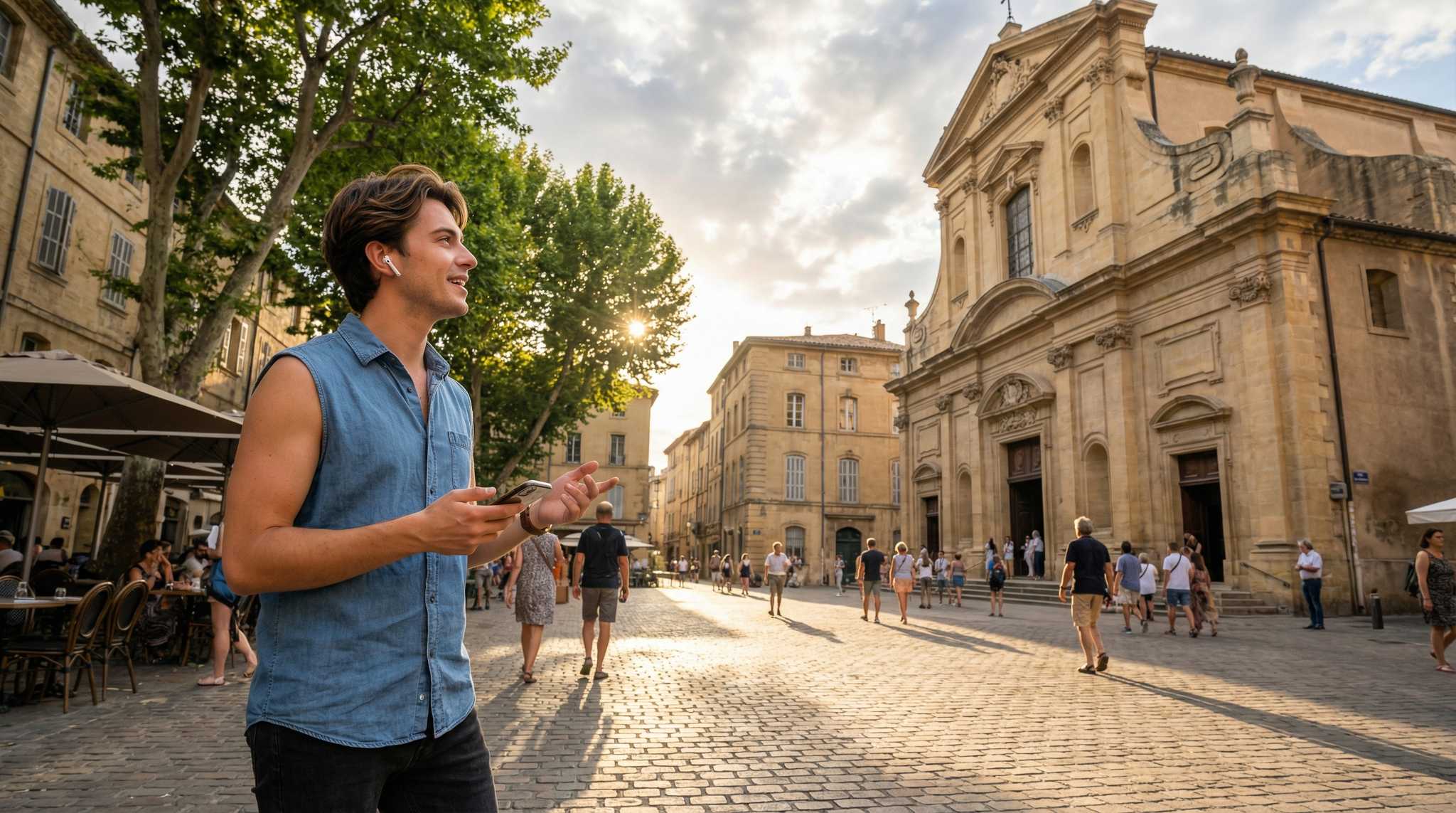
エクス=アン=プロヴァンス オーディオツアー:優雅さと芸術の響き
太陽の光が降り注ぐエクス=アン=プロヴァンスの木陰の下、黄金の邸宅が長い影を落とし、古の噴水が絶えずささやき続ける場所で、秘密が待っています。 このセルフガイドオーディオツアーで街の中心を探索し、ほとんどの人が見過ごしてしまう埋もれた物語や隠れた場所を解き明かしましょう。 象徴的なミラボー通りで王室の権威に逆らい、穏やかな南部に混乱を引き起こしたのは誰でしょうか? マドレーヌ教会の厳かなファサードの裏には、どんな何世紀もの秘密が眠っているのでしょうか? オテル・ド・コーモン(Hôtel de Caumont)の豪華な壁の中でスキャンダルを引き起こし、芸術家たちが何世代にもわたってささやき続けた有名な客とは誰でしょう? 革命と啓示が脈打つ曲がりくねった通りをさまよいましょう。輝く大通りから秘密の礼拝堂へと、街の移り変わる運命をたどり、語られざる物語ごとに足元でエクスが変化するのを感じてください。 さあ、冒険を始めましょう。エクス=アン=プロヴァンスのベールに包まれた歴史が、あなたを陽光から街の魅力的な深部へと導きます。
ツアーのプレビュー
このツアーについて
- schedule所要時間 30–50 mins自分のペースで進める
- straightenウォーキングルート 1.9kmガイド付きパスに沿って進む
- location_on
- wifi_offオフライン対応一度のダウンロードでどこでも使える
- all_inclusive無期限アクセスいつでも、ずっと再生可能
- location_onエクス=アン=プロヴァンスのプロテスタント教会から開始
このツアーのスポット
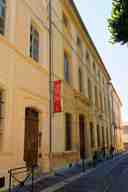
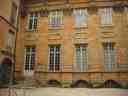
In front of you, you’ll spot the Gallifet Hotel-a long, pale ochre mansion with tall arched windows and an elegant wooden doorway, marked by a bright red flag that reads “Gallifet…もっと読む折りたたむ
In front of you, you’ll spot the Gallifet Hotel-a long, pale ochre mansion with tall arched windows and an elegant wooden doorway, marked by a bright red flag that reads “Gallifet Art Center” so just look for that flash of color along the quiet, narrow street. Imagine you’re standing in a secret pocket of time: sunlight bounces off the ochre stone, the same golden hue that’s witnessed centuries of drama, elegant soirées, and even whispered secrets of survival. This grand house, built in the eighteenth century, was once the jewel of Jean-Léon Leotard, a lord from the nearby mountains. But he wasn’t just building for himself. In a clever move worthy of a soap opera, he gifted it to the powerful Gallifet family as a wedding dowry-imagine that, a house as a wedding gift! Madeleine de Léotard d’Entrages married Simon Alexandre Jean de Galliffet, and so began the saga of this noble residence. The Gallifet family lived and thrived here for generations, building a reputation that was as solid as these walls. Their motto-“Do well and let them bark”-basically means “just do your thing and ignore the critics.” They produced presidents of parliament, military officers galore, and basically helped run the region. Let’s be honest: you’d have wanted them on your trivia team! Fast-forward a bit and the house had its share of history’s shadows. The Gallifet dynasty passed the keys to the Crémieux family in the mid-1800s, a prominent Jewish family who lived here until the ominous days of World War II. During those dark years, German officers took over the mansion, forcing the Crémieux family to flee for their lives. But here’s the twist: the Crémieux were “Jews of the Pope,” a special protected status dating back to centuries-old Papal edicts. Thanks to this, some members escaped the horrors of deportation-a glimmer of hope in the midst of turmoil. After the war, the house found itself in gentler hands: those of Maurice and Marguerite Mazet, who years later celebrated their tenth wedding anniversary by adding a grand colonnade-ten pillars for ten years of love. This wasn’t just for show; they and their descendants cherished the space as a place where art and life could thrive together. And so we jump to more recent times, when their grandson, Nicolas Mazet, opened the doors of Gallifet as a contemporary art center in 2010. Now, instead of stuffy silence, the ground floor and its shaded courtyard hum with creativity. You’ll find wild contemporary art, mysterious sculptures, concerts, and workshops. The garden is a dreamy escape, with the sound of a fountain trickling from a mascaron crowned with vines, and a colonnade that sparkles with memories. Take a moment-can you hear the echo of jazz from last summer’s Arty Jazz festival? Or imagine the surreal sight of a giant, red sculpture by Diadji Diop, as if a wise, multicultural figure was swimming right through the gravel at your feet. Every year, Gallifet hosts exhibitions that challenge tradition, spark conversation, and bring together artists from around the world-from enormous, vibrant prints to experimental street art. The doors out front might still bear traces left by famed French street artist Miss.Tic-yes, it’s a canvas as well as a door! Even the colors are inspired by the lush village garden behind these very walls. The building’s motto comes alive here, with artists daring to do something new, critics or no critics. So as you stand here, breathe in the mingled scent of lime blossoms, sun-warmed stone, and maybe, just maybe, the gentle hint of fresh paint from the latest exhibit. The Gallifet Hotel has survived weddings, wars, and wild ideas-and still, its message is clear: art and history aren’t just for looking at, they’re meant to be lived. Fascinated by the historical, art and culture or the the garden? Let's chat about it
専用ページを開く →
さらに7件のスポットを表示表示するスポットを減らすexpand_moreexpand_less
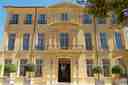
Right ahead, you’ll spot the majestic Hôtel de Caumont with its handsome honey-colored stone façade, elegant tall windows framed in blue, and a flourish of wrought iron…もっと読む折りたたむ
Right ahead, you’ll spot the majestic Hôtel de Caumont with its handsome honey-colored stone façade, elegant tall windows framed in blue, and a flourish of wrought iron balconies-just look for the grand entrance with the carved stonework, flanked by sculpted trees in perfect formation. As you stand before this splendid mansion, close your eyes and picture a time when powdered wigs were all the rage and horse-drawn carriages rattled through the cobblestone streets. The Hôtel de Caumont was born between 1715 and 1742, the work of Georges Vallon and Parisian architect Robert de Cotte. It wasn’t just a house-it was a statement, a sparkling jewel for the city's upper crust. Francois de Rolland, President of the Court of Auditors-no ordinary judge-commissioned this palatial residence. Over the decades, you’d have seen three generations of the illustrious Rolland de Réauville family sweeping through its halls, each one leaving a trace of glamour and a whiff of family drama behind. Now, imagine the clatter of hooves at the great portal as a carriage swings into the grand courtyard. The facade in front of you is a masterclass in harmony-tiers of perfectly matched windows, glistening stone from the legendary Bibémus quarries, and a doorway guarded by mythic faces: a faun, carved just above, forever grinning at newcomers. Stand under that balcony and look closely; you’ll see the swirling ironwork with its cast-iron stag, the proud symbol of the Bruny family, who took over in the mid-1700s. As the ages rolled by, the mansion would ring out with music, laughter, and the clink of crystal goblets-especially under Jean-Baptiste Jérôme de Bruny, a man who really knew how to throw a party fit for royalty. Legend has it that when Pauline de Bruny married the Marquis de Caumont, folks said he’d scooped up “the most beautiful girl, the finest mansion, the grandest château, and the fattest fortune in Provence.” Not a bad day’s work for the marquis! Of course, sometimes money can’t buy happiness, but it can buy one truly gorgeous family home. The adventure doesn’t stop at the doors. Step inside-if only with your mind-and you’ll find floors paved with a grand chessboard of black and white marble, sweeping staircases wrapped in wrought iron, secret fountains, and drawing rooms adorned with painted ceilings, golden gypseries, and rococo trimmings. During its most splendid years, this house witnessed moonlit balls, clandestine whispers of love, and perhaps the odd family feud over who got the comfiest sofa. And who could forget the elegant French gardens out back? Straight lines of sculpted boxwood, burbling fountains, and the flutter of songbirds on a summer morning. Fast-forward to the 20th century, and the Hôtel de Caumont took on new roles: conservatory of music, home to generations of students practicing scales and dreaming of applause. It was so posh, rumor had it even the ghosts preferred to hum Mozart. When the city of Aix considered selling it, the townsfolk nearly fainted into their croissants! Fortunately, a loving hand stepped in. In 2013, Culturespaces rescued and restored the building to dazzling perfection. Today, it’s a vibrant center for art and music, hosting blockbuster exhibitions on everything from Marilyn Monroe to Marc Chagall-and maybe, just maybe, a modern ghost who appreciates a good painting and a scone in the tearoom. So, as you gaze up at those regal windows shimmering in Provence sunshine, let your imagination roam. Behind each pane of glass, history twirls-secrets kept, fortunes won and lost, and beauty that simply refuses to fade. That’s the magic of Hôtel de Caumont: where every stone tells a story, and every story invites you inside. Shall we continue? Fascinated by the historical, today or the architecture? Let's chat about it
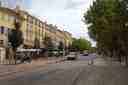
専用ページを開く →Ahead of you stretches a wide, tree-lined avenue bordered by elegant old honey-colored buildings, lively cafés with parasols, and rows of leafy plane trees; just glance down the…もっと読む折りたたむ
Ahead of you stretches a wide, tree-lined avenue bordered by elegant old honey-colored buildings, lively cafés with parasols, and rows of leafy plane trees; just glance down the long, sun-dappled promenade to spot the famous Mirabeau course. Welcome to the beating heart of Aix-en-Provence, the cours Mirabeau! Picture yourself back in the mid-1600s, when this lively boulevard was nothing more than the city’s southern wall, and a bunch of ambitious townsfolk schemed to turn it into the grandest parade route anyone had seen. They wanted somewhere wide enough to strut their stuff in carriages-and honestly, who doesn’t want a personal catwalk? So, at the parliament’s command, centuries-old fortifications were knocked down, and this avenue was born, its stones humming with the promise of future gossip and grandeur. Imagine the scene: horses trotting, wheels rattling on new paving stones, and townspeople-nobles on the sunny side, the less posh crowd guessing who belonged where. The locals were always keen on proper etiquette. Fancy a bit of drama? For years, you could only walk on the correct side of the street for your social class, and craftsmen opening shops here scandalized the city council. Instead, cafés flourished-inviting chatter, laughter, and a pot or two of local wine under leafy branches. The cours became the stage for all of Aix’s drama, pageantry, and, yes, even its plumbing mishaps. Sparks flew at grand celebrations, masked balls, and parades, with gold-laced coats, big powdered wigs, and glamorous carriages rolling past, while the city’s less fortunate sneaked along after dark. Here, news was invented as much as shared, fashion statements fizzed louder than champagne, and nobody wanted to be caught with mud-splashed shoes. That’s why they laid stone walkways for people to hop from carriage to pavement without taking a dip in the mud after a rainstorm. Speaking of rain-legend has it that in Aix, during a storm, you’d best use an umbrella for more than just the water, thanks to some ancient plumbing quirks! Over the centuries, everything from bustling markets to elegant cafes has lined this street. Four magnificent fountains still bubble along its length, including the famous “mossy” hot spring that steams mysteriously on chilly days. Want to spot something legendary? Take a walk to the end and check out the statue of King René, who stands holding a scepter in one hand, a bunch of grapes in the other, and maybe pondering why his monument took a month to travel from Paris. At the opposite entrance, stone statues by Truphème guard the cours, welcoming arts and science-and anyone ready for a good conversation. But life here was never just carriages and nobles. In the 19th and 20th centuries, shops and cinemas popped up. There was even a tramway-imagine, back in 1903, the excitement as the first tram rattled down the cours at the breakneck speed of 16 kilometers an hour! The tram didn’t last forever, replaced by buses after World War II, but you might spot rails peeking from under the road if you look closely enough. Through wars and peaceful days, demolition and rebuilding, the cours Mirabeau never really slowed down. Today, those café terraces invite you for an espresso where nobles once whispered secrets, beneath plane trees that replaced the ancient elms, and on smooth granite where nobles and everyday folks now walk side by side. Relax and soak up the living, breathing story of Aix’s biggest boulevard-a place where ceremony and snack breaks work perfectly together. Oh, and if it starts raining, just remember the old saying: in Aix, “when it rains, it pours… everything!” Seeking more information about the location and access, historical or the monuments of the cours mirabeau? Ask away in the chat section and I'll fill you in.
専用ページを開く →To spot the Natural History Museum, look for a stately ochre building with grand windows framed by ornate stonework and a flight of stone steps leading to double doors. Right…もっと読む折りたたむ
To spot the Natural History Museum, look for a stately ochre building with grand windows framed by ornate stonework and a flight of stone steps leading to double doors. Right now, you’re standing in front of a place bursting with stories almost as wild as some of its creatures. Imagine it’s 1838: the world is on the edge of scientific adventure, and a geologist named Henri Coquand is teaming up with an extraordinary group of Aix locals-including a very determined widow, Madeleine Carle. After her pharmacist husband passed away, Madeleine convinced the city to buy his bizarre collection of exotic birds and curiosities. Suddenly, what had been a trove of oddities in her living room was about to become the very heart of the first cabinet of natural history here in Aix-en-Provence. It all started in two rooms at the city hall, filled with bones, feathers, minerals, and the bubbling excitement of discovery. Picture the scientific hustle and bustle-early curators like Coquand and his successor Léon Martin passing through the musty halls with arms full of fossils, new donations arriving from local dignitaries, and, of course, the first visitors pressing in to see wonders from near and far. The opening was even announced by the local newspaper-fitting for a museum that would soon become the pride of the town. But the glory days didn’t last forever. As the years rolled on, the treasures lost their shine, dust gathered, and visitors trickled away. It looked like the museum might become just another curiosity. That is, until 1892, when Louise Rostan d’Abancourt-whose energy could have powered half of Provence-offered the city a colossal collection of minerals, shells, fossils, and prehistoric objects. Her donation, and another from her friend Dr. Philippe Aude, revived the museum. Suddenly, the little collection had outgrown its home, moving to a bigger room called the “Louise Rostan d’Abancourt Hall,” but even that soon filled to the rafters. Louise was relentless, fighting for a real building until her last breath-only it wasn’t finished before she died in 1903. Imagine the excitement in 1905 when at last the new museum on boulevard du Roi-René opened its doors. Five thousand people poured in that very day alone! The halls rang with children’s laughter, excited footsteps, and the wide-eyed awe of seeing dinosaur eggs for the first time. Through the decades, the museum survived wars, fires, army occupations, and collections being hidden away for safety. Once, in 1944, flames threatened its very existence-some collections were lost forever, but enough remained to let the story continue. In the wild 1950s, the discovery of actual dinosaur eggs near Sainte-Victoire mountain made the museum famous across France. The riches inside would leave any explorer green with envy: over 70,000 fossils-including dinosaurs like titanosaurs and rhabdodons, ancient crocodiles, and tortoises; a paléobotany collection to make any botanist swoon; and a treasure trove of North African archaeological relics. Some of these items are so rare they’d make Indiana Jones raise an eyebrow! There’s a dizzying number of zoological specimens as well-over 500 mammals, almost 2,000 birds, and nearly 90,000 mollusks. The museum even boasts an herbarium with 300,000 plants and some very curious items from the world of ethnology, from Pacific island dioramas to West African masks that somehow escaped decades of turmoil and disappearance. Today, though the museum itself is closed to the public and the collections are scattered in various spots, its spirit endures-quiet but alive, just waiting for the next visitor to marvel at its wonders after so many years. Let’s hope the future brings a new home, and maybe, just maybe, a few fewer dinosaur eggs to trip over.
専用ページを開く →Take a look ahead! You can spot the Church of the Madeleine by its tall, imposing classical façade, colored in pale stone, standing proudly at the edge of Place des Prêcheurs.…もっと読む折りたたむ
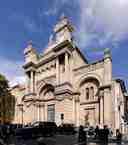
Take a look ahead! You can spot the Church of the Madeleine by its tall, imposing classical façade, colored in pale stone, standing proudly at the edge of Place des Prêcheurs. With its broad steps and sculpted figures, it stretches up towards the sky, like it’s about to break into a song-or maybe tell you a few secrets from eight centuries of history. Now that you’re standing before the Church of the Madeleine, take in that sense of centuries layering atop each other. Imagine the year is 1272: horses' hooves clatter over the cobblestones, monks in flowing black robes pass by in silence, their sandals slapping the ground. This very spot was chosen by Dominican friars, who had just arrived in Aix-en-Provence thanks to a generous count, only a few years before the church was first built. But don’t let this grand old building fool you-it’s been through more makeovers than a reality TV star! An earthquake left it shaken, a fire tried to roast it, and its own enthusiasm for rebuilding even led to part of it collapsing in 1485. (Sometimes, even churches need to slow down and read the instructions!) Local lords, queens, and kings were all tangled up in its fate, from Raimond-Bérenger V gifting land to the monks, to the states of Provence deciding inside its walls that they’d join France. That makes this not just a church, but the dramatic stage for some pivotal moments in history-think of it as Aix-en-Provence’s own “Game of Thrones,” but with fewer dragons and more incense. Fast forward to 1691, when master builder Laurent Vallon and his team were called in for a total transformation. You’d hear the chiseling of stone, the sling and clang of scaffolding, as the church was rebuilt in the elegant classic style you see now-all rounded arches and stately columns. Even in the 19th century, the talented architect Henri Révoil gave the façade its last extreme makeover, with the sculptor Auguste Bosc adding a tympanum (that’s the fancy bit over the door) showing Mary Magdalene herself with Jesus. Of course, the Madeleine is not just famous for its stones and statues. The church has starred in quite a few important life events: Right here, Paul Cézanne, the future trailblazer of modern art, was baptized as a baby. André Campra, who helped jazz up French opera, had his first holy splash here too. And, back in its heyday, this was the final resting place for Aix’s most illustrious families and statesmen. Don’t forget the music! The Madeleine’s grand organ, built in 1743 by Jean-Esprit Isnard, might look quiet now, but it’s hiding a whopping 3,500 pipes. Can you picture it? In the candlelight, the organ thunders into life, echoing off marble and stone under painted vaults, filling the air with music-and maybe, if you listened closely, a few off-key notes if the squirrels got involved (hey, anyone can have stage fright). Art lovers-you’d have feasted your eyes on masterpieces like “The Death of Saint Joseph” by van Loo, or “The Martyrdom of Saint Paul,” originally spirited away from Belgium with all the drama of an art heist, only to end up gracing the altar here. Even relics from the Revolution, like a 1443 triptych, were sheltered from destruction inside these walls. Everything grand comes with a price, though. By 2006, the church was closed for major restoration-its ancient bones needed some serious TLC after earthquakes, centuries-old shops leaning on its side, and just plain old age. For years now, behind these doors, experts have been bustling about, gently stabilizing stone arches, cataloging each artwork, and shooing away imaginary pigeons. According to the latest news, the Madeleine will soon be ready for a glorious rebirth-just one final round of dusting, hammering, and maybe a little Poltergeist prevention. So, as you gaze at this silent giant, imagine all those lifetimes: the smoky incense, the echo of sermons, the sounds of decision-making that changed the course of Provence, and the laughter of children baptized, some of whom grew up to change the world. The Church of the Madeleine may be closed to visitors at the moment, but its history is anything but quiet-it’s humming beneath your feet, just waiting to burst into song again. Fascinated by the organ, personalities baptized in the church or the personalities buried in the church? Let's chat about it
専用ページを開く →To spot the Aix-en-Provence International Festival of Lyric Art, look ahead for the lively arc of water sprays catching the sunlight-right where a statue stands surrounded by…もっと読む折りたたむ
To spot the Aix-en-Provence International Festival of Lyric Art, look ahead for the lively arc of water sprays catching the sunlight-right where a statue stands surrounded by dancing droplets and a leafy tree canopy. Let’s set the scene: imagine you’re in the heart of summer in Aix-en-Provence. The air is warm, and the faint scent of lavender sometimes drifts by, but now, you’re surrounded by the gentle splash and hiss of water from the grand fountain nearby. It’s more than just a fountain-it’s a symbol of a festival that has made this city sing aloud every summer since 1948! Here, just a few steps away, the magic of opera and classical music has blossomed into one of Europe’s most celebrated musical gatherings: the Aix-en-Provence International Festival of Lyric Art. In its earliest days right after World War II, the city needed a bit of joy (don’t we all?), so an ambitious music lover named Gabriel Dussurget, with the help of the generous countess Lily Pastré, decided to create an event that would bring music soaring over Aix. The first festival arose in the open-air courtyard of the old Archbishop’s Palace, the night stars providing the only roof. The scene was set for Mozart’s “Così fan tutte”, and suddenly, it was as if characters from the opera-Fiordiligi and Dorabella-were almost about to stroll down the Mirabeau, singing their way into the hearts of the crowd. As the years passed, opera lovers flocked here not just for Mozart but for the drama of “Don Giovanni”, with new breathtaking stage sets appearing in 1949. Imagine the excitement and a dash of nervousness each year as a fresh audience, eager journalists (over 200 of them in recent years!), and even television crews from France to Japan crowded the city, hoping to catch a once-in-a-lifetime performance. Through the decades, each festival director added their signature touch-Bernard Lefort opening the stage to the dazzling voices of Verdi and Donizetti, Louis Erlo inviting the timeless music of baroque masters like Purcell and Rameau, and then, in the late 1990s, Stéphane Lissner orchestrating a world-famous “Don Giovanni” with Peter Brook and Claudio Abbado, turning heads from Vienna to New York. The venues themselves evolved right alongside the music: not just the Archbishop’s Palace anymore, but the opulent Grand Théâtre de Provence and the intimate Théâtre du Jeu de Paume began to hum and reverberate with arias and overtures. And what a following there is! Imagine: over 86,000 people gathering in a single summer, some dressed up like it’s the Oscars, others arriving straight from the market still holding their baguettes under their arms, all falling under the spell of the music. The festival isn’t just for the musical elite anymore-it’s an annual celebration for everyone, from lifelong opera fans to unsuspecting first-timers who wander in and leave dazzled. In these open-air nights, you might hear Wagner’s epic “Ring” cycle or the otherworldly twist of a brand-new opera, all happening as dusk settles over Aix. Over the years, the festival has become a leader in opera innovation, honored with grand prizes and recognized across Europe. Even in tough times-like 2020, when the world fell oddly silent due to the pandemic-the spirit of the festival pulsed on, ready to burst back to life. As of 2025, it’s even been awarded the prestigious Birgit-Nilsson Prize for artistic achievement. Not bad for a festival that started in a little courtyard, inspired by musical ghosts and the dream of sharing Mozart under a southern sky. So as you stand here, take in the energy: the delicate mist of the fountain, the anticipation that lingers from music waiting to be played, and the history that swirls with every breeze. For every dramatic note sung, every spectacular set, and every memorable summer memory, you’re part of a living story-right where the world’s greatest voices meet Aix-en-Provence.
専用ページを開く →
よくある質問
ツアーはどうやって始めますか?
購入後、AudaToursアプリをダウンロードして引き換えコードを入力してください。ツアーはすぐに開始できます。再生ボタンをタップして、GPSガイド付きルートに従うだけです。
ツアー中にインターネットは必要ですか?
いいえ!開始前にツアーをダウンロードしておけば、完全にオフラインで楽しめます。チャット機能のみインターネットが必要です。モバイルデータを節約するため、WiFi環境でのダウンロードをお勧めします。
これは団体ツアーですか?
いいえ、これはセルフガイド式のオーディオツアーです。ガイドや団体、決まったスケジュールに縛られることなく、スマホから流れるナレーションを聴きながら自分のペースで自由に探索できます。
ツアーの所要時間は?
ほとんどのツアーは60〜90分で完了しますが、ペースは完全に自由です。好きな時に一時停止したり、スポットを飛ばしたり、休憩を取ったりできます。
今日中にツアーを終えられない場合は?
問題ありません!ツアーには無期限でアクセスできます。明日、来週、あるいは来年でも、好きな時に再開できます。進行状況は保存されます。
どの言語が利用可能ですか?
すべてのツアーが50以上の言語に対応しています。コードを引き換える際にお好みの言語を選択してください。注意:ツアー生成後に言語を変更することはできません。
購入後、どこからツアーにアクセスできますか?
App StoreまたはGoogle Playから無料のAudaToursアプリをダウンロードしてください。メールで届いた引き換えコードを入力すると、ライブラリにツアーが表示され、ダウンロードして開始できるようになります。
もしツアーを楽しめなかった場合は、返金いたします。お問い合わせ先: [email protected]
以下の決済で安全にチェックアウト 


