
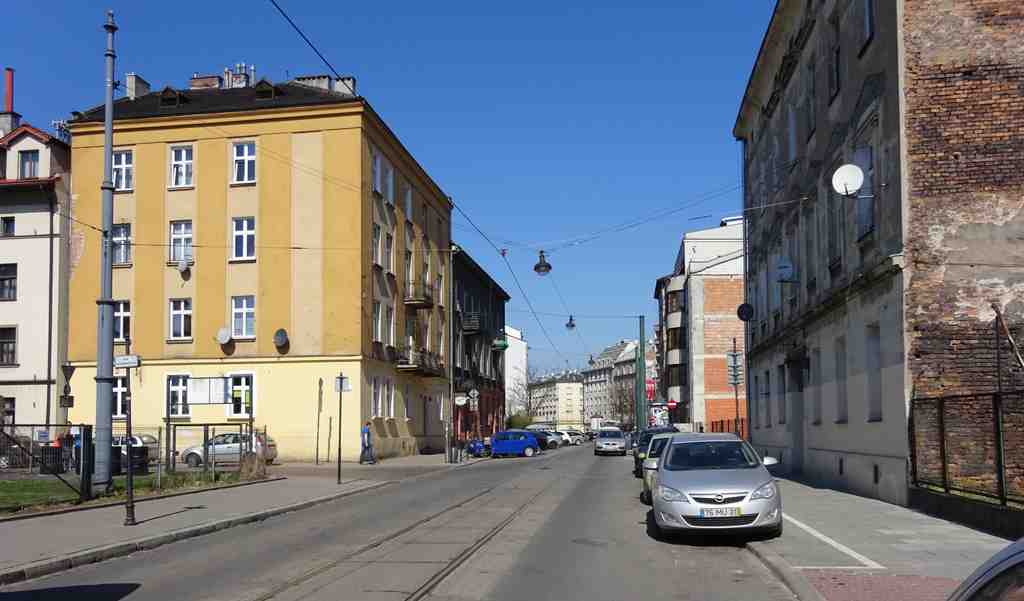
Dajwór is a long, straight street lined with plaster-fronted tenements and red-brick industrial buildings, with tram tracks running firmly through its centre.
It looks like ordinary city fabric. That is precisely the point. Streets like this absorb history without announcing it.
In the seventeenth century, this was not yet a proper urban street at all. A road ran here along the eastern walls of Kazimierz, leading to a farm. In sixteen forty, Marcin Dajwór leased that farm, and people began calling the route the Road to Dajwór. Later, in the eighteen forties, planners fixed the street in its present form. Officials tried to rename it Wałowa in the eighteen eighties, but residents kept saying Dajwór until the city finally accepted the popular memory.
At number one, the Popper Synagogue tied this street to Jewish life from sixteen twenty onward. You have already met Wolf Popper. Here, his legacy becomes more difficult. During the Second World War, the synagogue suffered devastation, and the Jewish residents of this street were forced into the ghetto in Podgórze. After the war, builders repaired the synagogue, but they did not restore it faithfully. Between nineteen sixty-five and nineteen sixty-seven, they bricked up the niche for the Aron ha-kodesh. They turned the entrance from Dajwór into a window. They removed the wooden arcades and side annexes. So the building survived, yet part of its old face vanished.
That pattern repeats along the street. In the late nineteenth century, a brickworks here made prized roof tiles. Tram lines arrived. At number twenty-seven, engineers raised a municipal power station in the years from nineteen oh-four to nineteen oh-eight, though Kraków’s gas authority resisted electric power for years. Across the street, a transformer station from nineteen thirty still shows a lightning emblem on its brick wall.
And then, quietly, life returns. At number eighteen, the Galicia Jewish Museum documents what endured, and Tanja Segal leads a musical Shabbat there each Friday.
Dajwór teaches a sober lesson: a calm facade can carry rupture for centuries. We’ll follow that thread next at the Galicia Jewish Museum, just ahead.




