

Tour audio di Trondheim: Dalle piste di pattinaggio ai bunker di fanteria
Sotto i tetti tranquilli di Trondheim, i segreti scoppiettano come foglie autunnali—basta guardare oltre le facciate luminose e ascoltare. Questo tour audio autoguidato ti porta dai campi da calcio costruiti con pochi spiccioli alle scuole di mattoni rossi dove gli studenti un tempo saltavano dalle finestre per un assaggio di avventura. Scoprirai quale quartiere ha scatenato una ribellione cittadina per i piani edilizi? Quali ombre si nascondono su Kirkegata dove un famoso violinista si esercitava da ragazzo? Chi, esattamente, possedeva il metro quadrato di terreno più strano nella più folle raccolta fondi di Rosenborg? Attraversa litigi politici, leggende musicali e racconti di uno spirito comunitario eccentrico. Ogni passo estrae drammi nascosti da strade familiari e trasforma angoli dimenticati in storie viventi. Alla fine del viaggio, la città si sente elettrica—stratificata di risate, rivalità e sorprendente coraggio. Premi play e lascia che i veri colori di Trondheim si rivelino in ogni eco e pietra.
Anteprima del tour
Informazioni su questo tour
- scheduleDurata 30–50 minsVai al tuo ritmo
- straighten3.7 km di percorso a piediSegui il percorso guidato
- location_on
- wifi_offFunziona offlineScarica una volta, usa ovunque
- all_inclusiveAccesso a vitaRiascolta quando vuoi, per sempre
- location_onParte da Ferrovia di Rosenborg
Tappe di questo tour
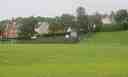
To spot Rosenborg Railway, look out for a wide open green football field with simple metal goalposts, old stone bleachers, and small colorful houses just beyond the trees in the…Leggi di piùMostra meno
To spot Rosenborg Railway, look out for a wide open green football field with simple metal goalposts, old stone bleachers, and small colorful houses just beyond the trees in the background. Alright, as you stand here on the edge of this bright emerald field, take a deep breath and imagine the whirlwind of excitement back in 2006-this pitch was the talk of the town! Before, there was just a rough, dusty gravel patch where hopeful kids practiced their shots, sometimes swallowing more dust than pride. But then, the football clubs FK Kvik and IL Trond, together with Sparebank1, had a wild idea: “Let’s build a real football field!” Only one problem-money doesn’t exactly grow on Norwegian fir trees. So, the community sprang into action with a “lightning fundraiser”! Picture it: posters everywhere, parents desperately shaking piggy banks, local shops cheering people on, and one bold plan-anyone could buy 1 square meter of the turf for 500 kroner. Maybe you’d own the penalty spot, or maybe-if you were unlucky-the corner flag that everyone avoided during sprints. And what a transformation! The soft, shiny artificial grass replaced the old sandpit, while nearby, the original grass pitch-still lovingly cared for by the city-kept its place. Once, the mighty Trondheims-Ørn women’s team played their matches here, filling the stands with cheers before moving to a new home in 2006. Today, beneath those cheerful houses and swaying birch trees, you’re standing not just on a field, but on the hard work-and a little bit of humor-of an entire neighborhood. And hey, if you feel a sense of pride, maybe it’s because your own shoes are touching a patch that someone “bought” in a rush to build something special!
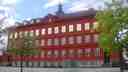
Apri pagina dedicata →You’re looking for a large and unmistakable red-brick building with a little tower and a clock at the top-right in front of you, stretching across the square, you can’t miss…Leggi di piùMostra meno
You’re looking for a large and unmistakable red-brick building with a little tower and a clock at the top-right in front of you, stretching across the square, you can’t miss it! Now, picture yourself standing right here back in the crisp autumn air of 1898. Imagine there’s no grand red wall yet-just five cheerful wooden pavilions, freshly built and smelling of sawdust and promise. With laughter bouncing off the rooftops, children rush through the new Bispehaugen School’s doors, probably without even knowing that this place would become a cornerstone of Trondheim’s community. But long before any of these buildings sprang up, kids from the Møllenberg area walked dusty roads to Bakklandet Friskole-a school born in 1778 by the inspiration of Bishop Marcus Fredrik Bang, with separate classes for boys and girls. Boys were eventually moved to an old mill called Graamølna. During recess, wild with energy, some students jumped right out the windows for a refreshing swim in the sea below. I bet the teachers were always on high alert! As Trondheim began to grow through the 1880s and 90s, there was a baby boom on Møllenberg-a lot of kids needing more space to learn and play. The poor old Graamølna just couldn’t keep up; between rickety floors and overcrowding, it wasn’t unusual for students to dream of a spacious, proper school above the bustling city streets. So, the local leaders decided: it was time for a state-of-the-art school, something grand enough to hold up to 1600 students. Arguments broke out at City Hall-should Bispehaugen be made of several small wooden buildings or just one enormous brick masterpiece? In the end, they started with the pavilions. By September 26, 1898, Bispehaugen opened its doors with a whoosh of cold air and new hopes, but even that soon felt cramped. Fast forward to 1918, a decision was made: it was finally time for a school as solid and bright as the city’s spirit. A whole new red-brick giant began to rise, built at record speed on a plateau that offered sweeping city views-imagine the clang of bricks and the shouts of masons. The final result was so impressive that it earned the architect, Carl J. Moe, a special award for excellence. Trondheimers called it “the city’s most splendid new creation,” and you can see why. Inside, students found wide, sun-filled corridors and classrooms designed for fresh thinking-a real upgrade from jumping out windows for fun, though I suspect some mischievous spirits still lingered. There were, believe it or not, gym classes held beneath the beams of the attic, sunlight pouring in through skylights. Wouldn’t you love to have done cartwheels up there? Bispehaugen was also famous for its school band, the legendary “Småbispan,” first started back in 1909. You can almost imagine the sound of trumpets and drums drifting across the neighborhood on parade day. And here’s a fun twist: it was for boys only at first, until 1955, when girls-finally!-were allowed to join, bringing a whole new energy and balance to the band. Standing here now, you might notice the gentle curve of the street, how the school seems to anchor this whole block. It divides old Trondheim into before and after-before Bispehaugen, when students took chilly plunges during recess; and after, when the city’s children had the grandest of stages for learning, exploring, and making a bit of noise of their own. So, take a look up at those rows of bright windows-imagine the buzz of new ideas flowing, and remember, every corner of this place has stories etched into its red-brick bones. Onward with the tour? I promise the next stop won’t require you to jump out any windows!
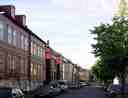
Apri pagina dedicata →To spot Kirkegata, just look for the row of charming wooden houses lined up along the left side of the street, their colors quietly glowing under the Trondheim sky, while leafy…Leggi di piùMostra meno
To spot Kirkegata, just look for the row of charming wooden houses lined up along the left side of the street, their colors quietly glowing under the Trondheim sky, while leafy trees watch over from the right. Now, let’s imagine you’re stepping onto Kirkegata back in 1878, when horse carts rattled by and the air was thick with the smell of wood smoke and fresh bread. Kirkegata was named after Bakke Church, which sits just on the west side - almost as if the church is keeping an eye on everyone strolling by. This street was the heartbeat of Trondheim’s hardworking folks, the workers who built the city-maybe a bit loud, always lively, and definitely never boring. Take a peek at number 5 along the street. If you listen carefully, you might almost hear faint violin notes floating through the air. That’s because legendary violinist Arve Tellefsen grew up right there. And number 1? It’s not just any house-it’s a grand old mansion built in 1880, proudly watching over the street like a wise old owl. If you wander a bit further, you’ll spot “Småtta” at number 14, the tiniest apartment building on the block-neighbors probably passed more than a cup of sugar through those close-set windows! Kirkegata’s wooden house walls have heard stories of laughter, hard work, and maybe a little gossip. Who knows, a friendly ghost or two might be listening to us right now. So, stroll slowly and soak in the whispers of Trondheim’s past that dance along Kirkegata.
Apri pagina dedicata →
Mostra altre 8 tappeMostra meno tappeexpand_moreexpand_less
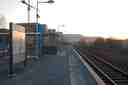
You’ll spot Lademoen Station by looking for a simple, modern platform with a tall sign saying “Lademoen,” metal bins, and a small glass shelter overlooking the straight stretch of…Leggi di piùMostra meno
You’ll spot Lademoen Station by looking for a simple, modern platform with a tall sign saying “Lademoen,” metal bins, and a small glass shelter overlooking the straight stretch of railway tracks-just past the blue-wrapped buildings and construction crane. Welcome to Lademoen Station-or should I say, Lademoen/Nedre Elvehavn, depending on whom you ask! This stop is a fresh face in Trondheim’s railway family, only opening its doors in 2007, yet it sits surrounded by the energetic hum of city life. If you pause and listen, you might catch the distant, a little reminder that this is a heart-thumping crossroads for students, professionals, and locals alike. From here, you’re just under a kilometer from Trondheim’s Central Station and only six meters above sea level-talk about traveling at ground level! But aha, don’t let the calm fool you. The tale of this spot has the kind of identity confusion that would make even the savviest city historian scratch their head. Years ago, this part of town was home to a thriving industrial site, Trondheims Mekaniske Verksted, until progress called for urban renewal. When the time came to name the station, local politicians decided, “Let’s be traditional!”-so they picked “Lademoen.” Problem is, the original Lademoen Station had moved to another neighborhood and taken on the name “Lilleby.” Now, humor me here: the ‘Lademoen’ you’re standing at is actually in Nedre Elvehavn, while the ‘Lilleby’ stop is up in what used to be Lademoen. Still with me? You’d need a map and maybe a cup of coffee just to keep up. Nowadays, you’re in the middle of life’s hustle-surrounded by big business names, students from the Academy of Fine Art, and the buzz of Solsiden. As you soak up the chilly air and the click of footsteps on the platform, remember: every platform here tells the story of a city forever reinventing itself, and sometimes getting hilariously tangled up in its own history. So, keep your ticket handy and your sense of direction even handier!
Apri pagina dedicata →To spot Dora I, look for an enormous, fortress-like concrete building with thick walls and a flat roof, stretching long behind the railway tracks, topped by a modern blue upper…Leggi di piùMostra meno
To spot Dora I, look for an enormous, fortress-like concrete building with thick walls and a flat roof, stretching long behind the railway tracks, topped by a modern blue upper story that almost looks like a giant, window-lined box sitting on an older, grey bunker. Now, take a deep breath and imagine you’ve just stepped back into the world of wartime Trondheim. Right in front of you stands Dora I - the city’s grandest concrete giant, a real-life relic of World War II. Behind those unyielding, grey walls is a story built with sweat, steel, and more than a little wartime drama. Back during the chaos of 1940, when Norway fell under German occupation faster than you could say “smørbrød,” German naval officers soon realized Norwegian shipyards weren’t quite up to keeping their prized U-boats afloat. So what did they do? Well, they ordered up a monstrous bunker to keep their submarines safe from the relentless eyes in the sky. And believe me, when the Germans say “bunker,” they really mean it: Dora I’s concrete roof is thicker than a stubborn Norwegian winter, with over three meters of grumpy, steel-reinforced protection! Construction began in 1941, with the Todt Organization and Sager & Wörner from Munich managing the show. Their hired hands, however, were mostly forced laborers dragged in from occupied lands, including many Serbians. The worksite became a tough, tense world, with workers battling cold, hunger, and each other’s languages as much as they battled with backbreaking construction. Listen carefully - doesn’t this place just hum with echoes of clanging tools and shouted orders? Here’s one chilling rumor that kept the workers up at night: when a wall collapsed, five Serbian workers lost their lives, and some whispered that their bodies-like curses-remained forever sealed in the concrete slabs. German engineers decided that didn’t make for sound construction, though, so the truth is a bit more mundane - the bodies were removed, but the legend lingers in the air like the smell of old diesel fuel. But it wasn’t just tough labor; getting enough building material was like trying to collect sunshine in a bucket. Norway, with its picturesque wooden houses, proved a terrible supplier of concrete. Sand, gravel, and steel often had to be shipped in over seas rougher than a bear on a unicycle. Roads and railway tracks vanished regularly under heaps of snow and ice, and even the prefab huts shipped in for workers ended up being as useful as a chocolate teapot. Sometimes the only thing running on schedule were the rumors! Dora I was supposed to have a grand second floor with offices and workshops, but after all these headaches, they abandoned that plan. The land itself was soft and muddy, making the structure settle like a tired sumo wrestler. In fact, the whole bunker sagged up to 15 centimeters. Building Dora I was a Herculean task, but eventually, in 1943, it opened its submarine jaws to the German Kriegsmarine as the home base for the mighty 13th U-boat Flotilla. These roaring steel monsters would glide in and out of their blast-proof garage, hiding from overhead bombers. The Allies did try to knock this place out, and in 1943 and ’44, you’d have heard the thunder of distant bombs and read reports of big delays and heavy destruction on the surrounding area. Yet the Dora I bunker itself came away with only minor bruises-tough cookie, this one. Then came the war’s end. The Germans surrendered, and you can almost picture the moment: silence, only the restless lap of water and footsteps echoing through the cavernous pen. There were plans to blow up Dora I with dynamite, but local officials soon realized that would add a little too much “open-plan” to the neighborhood, not to mention some serious property damage. Instead, Norwegian submariners made themselves at home until the 1950s-yes, keeping their own fleet inside what was once the enemy’s fortress! Later, two blue-painted stories were added, making the building look like someone tried to put a trendy hat on an ancient viking. Today, these submarine pens, which once bristled with secrets and danger, are filled with archivists, bowlers, business folks, and civilian boats bobbing gently in the pen. If these concrete walls could talk, they’d surely have a few salty tales to share-and perhaps, just perhaps, a joke about how they used to house fleets and now they shelter bowling shoes. So take it all in: thick, battered, and stubbornly standing-Dora I turned from fortress of war to warehouse of memories. If you listen closely, you might just hear the whispers of the past blending into the laughter and life of today.
Apri pagina dedicata →To spot E.C. Dahls bryggeri, just look ahead for a large, bright white industrial building with a striking castle-like tower near one end, standing tall beside the road with the…Leggi di piùMostra meno
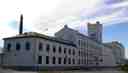
To spot E.C. Dahls bryggeri, just look ahead for a large, bright white industrial building with a striking castle-like tower near one end, standing tall beside the road with the proud "DAHLS" name written on the side. Welcome to E.C. Dahls bryggeri-the crown jewel of Trondheim’s brewing scene, where history is as rich as the foam on a freshly poured pilsner. If you listen closely, you might just hear the clinking of bottles and the cheerful chatter of brewmasters echoing through time. Let’s travel back to 1856. Trondheim is bustling, and a man named Erich Christian Dahl, who had already made his fortune trading grain and salted herring, is about to shape the city’s future. He acquired a place called the Sukkerhuset and, after a couple years of banging pipes and rearranging barrels, he started what would soon become Norway’s mightiest northern brewery. And get this: the very first beer, a golden Bayer, was bottled just a year later. You can almost picture the townsfolk queuing up to see what all the fuss was about-a new beer, light and fresh, made by skilled hands like that of Christopher Olsen, the carpenter-turned-brewmaster with just a few months’ brewery training under his belt. Trondheim’s pubs and the city’s thirsty workers quickly discovered Dahl’s secret: his beer not only tasted good, it stayed good, even on journeys as far off as Rio de Janeiro. Since those early days, E.C. Dahls has always thought big. It grew from a humble operation to a roaring industrial powerhouse with noisy steam engines and workers bustling between massive vats. For a while, it was the largest brewery north of the Dovre mountains. Talk about climbing the “brewer’s ladder!” Now, Erich Christian Dahl himself rose to become one of Norway’s wealthiest men, reportedly leaving behind a fortune of 1.6 million kroner-quite a nest egg for a man who started out shipping fish and wheat. After he passed away, the brewery was snapped up by some of Trondheim’s most ambitious business families, like the Lysholms, who added their own flair and even started brewing special seasonal beers like the famous Lysholmer Spesialøl. But brewing in Trondheim wasn’t always friendly neighborly competition-it was, at times, a real foam fight! In 1966, after years of spirited rivalry (and perhaps a few heated discussions over a barrel or two), E.C. Dahls merged with the city’s other top brewery, Aktiebryggeriet. This merger was like two rival football teams joining forces to create a super-squad-there was excitement, tension, and maybe a little suspicion at first, but it led to a powerhouse that brewed everything from pilsner to mineral water. By the 1970s and 1980s, E.C. Dahls was branching out, even buying up breweries as far north as Bodø. The factory’s roar filled the air, and truck after truck rolled down Strandveien, loaded with crates of beer and bottles of soda. Speaking of soda, for over a hundred years, this place was also Trondheim’s own soda fountain, churning out everything from selters water to apple-flavored Solo and holiday-favorite julebrus. People here love their ginger ale with local dishes like sodd-so if you get a chance to try it, you’re tasting a real piece of tradition! All along, E.C. Dahls stayed at the heart of Trondheim’s party scene, fueling celebrations and quiet evenings both. Even after it merged with larger groups like Ringnes and ultimately Carlsberg, the brewery never lost its local charm. In 2016, after a major renovation, these gates opened wide to visitors-that means you can not only taste the history but walk through it, explore the machinery, or enjoy a beer in the stylish Pub and Kitchen. And let’s not forget the beer! From the dark bayer of old to today’s Dahls Pils and bold craft brews like Ramp Pale Ale, Bolt IPA, and Passion Fruit Sour, the taps never run dry. E.C. Dahls’ ingenuity has been recognized across the continent, bagging gold medals at the European Beer Challenge for their ultra-crisp Dahls Pils and bold, wintry flavors of Kong Vinter. So take a breath-can you smell that hint of malt in the air? Behind these stately white walls, over 160 years of laughter, labor, and legend are still alive and well, just waiting for you to sample. Cheers to that!
Apri pagina dedicata →

Domande frequenti
Come inizio il tour?
Dopo l'acquisto, scarica l'app AudaTours e inserisci il tuo codice di riscatto. Il tour sarà pronto per partire immediatamente – tocca play e segui il percorso guidato dal GPS.
Ho bisogno di internet durante il tour?
No! Scarica il tour prima di iniziare e goditelo completamente offline. Solo la funzione chat richiede internet. Ti consigliamo di scaricare tramite WiFi per risparmiare dati mobili.
È un tour guidato di gruppo?
No – è un tour audio autoguidato. Esplori in autonomia al tuo ritmo, con la narrazione audio riprodotta dal tuo telefono. Nessuna guida, nessun gruppo, nessun orario.
Quanto dura il tour?
La maggior parte dei tour richiede 60–90 minuti, ma sei tu a controllare il ritmo. Metti in pausa, salta le tappe o fai pause quando vuoi.
E se non riesco a finire il tour oggi?
Nessun problema! I tour hanno accesso a vita. Metti in pausa e riprendi quando vuoi – domani, la prossima settimana o il prossimo anno. I tuoi progressi vengono salvati.
Quali lingue sono disponibili?
Tutti i tour sono disponibili in oltre 50 lingue. Seleziona la lingua preferita quando riscatti il codice. Nota: la lingua non può essere cambiata dopo la generazione del tour.
Dove accedo al tour dopo l'acquisto?
Scarica l'app gratuita AudaTours dall'App Store o Google Play. Inserisci il codice di riscatto (inviato via email) e il tour apparirà nella tua libreria, pronto per essere scaricato e avviato.
Se il tour non ti piace, ti rimborseremo l'acquisto. Contattaci a [email protected]
Pagamento sicuro con 


