Audioguida di Napoli: Segreti del Cuore Storico di Napoli
Una stella d'argento segna una facciata crivellata di proiettili a Napoli, sussurrando segreti di monarchi scomparsi e miracoli proibiti. Sotto il luminoso caos della città giacciono strati di sconvolgimenti, tradimenti e passioni che persino i napoletani di lunga data trascurano. Questo tour audio autoguidato ti permette di immergerti in vicoli e piazze che nascondono secoli di scandali, ribellioni e affari loschi—esperienze che la maggior parte dei turisti non scoprirà mai. Quale complotto mortale si svolse al Gesù Nuovo sotto quei simboli criptici? Quale fantasma si aggira ancora per San Domenico Maggiore, cercando giustizia per un omicidio irrisolto? Perché un'intera ala fu sigillata per sempre all'interno di Santa Maria La Nova dopo una singola visita a mezzanotte? Passa dalla luce all'ombra mentre storie nascoste ti trascinano avanti. Stai dove le rivoluzioni si accesero, dove i monaci ruppero i loro voti, dove il silenzio stesso vibra di voci e rivelazioni. La vera Napoli pulsa sotto ogni pietra. Inizia ad ascoltare e lascia che le storie mai raccontate della città ti trascinino nel suo affascinante mondo sotterraneo.
Anteprima del tour
Informazioni su questo tour
- scheduleDurata 40–60 minsVai al tuo ritmo
- straighten2.7 km di percorso a piediSegui il percorso guidato
- location_on
- wifi_offFunziona offlineScarica una volta, usa ovunque
- all_inclusiveAccesso a vitaRiascolta quando vuoi, per sempre
- location_onParte da Palazzo Carafa di Maddaloni
Tappe di questo tour
You are looking at a massive corner building defined by its striking orange and grey plastered walls, punctuated by wrought-iron balconies and an ornate marble plaque curving…Leggi di piùMostra meno
Apri pagina dedicata →You are looking at a massive corner building defined by its striking orange and grey plastered walls, punctuated by wrought-iron balconies and an ornate marble plaque curving around the masonry edge. Before the stones were laid, these grounds were fertile orchards with names that sounded like poetry. One plot was called Biancomangiare, after a popular sweet white pudding, and another Carogioiello, meaning dear jewel.
In the sixteen fifties, this serene land became a weapon of architecture. Just years earlier, the violent Masaniello revolt had torn through Naples. The aristocratic Carafa family was a primary target of the mob. Their brother was murdered in the uprising, and their former family seat was looted and burned. Buying this immense property from a wealthy Flemish banker in sixteen fifty-six was their way of fighting back. The Carafa family's aggressive reclamation of this site stands as a perfect mirror for Naples itself. This is a city defined by an endless cycle of destruction and rebirth, where ruin is never the end, but merely the brutal foundation for the next spectacular era.
They hired Cosimo Fanzago, a master architect, to design a theatrical declaration of their dominance. Check your screen to see the original grand portal he created. He built it using marble and piperno, a dark, porous volcanic rock unique to Neapolitan construction. Fanzago knew the ground beneath Naples was volatile, so he drove the foundations seventeen meters deep into the earth. This ensured their newfound opulence would survive the seismic tremors that routinely fractured the region.

This grand portal, designed by Cosimo Fanzago, was intended as a 'scenographic machine' to announce the Carafa family's return to dominance after the Masaniello revolt, originally crowned with a bust of Diomede V.Photo: Pinotto992, Wikimedia Commons, CC BY-SA 3.0 it. Cropped & resized. There is a profound tension woven into these heavy walls. Behind these polished baroque facades and elevated balconies adorned with stucco eagles, the nobility sought to isolate themselves from the raw, unpredictable violence of the city outside. Yet the intertwined dark lore and faith of the Neapolitan streets always found a way to seep through the thick wooden doors, proving that no amount of aristocratic wealth could truly wall off the chaos of human nature.
Nowhere was this clearer than in the magnificent Sala Maddaloni inside. It was a vast, frescoed ballroom dedicated to music. The legendary composer Giovanni Battista Pergolesi spent time here, creating sacred music funded by the family's religious devotion. But the palace also harbored deep scandals. When the infamous adventurer Giacomo Casanova visited in seventeen sixty-one, he attempted to seduce the Duke's young, beautiful ward, Leonilda. The pursuit abruptly ended when Casanova met her mother, a former lover of his, and realized the girl he was trying to romance was his own daughter.
The family's immense wealth eventually evaporated. By eighteen oh six, the last Duke was entirely consumed by debt. The palace was auctioned off in a humiliating public spectacle, ultimately carved up into confusing, isolated islands by rival princely families. Today, it remains a fractured giant, with beautifully restored exteriors hiding abandoned, forgotten ballrooms within.
As we leave the secular ambitions of the nobility behind, we will find that the religious sanctuaries of Naples hold their own intensely dramatic narratives. Our next stop is Sant'Anna dei Lombardi, just a three-minute walk away.
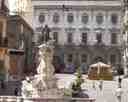
Look to your left, just past the multi tiered stone fountain crowned with a dark bronze statue, to spot the church's flat rectangular facade and heavy stone entrance portico.…Leggi di piùMostra meno
Apri pagina dedicata →
Sant'Anna dei LombardiPhoto: Jeffmatt, Wikimedia Commons, Public domain. Cropped & resized. Look to your left, just past the multi tiered stone fountain crowned with a dark bronze statue, to spot the church's flat rectangular facade and heavy stone entrance portico.
Once, this was not merely a building, but a sprawling micro city. In the early fourteen hundreds, it was the domain of the Olivetans, a strict branch of monks, who cultivated orchards and crafted medicinal herbs in a vast complex of cloisters right where you are standing. It was a place of immense prestige, a spiritual hub where the powerful royals of the era attended daily mass.
But cities are living things, prone to sudden shifts and brutal reinventions. In seventeen ninety eight, the king abruptly evicted the monks. The empty halls were soon claimed by the Lombards. This was a powerful confraternity, a religious brotherhood of merchants and artisans from northern Italy. Their own nearby church, dedicated to Saint Anne, had just been demolished. So, they brought their archives, their devotion, and their name to this abandoned monastery, effectively rebranding the ancient site as Sant'Anna dei Lombardi.
Then came the violent turn of eighteen oh five. An earthquake tore through Naples, collapsing a massive section of this sanctuary.
What was lost in the rubble remains an aching wound in the history of art. Inside the collapsed wing were three monumental paintings by the revolutionary artist Caravaggio. One of them was a highly controversial depiction of the Resurrection. Instead of painting a triumphant, serene figure rising from the tomb, Caravaggio broke all tradition. He painted a man emerging into the light with visceral, raw terror. His contemporaries called it indecent, but it was an intensely human, modern vision. Those irreplaceable canvases were crushed to dust beneath the falling stone.
It is a heavy loss to absorb. Yet, the fact that this building still stands, having survived evictions, natural disasters, and modern urban development pressing right up against its walls, speaks volumes. It shows how the enduring spirit of this city survives terrible devastation, weaving deep losses and necessary reinventions into a continuously surviving legacy. If you wish to step inside to see the surviving art, the church is open most days from nine thirty to six, with a later start on Sundays.
Now, turn your attention across the street. We are heading toward the grand Renaissance architecture of Palazzo Orsini in Gravina, just a two minute walk away, where we must navigate the incredibly dangerous political games of the sixteenth century.
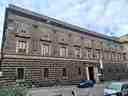
Notice the imposing, dark gray piperno stone facade on your left, characterized by its heavily textured, pillow-like rectangular blocks on the ground floor and the distinctive…Leggi di piùMostra meno
Apri pagina dedicata →
Palazzo Orsini in GravinaPhoto: Deca16894, Wikimedia Commons, CC0. Cropped & resized. Notice the imposing, dark gray piperno stone facade on your left, characterized by its heavily textured, pillow-like rectangular blocks on the ground floor and the distinctive circular medallions containing marble busts above each window. Take a look at your screen to see a close-up of these features in the first image.

This image captures the elegant Renaissance exterior of Palazzo Orsini di Gravina, showcasing the original cushion rustication and the roundels with Orsini busts by Vittorio Ghiberti, many of which are 19th-century copies of the lost originals.Photo: Deca16894, Wikimedia Commons, CC0. Cropped & resized. Ferdinando Orsini, the Duke of Gravina, bought this land in 1513 for just over a hundred ducats, roughly a few thousand dollars today. But keeping it proved to be a high-stakes game of survival. During the Siege of 1528, French forces tried to wrestle control of Naples from the Spanish crown. The Duke made a calculated gamble and secretly aligned himself with the French, hoping to secure even greater power if the city fell.
The French failed. The Spanish crown immediately declared the Duke a traitor and seized all his assets, including the half-built walls standing right in front of you. He avoided execution and managed to save this palace only by paying a crushing financial penalty and begging for the personal clemency of the Holy Roman Emperor.
Once his pardon was secured, the Duke poured his remaining resources into making this building a Renaissance triumph. That dark volcanic rock on the lower level is carved into what architects call cushion rustication... stone blocks cut so their faces bulge outward, mimicking the softness of pillows, yet projecting an impenetrable fortress-like strength.
Look closely at the circular medallions above the windows. These hold the busts of the Orsini family line. The originals were carved by master sculptors, but many were lost when the building was transformed into rental apartments in the nineteenth century. Purists were naturally outraged to see a princely home reduced to boarding rooms for commoners.
But the building was soon engulfed in far worse violence. In 1848, it became a headquarters for liberal rebels plotting against the Bourbon monarchy. The king's troops did not hesitate. They blasted the roof with cannons and incendiary bombs, reducing the Duke's masterpiece to a smoldering shell just to flush the rebels out.
Yet, the palace was stubborn. It was rebuilt. It later housed state telegraph workers, where a young Matilde Serao worked long, grueling hours before becoming one of Italy's greatest journalists. It endured yet another occupation during World War Two, when American military vehicles used its elegant interior courtyard as a parking lot, destroying a priceless seventeenth-century fountain in the process.
Today, it is home to the city's architecture students. They study the very walls that survived so much political fire and reinvention.
Let us keep moving to Santa Maria La Nova, where explosive accidents changed the landscape forever. It is a brief three-minute walk away.
Mostra altre 9 tappeMostra meno tappeexpand_moreexpand_less
On your right is a restrained stone and white facade, sitting behind a classic balustrade and crowned by a triangular roofline with a singular circular opening. The Angevin…Leggi di piùMostra meno
Apri pagina dedicata →On your right is a restrained stone and white facade, sitting behind a classic balustrade and crowned by a triangular roofline with a singular circular opening.
The Angevin Dynasty, a powerful French royal house that ruled Naples in the Middle Ages, profoundly reshaped the city's skyline. They introduced soaring Gothic arches and monumental fortifications, aiming to visually cement their dominance over Southern Italy. This very site was born from that sweeping ambition. King Charles of Anjou ordered the demolition of a previous Franciscan monastery near the harbor just to clear space for his massive new fortress, Castel Nuovo. To compensate the displaced friars, he granted them this land in 1279 to build a new church, earning it the name Santa Maria la Nova.
Fast forward to December 13, 1587. A rogue lightning bolt struck the hilltop fortress of Castel Sant'Elmo, directly hitting the military powder magazine. The resulting explosion was so violent that it rained shattered stone and flaming debris across the city below, completely crushing the roof of Santa Maria la Nova and killing the worshippers inside.
The medieval Gothic structure was left in absolute ruin. But the monastic community resolved to rebuild it in the Counter-Reformation style, a movement that favored clear, focused, and emotionally powerful religious art designed to inspire the Catholic faithful. You can see this grand reimagining on your screen right now. Notice the lavish, gilt-framed rectangular fresco panels that completely cover the central nave ceiling, the grand hall of the church.
What truly galvanized the community to finish this 1596 reconstruction was a miraculous intervention, when a man crippled from birth was suddenly healed after praying to the Madonna delle Grazie within these broken walls. This profound event sparked a frenzy of devotion and generous offerings, allowing the friars to quickly fund the new facade before you today.
Yet, beneath this miraculous rebirth, darker legends linger. Some modern researchers claim that the church cloister holds the secret grave of Vlad the Impaler, the historical figure who inspired Dracula. If you open your app, you will see the chapel interior where researchers point to an encrypted stone carving and a tomb adorned with a dragon, the symbol of Vlad's knightly order. They theorize his daughter smuggled his ransomed body here to Naples, burying the infamous ruler in total anonymity.
From pulverized roofs to miraculous healings and cryptic graves... Naples endlessly absorbs tragedy and transforms it into entirely new chapters of life.
You can explore the cloister and the striking interior yourself any day of the week between 9 AM and 5 PM. For now, we will turn our attention toward Palazzo Penne, an older relic of noble ambition, just a three-minute walk away.
Before you stands a striking facade constructed of dark, tightly fitted rusticated stone blocks, anchored by a wide arched marble doorway and crowned by a protruding band of…Leggi di piùMostra meno
Apri pagina dedicata →
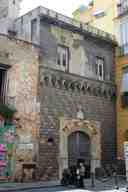
Palace pensPhoto: Miguel Hermoso Cuesta, Wikimedia Commons, CC BY-SA 4.0. Cropped & resized. Before you stands a striking facade constructed of dark, tightly fitted rusticated stone blocks, anchored by a wide arched marble doorway and crowned by a protruding band of pointed stone arches.
This is Palazzo Penne. It was built in the year 1406 by Antonio di Penne, the powerful secretary to King Ladislaus of Naples. Antonio was an imperial notary, a man who wielded the king's authority through ink and parchment. He wanted an architectural monument that proved his ascent into the highest ranks of society, blending the heavy, rough-hewn Tuscan style of the main stone wall with the elegant, slightly flattened archway typical of Catalan design.
Examine the rusticated facade. Can you spot the carved relief of a feather pen in the center of the stones?
That quill is a permanent signature of his family name, Penne, but it is also a deliberate boast about the source of his immense influence. The stones themselves speak of his pride. Above the doorway, an inscription quotes the ancient Roman poet Martial. It translates to a taunt against jealous rivals, reading, you who turn your head, envious one, may you be envious of everyone, and no one of you.
Perhaps it was that very arrogance that birthed the dark folklore surrounding these walls. According to local legend, Antonio fell in love with a woman who demanded he build her a magnificent palace in a single night. To accomplish the impossible, Antonio signed a blood pact with the devil. Beelzebub would build the palace before dawn, and in exchange, he would take Antonio's soul.
But Antonio added one final clause. The devil would only get his soul if he could accurately count a handful of wheat grains scattered across the new courtyard. When the devil counted, he came up five grains short, losing the wager. Antonio had secretly mixed sticky pitch into the wheat, trapping the missing grains under the devil's claws. Furious at being tricked, the demon raged until Antonio made the sign of the cross. A chasm ripped open in the courtyard, swallowing the devil whole. Locals say a well was built over the demonic pit... and strangely enough, recent excavations in the courtyard actually uncovered an ancient, hidden well.
For centuries, locals blamed that buried demon for the long, painful decay of the building. By the early two thousands, the once proud home had crumbled into a neglected rooming house, its roof rotting and its historic marbles defaced. The regional government bought it for ten billion lire, which is about five million dollars today, but left it to rot further. It was only saved when two local women, descendants of a famous philosopher, fought a fierce legal battle to stop illegal construction that would have parcellized and gutted the interior. They forced the city to finally begin restoring the palace to its rightful dignity.
Antonio di Penne's earthly ambitions survived the devil, centuries of decay, and modern greed. But to see the ultimate proof of his prestige, we must follow his ghost. Our next destination is just a six minute walk away. We are heading to the solemn grounds of Santa Chiara, the sacred resting place of Neapolitan nobility, where Antonio managed to secure his own grand tomb.
On your left is the massive, pale stone facade with its sharply peaked roof and a prominent, circular rose window set right in the center. This is Santa Chiara. It was built in…Leggi di piùMostra meno
Apri pagina dedicata →
Santa Chiara, NaplesPhoto: Vitold Muratov, Wikimedia Commons, CC BY-SA 4.0. Cropped & resized. On your left is the massive, pale stone facade with its sharply peaked roof and a prominent, circular rose window set right in the center. This is Santa Chiara.
It was built in the early thirteen hundreds by Queen Sancha and King Robert of Naples. Sancha was a deeply devout woman who initially refused to marry, wishing instead to become a nun. She finally agreed to the union on the condition that they live like brother and sister. Reflecting her intense spiritual partnership with the King, she designed this as a double monastery, housing Franciscan friars and cloistered Poor Clare nuns in entirely separate wings.
But the severe, unadorned stone you see today carries the weight of a profound cultural trauma. On August 4, 1943, Allied incendiary bombs struck the roof. The dry wooden timbers ignited, and the fire raged uncontrollably for days. The soaring central hall, known as the nave, became a giant kiln that baked and pulverized centuries of exquisite marble and stucco. Feel free to check your screen to see a comparison of the church's interior before and just after that devastating blaze.
The fire destroyed stunning Baroque decorations and exposed a heartbreaking secret. Beneath the ash were the ruined fragments of massive apocalyptic frescoes painted by the medieval Florentine master, Giotto. They had not been destroyed by the bombs, but by shifting fashions. In the eighteenth century, royals who found the medieval art too gloomy had them whitewashed. The fire peeled away the plaster only to reveal that Giotto's masterpieces had been hacked with pickaxes centuries earlier to help the new stucco adhere.
The subsequent restoration was fiercely debated. Instead of recreating the lost Baroque interior, architects chose to leave the stark, original Gothic stone exposed. It stands today as a stark monument to resilience... a testament to a community that continually resurrects itself from the ashes.
Yet, survival here is not just about enduring tragedy. It is also about finding joy. Hidden behind the church is the famous Majolica Cloister. In the seventeen hundreds, the nuns' somber garden was transformed with vibrant ceramic majolica tiles. Painted with colorful scenes of peasants and masked balls, these brilliant ceramics brought a flash of worldly life into their strict, secluded vows.
Imagine watching centuries of your own history burning uncontrollably in a single night... how do you find the will to rebuild from the ashes? Keep that resilience in mind as we make the one minute walk toward Gesù Nuovo, another architectural marvel of reinvention just across the square. And if you wish to explore Santa Chiara's cloisters and museum before we move on, the complex is open daily until five in the evening, though it closes earlier on Sundays.
Straight ahead is a massive facade covered entirely in dark stone blocks carved into sharp, projecting diamond shapes, anchored by a grand white marble portal in the center. You…Leggi di piùMostra meno
Apri pagina dedicata →
Gesù NuovoPhoto: Berthold Werner, Wikimedia Commons, CC BY-SA 3.0. Cropped & resized. Straight ahead is a massive facade covered entirely in dark stone blocks carved into sharp, projecting diamond shapes, anchored by a grand white marble portal in the center.
You are standing before Gesù Nuovo, or New Jesus. But this striking building was not born a church. It began in the late fifteenth century as a grand secular palace for the powerful Sanseverino family, built as the city expanded westward. Its transformation from a noble residence into a formidable Jesuit stronghold reveals how the cultural soul of this city absorbs tragedy, reinvents its purpose, and weaves dark legends out of stone.
In fifteen forty-seven, Ferrante Sanseverino, the Prince of Salerno, made a dangerous choice. He stood with the people in a massive popular uprising against the Spanish Viceroy, who was attempting to force the Spanish Inquisition upon Naples. For his defiance, Ferrante was stripped of his titles and forced into exile. His magnificent Renaissance palace was confiscated by the crown and eventually sold to the Jesuits in the fifteen eighties for forty-five thousand ducats, a staggering sum equivalent to tens of millions of dollars today.
The Jesuits kept the unusual facade, made of a dark volcanic rock called piperno, cut into heavy diamond shapes known as rusticated ashlar. If you look closely at these stones, you will notice strange engravings. Master quarrymen carved these symbols, which local lore claimed were esoteric wards meant to attract positive energy. But the legend insists the builders placed the stones in the wrong order, reversing the magic. This mistake supposedly doomed the building to centuries of misfortune, including devastating fires and collapses.
One such collapse happened during a massive earthquake in sixteen eighty-eight. The disaster destroyed the church's original dome, and beneath it, obliterated the grand tomb of Carlo Gesualdo, an infamous prince and murderer whose dissonant choral music was centuries ahead of its time.
Yet, the building's supposed curse took a miraculous turn in two thousand and ten. An art historian and a team of Hungarian musicologists discovered that the mysterious symbols on the facade were not reversed magical wards at all. They were letters of the Aramaic alphabet representing musical notes. When read from right to left, bottom to top, the entire facade becomes a colossal musical score, translating into a forty-five minute Gregorian chant for stringed instruments.
That hidden music seems to have offered its own kind of protection. During the height of World War Two, as bombs rained down on Naples, terrified citizens huddled inside Gesù Nuovo. A bomb crashed directly through the ceiling of the nave, the soaring central hall of the church, landing near a side chapel. Miraculously, it failed to detonate. The casing of that unexploded bomb remains on display inside today, a silent witness to the lives spared.
If you want to step inside to see the vast, illusionistic ceilings and the bomb casing yourself, the church is open every day from eight in the morning until twelve forty-five, and again from four to seven in the evening.
When you are ready, let us continue to San Pietro a Majella, just a six minute walk away, where we will explore a rather different, much darker musical legacy.
To your right stands San Pietro a Majella, a formidable structure defined by its gray stone bell tower capped with a pointed spire, a sweeping rounded stone apse, and a deep…Leggi di piùMostra meno
Apri pagina dedicata →To your right stands San Pietro a Majella, a formidable structure defined by its gray stone bell tower capped with a pointed spire, a sweeping rounded stone apse, and a deep arched entrance.
Notice the sounds drifting out from the open windows above. This complex houses the adjacent Naples music conservatory, a sanctuary where the city's artistic essence has been stubbornly preserved. But the foundation of this church rests on a far darker legacy. Look at your app to view the soaring central hall, or nave, of the church's interior. It is a space built on blood money.
The man who funded this early fourteenth-century church was Giovanni Pipino da Barletta. Pipino was a commoner turned accountant who climbed the ranks through ruthless efficiency. History remembers him by a grim title... the Butcher of Lucera. Pipino destroyed a Saracen colony in southern Italy, slaughtering the men and selling the women and children into slavery. This atrocity amassed him a massive fortune, which he used to buy his way into nobility and build this very church. Yet, his grand dynasty crumbled almost instantly after his death. His grandsons lost their titles, dying in exile. A sharp, almost poetic justice for a legacy built on suffering.
The darkness of its origins eventually gave way to a brilliant reinvention. By eighteen twenty-six, the former monastery here was converted into a conservatory. The survival of the Neapolitan School of music is largely thanks to Saverio Mattei, a royal delegate in the seventeen nineties. Recognizing that the city's musical heritage was vanishing, Mattei issued a draconian decree. No theater in Naples could stage an opera unless a complete copy of the score was first deposited in this conservatory's archives. That single bureaucratic maneuver saved thousands of manuscripts. Today, the building holds immense treasures, including pianos gifted by Catherine the Great and a rare Stradivari harp. This is a diatonic harp, meaning it plays only the standard notes of a scale without tuning pedals, crafted by the legendary instrument maker in sixteen eighty-one.
The tension between sin and salvation reveals itself in the art, too. Pull up the image on your phone to see the magnificent ceiling. These paintings were created by Mattia Preti in the mid-seventeenth century. Legend claims Preti, a Knight of Malta, fled to Naples after murdering a guard who denied him entry to a quarantined city. To earn his way back into good graces, he essentially painted for his life. Out of plague and murder came an artistic triumph so profound that rival painters called this church a school for studious youth.
Even the building's architecture reflects the city's pattern of ruin and resurrection. During World War Two, Allied bombings devastated the complex. Yet, this tragedy inadvertently aided restorers. The blasts stripped away crumbling seventeenth-century Spanish stucco, revealing the pure Angevin Gothic lines you see today, a stark medieval style favored by the rulers of the era.
The church is an open house of worship today, welcoming visitors Monday through Friday. As we move on, prepare yourself for the ultimate blend of artistic genius and dark legend at Cappella Sansevero, just a three-minute walk away.
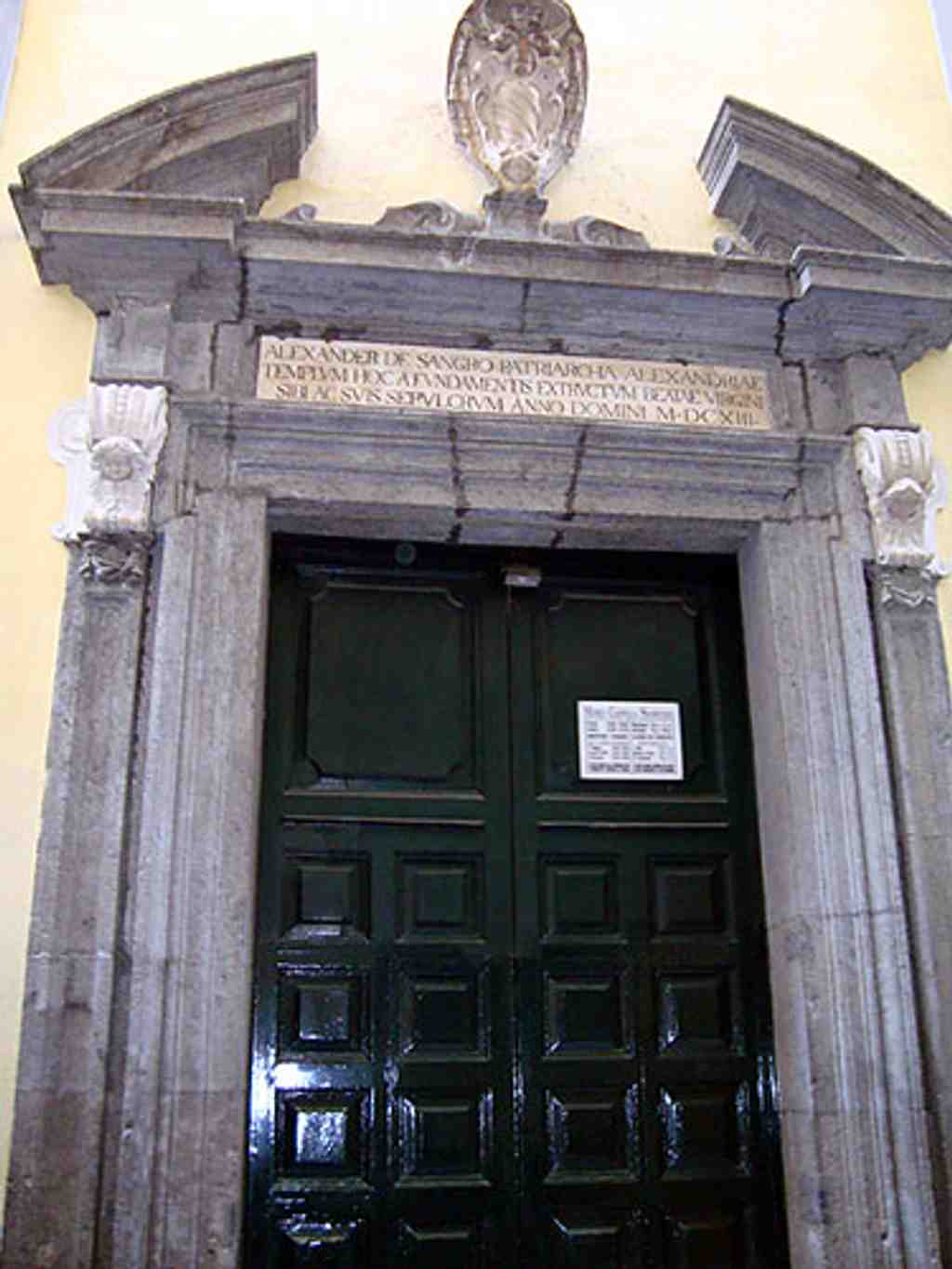
Notice the tall dark paneled double doors framed by heavy gray stone, topped with a carved Latin inscription and a broken pediment holding an oval crest. This is the Cappella…Leggi di piùMostra meno
Apri pagina dedicata →
Cappella SanseveroPhoto: Hohenloh, Wikimedia Commons, Public domain. Cropped & resized. Notice the tall dark paneled double doors framed by heavy gray stone, topped with a carved Latin inscription and a broken pediment holding an oval crest. This is the Cappella Sansevero, though locals once knew it by a gentler name... the Pietatella.
Its origin is rooted in a story of miraculous justice. An innocent man, being dragged to prison past this very spot, saw a section of the garden wall collapse, revealing a hidden painting of the Pietà, the classic image of the Virgin Mary cradling Christ. He prayed to the image, promising to build a shrine if his innocence was proven. He was soon released, and true to his word, he built the small shrine that eventually became this grand family burial chapel.
But the chapel's reputation soon shifted from divine miracles to dark rumors. In the eighteenth century, the chapel was reconstructed by Raimondo di Sangro, the Prince of Sansevero. He was a brilliant, eccentric inventor, but his genius spawned a terrifying Black Legend. Whispers spread through Naples that the Prince was a sorcerer. Locals claimed he murdered seven cardinals to craft macabre chairs from their bones and skin.
Inside rests his crowning commission, the Veiled Christ. Look at your screen to see the astonishing detail of its face. The marble veil appears so delicate, so impossibly sheer, that a myth arose claiming the Prince used dark alchemy to turn real fabric into stone. In truth, the sculptor Giuseppe Sanmartino carved it all from a single block of marble... though the legend insists the Prince later blinded Sanmartino to ensure he could never create another masterpiece.
The Prince's reputation for the macabre reaches its peak in the chapel basement. Take a look at your app for a glimpse of the anatomical machines. These are human skeletons encased in a complex web of what look perfectly like human blood vessels. For centuries, people believed the Prince had injected a metallic substance into the veins of two living servants, preserving their circulatory systems in an act of murder for science. Modern analysis has proven the veins are actually crafted from beeswax, wire, and silk, but the chilling stories remain.
Here we find devotion and sinister rumor completely tangled together. A shrine born from an innocent man's prayer was transformed by a notorious prince. It shows how this city holds onto its miraculous belief while embracing its darkest shadows, carrying its cultural soul intact through endless cycles of ruin and reinvention.
Even the Prince's death is wrapped in gothic horror. The story goes that he ordered himself hacked to pieces and locked in a chest, promising to resurrect himself at a specific hour. But his family panicked and opened the chest too soon. His partially reassembled body let out one final agonizing scream before collapsing into a heap of lifeless flesh.
Step back out into the light, leaving the shadows of the Sansevero family behind. Proceed toward the intellectual hub of San Domenico Maggiore, just a two minute walk away. And if you plan to venture inside the chapel, it is open daily from nine in the morning until seven in the evening, except for Tuesdays when the doors remain closed.
Straight ahead is San Domenico Maggiore, an imposing complex anchored by a towering, polygonal stone apse with crenellated rooflines and a grand staircase leading up to its arched…Leggi di piùMostra meno
Apri pagina dedicata →
San Domenico MaggiorePhoto: IlSistemone, Wikimedia Commons, CC BY-SA 3.0. Cropped & resized. Straight ahead is San Domenico Maggiore, an imposing complex anchored by a towering, polygonal stone apse with crenellated rooflines and a grand staircase leading up to its arched portal. Take a look at your screen to see the full Gothic majesty of this exterior.
This fortress of faith was shaped by the Angevins, the powerful French royal dynasty that ruled Naples in the thirteenth century. King Charles the Second commissioned its grand Gothic redesign, effectively transforming the space into an intellectual crossroads. This very site became the original seat of the University of Naples. And in 1272, its halls echoed with the lectures of a philosophical giant... Thomas Aquinas.
Aquinas lived and taught within this monastery. One night in 1273, a sacristan claimed to witness Aquinas levitating in prayer before a crucifix, weeping heavily. According to the account, Christ spoke to the friar, asking what reward he desired for his brilliant writings. Aquinas replied that he wanted nothing but God. This profound mystical encounter completely shattered the great thinker's academic drive. He abruptly abandoned his masterpiece, the Summa Theologica. When his secretary begged him to finish, Aquinas stated that compared to the divine secrets just revealed to him, everything he had written now appeared to be of little value. He died mere months later, taking the mystery of his vision to the grave.
The intellect endlessly seeks the divine, but the body remains tethered to a much harsher reality. Deep inside the sacristy lie the remains of another ruling dynasty... the Aragonese royals who governed Naples centuries later. You can view their ornate sepulchres on your app.
In the 1980s, a team of paleopathologists... scientists who specialize in diagnosing ancient diseases... performed modern autopsies on these mummified kings and queens. What they discovered beneath the velvet and gold was a staggering chronicle of physical suffering and toxic vanity. Isabella of Aragon was celebrated as one of the great beauties of the Renaissance. But she had contracted syphilis. To cure the disease, she self-medicated with heavy doses of mercury, a poison that turned her teeth entirely black. Desperate to maintain her flawless image, she used a metal file to scrape away the dark stains, completely obliterating her enamel. She ultimately died of chronic mercury poisoning.
Her relative, King Ferdinand the Second, met a similarly grim fate. The young monarch suffered from a severe double infestation of head and pubic lice. To combat the maddening itch and the humiliation of the condition, he slathered his skin and hair in a mercury-rich ointment. The treatment absorbed rapidly through his skin, inadvertently poisoning and killing the king at the age of twenty-eight.
Naples is a city that constantly sheds its skin, enduring the physical ruin of empires, the desperate measures of poisoned monarchs, and the unfinished thoughts of geniuses. The pursuit of perfection leaves deep scars behind. The church is open most days until five thirty in the afternoon if you would like to explore its interior. We are now going to follow the ancient Greek street plan deeper into the city's origins, heading toward the Basilica of San Giovanni Maggiore, which is about a five-minute walk from here.
Notice the pale, smooth facade up and to your right crowned with a sharp triangular pediment, featuring a large, square paned window above a set of simple green doors. Beneath…Leggi di piùMostra meno
Apri pagina dedicata →
Basilica of San Giovanni MaggiorePhoto: IlSistemone, Wikimedia Commons, CC BY-SA 3.0. Cropped & resized. Notice the pale, smooth facade up and to your right crowned with a sharp triangular pediment, featuring a large, square paned window above a set of simple green doors.
Beneath those very doors lie subterranean pagan temples. The foundations of this church date back to the year 324, resting directly upon an ancient pagan sanctuary likely dedicated to Hercules, or perhaps Antinous, the tragic lover of Emperor Hadrian. When Emperor Constantine ordered this church built, it was a deliberate act to overwrite a site of profound imperial cult worship. Yet, the old world was not entirely erased. If you walk inside, you will find two massive columns of cipollino marble framing the apse, the semicircular recess behind the altar. Those columns were salvaged straight from the original pagan temple.
Over the centuries, this basilica became a center of immense worldly power. In 1298, within these very walls, Robert of Anjou was solemnly crowned the Duke of Calabria. It was a space where the divine endorsed the mortal rulers of Naples.
But the earth beneath Naples is restless. Earthquakes repeatedly shattered the basilica, century after century. The most devastating struck in 1870, tearing down the right nave, the long side aisle of the church, and collapsing the vaulted ceiling. The damage was so absolute that city officials declared the building an irrecoverable ruin. They formally proposed to demolish it and pave over the rubble to build a public square. The basilica would have vanished entirely if not for a single determined priest named Canonico Giuseppe Perrella. He defied the city, personally raised the funds, and saved this magnificent architectural tapestry from destruction.
Because the building survived, so did its oldest, most mysterious legends. Tucked away in the left transept is a marble plaque from the eleventh century. It bears an invocation to Parthenope, the mythical siren whose body was said to have washed ashore and been buried right beneath this very spot. This deeply rooted myth made the church a pilgrimage site for centuries.
By 1689, church authorities had grown tired of the rumor. They installed a second plaque directly beneath the first. The new inscription bluntly warned visitors that this stone was just a superstition and did not hold a siren. Yet, tellingly, they never removed the original pagan invocation. They simply let the orthodox doctrine and the ancient myth share the wall.
You can explore the interior Monday through Saturday from nine to six, and Sunday mornings until one.
Let us proceed to our final stop to see how all these layers of history collide, just a short three minute walk away at San Pietro Martire.
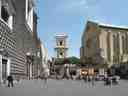
To your right is a pale stucco facade featuring a large, dark lobed window and an ornate crest at the roofline, standing quietly behind the tall bronze statue on a stone pedestal.…Leggi di piùMostra meno
Apri pagina dedicata →
San Pietro Martire, NaplesPhoto: Baku, Wikimedia Commons, CC BY-SA 3.0. Cropped & resized. To your right is a pale stucco facade featuring a large, dark lobed window and an ornate crest at the roofline, standing quietly behind the tall bronze statue on a stone pedestal.
This is San Pietro Martire. If you glance at your app, you can see how it looks nestled into the modern university district. We end our journey together here, at a structure that perfectly captures the unending cycle of ruin and resurrection that defines this city.
The church's story begins with the Angevin Dynasty. It was commissioned in 1294 by Charles the Second of Anjou to house the Dominican Order, a Catholic religious group dedicated to preaching and intense study. It is fitting, then, that the statue in front of you honors Ruggero Bonghi, a nineteenth-century politician who helped reform public education in a newly unified Italy.
For centuries, this monastic complex held a very local kind of magic. In its small cloister was a well tapping into the underground Sebeto river. This Water of San Pietro was renowned for being pure and supposedly incorruptible. There were many stories of miraculous interventions and healing associated with it. When the Holy Roman Emperor Charles the Fifth visited in the sixteenth century, he was so captivated by its clarity that he refused to drink anything else. When it was time to leave, he ordered massive wooden casks of the water loaded onto his fleet to sustain him on his long voyage home.
But the survival of this building is a miracle in itself.
In the late nineteenth century, Naples underwent the Risanamento, a massive urban renewal project. Demolition crews ruthlessly bulldozed the medieval slums of this neighborhood to carve out the broad, modern avenue you see today. San Pietro Martire narrowly escaped the wrecking ball, standing as a lone survivor of a vanished, older Naples. Decades later, during World War Two, an Allied bombing raid aimed at the nearby port struck the complex. The blast shattered its walls and damaged centuries of art.
Yet, the city slowly rebuilt it. The ancient monastic spaces were eventually adapted for the University of Naples, and today, students hurry to lectures through halls where monks once walked in silent prayer.
If you look at the interior photo on your screen, imagine stepping through the entrance. You would immediately face a grim bas-relief, a shallow stone carving, depicting a skeleton. It holds a scroll with the words, Everything ends. This was a classic memento mori, a stern reminder to the monks of the brevity of earthly life.
The women buried inside knew that lesson well. Isabella of Clermont, a fierce fifteenth-century queen, lies here. She was no passive royal, she personally raised funds and military support to crush rebellions against her husband's throne. Her daughter, Beatrice of Aragon, rests beside her. Beatrice rose to become the Queen of Hungary, but after being widowed twice and losing her grip on power in foreign courts, she was forced to return to Naples, living out her final days with little of her former glory.
Everything ends. That is what the stone skeleton warns. But standing here, looking at a church that outlasted floods, bulldozers, and bombs to become a vibrant place of learning, you might realize that the soul of Naples never truly vanishes. It simply reinvents itself.
If you wish to look inside, please note the church is only open to visitors on Saturdays between ten thirty in the morning and six in the evening.
Domande frequenti
Come inizio il tour?
Dopo l'acquisto, scarica l'app AudaTours e inserisci il tuo codice di riscatto. Il tour sarà pronto per partire immediatamente – tocca play e segui il percorso guidato dal GPS.
Ho bisogno di internet durante il tour?
No! Scarica il tour prima di iniziare e goditelo completamente offline. Solo la funzione chat richiede internet. Ti consigliamo di scaricare tramite WiFi per risparmiare dati mobili.
È un tour guidato di gruppo?
No – è un tour audio autoguidato. Esplori in autonomia al tuo ritmo, con la narrazione audio riprodotta dal tuo telefono. Nessuna guida, nessun gruppo, nessun orario.
Quanto dura il tour?
La maggior parte dei tour richiede 60–90 minuti, ma sei tu a controllare il ritmo. Metti in pausa, salta le tappe o fai pause quando vuoi.
E se non riesco a finire il tour oggi?
Nessun problema! I tour hanno accesso a vita. Metti in pausa e riprendi quando vuoi – domani, la prossima settimana o il prossimo anno. I tuoi progressi vengono salvati.
Quali lingue sono disponibili?
Tutti i tour sono disponibili in oltre 50 lingue. Seleziona la lingua preferita quando riscatti il codice. Nota: la lingua non può essere cambiata dopo la generazione del tour.
Dove accedo al tour dopo l'acquisto?
Scarica l'app gratuita AudaTours dall'App Store o Google Play. Inserisci il codice di riscatto (inviato via email) e il tour apparirà nella tua libreria, pronto per essere scaricato e avviato.
Se il tour non ti piace, ti rimborseremo l'acquisto. Contattaci a [email protected]
Pagamento sicuro con