AudaTours logoAudaTours

Audioguida di Panaji: Il Tour alla Scoperta dei Gioielli Culturali di Panaji

starstarstarstarstar
4.01 recensioni
Audioguida8 tappe

Sotto le strade assolate di Panaji si cela un mondo nascosto di ribellione artistica, segreti sussurrati e intrighi secolari. Questo tour audio autoguidato conduce attraverso il cuore pulsante della città, dove gallerie vivaci, grandi biblioteche e vicoli color pastello rivelano storie che persino i locali trascurano. Quali lotte di potere si scatenarono dietro le mura della più antica biblioteca dell'India? Chi scomparve una notte di pioggia lungo le labirintiche stradine di Fontainhas, lasciando solo domande senza risposta? E perché i sussurri di uno scandalo artistico persistono nei cortili ventilati di Sunaparanta? Muoviti attraverso corridoi ombrosi fiancheggiati da libri proibiti, attraverso tetti piastrellati che brillano di tonalità portoghesi e sotto lo sguardo di muse silenziose. Ogni passo svela un pezzo della storia non raccontata di Panaji, dipingendo la città come non l'hai mai vista prima. Pronto a perderti nel mistero e nella meraviglia? Inizia il viaggio: scopri cosa Panaji sta davvero nascondendo.

Anteprima del tour

map

Informazioni su questo tour

  • schedule
    Durata 30–50 minsVai al tuo ritmo
  • straighten
    4.0 km di percorso a piediSegui il percorso guidato
  • location_on
    PosizionePanaji, India
  • wifi_off
    Funziona offlineScarica una volta, usa ovunque
  • all_inclusive
    Accesso a vitaRiascolta quando vuoi, per sempre
  • location_on
    Parte da Sunaparanta, Centro d'Arte di Goa

Tappe di questo tour

  1. Now, let me tell you about the cool stuff they have here. We've got exhibition galleries where you can feast your eyes on incredible art. They've even got spaces for workshops and…Leggi di piùMostra meno

    Now, let me tell you about the cool stuff they have here. We've got exhibition galleries where you can feast your eyes on incredible art. They've even got spaces for workshops and lectures, so you can learn all about art, even if you're not the best with a paintbrush. Oh, and they've got studios too, in case you feel like channeling your inner Picasso. But wait, there's more! They've got these residency rooms where visiting scholars, artists, and faculty can stay. It's like a creative hotel! And let's not forget the open-air amphitheatre, where performances are held under the stars. Talk about a magical setting! The cherry on top is the outdoor courtyard, where you can chill and grab a bite at Café Al Fresco. It's the perfect spot to soak in the artistic vibes while sipping on a cup of joe. Oh, did I mention they're setting up an art resource library too? It's gonna be a paradise for all you art students out there. Everything you need right at your fingertips. So, now that you're all hyped up about this place, let's drift on over to our next stop, the Krishnadas Shama Goa State Central Library. Trust me, you won't want to miss it!

    Apri pagina dedicata →
  2. Now, listen closely because here comes the fun part. The library proudly boasts that it's the first public library to be set up in all of India. That's right, folks, they were…Leggi di piùMostra meno

    Now, listen closely because here comes the fun part. The library proudly boasts that it's the first public library to be set up in all of India. That's right, folks, they were trendsetters way back in the early 1830s! The Portuguese Viceroy of Goa himself, Dom Manuel de Portugal e Castro, came all the way to Panaji to inaugurate this incredible institution on 15 September 1832. Back then, it was known as the Publica Livraria of the Academia Militar de Goa. Quite a mouthful, huh? In 1836, it decided to give itself a cooler name and became the Bibliotheca Pública. Woohoo, now that's what I call a name upgrade! Over the years, this library has had quite the transformation. It became the Bibliotheca Publica da Nova Goa in 1870 and even elevated its status to a National Library in February 1897. Talk about fancy! But wait, there's more! In 1956, the library started receiving free copies of all publications from Portugal and her overseas colonies. It's the library's version of happy mail day! They were even kind enough to compile and publish an annual bibliography of Goa-published books. How thoughtful! After Goa gained its independence from Portuguese rule in 1961, the library got a makeover and became the Central Library. It expanded its activities to include lending, reference, and special services for all the little bookworms out there. Now, my friend, it's time to turn the page and head to our next stop. We're off to explore the beautiful and historic quarter of Fontainhas. Buckle up and get ready for some jaw-dropping architecture and vibrant streets! But before we go, let me leave you with a library joke. Why don't librarians like vampires? Because they're always returning books with bite marks! Oh, those cheeky librarians. All right, off we go now! To Fontainhas we shall venture!

    Apri pagina dedicata →
  3. Fontainhas is filled with old villas and buildings that have a Portuguese influence. They have these adorable projecting balconies painted in pastel shades of yellow, green, and…Leggi di piùMostra meno

    Fontainhas is filled with old villas and buildings that have a Portuguese influence. They have these adorable projecting balconies painted in pastel shades of yellow, green, and blue. And let's not forget the roofs, oh, those beautiful red tiles! It's like a painter's palette came to life and decided to color the rooftops of Fontainhas. This place is so special because it represents the traditional Portuguese influence in the area. In fact, it is the oldest Latin quarter of Panjim. It's all thanks to an adventurous Goan expatriate named António João de Sequeira, or Mossmikar as he liked to be called. He made his fortune in Mozambique and decided to create a little piece of Portugal right here in Goa. Now, let me tell you about the name Fontainhas. It actually comes from a spring at the foot of the Altinho Hills, which started flowing around 1770. "Fontainhas" means "little fountain" in Portuguese. See? It's like the neighborhood has its own little secret tap of endless charm! Oh, and did you know that Fontainhas is the only area in Goa where Portuguese is still the main spoken language? It's like a language time capsule right here in India! And let me tell you, the locals here really know how to keep the Portuguese vibe alive. You'll see unmarried women sitting on the roofed gallery steps, reading newspapers, and chatting away in Portuguese, like it's nobody's business. Fontainhas is also home to some beautiful art galleries and exotic cafes. You can sip on a delicious cup of coffee while being surrounded by vibrant artwork. It's the perfect spot to soak up the creative atmosphere. Alright, my friend, it's time to say "obrigado" to Fontainhas and move on to our next stop. Get ready to dive into the rich heritage of Panjim as we head to Our Lady of the Immaculate Conception Church. Let's go! To get to our next destination, you'll need to head east and walk for about 15 minutes. Enjoy the walk and take in the sights along the way. And don't worry, I'll be here with you every step of the way, cracking jokes and making sure you have an unforgettable tour experience! Let's go!

    Apri pagina dedicata →
Mostra altre 5 tappeMostra meno tappeexpand_moreexpand_less
  1. Ah, the Our Lady of the Immaculate Conception Church! This beautiful church is like a crown atop the city of Panjim. It was first built way back in 1541 as a small chapel, but as…Leggi di piùMostra meno

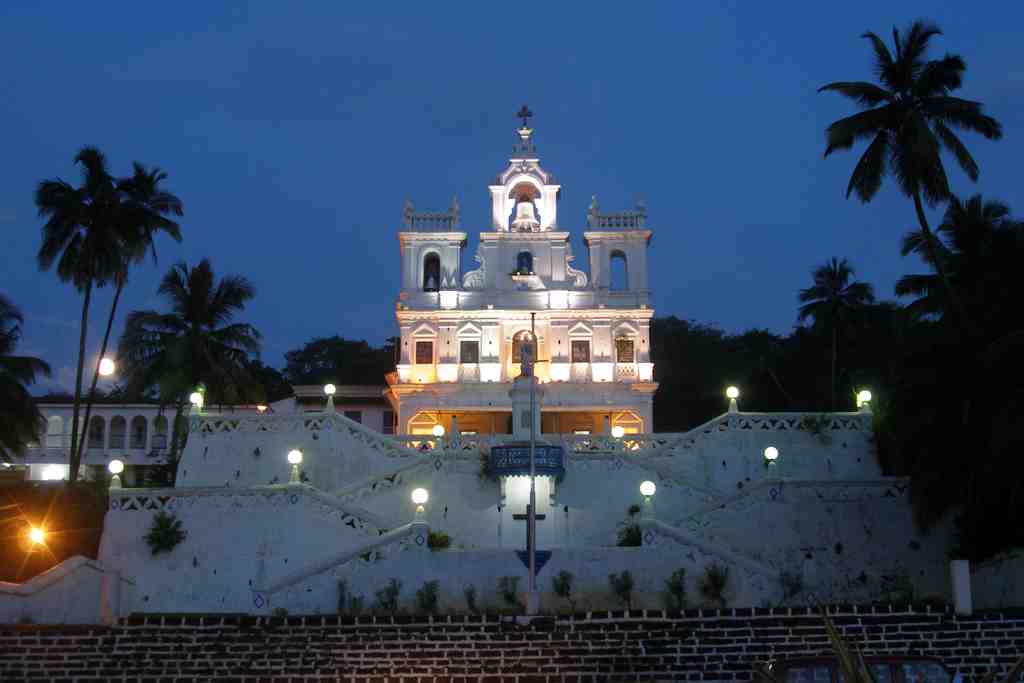
    Ah, the Our Lady of the Immaculate Conception Church! This beautiful church is like a crown atop the city of Panjim. It was first built way back in 1541 as a small chapel, but as the Portuguese influence grew, so did the church. In the 1600s, they decided to replace the chapel with a larger church as part of their religious expansion. Now, the church conducts Mass every day in English, Konkani, and Portuguese. Talk about being multilingual! And speaking of languages, did you know that this church houses a bell that was removed from the ruins of the Church of Our Lady of Grace in Old Goa? It's considered the second largest bell in Goa, only surpassed by the Golden Bell in the Sé Cathedral. The church has quite the history, too. It sits on a hill facing the square below, and it used to be the first port of call for Portuguese sailors when they arrived in Goa. Talk about a warm welcome! And let's not forget about the grand exterior. The facade is painted a bright white to represent the Immaculate Virgin Mary, and the two towers and the tall belfry make it quite a sight to see. No wonder it's known as the 'crown' of Panjim! Now, if you're done admiring the beauty of this church, our next stop is the quaint neighborhood of Fontainhas. It's just a short walk from here, and you'll get to experience the charm and colorful history of this historic quarter. Let's go, shall we? Directions: From the Our Lady of the Immaculate Conception Church, head south on Rua de Ourem towards 18th June Road, continue straight onto Rua Quatro de Abreu, and you'll find Fontainhas just around the corner. Enjoy the stroll!

    Apri pagina dedicata →

  2. Ah, Calvim! This island village is quite a hidden gem in the Bardez sub-district of Goa. It's like a small treasure tucked away near the Aldona village. Calvim is actually one of…Leggi di piùMostra meno

    Ah, Calvim! This island village is quite a hidden gem in the Bardez sub-district of Goa. It's like a small treasure tucked away near the Aldona village. Calvim is actually one of the two islands in this area, along with Corjuem. They're like the dynamic duo of islands, you know? Now, Calvim isn't just any ordinary island. Nope, it's a part of the Aldona village panchayat, which basically means it's under their jurisdiction. But fear not, my adventurous friend, because Calvim is accessible by a bridge. We've got ourselves a bridge, folks! And it's not just any ordinary bridge, it's one of the four bridges in this area. That's some serious bridging business going on here! What else can you find in Calvim? Ah, yes, there's a church. And it's not just any ordinary church either. It's the church of St. Sebastian. Legend has it that this church was originally a chapel built by the islanders themselves. They must have been quite handy with tools, eh? Anyway, the chapel was later elevated to a church in 1980. Talk about an upgrade! Now, let me give you some fun facts about this church's architecture. It's done in a Neo-Roman style, which means it has a touch of fancy elegance. It's of medium size, with three bays and three stories. Oh, and don't forget about those two bell turrets! They add a beautiful touch. And watch out for those finials of spindle and spear type, they're real showstoppers. The church even has a large concrete porch with a fancy cement grille railing on the roof. It's all about the little details, my friend. Calvim, being an island, has its own little sub-division within the Aldona community. It's like a big family, you see. And in this family, Calvim covers an area of 135.01 hectares. There are 113 households here, with a population of 403 people. And guess what? There are more females than males here. Ladies taking over the island, I suppose! Although Calvim is a quaint and peaceful place, it did make the news back in 2012. Unfortunately, there was a tragic bus accident where a minibus plunged into the Calvim river. It was a heartbreaking incident, with several lives lost, including school students. It was a difficult time for the community, and the accident was marked and commemorated in the following years. Now, my dear explorer, it's time to move on to our next stop. Head over to Azad Maidan, where a magnificent monument awaits us. Let's go, go, go! Direction: Head towards Azad Maidan for our next stop.

    Apri pagina dedicata →
  3. Azad Maidan, my friend! This place is not just any ordinary ground; it is a place of remembrance and bravery. It's a martyrs' monument here in Panaji, Goa. Imagine standing right…Leggi di piùMostra meno

    Azad Maidan, my friend! This place is not just any ordinary ground; it is a place of remembrance and bravery. It's a martyrs' monument here in Panaji, Goa. Imagine standing right across the Goa Police headquarters on the Mahatma Gandhi Road. Cool, isn't it? Originally, this square-shaped area was called the Praça de Sete Janelas, which translates to the Square of the Seven Windows. But why the name, you ask? Well, it's because of the iconic Goa Police headquarters building, which has seven windows on each of its ends and at the entrance. Quite the unique feature, right? Now, let's talk about history! In 1843, they placed a statue of the legendary Portuguese general, Afonso de Albuquerque, inside a domed structure right here at the Maidan. Pretty impressive, huh? The iron beams and granite pillars for this monument were brought all the way from the Convent of S. Domingos, Velha Goa. Talk about effort! But here's an interesting twist. After the Annexation of Goa, the statue of Albuquerque was removed from the domed pedestal by a group of Marathi immigrants. They transferred the statue to the Archaeological Survey of India Museum at Old Goa. But don't worry, they didn't leave the monument empty. They installed a brass urn containing the mortal remains of Tristão de Bragança Cunha instead. And that's not all, my friend! The Freedom Fighters' Association built a tall memorial right here at the Maidan, using public donations, to honor those who sacrificed their lives in the Goa liberation movement. This memorial is truly unique, with a crest displaying a four-armed structure and a pyramid on top. The four-armed structure represents the freedom fighters from the four corners of India who participated in the movement. And the pyramid symbolizes their sacrifice. It's a powerful statement, don't you think? Now, on either side of this memorial, you'll find two rectangular pillars displaying the names of 67 freedom fighters from the Goa liberation movement. It's truly awe-inspiring to see their names honored like that! Every year, on national days, important people pay their respects by laying wreaths at the memorial and observing a moment of silence. It's a beautiful gesture, honoring those who fought tirelessly for their land. Oh, one more thing! In modern times, the Maidan has become a gathering spot for Goans. It's a place where different opinions are voiced, and issues are openly discussed. It's like a melting pot of ideas and conversations, all happening right here. Well, my friend, it's time to move on to our next stop-the Centre for Post-Graduate Instruction and Research. It's a beautiful place where knowledge flourishes, and minds expand. Let's go! (Direction: From the Azad Maidan, head southeast on M.G. Road. The Centre for Post-Graduate Instruction and Research will be on your right.)

    Apri pagina dedicata →
  4. You see, after Portuguese rule ended in Goa, the Indian government wanted to expand higher education. So they set up the CPIR under the University of Bombay. It's pretty cool…Leggi di piùMostra meno

    You see, after Portuguese rule ended in Goa, the Indian government wanted to expand higher education. So they set up the CPIR under the University of Bombay. It's pretty cool 'cause it was the first post-graduate campus of any state university in India to function outside its original jurisdiction. Take that, academic boundaries! During its years of operation, the CPIR saw thousands of students, smarty-pants, like you, pursuing their Masters education here. Some of them even went on to become big shots in fields like education, journalism, law, and science. Hey, maybe you'll be the next big shot! The CPIR started out in June 1962 and continued rocking and rolling until the Goa University opened its doors on June 1, 1985. It was a time of transition as education shifted from Portuguese to English. Can you imagine the language challenges? But hey, learning is universal, language doesn't matter! Now, interestingly, there are some conflicting dates about when the CPIR was actually set up. But according to the official Gazetteer, it was launched in June 1965. So, let's go with that. The CPIR was initially housed in the Sushila Building, located on the bustling 18 June Road in the heart of Panaji. It may have been modest in size, but it sure had a big impact on post-graduate education in Goa! Dr. Pandurang Pissurlenkar, the former head of the Goa Archives, was the first director of the CPIR. He even donated his collection of Goa-focused books to the center. Gotta love someone who appreciates the importance of sharing knowledge! During the 1960s, Goa saw the birth of various undergraduate institutions in fields like Arts, Sciences, Commerce, Law, Education, Engineering, and Medicine. But it wasn't until the 1980s that Goa got its own university! Before that, the CPIR affiliated with the first colleges established in Goa in 1962. It formed the nucleus for Goa University, you know, before it even existed! Setting up post-graduate education in Goa had its challenges, like switching from Portuguese to English and dealing with a brand-new administrative setup. But the University of Bombay was up for the challenge! They resolved to establish the CPIR in Panaji on April 30, 1965. Talk about determination! Okay, enough history for now. Our next stop is the Goa Public Service Commission. Ready for some government action? Let's go! Hint: The Goa Public Service Commission is located near the Patto Bridge. Keep an eye out for it!

    Apri pagina dedicata →
  5. The Goa Public Service Commission is like the gatekeeper of the civil service. It's responsible for selecting and examining all the candidates who want to work for the government.…Leggi di piùMostra meno

    The Goa Public Service Commission is like the gatekeeper of the civil service. It's responsible for selecting and examining all the candidates who want to work for the government. It's like a giant job interview, but with a touch of Goan flavor! Now, the commission has some pretty important responsibilities. They advise the Government of Goa on matters like appointments, recruitment rules, transfers, promotions, and even disciplinary actions of civil servants. They're basically the HR department of the government! And guess what? They report directly to the Governor of Goa, the big boss! Talk about an important job. The commission is made up of a chairman and other members who are appointed by the Governor. In 2018, we had Mr. José Manuel Noronha as the chairman, Mr. Ameya Abhayankar as the secretary, and Ms. Seema V. Malkarnekar as the deputy-secretary. Now, let me tell you a little history. Before 1987, when Goa became a state of India, the Union Public Service Commission was responsible for all the recruitment and service-related matters. But then, Goa got upgraded to a state of its own, and ta-da, the Goa Public Service Commission was born! It started its journey on May 30, 1988, with the first chairman being Mr. J. C. Almeida. So, next time you see a government employee in Goa, you can thank the Goa Public Service Commission for finding that person and making sure they're the cream of the crop! Alright, my friend! That concludes our fun tour of Panaji. I hope you had a great time exploring the city with me. If you have any questions or need any recommendations, feel free to ask. Enjoy the rest of your stay in Goa!

    Apri pagina dedicata →

Recensioni

4.0
starstarstarstarstar
1 recensioni

Domande frequenti

Come inizio il tour?

Dopo l'acquisto, scarica l'app AudaTours e inserisci il tuo codice di riscatto. Il tour sarà pronto per partire immediatamente – tocca play e segui il percorso guidato dal GPS.

Ho bisogno di internet durante il tour?

No! Scarica il tour prima di iniziare e goditelo completamente offline. Solo la funzione chat richiede internet. Ti consigliamo di scaricare tramite WiFi per risparmiare dati mobili.

È un tour guidato di gruppo?

No – è un tour audio autoguidato. Esplori in autonomia al tuo ritmo, con la narrazione audio riprodotta dal tuo telefono. Nessuna guida, nessun gruppo, nessun orario.

Quanto dura il tour?

La maggior parte dei tour richiede 60–90 minuti, ma sei tu a controllare il ritmo. Metti in pausa, salta le tappe o fai pause quando vuoi.

E se non riesco a finire il tour oggi?

Nessun problema! I tour hanno accesso a vita. Metti in pausa e riprendi quando vuoi – domani, la prossima settimana o il prossimo anno. I tuoi progressi vengono salvati.

Quali lingue sono disponibili?

Tutti i tour sono disponibili in oltre 50 lingue. Seleziona la lingua preferita quando riscatti il codice. Nota: la lingua non può essere cambiata dopo la generazione del tour.

Dove accedo al tour dopo l'acquisto?

Scarica l'app gratuita AudaTours dall'App Store o Google Play. Inserisci il codice di riscatto (inviato via email) e il tour apparirà nella tua libreria, pronto per essere scaricato e avviato.

verified_user
Soddisfazione garantita

Se il tour non ti piace, ti rimborseremo l'acquisto. Contattaci a [email protected]

Pagamento sicuro con

Apple PayGoogle PayVisaMastercardPayPal

AudaTours: Tour Audio

Tour a piedi autoguidati, coinvolgenti e convenienti

Prova l'app arrow_forward

Amato dai viaggiatori di tutto il mondo

format_quote Questo tour è stato un ottimo modo per vedere la città. Le storie erano interessanti senza sembrare troppo scriptate, e mi è piaciuto poter esplorare al mio ritmo.
Jess
Jess
starstarstarstarstar
Tour Tbilisi arrow_forward
format_quote Un ottimo modo per conoscere Brighton senza sentirsi un turista. La narrazione aveva profondità e contesto, senza esagerare.
Christoph
Christoph
starstarstarstarstar
Tour Brighton arrow_forward
format_quote Ho iniziato questo tour con un cornetto in mano e zero aspettative. L'app ti accompagna tranquillamente, niente pressione, solo tu, le tue cuffie e delle storie interessanti.
John
John
starstarstarstarstar
Tour Marseille arrow_forward

Tour Audio Illimitati

Sblocca l'accesso a OGNI tour nel mondo

0 tour·0 città·0 paesi
all_inclusive Esplora Illimitato