
Tour Audio di Rouen: Cattedrali, Corone e Cronache Svelate
Una guglia di cattedrale si avvolge nella nebbia su Rouen, sussurrando segreti sepolti da secoli di rivoluzione e rinascita. Questo viaggio audio autoguidato svela i drammi nascosti di Rouen, guidandoti attraverso i suoi vicoli, le imponenti cattedrali e i misteriosi tribunali che pochi visitatori vedono veramente. Quale trama oscura scosse le sale di Notre-Dame quando il fuoco dipinse le sue pietre di panico? Quale avvincente scandalo si svolse dietro la facciata intagliata del tribunale, creando onde in tutta la Francia? E perché c'è un foro di proiettile in un cancello del castello che la maggior parte dei passanti non nota mai? Attraversa con coraggio Rouen, dove la giustizia si scontrò con l'ambizione e i ribelli premettero contro le mura reali. Ogni punto di riferimento rivela sia splendore che suspense, frantumando la calma della città con storie di ribellione, arte e intrigo. Solleva il velo sui segreti di Rouen. Inizia il tour ora e scopri cosa si nasconde sotto il famoso skyline della città.
Anteprima del tour
Informazioni su questo tour
- scheduleDurata 40–60 minsVai al tuo ritmo
- straighten3.2 km di percorso a piediSegui il percorso guidato
- location_on
- wifi_offFunziona offlineScarica una volta, usa ovunque
- all_inclusiveAccesso a vitaRiascolta quando vuoi, per sempre
- location_onParte da Chiesa di San Vincenzo di Rouen
Tappe di questo tour
Picture yourself here a few centuries ago. Around the mid-1400s, the bustling port of Rouen sat just a stone’s throw away from where you’re standing. The old St. Vincent was known…Leggi di piùMostra meno
Picture yourself here a few centuries ago. Around the mid-1400s, the bustling port of Rouen sat just a stone’s throw away from where you’re standing. The old St. Vincent was known locally as Saint-Vincent-sur-Rive, thanks to its prime riverside location near the Seine. If churches could pick real estate agents, St. Vincent really nailed the “location, location, location” part-it was right by the port, the economic lifeblood of medieval Rouen. Imagine sailors, merchants, and townsfolk all weaving by, perhaps pausing to measure salt or check some ledgers at the Vicomté across the way-think of it as the old city’s customs office where every grain and shipment was strictly accounted for. If someone tried to sneak extra salt into their soup, St. Vincent’s congregation probably knew! By size alone, this place was a showstopper: the fourth largest Gothic church in Rouen, trailing only the grand Notre-Dame, Saint-Ouen, and Saint-Maclou. Construction was a marathon, not a sprint-commencing in the 1400s and not really wrapping up until the mid-1500s. This church grew as the centuries ticked past: first the nave, then the transept, sprouting impressive towers and porticos like a medieval version of one of those never-ending kitchen remodels. In the 1470s, they expanded the crossing, adding portals to the north, south, and west-so there was no chance of sneaking in late to Mass without someone noticing! Between 1512 and 1528, the chancel was built up with such grandeur that its roof almost touched the tip of the lantern tower-a feat even the most ambitious roofers today would be proud of. But what truly made St. Vincent dazzling, besides its soaring arches and intricate stonework, were its 29 breathtaking stained glass windows crafted by master artisans from both Beauvais and Rouen. These vast, luminous panels illustrated everything from biblical dramas to scenes of Saint Vincent’s own martyrdom. The colors would have bathed parishioners in story and light-and probably helped keep dozing off during sermons to a minimum. Over the centuries, St. Vincent kept growing and changing: a new side aisle added in the 1700s, a rebuilt choir, a brand-new organ. The church even survived Revolutionary turmoil, closing briefly during the Terror before being snapped up, preserved, then swiftly returned to worship. In the 19th century, great efforts were made to restore and maintain the structure-Rouen’s own version of medieval TLC. The brilliant stained glass windows, treasured citywide, even had their own journeys, lovingly restored every time they needed a touch-up. By the 1930s, they’d become such a source of pride that when war threatened, they were carefully removed and shipped off to Niort for safekeeping in 1939. Just in time, too, because in 1944, this corner of Rouen was caught in devastating air raids during what became known as the “red week.” Bombs struck, and nearly all of St. Vincent was obliterated in a single night. Today, only a battered south portal remains, the last witness to centuries of devotion, music, and laughter-yes, even churches have their funny moments. But the tale doesn’t end here. The rescued windows eventually found a new home in the modern church of Sainte-Jeanne-d’Arc at Old Market Square. So, if you feel a sense of both loss and legacy as you stand here, it’s not just you-St. Vincent’s story lives on, scattered in light and color through the heart of Rouen. And who knows? Maybe Saint Vincent still keeps an eye out, making sure people measure their salt with an honest hand. Shall we continue to our next stop?
Apri pagina dedicata →If you look straight ahead, you’ll spot the Old Market Square by its lively cluster of colorful half-timbered houses, with their quirky wooden frames and cheery flags, gathered…Leggi di piùMostra meno
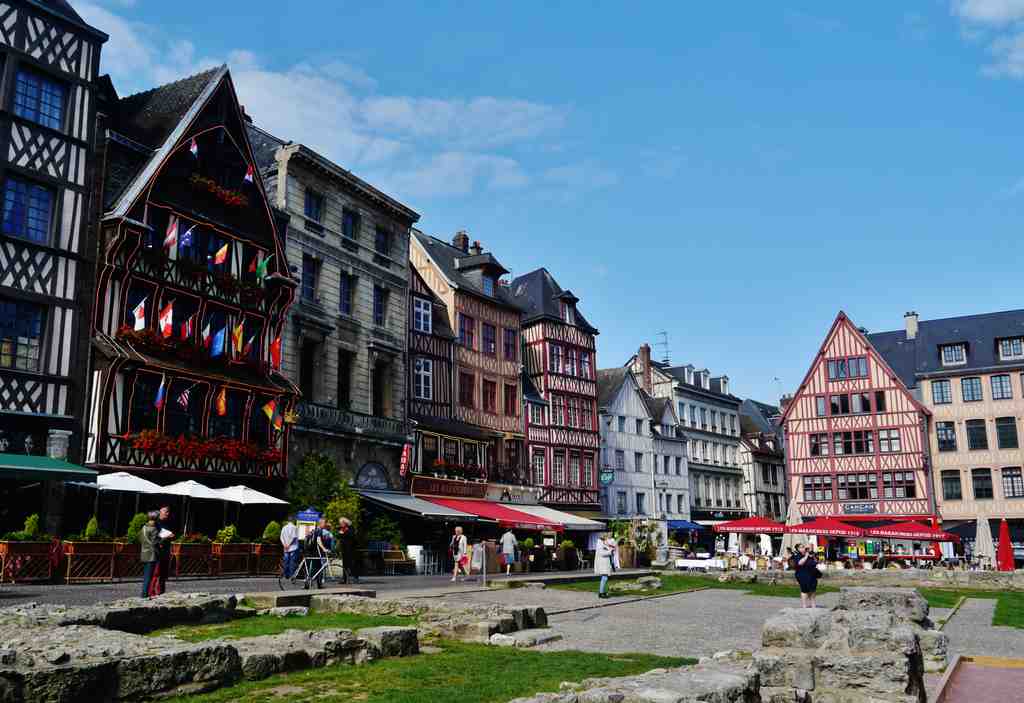
If you look straight ahead, you’ll spot the Old Market Square by its lively cluster of colorful half-timbered houses, with their quirky wooden frames and cheery flags, gathered around the open square dotted with rough stone ruins. Welcome to the heartbeat of Rouen’s history-the Old Market Square, or as the locals say, “la place du Vieux-Marché,” a spot that has witnessed everything from bustling trade to moments that changed the nation. Imagine the air buzzing with chatter, merchants hawking their wares, and horses clopping over the cobbles. This square has always been the crossroads of activity, thanks to the web of streets that weave into it like spokes on a wheel-Rue de la Pie, Rue Cauchoise, Rue du Gros-Horloge, among others. There’s a modern parking garage below, but trust me, history here is all above ground! The name “Old Market” isn’t just for show; it goes back to the days when locals came here to buy and sell, well, pretty much everything (although the best bargains were probably for fish-if you could stand the smell). Take a look at those charming medieval houses-some are the real deal, and some are clever reconstructions, patched together in the decades after World War II to bring the old square back to life. Just imagine their beams creaking through centuries of market days, revolutions, and even bombings. Speaking of things below your feet, on the southern edge of the square near the bold modern curves of Sainte-Jeanne d’Arc Church, you can see the old stone foundations of the long-lost Saint-Sauveur Church. Many years ago, it was destroyed in the chaos of the French Revolution, but the stones were uncovered only during renovations in the 1970s, like an archaeological treasure hunt that never ends. But the Old Market Square is forever inked into the pages of history for something more dramatic and somber. On this very ground in 1431, Joan of Arc-France’s most legendary heroine-faced her fiery fate. You’re standing in the spot where she was burned at the stake, accused as a heretic but destined to become a symbol of courage. Years later, her name was cleared and France built a monument here in her honor, a cross next to where the flames once roared, with the message: “To Joan of Arc, the grateful French people.” Over the centuries, the square was transformed again and again: in the 19th century, two great market halls sprang up, turning it into a shopping hotspot. The buzz of commerce mixed with the growing reverence for Joan. In fact, every October, thanks to Lucien Dorin-the clever restaurateur from “La Couronne” (yes, that’s the handsome building at number 31)-a lively festival called “La Fête du Ventre” celebrates Rouen’s gastronomic delights. Talk about tasty heritage! Now, catch a glimpse of the sweeping rooflines of Sainte-Jeanne d’Arc Church, built in the 1970s to echo both Viking ships and leaping fish. Its daring design divided the city, but everyone agrees on the beauty of the 16th-century stained glass rescued from wartime ruin and now shining inside. Even today, the Old Market Square is alive. Stroll by the new covered market, built to look like rolling ocean waves, hinting at Rouen’s maritime spirit. Smell the food, listen for laughter, and you’ll realize the square is both a memorial and a celebration-a place where Rouen remembers, and life goes on, full of flavor and story.
Apri pagina dedicata →As you look around, you’re surrounded by history that isn’t shy-it’s all out for you to see. This street has played more roles than an actor at a Shakespeare festival! Through the…Leggi di piùMostra meno
As you look around, you’re surrounded by history that isn’t shy-it’s all out for you to see. This street has played more roles than an actor at a Shakespeare festival! Through the ages, it’s had a variety of names, from “Grande-Rue” to “rue Courvoiserie,” then, rather dramatically, “rue Massacre.” Don’t let that one scare you! It eventually circled back to Grande-Rue, until finally becoming Rue du Gros-Horloge, borrowing its name from the city’s beloved landmark watchtower and clock right nearby. This street became a causeway for commerce and a parade for parades-always full of activity. And speaking of activity: in 1932, France’s very first Monoprix (then called Noma, which was short for “nouveau magasin”-meaning “new store”) opened its doors here. Revolutionary for its time, people flocked for the novelty of fixed prices. Decades later, in 1971, this street made French history again, becoming France’s very first pedestrianized street. Cars out, window shopping and strolls in! Now that’s progress you can walk on-no parking tickets required. If you look up and around, you’ll spot some remarkable buildings. The timbered houses lining the street-look for the ones that bulge out over the pavement-are some of Rouen’s finest. At least three of these homes were already old news when Joan of Arc met her fate in 1431. There are addresses here with histories all their own: the wooden façade at number 13 crafted by architect A. Lequeux; number 72, birthplace of the painter Pierre Hodé; and, not to be left out, the offices once held by architect Émile Janet at number 42. Notable artists have been inspired by these views, including Camille Pissarro, who immortalized this street with an engraving in 1885. Next time you pop into a shop for a baguette, remember-you could be walking in the footsteps of painters, architects, revolutionaries, and perhaps a few exasperated Roman soldiers who forgot where they parked their chariots. Now, onto the next marvel-we’re only getting warmed up!
Apri pagina dedicata →
Mostra altre 12 tappeMostra meno tappeexpand_moreexpand_less
To spot the Bureau des Finances, look for the striking stone façade just across from the cathedral, with rows of large arched windows, ornate carvings, and little triangular…Leggi di piùMostra meno
To spot the Bureau des Finances, look for the striking stone façade just across from the cathedral, with rows of large arched windows, ornate carvings, and little triangular dormer windows popping out across the sloped roof. Now, let’s time travel a bit-imagine yourself standing here in the early 1500s, the city of Rouen buzzing with newfound wealth after some tough years. Instead of sleek glass or steel, you’d see craftsmen carving intricate decorations into these very walls, all under the watchful eye of Thomas Bohier, the finance boss who wanted Rouen to show off just how grand it could be. The building’s facade is like a “best of both worlds” mixtape, blending the last flourishes of medieval Gothic with decorations inspired by the fancy Italian Renaissance-expect to spot pilasters inspired by northern Italy right next to old-school gothic arches. But wait, there’s more! The building didn’t just have one important job. Over the centuries, it’s been the meeting spot for the city’s money matters, home to the high-flying “Cour des Aides,” and at one point, even transformed into a theater. In the 1800s, you might’ve bought a dress or a pastry right from these windows, and nowadays one side even houses a tobacco shop-proving it’s survived the ages by always keeping things interesting. Listen closely, can you imagine the clatter of boots and murmurs of heated debate as finance officials argued inside about who was in charge? The courtrooms inside weren’t just for quiet number crunching-oh no, they were filled with rivalry between finance officials, all trying to outrank each other, until the great merger in 1705 united the city’s financial powers under one grand roof. But the magic doesn’t end there. During World War I, this spot was in real danger-the German army targeted Rouen, and while the cathedral was badly threatened, the Bureau des Finances somehow escaped almost unscathed. The Pope himself stepped in, sending word to the German government: “Hands off the cathedrals!” And you know what? Even the German emperor agreed-unless it was absolutely necessary for the war, these masterpieces would be spared. And can you picture this: during the Second World War, on an April day in 1944, a sudden air raid shattered peace and sent shards flying from these walls. But the worst was yet to come, as a second bombing in August destroyed much of the precious detail work on the façade, just before the city was liberated. Still, like a cat with nine lives, the building endured-rebuilt and preserved, rising again to stand as a proud relic whose stonework whispers tales of kings, cardinals, chaos, and resilience. In a fun twist, if you look up to the second floor and squint, you might just catch a whiff of paint and hear the soft scratch of a brush-this is exactly where the great Claude Monet set up his easel in the 1890s, painting his famous series of Rouen Cathedrals. So whether you’re an artist, a number cruncher, or just after a strong cup of coffee, this building has had a little something for everyone. Finally, take a moment to really look at the details on that façade-gothic pinacles, Renaissance garlands, mischievous little putti from Rome, and sharp, clean French lines all jostling for attention. If you want to know what happens when you throw the Middle Ages, the Renaissance, two world wars, and a dash of French civic pride in a blender-well, you’re looking at it!
Apri pagina dedicata →To spot the Notre-Dame de Rouen Cathedral, look for the breathtaking building right in front of you, with its massive, ornate Gothic façade and three towers-the center one…Leggi di piùMostra meno
To spot the Notre-Dame de Rouen Cathedral, look for the breathtaking building right in front of you, with its massive, ornate Gothic façade and three towers-the center one shooting dramatically into the sky like a lacy iron rocket, with an army of statues watching from every angle. Now, let’s take you on a whirlwind journey through time-right at the very spot where you’re standing. Imagine smoke drifting through ancient alleys, as in the third century, a man named Mellon creates a secret place for Christian worship in a city mostly packed with ordinary Roman homes. Fast forward a little: fire sweeps through the neighborhood, -not the last time flames will dance with this place! Then, when Christianity is no longer forbidden, the first cathedral rises; can you picture the simple basilica and the excitement in the air as a bishop named Victrice helps build it? Don’t worry: no hard hats or scaffolding mishaps here-yet. Through the centuries, the cathedral grew, with Vikings making unwelcome visits (they had a thing for bonfires, apparently) and even Rollon, a legendary Viking chief, being baptized here. This church was a royal resting place, resting spot for the first dukes of Normandy! By the 11th century, it got a grumpy neighbor, a Romanesque beauty overseen by Archbishop Robert, who, by the way, never saw the job finished because he, well, ran out of time. But let’s zoom out to the real star: the Gothic cathedral you see now, started in the 12th century. Imagine masons and sculptors climbing the ever-growing shell, their hammers echoing against the stone as towers shot up toward the sky. The famous Saint-Romain tower at your left brought in Norman Gothic like a new fashion craze, while the crowd-funded “Butter Tower” on your right was paid for by people craving dairy during Lent! (Who says cheese can’t build empires?) The center lantern tower once wore a shiny Renaissance spire-until lightning turned it into a roasted marshmallow in 1822. Its current iron spire is the tallest in France, peaking at 151 meters-and for a glorious moment, this was literally the tallest building in the world. No wonder Claude Monet couldn’t stop painting it! You might notice that the twin front towers aren’t identical-the cathedral’s slight asymmetry is what makes her so beloved. Local legend calls her “the most human of cathedrals” because of her charming imbalance, as if even great churches get a little wonky with age. But life hasn’t always been peaceful here. The cathedral has survived Vikings, rampaging Huguenots, wild weather, and revolutions-at one terrifying point, the Virgin Mary chapel was a barn and the grand nave, a concert hall. The stained glass and statues have been battered, heads knocked off by angry mobs, and the bells have been melted for war. During World War II, bombs tore open the walls and fire raged again, but somehow the pillars held and the spire didn’t crash down-a close call for the whole city. In the decades since, dedicated hands have restored its lacy western façade, fixed storm damage, and patched up war wounds. Not to mention, the recent fire in 2024 during restoration-don’t worry, the firefighters here work fast and left the cathedral mostly unharmed! And if you think the artworks inside have an easy life, think again: they’ve been moved, stored, lost, and slowly brought back again over decades, carefully brushed clean and hung once more where centuries of pilgrims and sightseers have marveled. So, whether you’re gazing at its record-breaking façade, the magnificent spire, or the statues that inspired Monet, you’re standing at the crossroads of history, art, legend, and more than a little stubborn Norman spirit. And just remember-if you’re ever lost in Rouen, follow the spire: it’s taller, older, and probably more reliable than your GPS! To delve deeper into the work carried out by the cathedral architects between 1822 (fire) and 2011, protections under the title of historical monuments or the size, simply drop your query in the chat section and I'll provide more information.
Apri pagina dedicata →Look ahead for a dramatic stone church with sharp pointed arches, lavish Gothic decoration, and an impossibly tall spire stretching into the sky-trust me, you can't miss it, it’s…Leggi di piùMostra meno
Look ahead for a dramatic stone church with sharp pointed arches, lavish Gothic decoration, and an impossibly tall spire stretching into the sky-trust me, you can't miss it, it’s the one making all the other buildings look like they skipped leg day. Standing in front of the stunning St. Maclou Church, imagine the marshy island that once lay here, centuries back, with frogs croaking all around and the Seine lapping quietly at the muddy banks. This church is named after Maclou, one of Brittany's seven founding saints-a man so impressive, the locals decided their church deserved his name. Back in the 10th century, this spot was more about slippery ground than grand architecture. Luckily, the Duke of Normandy decided enough was enough and dried out the marshes, making way for new homes, fresh streets, and of course, a chapel that grew into this parish. If you’d visited in the Middle Ages, you might have smelled wood smoke and heard the clang of tools as the townsfolk rushed to rebuild after lightning strikes and two devastating fires burned down earlier churches. When the nave collapsed from neglect in the early 1400s, rebuilding became a community affair! In 1432, the locals convinced the archbishop to allow a new church, sweetening the deal with forty days of indulgences for everyone who chipped in-church fundraising, medieval style! Architect Pierre Robin sketched the first plans, but it took decades of hard work, several architects, and generous donations to get things right, ensuring the place was adorned with golden drapes, a fresh sacristy, and those incredible wooden doors you see now. Plenty of drama followed-protestants left their mark in the 1500s, and the Revolution slammed the doors shut in 1793. Still, St. Maclou survived, standing tall when many others didn’t. The spire you’re gazing up at? It was rebuilt in the 19th century after storms battered the previous one. Through flames, floods, and revolutions, this church has weathered it all. So as you stand here today, picture centuries of Rouen locals passing through these grand doors, eager for a little peace, a touch of gold, and maybe an indulgence or two! Yearning to grasp further insights on the architecture, stained glass or the protection? Dive into the chat section below and ask away.
Apri pagina dedicata →To spot the Archiepiscopal Palace of Rouen, look for a grand, pale stone building with tall windows and two round towers on either side-it’s directly in front of you, with a…Leggi di piùMostra meno
To spot the Archiepiscopal Palace of Rouen, look for a grand, pale stone building with tall windows and two round towers on either side-it’s directly in front of you, with a stately courtyard and intricate carvings above the windows. Now, let’s step back in time together-just imagine it’s a misty morning, and this very palace stands as the silent guardian of centuries of secrets and drama. The Archiepiscopal Palace isn’t just any old building; it’s the only one in all of France that’s still serving its original purpose, paired elegantly with the nearby cathedral. Together, they make a historic duo-like an ancient French version of Batman and Robin, except with more stained glass and fewer gadgets. At first, the palace wasn’t here at all. Picture the earliest bishops trying to decide where to put their fancy manor-south of the cathedral, maybe, until Viking raids and the ducal dawn prompted a move to where you’re standing now. As you stand near the northern side of the cathedral, you can almost feel the shifting history beneath your feet. In the 11th century, Bishop Guillaume Bonne-Âme revamped the palace, and inside the courtyard of Maîtrise Saint-Évode, traces of his ancient work still peek out, especially the ground-level stonework. Later, Bishop Guillaume de Flavacourt took over in the Gothic period, giving the palace its dramatic style-he added the watchtower and the grand hall. Here’s a plot twist worthy of a Netflix special: that very hall was the setting for Joan of Arc’s final tribunal. Picture tense voices, nervous whispers, and the fateful verdict echoing across these very stones. Then, in 1456, the same space hosted her posthumous retrial, trying to right a great wrong. Drama, intrigue, and a pinch of medieval courtroom chaos-if these walls could talk, they’d have a bestseller. The palace was expanded, remodeled, and just when things settled down, another Guillaume-d’Estouteville, no less-decided to knock most of it down in the mid-1400s, making room for bigger kitchens, a fancy audience chamber, and a stunning spiral staircase. If you think your home renovations are expensive, imagine his bill: 400,000 livres. But wait, there’s more! In the late 1400s and early 1500s, Georges d’Amboise doubled the palace’s size, added elegant pavilions (Saint-Romain to the northeast, Notre-Dame to the southeast), and created a garden straight out of a fairy tale, complete with statues and a sparkling marble fountain. The garden even had glass galleries, which, as it turns out, didn’t survive long against Normandy’s rainy weather-Mother Nature always has the last laugh. Through the centuries, rooms kept multiplying: there are now three kitchens, three dining halls, and storerooms filled with everything from relics to paintings-about 280, if you’re keeping count! The Salle des États, the palace’s crown jewel, dazzles with massive windows and centuries-old stained glass. If you wander inside (and you can, thanks to the Joan of Arc History Center), you’ll spot a set of dramatic paintings showing Normandy’s greatest seaports and a rare Renaissance dressoir loaded with porcelain. Book lovers-pay a visit to the library, home to over 12,000 volumes (not all are about bishops, I promise). The palace hasn’t always been a serene sanctuary. In the French Revolution, it became a grain store and even a military HQ during World War I. For a while in the 1900s, the church had to leave, and the state marched in. But in the end, the palace returned to its archbishop-talk about a boomerang property. Standing here, you’re in a living, breathing time machine. Protected as a historic monument, filmed by television crews (“Secrets d’Histoire,” no less!), and home today to the emotional Joan of Arc exhibit, the palace carries on-its stones, towers, and grand halls, witnesses to the greatest dramas in French history. And all just a few steps away from a car park-because even epic legends need somewhere to park! To delve deeper into the description, protections or the filming location, simply drop your query in the chat section and I'll provide more information.
Apri pagina dedicata →Right in front of you is a spot where the grand story of Rouen’s bishops and archbishops unfolds-a saga that’s older than many buildings in this entire city and, quite possibly,…Leggi di piùMostra meno
Right in front of you is a spot where the grand story of Rouen’s bishops and archbishops unfolds-a saga that’s older than many buildings in this entire city and, quite possibly, some types of French cheese! Imagine: it goes all the way back to the third century, when the Roman Empire was still… well, in business. The very first bishop known by name here was Avitien, who strolled down to the Council of Arles in the year 314, likely without Google Maps or comfy sneakers. Rouen’s archdiocese is one of the earliest in all of ancient Gaul. But here’s where things get dramatic: in the ninth century, Viking raids swept through Normandy like a toddler through a birthday cake, and with them went precious church records. That’s why the list of early bishops and archbishops is a bit of a historic jigsaw puzzle, pieced together later-sometimes filling in gaps with legendary names. Some bishops almost feel like they come from myth rather than fact. I guess even medieval record-keeping could use a backup plan. From the eighth century, the bishops of Rouen received a very special item-the pallium, a bit like a VIP scarf of the church world. This gave the highest-ranking churchman in Rouen the lofty, and now honorary, title of Primate of Normandy. You may not spot any fancy scarves today, but trust me, back then, it was quite the fashion statement. Stories of the men who wore these titles have been recorded by devoted monks and clerics at the cathedral. Imagine the quiet scratching of quills on parchment as they wrote the Acts of the Archbishops and the Rouen Annals, each line adding another thread to this huge tapestry of history. There’s even a poetic chronicle that sums up each archbishop using just two lines per person-proving that sometimes history meets poetry, and also, that monks were really into efficient recordkeeping. Today, as you look around, know that these names-historic and legendary-are woven into the very spirit of Rouen. Who knew a list could be so interesting? Even Excel would be jealous.
Apri pagina dedicata →Look to your left across the square for a grand, cream-colored stone building bursting with spiky towers, sharp gables, and rows of intricate gothic windows - that’s the Rouen…Leggi di piùMostra meno
Look to your left across the square for a grand, cream-colored stone building bursting with spiky towers, sharp gables, and rows of intricate gothic windows - that’s the Rouen courthouse, impossible to miss with its dramatic roof and forest of stone pinnacles. Now, picture yourself in front of this extraordinary palace, the pride of Rouen, where centuries of stories have swirled like courtroom whispers. This place began its journey way back in 1499, built for the mighty Échiquier de Normandie-a medieval court that used to wander from town to town like a traveling circus for judges. Eventually, King Louis XII got tired of all the traveling and decided, “Let’s put down roots in style.” Cue the hammering of stonemasons and the whistling of craftsmen as Rouen’s prosperity soared, and these flamboyant gothic walls rose up, festooned with carved gargoyles and crowned with steep blue slate roofs. It wasn’t just a symbol of power - it was a show-off move! They wanted everyone to see how Rouen had bounced back after hard times. This wasn’t just a courthouse; it was also the seat of Parliament for Normandy when François I took the throne in 1515. Over the centuries, the courthouse kept expanding: new wings, new styles, classic facades meeting medieval towers like an architectural family reunion where everyone’s dressed for a different century. There’s drama behind these walls, too - plenty of it! In the 1800s, one section was so rickety it collapsed during the night, bringing down a ceiling painted by poor Jean Jouvenet, who had to paint left-handed after being paralyzed. And don’t get me started on the “staircase scandal.” Around 1903, architects argued so furiously about the right way to rebuild the grand staircase that locals started leaving graffiti like “Down with the wall!” and “Nice try, Lefort!” on the site. Never underestimate the passion of a Rouen architect on a bad day. Walk around and you’ll notice something a little magical about those windows - their wide, cross-shaped frames were a sign of luxury and let in the light and fresh Normandy air, because even judges need a breeze during a long trial! The flamboyant gothic style is everywhere, from the flowery stonework to the carved stone creatures perched and glaring down at passersby. Even the sound of footsteps on the old flagstones would echo through the courthouse halls. This building survived the chaos of World War II-barely. In 1944, during the “Red Week,” massive bombings tore through Rouen, ravaging the central section of the courthouse. The walls stood stubborn, but the roof and interiors were devastated: the wooden beams shattered, sculptures lost to dust. Later, during an air raid, most of the Renaissance-style hall was wiped out, and some scars from falling bombs are still visible today, preserved as a reminder of all Rouen suffered for France’s freedom. And as if that wasn’t enough, hidden under the eastern staircase is a true relic of mystery: the “Maison Sublime,” a Romanesque stone hall from the year 1100, discovered centuries after being buried by courthouse construction. Archaeologists still argue if it was a school, a synagogue, or both-a reminder Rouen once had a large Jewish community, lost when they were expelled centuries ago. So here’s a building that’s been everything from a merchants’ meeting hall to a revolutionary court, from a bombed-out ruin to a centerpiece of French justice. Its soaring roofs and stone guardians watch over a patchwork of centuries, each one packed with legends, misadventures, and some very opinionated architects. And don’t worry - nowadays, the only drama here is of the legal kind… or, occasionally, a pigeon with a flair for gothic architecture. Ready to delve deeper into the the staircase affair (1902-1904), architecture or the interior decorations? Join me in the chat section for an enriching discussion.
Apri pagina dedicata →To spot the Palace of Justice - Gisèle Halimi (Rouen Tramway) station, look for the sleek, modern entrance structure right in front of you with metallic awnings and a big “M” sign…Leggi di piùMostra meno
To spot the Palace of Justice - Gisèle Halimi (Rouen Tramway) station, look for the sleek, modern entrance structure right in front of you with metallic awnings and a big “M” sign next to the Place du Maréchal-Foch, just where the stairs slip down beneath the bustling street. Alright, welcome to the heart of Rouen’s tramway underworld! Imagine for a moment: you’re standing at the gateway to a station that’s not just an ordinary hop-on, hop-off kind of place-it’s a portal with a story. Let’s rewind to the 1990s, when Rouen’s big dream was to bring a touch of metro magic right under your feet. Tunnels snaked under the right bank of the Seine, shaking the city’s foundations-literally! Then, just as work was about to start on this very station, the mayor, Jean Lecanuet, decided he fancied a little location switcheroo on the day construction was due. It’s like ordering pizza to one address and running to the neighbor’s house for delivery-chaos, but with a twist! The site moved here to the Place du Maréchal-Foch. From 1992 to 1995, a massive archaeological dig took place where you now stand, uncovering centuries-old secrets before the digging machines moved back in. And when the tramway finally debuted in December 1994, this station was fashionably late to its own party, opening the doors to passengers only in September 1997. But hey, good things come to those who wait, right? Step inside today and you’re greeted by artistry in motion. Philippe Kauffmann’s “two columns of blue neon light” shimmer on the platforms-like a nightclub for trams! Designer Yves Couloume threw out boring tiles and filled this place with open spaces, playful stone and perforated metal, and sunlight streaming in from above. You might even forget you’re catching public transport! But the story doesn’t stop there. In 2022, the station was given a brand new name-Palais de Justice - Gisèle Halimi-honoring the fierce lawyer and feminist Gisèle Halimi, who fought her entire life for human rights. To keep her spirit alive, look for colorful panels sharing her inspiring story and even a few of her boldest quotes as you wander the station. So whether you’re dashing up from the platform or gliding down the escalator, remember: you’re standing at a crossroads of Rouen’s past, present, and future-complete with art, activism, and a little bit of urban adventure. Now, who says waiting for a tram can’t be epic?
Apri pagina dedicata →Directly in front of you, Jeanne-d'Arc Street reveals itself as a broad, elegant avenue lined with pale stone buildings, iron balconies, and perfectly squared-off leafy trees…Leggi di piùMostra meno
Directly in front of you, Jeanne-d'Arc Street reveals itself as a broad, elegant avenue lined with pale stone buildings, iron balconies, and perfectly squared-off leafy trees marching tidily down both sides-just look straight ahead for a lively mix of shops, banks, and classic Rouen architecture. Welcome to Jeanne-d'Arc Street-Rouen’s north-south lifeline and probably the city’s most dramatic catwalk for both fashion and history buffs! Take a deep breath-can you smell the pastry shops in the air, maybe catch a distant ring of tram bells, or feel the hum of city energy beneath your feet? This street has witnessed the thunder of change across centuries, so let’s step back and watch the show together. The street wasn’t always called Jeanne-d'Arc, and it wasn’t always the bustling boulevard you see today. In the mid-1800s, this place was a messy construction site. Starting in 1859, city planners decided they would force a new artery through Rouen, which involved knocking down whole blocks-including three ancient gothic churches. Now, only the Saint-André Tower remains, stubbornly refusing to budge, just like that one relative who never leaves family gatherings. When the dust finally settled, the street opened as “Rue de l’Impératrice”-fit for royalty! But after the fall of the Second Empire in 1870, it exchanged its imperial flair for a true Rouennaise heroine: Jeanne d'Arc herself. You’re standing on hallowed ground. Under your shoes lies the memory of Joan of Arc-the fearless young leader, captured, imprisoned, and burned right here. In fact, traces of her prison, the Tour de la Pucelle, still lurk in a courtyard at number 102. There’s even a black marble plaque and sculpted model marking the haunting spot. In a way, every footstep carries a whisper of her legend. Yet the street pulses with other stories too. Fires and wars have scarred its stones: number 34 burned in 1937, and the southern stretch was battered by World War II bombs. Still, life always returns-a bit singed, maybe, but never broken. Take a look at the details as you stroll: At number 66, the bookshop L’Armitière welcomes you behind a grand stone doorway, guarded by sculpted caryatids worthy of a Parisian palace. Number 45 is home to the main post office, sporting a bas-relief above its door-delivered express by artist Josette Hébert-Coëffin. Every few meters, you’re brushing shoulders with the ghosts of architects, artists, scientists, and even philosophers-Jean-Paul Sartre himself used to sip coffee at “Le Métropole” on this very street. But don’t get lost in the past-today, Jeanne-d’Arc Street bustles with modern life: trams glide beneath its surface, bicycles zip between Cy’clic stations, and the chatter of lunchtime crowds fills the air. It’s a living monument, never still, and always ready for the next chapter-or the next visitor, just like you. Now, onward-shall we see what history waits at our next stop?
Apri pagina dedicata →To spot the Rouen Synagogue, look for a light stone building on the corner with clean rectangular lines, tall vertical windows, and a striking Star of David carved into the upper…Leggi di piùMostra meno
To spot the Rouen Synagogue, look for a light stone building on the corner with clean rectangular lines, tall vertical windows, and a striking Star of David carved into the upper part of the wall facing the street. Now, let your imagination wander as you stand before this modern-looking synagogue-believe it or not, you’re at a crossroads of more than a thousand years of history! If you close your eyes for a second, you might hear the distant echo of footsteps from Roman times, because the very roots of Rouen’s Jewish community date back to when the Romans first tried to make their stamp on the land. Imagine dusty sandals on ancient stone and the low hum of Latin and Hebrew blending together. Fast-forward to the Middle Ages and picture a bustling quarter just northwest from here, crisscrossed by the narrow lane known as rue aux Juifs, the street of the Jews. This area was the heart of a vibrant community-5,000 or more people strong, almost a fifth of all Rouen! Tales were told in Yiddish and French; debates echoed through the air, and biblical commentaries filled the cramped homes. Kids probably traded jokes about rabbis right on the street! But things weren’t always peaceful here. In 1096, as crusaders swept through Rouen, tragedy struck: the first synagogue, just down the road from here, was destroyed during a brutal pogrom. Ironically, that very spot was built over and became Notre-Dame-de-la-Ronde-an early lesson in how layers of history stack up like pancakes. Not the kind you want for breakfast, though! Jewish life surged back, however, and another new synagogue rose around the corner, near today’s number 55. Medieval texts describe it as a sturdy Romanesque pavilion, almost castle-like, with thick stone walls, grand arches, and sunbeams shining through two tall windows-sort of like the superhero lair of its time. Inside, you might’ve glimpsed beautiful wall paintings or even a glimpse of a Torah scroll kept in a curved eastern apse. Over the centuries, waves of persecution and expulsion-think of 1306, when King Philip the Fair sent Jews packing-repeatedly tried to end this community’s story. But they always found their way back, whether in the sixteenth century as secret Jews (marranes) fleeing elsewhere, or in the 1800s as new families set down roots after the Revolution. If buildings could talk, this one would definitely be a champion storyteller. The synagogue you see now isn’t medieval, though-it rose after unimaginable suffering during World War II. The Jewish community had found refuge in the old Sainte-Marie-la-Petite church, which was tragically bombed in 1944-no, Rouen can’t seem to hold onto its synagogues for very long! But out of those ashes, in 1950, the present building sprang up, designed by three French architects. Check out the geometric lines and stylized glass: those stained-glass windows aren’t just pretty, they’re the work of famed artist Gabriel Loire, swirling with motifs of the Star of David and the Ten Commandments. Look up and spot the square protrusion-see that Star of David? On a sunny day, the light streams through it and dances in colored patterns on the floor inside, a living memory to centuries past. And history isn’t done here yet. In 2024, the synagogue faced danger again when an arsonist caused chaos and damage to the entry and furniture. Yet once more, the community rallies to protect this landmark-not just the stone and glass, but the stories and the faith it represents. So, as you stand by the entrance, maybe brush your hand across the cool stone and read the memorial plaque to those lost in the deportations of WWII. And remember: no matter how many times history tries to erase this place, it comes back with a new chapter, sometimes written in Hebrew, sometimes in stone, but always, always part of the story of Rouen.
Apri pagina dedicata →In front of you stands a grand, symmetrical stone building with classical columns, a commanding central dome, and statues on either side of the main entrance-just look for the big…Leggi di piùMostra meno
In front of you stands a grand, symmetrical stone building with classical columns, a commanding central dome, and statues on either side of the main entrance-just look for the big plaza facing the geometric black sculpture and the colorful banners hanging above the steps. Now, let me take you on a little journey right where you’re standing, the heart of Rouen’s artistic spirit! The Fine Arts Museum of Rouen looks calm today, but its story is anything but quiet. It was born in the whirlwind aftermath of the French Revolution-Napoleon Bonaparte himself pushed it into existence with a decree in 1801. The earliest collections started off humbly, like a painter with just a few colors. But don’t be fooled-soon those few became many, and by the late 1800s, proud locals were boasting that their museum was the best outside Paris! Picture bustling workers in the 19th century, carting in masterpieces from every corner of Europe, the air filled with hope-and probably a bit of dust. Over time, the museum’s collection swelled to over eight thousand works, from Renaissance icons to cutting-edge modern marvels. In fact, its cabinet of graphic arts-full of prized drawings-gained international fame, making researchers and art lovers alike practically sprint through those doors. But not all has been as serene as the paintings inside. Imagine wartime Rouen, the skies troubled and nervous. As enemy forces approached in 1940, museum staff rushed to evacuate the prized collections. Some parts of the building were bombed during World War II, and for years, only a small fraction of rooms could open to the public. It wasn’t until 1994, after an extensive renovation-new life everywhere: shining floors, modern galleries, and elegant light-that the museum stood fully restored. Let’s talk treasures! Inside, you’ll find rare Russian icons, Renaissance masterpieces, paintings from Italian legends like Perugino and Veronese, golden age Spanish wonders (including a Velázquez-a rarity in France), and jaw-dropping French canvases from the likes of Poussin and Delacroix. There’s a painting by Caravaggio, who was about as well-behaved as a wild cat in a chandelier shop. Sculptures from Géricault, who was born right here in Rouen, proudly stand alongside pieces by Bourdelle and other stars. And here’s where Normandy steps onto the world stage: Impressionist art. That magical French light, captured in brushstroke after brushstroke by Monet, Pissarro, and Gauguin, fills the museum’s walls. In 2010, when the museum put on its blockbuster show "A City for Impressionism," crowds swarmed in-over 240,000 people jostling for a look. That’s more fans than most football stadiums! The building itself, which took shape from the mind of architect Louis Sauvageot from 1877 to 1888, is a sight to see. Don’t miss the two statues by the entrance. Those fellows are Nicolas Poussin and Michel Anguier, two celebrated local artists keeping watch. Sculpted pediments by Auguste Bartholdi (you know, the guy who did the Statue of Liberty) crown the sides-talk about having the right friends in high places! Events here aren’t just background noise-they’ve made international headlines, from glowing Impressionist festivals, where colorful projections danced across this very façade, to visiting exhibitions that brought Picasso, Hockney, and Whistler into the story. Don’t worry if you’re feeling a bit overwhelmed-all those feet heading in now are doing the same thing: soaking up beauty, mystery, and a bit of art world mischief. So next time you stroll through these doors, remember, you’re not just walking into a museum. You’re entering centuries of ambition, drama, and invention-plus, if you’re lucky, maybe you’ll find a painting with a nose as crooked as Napoleon’s! Seeking more information about the building, collections or the exhibitions? Ask away in the chat section and I'll fill you in.
Apri pagina dedicata →To spot the St. Godard Church, look for a tall stone building with a slate roof, lots of pointed Gothic arches and big stained-glass windows lined up along its side-just at the…Leggi di piùMostra meno
To spot the St. Godard Church, look for a tall stone building with a slate roof, lots of pointed Gothic arches and big stained-glass windows lined up along its side-just at the corner of the open square. Ah, welcome to St. Godard Church! As you stand here, take a moment to imagine the centuries of history layered into its stones-if only walls could talk, right? They’d probably start with a whisper about Saint Godard himself, buried here in 525, and Saint Romain, who joined him a century later. Back then, this wasn’t known as St. Godard’s at all! It may have first been dedicated to Mary, under the poetic name “Sainte-Marie-hors-les-murs,” literally Mary-outside-the-walls. But these holy bones gave it a new identity, and legend says the faithful kept watch over the sarcophagus right up until the 19th century. This spot grew and changed alongside Rouen. In the days of King Louis IX-good old Saint Louis-the church was pulled within the city walls, protected but far from immune to trouble. In 1248 it was almost entirely burnt down and had to be rebuilt and expanded, with masons and builders working by torchlight and chisel, shaping a church fit for a city on the rise. Fast forward to the fifteenth and sixteenth centuries, and it’s a bustling parish at the heart of Rouen’s castle district. Picture rows of nobles streaming in for mass, their children squirming in the pews, their money funding chapels and stained glass. The church door still bears the impressive coat of arms of the de Brézé family, who commanded the castle and took parish life quite seriously-at least when they weren’t plotting or feasting. The church you see now is a patchwork of these lively centuries. The central nave you’re next to-built in the grand late Gothic style-was completed in the 1400s, while the side aisles and crypt steps followed in the 1500s, thanks to architects like Julien Chanevyere and builders who must have developed the world’s strongest leg muscles rushing up and down scaffolding all day. In 1612, the northwestern tower joined the skyline, though legend has it the builders never quite finished it…like someone who keeps meaning to fix that dripping tap but never gets around to it. Of course, history isn’t just grand processions and glorious glass. The church suffered damage in 1562 during clashes with the Calvinists, was closed during the Revolution, and nearly vanished for good. But, in a moment worthy of a late-night drama, the persistent Abbé Chefdeville campaigned to have it reopened in 1806, a victory for determined priests everywhere. Now, lean in a little closer to those windows. St. Godard’s is famous for its 24 stained-glass masterpieces, twinkling from the 1500s through the 1800s. Four glorious panels from the 16th century share scenes like the life of Mary and the incredible Arbre de Jessé-crafted by Arnoult de Nimègue in 1506, just as the church’s stone was settling into place. These works survived not only time but also multiple evacuations; in 1939, during the dark shadow of war, the windows were whisked away to Niort and restored by Jean-Jacques Grüber, then returned triumphantly after the conflict. The interior was a feast for more than the eyes. In the 1880s, the world-famous organ builder Aristide Cavaillé-Coll installed not one, but two grand organs. Imagine the sound, rich and powerful, filling the three equal-height aisles and soaring to the wooden barrel-vaulted ceiling carved by Josias le Grand. The first notes ever played echoed in 1884, with composer Charles-Marie Widor at the keys and surely a packed house of Rouenais grinning from ear to ear. So, as you stand by the historic steps of St. Godard’s, picture a living tapestry of bishops and builders, revolution and resilience-centuries of faith, music, and light held in stone and glass. And who knows? With so many moving parts, one can only hope the next chapter will be written with a little less fire, and a little more harmony!
Apri pagina dedicata →You’ll spot Rouen Castle by looking for the tall, round stone tower with a sharp, dark-gray cone-shaped roof, rising above the rooftops around it - just head toward that…Leggi di piùMostra meno
You’ll spot Rouen Castle by looking for the tall, round stone tower with a sharp, dark-gray cone-shaped roof, rising above the rooftops around it - just head toward that unmistakable medieval turret! Welcome to the legendary Rouen Castle! As you stand here, close your eyes for a second and picture the clang of swords on armor, the shouts of guards in the chilly early morning, and the thundering hooves of horses echoing on the cobblestones. This place is Rouen’s old warrior - once a mighty fortress, now a silent storyteller of centuries gone by. The castle you’re looking at was built very quickly-between 1204 and 1210-right after King Philippe Auguste of France seized Normandy from John Lackland, the English king. He wasn’t just building a castle; he was planting a giant “Keep Out!” sign, letting the city know who was boss. The structure itself rose atop the remains of an enormous Roman amphitheater-which had probably seen its share of drama too, but likely with fewer swords-giving the new fortress deep, solid foundations. Its walls soared up and bristled with ten round towers, a deep moat, and an inner courtyard where soldiers and nobles mingled-and maybe a sneaky jester or two, trying not to get caught! But Rouen Castle wasn’t just for show: it soon became the headquarters for both the king’s local administrators and, whenever he visited, the king himself. During the Hundred Years’ War, imagine tension so thick you could cut it with a dagger. When the English took over, this castle saw English kings, fierce battles, daring nighttime escapes, and betrayals that would rival any TV drama. In fact, the most famous prisoner ever held here was Jeanne d’Arc-Joan of Arc herself. In December 1430, she was locked in one of the castle’s cold, round towers, clutching hope and faith as she faced her dark fate. You can almost hear the iron doors creaking shut behind her, echoing off the thick stone. Her interrogations and trial happened right here. Just imagine the flickering candlelight, the nervous whispers, the sense of history changing forever within these walls. But the castle wasn’t all gloom and doom! It was at times a seat of festive royal banquets-just don’t invite Charles de Navarre to dinner, unless you like a side of betrayal and execution drama! On several occasions, taxes and revolts shook these stones: in 1292, angry citizens even attacked the place after a particularly unpopular tax. Fast-forward to the 16th century and to the chaos of the religious wars; the fortress changed hands more often than a hot potato, until artilleries made the old walls not so useful anymore. Eventually, in 1591, most of the castle was torn down-except for this iconic round tower, now called the Tour Jeanne-d’Arc. It stood defiant, a survivor where many of its fellow towers were lost to time. This tower then became a classroom, a bunker during World War II, and even today, it contains an escape game-a far cry from dungeons and gloomy trials, unless your team is truly hopeless at solving clues! Yet, deep in the earth beneath your feet, archaeologists still find traces of its Roman past and secrets from every age. It’s as if this spot has always been destined as a stage for history’s greatest shows-and maybe, just maybe, if you listen on a windy night, you’ll hear a whisper or two from those long-ago days. So take in the sight-Rouen Castle, where kings ruled, rebels plotted, and legends like Joan of Arc became immortal. And watch out for ghosts; I hear they’re terrible at hide-and-seek but excellent at telling stories.
Apri pagina dedicata →
Domande frequenti
Come inizio il tour?
Dopo l'acquisto, scarica l'app AudaTours e inserisci il tuo codice di riscatto. Il tour sarà pronto per partire immediatamente – tocca play e segui il percorso guidato dal GPS.
Ho bisogno di internet durante il tour?
No! Scarica il tour prima di iniziare e goditelo completamente offline. Solo la funzione chat richiede internet. Ti consigliamo di scaricare tramite WiFi per risparmiare dati mobili.
È un tour guidato di gruppo?
No – è un tour audio autoguidato. Esplori in autonomia al tuo ritmo, con la narrazione audio riprodotta dal tuo telefono. Nessuna guida, nessun gruppo, nessun orario.
Quanto dura il tour?
La maggior parte dei tour richiede 60–90 minuti, ma sei tu a controllare il ritmo. Metti in pausa, salta le tappe o fai pause quando vuoi.
E se non riesco a finire il tour oggi?
Nessun problema! I tour hanno accesso a vita. Metti in pausa e riprendi quando vuoi – domani, la prossima settimana o il prossimo anno. I tuoi progressi vengono salvati.
Quali lingue sono disponibili?
Tutti i tour sono disponibili in oltre 50 lingue. Seleziona la lingua preferita quando riscatti il codice. Nota: la lingua non può essere cambiata dopo la generazione del tour.
Dove accedo al tour dopo l'acquisto?
Scarica l'app gratuita AudaTours dall'App Store o Google Play. Inserisci il codice di riscatto (inviato via email) e il tour apparirà nella tua libreria, pronto per essere scaricato e avviato.
Se il tour non ti piace, ti rimborseremo l'acquisto. Contattaci a [email protected]
Pagamento sicuro con 


