गोटेबोर्ग ऑडियो टूर: संस्कृति और समय के माध्यम से खजाने की खोज पर
गोटेबोर्ग में अतीत कभी पूरी तरह शांत नहीं होता—छिपे हुए कोनों में विद्रोह, दावतों और उन पलों की गूँज होती है जिन्होंने एक शहर को हमेशा के लिए बदल दिया। यह स्व-निर्देशित ऑडियो टूर आपको ऐतिहासिक सड़कों और उन लैंडमार्क रहस्यों से होकर ले जाता है जिन्हें कई आगंतुक चूक जाते हैं, हर पड़ाव पर साज़िश की परतों को खोलता है। 2017 में सिनेगॉग के बाहर अचानक आग की लपटें क्यों उठीं, जिससे मंत्रियों को कार्रवाई करनी पड़ी? जब शहरवासियों ने एक पूरे सिटी हॉल को, लकड़ी-दर-लकड़ी, स्थानांतरित कर दिया, जिससे राजनीतिक शक्ति का मार्ग बदल गया, तो कौन सी अदृश्य रेखा पार की गई? और सालुहलेन में स्टालों के बीच दौड़ने वाला रहस्यमय 'चूहा कुत्ता' कौन था, जिसने आने वाली पीढ़ियों के लिए व्यंजनों को बचाया? उन कदमों का पता लगाएँ जहाँ शांति संधियों पर बातचीत हुई थी और जहाँ भव्य हॉलों में घोटाला छाया हुआ था। प्रत्येक कदम नाटक और खोज को उजागर करता है क्योंकि जीवंत गंध, ध्वनियाँ और दृश्य आपको गोटेबोर्ग के दिल में गहराई तक खींचते हैं। रहस्यों में गोता लगाएँ—अपनी यात्रा अभी शुरू करें और गोटेबोर्ग को वह सब प्रकट करने दें जो वह आमतौर पर छिपा कर रखता है।
टूर पूर्वावलोकन
इस टूर के बारे में
- scheduleअवधि 40–60 minsअपनी गति से चलें
- straighten2.1 किमी पैदल मार्गगाइडेड पथ का पालन करें
- location_on
- wifi_offऑफ़लाइन काम करता हैएक बार डाउनलोड करें, कहीं भी उपयोग करें
- all_inclusiveलाइफ़टाइम एक्सेसकभी भी, हमेशा के लिए फिर सुनें
- location_onHotel Royal, Gothenburg से शुरू होता है
इस टूर के स्टॉप
Look up at that imposing grey stone-textured building with its distinctive rounded corner and the prominent gold lettering spelling out HOTEL ROYAL across the facade. You are…और पढ़ेंकम दिखाएँ
समर्पित पेज खोलें →Look up at that imposing grey stone-textured building with its distinctive rounded corner and the prominent gold lettering spelling out HOTEL ROYAL across the facade. You are looking at the oldest continuously operating hotel in all of Gothenburg. Back in eighteen forty nine, a master carpenter named Carl Alfred Sundbeck bought this plot of land and began building something special. He opened its doors on April first, eighteen fifty four, offering just twenty five rooms to weary travelers. He originally gave it the rather clunky name of Sundbeck's New Hotel for Travelers, but thankfully rebranded it to Hotel Royal a few years later.
Now, here is the truly fascinating part. Beneath the floorboards and foundations lies a hidden piece of military history. This entire city block is built directly on top of the ruins of Carolus Rex. That was a massive seventeenth century bastion, which is a fortified angular structure extending outward from a city wall, designed for defense. In fact, if you look closely at the steps leading from the street to the hotel, they are actually supported by a surviving section of that ancient fortification wall.
Imagine checking in almost a century ago. When a man named Nils Olsson bought the place in nineteen twenty eight, he installed hot and cold running water in every single room. At the time, that was absolute luxury. Later, a fiercely dedicated woman named Maria Palm ran the hotel with an iron will, preserving its magic until nineteen seventy nine. Today, the doors are open twenty four hours a day, always ready for new arrivals. Take a moment to admire this incredible historic survivor. When you are ready, we can continue on to our next stop.
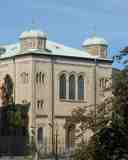
Cast your eyes to the left to find the Gothenburg Synagogue, a pale yellow brick structure defined by tall arched windows and two green domes crowned with Stars of David. Designed…और पढ़ेंकम दिखाएँ
समर्पित पेज खोलें →
Gothenburg SynagoguePhoto: Gumisza, Wikimedia Commons, CC BY-SA 3.0. Cropped & resized. Cast your eyes to the left to find the Gothenburg Synagogue, a pale yellow brick structure defined by tall arched windows and two green domes crowned with Stars of David. Designed by August Krüger and finished in 1855, this sanctuary seats three hundred people. It showcases Romanesque Revival architecture, a style echoing the thick walls and rounded arches of medieval Europe.
Check out the app to see how over a century later, the moat beside the Gothenburg Synagogue has transitioned from a bustling site for washing city laundry to a peaceful waterway enjoyed by recreational canoeists.
But the modern reality of this listed building is heavy. Because of ongoing threats from extremists, the congregation spends nearly thirty percent of its membership fees strictly on security measures. In December 2017, ten to fifteen attackers firebombed this site in concert. Three people were arrested, and the mayor forcefully condemned the assault as antisemitic. In the aftermath, two cabinet ministers visited right here to show support from the highest political level.
This magnificent building stands as a powerful testament to incredible resilience. Pause to reflect on the resilience of this sanctuary. When you are ready, we can head to the next stop.
Turn your attention to the right, where Arkaden stands, a blocky, light-brick building topped with a copper-colored roof and distinguished by a tall, dark vertical clock tower…और पढ़ेंकम दिखाएँ
समर्पित पेज खोलें →
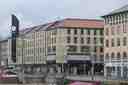
ArcadePhoto: Arild Vågen, Wikimedia Commons, CC BY-SA 4.0. Cropped & resized. Turn your attention to the right, where Arkaden stands, a blocky, light-brick building topped with a copper-colored roof and distinguished by a tall, dark vertical clock tower jutting out from its facade.
It looks thoroughly modern today, but the story of this exact spot is absolutely wild. It involves a massive financial gamble, Hollywood royalty, and the very birth of Swedish cinema.
Back in 1897, three wealthy merchants formed a company to do something unheard of. They bought up a rectangular city block, tore down the existing buildings, and carved a brand new, privately-owned diagonal street right through the middle of it. This new street was called Arkaden.
Pull up the first image on your screen. This was the original Arkaden building, completed in 1899. Just look at those magnificent brown-red brick towers and turrets. The architect, Frans Louis Enders, designed this eccentric building as just the first half of a much grander vision. The plan was to build a matching structure across the new diagonal street and connect the two halves with sweeping, vaulted arches overhead.

The original 'Arkaden' building in 1916, featuring the unique privately-owned street 'Arkadpassagen' that diagonally cut through the block, and the distinct brown-red brick architecture with turrets and towers.Photo: Unknown authorUnknown author, Wikimedia Commons, Public domain. Cropped & resized. But there was a catch. They ran out of money. The company had an investment capital of six hundred thousand kronor in 1902, which is roughly forty-five million kronor today, but they still completely overextended themselves. The grand arches were never built. The funny thing is, the builders had already prepared for them. If you look closely at the towers in that old photo, you can see the stone ledges sticking out, waiting for arches that would never arrive.
Despite the financial drama, the Arkaden complex became a hub of pure magic. In March 1902, a Danish film pioneer and professional illusionist named Niels Jacobsen opened Sweden's very first permanent movie theater right down in a small basement room here. He called it Arkadens Kinematograf, using an early movie projector to dazzle audiences. Just two years later, a second cinema called Olympia opened in the very same complex. Jacobsen actually had to rename his theater to Alhambra just so people would stop going to the wrong movie.
Up above the cinemas, Arkaden was Gothenburg's premier shopping destination. In the nineteen fifties, a boutique called Bohus Stickning set up shop here. When Hollywood icon Ingrid Bergman and other international stars started wearing their elaborate knitwear in the United States, American tourists would literally flock to this store the moment their ocean liners docked in the harbor. They would completely empty the store's inventory in a matter of days.
The original fairy-tale building was controversial when it was built, and ironically, its demolition in 1972 caused just as much of an uproar. You can see the result in the second image on your app. The building standing in front of you today was designed by Anders Tengbom and opened in 1974, keeping the famous diagonal path and the Arkaden name alive.

The modern Arkaden shopping mall in 2009, designed by Anders Tengbom and inaugurated in 1974, stands on the site of the original building, offering a bright shopping experience.Photo: Fluff, Wikimedia Commons, CC BY-SA 3.0. Cropped & resized. From a grand, half-finished Victorian dream to a bustling modern hub, Arkaden has always been a place where Gothenburg goes to experience something spectacular. Feel free to explore the area before moving on to our next destination.
12 और स्टॉप दिखाएँकम स्टॉप दिखाएँexpand_moreexpand_less
You are standing near the site of what was once an absolute institution in Gothenburg. Gumpert's Bookstore. If you asked a local where to meet up, for over a century, the answer…और पढ़ेंकम दिखाएँ
समर्पित पेज खोलें →You are standing near the site of what was once an absolute institution in Gothenburg. Gumpert's Bookstore. If you asked a local where to meet up, for over a century, the answer was simply Gumpert's Corner.
Let us wind the clock back to February first, 1834. The store was originally opened by a bookseller from Lund, but a young Danish man named Nathan Jacob Gumpert eventually took the reins. And Nathan... well, he was a retail genius way ahead of his time. He did not just sell books. By 1839 he had launched a musical lending library, letting locals borrow sheet music, and he advertised relentlessly in the local paper.
His greatest masterstroke happened in October 1845. Gumpert held the very first recorded book sale in the history of Gothenburg. He dropped an advertising insert right into the daily newspaper, listing highly valuable texts at massively slashed prices. People absolutely flocked to it.
Business boomed. In August 1857, the bookstore moved right across the street. The property was purchased for seventeen thousand, three hundred and thirty three riksdaler, the Swedish currency of the era. Today, that would be equivalent to roughly two hundred thousand American dollars. The widow of Nathan Gumpert completely rebuilt the ground floor just to install massive, gleaming shop windows to lure in passersby.
Then, on December sixth, 1871, the shop moved again, settling into a grand corner property at Södra Hamngatan and Östra Hamngatan. This became the legendary Gumpert's Corner. Glance at your app to see what I mean. This photograph from 1873 captures the avenue just a couple of years after the bookstore arrived, anchoring this intersection as the ultimate rendezvous point.

This 1873 photograph captures Östra Hamngatan, where Gumpert's Bookstore moved in 1871, establishing the famous "Gumperts hörna" (Gumpert's Corner), which became a popular meeting place in Gothenburg.Photo: Axel Lindahl (Q792251), Wikimedia Commons, Public domain. Cropped & resized. The store itself eventually moved into the Nordstan shopping center in 1978, but the name stubbornly survived in the local vocabulary. Even decades later, Gothenburgers still use the phrase as a meeting spot.
It is brilliant how a single bookseller's savvy marketing can permanently embed his name into the social fabric of a city. Take your time enjoying the area, and whenever you are ready, let us head to our next destination.
Look for the shallow metal arch with its crisscrossing green ironwork, flanked by heavy stone pillars and crowned with cast-iron street lamps. You are standing at Fontänbron, or…और पढ़ेंकम दिखाएँ
समर्पित पेज खोलें →
The Fountain BridgePhoto: Albin Olsson, Wikimedia Commons, CC BY 3.0. Cropped & resized. Look for the shallow metal arch with its crisscrossing green ironwork, flanked by heavy stone pillars and crowned with cast-iron street lamps. You are standing at Fontänbron, or the Fountain Bridge. It takes its name from the famous fountain nearby, but its real story is built right into its foundations.
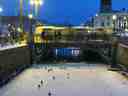
Even though regular cars are strictly banned, this is an intensely busy spot, buzzing with trams, buses, and pedestrians. Take a glance at your phone to see a snapshot of just how lively this car-free transit hub gets.

The Fountain Bridge, shown here over the Hamnkanalen, is known for its exceptionally lively traffic of trams, buses, and pedestrians, despite being closed to regular car traffic.Photo: Albin Olsson, Wikimedia Commons, CC BY 3.0. Cropped & resized. Gothenburg's very first bridge was constructed right here in 1624. Imagine thirty city soldiers hauling timber to build a wooden crossing. Fourteen years later, they painted it bright red and added four massive, crowned wooden lions. Those wooden beasts were actually Gothenburg's first public artworks. They eventually wore down and had to be removed, but the legacy stuck. The bridge was rebuilt in wood, stone, and finally iron, but the lions always returned. Check your screen to see one of the two reclining bronze lions that guard the steps here now. They were added in 1991 to continue that centuries old tradition.

One of the two reclining bronze lions flanking the Lejontrappan, created by sculptor Camilla Bergman and inaugurated in 1991, continuing the bridge's historic association with lion sculptures.Photo: BIL, Wikimedia Commons, Public domain. Cropped & resized. During the eighteenth century, this spot was nicknamed the Horse Bridge because locals used it as a livestock market. But the most bizarre addition came much later, in 1915. Engineers built a public toilet directly into the internal structure of the iron bridge itself. Known as the Cabinet, this underground restroom served the public for over seventy years before being demolished in the late nineteen eighties.
The Fountain Bridge remains a fascinating, vital piece of urban engineering. Take a moment to watch the trams glide by. Whenever you are ready, we can head to our next stop.

A view of the Fountain Bridge (Fontänbron) crossing the Hamnkanalen canal, west of Brunnsparken, as described in the text.Photo: JLogan, Wikimedia Commons, Public domain. Cropped & resized. 
The official sign for Fontänbron (The Fountain Bridge), which was named after Per Hasselberg's 'Såningskvinnan' fountain, also known as 'Johanna i Brunnsparken'.Photo: Albin Olsson, Wikimedia Commons, CC BY 3.0. Cropped & resized. 
An historical view of the Fountain Bridge area, showcasing the evolution of the bridge and its surroundings over time, including Norra Hamngatan.Photo: Unknown authorUnknown author, Wikimedia Commons, Public domain. Cropped & resized. Glance across to the left to see a grand, rectangular white masonry building defined by a stately row of arches and columns on the ground level, topped with six distinct statues…और पढ़ेंकम दिखाएँ
समर्पित पेज खोलें →
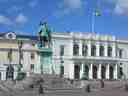
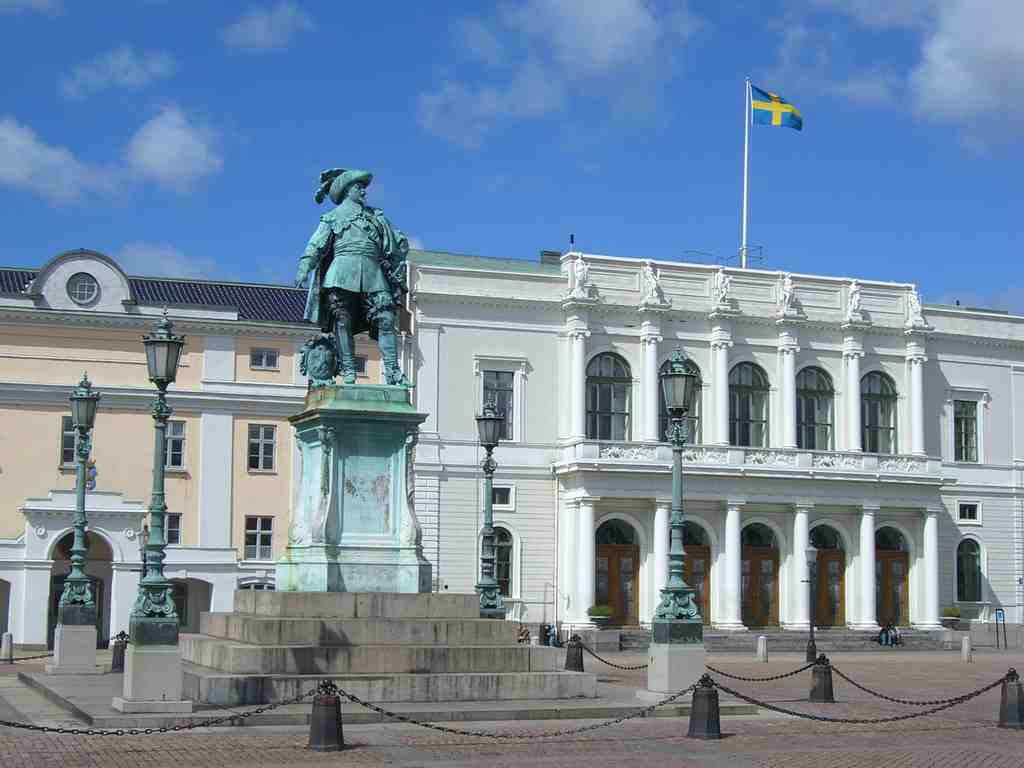
Börsen, GothenburgPhoto: Axt, Wikimedia Commons, Public domain. Cropped & resized. Glance across to the left to see a grand, rectangular white masonry building defined by a stately row of arches and columns on the ground level, topped with six distinct statues standing guard along the roofline. This is Börsen, Gothenburg's historic Exchange Building and current home to the city council.
The story of this place is absolutely fascinating. Back in the seventeenth century, the city's merchants didn't have a dedicated building. They just conducted their business right out on the main square, and when they needed a roof over their heads, they would huddle in a lower room of the nearby city hall. They called that room the Beursen. By the late seventeen hundreds, they decided they needed a proper headquarters, but they didn't actually gather the funds until 1844.
When they finally started building, they hit a massive literal roadblock. The ground here is pure clay. We are talking twenty to fifty meters of soft, shifting clay deep into the earth. So, to keep this massive structure from sinking into the mud, engineers had to drive a double layer of wooden foundation piles deep into the ground. But even with all that effort, the building still settles. In fact, a modern survey found a staggering forty centimeter height difference in the floor between two of the building's corners!
King Oscar the First laid the foundation stone in 1844, hiding a lead box inside filled with gold, silver, and copper coins. By the time the building opened in 1849, it had used two million bricks and cost four hundred and fifty thousand silver riksdaler. That was the old Swedish currency, which would be roughly four million dollars today.
Look up at those six figures on the roof. They might look like carved stone, but they are actually hollow, cast from zinc at a Swedish foundry. They represent the driving forces of Gothenburg. From left to right, you have Diligence, Peace, Commerce holding a staff, Navigation represented by Neptune with a trident, Wealth leaning on a horn of plenty, and Industry holding a rudder.
The square in front of the building has changed dramatically since those statues were first raised. Notice how the bustling Östra Hamnkanalen, visible in front of the Exchange Building in 1910, was eventually filled in to create the expansive paved plaza of Gustav Adolfs Torg that visitors walk across today.
In 1895, a massive fire ripped through the building. The damage was extensive, leading to a major reconstruction in the early nineteen hundreds. During that rebuild, they transformed an open inner courtyard into a spectacular indoor hall. Take a look at your screen to see a photo of its beautiful vaulted glass roof and walls made of yellow marble stucco, which is a fine plaster molded and polished to look exactly like solid stone.

The vaulted glass roof of the Hall, an area added during the 1904-1905 reconstruction, which replaced an open courtyard.Photo: Pklarsson, Wikimedia Commons, CC BY-SA 3.0. Cropped & resized. Today, those grand inner halls, filled with green marble columns and intricately patterned oak parquet floors, host the city's most important council meetings and even royal guests.
Enjoy the grandeur of the square, and let us continue when you're ready.

The Börsen, designed by Pehr Johan Ekman, stands majestically on Gustaf Adolfs Torg. Look closely at the facade to spot the six zinc frieze sculptures by Carl Gustaf Qvarnström, representing virtues like Commerce and Navigation.Photo: Arild Vågen, Wikimedia Commons, CC BY-SA 4.0. Cropped & resized. 
View of Börsen from Östra Hamngatan, where its foundations had to be built on piles due to clay depths of 20-50 meters.Photo: Lintoncat, Wikimedia Commons, CC BY-SA 3.0. Cropped & resized. 
Börsen seen on Gustaf Adolfs Torg, next to Gothenburg's City Hall (Rådhus), where the first merchants met in the "Beursen" before the current building existed.Photo: Torleif Ceder, Wikimedia Commons, CC BY-SA 3.0. Cropped & resized. 
A plaque on Börsen, which has been a protected building monument since 1968 and 1973.Photo: Lintoncat, Wikimedia Commons, CC BY-SA 3.0. Cropped & resized. 
Detailed cast-iron grilles, a material that was "hitherto almost untried" for ornamentation when produced at Jonsereds foundry.Photo: Vogler, Wikimedia Commons, CC BY-SA 4.0. Cropped & resized. 
One of the building's ornate tiled stoves, similar to the four found in the Grand Exchange Hall, which are topped with gypsum statues representing muses and truth.Photo: Pklarsson, Wikimedia Commons, CC BY-SA 3.0. Cropped & resized. 
The City Council's Session Hall, designed in classical Art Nouveau style during the 1904-1905 renovation, offers space for around 80 council members.Photo: Pklarsson, Wikimedia Commons, CC BY-SA 3.0. Cropped & resized. 
A historical photograph from 1920 shows Börsen on Gustaf Adolfs Torg, where a large Christmas tree has been erected.Photo: unknown, Wikimedia Commons, Public domain. Cropped & resized. 
A view of Börsen and Östra Hamnkanalen from 1910, depicting the area before the canal was covered.Photo: Olga Rinman, Wikimedia Commons, Public domain. Cropped & resized. Straight ahead and to the right is Gothenburg City Hall, a massive pale yellow stone complex where a classical facade with colossal pillars and a balcony meets a surprisingly…और पढ़ेंकम दिखाएँ
समर्पित पेज खोलें →
Gothenburg City HallPhoto: Arild Vågen, Wikimedia Commons, CC BY-SA 4.0. Cropped & resized. Straight ahead and to the right is Gothenburg City Hall, a massive pale yellow stone complex where a classical facade with colossal pillars and a balcony meets a surprisingly flat, unadorned modern extension next door. This building is a spectacular timeline of ambition, disaster, and architectural scandal.
Let us wind the clock back. Gothenburg's very first city hall was actually second hand. In 1621, they bought a simple wooden building from a neighboring town, took it apart, and moved it here for 554 riksdaler, which translates to roughly a million kronor or one hundred thousand dollars today. It was a bit of a bargain for a government headquarters. But a few decades later, a massive fire in 1669 reduced the city center to ash, and that wooden hall was completely destroyed.
The city leaders decided they were done with wood. They hired a prominent architect to design a fireproof stone fortress, which was completed in 1672. But the city kept growing, and by the early 1800s, they needed more space. Architect Jonas Hagberg literally wrapped the old stone building inside a brand new brick shell to support a third floor.
Take a look at your screen to see the impressive facade Hagberg created. Notice the central section that steps out toward the square. In architecture, this projecting section is called a risalit. Above the massive columns, you will see a triangular decorative space known as a tympanum. It features a clock guarded by two figures in relief. On the left is Justice holding her scales, and on the right is Prudence with a mirror, reminding the city's leaders to reflect carefully before they act.

The impressive facade facing Gustaf Adolfs torg, completed in 1817 by Jonas Hagberg, features a central risalit with colossal Tuscan columns and a tympanum field that later included a clock and allegorical figures of Justice and Prudence.Photo: ArildV, Wikimedia Commons, CC BY-SA 4.0. Cropped & resized. But the real drama of this building happened a century later. By 1912, the city hall was too small again. The city held a design competition for an extension, eventually won by a Swedish architect named Gunnar Asplund. Now, check your app to see the entire complex as it stands today. See that stark, boxy addition on the right side of the classical building? That is Asplund's design, finally completed in 1936.

This image shows Gothenburg City Hall, a complex combining Nicodemus Tessin d.ä.'s original 1672 building with Gunnar Asplund's functionalist annex from 1936.Photo: Rolf Broberg, Wikimedia Commons, CC BY-SA 3.0. Cropped & resized. It is a prime example of functionalism, an architectural style that strips away all decoration to focus entirely on the practical use of the building. And the public absolutely hated it. When the scaffolding came down, it caused an absolute uproar. Critics called it a catastrophe and the most tragic thing in Gothenburg's recent history. They were furious that a flat, modern box was attached to their majestic classical palace.
Yet today, architecture students travel from all over the world just to study how Asplund beautifully blended the interior spaces of the old and new buildings. Over the centuries, this hall has survived fires, expansions, and intense public outrage, evolving into a fascinating, fractured mirror of Gothenburg itself. Let us leave this architectural debate behind and continue our walk.
Look for a row of grand, multi-story pale stone and stucco buildings lining the canal, anchored by a prominent facade featuring an ornate, projecting rounded bay window that…और पढ़ेंकम दिखाएँ
समर्पित पेज खोलें →
Norra HamngatanPhoto: Ankara, Wikimedia Commons, CC BY-SA 3.0. Cropped & resized. Look for a row of grand, multi-story pale stone and stucco buildings lining the canal, anchored by a prominent facade featuring an ornate, projecting rounded bay window that stretches up the center.
You are standing on Norra Hamngatan, the historic northern harbor street of Gothenburg. It stretches about seven hundred meters along the Great Harbor Canal, and honestly, it is basically a timeline of the city's immense wealth and resilience written in stone.
The street officially got its modern name in 1846, but people have been walking this path since the city was founded in 1621. See that building with the projecting bay window? That is the Malm House at number four. It was built in the 1880s by a merchant named Max Malm. But before that, the property belonged to the brother of Lars Gathenhielm, an infamous Swedish privateer which is basically a fancy term for a state-sponsored pirate. Later, a director of the East India Company bought the plot, having amassed an absolute fortune distilling liquor.
That East India Company money is everywhere here. Number six, the Tham House, was built by another fabulously wealthy company director. And number twelve is the old East India House itself, which took fifteen years to build and now holds the City Museum.
But this street also holds memories of absolute disaster. On a January night in 1746, a massive fire ripped through this district, obliterating nearly two hundred private homes. The devastation was complete. But from those ashes rose the solid, fire-resistant stone palaces you see today. For example, at number fourteen, a wealthy widow named Birgitta Sahlgren rebuilt her family's ruined stone house, originally adding a classic mansard roof, which is a distinctive French-style roof with two slopes on all sides. Later owners completely altered that roofline, but the grand bones of her vision remain.
Take a look at your screen to compare this westward view from the bridge over ninety years, and watch how modern life settles around these steadfast historic facades.
The city has always been incredibly proud of this architectural lineup. Back in September 1953, they decided these magnificent buildings needed to be properly shown off. They set up massive, two-thousand-watt Swiss spotlights across the water just to illuminate these exact facades. Imagine the sheer theatrical drama of that light hitting the pale stone, reflecting off the dark canal water.
And this street has never stopped moving. If you check out the other photo in your app, you can see one of the city's modern trams cruising right down this thoroughfare, keeping the historical heartbeat alive today.

A modern tram travels along Norra Hamngatan, showcasing the street's continued role as a vibrant public thoroughfare in Göteborg.Photo: Andersreilund, Wikimedia Commons, CC BY-SA 4.0. Cropped & resized. This unbroken line of palaces and merchant houses stands as a monument to the traders, the survivors, and even the pirates who built Gothenburg. Once you have taken in the view along the canal, make your way to our next destination.

A modern view of Norra Hamngatan 18-36, featuring contemporary buildings such as Thulehuset (built 1937) and the main entrance to the Nordstan shopping center.Photo: Mattias Blomgren, Wikimedia Commons, CC BY-SA 4.0. Cropped & resized. Look for the grand yellow brick building with a massive barrel-vaulted roof, shaped like a giant half-cylinder, and a large clock face set right above the main stone archway. This…और पढ़ेंकम दिखाएँ
समर्पित पेज खोलें →
Saluhallen, GothenburgPhoto: Jens Hunt, Wikimedia Commons, CC BY-SA 3.0. Cropped & resized. Look for the grand yellow brick building with a massive barrel-vaulted roof, shaped like a giant half-cylinder, and a large clock face set right above the main stone archway. This is Stora Saluhallen, Gothenburg's great market hall.
For over a century, this spot at Kungstorget has been the beating culinary heart of the city. Back in the mid eighteen hundreds, this square was entirely open-air, packed with merchants selling meat, butter, and flour. But in eighteen eighty-eight, the city decided to elevate things, bringing in architect Hans Hedlund to design this magnificent enclosed hall. Check out the historic photo on your screen to see how the market's vibrant atmosphere has evolved since the eighteen nineties, while this iconic hall remains the centerpiece.
Constructing this marvel cost roughly two hundred fifty thousand kronor, a staggering sum that translates to tens of millions today. It was completely worth it. When the doors officially opened on February first, eighteen eighty-nine, it was an instant sensation. But a massive food hall naturally attracts uninvited dinner guests. So, in eighteen ninety-one, the city council made a highly official purchase. They bought a rat dog. Yes, a dedicated terrier on the municipal payroll, hired strictly to patrol the aisles and hunt down pests.
It is brilliant, really.
If you pull up the image of the interior on your app, you can see Hedlund's breathtaking architectural design, specifically the soaring vaulted roof structure overhead. That massive arch is not just beautiful, it was engineered to maximize air circulation.

The impressive vaulted roof structure of Saluhallen, showcasing the architectural design by Hans Hedlund.Photo: Rolf Broberg, Wikimedia Commons, CC BY-SA 3.0. Cropped & resized. During a major restoration between two thousand nine and two thousand twelve, workers uncovered long-forgotten artifacts. They found vintage merchant signs and painted text from the hall's earliest days hidden right inside the walls. Today, the space is filled with incredible vendors, some of which, like Hugo Ericson's cheese shop, have been operating here since eighteen eighty-eight.
Just keep in mind the hall is closed on Sundays if you are planning to go inside and grab a bite. Enjoy the vibrant energy here before we move along.

The south facade of Saluhallen, an important landmark that became a listed building in 1985.Photo: Rolf Broberg, Wikimedia Commons, CC BY-SA 3.0. Cropped & resized. 
The north-east side of Saluhallen, which was built between 1888 and 1889 after a decision by the city council in 1887.Photo: Rolf Broberg, Wikimedia Commons, CC BY-SA 3.0. Cropped & resized. 
Kungstorget with Saluhallen in the 1890s, shortly after the market hall opened for food sales on February 1, 1889.Photo: Aron Jonason (Q5890248), Wikimedia Commons, Public domain. Cropped & resized. 
A historical view of Kungstorget from 1923, showing the early bazaar rows that were demolished in November 1966, alongside Saluhallen.Photo: Karl Albert Utgård, Wikimedia Commons, Public domain. Cropped & resized. 
An aerial perspective of Kungstorget in 1984, illustrating its central role as a market square even before Saluhallen was added.Photo: User:Lars Mongs, Arxfoto, Wikimedia Commons, CC BY 4.0. Cropped & resized. 
The renovated interior of Saluhallen in 2015, following a significant restoration project that took place between 2009 and 2012.Photo: Arild Vågen, Wikimedia Commons, CC BY-SA 4.0. Cropped & resized. 
A manufacturer's sign, one of the cultural-historical objects discovered during the extensive renovation works in 2009-2012.Photo: Rolf Broberg, Wikimedia Commons, CC BY-SA 3.0. Cropped & resized. 
A vibrant greengrocer's stand inside Saluhallen, reflecting the market's long tradition of fresh produce, with Frukt Larsson being a notable merchant today.Photo: Rolf Broberg, Wikimedia Commons, CC BY-SA 3.0. Cropped & resized. 
A cheese stand, representing the market's rich dairy offerings, including Hugo Ericson's ost, which has been present since 1888.Photo: Rolf Broberg, Wikimedia Commons, CC BY-SA 3.0. Cropped & resized. Look up at the sleek, seven-story facade of the Avalon Hotel. It is hard to imagine that for forty years, this prime spot at Kungstorget was essentially a wooden barrack. Back…और पढ़ेंकम दिखाएँ
समर्पित पेज खोलें →Look up at the sleek, seven-story facade of the Avalon Hotel. It is hard to imagine that for forty years, this prime spot at Kungstorget was essentially a wooden barrack.
Back in 1879, a grand four-story stone building stood here, home to Gothenburg's bank. But a devastating fire in 1966 reduced it to rubble, leaving the lot to host simple shops. You can check out the before and after image in your app to see how this corner transformed from a dusty 2007 construction site into the finished modern architectural landmark seen today.
Built across the historic Idogheten block, the modern Avalon boasts 101 rooms and suites. It did not just fill a void, it redefined the street. Nominated for Sweden's prestigious Kasper Salin Prize for architecture in 2007, it was voted Gothenburg's most beautiful building the very next year. Operated by Stureplansgruppen, it joined Nordic Hotels and Resorts in 2015. Conveniently, its doors are open twenty four hours a day, all week long.
Appreciate the bold lines of the hotel before we make our way to the next stop.
Look for the corner entrance marked by tall fluted columns, expansive glass windows, and the glowing red script of the BioPalatset sign. This is Gothenburg's cinematic powerhouse.…और पढ़ेंकम दिखाएँ
समर्पित पेज खोलें →
Biopalatset, GothenburgPhoto: Showman, Wikimedia Commons, CC BY-SA 3.0. Cropped & resized. Look for the corner entrance marked by tall fluted columns, expansive glass windows, and the glowing red script of the BioPalatset sign. This is Gothenburg's cinematic powerhouse. When it opened on September 15, 1995, it was the third grand multiplex built by Sandrew Metronome in Sweden. Take a peek at your app to see its grand exterior. Designed by architects Semrén and Månsson inside a repurposed 1980s galleria, it spans three floors. Half of its ten screens are THX-certified, an elite audio standard ensuring the sound is exactly what the director intended. But the best plot twist is hidden right on the ground floor. Designers preserved a massive chunk of a seventeenth-century bastion wall, an old fortified stone embankment originally built to defend the city from attacks. Imagine grabbing popcorn next to genuine military history. Over a thousand film lovers can sit in the dark here, completely unaware of the ancient fortress beneath their feet. This theater beautifully bridges centuries of Gothenburg history. Take your time enjoying the view, and whenever you are ready, we will head to our next stop.

Biopalatset, located at Kungstorget, houses 10 cinema screens across three floors, originally designed by Semrén & Månsson.Photo: Showman, Wikimedia Commons, CC BY-SA 3.0. Cropped & resized. 
A view of the Biopalatset cinema's entrance in Gothenburg, which first opened its doors on September 15, 1995.Photo: (Alex Beck), Wikimedia Commons, Public domain. Cropped & resized. As you continue, notice the towering yellow brick facade of Gothenburg Cathedral, anchored by four sturdy, unadorned Doric columns at the main entrance and topped with a…और पढ़ेंकम दिखाएँ
समर्पित पेज खोलें →
Gothenburg CathedralPhoto: DKjellby, Wikimedia Commons, CC0. Cropped & resized. As you continue, notice the towering yellow brick facade of Gothenburg Cathedral, anchored by four sturdy, unadorned Doric columns at the main entrance and topped with a distinctive, copper-roofed clock tower. What you are looking at is actually the third cathedral to stand on this exact spot.
The story starts back in the sixteen twenties with a temporary stave church, an early medieval style of wooden building supported by heavy, load-bearing timber posts. To fund a proper stone replacement, King Gustavus Adolphus literally taxed the region in grains, demanding barrels of wheat, oats, and barley to pay the builders. That first stone cathedral stood for decades until a massive fire wiped it out in seventeen twenty-one.
So, they rebuilt it. But then came the disastrous night of December twentieth, eighteen hundred and two. A fire ripped through the city, destroying over a hundred and seventy buildings. The timing was especially grim for the family of a man named John Hall the Elder. His funeral had just been held right here in the cathedral, and his remains were still inside waiting to be moved to a permanent tomb. The inferno consumed the building, the costly coffin, and John Hall right along with it.
Incredibly, a few artifacts survived that inferno. Pull up your screen to see a photo of an ornate eighteenth-century grandfather clock made by a local watchmaker that was somehow rescued from the flames and still chimes inside today.
The cathedral you see right now rose from those ashes, designed by architect Carl Wilhelm Carlberg in the classical style, an architectural movement relying on clean, symmetrical lines inspired by ancient Greece and Rome. Carlberg actually died before the project was finished, so his pupil, Major Justus Frederick Weinberg, took over. But Weinberg was so terrified that the church's thin, flat ceiling arches were structurally flawed and going to collapse, he completely refused to attend the inauguration. Fortunately, his fears were unfounded, and the arches held firm.
This building is an absolute survivor, and it was quite innovative, too. In eighteen fifty-two, it became the very first church in all of Sweden to install central heating. To see how much the world has changed around this steadfast building, tap the comparison photo to see the exact same angle captured decades apart. It is fascinating how the city morphs while this giant holds its ground.
If you want to peek inside those massive doors, the cathedral is open to visitors most days from ten in the morning until six thirty in the evening, though it closes a bit earlier at four on weekends.
Take your time admiring the grounds, and whenever you are set, we will carry on.

A grand view of Gothenburg Cathedral, designed in the classical style by Carl Wilhelm Carlberg after the devastating 1802 fire.Photo: Andrzej Otrębski, Wikimedia Commons, CC BY-SA 4.0. Cropped & resized. 
The main portal at the west end of the cathedral, framed by four Doric columns, exemplifies the classical architectural style.Photo: Natonato, Wikimedia Commons, CC BY-SA 3.0. Cropped & resized. 
The cathedral's tower, completed in 1825 and clad in copper by 1827, was inaugurated ten years after the main church building.Photo: This photo was taken and uploaded by Andrzej Otrębski To zdjęcie zostało wykonane i przesłane przez Andrzeja Otrębskiego Andrzej's photos on Commons Andrzej's gallery on Flickr Please notify me when using this photo outside WikimediaPowiadom mnie o wykorzystaniu zdjęcia poza projektami Wikimedia, Wikimedia Commons, CC BY-SA 3.0. Cropped & resized. 
A close-up of the tower clock, which was inaugurated in 1825 along with the completed tower of the third cathedral.Photo: Andrzej Otrębski, Wikimedia Commons, CC BY-SA 3.0. Cropped & resized. 
The spacious interior of Gothenburg Cathedral, showcasing elements of both classical and Empire styles.Photo: W. Bulach, Wikimedia Commons, CC BY-SA 4.0. Cropped & resized. 
The altarpiece, still in use today, features Baroque angelic figures sculpted in 1752 by Jacques Adrien Masreliez and salvaged from the 1802 fire.Photo: Rolf Broberg, Wikimedia Commons, CC BY-SA 3.0. Cropped & resized. 
This baptismal font reflects the intricate carvings and historical images characteristic of pieces crafted by sculptor Marcus Jaeger the Elder in the late 17th century.Photo: Tine, Wikimedia Commons, CC BY-SA 4.0. Cropped & resized. 
A side altar within the cathedral, reflecting the blend of classical and Empire styles with its elegant details and gilded elements.Photo: Tine, Wikimedia Commons, CC BY-SA 4.0. Cropped & resized. 
The cathedral well (Domkyrkobrunnen) located in Domkyrkoplanen, the square that was once a cemetery where approximately 20,000 people were buried.Photo: Sekreterare, Wikimedia Commons, CC BY-SA 4.0. Cropped & resized. 
The iron fencing around Domkyrkoplanen, installed around 1860, encloses the area that was repurposed from a burial ground into a planted square.Photo: Alicia Fagerving, Wikimedia Commons, CC BY-SA 3.0. Cropped & resized. 
A rare historical photograph from 1873, showing Gothenburg Cathedral and its surroundings decades after the third cathedral's construction was completed.Photo: Axel Lindahl (Q792251), Wikimedia Commons, Public domain. Cropped & resized. 
This 1901 photograph offers a view of Domkyrkoplanen and the cathedral, illustrating the urban context of the time before further city changes.Photo: Aron Jonason (Q5890248), Wikimedia Commons, Public domain. Cropped & resized. Just to your left sits the Cathedral Well, a square structure made of pale grey stone blocks with a flat roofline and a carved inscription plaque above the green metal spout.…और पढ़ेंकम दिखाएँ
समर्पित पेज खोलें →
The Cathedral WellPhoto: Liberaler Humanist, Wikimedia Commons, CC BY-SA 4.0. Cropped & resized. Just to your left sits the Cathedral Well, a square structure made of pale grey stone blocks with a flat roofline and a carved inscription plaque above the green metal spout. Built in 1816 by city architect Jonas Hagberg, this was once a vital urban lifeline. It brought fresh drinking water from the Kallebäck spring directly into the city. People loved this little stone well so much that when officials tried to tear it down in the 1890s, a fierce public protest saved it! Check out the before and after image on your phone to see how it has held its ground since the 1970s while the city evolved around it. Originally, it sat right on the street edge, but was moved here in 1967 after the old canal was filled. The inscription on the front carries a brilliant double meaning. It tells you that while this earthly water cures physical thirst, you should look toward the temple, the cathedral behind it, to quench your spiritual thirst. It is a beautiful piece of architectural survival. Let us leave this quiet corner and see what else awaits.

The Cathedral Well, located on Domkyrkoplanen's southwest side, stands proudly beside Gothenburg Cathedral, which is mentioned in the well's inscription.Photo: Sekreterare, Wikimedia Commons, CC BY-SA 4.0. Cropped & resized. 
A full view of The Cathedral Well, constructed in 1816 and designed by city architect Jonas Hagberg.Photo: Natonato, Wikimedia Commons, CC BY-SA 3.0. Cropped & resized. 
This historical photo from 1910 shows the well in its original location by Västra Hamngatan, before it was moved in 1967 after the Västra Hamnkanalen was filled in.Photo: unknown, Wikimedia Commons, Public domain. Cropped & resized. 
A close-up of the well's profound inscription, urging visitors to seek the spiritual 'source of life' in the nearby Temple.Photo: Lintoncat, Wikimedia Commons, CC BY-SA 3.0. Cropped & resized. 
Water gracefully streams from the mouth of the ornamental 'water monster', symbolizing the Kallebäcks källa pipeline that fed the well.Photo: Lintoncat, Wikimedia Commons, CC BY-SA 3.0. Cropped & resized. 
A less prominent inscription, 'GÖTEBORGS MEK. WERKSTAD,' reveals another layer of history or craftsmanship associated with the well.Photo: Alicia Fagerving, Wikimedia Commons, CC BY-SA 3.0. Cropped & resized. 
The Cathedral Well functioned as a tap for the water pipeline, bringing fresh water from the Kallebäcks källa, located four kilometers away.Photo: Fluff, Wikimedia Commons, CC BY-SA 3.0. Cropped & resized. 
This well house is recognized as the last remaining part of Gothenburg's first city-wide water plant, a testament to early urban infrastructure.Photo: Nato Morgoshia, Wikimedia Commons, CC BY-SA 3.0. Cropped & resized. 
A detailed view of the well's architecture, which was designed by city architect Jonas Hagberg in 1816.Photo: Alicia Fagerving, Wikimedia Commons, CC BY-SA 3.0. Cropped & resized. Turn to the right to see a towering four-meter bronze statue standing atop a smooth, cylindrical red granite column adorned with sculpted garlands. That is Jonas Alströmer, and…और पढ़ेंकम दिखाएँ
समर्पित पेज खोलें →Turn to the right to see a towering four-meter bronze statue standing atop a smooth, cylindrical red granite column adorned with sculpted garlands. That is Jonas Alströmer, and this patch of green is Lilla Torget, or the Little Square.
Now, Alströmer might look highly distinguished up there, but for a long time, locals lovingly called him the parking attendant. As the city modernized, cars were allowed to park right up against his granite pedestal, completely boxing him in.
But long before cars existed, this space was defined by water. In the sixteen hundreds, this was Gothenburg's original fish market. Instead of stalls on solid ground, the merchants sold directly off a massive floating wooden raft called the Fish Fleet. By eighteen eleven, this floating market had evolved into a serious piece of engineering. It was constructed of four large, flat-bottomed pine barges, heavily tarred to keep the water out, and lashed together with heavy wooden planks to create a single giant platform. Take a glance at your phone to see a historical view of the canal from nineteen twenty, showing how closely the city interacted with the water.

This 1920 historical image captures Stora Hamnkanalen from Lilla Torget, where Gothenburg's oldest fish market, known as Fiske Torgett, was once located.Photo: Unknown photographer, Wikimedia Commons, Public domain. Cropped & resized. Lilla Torget was a chameleon over the centuries. At one point, it was the center of the local furniture trade. Later, it became known as Maid Square, because domestic workers would gather here in hopes of being hired by wealthy families. And there was plenty of wealth around. In seventeen eleven, Lars Gathenhielm, the infamous privateer we heard about earlier, bought a two-story wooden house here for two thousand four hundred silver coins. That was a staggering sum, easily translating to tens of thousands of dollars today.
Those wooden houses did not last. A devastating fire swept through in eighteen oh four, completely wiping out the timber structures and even incinerating the trees along the canal edge. When Gothenburg rebuilt, they used stone. If you look around, you will see grand masonry structures like the Wijkska house, a towering nineteenth-century merchant palace.
The square used to have some highly specific amenities, too. Up until nineteen forty-eight, there was a small wooden warming hut here, specifically built so horse-drawn cab drivers would not freeze while waiting for fares. You can actually spot that little cabman's shelter in a nineteen sixteen photo on your screen. And in a rather unglamorous twist, the eastern edge of the square also hosted the city's very last outdoor urinal, which somehow survived all the way until nineteen eighty.

This 1916 view of Lilla Torget shows the droskkur (cabman's shelter) near the quay, one of 13 in the city until 1948, as well as the Jonas Alströmer statue.Photo: Unknown authorUnknown author Förlag: Jolin & Wilkenson, Wikimedia Commons, Public domain. Cropped & resized. Today, Lilla Torget is a quieter piece of the city, cut off from the canal by modern roadways. Take in the surviving stone architecture, and when you are ready, let us make our way to our very last stop.

This general view shows the four-meter-tall statue of Jonas Alströmer, a central feature of Lilla Torget, unveiled in 1905.Photo: Mkallgren, Wikimedia Commons, Public domain. Cropped & resized. 
A close-up of the signature of John Börjeson, the sculptor of the Jonas Alströmer statue located at Lilla Torget.Photo: Mkallgren, Wikimedia Commons, Public domain. Cropped & resized. 
This image likely shows Wijkska huset at Lilla Torget 1, a merchant's palace designed by Adolf W. Edelsvärd and erected between 1850–53.Photo: Andersreilund, Wikimedia Commons, CC BY-SA 4.0. Cropped & resized. 
A sign marking Lilla Torget 5, which is part of a project to label significant buildings and represents the modern office and commercial activities surrounding the square today.Photo: Mkallgren, Wikimedia Commons, CC BY-SA 4.0. Cropped & resized. On your left stands a broad, pale yellow three-story stone building, featuring rows of neatly spaced square windows and a grand, arched sandstone portal right in the center.…और पढ़ेंकम दिखाएँ
समर्पित पेज खोलें →
The residence in GothenburgPhoto: Andrzej Otrębski, Wikimedia Commons, CC BY-SA 4.0. Cropped & resized. On your left stands a broad, pale yellow three-story stone building, featuring rows of neatly spaced square windows and a grand, arched sandstone portal right in the center.
This is the Residence, or Residenset, and it is the oldest surviving residential building in all of Gothenburg. Its story is an incredible mix of grand ambitions, royal drama, and some spectacularly bad architectural decisions.
The story starts in 1647 with Count Lennart Torstenson. He was just appointed as a general governor, essentially a powerful military and political administrator for the region. To match his new title, he needed the ultimate mansion. He bought this plot of land for twelve hundred gold ducats. That was an absolute fortune at the time, roughly equivalent to a multimillion-dollar real estate deal today. He hired a master builder and set to work.
But here is the tragic twist. Torstenson fell deeply ill and died in Stockholm in 1651. He never got to spend a single night inside his dream home. His widow, Beata De la Gardie, had to finish the construction. If you look closely at that magnificent stone portal around the main entrance, you can see their family crests permanently carved into the rock by a master stonecutter.
By 1657, the Swedish Crown purchased the building, and it quickly earned a new nickname, the King's House. It became a hub of supreme royal power. King Karl the Tenth Gustav held parliament, the national assembly of nobles and leaders, right here. In February of 1660, he actually took his final breath and died inside these very walls. Years later, King Karl the Twelfth paced these floors while planning a war against Norway. King Gustav the Third even used the house as his strategic headquarters to fend off a massive invasion during the Theater War in 1788.
But my absolute favorite story about this building involves a ridiculous feud over the roof. In 1774, a rather stubborn governor named Anders Rudolf Du Rietz decided the original sweeping seventeenth-century roof was simply too tall. He complained relentlessly until he got it legally condemned. The city architect protested furiously, but the governor forced him to design a trendy new mansard roof, which is a style of roof with a double slope on all sides to maximize attic space. Well, the architect had the last laugh. The trendy new roof was a total disaster. Within thirty years, the wood completely rotted away and the slate tiles literally blew off in the wind.
The building you see today has evolved. It originally had only two floors with pointed gables, and that entire third floor was added in the 1850s. Today, it still serves as the official home for the regional governor. It even hosted the American president George W. Bush during a European summit in 2001.
And with that, our journey comes to an end. It has been an absolute thrill exploring the history, the architecture, and the forgotten secrets of Gothenburg with you. Keep exploring, stay curious, and have a fantastic time wherever your travels take you next.
अक्सर पूछे जाने वाले प्रश्न
मैं टूर कैसे शुरू करूँ?
ख़रीदारी के बाद, AudaTours ऐप डाउनलोड करें और अपना रिडेम्पशन कोड दर्ज करें। टूर तुरंत शुरू करने के लिए तैयार होगा - बस प्ले टैप करें और GPS-गाइडेड रूट का पालन करें।
क्या टूर के दौरान मुझे इंटरनेट चाहिए?
नहीं! शुरू करने से पहले टूर डाउनलोड करें और पूरी तरह ऑफ़लाइन इसका आनंद लें। केवल चैट फ़ीचर को इंटरनेट की ज़रूरत है। मोबाइल डेटा बचाने के लिए WiFi पर डाउनलोड करने की सिफ़ारिश है।
क्या यह एक गाइडेड ग्रुप टूर है?
नहीं - यह एक सेल्फ-गाइडेड ऑडियो टूर है। आप अपनी गति से स्वतंत्र रूप से खोजते हैं, आपके फ़ोन से ऑडियो कथन बजता है। कोई टूर गाइड नहीं, कोई ग्रुप नहीं, कोई शेड्यूल नहीं।
टूर में कितना समय लगता है?
अधिकांश टूर पूरा करने में 60-90 मिनट लगते हैं, लेकिन गति पूरी तरह आपके नियंत्रण में है। जब चाहें रुकें, स्टॉप छोड़ें, या ब्रेक लें।
अगर मैं आज टूर पूरा नहीं कर सकता/सकती तो?
कोई समस्या नहीं! टूर की लाइफ़टाइम एक्सेस है। जब चाहें रोकें और फिर शुरू करें - कल, अगले हफ़्ते, या अगले साल। आपकी प्रगति सेव रहती है।
कौन सी भाषाएँ उपलब्ध हैं?
सभी टूर 50+ भाषाओं में उपलब्ध हैं। अपना कोड रिडीम करते समय अपनी पसंदीदा भाषा चुनें। नोट: टूर जेनरेट होने के बाद भाषा बदली नहीं जा सकती।
ख़रीदारी के बाद मैं टूर कहाँ एक्सेस करूँ?
App Store या Google Play से मुफ़्त AudaTours ऐप डाउनलोड करें। अपना रिडेम्पशन कोड (ईमेल द्वारा भेजा गया) दर्ज करें और टूर आपकी लाइब्रेरी में दिखेगा, डाउनलोड और शुरू करने के लिए तैयार।
अगर आपको टूर पसंद नहीं आया, तो हम आपकी ख़रीदारी वापस करेंगे। हमसे संपर्क करें [email protected]
सुरक्षित चेकआउट