रेगेन्सबर्ग ऑडियो टूर: इनेंनस्टाड्ट चौराहे की गूँज और किंवदंतियाँ
रेगेन्सबर्ग की भव्य छतों के नीचे, सम्राटों, शहीदों और वर्जित रहस्यों की फुसफुसाहटें हैं—पत्थरों में इंतज़ार करती गूँजें। यह स्व-निर्देशित ऑडियो टूर आपको इनेंनस्टाड्ट की भूलभुलैया से होकर ले जाएगा, जहाँ आप उन छायादार कोनों और नाटकीय कहानियों को उजागर करेंगे जिन्हें अधिकांश यात्री अनदेखा कर देते हैं। किस पोप के शब्द ने एक बार शक्तिशाली कैथेड्रल को विश्वास और शक्ति के युद्धक्षेत्र में बदल दिया था? आधी रात की घंटियों ने एक बार सेंट एमेरम मठ के प्राचीन हॉल में सिहरन क्यों पैदा कर दी थी? कौन पुरानी चैपल की चाँदनी गलियों से फिसल गया, एक ऐसा रहस्यमय अवशेष छोड़ गया जिसे कोई इतिहासकार समझा नहीं सकता? जैसे ही कैथेड्रल के शिखर और घुमावदार रास्ते प्रतिद्वंद्विता, चमत्कारों और रहस्यों के एक जीवंत मंच में बदल जाते हैं, अग्रभागों से परे जाएँ। अपनी गति से चलें, हर कदम को रहस्यों को खोलते हुए और रेगेन्सबर्ग के छिपे हुए दिल को धड़कते हुए महसूस करें। शहर के नीचे के शहर को उजागर करें। प्ले दबाएँ और रेगेन्सबर्ग के रहस्यों को अपने पैरों के नीचे के पत्थरों से ऊपर उठने दें।
टूर पूर्वावलोकन
इस टूर के बारे में
- scheduleअवधि 40–60 minsअपनी गति से चलें
- straighten2.6 किमी पैदल मार्गगाइडेड पथ का पालन करें
- location_onस्थानरेगेन्सबर्ग, जर्मनी
- wifi_offऑफ़लाइन काम करता हैएक बार डाउनलोड करें, कहीं भी उपयोग करें
- all_inclusiveलाइफ़टाइम एक्सेसकभी भी, हमेशा के लिए फिर सुनें
- location_onसेंट एमेरम मठ से शुरू होता है
इस टूर के स्टॉप
As you stand before the mighty St. Emmeram Monastery, let your imagination wander back almost 1,300 years, when this spot was a holy crossroads between the sacred and the…और पढ़ेंकम दिखाएँ
As you stand before the mighty St. Emmeram Monastery, let your imagination wander back almost 1,300 years, when this spot was a holy crossroads between the sacred and the everyday. The air would have been thick with the scent of incense and the murmurs of monks echoing through the stone halls, the distant sound of bells marking the passage of time. Picture the scene in the year 739. The Frankish missionary Emmeram, respected and later revered as a martyr, had recently been laid to rest here, on the site of a much older Christian burial ground. The modest St. George’s Church stood over his grave, but soon a community of Benedictine monks gathered, drawn by the saintly reputation of Emmeram-even without the aid of Instagram influencers to spread the word. St. Emmeram’s story quickly became entwined with that of the emerging city of Regensburg, which grew up around the remnants of the old Roman fort, Castra Regina. Fun fact: in those days, if you needed home improvement, you didn’t call a contractor; Duke Arnulf I simply tore down the west wall of the Roman fort to expand the city-and the monastery-inside the new town walls. That’s one way to renovate your neighborhood! By the time the 10th century rolled around, the monastery had become a real powerhouse, not just spiritually but politically. In 972, it gained the status of “Imperial Abbey,” which put its abbot just a power nap away from becoming local royalty. While the abbots and bishops occasionally needed to check who got which bedroom, the first truly independent abbot, Ramwold, took charge in 975. From then, St. Emmeram became as much a center of learning as of worship. The monastery began to spread its influence far and wide. Duke Tassilo III of Bavaria was so impressed, he basically gifted them land as easily as pressing the “like” button. The monks even founded cells in the borderlands, spreading the good news and probably looking for the best strudel recipes in the process. Yet, frontier life was tough-when Hungarian raids struck around 910, some of these outposts vanished in smoke and ruin. Inside these very walls, St. Emmeram became the birthplace of serious medieval book geekery. The scriptorium here turned into a hive of creativity-a bit like Hogwarts, but with more Latin and less Quidditch. Masterpieces like the Sacramentary of Henry II and the sparkling Uta Codex came to life, their golden pages glowing by candlelight. Those monks could have given modern illustrators a run for their money. As time rolled by, the abbey faced its share of ups and downs. After Regensburg leaned towards Lutheranism in the 16th century thanks to the Peace of Augsburg, St. Emmeram’s cultural spotlight dimmed. But don’t worry, the story doesn’t end there! The Thirty Years’ War and the roll-back of Protestant reforms gave the monastery a fresh boost. Suddenly, research in everything from astronomy (imagine monks, telescopes pointed skyward) to the natural sciences flourished behind these stout walls, and the famous astrolabe of Wilhelm of Hirsau made its appearance. In the 18th century, the abbot’s status was notched up to Prince-Abbot (which, let’s be honest, sounds like the final boss in a medieval video game). And just when you thought the architectural drama was over, the abbey church received a full Baroque makeover by the dazzling Asam brothers, complete with drama, color, and enough gilding to keep a magpie happy for years. But everything changed in the early 19th century, with secularization sweeping through Bavaria like a very determined cleaning lady. The monastery’s treasures-think priceless books, gold, and more-were shipped off to Munich. The buildings themselves were turned into a residence for the aristocratic Thurn and Taxis family, who must have preferred slightly more luxurious digs than the average monk. If you look up, notice the striking bell tower north of the church-a Renaissance marvel climbing 63 meters into the sky, once rising from the heart of the monastery graveyard. The tower has survived lightning, fire, and countless thunderstorms (although possibly not as many tourists trying to take selfies). Standing here today, you’re in the presence of centuries of devotion, art, power, and a surprising amount of clever paperwork and forgery (those medieval abbots sure liked their “official” documents). St. Emmeram remains a basilica, watched over by the city and the spirits of those who shaped it-sometimes with prayer, and sometimes with a really crafty legal loophole.
समर्पित पेज खोलें →To spot the Neupfarrkirche, look for a cream-colored church rising above Neupfarrplatz with two symmetrical towers capped with red roofs and clock faces, standing proudly in the…और पढ़ेंकम दिखाएँ
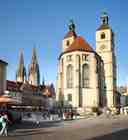
To spot the Neupfarrkirche, look for a cream-colored church rising above Neupfarrplatz with two symmetrical towers capped with red roofs and clock faces, standing proudly in the middle of the square, almost as if it’s wearing a pair of pointy hats and keeping perfect time. Now, as you stand here, let’s step back in time and breathe in the charged air of medieval Regensburg-though, for your nose’s sake, I promise not to describe the smells too vividly! Picture this square in 1519: bustling, noisy, packed with traders, townspeople, and suddenly, a shocking event. On this very spot once stood the heart of Regensburg’s Jewish community, one of the largest and most important in medieval Germany. Suddenly, political machinations and financial desperation led to their sudden and tragic expulsion. The entire Jewish quarter, including their centuries-old synagogue, was demolished almost overnight, the gravestones stolen, the memory bulldozed. The city council didn’t quite waste time-where the synagogue had been, they planned a towering church, the “Schöne Maria.” Talk about adding insult to injury; soon, miracle stories began to swirl, like the tale of the clumsy stonemason who survived a terrifying fall thanks to - who else? - the Virgin Mary! This miraculous reputation spread like wildfire, stoked by early printers and canny city officials eager for funds. Pilgrims descended en masse, rattling coins in wooden alms boxes and hammering on the doors to glimpse the wonders. The site became home to one of the biggest pilgrimages in the German-speaking world-just imagine the sound of hundreds of feet shuffling, prayers offered, merchants shouting “miracle books, get your miracle books here!” Of course, the church they tried to build was enormous-but as the pilgrims’ excitement faded, so too did the city’s bank accounts. Construction was halted. All that stood was the choir, two unfinished towers, and a half-church with dreams bigger than its stones-well, at least the church could say it was halfway to heaven! Crowdfunding wasn’t an option back then, so the city had to settle for a much smaller, makeshift finish. By the time the Reformation rolled in, the mood had shifted, and the church found itself with a new identity; rather than being a Catholic pilgrimage hotspot, it became Regensburg’s first Protestant parish church-a real plot twist in the story! Inside, even the furniture got into the spirit of reinvention. The city never built the fancy stone altar they’d planned, opting instead for a wooden altar painted with vibrant, dramatic scenes. It became something of a celebrity, only to be moved about and eventually put on display in the museum. The current altar in the church is from 1617, and if you sneak a peek, you might spot one of Bavaria’s rarest treasures: a surviving “pulpit clock”-because nothing says ‘efficiency’ like preaching on a schedule! And here’s a musical tidbit: Neupfarrkirche’s tradition of church organs sometimes teetered on the brink of bankruptcy, but in the end, the church always found a way to keep the music playing. The current instrument is a mighty pipe organ, built in the 1980s and tuned for the twenty-first century, a sound that fills the soaring single nave with music during services and concerts. Today, the story continues. There’s an exhibition about Regensburg’s Jewish history and the Reformation at the back of the church, and if you peer downwards-or join a guided tour-you can see remnants of the lost Jewish quarter and even the foundations of the old synagogue, now marked with a sculpted outline on the square. So next time someone complains about building delays, just tell them about the Neupfarrkirche: five centuries, three religions, two towers, and one unforgettable city square!
समर्पित पेज खोलें →To spot the Collegiate Church of St. Johann, look for the striking yellow-and-gray building on your right, with a crest-topped entrance, a statue of John the Baptist near the…और पढ़ेंकम दिखाएँ
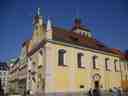
To spot the Collegiate Church of St. Johann, look for the striking yellow-and-gray building on your right, with a crest-topped entrance, a statue of John the Baptist near the roof, and a stout tower with a clock and baroque lantern rising above. Welcome to the splendid Collegiate Church of St. Johann! Imagine standing here centuries ago-smelling the incense, feeling the excitement of a grand feast day, maybe even dodging an absent-minded monk. This church is as much a survivor as it is a spiritual centerpiece. Its roots lead all the way back over a thousand years, when the very first St. Johann stood here as the baptismal church for the old Regensburg Cathedral. If you were here in 845, you might have seen the legendary baptism of 14 Bohemian princes right on this spot. These days, a commemorative plaque on the north wall marks that dramatic occasion-no Bohemian princes in sight, but plenty of curious pigeons. Throughout the medieval ages, St. Johann was juggled, rebuilt, and sometimes even threatened with demolition. Fires in the city roared through in 1152 and 1176, probably giving the church (and its parishioners) some serious heartburn. Over time, chapels and additions sprung up, like the early Gothic St. Nicholas Chapel-its stones still telling tales under the current cathedral’s south tower. Now, imagine the tension in the 1300s, as this little church stood stubbornly in the way of Regensburg Cathedral’s majestic expansion. The powerful leaders of St. Johann held out as long as possible, but finally-in a mix of heated negotiations and no doubt a lot of finger-pointing-the old St. Johann came down in 1380 with a promise to rebuild it nearby. The result? By 1381, a new, double-nave Gothic church stood here, with mighty stone walls and towering ambitions. As centuries rolled on, the Renaissance and Baroque ages worked their magic, and the church’s tower even received a clock in 1628, ticking away reliably ever since. Around this time, Regensburg got a little musical upgrade-St. Johann received new bells and a magnificent organ, which would make even the most tone-deaf congregation sound angelic. Picture that: grand music filling the nave, sunlight dappling through the painted windows, and the scents of old stone and beeswax candles wafting through the air. In the late 1700s, the church got a dazzling Baroque makeover. Fancy new frescoes appeared, like one of the beheading of John the Baptist-spoiler alert, not the happiest ending for the church’s patron, but quite the dramatic ceiling, that’s for sure. There were even new seats for canons and an opulent chapter room upstairs. But fortune can be fickle: disaster struck in 1887 when a fierce fire in the northern Bishop’s Court quickly leapt to St. Johann, gutting the roof and tower and undoing years of careful renovation. For a moment, the city leadership pondered tearing it down completely to make the cathedral look even grander! Thankfully they came to their senses, and entrusted architect Bruno Specht with a glorious neobaroque reconstruction-which is the elegant, sunny facade you see right here, complete with its statues and sharp symmetry. Nowadays, St. Johann is a feast for the senses-step inside, and you’ll spot a patchwork of history: precious altar paintings, baroque angels peering down from their pedestals, countless objects crafted in gratitude by generations of Regensburg’s faithful, and even a musical surprise. Four times a day, the carillon in the tower rings out with one of 84 melodies. Fancy a serenade while you stroll? You’re in luck! Of course, the mysteries linger. Somewhere inside are relics of saints, and even a precious blood relic of Pope John Paul II, donated just a few years ago. All these layers-fire and music, stone and faith-come together in a church that has been at the center of Regensburg’s religious life for almost nine centuries. Don’t be shy-peek in, marvel at the painted ceilings, and try not to get stuck behind a tour group with selfie sticks. After generations of upheaval and renewal, St. Johann stands-bold, bright, and still ringing out its story.
समर्पित पेज खोलें →
11 और स्टॉप दिखाएँकम स्टॉप दिखाएँexpand_moreexpand_less
To spot the Regensburg Cathedral, simply look up ahead for the two soaring, lace-like Gothic spires that tower above the old town-this stunning white limestone giant is impossible…और पढ़ेंकम दिखाएँ
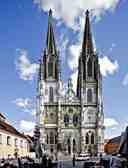
To spot the Regensburg Cathedral, simply look up ahead for the two soaring, lace-like Gothic spires that tower above the old town-this stunning white limestone giant is impossible to miss! As you stand before the Regensburg Cathedral, close your eyes and let your mind drift back through swirling centuries of music, stone, and the scent of incense. Imagine the year is 1275: the fires of the old Romanesque cathedral have just gone out, leaving only the so-called “Donkey Tower” standing. Now, listen-tools clink and echo as masons lay the first blocks of what will soon become a Gothic masterpiece, with its mighty towers eventually reaching over 100 meters high. This cathedral, dedicated to St. Peter, is the beating spiritual heart of Regensburg, much like the Cologne Cathedral is to its city. The land beneath your feet has held churches since around the year 700, but fires were a frequent visitor to these stones-blazes in 891 and 1156 destroyed what came before. But Regensburg’s citizens were determined! You’d almost expect to see monks and bishops arguing over building plans with the dramatic air of a reality TV episode. In the 13th century, plans for the new cathedral began-though at first, it was going to be rather short and squat. Lucky for us, the talented Master Ludwig (mysteriously also known as the Erminoldmaster), took charge around 1295. He had a bold, artistic vision inspired by the great French cathedrals: soaring heights, intricate sculpture, and walls that almost seem to float with light. By 1450, after constant negotiation, clever engineering, and endless fundraising-even by melting down church treasures to pay artists-Regensburg finally had a fully usable cathedral, complete with dazzling white walls and pops of color from the altars and sculptures. Can you picture the original building gleaming in limestone, the sunshine streaming through a forest of medieval stained glass windows? Over the centuries, the cathedral kept growing and changing-at times golden with decoration, at other times repainted olive-gray or stark white depending on fashion and philosophy. Even the mighty towers you see today weren’t finished until 1869, nearly 600 years after the first stones were laid. This place thrums with memory. Dukes and bishops rest inside, their tombs hidden away like treasure. The famous Domspatzen-cathedral choirboys-have sung here for centuries, their voices soaring like the spires overhead. Can you hear organ music echoing through the cavernous nave, rattling your very bones? That’s the sound of one of Germany’s largest organs: over 100 registers and a steel frame that seems to defy gravity. Keep your eyes on the west façade: statues of saints, prophets, and angels crowd the intricate portal, narrating stories of the Virgin Mary and the life of Christ. Inside, you’ll find altars sculpted as if they leapt straight out of a fairy tale, and even a monumental well over 12 meters deep-with tiny stone people acting out a scene at the edge. The cathedral’s old stones also bear darker reminders-the “Judensau” relief and its modern informational plaque, a testament to the complex, sometimes troubled history that lingers here. Regensburg Cathedral isn’t just a church; it’s a patchwork of dreams, disasters, cunning plans, and a touch of Bavarian stubbornness, rising above the city for more than 600 years. And as the bells ring out over the city today, just imagine all the footsteps, prayers, secrets, and songs these stones have absorbed. Not bad for a building that almost didn’t get its towers finished-talk about German perseverance! Wondering about the brief characterization of the building, equipment or the all saints' chapel? Feel free to discuss it further in the chat section below.
समर्पित पेज खोलें →Straight ahead you’ll spot a church with a long, white façade, a red-tiled roof, and a free-standing bell tower rising at one end-just behind those rows of parked cars and…और पढ़ेंकम दिखाएँ
Straight ahead you’ll spot a church with a long, white façade, a red-tiled roof, and a free-standing bell tower rising at one end-just behind those rows of parked cars and leafless winter trees-this is your landmark! Now, let me invite you back through time-watch out for any wayward Roman chariots, though! The Stiftskirche zur Alten Kapelle may look like a tranquil cornerpiece now, but this church claims to be Regensburg’s oldest, and even the “mother church” of all Bavaria. Some say the very first Christians in the region gathered here, right where a temple to the Roman goddess Juno used to stand. Picture it: priests swapping togas for vestments, incense lingering in the chilly air, and a bishop named Rupert transforming the old pagan altar into one devoted to Mary. According to legend, even Duke Theodo II himself was baptized here, starting the centuries-long flood of Christianity across the land. Oh, and in case you were wondering, no hard evidence-that’s historian speak for “cold coffee”-exists for those legends, but they’ve definitely spiced up the local storytelling! The church pops up in the records for real in 875-King Louis the German ruled from here, calling himself the founder of a basilica built with hefty stones supposedly borrowed from the city’s Roman walls. I guess recycling was trendy, even in the Middle Ages. But, as rulers moved on, the church fell into disrepair, earning the nickname “Old Chapel” as the decades creaked by. Everything changed again in the year 1002, when King Henry II-future saint, medieval multitasker-gave this place a fresh restart. He and his equally saintly wife, Kunigunde, rebuilt the Old Chapel, keeping its ancient layout. Henry handed it over to his newly founded Bishopric of Bamberg, but the church operated almost like an independent little kingdom, determined to show up its mighty neighbor, the Regensburg Cathedral. Of course, trouble was never far off! A couple of city-wide fires in the 1100s left the church wounded, but not down for long. Over centuries, it grew, with new side chapels, an ever-taller bell tower (if churches could get a nosebleed, that one would), and a crypt for the bones of the faithful. The beautiful, dramatically high Gothic choir you see sticking out from the end was added in the 1400s, crafted by Hans Engel to replace a cramped old apse. Just try not to trip over the buried history under your feet as you imagine it! Then came the 1700s, when the church got a fabulous Rococo makeover-think gold swirls, bubbly shapes, painted angels doing their angelic thing, and so many curls and flourishes you’ll wonder how anyone dusts them. Artists like Anton Landes and Christoph Thomas Scheffler turned the chapel from austere to absolutely dazzling. The church’s rivals used to mutter “St. Peter (the Cathedral) is the mighty, but the Chapel is the splendid.” (I’d say there’s a bit of holy sass there.) Inside, every corner beams with color and extravagance. Stroll through and you’ll find frescoes showing the dramatic life stories of Henry and Kunigunde, miraculous baptisms, and-my personal favorite-Kunigunde proving her innocence by walking over burning plows. Medieval drama had its own style of reality TV, didn’t it? The altarpiece soars, almost swallowing the choir, topped by a shimmering Mary with a ring of stars. Meanwhile, the church’s famous organ even drew Pope Benedict XVI for a blessing in 2006-talk about an endorsement! Through bombings and bad weather, the church has risen from rubble, repainted and revived, again and again. So, as you glance up at the white walls and quirky bell tower, remember: this is where centuries of faith, imagination, fierce rivalry, and a dash of legend come together-proving that in Regensburg, the past never sits still for long.
समर्पित पेज खोलें →To spot St. Josef, look for a grand white Baroque church with ornate statues and scrolls topping its West-facing facade at the edge of Alter Kornmarkt, right ahead of you. Now,…और पढ़ेंकम दिखाएँ
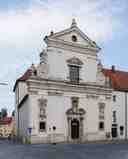
To spot St. Josef, look for a grand white Baroque church with ornate statues and scrolls topping its West-facing facade at the edge of Alter Kornmarkt, right ahead of you. Now, let’s imagine the year is 1660. The city of Regensburg is bustling, and you’re walking across the cobblestones with the smell of bread wafting from the market. Suddenly, you stop-work has just begun on this beautiful Carmelites’ church, thanks to a patchwork of donations from emperors, nobles, and the good citizens of Regensburg, all determined to turn dreams into stone. Money was a bit tight at first; picture the friars stretching every coin like it’s made of caramel rather than copper! No one quite knows which architect unleashed this slice of Italian charm in the middle of Bavaria, but it might have been the celebrated Carlo Lurago, Antonio Petrini, or maybe just one of Petrini’s brilliant students who took a wrong turn out of Italy and ended up right here. Construction lasted until 1673, and as soon as it was done, the church was dedicated to St. Joseph himself-who, among other things, is the patron saint of hard work and tight budgets. He probably looked down and said, “Well played, team.” Now scan the front of the building: the door you see is flanked by two grand columns topped with a broken pediment, and nestled in a shell niche above is St. Joseph himself holding the infant Jesus. If you check out the surrounding niches, you’ll spot statues of St. Teresa of Ávila and St. John of the Cross, heroes to the Carmelite order. Along the upper ledge, ponderous vases and curving volutes stand as silent witnesses while Henry and Kunigunde, the king-and-queen statue pair, keep a careful eye on things. This building has been through its share of drama and funnies-during the secularization of the early 1800s, imagine monks forced to pack up and let the church become a customs warehouse. Make way for the barrels of wine and crates of who-knows-what! The glorious interior treasures vanished; the high altar even ended up across the border in Austria. Luckily, the Carmelites made a comeback: by 1835 their church was back in action, re-stocked with altars scavenged from other churches (because who needs Ikea when you’ve got Baroque masterpieces up for grabs?). The church was officially reconsecrated in 1836, which surely called for a bang of the new bells or at least an optimistic ‘Amen!’ Walk around outside and you’ll see the tall, proud tower rising from the southeast corner, completed in 1681. It’s topped with a double onion dome and a lantern glinting in the sun, almost as if it’s winking at the nearby Old Chapel. Inside, you’ll find not just soaring ceilings and grand pillars but a treasure chest’s worth of altars-seven in all-and, at the heart, an exuberant high altar inherited from Regensburg Cathedral, covered in gold and peopled with angels, prophets, and saints. The light pours in through tall windows set just above the grand cornice, bathing everything in an almost magical glow. If you listen, you might even sense a gentle breeze stirring the devotional banners. If you visit during December, you’ll catch the city’s famous “Christkindl-Andacht,” a sequence of Advent prayers that’s been running since 1697, complete with folk music and processions. Or try the “Josefs-Mittwoche” leading up to St. Joseph’s Day, a tradition since 1782-think of it as the ancient Bavarian version of a midweek pep talk. The church is known as Regensburg’s confession hotspot; if you ever need to offload a decade’s worth of questionable pastry choices, this is your place. Through war, peace, and centuries of changing fashion, the bells of St. Josef have always rung out-four powerful bells cast in 1949 still chime today, echoing across the old city. Amidst all the history and hustle, something about St. Josef captures a bit of Bavarian resilience, Italian artistry, and Carmelite spirit-plus, if you walk away with a lighter heart, you’ll know the magic is still alive. On to the next stop!
समर्पित पेज खोलें →To spot Niedermünster Abbey, look for a grand Romanesque church with a simple, elegant façade flanked by sturdy towers-its location is just north of the Old Corn Market and not…और पढ़ेंकम दिखाएँ
To spot Niedermünster Abbey, look for a grand Romanesque church with a simple, elegant façade flanked by sturdy towers-its location is just north of the Old Corn Market and not far from the magnificent Regensburg Cathedral, on Niedermünstergasse 6. Alright, fellow explorer, get ready to step into one of Regensburg’s most mysterious and ancient corners! Picture it: the air is cool and crisp here in the heart of the old city, and you’re standing right where centuries of stories, secrets, and holy rituals are buried-sometimes literally-just beneath your feet. Niedermünster Abbey might seem calm and stately on the outside, but oh, if these stone walls could talk! They’d whisper tales of duchesses in glittering robes, Roman soldiers clanking armor, and more than a few frantic cooks chasing after runaway pigs. You’ll see why pigs matter in a moment. Let’s travel back in time. The founding roots of Niedermünster stretch all the way to a dramatic moment in 788-when the last Bavarian duke of the legendary Agilolfinger family, Tassilo III, decided to build a religious community for canonesses. Picture the end of the 8th century: Rome’s influence lingered, the Regensburg legions’ camp (Castra Regina) just to the south was falling quiet after centuries of marching boots, and the air smelled faintly of wet stone and promise. Tassilo probably chose this spot for more than its beauty-the embracing Roman walls offered protection, and underground wells bubbled with crystal-clear water. Security and plumbing: always important, even in the Middle Ages! By the early 9th century, after Tassilo’s departure, Niedermünster was becoming one of the most important women’s religious houses in the Holy Roman Empire. An early church rose here, built with stones “recycled” from Roman buildings-those thrifty monks really set the first trend of upcycling. But things truly flourished under Judith, one of the great women of medieval Bavaria. After her husband, Duke Heinrich I, died in the 10th century, Judith not only finished the big new church, but she moved in, ran the abbey herself, and ruled until her death in 987. In a world run mostly by men, this abbey became a shelter, school, and workplace for noble ladies. Judith’s tomb, and those of other rulers, lie near the high altar-how’s that for a VIP section? Under Judith’s watch, Niedermünster became so powerful that, by the 1000s, it was made an imperial abbey. Here’s where things get quirky! Being a Reichsabtei meant you owed a “servitium regis” to the Emperor-a fancy way of saying, “Pay up when the boss visits.” For a while, the abbey had to hand over sixty pigs every time the Emperor came to Regensburg. Sixty! Can you imagine the noise and the smell? It’s said that in 1073, thanks to the clever Abbess Gertrud, the pig tax was reduced to forty, and later swapped out for cold, shiny coins-or, after 1218, skipped altogether. Victory for bacon everywhere! Here’s a fun twist: deep beneath your feet, hidden for centuries, are layers upon layers of old buildings and tombs. Under the abbey, through what’s now called the “document Niedermünster,” archaeologists found not only the remains of Roman barracks, but the very sarcophagus of Saint Erhard, an early Christian bishop. That dusty old tomb was carefully built right into the north wall of the church, and when excavators discovered it in 1963, explorers realized it sat just where it always had-meaning you’re peering into the exact spot medieval worshipers did, more than a thousand years ago! Today’s church stands in the form built after a fire in 1152, rich with stones that survived the flames. After secularization in 1803, the abbey’s religious life slowed, the rooms rented and reused, even serving as a bishop’s mansion and administrative offices. As you ponder these ancient walls, imagine it bustling with the footsteps of noblewomen, the voices of prayer and political intrigue, echoes of lost emperors, and maybe, if you listen closely, a faint oink from centuries of pig payments. So, traveler, as you stand outside Niedermünster Abbey, take a deep breath. You’re in the heart of a story layered with ambition, faith, powerful women, and even a bit of medieval bacon economics! Don’t forget to peer into the archaeological exhibits below if you ever get the chance-sometimes the best secrets are right under your nose… or your shoes! Onward to our next stop!
समर्पित पेज खोलें →If you’re looking for the Porta Praetoria, just glance to your left-you’ll spot a weathered, ancient stone arch partially set into the wall of the modern building, with big Roman…और पढ़ेंकम दिखाएँ
If you’re looking for the Porta Praetoria, just glance to your left-you’ll spot a weathered, ancient stone arch partially set into the wall of the modern building, with big Roman stones at the base and a round white tower rising above it; it’s like a time machine peeking through the streets of Regensburg! Now, imagine this: you’re standing in the footsteps of Roman legionaries, right at the gateway of the mighty Castra Regina, nearly 2,000 years ago. The year is 179 AD, and Emperor Marcus Aurelius has just finished building this immense fortress on the windswept banks of the Danube-Regensburg was little more than a wild outpost then, and the Porta Praetoria was its proud northern entrance, facing the river and beyond that, the mysterious lands of the Germanic tribes. The gate you see before you was no ordinary door-it was the mighty “front door” of the legion camp, with thick stone arches and two towers that must’ve soared nearly 20 meters into the air, making today’s entrance look a bit like the doormat of a giant. I bet even the birds felt intimidated as they flew past! Picture the clank of armor, the shuffle of sandaled feet, the torchlight at dusk as soldiers hurried through this very entrance. This gate was the gem in the fortress wall-a proud symbol of Rome’s power, meant to impress friend and foe alike. The Romans, ever poetic even when they were building military bases, once wrote that “like a jewel set in gold, the gate adorns the camp.” And Tacitus, the famous Roman historian, noted that a soldier’s greatest pride was his camp. So you’re not just looking at stones; you’re gazing at a badge of ancient honor! For centuries, the Porta Praetoria was the way north, called the Wassertor or “Water Gate” by later locals since it led down to the river and the famous Stone Bridge. Even as medieval walls rose around Regensburg, at first the gate stubbornly kept its job as the city’s watery welcome mat. But time, weather, and more than a few invading armies left their marks. Legend has it that parts of the gate were hastily rebuilt after attacks, sometimes using whatever was handy-even shattered gravestones. Yes, nothing says Roman recycling quite like patching your fortress with someone’s memorial slab. Eventually, earthquakes, neglect, and the hustle of city life swallowed the gate-by the 17th century, it was literally built right into a brewery! I suppose that’s one way to preserve history: drown it in beer. For a long time, the Porta Praetoria just disappeared from memory-hidden in walls, covered by new roads, forgotten by all except maybe a few wandering ghosts who wished they could still march out to the Danube. Then, in 1885, when the brewery next door decided to expand, workers began tearing down an old annex and-surprise!-the ancient arch and stone tower emerged from beneath the dust, like a Roman centurion returning from a centuries-long nap. The city was in a tizzy! Some people worried that disturbing the ruins would unleash ancient diseases. The city ignored the panic, coughed up some gold marks, and carefully revealed this bit of buried treasure. Even after discovery, history kept playing its tricks. People got the gate’s floorplan all wrong, thinking it only had one archway instead of two. It took another hundred years and some modern archeological sleuthing to set the record straight with foundation scans and a bit of head scratching. Today, the Porta Praetoria stands as one of only a handful of Roman military gates north of the Alps-its rough limestone blocks patched with newer stones, a mixture of history and survival. The big round tower leans ever so slightly, probably from holding up all those stories. The gate’s been a beer cellar, a potato store, and now part of a hotel, where lucky guests can sleep in the “Porta Praetoria Suite.” And thanks to recent renovations, you can finally see its ancient base again, right at the same level the Roman soldiers once marched through-so take a good look, and step back in time. If you listen closely, you might even hear the echo of Roman boots-or is that just the rumble of your stomach from all this history?
समर्पित पेज खोलें →Just ahead, you’ll spot the mighty Goliath House by looking for the enormous mural of David and Goliath on a pale, stone-faced building crowned with battlements and a quirky,…और पढ़ेंकम दिखाएँ
Just ahead, you’ll spot the mighty Goliath House by looking for the enormous mural of David and Goliath on a pale, stone-faced building crowned with battlements and a quirky, turreted corner-trust me, you can’t miss Goliath the giant looming above the street! Alright, you’re standing at the foot of one of old Regensburg’s true storybook gems: the Goliath House! Imagine you’re stepping back over 800 years-close your eyes for a second and picture armored knights clattering across these cobblestones, their voices echoing off thick medieval walls. This formidable early Gothic “house-castle” was first built by patrician families right on top of an ancient Roman wall, so you’re literally standing where centuries of Regensburg’s drama played out. But it’s not the stonework that catches your eye first, is it? No, it’s that bold mural soaring above-David, slinging his stones, facing off against the towering, bearded Goliath, painted larger than life since 1573. Funny enough, the name “Goliath House” actually doesn’t come from the mural or the biblical giant, but from a much older building that stood here, once a home for wandering medieval scholars called “Goliards” (yes, scholars with a rebellious streak-imagine a hostel with poetry recitals and questionable jokes every night). Now, let’s turn up the drama: the mural itself has changed its face as many times as a chameleon at a paint store! Over the years, famous artists and hopeful locals have painted, repainted, and argued over how Goliath should look. At one point in 1841, an artist even snuck a whimsical frog with a mustache into the picture as a jab at a rather eccentric baron who strutted by each day. Some say Goliath was painted to mock greedy merchants or symbolize the mighty duchy of Bavaria towering over tiny Regensburg. Others simply enjoyed the spectacle-nothing like a giant on your wall to give the neighbors something to talk about. For centuries, the Goliath House was prized property, passed from family to family. The Thundorfers called it home in the 1200s, later joined by wealthy merchants with names like Tucher and Maller. At one point, the famous city historian Georg Gottlieb Plato-Wild married into the family next door and combined the two houses-now that’s what I call expanding your real estate portfolio! But the Goliath House hasn’t always had it easy. In the late 1800s, when Regensburg joined the railway era, officials wanted to tear down old buildings to widen the winding streets for carriages and trams. People panicked! The owner nearly demolished the entire place, but after a public outcry (imagine angry letters, fiery debates, probably a few pointed cartoons), the city bought off the owner just in time and promised to protect the front for at least 20 years. The inside, though, was gutted and rebuilt-so somewhere between knightly fortress and modern optics shop, the Goliath House reinvented itself once again. And here’s where a twist of artistic fate comes in: every time the mural faded, a new painter was called. Sometimes, insurance insisted they stick to the old style. Sometimes, the artist went rogue and gave Goliath a gladiator’s helmet or a gondolier’s grip! But the version you see today was painted by Franz Rinner in 1900, cleverly fitting Goliath’s hulking arms between the windows, with a pose so bold it outplays David’s sly determination. These days, the Goliath House holds a theater in its old tower-imagine laughter and applause filling the night air-and even a Michelin-starred restaurant in the back. So, from medieval fortress to mural battleground to posh dining, this house is proof that giants never really settle down-they just keep finding new ways to stand tall over the centuries.
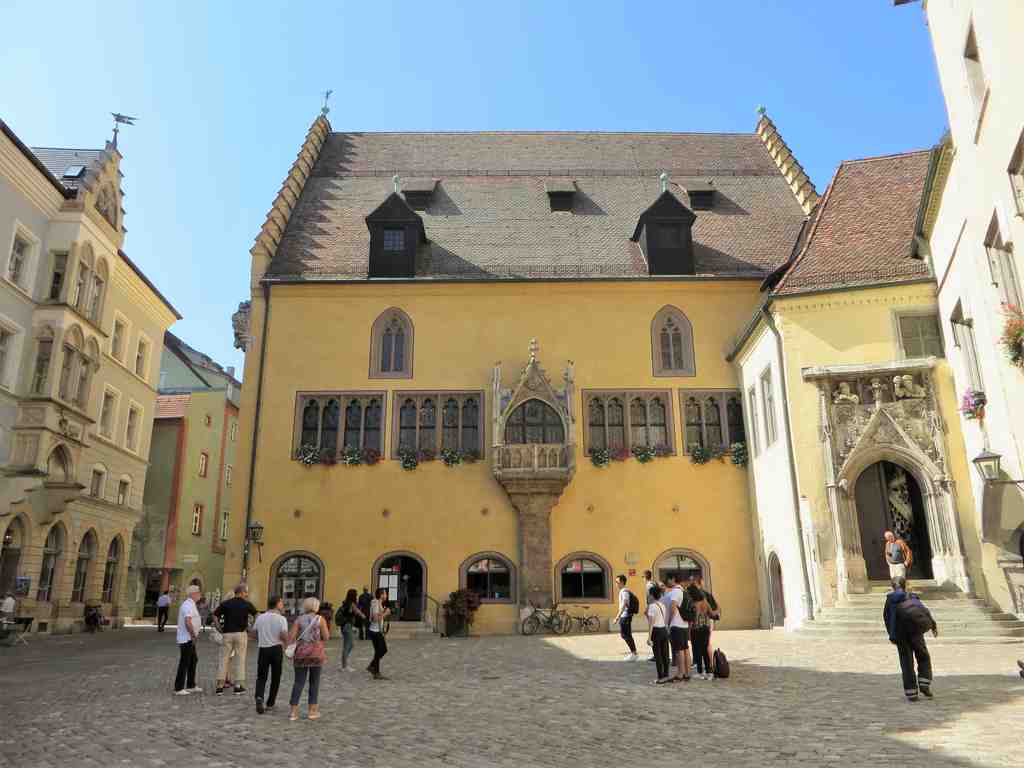
समर्पित पेज खोलें →To spot the Old Town Hall, just look for the large yellowish building with a steep, gabled roof, tall medieval windows, and a striking stone balcony that juts out above the…और पढ़ेंकम दिखाएँ
To spot the Old Town Hall, just look for the large yellowish building with a steep, gabled roof, tall medieval windows, and a striking stone balcony that juts out above the entrance directly ahead of you. Now, get ready-because you’re standing in front of a living patchwork quilt of Regensburg’s history! The Old Town Hall isn’t just one building, but a whole puzzle of three different buildings stitched together through the centuries. Imagine, way back in the Middle Ages, this corner of the city was buzzing with merchants, rulers, and the odd, suspicious-looking spy or two (it was a busy place!). First, your eyes are drawn to the Reichssaalgebäude to the south, with its charming oriel-like the city’s own medieval stage, perfect for a serious emperor or a dramatic wave to the crowd. This Old Town Hall, with parts dating all the way back to the mid-1200s, was built in the style of a patrician’s fortress. The oldest section, with its eight-story tower rising up 55 meters, was once the dramatic highlight of Regensburg’s skyline. Picture the year 1360-suddenly, disaster! The tower goes up in flames. But Regensburg doesn’t let a little fire keep it down. By 1363, the tower is restored and looking as mighty as ever. Take a peek at the large arched gateway: that’s your entrance to the inner courtyard, where the Venus Fountain from 1661 still sparkles, thanks to the sculptor Leoprand Hilmer. And keep an eye out for oversized statues tucked in the courtyard. They were supposed to decorate a nearby church but turned out to be too tall-proof that sometimes, even in art, size does matter! Back in the day, the Reichssaal (the grand hall upstairs) was bustling with the rumbling voices of the Holy Roman Empire’s top brass, who’d gather here for endless debates-a bit like the world’s oldest and loudest parliament. When the Emperor graced these halls, he’d show himself to the crowds below from the grand bay window, accepting their cheers or perhaps a loaf of bread thrown in enthusiasm. After 1594, the city became the permanent home of the Imperial Diet (the Immerwährender Reichstag). Regensburg was basically the “Capital of Debates”-perhaps not the fastest government in the world, since these meetings sometimes dragged on for years. The Old Town Hall’s story is not only about grand politics. Downstairs, in the depths, you can actually explore old prison cells and a genuine torture chamber. Imagine the chill in those stone halls-no wonder criminals in old Regensburg behaved (well, most of the time). With all this importance, the town decided the buildings needed a unifying look, so, in the 1570s, artist Melchior Bocksberger got a hefty sum of gold to paint delightful facades-sadly, those paintings have vanished, but you can still see drawings found in the attic a good 300 years later. If the walls could talk! In the centuries that followed, the Old Town Hall saw a bit of everything: After the end of the Holy Roman Empire, the magnificent Reichssaal became a dusty storage room. By the late 1800s, the place looked so rough the Bavarian Parliament said it resembled a barn-lucky for us, that shaming led to repairs, paid for by a lottery (imagine winning that ticket: “Congratulations-you’ve saved German history!”). The latest spruce-up of the grand wooden ceiling was in the 1970s. Now, as you stand here, imagine the swirl of colors, the clang of city guards’ swords, and the anxious faces of citizens peeking up at the famous Schutz and Trutz statues above the door-stone guardians representing the city’s defensive spirit. These days, the building is not just for the mayor but a vibrant museum where you can explore the rooms where princes and electors once whispered in secret, admire the Blue Room, or shiver at the old “Room of the Wretched Soul”-the death cell for those sentenced to the ultimate punishment. So, take a deep breath and soak it all in. This place is where Regensburg’s past still echoes with footsteps of emperors, whispers of high-stakes negotiations, and even a few ghost stories lingering in the shadows, just waiting for someone curious like you to listen. Ready for the next adventure?
समर्पित पेज खोलें →In front of you, you’ll spot Haidplatz as a wide open cobblestone square framed by pastel-colored medieval buildings, the striking red-towered Goldenes Kreuz on one side, and a…और पढ़ेंकम दिखाएँ
In front of you, you’ll spot Haidplatz as a wide open cobblestone square framed by pastel-colored medieval buildings, the striking red-towered Goldenes Kreuz on one side, and a baroque fountain with a statue standing proudly in the middle-just look towards the area where people are gathering at café tables in the sun. Welcome to Haidplatz! Take in the lively atmosphere-this square wasn’t always bustling with coffee-sippers and laughter. Imagine, nearly two thousand years ago, this spot was actually a scruffy field beyond the grand Roman fortress, Castra Regina. The Romans packed up and left, and over the next centuries, people started settling here. By early medieval times, the place was buzzing and soon became the heart of Regensburg’s Old Town. Fancy a medieval joust? Because in the Middle Ages, this was the go-to arena for tournaments. Picture it: the year is 1393, and three hundred knights in shining armor are crashing and clanging in a blur of metal, horses, and shouting crowds. One legendary face-off happened here, too-the epic tilt between Hans Dollinger and the so-called pagan Krako, straight out of 10th-century local legend. The buildings snuggling up to the square each tell their own tales. The most commanding is the Goldenes Kreuz, the old patrician castle at the northwest end. Looks fancy, but did you know kings and emperors bunked there? Even Emperor Charles V stayed so often some joked he was a regular. Local gossip says he fell for Barbara Blomberg, a young woman from Regensburg, and, well, the result was Juan de Austria-the guy who later defeated the Turks at Lepanto. That’s one historic hotel romance, right? These walls were also home to medieval power families and served as a guesthouse fit for emperors, kings, and entire royal entourages. On the eastern side, you’re looking at the stately Thon-Dittmer-Palais. It’s a little more refined, showing off its neoclassical face after centuries as a mash-up of medieval house-fortresses. Nowadays, it’s all about culture-pop inside and you might stumble onto a concert, play, or the Regensburg silent film festival. In the evenings, echoes of music and voices often drift across the square. Meanwhile, along the entire east edge, the Neue Waag once weighed not just goods, but also important political and religious questions-Philipp Melanchthon and Johannes Eck debated religion here in 1541. Plus, if you’re voting for the city’s oldest mouse, there’s a stone carving called the “Stadtmäuschen” in the former chapel. No cheese required. The south side’s narrow, ship-like house is called “die Arch.” With its pointed façade, it looks ready to sail right into the Rote-Hahnen-Gasse-it even needed a fortified riverbank because the Vitusbach used to flow right by! In case you worried about neighborhood rules: in 1455, the city council finally told people to stop keeping pigs in their houses and driving them out onto the “Heida.” That’s right-centuries before its café culture, this square was as much about oinking and mud as grand social gatherings. Haidplatz has seen joy and sorrow, too. In 1635, after the city was retaken from the Swedes, an imperial general named Hans Ulrich von Schaffgotsch was executed here, a grim spectacle watched by anxious citizens. But the square was hardly all doom and gloom. In 1673, a daring-and perhaps slightly bonkers-French eye surgeon tried to cross the square on a wire strung from the Goldenes Kreuz, covered in fireworks. You guessed it: he didn’t make it. Lesson learned-never mix surgery and pyrotechnics! Over the centuries, the square was transformed from market to parade ground, from tram hub to-believe it or not-a packed parking lot. By the 1980s, the city had enough of the traffic and gave the old stones a makeover. So, thanks to history and a bit of urban planning, today you can rest where emperors walked, knights clashed, pigs roamed, and where jazz now fills the square every summer during the Bavarian Jazz Weekend. Soak up the lively spirit, or if you’re daring, imagine what it sounded like when those 300 knights thundered across the cobblestones-no armor required! Eager to learn more about the location and structural development, name, origin and use or the development of the course? Simply drop your inquiries in the chat section and I'll provide the details you need.
समर्पित पेज खोलें →To spot the Holy Trinity Church, look for two distinct towers-one crowned with an octagonal lantern and green copper dome, the other simpler and topped by a reddish roof-rising…और पढ़ेंकम दिखाएँ
To spot the Holy Trinity Church, look for two distinct towers-one crowned with an octagonal lantern and green copper dome, the other simpler and topped by a reddish roof-rising boldly above the street ahead of you, framed by some leafy trees. Now, let’s step back in time to the early 1600s-Regensburg is bustling, but tensions fill the air. Imagine the dusty streets echoing with distant clanging armor and the urgent clip-clop of horses. The Thirty Years’ War is raging, and in the midst of all this chaos, a band of determined Protestants decides they want a church of their own. What could go wrong, right? Spoiler alert: almost everything. Construction on this early Baroque masterpiece kicked off in 1627 under the master builder Hanns Carl, but talk about bad timing! The city was wrestling with armies, mercenaries, refugees, and a serious shortage of coffee breaks. The Holy Trinity Church-back then called the Church of the Holy Trinity-became the first major Protestant church rising in Bavaria, and an architectural rebel too, with its grand hall completely free of columns. Step inside-if only with your imagination-and picture a sea of pews, over a thousand seats, all with a perfect view of the altar. Fancy a sermon? No pillars blocking the view! But wait, there’s more: step into 1631 and the church is almost finished. The northern tower’s done, the walls are so solid they look ready to withstand a siege, and excitement is building. Suddenly, disaster! Bavarian troops, defeated and battered, rush into Regensburg, pillage the city coffers, and leave the second tower unfinished-a bit like leaving your IKEA furniture 80% built because you lost the screws! The chaos means the south tower only gets three stories and a quick roof. But the people of Regensburg soldier on. This new church becomes a beacon for exiled Protestants from Austria and Bohemia, who pitch in for its construction and, later, even find their final rest in the churchyard-a patch of history just beyond these walls. There’s a bit of a mystery, too. The church’s grand portals were supposed to be decorated with striking sculptures-think of them like holy bouncers making sure you admired the building. A famous artist, Leonhard Kern, got the contract, but the sculptures suffered endless delays, partly thanks to the war. By the time some arrived, no one quite knew what to do with them. So today, the statues meant for the church hang out at the Old Town Hall instead, like misplaced party guests. Engineering here was a marvel: to keep the sightlines open, the whole vaulted ceiling was suspended from the roof, and instead of heavy ribs, innovative hollow decorations made from fabric and glue were used. Pretty crafty, though they turned out to be a bit of a magnet for damp and mold-a historic “uh-oh” moment in church maintenance. Jump forward a century or two, and you’ll find noblewomen like Princess Therese of Thurn and Taxis negotiating their own private box-a kind of VIP balcony, because every great church deserves front-row seating for the aristocracy. A little further down the line, it becomes the stage for grand concerts and the powerful sounds of a mighty organ-today, a special “Bach-Orgel,” built just for the stirring works of Johann Sebastian Bach. With every step on its worn stone floors, you’re brushing shoulders with soldiers, nobles, refugees, musicians, and everyday townsfolk-each leaving their own quiet echo. On a summer day, climb the northern tower and feel the wind whip over Regensburg’s rooftops, the city and river unfurling like a painted panorama. Whether stormed by armies or shaken by renovations-even mysterious ceiling collapses-Holy Trinity Church has endured as Regensburg’s resilient, beautiful rebel, always pointing skyward and forward.
समर्पित पेज खोलें →You’re now standing outside the Regensburg Theatre, where drama, music, and a few plot twists of its own have played out for more than two centuries. Let your imagination conjure…और पढ़ेंकम दिखाएँ
You’re now standing outside the Regensburg Theatre, where drama, music, and a few plot twists of its own have played out for more than two centuries. Let your imagination conjure the sound of an orchestra warming up, the muffled voices of excited theatergoers, and perhaps a faint whiff of greasepaint-because inside, stories old and new come alive almost every night. Picture this: It’s the early 1800s, and Regensburg wants to make a dazzling statement. So, the city asks the star architect of the era, Emanuel Herigoyen, to design a theatre that truly steals the show. Construction is swift, the mood is electric, and by 1804, the doors swing open to a brand-new Neoclassical theatre. But Regensburg isn’t just building four walls around a stage-it’s throwing in a grand ballroom upstairs and, in a stroke of VIP-worthy genius, a carriage driveway that cuts straight through the ground floor. Why walk around the building when you can ride straight through? Opera capes won’t wrinkle themselves, after all. For a while, the theatre hosts more drama behind the scenes than onstage. The city funds some of it, the princely Thurn and Taxis family chips in, and each theatre director tackles the fun challenge of scraping together the rest, usually with sweat, tears, and a dash of creative fundraising. Ignaz Walter, the first director, keeps things running for twenty years-probably developing the patience of a saint and the nerves of a juggler. But in 1849, disaster strikes. The theatre is engulfed by flames and burns almost completely to the ground. While the smell of smoke still lingers, a plucky troupe of actors moves into a local inn to keep the magic of theatre alive. The House of Thurn and Taxis even lends the city their entire theater wardrobe and props-because where else is someone going to find a dozen powdered wigs and a fake sword at the last minute? By 1852, a new theatre rises from the ashes, rebuilt on the original site with help from local citizens, the monarchy, and-not surprisingly-the fire insurance fund. There are some changes: the stage and auditorium swap places, and they add a new ballroom, the Neuhaussaal, which you can still find inside today. Those classic columns on the Bismarckplatz side? They're mostly the work of Carl Victor Keim, who managed to blend the past and the future into the stonework. Over the years, the theatre survives wars, modernization, more than thirty renovations, and at least one intense debate about whether to knock it all down or just give it a good scrub. In the 1990s, a grand restoration aims to bring back its 19th-century shine-goodbye, architectural confusion, hello, crisp Neoclassical lines! Even the old carriage passage is restored; less for actual horses, more for old-school charm. These days, the Regensburg Theatre is a five-genre marvel, hosting opera, drama, dance, youth theatre, and concerts, in venues across the city, from ornate halls to converted palaces and the open-air courtyard of the Thon-Dittmer-Palais. More than 180,000 people come through its doors every year. With over six thousand season-ticket holders, it’s safe to say: Regensburg loves a good show. It’s even produced several winners of the Bavarian Award for Artistic Promotion-proof that this stage is as lively today as it was two hundred years ago. So, as you stand here, try to imagine the generations of directors and dreamers, from marquises to modern-day impresarios, all weaving their own stories into the fabric of the city. And don’t forget-if you ever hear the faint rumble of a carriage, it’s probably just the spirit of an old actor, arriving fashionably late for curtain call. Trust Regensburg Theatre to never let the show stop-even when the building tried to do just that. Let’s see if the next act of its history will be comedy, tragedy, or-knowing Regensburg-a bit of both.
समर्पित पेज खोलें →To spot St. Oswald, just look for the tall, elegant church with its pointy roof and slender tower topped by a small greenish dome, standing grandly above the colorful houses right…और पढ़ेंकम दिखाएँ
To spot St. Oswald, just look for the tall, elegant church with its pointy roof and slender tower topped by a small greenish dome, standing grandly above the colorful houses right at the southern bank of the Danube. Now, imagine yourself standing here hundreds of years ago, a fresh breeze from the river swirling around you, the bells of St. Oswald calling out across Regensburg's hustle and bustle. This isn’t just any church-it’s a place where stories cling to every stone like dust after a busy festival! St. Oswald began its journey way back around 1290-think ancient monks in brown robes, a time when giants like the city walls of Regensburg watched over everyone. This site was originally home to a Carmelite monastery; those monks didn’t stay long, moving off to Straubing by 1367, perhaps chasing better soup or just looking for quieter neighbors. But the buildings remained, and soon after, a new chapter was written here: the founding of a hospital and church for twelve pious women by two wealthy Regensburg citizens, Friedrich Auer and Karl Prager. Imagine them, bustling about, probably arguing about how many windows the place needed! Their foundation was the first of its kind-run not by bishops or church authorities, but by ordinary townsfolk. It was like the first citizens' committee, but with more prayers and less paperwork. The coats of arms of these original founders can still be seen proudly displayed on the outside, facing the street and the river-almost like family stickers on a modern van. And here’s a fun twist: In the years that followed, the hospital and church came under the care of a new family, the Gumprechts, when the Prager line ended. These folks even had their family crest built into the inside of the church, right in the choir arch-talk about marking your spot! Later on, after the Auers also disappeared from the family tree, the city itself fought over control of the church. There was a long legal squabble, and the city council finally claimed it, banging their gavel in civic triumph. Years later, as the Reformation swept through Europe, St. Oswald became one of the first Protestant churches in Regensburg. Step inside today and you might still catch the echoes of heated sermons and community debates. But let’s not forget the building itself: the impressively high, slender choir was the work of talented medieval stonemasons. The marks of their chisels, found here and at the nearby Dominican church, are like signature tags from the past. Remnants of ancient cellars below hint at even earlier buildings, possibly women’s residences-a kind of medieval dormitory where the original twelve ladies could peek into the church from their living quarters. Over time, St. Oswald grew. After 1604, it expanded westwards, incorporating even the living quarters-just imagine being able to sit by your stove and glance straight at the altar! The west entrance you see now, with its helpful (and maybe slightly proud-looking) portico, wasn’t built until 1908. Inside, your senses would be delighted by a spectacular baroque transformation-elaborate altars, a painted ceiling bursting with Bible stories, angels swirling in plaster overhead, and the stirring notes of an organ built in 1750 by Franz Jakob Späth. The church is a treasure chest of art and symbolism, with wild tales in every corner: Jonah and his whale, Moses and the burning bush, and at the center, the powerful message that the word of God endures forever. Today, St. Oswald is part of the Dreieinigkeitskirche parish, hosting concerts and summer organ recitals that fill these ancient walls with music and laughter. Who knew a place born in the hush of medieval cloisters would one day swing to the sounds of summer jazz? So linger at St. Oswald a moment more, and listen-the stones whisper secrets, the river carries old hymns, and the whole place seems ready for its next adventure. And if you felt a ghostly tap on your shoulder, don’t worry… it’s just Friedrich Auer checking if his family crest still looks sharp! Intrigued by the specifications, equipment or the municipality? Explore further by joining me in the chat section below.
समर्पित पेज खोलें →
अक्सर पूछे जाने वाले प्रश्न
मैं टूर कैसे शुरू करूँ?
ख़रीदारी के बाद, AudaTours ऐप डाउनलोड करें और अपना रिडेम्पशन कोड दर्ज करें। टूर तुरंत शुरू करने के लिए तैयार होगा - बस प्ले टैप करें और GPS-गाइडेड रूट का पालन करें।
क्या टूर के दौरान मुझे इंटरनेट चाहिए?
नहीं! शुरू करने से पहले टूर डाउनलोड करें और पूरी तरह ऑफ़लाइन इसका आनंद लें। केवल चैट फ़ीचर को इंटरनेट की ज़रूरत है। मोबाइल डेटा बचाने के लिए WiFi पर डाउनलोड करने की सिफ़ारिश है।
क्या यह एक गाइडेड ग्रुप टूर है?
नहीं - यह एक सेल्फ-गाइडेड ऑडियो टूर है। आप अपनी गति से स्वतंत्र रूप से खोजते हैं, आपके फ़ोन से ऑडियो कथन बजता है। कोई टूर गाइड नहीं, कोई ग्रुप नहीं, कोई शेड्यूल नहीं।
टूर में कितना समय लगता है?
अधिकांश टूर पूरा करने में 60-90 मिनट लगते हैं, लेकिन गति पूरी तरह आपके नियंत्रण में है। जब चाहें रुकें, स्टॉप छोड़ें, या ब्रेक लें।
अगर मैं आज टूर पूरा नहीं कर सकता/सकती तो?
कोई समस्या नहीं! टूर की लाइफ़टाइम एक्सेस है। जब चाहें रोकें और फिर शुरू करें - कल, अगले हफ़्ते, या अगले साल। आपकी प्रगति सेव रहती है।
कौन सी भाषाएँ उपलब्ध हैं?
सभी टूर 50+ भाषाओं में उपलब्ध हैं। अपना कोड रिडीम करते समय अपनी पसंदीदा भाषा चुनें। नोट: टूर जेनरेट होने के बाद भाषा बदली नहीं जा सकती।
ख़रीदारी के बाद मैं टूर कहाँ एक्सेस करूँ?
App Store या Google Play से मुफ़्त AudaTours ऐप डाउनलोड करें। अपना रिडेम्पशन कोड (ईमेल द्वारा भेजा गया) दर्ज करें और टूर आपकी लाइब्रेरी में दिखेगा, डाउनलोड और शुरू करने के लिए तैयार।
अगर आपको टूर पसंद नहीं आया, तो हम आपकी ख़रीदारी वापस करेंगे। हमसे संपर्क करें [email protected]
सुरक्षित चेकआउट