

बाम्बर्ग ऑडियो टूर: समय और जिज्ञासाओं के निशान
एक हजार साल पहले, बाम्बर्ग की सात पहाड़ियाँ उन रहस्यों से गूँजती थीं जो राजाओं को गिरा सकते थे और साम्राज्यों का निर्माण कर सकते थे। बाम्बर्ग विश्वविद्यालय के शांत पत्थरों और कैथेड्रल के विशाल टावरों के नीचे, सत्ता संघर्ष, वर्जित प्रेम और रहस्यमय सौदों ने शहर का भाग्य गढ़ा। यह स्व-निर्देशित ऑडियो यात्रा घुमावदार गलियों और ऊँची मीनारों से होकर गुजरती है, उन कहानियों को उजागर करती है जिन्हें स्थानीय लोग भी शायद ही कभी सुनते हैं। छिपे हुए कोनों और खोई हुई गूँजों को खोजें क्योंकि प्रत्येक पड़ाव बाम्बर्ग के बहुस्तरीय अतीत को स्पष्ट रूप से सामने लाता है। किस छिपे हुए विद्रोह ने विश्वविद्यालय के विद्वानों को वफादारी और निर्वासन के बीच चयन करने के लिए मजबूर किया? कैथेड्रल की छाया के नीचे कौन गायब हो गया, जिसे फिर कभी नहीं देखा गया? अपर पैरिश में किस अप्रत्याशित घोटाले ने शहर के अपने पुजारियों पर विश्वास को हमेशा के लिए बदल दिया? हर कदम के साथ समय में आगे बढ़ें। राजनीतिक साज़िश के तनाव और सदियों पुराने रहस्यों को उजागर करने के रोमांच को महसूस करें। बाम्बर्ग को एक जीवित, साँस लेती हुई किंवदंती के रूप में देखें। शहर की सच्ची कहानी की चाबियाँ आपकी हैं। शुरू करने की हिम्मत करें।
टूर पूर्वावलोकन
इस टूर के बारे में
- scheduleअवधि 40–60 minsअपनी गति से चलें
- straighten3.9 किमी पैदल मार्गगाइडेड पथ का पालन करें
- location_on
- wifi_offऑफ़लाइन काम करता हैएक बार डाउनलोड करें, कहीं भी उपयोग करें
- all_inclusiveलाइफ़टाइम एक्सेसकभी भी, हमेशा के लिए फिर सुनें
- location_onफ्रांज-लुडविग-जिम्नेजियम बाम्बर्ग से शुरू होता है
इस टूर के स्टॉप
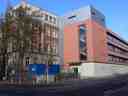
Look for the mix-and-match school complex: an older red-brick building with classic window frames on the left, connected to a newer peach-and-silver modern wing on the right.…और पढ़ेंकम दिखाएँ
Look for the mix-and-match school complex: an older red-brick building with classic window frames on the left, connected to a newer peach-and-silver modern wing on the right. Alright, you’re standing at the Franz-Ludwig-Gymnasium, or FLG if you want to sound like you’ve got a locker inside. What you’re seeing in front of you is basically Bamberg’s education story in architecture: tradition on the left, practical modern upgrades on the right… because even Latin needs decent stairwells. This is a language-focused, humanistic high school, which in Germany means the classics aren’t just a decorative idea. We’re talking real Greek and Latin-languages that have a special talent for humbling teenagers and adults equally. The school started life on October 1st, 1890 as the “New Gymnasium,” Bamberg’s second academic high school. And “new” wasn’t just marketing. Back then the older gymnasium mainly served Catholic boys. This one, by order of the ministry, opened its doors wider: girls could attend… and so could Protestant and Jewish students. In 1890, that was a pretty serious statement-less “everyone’s welcome” slogan, more “we’re actually changing the rules.” Now, the 1930s and 40s were the stress test. In 1938 the Nazis reshaped gymnasiums into so-called “German secondary schools.” A lot of traditions got bulldozed-intellectually, culturally, and tragically in human terms. But here’s a striking detail: this school was the only gymnasium in all of Upper Franconia that managed to keep the humanistic track alive through that period, still teaching Greek and Latin. That meant when 1945 arrived and Germany had to rebuild its institutions, this place didn’t need a total academic reinvention… it had stubbornly kept a thread of continuity. By the early 1960s the school physically expanded-new construction filled in space between the main and rear buildings. And in 1963 the curriculum expanded too: alongside the traditional humanistic route, students could choose a modern language track-Latin, English, French. Two years later, in 1965, the school took the name Franz Ludwig von Erthal, a prince-bishop from the 1700s known as a reformer who pushed education and social improvements. Naming a school after him is Bamberg’s way of saying: we like our history… but we prefer it when history funds schools. Over time, the place kept evolving. In the 1970s it adopted the then-new upper-level course system. In 1979 it also became a training site for future teachers-starting with German, history, and civics, and later adding more subjects. And because languages are kind of the school’s love language, offerings grew far beyond the basics: Spanish joined in, and at times even electives like Russian, Italian, and Chinese popped up. In 1998, they added yet another path with English as the first foreign language-because the world was shrinking, and homework was expanding. One last bit of local flavor: until 1999, students from the archbishop’s boys’ seminary-the “Ottonianum”-were closely tied to this school. Also, for decades every headmaster was a classicist… which is either a fun coincidence or proof that Latin teachers eventually run everything. When you’re ready, Schönleinsplatz is next-just walk west for about 4 minutes.
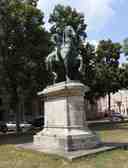
समर्पित पेज खोलें →Look for the bronze rider on a horse up on a big pale stone base, standing in a small green patch with trees and traffic rolling past on all sides. Welcome to Schönleinsplatz……और पढ़ेंकम दिखाएँ
Look for the bronze rider on a horse up on a big pale stone base, standing in a small green patch with trees and traffic rolling past on all sides. Welcome to Schönleinsplatz… although that name is actually a bit of a rebrand. For a long time this was basically “the shooting club spot,” a practical place outside the old city defenses where you could build loud, smoky things without annoying the people inside the walls… too much. You’re standing near the start of Bamberg’s long main approach into the old town, and right around here-until 1805-stood the Langgasser Gate. This wasn’t some modest doorway either. It was the city’s show-off entrance: a gate tower that worked as customs office and jail, and the ceremonial starting line where newly elected prince-bishops began their grand ride into Bamberg. Picture it: polished boots, nervous officials, a little fanfare… and just off to the side, the reminder that yes, the city also had a prison. Balance. Back then, this whole area was flood-prone. So instead of elegant squares, you got simple huts, workshops, and the kind of businesses that don’t mind wet feet. A shooting house outside the walls made perfect medieval sense-safer for everyone involved. Later, as Bamberg’s beer culture expanded, the neighborhood around the Hain filled with hop kilns and breweries, their tall chimneys stamping the skyline well into the 1900s. If you could time-travel, you’d smell toasted malt and coal smoke, and you’d probably need to wash your clothes afterward. Now, the name “Schönleinsplatz” comes from Johann Lukas Schönlein, a doctor born in 1793. When he died in 1864, locals quickly formed a committee to honor him. But money was tight, so instead of a full-blown bronze statue, they went for a large Carrara marble bust-still impressive, just… from the shoulders up. The sculptor was Caspar von Zumbusch from Vienna. And because a bust can disappear on a wide open square, they put it on a little hill so it wouldn’t get visually swallowed. Naturally, that hill sparked complaints-one letter even asked if the mound could be removed so the shooting club’s new building would “stand out” better. In other words: “Lovely monument… but could it stop blocking our vibe?” The big unveiling happened on November 30, 1873-Schönlein’s 100th birthday. The city’s dignitaries gathered at his humble birthplace, then processed here with singing clubs, speeches, and enough civic pride to power a small tram system… which, fittingly, arrived later. After the ceremony, the fine folks feasted at the Hotel Bamberger Hof, and ended the day at the theater with Meyerbeer’s opera The Huguenots. That’s Bamberg for you: medicine, music, and a good dinner, all in one commemorative package. By the late 1800s, this square became a grand Gründerzeit “front door” to the city-designed to impress visitors arriving from the station side. It got formal plantings, diagonal paths, and a fountain installed in the 1880s, later even lit up in color from the new electricity works. By 1905, trams were fanning out from here, turning elegance into infrastructure. And then… modern life happened. Designs were simplified, lawns replaced intricate flower beds, and by the 1950s the once-glamorous Schützenhaus-Bamberg’s proud party palace-was demolished and replaced by a heavier, more practical bank building. Today Schönleinsplatz is less “strolling and flirting by the fountain,” more “crosswalk strategy and traffic awareness.” Progress has a habit of being useful. When you’re ready, ETA Hoffmann Theater is a 4-minute walk heading south.
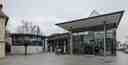
समर्पित पेज खोलें →On your left, look for the modern theater building with a wide, sharp-edged roof and a big glass front like a display case for the lobby inside. You’re standing by Bamberg’s…और पढ़ेंकम दिखाएँ
On your left, look for the modern theater building with a wide, sharp-edged roof and a big glass front like a display case for the lobby inside. You’re standing by Bamberg’s city theater, the ETA Hoffmann Theater… and it’s a lot older than it looks. The glass-and-steel entrance you see today is the latest layer on a cultural lasagna that’s been baking since 1802. Before it was a theater, this spot was basically the social engine room for Bamberg’s well-dressed citizens. In the late 1700s, different properties around Schillerplatz got stitched together, and one owner turned it into a “society house” - a place to meet, eat, drink, gossip, and generally pretend you’re only here for the conversation. They even built a special hall for it: about 130 people, sparkling chandeliers, big mirrors, game tables… the kind of room that says, “We are making very serious decisions,” while someone definitely cheats at cards. Then, in April 1802, a nobleman named Friedrich Julius Heinrich von Soden took over the complex and gave Bamberg something ambitious: a proper theater. The opening performances happened on October 3rd and 4th, 1802, under the grand title of a “princely privileged stage.” Because nothing says “fun night out” like a mouthful of bureaucracy. The early theater was surprisingly forward-thinking: it had one of the first permanent ensembles around, and room for roughly 500 people - on the main floor and two balcony levels - though the stage itself was fairly compact. So, big audience… cozy drama. In 1808, the story gets a serious upgrade. A newly built theater building opened here at Schillerplatz - and that structure still forms the historical core of what you’re looking at now. And get this: the first piece performed in the new building was an allegorical work called “The Vow,” written by E.T.A. Hoffmann himself. Yes, the guy the theater is later named after. He arrived that same year as musical director and stayed in Bamberg until 1813… but his theater job was a little chaotic. He was hired as Kapellmeister, yet he effectively conducted only one opera. Internal squabbles, rival musicians… the usual artistic “collaboration.” So he pivoted - working as a dramaturg, a ticket-taker, even painting scenery. Imagine the future literary legend ripping tickets at the door like, “Enjoy the show.” For the German premiere of “Käthchen von Heilbronn” in 1811, he actually designed the sets. After that, the theater lived a long life of changing leadership and frequent money headaches for about 150 years, until it was shut down entirely under the Nazis. During the war, performance life went quiet. Afterward, the building was used as a refugee shelter, and the acting troupe performed wherever they could - gym halls, event rooms, whatever was available. It wasn’t until 1959 that the theater could reopen in a renovated form, and from 1970 onward it officially carried Hoffmann’s name as a dedicated drama house with musical guest performances. Now look again at that clean modern entrance: between 1999 and 2003, the whole place was renovated and expanded. That’s why you get this welcoming glass foyer, new spaces like a studio stage with flexible seating, and all the modern stage tech… carefully hidden, so the magic doesn’t show its wiring. Today, it’s still very much a working city theater with a resident ensemble - and since the 2025 to 2026 season, the artistic director is John von Düffel. Ready for Drudenhaus? Just walk northwest for about 7 minutes.
समर्पित पेज खोलें →
11 और स्टॉप दिखाएँकम स्टॉप दिखाएँexpand_moreexpand_less
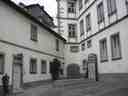
On your left, look for the pale, enclosed courtyard building with lots of simple windows and a stone slab sign that reads “NATUR KUNDE MUSEUM” beside a big arched doorway.…और पढ़ेंकम दिखाएँ
On your left, look for the pale, enclosed courtyard building with lots of simple windows and a stone slab sign that reads “NATUR KUNDE MUSEUM” beside a big arched doorway. You’re standing at Bamberg’s Natural History Museum, tucked into the old university rooms of the former Jesuit college in the island district… which is a wonderfully Bamberg way of saying: “Yes, it’s important, and yes, it’s slightly hidden.” It began in 1791, when Prince-Bishop Franz Ludwig von Erthal set up a “cabinet of curiosities” with an Enlightenment-era mission: collect, catalog, and study the region’s biology and geology. Not really for casual browsing, either. This was designed for professors and students first… the public came later, once everyone loosened their collars. Then the university was dissolved in 1803, and the collection had to reinvent itself. By 1822, under Dionysius Linder, it absorbed pomology materials from the Benedictine monastery at Banz… basically, serious fruit science. Somewhere, an apple felt very seen. The museum kept growing thanks to gifts and collectors, including Julius von Minutoli, who brought back objects from travels far outside Europe-turning this place into a global scrapbook of natural history. Inside is the famous Vogelsaal-the “Bird Hall”-and it’s not just a room, it’s a time capsule. Finished in 1810, it’s the only original 19th-century museum display room still preserved like this. The lower level shows European and exotic birds; the gallery adds invertebrates, fish, amphibians, reptiles, mammals, botany… the whole crowded, wonderfully old-school parade of nature. Nobody’s totally sure why it was never modernized. The best theory? After 1803, teaching mattered less, the Bavarian crown wasn’t eager to spend, and Linder was busy obsessing over fruit models. Priorities. And about those collections: roughly 200,000 objects-minerals from now-vanished sites, records of old ore deposits, about a thousand Jurassic ammonites, a complete preserved quagga (rare worldwide), 60,000 local insect records around 1930, and wax models of apples, pears, and cherries from around 1800-varieties that mostly don’t exist in orchards anymore. There’s even the “Bamberg Wonder Chain,” carved from more than 150 tiny fruit stones. Patience, weaponized. When you’re set, University of Bamberg is a 4-minute walk heading northwest.
समर्पित पेज खोलें →On your left, look for the wide, palace-like stone facade with three big arched wooden doorways and tall arched windows above them. So yes… this is a high school, but it’s…और पढ़ेंकम दिखाएँ
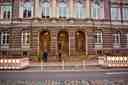
On your left, look for the wide, palace-like stone facade with three big arched wooden doorways and tall arched windows above them. So yes… this is a high school, but it’s dressed like it has a meeting with a king. That “serious public building” look is no accident: Clavius-Gymnasium was built in 1879 to 1880 in a Neorenaissance style that was popular for civic pride projects after German unification-basically, architecture saying, “Education is important, and we have the stonework to prove it.” The school’s roots go back further than the building, though. In 1794 it started life as an engineering and drawing academy-very practical, very hands-on-meant to feed Bamberg’s trades and crafts with real skills. By 1833 it earned official state recognition as a combined agricultural and trade school, which is why that year is treated as its formal “birth.” Then came additions like a commercial department in 1854, bringing in subjects like English and shorthand… the nineteenth-century version of “add business skills so the kids can get jobs.” Space was a constant headache. Classes were squeezed into the old Wedding House downtown, and gym class wandered wherever it could fit-sometimes even into a secularized church in winter. Then in 1871, disaster struck: the roof of that old building burned. Suddenly, “we need more room” became “we need a new building yesterday.” So Bamberg debated locations like a committee that couldn’t pick a restaurant. Eventually, they settled here, and one doctor argued the case beautifully: the street was broad, friendly, airy… lively, but not choked with traffic. Also-and this is very Bamberg-another proposed site was rejected because nearby hop-drying kilns might be unhealthy for students. Nothing says “educational planning” like being taken out by beer logistics. The school was later named after Christophorus Clavius, the scholar who helped make the Gregorian calendar reform work-so when your phone calendar behaves, you can mutter a quiet thanks. The institution became a full Gymnasium in 1965, strengthened its science-and-technology focus, and later added an economics track too. Its history isn’t only proud; it’s also sobering. During the Nazi era, Jewish teachers and students were pushed out, the building was seized as a hospital during the war, and then used for refugees and emergency care afterward. These walls have seen a lot more than exams. Today, the memorial plaques inside still hold that memory. And speaking of “today,” the big modernization from 2011 to 2017 cost about 39 million euros at the time-roughly the same order as 45 million dollars in today’s money-and replaced decades of temporary container classrooms with new space, a new sports hall, elevators, and a restored historic feel. When you’re set, Tent of Religions is a 2-minute walk heading north.
समर्पित पेज खोलें →On your left, look for a half-open, dome-like tent made of curved metal ribs and translucent, stained-glass-colored panels, sitting under leafy trees like a modern pavilion in a…और पढ़ेंकम दिखाएँ
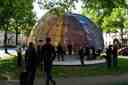
On your left, look for a half-open, dome-like tent made of curved metal ribs and translucent, stained-glass-colored panels, sitting under leafy trees like a modern pavilion in a small square. This is Bamberg’s Tent of Religions, and it’s exactly what it sounds like: a shared meeting place for Jews, Christians, and Muslims… in the form of a tent. Not a church borrowing a corner for an “interfaith night,” not a sterile conference room with bad coffee, but a space designed from the start to belong to all three. That’s the point here: nobody’s a guest, nobody’s the host, and nobody has to pretend beige walls are “neutral.” Beige walls have started wars of their own. The structure is cleverly symbolic. See how the shell is made of three equal, petal-like sections that interlock into one bud? Each “petal” represents one of the three religions, and it’s built from a metal frame covered with a special tarp-like skin. It’s art, architecture, and engineering having a surprisingly productive group project. The design came from two Bamberg graphic artists, Bernhard Kümmelmann and Christine Kaufmann, with the technical planning handled by KTA Kiefer and the construction carried out by Prebeck. Step closer and the visuals get more specific. One panel carries Hebrew text on a deep blue field, opening with the beginning of Genesis: “In the beginning…” Alongside it is the gold seven-branched menorah, a symbol tied to the Torah and the ancient Temple in Jerusalem-still iconic long after the Temple’s destruction in 70 CE. Another panel is Christian: a purple-red background with an excerpt inspired by the Bamberg Apocalypse, a famous manuscript made around the year 1000 on Reichenau Island. Emperor Henry II and Empress Kunigunde gifted it to St. Stephen’s here in Bamberg-because when you’re an emperor, you don’t bring a bottle of wine, you bring a masterpiece. Above the text: the cross, plus Alpha and Omega, pointing to Christ as beginning and completion. The third petal is Islamic, using Arabic calligraphy-because imagery is traditionally avoided-quoting a saying of the Prophet Muhammad: “Allah is beautiful and loves beauty,” set against golden tones that nod to mosque domes. This tent began as the centerpiece of Bamberg’s 2012 State Garden Show, in a “Garden of God” project built around shared ideas of paradise and hospitality-roots that reach back to the nomadic traditions of all three faiths. During that summer, nearly 600 events happened inside: prayers, talks, dialogues, real conversations. When the garden show ended, the tent had to come down and went into storage… until locals pushed to bring it back. A nonprofit formed in 2013, and in 2014 the tent was re-raised right here on Markusplatz, where it still hosts events-often from April to October. In 2017, the group behind it even received a Bavarian state parliament citizens’ prize for civic engagement and respectful dialogue. Which is a very official way of saying: “Nice work, humans.” Ready for Bamberg State Library? Just walk southeast for about 9 minutes.
समर्पित पेज खोलें →On your right, look for the long, honey-colored stone wing of the New Residence with rows of tall windows and a big, palace-style corner tower anchoring the whole façade. So…और पढ़ेंकम दिखाएँ
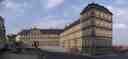
On your right, look for the long, honey-colored stone wing of the New Residence with rows of tall windows and a big, palace-style corner tower anchoring the whole façade. So yes… this is a library, but it’s wearing the outfit of a prince-bishop’s headquarters. The Bamberg State Library lives inside the New Residence at Cathedral Square, and that setting is the first clue to its personality: serious scholarship, wrapped in Baroque confidence. The library as an institution really took shape after a huge shake-up in 1802 and 1803, when church property was secularized and Bamberg’s monasteries and foundations were dissolved… and the old university was shut down. Imagine the chaos: carts, crates, and “temporary” stacks turning into permanent mountains of books. Out of that upheaval, the Elector’s Library was founded in 1803. Names changed with politics-Royal Library, then State Library-and in 1966 it became the Bamberg State Library. Early on, the library’s problem wasn’t prestige. It was organization. Their first major builder of order was Heinrich Joachim Jaeck, a former Cistercian monk, who somehow turned a flood of inherited collections into a usable research library. That’s the kind of work nobody applauds… until it isn’t done. Then everyone suddenly becomes very passionate about “access.” Today it’s open to everyone for serious study, professional work, or just self-improvement, and it’s focused on the humanities-history, art history, manuscripts, the book itself as an object, and especially Franconian regional culture. It also works closely with the University of Bamberg’s library, because in a town like this, the past has a way of showing up in the present and asking to be cataloged. One of its key regional jobs is collecting anything published in Upper Franconia. Since 1987 it has been a legal deposit library for the region-meaning local publishers owe it copies for permanent preservation. The result is a kind of paper memory for Upper Franconia: not glamorous, but priceless when you’re tracking down who said what, when, and why. Now for the headline treasures. This place has around 1,000 medieval manuscripts, and some are tied directly to Emperor Henry II, who founded the Diocese of Bamberg and gifted manuscripts to it between 1007 and 1024. Two spectacular manuscripts-the Bamberg Apocalypse and a major biblical commentary-were added to UNESCO’s Memory of the World register in 2003. And in 2013, the Lorsch Pharmacopoeia, written around the year 800, joined them. In other words: Bamberg isn’t just storing books… it’s storing civilization’s receipts. The building itself keeps the drama going. The New Residence was built from 1697 to 1703 by Johann Leonhard Dientzenhofer for Prince-Bishop Lothar Franz von Schönborn. Inside, the reading room combines former ceremonial spaces remodeled by Balthasar Neumann in 1731, opening up with grand arches and a view toward the Rose Garden. Even the entrance hall shows off stained glass from the 1500s and 1600s-because apparently a normal lobby would be embarrassing. When you’re ready, Heller-Bräu Trum is next-just walk southeast for about 3 minutes.
समर्पित पेज खोलें →On your right, look for the black-and-white half-timbered building with teal-blue shutters and bright red flower boxes under the windows, plus a small hanging brewery sign over…और पढ़ेंकम दिखाएँ
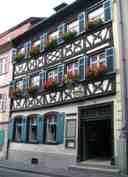
On your right, look for the black-and-white half-timbered building with teal-blue shutters and bright red flower boxes under the windows, plus a small hanging brewery sign over the doorway. Alright... you’ve arrived at Heller-Bräu Trum, better known by the nickname that gets said with a little extra affection: Schlenkerla. And if your nose is picking up a faint campfire vibe, no, you’re not hallucinating your way into a backyard barbecue. That’s Rauchbier-smoked beer-one of Bamberg’s most famous calling cards. Honestly, this place smells like history decided to get cozy. The building you’re looking at has been on the record since 1405. That’s not “old for a pub,” that’s “older than a lot of countries as we know them” old. Back then this property sat near the Dominican monastery church, and over the centuries it passed through hands, changed shape, and survived the kind of setbacks that would make most businesses quietly become a parking lot. In 1538, a cooper-someone who made barrels-named Asmus Schneider is thought to be the first to seriously set up a tavern and brewery here. Which makes sense: if you build the barrels, you might as well fill them. Then came the Thirty Years’ War, and the whole place was nearly wiped out. In 1649, Jakob Stengel bought the ruins and started rebuilding. Picture it: scorched stone, splintered beams, and someone stubborn enough to say, “Yep, we’re pouring beer here again.” Respect. The name “Hellerbräu” comes later, in 1738, when Johann Wolfgang Heller bought the brewery and stamped his name on it. The family story keeps winding through the centuries until 1866, when Konrad Graser purchased it-kicking off the era that still continues today through his descendants, including the Trum family. Now, the nickname “Schlenkerla” has the best origin story in town. The tale goes that the brewmaster Andreas Graser-running things from 1875 to 1905-was injured in a wagon accident when the horses bolted while unloading barrels. After that, he walked with a noticeable arm-swinging wobble… a “schlenkern,” in local speech. So people, being people, started calling him Schlenkerla-half teasing, half affectionate. Bamberg: where your limp becomes your brand. And the beer? The classic is the Aecht Schlenkerla Rauchbier, a dark Märzen traditionally matured in oak barrels. There’s also an Urbock poured in strong-beer season, a Rauchweizen with a gentler smoke, and even a lager brewed with the same yeast and copper kettles-so it keeps a subtle smoky signature. Seasonal specials show up too, including a Christmas Doppelbock dried over oak wood, plus playful variations like cherrywood-smoked red beer and alder-smoked black beer. When you’re ready, St. Stephen’s Church is about a 7-minute walk heading east.
समर्पित पेज खोलें →Look to your right for a big, honey-colored stone church with a long red-tiled roof and a tall square tower wearing a pale, boxy “cap,” plus a clock face halfway up. You’re…और पढ़ेंकम दिखाएँ
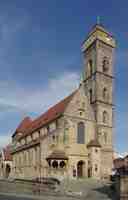
Look to your right for a big, honey-colored stone church with a long red-tiled roof and a tall square tower wearing a pale, boxy “cap,” plus a clock face halfway up. You’re standing by Bamberg’s Obere Pfarre, officially “Our Dear Lady”... but locals went with the far more practical nickname: “Upper Parish.” It’s called that because it sits up here on the Kaulberg hill, the high counterpart to the old “Lower Parish” church that once stood down on today’s Maximiliansplatz and was later torn down. Bamberg does romance, sure. It also does GPS-before-GPS. This place has deep roots. The parish may trace back to an early private church tied to the old Counts of Babenberg, though the first solid written mention shows up around 1140 in a document from Bishop Egilbert. By the early 1300s, it belonged to the cathedral chapter. There were disputes-because of course there were-and in 1401 the chapter’s claim got re-confirmed. Medieval paperwork was basically a contact sport. Now, take in the building itself. It’s a three-aisled High Gothic basilica-serious, upright, and a little stern-started in 1338, though planning probably began earlier. There’s even a specific foundation date recorded: June 16. The main body took ages; it wasn’t consecrated until 1387. Then came the ambitious choir, begun around 1392, soaring up like it’s trying to out-Gothic its neighbors. That choir is one of the showpieces of Franconian Gothic, and the whole church has that “ship of stone” feel, especially from certain angles on the hill. The tower? Slim, tall, and once doubled as part of the city’s defenses-a church that could also keep an eye on trouble. Bamberg loved efficiency. A watchman lived up there until 1923, in the upper two-story structure. Imagine your job being: “stand in the wind and tell everyone if something’s on fire.” Character-building, they’d call it. Through the centuries, the church got patched, tweaked, and occasionally humbled. Around 1606 to 1607, it needed major repairs-and in 1608 a scaffold collapsed, killing one worker and badly injuring three others. It’s a sharp reminder that these grand buildings weren’t “built,” like ordering furniture... they were wrestled into existence. In the early 1700s, the interior went Baroque-funded by a benefactor’s will-so the plain Gothic bones got dressed up in stucco and drama. Yet the builders showed surprising restraint: parts like the Gothic ambulatory and ribs stayed visible, as if even Baroque craftsmen knew when the old work didn’t need “improving.” A rare moment of self-control in the Baroque era. If you step inside later, keep an eye out for the star: the Madonna and Child, a walnut sculpture from a Cologne workshop around 1250, later revered as a miracle-working image and eventually placed at the heart of the high altar. And there’s also a major painting of Mary’s Assumption by Tintoretto-yes, that Tintoretto-originally connected to the cathedral’s great Marian altar, now here on loan. Bamberg quietly collects masterpieces the way some people collect fridge magnets. One more charming detail: the “wedding portal” on the north side, decorated with wise and foolish virgins. It wasn’t just pretty-it served a wedding ritual where the priest blessed the couple and gave the rings outside, before everyone processed in for Mass. Practical, symbolic, and less awkward than squeezing a whole crowd through a narrow doorway. When you’re set, the Diocesan Museum Bamberg is about a 4-minute walk heading west.
समर्पित पेज खोलें →On your left, look for the long, pale-stone Baroque building with a steep red-tile roof, a carved triangular pediment, and a broad staircase leading up to the entrance. This is…और पढ़ेंकम दिखाएँ
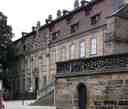
On your left, look for the long, pale-stone Baroque building with a steep red-tile roof, a carved triangular pediment, and a broad staircase leading up to the entrance. This is the Diocesan Museum of Bamberg, tucked into the cathedral’s chapter house… basically the place where the cathedral’s leadership did the serious work of running the show. And the building itself? It was designed by Balthasar Neumann and built from 1731 to 1733, which means you’re standing beside a piece of architecture with very confident “yes, I’m important” energy. The funny thing is, people wanted a museum here as early as 1907, but it didn’t actually open until 1966. Classic institutional timing: everyone agrees it’s a good idea… and then several decades pass. Since then, the display rooms were refreshed in the early 1990s, and the museum expanded again in 2005, because once you start pulling treasures out of cupboards, you run out of cupboards. And “treasures” isn’t marketing fluff here. The core collection comes from the old cathedral treasury and from across the archdiocese. The headliners are the Imperial Vestments… six luxurious garments tied to Emperor Henry II and Empress Kunigunde. We’re talking embroidered silks from the first quarter of the 1000s: a starry cloak for Henry, blue and white cloaks for Kunigunde, plus pieces like a rider’s cloak, a tunic, and a richly worked chest piece called a rationale. They’re so rare that museums elsewhere would happily trade a small castle for them… though the paperwork would be a nightmare. Then there’s the jaw-dropper: the vestments from Pope Clement II, taken from the only preserved pope’s grave north of the Alps. That’s the kind of fact that makes historians sit up straighter. Add the Gunthertuch, a massive Byzantine silk textile from around 975, and you’re looking at a textile collection with worldwide bragging rights. The treasury section goes heavy on sacred objects: reliquaries, incense burners, altar crosses, and the Eucharistic gear that actually touches the ritual itself-chalices, patens, little spoons, cruets, monstrances, ciboria. The superstar is the “cathedral cross,” a monumental gem-studded cross-reliquary that still gets carried through Bamberg during the Corpus Christi procession. It’s not retired behind glass; it’s still on the job. And don’t miss the cloister area: original stone sculptures from the cathedral-figures from grand portals like the Adam’s Gate and the Princes’ Portal, made by sculptors who likely came from Reims around 1220 or 1230. You’re face-to-face with the cathedral’s original skin. When you’re set, Bamberg Cathedral is a 2-minute walk heading northwest.
समर्पित पेज खोलें →On your left, look for the long, honey-colored stone cathedral with FOUR tall towers and greenish copper spires, stretching wide across the Domberg like it owns the skyline...…और पढ़ेंकम दिखाएँ
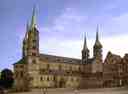
On your left, look for the long, honey-colored stone cathedral with FOUR tall towers and greenish copper spires, stretching wide across the Domberg like it owns the skyline... because it kind of does. Alright, welcome to Bamberg Cathedral: officially St. Peter and St. George, one of Germany’s “imperial cathedrals,” and the sort of building that makes you instinctively lower your voice, even outside. Not because you have to... it’s just the vibe. This hilltop, the Domberg, has been settled since around the year 600, and by 902 there’s already mention of a fortress here. But the cathedral story really kicks off in 1004, when King Henry II lays the foundation stone. Three years later, in 1007, he creates the Diocese of Bamberg-more like a strategic power move than a casual church project. Henry was unusually educated for a medieval ruler-many of his peers couldn’t even read. He could. Which, at the time, was basically a superpower. The first cathedral was dedicated in 1012 on Henry’s birthday, with a jaw-dropping crowd: 45 bishops and top church officials. That’s not a normal dedication... that’s a medieval VIP summit. The patrons were chosen with intent: Peter for Rome and the Western Church, George for the Byzantine East, and Mary as the shared bridge between them. A spiritual diplomacy package, carved in stone. Then came fire... twice. A major blaze in 1081, a patch-up, then another catastrophe in 1185 that led to demolition and a fresh start. The building you’re looking at is essentially the “second attempt,” dedicated in 1237-again on Henry II’s birthday, because if you’re founding a cathedral, you might as well schedule the party on-brand. Inside are some heavyweight residents: the tomb of Henry II and his wife Kunigunde-THE only canonized imperial couple of the Holy Roman Empire, which is an extremely specific category to win. And there’s also the tomb of Pope Clement II, originally Bamberg’s bishop Suidger, crowned pope in 1046. It’s the only surviving papal grave in Germany and north of the Alps. Bamberg doesn’t do subtle flexes. Take in the towers. The eastern pair mixes Romanesque roots with later Gothic touches, and the copper tops you see today come from an 18th-century redesign. The western towers borrow ideas from northern France-Laon Cathedral-down to the little animal figures up high. Locals call them the “cathedral cows,” though they’re more like mules... a stone thank-you note to the animals that hauled building materials upward. Finally, some workplace recognition. And if you hear bells later, know this: some of them are medieval giants. The “Henry bell,” over five tons, is rung Fridays at 3 p.m. The cathedral even served as the city’s timekeeper for centuries-its tower clock used to set Bamberg’s rhythm. Just stand here a moment... four towers, a thousand years of ambition, disasters, redesigns, and a couple of saints who used to be emperors. Bamberg’s big stone reminder that history doesn’t retire-it just echoes.
समर्पित पेज खोलें →
अक्सर पूछे जाने वाले प्रश्न
मैं टूर कैसे शुरू करूँ?
ख़रीदारी के बाद, AudaTours ऐप डाउनलोड करें और अपना रिडेम्पशन कोड दर्ज करें। टूर तुरंत शुरू करने के लिए तैयार होगा - बस प्ले टैप करें और GPS-गाइडेड रूट का पालन करें।
क्या टूर के दौरान मुझे इंटरनेट चाहिए?
नहीं! शुरू करने से पहले टूर डाउनलोड करें और पूरी तरह ऑफ़लाइन इसका आनंद लें। केवल चैट फ़ीचर को इंटरनेट की ज़रूरत है। मोबाइल डेटा बचाने के लिए WiFi पर डाउनलोड करने की सिफ़ारिश है।
क्या यह एक गाइडेड ग्रुप टूर है?
नहीं - यह एक सेल्फ-गाइडेड ऑडियो टूर है। आप अपनी गति से स्वतंत्र रूप से खोजते हैं, आपके फ़ोन से ऑडियो कथन बजता है। कोई टूर गाइड नहीं, कोई ग्रुप नहीं, कोई शेड्यूल नहीं।
टूर में कितना समय लगता है?
अधिकांश टूर पूरा करने में 60-90 मिनट लगते हैं, लेकिन गति पूरी तरह आपके नियंत्रण में है। जब चाहें रुकें, स्टॉप छोड़ें, या ब्रेक लें।
अगर मैं आज टूर पूरा नहीं कर सकता/सकती तो?
कोई समस्या नहीं! टूर की लाइफ़टाइम एक्सेस है। जब चाहें रोकें और फिर शुरू करें - कल, अगले हफ़्ते, या अगले साल। आपकी प्रगति सेव रहती है।
कौन सी भाषाएँ उपलब्ध हैं?
सभी टूर 50+ भाषाओं में उपलब्ध हैं। अपना कोड रिडीम करते समय अपनी पसंदीदा भाषा चुनें। नोट: टूर जेनरेट होने के बाद भाषा बदली नहीं जा सकती।
ख़रीदारी के बाद मैं टूर कहाँ एक्सेस करूँ?
App Store या Google Play से मुफ़्त AudaTours ऐप डाउनलोड करें। अपना रिडेम्पशन कोड (ईमेल द्वारा भेजा गया) दर्ज करें और टूर आपकी लाइब्रेरी में दिखेगा, डाउनलोड और शुरू करने के लिए तैयार।
अगर आपको टूर पसंद नहीं आया, तो हम आपकी ख़रीदारी वापस करेंगे। हमसे संपर्क करें [email protected]
सुरक्षित चेकआउट 


