
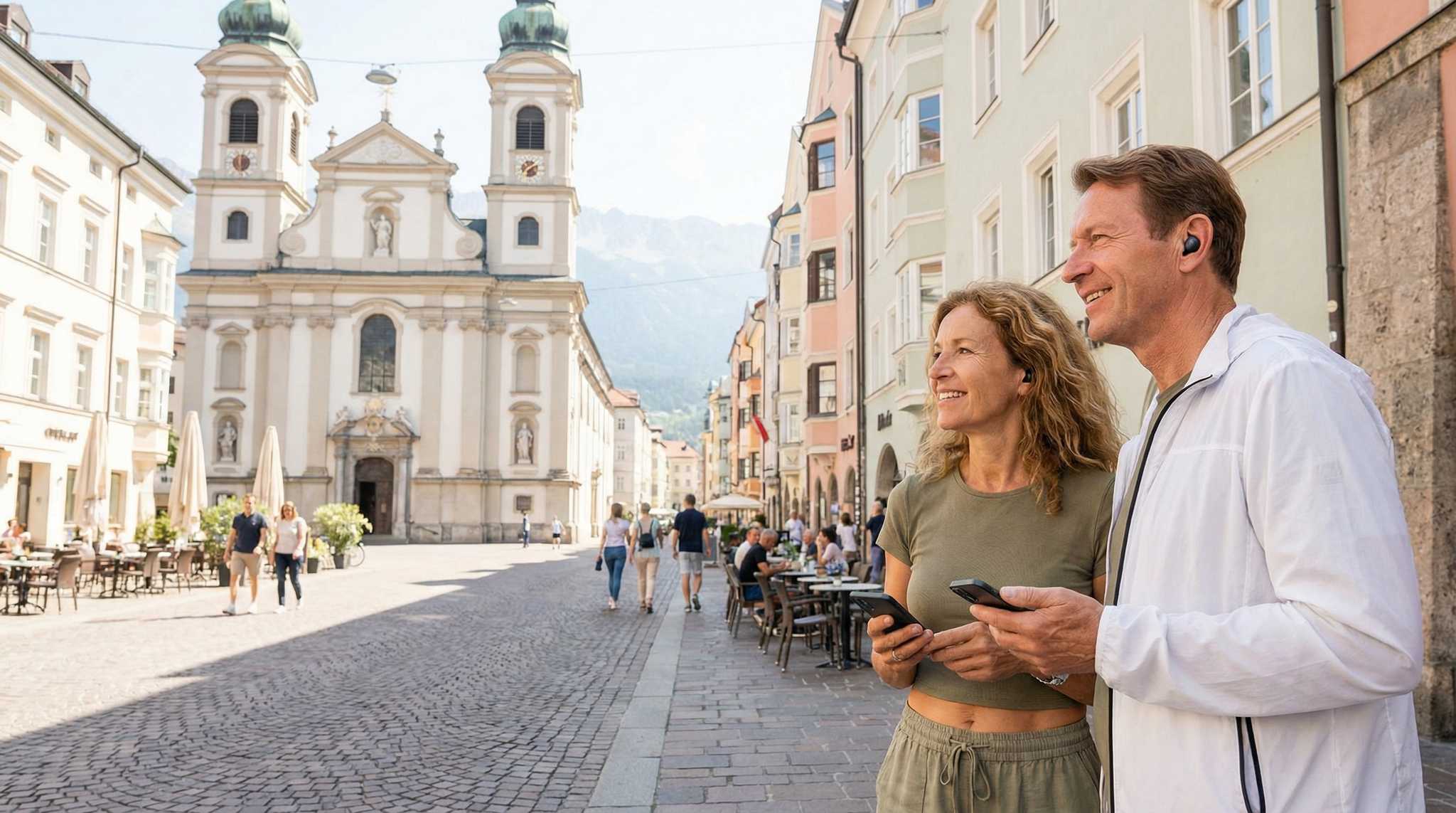
इंसब्रुक ऑडियो टूर: गुंबद, चील और सुनहरी छत की किंवदंतियाँ
इस रमणीय टूर पर इंसब्रुक के मनमोहक आकर्षण की खोज करें! टीआईडब्ल्यूएजी (TIWAG) की यात्रा से शुरुआत करें, जहाँ शानदार अल्पाइन परिवेश के बीच नवाचार प्रकृति से मिलता है। हलचल भरी मारिया-थेरेसियन-स्ट्रास (Maria-Theresien-Straße) के साथ टहलें, जो इंसब्रुक का जीवंत हृदय है, जहाँ सुरुचिपूर्ण दुकानें, आरामदायक कैफे और प्रभावशाली ऐतिहासिक वास्तुकला मौजूद हैं। फिर, ओल्ड कंट्री हाउस (Old Country House) में समय में पीछे जाएँ, एक खूबसूरती से संरक्षित रत्न जो पारंपरिक टायरोलियन संस्कृति और विरासत को प्रदर्शित करता है। यह टूर आधुनिक ऊर्जा और कालातीत परंपराओं का एक आदर्श मिश्रण प्रदान करता है, जो एक अविस्मरणीय इंसब्रुक अनुभव का वादा करता है।
टूर पूर्वावलोकन
इस टूर के बारे में
- scheduleअवधि 40–60 minsअपनी गति से चलें
- straighten2.5 किमी पैदल मार्गगाइडेड पथ का पालन करें
- location_on
- wifi_offऑफ़लाइन काम करता हैएक बार डाउनलोड करें, कहीं भी उपयोग करें
- all_inclusiveलाइफ़टाइम एक्सेसकभी भी, हमेशा के लिए फिर सुनें
- location_onहाइपो टिरोल बैंक से शुरू होता है
इस टूर के स्टॉप
To spot the New Country House here in Innsbruck, look for a grand, cream-colored building straight ahead with rows of square windows, a flat red roof, a tall central section with…और पढ़ेंकम दिखाएँ
To spot the New Country House here in Innsbruck, look for a grand, cream-colored building straight ahead with rows of square windows, a flat red roof, a tall central section with impressive columns, and a proud flag waving at the very top-it takes up practically the whole side of the square, so it’s hard to miss! Now, let me take you on a journey through the remarkable-and sometimes turbulent-life of the building right before your eyes. Imagine standing here back in 1939: the world feels tense, an uneasy silence hangs in the air, and this very spot has just been transformed by an enormous, stern new building-one that seemed to sprout overnight, and not by accident. The New Country House, or "Neues Landhaus," wasn’t always the administrative heart of Tyrol. Built in the late 1930s by two architect brothers, Walter and Ewald Guth, its birth is rooted in a rather dark chapter of history. Picture the rapid, bold construction-crews hammering, brick dust swirling-when this site was chosen to become the Nazi regional headquarters, or "Gauhaus," for Tyrol and Vorarlberg. The building’s look is heavy, inspired by the mighty New Reich Chancellery in Berlin, with columns and symmetry that almost shout “authority!” If you peek above the side entrance (don’t worry, no need for binoculars), you’ll catch the Tirol and Vorarlberg coats of arms clinging to the facade-silent witnesses to a complex past. The Nazis found the Old Country House, just down the street, far too cramped for their oversized ambitions. So, they dreamed up this extension, hoping it would anchor a huge new Nazi forum-but those grandiose plans never survived the chaos of war. When World War II ended, the swastikas and eagles quickly vanished, replaced in 1960 with something more local and proud: a stone Tyrolean eagle inspired by a medieval drawing from the Zenoburg. Imagine the relief and the cautious, hopeful footsteps as Innsbruck tried to heal its wounds and reclaim this space for democracy. And still, this isn’t just a relic. Today, the New Country House-now with a shiny new neighbor, "Landhaus 2," added in 2005-buzzes with the work of the Tyrolean administration. Right across the square, you’ll find the Liberation Monument, built just after the war, and not far from there, the Pogrom Memorial: both stand as firm reminders never to forget the painful lessons of the past. In recent years, the city has wrestled with how to remember and interpret this building's story. Historians and artists have debated, guided tours have led curious crowds (with maybe a nervous joke or two), and even now, explanations outside spark arguments and protests-not because people want to forget, but because the past can sometimes be heavy to carry. The square itself, newly transformed after a design competition, now welcomes you to wander, reflect, and perhaps imagine yourself in the shoes of the many different people who have stood here before. History isn’t always easy, but here, every stone is buzzing with stories-old secrets, new truths, and the hope that by being honest about where we’ve come from, maybe we can shape a better future. And hey, at least today, the only uniforms you’ll see are from office workers heading for their afternoon coffee!
समर्पित पेज खोलें →

12 और स्टॉप दिखाएँकम स्टॉप दिखाएँexpand_moreexpand_less
To spot the Servit Church, just look for the simple cream-colored building with tall arched windows and a striking baroque tower topped with a greenish dome, and you’ll notice a…और पढ़ेंकम दिखाएँ
To spot the Servit Church, just look for the simple cream-colored building with tall arched windows and a striking baroque tower topped with a greenish dome, and you’ll notice a colorful mural painted outside above the entrance. Now, let’s step back in time together, right here on Maria-Theresien-Straße, with echoes of horse hooves and the soft ring of bells in the air. Imagine it’s the early 1600s-a time of powdered wigs, candlelight, and a city eager for a touch of beauty and hope. The Servit Church, dedicated to Saint Joseph, was founded between 1613 and 1616, thanks to Anna Caterina Gonzaga, the strong-willed widow of Archduke Ferdinand II. I like to think she picked this spot because Innsbruck’s chilly winters demanded a cozy church and perhaps she was an early advocate for indoor heating! But adventure struck fast. Just a few years in, in 1620, disaster! The whole complex was swallowed up by flames, leaving little more than ashes and-if we believe the old stories-a few very startled monks in singed robes. Not to be defeated, the Servites rolled up their sleeves, rebuilt, and by 1626, they were back in business, with a dazzling new altar crafted in 1628 by the renowned artisan Matthias Carneri. Growth continued, with grand chapels sprouting up in the 1700s and the tower receiving its crowning finish in 1899. The church flourished, often receiving nods (and donations) from the mighty Habsburgs. But history has a mischievous streak; in 1938, the Nazis shut the monastery down, the first in Innsbruck to suffer that fate. Then, in 1943, bombs rained down, reducing much of the church to rubble. Yet, much like a soap opera hero, the Servit Church bounced back after the war. With new art, fresh renovations, and laughter echoing again, the Servites reopened their doors. So as you stand here, remember: you’re looking at a survivor, a symbol of resilience, and possibly the best place in Innsbruck to hide from both history lessons and winter draughts!
समर्पित पेज खोलें →Take a look just ahead and slightly to your right-standing before you is a stately, timeworn complex with a sturdy triangular gable and rows of tall, pale windows, framed by old…और पढ़ेंकम दिखाएँ
Take a look just ahead and slightly to your right-standing before you is a stately, timeworn complex with a sturdy triangular gable and rows of tall, pale windows, framed by old facades. If you spot the hint of a bell tower peeking behind, you're right at Innsbruck’s historic hospital grounds. Now, ready for a bit of a time-traveling adventure? Imagine the year is 1320. Innsbruck hums with medieval life, thick with the scent of woodsmoke and market stalls. Right here, at what is now the edge of busy Maria-Theresien-Straße, the city built its very first Hospital of the Holy Spirit. But this was no ordinary hospital-it came with its own graveyard, the first to win the right to bury Innsbruck’s citizens. Sounds like a “two-for-one” medieval healthcare plan, doesn’t it? Picture the air crisp, bells ringing in distant church towers, and, yes, the *occasional* ghostly whisper if you believe in that sort of thing. For centuries, this spot was not only a place where the sick and needy found care but where generations were laid to rest-layer upon layer, bodies beneath cobbles and chapel floors. In fact, from 1510 to 1856, it wasn’t just a hospital cemetery, but the city’s main burial ground. Yes, Innsbruck’s ancestors were sleeping just below everyone’s busy feet. Now, envision the years drifting by. By 1510, a wealthy pharmacist named Rumler decided that even the deceased deserved some architectural upgrade and funded a beautiful chapel for the grounds-St. Michael’s-right on the cemetery’s west side. Soon after, arches and columns were added along the walls using a local stone called breccia, creating peaceful walkways for prayer, mourning, or perhaps secretly dodging hospital chores. As time marched forward, so did the need for space. The graveyard stretched westward, swallowing up what is now Adolf-Pichler-Platz and beyond. By the late 1700s, the smell of city life-let’s just say, not the most hygienic-prompted Emperor Joseph II to order all graveyards moved outside Innsbruck’s limits. Apparently, nobody likes a surprise skeleton in their soup! But while part of the cemetery was closed, it simply kept expanding in other directions, always a little further, almost like a real-life zombie movie… minus the zombies, thankfully. By the 1800s, the site was a tangled patchwork of burial plots and chapels, now surrounded by the noise of city life and the gossip of hospital staff. Here’s where it gets even more interesting. In the late 1800s, Innsbruck needed a brand-new hospital, so the old one was turned into a school. Can you imagine being a student, practicing your algebra, with a whole secret world of tombs and forgotten relics just under your classroom? Every so often during city renovations, workers would dig up bones, relics, and even treasures like rosaries, crosses, coins, and jewelry-enough to make Indiana Jones envious! Fast-forward to the 2000s, when archaeologists got one last chance to peek below the modern surface. In a frantic rush-because city construction waits for no one-they uncovered nearly 450 graves, some with bodies still clutching their pilgrim medals and prayer beads. Much of the rest, sadly, was swept away by construction machinery before it could be documented. Let’s pause and imagine what it must’ve sounded like: men shouting, picks striking soil, maybe the faint ring of a chapel bell drifting through dawn mist, as more and more was revealed. The remains were close together, some stacked deep in shared shafts. Most, scientists discovered, belonged to laborers-bones worn from years of heavy work, with teeth ruined by too many sweet treats and not enough toothbrushes. Quite modern, really! Oh, and here’s a twist for the lovers of medical mysteries: many skeletons here show marks from scalpels and surgical saws-not from battle injuries, but from young doctors and surgeons practicing their craft. It appears Innsbruck’s hospital was a “mixing pot” for learning, healing, and sometimes a bit of grave-side homework. As you stand here, picture beneath your shoes a story three feet deep-pilgrimages, prayers, experiments, generations of city life and death, all pressed into this ordinary spot. If you feel a tiny shiver, don’t worry! Innsbruck simply has a way of keeping her secrets close-and you, my friend, are walking right through the heart of history. Ready to delve deeper into the archaeological research, grave goods or the anthropological investigation? Join me in the chat section for an enriching discussion.
समर्पित पेज खोलें →To spot the Hospital Church, just look for a lovely pink-and-white building with round windows and a grand old clock tower topped by a green onion-shaped dome-it’ll stand out…और पढ़ेंकम दिखाएँ
To spot the Hospital Church, just look for a lovely pink-and-white building with round windows and a grand old clock tower topped by a green onion-shaped dome-it’ll stand out right in front of you! Now, as you stand here, imagine Innsbruck back in 1326, when this spot was not the heart of the city but way out on its fringes, home to a hospital for the sick. Back then, you didn’t want contagious folks mixing with city life, so they built the hospital far from the bustle. You could say it was Innsbruck’s ancient social distancing! Attached to this hospital was a little chapel, where families whispered prayers for their loved ones, flickering candlelight dancing on old stone walls. By the late 1500s, master builders-one named Christoph Geiger, which sounds suspiciously like someone who’d whistle while he worked-wove the nearby Elsbethenkapelle right into the church, turning it into a grand, three-aisled space filled with hope and echoes. Imagine hammers clanging and masonry dust swirling in the chilly Alpine air. But fate had other plans. In 1689, a sudden earthquake rattled Innsbruck, shaking the church nearly to bits. People dashed outside, hearts pounding, as stones tumbled and the bells rang out wildly above. Most of the ancient church had to be torn down after that, but don’t worry, the story doesn’t end in rubble. The town called in a famous architect, Johann Martin Gumpp the Elder, who drew up bold new plans. By 1705, the “new” church was ready-bigger, brighter, and blessed by the prince-bishop in a ceremony full of incense and singing. Inside, peek at the ornately carved doors and see if you can spot the baroque altar gleaming under layers of intricate plasterwork. The ceiling was badly damaged by WWII bombs in 1945-imagine the shockwaves ripping through these peaceful walls. But in 1962, new, lively frescoes took their place, painting stories over the old scars. Listen closely: the bells you hear now came from the nearby Jesuit church, brought over in 1901, each with a character of its own-the grand Löffler bell from 1579, weighing 600 kilograms, and its smaller siblings St. Pirminius and St. Ignatius. When these ring out together, it’s as if the whole city is taking a breath. Today, the Hospital Church is known as the “City Church,” welcoming everyone-locals, travelers, dreamers, and the slightly lost!-for prayer, music, art, and just a quiet moment to catch your breath in the heart of Innsbruck. So go on, step inside if you like, and imagine all the generations that have stood right where you’re standing.
समर्पित पेज खोलें →Directly ahead, you’ll spot the Hotel Goldener Adler by looking for a distinctive white and pinkish-peach corner building, marked with intricate artwork around the windows, a…और पढ़ेंकम दिखाएँ
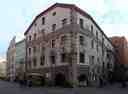
Directly ahead, you’ll spot the Hotel Goldener Adler by looking for a distinctive white and pinkish-peach corner building, marked with intricate artwork around the windows, a decorative gold eagle sign, and sturdy stone archways at street level-just look for that splash of old-world charm standing proud at the corner! Take a deep breath and stand still for a moment-you're about to step back in time, right here on these cobblestones! Imagine the year is 1390. Innsbruck is bustling, with wagons rolling over stone roads, the sound of horses’ hooves echoing in the air, and traders from Italy and Germany seeking food, fire, and a place to rest beneath the archways you're looking at now. The Goldener Adler is no ordinary hotel; it’s been a crossroads of history for over six centuries-a place where secrets, celebrations, and, let's be honest, probably a little snoring from weary travelers have filled these walls! If you could press your ear to the old masonry, you might hear the echoes of Emperor Charles V himself in 1552, pausing here as he fled across Tyrol on horseback-can you picture the tension as the powerful emperor ducks into the inn, probably hoping the staff serves coffee strong enough to keep his nerves steady? In 1573, the party of the century swept through the Goldener Adler. Archduke Ferdinand II, his beloved Philippine Welser, and an entourage larger than some modern music festivals-416 people and 580 horses-descended for a grand festival shooting match. The poor innkeeper probably needed a nap after organizing beds, meals, and-let’s not forget-the local animals' reactions to so many horses! He cashed in a whopping 1,800 guilders for it; clearly, business was galloping along nicely. Royalty loved the Adler-sometimes undercover! In 1777, Emperor Joseph II crept in incognito as “Count Falkenstein” after a long journey from Paris. I’m sure he thought his disguise was ingenious, but if you look at the painting inside the old “Kaiser-Joseph-Stube,” he probably wasn’t fooling anyone. He slept here, rested up, and, the next day, slipped out again, leaving behind just a whiff of royal mystery. And then there’s Mozart-not Wolfgang, but Leopold, his father, who reserved a room for the two of them in 1773, probably wondering if young Wolfgang would play for his supper or for extra dessert. Goethe-the superstar writer-was such a fan that he popped in not once, but twice, once in 1786 for a lunch chat with the landlord’s son, whom he decided was the living image of one of his own characters. He came back for a two-day stay in 1790, bringing the Duchess of Saxe-Weimar, a chamberlain, and some courtly ladies-imagine the conversations echoing through the halls, verses and laughter mixing with the clatter of plates. The Goldener Adler wasn’t just a stage for emperors and artists. It became a military outpost in troubled times. In 1809, after defeating Napoleon’s troops, local hero Andreas Hofer stayed here and, from the very first floor, delivered a rousing speech to the people below: “I won’t abandon you, as true as my name is Andreas Hofer!” Can you feel the goosebumps? Later, Austrian Field Marshal Bellegarde would announce here, through proclamations, that it was time for farmers to lay down their arms. Between wars, noble guests were everywhere-King Ludwig I of Bavaria visited repeatedly, as did the Prussian Crown Prince, the Prince of Sweden, and even the virtuoso Niccolò Paganini-rumor has it he scratched his name on a windowpane upstairs. He wasn’t the only creative type: the poet Heinrich Heine and a parade of princes added their own notes to the Goldener Adler’s great ledger. And then there was the British traveler H. D. Inglis, who arrived by mistake, intending to visit another inn-the “Sonne”-but wound up enchanted by the Adler. Sometimes, the best stories are the ones you stumble into. Today, you stand before a hotel that’s both a historical monument and a modern comfort zone, renovated for its 600th birthday but still echoing with the stories of laughter, music, whispers, and thunderous celebrations. Whether you want to meet a disguised king, a poetic genius, or just take selfies in front of these ancient walls, remember: in the Goldener Adler, every stone has its own tale waiting to be told. Ready for your next stop-or do you feel like asking the front desk for a room with a royal view?
समर्पित पेज खोलें →Ahead of you, you'll spot the Goldenes Dachl by looking up for a small, ornate balcony sticking out from a white building, topped with a dazzling golden roof made of thousands of…और पढ़ेंकम दिखाएँ
Ahead of you, you'll spot the Goldenes Dachl by looking up for a small, ornate balcony sticking out from a white building, topped with a dazzling golden roof made of thousands of shimmering tiles. Picture yourself here on a chilly morning in the late 1400s, the street alive with the bustle of horses’ hooves and the banter of Innsbruck’s townsfolk. The Goldenes Dachl-meaning the Golden Roof-shines above you, its late Gothic balcony gleaming in the sunlight. That magnificent roof? It’s covered in precisely 2,657 fire-gilded copper shingles, all sparkling like a pile of gold coins. And trust me, this was no ordinary bit of home improvement. Emperor Maximilian I, always a fan of making an entrance, commissioned this spectacular oriel in 1497 to show off his wealth, mark the turn of the century, and, let's be honest, have the fanciest place in town to watch knightly tournaments and festivals on the street below. But the Goldenes Dachl holds more than just royal parties. Imagine 1420, when this was just the “New Court,” a stately home for Tyrolean lords. By 1500, it became an international symbol-and not just for the view. Look more closely at those reliefs along the balcony. You’ll see the mighty Maximilian with his two wives (yes, two!), his clever chancellor, a troop of jolly fools, and wild, mask-wearing dancers called Moriskentänzer. All around are coats of arms and mysterious symbols-a sort of medieval emoji collection, if you ask me! Now, behind the shiny façade lie darker stories. In 1536, right here in front of this sparkling roof, a preacher named Jakob Hutter met a tragic fate, burned publicly as onlookers watched in horror. Yet, the Goldenes Dachl stood witness to it all-celebrations, tragedies, and secrets. If you’re into mysteries: that odd lettered band running behind the figures on the balcony puzzled scholars for centuries. It mixes Latin, Greek, Hebrew, and even some strange Egyptian-seeming symbols. People spun wild theories about what it meant. Only in 2020 did an amateur historian claim to crack the code, revealing it reads “Ego sum lux mundi”-“I am the light of the world.” Enlightening, isn’t it? The Goldenes Dachl has inspired stamps, athletic challenges, and even international competitions! Since 2005, athletes have soared in the Golden Roof Challenge right beneath these golden shingles, trying to catch just a bit of that imperial glory. But sometimes, that golden shine proved tempting-thieves have actually stolen gold shingles more than once, only for the pieces to pop up in post boxes or be found in the streets, as if the city itself wanted its crown jewels returned. Today, the Goldenes Dachl continues to sparkle-now home to a museum and the secretariat of the Alpine Convention. Step closer, let your eyes absorb the sun-drenched gold and centuries of stories. Imagine yourself as a festival-goer, a royal guest, or even a code-breaker in medieval Innsbruck. How many layers of mystery, joy, and drama can one tiny golden roof shelter? Welcome to the shining heart of the city!
समर्पित पेज खोलें →To spot the Management Center Innsbruck, look for a sleek modern building displaying the bold blue-and-orange MCI logo, with the words “Die unternehmerische Hochschule,” usually…और पढ़ेंकम दिखाएँ
To spot the Management Center Innsbruck, look for a sleek modern building displaying the bold blue-and-orange MCI logo, with the words “Die unternehmerische Hochschule,” usually placed prominently on or near the entrance. Imagine standing here in front of the Management Center Innsbruck, also known as MCI, a place bursting with energy, ideas, and maybe the occasional overwhelmed student clutching a coffee! Since its founding in 1995, the MCI has been Innsbruck’s home for innovators and go-getters-a private college, but one deeply connected to the public spirit of the city. Picture the very first group of students hustling through its doors on a cold morning, a mix of nerves and excitement whispering through the halls. Back then, few could have guessed just how fast and big the MCI would grow! Today, the MCI isn’t just one building but a network spread across five spots in Innsbruck. This main location is really the heart, but other branches stretch from Universitätsstraße to Weiherburggasse, Maximilianstraße, and Kapuzinergasse. Each location has its own flavor: tourism, technology, life sciences-you name it! You might say the only thing they’re missing is a Department of Lunch Breaks, though rumor has it students already major in that unofficially. Now, let me tell you a little secret-it’s been quite dramatic here in recent years. There were ambitious plans for a fancy new building near the Hofgarten. Imagine shiny glass walls and students gazing at the gardens while deciphering business strategies! But just as the blueprints were ready and dreams were big, the city put the plan on ice. Budget cuts swooped in, and the region’s leader, Anton Mattle, pulled the plug. Instead of a sparkling new home, MCI had to stick to its tried-and-true spaces, which are-thankfully-still full of laughter, caffeine, and creativity. Maybe it’s for the best; after all, the heart of a university is its people, not just the walls! MCI is a global gateway, with 250 partner universities around the world. Some students hop from Innsbruck to Asia or the Americas, returning with stories and even extra diplomas-known as “double degrees” if you want to impress someone at a dinner party. And if you stay up late enough, you might hear the secrets of executive PhDs or whispers about entrepreneurship plans that just might change the world. But beyond all the prestigious accreditations and sparkling rankings, the real magic of MCI is its sense of possibility. Step a little closer, and you might just catch tomorrow’s leaders in the making-right here, plotting big dreams in Innsbruck. Onward to our next stop, adventurer! Exploring the realm of the locations, study programs or the further training courses? Feel free to consult the chat section for additional information.
समर्पित पेज खोलें →To spot the Jesuit Church, just look for a grand, light stone facade with two tall, octagonal towers topped with onion domes and clocks on each side-it stands proudly in the…और पढ़ेंकम दिखाएँ
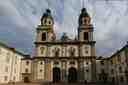
To spot the Jesuit Church, just look for a grand, light stone facade with two tall, octagonal towers topped with onion domes and clocks on each side-it stands proudly in the square, impossible to miss with its strict, symmetrical front. Welcome to the mighty Jesuit Church of Innsbruck! As you stand before these two towering guardians, take a moment to picture the scene almost four hundred years ago, when this place was nothing but plans and fresh ambition. Instead of the sounds of traffic, you’d have heard the clatter of hammers and the shouting of stone masons, led by the creative minds of Karl Fontaner and Christoph Gumpp the Younger. They weren’t building just another church-they were bringing the extravagant spirit of early Baroque to the mountains, inspired by famous masterpieces from Rome and Salzburg. Their work was so ahead of its time, it must have felt like someone was installing WiFi in the 1600s! The facade right in front of you is a lesson in drama and elegance. Let your eyes follow the strong lines of the pilasters, stacked like architectural “Russian dolls,” each row more elaborate as your gaze climbs: Doric at the bottom, Ionic in the middle, and Corinthian at the top-like a classical fashion show. The two towers above you seem to launch skyward from the third story, and, if you look closely, each is crowned by a lantern-topped dome. Yes, it’s a bit like a giant cake-just with more marble and a lot fewer calories! Crowning the facade is a powerful scene: the Holy Trinity, perched on a volute gable, watching protectively over the city. Step inside, and you’re enveloped in another world, a swirl of white light and shadow, with splashes of reddish marble and steel-gray accents. If you listen closely, you might hear the bustling of city life fade away, replaced by the gentle echo of footsteps on polished floors. This church is short and stout on the outside, but open and soaring within thanks to its domed crossing and arches. There’s a hidden drama even in the structure: the main hall is flanked by chapels, then galleries above, then windows which let sunlight paint moving mosaics on the walls. Legend walks hand-in-hand with history here. Since 1575, the remains of Saint Pirminius have rested in this very church. He wasn’t just anyone-he’s one of Innsbruck’s city patrons, a relic traveler whose bones were spirited away from a former monastery by a determined abbot keen on saving them from destruction. After a heroic journey-worthy of its own Netflix miniseries-his relics were finally settled here. Today, they’re housed in a shimmering shrine crafted by Rudolf Millonig, proof that even a saint needs a stylish place to rest. This church knows a thing or two about sound as well as silence! Its bells have stories of their own. Until 1901, the grandest was known as the Silver Bell-cast in the 16th century and weighing as much as a small elephant. When the seven-bell chime went up in 1901, it was one of the largest in the entire Austro-Hungarian Empire. Wars, though, took their toll, and only the Silver Bell survived them all, faithfully ringing for decades on its own. But Innsbruck loves a comeback story, so in 1959, the city celebrated with the creation of the enormous Schützenglocke-a colossus dedicated to heroic defenders and chiming every Friday at 3 p.m. for the hour of Jesus’s death. Fresh bells were added over time, each ringing out their own chapter of Innsbruck’s history-one even honors university martyrs, another celebrates strong women in the Bible, and a fourth is named for beloved local figures. Inside, you’ll find other treasures: gleaming wrought iron from the 1600s, a beautifully reconstructed high altar, and even playful details-look for cherubs shaped like miniature Mozart’s, making music from their hidden balcony. There are also somber reminders of the past, with humble monuments to eleven Habsburg family members-including the church’s original sponsors and their children. Finally, the church has played host to thinkers and dreamers across centuries, from respected Jesuits to famous theologians. So, whether you’re drawn by art, acoustics, relics, or the faint hope of catching a medieval ghostly choir rehearsal, the Jesuit Church invites you to step in, look up, and let a little Baroque magic raise your spirits. Honestly, if these walls could talk, even the statues would lean in to listen! Want to explore the architecture, place of worship of st. pirminius or the equipment in more depth? Join me in the chat section for a detailed discussion.
समर्पित पेज खोलें →To spot the Hofgarten, just look ahead for a lush sea of green right in the heart of the city, a rolling expanse of trees and lawns standing out like a giant emerald rug among the…और पढ़ेंकम दिखाएँ
To spot the Hofgarten, just look ahead for a lush sea of green right in the heart of the city, a rolling expanse of trees and lawns standing out like a giant emerald rug among the rooftops and streets. Welcome to the Hofgarten, Innsbruck’s very own secret garden! Over six hundred years old, this ten-hectare park has seen just about everything-imagine, it started life as a wild riverside forest, then got a Renaissance makeover worthy of a royal selfie, followed by a fancy Baroque phase, and finally took on the current English landscape style about 150 years ago. Talk about reinventing yourself! It’s almost as if the garden couldn’t decide which fashionable hat to wear-maybe next century it’ll try a new look, who knows? The final transformation was designed by the famous landscape gardener Friedrich Ludwig von Sckell, although the person who eventually put shovel to soil was a mysterious figure no one ever identified. Maybe that’s why some say if you listen on a misty morning, you can almost hear the quiet whistling of an invisible gardener among the trees. Maintained by the Austrian Federal Gardens, the Hofgarten bursts with all sorts of treasures: towering old trees, an enchanting pond, a playground where laughter bubbles up like the fountains, a tropical palm house hosting nearly 1,700 plant species, and a cherished garden restaurant that tempts every passerby with delicious scents. There’s even a tale that some of these plants were put into the earth by Maria Theresa herself-so keep your eyes peeled for a royal-looking shrub! At the very heart, you’ll find an elegant pavilion, built back in 1733, where concerts now fill the air with music and oversized chess sets invite grandmasters and beginners alike to battle it out, piece by giant piece. For years, the lawns were off-limits to protect their dainty blades, but since 2014, you’re free to fling yourself onto the grass and soak up the sun to your heart’s content. So, as you wander through these peaceful, shaded paths, remember-this isn’t just a park. It’s a living time machine, a green oasis, and Innsbruck’s favorite place to press pause on the chaos of city life. Go ahead, take a deep breath. The garden’s been waiting for centuries just for you.
समर्पित पेज खोलें →



अक्सर पूछे जाने वाले प्रश्न
मैं टूर कैसे शुरू करूँ?
ख़रीदारी के बाद, AudaTours ऐप डाउनलोड करें और अपना रिडेम्पशन कोड दर्ज करें। टूर तुरंत शुरू करने के लिए तैयार होगा - बस प्ले टैप करें और GPS-गाइडेड रूट का पालन करें।
क्या टूर के दौरान मुझे इंटरनेट चाहिए?
नहीं! शुरू करने से पहले टूर डाउनलोड करें और पूरी तरह ऑफ़लाइन इसका आनंद लें। केवल चैट फ़ीचर को इंटरनेट की ज़रूरत है। मोबाइल डेटा बचाने के लिए WiFi पर डाउनलोड करने की सिफ़ारिश है।
क्या यह एक गाइडेड ग्रुप टूर है?
नहीं - यह एक सेल्फ-गाइडेड ऑडियो टूर है। आप अपनी गति से स्वतंत्र रूप से खोजते हैं, आपके फ़ोन से ऑडियो कथन बजता है। कोई टूर गाइड नहीं, कोई ग्रुप नहीं, कोई शेड्यूल नहीं।
टूर में कितना समय लगता है?
अधिकांश टूर पूरा करने में 60-90 मिनट लगते हैं, लेकिन गति पूरी तरह आपके नियंत्रण में है। जब चाहें रुकें, स्टॉप छोड़ें, या ब्रेक लें।
अगर मैं आज टूर पूरा नहीं कर सकता/सकती तो?
कोई समस्या नहीं! टूर की लाइफ़टाइम एक्सेस है। जब चाहें रोकें और फिर शुरू करें - कल, अगले हफ़्ते, या अगले साल। आपकी प्रगति सेव रहती है।
कौन सी भाषाएँ उपलब्ध हैं?
सभी टूर 50+ भाषाओं में उपलब्ध हैं। अपना कोड रिडीम करते समय अपनी पसंदीदा भाषा चुनें। नोट: टूर जेनरेट होने के बाद भाषा बदली नहीं जा सकती।
ख़रीदारी के बाद मैं टूर कहाँ एक्सेस करूँ?
App Store या Google Play से मुफ़्त AudaTours ऐप डाउनलोड करें। अपना रिडेम्पशन कोड (ईमेल द्वारा भेजा गया) दर्ज करें और टूर आपकी लाइब्रेरी में दिखेगा, डाउनलोड और शुरू करने के लिए तैयार।
अगर आपको टूर पसंद नहीं आया, तो हम आपकी ख़रीदारी वापस करेंगे। हमसे संपर्क करें [email protected]
सुरक्षित चेकआउट 


