
Visite audio de Seattle : Pionniers, visions en miroir et innovations mondiales
La silhouette élégante de Seattle cache un réseau de dialogues secrets, de batailles à milliards de dollars et de sentinelles silencieuses de l'innovation qui ne dorment jamais. Découvrez l'âme sous l'acier avec cette visite audio autoguidée, conçue pour vous montrer le pouls de la ville au-delà de Pike Place et des cartes postales, où même les coins de rue abritent des ambitions mondiales. Quelle guerre froide a été menée dans des laboratoires cachés derrière des verres miroirs ? Qui a glissé des messages codés dans des sculptures silencieuses pour les générations futures ? Et comment un verre d'eau recyclée a-t-il stupéfié tout un conseil d'administration – et changé le monde ? Tracez votre chemin de l'art public scintillant aux laboratoires de maladies de pointe et à la légendaire Fondation Gates. Chaque tournant crépite d'histoires de rébellion, de science, de scandale et d'un espoir stupéfiant. Parcourez ces blocs et découvrez Seattle révélée – un secret murmuré à la fois. Laissez la curiosité vous guider. Commencez le voyage et déverrouillez la ville que la plupart ne rêvent que d'apercevoir.
Aperçu du tour
À propos de ce tour
- scheduleDurée 30–50 minsAllez à votre propre rythme
- straightenParcours à pied de 1.4 kmSuivez le sentier guidé
- location_onEmplacementSeattle, États-Unis
- wifi_offFonctionne hors ligneTéléchargez une fois, utilisez n'importe où
- all_inclusiveAccès à vieRéécoutez n'importe quand, pour toujours
- location_onCommence à Mirall
Arrêts de ce tour
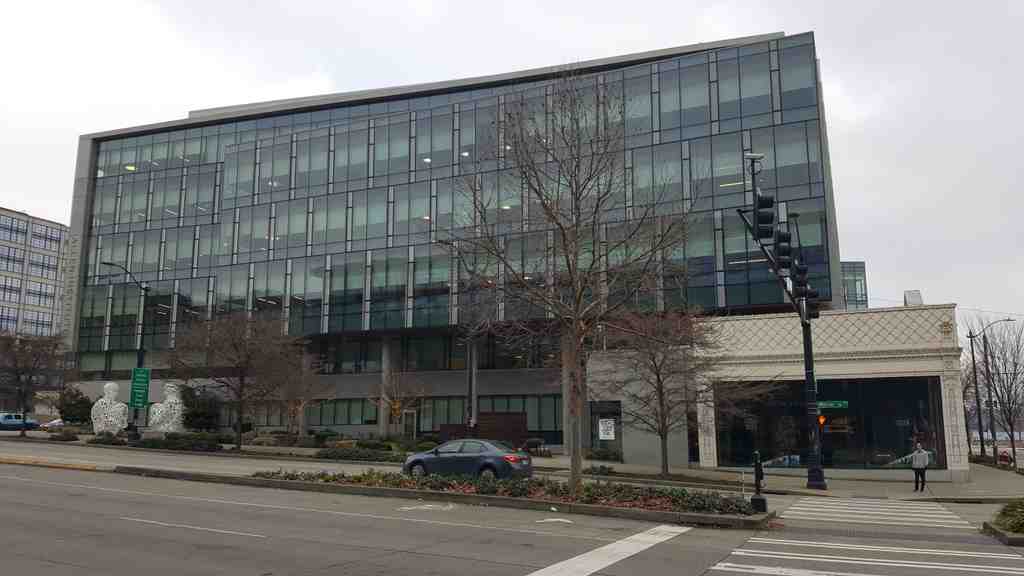
If you look to your left, right outside the glass-walled Allen Institute building at the corner of Mercer Street and 9th Avenue North, you’ll spot two large white figures sitting…Lire plusAfficher moins
If you look to your left, right outside the glass-walled Allen Institute building at the corner of Mercer Street and 9th Avenue North, you’ll spot two large white figures sitting quietly face-to-face, their bodies made out of a swirling mesh of letters. Standing in front of Mirall feels a bit like stumbling into a secret meeting between old friends who speak in silent riddles. Made by the artist Jaume Plensa, this sculpture isn’t just a pair of giant seated figures-they’re woven from the alphabet soup of eight different languages! Peer closely and you’ll find Arabic curves, Greek twists, Chinese brushstrokes, Hindu dots, Hebrew lines, Japanese brush flips, the stately Roman alphabet, and even Russian Cyrillic. It’s almost as if language itself got tired of being spoken and decided to take a seat right here in South Lake Union. Isn’t it wild to think these two are always mid-conversation, but you’ll never hear a sound? It’s a silent banter where every word is written but never spoken-sort of like texting under a strict librarian’s watch. Imagine all the stories-love letters, scientific ideas, jokes about Seattle rain-they might spell out if only they came to life for a minute! Take in the gleaming stainless steel, reflecting both the city’s energy and the soft gray skies above, and just for a second, wonder what you might say if you could join their mysterious, everlasting chat.
Ouvrir la page dédiée →Look ahead for two large, modern buildings with a striking green roof and plenty of glass walls-right across from the Seattle Center-those are the Gates Foundation…Lire plusAfficher moins
Look ahead for two large, modern buildings with a striking green roof and plenty of glass walls-right across from the Seattle Center-those are the Gates Foundation headquarters. Alright, take a moment and let your eyes wander across those long, grassy rooftops and glassy facades. This isn’t your average office park. Here’s where philanthropy gets a Seattle twist-big, bold, and a bit high-tech, just like the city itself. Now, let’s step back in time for a second, because the story of this place is bigger than what you see in front of you. It started quietly back in 1994, when Bill Gates-yes, the computer guy with that “Windows” thing-and his wife, Melinda, decided they wanted to do more good with their mountain of fortune. But it wasn't until the year 2000 that things really leveled up: the Gates Foundation was officially launched. Imagine the buzz-people wondered; what would two of the world’s wealthiest do now? Build another tech giant? Nope. Instead, they set out to squish global poverty and wipe out diseases that most people here in Seattle only read about. Every year, this Foundation has to give away 5% of its assets-currently, over seventy billion dollars. That’s a lot of zeros. Their mission? It’s massive: better health for everyone, everywhere, along with more opportunities in education, and a world where everyone can have clean water and decent toilets-really, they even reinvent toilets here. Can you picture a toilet that turns waste into clean water? Bill Gates actually drank a glass of that water once for a TV audience. If that’s not commitment, I don’t know what is! But hold on. The story isn’t all smooth, echoing halls and happy board rooms. There’s been drama-big decisions, some controversy, even world-shaking moments. In 2006, Bill decided to leave his daily role at Microsoft. He wasn’t getting bored; he just wanted to focus all his brainpower here, fighting malaria, funding scholarships, and basically trying to outdo Santa when it comes to giving things away. Rubbing shoulders with him is a hall-of-fame team, including Warren Buffett-yep, that Warren Buffett-who pledged his own billions to the cause. In 2010, the Gateses kicked off a project to reimagine global health education. They even teamed up with Hillary Clinton on projects for women and girls, and when COVID-19 hit, the Foundation had already built relationships worldwide, making it possible to move fast in getting help where it was needed most. Now, the building you’re in front of-it’s not just stylish. When they opened these shiny headquarters in 2011, it was Seattle’s newest eco-friendly trophy, decked out with solar panels, a “living roof,” and rainwater pools. Even the land it stands on has a cool story-it used to be a city bus base. Now, instead of the hum of buses heading out, there are conference rooms buzzing with discussions about how to end polio, send girls to school, or create a rice that saves millions of lives from Vitamin A deficiency. Over the decades, they’ve weathered a few storms, too-public criticism, legal changes, and even the challenge of keeping the founders working together after their divorce. As of 2024, Melinda stepped down, but the Foundation kept on rolling-scheduled, believe it or not, to spend itself out of existence by 2045. No trust funds lingering for centuries-just an all-in push to give it all away within 20 years of Bill Gates’ passing. It’s like a superhero promising to retire once the world’s safe. So as you stand here, right at the edge of this campus, picture not just the dollars and the headlines, but the millions of lives changed-vaccines in remote clinics, life-changing scholarships at Cambridge, or a simple, clean toilet where there wasn’t one before. You’re in the presence of Seattle’s powerhouse for hope, a machine for optimism, and perhaps the most ambitious “give it all away” project the world has ever seen. I have to say, if these walls could talk, they’d be arguing about whether to fund a new malaria vaccine or build a better toilet. Not your usual office gossip! Ready to head to our final stop? Let’s walk-who knows what future trailblazer might have just walked past you! Yearning to grasp further insights on the activities, financials or the global development division? Dive into the chat section below and ask away.
Ouvrir la page dédiée →

Afficher 1 arrêts de plusAfficher moins d'arrêtsexpand_moreexpand_less
To spot the Impatient Optimist, look up above the open plaza in front of the Bill & Melinda Gates Foundation-you’ll see a massive, colorful net floating in the air, glowing like a…Lire plusAfficher moins
To spot the Impatient Optimist, look up above the open plaza in front of the Bill & Melinda Gates Foundation-you’ll see a massive, colorful net floating in the air, glowing like a dreamcatcher for the whole city. Now, take a deep breath and listen closely-you’re standing beneath a sculpture with a secret. Back in 2015, artist Janet Echelman and her team wanted to capture the very shape of a Seattle day, but not with paint or clay. Instead, they snapped a photo of the sky every five minutes for 24 hours and then, like digital wizards, spun all that color data into this huge, swooping net above you. At 120 feet long and 80 feet wide, “Impatient Optimist” isn’t just any net; it’s the heartbeat of the Gates Foundation campus, connecting Seattle to sister campuses all over the world. At night, the net comes alive, glowing with the colors of sunrise as it happens-in real time-in places as far away as Africa and Asia. It’s almost as if the sculpture is playing an epic, cosmic game of telephone. The whole thing, with its shifting lights and shimmering threads, was built to remind us how one person can change the world-or at least brighten up a rainy Seattle day. Pretty dazzling, right? And you didn’t even need to climb a ladder to get this view!
Ouvrir la page dédiée →

Foire aux questions
Comment commencer le tour ?
Après l'achat, téléchargez l'application AudaTours et entrez votre code de réduction. Le tour sera prêt à commencer immédiatement - il suffit d'appuyer sur lecture et de suivre l'itinéraire guidé par GPS.
Ai-je besoin d'Internet pendant le tour ?
Non ! Téléchargez le tour avant de commencer et profitez-en pleinement hors ligne. Seule la fonction de chat nécessite Internet. Nous recommandons de télécharger en WiFi pour économiser vos données mobiles.
S'agit-il d'une visite de groupe guidée ?
Non - il s'agit d'un audioguide en autonomie. Vous explorez indépendamment à votre propre rythme, avec une narration audio diffusée par votre téléphone. Pas de guide, pas de groupe, pas d'horaire.
Combien de temps dure le tour ?
La plupart des tours durent entre 60 et 90 minutes, mais vous contrôlez totalement le rythme. Faites des pauses, sautez des arrêts ou arrêtez-vous quand vous le voulez.
Et si je ne peux pas finir le tour aujourd'hui ?
Pas de problème ! Les tours disposent d'un accès à vie. Faites une pause et reprenez quand vous le souhaitez - demain, la semaine prochaine ou l'année prochaine. Votre progression est sauvegardée.
Quelles sont les langues disponibles ?
Tous les tours sont disponibles dans plus de 50 langues. Sélectionnez votre langue préférée lors de l'utilisation de votre code. Note : la langue ne peut pas être changée après la génération du tour.
Où accéder au tour après l'achat ?
Téléchargez l'application gratuite AudaTours sur l'App Store ou Google Play. Entrez votre code de réduction (envoyé par e-mail) et le tour apparaîtra dans votre bibliothèque, prêt à être téléchargé et commencé.
Si vous n'appréciez pas le tour, nous vous rembourserons votre achat. Contactez-nous à [email protected]
Paiement sécurisé avec 


