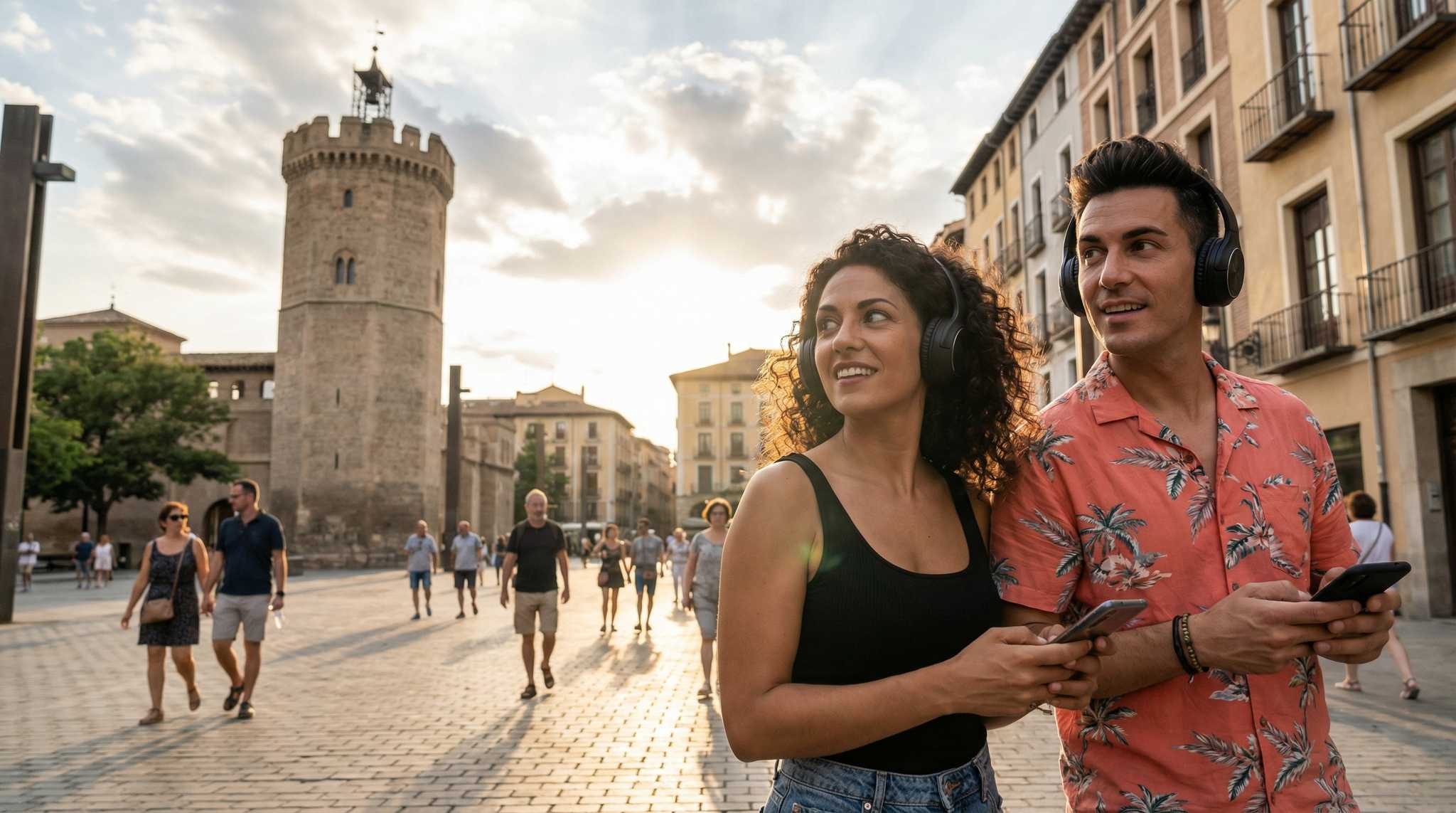
Échos d'Empires : L'Aventure Audio des Pierres Cachées de Saragosse
Mille ans de secrets se cachent dans les ombres de Saragosse, veillés par le Torreón de La Zuda penché et résonnant à travers les couloirs animés du Mercado Central. Embarquez pour une visite audio autoguidée qui dévoile les couches de la ville, révélant des moments perdus et des rebondissements dramatiques dont la plupart des voyageurs n'entendent jamais parler. Qui a osé prendre d'assaut les murs de La Zuda lorsque la rébellion a balayé l'ancienne cité ? Pourquoi des siècles de négociations secrètes persistent-ils là où les étals du marché se dressent aujourd'hui sous des vitraux et des poutres d'acier ? Et quel étrange mystère a conduit la tour de San Pablo à fusionner trois cultures en une seule flèche imposante ? Promenez-vous dans les rues médiévales où les souverains sont tombés, les fortunes ont changé de mains, et les voix du passé façonnent encore le présent. Chaque arrêt alimente de nouvelles questions et des images vives à mesure que vous vous enfoncez dans l'âme vibrante de Saragosse. Commencez à explorer maintenant – laissez les tours et les arches révéler les histoires extraordinaires que seule Saragosse peut raconter.
Aperçu du tour
À propos de ce tour
- scheduleDurée 40–60 minsAllez à votre propre rythme
- straightenParcours à pied de 3.6 kmSuivez le sentier guidé
- location_on
- wifi_offFonctionne hors ligneTéléchargez une fois, utilisez n'importe où
- all_inclusiveAccès à vieRéécoutez n'importe quand, pour toujours
- location_onCommence à Torreón de La Zuda
Arrêts de ce tour
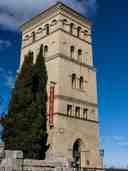
To spot the Torreón de La Zuda, look out for a tall, light-brown brick tower with elegant, arched windows stacked neatly on each floor. You’ll notice a pointed roofline decorated…Lire plusAfficher moins
To spot the Torreón de La Zuda, look out for a tall, light-brown brick tower with elegant, arched windows stacked neatly on each floor. You’ll notice a pointed roofline decorated with a pattern of small arches, sitting boldly above the old Roman stones at its base. There’s a big, red banner running down the front that says “Oficina de Turismo,” so you really can’t miss it! If you see some tall, dark green cypress trees hugging the side of a sturdy square tower, you’re in the right place. Now, take a breath and imagine you’re stepping into an ancient city full of secret passageways, bustling crowds, and powerful rulers. Right where you stand, over a thousand years ago, stood the heart of the city’s government! This tower is all that’s left of the royal palace known as La Zuda, a place with so much history, you’d think it could whisper stories after dark. Let’s go back to the year 714. Zaragoza was called “Saraqusta” and it was a mighty Muslim city, protected by massive stone walls-so thick and tall, you’d need a really good ladder and a lot of courage just to peek over! The ruler’s palace, a sort of elegant fortress, rose right here at the edge of the Ebro River. Can you feel the energy of ancient city life swirling around you, the shouts of market sellers and the clatter of soldiers on patrol? As centuries passed, the city changed hands. The tower you see would become a prize in the great chess game of conquerors. When the Christian king Alfonso I captured Zaragoza in 1118, the first thing his victorious troops did was seize this towering stronghold-symbolizing their total victory! Afterward, this spot hosted kings of Aragón, holy knights, and even served as a hospital, opening its doors to care for the sick and the poor. And a curious twist? The tower leans just a little. So, if you notice yourself tilting your head, don’t worry-it’s not you, it’s the architecture! Over the years, the building housed everyone from kings and queens to nuns on a mission to help women in need. So, as you gaze up at this mighty tower, imagine all those restless centuries echoing inside its walls. This is more than a tower. It’s a survivor, watching the city’s story unfold for over a thousand years. Shall we see what other stories Zaragoza is hiding next? Let’s get moving!
Ouvrir la page dédiée →Take a step closer, and let your senses wake up-you're standing at the grand entrance of Zaragoza’s Mercado Central. Picture this: the stone arches stretch above you, each…Lire plusAfficher moins
Take a step closer, and let your senses wake up-you're standing at the grand entrance of Zaragoza’s Mercado Central. Picture this: the stone arches stretch above you, each whispering tales of markets past-some say the breeze here still smells faintly of oranges and roasted coffee wafting from a hundred busy stalls. If you listen closely, you might hear the echo of haggling voices from decades ago-every seller had a trick up their sleeve and every shopper their eye on a bargain. It’s as if the walls still remember the excitement of racing for the freshest vegetables just before the church bells rang. Now, imagine being here in 1903, when this iron-and-glass masterpiece first opened its gates. It was a sensation! Metal beams gleamed in the sunlight-quite a modern sight for Zaragoza back then-while everyone in town was buzzing about the fancy roof. Some folks joked the new market was so bright, you’d need sunglasses just to buy an onion. Yet the Mercado Central wasn’t just about food. This place was-and still is-a true meeting point for Zaragoza’s heart and soul. Deals were sealed, secrets swapped, and friendships formed all between weighing carrots and sampling olives. Can you spot the old weighing stations? I promise, more deals were struck there than on the stock exchange. Today, around you, you can see locals still coming to shop-though maybe now they also take selfies with their tomatoes. This isn’t just a market; it’s Zaragoza in a nutshell: lively, proud, and full of flavor. Just make sure you don’t leave without trying a little jamón-Spanish ham-with bread, or you might get a stern talking-to from any Zaragoza grandmother you meet! As you take it all in, listen to the faint clinking of bottles and crates being stacked, just as they always have been. The Mercado Central isn’t just a building-it’s a living memory, and today, you're part of its story. Ready to taste Zaragoza’s history? Let’s keep walking!
Ouvrir la page dédiée →Look ahead and up-you’ll spot San Pablo by its tall, octagonal brick tower rising proudly over the street, decorated with patterned designs that catch the sunlight just right. If…Lire plusAfficher moins
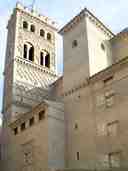
Look ahead and up-you’ll spot San Pablo by its tall, octagonal brick tower rising proudly over the street, decorated with patterned designs that catch the sunlight just right. If you're not sure, look for the massive stone archway entrance, topped by a statue of a saint holding a staff-he’s holding the fort for everyone! Now, while you stand here, imagine Zaragoza way back when knights clanged down these very streets and horses’ hooves echoed through the air. The church in front of you, San Pablo, has held this corner since the late 1200s-so it’s seen its share of drama. The original building was simple, but over centuries, new parts sprouted like wildflowers, stretching up with flying buttresses, side chapels, and, most eye-catching, this Mudéjar tower added in 1343. You can sense the mix of cultures-Gothic pointed arches, Moorish brick patterns, and Christian saints carved right by the doors. Don’t be shy: take a look at the main entrance! Here’s where Saint Peter and Saint Paul are posted like medieval bouncers. Christ sits above them, flanked by the Virgin, Saint John, and Saint Blaise, as if he’s the judge in an ancient reality show. Try to spot the tuscan stonework and all the fancy sculptures. Up top, the tower boasts Moorish decorations and even a real pyramidal spire. And buried in the heart of the church (though you can’t see it now) is an Arab-style frieze. If these walls could talk, you’d probably hear whispers in Latin, Arabic, and Spanish, all at once! Inside, the main altar is a showstopper carved by Damián Forment-so golden and grand it almost looks edible, but please, don’t try to nibble! In fact, San Pablo is now a monumento nacional and a World Heritage Site, officially protected so it can keep surprising travelers... like a 700-year-old magician. Alright, wonder-seeker, ready to wander on and discover the next marvel? Onward to more history!
Ouvrir la page dédiée →
Afficher 11 arrêts de plusAfficher moins d'arrêtsexpand_moreexpand_less
You’re now standing right where the locals would have stood, gazing up at Zaragoza’s legendary Leaning Tower. Look up ahead, above the old rooftops, and you can just imagine the…Lire plusAfficher moins
You’re now standing right where the locals would have stood, gazing up at Zaragoza’s legendary Leaning Tower. Look up ahead, above the old rooftops, and you can just imagine the mighty tower shooting up into the sky, but tilting dangerously to one side-far more dramatic than your average Pisa copycat! Picture a huge brick spire with a striking twist, literally leaning over the plaza, surrounded by bustling streets and people looking up in awe. Back in the 1500s, when the Catholic Monarchs ruled Spain, this tower-known as the Torre Nueva-was the highest Mudéjar-style tower ever built. It reached a dizzying 80 meters, about as tall as you’d feel after spinning around five times! Its base was shaped like a sixteen-pointed star, and as you looked higher, the shape turned octagonal, with each level more ornately decorated than the last. Imagine beautiful patterns made entirely from brick, pointed arches that looked like they belonged in a fairy tale, and at the very top, a triple spire with slate roofs that sparkled in the sun. But here’s where the story tips-literally! The builders, a brilliant mix of Christians, Muslims, and a Jew, were in a hurry. The southern side of the tower was built quicker than the northern side, and before anyone could say, “Maybe we should check those foundations,” the whole tower began to lean! Even after extra work to try and fix it, the tilt stuck around-nearly three meters off from where it should be. Don’t worry, though-everyone said it was totally safe… for the most part. In the old days, neighbors probably wondered if one day it would finally tip over into their kitchens! But instead, Torre Nueva became the city’s champion of weird architecture-a star attraction captured by painters and early photographers, even making it onto cigarette cards. During the French siege in the early 1800s, the tower stood tall as a lookout and a warning post. If you listen closely, you might even imagine the distant shouts of soldiers and church bells as they watched for danger. By the late 1800s, the city council decided the tilt was too risky and voted to demolish the tower-much to the heartbreak of the people. When it finally came down, many Zaragozans grabbed bricks as souvenirs, like keeping a piece of a shared dream that defied gravity. So, as you stand here now, close your eyes for a moment and imagine you’re in a lively square, with crowds below and a tower overhead, leaning so far it almost looks like it’s waving to you. That’s Torre Nueva, Zaragoza’s one-of-a-kind monument that just couldn’t stand up straight-but definitely stood out!
Ouvrir la page dédiée →Right in front of you, you’ll spot something that looks a bit like a giant, jagged puzzle piece rising out of the ground, with water shimmering and rippling across its bold,…Lire plusAfficher moins
Right in front of you, you’ll spot something that looks a bit like a giant, jagged puzzle piece rising out of the ground, with water shimmering and rippling across its bold, geometric edges. See that wide splash of pale stone, shaped almost like the outline of a continent? You’re looking at the Fuente de la Hispanidad-one of Zaragoza’s most unique fountains. As you get closer, notice how the water flows over sharp, uneven steps, and if you stand back and squint just a little, you’ll realize you’re looking at an abstract map of Latin America. There’s even a long groove on the left-a sneaky little nod to the Yucatán Peninsula and Central America. Now, take a whiff of the fresh water in the air, hear the gentle splash echoing off the stone, and imagine for a moment that you’re standing at the edge of the New World, right before the ships arrived. This fountain was created during a big renovation of the plaza in 1991 and stands as a tribute to Hispano-American culture-a nod to what connects Spain to all those countries across the Atlantic. But this isn’t just any old slab of stone and water. Alongside the main fountain, see if you can spot three white marble blocks-all different sizes. They’re not random! They represent the three ships-Niña, Pinta, and Santa María-that Columbus and his bold crew used to set sail on their “maybe we’ll find India, maybe we’ll discover America” adventure. I always imagine a sailor here, peeking over the edge of one of those blocks and saying, “Are we there yet?” And that big round globe nearby? It’s meant to capture the whole world of discovery these voyages set off. So, as you stand in front of this masterpiece, you’re standing at a meeting place-a bridge between two worlds. And hey, if you manage to spot the continents in the fountain’s lines before your travel buddies, you can claim bragging rights for the rest of the day. Ready to set sail for our next stop? Anchors away!
Ouvrir la page dédiée →Look straight ahead and you’ll see something truly breathtaking: tall, elegant towers rising up, their domes and spires outlined with golden lights against the dark sky. The…Lire plusAfficher moins
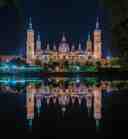
Look straight ahead and you’ll see something truly breathtaking: tall, elegant towers rising up, their domes and spires outlined with golden lights against the dark sky. The Cathedral-Basilica of Our Lady of the Pillar almost floats above the city, and-if you’re lucky enough to catch the river nearby-you might spot its perfect reflection shimmering in the water. Four massive towers mark its corners and a row of cupolas stretches between them, like a royal crown glittering under the night. Now, imagine stepping back in time. You’re arriving at a church that, according to tradition, was the world’s first ever built for Mary, the Mother of Jesus. But this isn’t just any church-it’s a spot where miracles and mysteries swirl in the air like incense. Picture yourself over 2,000 years ago, with Saint James by the banks of the Ebro. He’s tired, maybe even grumpy, because it seems no one’s listening to his message. Suddenly, there’s a gentle whoosh--and Mary herself appears, standing on a pillar of bright, gleaming jasper. She encourages James to keep going, right here on this very spot. Legend says James built a tiny chapel in Mary’s honor-a small, quiet place that must have felt like a hidden treasure among the Roman stones. Over the centuries, waves of kings, saints, and pilgrims followed, each one in awe of the miraculous statue of Mary above her pillar. The basilica as you see it now is a grand survivor, built and rebuilt from fire, war, and time. Its walls have absorbed centuries of prayers, secrets, and celebrations. Inside, the Holy Chapel is the heart of it all, watched over by the statue of Mary herself. Around you, the domes are alive with bright frescoes-yes, painted by none other than Francisco Goya when he was just a young man hoping for fame. If you pause and really listen, you might even imagine the distant echoes of footsteps and whispered prayers from visitors past-. So as you stand before this spectacular building, remember you’re at the crossroads of legend and life, where everyday Zaragoza meets the very edge of a miracle. Oh, and try not to bump into any saints-you never know who’s stopping by! Exploring the realm of the pillar and the image, layout or the organ and music? Feel free to consult the chat section for additional information.
Ouvrir la page dédiée →Take a look straight ahead-what you see now is no ordinary city square! To spot the Plaza of Our Lady of the Pillar, just look for the enormous open space right before you,…Lire plusAfficher moins
Take a look straight ahead-what you see now is no ordinary city square! To spot the Plaza of Our Lady of the Pillar, just look for the enormous open space right before you, flanked by two towering cathedrals and dotted with people, trees, and some very curious modern pillars stretching up on your right. On your left, you can't miss the grand basilica with its tall, elegant towers and colorful tiled domes peeking above. And, if you’re wondering about that giant stone ball-that’s a little modern touch in a place where history runs deep. Welcome to the beating heart of Zaragoza! You’re standing in Plaza del Pilar, nicknamed “the hall of the city”-and, honestly, you might feel like you’ve just walked into the ballroom of a royal palace. This plaza is the biggest pedestrian square in Europe, so if you feel like doing a dramatic spin in the middle, no one would blame you! And yes, it's second in size only to the mighty Red Square in Moscow, but trust me, nobody here expects you to wear a winter coat. Here, every step has a story. Imagine the crowds gathering for festivals; the air filled with laughter, music, and that irresistible smell of fresh churros drifting from street vendors. Look up and you’ll see two majestic cathedrals watching over the plaza-La Seo and the Pilar-making this the only place in all of Spain where two cathedrals share the same square. If cathedrals could gossip, I wonder what secrets they’d trade! To your side stands the city hall, and just nearby, a tribute to the artist Goya, who probably would have painted these lively scenes if he weren’t busy making history himself. And let’s not forget the Fountain of Hispanicity just ahead-a dramatic splash of water that has probably seen just as much excitement as the pigeons trying to bathe in it. This plaza isn’t just a meeting point for people; it’s where past and present shake hands. Soak it all in, snap a photo, and listen: if you let your imagination roam, you might even hear echoes of a centuries-old festival or the whispering footsteps of pilgrims drawn here for a little miracle of their own.
Ouvrir la page dédiée →Take a look up ahead on Espoz y Mina Street-you can’t miss the bold Renaissance palace with its solid, pale brick walls and row of elegant black iron balconies running along the…Lire plusAfficher moins
Take a look up ahead on Espoz y Mina Street-you can’t miss the bold Renaissance palace with its solid, pale brick walls and row of elegant black iron balconies running along the upper floor. Above the stone-framed doorway, there’s a banner for the current exhibition, and you might spot a couple of flags fluttering in the breeze. The entrance is big and sturdy, like it’s been waiting for centuries for visitors just like you. If you’re here for Goya, you’re in the right place! Now, let’s imagine this palace over the centuries: way back in 1535, a Moorish architect named Juan de Lanuza put his dreams into these stone walls for the Pardo family. The house hosted noble residents, and at one point the generals of the War of Independence hurried in and out of these very doors. If these walls could talk, they might demand a raise. Fast forward past fierce battles, auction signs, and a few renovations (you know how houses are-always in need of a facelift), and this palace found its ultimate calling: a temple for art! In 1979, the collector and art fanatic José Camón Aznar donated his collection to kick things off. And when Ibercaja and the Real Sociedad threw their own treasures into the mix, the place started bursting with masterpieces. So, what’s inside? Over 1,000 works of art-paintings, engravings, drawings, even bits of ancient ceramics-are gathered here. Walk the halls and you’ll see Goya’s genius everywhere, from wild bullfights to the haunting Los desastres de la guerra. He even did a self-portrait, probably to check if his hair looked okay that day. But it’s not just Goya: they have works from the 1400s up to the 20th century, enough to make your head spin with color, drama, and stories. Don’t forget to pause in the Camón Aznar Room, named after the museum’s founder, or look for the glimmering gilded hall and the marble columns in the courtyard-traces of Renaissance glory carefully restored so your footsteps echo right beside history. There’s even a little mystery beneath your feet: the basement holds some Roman remains, remnants of Zaragoza’s ancient past. Imagine Goya and Roman soldiers bumping into each other down there-awkward! And hey, if you hear any arguing about the museum’s name, just smile and remember: art, like life, loves a little drama. Ready to step inside and see why Goya made such a splash? Let’s go explore masterpieces that have survived empires, wars, makeovers, and, yes, very passionate debates over naming rights!
Ouvrir la page dédiée →Once upon a time, this whole area was wrapped up tight by sturdy Roman walls. They went up in the 3rd century, so if you ever feel lost, you can just blame the ancient Romans for…Lire plusAfficher moins
Once upon a time, this whole area was wrapped up tight by sturdy Roman walls. They went up in the 3rd century, so if you ever feel lost, you can just blame the ancient Romans for all these confusing streets! Those walls once made Zaragoza one of Spain’s most powerful fortresses. Look around and imagine Roman citizens strolling down the Cardo and Decumano-those are the ancient “Main Streets” of Caesar Augusta, the Roman name for Zaragoza. Nowadays, they’re called Calle Don Jaime I and Manifestación, Espoz y Mina, and Mayor. But don’t be fooled by the old-timey charm; some “historic” streets like Alfonso I are really just 19th-century renovations, which is basically cheating in the world of ancient city planning. Now, as you wander here, you’re actually standing in Spain’s second largest historic center-only Toledo is bigger. That means you’re standing on layers and layers of history. Beneath your feet and all around you are remains from Roman times: bits of wall, old theaters, a river port, a forum, and Roman baths. Not a bad local spa, huh? Medieval times left their mark here too, with Jewish baths, Mudejar churches, and palaces like the Palacio de los Morlanes and Real Maestranza. The really classy stuff is tucked inside these twisting streets. And you know what? Zaragoza’s oldest shop is still baking sweets nearby since 1856-a pastelería called La Flor de Almíbar, where legends say even the ghosts have a sweet tooth. And if you get hungry for more than legends and sugar, Casa Lac holds the title of oldest restaurant still serving up delicious food. But not all stories here have a sweet ending. In 1990, the Calle Trinidad saw a terrible tragedy with a fire at the Flying nightclub-the darkest day in city history. But the city’s heart beat on, like the rhythm of people walking these streets for centuries. So keep your eyes wide, your nose ready for pastry scents, and your ears tuned for history whispering around corners. The Casco Histórico is a place where every step tells a story-just listen, and you’ll pick up more than just footsteps.
Ouvrir la page dédiée →Look straight ahead-do you see that tall, square tower with the fancy brick patterns, almost like someone played tic-tac-toe across the walls for centuries? That’s San Gil Abad.…Lire plusAfficher moins
Look straight ahead-do you see that tall, square tower with the fancy brick patterns, almost like someone played tic-tac-toe across the walls for centuries? That’s San Gil Abad. The church looks solid and ancient, built from pale, sun-baked bricks, and its tower stands like a guard above the street. There’s a small stone carving above the doorway-if you squint, you might just make out a figure in a niche, almost as if the church is winking at you in secret. Now, imagine it’s the 14th century. The air smells of baking bread and fresh straw. After the Reconquista, the old Romanesque church that once stood here was taken down, making way for this shining new building in the splendid Mudéjar style. Mudéjar is a blend-part Christian, part Islamic flair-like a medieval mashup before it was cool. Picture the sound of masons chipping brick, with clay dust dancing in golden sunlight. But the story didn’t stop there! Fast forward a few hundred years, and Zaragoza is buzzing with ideas and new fashions. Out go the plain walls; in comes the wild Baroque style. The church gets a makeover-fancier ceilings, dramatic shapes, and even a new entrance in 1640. For a moment, imagine the townsfolk gathering outside, craning their necks to get a peek at what’s new, probably hoping for a little more leg room during Sunday service. Step inside (in your mind, at least): the air turns cool, and you’re wrapped in the swirl of golden light from the 18th century. The altarpiece, gleaming since 1628, is dedicated to St. Gil Abad himself. Walk around to the sacristy and, if you can, look up. You’d see an elegant painted vault by Ramón Bayeu, like the sky itself has been captured indoors, and paintings by his brother Manuel on every wall. Really, this church is a bit like a time machine-you get Roman roads, Mudéjar artistry, Baroque drama, and everyday stories from centuries before. So, while you’re here, why not try a fun experiment? Close your eyes, fancy yourself a traveler just arriving at the city gate, and see if you can decide which century you’ve landed in. And if you get lost, don’t worry-it happens to everyone in Zaragoza’s twisting, story-packed streets!
Ouvrir la page dédiée →Right in front of you is the Cathedral of the Savior, or as locals love to call it, La Seo. If you look ahead, you will see a truly unique building rising in the soft golden glow…Lire plusAfficher moins
Right in front of you is the Cathedral of the Savior, or as locals love to call it, La Seo. If you look ahead, you will see a truly unique building rising in the soft golden glow of the streetlights. Its tall bell tower cuts sharply into the sky, crowned by a chunky dome with elegant shapes, and its walls are adorned with intricate brickwork and geometric patterns-hallmarks of the Mudéjar style, like someone decorated their castle with a giant set of stencils! La Seo stands tall at the plaza, a proud patchwork of stone, brick, and centuries of stories, so just follow the light and look for those subtle Moorish patterns dancing along the façade. Let’s go back in time here-imagine horses’ hooves echoing on the stones and church bells chiming above. This very spot has been the center of the city's heartbeat for centuries. But unlike most Roman cities, Zaragoza’s ancient forum was right here, next to the river, bustling with merchants, worshippers, and, if you can believe it, the occasional Roman senator looking for a bargain. Beneath your feet, ancient secrets from the Roman forum still sleep; the Museum of the Forum is just across the plaza, keeping them safe underground. La Seo has had many lives-a Roman forum, then a mosque, and finally, this grand cathedral. Picture it: in 1118, Alfonso the Battler strolled in, a sword probably clinking against his armor, and said, “Alright, time to switch things up!” He gave Muslims a year to pack up, and then this place slowly transformed from mosque to magnificent church. Workers chipped away at stone, adding arches, naves, and secret sculptures. If you listen closely, you might just catch the faint echo of chisels tapping away. Here’s a fun fact: all the kings of Aragon were crowned right here! Imagine the excitement-crowns, swords, and armor, all paraded from the Aljafería to the cathedral. The king, probably a little nervous, swearing oaths and getting doused with holy oil. Rival princes fighting for a better seat-some things never change. This cathedral isn’t just a building-it’s a scrapbook of Zaragoza’s wild history: Roman stones at the base, stripes of brick and plaster from medieval renovations, and even the marks where the old mosque’s minaret was attached. It’s survived battles, royal feuds, and probably more than a few pigeons. So take a good look at those beautifully mismatched walls-every stone and brick has a story, and if they could talk, I bet they’d have some wild tales about kings, knights, and late-night construction mishaps. Ready for the next stop? Let’s keep walking through history!
Ouvrir la page dédiée →Take a look just across the road-you’ll spot a long, fortress-like building rising above an old stone wall. Its walls are a mix of rough stone at the bottom and smoother, pale…Lire plusAfficher moins
Take a look just across the road-you’ll spot a long, fortress-like building rising above an old stone wall. Its walls are a mix of rough stone at the bottom and smoother, pale plaster up top. The windows are small and square, tucked into the thick walls, and right in the middle, you’ll notice a rounded, tower-like chapel with arched windows. It almost looks like the building is keeping a thousand-year-old secret. Alright, step a little closer and imagine this: centuries ago, the street you’re standing on was probably covered in the sound of horse hooves, and the only way into this solid monastery was through a heavy wooden door guarded by nuns with eyes sharper than a hawk’s. This is the Monastery of Comendadoras Canonesas del Santo Sepulcro. Don’t worry, you don’t have to pronounce all that at once-locals just call it “the Santo Sepulcro.” Now, not just any building in Spain gets to be called a “Bien de Interés Cultural” - that’s a fancy way of saying the country thinks this place is really special. This monastery has been standing guard since 1893, but its story stretches back even further. Picture the city in the Middle Ages, full of knights, noble ladies, and-of course-a few mysterious secrets. The nuns here belonged to a very rare order tied to the legendary knights of the Holy Sepulchre. Imagine what tales these thick walls have heard: whispered prayers, sweeping cloaks, maybe a secret passage or two… Although I wouldn’t recommend looking for hidden tunnels today, unless you want to get in trouble with a real-life nun! Let your eyes trace the old stones and picture the quiet lives led inside; there’s something powerful and almost magical about this place. For hundreds of years, the world outside has changed-cars, electricity, tourists with funny hats-but these walls keep their ancient calm. Now you get to be part of its long chain of visitors, soaking in the silence and the centuries. Not bad for a quick stop, right? When you’re ready, I’ve got more Zaragoza secrets up my sleeve for our next stop!
Ouvrir la page dédiée →Straight ahead, you’ll see an impressive octagonal building with pale brick walls, almost like a giant stone lantern rising up from the street. The entrance is heavy, dark, and…Lire plusAfficher moins
Straight ahead, you’ll see an impressive octagonal building with pale brick walls, almost like a giant stone lantern rising up from the street. The entrance is heavy, dark, and arched, framed with stone columns that look like they’ve weathered a few centuries. If you look up, you’ll spot fancy brickwork zig-zagging around the top - it’s all decorated in geometric patterns, almost like someone tried to knit with bricks. Take a deep breath and imagine it’s the 14th century. The streets are full of clattering carts, merchants shouting out their wares, and in the middle of it all, this mysterious, fortress-like church stands with its proud Mudéjar brickwork. Welcome to Santa María Magdalena! There’s something magical about the way this church combines different worlds: it was first mentioned far, far back in 1126, when it was a simple Romanesque building. But centuries later, folks decided to swap it for something a bit fancier. What you see now is a treasure from the time when brick was the coolest thing in town. Picture medieval builders - probably covered in dust and definitely a bit sweaty - stacking bricks in patterns inspired by palaces and towers, with a bit of a nod to the famous Aljafería Palace just across the way. The church is shaped like a big cross, and, get this, if you peek around the outside, you’ll notice dozens of arches and decorative crosses, almost like a medieval comic strip running around the walls. And that tall tower? Four levels high and decorated with white and green tiles, it’s a cousin of the striking Mudéjar towers you’d find in Teruel. It’s almost as if the tower wanted to dress up for a festival and borrowed some extra flair. Actually, the inside is quite different-thanks to some serious redecorating in the 17th and 18th centuries, you’d find a stunning baroque altar, made by José Ramirez de Arellano, and even a golden statue of the Immaculate. It’s like the church got a brand new party outfit, but decided to keep its outer medieval armor. So take a look at the details and imagine the stories these bricks could tell. If these walls could talk, they’d probably whisper secrets about kings, crusaders, and the timeless competition for “best-looking tower” in Zaragoza. Ready to discover what’s next?
Ouvrir la page dédiée →If you look just ahead, you’ll spot the Roman house right in front of you, tucked away on Añón Street. To be precise, you’ll know you’re in the right place if you see an elegant…Lire plusAfficher moins
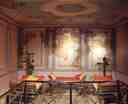
If you look just ahead, you’ll spot the Roman house right in front of you, tucked away on Añón Street. To be precise, you’ll know you’re in the right place if you see an elegant and somewhat mysterious space through glass or an opening, with faded but colorful wall paintings, a mosaic on the floor, and low Roman-style couches lined up as if waiting for dinner guests from two thousand years ago. Alright, take a deep breath and step into the world of ancient Caesaraugusta. This spot isn’t just any old ruin-it’s the remains of a grand Roman house, discovered by surprise in the year 2000, hiding in the middle of a modern city. Even now, it feels as if the old Roman family could waltz in at any moment, ready to show off their designer dining room. Imagine the aroma of spices and roasted meats drifting through the air, Roman laughter echoing off these painted walls. You’re standing where their triclinium, or dining room, once was-this was the main stage for feasts and deep conversations. Listen for the sound of wine being poured and soft chatter bubbling from those elegant couches! The stone floor below your feet? That’s the original mosaic, with geometric shapes set there almost two thousand years ago. The Romans even painted the walls and ceiling to impress their guests. Look up, and you’ll find bits of wild and magical scenes-flying cupids with big craters of wine and flashes of Jupiter’s thunderbolts. There’s also Bacchus, the Roman god of parties, lounging with some very curious creatures-was that a sea horse and two panthers? Clearly, Romans didn’t hold back on their imagination or their parties! And get this-unlike most Roman towns, this house was built outside the city’s old walls. Maybe the family wanted more space, or maybe the whole city was just growing faster than anyone realized. It’s the oldest home of Caesaraugusta where you can still see the original paintings, plaster, and floors. Even archaeologists were stumped; they’d never seen wall decorations quite like these in any Roman house, even in Italy! So, next time you throw a dinner party, just remember: the Romans were doing themed rooms before it was cool. And don’t worry-no ancient ghost is going to ask you to pass the olives. Or will they?
Ouvrir la page dédiée →
Foire aux questions
Comment commencer le tour ?
Après l'achat, téléchargez l'application AudaTours et entrez votre code de réduction. Le tour sera prêt à commencer immédiatement - il suffit d'appuyer sur lecture et de suivre l'itinéraire guidé par GPS.
Ai-je besoin d'Internet pendant le tour ?
Non ! Téléchargez le tour avant de commencer et profitez-en pleinement hors ligne. Seule la fonction de chat nécessite Internet. Nous recommandons de télécharger en WiFi pour économiser vos données mobiles.
S'agit-il d'une visite de groupe guidée ?
Non - il s'agit d'un audioguide en autonomie. Vous explorez indépendamment à votre propre rythme, avec une narration audio diffusée par votre téléphone. Pas de guide, pas de groupe, pas d'horaire.
Combien de temps dure le tour ?
La plupart des tours durent entre 60 et 90 minutes, mais vous contrôlez totalement le rythme. Faites des pauses, sautez des arrêts ou arrêtez-vous quand vous le voulez.
Et si je ne peux pas finir le tour aujourd'hui ?
Pas de problème ! Les tours disposent d'un accès à vie. Faites une pause et reprenez quand vous le souhaitez - demain, la semaine prochaine ou l'année prochaine. Votre progression est sauvegardée.
Quelles sont les langues disponibles ?
Tous les tours sont disponibles dans plus de 50 langues. Sélectionnez votre langue préférée lors de l'utilisation de votre code. Note : la langue ne peut pas être changée après la génération du tour.
Où accéder au tour après l'achat ?
Téléchargez l'application gratuite AudaTours sur l'App Store ou Google Play. Entrez votre code de réduction (envoyé par e-mail) et le tour apparaîtra dans votre bibliothèque, prêt à être téléchargé et commencé.
Si vous n'appréciez pas le tour, nous vous rembourserons votre achat. Contactez-nous à [email protected]
Paiement sécurisé avec