
Visite audio de Sibiu : Tours, traditions et trésors intemporels
Chaque pierre de la vieille ville de Sibiu murmure encore des secrets de l'époque où cette cité gardait les confins des empires. Au-delà des places dignes de cartes postales et des flèches gothiques se cachent des trahisons glaçantes, des soulèvements fatidiques et des légendes excentriques que la plupart n'entendent jamais. Cette visite audio autoguidée vous permet de flâner à votre propre rythme. Découvrez ce que la foule manque et déverrouillez des recoins cachés où l'art, l'ambition et l'intrigue se sont rencontrés pendant des siècles. Quel complot s'est déroulé sous le regard imposant de la Cathédrale luthérienne, brisant presque les ambitions royales ? Pourquoi les cloches silencieuses de la Tour du Conseil ont-elles autrefois semé la panique dans les rues ? Et quel objet particulier le Musée National Brukenthal garde-t-il enfermé, avec une histoire qui défie toute explication ? Engagez-vous dans des ruelles sinueuses et élevez-vous au-dessus des toits. Ressentez le pouls du drame de Sibiu, découvrez des chapitres perdus et laissez la ville vous surprendre à chaque tournant. Prêt à écouter là où la ville se souvient encore ? Appuyez sur lecture pour commencer.
Aperçu du tour
À propos de ce tour
- scheduleDurée 40–60 minsAllez à votre propre rythme
- straightenParcours à pied de 1.8 kmSuivez le sentier guidé
- location_on
- wifi_offFonctionne hors ligneTéléchargez une fois, utilisez n'importe où
- all_inclusiveAccès à vieRéécoutez n'importe quand, pour toujours
- location_onCommence à Le Musée de l'Histoire de la Pharmacie de Sibiu
Arrêts de ce tour
You are standing in front of a handsome, light-colored building with a ground-floor arcade of thick stone arches and a steeply pitched roof dotted with small dormer windows. This…Lire plusAfficher moins
Ouvrir la page dédiée →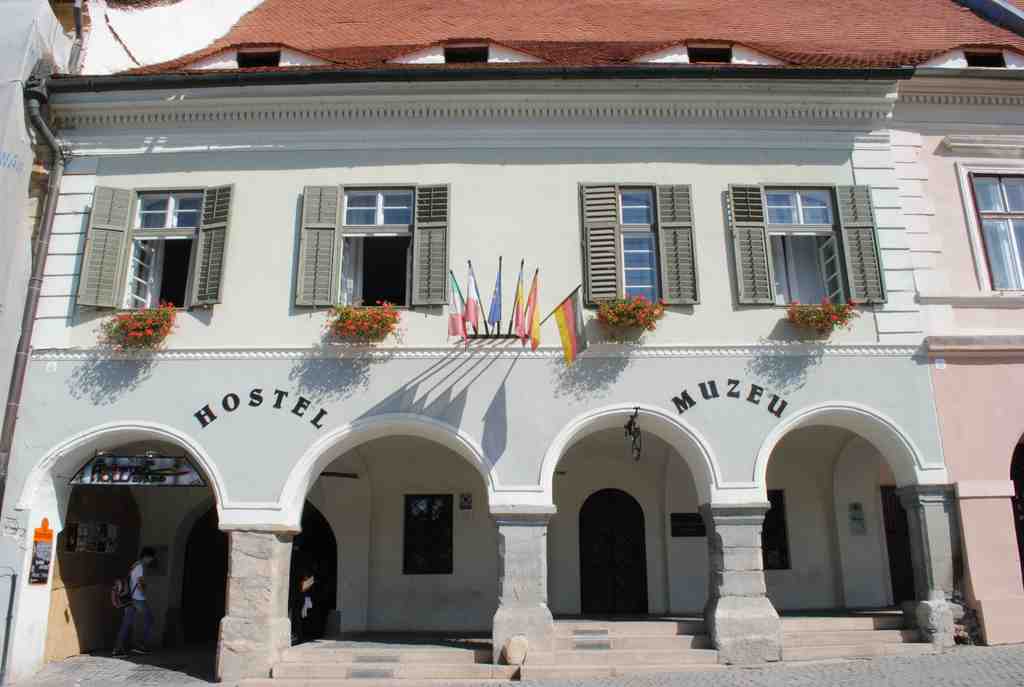
The Museum of the History of Pharmacy in SibiuPhoto: Andrei kokelburg, Wikimedia Commons, CC BY-SA 3.0 RO. Cropped & resized. You are standing in front of a handsome, light-colored building with a ground-floor arcade of thick stone arches and a steeply pitched roof dotted with small dormer windows. This is the Museum of the History of Pharmacy, housed in a fifteen sixty-eight architectural gem known as Casa Hess.
Let me tell you, this place holds some truly unexpected secrets. Sibiu actually had the very first documented pharmacy in present-day Romania way back in fourteen ninety-four. That was during the second great plague pandemic, a time when apothecaries-the historical predecessors to modern pharmacists-were the absolute lifelines of the city. While that first pharmacy was over in the Large Square, a new apothecary opened right here in this building around sixteen hundred. If you check your screen, you can see how this handsome Renaissance and Gothic structure appeared historically as the home of that very shop.
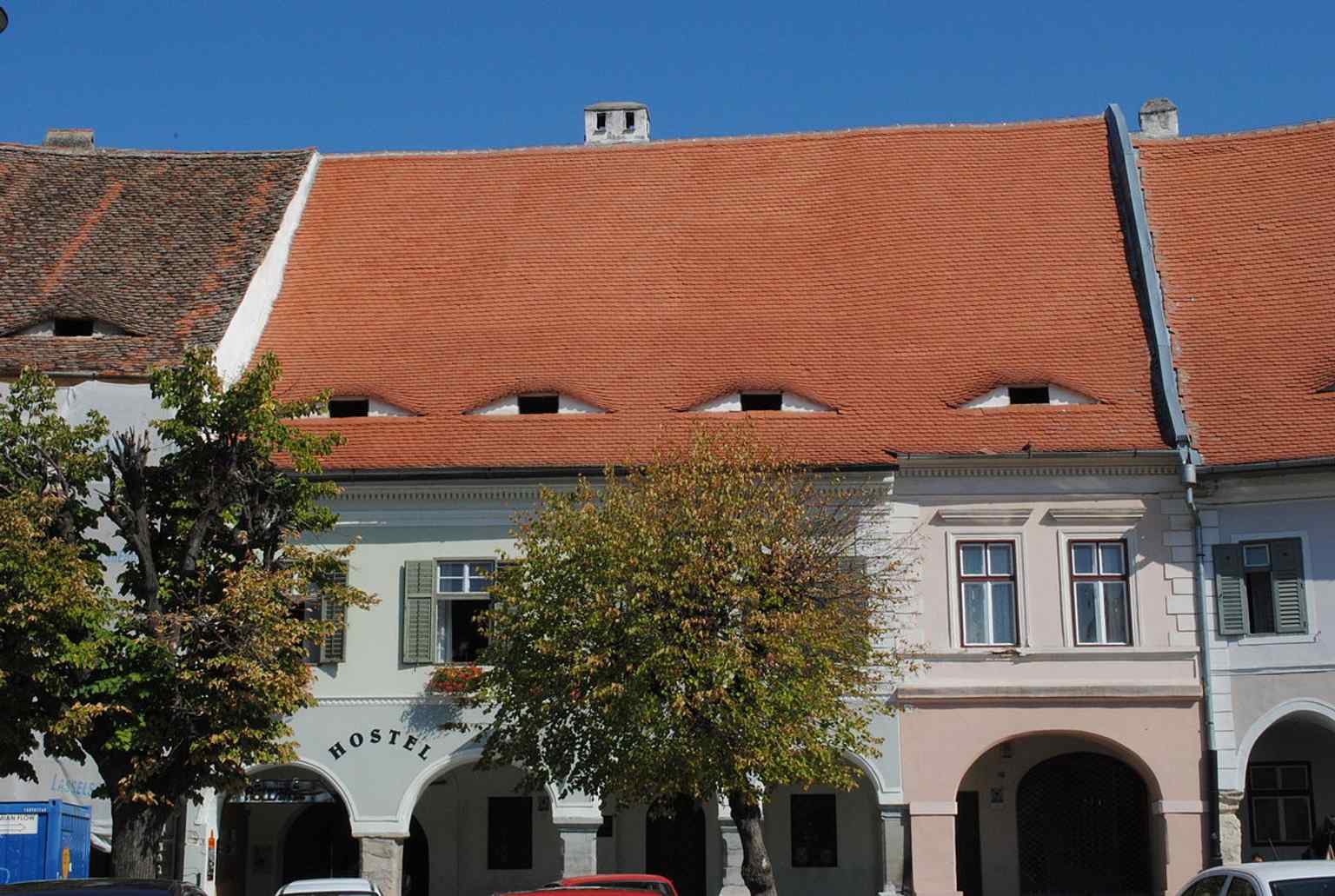
The Museum of the History of Pharmacy is housed in the historic 'Casa Hess' building, dating from 1568, which features Gothic and Renaissance architectural elements and was restored between 1968 and 1972.Photo: Andrei kokelburg, Wikimedia Commons, CC BY-SA 3.0 ro. Cropped & resized. In eighteen hundred and nine, the owner, Johann Georg Kayser, officially named it At the Black Bear. It stayed in his family for generations, blending scientific rigor with the respected community standing you would expect from a trusted healer. But in nineteen forty-nine, private enterprise came to an abrupt end. The communist state nationalized the business, and the last owner, Guido Fabritius, had to watch his family's proud legacy become simply, and rather soullessly, State Pharmacy Number Six.
Fortunately, a government decree in the nineteen fifties accidentally saved all these treasures by ordering the collection of pharmaceutical relics from all over the country into a single storage depot. Today, those items make up this museum's collection of over six thousand six hundred pieces.
If you step inside, you will find intricate bronze mortars, heavy marble pestles, and old tools for crushing roots and herbs. You will also find ingredients that seem more like magic than medicine. The most striking is Mumia vera. In case your Latin is rusty, that translates to a powder made by grinding up actual Egyptian mummies. Right up into the twentieth century, doctors believed it was a miracle cure, especially for stopping bleeding, making it incredibly expensive. The museum still has the original eighteenth and nineteenth-century wooden jars containing the authentic, macabre remnants of this powder, kept carefully sealed today to prevent it from vanishing into thin air.
There is another fascinating connection here. The founder of homeopathy-a system of alternative medicine based on highly diluted substances-was Samuel Hahnemann, who lived in Sibiu between seventeen seventy-seven and seventeen seventy-nine. He worked as a physician and secretary to the governor of Transylvania. While organizing the governor's massive library, Hahnemann had access to rare medical texts. He was also initiated into the local Freemason lodge, a secretive fraternal organization. His famous motto, meaning "Dare to be wise," was directly inspired by the Masonic symbolism he absorbed right here in this city. You can see his influence in the museum's rare collection of almost three thousand homeopathic pieces.
It is amazing to think of the cures, the scientific breakthroughs, and the simple hopes that have echoed through these arches over the centuries. Take a moment to soak this in. When you are ready, we can head to the next stop.
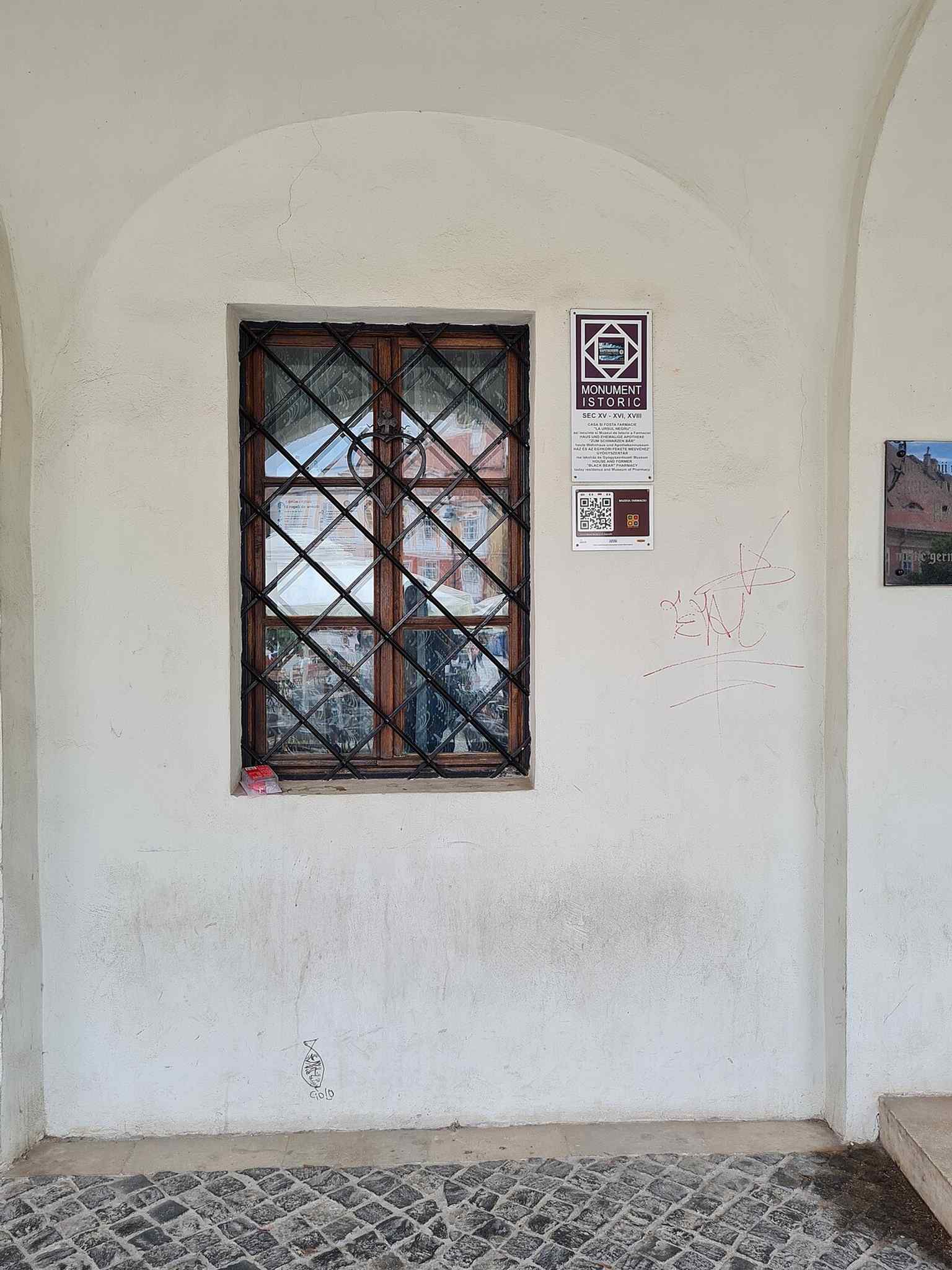
This building, now home to the museum, once housed the 'La Ursul Negru' pharmacy, established around 1600, whose name was officially imposed in 1809 by pharmacist Johann Georg Kayser.Photo: Leontin l, Wikimedia Commons, CC BY-SA 4.0. Cropped & resized. Look to your right for a long, rectangular stone building with a bright white facade, featuring a striking arcade of rounded arches across its ground floor and a circular emblem…Lire plusAfficher moins
Ouvrir la page dédiée →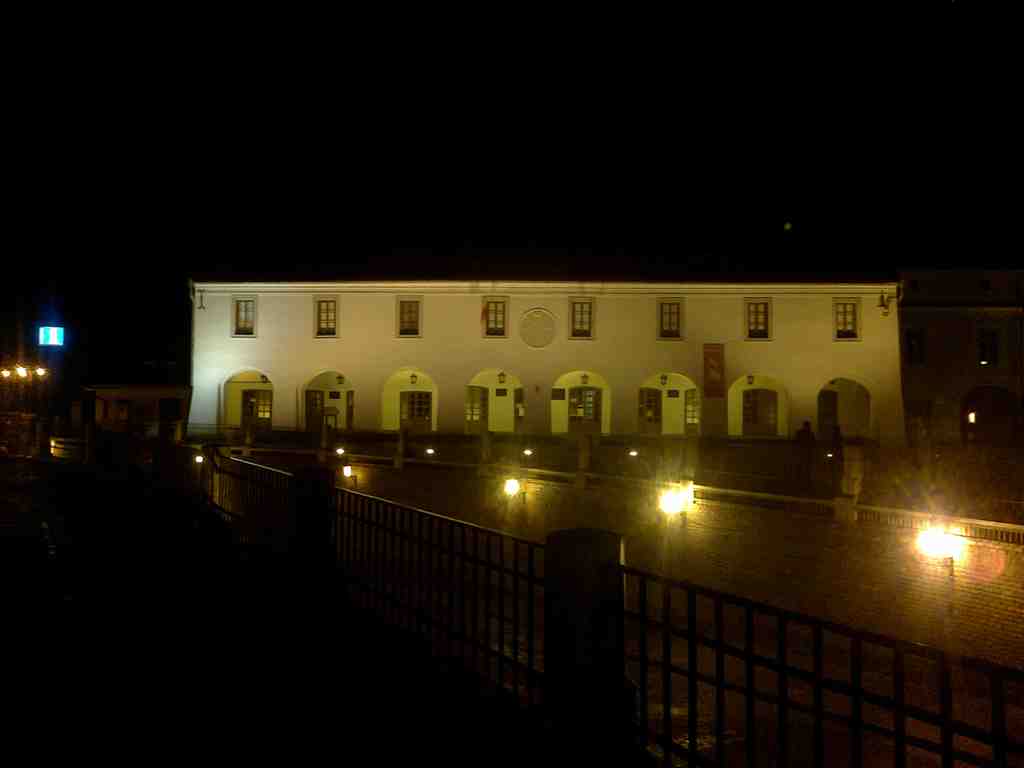
Museum of Ethnography and Saxon Folk Art "Emil Sigerus"Photo: Asybaris01, Wikimedia Commons, Public domain. Cropped & resized. Look to your right for a long, rectangular stone building with a bright white facade, featuring a striking arcade of rounded arches across its ground floor and a circular emblem set into its center. If you glance at your screen, you can see a close-up of that emblem, which is the historical Sibiu coat of arms. This building is Casa Artelor, the House of Arts, first documented way back in thirteen seventy. Originally, it was a butchers hall, so just imagine the sheer volume of meat that must have passed through those arches over the centuries.
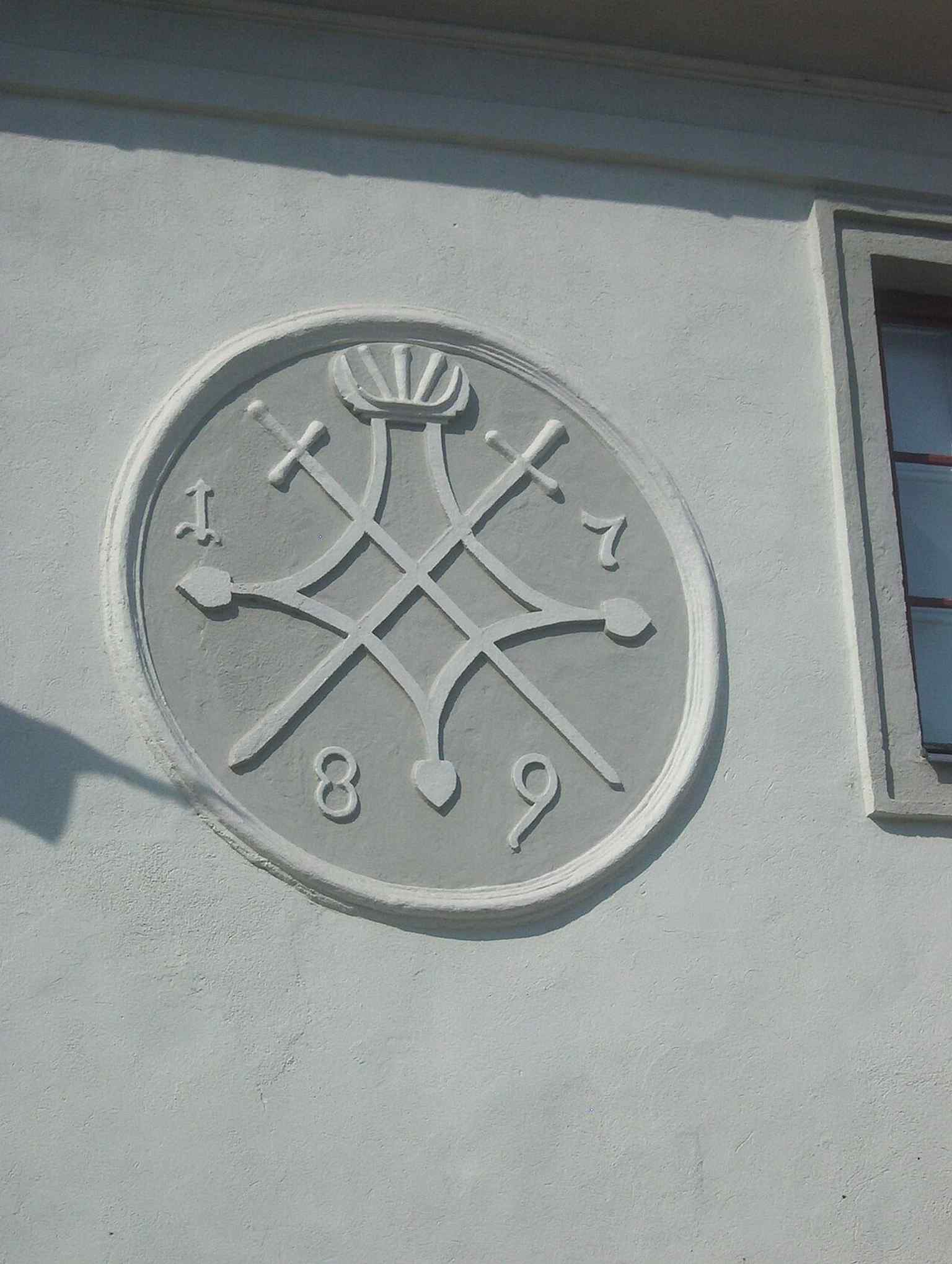
A close-up of the Sibiu coat of arms displayed on the Casa Artelor, a historical monument documented since 1370.Photo: Catalin Bogdan, Wikimedia Commons, CC BY-SA 3.0. Cropped & resized. Nowadays, it serves a much quieter purpose as the home of the Emil Sigerus Museum of Ethnography and Saxon Folk Art. The Saxons were ethnic Germans who settled in Transylvania during the Middle Ages, leaving a massive cultural footprint on Sibiu. Established in nineteen ninety-seven as part of the larger ASTRA museum complex, this institution preserves that legacy. The museum holds over eight thousand nine hundred artifacts. We are talking about intricately painted furniture, fine embroidery, and ceramics. They even hold one of Europe's largest collections of cahle, which are highly decorated, heat-retaining ceramic tiles used to build traditional indoor heating stoves. In two thousand and seven, the museum moved its vast storage into the redesigned attic of this very building, a historic monument that was extensively restored in the nineteen sixties.
Just keep in mind, if you want to explore the collections inside, they are open Tuesday through Sunday from nine in the morning until five in the evening. It is a wonderful tribute to the people who shaped this region. Take your time admiring the architecture, and whenever you are ready, we can stroll over to the next stop.
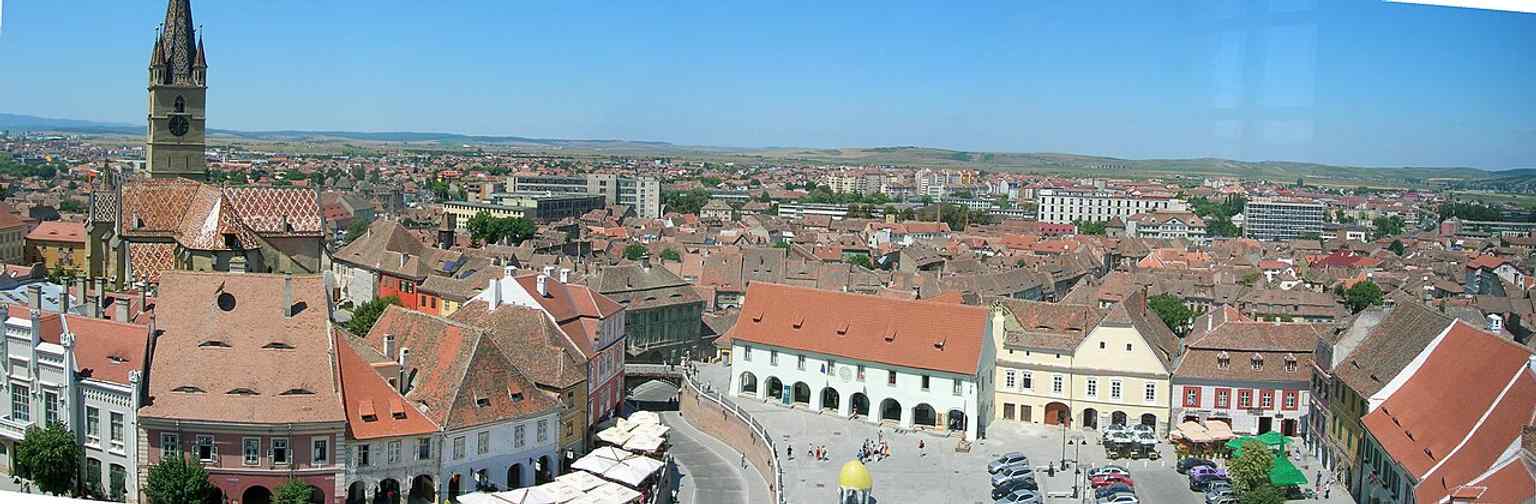
This panoramic view from the Council Tower in Sibiu showcases the historic Casa Artelor, which houses the 'Emil Sigerus' Museum, in its prominent urban setting.Photo: TwoWings, Wikimedia Commons, CC BY 3.0. Cropped & resized. 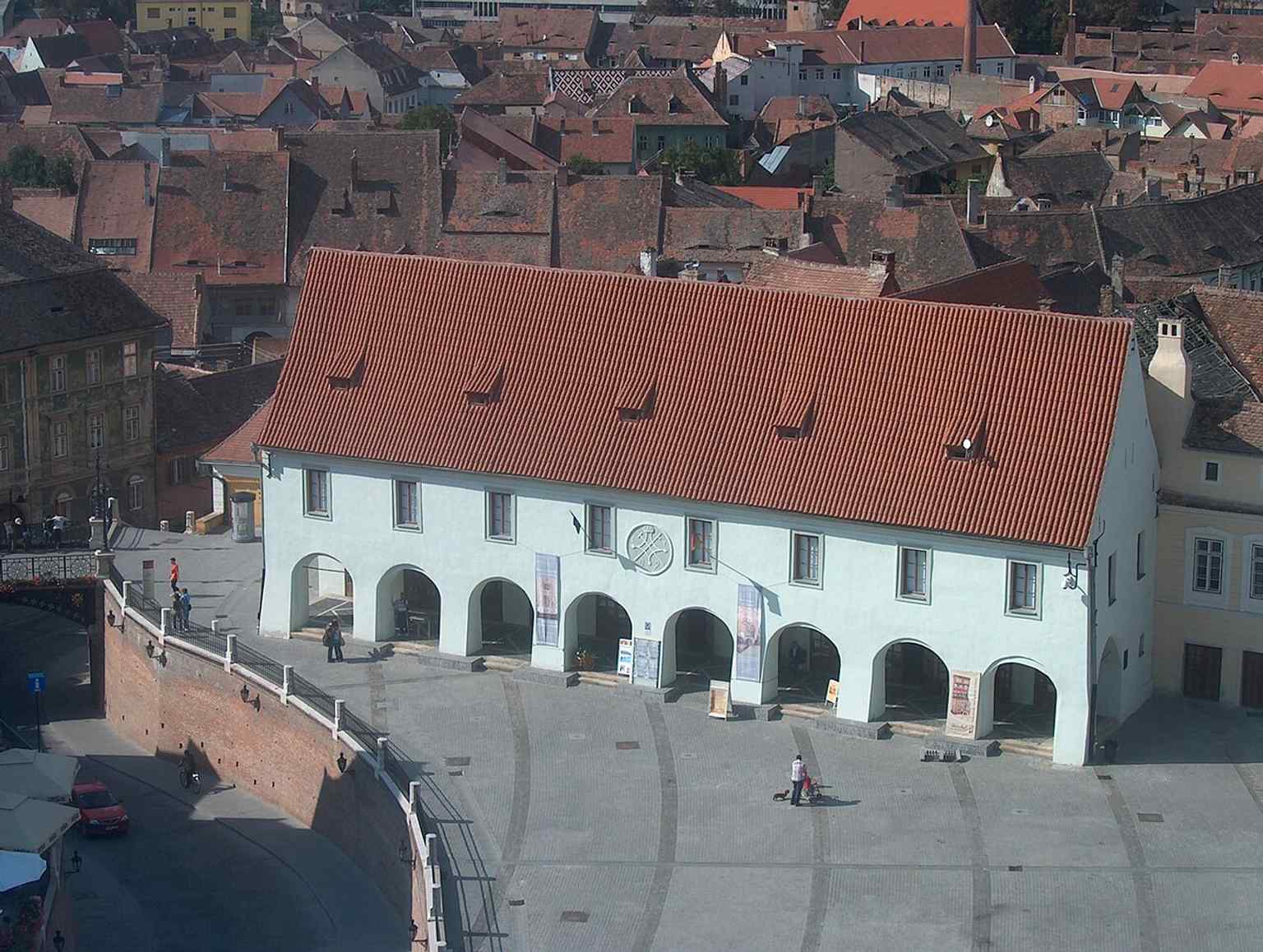
An elevated view of the Casa Artelor, also known as the House of Arts, seen from the Council Tower, where the 'Emil Sigerus' Museum's headquarters are located.Photo: Catalin Bogdan, Wikimedia Commons, CC BY-SA 3.0. Cropped & resized. 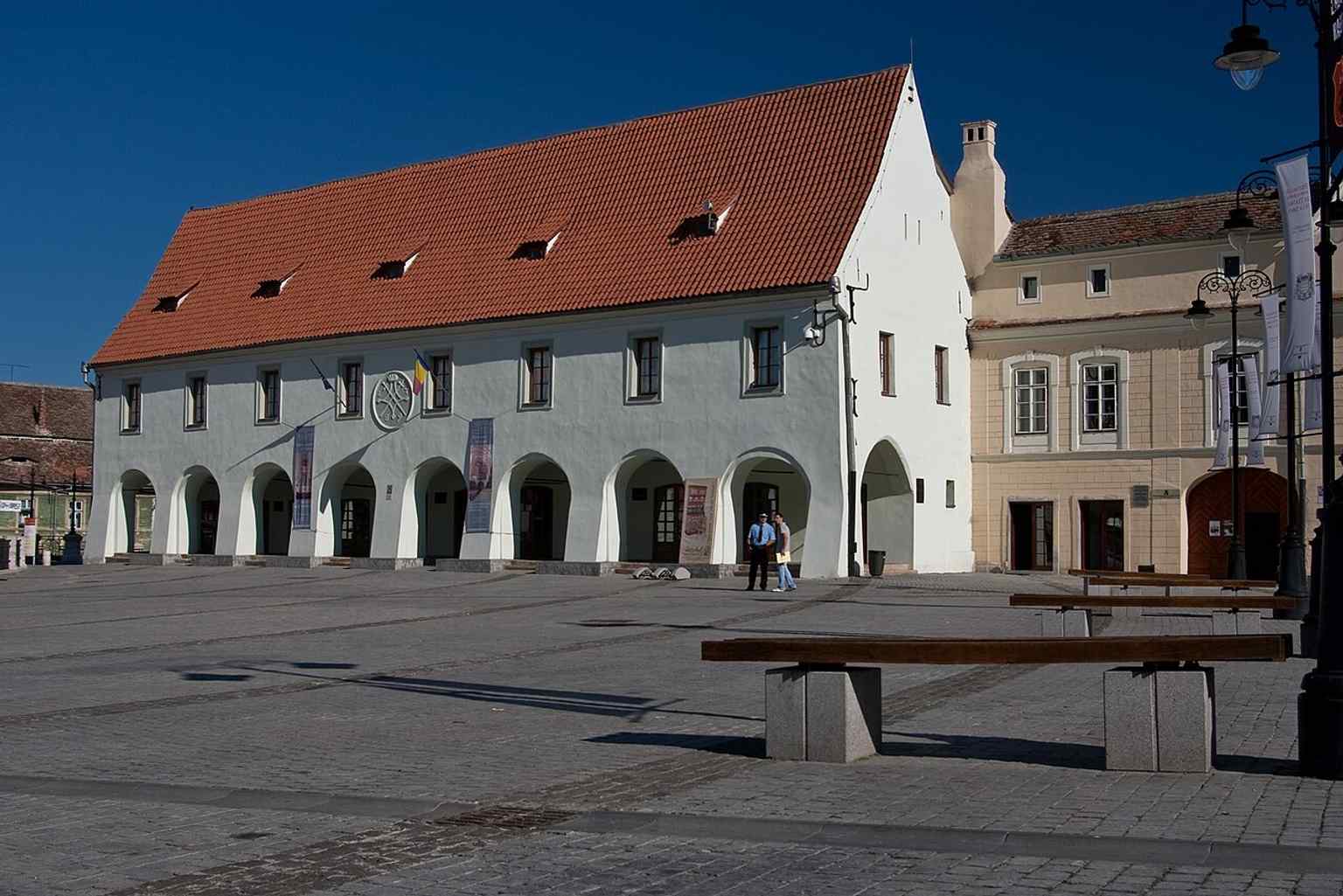
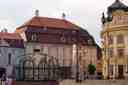
An exterior view of the Casa Artelor from Piața Mică, which serves as the headquarters for the 'Emil Sigerus' Museum of Ethnography.Photo: Alexandru Ene, Wikimedia Commons, CC BY-SA 3.0 ro. Cropped & resized. 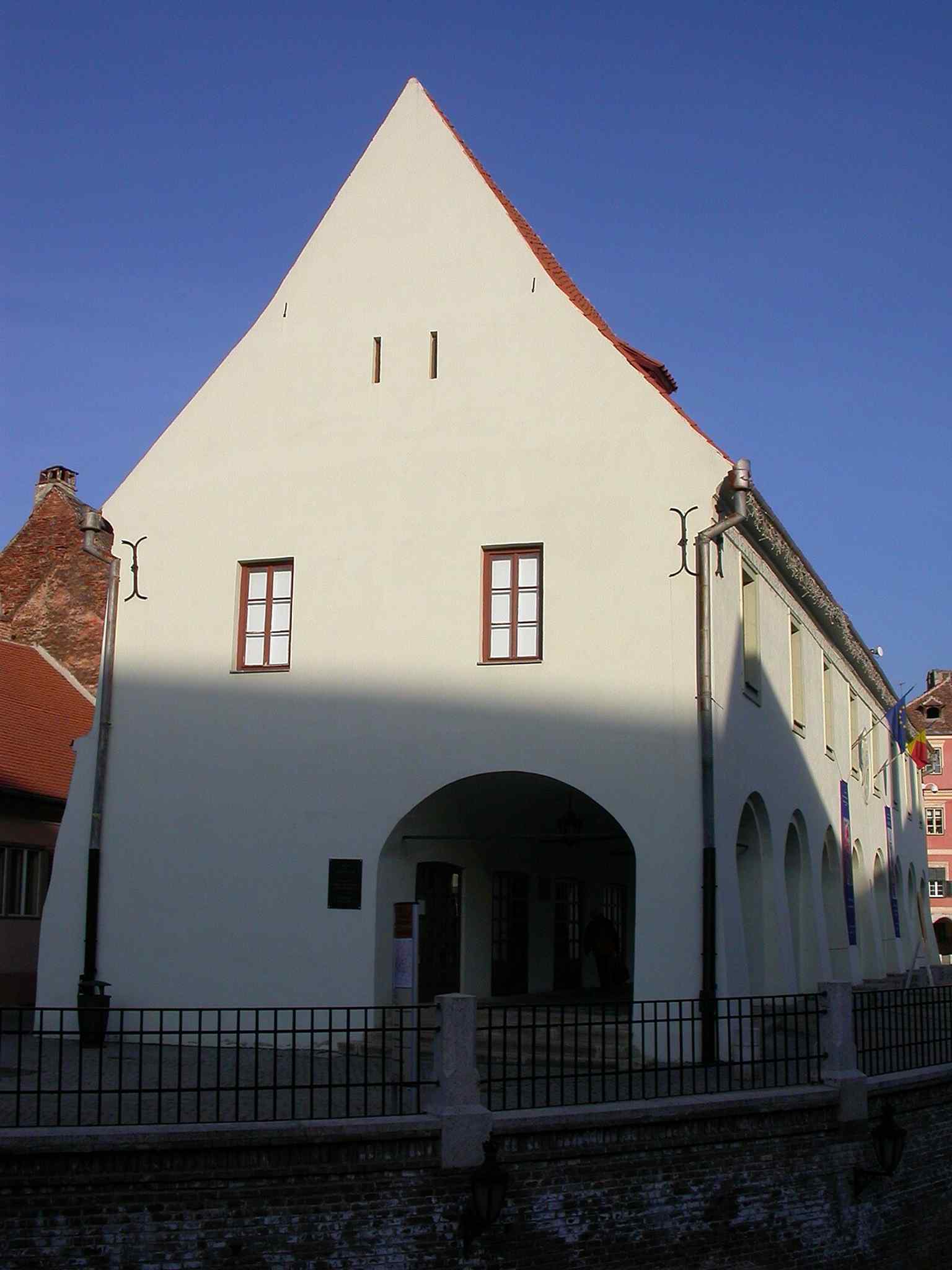
A vertical shot of the Casa Artelor, highlighting its impressive architecture as a historical monument that was restored between 1962 and 1967.Photo: Andrei kokelburg, Wikimedia Commons, CC BY-SA 3.0 ro. Cropped & resized. 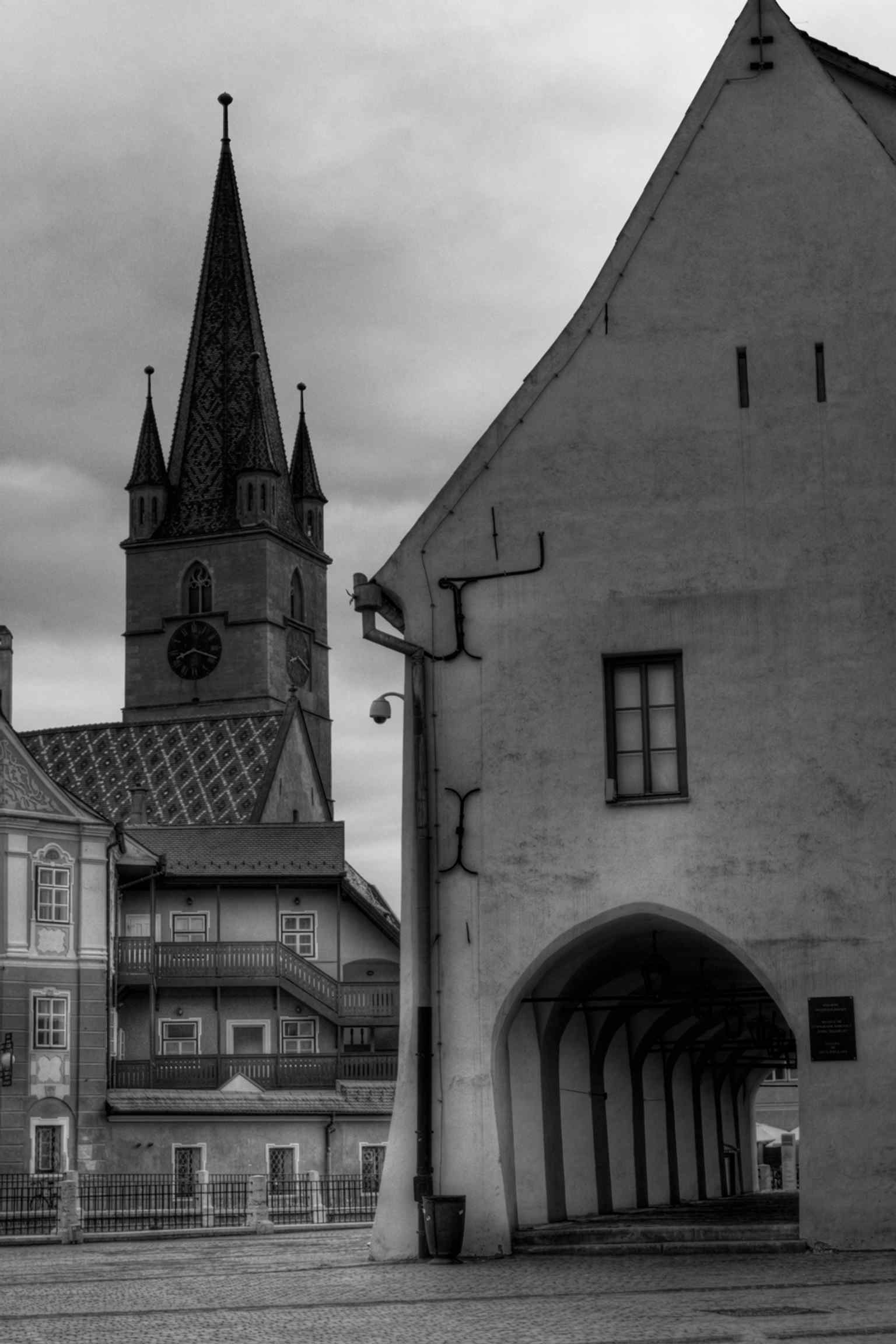
The Casa Artelor, home to the 'Emil Sigerus' Museum, is seen here alongside the Evangelical Cathedral, demonstrating its significant location within Sibiu.Photo: Deak Mihai, Wikimedia Commons, CC BY-SA 3.0 ro. Cropped & resized. 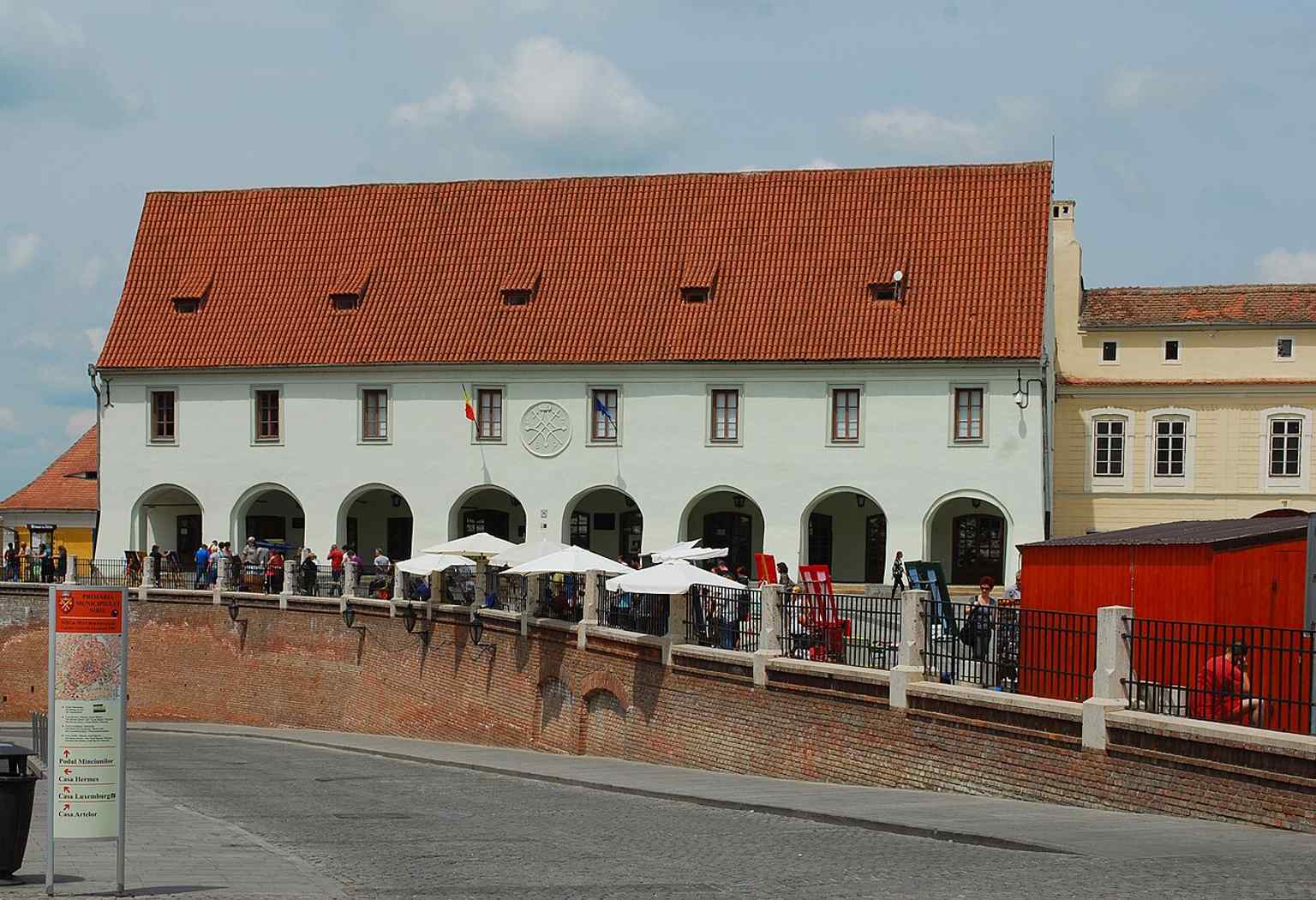
A high-resolution exterior view of the Casa Artelor, formerly the Butchers' Hall, which now hosts the 'Emil Sigerus' Museum.Photo: Andrei Stroe, Wikimedia Commons, CC BY-SA 4.0. Cropped & resized. 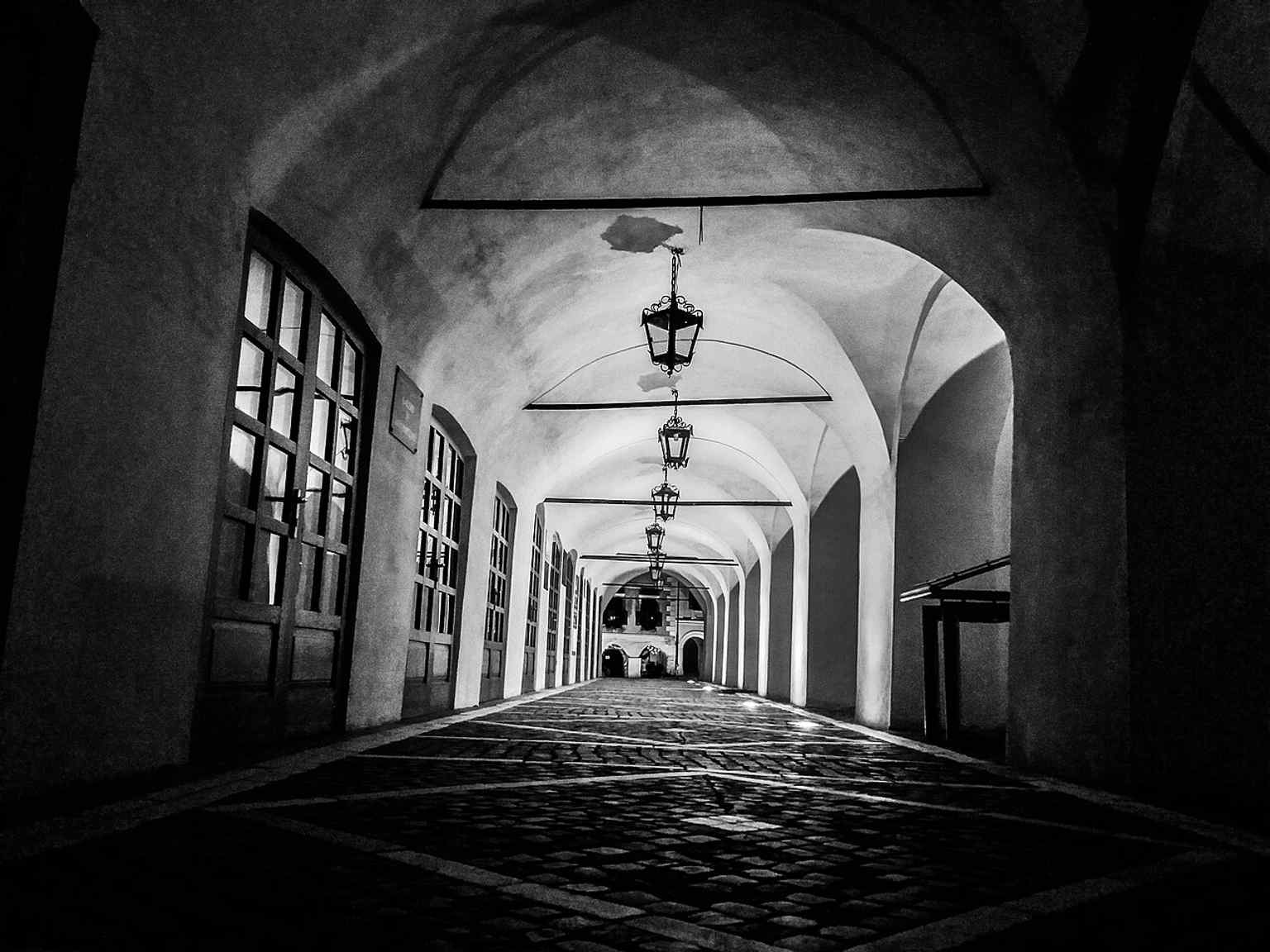
A captivating night view of the Casa Artelor, a historic monument where the 'Emil Sigerus' Museum holds its diverse collections of Saxon folk art.Photo: Anamariapetrescu, Wikimedia Commons, CC BY-SA 4.0. Cropped & resized. 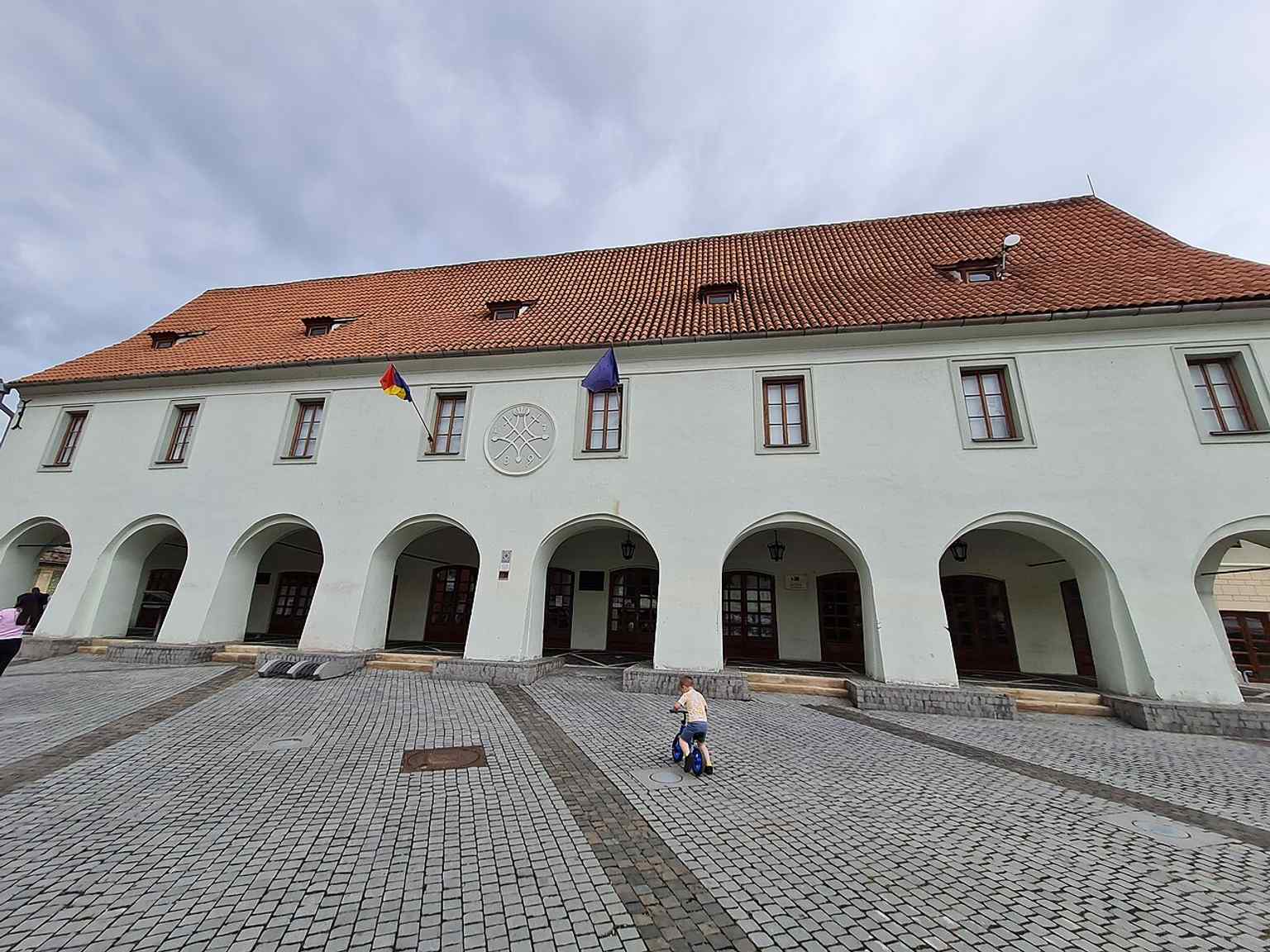
A contemporary view of the Casa Artelor, a historical monument, where the 'Emil Sigerus' Museum of Ethnography and Saxon Folk Art is located.Photo: Leontin l, Wikimedia Commons, CC BY-SA 4.0. Cropped & resized. Look up at the tall, square tower built from white plaster, topped with a dark bulb-shaped roof and large blue clock faces. This is the Council Tower, the famous passageway…Lire plusAfficher moins
Ouvrir la page dédiée →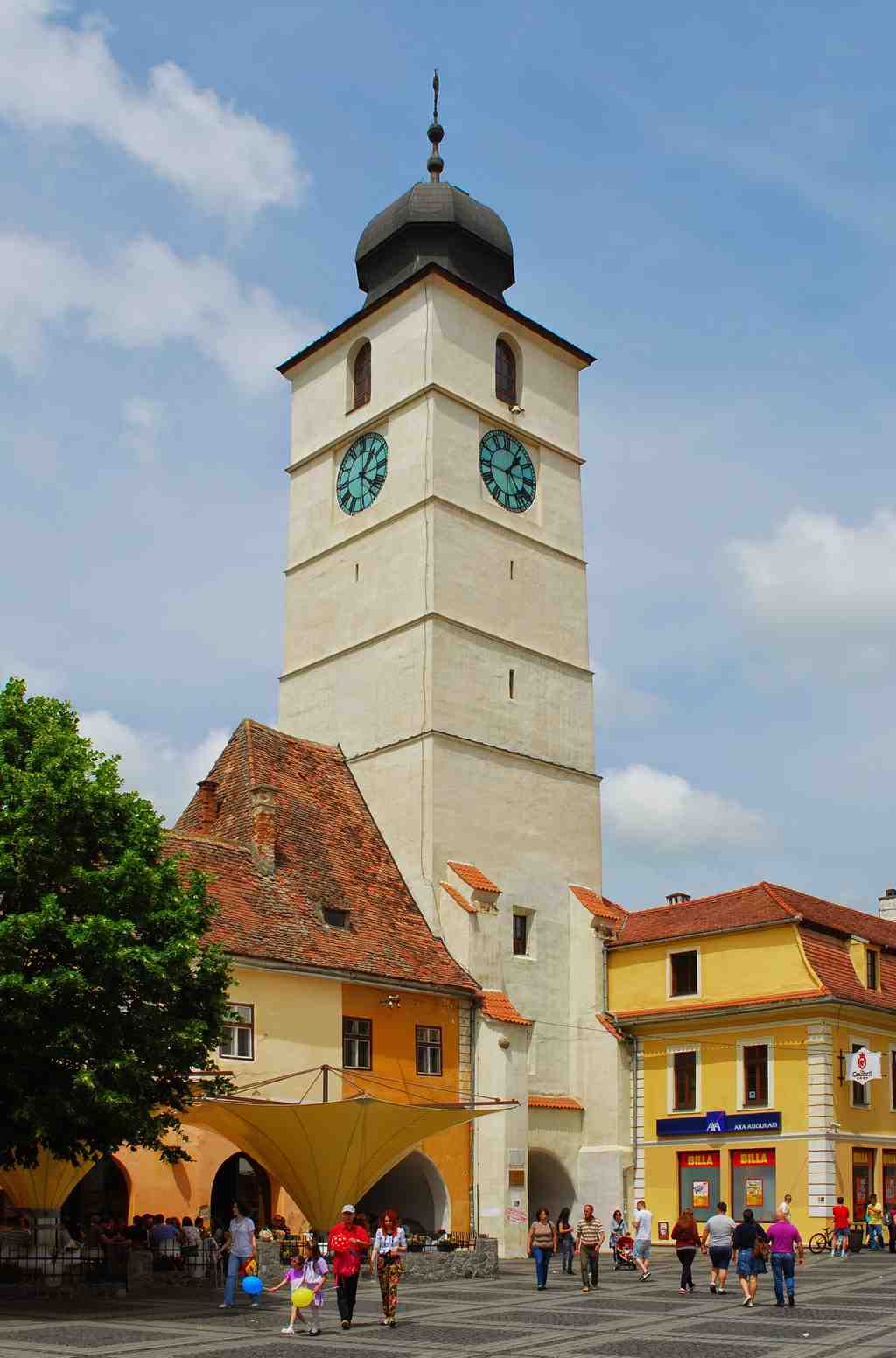
The Council Tower in SibiuPhoto: Andrei Stroe, Wikimedia Commons, CC BY-SA 4.0. Cropped & resized. Look up at the tall, square tower built from white plaster, topped with a dark bulb-shaped roof and large blue clock faces. This is the Council Tower, the famous passageway connecting the Large Square and the Small Square.
It was originally built back in the thirteenth century, acting as a fortified gate to protect the second ring of the city. However, only the very bottom section of that original structure still stands today. The rest of it had a rather dramatic remodeling. In fifteen eighty-five, a painter named Johann David was standing on high scaffolding, carefully decorating the ceiling of the passageway.... Without warning, the entire upper section of the tower collapsed, tragically burying the artist under a mountain of rubble.
The city came together to rebuild it between fifteen eighty-six and fifteen eighty-eight, paying for the construction out of their own pockets. If you look closely near the roof, you might notice four small turrets at the corners. That was not just a decorative choice. Those four turrets signaled that Sibiu possessed the ius gladii, a Latin term meaning the right of the sword. It was a public warning that the local magistrates had the legal authority to sentence criminals to death.
Over the centuries, the tower has served as a grain silo, a prison, and even a temporary natural history museum in the mid-nineteenth century. They eventually had to move the museum exhibits because the thick stone walls were much too damp. It also served as a fire watchtower, which was a tough job. In seventeen twenty, the city magistrates ordered the guards to beat a drum every thirty minutes throughout the night. This was mostly to prove to the citizens below that the watchmen were actually awake and looking for smoke.
The roof itself has a bit of a chaotic history. It used to be a tall pyramid, then a shorter pyramid, until the current bulb shape was added in eighteen twenty-six. Then, during the First World War in nineteen seventeen, the German army stripped off the entire copper covering of the roof to melt it down for munitions, leaving the building totally exposed to the elements until the war ended.
The clock at the top has its own stories, too. The original mechanism was made entirely of wood. The current metal machinery was installed in nineteen hundred and six, and a dedicated local clockmaker named Andrei Albert still climbs the narrow, spiral staircase to oil the gears. He had his work cut out for him in two thousand nineteen, when a violent lightning storm struck the tower and completely stopped the clock. Strangely enough, the hands froze at exactly twelve o'clock.
These two stone lions carved into the lower walls still act as historic guardians of the gate, having miraculously survived the dramatic collapse centuries ago. Take your time admiring the details, and whenever you are ready, we can wander over to the next stop.
Afficher 9 arrêts de plusAfficher moins d'arrêtsexpand_moreexpand_less
On your right, look for the striking pale green plaster facade with a central stone balcony and distinctive white crenellated turrets reaching above the roofline. This is the…Lire plusAfficher moins
Ouvrir la page dédiée →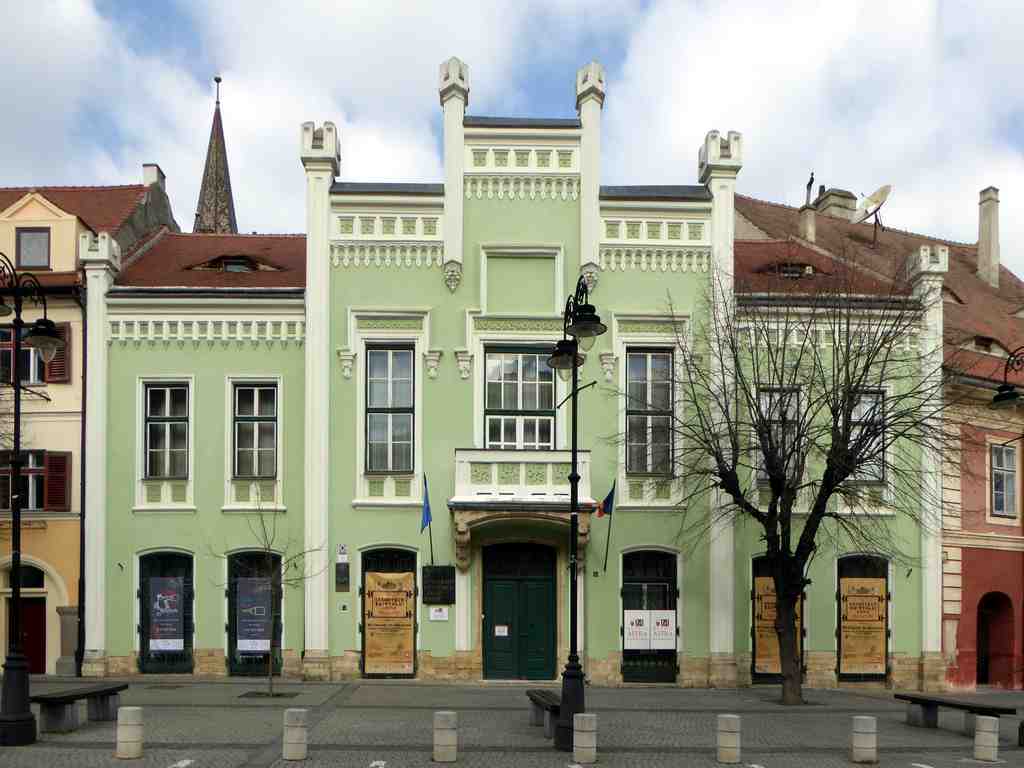
Museum of Universal Ethnography "Franz Binder"Photo: Renardo la vulpo, Wikimedia Commons, CC BY-SA 3.0. Cropped & resized. On your right, look for the striking pale green plaster facade with a central stone balcony and distinctive white crenellated turrets reaching above the roofline. This is the Museum of Universal Ethnography, widely known as the Franz Binder Museum.
Take a glance at your screen to see the exterior of this neo-gothic structure, a style that intentionally revives medieval architectural features like dramatic arches and tall pillars, even though this building was actually constructed much later, between eighteen sixty-five and eighteen sixty-seven. Originally, it served as a bustling center for local craft guilds.
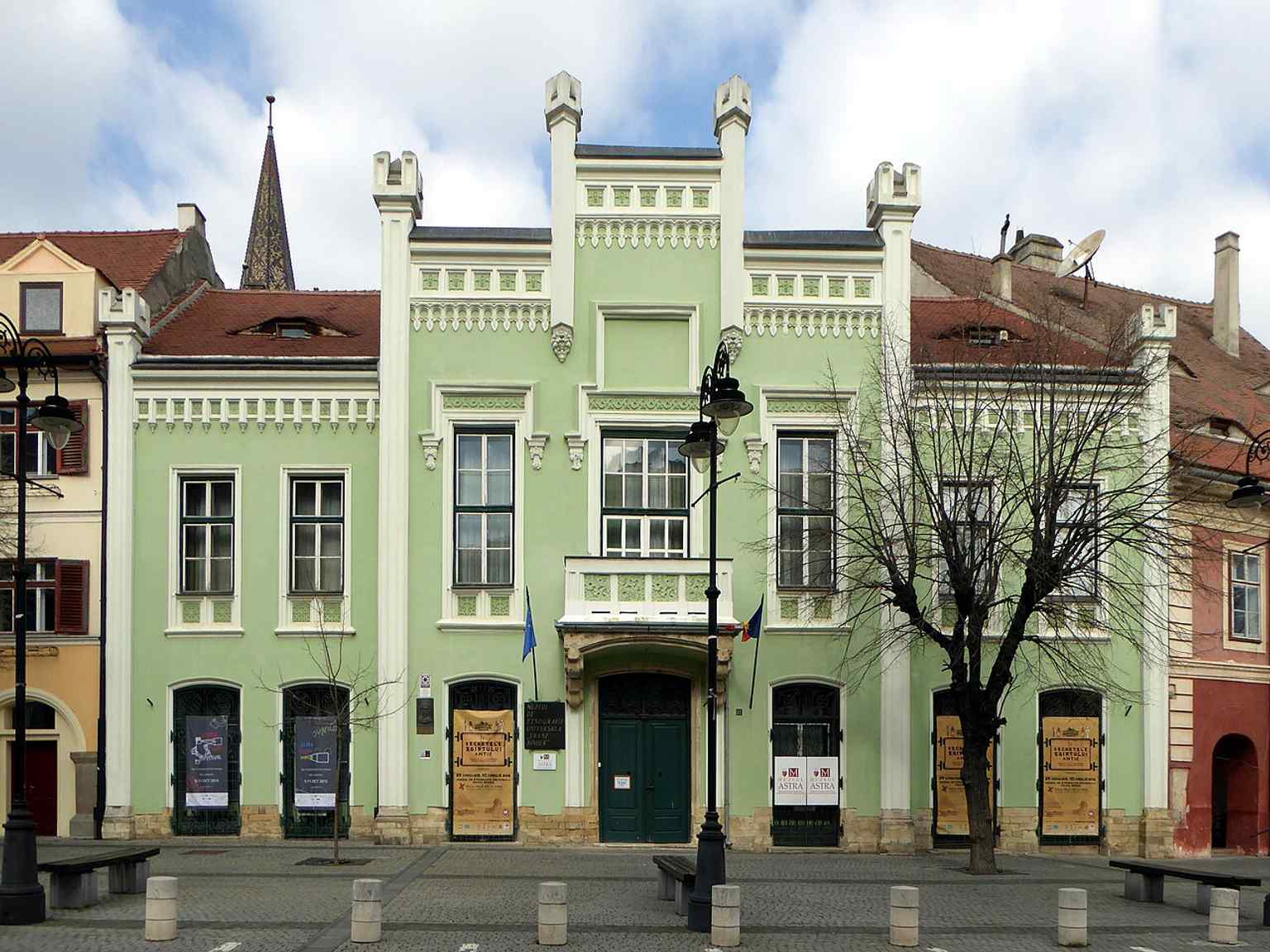
The Museum of Universal Ethnography "Franz Binder" is housed in a historical Neogothic building, constructed between 1865-1867, and declared a historical monument.Photo: Renardo la vulpo, Wikimedia Commons, CC BY-SA 3.0. Cropped & resized. Interestingly, during major restorations in nineteen eighty-nine, workers uncovered heraldic shields proving that a rather impressive figure named Valentin Frank von Franckenstein lived on this exact spot in the late sixteen hundreds. He was a Saxon count, a royal judge, and remarkably, the very first person to translate the ancient Roman poet Ovid into both the Romanian and Hungarian languages.
Today, this building holds around three thousand objects and stands as the only museum in Romania dedicated entirely to non-European art and civilization. The core of the collection comes from nineteenth-century Saxon explorers who traveled the globe. The most famous of them was Franz Binder. In eighteen sixty-two, he donated an extraordinary array of artifacts gathered from the Upper White Nile region in central Africa. Because of its sheer age and scale, his contribution remains one of the most valuable collections of its kind in the entire world.
If you venture inside, you will even find an authentic Egyptian mummy resting in a wooden sarcophagus from the Ptolemaic Period. That refers to the final era of the ancient Egyptian empire before Roman rule, making the mummy over two thousand years old. If you are hoping to see these global treasures, keep in mind the doors are open Monday through Friday from eight A-M to four P-M, but they are closed on weekends.
It is a fascinating little portal to the wider world, tucked perfectly into this historic square. Enjoy this quiet corner, and feel free to move on when you are ready.
On your right, you will see a striking white stone structure characterized by its pointed Gothic arches and a massive, soaring tower topped with a vibrant, geometric tiled roof.…Lire plusAfficher moins
Ouvrir la page dédiée →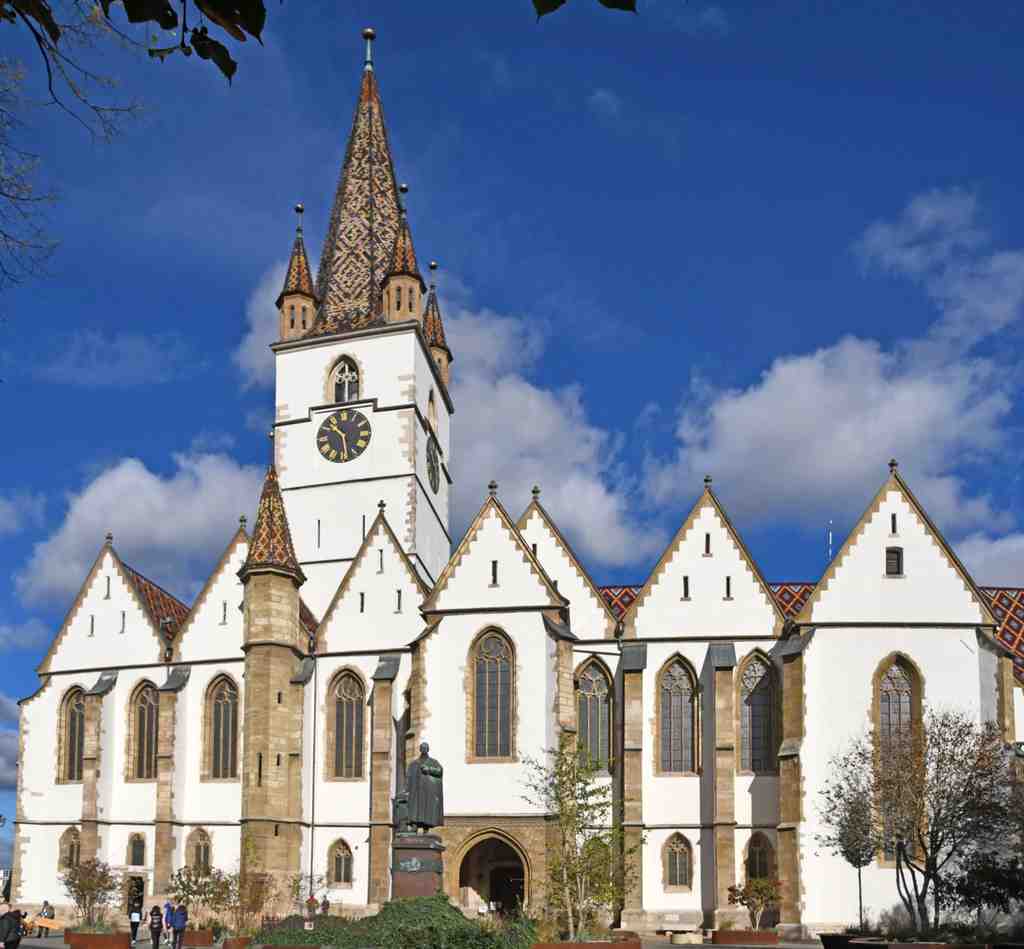
Catedrala Evanghelică din SibiuPhoto: Pasztilla aka Attila Terbócs, Wikimedia Commons, CC BY-SA 4.0. Cropped & resized. On your right, you will see a striking white stone structure characterized by its pointed Gothic arches and a massive, soaring tower topped with a vibrant, geometric tiled roof.
This is the Evangelical Cathedral of Sibiu, one of the most iconic Gothic buildings in Transylvania. Take a look at that massive tower reaching over seventy-three meters into the sky. If you check your screen, you can get a closer look at its impressive seven-level structure, topped with four small turrets. Just like at the Council Tower, those four little corner turrets signaled that the city held the right of the sword, meaning local authorities had the power to sentence people to death. Always a warm welcome for medieval visitors.
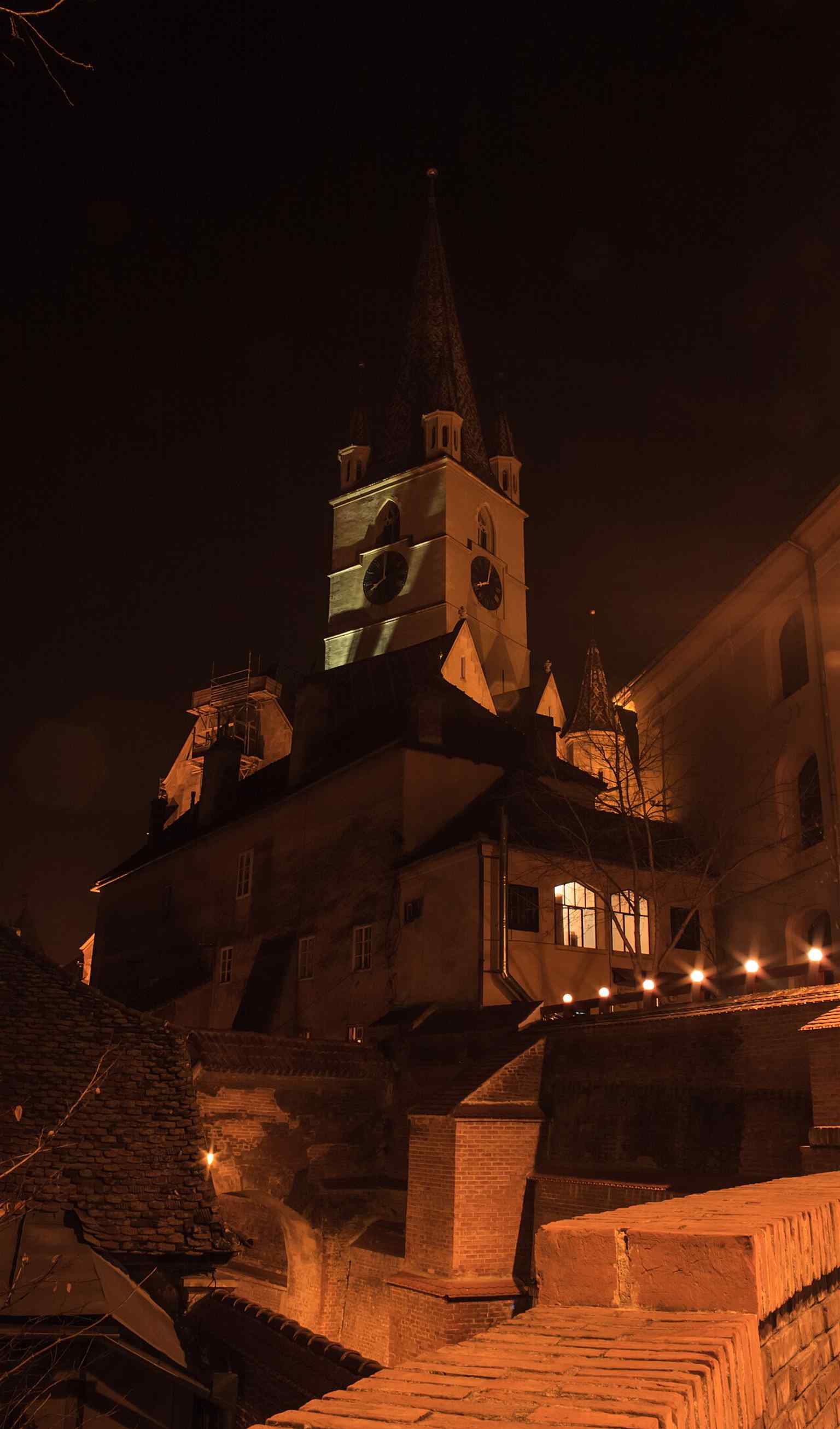
The cathedral's impressive 7-level tower, topped with four turrets, historically symbolized Sibiu's right to impose capital punishment and served as a fire lookout.Photo: Radueduard, Wikimedia Commons, CC BY-SA 3.0 ro. Cropped & resized. For centuries, the tower served as a fire lookout, which is why today's visitors have to climb one hundred and ninety-two steps to reach the viewing platform. But there is a great local legend about its height. The story goes that the people of Sibiu wanted the absolute tallest tower in Transylvania. So, they sent a team to the rival town of Bistrița to secretly measure their church tower with a rope. After a successful midnight measurement, the Sibiu builders stopped at a tavern to celebrate. The tavern keeper, a Bistrița local, figured out what they were up to. He got them thoroughly drunk, waited until they passed out, and snipped about two meters off their measuring rope. Oblivious, the builders went home and built their tower exactly to the shortened length, falling just short of their rival. Historical documents actually show Sibiu finished their tower in fourteen ninety-four, way before Bistrița, but... the legend is just too good to ignore.
Inside, the cathedral is a soaring Gothic space, complete with ribbed vaults, which are the arched ceiling structures that distribute the weight of the massive stone roof. You can see the grand interior on your app. The western part of the church, an entrance hall called the ferula, holds some much darker history. It contains a gallery of sixty-seven medieval tombstones. One of them belongs to a man named Mihnea the Bad, a Wallachian prince. In March fifteen ten, Mihnea had just attended a church service and stepped out of the northern doors when he was ambushed by rival noblemen. Despite his son's efforts to fight off the attackers, killing two of them on the spot, Mihnea was stabbed to death right outside. He remains the only Romanian prince buried among the Saxon elites here.
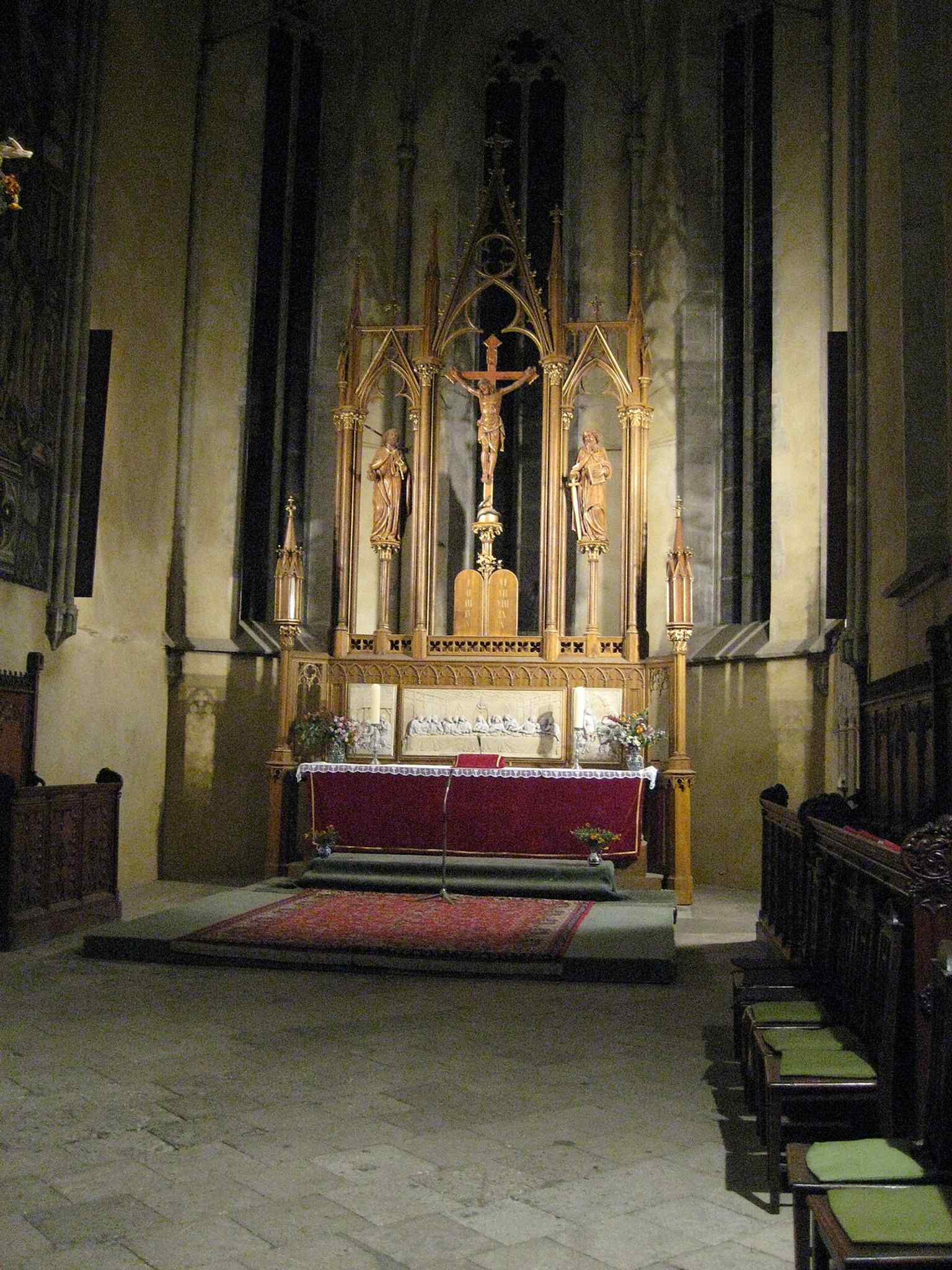
Gaze upon the Gothic interior of the cathedral, leading towards the main altar, a central piece of the church's spiritual life.Photo: Hensenbensen, Wikimedia Commons, Public domain. Cropped & resized. Decades later, burials inside the church were banned. The last major exception was made in eighteen oh three for Baron Samuel von Brukenthal, a former governor of Transylvania. His remains were placed under the floor near the pulpit. In twenty twenty-five, a local museum actually asked to open his crypt to study the remains using modern archaeology. The church firmly said no, preferring to let the Baron rest in peace until completely non-invasive methods exist. So, the mystery of the crypt remains.
The cathedral is generally open every day from ten A-M to eight P-M, though it opens a bit later on Fridays and Sundays. Linger as long as you like in the shadow of this magnificent building before continuing on.
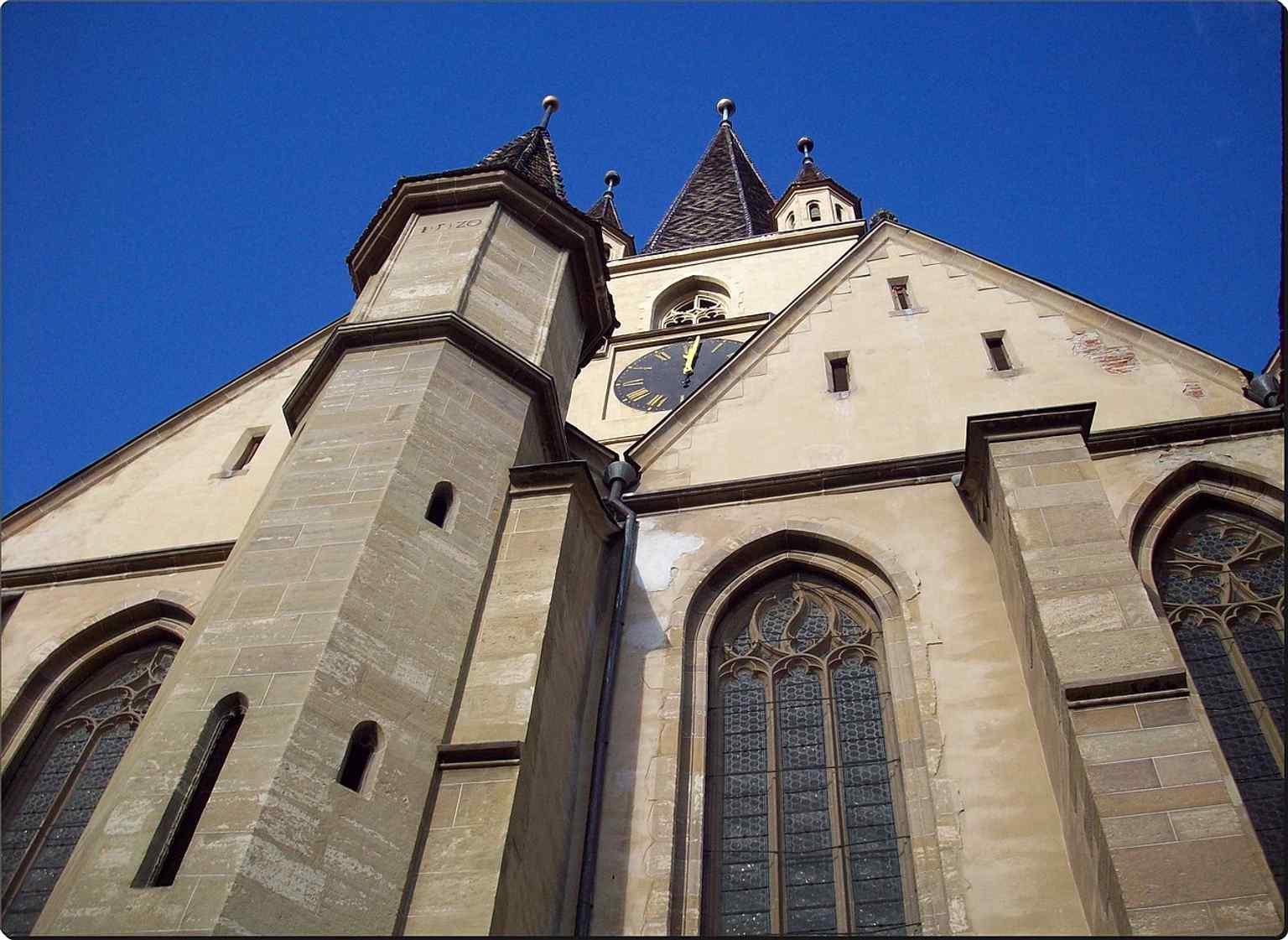
The Evangelical Cathedral, a prominent example of Gothic architecture in Transylvania, dominates the Sibiu skyline.Photo: LHL72, Wikimedia Commons, CC BY-SA 3.0 ro. Cropped & resized. 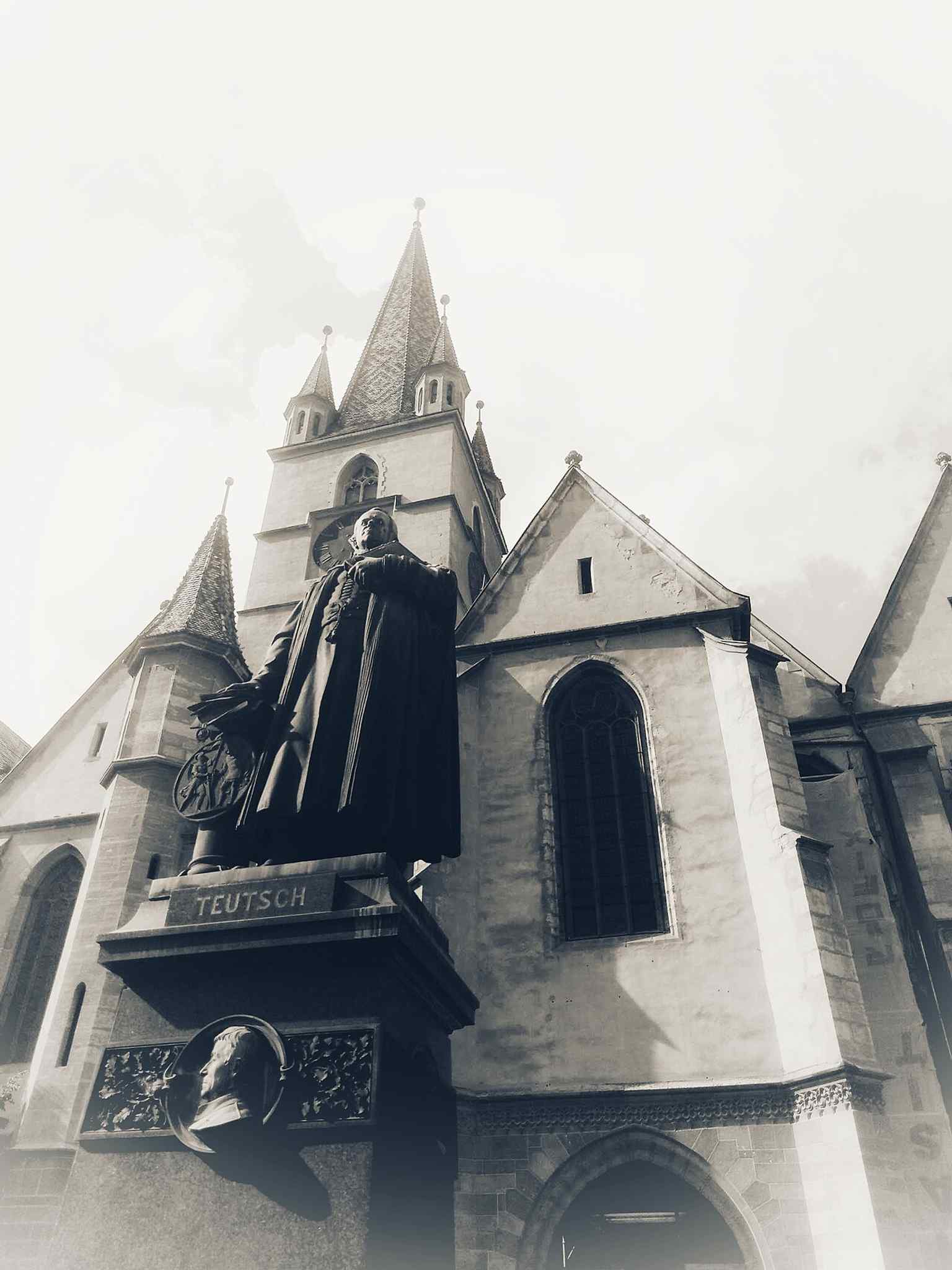
This statue honors Bishop Georg Daniel Teutsch (1817-1893), whose monument was erected in front of the cathedral in 1899.Photo: davidgurau_mc, Wikimedia Commons, CC BY-SA 4.0. Cropped & resized. 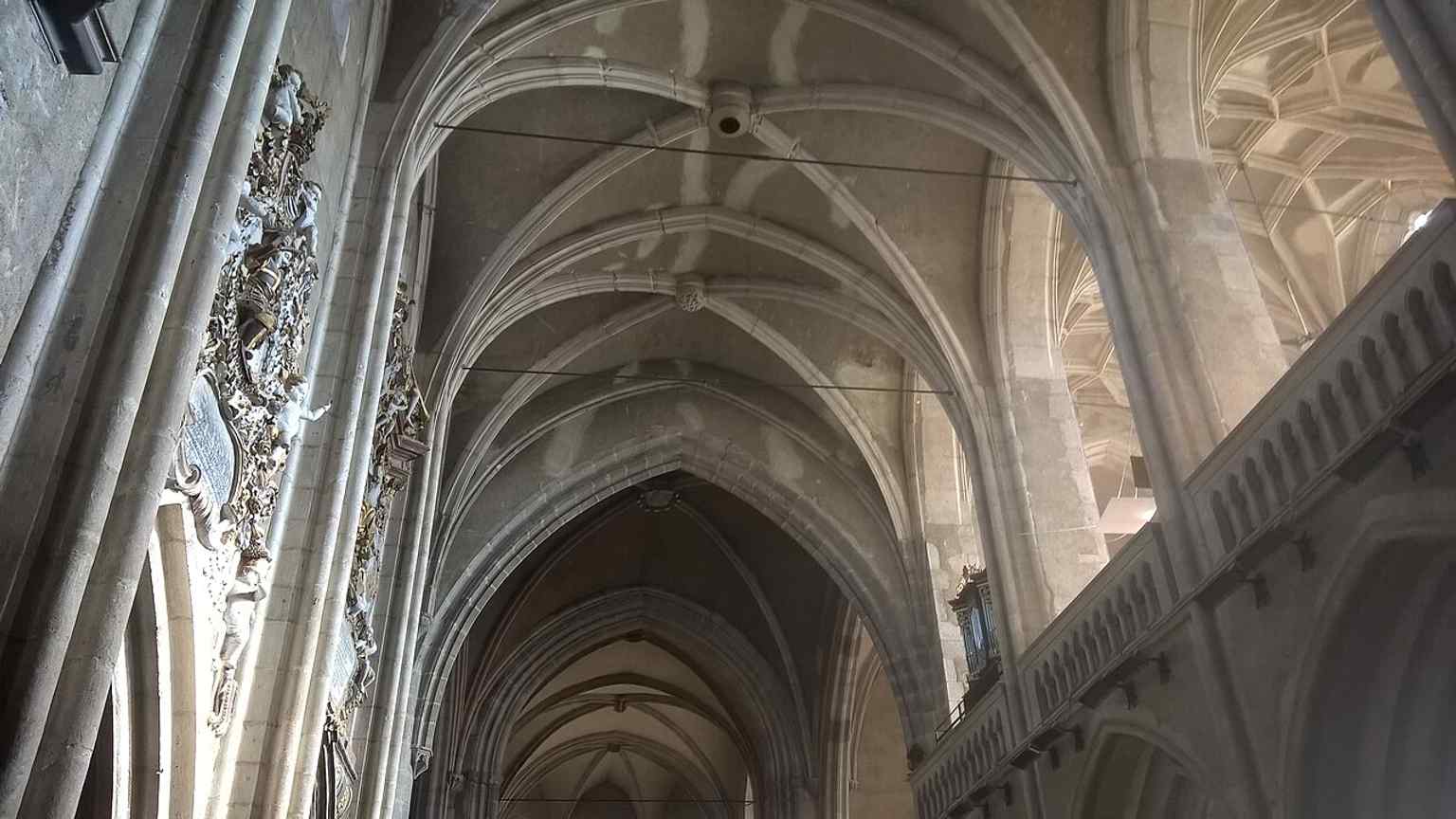
Admire the intricate Gothic rib vaults that define the cathedral's interior, a hallmark of its 15th-century construction.Photo: Leontin l, Wikimedia Commons, CC BY-SA 3.0 ro. Cropped & resized. 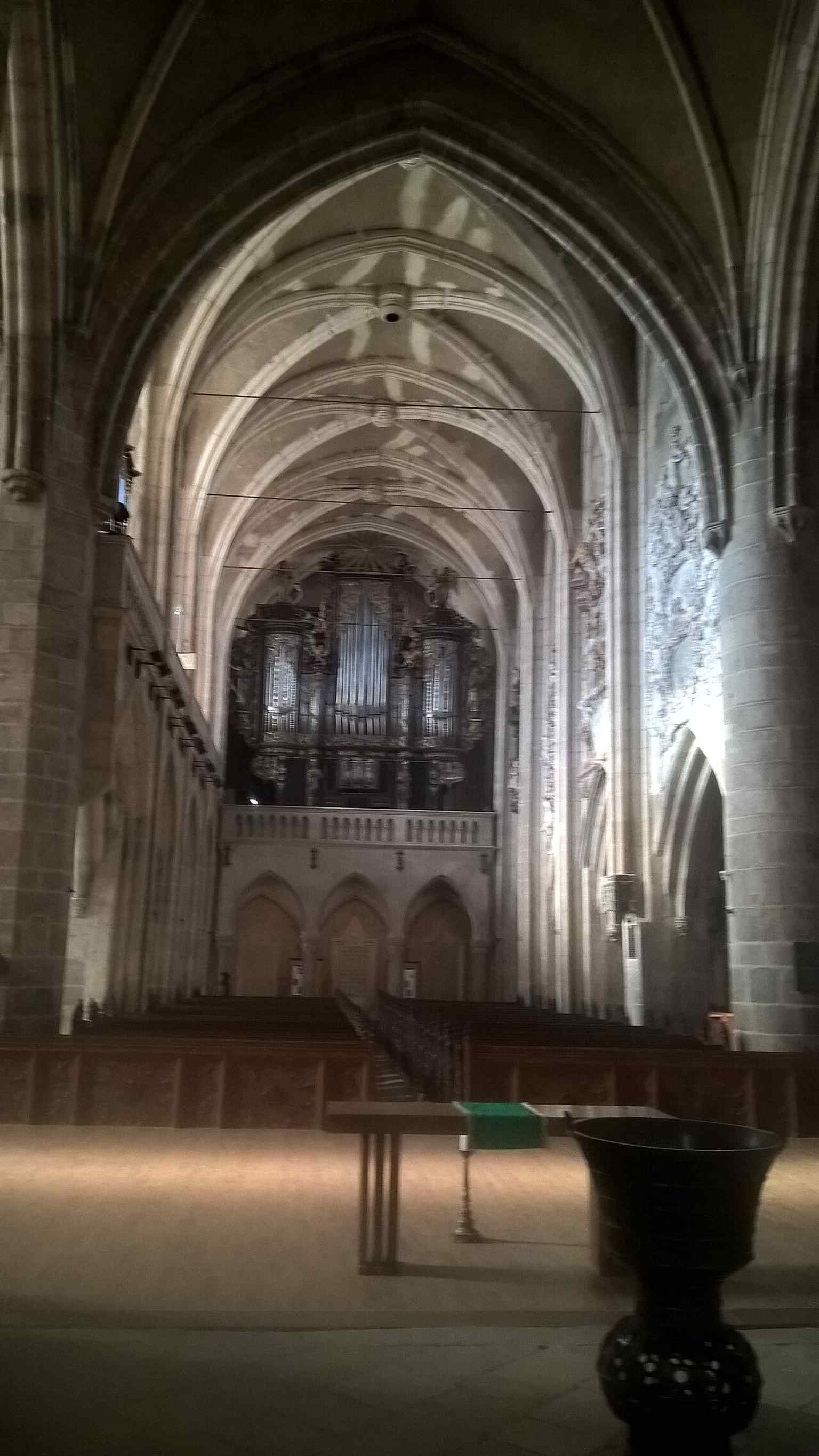
The cathedral houses the largest organ in Southeast Europe, originally installed in 1914 and fully renovated in 1997.Photo: Leontin l, Wikimedia Commons, CC BY-SA 3.0 ro. Cropped & resized. 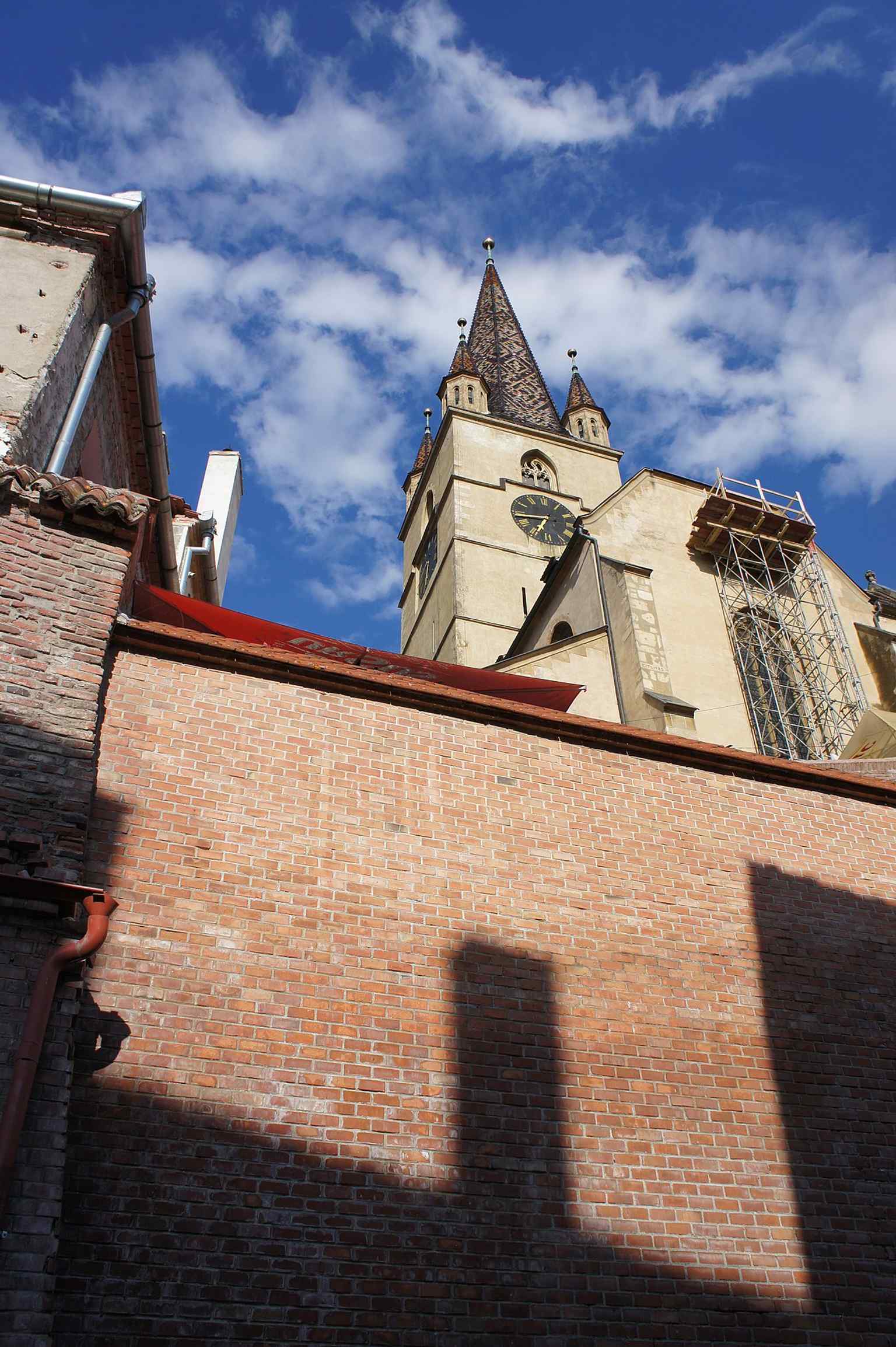
A unique perspective of the Saxon Cathedral seen from the historic Passage of Stairs, connecting different levels of the city.Photo: Martin Greslou, Wikimedia Commons, CC BY-SA 3.0. Cropped & resized. 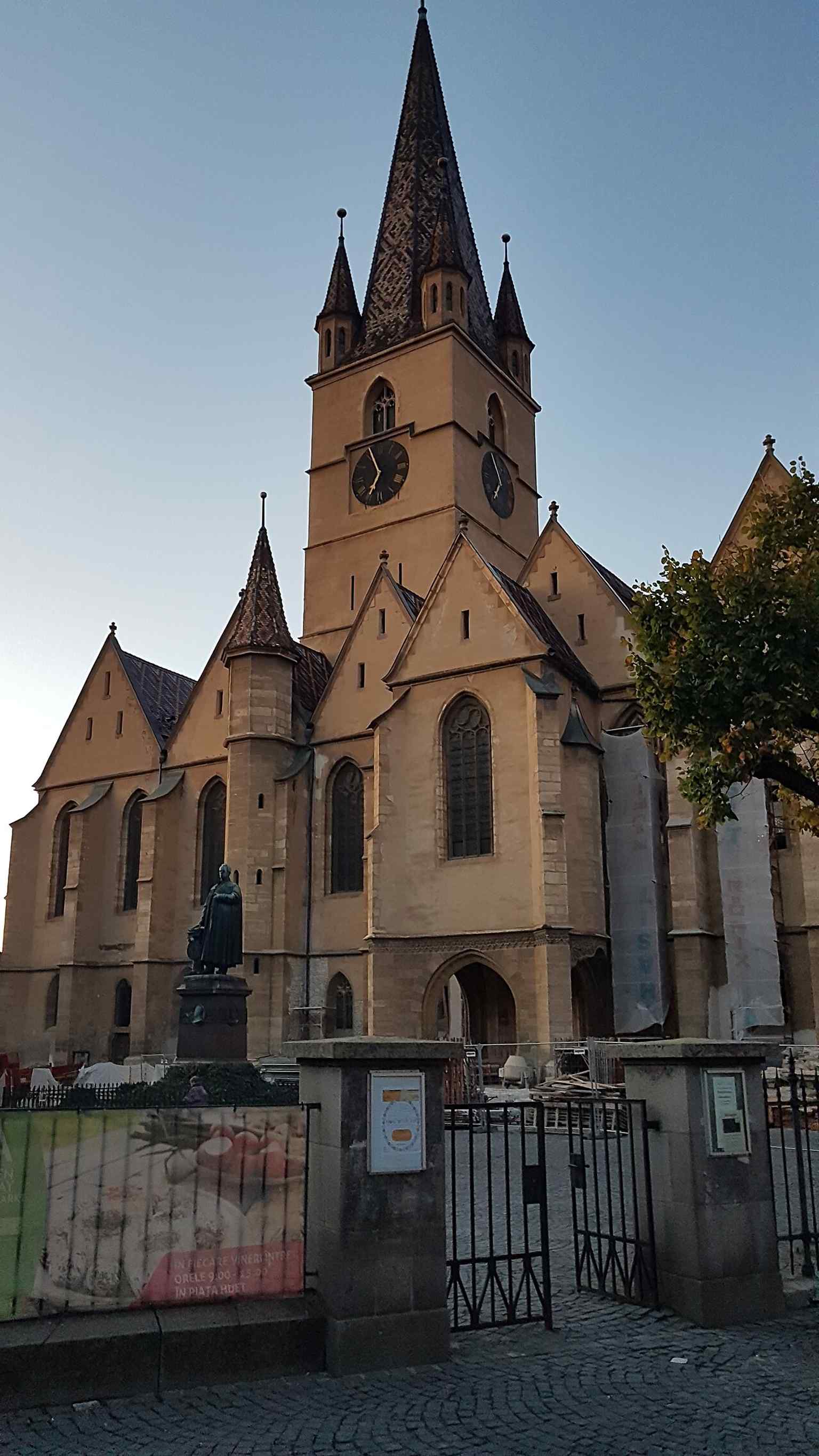
Another commanding view of the Evangelical Cathedral, recognized as a historic monument in Sibiu, with a construction period dating 1350-1520.Photo: Leontin l, Wikimedia Commons, CC BY-SA 4.0. Cropped & resized. Look for the imposing, light-colored stone building with a steep red-tiled roof, featuring a distinct rectangular tower structure that juts out from the facade on ornate stone…Lire plusAfficher moins
Ouvrir la page dédiée →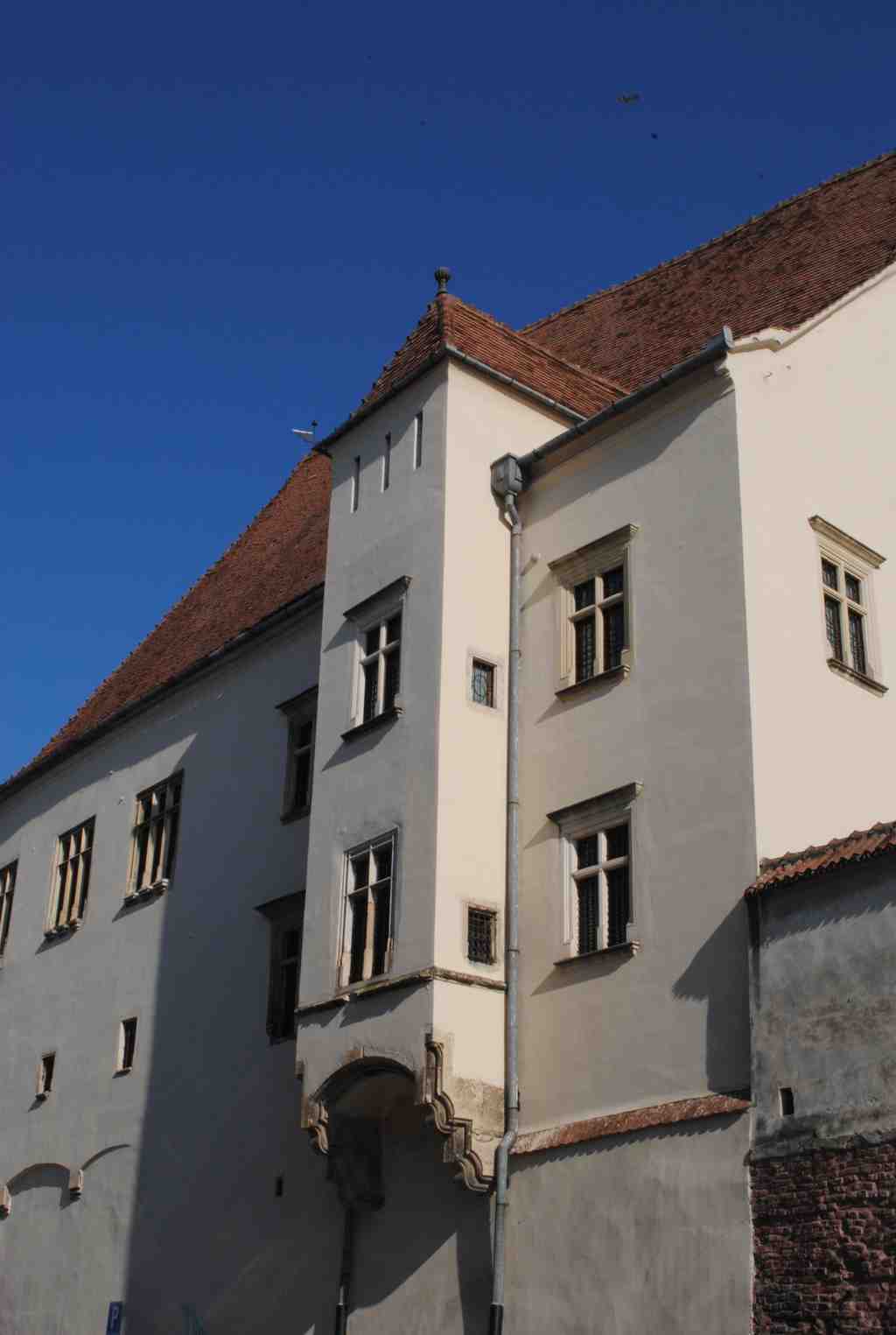
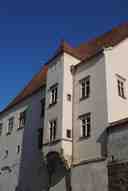
History Museum of SibiuPhoto: Andrei kokelburg, Wikimedia Commons, CC BY-SA 3.0 RO. Cropped & resized. Look for the imposing, light-colored stone building with a steep red-tiled roof, featuring a distinct rectangular tower structure that juts out from the facade on ornate stone supports.
You are standing in front of the Altemberger House, which today serves as the History Museum of Sibiu. Built between fourteen seventy and fourteen ninety-one, this is actually the most important Gothic civil architecture complex in all of Transylvania. By Gothic, I mean that late medieval style characterized by tall, imposing structures, pointed arches, and a general sense of grand durability.
The original owner of this political powerhouse was Mayor Thomas Altemberger. He was a highly educated man for his time, having studied law and theology in Vienna. But his fabulous wealth did not come from a city salary. He controlled the mining of noble metals in the region, and that money built this palace. He even bought the first urban law code for the area in fourteen eighty-one, a compilation of customary law, meaning rules based on long-standing community traditions rather than royal decrees. This book formed the bedrock of local justice for over two centuries.
Take a glance at your screen to see a wide view of the entire complex.
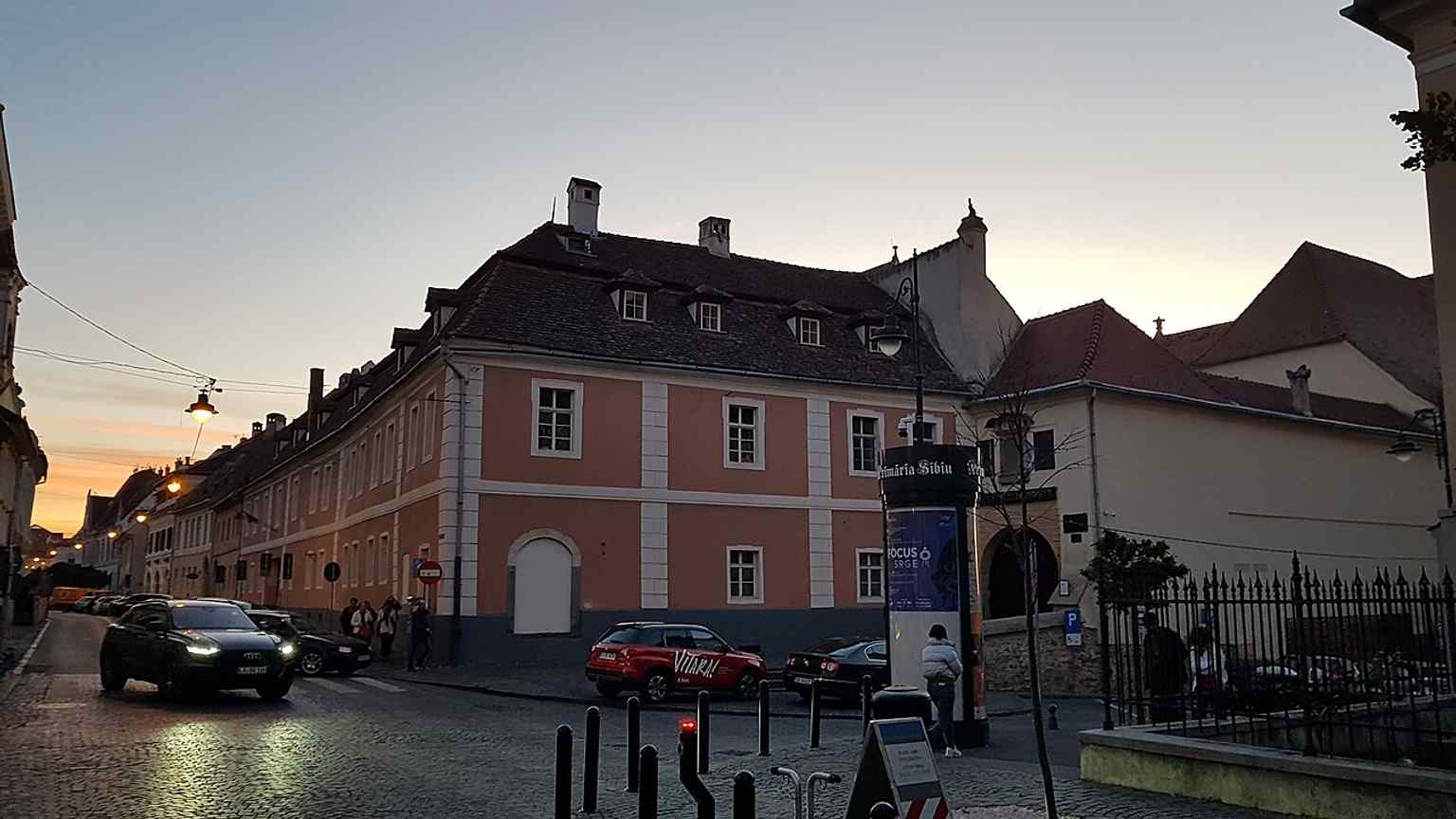
A clear view of the History Museum of Sibiu, the most important Gothic civil architecture complex in Transylvania, built by Mayor Thomas Altemberger between 1470 and 1491.Photo: Leontin l, Wikimedia Commons, CC BY-SA 4.0. Cropped & resized. In fifteen forty-five, the city bought the house to use as its City Hall, a role it held for four straight centuries until nineteen forty-eight. Over the years, this place was the true nervous center of the city. It housed the Saxon University, the courthouse, the police headquarters, and even the local fire department.
It was also the site of a rather famous visit. In the summer of seventeen seventy-three, the Habsburg Emperor Joseph the Second stayed here for ten days to write a report for his mother, Empress Maria Theresa. During his stay, the young Emperor completely upended the strict etiquette of the day. He refused to let people kneel before him and insisted on receiving petitions personally, whether they came from high-ranking clergy or poor local serfs.
Look at your app to see a view of the stairway passage. These very stairs were transformed into a bustling pilgrimage site where thousands of subjects lined up, hoping to get justice directly from the Emperor.
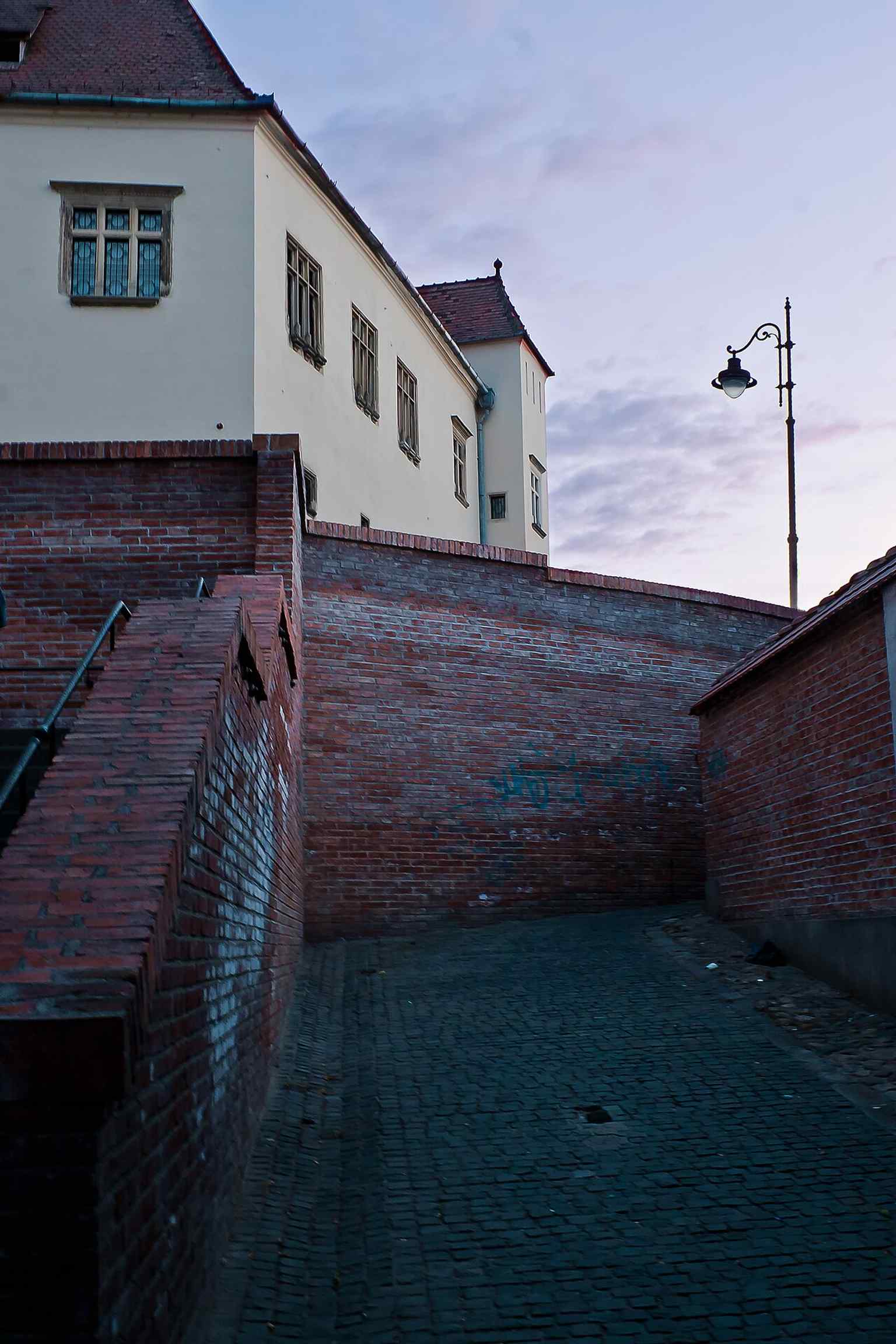
View of the museum from the stairway passage, evoking the historical significance of the building's stairs, where Emperor Joseph II famously received petitions directly from citizens in 1773.Photo: Bogdan Parau, Wikimedia Commons, CC BY-SA 3.0 ro. Cropped & resized. Now, every old building has its dark side, and this one is no exception. Until seventeen forty-seven, the building also functioned as the city prison. There is a second courtyard here that visitors often mistakenly call the Garden of Martyrs. That is actually a very bad translation of the original German term, which translates to the Garden of Torture. It was exactly what it sounds like, a secluded space where physical punishments were carried out against thieves and serious offenders.
On a lighter note, if you explore the main courtyard, you will find a fascinating piece of history called the Iron Soldier. It is a wooden statue from nineteen fifteen, carved to raise funds for World War One orphans and invalids. Anyone who donated money earned the right to hammer a metal nail or plaque into the wood, and it remains the only surviving statue of its kind in Romania today.
If you want to explore the extensive exhibits inside, keep in mind the museum is open Wednesday through Sunday from nine in the morning to five in the afternoon.
Take your time admiring the history layered into these walls. Whenever you are ready, we can head to the next stop.
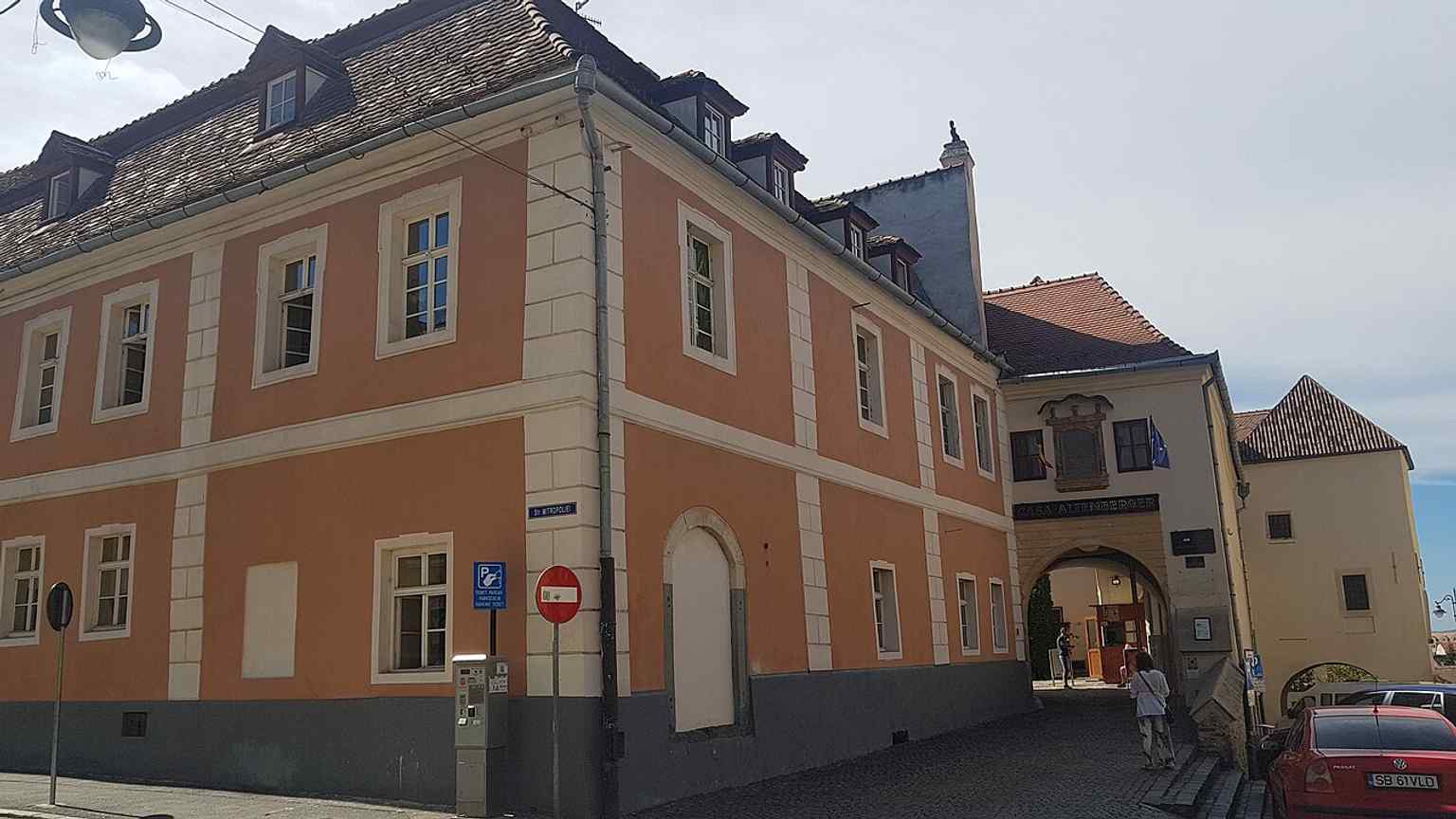
A wide view of the Altemberger-Pempflinger House, which served as Sibiu's City Hall from 1549 until 1948, marking nearly four centuries as the city's administrative hub.Photo: Leontin l, Wikimedia Commons, CC BY-SA 4.0. Cropped & resized. 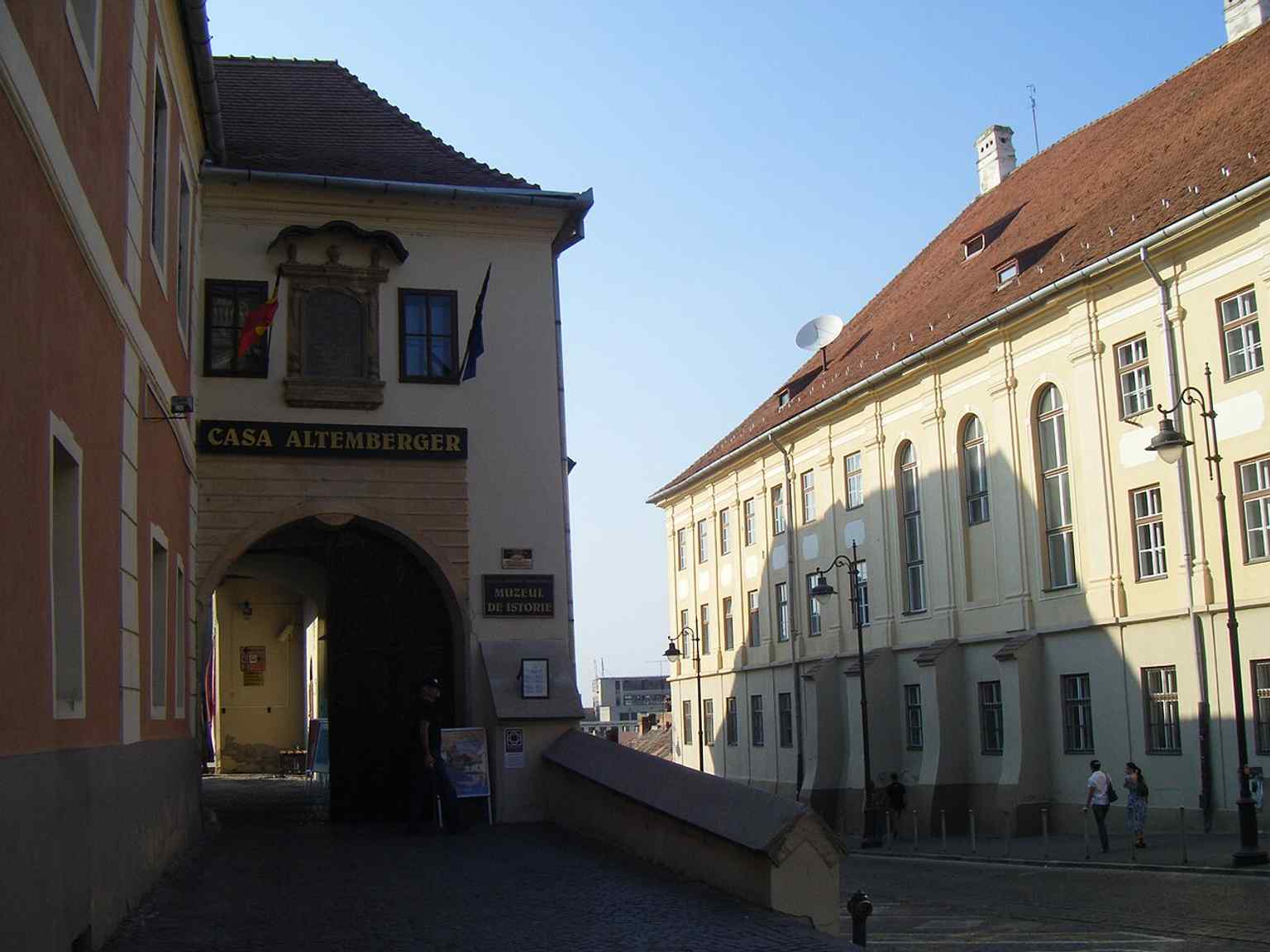
The imposing exterior of the Altemberger-Pempflinger House, a Gothic monument with Renaissance elements that originally served as a residential tower before becoming the city's City Hall.Photo: Oprea.alex, Wikimedia Commons, CC BY-SA 3.0. Cropped & resized. 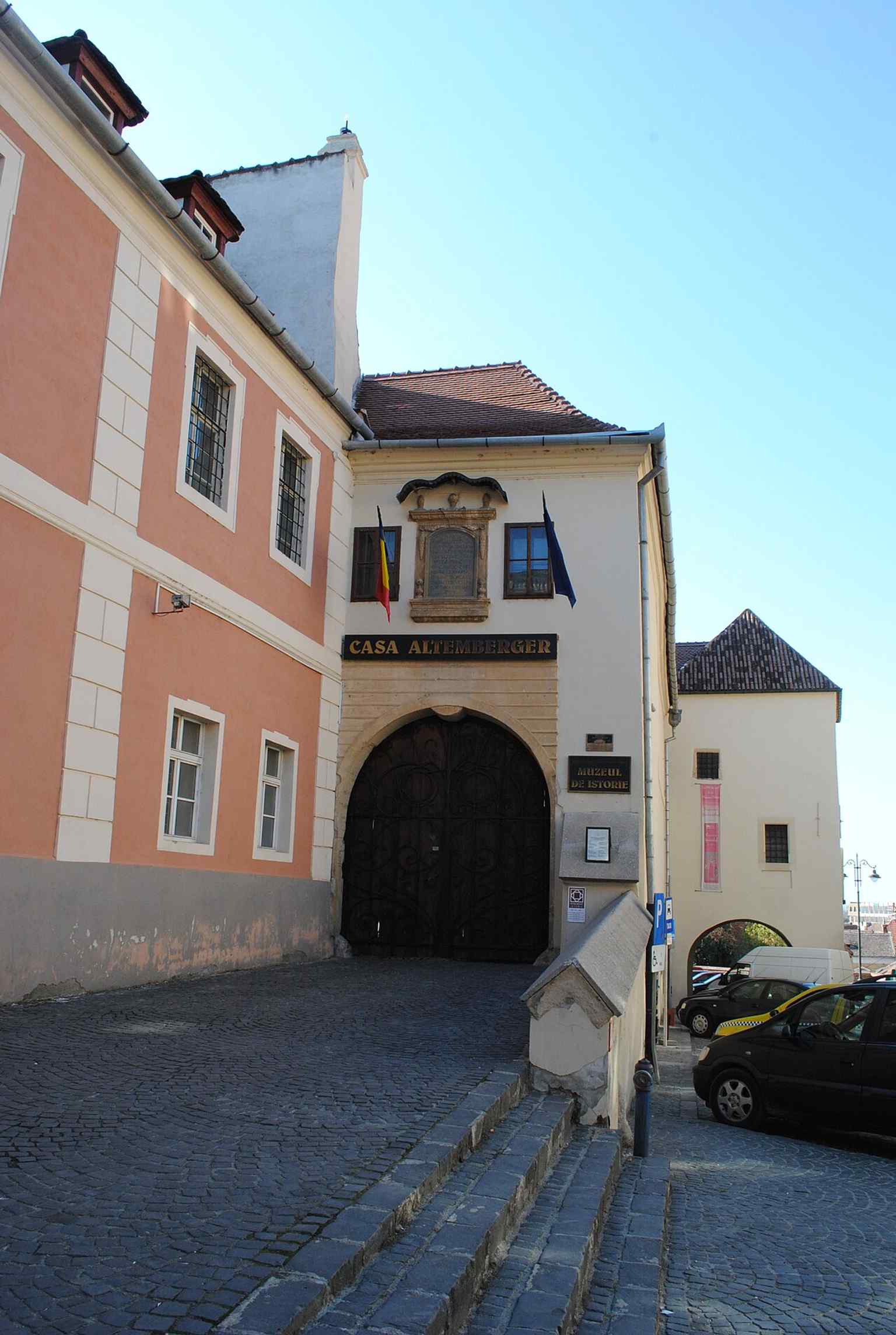
A towering perspective of the building, which once housed not only the City Hall but also the Saxon University, courthouse, police headquarters, and even the Sibiu fire department.Photo: Andrei kokelburg, Wikimedia Commons, CC BY-SA 3.0 ro. Cropped & resized. 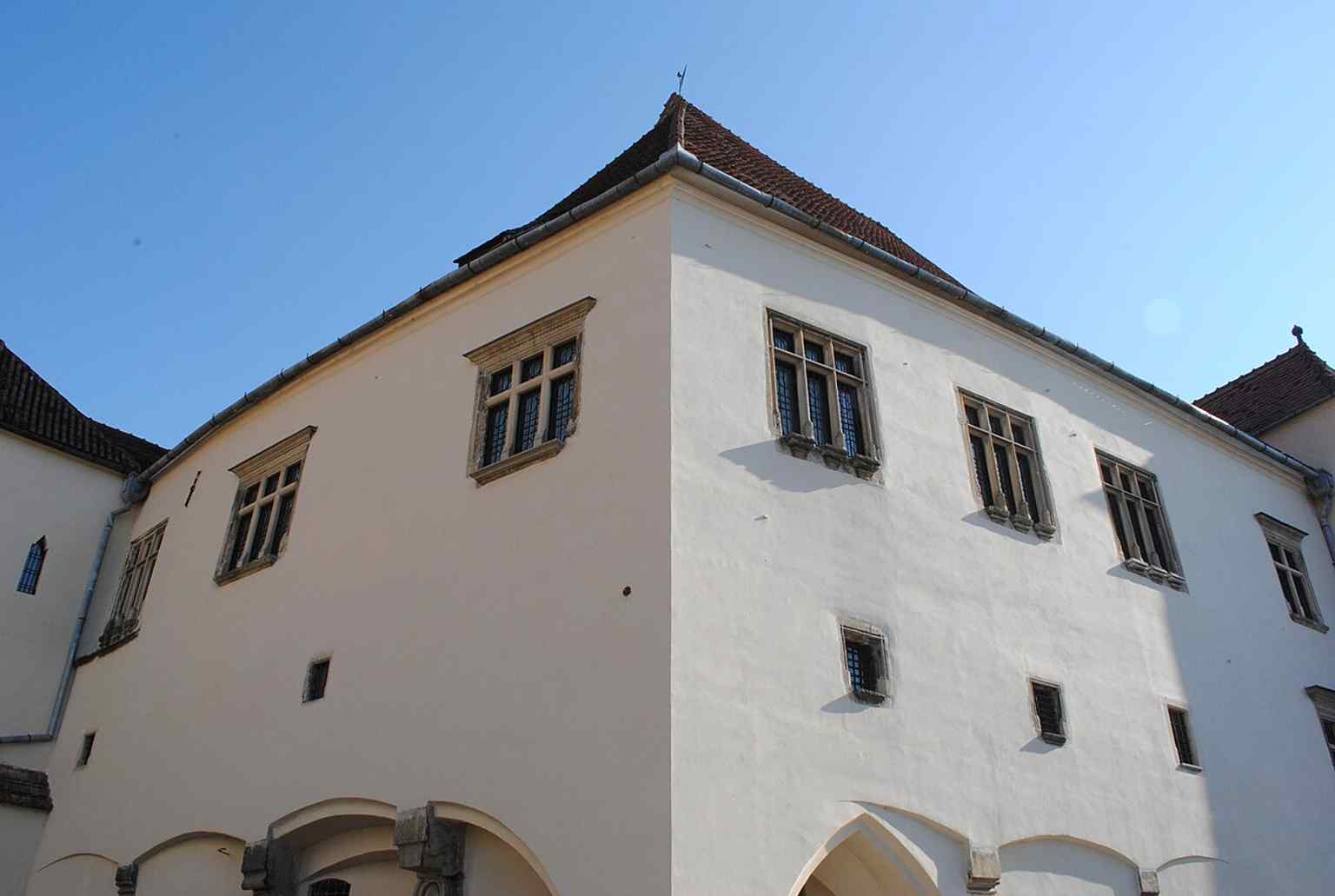
A broad view of the Altemberger-Pempflinger House, which underwent extensive restoration between 1967 and 1988, revealing original architectural details that had been covered by successive administrative changes.Photo: Andrei kokelburg, Wikimedia Commons, CC BY-SA 3.0 ro. Cropped & resized. 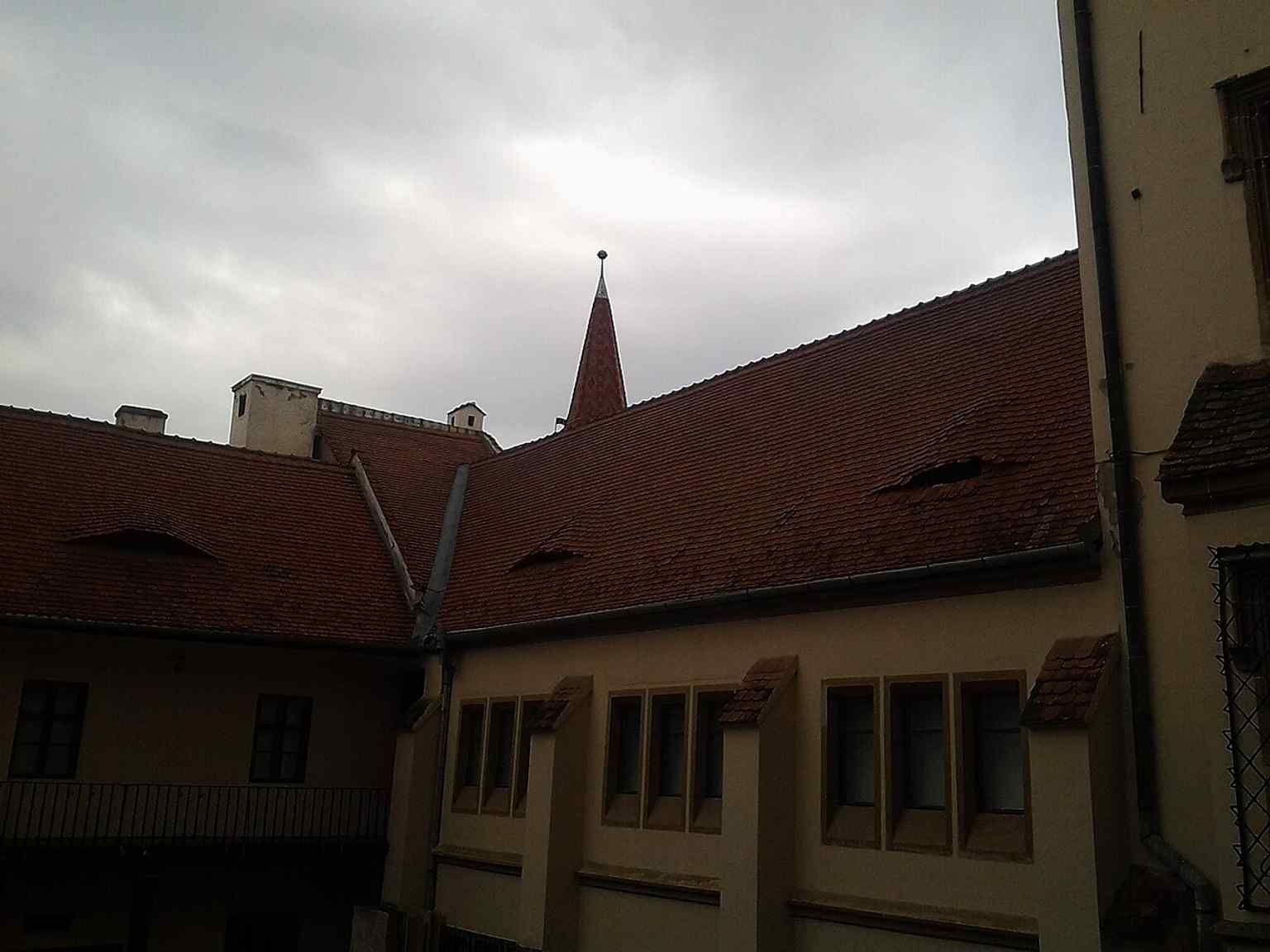
A frontal view of the building, notable for the attached defense tower that was part of the city's third defensive enclosure and housed the city's archive from 1546 to 1923.Photo: Leontin l, Wikimedia Commons, CC BY-SA 4.0. Cropped & resized. 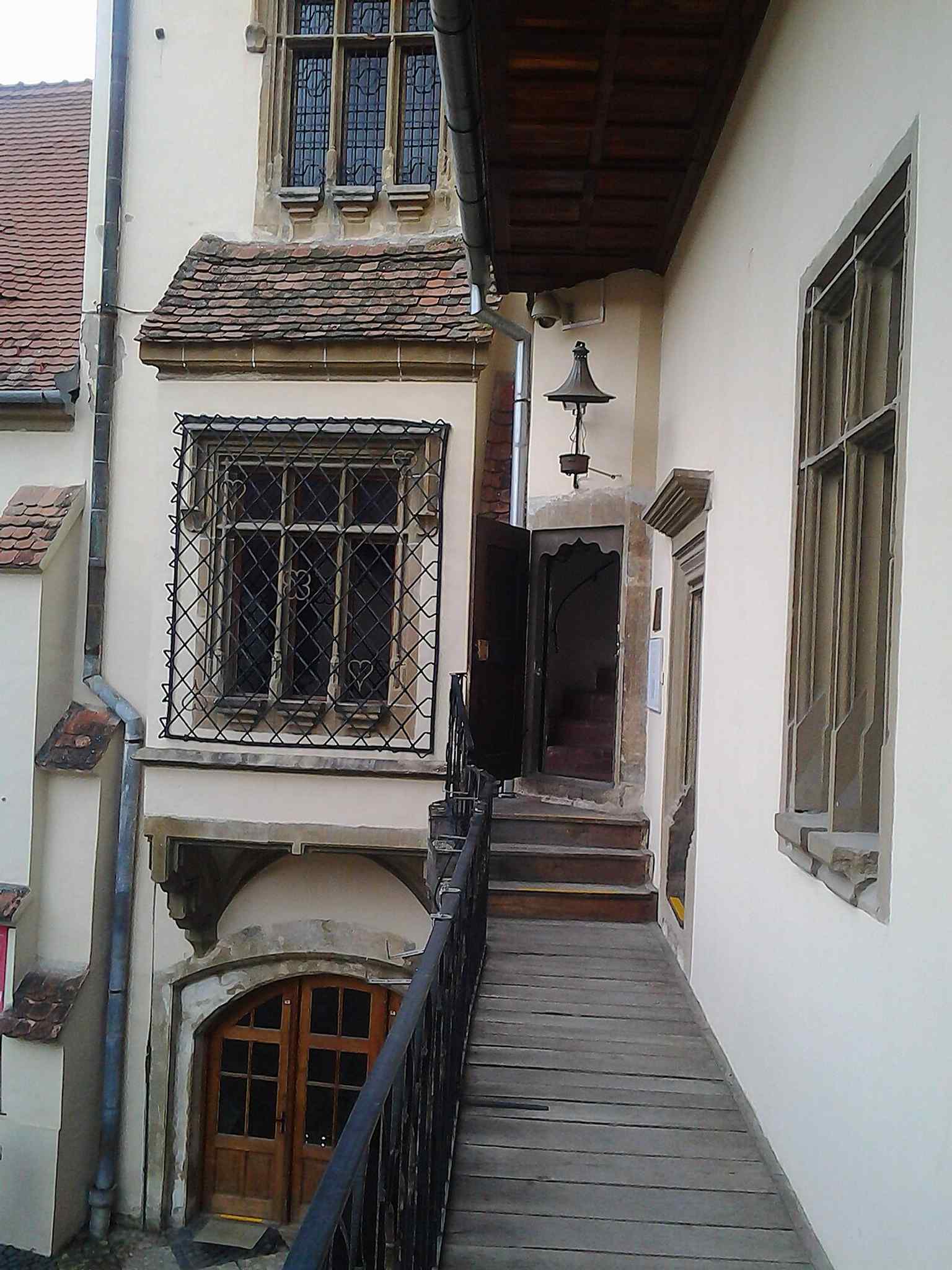
A vertical perspective of the museum, highlighting its status as a declared historical monument, built in several stages from the late 15th to the 19th centuries.Photo: Leontin l, Wikimedia Commons, CC BY-SA 4.0. Cropped & resized. 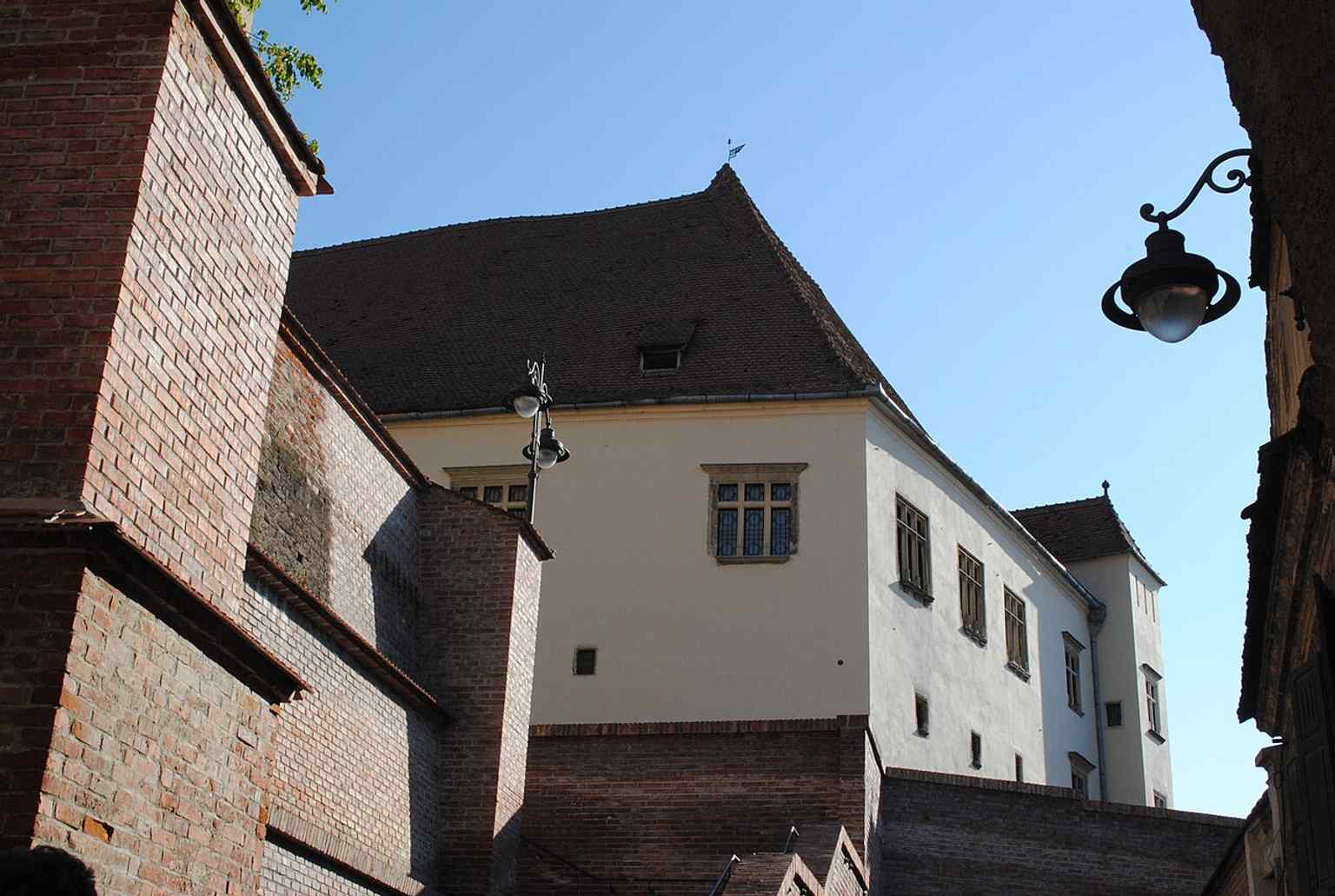
The facade of the Altemberger-Pempflinger House, which was acquired by the city in 1545 to serve as the new seat of the city council, showcasing its role as a central decision-making body.Photo: Andrei kokelburg, Wikimedia Commons, CC BY-SA 3.0 ro. Cropped & resized. 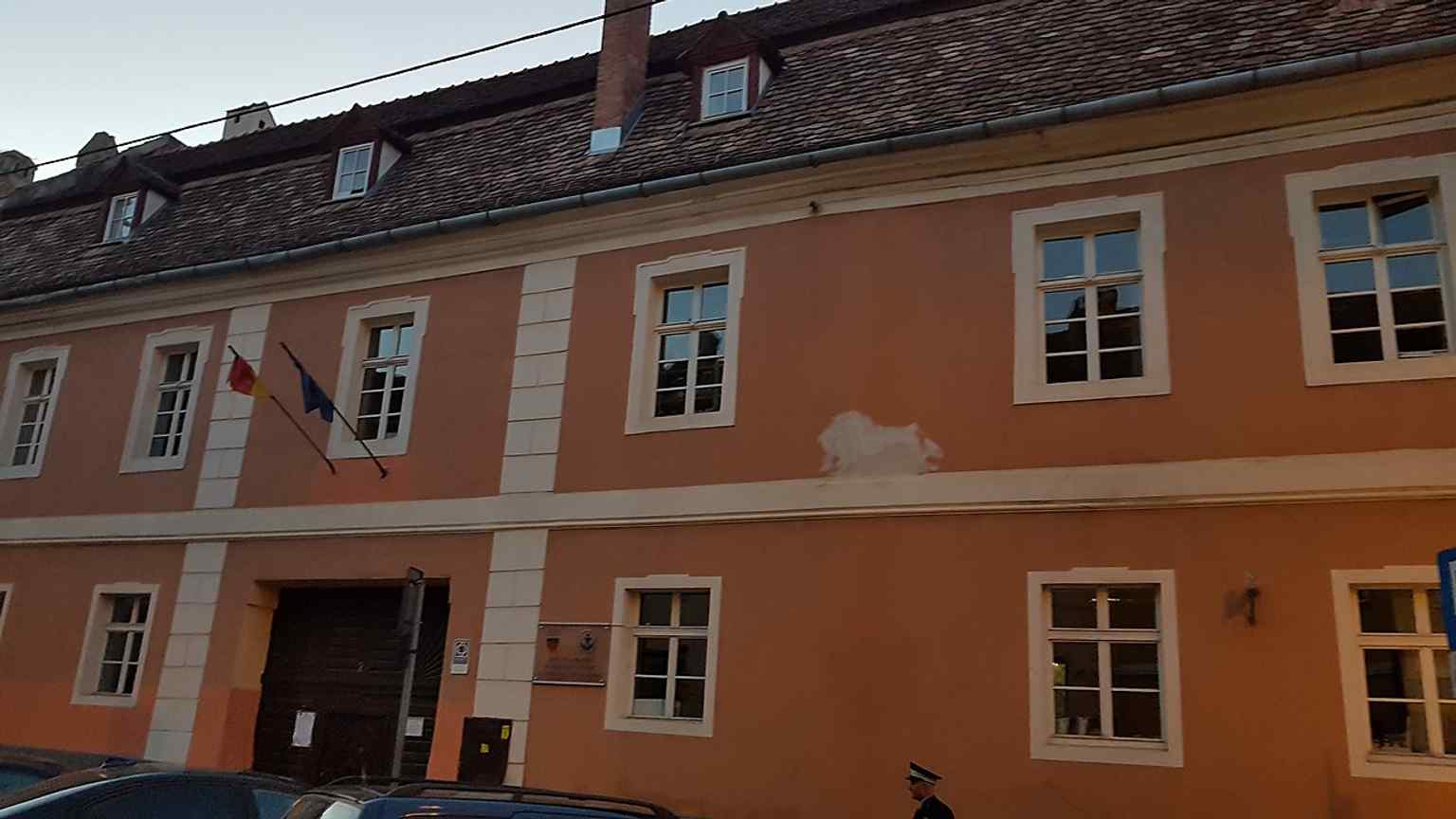
A view capturing a section of the museum building, reflecting its long history as the "nervous center" of Sibiu, where all major decisions, from economic regulations to judicial sentences, were made.Photo: Leontin l, Wikimedia Commons, CC BY-SA 4.0. Cropped & resized. On your left, the historic center of Sibiu unfolds as a sea of steep red clay roofs anchored by a soaring stone tower with a pointed spire. This entire area, an official…Lire plusAfficher moins
Ouvrir la page dédiée →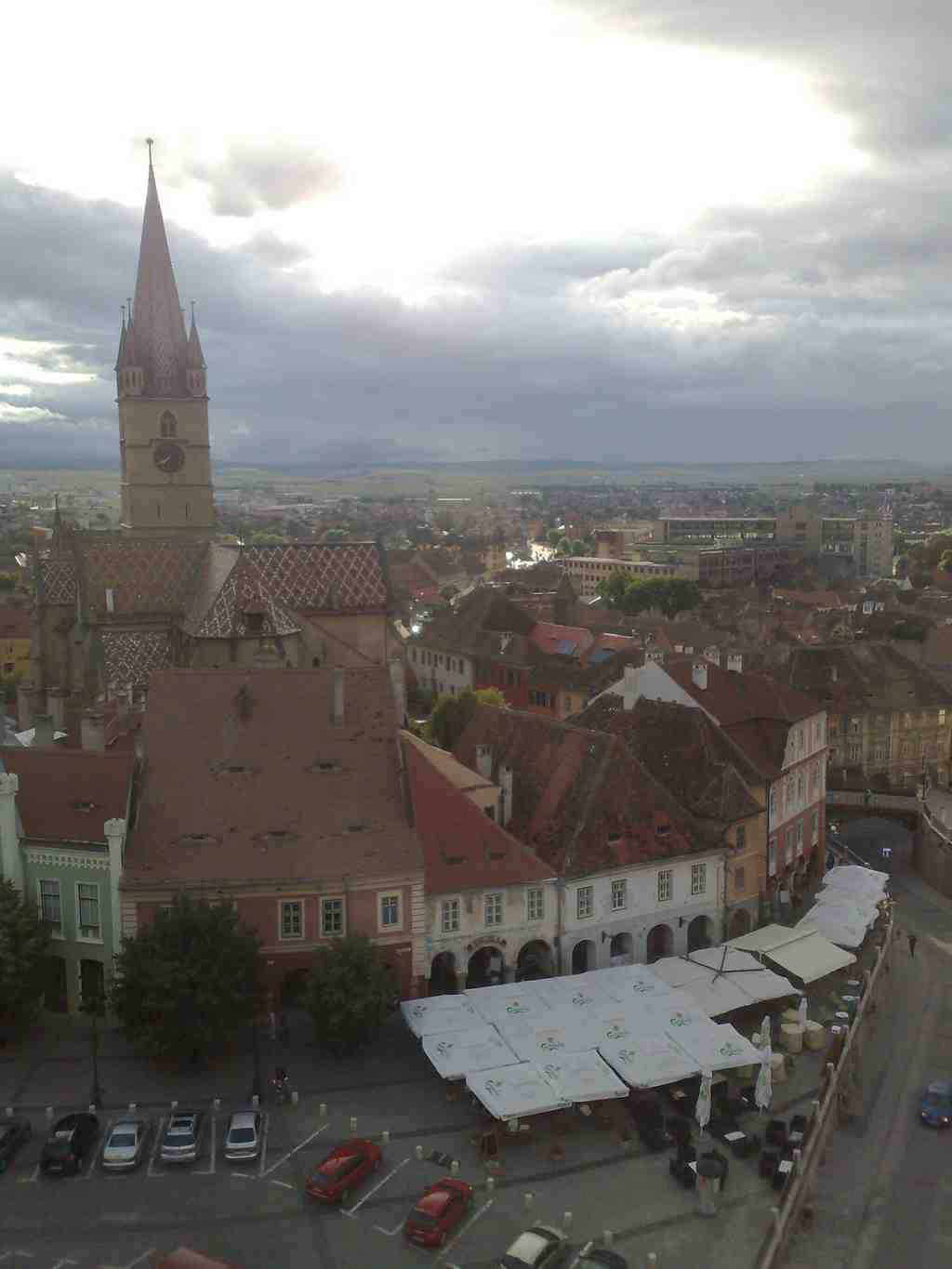
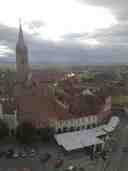
The historic center of SibiuPhoto: Korinna, Wikimedia Commons, CC BY-SA 3.0 RO. Cropped & resized. On your left, the historic center of Sibiu unfolds as a sea of steep red clay roofs anchored by a soaring stone tower with a pointed spire. This entire area, an official historical monument, circles the three main squares of the Upper Town. The Upper Town was the wealthy commercial heart of the city, built up high to protect its riches. Honestly, you could trip and accidentally lean against a building from the fourteen hundreds here. Take the House of Arts, for instance, which we visited earlier. Long before it was an art venue, it was the butchers' guild hall-one of the many exclusive medieval unions that controlled local trade. On its south facade, you can spot the city coat of arms added in seventeen eighty-nine. This historic center is the true architectural core of Sibiu. Take a moment to look around, and when you are ready, we can head to the next stop.
Look for the grand pale stone facade topped with a steeply pitched red tiled roof and a prominent, dark stone arched portal at its center. This imposing building was the private…Lire plusAfficher moins
Ouvrir la page dédiée →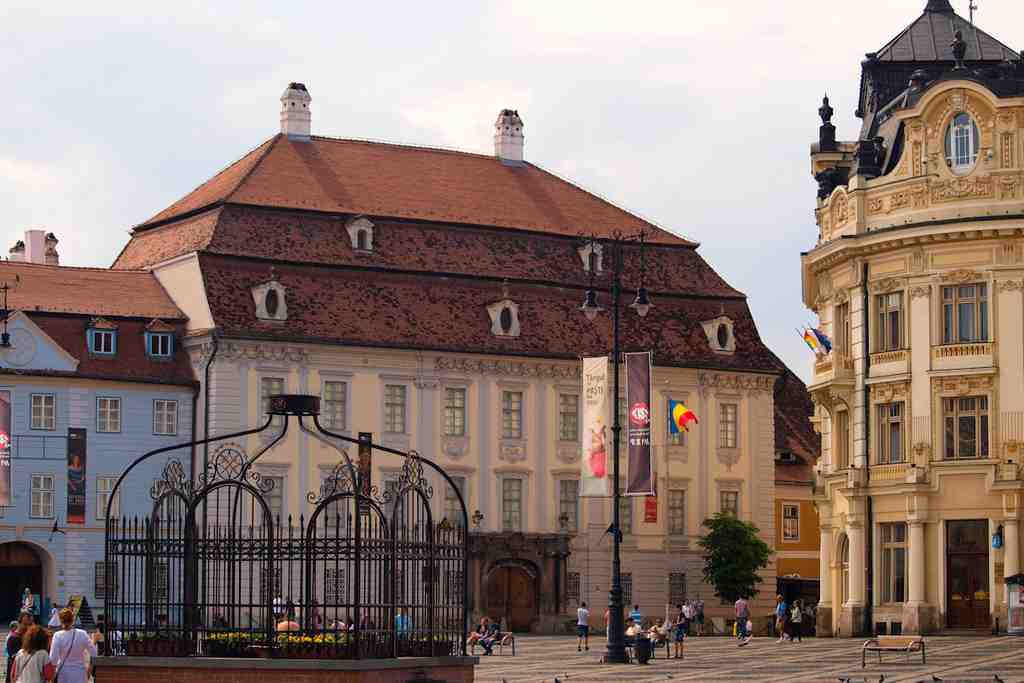
Brukenthal National MuseumPhoto: 7castle, Wikimedia Commons, CC BY-SA 3.0. Cropped & resized. Look for the grand pale stone facade topped with a steeply pitched red tiled roof and a prominent, dark stone arched portal at its center. This imposing building was the private city palace of Baron Samuel von Brukenthal, a governor of Transylvania in the late eighteenth century. He clearly did not believe in traveling light. He began amassing a massive personal collection of European art around seventeen ninety.
By eighteen seventeen, these doors were officially opened to the public, making the Brukenthal National Museum the oldest institution of its kind in modern-day Romania. Take a peek at your screen to see the art galleries hidden inside. The museum houses around one thousand two hundred works from the fifteenth to the eighteenth centuries, featuring Flemish, German, and Italian masters. Today, it is actually a sprawling complex of six different museums spread across the city, though this palace is the beating heart of it all.
If you want to explore the collections, the museum is open from nine A-M to five P-M Wednesday through Sunday. It is quite a legacy for one man to leave behind. Whenever you are ready to keep moving, our next stop awaits.
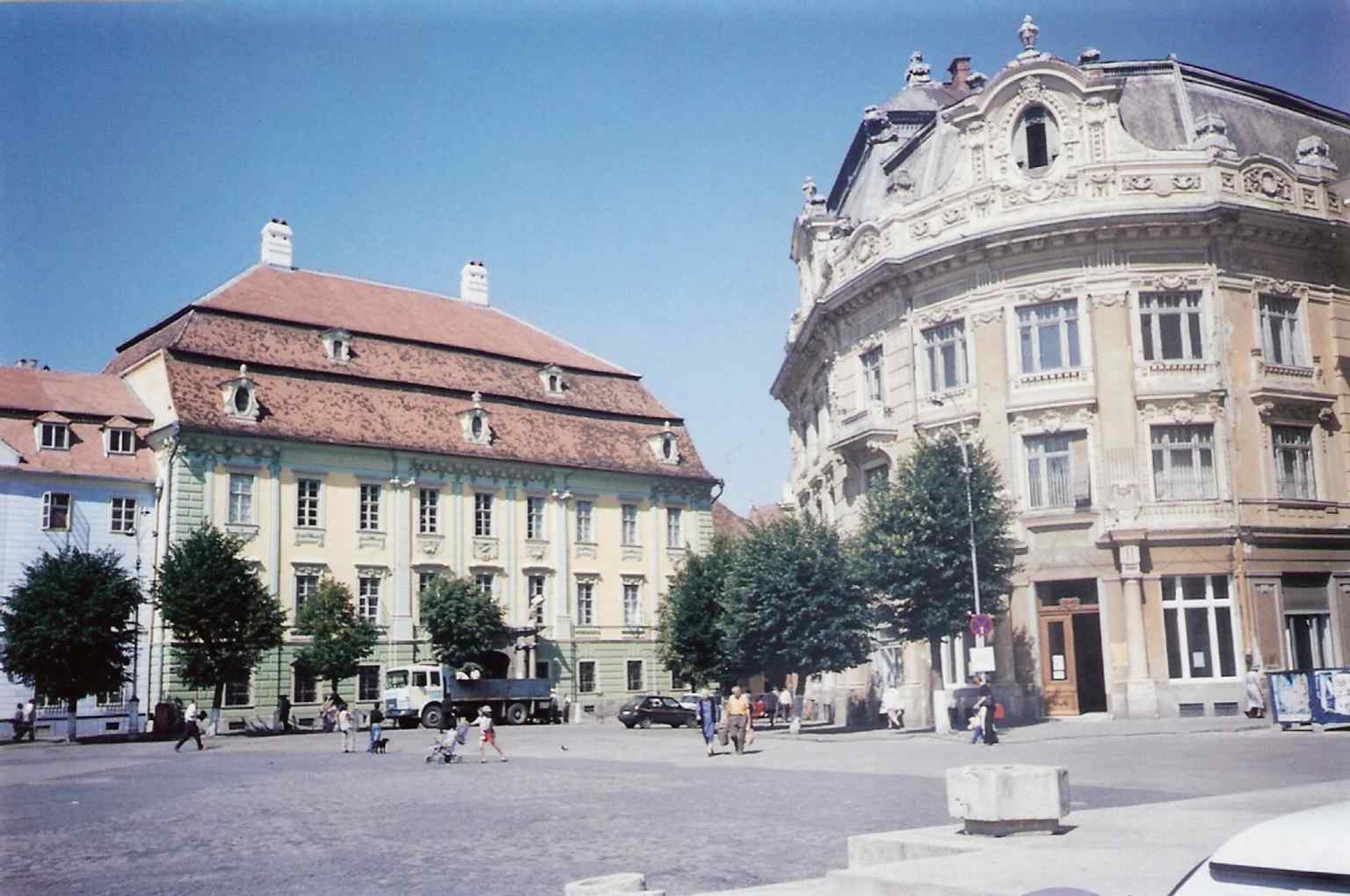
This welcoming facade belongs to the Brukenthal National Museum, first opened to the public in 1817 as Romania's oldest such institution.Photo: Avishai Teicher, Wikimedia Commons, Public domain. Cropped & resized. 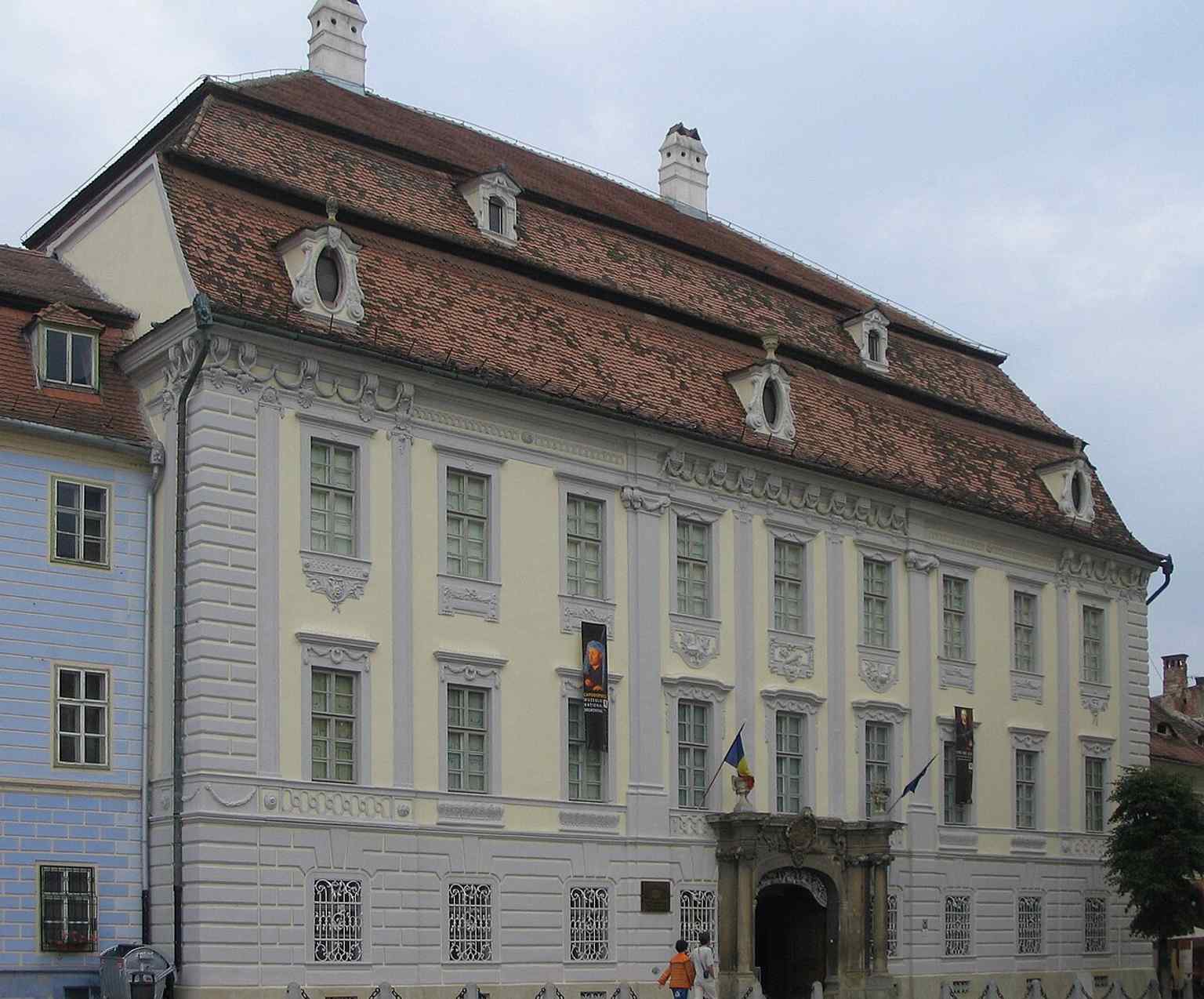
The Brukenthal National Museum stands proudly in Sibiu, a city in Transylvania where Samuel von Brukenthal established his influential collections.Photo: Rsocol, Wikimedia Commons, CC BY-SA 3.0. Cropped & resized. 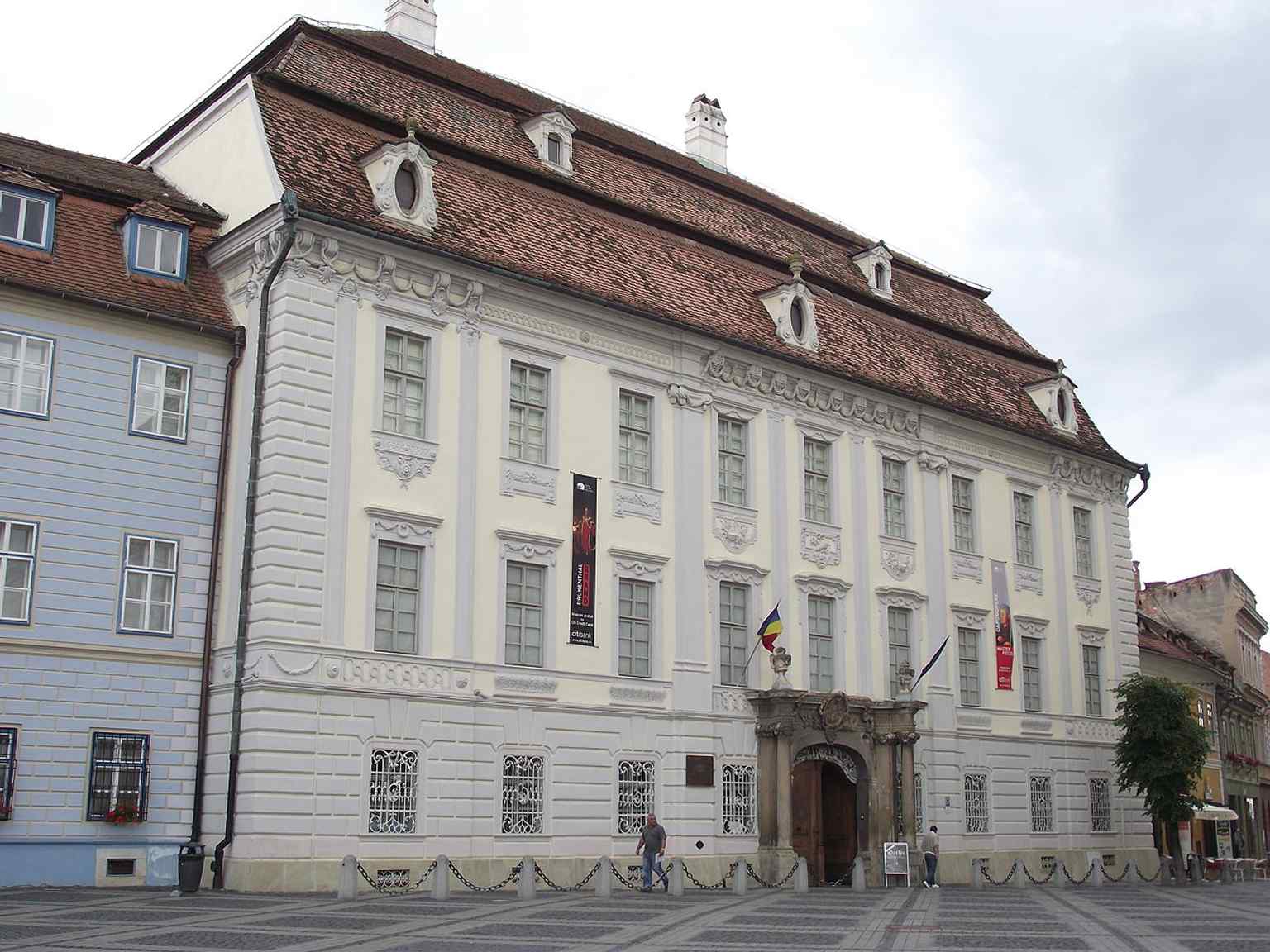
Gaze upon the grand facade of the Brukenthal Palace, home to the museum which officially opened to the public in 1817, making it Romania's oldest.Photo: Mara23, Wikimedia Commons, CC BY-SA 3.0. Cropped & resized. 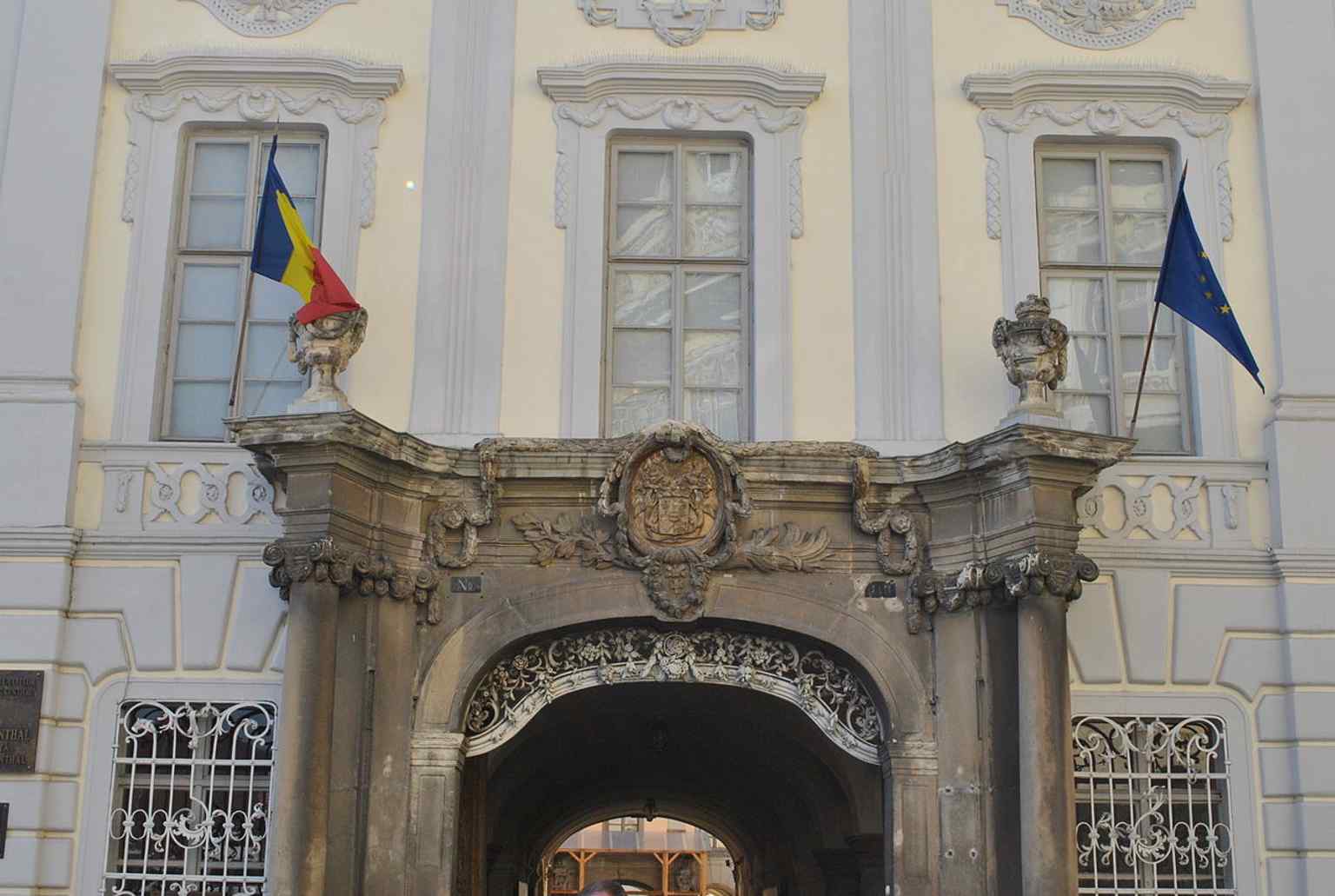
The impressive Brukenthal Palace, constructed between 1778 and 1788, was the private residence of Samuel von Brukenthal, who established his collections here around 1790.Photo: Andrei kokelburg, Wikimedia Commons, CC BY-SA 3.0 ro. Cropped & resized. 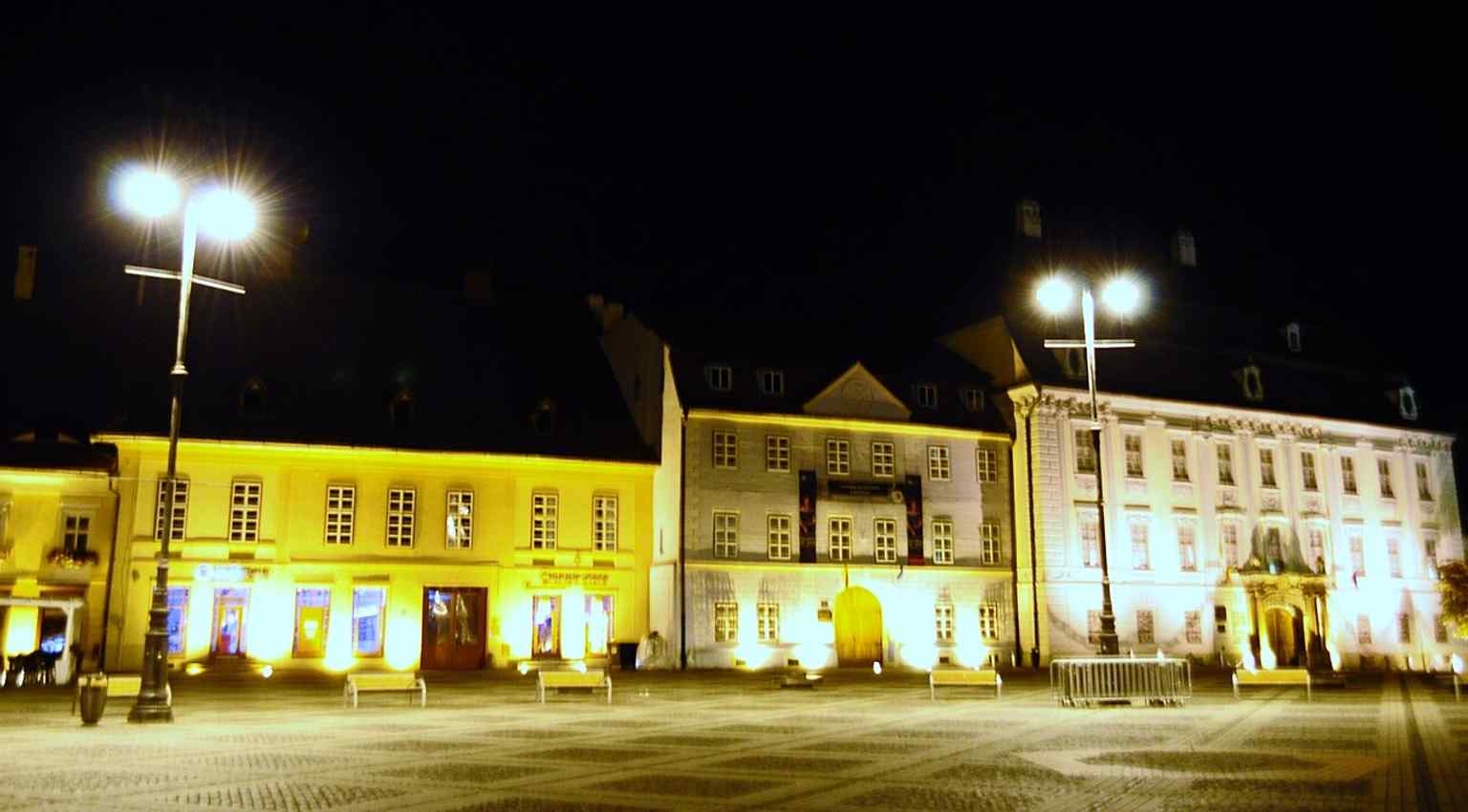
See the Brukenthal Palace alongside the 'Blue House,' one of the other buildings that are part of the museum's extended complex of six distinct cultural institutions.Photo: Țetcu Mircea Rareș, Wikimedia Commons, CC BY-SA 3.0 ro. Cropped & resized. 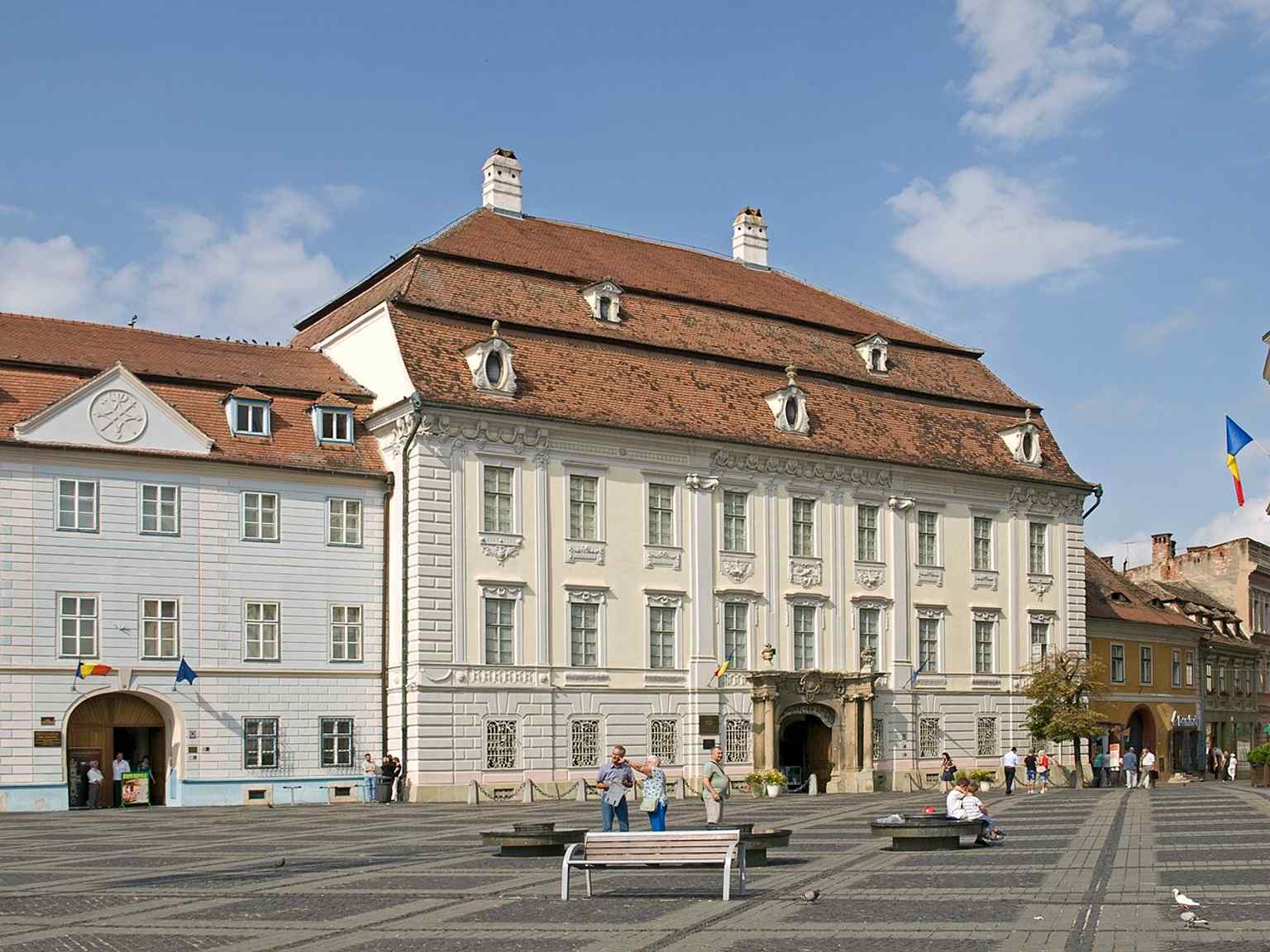
Witness the prominent location of Brukenthal Palace and the Blue House in Sibiu's historic center, part of Baron Brukenthal's original city palace complex.Photo: Ymblanter, Wikimedia Commons, CC BY-SA 4.0. Cropped & resized. 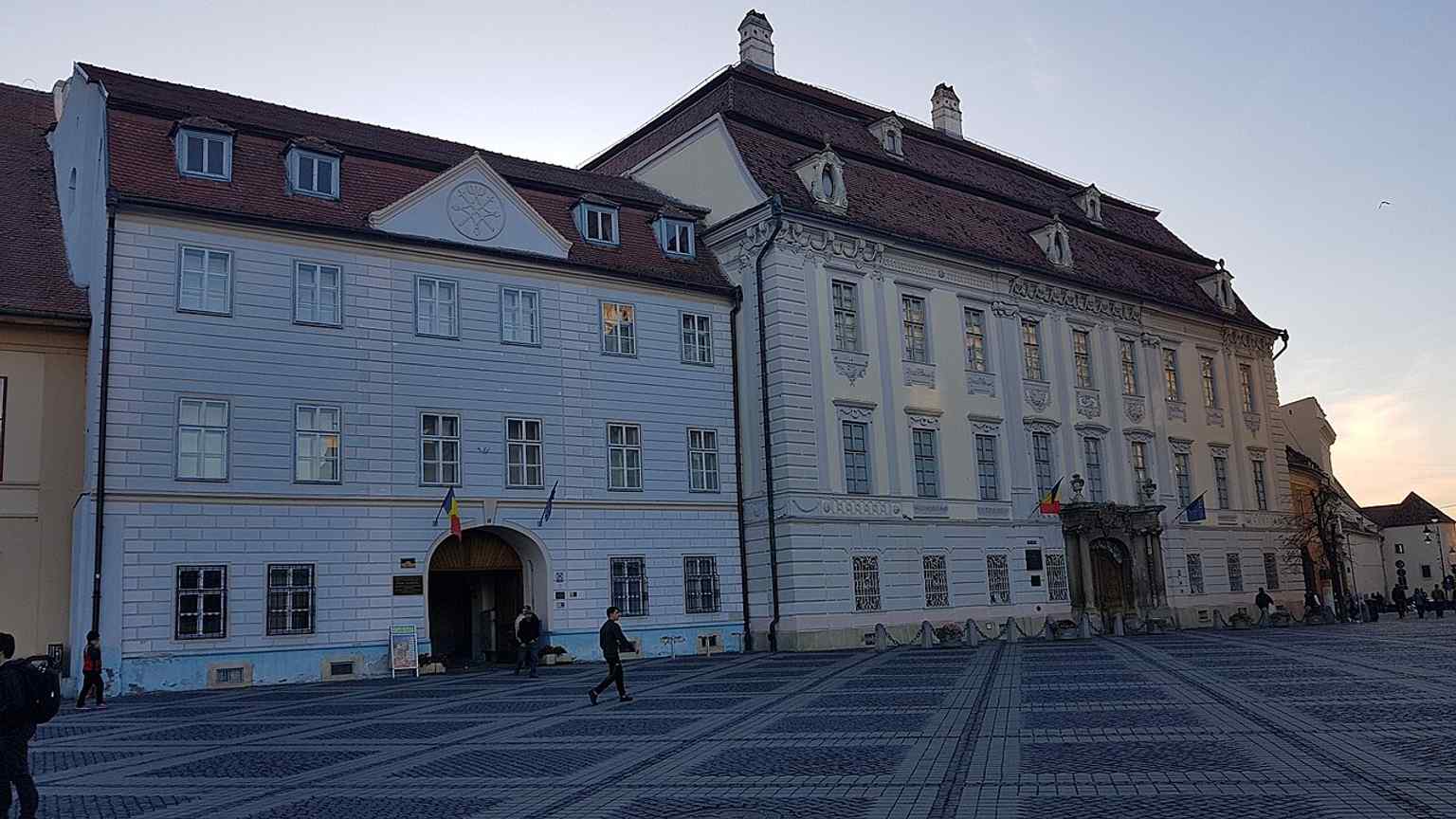
The Brukenthal Palace and the adjacent Blue House stand as key components of the multi-site Brukenthal National Museum, which now encompasses six different cultural programs.Photo: Leontin l, Wikimedia Commons, CC BY-SA 4.0. Cropped & resized. Right in front of you stands a robust defense structure featuring a cylindrical base of exposed red brick that transitions into an octagonal, plastered upper level, all crowned by…Lire plusAfficher moins
Ouvrir la page dédiée →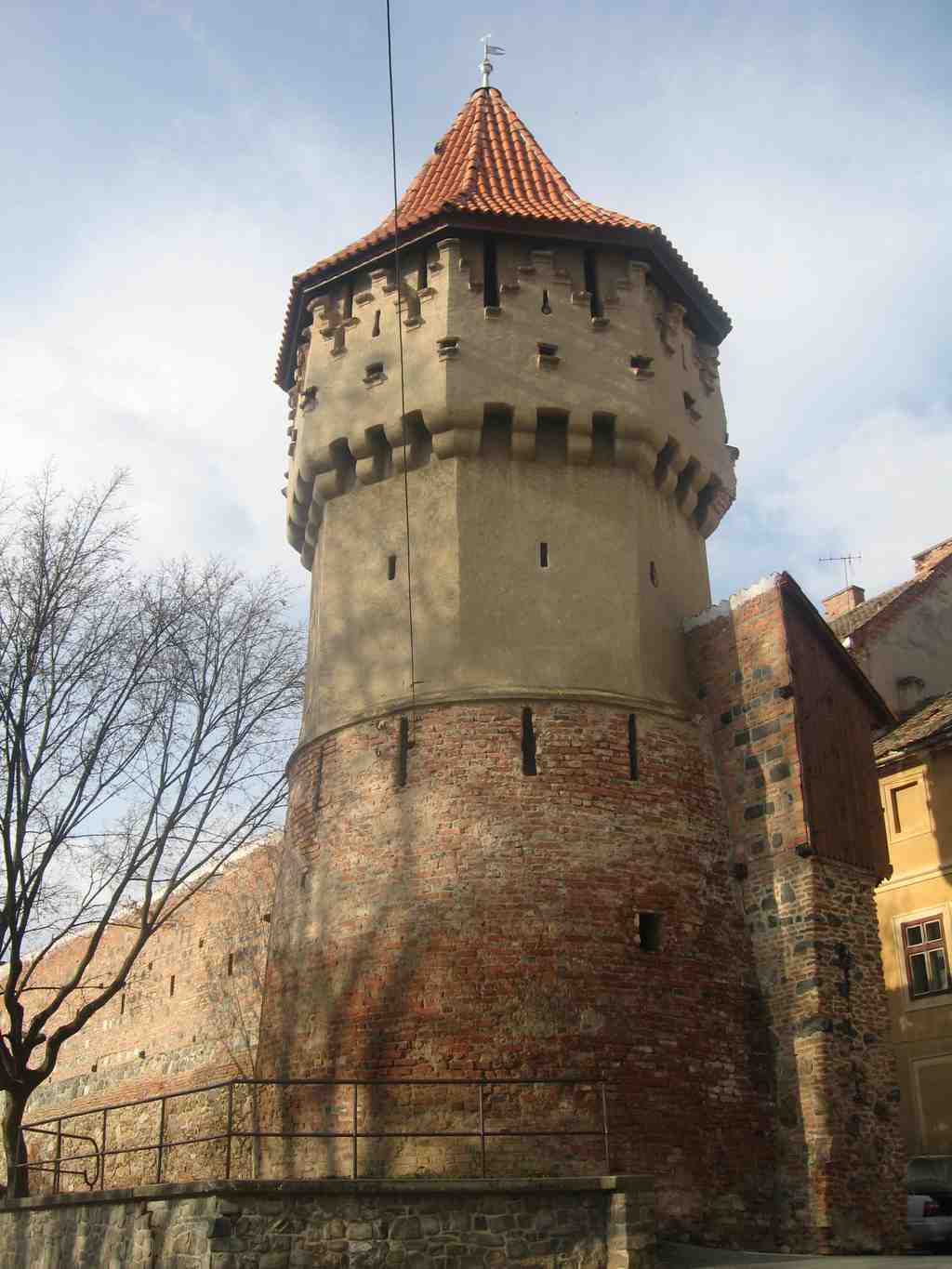
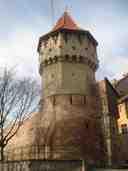
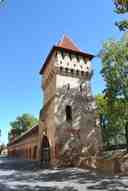
The Carpenters' Tower in SibiuPhoto: Cezar Suceveanu, Wikimedia Commons, CC BY-SA 3.0. Cropped & resized. Right in front of you stands a robust defense structure featuring a cylindrical base of exposed red brick that transitions into an octagonal, plastered upper level, all crowned by a steep, red-tiled roof with a metal weather vane at its peak.
This is the Carpenters' Tower, built between thirteen fifty-seven and thirteen sixty-six by the Saxon carpenters' guild. It is the northernmost of three surviving towers along this defensive wall. Back then, this formidable brick network earned Sibiu the nickname the Red City, famous for its ability to withstand sieges.
If you look at the architecture, the base is circular, but above the protruding horizontal molding, known as a cornice, it shifts into an octagonal prism. From certain angles down the street, that robust shape actually resembles the prow of a medieval ship.
Now, let us talk about defense. On the lower level, you will notice slits shaped like keyholes. Those were specifically designed for firing arquebuses, an early type of heavy matchlock gun. But if the attackers somehow survived the gunfire and reached the base of the tower, things got much worse for them. Look up just beneath the overhanging roof section. Those gaps between the supporting arches are called pitch holes. Defenders used those functional channels to pour boiling water, hot oil, or melted pitch directly onto the heads of anyone trying to scale the brickwork.
During peacetime, the carpenters used the tower to hoard supplies, as guild members were required to stock enough provisions to survive months of blockade. If you look at the very tip of the roof, the metal weather vane proudly displays two crossed broadaxes, the traditional emblem of their trade.
The street we are standing near carries its own dramatic story. For centuries, it was named after Johann Sachs von Harteneck, a visionary mayor who commissioned the very first topographic maps of Sibiu to better understand its defenses. But his political career met a violent end. In seventeen zero two, he proposed taxing the nobility to ease the financial burden on the working class. The nobility retaliated swiftly, and Harteneck was convicted and publicly beheaded in the city square in seventeen zero three.
In more recent times, this sixteenth-century architecture proved authentic enough to serve as a backdrop for the nineteen seventy historical film Mihai Viteazul. However, it also survived a rather undignified modern era when it was abandoned and used as an electrical transformer station. Thankfully, it was fully restored and finally reopened to visitors in twenty twenty. If you want to explore the inside and walk the connecting gallery, the tower is open Tuesday through Sunday from eleven A-M to six P-M.
It is a brilliant piece of medieval engineering. Whenever you are ready, we can make our way to the next stop.
Look ahead at this towering rectangular structure made of faded plaster and exposed brick, featuring a sharply projecting upper section supported by heavy stone brackets beneath a…Lire plusAfficher moins
Ouvrir la page dédiée →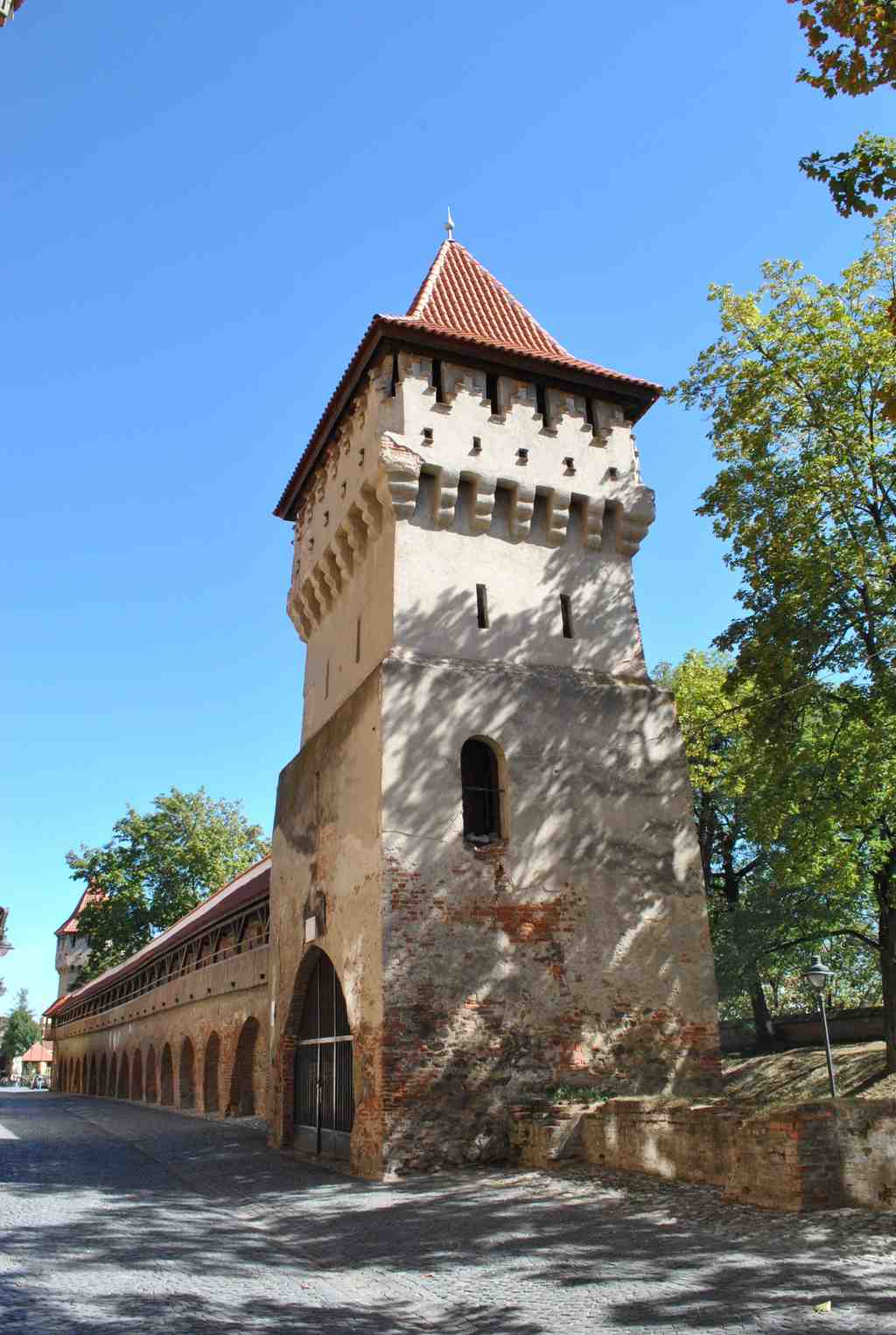
The Potters' Tower in SibiuPhoto: Andrei kokelburg, Wikimedia Commons, CC BY-SA 3.0 RO. Cropped & resized. Look ahead at this towering rectangular structure made of faded plaster and exposed brick, featuring a sharply projecting upper section supported by heavy stone brackets beneath a steep tiled roof. You are standing in front of the Potters Tower, built by the Saxon potters guild back in the fifteenth century as part of the citys third fortification ring.
If you look closely at the exterior, you might spot the guilds signature carved right into the stone, an actual potters wheel and ceramic vessels. They wanted everyone to know exactly whose money built this impressive defense.
Notice that the wall connecting this to the tower we just left is made of two entirely different materials. The bottom half is rough stone, while the top half is brick. That is called a curtain wall, a defensive barrier connecting two towers. The defenders doubled its height later on to adapt to a terrifying new invention on the battlefield... artillery. Brick absorbed cannonball impacts much better than rigid stone, which tended to shatter. Up at the top of that wall, there is a covered corridor resting on arches, designed so defenders could quietly rush supplies back and forth during night attacks.
The tower itself is another masterpiece of lethal engineering. Just like the Carpenters' Tower, it features keyhole-shaped loopholes on the lower levels for heavy firearms, and an overhanging top section with pitch holes to drop burning debris directly onto the heads of anyone trying to scale the masonry.
But the threats to Sibiu did not always come from outside. In fifteen fifty-six, a massive fire destroyed nearly six hundred homes and killed over thirty people. The surviving citizens were convinced the blaze was set intentionally to force the city to submit to the Prince of Transylvania. A furious mob blamed the royal judge, Johann Roth. They dragged the old man out of his house, paraded him through the smoldering ruins of the city, and then killed him with an axe right in front of his own front door.
A few decades later, in sixteen ten, things got worse. Prince Gabriel Báthory, known by the citizens as the crazy prince, took the city by trickery. He confiscated all the weapons from the guilds, including the potters, and turned these defensive towers into lookout posts for his own occupying army. His rule was brutal. According to local legend, Báthory tortured a man to death in prison, then tried to court the mans beautiful widow. Preferring death to losing her honor to a tyrant, she tragically took her own life in her home near the Large Square.
Thankfully, the tower sees much more peaceful days now, and you can actually explore the inside from Tuesday through Sunday between eleven A-M and seven P-M by entering through the Carpenters Tower.
Pause here to appreciate the potters' formidable handiwork before continuing along the wall.
You are looking at a classical stone bust of a man crowned with laurels, resting on a tall inscribed pedestal within a vibrant, red-orange arched niche. The man gazing down at you…Lire plusAfficher moins
Ouvrir la page dédiée →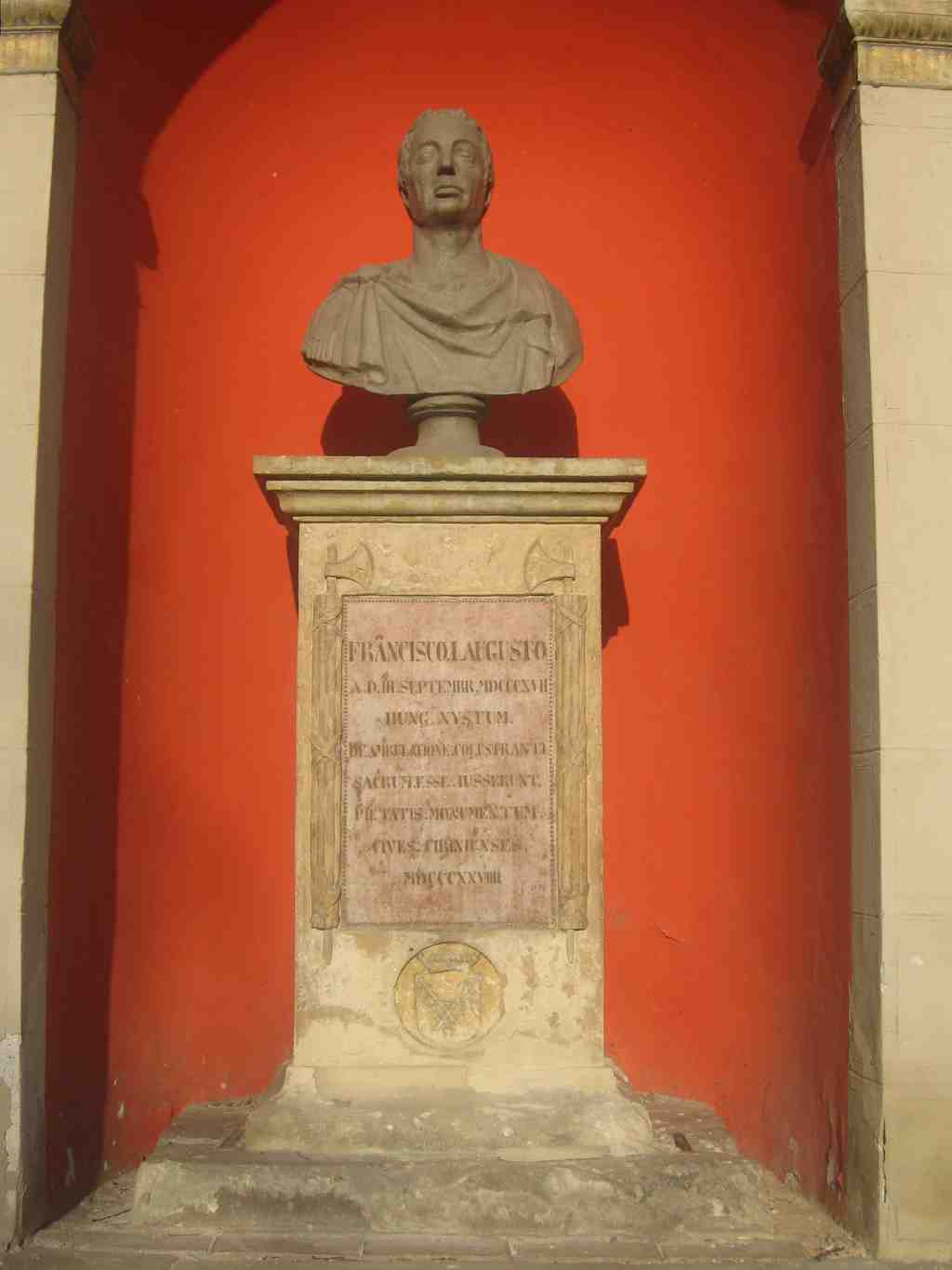
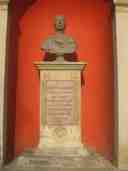
Bustul împăratului Francisc I din SibiuPhoto: Cezar Suceveanu, Wikimedia Commons, CC BY-SA 3.0. Cropped & resized. You are looking at a classical stone bust of a man crowned with laurels, resting on a tall inscribed pedestal within a vibrant, red-orange arched niche. The man gazing down at you is Francis the First, Emperor of Austria, and his presence here is the result of what you might call an early nineteenth-century public relations campaign.
Back in eighteen seventeen, Transylvania was reeling from famine and the economic hangover of the Napoleonic Wars. To calm the nerves of the locals, the Emperor and his wife paid a royal visit to Sibiu. They inaugurated the streetlights and officially opened the Brukenthal Museum, which you might remember from earlier on our route.
By eighteen twenty-eight, the citizens decided to honor that visit with this monument, designed by local artist Franz Neuhauser the Younger. Take a look at your screen. The niche is styled like an ancient Greek shrine, framing the emperor in a classicist design. But the setting was not always this grand. Before this became a respectable walkway, the area right by the citadel wall was a chaotic mess of thick birch bushes and, rather unglamorously, illegal pigsties built by locals. A military commander named Colonel Johann von Vecsey ordered the pigs evicted and transformed the space into a xyst. That is an architectural term for a grand garden promenade, originally meant as a respectable place for retired and wounded Habsburg soldiers to take the air.
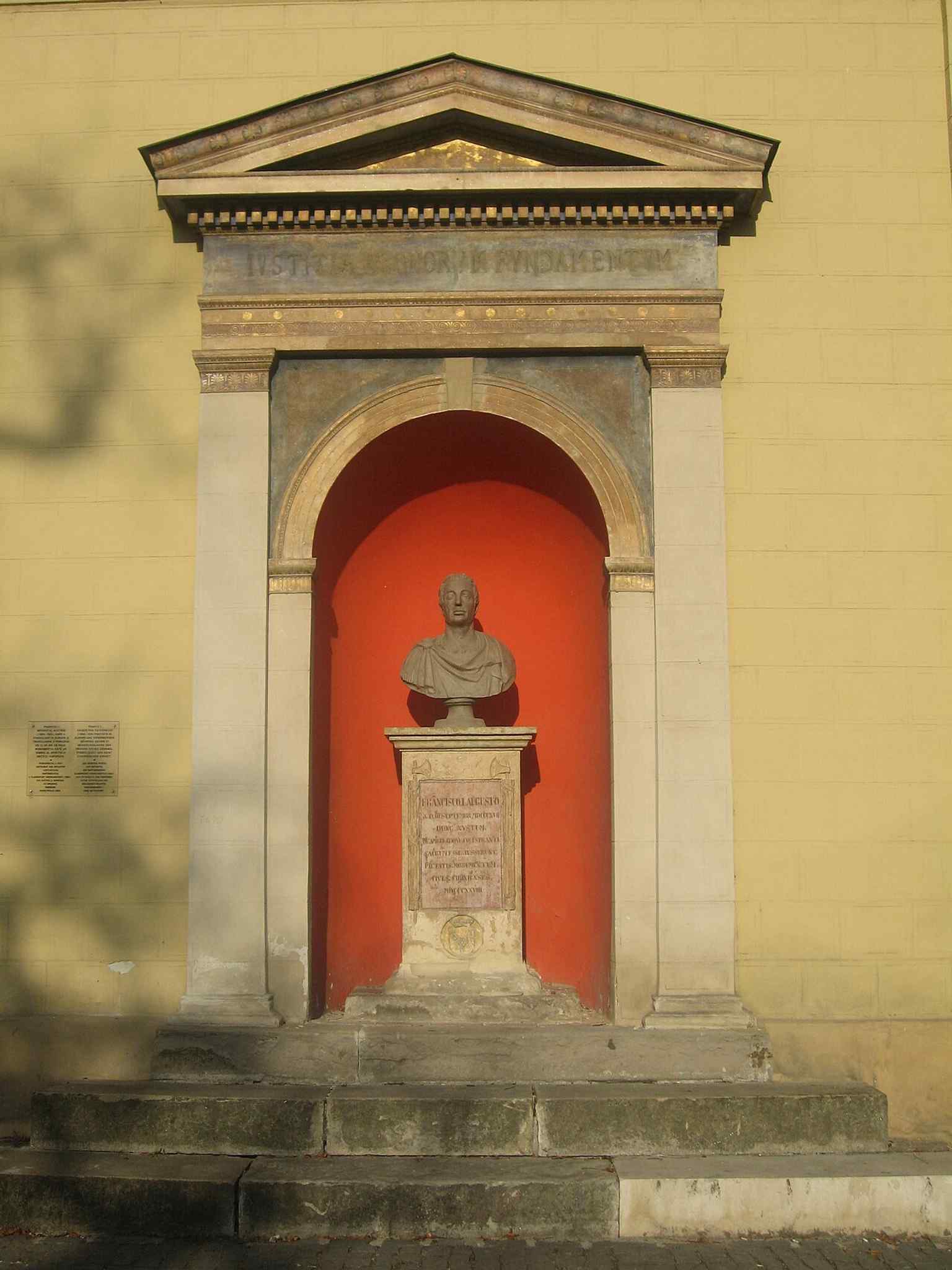
The classicist niche houses the bust, featuring columns, an entablature, and a triangular pediment, recalling ancient Greek monuments.Photo: Cezar Suceveanu, Wikimedia Commons, CC BY-SA 3.0. Cropped & resized. In eighteen eighty-three, Francis the First's grandson, Emperor Franz Joseph, paid one thousand florins out of his own pocket to restore the monument, a sum roughly equal to tens of thousands of dollars today.
Now, the bust you see today is actually a stone replica. The original, crafted by a Viennese sculptor, was cast in lead. Lead is wonderfully soft for carving fine facial details, but it turns out to be a terrible material if your city ever hosts a violent revolution.
During the uprisings of December nineteen eighty-nine, this area became a crossfire zone between military and internal forces. The lead statue took several direct hits. The emperor lost his nose and a good portion of his skull, which is a bit ironic considering Francis the First had absolutely nothing to do with the twentieth-century communist regime that was actually falling from power.
To protect the damaged emperor, he was taken down and moved into storage. And then... he was completely forgotten. For over a decade, the oldest statuary monument in Sibiu was officially declared lost. In two thousand and four, restorers finally gave up hope and carved the stone replica you see before you now.
But the story has a punchline. Four years later, in two thousand and eight, workers cleaning out the basement of the local Prefecture building were moving a pile of broken chairs and old office supplies. Underneath all that junk, they found the original lead emperor, battered but surviving. It has since been beautifully restored using molds from this very replica, and is now safely kept indoors at the Brukenthal Museum.
Take a moment to appreciate this strange survivor of pigsties and revolutions. When you are ready, we can head to the next stop.
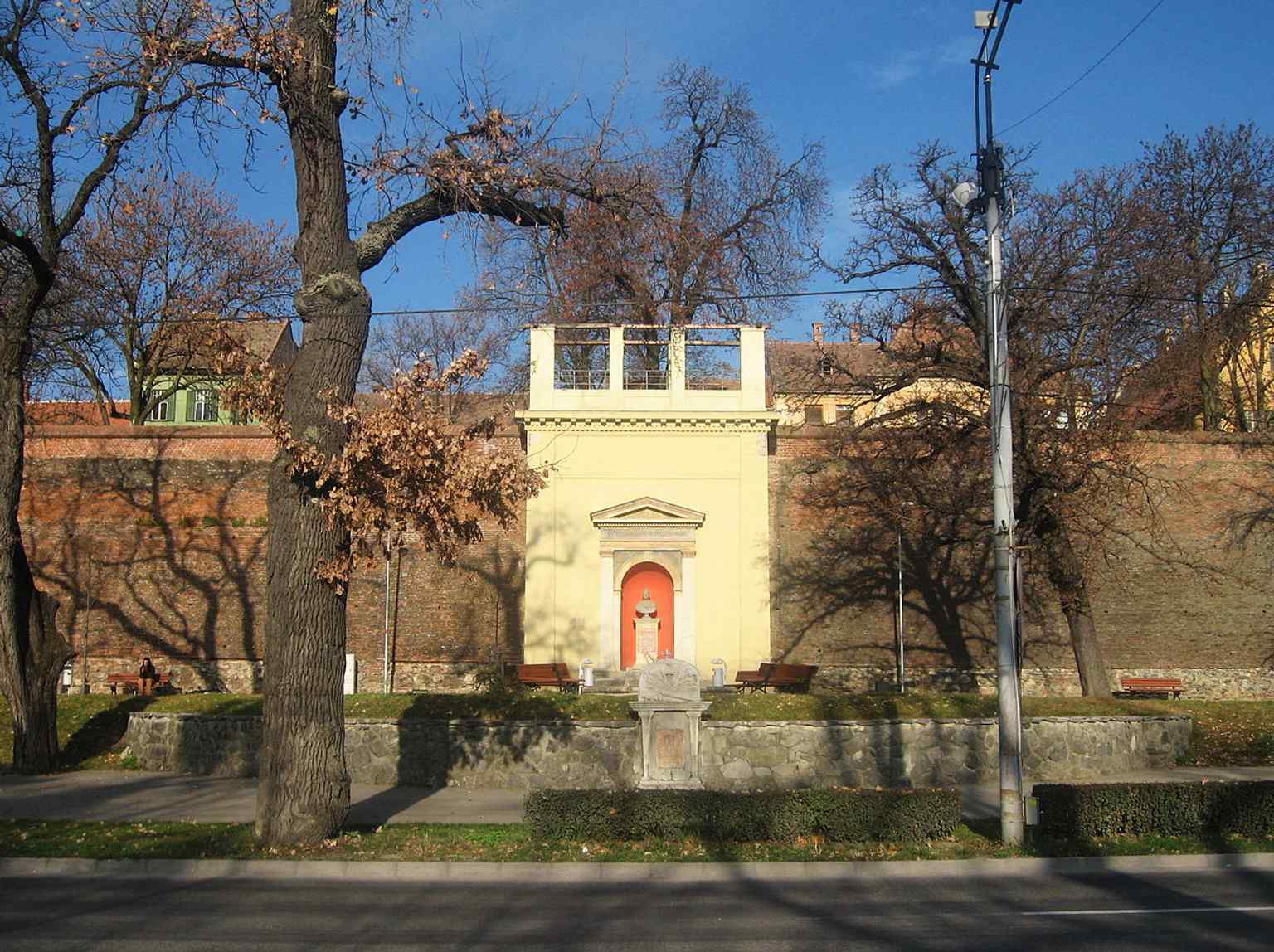
The monument is seen from Corneliu Coposu Boulevard, the site of the former "Promenade of Invalids" established by Colonel Johann von Vecsey.Photo: Cezar Suceveanu, Wikimedia Commons, CC BY-SA 3.0. Cropped & resized. 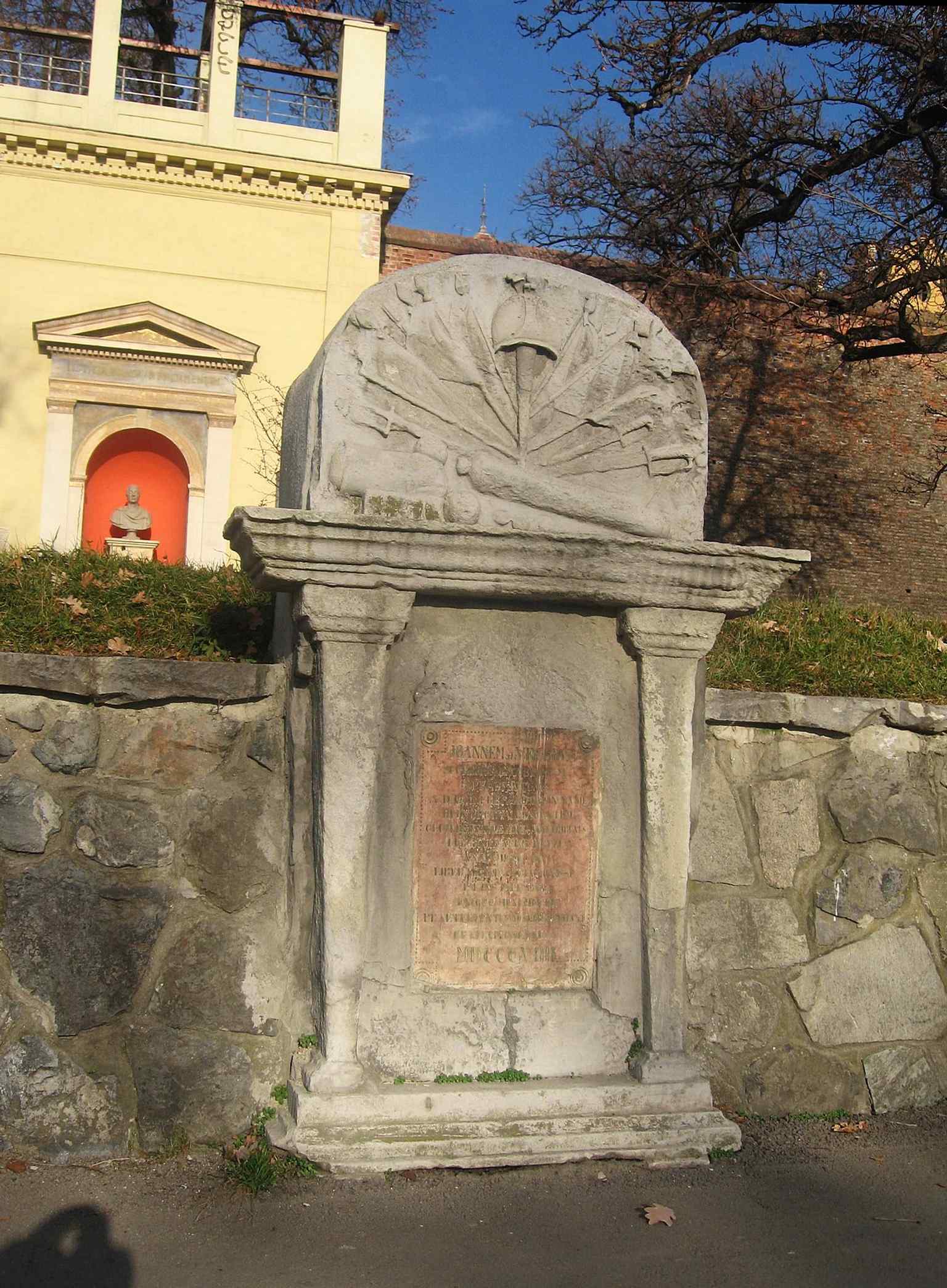
The arch of the round platform, which originally held a commemorative plaque for Colonel Johann von Vecsey, who transformed the area into a promenade.Photo: Cezar Suceveanu, Wikimedia Commons, CC BY-SA 3.0. Cropped & resized.
Foire aux questions
Comment commencer le tour ?
Après l'achat, téléchargez l'application AudaTours et entrez votre code de réduction. Le tour sera prêt à commencer immédiatement - il suffit d'appuyer sur lecture et de suivre l'itinéraire guidé par GPS.
Ai-je besoin d'Internet pendant le tour ?
Non ! Téléchargez le tour avant de commencer et profitez-en pleinement hors ligne. Seule la fonction de chat nécessite Internet. Nous recommandons de télécharger en WiFi pour économiser vos données mobiles.
S'agit-il d'une visite de groupe guidée ?
Non - il s'agit d'un audioguide en autonomie. Vous explorez indépendamment à votre propre rythme, avec une narration audio diffusée par votre téléphone. Pas de guide, pas de groupe, pas d'horaire.
Combien de temps dure le tour ?
La plupart des tours durent entre 60 et 90 minutes, mais vous contrôlez totalement le rythme. Faites des pauses, sautez des arrêts ou arrêtez-vous quand vous le voulez.
Et si je ne peux pas finir le tour aujourd'hui ?
Pas de problème ! Les tours disposent d'un accès à vie. Faites une pause et reprenez quand vous le souhaitez - demain, la semaine prochaine ou l'année prochaine. Votre progression est sauvegardée.
Quelles sont les langues disponibles ?
Tous les tours sont disponibles dans plus de 50 langues. Sélectionnez votre langue préférée lors de l'utilisation de votre code. Note : la langue ne peut pas être changée après la génération du tour.
Où accéder au tour après l'achat ?
Téléchargez l'application gratuite AudaTours sur l'App Store ou Google Play. Entrez votre code de réduction (envoyé par e-mail) et le tour apparaîtra dans votre bibliothèque, prêt à être téléchargé et commencé.
Si vous n'appréciez pas le tour, nous vous rembourserons votre achat. Contactez-nous à [email protected]
Paiement sécurisé avec 


.jpg)


.jpg)
.JPG)


.jpg)
.jpg)


.jpg)
.jpg)
%2C%20azi%20Muzeul%20de%20Istorie-%20(2).jpg)
%2C%20azi%20Muzeul%20de%20Istorie-%20(3).jpg)
.jpg)


.jpg)


