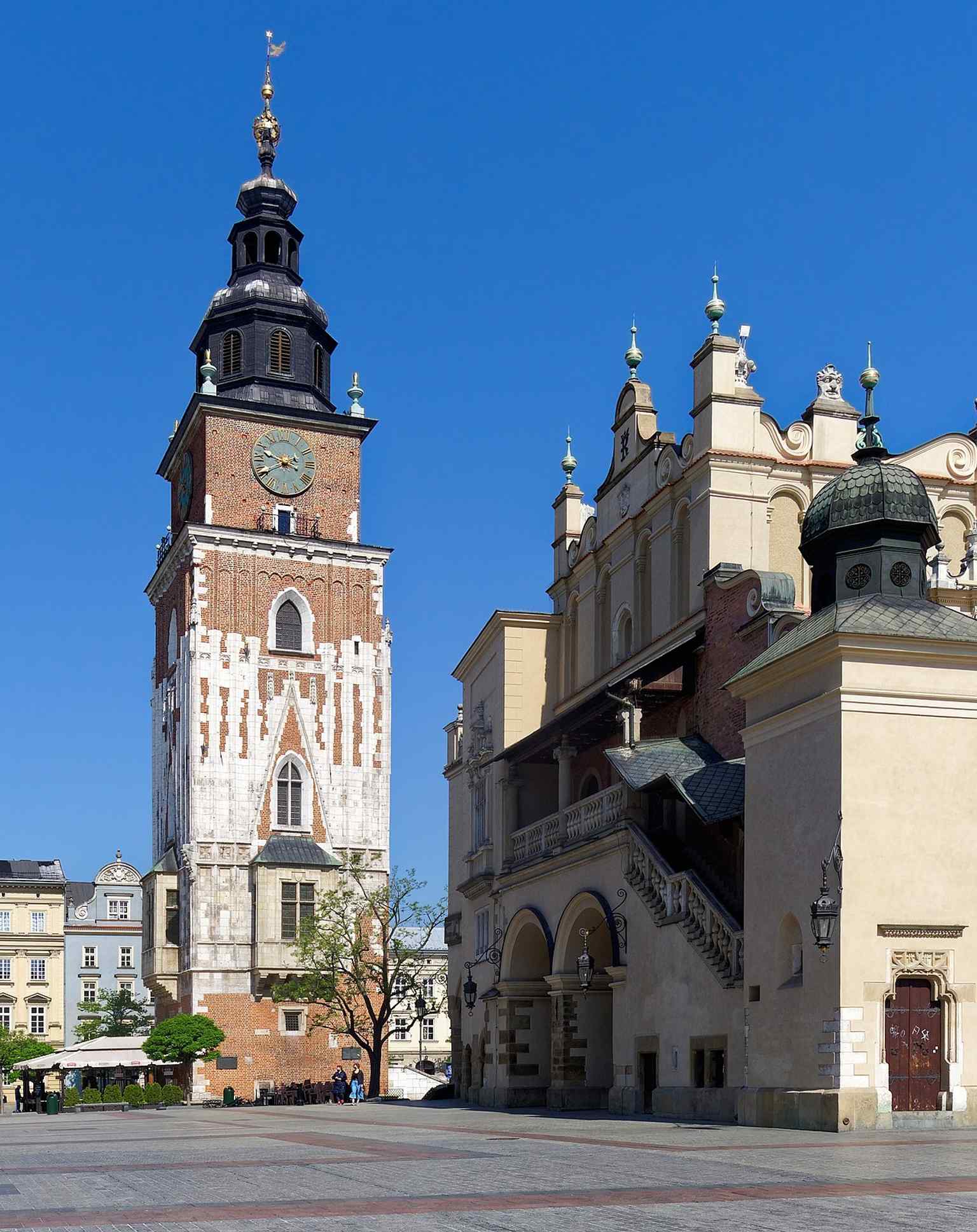
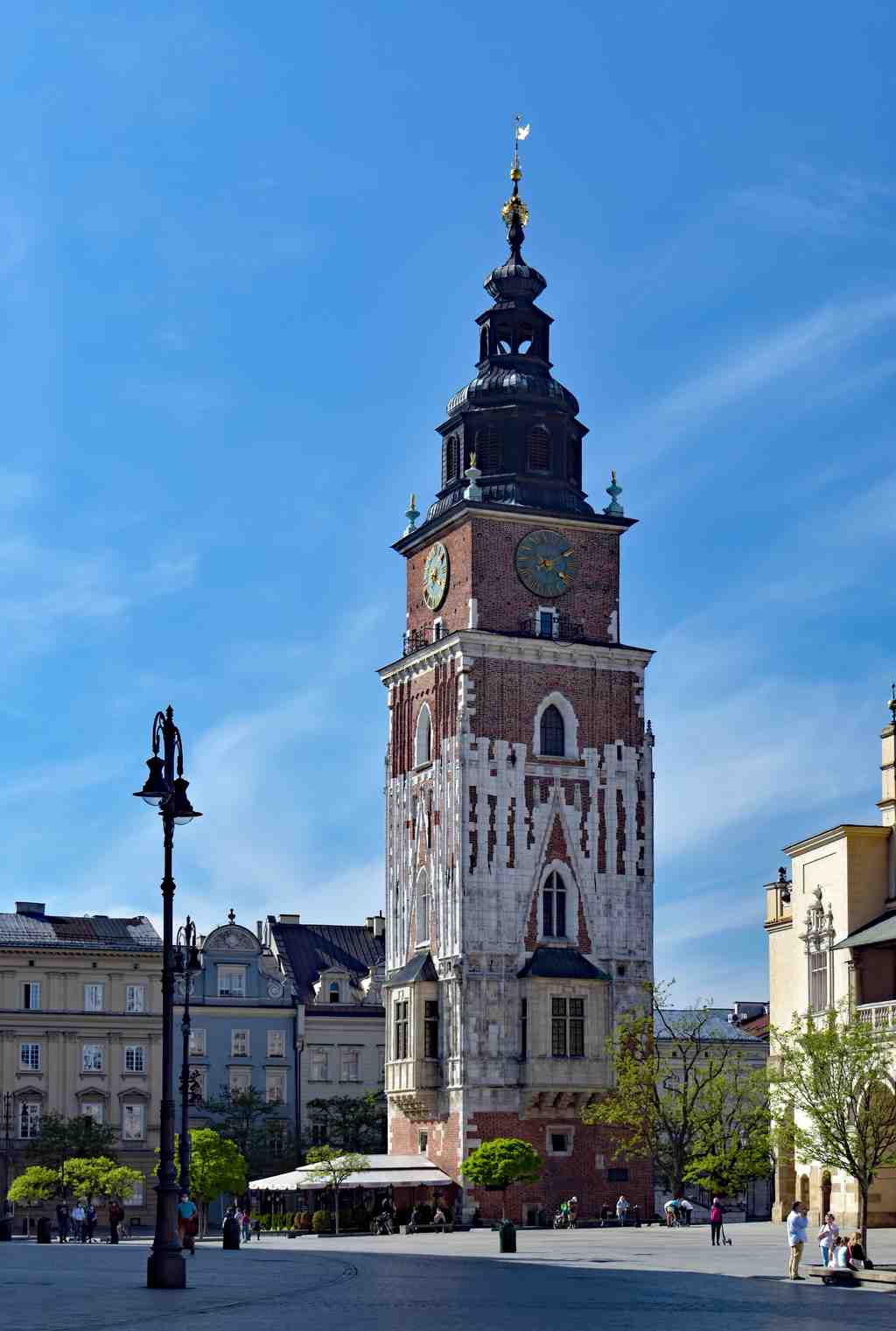
On your right stands a tall stone-and-brick Gothic tower, leaning ever so slightly, with a heavy support buttress and two stone lions guarding its entrance.
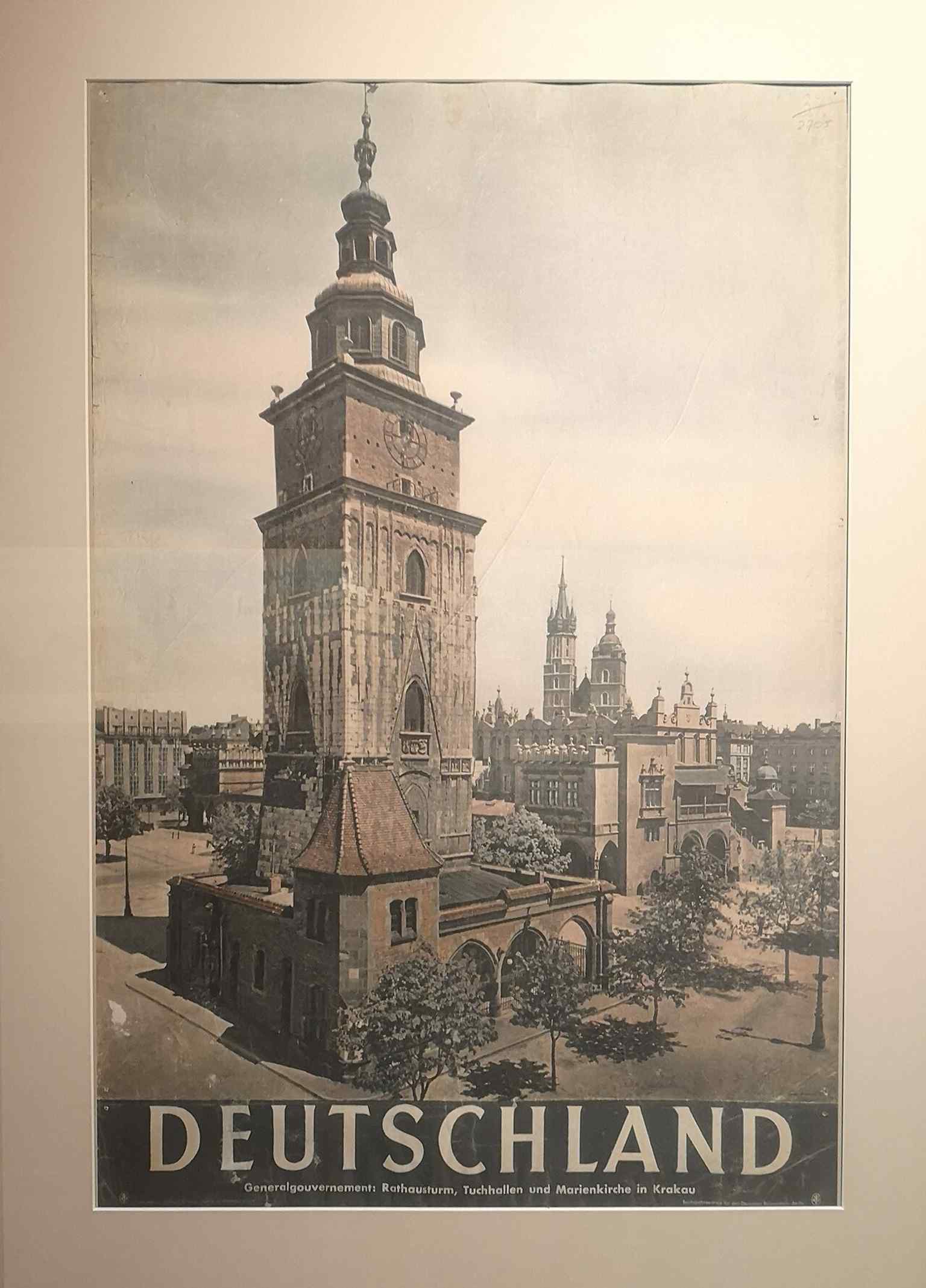
This is the Town Hall Tower, and it carries itself like the last witness left in the courtroom. Everything around it used to belong to Kraków’s old town hall, the ratusz, the seat of civic power for more than five centuries. Then, in the era of the Free City of Kraków, officials decided the square needed “improving.” That sounds tidy, doesn’t it? In city politics, “beautifying” often means somebody’s memory is about to get bulldozed.
The official story said demolition became necessary in eighteen twenty, when cracks appeared in the walls during nearby work. But the earlier plan, in eighteen seventeen, had aimed only at the adjacent granary. Those dangerous cracks gave authorities a wonderfully convenient excuse to erase the whole medieval complex and open the square into the broad space you see now.
Take a moment and look at the tower standing alone. Try to picture the missing town hall wrapped around it. The emptiness is part of the monument too.
If you want the contrast at a glance, the app image shows the tower surviving while the square around it has been remade into open space.
And the tower nearly followed its parent building into oblivion. In eighteen twenty-one, Senator Mieczysław Soczyński wrote in a newspaper that this “isolated Gothic clock” spoiled the view and deserved demolition. Imagine looking at this survivor and saying, basically, “Awful eyesore, knock it down.” Thankfully, people ignored him. That snub became one of Kraków’s early victories for preservation.
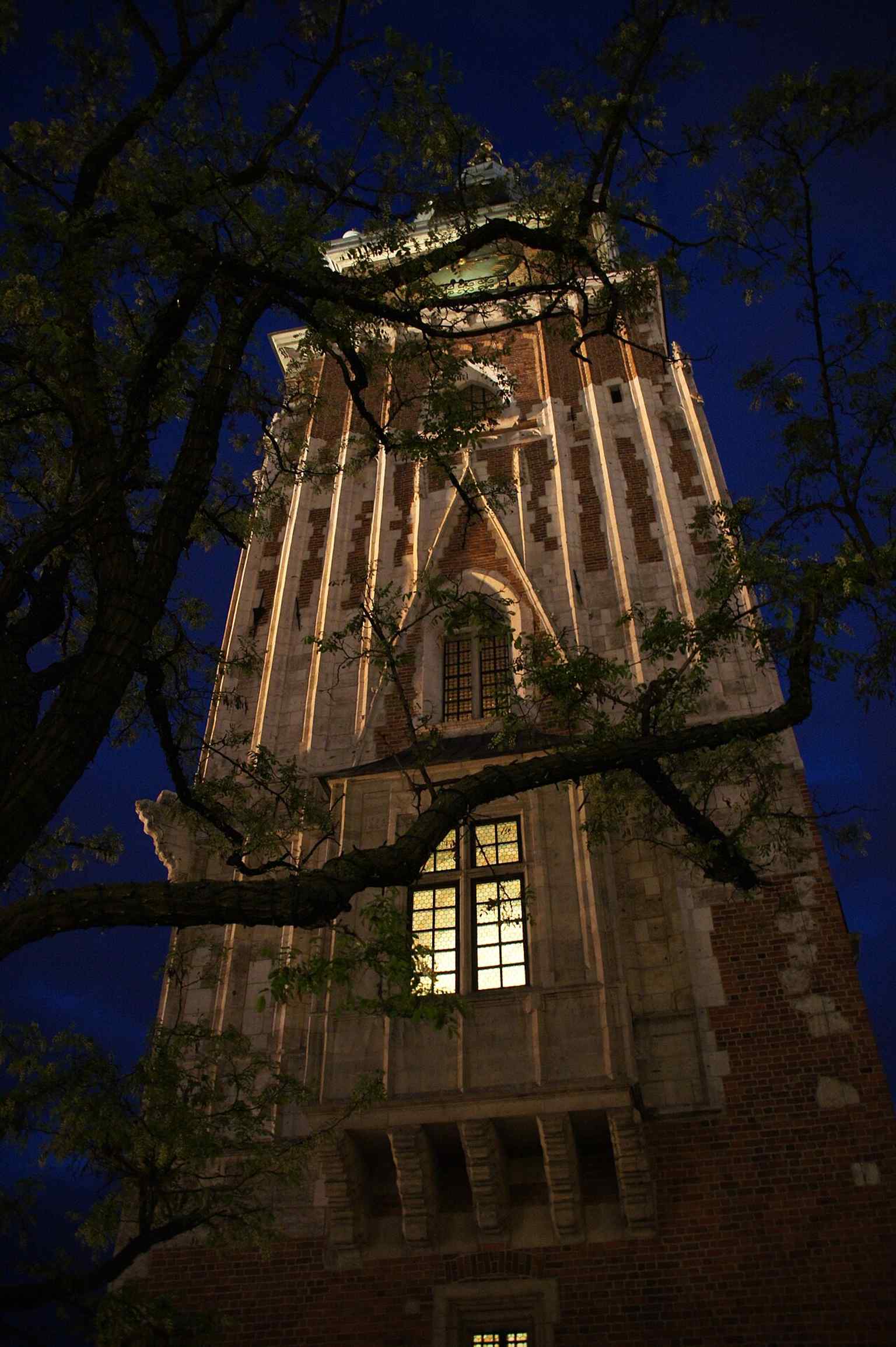
The tower itself has had a rough biography. Builders raised it at the end of the fourteenth century. Lightning struck in sixteen eighty, melted the lead roof and bells, and burned the structure down to half its height. Royal architect Piotr Beber then rebuilt it and added the huge western buttress to keep the weakened walls standing. Later, a violent storm in seventeen oh three shoved the foundations, leaving the tower with its famous lean of fifty-five centimeters. It is Kraków’s subtle answer to Pisa: less show-off, more survivor. If you glance at the low-angle photo in the app, the tilt shows up nicely there.
Now for the basement, because medieval city halls never knew when to stop. One half held the Świdnicka Cellar, a beer house so notorious for rogues and what the records delicately called “unholy wenches” that locals nicknamed it the pigsty. The other half held the prison and torture chamber. One partition separated drunken songs from screams. Those who survived interrogation met the executioner, then were taken to the Wretches’ Chapel at Saint Mary’s to make peace with God before public execution. That is Kraków in one building: merriment, authority, fear, and ritual packed together like a family argument at Thanksgiving.
Even restoration has edited this tower. In the nineteen sixties, architect and television personality Wiktor Zin reconstructed the second-floor bay windows incorrectly, permanently revising the Gothic silhouette. So this landmark does not merely preserve history; it also records the mistakes of people trying to preserve it.
It now belongs to the Historical Museum, and if you plan to go up, it is generally open Monday from eleven to four, and Tuesday through Sunday from ten to six.
When you’re ready, head toward Bracka Street, about a two-minute walk from here; we’re leaving the square for the university quarter, where memory starts taking shelter in texts and institutions. And as this tower stays behind like a witness under oath, ask yourself: is an open square a gain if the price is amnesia?