
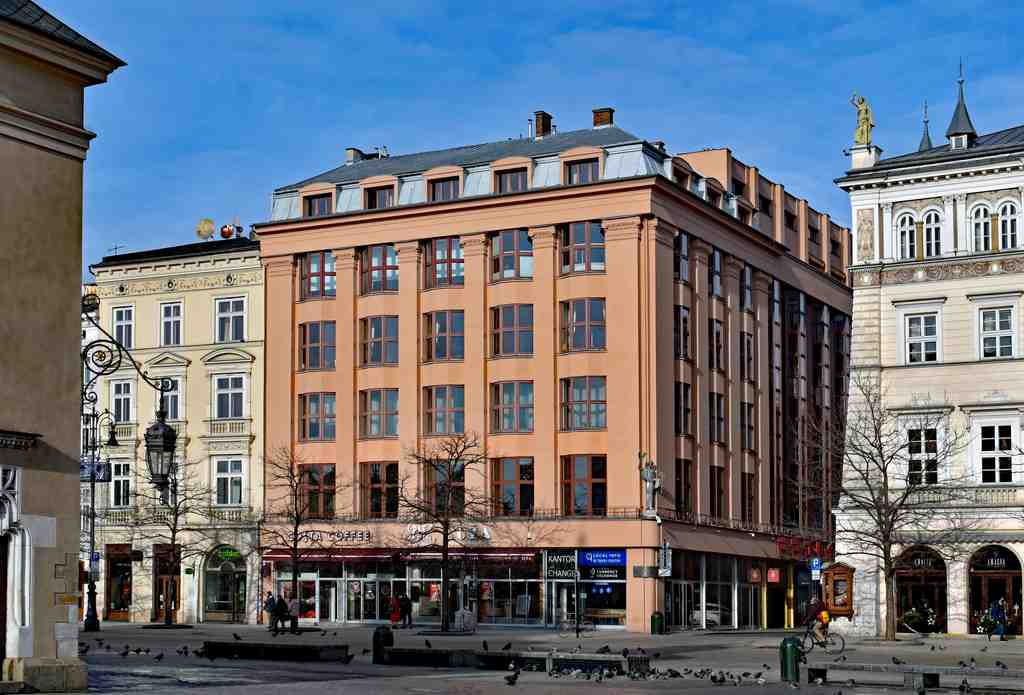
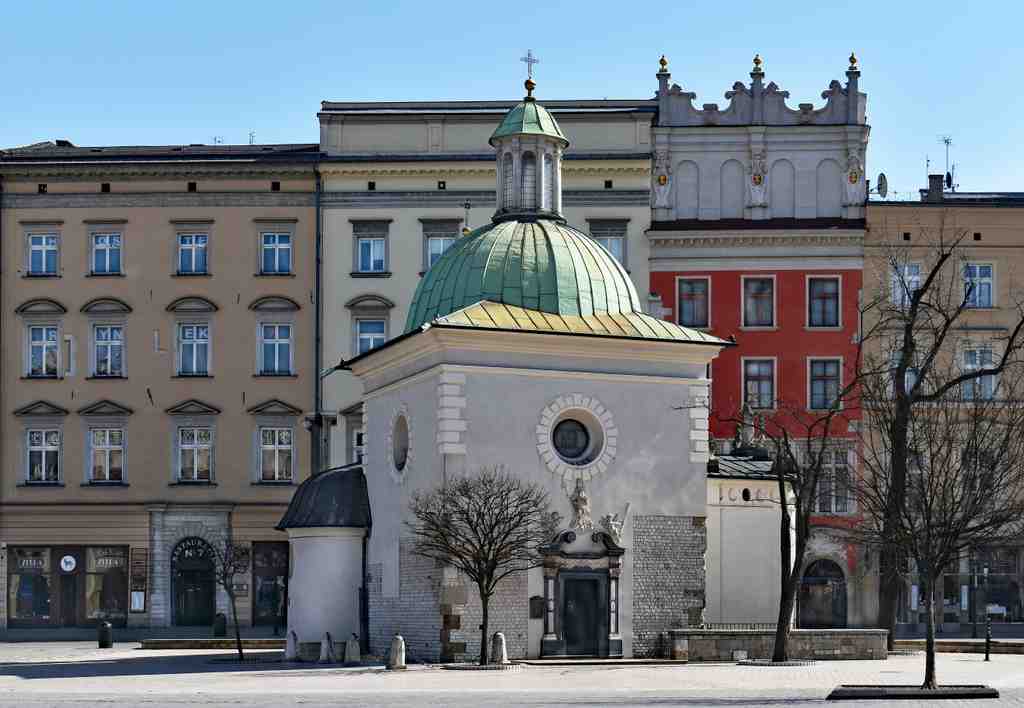
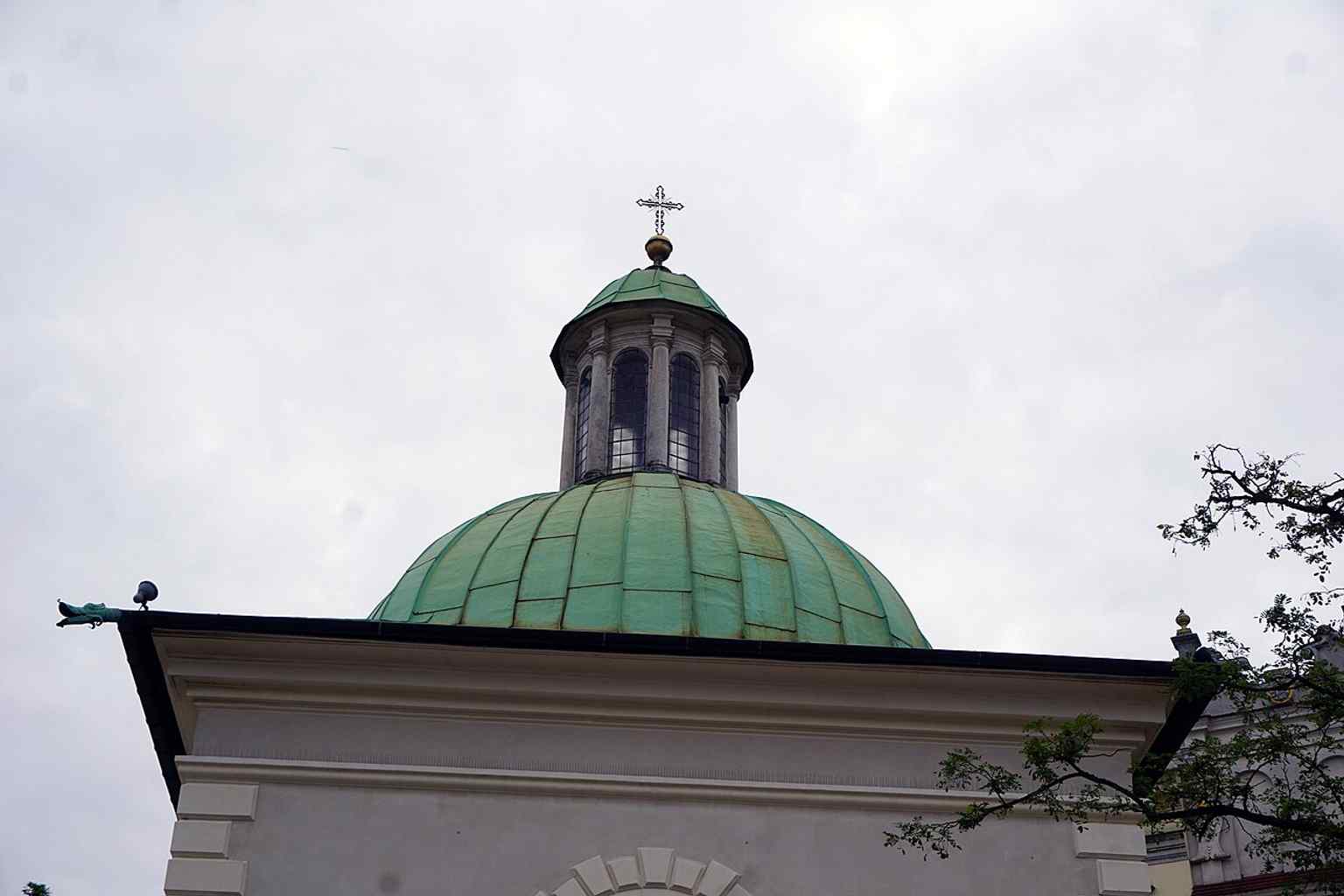
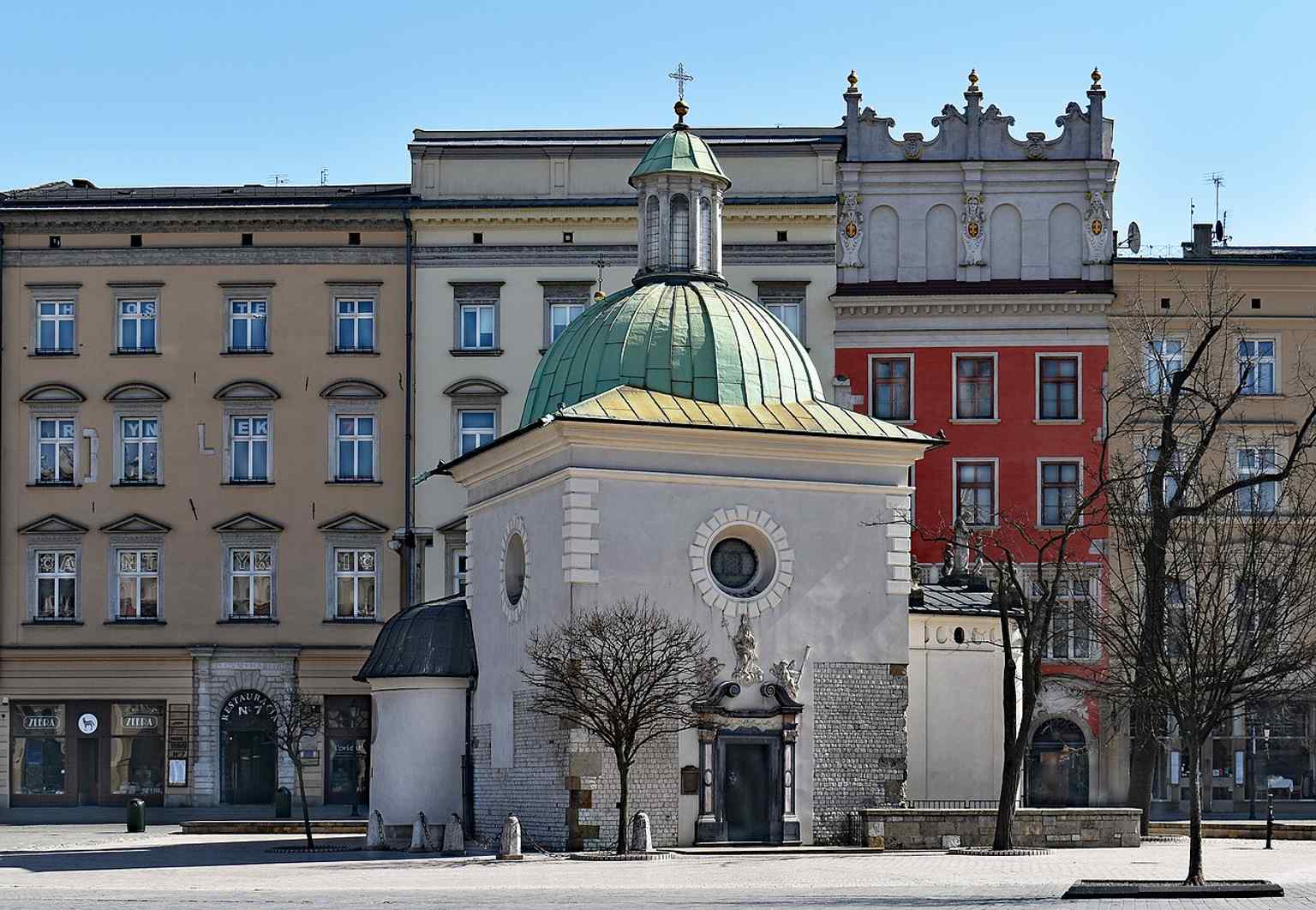
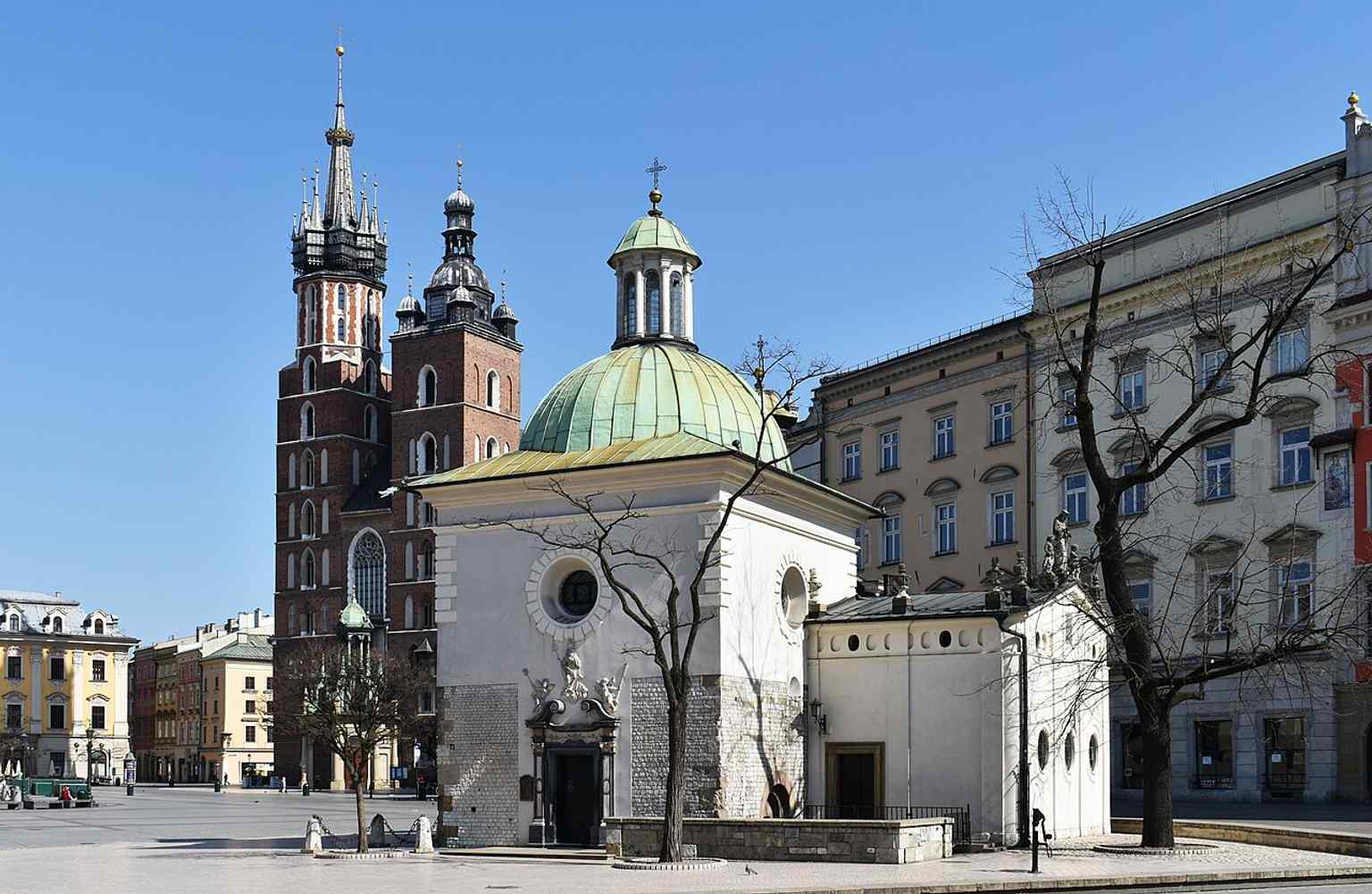
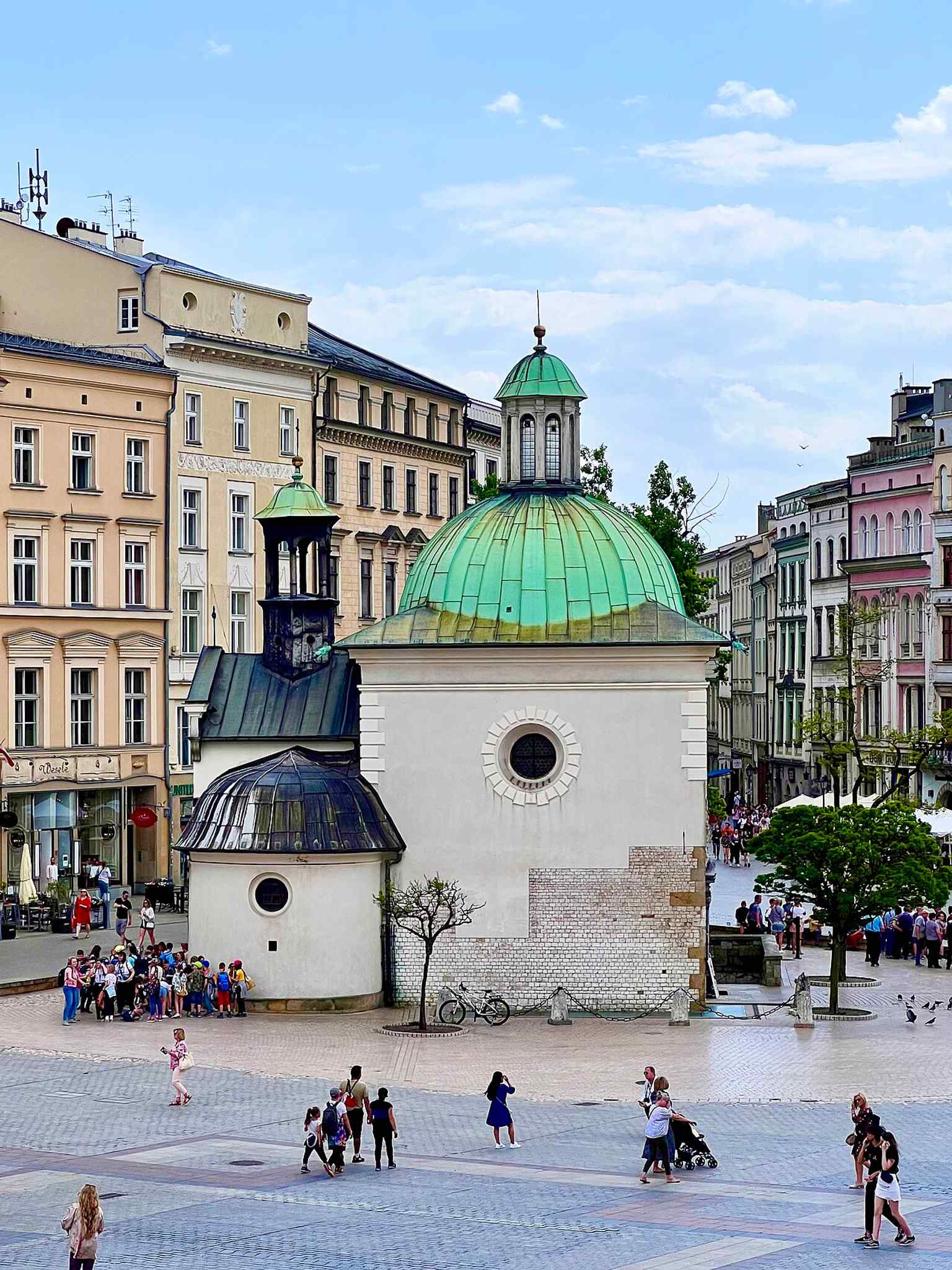
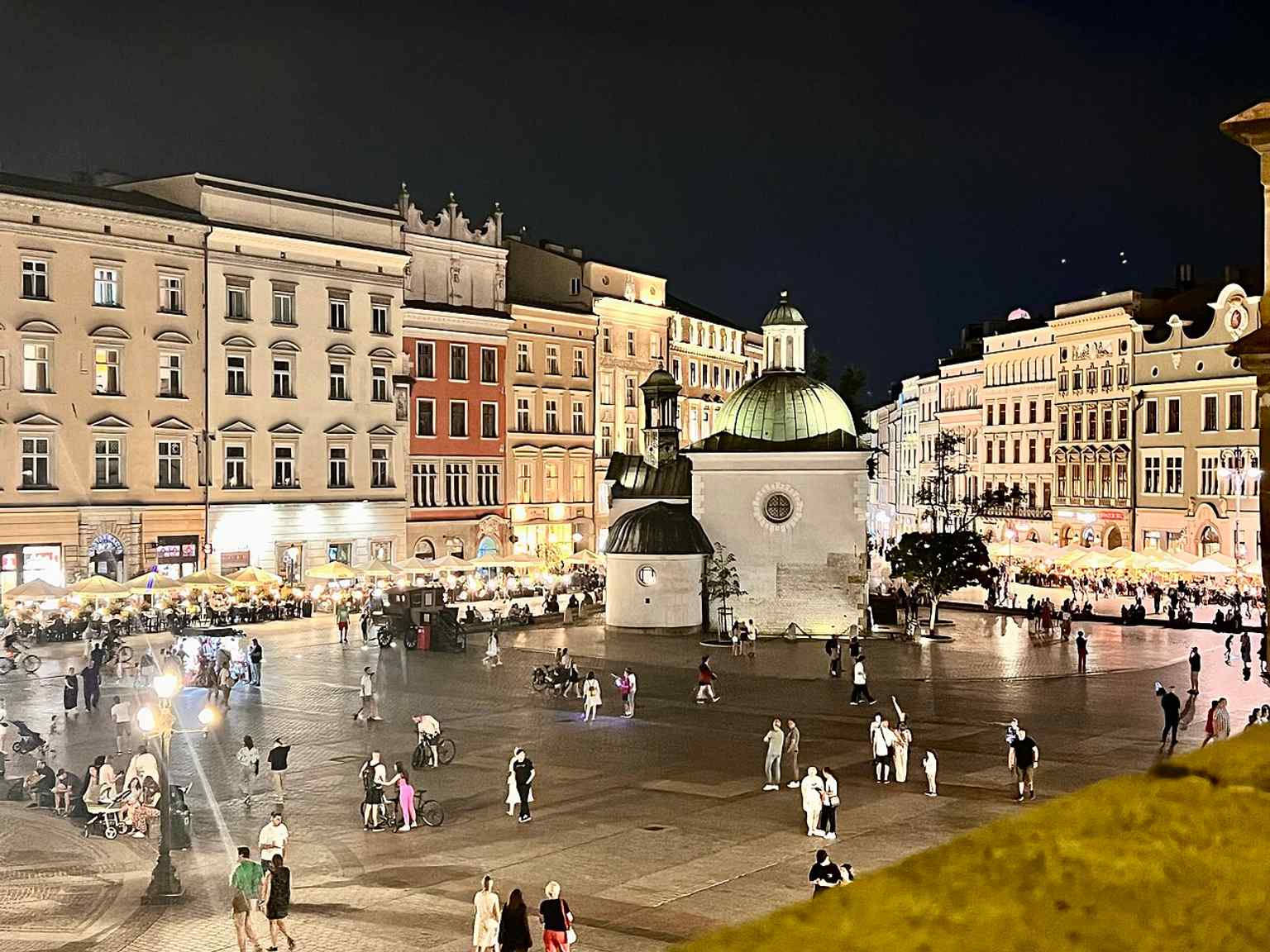
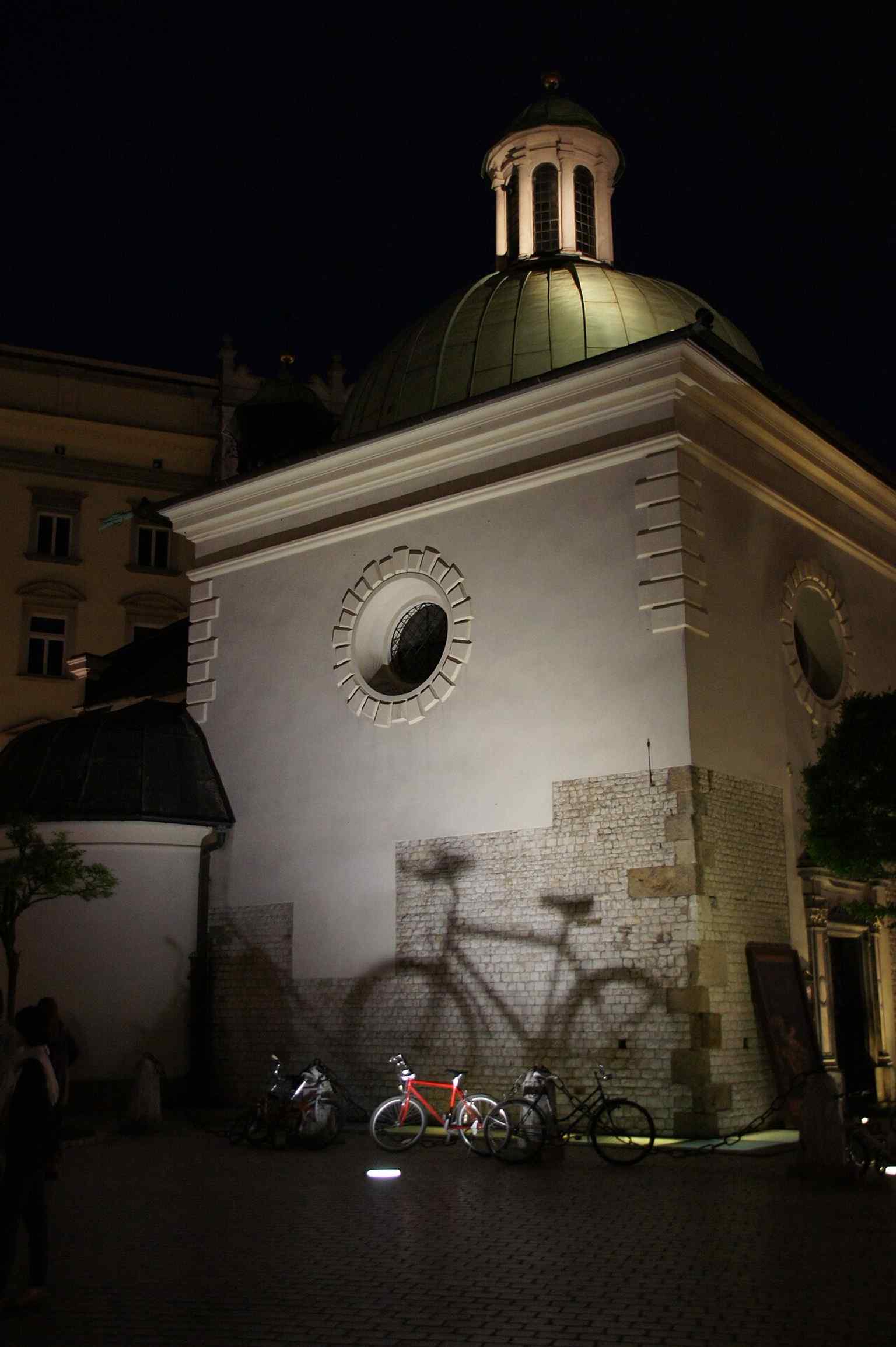
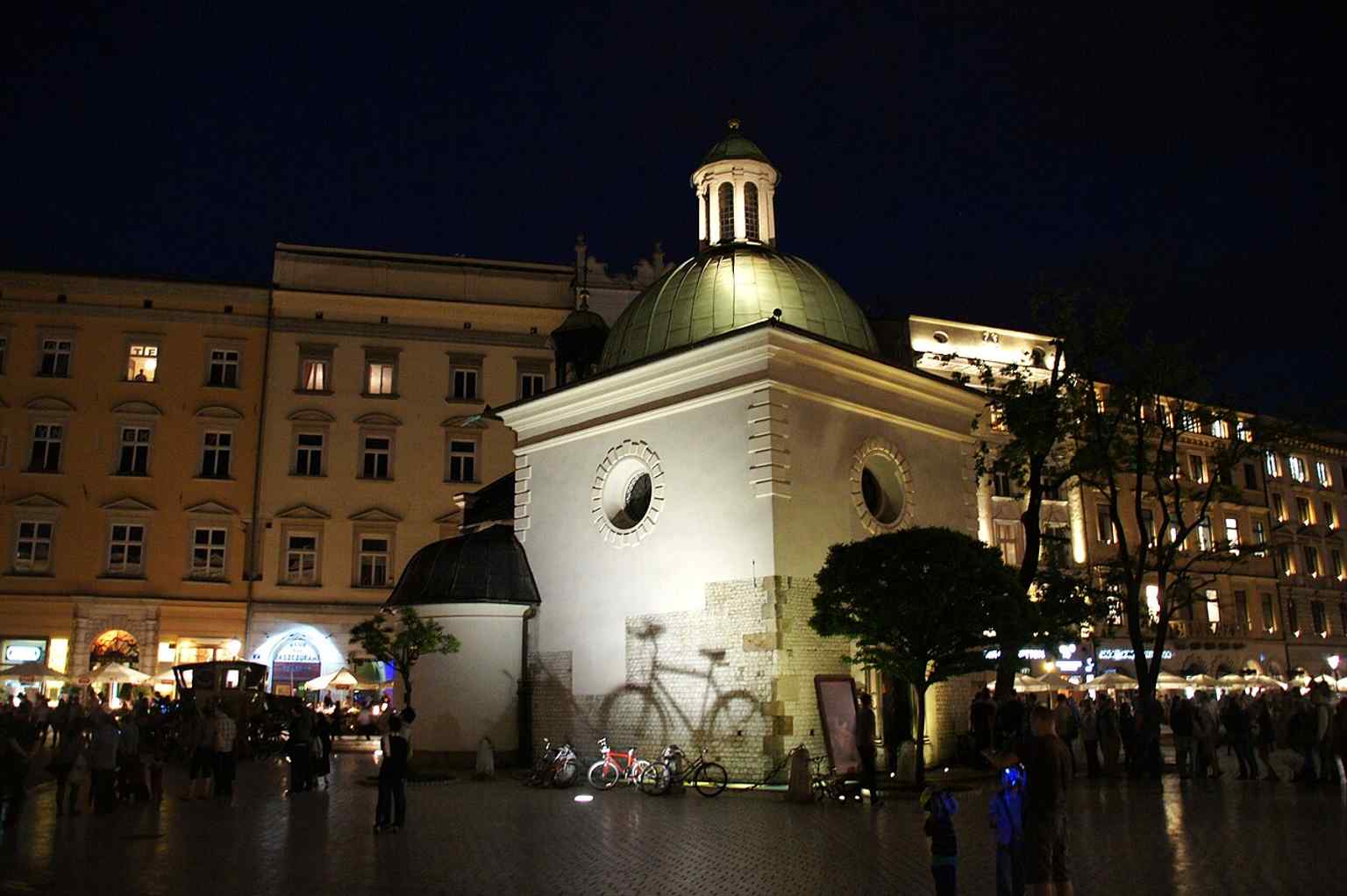
On your right, look for a small pale stone church with a rounded Baroque dome, a compact curved apse, and walls that sit noticeably low against the pavement of the square.
This is Saint Adalbert’s Church, or Saint Wojciech’s, one of the oldest stone churches in Poland, and tradition treats it as Saint Adalbert’s preaching site. The legend says he spoke here around the year nine ninety-seven, after Prince Boleslaus the Brave invited him to Poland, back when this was a crossroads of trade routes rather than the giant market square you see now. In other words, before Kraków arranged the furniture, this little church had already taken its seat.
It has the scale of a chapel, but the biography of a veteran. Merchants from across Europe stopped here to pray. Citizens and nobles met here too. If Saint Mary’s across the square is Kraków’s trumpet blast, this church is the old voice that never needed to shout.
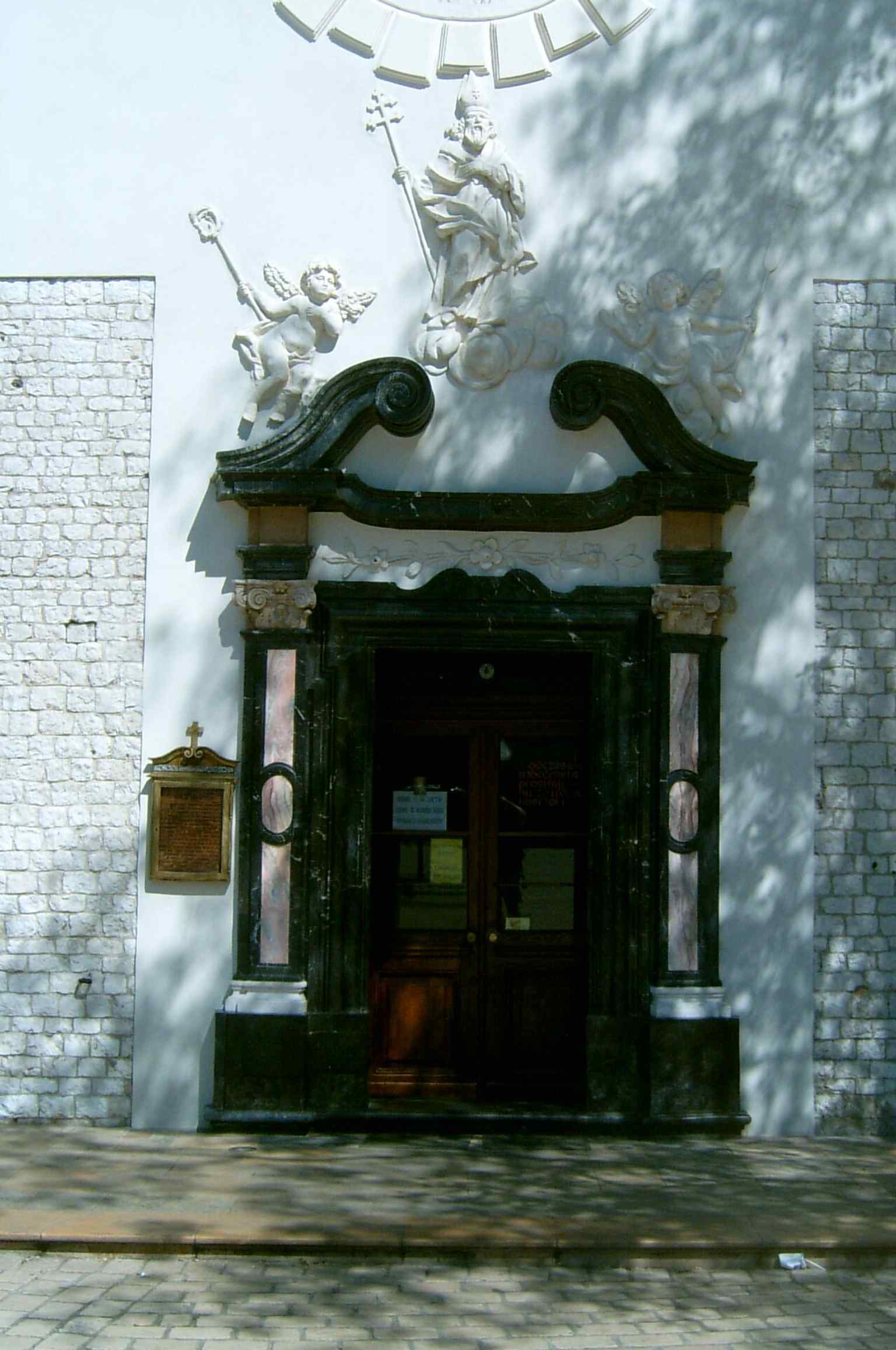
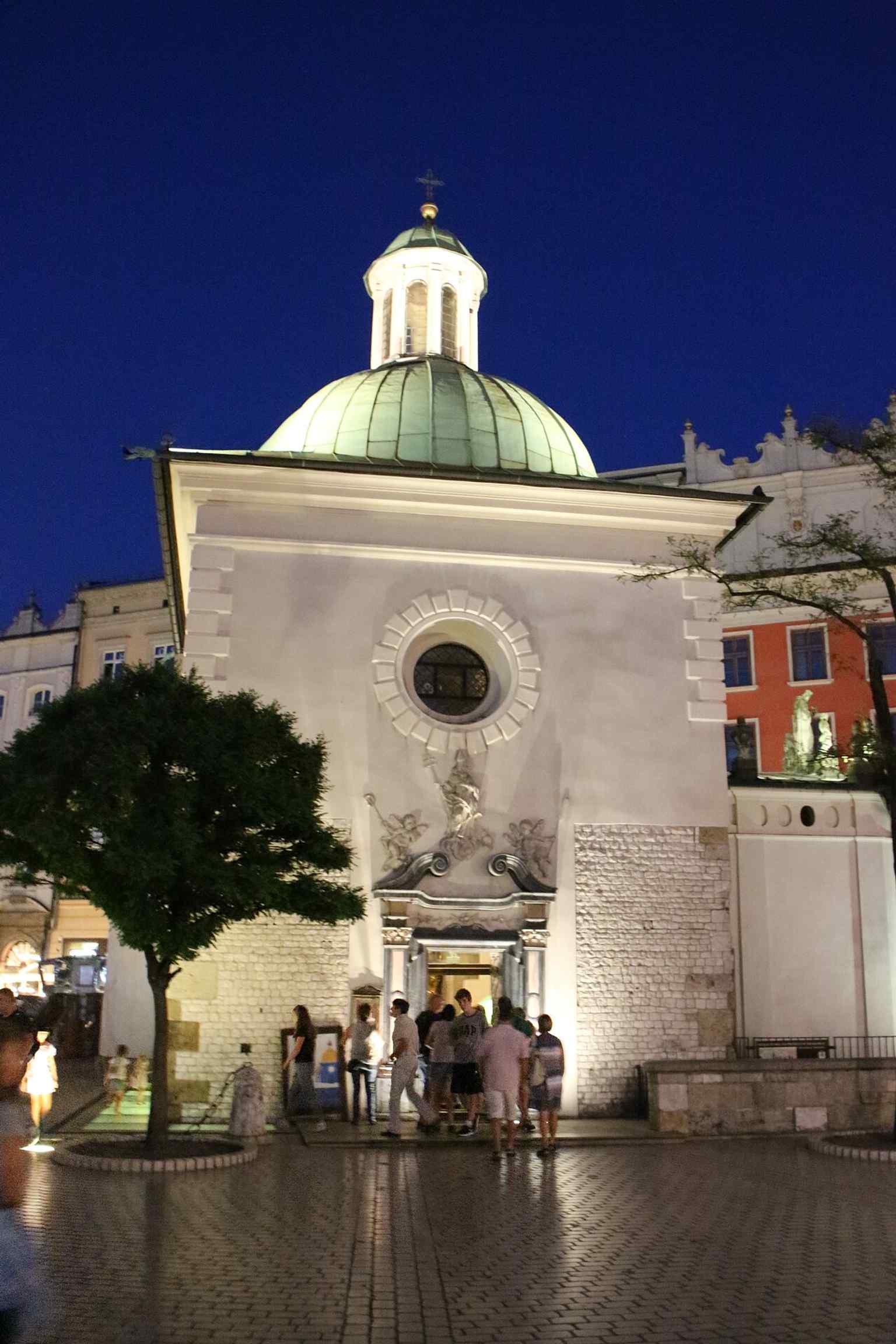
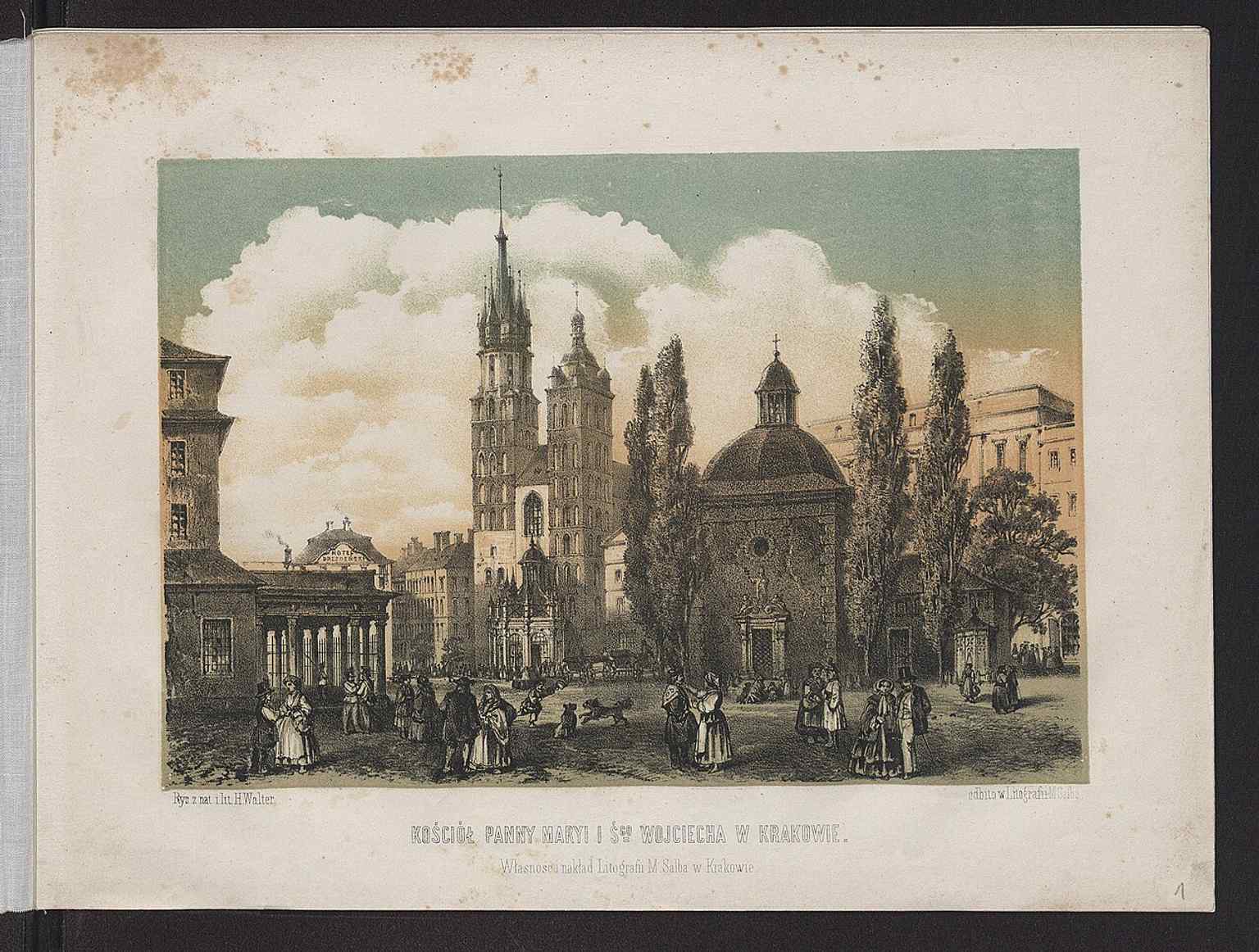
And here is the sly architectural trick the square plays on you: the church floor lies below today’s pavement. Over centuries, the market surface kept rising, layer by layer, until the old Romanesque church ended up sunk beneath the city around it. In the early seventeenth century, builders raised the walls, added stucco, cut a new western entrance, and crowned it with that Baroque dome. So the building you see is both older and younger than it looks, which is a very Kraków move.
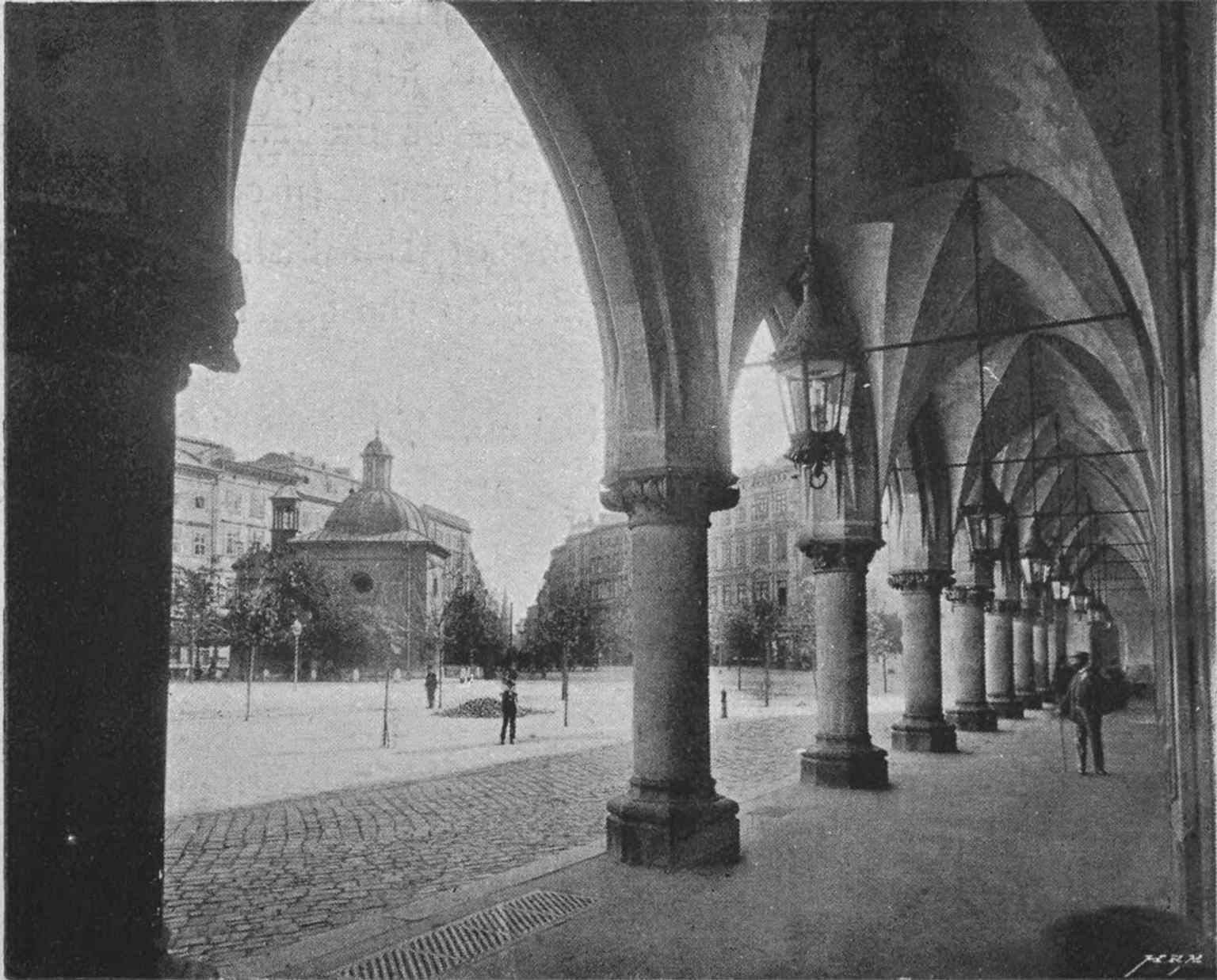
If you want, peek at the before-and-after image; nearly a century changes the whole market scene, but this little church barely seems to blink. Most tourists miss one of the best parts of the story. In fourteen oh four, Bishop Piotr Wysz Radoliński gave the church to the university as a prebend, meaning its income supported a church post tied to scholars and clergy. So this was not only a neighborhood shrine. It became part of Kraków’s academic brain as well as its praying heart. Tiny church, very impressive résumé.
Then in fourteen fifty-three, Cardinal Zbigniew Oleśnicki and King Casimir the Fourth brought the Franciscan preacher John Capistrano here. Imagine the scene: a celebrated reforming friar, crowds pressing close, sermons pouring out into a square already used to commerce and argument. Preaching, teaching, bargaining, governing, all of it rubbing shoulders at one corner.
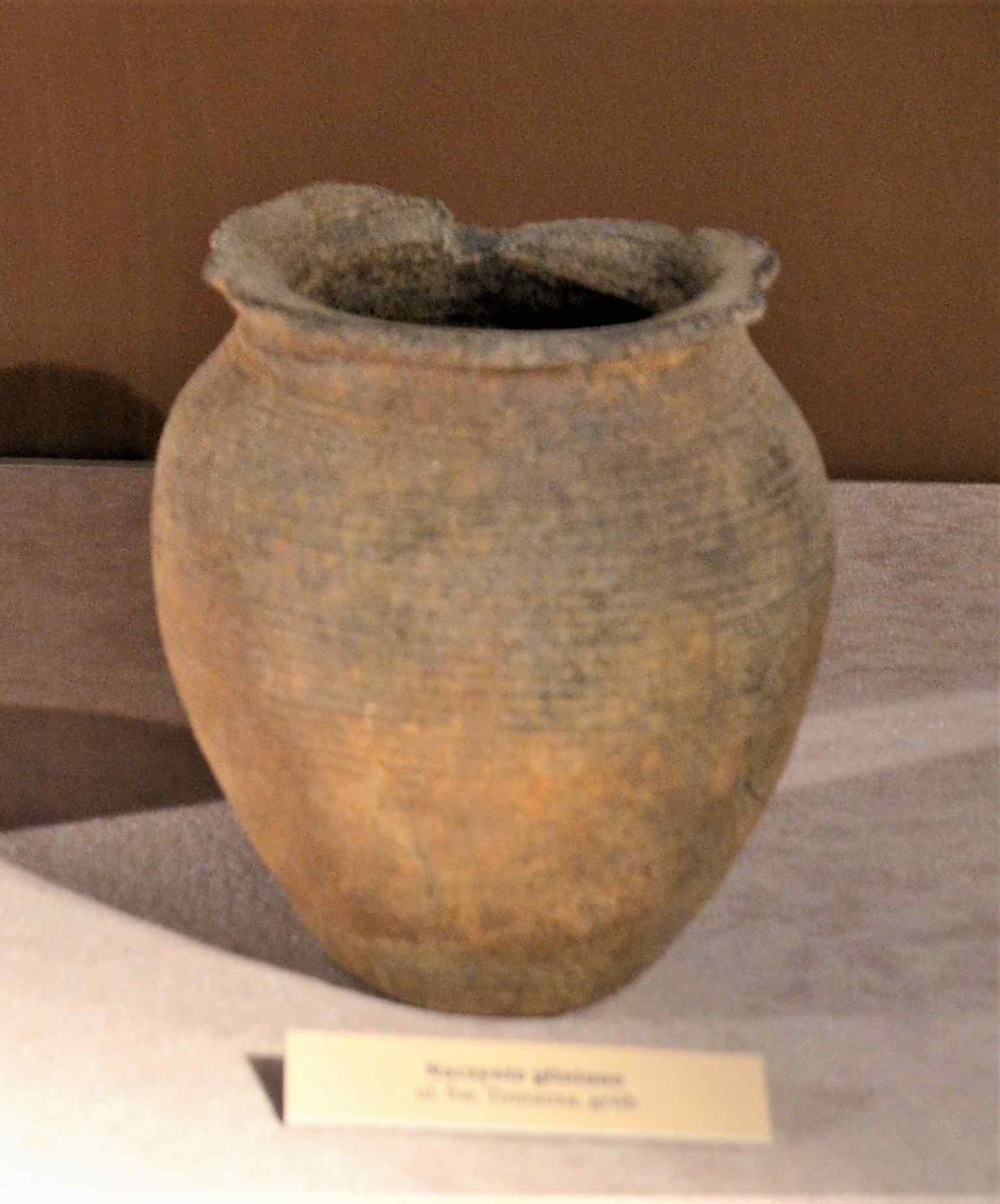
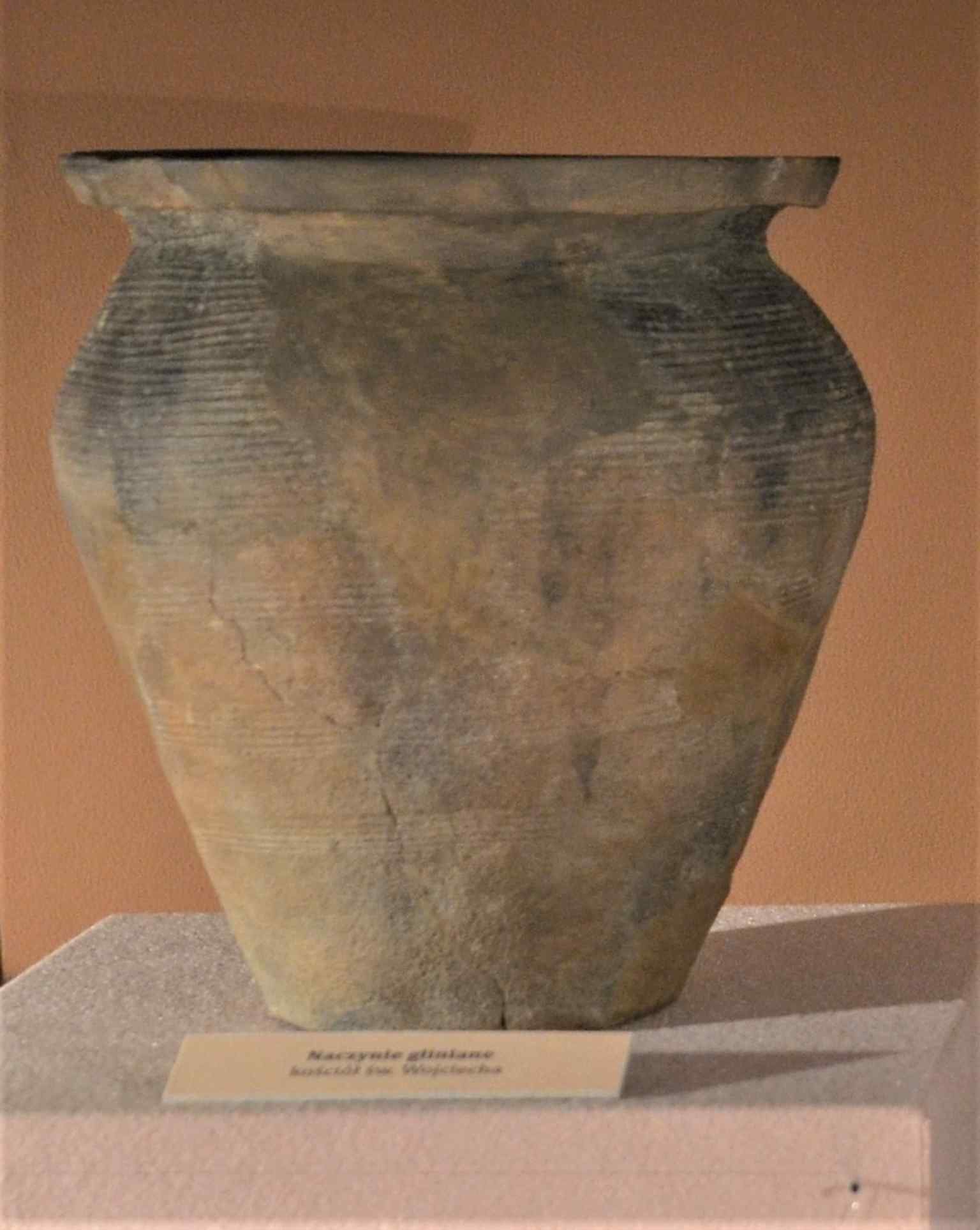
Nineteenth-century repairs peeled back the plaster and revealed the Romanesque core hidden underneath. Archaeologists later found traces of even earlier wooden churches from the late tenth century, plus a nearby cemetery. So beneath your feet lies not one moment, but a stack of them: timber, stone, graves, pavement, memory.
If you glance at the app image of the portal, you’ll see one of the oldest survivors here, a plain Romanesque doorway with the stubborn simplicity of the first church. Even now, this is still a living church. People step in from the clatter of the square to pray, and the door opens almost straight back into city noise. That may be its most honest lesson: voices break, sermons end, streets change, but some places keep receiving them all.
Next, we leave sacred continuity for its civic counterpart: a tower that survived after the rest of its building vanished. Head on to the Town Hall Tower, about two minutes away.






.jpg)
%2C%202%20Main%20Market%20square%2C%20Old%20Town%2C%20Krakow%2C%20Poland.jpg)
%2C%202%20Main%20Market%20square%2C%20Old%20Town%2C%20Krakow%2C%20Poland.jpg)


.jpg)
%20Early%20medieval%20pottery%20from%20Krak%C3%B3w%2C%20Saint%20Adalbert%20church.jpg)
