
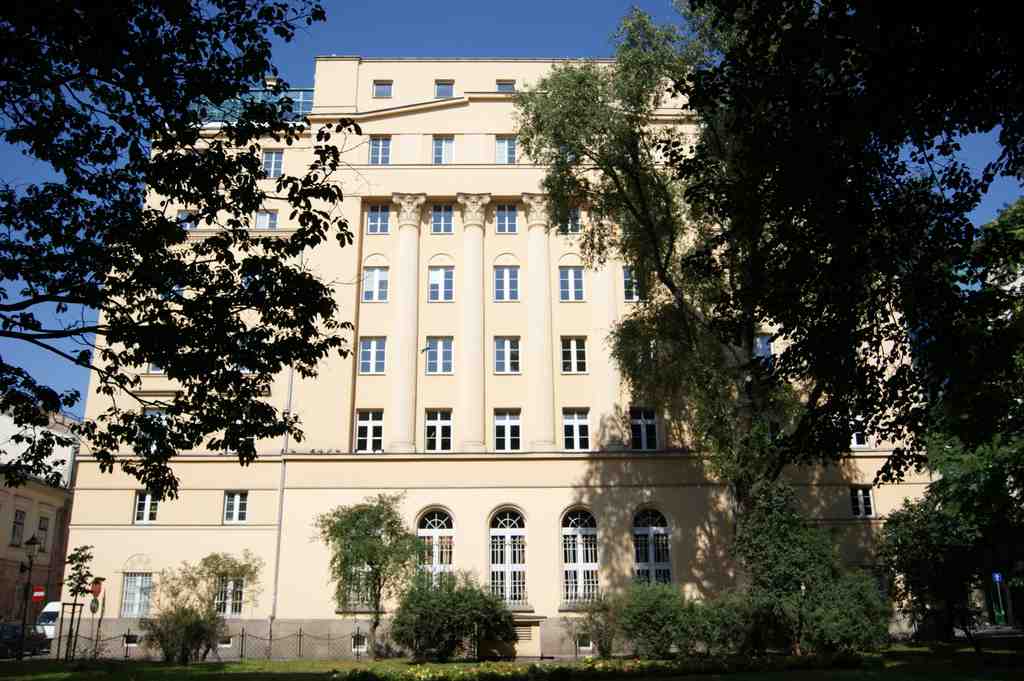
Look for a pale stone facade with a tidy grid of rectangular windows and a formal central entrance marked with the academy’s name.
Here, at the Krzysztof Penderecki Academy of Music, Kraków begins our walk not with trumpets and fanfare, but with something tougher: persistence. This is a conservatory, a higher school devoted to music, and it stands for a very Kraków habit of mind. When power tried to silence culture, people simply carried it by hand, by memory, by lesson, by whisper.
That is where our thread starts: interrupted voices. In this city, voices were cut off by empire, occupation, censorship, and war, yet they did not vanish. They changed rooms. They lowered their volume. They waited for the door to close and then began again. Kraków has always known that survival is sometimes less about shouting than about refusing to forget the next note.
The school itself began in eighteen eighty-eight, when the composer Władysław Żeleński pushed it into existence with help from Princess Marcelina Czartoryska, a concert pianist who had studied with Frédéric Chopin. That alone feels wonderfully Kraków: a composer, a princess, and a mission. Because Poland was partitioned at the time, Żeleński had to satisfy Austrian imperial rules before he could even open the place. Two professors from the Vienna Conservatory, Joseph Dachs and Johann Fuchs, came to inspect it. Imagine them arriving with stern faces and professional suspicion, the academic version of customs officers. Instead, they gave the plan an enthusiastic approval.
Then came the darkest break. On the fifth of February, nineteen forty, Gestapo units shut Kraków’s music schools, including this one. The conservatory did not stop; teachers continued clandestine classes, turning music lessons into acts of quiet defiance. A scale, a chord, a page of notation, none of it looked like a weapon, which is precisely why it mattered.
After the war, Professor Zbigniew Drzewiecki helped restart the school almost from scratch. And the first postwar teachers were not some imported glittering elite. They were working musicians from the Kraków Philharmonic: flutist Wacław Chudziak, trumpeter Ludwik Lutak, and percussionist Józef Stojko. That detail tells you everything. The city stitched the academy back together with the people already holding its sound in their hands.
Later, Krzysztof Penderecki studied here, then returned as rector for fifteen years, guiding the academy through the late communist era while keeping unusual independence and reopening links with the wider world. By the nineteen seventies, the school even launched an electronic music studio, one of Poland’s earliest major centers for composing with analog sound equipment. So this place guarded old traditions and experimented wildly at the same time, which is a neat trick and, frankly, a very musician move.
Its alumni include two winners of the International Chopin Competition, Halina Czerny-Stefańska and Adam Harasiewicz, the only Polish academy that can make that boast without blushing. In two thousand and twenty-one, the institution formally took Penderecki’s name, becoming one of the first Polish music academies to do so.
So stand here a moment with that thought: if music could survive in secret, what else in Kraków survived by passing quietly from person to person? We’ll carry that question to Saint Florian’s Gate, about a six-minute walk from here. If you want to return later, the academy generally keeps long hours, from early morning into the evening, with shorter hours on weekends.




