
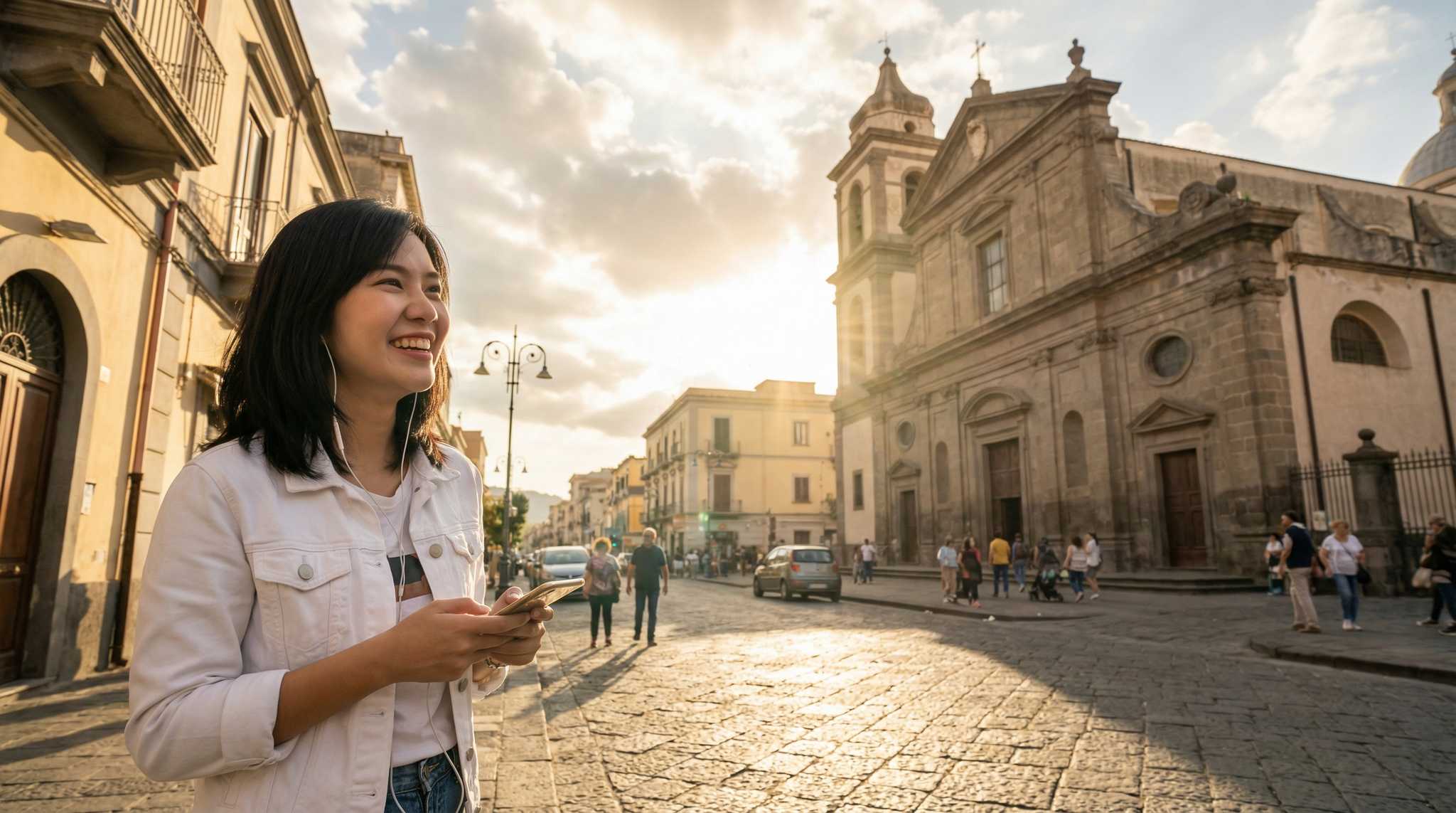
Visite audio de Naples : Basiliques cachées et places oubliées
Il y a des siècles, les pierres de Naples résonnaient des cris de révolte, des secrets chuchotés dans les cours ombragées et des prières silencieuses des exilés cherchant refuge. Cette visite audio autoguidée vous plonge au cœur méconnu de la ville. Traversez des ruelles, des sanctuaires sacrés et des places historiques rarement remarquées par le voyageur pressé. Écoutez des légendes oubliées et découvrez l'histoire cachée sous la surface vibrante de la ville. Comment une seule nuit de rébellion sur la Piazza del Mercato a-t-elle remodelé Naples pour toujours ? Quel mystère non résolu plane dans la crypte sous la Basilique Sanctuaire de Santa Maria del Carmine Maggiore ? Qui était cette figure non conventionnelle aperçue quittant l'église de Sant'Anna alle Paludi à minuit et quel étrange secret portait-elle ? Serpentant à travers de grandes places et des chapelles silencieuses, ce voyage éveillera vos yeux et votre esprit. Préparez-vous au drame, à l'intrigue et au parfum du Naples d'antan qui se révèle pas à pas. Commencez à écouter maintenant et découvrez les échos que l'histoire a laissés derrière elle.
Aperçu du tour
À propos de ce tour
- scheduleDurée 40–60 minsAllez à votre propre rythme
- straightenParcours à pied de 3.8 kmSuivez le sentier guidé
- location_on
- wifi_offFonctionne hors ligneTéléchargez une fois, utilisez n'importe où
- all_inclusiveAccès à vieRéécoutez n'importe quand, pour toujours
- location_onCommence à Piazza Garibaldi
Arrêts de ce tour
You’ll know you’ve arrived at Piazza Garibaldi when you see a wide-open plaza covered by striking modern canopies made of steel and mesh, just in front of the large Napoli…Lire plusAfficher moins
You’ll know you’ve arrived at Piazza Garibaldi when you see a wide-open plaza covered by striking modern canopies made of steel and mesh, just in front of the large Napoli Centrale train station and surrounded by rows of historic buildings-look up for the geometric metal structures stretching overhead! Now let’s dive right into the heart of Naples-welcome to Piazza Garibaldi! Stand still for a moment and just listen: the city hums all around you, taxi horns mixing with the laughter of travelers and the rolling suitcases making their own sort of urban symphony. It’s no wonder this spot is always buzzing-with so many people coming and going, it almost feels like you’re inside a giant living clock, each second marked by the arrival or departure of a train, tram, or bus. But this energetic square wasn’t always the city’s grand crossroads. After the unification of Italy, the new railway station was built along what was then called the Street of Ditches-yes, it doesn't sound very glamorous, does it? Soon, the area became vital to the city, and people started calling it everything from Station Square to Railway Square. Imagine back then-old steam trains, porters running, and passengers dressed in their finest, all converging right here, a tornado of hats and mustaches! In 1891, the city decided this plaza deserved a name just as impressive as its growing crowds. So, they named it after Giuseppe Garibaldi, the “Hero of Two Worlds,” whose dramatic statue-you’ll spot him if you look left-reminds everyone of those wild days when Italy was being stitched together, piece by passionate piece. But what’s really wild is how the face of Piazza Garibaldi has changed! In the 1960s, the old train station was demolished in a cloud of dust and hope, and a striking new station took its place, set farther back to give the plaza room to breathe. That famous pyramid-shaped roof-that’s the handiwork of Pierluigi Nervi and Bruno Zevi. The whole square was turned into a hub for not just trains, but also buses, trams, and taxis-a bit like the city’s own transportation circus. There even used to be a huge bus canopy called “the proboscis,” but don’t bother looking for it, it was demolished in 2000. And today? Oh, what a transformation! Thanks to architect Dominique Perrault’s recent renovations, the northern side has become a kind of urban woodland, complete with an amphitheater and places to rest or play-like a green secret tucked behind the traffic. If you wander to the southern part, there’s a sleek underground gallery full of shops and sparkling life, sheltered by futuristic, semi-transparent canopies. So take in the bustle, feel the pulse of Naples beneath your feet, and remember-you’re standing where millions of journeys begin and end, every single year. Don’t be surprised if you suddenly get the urge to hop on a train and invent an adventure of your own… but for now, stick with me-the tour’s just getting started!
Ouvrir la page dédiée →To spot the Church of Sant'Anna alle Paludi, just look for the cream-colored building with a classic triangular pediment and a white dome peeking out behind, nestled right up…Lire plusAfficher moins
To spot the Church of Sant'Anna alle Paludi, just look for the cream-colored building with a classic triangular pediment and a white dome peeking out behind, nestled right up against the surrounding apartment blocks on Corso Arnaldo Lucci. As you stand in front of the church today, it's hard to imagine that this spot was once swallowed by marshes, full of water, mud, and the buzzing of insects rather than the roaring of Naples’ traffic. Picture it: centuries ago, this was the wild countryside outside the city walls, a place where only the bravest gardeners-or “hortolani”-would dare to tread. The church itself was first built before 1350, and back then you’d need a sturdy pair of boots just to get to the front door without losing a shoe in the muck. But don’t worry, I doubt you’ll get your feet muddy now-unless you have a serious tripping issue! This neighborhood, called le Case Nuove, was once open country, dotted with farms and then, by the 19th century, factories and new apartment buildings. When they raised this main road in the 1800s, the poor church ended up a full five meters below street level. Talk about being down in the dumps! So, they built new steps and entrance ramps, and by the early 1900s, lifted the whole building up to meet the modern world. If church buildings could groan from being stretched, I bet this one would have made a sound! The inside is a single long nave, simple at first glance but with a neobaroque dome bursting with elegant decorations-the only part finished according to Alfredo Belli’s late 1800s designs. The marble altar gleams from 1710, and at its center is a charming bass-relief: Madonna and Child, surrounded by stories told in old golden oil triptychs. One masterpiece catches everyone’s eye: Andrea da Salerno’s painting of Madonna delle Grazie, kept right on the altar she protects. But let’s talk about devotion-because, in these parts, people aren’t just visitors but family to this church. The star of the show is the famous wooden statue of Sant’Anna with the Child Mary, carved with remarkable detail, right down to Sant’Anna’s powerful veined hand. Legend says it wasn’t originally made for this church, but around 1825, records show it arriving here-maybe guided by a higher power, or possibly just a very strong delivery man. The statue itself is surrounded by stories as rich as the carvings. One day, after the Battle of Ponte della Maddalena, a weary farmer named Nicolino stumbled into these soggy lands. Suddenly he sees a little girl in distress, her mother caught in the mud. Rushing to help, he finds not a woman, but a statue, clutching the very child who’d pleaded for help. The statue then speaks (Naples is magical like that!) and tells him to carry her to this very church, promising protection for all “paludani”-locals of the marsh. Maybe next time you lose your umbrella, think twice before digging around here-there might be another saintly artifact waiting for a dramatic entrance! There are more tales. They say Sant’Anna is the most beautiful wooden sculpture ever chiseled by Neapolitan hands-a friendly rival to those in other famous churches. Her statue traveled the streets every year in a grand festival, carried high through the neighborhood by teams of devoted bearers, through a crowd hungry for blessings and, of course, for the famous “pagnottiello”-stuffed bread originally baked for Sant’Anna’s special Tuesday. I'm warning you: if you catch a whiff of fresh bread around here, follow your nose! Over the centuries, some remarkable people have crossed this threshold. King Alfonso I of Aragon prayed here in 1438, so determined to get some divine help during his siege of Naples that he stayed put even when his brother was struck down by a cannonball just outside. He declared the church “Royal," and left with a very dramatic story to tell at dinner. Enrico Caruso, the legendary tenor, first sang his heart out here as a child. During a funeral, his mighty voice caught the ear of a local baritone, and in a plot twist worthy of an opera, he was introduced to his first music teacher right here. And Mario Merola, the king of the Neapolitan “sceneggiata,” gave his very first public performance on this church’s festival stage-it’s literally the birthplace of local legends. This church saw saints, singers, soldiers, and even the notorious bandit Pilone, who kept a picture of Sant’Anna in his pocket for luck-though it didn’t quite help him out of his tight spots. Add in a few legends about lost daughters, miraculous coins falling from saintly hands into the desperate palms of young girls, and you’ve got a place where faith, fate, and the very best of Neapolitan storytelling come together. So take in the simple lines, the bustling noise of the street, and imagine all the feet-muddy or polished-that have crossed this threshold, bringing with them hope, heartbreak, and maybe a song or two. To delve deeper into the description, the simulacrum of sant'anna alle paludi or the the cult of sant'anna, simply drop your query in the chat section and I'll provide more information.
Ouvrir la page dédiée →To spot the Castle of Carmine, look for the sturdy stone walls and tall cylindrical towers hugging the curves between the open sea and the city-just ahead of you, where old Naples…Lire plusAfficher moins
To spot the Castle of Carmine, look for the sturdy stone walls and tall cylindrical towers hugging the curves between the open sea and the city-just ahead of you, where old Naples meets the busy streets. Welcome, traveler, to the site where history was built brick by brick, stone by stone, and possibly a bit of medieval sweat! You’re standing where the mighty Castle of Carmine once rose, a fortress so tough even the wind seemed to salute it. Picture the year 1382-King Charles III of Durazzo didn’t just want a castle, he wanted a fortress at the very edge of Naples, right where marshes, danger, and mystery all mingled. So here, at the southern tip of the city walls, with the smell of seawater and mud from the old Palus Neapolitana, the castle was born for one purpose: pure defense. If you close your eyes, you might imagine the clank of armor or the distant splash of the waves. The Castle of Carmine didn’t care for luxury-no grand mythic thrones or sparkling dance halls here. Instead, it grew two powerful round towers, one towering keep, and thick, angle-tipped walls, all sculpted from dark piperno stone. This wasn’t a castle to sip wine in; this was a castle to defend your kingdom with! And defend they did! Imagine the chaos just four years into its lifetime when battle erupted right outside-Louis II of Anjou battling Ladislao of Durazzo under the watchful eye of these stone towers. The smells of fire, the beat of hooves, the sound of swords-history in surround sound! But the excitement didn’t end there. Flash forward to the days when Alfonso V of Aragon besieged the gates, his troops charging while his brother Pietro fell in battle, the walls echoing with strategy and sorrow. Over the centuries, the castle shape-shifted as kings dreamed up new defenses. In 1484, King Ferdinand I ordered mighty architect Francesco Spinelli to make the castle even tougher, wrapping it in new walls and immortalizing his work with a proud stone plaque. Floods in 1512? No problem! The main tower was rebuilt square, standing firm against both water and war. During Masaniello’s fiery revolt, a man named Gennaro Annese turned these rooms into his personal headquarters, plotting revolution while the streets outside crackled with unrest. The story grows even richer-here, the “Serenissima Real Repubblica Napolitana” was proclaimed, though it lasted about as long as an Italian coffee break. Conspirators plotted, Austrians loomed, the French under Championnet stormed in 1799, and Garibaldi’s red-shirted fighters clashed desperately to hold the city. But as times changed, so did the fortress. In 1906, to modernize Naples, the grand old castle was demolished. Where its walls once stood rose the Giacomo Sani barracks, baking bread for soldiers instead of bracing for war. Even these were partly torn down to make way for new roads. For a while, military warehouses filled the western edge, their style echoing fascist architecture-another chapter added and erased with the sweep of history. So here you stand, where centuries of soldiers, kings, rebels, and everyday Neapolitans watched history unfold. If these stones could talk, they’d have more drama than a soap opera and more battles than a chess tournament! Listen closely-you might still catch the echoes.
Ouvrir la page dédiée →
Afficher 11 arrêts de plusAfficher moins d'arrêtsexpand_moreexpand_less
Look to your right where the narrow street bends; you’ll spot a sign for “Chiesa di S. Giovanni a Mare” above a gated entrance tucked between pale, weathered buildings-blink and…Lire plusAfficher moins
Look to your right where the narrow street bends; you’ll spot a sign for “Chiesa di S. Giovanni a Mare” above a gated entrance tucked between pale, weathered buildings-blink and you might miss its humble, almost secret doorway surrounded by city life. Welcome to the mysterious Church of San Giovanni a Mare! You might notice it doesn’t shout for attention like those grand cathedrals-it prefers the role of Naples’ shy, ancient neighbor, quietly bearing centuries of secrets just a stone’s throw from the lively port. Imagine it’s the twelfth century: the air smells of salt from the harbor, monks in heavy robes shuffle quietly, and the sound of ships creaking echoes through these narrow alleys. This church was crafted by the Benedictines, a group with a knack for picking spots where Naples would swirl and grow around them for centuries. The architecture here is a true time capsule, the best slice of Romanesque style you’ll find in the city. Picture old stones worn smooth by thousands of silent prayers and stories layered like lasagna-from medieval splendor to baroque drama and Renaissance elegance. Back in the Middle Ages, the church was connected to a bustling hospital run by the Knights of Jerusalem. Soldiers and sailors limped in, wounded from travels and wars, hoping for miracles or maybe just a good meal and some bandages. That hospital kept going and going-right up until the 1800s, when Napoleon’s laws closed it down and the State claimed the property. Afterward, the church itself was left abandoned, gathering dust and harboring echoes of history, until recent rescue efforts polished it back to a glimmer of its former glory. If you could peek inside, you’d see columns rescued from even older ruins, domes and arches borrowed from Arab and Byzantine styles, and chapels that seem to argue over whether Roman, Cistercian, or Amalfitan architects did it best. Look up and you might notice arches that arrived a bit late to the party, from the 14th or 15th centuries-like a tardy guest who still brings something special. But here’s the twist! In the entry hall, there’s a copy of Naples’ most mysterious local celebrity: the bust of Donna Marianna-known as “the head of Naples.” Once thought sacred, this ancient Greek sculpture is rumored to be all that’s left of a statue of Parthenope, Naples’ mythic siren founder. Over centuries it’s been whacked, worshipped, and paraded, even serving as a rebellious mascot during the wild days of the French Republics. People whispered about it, argued over it, saw their city’s fate in its stony eyes-a true Neapolitan legend, tough and resilient, just like this secretive little church. So as you stand here, listen to the city buzz around you, but don’t forget the monks, the wounded knights, the revolutionaries, and the mysterious siren-they’re all part of the spell San Giovanni a Mare quietly weaves.
Ouvrir la page dédiée →To spot the Church of Sant'Eligio Maggiore, just look ahead for the striking, pale stone building with tall, pointed Gothic windows and an arched passageway beneath a large…Lire plusAfficher moins
To spot the Church of Sant'Eligio Maggiore, just look ahead for the striking, pale stone building with tall, pointed Gothic windows and an arched passageway beneath a large clock-it's sandwiched tightly between the older city blocks. As you stand here, take in the scene: these ancient, angular walls have been watching over Naples since the days when knights and kings trotted through the Market Square, just steps away from you. Imagine, it’s the year 1270-the horses’ hooves clop along cobblestones, merchants shout over baskets of oranges, and out of all the city’s chaos rises something brand new: the very first church in Naples to show off that sharp, majestic Gothic style, thanks to King Charles of Anjou and his ambitious builders. They didn’t just pop up a church-they built a statement, creating a spiritual stronghold right beside a bustling hospital, ready to mend both souls and bodies. That grand archway with the clock? It used to be the church’s main face before time and history wove the hospital into its bones. And here’s a twist worthy of a medieval mystery novel: during World War II, bombs crashed down and nearly buried these old secrets for good. But as the dust cleared and restorers returned, the original medieval lines and bones of the church were rediscovered, almost like finding a treasure map drawn in stone. So, next time you walk under that arch, you’re not just crossing the street-you’re stepping straight into the layered, lively heart of Naples’ story. Now, who needs a time machine?
Ouvrir la page dédiée →To spot Piazza del Mercato, look for a wide, open square lined with colorful buildings, a striking church with a tall yellow and green dome on your left, and a dramatic stone…Lire plusAfficher moins
To spot Piazza del Mercato, look for a wide, open square lined with colorful buildings, a striking church with a tall yellow and green dome on your left, and a dramatic stone obelisk fountain with seated sculptures in the center of the square-trust me, you can’t miss it! Now take a deep breath and soak in the lively, sprawling expanse around you-welcome to Piazza del Mercato, one of Naples’ grand old storytellers, bursting with secrets, drama, and, quite frankly, enough history to make a pizza jealous! Long before all these cars, bustling markets, and ringing church bells, this was just a dusty patch called Campo del Moricino, pressed right up against the old city walls. Imagine it: centuries ago, this wide, uneven ground sat just outside the official hustle and bustle-a sort of forgotten neighbor until the 13th century, when the powerful Angevin dynasty decided to give it a glow-up. In 1270, under King Charles I of Anjou, the city’s most important marketplace was moved here from its cozy original spot, and, as they say, business started booming. Suddenly, this piazza woke up! Merchants arrived in droves, and goods from across Italy and Europe poured in. The air fizzed with shouts, horses’ hooves, and the jingle of coins. Smell that? Maybe a trace of roasted chestnuts or the ever-suspicious aroma of unwashed fish that somehow never truly leaves the place. If that weren’t enough action, this square quickly turned into the city’s main crossroads, making it Naples’ own beating heart. Now, keep those senses sharp, because if these stones could talk, they’d have some downright chilling tales. Between 1268 and 1800, executions took place right on this very ground. The doomed Corradino di Svevia was the first, a prince swept up in medieval intrigue, and the last was poor Luisa Sanfelice, caught up in the storm that followed the fall of the Neapolitan Republic in 1799. Legend says you can sometimes feel a chill if you linger too long in the piazza at dusk-whether from the ghosts or from the wind whistling through the nearby streets, that’s for you to decide… But don’t worry, it wasn’t all doom and gloom. This was also where the famous Masaniello, the rebellious fisherman, sparked a legendary uprising right here in 1647-his revolutionary cries rumbling over the cobbles, his house just behind the square. Today, there’s an inscription on that very wall, honoring the moment the little guy stood up to the powers that be. Piecing the piazza back together hasn’t always been easy. Picture this-1781, a fireworks show goes horribly wrong and a fire sweeps through the wooden shops crowded around the square. King Ferdinand IV decided that was enough drama for one neighborhood, so he called in Francesco Sicuro, the architect, to rebuild it all in stone and style. The result? That stunning esedra-a grand, curved row of shops bordering the square-and the centerpiece church of Santa Croce e Purgatorio with its bold presence in the middle. Oh, and let’s talk fountains! There used to be three fantastic ones: the Dolphin Fountain, which folks believe once served as Masaniello’s soapbox; the impressive Fontana Maggiore, and the bold Fountain of the Lions, whose remaining cousin now lives in the gardens of Molosiglio. Today, you can spot a pair of grand baroque fountains shaped like obelisks guarding either side of the piazza-pretty stylish for a spot that used to be just mud and stray goats. Piazza del Mercato took a pounding in World War II; bombs damaged much of this area, and after the war, city planners replaced rows of ancient buildings with the huge Palazzo Ottieri-the blocky apartment building you see to the south, looming and separating this lively space from the nearby Piazza del Carmine. Some call it progress, others call it a sore thumb, but that’s Naples for you-a city full of contrasts, always arguing with itself! Recently, the square has tried for a comeback. Shops and textile traders joined forces, public events came back, and there’s even talk of getting rid of the Ottieri building to restore the old view. You might still spot a few battered corners or hear concerns about local troubles, but the spirit of the place remains. Each May, the square lights up for big festivals and processions, celebrating the neighborhood’s roots, and if you come on a special night, the sky is painted with fireworks and the old stones come alive again. So, as you stand at the heart of Piazza del Mercato-surrounded by crumbling history, stubborn energy, and a thousand stories-remember: here in Naples, every stone has a secret, every piazza a punchline, and every visit a tale worth telling!
Ouvrir la page dédiée →Look ahead for a grand old church façade painted in orange and grey, with a tall, striped bell tower that rises like a proud storyteller above the busy city-if you see the…Lire plusAfficher moins
Look ahead for a grand old church façade painted in orange and grey, with a tall, striped bell tower that rises like a proud storyteller above the busy city-if you see the impressive tower with its onion-shaped dome, you’ve found Santa Maria del Carmine! Now, let’s travel back in time as you stand here at one end of Piazza Mercato, the old beating heart of Naples. The air buzzes with memory; imagine merchants shouting, footsteps echoing off stone and--the cries of the market, mixing with the distant peal of church bells. This church, Santa Maria del Carmine, has stood through centuries of drama. It was founded in the 1200s by Carmelite friars, refugees running from the Crusades, possibly even earlier-so you might say it’s the original ‘crash pad’ for wayward holy men! Some say they arrived tossed by waves from the Holy Land; all we know is, they brought their faith and a mysterious painting of the “Brown Madonna,” treasured ever since. Look around and feel the weight of history: right here in 1268, a young prince named Conradin, only sixteen, met his fate at the hands of a new king. His mother, consumed with grief, made this very church a sanctuary-a resting place for him and his friend Frederick of Baden. Today, their remains lie inside, alongside a striking statue put up by a Bavarian prince who wanted the world to remember. And that’s just the beginning: this square has seen bloody battles, rebellions like Masaniello’s revolt in 1647, and even mass executions during the birth of the short-lived Neapolitan Republic. The ghosts of those days seem to whisper through the wind, and yes-the church still carries the scars of bombs dropped in World War II, the pockmarks of history never quite fading away. Step closer and you might bump into the old monastic grounds, now a shelter for those who need it most. Inside lies marvel after marvel: glittering baroque decorations, altarpieces by some of Italy’s greatest artists, and-if you look up front-a painting of the Brown Madonna and a crucifix with no crown of thorns. Legend has it, during a siege centuries ago, a cannonball struck and Christ’s head moved so forcefully that his crown tumbled off-now that’s what you call losing your head in a crisis! Take in this magnificent scene; just imagine all the souls, from heroes to the hungry, who have crossed this threshold before you. And as you gaze at the tower rebuilt in the 1600s, its dome shimmering with colored tiles, listen for the voices of the past as they drift across the piazza.
Ouvrir la page dédiée →Right ahead of you is the Basilica sanctuary of Santa Maria del Carmine Maggiore-just look for the impressively tall, ornate bell tower rising high above the square like a guiding…Lire plusAfficher moins
Right ahead of you is the Basilica sanctuary of Santa Maria del Carmine Maggiore-just look for the impressively tall, ornate bell tower rising high above the square like a guiding finger to the sky! Alright, imagine you’re standing right here centuries ago, when this very spot was the edge of the city and waves from the sea would lap just a stone’s throw away. Legend has it that a band of monks, fleeing danger in distant Palestine, arrived in Naples clutching their greatest treasure-a sacred image of the Madonna, venerated on Mount Carmel. Picture arriving penniless, tired, and carrying this relic, all while dodging Saracen pirates! Here in Naples, they found a tiny chapel devoted to Saint Nicholas and made it their own, tucking the Madonna into a little grotto they called "la grotticella." But don’t be fooled-this place isn’t just about peaceful prayer. Oh no, it’s seen drama worthy of a Netflix series! In 1268, out in the square where you’re standing, a young prince named Corradino di Svevia lost his head. Literally. Having tried to reclaim his rightful throne, he ended up betrayed, captured, and executed right in front of the church. His bones took a long, eventful journey themselves, hidden, found, nearly stolen by invading soldiers, and now rest beneath a grand statue inside. Once, German soldiers even tried digging around looking for his remains but-spoiler alert-they never found them. The bones are still tucked safely away! Now, let me take you to the year 1439. Imagine the thunder of cannons as two rival forces, the Angevins and the Aragonese, battle over Naples. The church tower is rigged up like a fortress. Suddenly, a massive cannonball crashes through the apse, aiming straight for the head of the church’s precious crucifix. Just when it all seems lost, the legend says the head of Christ ducks to one side-yes, you heard me, the statue ducks-dodging the cannonball! No wonder people started whispering about miracles. Miracles, by the way, seem to be the local specialty. There’s even a special Wednesday devoted to the Madonna Bruna, the church’s much-loved icon. When it went on a trip to Rome in 1500, miracles poured out on the way, until even the pope got nervous about outshining his own events and sent it back to Naples. After that pilgrimage, people would gather here every Wednesday, hoping for a healing touch or a glimmer of hope. A beam of brilliant light once fell over the gathered sick during Mass, and-just like that-many were healed. Today, people still come from all over to leave flowers, prayers, and thanks on Wednesdays. And then there’s the fiery episode of Masaniello, the fisherman who led a rebellion for the people of Naples in 1647. He stormed the streets, demanded justice for unfair taxes, and when cornered by accusations of madness and betrayal, literally dashed through the church doors, stripped naked, and began preaching to the crowd! Sadly, his wild protest ended with his assassination-right here. His head was paraded through the city, but the people quickly realized his absence meant suffering returned, and so they brought him back in mourning to this church’s care. If the walls look a little battered, you’re not wrong. This facade, designed in 1766 after earthquakes and cannonballs left their mark, had to be redone more than once-let’s just say it’s Naples’ favorite target for both Mother Nature and misfired revolution. The bell tower beside you has a colorful past too. Struck by lightning, scarred by war, and built in ornate tiers, it houses five grand bells, each with its own name and story. During the First World War, a monument was added for local heroes lost in the conflict. Step inside, and you’ll find a treasure chest of marble, painted chapels, flickering candles, and one of the largest organs you might ever see-so large, in fact, that its music once echoed across Italy on the radio! Under the floors, the ghosts of revolutions and failed republics rest, and if you’ve got a sharp eye, you might spot reminders of those who risked everything for the city. And finally, if you’re here on July 15th, brace yourself! The Festival of the Carmine lights up the whole neighborhood as a spectacular (and very loud) firework display makes it look like the giant bell tower is on fire. It’s the only time in Naples when people see flames and cheer, rather than run for buckets! So, as you look up at that dazzling tower, remember-you’re standing in the heart of Naples’ drama, miracles, and memories. This isn’t just a church; it’s the city’s beating, sometimes explosive, heart. Fascinated by the sources, conradin of swabia or the the miracle of the crucifix? Let's chat about it
Ouvrir la page dédiée →Picture yourself standing at this busy crossroads in Naples, surrounded by bustling streets and everyday city noise. Now, close your eyes for a second and imagine you’ve gone back…Lire plusAfficher moins
Picture yourself standing at this busy crossroads in Naples, surrounded by bustling streets and everyday city noise. Now, close your eyes for a second and imagine you’ve gone back all the way to 1576. Instead of cars and cafés, you’d be facing the Church of San Matteo Maggiore al Lavinaio-one of Naples’ lost treasures. This spot was once filled with the scent of burning candles, the sound of hymns echoing off marble floors, and the sight of locals weaving in and out, seeking both inspiration and maybe a little neighborhood gossip. The church’s story begins in dramatic Naples fashion: back in 1560, there was already a sacred image of Saint Matthew nearby, drawing in crowds for a bit of divine help. Apparently, people thought San Matteo was the go-to guy for their troubles. The devotion grew so intense that two Neapolitans-Francesco Antonio Lanzetta and Giovanni Domenico d’Anfora-decided Naples deserved a bigger, proper church at this very spot. With the guidance of Don Sabbatino Bosco and a fancy papal stamp of approval from Pope Sixtus V, construction began, and the church was soon officially born. Now, here comes a twist worthy of a soap opera! The infamous Congrega dei Battenti della Croce had just been kicked out of their old hangout because-wait for it-they supported the wrong side in a noble conspiracy. These exiled brothers split up: half founded new lives here at San Matteo al Lavinaio, while the rest started anew at San Giovanni a Mare. The Church of San Matteo would soon be bustling with the “White Brotherhood”-a group that cared for the sick and celebrated their compassion with grand processions and sermons that could make even the bakery next door pause in curiosity. Step into the imaginary nave with me: inside, it was dazzling. Seven altars lined the church, each boasting vivid 17th-century paintings-think of the Blessed Virgin of the Rosary, a sorrowful Madonna, Saint Joseph, Saint Anne, and even San Gennaro, patron of Naples. A grand painting of Saint Matthew himself dominated the main altar, while the ceiling glowed with frescoes of his glory-surely meant to make you look up, just in case you missed the point. Over the entrance stood a stately statue of Saint Matthew, crafted in 1625 by local sculptor Francesco Iodice, who was kind of a rock star among artists at the time. Art and charity went hand in hand here. Upstairs, you’d discover a unique polygonal hall, draped with paintings showing the life of Mary, the Pentecost, and Annunciation scenes. Benevolent members of the congregation weren’t just about prayers: eighteen dedicated laymen tried to rescue priests who found themselves locked up in Naples’ notorious prisons, even visiting the penal baths on the island of Nisida twice a year. (Move over, action movies-these guys did church charity with serious style!) In 1757, the congregation paid a local artist, Antonio Sarnelli, twenty whole ducats for his paintings. It wasn’t cheap, but apparently beauty on a budget wasn’t in style yet. Drama, of course, found its way here too. In the age of upheaval during the short-lived Neapolitan Republic of 1799, the church’s head priest sided with the royalists against the revolutionaries-dangerous business, to say the least. The church became a resting place for key historical figures: Giambattista Vico’s son Ignazio, hung in the congregation’s memory; Francesco Guardati, a revolting friar and professor who met his end in the Piazza del Mercato; and Vincenzio Russo, a revolutionary buried right here after being executed for his ideals. With all these restless spirits, no wonder Neapolitans believed every corner of the church breathed memories. Unfortunately, time wasn’t kind to San Matteo Maggiore. It survived centuries of ups and downs only to be half-destroyed in a U.S. air raid during World War II. By 1962, the last stone gave way to a modern apartment building. All that’s left is the echo of prayers, the imagined flicker of candles, and-if you listen carefully-the tales of heroes, artists, and dreamers who once called this sacred patch of earth their own. So, as you stand here, remember: even though you can’t see the church’s marble pillars or painted ceilings anymore, Naples keeps its stories not just in stone, but in spirit. And speaking of spirit, maybe don’t linger here after dark... just in case those revolutionary ghosts still enjoy a midnight stroll!
Ouvrir la page dédiée →To spot St. Peter’s Basilica in Aram, look for a striking grey-and-white façade with strong rounded edges and tall columns, standing proudly along Corso Umberto I-it’ll look like…Lire plusAfficher moins
To spot St. Peter’s Basilica in Aram, look for a striking grey-and-white façade with strong rounded edges and tall columns, standing proudly along Corso Umberto I-it’ll look like a sturdy fortress with gorgeous classical decoration. Now, as you stand here, let’s imagine the lively Naples of centuries past… Rumor has it that right inside this very church, the mighty St. Peter himself stood at an altar, speaking to a crowd of curious Neapolitans. If you listen closely enough, you might almost hear the echoes of his booming voice bouncing off the stones, baptizing the city’s very first Christian converts-Saint Candida and Saint Aspreno. Whether you’re a saint or just hoping for some good vacation luck, that’s a legendary way to kick off a church’s history! This isn’t just any church. Between the 1650s and 1690s, two ambitious architects, Pietro De Marino and Giovanni Mozzetta, transformed the place into the grand, Latin-cross shaped basilica you see now. The history here isn’t just in the walls, but right under your feet-a crypt hides ancient Christian art, resting away from the rush and the honking scooters of Naples above. Peek inside, and you’ll find a treasure trove: frescoes in the vestibule by Girolamo da Salerno, statues, and altarpieces that seem to wink at you from every corner. There’s a majestic baldacchino, and in the right chapel, a sculpted Madonna by Giovanni da Nola who clearly knew how to impress a crowd. Some call this place a mini art gallery, with paintings by everyone from Wenzel Cobergher to Luca Giordano-one canvas even shows St. Peter and St. Paul hugging it out before their grand martyrdom, which I like to call history’s most dramatic farewell. Parts of an old cloister linger nearby, like hidden puzzle pieces. With every step and every brushstroke, this basilica asks: are you here as a tourist, or are you joining the legend? Either way, take a moment-it’s not every day you share a sidewalk with saints and stories older than most pizza recipes.
Ouvrir la page dédiée →To spot the Basilica of the Santissima Annunziata Maggiore, look ahead for a tall, ancient bell tower with a clock and a striking black-and-yellow facade with classical columns…Lire plusAfficher moins
To spot the Basilica of the Santissima Annunziata Maggiore, look ahead for a tall, ancient bell tower with a clock and a striking black-and-yellow facade with classical columns and a majestic dome rising above it. Now, let’s step into a story bursting with centuries of drama, kindness, and a sprinkle of royal secrets. Imagine the streets around you, echoing with the footsteps and whispers of generations, as you stand before this remarkable basilica. Built into Naples’ very heart, this is more than just a church-it's part of a sprawling complex that once bustled with the sounds of an orphanage, a hospital, even a home for young women in need. I always say: if these walls could talk, they’d need a good lawyer! Rewind to the early 1300s. Naples, lively and chaotic, yet brimming with hope for its children. The basilica and its complex, under the Real Casa dell’Annunziata, was founded especially to care for abandoned children-a mission embraced by the powerful Congregation of the Annunziata. In fact, Queen Sancha of Aragon, no less, gave the organization a royal boost in 1343, ensuring its future under the protective shadow of Neapolitan kings. Over time, this place wasn’t just a symbol of charity; it became wrapped in royal intrigue, with noble families throwing their support-and sometimes their secrets-into its hallowed halls. As you’re gazing at the facade, notice how the outside of the church whispers of the late Baroque, with its curving lines and stacked columns, all topped by those stately classical capitals. To your left, the robust sixteenth-century bell tower reaches upward, perhaps itching to keep up with the drama inside. But let’s talk about one of Naples’ most mysterious inventions: the “Foundling Wheel.” Peer to the left of the entrance-once, there was a little hole in the wall here, through which desperate mothers would place their newborn babies, especially those born in secret or out of wedlock, into a rotating drum known as the “ruota.” Once turned, the baby would disappear into the safety of the sanctuary, ensuring the mother remained anonymous. Records as far back as the 1500s show meticulous notes-names, clothes, even tiny tokens split in half for potential family reunions, though more often, the little ones arrived with just a bit of cloth to their name. In fact, that’s why so many Neapolitans today carry last names like Esposito or Degli Esposti-descendants of those taken in by the Annunziata. Stepping inside, you’d be struck by the immense space and the soft echo of your footsteps on marble floors-a masterpiece rebuilt after a roaring fire in 1757 destroyed the older church. The great Luigi Vanvitelli, architect extraordinaire, swooped in to redesign the basilica, weaving in fragments of its earlier self like a master chef mixing old and new flavors. His son Carlo picked up the baton, quite literally keeping the family business going! Look up, and the soaring dome seems to float above-67 meters high, basking in light-while a forest of 44 Corinthian columns lines the nave, almost inviting you to count them (I’d recommend stopping at “a lot”). The church’s hidden treasures include the Carafa Chapel-which survived both fire and centuries of mischief-packed with intricate marble and tombs that seem to murmur stories of centuries past. There’s also the Treasure Chapel, where a motherlode of precious relics from saints rests, all gifted in the 1400s. Even the sacristy is a gallery, with dazzling frescoes showing Old Testament scenes, and woodwork so delicately carved, you’d expect to hear a craftsman still chiseling away. But wait, beneath your feet, the adventure continues! During Vanvitelli’s reconstruction, a whole underground church was built to keep prayers rising even as workers hammered away above. Down in the cool, hushed earth, you’ll find a unique circular crypt, its six altars holding rescued sculptures-like a Madonna that seems to watch over Naples through centuries of turmoil-and standing there, hearing your shoes echo on the stone, you’d feel Naples’ heartbeat synched to your own. So here, at the Basilica of the Santissima Annunziata Maggiore, every stone and shadow holds stories of royal generosity, secret heartbreak, and the relentless human spirit. Not bad for what looks at first like just another beautiful church-around here, beauty always hides a backstory!
Ouvrir la page dédiée →As you arrive at the Trianon Theatre, look for a stately cream-colored building with elegant balconies stacked one above the other, bursting with light and often humming with…Lire plusAfficher moins
As you arrive at the Trianon Theatre, look for a stately cream-colored building with elegant balconies stacked one above the other, bursting with light and often humming with people gathering around its entrance in Piazza Vincenzo Calenda. Welcome to the Trianon Theatre, the beating heart of Neapolitan song and drama! Imagine it’s 1911: the streets of Forcella are alive with anticipation, and the very first audience gathers for a grand opening night. Amadio Salsi, the proud owner, beams as legendary actor Vincenzo Scarpetta takes the stage, making the crowd laugh with the classic comedy “Miseria e nobiltà.” If those walls could talk (and sing!), what stories they would share! From its very first day, Trianon was Naples’ love letter to music, a sanctuary where the soul of the city echoed in every note. Step inside-close your eyes for a second and imagine the velvety red seats filling up, the hush before the curtain rises, and the smell of wood and old programs lingering in the air. Not just a theatre, it’s a time machine that’s hosted every celebrated family of the Neapolitan stage. Scarpetta, De Filippo, Viviani-these names graced the boards again and again, mingled with talents like Totò, Elvira Donnarumma, and Salvatore Papaccio. If you could catch an echo, you’d probably hear Sergio Bruni’s soulful singing or the wild applause for Mario Trevi in the raucous 1950s and 60s. Trianon wasn’t just a pretty stage; it was-and still is-a living memory book of Naples’ finest voices. But this theatre’s story has had its dramas, too-oh, has it ever! After being transformed into the Cinema Splendore in 1947 (because every grand old theatre has its rebellious movie phase, right?), the building was pulled back from the brink of fading away, first in 2002, thanks to a passionate descendant of a former owner. He rescued it, dusted it off, and brought the spotlights back with the play “Eden Teatro." Suddenly, music flooded the hall again, making even the dust want to dance. Since then, the Trianon Theatre has lived on through generosity, politics, and downright Neapolitan stubbornness. The city of Naples and the Campania region took the reins, officially making it a public treasure. They dedicated it to Raffaele Viviani, the king of Neapolitan song and comedy. Famous pop star Nino D’Angelo even directed the theatre for a while, layering new beats over those old tunes. But the drama didn’t stop-by the 2010s, the theatre was in serious trouble, drowning in debt with the very real threat of being turned into, brace yourself… a supermarket or a bingo hall! A theatre where people might shout “Bingo!” instead of “Bravo!”? Naples shuddered at the thought. It led to passionate protests-artists and ordinary folks joined forces, singing and standing arm in arm outside the theatre’s locked doors. During the elections, crowds gathered, politicians made promises, and at last, the theatre’s fate hung in the balance like a high note before the crescendo. Finally, in 2016, after what felt like an eternity, Trianon reopened to rapturous applause under Nino D’Angelo’s direction once more, with a deep sigh of relief from the whole city. The Trianon isn’t just a backdrop to history; it’s an artwork itself. The renovation in the early 2000s uncovered something extraordinary-a Greek tower from over two thousand years ago, right there in the audience! Where else can you catch a bit of ancient history while waiting for Act Two? With 530 seats and a perfect Italian-style horseshoe layout, it boasts some of the best acoustics in Naples-so if your singing isn’t up to scratch, be careful, the seats will let you know! Today, under the artistic direction of actress Marisa Laurito, the theatre pulses with new life, its halls alive with exhibitions, concerts, and the ongoing story of Neapolitan passion. So, soak in the legacy, listen for echoes, and remember: here, where music and rebellion meet, every show is more than a performance-it’s Naples telling the world, “Hey, don’t count us out just yet!”
Ouvrir la page dédiée →To spot the Church of Sant'Agostino alla Zecca, look up at the imposing stone façade with tall columns and a rather dramatic display of skull carvings above the entrance, just in…Lire plusAfficher moins
To spot the Church of Sant'Agostino alla Zecca, look up at the imposing stone façade with tall columns and a rather dramatic display of skull carvings above the entrance, just in front of you. Now, let’s take a step back in time-just imagine the hustle and bustle of medieval Naples all around you. This church, granted to some very lucky Augustinian monks by King Robert of Anjou in 1259, once stood at the heart of a lively neighborhood. If you listen closely, you might just hear the distant ring of coins being stamped at the old mint nearby-that's actually where the church gets its quirky nickname "alla Zecca," meaning "at the Mint." Fast forward a few centuries, and the church got a full Baroque makeover, thanks to the creative genius of Bartolomeo Picchiati. It’s like it went from medieval chic to full-on Baroque bling! But despite all that grandeur, time-and a rather unwelcome 1980 earthquake-haven't been too kind. The doors have stayed closed ever since, and the building looks a bit haunted with its overgrown vines and empty windows. But there’s still magic inside! Hidden behind those crumbling walls are beautiful frescoes by Giacinto Diano in the Sacristy, still holding on to their secrets in the silent gloom. Standing here, you can almost feel the weight of centuries watching you… or maybe it's just those stone skulls keeping an eye out!
Ouvrir la page dédiée →To spot Piazza Nicola Amore, just look for the huge, grand yellowish palaces with curved facades that dominate all four corners around the round, open space ahead-you’ll know…Lire plusAfficher moins
To spot Piazza Nicola Amore, just look for the huge, grand yellowish palaces with curved facades that dominate all four corners around the round, open space ahead-you’ll know you’ve arrived when you see four nearly identical, imposing buildings locking eyes with each other across the bustling intersection. Alright, take a deep breath-Naples is humming all around you, and here you are standing in the shadow of not one, but four mighty palazzi, smack in the heart of Corso Umberto I. Yes, this is Piazza Nicola Amore, but if you want to blend in with the locals, just call it “I Quattro Palazzi”-The Four Palaces. Everywhere you look, there’s that rare feeling of being watched… probably because these palaces were built to stare each other down across the square, like boxers at a weigh-in. Their facades are decked out in monumental neorenaissance style, with chunky stonework and arches-so solid you’d think they’re daring you to find a weak spot! If you look closely, between every giant door, you’ll spot two pairs of telamons-those are muscular stone figures holding up the world (and possibly looking for a gym membership). But don’t let these tough buildings fool you: this place has seen centuries of drama, from triumphs to heartache, and everything in between. Back in the 1800s, Naples wanted a makeover-not just a little tidy-up, but a full urban “cleanse.” Enter Nicola Amore, the mayor whose name you see here, famous for saying, “Let’s gut Naples!” like he was renovating a haunted house. So in the late 19th century, all the tight, winding alleys and markets that once filled this space-known as Piazza della Sellaria-were swept away to make room for something dignified and, frankly, gigantic. Gone were the medieval fountains and narrow lanes, replaced by proud palazzi and grand squares, creating the broad straight line of Corso Umberto I. But the original name of the piazza was actually supposed to honor Agostino Depretis-a bit like sending a birthday card to the wrong person. Later, the names got swapped, and the mayor’s name landed here for good. The center of the piazza was once home to a statue of Amore himself, sculpted by Francesco Jerace. Picture it: the proud mayor standing in the middle, lording over his urban creation. But historical irony struck-when Hitler came to town in 1938 (yes, even the Führer liked a good square), officials decided the monument blocked his motorcade’s view. So out went the statue, set off to Piazza Vittoria, and it never returned. Instead, the square got a revolving cup, then a humble flowerbed-talk about a drop in prestige! But wait, it’s not just stone and politics in this piazza. Under your feet lies a treasure chest of ancient secrets. With every attempt to build or dig, archaeologists discovered remnants from the Roman, Greek, and medieval city that stood here long before the palazzi. Imagine workers stumbling upon a Roman bathhouse, complete with faded frescoes, and even a headless statue believed to depict Nike, the Greek goddess of victory. What a place to lose your head, eh? If that’s not enough, they found the bones of a child in a funerary amphora, crumbling mosaic floors, columns, coins, scraps of pottery, and more-a real archaeological blockbuster. Most impressive was a temple dedicated to the Isolympic Games, created by Augustus himself. The games were like the Olympics but… well, even cooler, at least in the eyes of ancient Neapolis, the “most Greek” city on the peninsula. You can imagine the crowds, the cheers… and the sweet sound of victory, echoed by names of champions carved into ancient porticos beneath your feet. Fast-forward to the present, and the digging continues: all these discoveries delayed the construction of the modern Duomo Metro station right in the middle of the piazza. If you see a glass-and-metal bubble-like structure, it’s not a spaceship landing-it’s the work of architect Massimiliano Fuksas, designed to let everyone peek at the ruins below. What a twist: centuries ago, the city hid its history, but now Naples is putting its secrets on display for all to see. Tragedy marked the square, too. In 1982, Vice-Commissioner Antonio Ammaturo was killed here, a chilling reminder that the drama of Naples isn’t just ancient history. So next time you walk through the Piazza Nicola Amore, remember-the buildings might look sturdy and stoic, but beneath them bubbles a world of stories: Roman athletes, medieval water carriers, stone strongmen, vanishing mayors, buried gods, lost statues, and even historic underdogs rooting for your curiosity. And as Naples always proves, every step you take can open a door to the past… or at least a glass bubble over it!
Ouvrir la page dédiée →
Foire aux questions
Comment commencer le tour ?
Après l'achat, téléchargez l'application AudaTours et entrez votre code de réduction. Le tour sera prêt à commencer immédiatement - il suffit d'appuyer sur lecture et de suivre l'itinéraire guidé par GPS.
Ai-je besoin d'Internet pendant le tour ?
Non ! Téléchargez le tour avant de commencer et profitez-en pleinement hors ligne. Seule la fonction de chat nécessite Internet. Nous recommandons de télécharger en WiFi pour économiser vos données mobiles.
S'agit-il d'une visite de groupe guidée ?
Non - il s'agit d'un audioguide en autonomie. Vous explorez indépendamment à votre propre rythme, avec une narration audio diffusée par votre téléphone. Pas de guide, pas de groupe, pas d'horaire.
Combien de temps dure le tour ?
La plupart des tours durent entre 60 et 90 minutes, mais vous contrôlez totalement le rythme. Faites des pauses, sautez des arrêts ou arrêtez-vous quand vous le voulez.
Et si je ne peux pas finir le tour aujourd'hui ?
Pas de problème ! Les tours disposent d'un accès à vie. Faites une pause et reprenez quand vous le souhaitez - demain, la semaine prochaine ou l'année prochaine. Votre progression est sauvegardée.
Quelles sont les langues disponibles ?
Tous les tours sont disponibles dans plus de 50 langues. Sélectionnez votre langue préférée lors de l'utilisation de votre code. Note : la langue ne peut pas être changée après la génération du tour.
Où accéder au tour après l'achat ?
Téléchargez l'application gratuite AudaTours sur l'App Store ou Google Play. Entrez votre code de réduction (envoyé par e-mail) et le tour apparaîtra dans votre bibliothèque, prêt à être téléchargé et commencé.
Si vous n'appréciez pas le tour, nous vous rembourserons votre achat. Contactez-nous à [email protected]
Paiement sécurisé avec 


