Audioguía de Manhattan: Arte, Aristócratas e Historias Ocultas
Bajo la glamurosa superficie de Manhattan, sombras de rivalidad, escándalo y arte secreto se arremolinan por sus calles. Esta audioguía autoguiada desvela la pulcra fachada de la ciudad. Descubre historias escondidas más allá de las multitudes habituales y asómate a rincones que incluso los neoyorquinos de toda la vida pasan por alto. ¿Qué sala de hospital desató una protesta política que cambió la historia de la medicina de la noche a la mañana? ¿Qué misterio acecha en los ornamentados pasillos de la Casa Payne Whitney? ¿Y por qué un pintor se arriesgó una vez a ser arrestado dentro de las mismas paredes del Museo Metropolitano de Arte? Muévete de los grandes bulevares a los enclaves tranquilos, descubriendo rastros de rebelión e intriga susurrada. Siente cómo los viejos dramas parpadean bajo el cristal y la piedra mientras sigues los pasos de iconoclastas y visionarios. Cada parada es una nueva revelación: una mirada fresca a un terreno familiar. Sumérgete ahora y desentraña los secretos de Manhattan, donde obras maestras y caos comparten dirección.
Vista previa del tour
Sobre este tour
- scheduleDuración 40–60 minsVe a tu propio ritmo
- straighten2.9 km de ruta a pieSigue el camino guiado
- location_onUbicaciónManhattan, Estados Unidos
- wifi_offFunciona sin conexiónDescarga una vez, úsalo en cualquier lugar
- all_inclusiveAcceso de por vidaReprodúcelo en cualquier momento, para siempre
- location_onComienza en Casa Payne Whitney
Paradas en este tour
Take a look at this five-story gray-granite building, defined by its grand arched windows on the second level and the heavy horizontal stone ledges, known as cornices, that…Leer másMostrar menos
Abrir página dedicada →
Payne Whitney HousePhoto: Gryffindor, Wikimedia Commons, CC BY-SA 3.0. Cropped & resized. Take a look at this five-story gray-granite building, defined by its grand arched windows on the second level and the heavy horizontal stone ledges, known as cornices, that separate each floor. If you want a clear view of how these classical elements come together, take a glance at the exterior shot on your app.
To the casual observer, this structure radiates perfect classical calm, but that elegant stone shell completely masks the agonizing and chaotic reality of its construction. This was originally supposed to be a straightforward wedding gift. In nineteen zero two, the famously wealthy Colonel Oliver Hazard Payne commissioned this High Italian Renaissance mansion, a style defined by strict symmetry and grand Roman proportions, for his nephew, Payne Whitney, and his new bride, Helen Hay. He hired Stanford White, a brilliant architect who absolutely refused to be constrained by anything as vulgar as a budget.
White treated the project like his own personal European shopping spree. Instead of staying to supervise the build, he vanished to Europe for two years, hunting down antique doors, marble fireplaces, and entire sixteenth-century ceilings to rip out and ship across the Atlantic. He spent over one million dollars on furnishings alone. In today's money, that is north of thirty-five million dollars. Colonel Payne was horrified, demanding explanations for the soaring costs.
The architectural delays were legendary. Before the house was even finished, the newlyweds managed to have two children. Helen became so incredibly frustrated with the unending construction that she told White she felt like chucking the whole thing to go buy a nice, ready-made house. And the grand irony? Stanford White never even saw the finished product. He was famously murdered on the roof of Madison Square Garden in nineteen zero six. His architectural firm had to frantically decipher his remaining notes and sketches just to finish the mansion in nineteen zero nine.
Now, look very closely at the front wall of the building. Most tourists walk right past without noticing, but I want you to look at the alignment. The facade is not flat. It actually curves slightly outward toward Fifth Avenue. That is a subtly aggressive, unbelievably expensive architectural flex. Every single block of Vermont granite had to be custom-cut on a precise radius, done for no other reason than to catch the light more dramatically.
The interior is just as uncompromising. If you check your screen, you can see the Albertine bookstore on the second floor, which features a spectacular hand-painted ceiling mural of the constellations, inspired by German villa designs.
That ceiling, much like the custom-curved granite outside, reveals exactly what was happening here. The titans of this avenue were not simply constructing comfortable places to live. They were deliberately buying and importing centuries of European craftsmanship to build the ultimate monument to their own ambition.
Let us go see how the neighbors tried to outdo this. We are walking to the James B. Duke House, which is just a one-minute stroll south from here. If you want to browse those books yourself, the Albertine is open daily from eleven A-M to six P-M, closing an hour early on Sundays.
Looking to your left, you will spot a massive, rectangular limestone mansion designed to look like an elegant two-story block, anchored by a grand central portico. Welcome to…Leer másMostrar menos
Abrir página dedicada →
James B. Duke HousePhoto: Gryffindor, Wikimedia Commons, CC BY-SA 3.0. Cropped & resized. Looking to your left, you will spot a massive, rectangular limestone mansion designed to look like an elegant two-story block, anchored by a grand central portico.
Welcome to the James B. Duke House, a monument to the fine art of buying your way out of a bad reputation.
James Buchanan Duke built his staggering sixty million dollar fortune on tobacco, which translates to nearly two billion dollars today. But in the ruthless social hierarchy of early twentieth-century New York, massive wealth was merely the entry fee. To secure a true legacy, you needed an architectural pedigree.
Duke had a particularly urgent need to sanitize his public image. Before marrying his second wife, Nanaline, he was tangled in a sensational, deeply ugly divorce from his first wife, Lillian. Convinced she was having an affair, Duke unleashed a small army of private investigators to track her every move. The marriage finally dissolved in nineteen oh six, with Duke handing over a half-million-dollar settlement. A staggering sum to normal people, but absolute pocket change to a tobacco magnate.
To wash off the scandal and present himself as old money, Duke decided to invent an aristocratic past out of thin air. He commissioned a flawless replica of a historic French chateau. Take a glance at your app to see the magnificent stonework of this facade up close. The limestone was of such exceptionally high quality that jealous neighbors frequently mistook it for solid marble.
The genius behind these elegant proportions was Julian Abele, a brilliant African American architect who served as the chief designer for the firm. Abele's design was so meticulous that he managed to hide twelve separate servant suites in the attic directly behind that roofline balustrade, and he buried the service rooms deep in the basement. This clever engineering maintained the illusion that the Duke family lived in a modest, breezy two-story pavilion, rather than a colossal fortress requiring a small village of staff to operate.
But the drama did not end with the architecture. When James Duke died in nineteen twenty-five, his will contained a rather nasty trap. He gave Nanaline the right to live in their mansions, but another clause ordered the executors to immediately sell all his real estate to fund his endowment. His fourteen-year-old daughter, Doris, actually had to sue her own mother in a highly publicized fight just to prevent the sale of this very house. Doris won, taking her father's paranoid deathbed advice strictly to heart. He told her to trust no one, and she spent the rest of her life fiercely guarding her privacy.
Eventually, the family abandoned the cavernous, quiet house, donating it to N-Y-U in nineteen fifty-eight to serve as the Institute of Fine Arts. You might think an academic institution would bring peace to the block. You would be wrong. Just a few years ago, the university got into a vicious legal brawl with the wealthy condominium owners next door over a plan to punch a ten-foot hole through a historic wall for a simple breezeway. The locals fiercely opposed it, calling it a desecration of the neighborhood. The players may change, but the ferocious defense of territory on the Upper East Side never does.
Let us leave these turf wars behind and continue to our next stop, the New York Society Library, just a four-minute walk away.
Look straight ahead at the five-story rusticated limestone facade, anchored by Doric pilasters at the entrance and topped with carved, rounded pediments above the second-story…Leer másMostrar menos
Abrir página dedicada →Look straight ahead at the five-story rusticated limestone facade, anchored by Doric pilasters at the entrance and topped with carved, rounded pediments above the second-story windows. You are standing before the New York Society Library, the oldest cultural institution in the city. Founded in seventeen fifty-four, its journey to this spot perfectly captures how power and prestige constantly bulldoze and rebuild themselves in this neighborhood.
Before it occupied this nineteen seventeen Renaissance Revival mansion, the library survived a distinctly violent infancy. When the British Army occupied New York during the Revolutionary War, the city descended into chaos, and the library's collection suffered from extensive, devastating looting. Most people walking past this polite stone building have no idea what actually happened to those missing books. British soldiers systematically tore the pages out of the library's precious volumes, rolling the thick paper to use as wadding for their muskets. They literally weaponized the enlightenment. What they did not pack into their gun barrels, they happily traded away for rum.
It is a miracle any books survived at all.
Following the British evacuation in seventeen eighty-three, the trustees scrambled to piece the collection back together, tracking down stolen volumes through desperate newspaper ads. Their efforts paid off enough that the institution effectively served as the very first Library of Congress. George Washington himself borrowed two books in seventeen eighty-nine. He never returned them. The fine sat unpaid for two hundred and twenty-one years until his estate finally provided a replacement volume.
Take a glance at your app to see the elegant exterior of the John S Rogers Mansion, the library's fifth and final home. Getting into this building required the kind of aggressive real estate maneuvering that defines this city. In nineteen seventeen, a wealthy lawyer demolished two perfectly good brownstones just to build this limestone fortress for his family. Then, in nineteen thirty-seven, the estate of an heiress used her immense wealth to buy the mansion, gut the interior, and combine thirty-nine rooms into twenty-four just to house the growing library. You can see the historic architecture recognized by the National Register in the second image on your screen.
That is the nature of this island. Heritage is never static. It is constantly bought, gutted, and paved over by the next generation of wealth.
If you want to step inside, the library is open to the public for browsing Monday through Sunday, though the exact hours shift depending on the day. But as you walk away, think about the chaotic financial history of the twentieth century that allowed these grand, private palaces to change hands and become institutions. We will see exactly how that kind of money shapes the modern skyline at our next stop, The Mark Hotel, just a four-minute walk from here.
Mostrar 12 paradas másMostrar menos paradasexpand_moreexpand_less
Look to your right for a stately brick and limestone structure with a classic Renaissance Revival profile, featuring perfectly symmetrical masonry anchored by a sleek, geometric…Leer másMostrar menos
Abrir página dedicada →Look to your right for a stately brick and limestone structure with a classic Renaissance Revival profile, featuring perfectly symmetrical masonry anchored by a sleek, geometric marquee at the street level. This is The Mark Hotel.
Do not let that pristine exterior fool you. The history of this building is a high-speed collision of spectacular opulence and sheer financial panic. It opened in September nineteen twenty-seven as the Hyde Park Hotel. Perfect timing. The Great Depression wiped out demand for opulent apartments practically overnight, turning grand luxury properties across the city into massive, unmanageable liabilities. Unable to cover their mounting debts, the original owners were forced into a public foreclosure auction. Banks ruthlessly liquidated the entire building to the highest bidder for just five hundred and fifty thousand dollars, which is about twelve million dollars today, effectively erasing the founders' legacy on the spot.
That cycle of death and rebirth never really stopped. Real estate investors passed the property around for decades. In nineteen eighty-four, a new ownership group stripped away its aging residential identity to court high-end art galleries, eventually rebranding it as The Mark. By two thousand and six, owner Izak Senbahar brought in French designer Jacques Grange to gut the interiors. Grange approached the project like writing a novel, installing bespoke furnishings to create a feeling of monastic quiet in the suites to offset the theatrical, chaotic energy of the lobby.
Yet, the ghost of financial ruin nearly returned to claim the building again. Pull up the image on your screen to see the hotel in twenty twenty, during the height of the global pandemic. With the world shut down, owner Senbahar missed two monthly payments on a thirty-five million dollar mezzanine loan. That is a high-risk secondary mortgage that gives the lender aggressive rights if you default. The lender, a California firm, attempted a predatory, fast-track foreclosure. Senbahar did not even get an official notice. He found out his hotel was being sold from a frantic phone call from a friend. A New York Supreme Court judge had to step in and halt the auction, ruling the lender's attempt to seize the property during a lockdown was commercially unreasonable.
The hotel survived, retaining its status as the absolute epicenter of modern excess. During the annual Met Gala, stylists and celebrities call the two elevators a staggering one thousand five hundred and thirty-seven times in a single day. Staff manage demands that border on the absurd, like the A-list guest who demanded a fresh bucket of Kentucky Fried Chicken delivered to their suite every hour on the hour, completely regardless of whether they ate the previous order.
The Mark operates twenty-four hours a day, a meticulously managed stage for the world's most demanding clientele. But as we just saw, even the most glamorous facades often stand on razor-thin margins. Let us move on to another grand Upper East Side institution with a similarly catastrophic early history. Our next stop, the Carlyle Hotel, is a two-minute walk away.
Look up. The Carlyle Hotel is a towering forty-story structure of gray brick and terracotta featuring striking setbacks, which are step-like recessions in the upper walls that…Leer másMostrar menos
Abrir página dedicada →
Carlyle HotelPhoto: Jim.henderson, Wikimedia Commons, CC0. Cropped & resized. Look up. The Carlyle Hotel is a towering forty-story structure of gray brick and terracotta featuring striking setbacks, which are step-like recessions in the upper walls that taper into the sky, all anchored at the street level by an elegant limestone and granite base.
In nineteen twenty-eight, a Polish-born banker named Moses Ginsberg decided to build a residential oasis. He wanted to combine European sophistication with the new American appetite for skyscrapers. He poured his fortune into this massive Art Deco project, a design style famous for its sleek geometry and modern glamour.
He pushed forward even as the stock market crashed in nineteen twenty-nine. He knew he stood to lose millions, but he finished it anyway. The hotel opened in November nineteen thirty. But timing is everything. Within two years of opening his absolute dream project, Ginsberg lost the entire property to foreclosure.
Picture pouring your entire fortune and soul into a soaring forty-story monument, only to have the bank take the keys twenty-four months later. How do you even begin to process a financial ruin of that magnitude?
Ginsberg's loss became a legendary gain for his successors. A new owner bought the bankrupt hotel for two million six hundred fifty-five thousand dollars, roughly fifty-eight million dollars today... an absolute steal. They played it smart. Instead of flashy marketing, they cultivated a quiet, domestic atmosphere for wealthy families weathering the tough economic times. You can glance at your screen to see the before and after of how this Art Deco facade held its ground while the Madison Avenue streetscape changed from the nineteen forties to the twenty-first century. Check your app again for a nineteen forty-two photo showing this distinctly staid, low-profile era of the hotel.
Eventually, this quiet strategy paid off brilliantly. The Carlyle transformed into the Palace of Secrets. Presidents from Harry S Truman to Bill Clinton made it their New York headquarters. John F Kennedy maintained a duplex on the thirty-fourth floor, famously using the hotel's underground service tunnels to discreetly sneak in guests like Marilyn Monroe so the paparazzi would not see them. The hotel staff strictly forbade gossiping about the famous occupants, turning the building into a fortress of privacy.
It became the ultimate sanctuary for the elite, a monument to old-school luxury that constantly adapted to house the world's most powerful people. That was exactly what Ginsberg had envisioned all along. He built a legacy that would outlast them all, even if he never got to reap the rewards himself.
The Carlyle remains open twenty-four hours a day, a constant beacon of discretion. Now, let us leave the realm of high-stakes commercial ventures and head toward some purely cultural institutions... our next stop, the Met Breuer, is a two-minute walk away.

The Carlyle Hotel sits on Madison Avenue between 76th and 77th streets, a location described as 'uptown in every sense' due to its service, style, and luxurious offerings.Photo: Epicgenius, Wikimedia Commons, CC BY-SA 4.0. Cropped & resized. Look to your right at this looming, top-heavy gray granite structure shaped like an inverted pyramid with distinctive, asymmetrical trapezoidal windows projecting from its stark…Leer másMostrar menos
Abrir página dedicada →Look to your right at this looming, top-heavy gray granite structure shaped like an inverted pyramid with distinctive, asymmetrical trapezoidal windows projecting from its stark facade. You are looking at a building that has always known how to make an entrance. Completed in nineteen sixty-six by architect Marcel Breuer, this was originally the Whitney Museum of American Art. Breuer called his brutalist design an architecture of resistance, intentionally creating a heavy, monastic bunker to focus attention inward, away from the commercial noise of the street. Critics called it a Cyclopean ziggurat. The New York Times architecture critic Ada Louise Huxtable notoriously described its top-heavy mass as harshly handsome, noting that it grows on you slowly, like a taste for olives or warm beer.
Over the decades, this brutalist box has become a masterclass in how elite institutions constantly shuffle and rebrand their prestige to stay relevant. In twenty-sixteen, the Metropolitan Museum of Art took over the lease, seeking a shiny new outpost for contemporary art. Before moving in, they had to scrape away half a century of institutional wear. Pull out your screen for a moment to see a shot of the meticulously restored lobby. The architects preserved the authentic patina of the bronze fixtures, which had turned brassy from millions of hands, and applied a low-sheen wax to the bluestone floors to return them to the somber, dark tones Breuer originally intended.

The lobby of the Met Breuer, showcasing the meticulous restoration that preserved the authentic patina of materials like bronze fixtures and darkened the bluestone floors to Marcel Breuer's original somber vision.Photo: Glenda Altarejos, edited by MenkinAlRire, Wikimedia Commons, CC BY-SA 4.0. Cropped & resized. But the Met Breuer, as it was known, proved to be a monument to financial hubris. The seventeen-million-dollar annual operating cost blew a massive hole in the museum's budget, contributing to a forty-million-dollar deficit that ultimately forced the museum director to resign. The grand experiment ended with a whimper in twenty-twenty. A highly anticipated exhibition by Gerhard Richter was intended as a sublime farewell, but it was open to the public for just nine days before global events forced a sudden, permanent closure.
The building was then handed off to the Frick Collection for a few years, before taking its most dramatic turn in twenty twenty-three. The Whitney Museum finally sold the property to the auction house Sotheby's for approximately one hundred million dollars. And just like that, an architecture of resistance designed to block out commerce was swallowed whole by the commercial art market. If you glance at the exterior shot saved in your app, you can appreciate the sheer weight of this sixty-year game of institutional musical chairs.
From the fiercely guarded cultural fortresses of Madison Avenue, we are now going to shift our focus to the spiritual anchors that shaped the neighborhood long before the modern art crowd arrived. Let us walk three minutes to our next stop, Temple Israel of the City of New York, to explore the origins of the area's religious institutions.

A view of the Met Breuer's fourth floor in 2020, the year the museum permanently closed, marking the end of its four-year tenure as a branch of the Metropolitan Museum of Art.Photo: DanielPenfield, Wikimedia Commons, CC BY-SA 4.0. Cropped & resized. Look for the massive, flat, windowless limestone facade jutting out over a dark recessed entrance, marked by the simple metal letters spelling out Temple Israel. This structure…Leer másMostrar menos
Abrir página dedicada →
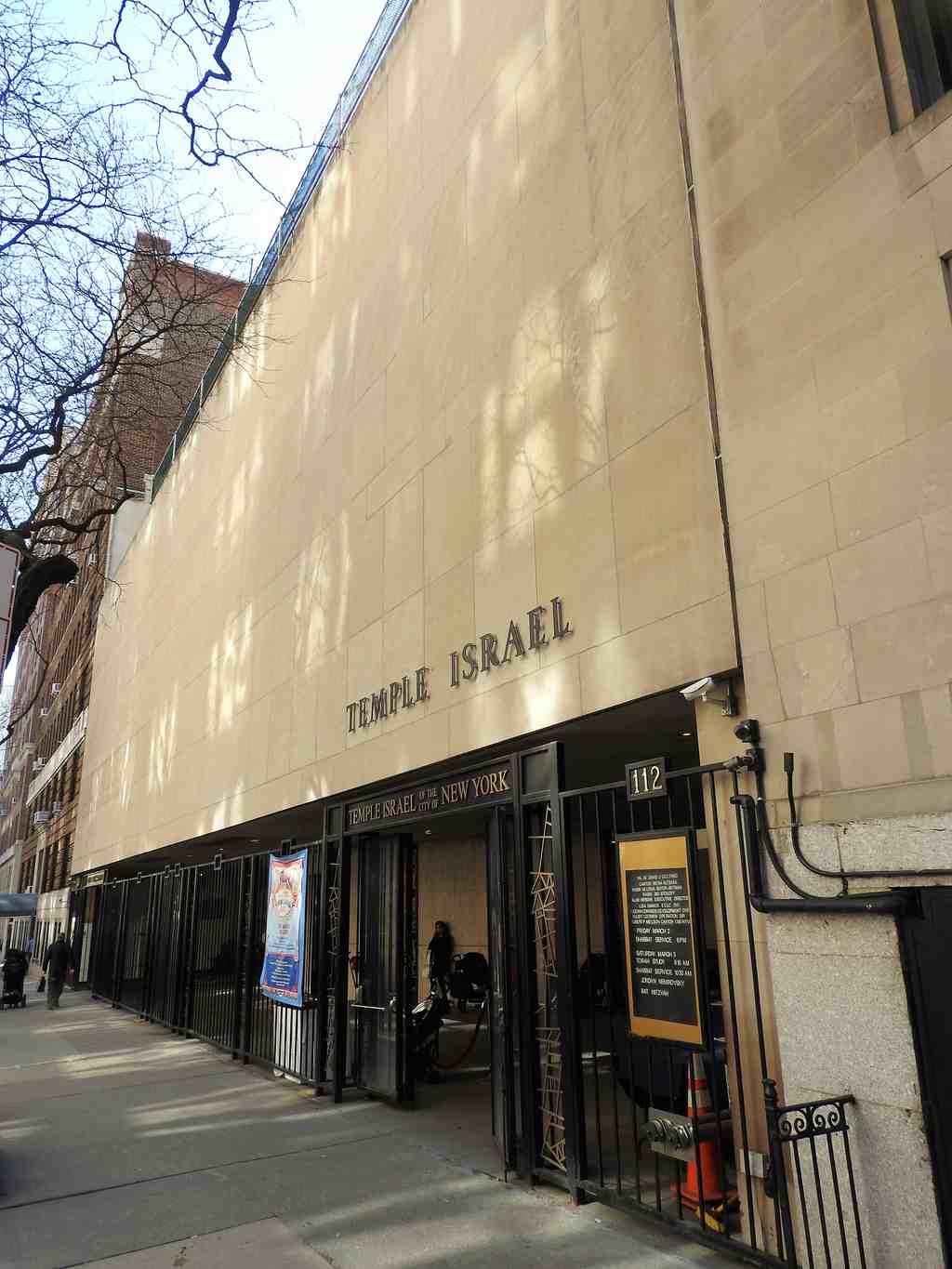
Temple Israel of the City of New YorkPhoto: Jim.henderson, Wikimedia Commons, CC BY-SA 4.0. Cropped & resized. Look for the massive, flat, windowless limestone facade jutting out over a dark recessed entrance, marked by the simple metal letters spelling out Temple Israel. This structure looks like a fortress of absolute permanence, a stark Brutalist block designed by architect Peter Claman in nineteen sixty-seven, using heavy, raw geometric forms to convey unshakeable sanctuary. But the story of this congregation is one of constant movement and social climbing, mirroring the endless upward mobility of Manhattan itself.
They certainly did not start out building limestone monoliths on the Upper East Side. Back in eighteen seventy-three, the founders were German Jewish immigrants, typically shopkeepers of moderate circumstances. These early congregants operated small retail stores on Third Avenue up in Harlem, and they lived right there, residing in cramped quarters directly behind their shops. They first gathered to worship in a rented room above a noisy printing press on East One Hundred and Twenty-Fifth Street.
They called themselves Congregation Hand in Hand. As their businesses grew, so did their ambition. Take a look at your screen. In nineteen zero seven, they commissioned this grand Neoclassical building, inspired by the symmetry of ancient Greece and Rome, on Lenox Avenue. The architect, Arnold Brunner, ignored the Moorish Revival style, with its Islamic-inspired arches and domes, that was popular for synagogues at the time. He argued that Jewish worship had no strict architectural rules. It looked exactly like a Roman temple, complete with columns, until you noticed the Stars of David tucked into the decorative panels. When they dedicated it, the crowd was so massive that officials had to literally lock the doors to prevent a stampede.
They eventually moved out of Harlem entirely, building another temple on West Ninety-First Street in nineteen twenty. Check that one out on your app. By then, they were a powerhouse of New York society, led by Rabbi Maurice Harris, a man who guided them for nearly fifty years. When Harris died in nineteen thirty, the congregation faced a logistical nightmare. They could not even hold his funeral in his own synagogue because the sanctuary was completely torn apart for redecoration. So, they had to borrow Congregation Emanu-El, where over a thousand mourners gathered to hear his eulogy.
Which brings us to the Upper East Side. In nineteen sixty-four, the trustees decided to relocate the synagogue here to East Seventy-Fifth Street. They built this sanctuary, and it has housed them through quiet years and loud ones. In two thousand and six, they hired Rabbi David Gelfand, who had just survived a vicious power struggle at a high-profile synagogue in the Hamptons. A faction of that board had accused him of financial improprieties and plagiarizing sermons, leading to million dollar lawsuits. But Temple Israel's search committee investigated, dismissed the allegations as completely baseless, and welcomed him with open arms, firmly rejecting the smear campaign. Clearly, this congregation knows how to handle a little New York drama.
It is inspiring to realize that this towering institution, which recently launched a forty million dollar renovation campaign, traces its roots back to a few shopkeepers praying over a printing press. Up next, we will see how another massive spiritual stronghold nearby also started from virtually nothing. Let us walk two minutes over to St. Jean Baptiste Roman Catholic Church.

The Brutalist-style Temple Israel building on East 75th Street, completed in 1967, serves as the congregation's current home.Photo: Jim.henderson, Wikimedia Commons, CC0. Cropped & resized. 
This view highlights the distinctive 100-foot-wide, windowless limestone facade of the current Brutalist synagogue, designed to create a sense of sanctuary.Photo: Jim.henderson, Wikimedia Commons, CC BY-SA 4.0. Cropped & resized. Look to your right for a monumental limestone church defined by a classical portico with four massive columns, twin bell towers, and a soaring green copper dome. Take a glance…Leer másMostrar menos
Abrir página dedicada →
St. Jean Baptiste Roman Catholic ChurchPhoto: Beyond My Ken, Wikimedia Commons, CC BY-SA 4.0. Cropped & resized. Look to your right for a monumental limestone church defined by a classical portico with four massive columns, twin bell towers, and a soaring green copper dome.
Take a glance at your screen to see a great shot of that impressive one hundred seventy-two foot dome, a rare feature for a Catholic church in this city.
This is Saint Jean Baptiste Roman Catholic Church, and standing before this Italian Renaissance Revival masterpiece today, you would never guess its humble beginnings. If you were a French-Canadian immigrant attending mass here in eighteen eighty-two, you were not gazing up at gilded column capitals. Most locals do not know this, but this massive congregation actually started out holding services in a rented hall situated directly above a smelly horse stable.
Parishioners nicknamed it the Crib of Bethlehem. The priests would burn heavy amounts of incense, but it was absolutely no match for the persistent odor of manure seeping through the thin floorboards, not to mention the constant rattling of iron chains and hoofbeats interrupting the silent prayers.
But if there is one constant in this neighborhood, it is the endless drive to upgrade one's surroundings into something spectacular. Enter Thomas Fortune Ryan, a spectacularly wealthy Gilded Age financier who regularly attended services here. One Sunday, he arrived late and had to stand. Annoyed, but immensely rich, he simply asked the pastor how much a new, larger building would cost. Told it would be around three hundred thousand dollars, Ryan essentially wrote a blank check and told them to make it happen.
Check your app again to appreciate the incredibly rich ornamentation on the west facade that Ryan's money bought, complete with statues of angels blowing trumpets.
The architect, Nicholas Serracino, quickly realized building in Manhattan is never simple. He hit a major snag when he discovered the bedrock was twenty-five feet deeper than expected, because old filled-in marshes compromised the ground below. The foundation costs skyrocketed eightfold, forcing Serracino to cancel plans to gild that magnificent dome. Still, Ryan kept signing checks, ultimately spending six hundred thousand dollars, about twenty million today, to ensure his architectural legacy stood out.
He spared no expense on the interior. Inside the nave, the soaring central hall of the church, you will find an exquisite fifty-foot-tall high altar that craftsmen imported directly from Italy. Even more impressive, artisans shipped the massive stained glass windows all the way from the legendary glass studios of Chartres in France. Saint Jean Baptiste is one of only two Catholic churches in the city to boast Chartres glass, the other being Saint Patrick's Cathedral. Not a bad transformation from a loud, smelly stable.
The church remains a sanctuary for those seeking spiritual health, but our next stop focuses on the physical kind. If you want to take a peek inside, the doors are open most mornings until one thirty in the afternoon, with extended hours on weekends.
Let us continue on. We have a three-minute walk ahead to Lenox Hill Hospital.
On your left stands a towering, fortress-like structure of dark red brick, distinguished by its stark, deeply recessed windows and an imposing, blocky profile. This is Lenox…Leer másMostrar menos
Abrir página dedicada →
Lenox Hill HospitalPhoto: Jim.henderson, Wikimedia Commons, CC BY-SA 4.0. Cropped & resized. On your left stands a towering, fortress-like structure of dark red brick, distinguished by its stark, deeply recessed windows and an imposing, blocky profile.
This is Lenox Hill Hospital, an elite medical titan that has treated prime ministers and birthed the heirs of pop royalty. Naturally, it was founded by a communist fugitive.
Doctor Abraham Jacobi was a German revolutionary who fought in the eighteen forty-eight uprisings. Arrested for high treason, he escaped to England, where he roomed with Karl Marx and Friedrich Engels. You know, the standard resume for an Upper East Side medical pioneer. Jacobi brought that same rebellious fire to New York. In eighteen fifty-seven, recognizing that poor German immigrants were completely isolated by the English-speaking medical system, he co-founded the German Dispensary. That very same year, he also helped found the New York Communist Club.
Jacobi was a respectable rebel who famously declared that the larger the institution, the surer is death. He championed personalized care for the marginalized. Take a glance at your app to see an eighteen sixty-eight etching of the original hospital. It was a modest sanctuary. But over the decades, the facility mirrored the surrounding neighborhood, trading its radical origins for a constant push toward high-status expansion.
When anti-German sentiment peaked during World War One, the board panicked. In nineteen eighteen, they erased their immigrant heritage entirely, adopting the name Lenox Hill to blend seamlessly with the affluent elite. The radical nature of its origins was quietly swept under the rug.
The continuous drive to cater to wealth became literal in nineteen thirty-one, when the hospital completed an eleven-story expansion costing two and a half million dollars, which is roughly fifty million dollars today. That same year, they treated Winston Churchill. He had been hit by a car while crossing Fifth Avenue and spent eight days recovering here. Because it was Prohibition, his doctor actually wrote a formal medical prescription for the daily use of alcoholic spirits so the famously thirsty British statesman could drink legally. Problem-solving at its finest.
Today, the hospital operates on an entirely different scale. It has morphed into a colossal complex where celebrities have reportedly spent over a million dollars to rent entire floors for private births, complete with personal security taping over surveillance cameras. Doctor Jacobi’s gritty immigrant clinic has been entirely swallowed by the relentless drive for modern exclusivity.
The hospital remains open twenty-four hours a day, seven days a week. We are now heading to another historic space shaped by charismatic leadership. Our next stop, the Unitarian Church of All Souls, is a five-minute walk away.

The main facade of Lenox Hill Hospital on Park Avenue, part of the current 10-building complex that occupies a full city block.Photo: Jim.henderson, Wikimedia Commons, CC BY-SA 4.0. Cropped & resized. Look up at the Unitarian Church of All Souls, easily recognizable by its stately red brick facade, the classical white columns flanking the main entrance, and the tall tiered…Leer másMostrar menos
Abrir página dedicada →
Unitarian Church of All SoulsPhoto: Beyond My Ken, Wikimedia Commons, CC BY-SA 4.0. Cropped & resized. Look up at the Unitarian Church of All Souls, easily recognizable by its stately red brick facade, the classical white columns flanking the main entrance, and the tall tiered white spire pointing sharply into the sky. You can check out a clear shot of this nineteen thirty-two Neo-colonial design on your screen.
It is a very composed, very proper Upper East Side structure. But the polished exterior hides a story of serious reinvention, one that starts far away from this neighborhood, in much less glamorous circumstances.
We have to go back to eighteen nineteen, to a cramped parlor on Broome Street in Lower Manhattan. A woman named Lucy Channing Russell invited forty friends over to hear her brother speak. Her brother, William Ellery Channing, was a prominent minister from Boston, but he was suffering from terrible health at the time. He was so weak he actually had to deliver his address sitting down. Still, the audience, mostly displaced Bostonians homesick for New England, were absolutely captivated by his reasoned approach to faith. Right then and there, they decided to form a permanent society. It was a truly humble start.
But starting a church in nineteenth-century New York was a massive gamble. Their first challenge was getting a minister. Very few clergymen wanted to leave the comfortable, established Unitarian heartland of Massachusetts to risk their careers in a wild new city. Finally, in December of eighteen twenty-one, they scored what they thought was a massive coup by hiring William Ware.
Ware was a brilliant writer. He had an impeccable pedigree. He was even married to the daughter of the famous physician who introduced the smallpox vaccine to the United States. He looked phenomenal on paper. There was just one tiny problem. He was a terrible public speaker.
His own parishioners frequently complained that he was a bad preacher whose delivery entirely lacked the fiery passion expected of the era. He was a quiet, intellectual man trying to lead a congregation that desperately wanted thunder and lightning.
Despite Ware's lack of dramatic flair, the congregation survived, grew wealthier, and constantly reinvented itself to match the rising ambitions of the city. By eighteen fifty-five, they had moved uptown and built a radical, wildly expensive sanctuary featuring alternating bands of red and white stone. Take a glance at your phone to see a historical photo of what New Yorkers ruthlessly nicknamed The Holy Zebra.
That massive architectural ego trip pushed them forty-eight thousand dollars over budget, which is roughly one point eight million dollars today. They nearly went bankrupt. The church was only saved when a tremendously wealthy trustee simply reached into his own pocket and covered the deficit.
That is the true nature of this area. It is a constant cycle of bold ambition, near disaster, and rescue by vast personal fortunes. The Holy Zebra eventually burned down in nineteen thirty-one, making way for the restrained, elegant brick building you see today, financed just as the staggering wealth of the nineteen twenties was reshaping the city.
If you are curious to see the interior, the doors are generally open every day from nine A-M to five P-M. Now, hold onto that thought about the sheer power of nineteen twenties money, because it leads us directly to our next stop, the East Eightieth Street Houses, just a short one-minute walk away.

A contemporary view of the All Souls UU congregation, which, since its founding in 1819, has provided a pulpit for leading theologians and recorded many eminent persons in its membership.Photo: Aunger67, Wikimedia Commons, CC0. Cropped & resized. Look to your right for a row of stately brick and stone townhouses, easily spotted by their prominent slate mansard roofs... those are the steep, double-sloped roofs that maximize…Leer másMostrar menos
Abrir página dedicada →
East 80th Street HousesPhoto: Epicgenius, Wikimedia Commons, CC BY-SA 4.0. Cropped & resized. Look to your right for a row of stately brick and stone townhouses, easily spotted by their prominent slate mansard roofs... those are the steep, double-sloped roofs that maximize top-floor space... and an elegant semicircular entrance portico jutting out from the red brick facade.
Back in the nineteen twenties, building a sprawling mansion in Manhattan was already getting difficult. High-rises were going up, and space was tight. But if you were a prominent financier or a member of the Astor family, you did not compromise. You engineered your own reality. These four houses, running from one sixteen to one thirty East Eightieth Street, were designed for a tier of society that treated real estate like a private chessboard.
My favorite detail about this block is how the residents solved a very specific problem. Sunlight.
George Whitney, a partner at J P Morgan, and his wife Martha wanted a sun-drenched garden oasis in their backyard. But developers were eagerly eyeing the lots right behind them on East Seventy-Ninth Street to build tall apartment buildings. Those towers would have cast long, permanent shadows over Martha's manicured lawns and rare plants. So, George and his neighbors simply bought the entire row of lots behind their own houses. They kept those lots empty, purely to protect their sunlight. That is the kind of capital it takes to mold the Upper East Side to your will.
But even old money gives way to new eras, and the way these buildings survive is a story in itself. If you are wondering how they escaped the wrecking ball over the last century, here is a detail most people walk right past. In nineteen sixty-seven, these specific houses were actually the very first group of structures ever designated as landmarks by the city, setting the precedent for historic preservation in New York.
Of course, historical preservation does not prevent historical drama. The brick house at one twenty-four was owned for decades by the Republic of Iraq, serving as the residence for their ambassador to the United Nations. Neighbors noticed the place was falling into visible neglect. A famous interior decorator living next door noted that the house was virtually empty inside, save for a single, life-sized portrait of Saddam Hussein. In April two thousand and three, during the fall of Baghdad, the final ambassador of that era was forced to vacate. Surrounded by a swarm of reporters, he dramatically shouted that he loved New York, only to suffer a truly New York indignity... his chauffeur had parked in the wrong spot and accidentally locked him out of his own escape limousine.
A few of these properties currently hold office hours from nine A-M to five thirty P-M, Monday through Friday, and are closed on weekends. Next, we are heading toward a structure with a rather different problem... a church that almost collapsed under its own architectural weight. It is an eight-minute walk away, over to the Church of Saint Ignatius Loyola.
On your left is the Church of Saint Ignatius Loyola, an imposing pale limestone structure anchored by a grand classical facade with a prominent central pediment and two…Leer másMostrar menos
Abrir página dedicada →
Church of St. Ignatius LoyolaPhoto: Jim.henderson, Wikimedia Commons, CC BY 4.0. Cropped & resized. On your left is the Church of Saint Ignatius Loyola, an imposing pale limestone structure anchored by a grand classical facade with a prominent central pediment and two copper-capped square tower bases.
In eighteen fifty-four, a priest named Reverend Eugene O'Reilly became an ambitious builder, looking at his humble wooden parish and deciding his flock needed something far grander, sparking a dangerous gamble with the congregation's finances. He wanted a permanent, magnificent stone building. The problem was his congregation consisted almost entirely of working-class Irish immigrants making meager wages. His architectural ambitions wildly exceeded their pockets. He pushed forward anyway, spending money the parish simply did not have, driving the church straight into absolute financial ruin.
It took a decade of crushing debt before the Jesuit order took over the parish in eighteen sixty-six. Things were so dire that the incoming priests had to contribute their own modest salaries directly into the parish coffers just to keep the doors open.
Then, on a Sunday in November eighteen eighty-six, the universe intervened. During a crowded Mass, a massive section of the old church ceiling suddenly collapsed right into the sanctuary. By some miracle, nobody was injured. The parishioners did not see this as a terrifying structural failure. Instead, they took it as a mandate from Heaven to finally build a safer, grander structure.
This moment perfectly captures how this neighborhood constantly overwrites its own history, transforming modest beginnings into sprawling monuments of power. Under the ambitious leadership of Father Neil McKinnon in the eighteen nineties, the church tapped into the area's growing affluence. McKinnon famously found the church of brick and left it of marble.
Take a look at the second image on your screen. That is the interior nave, a sprawling cavern built from pink Tennessee, red-veined Numidian, and yellow Siena marbles. Then check the fifth image. That is the baptistery semi-dome, gleaming with delicate opalescent glass crafted by Louis Comfort Tiffany's own studio. The working-class roots were entirely buried beneath European stonework and Tiffany glass.

The impressive Nave and Chancel, showcasing the rich American, European, and African marbles, including pink Tennessee and red-veined Numidian, used throughout the church's interior.Photo: Bestbudbrian, Wikimedia Commons, CC BY-SA 3.0. Cropped & resized. Today, this parish is the ultimate sanctuary for New York's elite. It has hosted the funerals of Jacqueline Kennedy Onassis, singer Aaliyah, and actor Philip Seymour Hoffman. Recently, television producers used this exact church to film the lavish, state-like funeral of the fictional media titan Logan Roy for the show Succession. They chose it because it perfectly projects that hushed, impenetrable wealth that defines the avenue.
If you want to look inside, the church is open every day from eight thirty AM to nine PM.
Now, let us leave the grand, marble-clad statements of the past and step into the contemporary art world, which has its own fascinating, hidden histories. We are heading to Galerie Buchholz, just a four minute walk away.

A view of the Church of St. Ignatius Loyola complex from Park Avenue, highlighting its prominent location on the Upper East Side and its associated educational institutions.Photo: Jim.henderson, Wikimedia Commons, CC0. Cropped & resized. 
The main Altar, crafted from exquisite Pavonazzo marble and gilt-bronze, is a testament to the intricate marble work executed by firms like James G. Batterson Jr.Photo: Bestbudbrian, Wikimedia Commons, CC BY-SA 3.0. Cropped & resized. 
The exquisitely designed baptistery, located at the opposite end of the church from the sanctuary, was the first interior space to be decorated.Photo: Bestbudbrian, Wikimedia Commons, CC BY-SA 3.0. Cropped & resized. 
The baptistery's stunning semi-dome, crafted by Tiffany Glass and Decorating Company with opalescent Favrile glass, suffuses the space with brilliant, sparkling light.Photo: Bestbudbrian, Wikimedia Commons, CC BY-SA 3.0. Cropped & resized. 
A Carrara marble statue in the nave, possibly of a Jesuit saint, with the Society of Jesus' motto 'Ad Majorem Dei Gloriam' ('To the Greater Glory of God') visible on the book.Photo: Bestbudbrian, Wikimedia Commons, CC BY-SA 3.0. Cropped & resized. Look for the stark white facade marked by deep horizontal grooves, a grand arched wooden doorway on the ground floor, and a sharply projecting bay window above. You are standing…Leer másMostrar menos
Abrir página dedicada →
Galerie BuchholzPhoto: Galerie Daniel Buchholz, Wikimedia Commons, CC BY-SA 4.0. Cropped & resized. Look for the stark white facade marked by deep horizontal grooves, a grand arched wooden doorway on the ground floor, and a sharply projecting bay window above.
You are standing in front of the New York outpost of Galerie Buchholz. While this gallery operates on a global scale today, its origins did not spring from a billionaire trust fund or an imposing, sterile white cube. It started with a sixteen-year-old kid. Daniel Buchholz began his career as an apprentice in a renowned Cologne bookstore, absorbing the contemporary art world by pure exposure. In the nineteen eighties, he spent a formative period here in New York City, soaking in the creative chaos, before heading back to Germany to launch his own project.
If you want to know how a massive international art dealer is truly built, look past the polished showrooms. The foundation of the Buchholz empire was quite literally a back room. In nineteen ninety-three, Buchholz moved his operations into the storage closet of his father's antiquarian rare book shop. It was a stifling nine square meters... though some early visitors swear it was barely three. Today, Buchholz jokes that a space that size is exactly where they keep their computer servers. But back then, that cramped intimacy became a signature. When the now legendary artist Wolfgang Tillmans showed up from London carrying his photos in a suitcase, he did not bother with formal frames. He just pinned and taped his raw prints directly to the walls of that tiny closet, completely ignoring the established rules of fine art display.
Take a look at your screen to see the interior of this New York location during its opening year.
When Buchholz expanded back to New York in two thousand and fifteen, he claimed a former doctor's office right here on the Upper East Side. He understands that this neighborhood has a habit of taking old, inherited spaces and thoroughly scrambling their D-N-A. For his inaugural Manhattan exhibition, Buchholz staged an obsessive, archival retrospective of the eccentric French writer Raymond Roussel. The star of the show was not a massive, multi-million dollar painting. It was a single, dried out cookie that the author had saved from a nineteen twelve lunch, enshrined behind glass like a religious artifact.
If you want to see what curious relics they are displaying today, the gallery is open Tuesday through Saturday from ten A-M to six P-M, and closed on Sundays and Mondays. Let us keep moving toward the final monumental mansions of our route, making the short two-minute walk over to the Benjamin N. Duke House.
Look to your right for the towering Beaux-Arts mansion clad in red brick and rusticated limestone, distinguished by its curved front and a steep, red-tiled mansard roof crowned…Leer másMostrar menos
Abrir página dedicada →
Benjamin N. Duke HousePhoto: A. Balet, Wikimedia Commons, CC BY 3.0. Cropped & resized. Look to your right for the towering Beaux-Arts mansion clad in red brick and rusticated limestone, distinguished by its curved front and a steep, red-tiled mansard roof crowned with copper cresting. Completed in nineteen oh one, this is the Benjamin N. Duke House. It was originally built as a speculative real estate trap. The developers, William and Thomas Hall, had a clever habit of moving into their newly finished properties, filling them with lavish furniture, and throwing extravagant parties just to show New York's emerging industrial elite what they were missing. The strategy worked beautifully.
The bait was taken by the founders of the American Tobacco Company, the Duke brothers. Benjamin Duke bought this magnificent Beaux-Arts confection, a highly decorative and opulent French architectural style, for a small fortune in nineteen oh one. But oddly, despite having a staggering net worth of sixty million dollars at the time, which equates to over a billion dollars today, he simply left the mansion empty and stayed in a nearby hotel for years. Then, his brother James met his future wife at a party here. Naturally, James bought the house from Benjamin in nineteen oh seven. The brothers seemed to trade Fifth Avenue mansions the way most people trade pocket change. In nineteen oh eight, while suffering from severe joint pain, James actually testified in a federal antitrust lawsuit from his bed inside this very house, surrounded by nervous Department of Justice lawyers. That is certainly one way to assert dominance during a deposition.
Check your screen for a closer view of the roof. Notice the intricate copper cresting and metal finials. During a massive restoration in the nineteen eighties, the descendants of the original nineteen oh one blacksmith were hired to rebuild that corroded roof. The modern firm had to buy custom hydraulic presses and recreate forty-eight original molds just to match their grandfather's exact craftsmanship.

The mansion's mansard roof, clad with red tile and topped by copper cresting and metal finials, required custom replacement pieces during its 1980s restoration by the grandson of the original metalworker.Photo: Epicgenius, Wikimedia Commons, CC BY-SA 4.0. Cropped & resized. This building perfectly captures the endless cycle of fresh fortunes overwriting the old. After the Dukes, the house saw generations of eccentric modernizations. Benjamin's daughter installed a royal blue glass-tiled bathroom with a sink that architectural critics noted looked exactly like a robot. More recently, in two thousand and six, a billionaire who started his career driving taxis bought the property for forty million dollars, planning to turn it into a private museum for his sculpture collection. That grand vision abruptly ended when federal agents discovered he had been illegally importing endangered species products on his private yacht. He eventually sold the empty home to a Mexican telecom magnate for forty-four million dollars. It is a relentless carousel of unimaginable wealth, where each new owner attempts to stamp their own monumental legacy over the last.
We have seen Gilded Age mansions and towering hotels, but there is one final monument to high society left on our route. We are heading to the ultimate symbol of Upper East Side luxury housing. Walk just two minutes down the avenue to nine hundred ninety-eight Fifth Avenue.

The Benjamin N. Duke House, a quintessential Fifth Avenue Beaux-Arts mansion, stands prominently at the corner of 82nd Street, showcasing its distinctive architectural style.Photo: Epicgenius, Wikimedia Commons, CC BY-SA 4.0. Cropped & resized. 
This wide view captures the mansion's impressive scale and corner orientation, a feature praised by architectural critics for providing excellent natural light.Photo: Epicgenius, Wikimedia Commons, CC BY-SA 4.0. Cropped & resized. 
The main entrance on 82nd Street features a metal-and-glass marquee and elaborate wrought-iron doors, leading to a grand interior staircase that runs the height of the building.Photo: Epicgenius, Wikimedia Commons, CC BY-SA 4.0. Cropped & resized. 
The distinctive oriel window, resembling a conservatory, projects from the mansion's one-bay-wide eastern wing on 82nd Street.Photo: Epicgenius, Wikimedia Commons, CC BY-SA 4.0. Cropped & resized. Before you stands a towering twelve-story block of pale limestone, characterized by deep horizontal grooves on its lower floors and a massive, projecting terra cotta overhang…Leer másMostrar menos
Abrir página dedicada →
998 Fifth AvenuePhoto: Godsfriendchuck, Wikimedia Commons, CC BY-SA 4.0. Cropped & resized. Before you stands a towering twelve-story block of pale limestone, characterized by deep horizontal grooves on its lower floors and a massive, projecting terra cotta overhang capping its roof.
In nineteen ten, a real estate lawyer named James T. Lee... maternal grandfather to Jacqueline Kennedy Onassis... made a staggering three million dollar gamble. Back then, if you had real money, you lived in a freestanding mansion. Apartments were strictly for the nouveau riche. Building a luxury high-rise this far north was considered financial suicide.
But Lee wanted to coax the American aristocracy out of their private palaces and into a shared building. To do it, he hired the legendary architectural firm McKim, Mead, and White to design an Italian Renaissance fortress. Check your screen for a look at the building's sheer scale from across the avenue.

From across Fifth Avenue, the building's scale and its location opposite a much smaller Metropolitan Museum of Art in 1912 highlight its pioneering presence.Photo: Epicgenius, Wikimedia Commons, CC BY-SA 4.0. Cropped & resized. The broker, Douglas Elliman, aggressively marketed these units not as apartments, but as vertical mansions. And the architects spared absolutely no expense to maintain that illusion. We are talking about two-foot thick fireproof walls, individual refrigerated wine cellars in the basement, and fifteen-room duplexes designed to house an entire domestic staff. Even the inner courtyard, normally an ugly brick afterthought, was faced with bright off-white stone so the servants would have a dignified view.
Still, the old money hesitated. So, Elliman used a classic retail trick. The loss leader. He offered a massive discount to Senator Elihu Root, dropping rent from twenty-five thousand dollars a year to fifteen thousand dollars... roughly four hundred and fifty thousand dollars today. Once a Senator moved in, the floodgates opened. Soon, the Astor and Vanderbilt families followed. Murry Guggenheim took the ninth floor and installed ceilings covered in real gold leaf. Take a look at your app to see the intricate terra cotta cornice capping this structure.

A closer view of the large terra cotta cornice, a prominent feature that tops the building.Photo: Epicgenius, Wikimedia Commons, CC BY-SA 4.0. Cropped & resized. Not everyone was impressed, of course. Some architectural critics looked at the prominent horizontal moldings and compared them to sliced-off Tootsie Rolls. Critics always find something to complain about.
The building also attracted highly eccentric wealth. Sylvia Green Wilks, the reclusive daughter of legendary financier Hetty Green, lived here in quiet isolation for decades. Despite residing in one of the city's most opulent buildings, she was notoriously frugal. When she died in nineteen fifty-one, she left behind an estate of nearly one hundred million dollars... much of it just sitting in standard checking accounts. A fascinating contradiction behind a pristine facade.
James T. Lee ultimately had the last laugh. Within twenty years, over ninety percent of New York's wealthiest families had abandoned their private houses for luxury apartments just like this one. The freestanding palaces were gradually torn down, replaced by towering fortresses of wealth, guarded by fiercely selective co-op boards.
As we prepare to wrap up our journey together, look up at the stone balustrades dividing the different sections of the building... notice how the architecture perfectly mimics the impenetrable palazzos of sixteenth-century Rome, a calculated design meant to project absolute, unshakeable power.

This luxury cooperative, 998 Fifth Avenue, was developed by James T. Lee, maternal grandfather of Jacqueline Kennedy Onassis.Photo: Epicgenius, Wikimedia Commons, CC BY-SA 4.0. Cropped & resized. 
The Italian Renaissance Palazzo-style structure, designed by McKim, Mead & White, is sheathed entirely in distinctive limestone.Photo: Epicgenius, Wikimedia Commons, CC BY-SA 4.0. Cropped & resized. 
Observe the balustrade stringcourses that define the building's horizontal divisions, a key design element inspired by the 16th-century Farnese Palace in Rome.Photo: Epicgenius, Wikimedia Commons, CC BY-SA 4.0. Cropped & resized. 
This 12-story building, with its grand apartments designed for full household staffs, helped shift the city's wealthy from private mansions to luxury apartment living.Photo: Epicgenius, Wikimedia Commons, CC BY-SA 4.0. Cropped & resized. 
Each window above the stringcourse is capped with a pediment or cornice, adding to the building's luxurious Italian Renaissance aesthetic.Photo: Epicgenius, Wikimedia Commons, CC BY-SA 4.0. Cropped & resized. 
Architectural critics disparagingly compared the building's prominent horizontal moldings to 'sliced-off Tootsie Rolls,' despite its inspiration from the prestigious Farnese Palace.Photo: Epicgenius, Wikimedia Commons, CC BY-SA 4.0. Cropped & resized.
Reseñas
Preguntas frecuentes
¿Cómo empiezo el tour?
Después de la compra, descarga la app AudaTours e ingresa tu código de canje. El tour estará listo para comenzar de inmediato - solo toca play y sigue la ruta guiada por GPS.
¿Necesito internet durante el tour?
¡No! Descarga el tour antes de empezar y disfrútalo completamente sin conexión. Solo la función de chat requiere internet. Recomendamos descargar en WiFi para ahorrar datos móviles.
¿Es un tour guiado en grupo?
No - esta es una audioguía autoguiada. Exploras de forma independiente a tu propio ritmo, con narración de audio reproduciéndose en tu teléfono. Sin guía, sin grupo, sin horario.
¿Cuánto dura el tour?
La mayoría de los tours toman 60–90 minutos para completar, pero tú controlas el ritmo completamente. Pausa, salta paradas o toma descansos cuando quieras.
¿Qué pasa si no puedo terminar el tour hoy?
¡No hay problema! Los tours tienen acceso de por vida. Pausa y continúa cuando quieras - mañana, la próxima semana o el próximo año. Tu progreso se guarda.
¿Qué idiomas están disponibles?
Todos los tours están disponibles en más de 50 idiomas. Selecciona tu idioma preferido al canjear tu código. Nota: el idioma no se puede cambiar después de generar el tour.
¿Dónde accedo al tour después de comprarlo?
Descarga la app gratuita AudaTours desde App Store o Google Play. Ingresa tu código de canje (enviado por email) y el tour aparecerá en tu biblioteca, listo para descargar y comenzar.
Si no disfrutas el tour, te reembolsamos tu compra. Contáctanos en [email protected]
Paga de forma segura con