

Audioguía de Alexandria: Ecos de Libertad y Fe
Bajo las elegantes calles de Alexandria, persisten sombras de los capítulos más tumultuosos de América. Cada ladrillo y estatua guarda ecos de rebelión, juegos políticos y asombrosos actos de coraje que moldearon una nación dividida. Esta audioguía autoguiada desvela el pasado oculto de la ciudad, llevándote a través de callejones y monumentos donde los secretos de la historia aún susurran. Descubre lo que la mayoría de los visitantes se pierden: sin censura, de cerca y en los mismos lugares donde sucedió. ¿Por qué una sola oficina desató un escándalo nacional y un gran dolor? ¿Qué reunión secreta cambió el destino de Appomattox para siempre? ¿Y quién sigue dejando lirios anónimos fuera de St. Paul's cada 3 de junio? Recorre Alexandria con ojos nuevos y sentidos agudizados. Las historias que se desvelarán profundizarán cada paso, convirtiendo las calles familiares en un escenario de ambición, pérdida y libertad duramente ganada. La historia espera bajo la superficie. Dale al play y profundiza.
Vista previa del tour
Sobre este tour
- scheduleDuración 40–60 minsVe a tu propio ritmo
- straighten3.3 km de ruta a pieSigue el camino guiado
- location_onUbicaciónKingstowne, Estados Unidos
- wifi_offFunciona sin conexiónDescarga una vez, úsalo en cualquier lugar
- all_inclusiveAcceso de por vidaReprodúcelo en cualquier momento, para siempre
- location_onComienza en Asociación Internacional de Parques de Atracciones y Atracciones
Paradas en este tour
Look at the building right in front of you, a sturdy two-story brick house defined by its shingled roof, dormer windows, and a striking red door framed by white columns. We are…Leer másMostrar menos
Abrir página dedicada →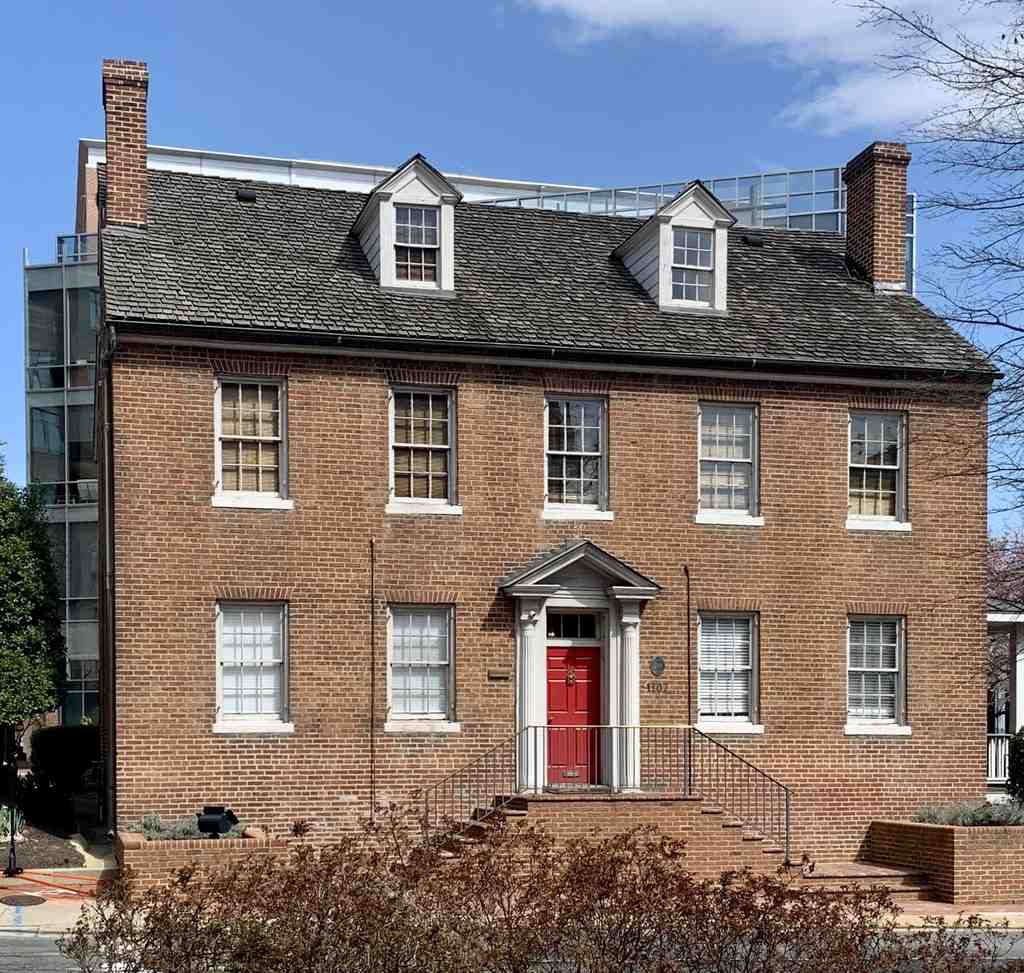
Bruin's Slave JailPhoto: APK, Wikimedia Commons, CC BY-SA 4.0. Cropped & resized. Look at the building right in front of you, a sturdy two-story brick house defined by its shingled roof, dormer windows, and a striking red door framed by white columns. We are standing on the Duke Street Corridor, which back in the mid-1800s was a grim, bustling central artery for the domestic slave trade.
In 1844, a man named Joseph Bruin bought this property. It wasn't just this brick house, but a massive two-acre compound where he imprisoned enslaved people awaiting forced sale to the Deep South. When archaeologists excavated the site, they found a storage pit containing a hoodoo ritual deposit. Hoodoo is a spiritual practice rooted in African traditions, and finding these artifacts tells us the people trapped here were desperately calling on spiritual forces for protection.
Take a peek at your screen to see how careful restoration work preserved this sobering historic brick facade while adapting the space for modern office use.
Bruin gained notorious fame after the Pearl incident in 1848. Seventy-seven enslaved individuals made a massive, desperate bid for freedom by attempting to sail away from Washington on a schooner, a fast-sailing merchant ship, named the Pearl, but they were captured at the mouth of the Chesapeake Bay due to poor weather.
Take a moment to consider the sheer desperation and courage it took for seventy-seven people to board that ship, knowing the brutal consequences of failure. For many, those consequences meant ending up right here.
Furious enslavers sold captives to Bruin, including two teenage sisters, Mary and Emily Edmonson. Bruin forced them to do laundry by day and locked them up by night. Seeing an opportunity, he demanded an outrageous ransom of two thousand two hundred fifty dollars for their freedom, which is roughly eighty thousand dollars today. He tormented the sisters, threatening to sell them to New Orleans as sex slaves if the money was not paid.
Their father desperately traveled north and begged for help. Reverend Henry Ward Beecher rallied his congregation and raised the funds overnight, freeing the girls after seven agonizing months. They went on to college in Ohio. Tragically, Mary died of tuberculosis at just twenty, but Emily became an educator and worked alongside Frederick Douglass in the abolitionist movement. Her harrowing story deeply moved Harriet Beecher Stowe, who used Bruin's real-life jail as the devastating background for her famous novel, Uncle Tom's Cabin.
You can see a beautiful tribute to the sisters if you look at the app which shows a ten-foot-tall bronze sculpture by Erik Blome in the plaza right next door, depicting Mary and Emily emerging from a solid mass of metal.
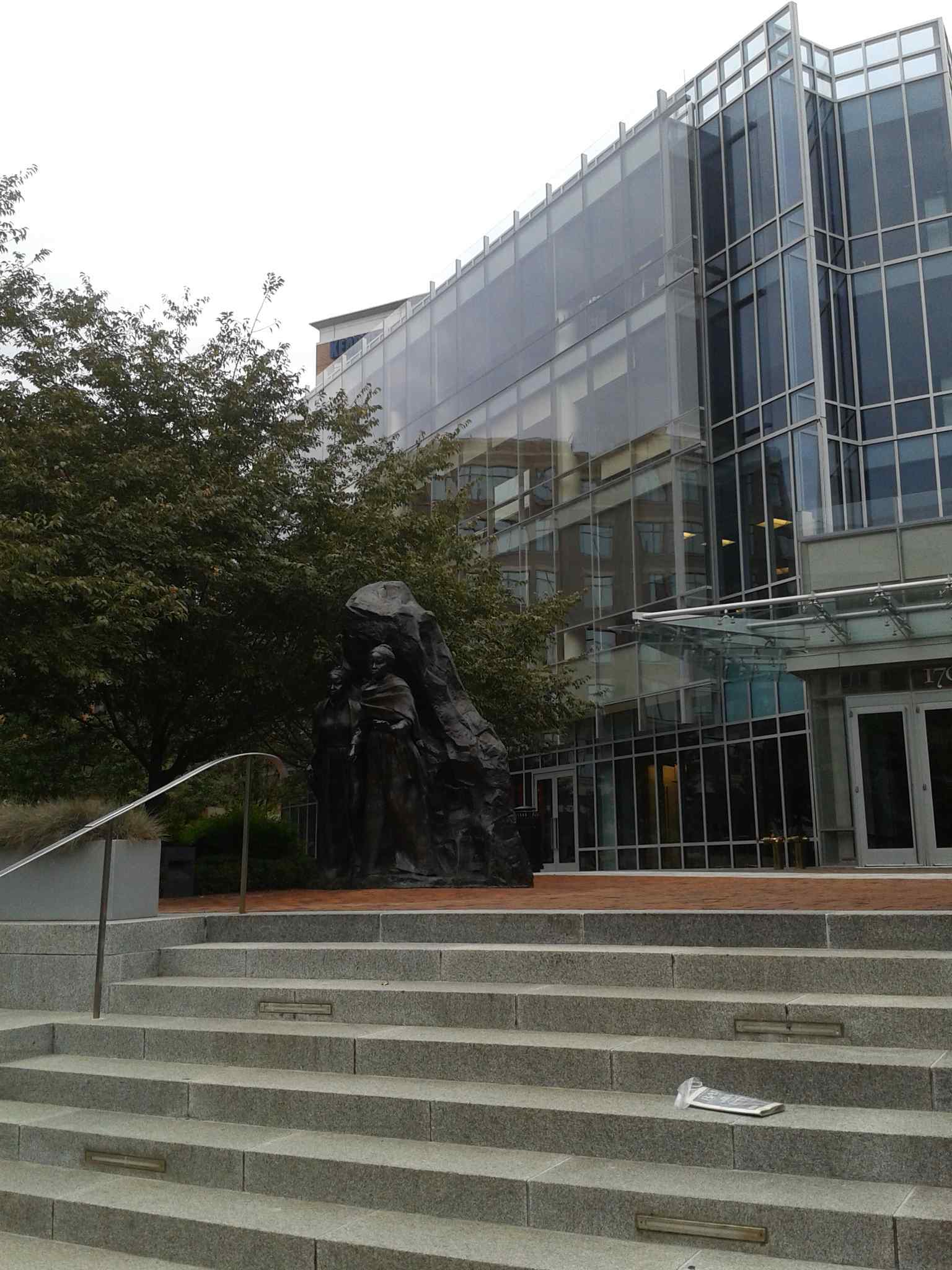
The bronze sculpture by artist Erik Blome depicts Mary and Emily Edmonson, who were imprisoned here after the Pearl incident and later freed through the efforts of Reverend Henry Ward Beecher.Photo: Ser Amantio di Nicolao, Wikimedia Commons, CC BY-SA 4.0. Cropped & resized. Their story reminds us of the profound bravery of those who resisted the forces trying to break their spirit. Now, let us walk over to Shiloh Baptist Church, which is about a six-minute walk away. The plaza and exterior grounds here are open twenty four hours a day, every day.
On your left is Shiloh Baptist Church, a striking red brick Gothic Revival building with tall arched windows and a prominent square bell tower topped with a steep pointed roof.…Leer másMostrar menos
Abrir página dedicada →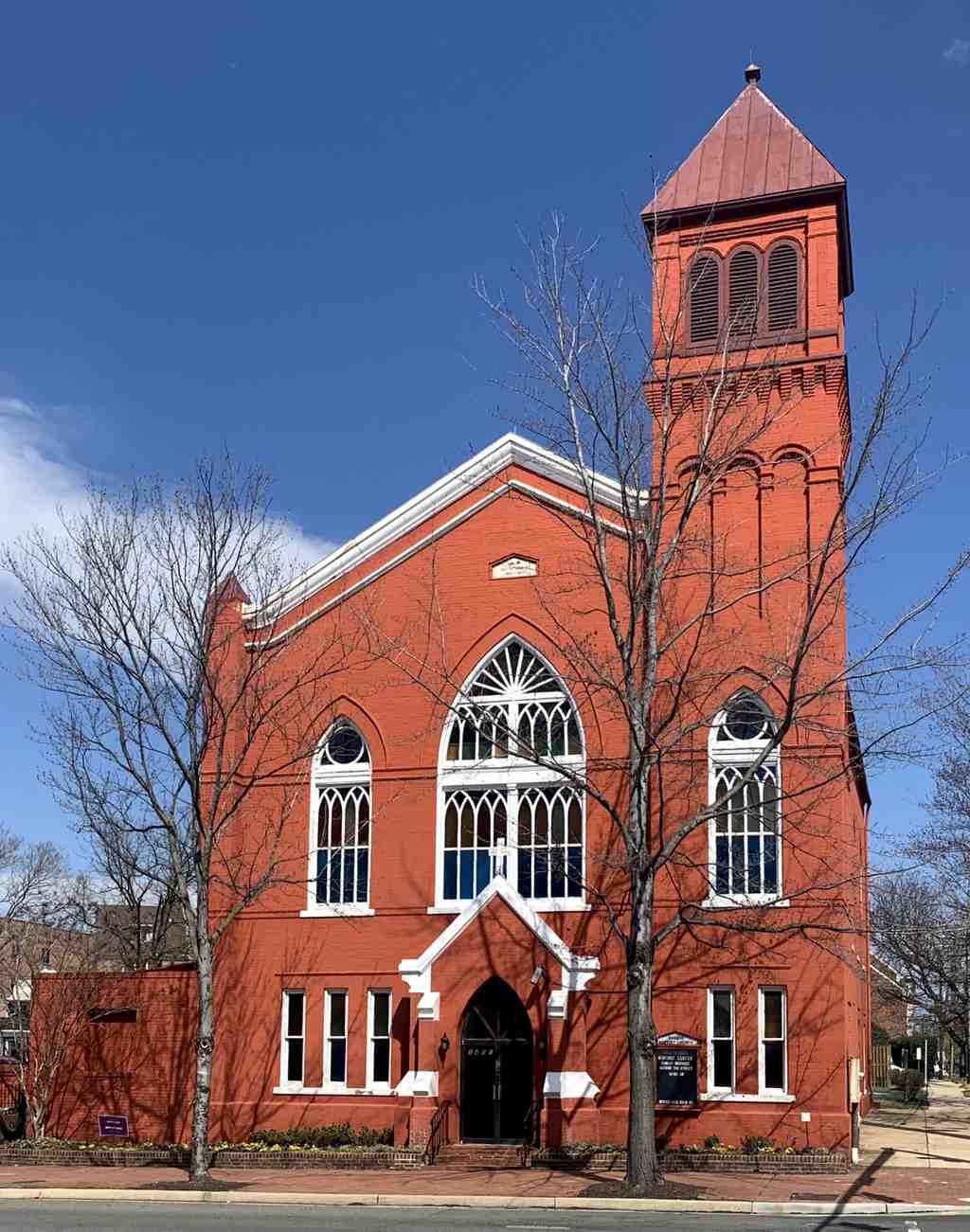
Shiloh Baptist ChurchPhoto: APK, Wikimedia Commons, CC BY-SA 4.0. Cropped & resized. On your left is Shiloh Baptist Church, a striking red brick Gothic Revival building with tall arched windows and a prominent square bell tower topped with a steep pointed roof.
When you look at a building like this, you are seeing community resilience through faith made visible in brick and glass. For newly freed Black Americans, a church was never just a place to pray. It was the absolute center of survival, a safe harbor, and the mortar that held a newly free society together. The American Civil War shattered the old brutal order of things and served as the profound catalyst that allowed these independent communities to finally form in the open. During that conflict, the Union army established L'Ouverture Hospital nearby to treat wounded Black soldiers and house escaped slaves seeking freedom, who were classified under military law as contraband refugees.
It was there, in a hospital mess hall in 1863, that fifty African Americans gathered to worship. They were led by Reverend Leland Warring, a former slave who became a teacher and minister. Finding a permanent home was not easy. They moved to a barracks, which burned down. They built a chapel, and that burned down too. Finally, in 1873, they bought a plot of land right around here for a hundred and seventy-five dollars... which is about four thousand five hundred dollars today.
But the road to this specific brick sanctuary was paved with some serious drama. In 1890, Reverend Warring retired and his son, Henry, took over. Almost immediately, a suspicious faction accused Henry of embezzling a fifteen dollar convention fee and ten dollars in travel expenses... a sum worth around eight hundred bucks today. The majority of the congregation stood by Henry, causing an outraged minority to leave and form their own church. Even one of their wealthiest backers, a local hotel owner named Wash Jackson, walked out.
Despite losing major funding, Henry Warring pushed forward. In 1893, the congregation dedicated this impressive Gothic Revival structure... an architectural style known for its dramatic upward pointing arches that draw the eye toward heaven. It cost around ten thousand dollars to build and furnish, roughly three hundred and thirty thousand dollars today. They packed it with modern circular oak pews, eight stained glass windows, and a massive glass prism reflector hanging from the ceiling. They even hosted a huge industrial fair in the lecture room to showcase the progress of Black craftspeople.
Today, the congregation has grown so much they built a new sanctuary across the street, leaving this historic building to serve as a youth center open with varying hours Wednesday through Sunday.
This space stands as a soaring testament to empowerment and freedom. But the dark history that these founders escaped is woven into the very streets of this city. We are heading three minutes away to the Franklin and Armfield Office next, where we will confront the horrors that made sanctuaries like this one so desperately necessary.
Mostrar 11 paradas másMostrar menos paradasexpand_moreexpand_less
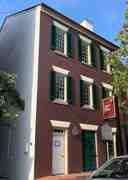
Look at the tall, three-story townhouse right in front of you, anchored by its dark red brick exterior, orderly rows of green shutters, and a simple white front door. It looks…Leer másMostrar menos
Abrir página dedicada →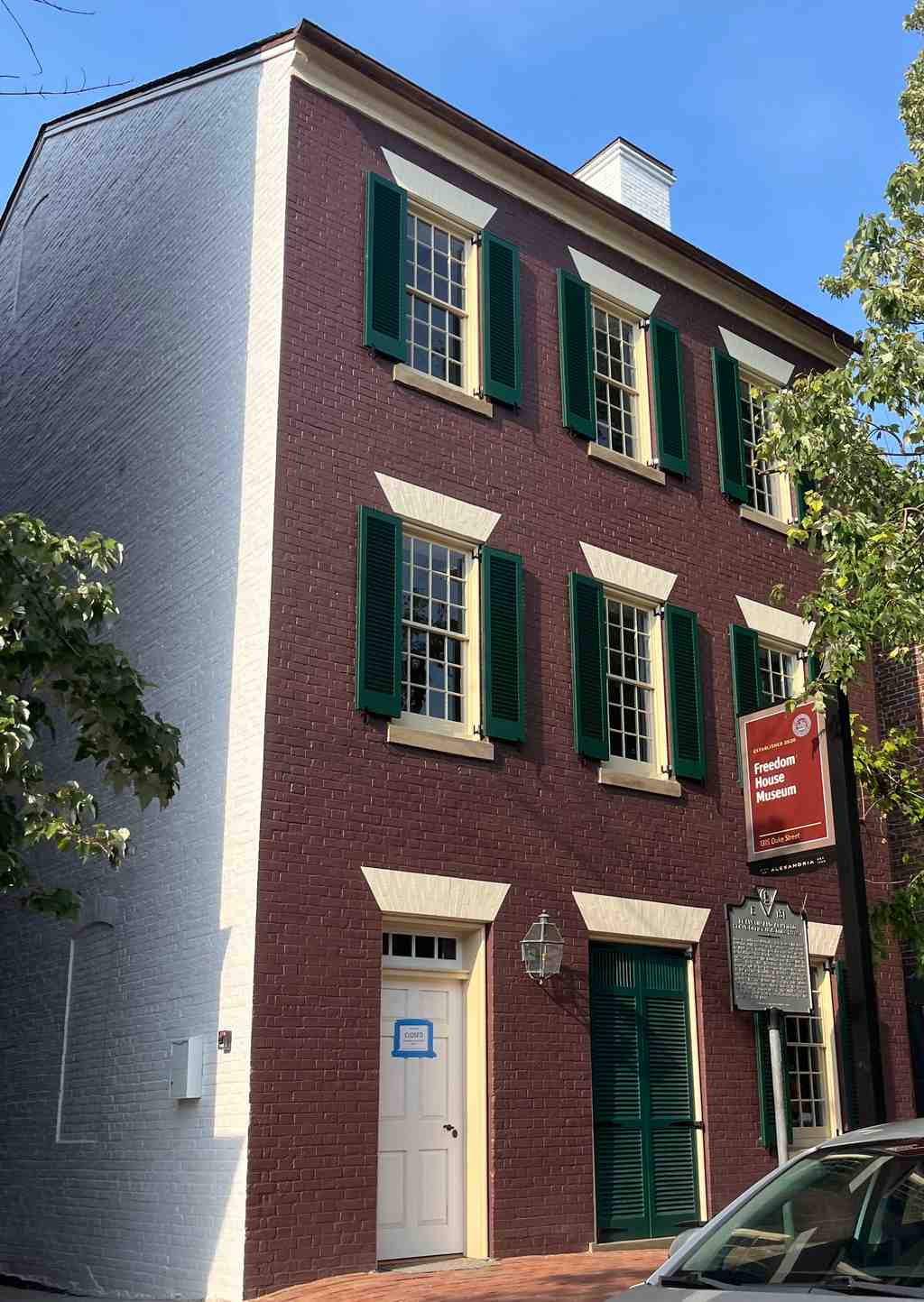
Franklin and Armfield OfficePhoto: Theodore Christopher, Wikimedia Commons, CC0. Cropped & resized. Look at the tall, three-story townhouse right in front of you, anchored by its dark red brick exterior, orderly rows of green shutters, and a simple white front door.
It looks like an ordinary, quiet historic home. But this building represents the dark duality of Alexandria, where everyday city life existed right alongside unimaginable cruelty. Behind this mundane facade was the epicenter of a massive human trafficking network. This was the headquarters of Franklin and Armfield, a firm that operated with ruthless, industrial efficiency to become the largest slave-trading company in the United States, tearing apart thousands of families for profit.
Starting in 1828, Isaac Franklin and John Armfield transformed this Duke Street property into a highly lucrative enterprise. They built high walls and interior chambers fitted with grated iron doors, turning a residence into a holding pen. Take a look at your screen to see an 1836 artwork illustrating the stark reality of those prison-like cages.
The financial magnitude of their operation was staggering. By 1832, this single business was so dominant that five percent of all commercial credit from the Second Bank of the United States... the nation's central federal banking system... was tied directly to them. A young woman sold here as a fancy maid... a sanitized term masking the horrific reality of sex slavery... could fetch two thousand dollars, equivalent to about eighty thousand dollars today.
Franklin and Armfield operated a fleet of ships, but they also orchestrated massive overland forced marches known as coffles. A coffle is a line of captives fastened together by chains or ropes. Once a year, John Armfield would sit on his horse at the front of a procession, armed with a gun and a whip. Behind him, hundreds of enslaved men, women, and children were chained together and forced to march over a thousand miles to markets in the Deep South. To hide the misery from onlookers along the turnpike, traders would force the captives to play banjos and sing, projecting a twisted illusion of compliance.
Later, a firm called Price, Birch, and Company took over the property. But when the Civil War broke out and the Union Army arrived in 1861, the dealers fled. They left behind only one old man, chained by his leg to the floor... a haunting symbol of the thousands whose names and futures were stolen here.
Yet, history has a way of inverting its darkest corners. Late in the war, the Union transformed this very building into L'Ouverture Hospital, named after the famed Haitian revolutionary. Black soldiers recovered from their wounds in the exact same rooms where their people had once been caged. You can check your app to see the before and after of this building's incredible transformation from a place of bondage to the Freedom House Museum.
You can step inside to explore the exhibits during their operating hours, which run Thursday through Saturday starting at eleven in the morning, and Sunday and Monday afternoons.
Let us take a moment of silence for the thousands who passed through these doors...
When you are ready, we will head to our next destination, Alfred Street Baptist Church, which is about a six-minute walk away.
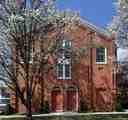
Take a look to your right at this stately red brick building with its classic gabled roofline and the distinctive twin arched red double doors framing the entrance. That is the…Leer másMostrar menos
Abrir página dedicada →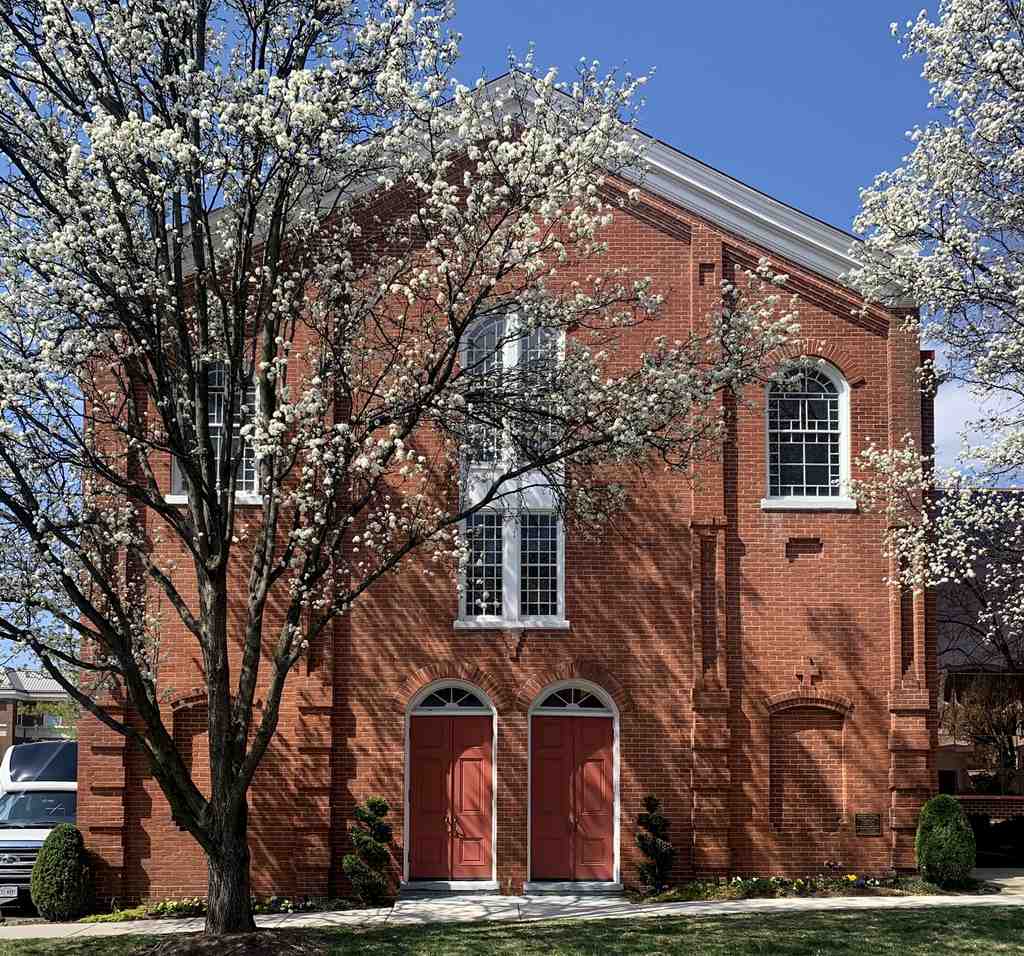
Alfred Street Baptist ChurchPhoto: APK, Wikimedia Commons, CC BY-SA 4.0. Cropped & resized. Take a look to your right at this stately red brick building with its classic gabled roofline and the distinctive twin arched red double doors framing the entrance. That is the preserved exterior of the Alfred Street Baptist Church, and if you take a peek at your screen, you can see how its historic look has been carefully maintained over the centuries.
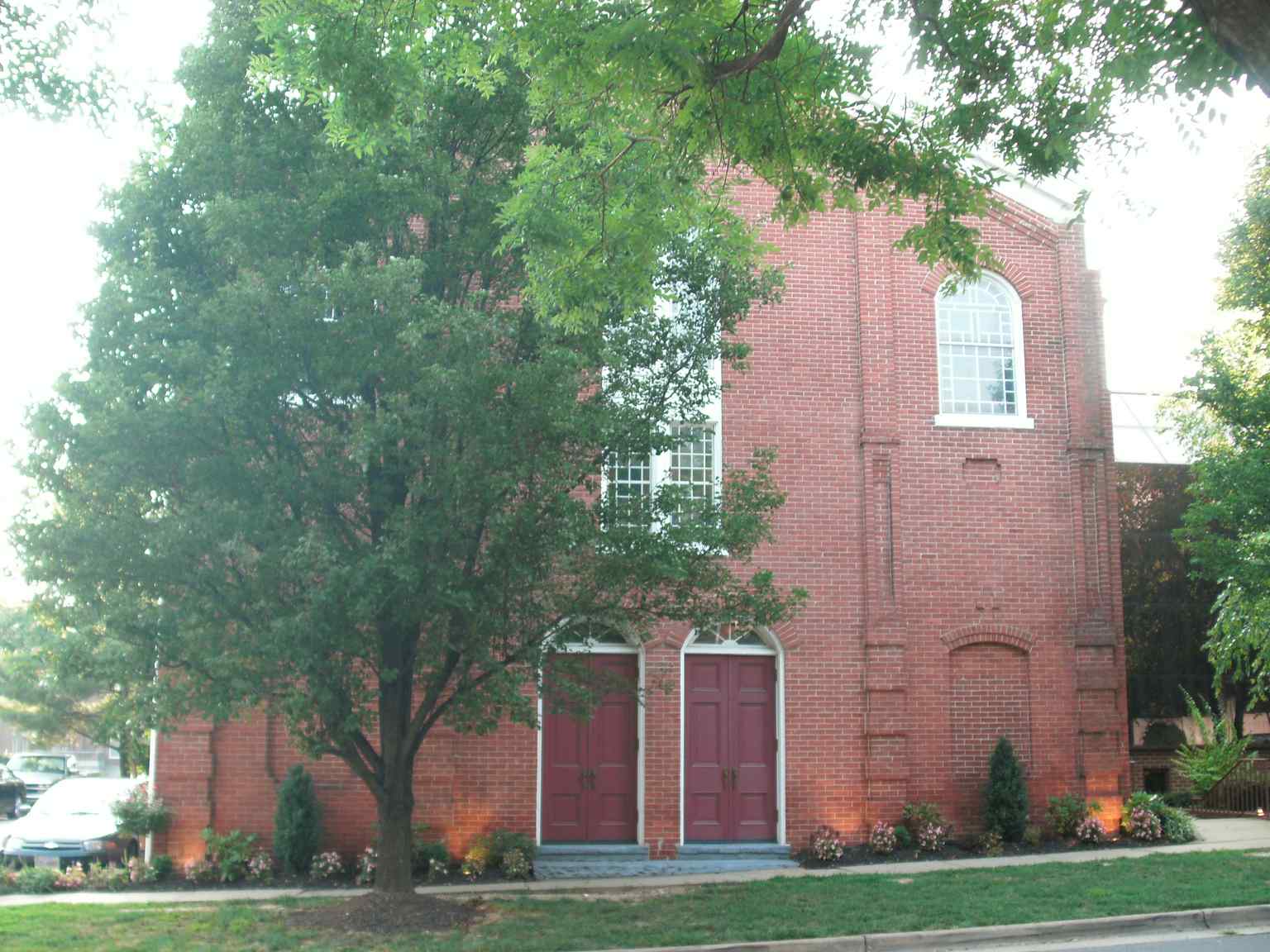
This image shows the preserved exterior of the Alfred Street Baptist Church, which maintained its original look even after a new sanctuary was constructed in 1994.Photo: The original uploader was Ser Amantio di Nicolao at English Wikipedia., Wikimedia Commons, CC BY-SA 3.0. Cropped & resized. This place is the beating heart of a story that goes all the way back to May 1803. That is when an enslaved woman named Susan Black was baptized, becoming the first person of color in the Alexandria Baptist Society. Her baptism shifted something fundamental. It prompted the integrated group to invite other free and enslaved African Americans into the fold.
By 1806, they formed their own society. They spent eighteen long years renting property right around here before finally buying this land in 1842. Free Black craftsmen designed and built the congregation's first known brick building in 1855, and remarkably, they paid off the mortgage in just two years.
But a building is just brick and mortar until you fill it with purpose. In 1859, Reverend Sampson White stepped up to the pulpit. He was a fierce abolitionist who urged his congregation to open their homes as safe havens. He effectively turned this community into a vital hub on the Underground Railroad, a covert network of routes and safe houses used by enslaved African Americans to escape into free states.
Then the Civil War tore through town. The Union Army actually commandeered this sanctuary. They stripped away its religious functions, turning the nave, the main central hall of the church, into a military hospital and a recruiting station for the United States Colored Troops, the segregated regiments of the Union Army composed mostly of African American soldiers. The congregation was forced to worship in secret.
It took decades to recover the costs of that military occupation. It was not until 1914 that the Federal Government finally paid the church nine hundred dollars in reparations, which is about twenty seven thousand dollars today. They used those hard won funds to build a parsonage, a residential house for their pastor, over on Queen Street.
This church has never stopped standing its ground. Under the recent leadership of Reverend Dr. Howard-John Wesley, it became a frequent Easter sanctuary for President Barack Obama and his family. But standing tall draws a target. In 2021, they endured a terrifying bomb threat from a Texas man who was later sent to federal prison for the crime. Still, they refuse to back down. They continue to stand firm in their values, navigating the complexities of the modern world with the same resolve as their founders.
This church is a monument to spiritual independence, but community resilience takes many forms. Let us shift gears from spiritual sanctuaries to secular societies and the physical spaces they built. We are heading to the Odd Fellows Hall, just a quick one minute walk from here.
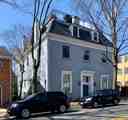
Look to your left for the sturdy, gray-painted brick building topped with a steep, sloping slate roof and a black metal railing trimming the top edge. That roof caps off a place…Leer másMostrar menos
Abrir página dedicada →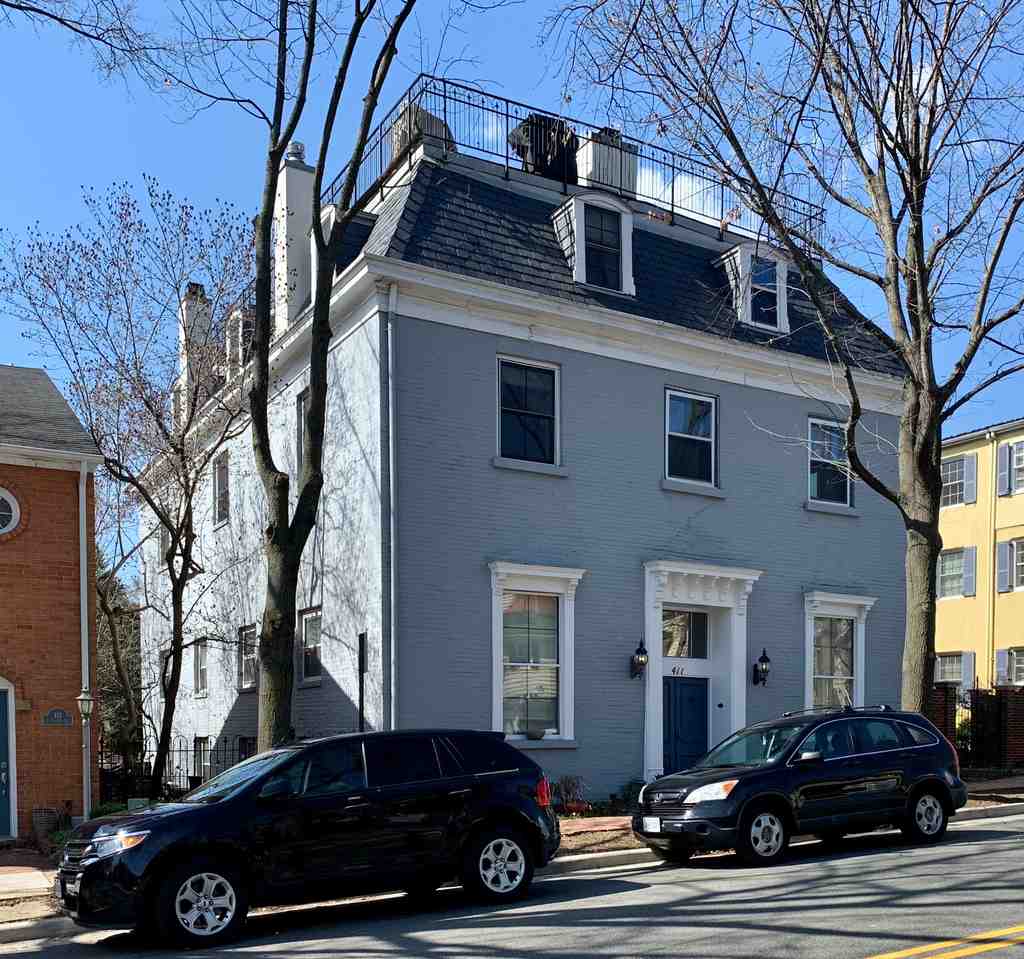
Odd Fellows HallPhoto: APK, Wikimedia Commons, CC BY-SA 4.0. Cropped & resized. Look to your left for the sturdy, gray-painted brick building topped with a steep, sloping slate roof and a black metal railing trimming the top edge.
That roof caps off a place born out of sheer grit, the Odd Fellows Hall. Originally a modest 1864 building for a struggling church, it was bought in 1869 by three local African American men to secure it for the Black community.
To expand it, they hired George Lewis Seaton. Seaton was a master carpenter who was born free, and he did not just help shape the city skyline, he shaped its politics as the first African American elected to the Virginia General Assembly from north of the Rappahannock River.
Under Seaton's direction, they transformed this into the largest structure built by African Americans in Alexandria outside of churches. It became a physical fortress for a people carving out autonomy in a hostile world. You can check your screen to see its impressive preserved exterior in a photo from 2009.
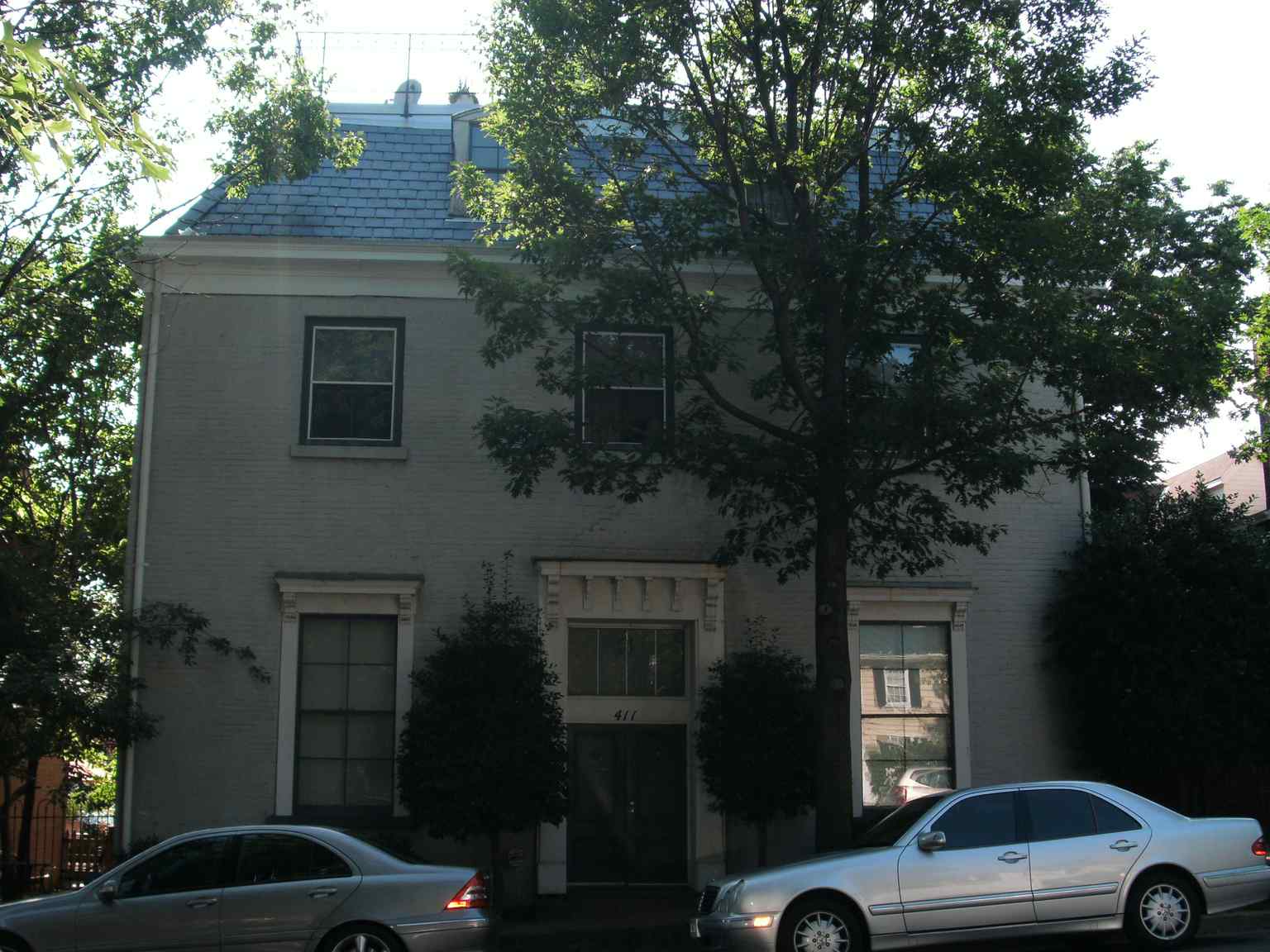
The Odd Fellows Hall as it appeared in 2009, showing the historically significant exterior with its distinctive slate mansard roof, which was preserved even after its conversion to condominiums in the 1980s.Photo: The original uploader was Ser Amantio di Nicolao at English Wikipedia., Wikimedia Commons, CC BY-SA 3.0. Cropped & resized. This ambitious expansion almost ended in disaster. By 1875, severe financial struggles threatened the hall with foreclosure. But Seaton stepped up again, negotiating a crucial loan to repay the Freedmen's Bureau and saving the building.
Firmly rooted here in the Bottoms, Alexandria's oldest African American neighborhood, the hall became the premier gathering spot. It hosted groups like Masons and the Daughters of Zion. These were mutual aid societies, vital networks where members pooled resources to handle sickness and burial costs. They gathered here for both joyous Emancipation Day dances and solemn funerals.
Decades later, the building barely escaped demolition during urban redevelopment, eventually becoming condominiums in the eighties. You can watch the historic Odd Fellows Hall transform as it emerges from an extensive remodeling project to reveal its restored facade just a year later.
Today it is a residential building, open weekdays from nine to five and closed on weekends, but its foundation remains powerful. Take a moment to consider the unshakeable legacy left in these very bricks, then let us stroll to the Bayne-Fowle House, just a three-minute walk away.
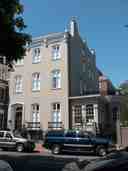
Take a look to your left at the Bayne-fowl House, a towering three-story painted gray masonry building with tall, arched windows and a distinctive flat-roofed glass conservatory…Leer másMostrar menos
Abrir página dedicada →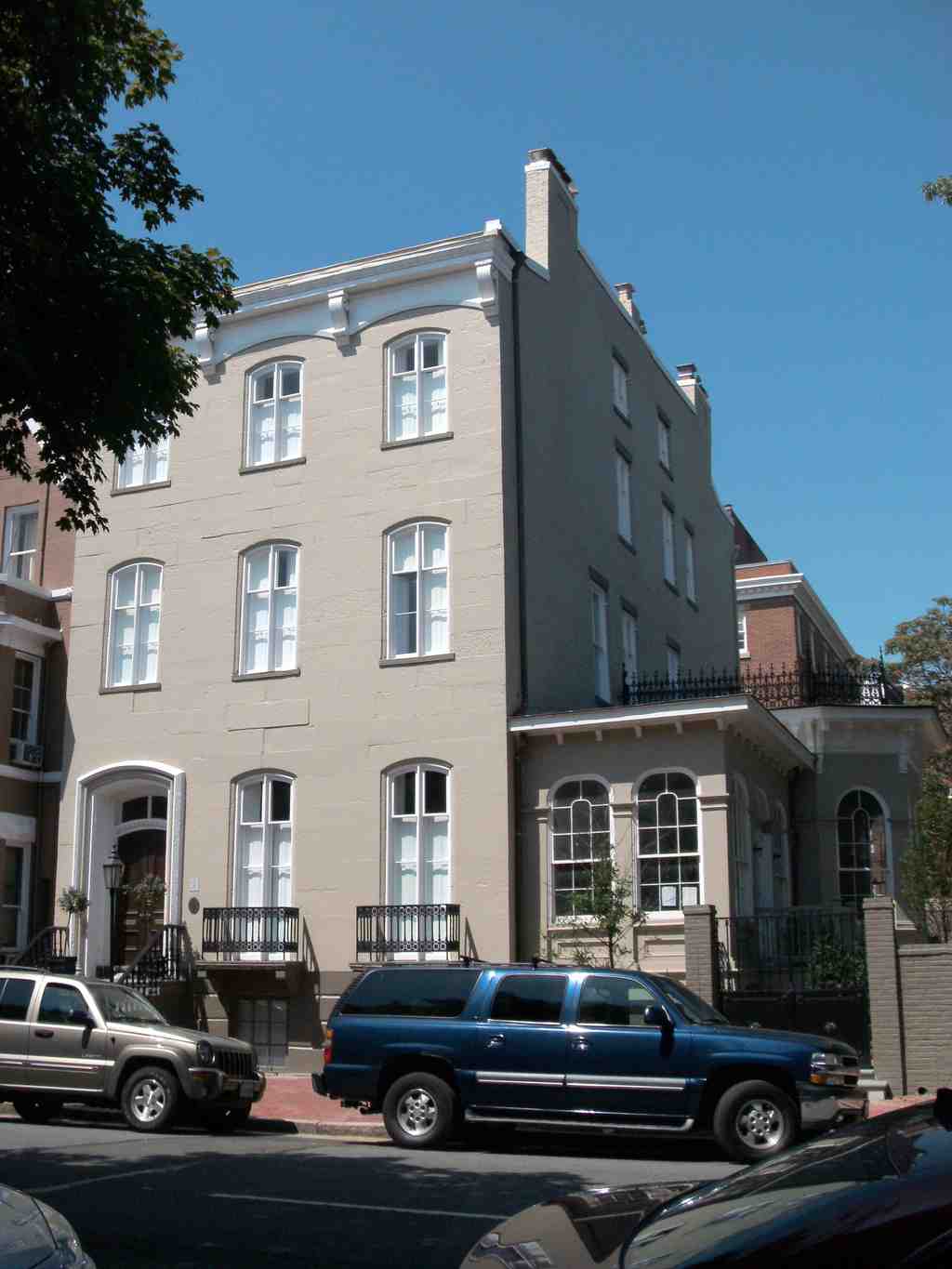
Bayne–Fowle HousePhoto: Ser Amantio de Nicalao, Wikimedia Commons, CC BY-SA 3.0. Cropped & resized. Take a look to your left at the Bayne-Fowle House, a towering three-story painted gray masonry building with tall, arched windows and a distinctive flat-roofed glass conservatory extending out on the right.
Now, we have spent a lot of time uncovering the incredible resilience of the people who were forced into bondage here, building their own sanctuaries while surviving unthinkable cruelty. But to fully grasp the world they were up against, we need to look at the people holding the power. Because behind these pristine brick walls, the wealthy white elite of Alexandria were already fracturing.
This house is practically dripping with high society drama. Let me tell you about William H. Fowle, a wealthy commission merchant... basically a middleman who sold wholesale goods for a cut of the profits... who bought this grand mansion in 1855. It was built in the Italianate style, a very trendy architectural design back then meant to mimic the look of romantic European villas. But long before he moved into this swanky pad, Fowle was involved in one of the city's most scandalous feuds.
Back in the 1820s, a local guy named Louis Cazenove publicly accused Fowle of refusing to help put out a fire at a nearby mill. Fowle was furious. He demanded an apology, did not get one, and challenged Cazenove to a duel.
Now, you would think this was a sure thing for Fowle. He was an experienced marksman. Cazenove had literally never held a loaded pistol until the night before the duel. They met the day after Christmas across the river in Maryland. They fired. Fowle missed completely. Cazenove, the absolute amateur, shot Fowle directly in the face.
Against all odds, Fowle survived the catastrophic injury, patched things up with his rival, and went on to live a very rich life right here. You can actually pull out your phone and see the beautiful side conservatory of the house where he might have relaxed, complete with its original scalloped wooden shelves.
But the drama did not stop with a bullet to the face. As the Civil War approached, the Fowle family was torn down the middle. The elder Fowle was the son of a Massachusetts man and was rumored to sympathize with the abolitionists, the activists fighting to legally end slavery. His son, however, went the exact opposite route, enthusiastically enlisting as an officer in the Confederate Army. When the war broke out, the family abandoned this luxurious home with all its gilded mirrors and marble mantels, fleeing to Richmond.
The Union army immediately seized the mansion, turning it into a military hospital. Up in the unfinished attic, recovering Union soldiers carved and penciled their names into the plaster walls. Those signatures are still there today, safely preserved under modern plexiglass.
It really makes you think about the stories we choose to preserve and the ones we pave over. People look at a beautiful historic facade and imagine a perfect, genteel past, but the reality was messy, violent, and deeply divided. Let us keep pulling back those layers as we walk over to the Alexandria Fire Department, which is just about a three minute stroll from here.
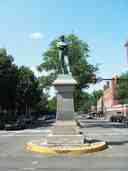
Anchored to a tall, square marble and concrete pedestal, a lone bronze soldier stands looking downward with his arms tightly crossed over his chest. That was the ap-uh-mat-uks…Leer másMostrar menos
Abrir página dedicada →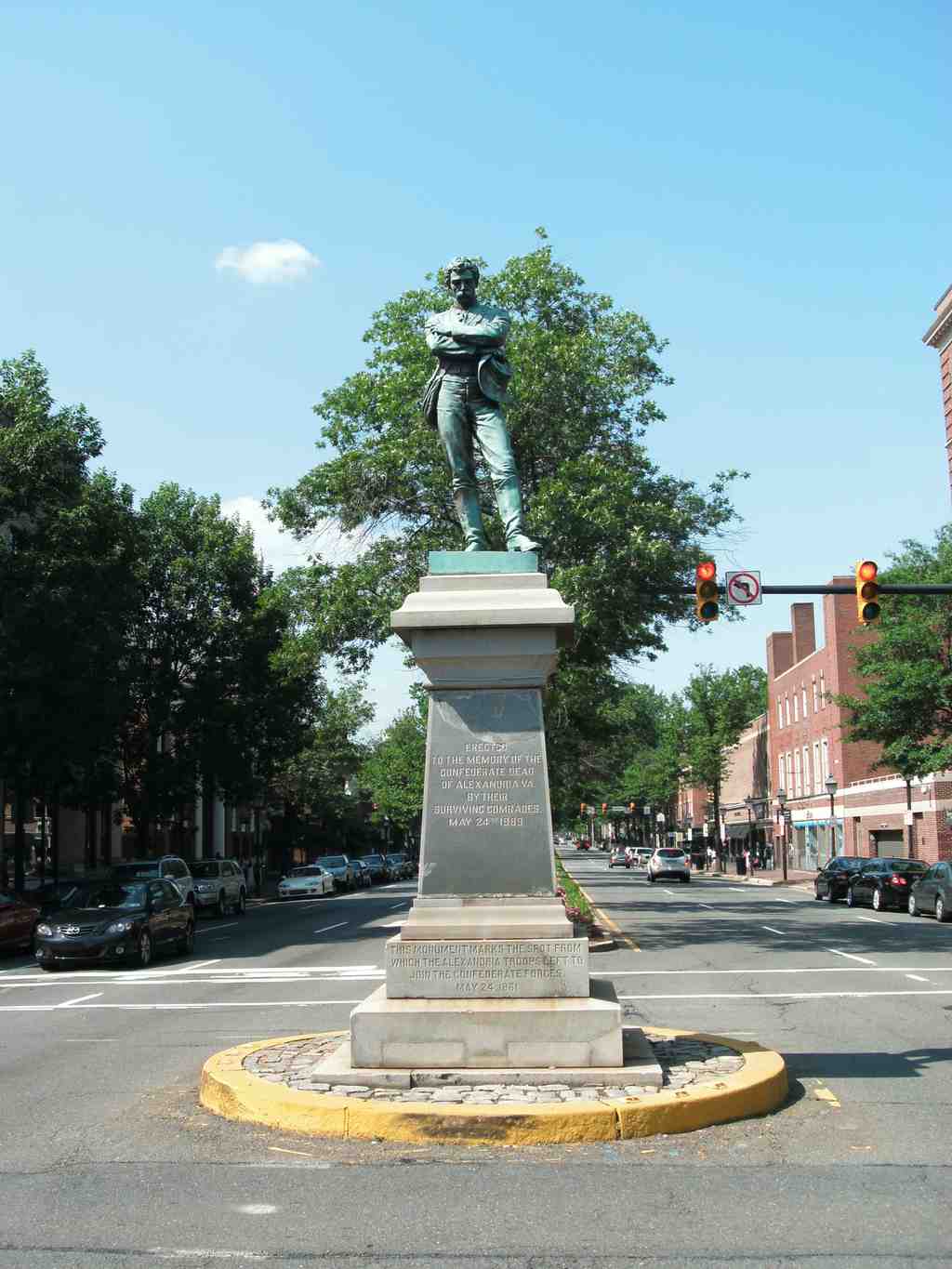
AppomattoxPhoto: Ser Amantio di Nicolao, Wikimedia Commons, Public domain. Cropped & resized. Anchored to a tall, square marble and concrete pedestal, a lone bronze soldier stands looking downward with his arms tightly crossed over his chest. That was the Appomattox statue, or at least, that is what used to stand right out there on your left in the middle of the intersection of South Washington and Prince Streets.
If you want to see how this bronze monument watched Alexandria shift from early motorcars to modern traffic before its sudden removal in two thousand twenty, just pull up the before and after image on your screen.
The monument was dedicated in eighteen eighty-nine to memorialize local Confederate dead from the American Civil War. The sculptor, M. Caspar Buberl, brought to life a design by John Adams Elder. Elder had painted a lone, unarmed soldier staring at the ground after the Confederacy surrendered to Union forces. You can take a closer look at that somber expression and downward tilt in the app. Elder never actually saw the finished monument, because he caught a brutal case of malaria while painting a portrait of Confederate President Jefferson Davis, eventually dying from the resulting paralysis.
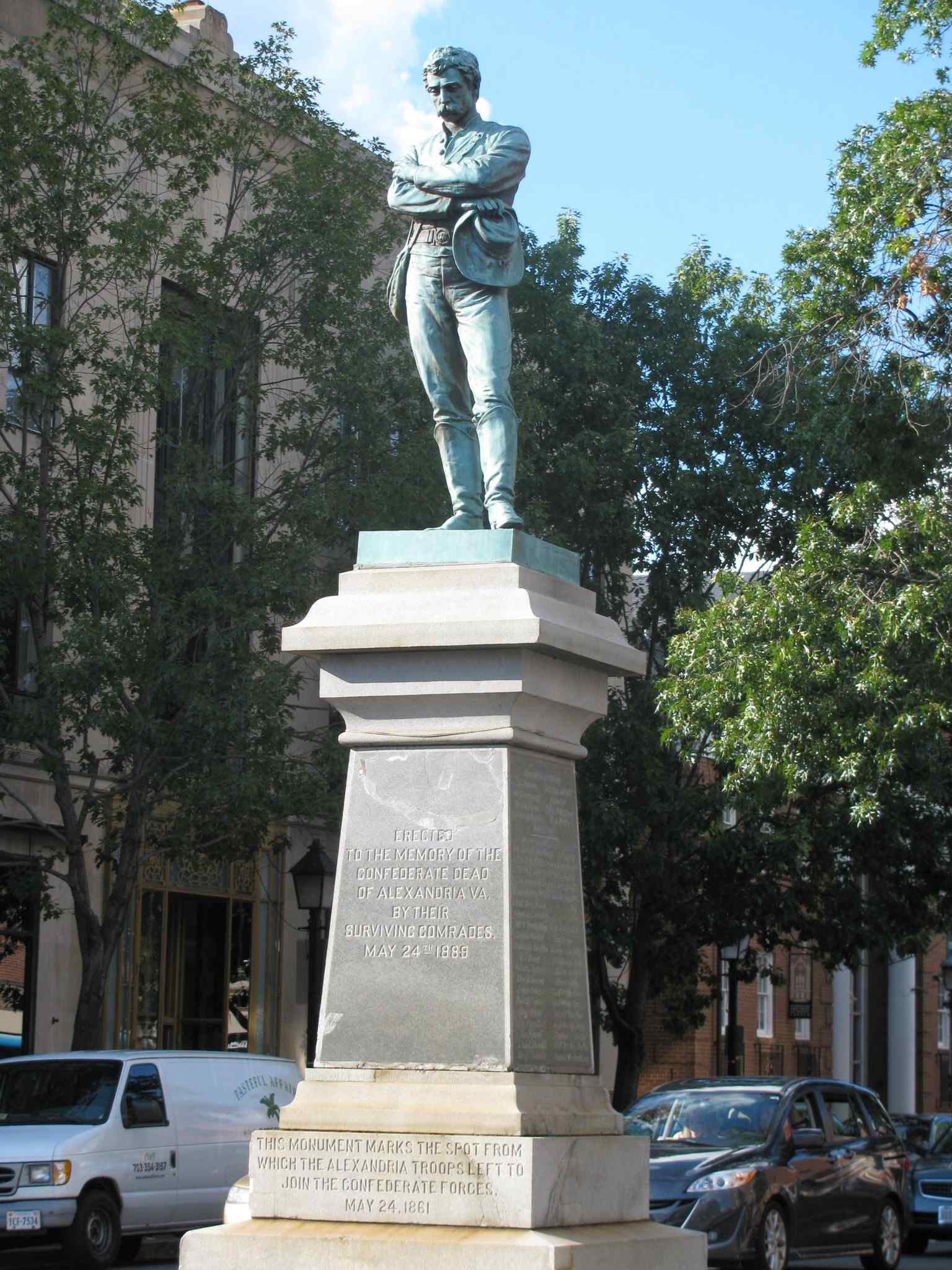
This vertical shot provides a closer look at the Appomattox statue, highlighting the lone Confederate soldier's crossed arms and downward gaze, reflecting the somber expression described.Photo: sculptor . Casper Buberl, Wikimedia Commons, Public domain. Cropped & resized. The timing of its dedication was incredibly deliberate. Organizers unveiled it exactly twenty-eight years to the day after Alexandria's garrison evacuated the city ahead of advancing Union forces. For the local Black community, who had fought so fiercely to cultivate their own networks of faith and independence amidst the cruel realities of human ownership, the statue's looming presence was no accident. It was a heavy, unavoidable monument to the regime that fought to keep them enslaved.
Decades before the modern debate over monuments, people here were pushing back. In the late nineteen sixties, following the assassinations of civil rights leaders, a group of Black high school students marched on City Hall demanding the statue's removal. Among them was a teenager named Bill Euille, who would later become the city's first African American mayor. Their march did not topple the statue, but it did force the permanent removal of the Confederate flag flying beside it.
The monument also had a few strange encounters with local traffic. In nineteen eighty-eight, a van smashed into the base and knocked the soldier right off. The impact popped open a hidden time capsule. A man living at a nearby YMCA grabbed the capsule and made a run for it. A detective eventually had to track him down to get the historical artifacts back intact.
The story finally came to a close in June of two thousand twenty. Following nationwide protests, state lawmakers passed a bill allowing local governments to take down war memorials. Alexandria planned to dismantle it in July, but the United Daughters of the Confederacy, a heritage organization for descendants of Confederate veterans who owned the statue, decided to act first. Their crews arrived early one morning and quietly hauled the bronze soldier off to an undisclosed private location.
Take a moment to look toward the empty center of the intersection where the bronze soldier once stood, and consider what its absence represents today. It is a quiet but powerful shift, making room for a city finally choosing to tell a wider story. We are going to keep moving now toward the Alexandria Historic District, which is just a short two minute walk from here.
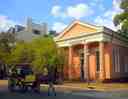
You should be looking at a striking peach-colored building shaped like a classical temple, featuring four tall fluted columns and the word ath-uh-nee-um displayed across its…Leer másMostrar menos
Abrir página dedicada →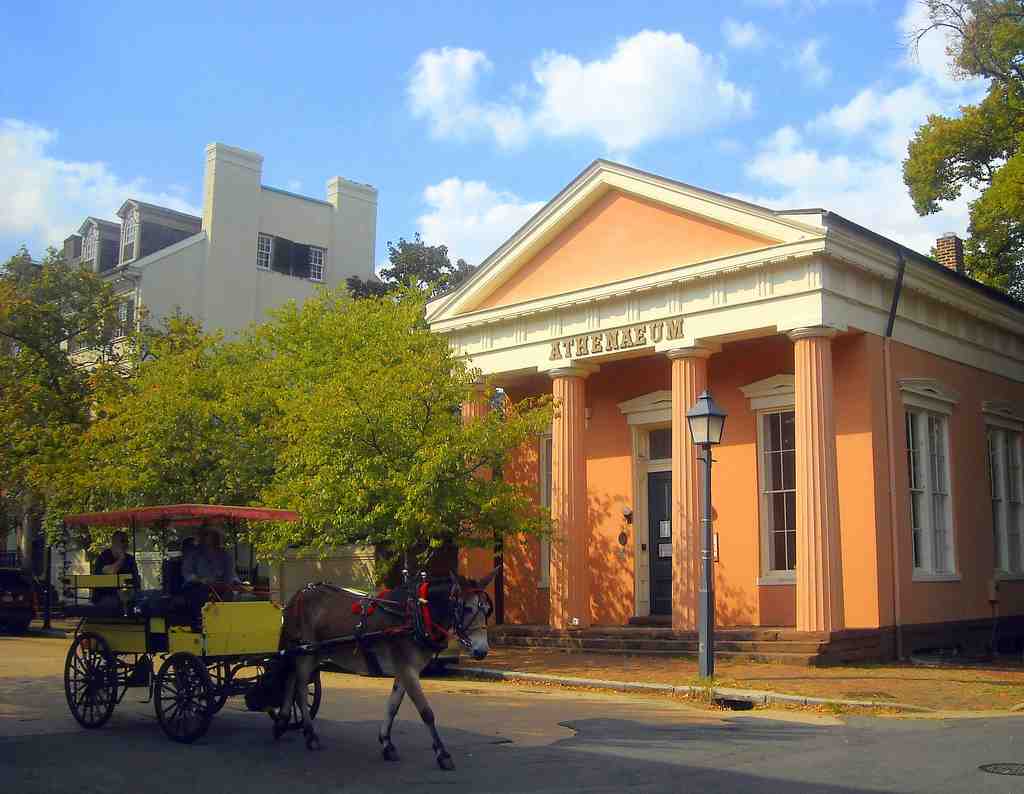
Alexandria Historic DistrictPhoto: AgnosticPreachersKid, Wikimedia Commons, CC BY-SA 3.0. Cropped & resized. You should be looking at a striking peach-colored building shaped like a classical temple, featuring four tall fluted columns and the word Athenaeum displayed across its triangular roofline. We are standing right in the heart of the Alexandria Historic District, surrounded by one of the best-preserved collections of early American architecture in the country.
If you zoom way out, long before the city was chartered in 1748 and its tidy grid of streets was laid out with the help of a young surveyor named George Washington, this land belonged to a surprising pioneer. In 1654, an English immigrant named Margaret Brent was awarded a massive 700-acre land grant, which was basically a large, official gift of territory from the colonial governor. Brent was a fierce trailblazer, actually becoming the first woman in the English North American colonies to stand and argue her case before a common law court. It was only after her heirs sold the massive property to a planter named John Alexander that this town began to take shape, eventually taking his name.
Take a glance at your screen for a 1933 photo showing the classic Federal style townhouses that line these blocks, characterized by their symmetrical brick facades and simple, elegant windows. But as we have seen along this walk, there is a profound duality to Alexandria.
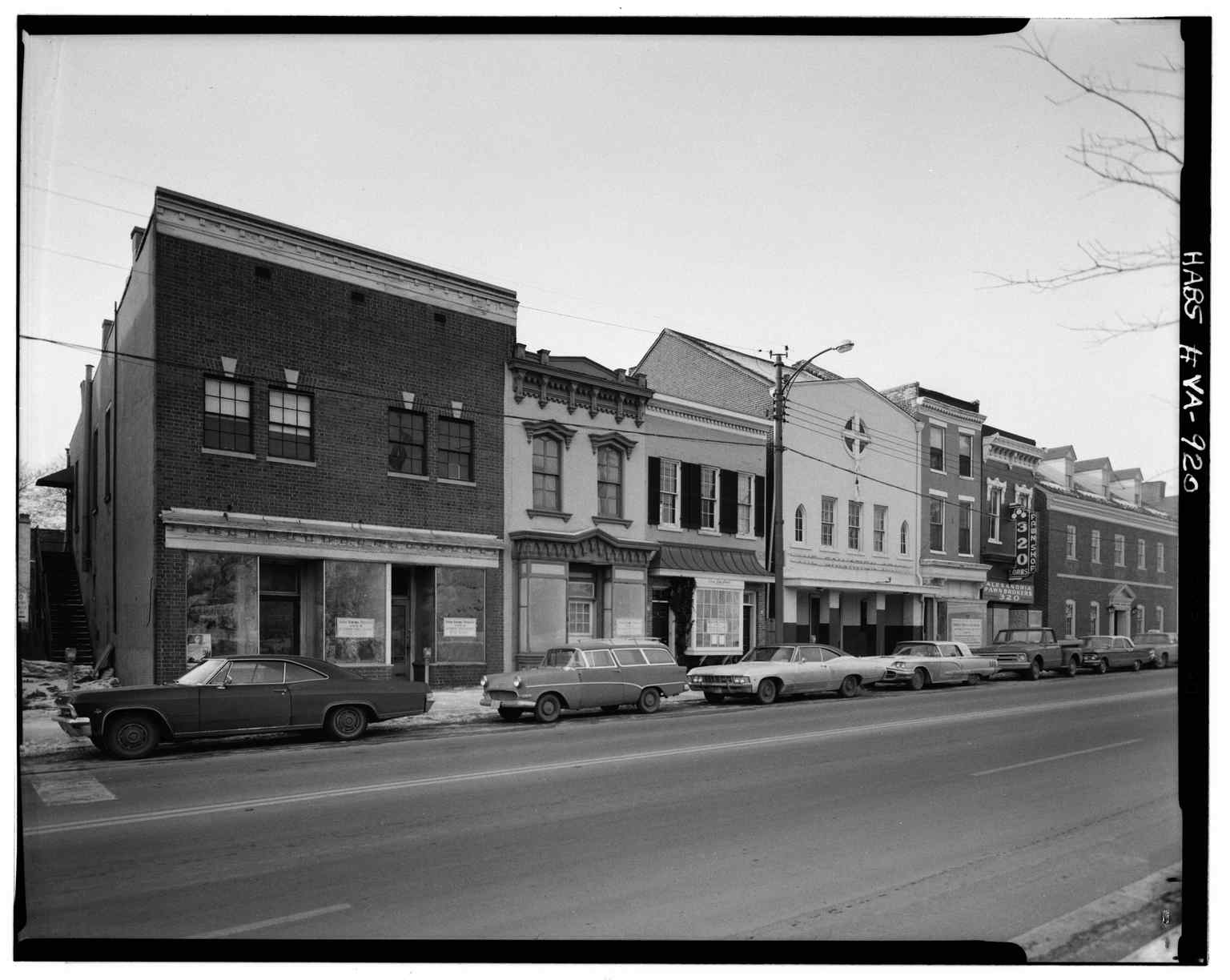
A 1933 street view of 300-320 King Street, showcasing the Federal style townhouses that characterize Alexandria's late 18th and early 19th-century urban architecture.Photo: Unknown, Wikimedia Commons, Public domain. Cropped & resized. The port absolutely thrived on exporting tobacco and wheat, funding the gorgeous structures around us. Yet, that charming grid of streets completely masked a grim reality. By the mid-nineteenth century, these scenic blocks had become a major hub for the domestic slave trade. This was the organized, brutal business of buying and selling enslaved men, women, and children within the borders of the United States. Countless enslaved people suffered profound heartbreak and exploitation right here, their forced labor silently financing the very bricks and streets that made the seaport wealthy. It is a heavy contrast, knowing that such profound injustice was happening right alongside the everyday bustle of the colonial elite.
In the face of that brutal reality, the enslaved and free Black communities of Alexandria had to forge their own spaces of survival and resilience. It was an incredibly difficult existence, but they found ways to build networks of support. A huge part of that foundation was faith. Let's head over to see the role the church played in the city's early days, as we make our way toward St. Paul's Episcopal Church.
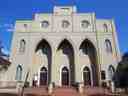
Looking up to your left, you will see a light tan facade distinguished by three towering, pointed Gothic arches that form a shallow front porch beneath a row of three round…Leer másMostrar menos
Abrir página dedicada →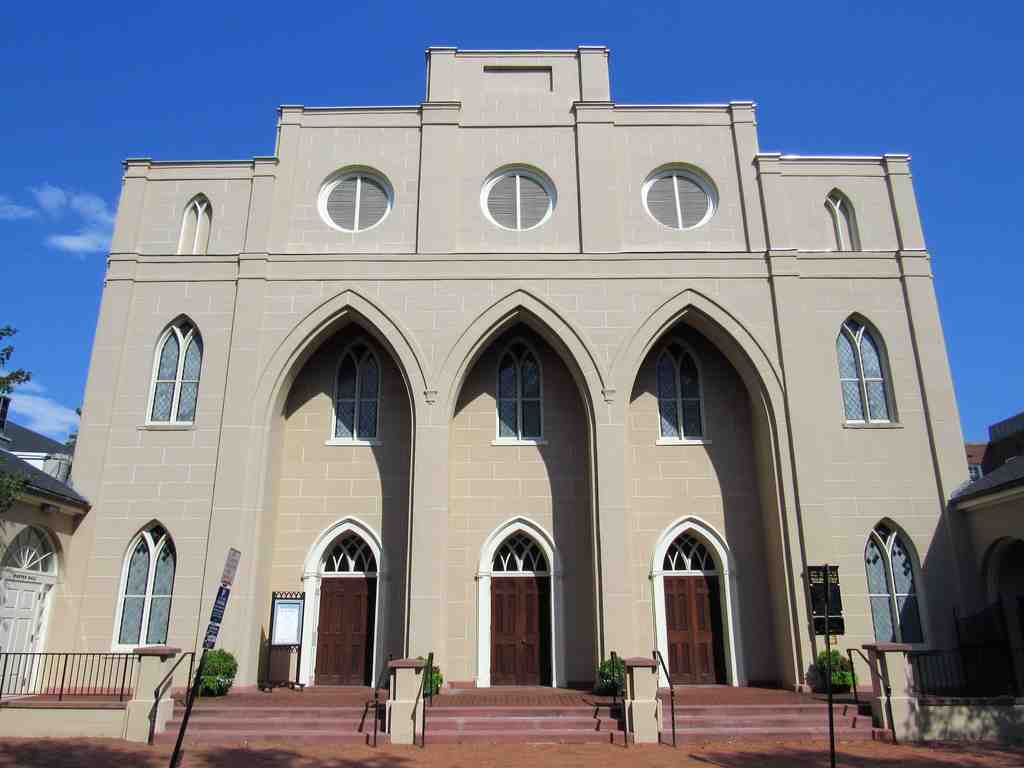
St. Paul's Episcopal ChurchPhoto: Farragutful, Wikimedia Commons, CC BY-SA 4.0. Cropped & resized. Looking up to your left, you will see a light tan facade distinguished by three towering, pointed Gothic arches that form a shallow front porch beneath a row of three round windows. It is a really striking sight, especially when you realize it was designed by Benjamin Latrobe, the second architect of the United States Capitol.
Check your screen for a clear view of this unique facade. Latrobe was famous for his grand, classical government buildings, but here he went with a style called Gothic Revival. That means he used medieval European elements, like those dramatically pointed arches, to draw the eye upward toward the heavens. Latrobe actually based this facade on a design that was rejected for the Baltimore Cathedral. The rector here at the time, a man named William Holland Wilmer, loved the Gothic look. He felt it captured the deep, historic fervor of the early church.
Wilmer was a total force of nature. When he arrived in 1812, the Episcopal Church in Virginia was struggling to survive after losing its official government funding and status following the American Revolution. Wilmer rolled up his sleeves and practically rebuilt the institution from the ground up. He wrote sermons, founded publications, and started holding classes right here in a small lecture hall. Those very classes eventually grew into the Virginia Theological Seminary.
But Wilmer's most profound legacy here might be the Sunday school he organized in 1818. Back then, Sunday schools were initially designed to teach reading, writing, and the basics of the Bible to the working poor. Here in Alexandria, this school became a quiet but incredibly powerful beacon. It educated white students, yes, but it also opened its doors to members of the local Black community.
In a society deeply entrenched in the horrific system of human bondage, this classroom offered a rare and precious resource. Enslaved and free Black men and women came here to learn to read and write. They used this knowledge to build their own networks, finding dignity and spiritual liberation within the pages of the Bible. It was a quiet, enduring act of claiming mental independence when physical liberty was completely denied.
Tragically, this sanctuary of learning was forcefully shut down. In 1831, after Nat Turner led an uprising further south, the Virginia legislature panicked. They passed draconian laws explicitly forbidding anyone from teaching Black individuals to read or write. The state forced the church to stop educating Black students, trying to crush that hard won intellectual freedom. But the seeds of devotion and strength they had already planted in this space could never be unlearned.
The building you are standing in front of holds all these complex layers of history, from Latrobe's architectural triumphs to the quiet, unyielding power of a marginalized people. Just so you know, if you want to take a look inside, the church is open Monday through Friday from 9 AM to 4:30 PM, and for services on Sunday mornings and evenings.
Now, let us continue to the personal home of one of Alexandria's most fascinating historical figures, the George Lewis Seaton House, which is just a two minute walk away.
Take a look at the large, rectangular red-brick building right in front of you, with its symmetrical tall windows and that distinct circular vent near the very top of the gabled…Leer másMostrar menos
Abrir página dedicada →Take a look at the large, rectangular red-brick building right in front of you, with its symmetrical tall windows and that distinct circular vent near the very top of the gabled roof.
It is the Old Presbyterian Meeting House. But the structure you are looking at is actually a survivor. Back in July of eighteen thirty-five, lightning struck during a violent storm. Within two hours, the original seventeen seventy-five building was completely gutted by fire. Only the brick walls were left standing. Despite the intense heat and utter chaos, the congregation actually rushed right into the burning sanctuary to save whatever they could. They dragged out original wooden pew benches and a colonial-era clock. Take a glance at your app to see the exterior as it stands today, proudly rebuilt from that ruin. That clock they saved, by the way, has its hands permanently frozen at ten-twenty at night, the exact time George Washington died, serving as a quiet tribute to the memorial services held for him right here.
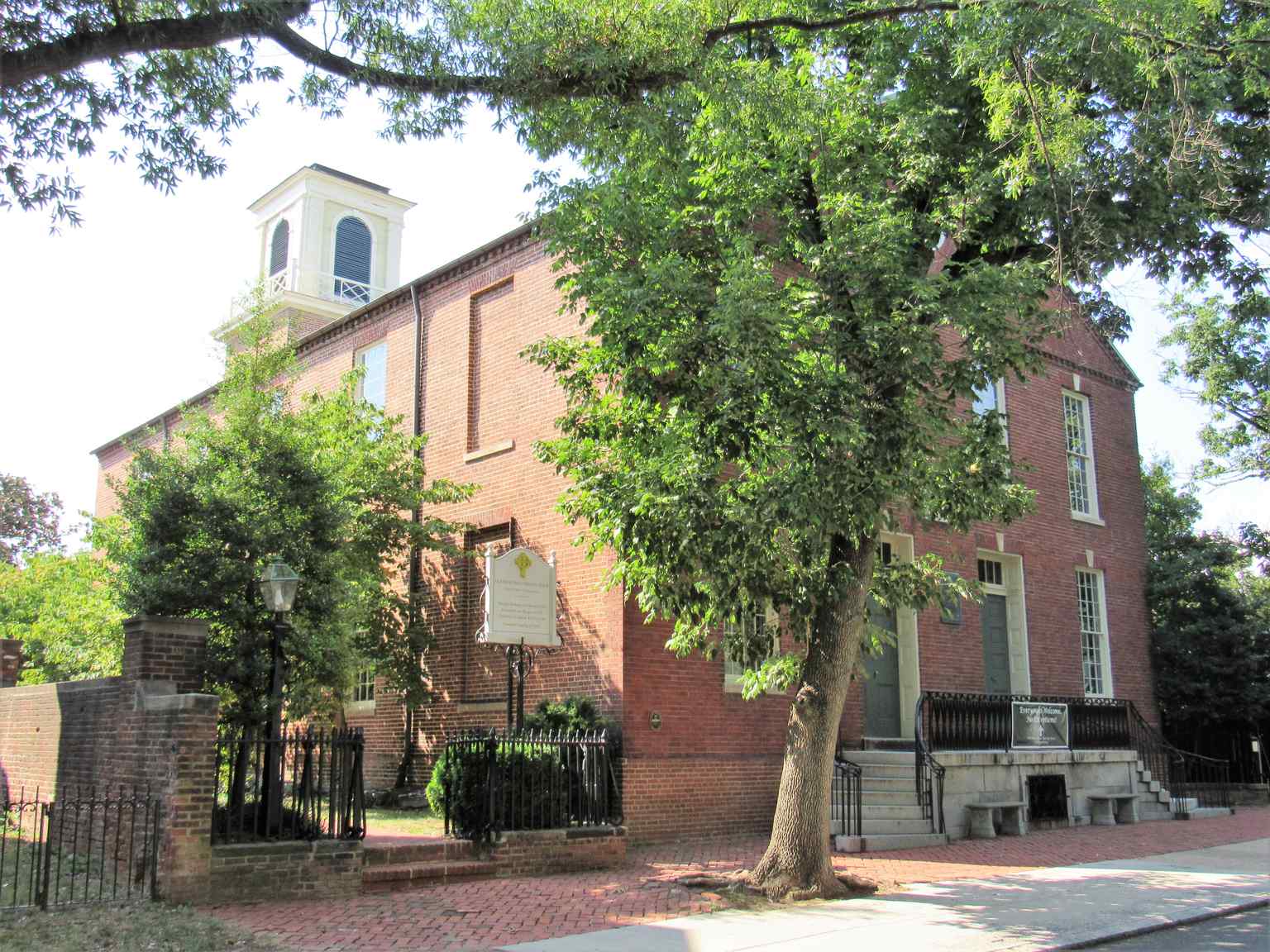
The Old Presbyterian Meeting House, built in 1775, stands today as a testament to Alexandria's early history, rebuilt in 1836 after a devastating fire.Photo: Farragutful, Wikimedia Commons, CC BY-SA 4.0. Cropped & resized. Look closely at the brick facade of the Meeting House, a quiet testament to a structure that stubbornly rose from those devastating ashes in eighteen thirty-six.
But rebuilding a roof is a lot easier than holding a fractured community together. Decades before the fire, this congregation was already cracking apart. In eighteen seventeen, a faction broke away to form the Second Presbyterian Church. It was a massive schism, a permanent split. As the Civil War loomed, those cracks deepened into a canyon. Under Reverend Elias Harrison, this Meeting House stayed loyal to the Union. Meanwhile, that breakaway Second Presbyterian congregation aligned itself with a pro-slavery synod, which is essentially a governing council of church officials.
It really makes you step back and look at the broader picture. Here you have these prominent, mostly white congregations literally tearing themselves apart over the politics of enslavement. But right alongside them, the Black residents of Alexandria were fighting a much heavier, far more dangerous battle. They were fighting simply to exist, pooling their resilience to forge their own gathering places and secure their own spiritual independence in a world built to deny it. The real narrative of survival here was not just about saving bricks from a fire, it was about claiming humanity when the system tried to erase it.
This congregation struggled heavily after the war. The numbers dropped so low the building actually closed for worship in eighteen ninety-nine, acting as a museum for half a century before a new congregation revived it in nineteen forty-nine. You can check your screen to see the bell tower that was added to the rebuilt structure in eighteen forty-three.
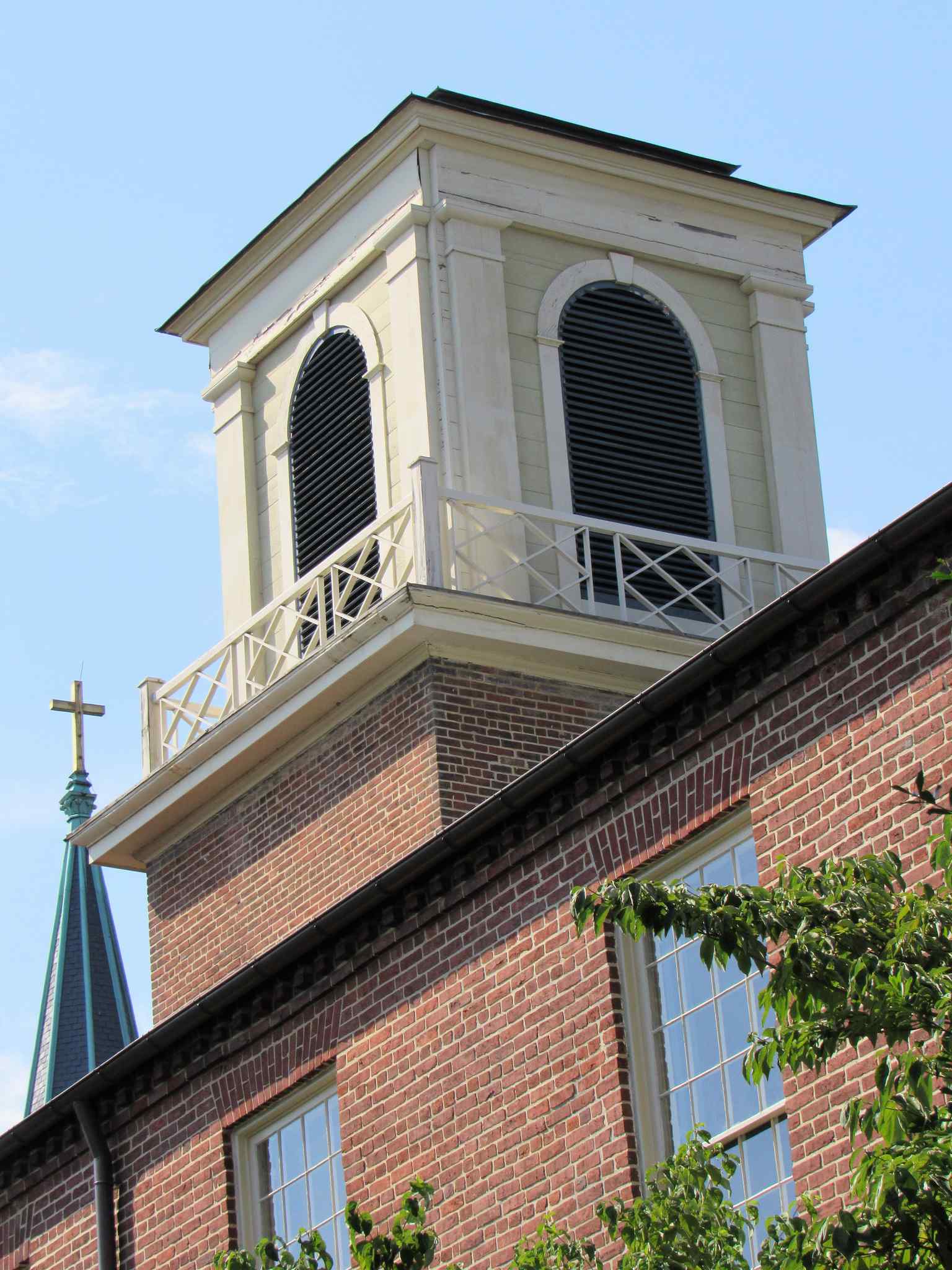
The bell tower, added to the Meeting House in 1843, once tolled for four days in mourning after George Washington's death in 1799.Photo: Farragutful, Wikimedia Commons, CC BY-SA 4.0. Cropped & resized. Our next and final stop is about an eleven-minute walk away, heading over to Roberts Memorial United Methodist Church, where we will uncover a truly powerful story of unshakeable faith and survival. Oh, and if you want to peek inside this Meeting House, it is generally open weekday mornings and afternoons, plus Sunday mornings.
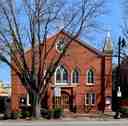
Take a look at the two story red brick building with pointed arch windows and a distinctive circular stained glass window set high up in the central gable. You are standing in…Leer másMostrar menos
Abrir página dedicada →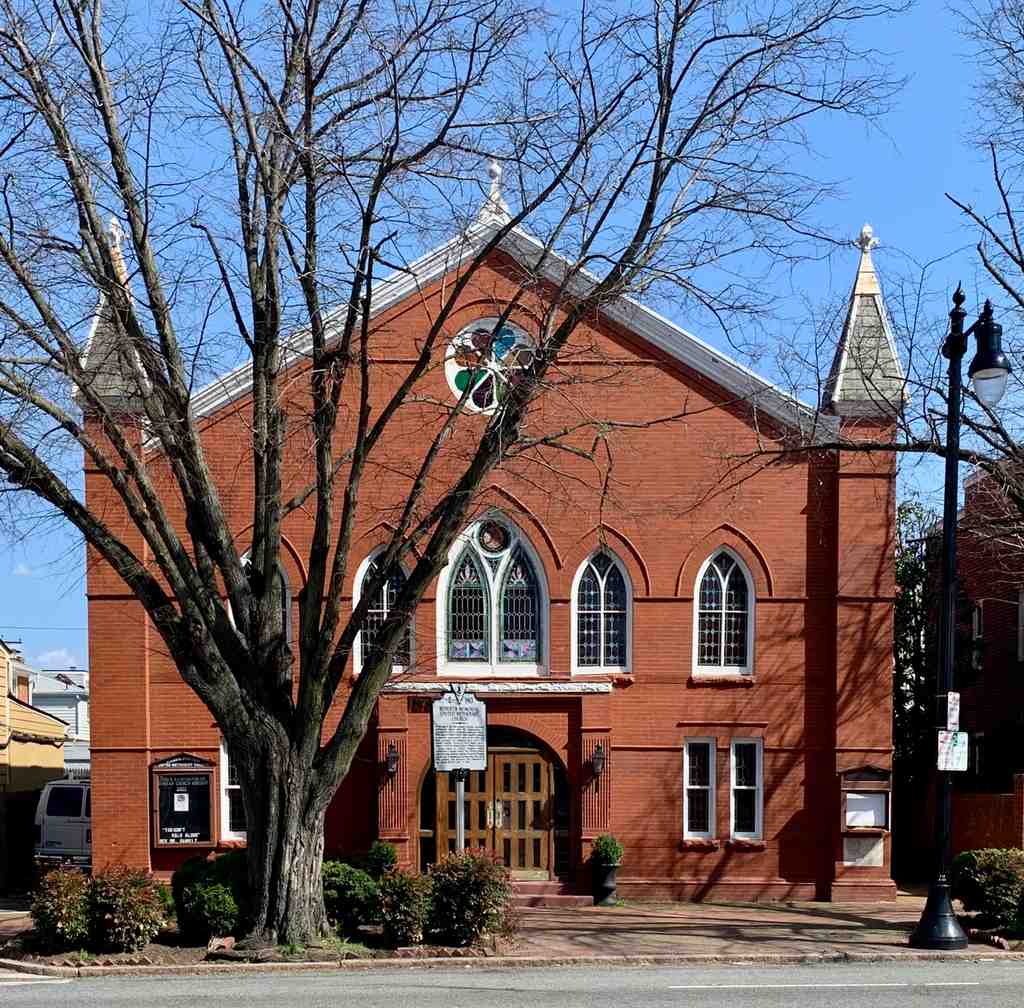
Roberts Memorial United Methodist ChurchPhoto: APK, Wikimedia Commons, CC BY-SA 4.0. Cropped & resized. Take a look at the two story red brick building with pointed arch windows and a distinctive circular stained glass window set high up in the central gable. You are standing in front of Roberts Memorial United Methodist Church, the oldest African American church structure in Alexandria.
Back in 1830, about two hundred and fifty free and enslaved Black Americans were attending Trinity Methodist Church. As was the custom then, they were restricted to sitting up in the gallery under the supervision of a white pastor. They wanted a space of their own, a place where they could speak with their own voice and train their own leaders. So, they pooled together two hundred dollars, which is around seven thousand dollars today, and bought some land.
Then came 1831, and Nat Turner led a massive rebellion against slavery down in southern Virginia. The pushback from white neighbors here in Alexandria was intense. Facing fierce opposition and very real safety concerns from the white residents living near their newly bought land, the congregation had to put their plans on ice.
But they absolutely refused to give up. By 1834, they purchased this property right here for three hundred and fifty dollars, roughly twelve thousand today. They strategically picked a spot sandwiched directly between two established Black neighborhoods.
If you check the screen on your device, you can see a great shot of the exterior. That ornate Gothic Revival facade was actually added during a massive remodel in 1894. But those side walls? Those are the original bricks laid back in 1834.
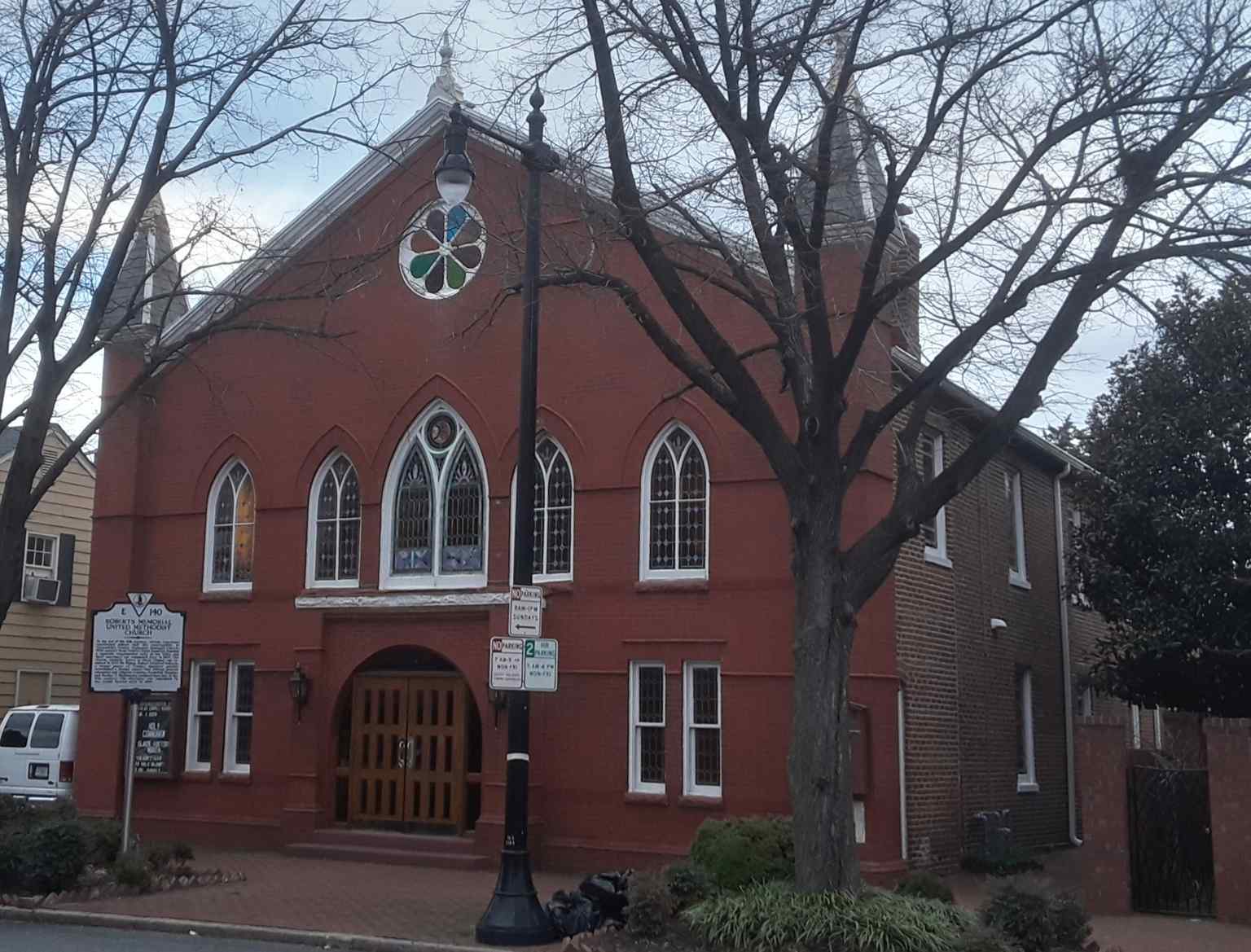
The Roberts Memorial United Methodist Church, seen here, features a Gothic Revival facade added during a major 1894 remodeling, though its original 1834 side walls still stand, making it Alexandria's oldest African American church structure.Photo: Ser Amantio di Nicolao, Wikimedia Commons, CC BY-SA 3.0. Cropped & resized. This building was a true anchor. Supported by fierce advocates like free Black business leader Moses Hepburn, and deeply dedicated women like Millie Triplett and Betsy Harris, the church ran one of the earliest schools for Black children and adults. They taught reading and writing at a time when Virginia laws strictly banned the education of African Americans.
Things got incredibly dark in 1846 when Alexandria was transferred from the relatively lenient District of Columbia back to Virginia jurisdiction, a move known as retrocession. Suddenly, brutal new restrictions came crashing down. A strict ten o'clock curfew was enforced, and gathering in groups of five or more without white supervision became completely illegal. The church school was forced to shut its doors. To make matters worse, the Methodist church split over the issue of slavery, and the man this chapel was originally named after, Reverend Davis, decided to side with the pro slavery southern faction.
So, the congregation simply erased his name. They renamed their sanctuary after Bishop Robert Richford Roberts, a beloved leader known for preaching to widely diverse crowds.
When Union troops arrived during the Civil War, those oppressive state laws finally vanished. The school reopened, the congregation flourished, and this very space eventually hosted towering historical figures like Frederick Douglass and Booker T. Washington.
Take a moment to just look at it. These original walls have absorbed nearly two centuries of sorrow, resilience, and soaring song, standing today not just as a sanctuary, but as a monument to freedom.
Preguntas frecuentes
¿Cómo empiezo el tour?
Después de la compra, descarga la app AudaTours e ingresa tu código de canje. El tour estará listo para comenzar de inmediato - solo toca play y sigue la ruta guiada por GPS.
¿Necesito internet durante el tour?
¡No! Descarga el tour antes de empezar y disfrútalo completamente sin conexión. Solo la función de chat requiere internet. Recomendamos descargar en WiFi para ahorrar datos móviles.
¿Es un tour guiado en grupo?
No - esta es una audioguía autoguiada. Exploras de forma independiente a tu propio ritmo, con narración de audio reproduciéndose en tu teléfono. Sin guía, sin grupo, sin horario.
¿Cuánto dura el tour?
La mayoría de los tours toman 60–90 minutos para completar, pero tú controlas el ritmo completamente. Pausa, salta paradas o toma descansos cuando quieras.
¿Qué pasa si no puedo terminar el tour hoy?
¡No hay problema! Los tours tienen acceso de por vida. Pausa y continúa cuando quieras - mañana, la próxima semana o el próximo año. Tu progreso se guarda.
¿Qué idiomas están disponibles?
Todos los tours están disponibles en más de 50 idiomas. Selecciona tu idioma preferido al canjear tu código. Nota: el idioma no se puede cambiar después de generar el tour.
¿Dónde accedo al tour después de comprarlo?
Descarga la app gratuita AudaTours desde App Store o Google Play. Ingresa tu código de canje (enviado por email) y el tour aparecerá en tu biblioteca, listo para descargar y comenzar.
Si no disfrutas el tour, te reembolsamos tu compra. Contáctanos en [email protected]
Paga de forma segura con 


