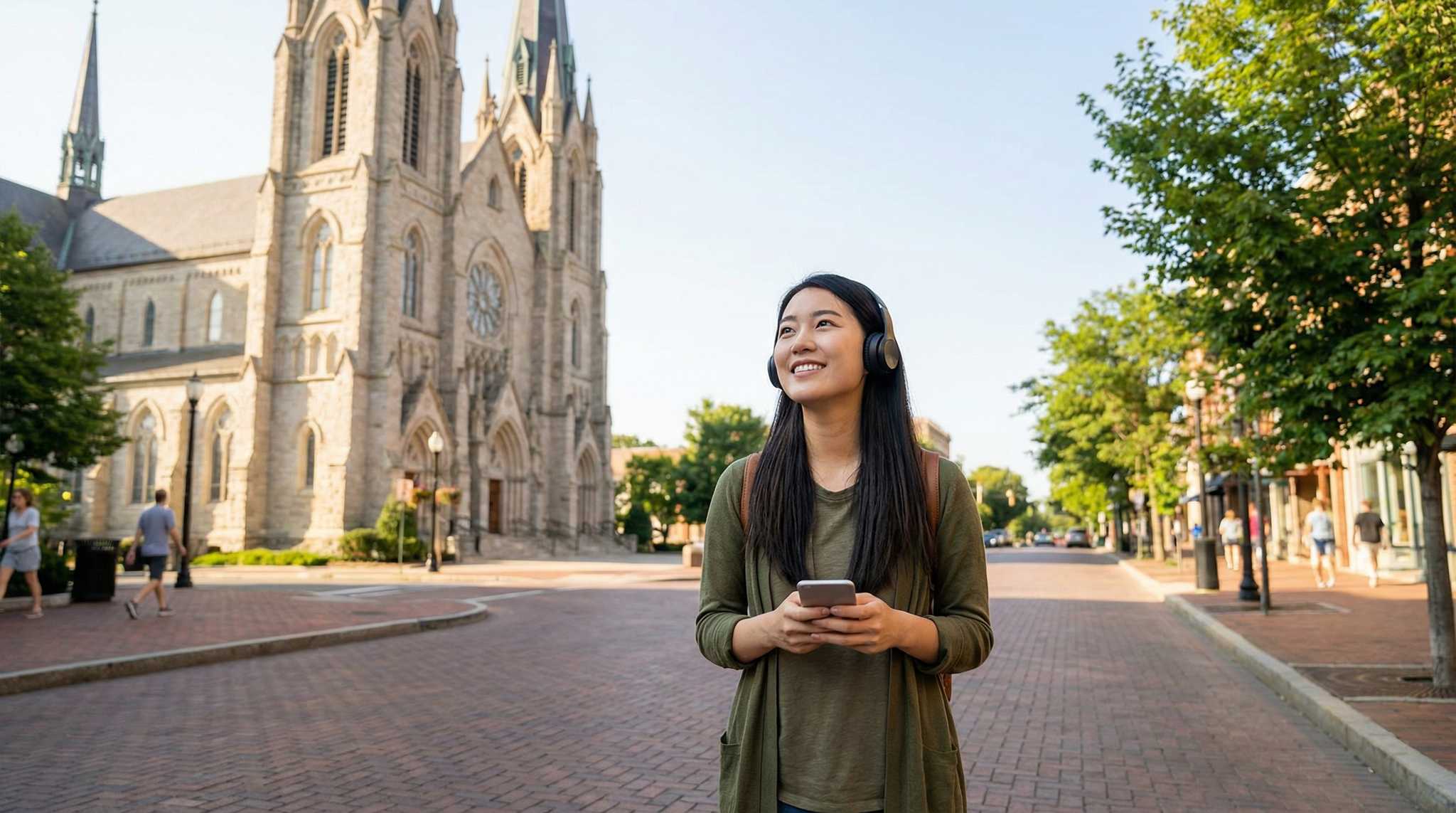
Tour de audio de Fall River: Molinos, Mansiones y Leyendas Marítimas
Una vez, un buque naval apuntó sus cañones no a enemigos de ultramar, sino aquí mismo, proyectando sombras sobre las inquietas calles de Fall River. Debajo de los campanarios de la ciudad y junto a cascos oxidados, yacen secretos esperando ser descubiertos. Este tour de audio autoguiado te lleva entre orillas de ríos, monumentos conmemorativos de batallas y catedrales imponentes. Descubre rincones ocultos e historias no contadas que la mayoría de los visitantes pasan por alto. ¿Qué advertencia susurrada casi provocó un motín a bordo del USS Joseph P. Kennedy Jr.? ¿Qué voto silencioso resuena a través de los vitrales de la Catedral de Santa María? ¿Por qué un simple banquete en la Iglesia de Santo Cristo provocó un revuelo en toda la ciudad que perdura hasta el día de hoy? Muévete por las callejuelas y los grandes salones de Fall River. Rastrea el legado de rebeldes, visionarios y héroes cotidianos. Cada paso revela drama y escándalo bajo la majestuosa mampostería de la ciudad. ¿Listo para caminar donde una vez tembló la historia? Presiona reproducir y desvela el corazón oculto de Fall River.
Vista previa del tour
Sobre este tour
- scheduleDuración 40–60 minsVe a tu propio ritmo
- straighten4.4 km de ruta a pieSigue el camino guiado
- location_onUbicaciónBristol, Estados Unidos
- wifi_offFunciona sin conexiónDescarga una vez, úsalo en cualquier lugar
- all_inclusiveAcceso de por vidaReprodúcelo en cualquier momento, para siempre
- location_onComienza en Escuela Secundaria B.M.C. Durfee
Paradas en este tour
To spot the B.M.C. Durfee High School, look high up the hill for a majestic stone building with a tall clock tower and lots of big, arched windows-its gray granite walls and…Leer másMostrar menos
To spot the B.M.C. Durfee High School, look high up the hill for a majestic stone building with a tall clock tower and lots of big, arched windows-its gray granite walls and distinctive red-topped dome stand out against the sky. Welcome to one of Fall River’s grandest old landmarks! Imagine you’re standing here in the late 1800s. The air is buzzing with excitement as workers haul blocks of rugged gray granite from the hills of Fall River for the first story, and paler stones from way up in New Hampshire for the upper floors. Wealthy Mary B. Young, in a gesture of motherly love and grand generosity, is making sure this building rises as a shining tribute to her son, Bradford Matthew Chaloner Durfee-who left this world too young, but whose name would be remembered by generations. Picture the townsfolk gathering for the big dedication ceremony in June 1887. Some say you could hear the sound of the bells echoing down the hill and the mayor trying not to trip over his speech notes. Designed by the famous Boston architect George A. Clough, this high school towered over the city, watching over the busy lives below. From this perch at the top of the hill-the “Highlands”-students became known as the “Durfee Hilltoppers.” I’d say they had a pretty good view for daydreaming, wouldn’t you? The school served thousands of students until 1978, when a shiny, modern building opened elsewhere in the city. For years, these halls were quiet-almost as if the building was snoozing, waiting for someone to whisper, “Class is back in session.” Then, in the 1990s, it was transformed again-no longer with chalk and blackboards, but with judges, lawyers, and family tales. Today, it’s a courthouse, but it’s also home to a hidden gem: a rare 19th-century telescope! Imagine, a four-foot-long telescope with an eight-inch lens, peering out into the stars. After gathering dust for decades, it was lovingly restored-now it hosts public stargazing nights. From science to sports, drama to drama court cases, this building has seen it all! And if you listen closely, maybe you’ll hear the cheers of those Durfee Hilltoppers echoing up from the past.
Abrir página dedicada →To spot the Lower Highlands Historic District, just look down this classic New England street-a mix of tall brick and clapboard houses with a prominent Gothic-style church spire…Leer másMostrar menos
To spot the Lower Highlands Historic District, just look down this classic New England street-a mix of tall brick and clapboard houses with a prominent Gothic-style church spire rising above the rooftops in the distance. You’re right in the heart of one of Fall River’s oldest residential neighborhoods! Now, let your imagination travel back in time a couple hundred years. Picture yourself walking these same streets, but instead of cars, you’d hear the soft clop of horses’ hooves, maybe see a Wampanoag family fishing along the Quequechan River-or, a little later on, hardy colonists dragging logs to a sawmill by the water’s edge. That’s right: these blocks were bustling with life long before most American cities were more than a twinkle in someone’s eye. By the late 1700s, the big deal in this district was grist and fulling mills. If you stand very still, I bet you can almost hear the creak and clatter of the wooden gears turning grain into flour inside those early mills-or maybe the wild stories neighbors swapped while waiting their turn. Then, in 1813, boom! The first giant textile mill in the city sprouted up along the river, and things really started buzzing. Storefronts popped up along North Main and Bedford Streets, while the neighborhoods behind them blossomed with workers’ homes, each one filled with families hoping the new industrial age would bring them better fortunes (or at least fewer blisters). But life here was never boring. In 1843, a devastating fire threatened to erase everything-picture frightened children clutching their parents’ hands, firemen dashing bucket to bucket, and neighbors shouting over the flames. Just when it seemed the story might end there, the community pulled itself together and rebuilt. And if you look closely, you’re surrounded by the results of that determined spirit-block after block of sturdy 19th-century homes, ranging from modest Greek Revival cottages to proud Federal-style houses like the ones built for the lucky few. And don’t be fooled-behind those charming front doors lived a lively crowd, from textile workers to business tycoons. Sometimes the buildings even have tales of their own, like the Gothic spire of the Church of the Ascension or the reliable little Cataract Engine Company No. 3, built after the flames to keep residents safe for good. Take a deep breath-the air in these streets is thick with stories, echoes, and maybe just the faintest smell of freshly sawn wood and baking bread. Welcome to the Lower Highlands, where history isn’t just in the books-it’s under your feet and all around you!
Abrir página dedicada →Look to your left and you’ll spot a striking red-brick church with tall, arched windows and a soaring spire topped by a cross-impossible to miss as it rises above the street…Leer másMostrar menos
Look to your left and you’ll spot a striking red-brick church with tall, arched windows and a soaring spire topped by a cross-impossible to miss as it rises above the street corner like something out of a gothic storybook. Now, as you stand in front of the Central Congregational Church, imagine you're stepping onto a stage where the past still whispers through the walls. Built back in 1875, this church has seen centuries come and go, all with that iconic steeple pointing straight to the sky. Picture horse-drawn carriages clattering by as families in their Sunday best slip through the arched doors. The air is thick with the scent of flour-dusted hymn books and the faint melody of an organ-no ordinary organ, by the way, but a rare Hook & Hastings, booming out notes that would give even your phone’s playlist a run for its money. Now, here’s where things get a little spooky and a lot more interesting. The Bordens-you know, that Borden family-were regulars here. Yes, Fall River’s most famous resident, Lizzie Borden herself, not only warmed a pew but even taught Sunday school in these very halls. Some say her presence still lingers… so if you feel a cold shiver, just blame it on the shade from that tall spire above you! Over the years, this place has transformed almost as much as Lizzie’s reputation-from a faithful congregation to a bustling culinary academy and now, a lively venue for weddings and celebrations. And pop culture can’t resist a church with secrets: Aerosmith rocked out in here for their “Cryin’” video in 1993, and ghost hunters from “Haunted Towns” have swarmed the aisles, hoping for a chat with Lizzie’s spirit. So go ahead, soak in the history and snap a photo or two-but if you hear footsteps behind you and nobody’s there, don’t worry. It’s probably just Lizzie making sure you’re singing in tune! Ready to move on, or still checking for ghosts?
Abrir página dedicada →
Mostrar 10 paradas másMostrar menos paradasexpand_moreexpand_less
Keep an eye out on your left for a bright red, two-story wooden building with a simple porch and tan trim-it stands out like a fire engine among the quieter colors of the…Leer másMostrar menos
Keep an eye out on your left for a bright red, two-story wooden building with a simple porch and tan trim-it stands out like a fire engine among the quieter colors of the street. Imagine standing here in 1843-smell the crisp air mixed with a hint of smoke from chimneys, hear the clatter of horses’ hooves, and maybe, just maybe, the clang of the town bell calling volunteer firefighters to action. This is Cataract Engine Company No. 3, and believe it or not, you’re looking at the city’s only surviving frame fire station, plus one of the last real-life Greek Revival “action heroes” left in Fall River that isn’t a house. Back in the day, this place buzzed with excitement whenever flames threatened the neighborhood, and the townsfolk would have watched red-faced firemen scrambling to their horse-drawn engine-probably wishing they’d had coffee as strong as today’s! But there’s more-after fighting fires, this humble building welcomed veterans from the Grand Army of the Republic, who swapped stories of bravery and brotherhood on chilly New England nights. Now, it’s a tobacco shop, but if these walls could talk, they’d whisper tales of courage, smoky escapades, and possibly some pretty epic mustaches. Listed on the National Register of Historic Places in 1983, it’s survived fire, time, and fashion changes-proving it’s got more staying power than even a mischievous squirrel in an attic. Take a moment to soak it in-history really is just a step away!
Abrir página dedicada →To spot the Academy Building, look for an impressive four-story structure made of red brick and brownstone, lined with decorative arches and tall windows right along the bustling…Leer másMostrar menos
To spot the Academy Building, look for an impressive four-story structure made of red brick and brownstone, lined with decorative arches and tall windows right along the bustling street-it’s a real showstopper stretching across the block! Alright, take a good look at this grand old building before you-the Academy Building, also once called the Academy of Music or the Borden Block. Picture yourself standing here in 1876: the streets are buzzing, gas lamps flicker, and wagons clatter along the stones. Lydia Borden and her children, dressed in their finest, are proudly watching as their tribute to Nathaniel Briggs Borden finally opens its doors. The architects they hired, Hartwell and Swasey from Boston, went all out, giving Fall River this hefty marvel with a touch of Gothic flair-check out those colorful bricks and all that ornate stonework. But let’s just say the construction wasn’t smooth sailing. The builders soon discovered that the ground under your feet had a mind of its own! Costs ballooned like a magician’s handkerchief trick. The Bordens had to wrangle up money from every bank and willing investor in town. In the end, the family lost ownership, which is proof that even in the 1800s, nothing ever goes quite as planned-except maybe bad puns. When it finally opened, the theater inside was the second largest in all Massachusetts. Imagine the electric excitement pouring out of those big front doors as people rushed to see the Theodore Thomas Orchestra’s opening night. The applause must’ve shaken these very bricks! In the 1880s, the legendary Boston Symphony Orchestra played here, filling the halls with thunderous music and fancy dresses brushing across the marble floors. Soon after, moving pictures arrived, and laughter and gasps echoed during comedies, dramas, and the city’s grand balls and political rallies. Now, here’s a quirky bit: upstairs, the city’s very first telephone exchange buzzed to life in 1879. Picture operators plugging in wires like they were playing some very complicated game of cat’s cradle. Downstairs, shops have always kept the storefronts busy, from the era of horse-drawn carts to the age of skateboards and cellphones. Yet for all its glory, the Academy Building nearly vanished forever-by the 1960s it’d fallen on hard times, and by the 1970s demolishing it seemed almost certain. Imagine the tumble of bricks and a deep silence where music once played. But not so fast! The community raised its voice, saving and restoring the structure in the 1980s. The theater may be gone, but above your head, new stories unfold every day as seniors call this home and shop owners keep the spirit of Main Street alive. So, as you stand here, you’re part of a place where drama-onstage and off-has echoed for nearly a century and a half. And hey, if these bricks could talk, I bet they’d have a few punchlines of their own!
Abrir página dedicada →Look up and to your right to spot the impressive stone cathedral with its tall, pointed spire topped by a cross-this is the Cathedral of Saint Mary of the Assumption! Now, take a…Leer másMostrar menos
Look up and to your right to spot the impressive stone cathedral with its tall, pointed spire topped by a cross-this is the Cathedral of Saint Mary of the Assumption! Now, take a moment to soak in the beauty of this mighty granite cathedral! This isn’t just a church-it’s the eldest surviving church building in all of Fall River. You’re standing where history has been swirling for nearly two centuries! Imagine the year is 1852: the city is humming with industry, Irish immigrants are flooding in to work the booming mills, and the Catholic community is growing fast. But here's the twist-before this grand cathedral, the Catholic families barely had enough people to form a parish. They had to wait for a visiting priest, and probably wondered if they'd ever get their own church. Persistence paid off, though-they scraped together $659 to buy this very land in 1835. (Makes you wonder what $659 could buy now… definitely not a cathedral!) The story moves quickly after that. By 1838, St. John the Baptist, a humble wooden church, popped up on this site. But when the newcomers kept arriving, the little church was bursting at the seams. The solution? Build big. Bishop John Fitzpatrick came from Boston to lay the cornerstone for what would become this breathtaking building you see now. Here’s a fun fact: as the new church began to rise, the old wooden church just kept holding services right in the middle of the construction muddle! Eventually, they had to move it out-and rather than just knocking it down, the parishioners picked up and rebuilt it nearby. Imagine being at Mass, with sawdust everywhere, while stonemasons set this granite beauty all around you. The church was dedicated in 1855, though the steeple would keep rising for three more years. Standing here now, think of Bishop Fitzpatrick-his heart probably racing from all the excitement, and maybe a touch of worry about keeping everything on budget! This cathedral isn’t just historic-it’s also the mother ship for the Diocese of Fall River. In fact, it didn’t become a cathedral officially until 1904, when Pope Pius X gave it the grand title and Bishop William Stang took his place as the first bishop here. Since then, this cathedral has overseen joys and sorrows, weddings and funerals, and at least five full-face-lifts (that’s more than your average celebrity): major renovations happened in 1890, 1912, 1951, 1978, and 2000! If these stone walls could talk, oh, the stories they could tell. Four bishops are actually buried in the crypt of the Bishop’s Chapel, so you could say some history sleeps here, too. But the interior is where this place truly shines, literally. Step inside and look up-you’ll see stone columns rising like ancient forest trees, dividing the space into three naves with the central one soaring ninety feet above the floor, capped by an intricate hammer-beam ceiling. Light from the stained glass windows, some over 130 years old, throws colors across the granite and wood; the windows themselves are a world tour, crafted in Germany, Brooklyn, and Boston. You might notice the two chapels flanking the main cathedral: The Lady Chapel, where daily Mass takes place and the Blessed Sacrament is kept, and the Bishop’s Chapel, dedicated to Saints John Fisher and Thomas More. The rectory, attached to the rear, is no less grand, clad in granite and elegantly tied to the main church by a colonnade. And speaking of elegance, the organ here is a star in its own right! The first grand pipe organ arrived in 1952-2,166 pipes and a command center of a console, so impressive it would make any church mouse want to take lessons. Its successor, crafted in 2015, is a glorious hybrid of local church history, combining pipes from Sacred Heart Church and the original Kilgen organ, as well as fancy new features that would wow even the most seasoned organists. During Sunday Mass, the pipes nearly rattle the rafters! So, whether you feel the weight of tradition, the sparkle of colored light on stone, or just an urge to hum a hymn, the Cathedral of Saint Mary of the Assumption holds tight to its old secrets-while boldly looking toward the sky with that amazing spire overhead. It’s the heart of Fall River’s Catholic story, standing tall as ever after all these years!
Abrir página dedicada →To spot the A. J. Borden Building, just look for a large, boxy red-brick building with rows of tall rectangular windows, right on the corner of South Main Street-it’s tough to…Leer másMostrar menos
To spot the A. J. Borden Building, just look for a large, boxy red-brick building with rows of tall rectangular windows, right on the corner of South Main Street-it’s tough to miss! Now, let me whisk you back to the late 1800s. Imagine this street bustling with horse-drawn carriages and the sharp, click-clack of shoes from folks heading to do their shopping. Rising proudly before you is the A. J. Borden Building, built in 1889 for-wait for it-Andrew Jackson Borden himself. Yes, the very same Andrew Borden from the legendary Fall River mystery! He was a businessman with a sharp eye for opportunity, and this solid, stylish building was a symbol of his success and ambition. But in 1892, the buzz on the street turned to whispers and tension when Andrew’s life came to a shocking end, leaving the building-and a fair bit of controversy-to his daughter, Lizzie Borden. Lizzie owned this place until 1927, and you can almost sense the shadows of those old secrets lingering in the brickwork. Over the years, it’s been home to everything from the jingling treasures of the JJ Newbury dime store to the careful calculations of insurance agents. Today, the sturdy Travelers insurance signs remind us that while the times change, a truly remarkable building has stories to tell in every era. And, just in case you like souvenirs, I promise-no axes included.
Abrir página dedicada →To spot Fall River Heritage State Park, look for the large sign in front of you and the red-brick building with a tower just beyond the parking lot. Welcome to Fall River…Leer másMostrar menos
To spot Fall River Heritage State Park, look for the large sign in front of you and the red-brick building with a tower just beyond the parking lot. Welcome to Fall River Heritage State Park, where history and fun blend right along the banks of the Taunton River! Picture yourself here decades ago: it’s 1985, people are excited as the new visitors center opens, part of a huge plan to celebrate the city’s rich culture and draw everyone outdoors. Walking these 14 acres, you’re crossing land that was transformed by a bold $35 million project, bringing new life-and maybe a few extra picnic blankets-to cities across Massachusetts. If you wander toward the riverside today, you’ll spot a smooth, wheelchair-friendly boardwalk, echoing with the steps of families and joggers. There’s even a classic carousel, rescued from Dartmouth’s Lincoln Park, adding a bit of fairground magic where you least expect it. Musicians play summer concerts on the meadow, and local artists fill the air with color during arts and crafts fairs. The whole place feels like a living festival of Fall River’s story-so take a deep breath, soak up that riverside breeze, and, if you hear sails flapping, know there’s probably a young sailor grinning as they catch the wind!
Abrir página dedicada →You’re looking for a long, sleek gray battleship with the bold white number “850” painted on the bow-if you look out across the water at Battleship Cove, you absolutely can’t miss…Leer másMostrar menos
You’re looking for a long, sleek gray battleship with the bold white number “850” painted on the bow-if you look out across the water at Battleship Cove, you absolutely can’t miss it! Alright, time for a sea-soaked tale as you stand here beside the legendary USS Joseph P. Kennedy Jr.! Picture this: it's 1945 at the Bethlehem Steel Shipyard, and a brand new destroyer is being launched with all the pride you can imagine-the Kennedy family is there, waving, as she slides into the harbor, her hull gleaming and engines rumbling with promise. Named for a true American hero, Joseph P. Kennedy Jr.-naval aviator, older brother of future president John F. Kennedy-she would soon be tested by both the chill of the North Atlantic and the heat of the Caribbean sun. In her early years, this ship was no stranger to excitement! With a young Robert F. Kennedy himself aboard for training, she sailed for shakedown in the tropics before heading back to Newport, taking on training missions and, at one point, earning a salute from the President of Venezuela as she paraded through South American waters. The hustle didn’t let up; in the late ’40s, she crossed the Mediterranean during some of Europe’s tensest times, a floating ambassador and peacekeeper in a world still shaky after the war. Uniforms crisp, decks scrubbed, and the sea wind always biting-just imagine standing on the deck looking out at endless blue, with only the salt and your duty to keep you company. Then came the Korean War, and everything kicked into overdrive. The Kennedy dashed from drills off Virginia and Puerto Rico to actual combat, steaming for Japan and joining the legendary Task Force 77 off Korea. She screened aircraft carriers as they launched crushing attacks, protected fragile lines, and provided bombardment support for the tough siege at Wonsan-her big guns echoing across the water, a thunderous response to distant threats. She didn’t simply go home when it was over-nope, this ship did a full world tour, circumnavigating the globe from Singapore to the Suez, flying the flag, visiting allies, and only returning when she’d earned her rest. By the mid-50s, she found herself sometimes in freezing Norwegian waters, sometimes parading midshipmen down the St. Lawrence River for the Seaway’s grand opening-her decks trembling with the passage of presidents and queens, her hull brushing shoulders with the world’s greatest ships. The 1960s brought new challenges: she witnessed John F. Kennedy's inauguration, participated in dramatic escalations like the Cuban Missile Crisis, and was even modernized with fancy new gear, looking sharper and deadlier than ever. She literally played a part in saving the world from nuclear disaster, blockading Cuba and enforcing President Kennedy's quarantine-history unfolding right on her decks. If you think that’s impressive, wait till you hear she also helped recover the Gemini 6 and Gemini 7 space missions-those astronauts needed a ride home, and who else would you trust except a ship with “Kennedy” on the side? Imagine the tension and excitement: radar screens glowing, orders flying, all eyes craning for the first glimpse of the returning capsules. And let’s not forget her stints in the Mediterranean and Red Seas, standing tall as a floating shield for peace, or as a classroom of the sea, training countless sailors in her storied corridors. Eventually, as Vietnam rewrote the Navy’s future, she was decommissioned in 1973, but the Joseph P. Kennedy Jr. didn’t just fade away. She became a floating museum-a memorial to the brave souls lost in the Korean and Vietnam Wars, and now, right here in Battleship Cove, an interactive history lesson you can touch, see, and hear. She even got to strut her stuff in Hollywood, appearing in the movie “Thirteen Days”-not bad for a lady with nearly 30 years in the service and a connection to one of America’s most famous families. So next time you hear the gulls and the slap of waves against her sides, remember the secrets this ship still whispers: of presidents and astronauts, heroes and peacekeepers, all keeping watch aboard the majestic USS Joseph P. Kennedy Jr. Intrigued by the 1945-1950, 1950-1960 or the 1961-1964? Explore further by joining me in the chat section below.
Abrir página dedicada →If you look straight ahead, you’ll spot a rugged, fortress-like stone building with rows of old windows and a tall brick smokestack towering over it-just look for the big “W.O.W.”…Leer másMostrar menos
If you look straight ahead, you’ll spot a rugged, fortress-like stone building with rows of old windows and a tall brick smokestack towering over it-just look for the big “W.O.W.” sign on that smokestack to know you’re in the right place. Alright, step right up! You’re standing before one of Fall River’s true industrial legends: the Metacomet Mill, with its sturdy fieldstone walls and its next-door neighbor, the American Printing Company Mill No. 7. This isn’t just any mill complex-it’s where some of the city’s earliest and greatest stories of industry, innovation, and, let’s be honest, a little bit of wild engineering, come crashing together, just like the waters of the Quequechan River used to, right underneath your feet. Picture yourself here in 1847. Colonel Richard Borden-a man with a name so bold you’d expect him to have a cape-builds this very mill. But unlike most American mills, the plans came all the way from Bolton, England, thanks to the teamwork of Major Durfee and William Davol. When the local folks first saw it, they called the Metacomet a “model mill”-not because it was runway ready, but because it was cutting-edge for its time! The secret? Cast iron girders and beams, a first in the United States. Before that, mills creaked and sagged on wooden supports, like an old bedframe on laundry day. But here, the iron held strong, letting the floors stay true and the machines whirring along without skipping a beat. All this action was powered by, you guessed it, the mighty Quequechan River, falling just beneath the floorboards, its misty roar mixing with the din of spinning cotton. The Metacomet Mill was built over native stone, with daring and determination, and originally soared five and a half stories high with its gable roof, reaching toward the smoky sky. Over the years, the mill grew larger, and when the river’s fury wasn’t enough, a chugging steam engine was added, puffing away like an engine that had just heard a good joke. Fast-forward to 1906, and the American Printing Company Mill No. 7 rises just upstream, a stout red-brick beauty with a Gothic-style engine house. This was the last big splash from the company that put more people to work than anyone else in town back when print cloth was all the rage. Imagine this place humming around the clock, workers moving under the shadow of those smokestacks, the city’s pulse set by the thumping of mighty looms. Now, if things feel a little tucked away today, there’s a reason. In the 1960s, the highways came roaring through, with Interstate 195 and the Braga Bridge hemmed in around this pocket of history. Many of the old mills vanished, but these two survived, holding out as reminders of the days when the Quequechan’s falls powered an empire. If you walk to the edge of the parking lot, you might catch the sight-or even the sound-of the river “daylighting,” bubbling out in small pools before vanishing beneath asphalt into darkness again. These days, the old mills have new lives inside them-small businesses, a fitness center (so even the ghosts here are probably in great shape!), and new dreams in these ancient walls. One smokestack flashes its W.O.W. sign, the other beams out mobile phone signals-talk about going from cotton to connections! Together, these mills are the last sentinels on this stretch of the Quequechan, echoing with 175 years of grit, grit, and a whole lot of cotton dust. Just imagine, as you stand here, the thousands who once bustled through these doors, powering a city and making a bit of history with every shift.
Abrir página dedicada →You’re looking for a large, historic brick mill building with long rows of tall windows and a bright red awning right by the entrance on Anawan Street-just glance slightly upward…Leer másMostrar menos
You’re looking for a large, historic brick mill building with long rows of tall windows and a bright red awning right by the entrance on Anawan Street-just glance slightly upward to spot those windows catching the sunlight! Alright, let’s dive into the story of this truly one-of-a-kind landmark: the Narrows Center for the Arts. Imagine stepping up to this old brick mill, the kind where you almost expect a whistle to sound and workers to pour out with cotton lint in their hair-but hold on-the only thing pouring out these days is music, laughter, and creativity! Here’s a little secret: the Narrows Center didn’t even start here. Back in 1995, a group of folks fired up about the arts got together in a small gallery downtown. They were so passionate, some might say they had “art” attacks! (Ba-dum-tss.) Their mission? To bring the visual and performing arts to everyone in Fall River. They started out in the “Narrows” section of the city-hence the quirky name-and then set their sights on this building, the old American Printing Company mill, perched above Battleship Cove. Now, picture this: high, open ceilings echo with the strum of a guitar one night, the smooth notes of a saxophone the next. Under those exposed beams, bands from all over the world-blues, folk, rock, you name it-have played for crowds sprawled on old church pews and around little tables. Yes, you heard that right-there are actual church pews here, donated for the cause, because what better way to enjoy some heavenly tunes? But the magic doesn’t stop at music. As you walk through, there are not one, but two beautiful art galleries. The main Gallery is a beauty, with nearly 210 feet of wall space, dazzling with all sorts of art-paintings, photographs, sculptures, and more. Every time you visit, something new catches your eye. They’ve hosted some pretty famous exhibits here, like “The Art of the Brick” (that’s art made out of LEGOs!) and the “Jerry Garcia Art Tour.” And here’s a fun fact: high school students and college artists from UMass Dartmouth get to show their artwork alongside national stars. Talk about starting your art career on a high note. The best part? It doesn’t cost a penny to come in and check out the gallery during normal hours. So whether you’re an art fan or just looking for a spot to enjoy a break, the Narrows makes sure everyone can experience some culture-no wallet required. Up on the second floor, you’ll find working studios-painters, photographers, jewelry-makers, you name it. Sometimes, if you time it just right during a concert, you might peek in and see the artists at work, brushes whisking, cameras clicking, or, who knows, maybe even a guitar being built. If you fall in love with a piece, you can probably buy it right then and there-nothing like a truly local souvenir! Comedy fans-don’t feel left out! The Narrows stage has also hosted big names like Paula Poundstone and plenty of laugh-out-loud local acts. Who knew an old mill could echo with music, applause, and the occasional perfectly timed punchline? On top of all this, the Narrows puts a huge emphasis on education-hands-on workshops for all ages, school visits, even docent-led tours to help bring the world of art alive. It’s about making art fun, friendly, and part of everyday life here in Fall River. And let’s just say, the world has noticed. The Narrows has racked up awards for being one of the best venues for folk, for destination concerts, and for simply being a gem in the heart of southeastern Massachusetts. So, as you stand here, take in the sound of footsteps echoing on old wood floors, the beams carrying stories from the days of mill workers to the vibrant artists of today, and know you’re at the heart of Fall River’s creative scene-where history, heart, and art come together in the most unexpected ways. If you're curious about the art, performing arts or the education, the chat section below is the perfect place to seek clarification.
Abrir página dedicada →To spot the Battleship Cove station site, just look straight ahead for the two rusted train tracks running through a tunnel of trees and brush, with a road and modern buildings…Leer másMostrar menos
To spot the Battleship Cove station site, just look straight ahead for the two rusted train tracks running through a tunnel of trees and brush, with a road and modern buildings off to the right-you're standing where trains will someday greet visitors at Fall River’s southern edge. Welcome to the spot where past, present, and future kind of do a little line dance together-this is the future home of the Battleship Cove MBTA station! Right now, you’re standing at a crossroads waiting for a station that will-like a time-traveling train-bring echoes of the past roaring into the present. Picture the wind rustling through the autumn-colored trees lining the tracks, and imagine that someday, instead of silence, this place will buzz with the footsteps of tourists eager to explore Battleship Cove and the historic waterfront. But hey, let’s jump back more than a century before we zoom ahead to the future. Way back in 1845, the brand-new Fall River Railroad rumbled into town. Steam engines puffed along these very rails, and the first station was tucked underneath Central Street in a two-story building so big you could almost hide an elephant in there-though I’m sure the city council might object to the smell! While the building was being completed, restless travelers used a temporary depot further north, probably wondering if train stations always arrived fashionably late. Once the tunnel finished in September, the main station opened, and Fall River was plugged into the rhythm of American expansion. Two years later, in 1847, things really started rolling. The Boston-Fall River Boat Train began: passengers coming down from Boston would hop off the train, ready to board steamers on the legendary Fall River Line for a glamorous trip to New York City. Try to picture Victorian ladies in billowing skirts, gentlemen tipping their hats, and porters hustling trunks like they weighed nothing at all. At night, the sound of a distant steam whistle would echo across the harbor as another steamer arrived-bringing news, letters, hopes, and dreams. But when the station’s role at the wharf changed, it was converted to store coal. Imagine the dust, the shovels scraping, the workers sweating away beneath those soaring ceilings! Debates about where to put the next big station probably made it sound like the world’s most determined game of Monopoly. In the end, two stations emerged-one at Ferry Street in the South End, and one near Metacomet Mill, closer to downtown. The line stretched even further south to Newport, Rhode Island, and the Old Colony and Newport Railway was born, renaming itself more often than a chameleon in a paint store every time the business changed hands. Fast forward to the 20th century, when the grand romance of rail and sea travel began to fade, not with a crash but with a quiet sigh. The Fall River Line steamers stopped in 1937, the Newport train ended the next year, and daily service to Boston melted quietly away in 1958, leaving just freight trains to rattle along these tracks as the decades passed. The rails rusted, the stations closed, but the stories lingered-every gravel crunch and each lonely breeze seemed to whisper, “We’ll be back.” And now, here you are, standing on the edge of the future. The new Battleship Cove station isn’t quite here yet-don’t worry, you haven’t missed your train, unless you have a calendar for 2030! When it opens, it’ll be a seasonal stop for explorers like you, with no parking but plenty of anticipation, right here at the gateway to the city’s historic heart. So, next time you visit, who knows? You might step off a train filled with visitors eager for adventure-just as people did for over a hundred years. Until then, enjoy the peace, and imagine the sound of the rails coming alive again, ready to write the next chapter in Fall River’s long, storied tale.
Abrir página dedicada →To spot Santo Christo Church as you walk, just look for the tall stone tower with a sharp red-tiled roof and elegant stained glass windows-all rising proudly at the bend in…Leer másMostrar menos
To spot Santo Christo Church as you walk, just look for the tall stone tower with a sharp red-tiled roof and elegant stained glass windows-all rising proudly at the bend in Columbia Street. Now, take a moment and let your eyes wander up to that graceful red roof and those glimmering windows-because under these very stones echoes the story of a whole community’s heart and hope. Imagine it’s 1889, and you’re one of the Portuguese families, fresh off the boat and yearning for a place to gather, to sing, and maybe to sneak a little recipe gossip after Mass. For years, priests had to come all the way from New Bedford, so every Sunday you’d wait, wondering if this week, Mass would feel a bit like home. Talk about anticipation! Back then, before the current grand building, the Portuguese Catholics bought a humble Baptist chapel right here at the corner of Columbia and Canal. The Protestants, hoping to win over the new arrivals, shared it with open arms, but those Portuguese families-tough as old boots-held fast to their faith. That first Solemn Mass must've felt as warm and bright as a candle in winter. For years, visiting priests slept at parishioners’ homes, and as the community grew, folks realized they needed more than a borrowed chapel-they needed their own home. By 1892, just think of the celebration when holy Mass echoed through a parish of their very own, now named Senhor Santo Christo dos Milagres-Holy Christ of the Miracles. And what a miracle it must have seemed. Now, what about this magnificent building in front of you? The Gothic Revival style might look a bit subdued at first, but step closer and you’ll notice the beautifully detailed stained glass, the elegant tile roof trimmed in copper, and those cast stone pinnacles reaching up with quiet confidence. This church didn’t rise in a day. Construction began in 1924, the walls going up stone by stone, until the exterior was finished in 1927. The belfry’s bells you see up there? They were donated by a local dentist-so yes, if you ever hear a ringing sound, maybe it’ll make your teeth tingle! The journey inside these walls was no simple tale. Through the Great Depression and the Second World War, the community scraped and saved, finally finishing the grand upper church in 1948-nearly twenty years after the first stones were laid. Imagine parishioners passing the collection plate, every penny hard-fought, raising $100,000 during tough times. The final touch was the plastering of the upper church, begun in 1941 but not finished until after the war. When Bishop Cassidy blessed the church in 1948 and the mortgage was finally burned in 1954, the sense of relief and joy must have been enormous-a story of dreams, determination, and good old-fashioned stubbornness. And the care for this place never stopped. In 2013, the church kicked off a major restoration-new roofs, sparkling gutters, fresh doors, and gleaming protective covers for those stained glass windows. You can almost hear the sound of hammers, the scuffle of work boots, and the chatter of neighbors, eager to see their landmark shine again. The restoration’s been a marathon, not a sprint, and today, the church stands ready for new generations, just as strong as when it rose from those first dreams. Masses here? They’re still in English and Portuguese, where old stories mix with new voices-Santo Christo is a living heart in Fall River
Abrir página dedicada →
Preguntas frecuentes
¿Cómo empiezo el tour?
Después de la compra, descarga la app AudaTours e ingresa tu código de canje. El tour estará listo para comenzar de inmediato - solo toca play y sigue la ruta guiada por GPS.
¿Necesito internet durante el tour?
¡No! Descarga el tour antes de empezar y disfrútalo completamente sin conexión. Solo la función de chat requiere internet. Recomendamos descargar en WiFi para ahorrar datos móviles.
¿Es un tour guiado en grupo?
No - esta es una audioguía autoguiada. Exploras de forma independiente a tu propio ritmo, con narración de audio reproduciéndose en tu teléfono. Sin guía, sin grupo, sin horario.
¿Cuánto dura el tour?
La mayoría de los tours toman 60–90 minutos para completar, pero tú controlas el ritmo completamente. Pausa, salta paradas o toma descansos cuando quieras.
¿Qué pasa si no puedo terminar el tour hoy?
¡No hay problema! Los tours tienen acceso de por vida. Pausa y continúa cuando quieras - mañana, la próxima semana o el próximo año. Tu progreso se guarda.
¿Qué idiomas están disponibles?
Todos los tours están disponibles en más de 50 idiomas. Selecciona tu idioma preferido al canjear tu código. Nota: el idioma no se puede cambiar después de generar el tour.
¿Dónde accedo al tour después de comprarlo?
Descarga la app gratuita AudaTours desde App Store o Google Play. Ingresa tu código de canje (enviado por email) y el tour aparecerá en tu biblioteca, listo para descargar y comenzar.
Si no disfrutas el tour, te reembolsamos tu compra. Contáctanos en [email protected]
Paga de forma segura con 



