
Tour de audio de Baltimore: Estrellas, jardines y joyas históricas ocultas
Bajo el imponente horizonte de Baltimore, donde los astrónomos desentrañan el universo y secretos férreos duermen en barrios históricos, la ciudad esconde una historia en cada esquina. Embárcate en este tour de audio autoguiado para descubrir lo que los libros de texto nunca revelan. Recorre calles tranquilas desde los pasillos del Instituto de Ciencias del Telescopio Espacial hasta el frondoso corazón de Guilford y el encanto perdurable de la Universidad de Notre Dame de Maryland, investigando las leyendas olvidadas y las revoluciones silenciosas de la ciudad. ¿Por qué un descubrimiento científico aquí estuvo a punto de encender un debate mundial? ¿Qué enigma sin resolver persiste en los pasillos de una universidad tranquila? ¿Qué famoso visitante dejó una pista extrañamente específica oculta a plena vista? Siente cómo cambia el pulso de Baltimore mientras las historias de innovación, rebelión, escándalo y asombro se desarrollan a cada paso. Camina entre sombras y luz, viendo cómo el lado inesperado de la ciudad cobra vida ante tus ojos. El cosmos llama. Comienza tu viaje y desvela el universo oculto de Baltimore.
Vista previa del tour
Sobre este tour
- scheduleDuración 30–50 minsVe a tu propio ritmo
- straighten6.3 km de ruta a pieSigue el camino guiado
- location_onUbicaciónBaltimore, Estados Unidos
- wifi_offFunciona sin conexiónDescarga una vez, úsalo en cualquier lugar
- all_inclusiveAcceso de por vidaReprodúcelo en cualquier momento, para siempre
- location_onComienza en Instituto de Ciencias del Telescopio Espacial
Paradas en este tour
To spot the Space Telescope Science Institute, look for a sleek, modern complex nestled on the Johns Hopkins University Homewood Campus, and keep an eye out for blue and white…Leer másMostrar menos
To spot the Space Telescope Science Institute, look for a sleek, modern complex nestled on the Johns Hopkins University Homewood Campus, and keep an eye out for blue and white signage with a distinctive futuristic logo featuring geometrical shapes and a stylized telescope. Alright, let’s set the cosmic scene! You’re standing where the universe’s mysteries are unraveled - not by wizards, but by a league of astronomers and scientists doing their best to turn “Eureka!” into the soundtrack of human discovery. This is the Space Telescope Science Institute, or STScI, the secret lair behind space’s most breathtaking selfies and cosmic revelations. If you listen closely, you can almost hear the gentle hum of computers and the low whispers of astronomers diving deep into galaxies far, far away. Founded in 1981, long before most of us thought of the word “selfie,” STScI became the control room and creative force behind the Hubble Space Telescope. Here’s a fun fact: STScI doesn’t just steer Hubble! Today, it's the hub for the James Webb Space Telescope, stationed a whopping 1.5 million kilometers from Earth, and the brand-new Nancy Grace Roman Space Telescope, ready to gaze for cosmic wonders yet unseen. Think of this place as NASA’s call center for the universe. Astronomers from all over the world call in - well, technically, they submit proposals - brimming with dreams of peeking at newborn stars or hunting for planets that might host life. But there’s stiff competition. Out of hundreds, sometimes over a thousand proposals a year, only about 15% strike cosmic gold and get time on those iconic telescopes. A panel of experts, the Time Allocation Committee (which sounds a bit like a sci-fi judge council, right?), decides whose ideas will soar into space. The selected scientists, known as General Observers, work closely with STScI’s staff to fine-tune their recipes for cosmic investigation, plotting exposure times and picking just the right moment to snap their interstellar shots. Once a proposal is chosen, the wizards - okay, software engineers and planners - here use advanced scheduling magic, like the “Min-conflicts” algorithm, to line up hundreds of observations without turning the telescope into a cosmic traffic jam. Some weeks are straightforward; other times, everything is upended by a surprise, like a supernova bursting in a nearby galaxy, and suddenly, everyone is in a stellar scramble. Now picture the real heart of the action, with around 850 staff busily working. About two hundred PhDs roam these halls, alongside engineers, data wranglers, educators, outreach pros, and a handful of European Space Agency scientists bringing an accent or two to the coffee line. Operations hum around the clock - data comes streaming in from space, zipping through NASA antennas, then landing here to be polished, calibrated, and stored in the Mikulski Archive for Space Telescopes. Already, this digital vault holds over 30 terabytes of cosmic history, from Hubble to Kepler, from ancient star clusters to planets in far-flung systems. STScI isn’t only for scientists. It’s also a bridge between cutting-edge discoveries and us earthlings itching for a taste of wonder. The outreach team produces mind-bending press releases, dazzling images, and even content for planetariums and museums. Every year, they put on lectures, run events, and share discoveries across YouTube, Instagram, and your favorite neighborhood science center. With every iconic Hubble image - remember the Hubble Deep Field or those swirly galaxies? - there was a team here working late, making sure the world got to see the spectacle. And there are real stories of tension and triumph. Remember when Hubble was launched and astronomers found its vision was blurred - a cosmic case of needing glasses? Scientists at STScI helped diagnose and fix the problem, turning a potential disaster into a legendary comeback, like the day the underdog wins and everyone cheers. Now, with Webb delivering jaw-dropping new views, someone here is probably already plotting to outdo themselves again! But STScI is not just peering out; it's reaching out. Summer interns flock from every corner of Earth, drawn by the thrill of doing real science. And each year, the Hubble Fellowship helps launch the next generation of cosmic explorers. So, take a deep breath, listen to the hum of ambition mingling with data streams, and imagine a room where every monitor is a window onto the universe. From the moment an idea is sparked in a curious mind to the second a new nebula is splashed across your social feed, it all ties back to this very place. And who knows - maybe your next stargazing “wow” moment started with a whisper, right here at the STScI.
Abrir página dedicada →Look for a wide stretch of bright green turf and big silver bleachers straight ahead - if you see tall lights and the blue HOPKINS logo smack in the middle, you’re right in front…Leer másMostrar menos
Look for a wide stretch of bright green turf and big silver bleachers straight ahead - if you see tall lights and the blue HOPKINS logo smack in the middle, you’re right in front of Homewood Field. Alright, time to imagine you’re stepping back to 1906 - Homewood Field is sparkling new, the crowd is buzzing, and you can almost smell fresh-cut grass. This isn’t just any sports field. It’s where Johns Hopkins legends are made-where students run, slide, and score under the same blue sky you see now. The name “Homewood” comes from Charles Carroll’s grand estate, but the drama here is all about the games. Lacrosse fans call this the “Yankee Stadium of Lacrosse,” and let’s be honest: that’s a lot cooler than the time your uncle tried out for the family bocce league. Not impressed yet? Imagine Thanksgiving 1915: 13,000 fans pack these stands, all yelling and stomping their feet as Hopkins fights Maryland in a muddy football duel. Tension’s so thick, you could cut it with a drumstick. Suddenly--Fletcher Watts kicks the game-winning field goal, and the stadium erupts! Football, soccer, field hockey, and those epic lacrosse matches all share these grounds. Even the Baltimore Bayhawks called it home for a while. Now, if you hear a soft echo of cheers or Conrad Gebelein’s band tuning up, you’re not imagining things-this field is soaked in over a century of unforgettable moments, and you’re standing in the middle of its story.
Abrir página dedicada →To spot the First Church of Christ, Scientist, just look for the grand white building on your left with towering columns and a set of wide stone steps leading up to three tall…Leer másMostrar menos
To spot the First Church of Christ, Scientist, just look for the grand white building on your left with towering columns and a set of wide stone steps leading up to three tall wooden doors. Now, take a deep breath and let your imagination whisk you back to 1911 Baltimore. Picture this: the city’s buzzing with streetcars and the air smells faintly of coal and rain-soaked cobblestones. In the midst of all that energy, architect Charles E. Cassell-who was already famous for designing the Chapel at the University of Virginia-is handed a new challenge. He sculpts this very church you see before you, giving it an almost temple-like dignity with its stately pillars and symmetrical façade. You get the sense that something important goes on inside-a place where secrets or big ideas might be shared. Legend has it, as the church rose from the dust, curious neighbors peeked out from under their hats, wondering whether this new design was too grand for the neighborhood. But as the sunlight danced on its pale stone, it became a proud landmark across from the Johns Hopkins campus. Despite over a century of change, laughter, and plenty of Baltimore snow, this church still welcomes people in for quiet moments and spiritual discovery-a living part of the community’s heartbeat. So, if these old stones could talk, I’m sure they’d have a few heavenly gossip stories to spill!
Abrir página dedicada →



Mostrar 7 paradas másMostrar menos paradasexpand_moreexpand_less
Take a look ahead and to your left-you’ll see a gentle curve of quiet streets lined with stately brick homes, stone accents, shady old trees, and cars tucked cozily along the…Leer másMostrar menos
Take a look ahead and to your left-you’ll see a gentle curve of quiet streets lined with stately brick homes, stone accents, shady old trees, and cars tucked cozily along the edges; it’s the picturesque entrance to Tuscany-Canterbury! Welcome to Tuscany-Canterbury, a neighborhood that’s so charming, some say the squirrels wear tuxedos at dinner! But seriously, if these homes could talk, they’d whisper stories straight out of Eileen Higham’s book, because every brick and stone here holds a hundred tales. Nearly a hundred years ago, this area felt more like the countryside than part of bustling Baltimore. Just imagine horses clip-clopping instead of car engines, and the aroma of fresh grass hanging in the air. Architects and visionaries were determined to make it special-so they designed winding lanes, lush gardens, and homes fit for painters, professors, and poets alike. By 2001, its unique look and neighborly spirit finally earned national recognition on the National Register of Historic Places. You might even feel a little breeze of history brushing your shoulder as you walk by! If you think the neighborhood has a peaceful, almost storybook spirit, you’re not wrong; even today, everyone from stargazers to dog walkers treat it like a secret garden in the city. Keep your eyes out-you never know when you’ll bump into someone who feels right at home in the pages of Baltimore’s past! All right, let’s keep moving before a squirrel tries to give us a dinner invitation.
Abrir página dedicada →Just up ahead, you’ll spot Sherwood Gardens as a wide, rolling green park with huge, blooming bursts of tulips and azaleas, surrounded by neat lawns and clusters of tall, leafy…Leer másMostrar menos
Just up ahead, you’ll spot Sherwood Gardens as a wide, rolling green park with huge, blooming bursts of tulips and azaleas, surrounded by neat lawns and clusters of tall, leafy trees - it’s the one that looks like nature decided to throw itself a fancy springtime party! Welcome to Sherwood Gardens, a magical six-acre carpet of grass, tulips, and color right in Baltimore’s Guilford neighborhood. Imagine you’re back in the 1800s: this whole spot would have been a big pond, part of the huge Guilford estate owned by A. S. Abell, the founder of The Baltimore Sun. The pond is gone now, but if you listen hard, maybe you’ll hear a splash or two from way back when. It was only in 1912 that the area was filled in, and the famous Olmsted Brothers named this open green space “Stratford Green.” Fast forward to the roaring 1920s - picture flappers, jazz, and one John W. Sherwood, a man who loved tulips almost as much as he loved a good business deal. He was the son of the president of Baltimore’s “Old Bay Line” and later bossed around the Sinclair Oil Company. Sherwood started planting tulip beds on his property, right next to Stratford Green, and he wasn’t stingy with his blooms - he imported them straight from the Netherlands and invited the public to visit every May. It must have looked like the gardens were hosting a secret party only the flowers knew about. When Sherwood passed on in 1965, the gardens became the pride of the Guilford Association and then Stratford Green, Inc. Today, these gardens are technically private, but they stay open to everyone, all year, just waiting for you to wander through. And here’s the real scoop: every Memorial Day weekend, they host the great “Tulip Dig,” where you can dig up and take home your very own tulip bulbs. Imagine a bustling, slightly chaotic treasure hunt - don’t forget your gardening gloves, or you might meet one mischievous tulip bulb that just refuses to budge. For now, just breathe in the fresh air, take in the color, and let Sherwood Gardens work its quiet magic.
Abrir página dedicada →To spot Guilford, Baltimore, look ahead for stately, elegant brick and stone houses, set back from gently curving tree-lined streets, nestled among manicured lawns, gardens, and…Leer másMostrar menos
To spot Guilford, Baltimore, look ahead for stately, elegant brick and stone houses, set back from gently curving tree-lined streets, nestled among manicured lawns, gardens, and leafy greenery. Welcome to Guilford! Take a deep breath and listen-the soft chirping of birds and the rustle of leaves in the breeze tells you you’re in one of Baltimore’s most storied neighborhoods. Can you picture horse-drawn carriages rolling over these graceful lawns? Let’s travel back to the days right after the American Revolution, when the first known resident, General McDonald, made his home here. Fresh from the Battle of Guilford Court House down in North Carolina-where he took a hit for the Continental Army-he named this area after that hard-fought battle. As the years rolled on, McDonald’s son, William, inherited the estate and built the grand Guilford Mansion. But the winds of change kept blowing: in 1872, Arunah S. Abell, who founded the Baltimore Sun, bought up the land, using it as a lush family playground for 35 years. Imagine high Victorian parties with top hats and parasols, laughter drifting among the gardens-until finally, the 20th century arrived with plans to create a neighborhood like no other. In 1907, the ambitious Guilford Park Company grabbed the estate. They wanted not just a place to live, but a modern, sophisticated haven for Baltimore’s elite. By 1911, all 210 acres merged with the famous Roland Park Company. To make things really shine, they called in Frederick Law Olmsted Jr.-a landscape genius-whose magic wand gave Guilford its signature winding streets and rolling terrain. Three little parks emerged: “Little Park,” “Stratford Green,” and “Sunken Park,” with a fourth called “Guilford Gateways” arriving in 1939. Every detail in Guilford spoke of quality: top-notch utilities, smooth roads, thoughtful drainage. If you look around, you’ll see homes designed by the hottest architects of the day-Edward L. Palmer, Bayard Turnbull, John Russell Pope, W. D. Lamdin, and Laurence Hall Fowler, just to name a few. Each one is a masterpiece in brick or stone, crafted in the revival styles that were the rage at the time, meant to whisper (okay, maybe shout) “old money, refined taste!” The neighborhood officially opened in 1913, immediately winning hearts across Baltimore. And to keep things looking just right? The Guilford Association-originally established to maintain the spirit and rules of the neighborhood-has watched over the integrity and beauty of these leafy boulevards for more than a century. Of course, Guilford wasn’t perfect: those very rules once excluded African American families from owning property. Thankfully, such covenants were thrown out and are an important part of the neighborhood’s complex past. Let’s not forget the showstopper-Sherwood Gardens. This patch of paradise, right at the heart of Guilford, bursts into color every spring and has become a pilgrimage spot for tulip lovers since 1965. Picture it: thousands of bright flowers, planted originally by John W. Sherwood who wanted to gift the neighborhood a bit of the Netherlands in Baltimore. He invited the public every May, and today the gardens are open all year, watched over by a community trust. Feel like doing your best “Sound of Music” twirl? This would be the place. Famous folks have walked these curving streets-Max Brödel, the medical illustrator; Ogden Nash, the poet; Dawn Chanté Flythe Moore, the First Lady of Maryland; even a Nobel-winning physicist, Riccardo Giacconi, whose original plans for an octagonal home were, get this, rejected by the neighborhood’s association (talk about strict style rules!). Guilford’s no stranger to pop culture, either-Laura Lippman’s “Baltimore Blues” describes it as a land of mansions and old money, and legendary filmmaker John Waters shot scenes of outrageous comedy right around the corner. Maybe you’re sharing sidewalk space with Baltimore history royalty right now-who knows? So take a stroll, let your imagination wander, listen for the echoes of bygone days, and enjoy the timeless elegance of Guilford.
Abrir página dedicada →To spot Reitz Arena, look for the big green brick building with high windows and the bold “Loyola Greyhounds” sign-it’s usually buzzing with excitement and right next to the…Leer másMostrar menos
To spot Reitz Arena, look for the big green brick building with high windows and the bold “Loyola Greyhounds” sign-it’s usually buzzing with excitement and right next to the Andrew White Student Center. Okay, get ready-because you’re now standing before a place that’s alive with the thud of basketballs, the squeak of sneakers, and the cheers of loyal fans. Reitz Arena isn’t just any gym; it’s where college dreams are made and hearts beat faster, whether you’re catching a buzzer-beating three-pointer or rooting on Loyola’s volleyball squad. It's not enormous-2,100 seats means you're never far from the action and energy sweeps over you like a tidal wave! But here’s something fun: the magic trick of this building is its disappearing seats. Oh yes, the sidelines can vanish, transforming the place into a grand ballroom. One minute, you have a sea of fans, the next minute-poof!-it’s fit for a fancy gala. Before this, there was Evergreen Gymnasium, built way back in 1926. That old gym had its creaks and quirks, and you can almost picture the echo of old-timey sneakers and the distant roar of long-ago fans next door. Today, Reitz Arena is where Loyola’s Greyhounds chase victories and create traditions. If you listen closely, you might hear the ghostly bounce of a basketball from the past-unless it’s just someone getting ready for the big game! Go Greyhounds!
Abrir página dedicada →Right in front of you, you’ll spot a grand, yellow mansion with enormous white columns and an elegant staircase-just look for the building that seems fit for royalty hiding behind…Leer másMostrar menos
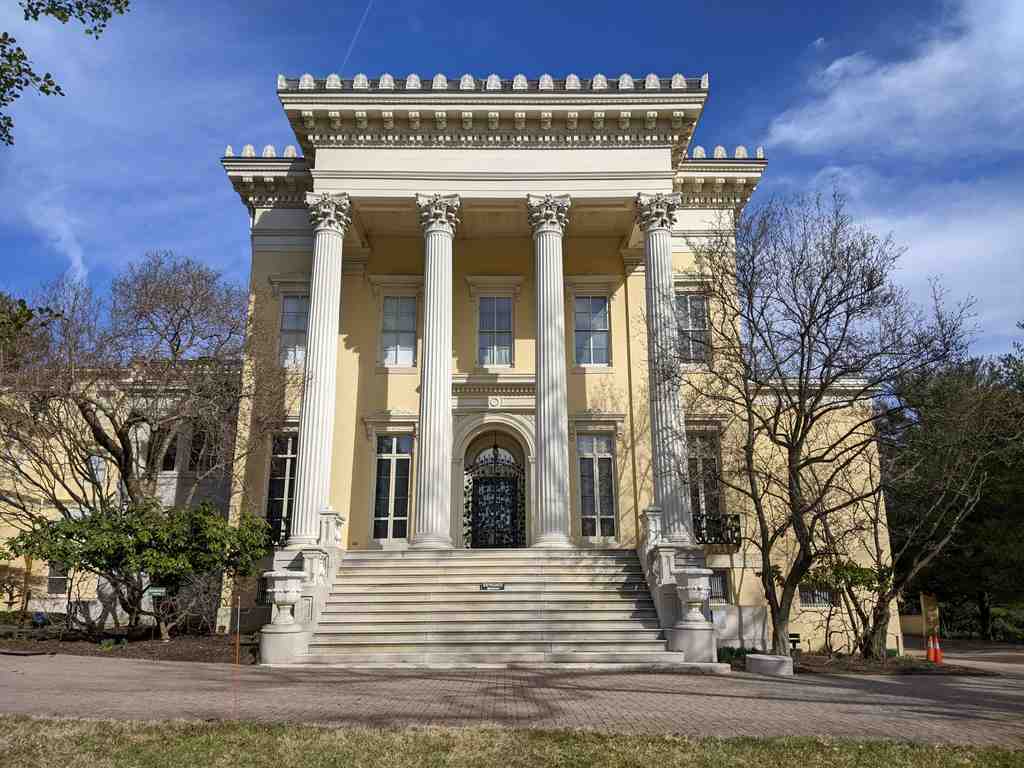
Right in front of you, you’ll spot a grand, yellow mansion with enormous white columns and an elegant staircase-just look for the building that seems fit for royalty hiding behind the trees! Welcome to the Evergreen Museum & Library, where history meets opulence and a little bit of mystery hangs in the air. Take a second and imagine the year is 1878. You’re standing outside the brand-new home of John W. Garrett, the president of the Baltimore and Ohio Railroad-a man whose family could probably afford more trains than most people have socks! The Garretts didn’t just want a house; they wanted their own “slice of Europe in Baltimore.” So, they began transforming a simple Italianate home into a 48-room Gilded Age palace set on 26 beautiful acres. Can you picture Victorian ladies in gowns and men with top hats marching up these steps? Maybe you'll even hear the as we step back in time. Inside, the Garretts were all about living big. Imagine a wing with its own bowling alley-talk about living the “high score” life. Thomas Harrison Garrett, John’s son, loved to impress friends with a billiard room and a gym. You might smell rich cigar smoke, hear laughter echoing through hallways, and see the shimmer of 23-karat gold in the bathroom. Later, they went even further: Thomas’s son John Work Garrett turned the bowling alley into an art gallery and built a private theatre-where the Russian artist Léon Bakst painted the stage. Sometimes, the place feels like it’s one inspiration away from turning water into champagne! Every room is packed with treasures: a red Asian-inspired sanctuary filled with Japanese and Chinese art, glowing Tiffany glass, or Dutch marquetry that would make a royal jealous. Even more magical is the library. Picture the hush of ancient leather-bound books-over 30,000 of them, including Shakespeare folios older than your granddad’s oldest joke. Tucked away are natural history volumes, original art plates, and American treasures, like the first booklet ever printed in colonial Maryland. Somewhere inside, you can almost hear the as scholars and curious visitors search for secrets. Evergreen stayed in the Garrett family until 1952, when they generously handed it over to Johns Hopkins University. Today, visitors wander through a mansion where the air hums with stories of art, travel, and invention. Who knows-maybe if you press your ear to a library wall, you’ll hear the faint laughter of the Garretts, still debating who bowled the last strike.
Abrir página dedicada →To spot the Charlcote House, look through the black iron gate ahead to find a grand, three-story red brick mansion crowned with white trim and a large black canopy over the…Leer másMostrar menos
To spot the Charlcote House, look through the black iron gate ahead to find a grand, three-story red brick mansion crowned with white trim and a large black canopy over the entrance. Now, imagine it’s Baltimore around 1915. Horses clop past on dirt streets, and out of the quiet, this majestic brick house rises like a set piece in a movie-windows glinting, white columns straight as a ruler, and all topped with a grand canopy that looks like it could shelter an army of fancy guests from a sudden rainstorm. This is Charlcote House, or as some might whisper around here, the James Swan Frick House. Built for a wealthy family in the elegant Guilford neighborhood, it was designed by none other than John Russell Pope-a legendary architect who also sketched out the Jefferson Memorial in Washington, DC. In fact, this is one of just two homes in all of Maryland that Pope ever designed. You’re basically looking at the architectural equivalent of a rare trading card! Fast forward through decades of laughter, secrets, and society parties-the house is still here, proudly listed on the National Register of Historic Places since 1988. Every brick seems to hum with stories, as if the walls themselves are politely gossiping about Baltimore’s grandest days and glitziest nights. Can you feel the old-time glamour? Maybe you even hear the faint clink of glasses from a long-ago gathering. Don’t worry, you’re not crashing a party-Charlcote House just loves a good audience.
Abrir página dedicada →





Preguntas frecuentes
¿Cómo empiezo el tour?
Después de la compra, descarga la app AudaTours e ingresa tu código de canje. El tour estará listo para comenzar de inmediato - solo toca play y sigue la ruta guiada por GPS.
¿Necesito internet durante el tour?
¡No! Descarga el tour antes de empezar y disfrútalo completamente sin conexión. Solo la función de chat requiere internet. Recomendamos descargar en WiFi para ahorrar datos móviles.
¿Es un tour guiado en grupo?
No - esta es una audioguía autoguiada. Exploras de forma independiente a tu propio ritmo, con narración de audio reproduciéndose en tu teléfono. Sin guía, sin grupo, sin horario.
¿Cuánto dura el tour?
La mayoría de los tours toman 60–90 minutos para completar, pero tú controlas el ritmo completamente. Pausa, salta paradas o toma descansos cuando quieras.
¿Qué pasa si no puedo terminar el tour hoy?
¡No hay problema! Los tours tienen acceso de por vida. Pausa y continúa cuando quieras - mañana, la próxima semana o el próximo año. Tu progreso se guarda.
¿Qué idiomas están disponibles?
Todos los tours están disponibles en más de 50 idiomas. Selecciona tu idioma preferido al canjear tu código. Nota: el idioma no se puede cambiar después de generar el tour.
¿Dónde accedo al tour después de comprarlo?
Descarga la app gratuita AudaTours desde App Store o Google Play. Ingresa tu código de canje (enviado por email) y el tour aparecerá en tu biblioteca, listo para descargar y comenzar.
Si no disfrutas el tour, te reembolsamos tu compra. Contáctanos en [email protected]
Paga de forma segura con 


