

Tour de audio de la Academia Naval: Leyendas y lugares emblemáticos de Anne Arundel revelados
Un imponente obelisco se alza donde los guardiamarinas una vez corrieron contra la medianoche, a solo unos pasos de secretos enterrados en ladrillo y piedra centenarios. El condado de Anne Arundel está cubierto de audaces triunfos y rebeliones ocultas que pocos descubren. Con este tour de audio autoguiado inmersivo, recorra Annapolis y más allá para desenterrar escapes audaces, rituales prohibidos y ecos de ambiciones olvidadas. Deje que las leyendas locales y los momentos escandalosos se revelen justo fuera de la vista. ¿Qué pacto secreto trajo el caos de medianoche a la base del Monumento a Herndon? ¿Quién arriesgó su reputación y seguridad para iniciar una protesta clandestina bajo la imponente cúpula de la Capilla de la Academia Naval? ¿Y por qué una tumba sin nombre detrás de la Iglesia de Santa Ana no lleva nombre, solo susurros? Muévase entre sombras y luz solar. Cada paso lo acerca a otra encrucijada, una nueva revelación, una ráfaga de drama bajo fachadas tranquilas. Descubra el pulso oculto de Annapolis. Su descubrimiento comienza ahora.
Vista previa del tour
Sobre este tour
- scheduleDuración 40–60 minsVe a tu propio ritmo
- straighten2.2 km de ruta a pieSigue el camino guiado
- location_onUbicaciónAnnapolis, Estados Unidos
- wifi_offFunciona sin conexiónDescarga una vez, úsalo en cualquier lugar
- all_inclusiveAcceso de por vidaReprodúcelo en cualquier momento, para siempre
- location_onComienza en Campo Worden
Paradas en este tour
Look out over wer-den Field, a sprawling flat expanse of manicured green turf, neatly framed by asphalt academy roads and anchored by a modest white-roofed gazebo on its eastern…Leer másMostrar menos
Abrir página dedicada →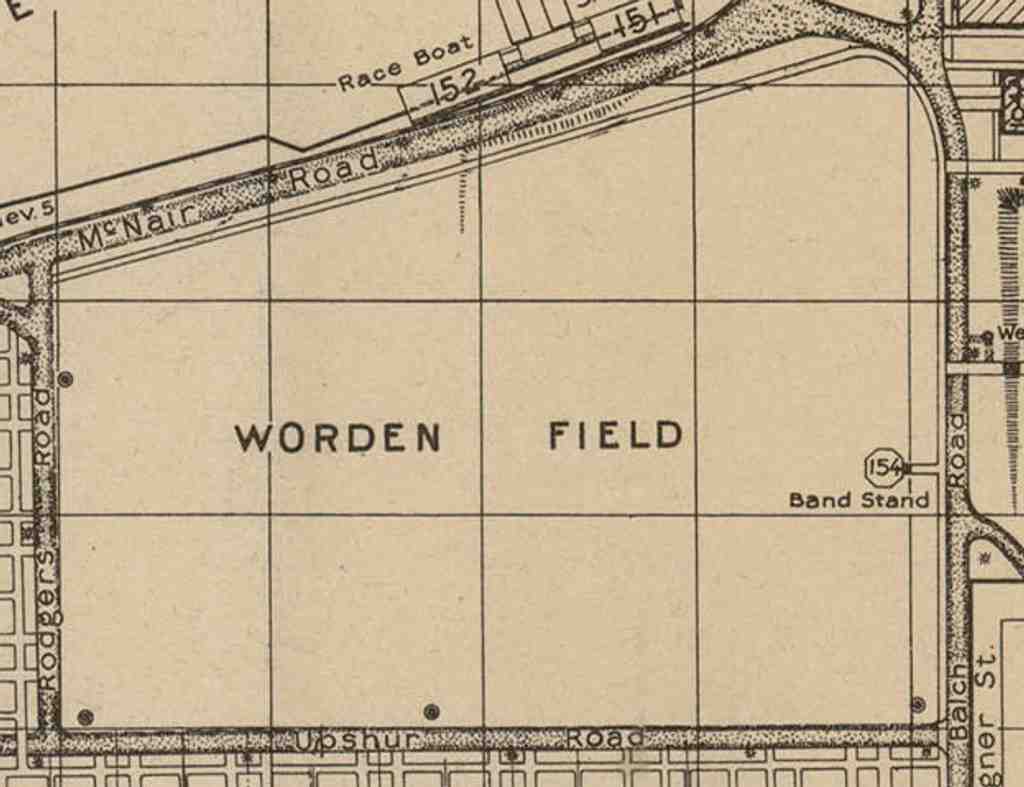
Worden FieldPhoto: C.E. Miller, Wikimedia Commons, Public domain. Cropped & resized. Look out over Worden Field, a sprawling flat expanse of manicured green turf, neatly framed by asphalt academy roads and anchored by a modest white-roofed gazebo on its eastern edge.
It looks incredibly peaceful. The Naval Academy excels at presenting these pristine, perfectly orderly spaces that seem to echo with nothing but honor and crisp discipline. But history is rarely as manicured as the lawns that memorialize it. The heroic image we like to attach to our monuments often acts as a polite cover for a much messier, and sometimes far less honorable, reality.
Take a look at the portrait on your screen. That is Admiral John Lorimer Worden, the Civil War hero this field is named for. He captained the famous ironclad, an early armored steamship, called the USS Monitor during its legendary clash with the CSS Virginia. Worden took a direct hit to the ship's pilothouse, suffering severe eye injuries that forced him to give up his command. He later became the Academy superintendent, establishing rigid traditions like the formal Color Parade, a highly choreographed military review still held right here on this grass. It is a story of sacrifice, duty, and flawless legacy.
But let us look at what actually happened on his namesake field. From 1890 to 1923, this was the home stadium for Navy football. Check your app for a map showing the field's layout just as its stadium days ended in 1924. In 1893, the grand Army-Navy game was played right here. The polished myth tells us of noble athletic rivalry. The reality is that the crowd erupted into a massive, violent brawl in the bleachers. It was such a disastrous spectacle that President Grover Cleveland completely banned the Army-Navy game. It took six years and the direct intervention of Theodore Roosevelt to get the competition reinstated.
And then there was the 1914 baseball scandal. The day before the Army-Navy game, Army coach Sammy Strang noticed something suspicious about the pitching mound on this field. He pulled out a tape measure and found the mound was fifty six feet and eight inches from home plate, which is nearly four feet closer than the strict regulation distance. The Navy coaches predictably claimed it was an innocent mistake that had somehow persisted all season. Strang did not buy it, forced the grounds crew to fix the distance on the spot, and Army went on to win the game anyway.
Even the Academy leadership could not escape the drama. In 1906, a grand new mansion was built nearby for the superintendent, but a visiting board decided it was simply too luxurious. They banned the superintendent from his own palace and banished him to a modest house on the edge of this field for three years.
So, as perfect as this grass looks today, remember the chaos buried beneath it. And speaking of chaos hiding behind a beautiful facade, our next stop is about a five minute walk away. Head toward the Tripoli Monument, where you will find that even the most elegant polished marble can obscure a remarkably dark and bitter truth.
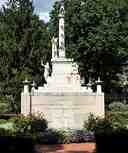
Look to your left for the Tripoli Monument, easily spotted by its tall white marble column rising from a blocky sandstone base and completely surrounded by intricately carved…Leer másMostrar menos
Abrir página dedicada →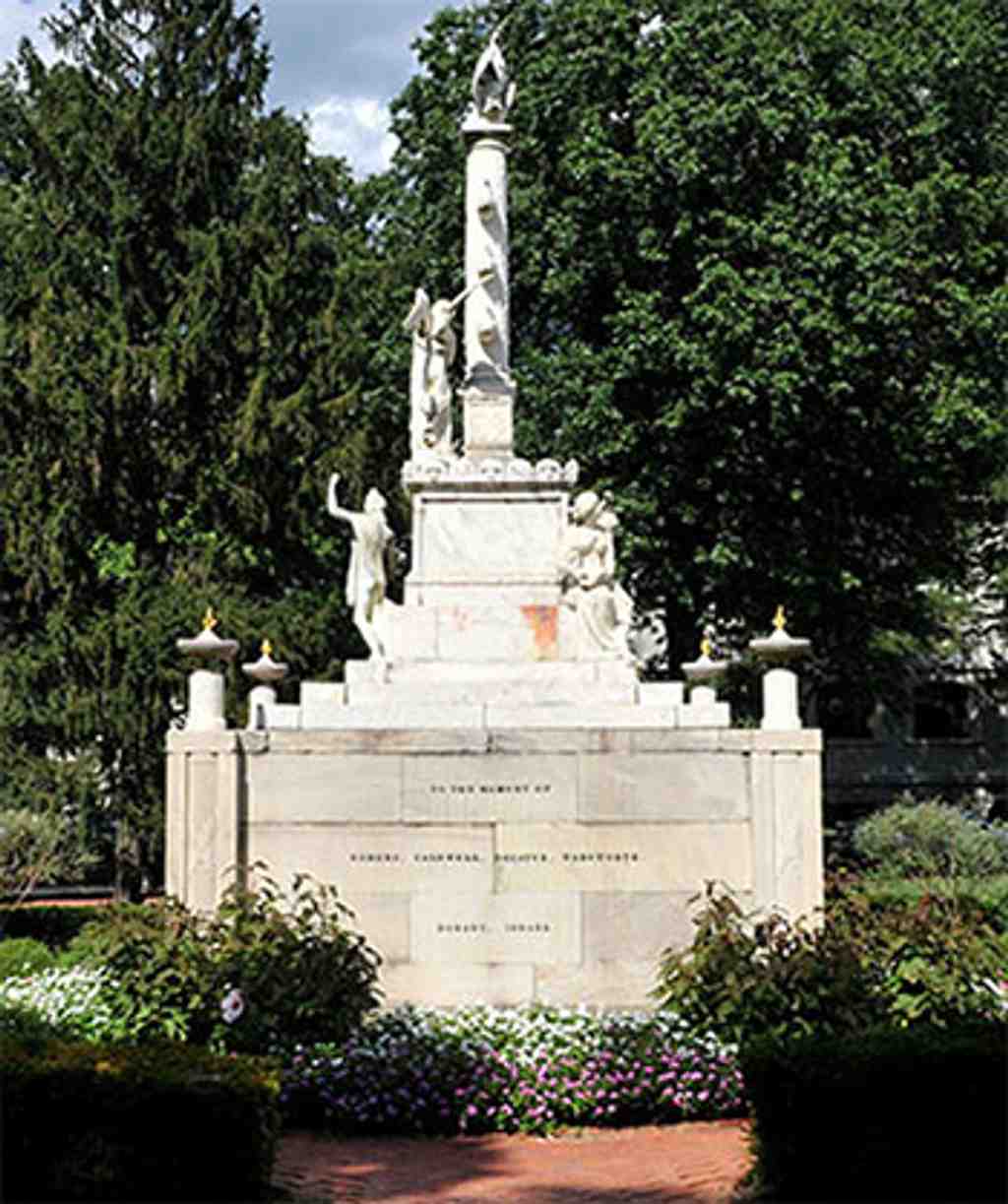
Tripoli MonumentPhoto: Employees of the United States Naval Academy, Wikimedia Commons, Public domain. Cropped & resized. Look to your left for the Tripoli Monument, easily spotted by its tall white marble column rising from a blocky sandstone base and completely surrounded by intricately carved stone figures.
Naval service has always carried a devastatingly heavy toll, demanding an absolute willingness to lay down one's life in the vast, unforgiving ocean. Nations often try to soften that brutal reality by transforming it into an idealized standard of ultimate sacrifice, immortalizing fallen sailors in pristine white stone and glorious bronze. But the truth of war is rarely so clean.
Take Master Commandant Richard Somers, a hero of the First Barbary War whose vessel prematurely exploded in 1804 while acting as a floating mine against the enemy fleet. He and his men perished in the blast, and their remains never made it home to American soil, resting instead in unmarked graves overseas, some of which reportedly lie beneath a modern parking lot in Libya.
This memorial, the oldest military monument in the United States, was spearheaded by Captain David Porter, a fellow officer who felt a profound duty to honor his fallen comrades. Because the government offered no public funds, Porter created a strict private fundraiser among his men, collecting up to a quarter of their monthly pay. He commissioned an Italian sculptor in 1806 for three thousand dollars, which is roughly seventy five thousand dollars today. It was carved from fine Carrara marble and originally adorned with gleaming gilded bronze accents.
The monument features allegorical figures, which are statues designed to represent abstract human concepts. A figure representing History holds a book to record naval victories, while Commerce mourns the loss of the protectors of trade. It is a stunning, polished myth of heroism. Yet, the chaos of war followed this monument home. When British forces captured Washington in 1814, they deliberately vandalized the structure. They snapped the marble fingers off the figures and stripped away the bronze accents.
In 1831, Congress attempted to elevate the monument by moving it to the Capitol grounds. Their grand idea was to place this towering structure inside a small fountain filled with live goldfish to simulate the Mediterranean Sea. A truly masterful tribute. Captain Porter was utterly disgusted, writing that capping the monument in a dirty puddle of fresh water was an evil omen for his departed friends.
The monument eventually found a proper home here at the Naval Academy in 1860. During a major restoration in the year 2000, conservators faced a choice about its missing pieces. They decided not to replace the stolen bronze or fix the carved hands. Consequently, the figure of History remains without her pen, and Fame still lacks her gilded palm branch. The monument stands beautiful and towering, but those broken fingers and missing branches are a quiet reminder that the true cost of war is never fully restored.
Make your way over to the Macedonian Monument, just a one minute walk away, to hear about a hero who survived the battlefield only to be undone by his own pride.
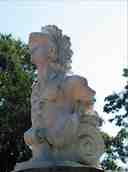
On your left, look for a stark white wooden sculpture of a man wearing a plumed classical helmet and a ruffled shirt, mounted atop a solid stone base. This is the Macedonian…Leer másMostrar menos
Abrir página dedicada →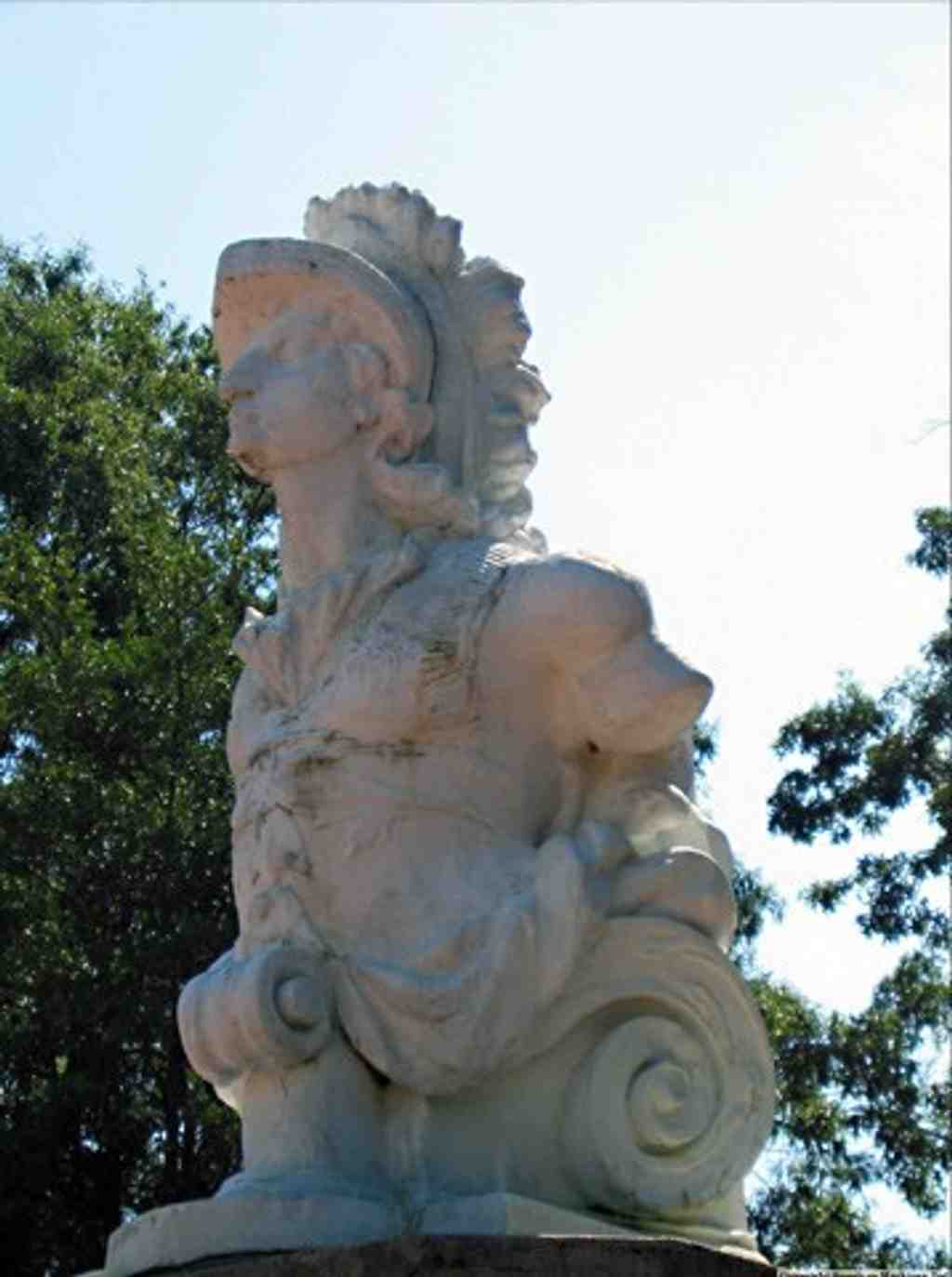
Macedonian MonumentPhoto: Photographers of the United States Navy, Wikimedia Commons, Public domain. Cropped & resized. On your left, look for a stark white wooden sculpture of a man wearing a plumed classical helmet and a ruffled shirt, mounted atop a solid stone base. This is the Macedonian Monument, and the man in the helmet is meant to be Alexander the Great. Originally, he was the figurehead, the carved wooden decoration mounted on the front bow, of the British warship HMS Macedonian.
To understand how a piece of British naval pride ended up here, we have to look at Captain Stephen Decatur. Decatur possessed a brilliant tactical mind that made him an American naval legend during the War of 1812, yet his unquenchable thirst for glory ultimately led to his tragic, self inflicted downfall.
The story actually starts with a friendly bet. In 1810, Decatur met British Captain John Surman Carden in Virginia. Carden playfully wagered a beaver hat that his newly built HMS Macedonian could defeat Decatur's USS United States in combat. Two years later, near the Canary Islands, they put that hat to the test.
Take a look at your screen to see Thomas Birch's 1813 painting of the engagement. Decatur executed a ruthless, calculated strategy. He knew his twenty four pound cannons could shoot further than the British eighteen pounders. So, he kept his distance and pounded the British ship with seventy broadsides, meaning the simultaneous firings of all the cannons on one side of his ship. The British could only manage thirty in return. The result was catastrophic. The Macedonian was reduced to a dismasted hulk. A third of the British crew was lost, while Decatur lost only twelve men.
Decatur became a national hero, but heroism is rarely a shield against ego. His outspoken nature and relentless pursuit of honor earned him powerful enemies. He publicly blamed Commodore James Barron for a previous naval disaster, prompting Barron to challenge him to a duel. On March 22, 1820, at the Bladensburg dueling grounds in Maryland, the two men faced off. Both fired. Both struck their targets. Barron survived. Decatur did not. He died at forty one, cutting short the very life this monument celebrates.
As for Alexander the Great here, maintaining a nineteenth century wooden carving is an engineering nightmare. For decades, the wood rotted. Early, misguided attempts to save it involved wrapping the whole thing in lead, and later, encasing it in fiberglass. Naturally, that just trapped the moisture inside and accelerated the decay.
When the Class of 1973 funded a three hundred thousand dollar restoration in 2014, they wanted a weatherproof bronze replacement. The Maryland Historic Preservation Commission said no, demanding historical authenticity with real wood. Forced to pivot, engineers laser scanned the decaying monument to create a digital baseline. They milled a styrofoam replica, had artisans hand sculpt the missing details, and then laser scanned that perfected model to create the precise computer paths needed to carve the pristine mahogany version you see today.
When you are ready, let us shift our focus from the heavy cost of naval warfare to something equally ambitious but far more peaceful. Keep walking ahead toward the Naval Academy Chapel, which is about a two minute walk away.
Mostrar 11 paradas másMostrar menos paradasexpand_moreexpand_less
You will spot the Naval Academy Chapel on your left by its massive green copper dome resting atop a grand cross shaped structure of pale stone, crowned with a gleaming gold cupola…Leer másMostrar menos
Abrir página dedicada →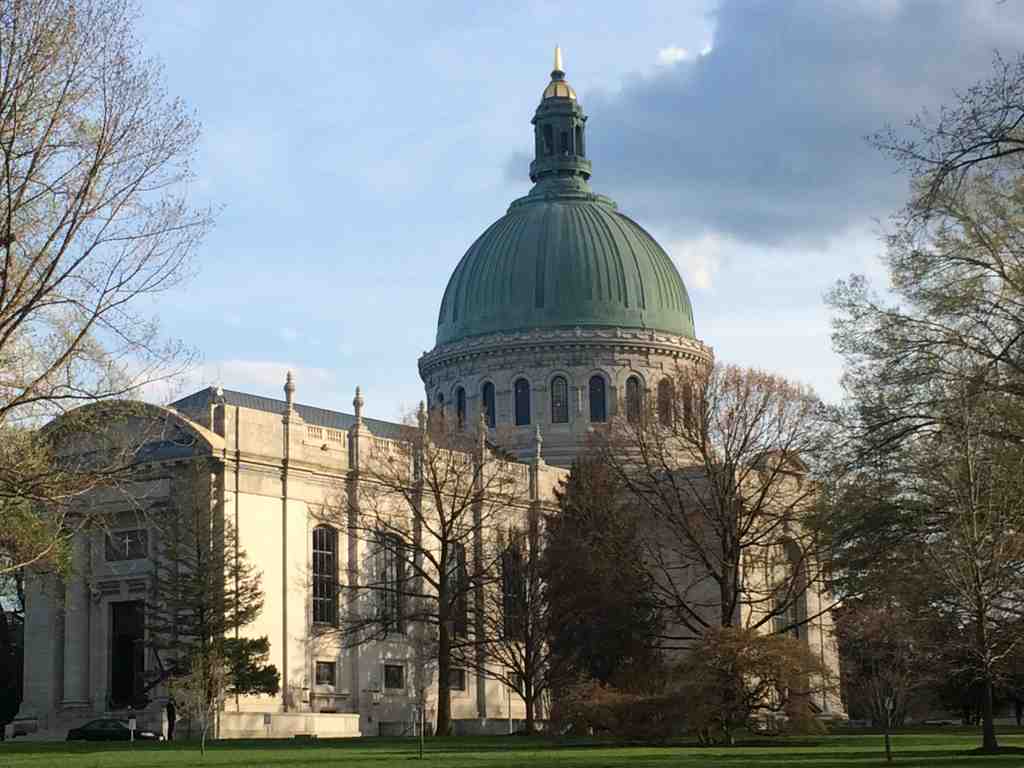
Naval Academy ChapelPhoto: Eaward24, Wikimedia Commons, CC BY-SA 4.0. Cropped & resized. You will spot the Naval Academy Chapel on your left by its massive green copper dome resting atop a grand cross shaped structure of pale stone, crowned with a gleaming gold cupola pointing skyward.
Throughout history, leaders and architects in Annapolis used grand monumental structures to project untouchable power and prestige. But as any engineer will tell you, building a myth out of stone and mortar is a risky business, often leading to spectacular failures. Take this very building. In the early nineteen hundreds, architect Ernest Flagg designed a sprawling master plan for the Academy in the Beaux-Arts style, a highly decorative and theatrical approach to architecture meant to impress and intimidate. He positioned this chapel on the highest ground as the campus spiritual center, anchoring an ambitious ten million dollar project, roughly three hundred and fifty million today. He even planned a massive boat basin aligned with the dome, forging a direct visual link between divine providence and the high seas.
Look up at the chapel's iconic green dome. Now, pull up your screen and take a look at the detail image. Can you imagine that dome covered in decorative terracotta instead of the copper sheathing you see today? Terracotta is baked clay, and Flagg's original design called for it in spades, earning the chapel the nickname the frosted wedding cake. There was just one problem. Terracotta is porous. It eagerly absorbed the local moisture, expanded, and began to shatter. The architectural ambition literally crumbled when a massive chunk of the frosted masonry plummeted straight down into the sanctuary. By nineteen twenty eight, the Navy surrendered to physics, ripped off the crumbling clay, and installed the copper you see now.
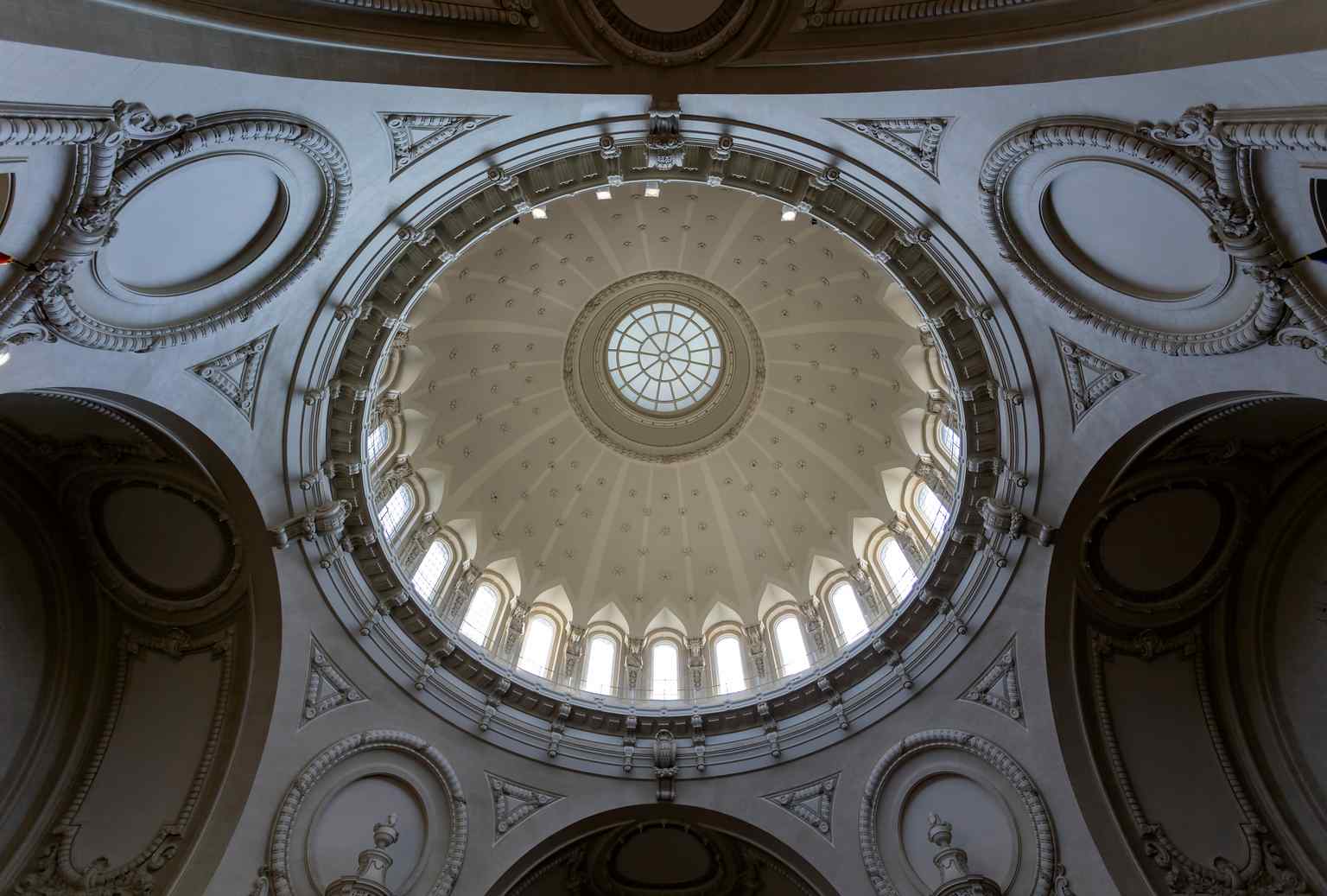
The chapel's iconic dome, now clad in copper, was originally nicknamed 'the frosted wedding cake' due to its porous terracotta cladding.Photo: Acroterion, Wikimedia Commons, CC BY-SA 4.0. Cropped & resized. Beneath the floorboards, the clash between polished legend and grim reality continues. The basement houses the crypt of Revolutionary War hero John Paul Jones. Look at the interior image on your app. He rests in a twenty one ton sarcophagus, a massive stone coffin carved from black and white Italian marble. It looks eternally dignified. But the journey here was a mess. General Horace Porter spent six years and thirty six thousand dollars of his own money, over a million today, to find Jones's forgotten grave in Paris. He finally unearthed him in nineteen oh five beneath a laundry, a grocery store, and a cheap hotel. Even after a grand memorial ceremony in nineteen oh six presided over by President Theodore Roosevelt, Jones spent another seven years parked in Bancroft Hall while Porter begged a reluctant Congress to fund the crypt. Porter never got his money back.
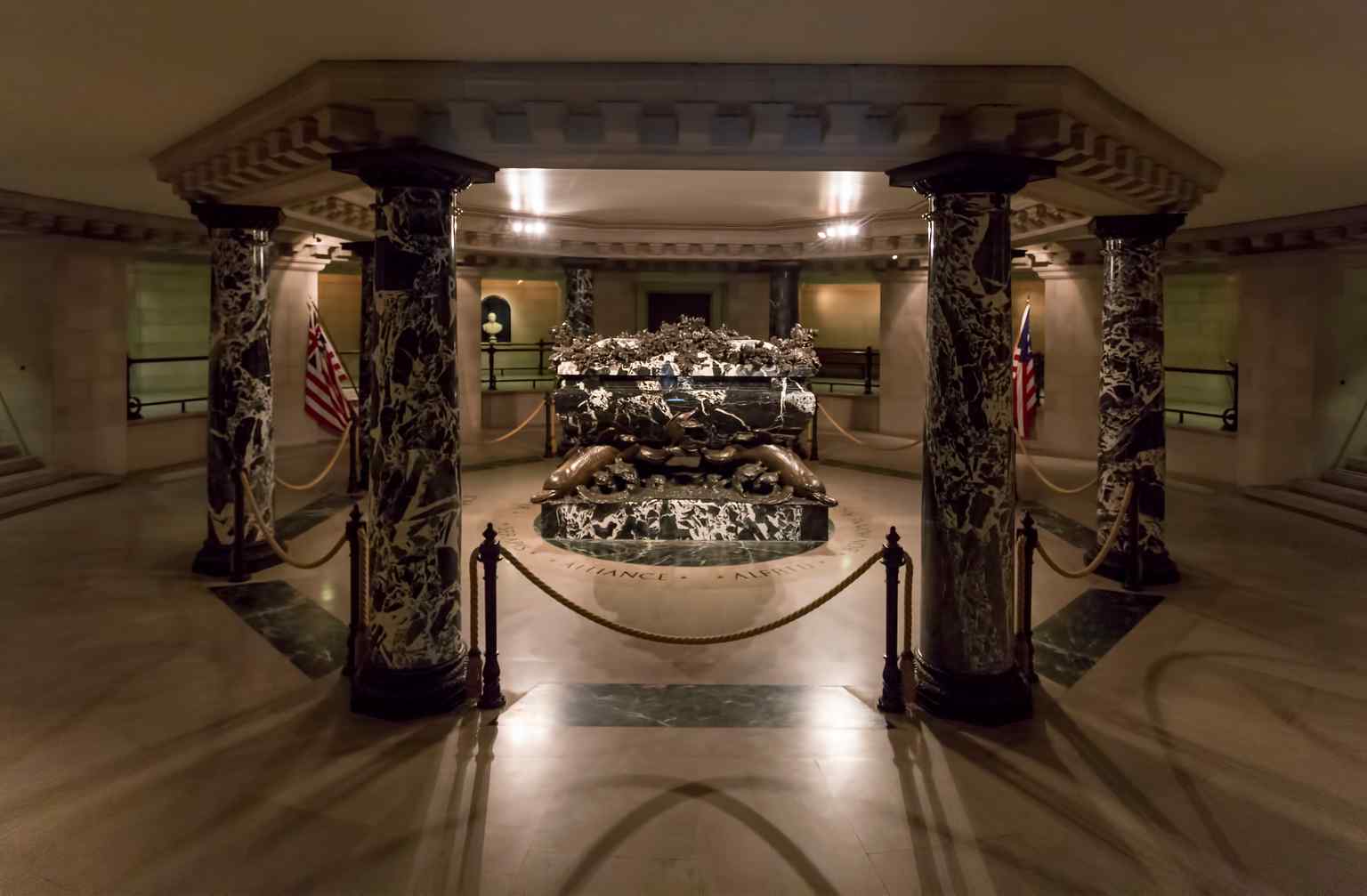
Revolutionary War hero John Paul Jones is interred in this 21-ton sarcophagus of black and white Italian marble beneath the chapel.Photo: Acroterion, Wikimedia Commons, CC BY-SA 4.0. Cropped & resized. If you want to view the crypt or the stunning twenty foot oculus, a round skylight hidden in the dome above, you can go inside Monday through Friday between eight and four. Just be prepared for the irony of a building where midshipmen were once forced to worship under threat of expulsion, a rule declared unconstitutional in nineteen seventy two, now serving as a veritable wedding factory for freshly graduated officers.
Now, let us step off the Academy grounds and discover the extravagant ambitions of the city's early colonial governors, as we walk to Jennings House.
On your left stands a twenty-one-foot obelisk, which is a tall, tapering four-sided pillar, carved from smooth grey granite and resting on a square base marked with raised…Leer másMostrar menos
Abrir página dedicada →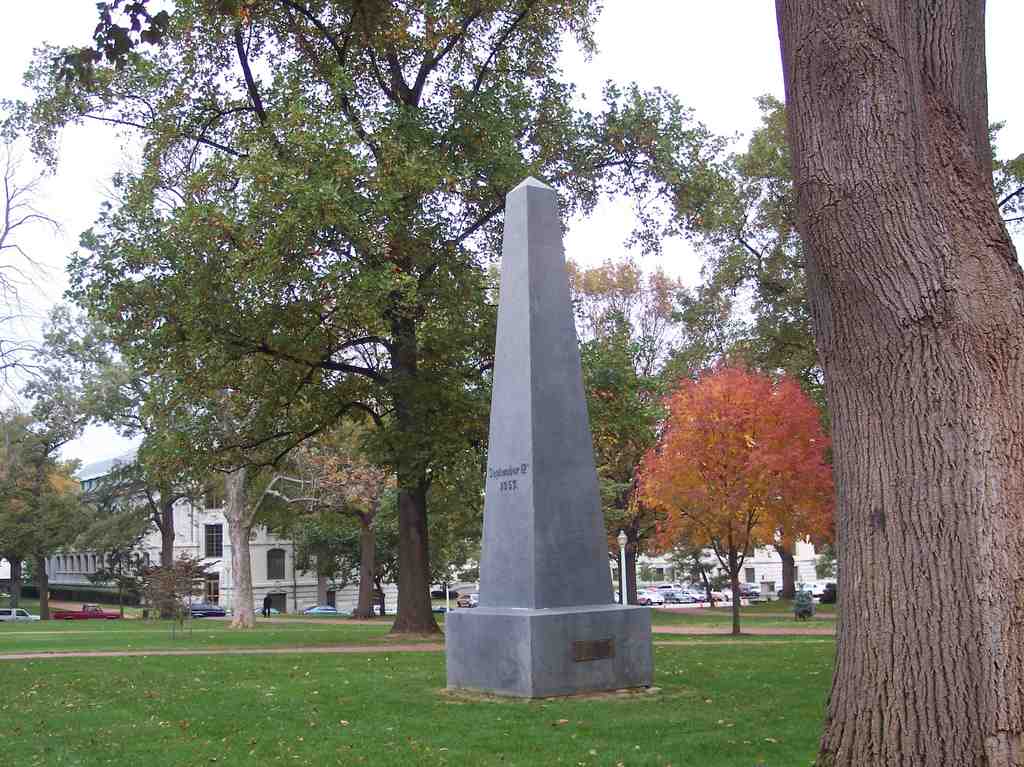
Herndon MonumentPhoto: Wikimedia Commons contributor, Wikimedia Commons, Public domain. Cropped & resized. On your left stands a twenty-one-foot obelisk, which is a tall, tapering four-sided pillar, carved from smooth grey granite and resting on a square base marked with raised lettering.
This is the Herndon Monument. It was erected by the class of eighteen sixty in memory of Captain William Lewis Herndon, and it perfectly captures the heavy toll of naval service. On September twelfth, eighteen fifty-seven, Herndon was commanding the S S Central America when a hurricane battered the ship off the coast of North Carolina. As the vessel began to sink, Herndon ordered the lifeboats launched, successfully saving all one hundred and fifty-two women and children on board, along with several men. Knowing his own fate, he handed his watch to a passenger to deliver to his wife, stating he could not leave while a single soul remained aboard. Survivors later reported that as the ship finally slipped beneath the waves, Herndon had put on his full dress uniform and was standing stoically by the wheelhouse.
He went down with his ship, becoming the ultimate Victorian exemplar of duty.
But there is always a gap between a pristine historical memory and the messy reality of how we choose to honor it. You can see this shift by looking at the before and after image in your app. While an eighteen sixty-eight photograph captures a solitary cadet quietly observing the newly erected monument, today this stone pillar is the centerpiece of a chaotic annual tradition.
It is called the Herndon Monument Climb. First-year students, known as plebes, must work together to scale the monument and replace a white sailor hat, called a dixie cup, sitting at the very top. In its place, they must secure an upperclassman's combination cover, which is the formal peaked cap worn by naval officers.
There is just one catch. Before the climb, upperclassmen slather the granite obelisk with up to fifty pounds of vegetable shortening. Take a look at your screen to see the midshipmen battling this ridiculous wall of lard. They form massive human pyramids, often sacrificing their own t-shirts to wipe away the grease for the climbers above them.

Midshipmen attempt to climb the Herndon Monument, famously covered in over 200 pounds of lard, a tradition reinstated in 2011 to foster spirit and camaraderie among the plebes.Photo: U.S. Navy photo by Photographer’s Mate 1st Class Brien Aho., Wikimedia Commons, Public domain. Cropped & resized. The academy has occasionally tried to tame the chaos. In twenty ten, a superintendent banned the grease citing safety concerns. The ungreased plebes completed the climb in a mere two minutes and two seconds. Instead of being relieved, the students felt robbed of their rite of passage, printing shirts that demanded to know where the grease went. The lard was quickly reinstated the following year.
Yet beneath the raucous yelling and flying shortening, the monument still commands profound respect. In two thousand eight, just days before the climb, a plebe named Kristen Marie Dickmann died suddenly from a heart condition. In a break with tradition, her classmates voted to place her cap on top of the monument instead of an upperclassman's. In that moment, a chaotic physical challenge transformed back into a solemn tribute for a fallen shipmate.
The naval academy grounds are open twenty-four hours a day, so this granite pillar stands perpetual watch, anchoring generations of tradition. Let us continue to the Peggy Stewart House to see how history is physically remodeled over time.
Look to your left and you will see a two-story red brick house sitting on an elevated basement, defined by a small white pillared portico at the entrance and a roof featuring two…Leer másMostrar menos
Abrir página dedicada →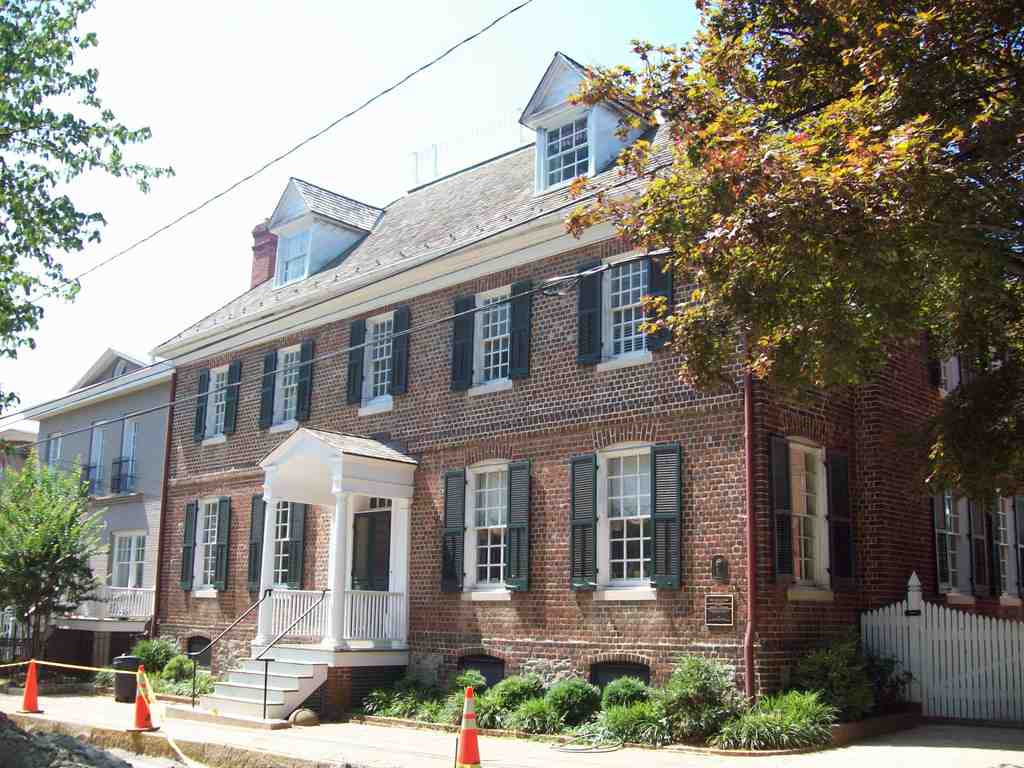
Peggy Stewart HousePhoto: Pubdog, Wikimedia Commons, Public domain. Cropped & resized. Look to your left and you will see a two-story red brick house sitting on an elevated basement, defined by a small white pillared portico at the entrance and a roof featuring two prominent dormer windows. This is the Peggy Stewart House. If you look closely at that roofline, you are actually looking at a physical metaphor for how history gets rewritten.
Buildings are much the same. The late nineteenth-century remodelings drastically shifted this Georgian mansion's original profile. Originally, it had a traditional gable roof with flush chimneys, typical of colonial Annapolis. But renovations in the 1890s removed that gable in favor of the current hipped roof, which slopes downward on all four sides. They also added the rooftop balustrade, a railing along the top, and completely rebuilt the chimneys to match. Take a quick glance at the before and after image on your screen to see how dramatically its silhouette was altered over time.
Just as the house was reshaped to fit a later era's tastes, the story of what happened here in October 1774 has been sanded down into a tidy patriotic myth. The event is known as the Annapolis Tea Party. It sounds quite dashing. The reality was a terrifying hostage situation.
Anthony Stewart owned this house and a cargo ship named after his daughter, the Peggy Stewart. When the ship arrived in port, Stewart discovered a merchant had secretly hidden over two thousand pounds of tea in the hull to avoid the hated British tea tax. Stewart chose to pay the tax himself. He did not do this out of loyalty to the British Crown, but out of desperation. There were fifty-three indentured servants, laborers contracted to work unpaid for years, trapped aboard the leaky vessel. They had been stuck at sea for nearly three months, and paying the tax was the only way to legally unload them.
The local patriots did not care about his humanitarian dilemma. They saw only a brazen violation of their boycott against British goods. An angry mob surrounded this very house. They erected a gallows in the town square and gave Stewart a grim ultimatum. Destroy the tea, or they would hang him, tar and feather him, or burn this house to the ground with his family inside.
Terrified for his wife and daughter, Stewart rowed out to his ship and set it ablaze himself, burning it down to the waterline as the crowd cheered. Stewart was financially ruined and fled the country, leaving his family behind to ultimately lose the house to foreclosure. A polished tale of colonial rebellion, built on the ashes of a man trying to save fifty-three lives.
Years later, the tragedy continued. Founding Father Thomas Stone bought the house in 1783 to care for his dying wife, Margaret. He even declined his appointment to the Constitutional Convention to stay by her side. She passed away in this home, and Stone, broken by grief, died just four months later.
History is rarely as clean as the monuments suggest. Speaking of remnants that survived the colonial era, the only object saved from the burning Peggy Stewart was a punch bowl, which sits just a three minute walk from here. Head toward the Hammond-Harwood House, where we will uncover a famous local ghost story.
Look to your left and you will spot a sprawling five part brick mansion with distinctive projecting wings and an elegant front door framed by columns. Take a glance at your screen…Leer másMostrar menos
Abrir página dedicada →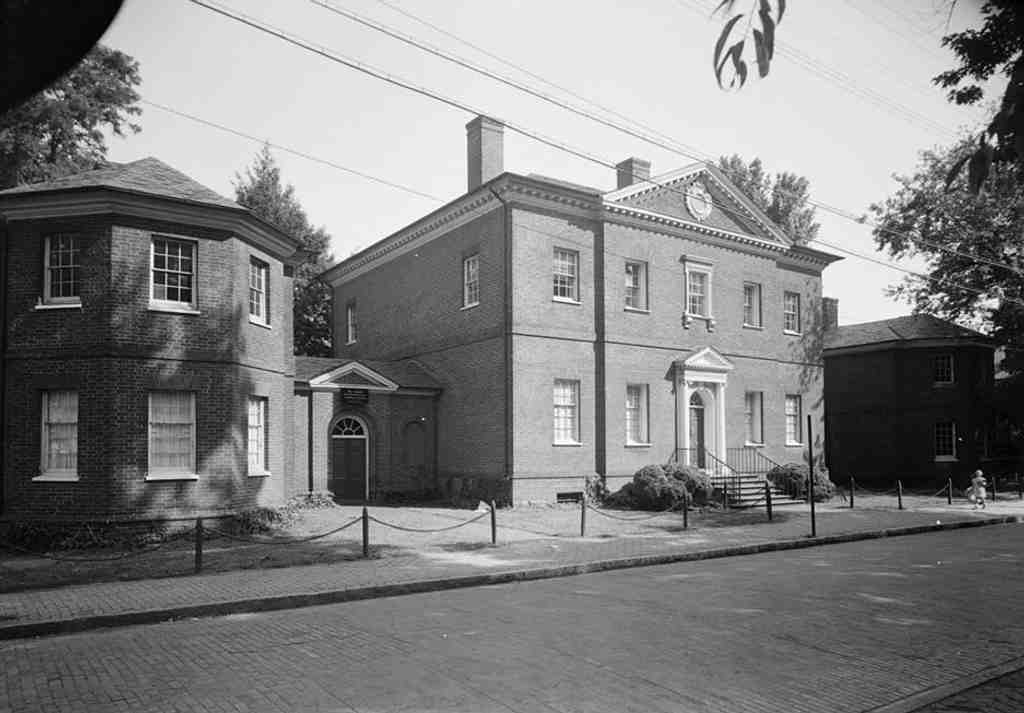
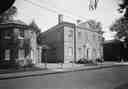
Hammond–Harwood HousePhoto: E. H. Pickering, Photographer, Wikimedia Commons, Public domain. Cropped & resized. Look to your left and you will spot a sprawling five part brick mansion with distinctive projecting wings and an elegant front door framed by columns. Take a glance at your screen to see a close up of that doorway, highlighting the beautiful fanlight window above the entrance.
This is the Hammond-Harwood House, completed in 1774. It is a masterpiece of colonial design, created by the architect William Buckland for a wealthy farmer named Matthias Hammond. Buckland dreamed big. He modeled this home directly on a sixteenth century Italian villa, adapting the design to include those single story connecting corridors you see between the main house and the wings, which architects call hyphens. You can see how beautifully preserved the exterior remains if you check the historic comparison on your screen.
Now, for over a century, Annapolis locals loved telling a very specific, very dramatic story about this place. According to local folklore, Matthias Hammond built this grand home for his fiancée, but he became so deeply obsessed with perfecting its architectural details that he completely neglected her. As the story goes, she got tired of waiting, broke off the engagement, and ran away with another man. Hammond was supposedly so devastated he abandoned the house forever. People even claim to see the ghost of a woman in a colonial gown gazing out the window.
It is a great romantic tragedy. It is also completely made up.
Historical records show Matthias Hammond was a lifelong bachelor who was never even engaged. Historians eventually figured out that the famous jilting actually happened to his brother, Philip. Philip's fiancée eloped with another man while Philip was away in Philadelphia shopping for furniture. The town gossips simply transferred the scandalous story to Matthias, likely because they could not understand why a single man would build such an enormous house.
But the true history of the Hammond-Harwood House holds a much deeper tragedy than a bruised ego. We often marvel at the polished perfection of colonial architecture, but that perfection relied heavily on unfree labor. Architect William Buckland brought several enslaved individuals with him from Virginia, including a man named Oxford, who was forced to construct this very building.
Later, the house was occupied by Frances and Richard Loockerman. From the outside, they looked like the picture perfect high society family. Behind closed doors, Richard was a heavy drinker with severe financial issues. The family enslaved several people on the property, and whenever Richard's gambling and drinking debts piled up, he would ruthlessly sell or rent out these individuals to cover his losses. The real heartbreak here is not a fabricated runaway bride, but the human beings systematically torn apart to fund one man's destructive habits.
The house eventually became a public museum, but only after nearly being gutted by commercial developers in the 1920s. Saint John's College managed to buy the building for forty seven thousand dollars, which is about eight hundred thousand dollars today. If you want to go inside, the museum is open daily from noon to five, though it is closed on Tuesdays.
Let us keep walking. It is a short three minute stroll to our next stop, the Paca House and Garden, where we will confront a much darker historical paradox.
Look at the red brick mansion on your left, built in a strictly symmetrical Georgian architectural style and defined by its steep roof dotted with a row of five white dormer…Leer másMostrar menos
Abrir página dedicada →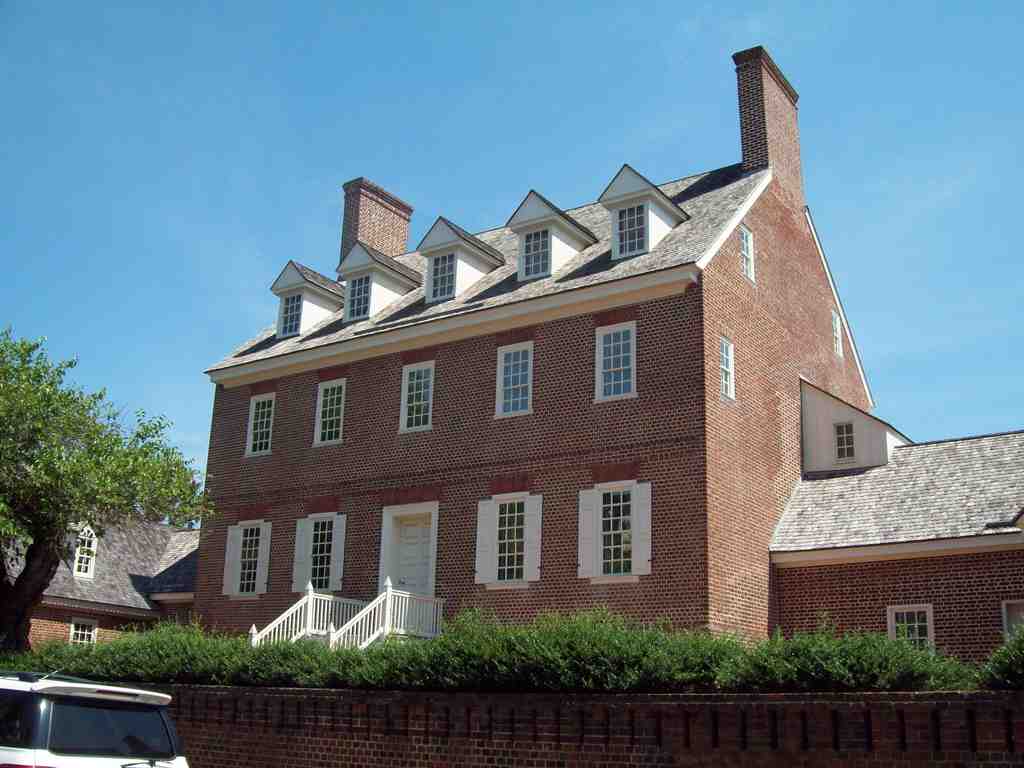
Paca House and GardenPhoto: Pubdog, Wikimedia Commons, Public domain. Cropped & resized. Look at the red brick mansion on your left, built in a strictly symmetrical Georgian architectural style and defined by its steep roof dotted with a row of five white dormer windows.
This is the William Paca House, constructed between 1763 and 1765. William Paca was a Founding Father, a three-term Governor of Maryland, and a man who confidently signed the Declaration of Independence. Like many of his peers, he enjoyed an elite lifestyle funded by immense colonial wealth. Yet, the pristine elegance of this estate was maintained entirely by enslaved individuals whose uncredited, forced labor made the opulent lives of the Annapolis elite possible. While Paca was publicly demanding American liberty, he held six to ten people in bondage right here. Historical records give us a few of their names. Denby, Affey, Poll, Sarah, Bett, and Sall. Unsurprisingly, this house saw active resistance. At least one indentured servant is known to have fled to freedom during Paca's tenure.
How do we reconcile the brilliant minds that birthed American liberty with the stark reality of the enslaved people who served them?
The hypocrisy survived his departure. When Paca sold the house to Thomas Jenings in 1780, the reliance on forced labor continued. Upon Jenings's death, his son freed only one enslaved man, a forty-six-year-old named Jacob, and ruthlessly sold off the rest of the household.
Fast forward to the twentieth century, and the mansion had been swallowed up by a sprawling two-hundred-room hotel called Carvel Hall. If you want to see how drastically the property was altered to fit the hotel before its modern restoration, take a look at the historic image in your app.
The hotel was so famous that a blacksmithing company named their steak knives after it. When the hotel announced its closure in 1965, panicked customers flooded the knife company with calls, terrified their favorite cutlery was doomed. The factory had to issue press releases clarifying they were still happily churning out blades. Through its long hotel era, the true backbone of Carvel Hall's famed hospitality was an African American staff member named Marcellus Hall, who started as a bellboy in 1913 and dedicated fifty-two years to the establishment, rising to Superintendent of Services.
By the nineteen sixties, developers planned to bulldoze this entire block for a motel and bus station. Preservationist Anne St. Clair Wright raised two hundred fifty thousand dollars, roughly two point four million today, to save it. Her team hired overnight guards to protect the site during restoration, but the guards quit after claiming a gentleman in colonial dress was haunting the parlor. Wright eagerly staked out the parlor herself, hoping for a ghost sighting, but the phantom never showed.
The true engineering triumph was resurrecting the two-acre colonial garden out back, which you can see in your app. It was buried under nine feet of landfill and an asphalt parking lot before archaeologists unearthed the original terraces and intricate water systems.
The house and self-guided garden are open to the public daily, closing by late afternoon. Let us move on toward the Historic Inns of Annapolis to explore the everyday life of the city's working class, which is about a four-minute walk from here.
On your left, you will spot the Government House, a large, symmetrical red brick mansion anchored by a prominent white framed arched window directly above the main entrance…Leer másMostrar menos
Abrir página dedicada →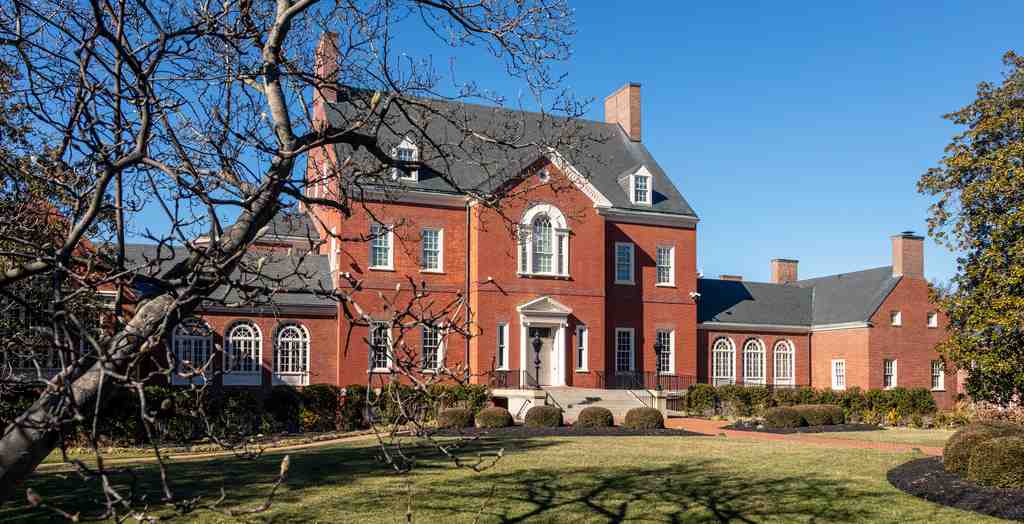
Government HousePhoto: Acroterion, Wikimedia Commons, CC BY-SA 4.0. Cropped & resized. On your left, you will spot the Government House, a large, symmetrical red brick mansion anchored by a prominent white framed arched window directly above the main entrance portico.
We like to imagine the seats of power as symbols of flawless order, but behind these pristine walls lies a history of massive egos, bitter brawls, and architectural ambition gone wildly off the rails. Before this polished residence existed, the path to housing Maryland's executive was paved with spectacular failure. In 1742, Governor Thomas Bladen secured an astonishing four thousand pounds, roughly a million dollars today, to build a colossal fourteen thousand square foot official residence. But his grandiose plans quickly exceeded his budget, sparking a bitter feud with a legislature that flatly refused to give him another dime. The result was Bladen's Folly, an abandoned mansion left completely unroofed to molder on a hill for decades until its framework collapsed.
With Bladen's dream dead, governors instead lived in the Jennings House. You might remember the Jennings House from earlier on our tour, it was the mansion purchased by the Naval Academy in 1869 for twenty thousand dollars, or roughly four hundred fifty thousand today, before being razed to expand their waterfront campus.
By 1870, the state finally completed this current mansion. Originally, it was designed with a French Second Empire mansard roof, which is a steep, four sided roof with a flat top, looking entirely different from the colonial style you see today. Almost immediately, the new house hosted a bizarre tragedy. Reverdy Johnson, an eighty four year old former U.S. Attorney General, enjoyed a dinner party here and a single glass of wine. He asked to be left alone in the parlor, a room designed with tall floor to ceiling windows that functioned as doors. Less than an hour later, he was found dead in the yard, having accidentally walked right out an open window and plummeted to his death. Legend says his ghost still roams the grounds, practicing his court arguments.
In the 1930s, the house was heavily remodeled to match the colonial style of the nearby State House. That historical facelift eventually set the stage for modern drama. In 1980, the state sued former Governor Marvin Mandel, accusing him of stealing twenty thousand dollars worth of state property when he left office, including Waterford crystal and three hundred fifty bottles of liquor. Mandel boldly countersued, claiming the state was holding hostage a marble bust of himself. He eventually paid the state ten thousand dollars to end the embarrassing dispute.
Today, things are a bit more wholesome, featuring a vegetable garden and a hidden apiary, which is simply a collection of beehives, tucked away from the public eye.
Now, let us walk three minutes away to St. Anne's Church, to see how even sacred architecture faced its own earthly struggles.
On your left stands St. Anne's Church, a stout red brick Romanesque building anchored by a prominent square tower that houses a large black and white town clock. Romanesque just…Leer másMostrar menos
Abrir página dedicada →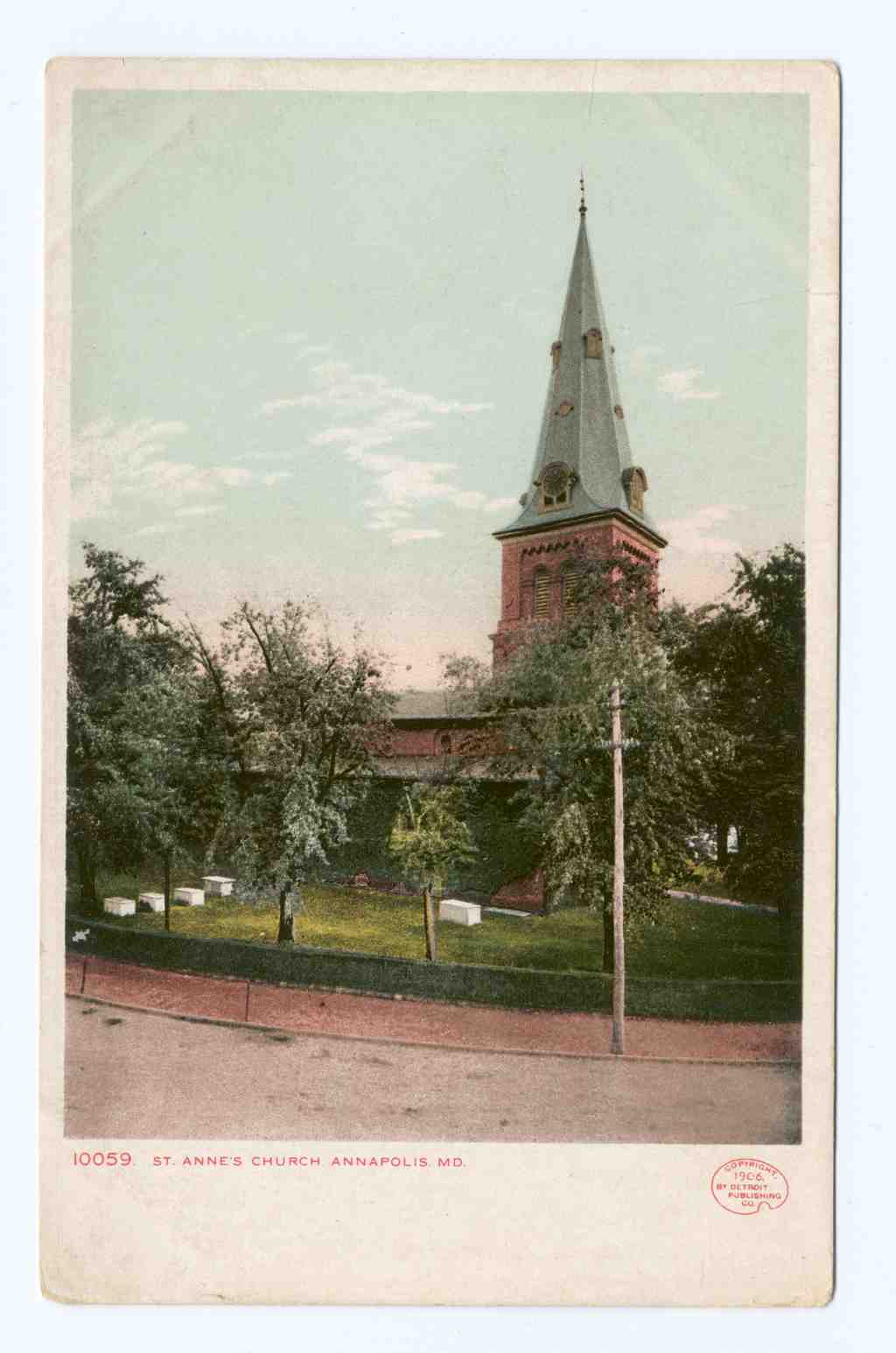
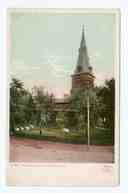
St. Anne's ChurchPhoto: Scan by NYPL, Wikimedia Commons, Public domain. Cropped & resized. On your left stands St. Anne's Church, a stout red brick Romanesque building anchored by a prominent square tower that houses a large black and white town clock. Romanesque just means it relies on those heavy, rounded arches you see, rather than the pointy spires of Gothic architecture.
This spot has been the spiritual center of Annapolis since 1694. When the royal governor laid out the city streets, he designed them around two circles. The larger was for the State House, and this smaller one was reserved for the church. The official narrative paints a picture of a glorious colonial parish, blessed by royalty. King William the Third gifted the parish a handsome silver communion service, and Queen Anne herself donated a bell for the tower. It was supposed to be a shining monument to British order.
But the reality of colonial engineering was far less polished. The colonial government hired a man named Edward Dorsey to build the first church in 1699. Dorsey was a prominent boatwright and the Keeper of the Great Seal of the Province, but despite his high status, he was completely incapable of actually getting the church built. His contract demanded a structure sixty-five feet long and thirty feet wide, complete with a porch and a bell tower.
Instead of a triumph of engineering, the project stalled out completely. Dorsey was fired and slapped with a massive penalty of three hundred and thirty-three pounds sterling for breach of contract, which is roughly seventy thousand dollars today. He faced total financial ruin.
Fortunately for him, the Reverend Thomas Bray stepped in. Bray pleaded with the assembly to show mercy, arguing that Dorsey had a great charge of a wife and twelve children to support. The assembly took pity on the overwhelmed boatwright and reduced his fine to two hundred pounds, or about forty thousand dollars today.
The church was finally finished by others, but it did not have a happy ending. In February 1858, a furnace fire hollowed out the building. The beloved royal bell donated by Queen Anne plummeted from the tower and melted into a puddle of bronze. Yet, somehow, someone managed to rush in before the roof collapsed and save King William's historic silver, which the church preserves to this day.
The sturdy brick structure in front of you was built immediately after that fire. If you are lucky enough to look inside, you will find an absolutely breathtaking stained-glass window designed by Tiffany Studios. Just keep in mind they are generally open Monday through Thursday from 9 AM to 4 PM.
The history of this circle shows how easily grand visions get bogged down in human incompetence. But across town, different struggles were taking place. Let us take a two minute walk toward the Banneker-Douglass-Tubman Museum, where we will hear how marginalized voices worked relentlessly to reclaim their own history from the shadows.
To your left is a gable-front red brick building distinguished by its steep roofline and towering, sharply pointed arched windows characteristic of Gothic Revival architecture. If…Leer másMostrar menos
Abrir página dedicada →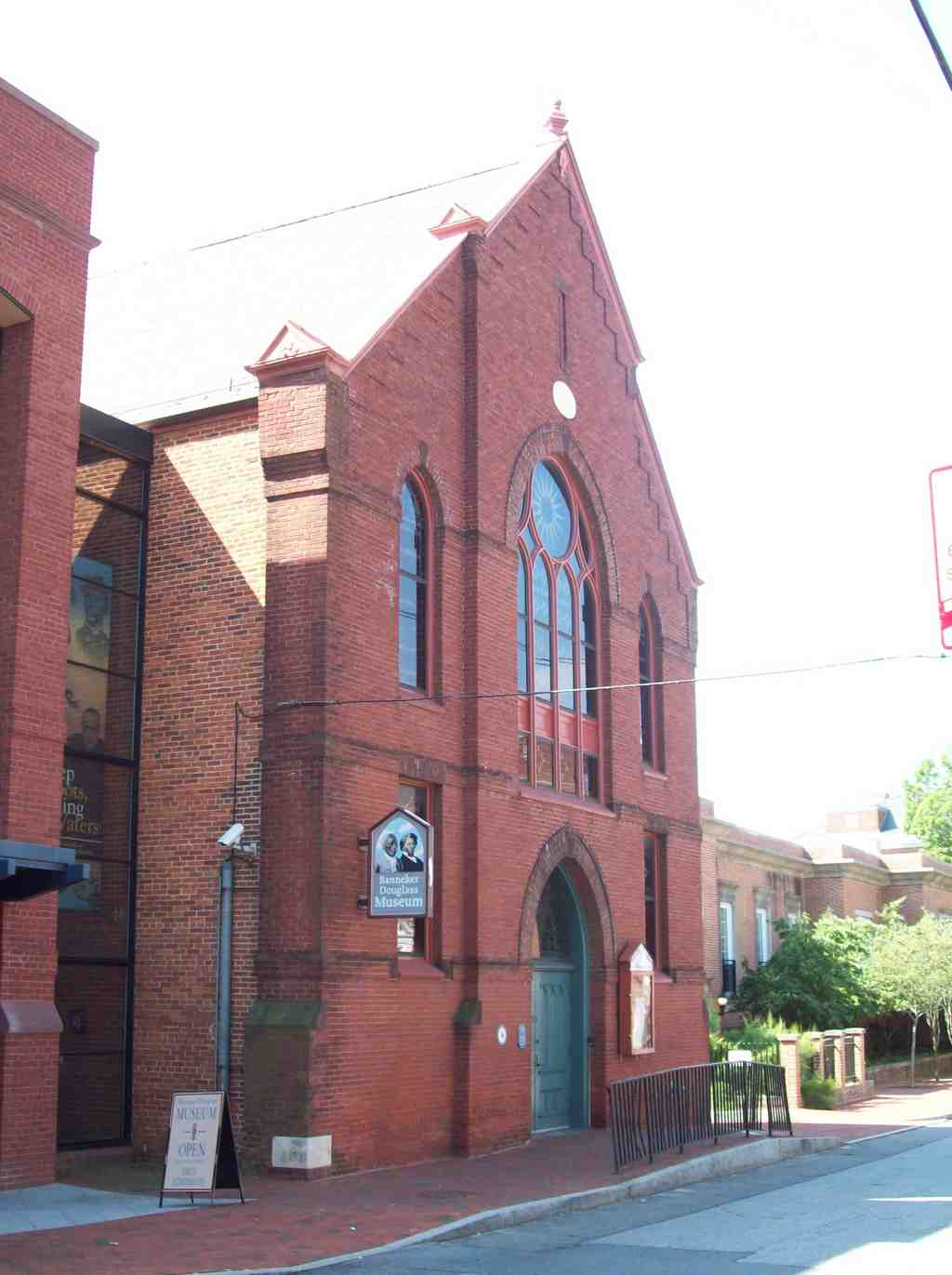
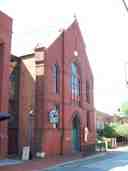
Banneker-Douglass-Tubman MuseumPhoto: Pubdog, Wikimedia Commons, Public domain. Cropped & resized. To your left is a gable-front red brick building distinguished by its steep roofline and towering, sharply pointed arched windows characteristic of Gothic Revival architecture. If you pull up the app, you can see a great shot of the structure's original 1875 facade.
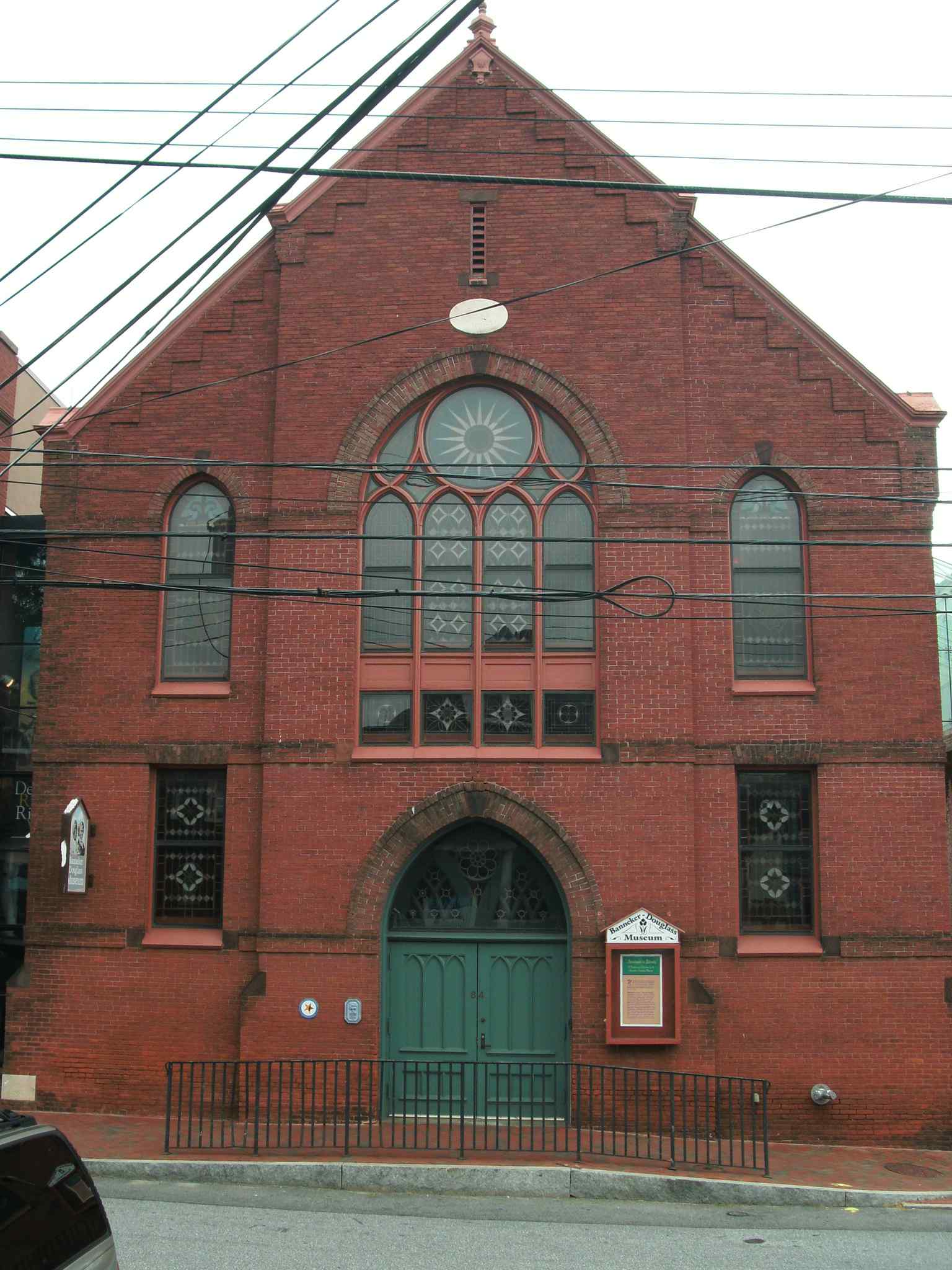
This image shows the gable-front brick church, built in 1875 in the Gothic Revival style, which now houses the Banneker-Douglass-Tubman Museum.Photo: AlbertHerring, Wikimedia Commons, CC BY-SA 3.0. Cropped & resized. We have spent a lot of time today admiring the grand mansions of the colonial elite, wealth generated almost entirely by enslaved individuals. This building offers the necessary counter-narrative. It is the Banneker-Douglass-Tubman Museum, Maryland's official repository for African American history and culture.
The museum is housed in the former Mount Moriah African Methodist Episcopal Church. In the 1970s, the county decided this historic structure was standing in the way of progress and slated it for demolition to build a courthouse parking lot. Truly an inspired piece of urban planning. Fortunately, the community mobilized, picketed county offices, and won a landmark 1974 court ruling that saved the building from the wrecking ball.
The collections inside do not just display history... they wrestle with it. They strip away the safe, sanitized myths of historical figures to reveal the harsh realities they actually lived through. For example, the exhibits include an original reward poster for the capture of Harriet Tubman. It is a chilling piece of paper that grounds her legendary heroism in the very real, lethal danger she faced every day. You can also listen to a rare audio recording of Frederick Douglass, allowing you to hear the actual thundering voice of the man who once walked these very streets.
In 2024, Harriet Tubman's name was officially added to the museum's title. The grounds also feature a striking ten-foot mixed-media sculpture of Tubman by artist Joyce J. Scott. It depicts her wielding a beaded rifle, challenging any passive depictions of the abolitionist and presenting her instead as a fierce warrior-protector.
The museum is not merely a display space. A Fulbright scholar named Sylvia Gaither Garrison championed the creation of an extensive library here, insisting the museum serve as a rigorous research hub to preserve the deep roots of Maryland's Black communities.
Today, the museum faces entirely new battles. Because of its proximity to the Annapolis waterfront, the subterranean, or underground, archives are at risk from rising sea levels, forcing the museum to engineer complex climate resilience plans. And the defense of this institution continues in other arenas. In early 2025, a federal department abruptly attempted to cancel a critical grant. The museum's executive director immediately partnered with the state's attorney to file a legal challenge. They won, successfully recovering the funds and proving that the building's legacy of resistance is still very much alive.
If you want to step inside and explore these archives yourself, the doors are open Tuesday through Saturday from ten in the morning until four in the afternoon. Now, let us walk four minutes down the road to our final stop, where we will examine the grand design that tied all of the Colonial Annapolis Historic District together.
You are standing before a sturdy colonial structure defined by its multi-tonal brick facade, a massive brick chimney climbing the right side, and a slanted roof punctuated by…Leer másMostrar menos
Abrir página dedicada →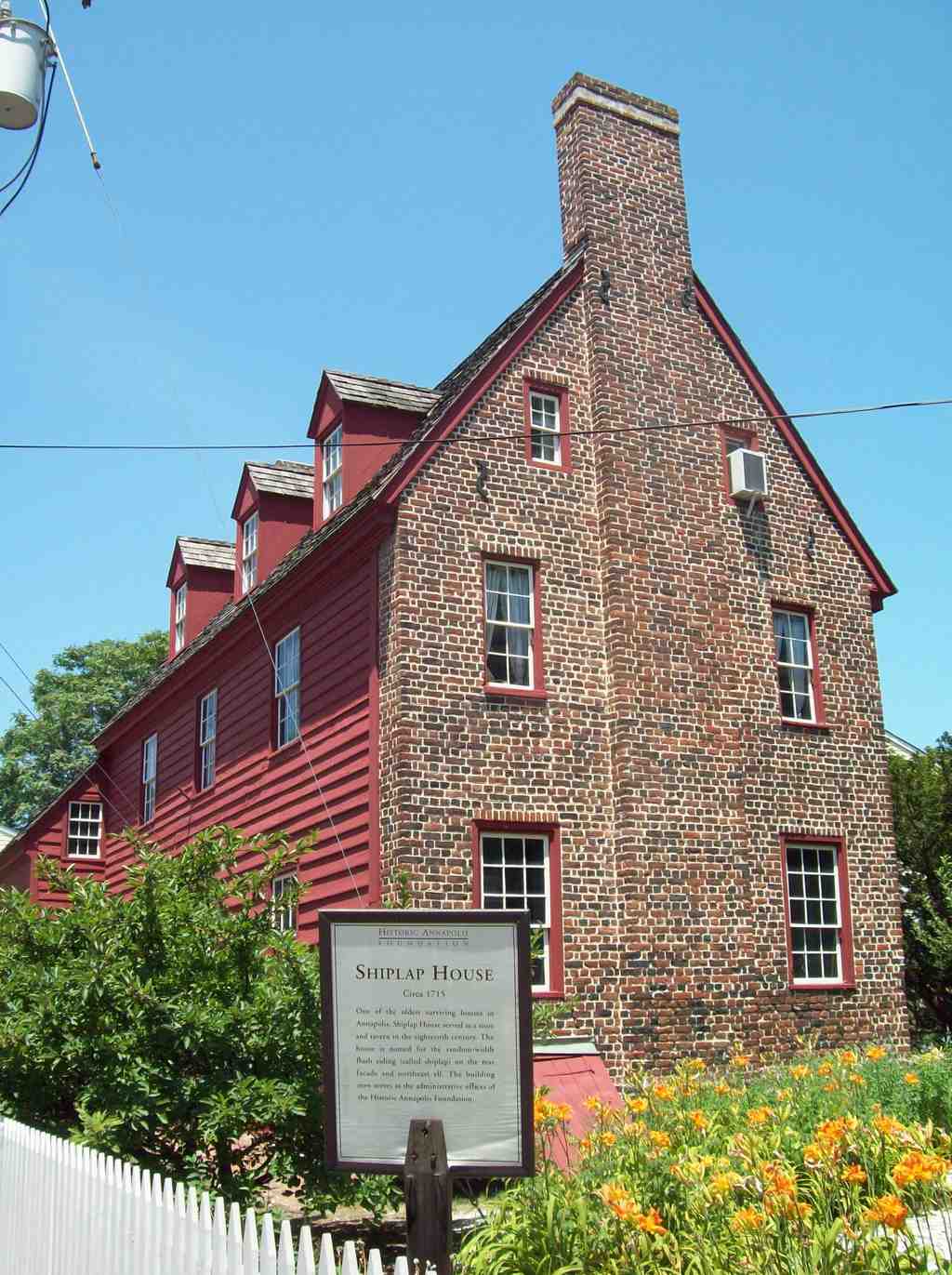
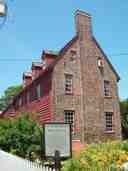
Colonial Annapolis Historic DistrictPhoto: Pubdog, Wikimedia Commons, Public domain. Cropped & resized. You are standing before a sturdy colonial structure defined by its multi-tonal brick facade, a massive brick chimney climbing the right side, and a slanted roof punctuated by distinct dormer windows. We have finally reached the Colonial Annapolis Historic District.
With roughly one hundred and twenty original eighteenth-century buildings still standing, this area presents an incredibly polished, idyllic picture of early America. Naturally, the reality is far more complex.
Take a look at the third image in your app. This aerial view reveals the city's underlying blueprint, laid out in sixteen ninety-five by Francis Nicholson. His design was not a standard, practical grid. It was a grand Baroque vision. In urban planning, the Baroque style relies on theatrical, sweeping geometries inspired by the royal gardens of Versailles, deliberately designed to impress the absolute power of the Crown and Church upon the landscape.
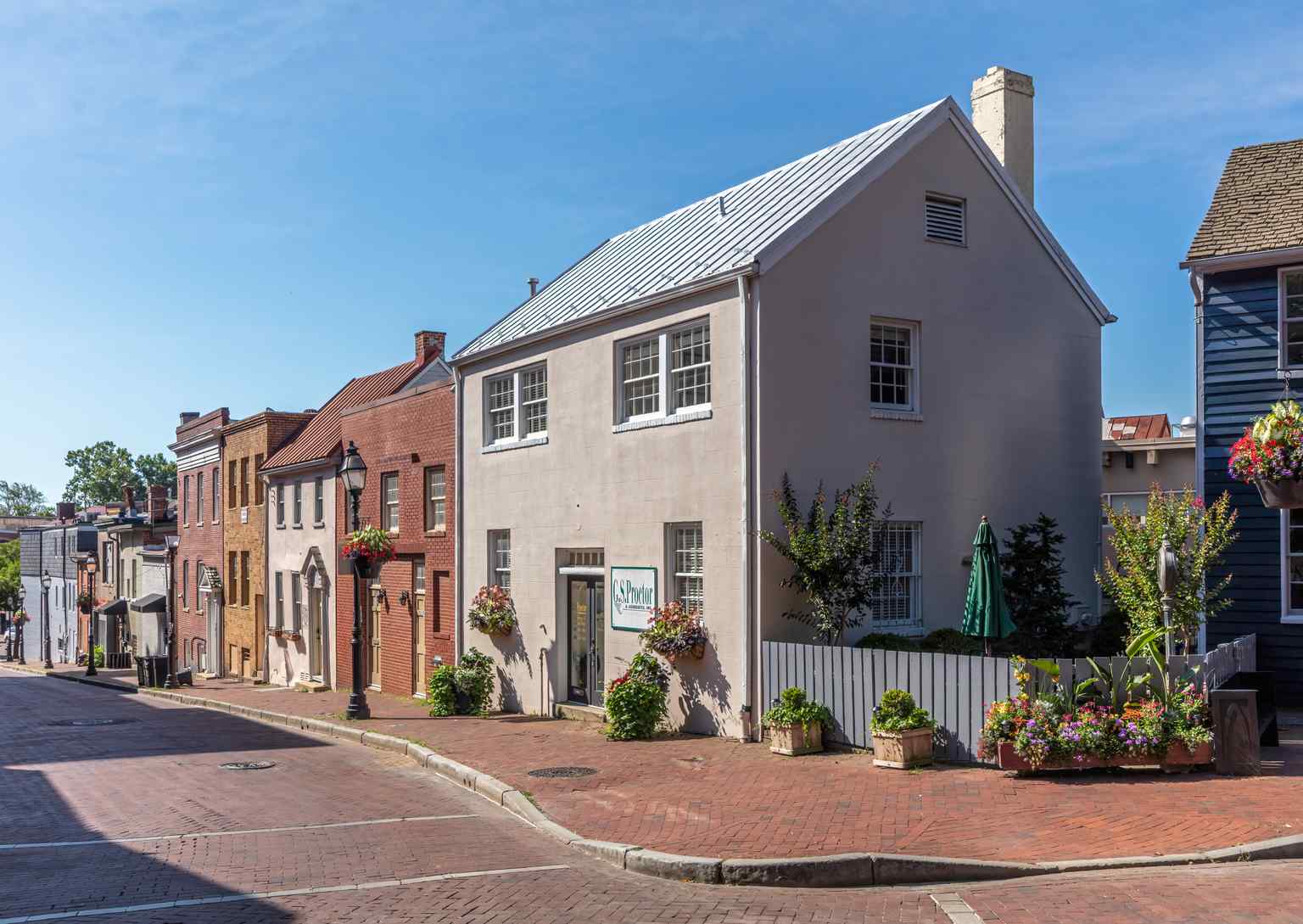
From State Circle, streets radiate outwards like the spokes of a wheel, a grand Baroque vision intended to impress the power of the Crown and Church.Photo: Acroterion, Wikimedia Commons, CC BY-SA 4.0. Cropped & resized. Nicholson placed two prominent circles on the city's highest hills. State Circle was for the government, and Church Circle was for the Anglican parish. The streets radiate outward from these hubs like the spokes of a wheel. But Nicholson included a very specific quirk. He used a pinwheel alignment. Instead of designing straight avenues that gave you a long, dramatic view of the buildings from a distance, he offset the approaching streets.
Because of this grand design, you never see the Maryland State House coming. It does not wait patiently at the end of a long boulevard. Instead, as you navigate the curved streets, the massive structure suddenly appears right on top of you, looming around a tight corner. It is a brilliant psychological trick, engineered to make the citizen feel small and the state look monumental.
Yet, this meticulously engineered order constantly masked the turbulent reality of the people living inside it. The grandiose mansions of the elite often hid deep personal failures, like Samuel Chase completely bankrupting himself halfway through building his massive home. The polite society rules of the time were just a facade for boiling political tensions. In seventeen seventy-four, a mob dragged a ship owner out of his house and forced him to personally set his own vessel, the Peggy Stewart, on fire right in the harbor simply because he paid a British tax on imported tea.
Even the ultimate moments of American heroism here were fraught with immense human frailty. When George Washington stood inside that looming State House in seventeen eighty-three to resign his military commission, his hands were visibly trembling. At a time when military victors usually declared themselves kings, Washington was terrified by the gravity of voluntarily surrendering his immense power back to civilian rule.
As our tour concludes, take a final look at the streets radiating out around you. Today, they are peaceful, filled with casual tourists and midshipmen in crisp white uniforms. But Annapolis remains a masterpiece of contradiction. The true fascination lies in the tension between Nicholson's rigid, engineered fantasy of absolute control, and the messy, rebellious, and entirely human history that actually unfolded on these bricks. Enjoy the rest of your time exploring these beautifully layered streets.




Preguntas frecuentes
¿Cómo empiezo el tour?
Después de la compra, descarga la app AudaTours e ingresa tu código de canje. El tour estará listo para comenzar de inmediato - solo toca play y sigue la ruta guiada por GPS.
¿Necesito internet durante el tour?
¡No! Descarga el tour antes de empezar y disfrútalo completamente sin conexión. Solo la función de chat requiere internet. Recomendamos descargar en WiFi para ahorrar datos móviles.
¿Es un tour guiado en grupo?
No - esta es una audioguía autoguiada. Exploras de forma independiente a tu propio ritmo, con narración de audio reproduciéndose en tu teléfono. Sin guía, sin grupo, sin horario.
¿Cuánto dura el tour?
La mayoría de los tours toman 60–90 minutos para completar, pero tú controlas el ritmo completamente. Pausa, salta paradas o toma descansos cuando quieras.
¿Qué pasa si no puedo terminar el tour hoy?
¡No hay problema! Los tours tienen acceso de por vida. Pausa y continúa cuando quieras - mañana, la próxima semana o el próximo año. Tu progreso se guarda.
¿Qué idiomas están disponibles?
Todos los tours están disponibles en más de 50 idiomas. Selecciona tu idioma preferido al canjear tu código. Nota: el idioma no se puede cambiar después de generar el tour.
¿Dónde accedo al tour después de comprarlo?
Descarga la app gratuita AudaTours desde App Store o Google Play. Ingresa tu código de canje (enviado por email) y el tour aparecerá en tu biblioteca, listo para descargar y comenzar.
Si no disfrutas el tour, te reembolsamos tu compra. Contáctanos en [email protected]
Paga de forma segura con 


