Tour de audio por Edimburgo: Puentes, entierros y misterios monumentales
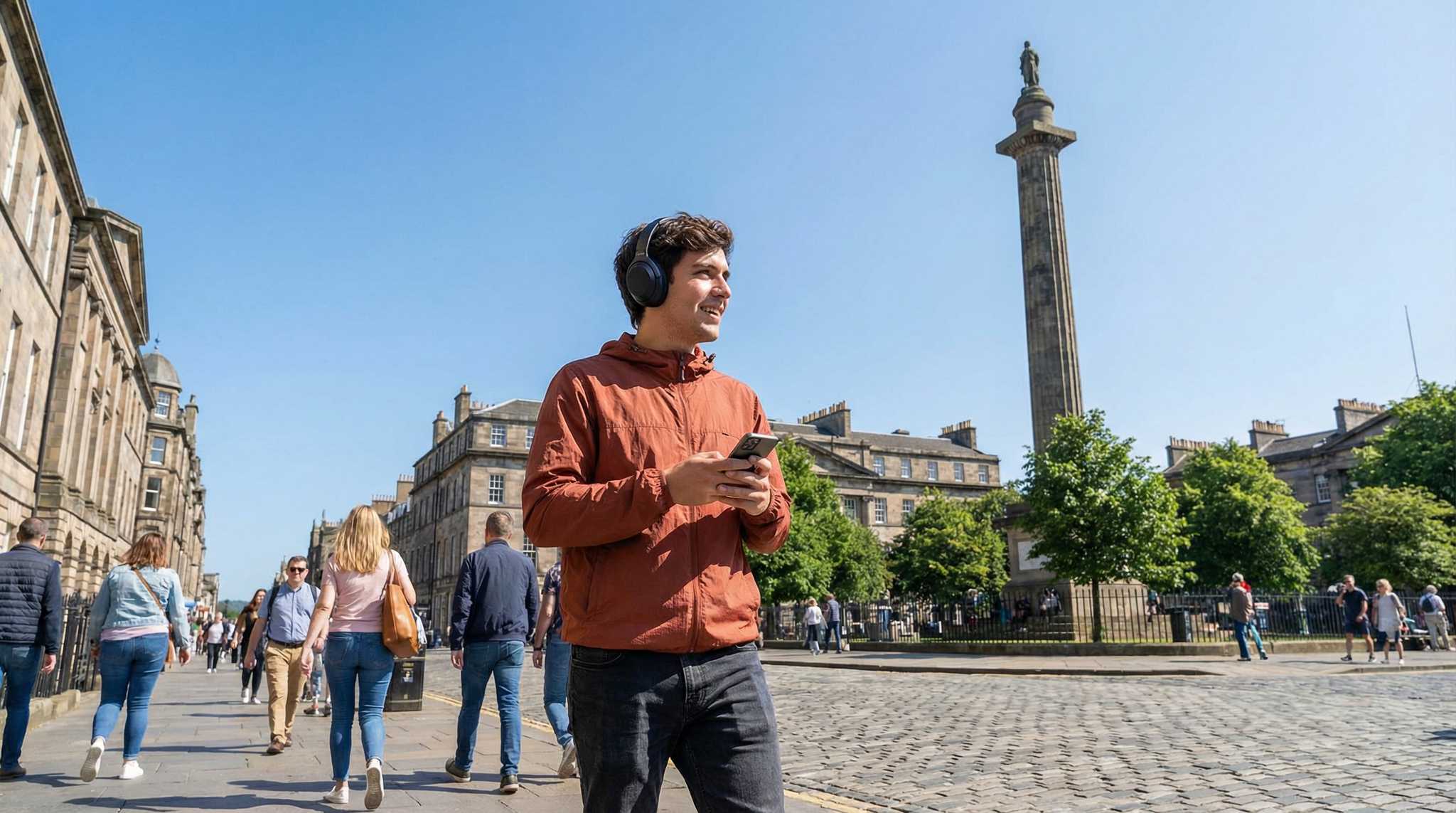
Una aguja gótica negra pincha el cielo de Edimburgo, y el Monumento a Scott proyecta largas sombras sobre historias que se niegan a permanecer enterradas. Este tour de audio autoguiado conduce a través del Casco Antiguo y más allá, combinando lugares famosos con rincones ignorados como Moubray House y los Archivos Nacionales de Escocia. Escucha a la ciudad hablar a través de rebeliones, escándalos, batallas políticas y momentos olvidados por los que la mayoría de los visitantes pasan de largo. ¿Qué mensaje desesperado podría convertir a una multitud cerca del Monumento a Scott de la admiración a la alarma? ¿Qué registro sellado en los Archivos Nacionales de Escocia insinúa un misterio que nadie quería resolver? ¿Por qué Moubray House sigue apareciendo en relatos extrañamente específicos sobre papeles desaparecidos y nombres tachados a medianoche? Muévete desde escalones de piedra hasta callejones ocultos, desde grandes fachadas hasta entradas silenciosas. Siente cómo Edimburgo se tensa y se abre de nuevo con cada giro. Empieza ahora y sigue esa aguja hacia las sombras.
Vista previa del tour
Sobre este tour
- scheduleDuración 40–60 minsVe a tu propio ritmo
- straighten3.5 km de ruta a pieSigue el camino guiado
- location_onUbicaciónEdimburgo, Reino Unido
- wifi_offFunciona sin conexiónDescarga una vez, úsalo en cualquier lugar
- all_inclusiveAcceso de por vidaReprodúcelo en cualquier momento, para siempre
- location_onComienza en Puente Norte, Edimburgo
Paradas en este tour
Look for the long, pale stone-and-iron bridge with big repeating arches spanning the valley above the train tracks and station roofs below. Alright, you’re standing at North…Leer másMostrar menos
Look for the long, pale stone-and-iron bridge with big repeating arches spanning the valley above the train tracks and station roofs below. Alright, you’re standing at North Bridge… which is basically Edinburgh’s great urban handshake: it links the Old Town up on the ridge with the New Town over by Princes Street, right across what used to be the North Loch. Today you’ve got traffic humming beside you, and down in the dip you can usually hear that steel-on-steel train hiss drifting up from Waverley Station. It’s a bridge with a view… and a memory. The first North Bridge began with one of those “we’re building the future” moments. On October 21, 1763, the city’s Lord Provost, George Drummond, laid the first stone. Drummond was a big believer in modernizing Edinburgh, and draining the North Loch that year was part of the makeover. Imagine the scene: the smell of wet mud, carts scraping, workers hauling out muck… and officials congratulating themselves for turning a swampy barrier into an opportunity. The actual building contract didn’t get signed until 1765, and the job went to architect William Mylne for £10,140… which is roughly £1.6 million in today’s money. The deadline was Martinmas, November 11, 1769, and Mylne even had to guarantee the work for ten years. Confident, right? Then Edinburgh’s geology cleared its throat. The slope below the Old Town is steep, and for ages people had tossed excavated earth down toward the loch. So underneath? Not solid ground… more like a giant historical junk drawer of loose fill. Mylne underestimated how deep the foundations needed to go, and with other design issues piled on top… the bridge partially collapsed on August 3, 1769, killing five people. It’s a brutal reminder that “progress” can have sharp edges. They rebuilt, spending another £18,000-about £2.8 million today-and the bridge finally reopened in 1772. The original was enormous by the standards of the day: multiple big arches, smaller hidden ones at the ends, and a roadway that widened as it met the city on either side. It was Edinburgh stretching itself out. But cities keep growing, and by the 1890s the old bridge was on borrowed time. The North Bridge you’re on now went up between 1894 and 1897: 525 feet long, 75 feet wide, with three big arched spans. The builder, Sir William Arrol and Company, also worked on the Forth Bridge… so yes, these folks knew their way around ambitious Scottish engineering. The ornamentation was designed by the city architect Robert Morham-because even your everyday commute deserves a little style. Keep your eyes open on the bridge for a war memorial by sculptor William Birnie Rhind, honoring soldiers of the King’s Own Scottish Borderers lost in campaigns from 1878 to 1902. History here isn’t tucked away-it’s built into the street furniture. And if you glance around at the edge of the bridge, the buildings tell you how vertical this city is: entrances at road level, and other doors far below in the valley. On one end you’ve got the Balmoral Hotel and Waverley Gate; on the other, the big blocks tied to newspapers, shops, and hotels. North Bridge isn’t just a crossing… it’s a whole stacked-up neighborhood. One last thing: if you’ve noticed construction gear or patched paving, you’re not imagining it. A major refurbishment kicked off in 2021, and thanks to some nasty surprises in the concrete, the finish line has slid… and slid again… now aiming at spring 2026, with costs at least £85 million. Nothing says “timeless landmark” like an eternally open worksite. When you’re set, Moubray House is a 6-minute walk heading south.
Abrir página dedicada →On your left, look for the chunky gray-stone corner building with rows of small-paned windows and a slightly jumbled, old-fashioned roofline-it sits right beside a squat stone…Leer másMostrar menos
On your left, look for the chunky gray-stone corner building with rows of small-paned windows and a slightly jumbled, old-fashioned roofline-it sits right beside a squat stone well-like structure on the sidewalk. This is Moubray House, one of those Royal Mile survivors that makes you realize Edinburgh isn’t just old… it’s stubborn. The street-facing part you’re looking at dates to the early 1600s, but it’s built on foundations laid around 1477-meaning people were living, working, arguing, and probably complaining about the weather here before Shakespeare was even a rough draft. It’s also one of the oldest continuously occupied residential buildings in the city, which is a polite way of saying: this place has had roommates for centuries. Now, the spot matters. You’re near where the Netherbow Port used to stand-the main gate into Edinburgh until it was demolished in 1764. Imagine the pinch-point here: carts creaking, merchants shouting, guards watching, and travelers trying to look innocent. And right in front, that squat stone structure is the Netherbow Well-one of the old water sources for the Old Town. Nothing says “medieval city life” like lining up for water with a bucket while someone’s livestock has opinions. Moubray House is also a rare escapee from the Burning of Edinburgh in 1544, when Henry the Eighth basically ordered the town put to the torch. Somehow, this “land”-that’s what these High Street property plots were called-held on. Ownership here was famously tangled: fore, mid, and back sections, different floors, different tenants… like a centuries-long game of real estate Jenga. The Moubrays themselves were well-connected merchants, especially in textiles. One Andrew Moubray supplied cloth to the queen-Margaret of Denmark-to line her bathtub. It’s comforting to know royal luxury once included “premium bath-liner sheets.” Another Moubray sold fine cloth to King James the Fourth and got paid with a gilded cup-because apparently “exact change” was hard in 1496. The family even worked international trade routes-wool out, wine and furs in-running cargo through places like Middelburg in the Netherlands. Inside this building, the real magic is overhead: painted Renaissance ceilings and rich plasterwork with fruit-and-flower molding, plus a barrel-vaulted attic that shows itself up on the roofline. These details were sometimes hidden for ages-one exceptional painted ceiling was only rediscovered in 1999. Imagine renovating and suddenly your ceiling starts flexing on you. And the guest list? Painter George Jamesone lived here. Daniel Defoe-yes, that Defoe-worked from here in 1710, editing a newspaper while helping push along the Act of Union. Later, this place even hosted a tavern, and the street-front shop belonged to Archibald Constable, the publisher connected to the Encyclopaedia Britannica. Moubray House has always been a mix of home, hustle, and history-just stacked vertically, like Edinburgh itself. When you’re ready, Old St Paul’s is a 3-minute walk heading west along the High Street.
Abrir página dedicada →On your left, look for the compact gray-stone church wedged between taller buildings, with a steep gable and a row of narrow, pointed Gothic windows like stone eyebrows. This is…Leer másMostrar menos
On your left, look for the compact gray-stone church wedged between taller buildings, with a steep gable and a row of narrow, pointed Gothic windows like stone eyebrows. This is Old Saint Paul’s, an Episcopal church sitting right in the Old Town’s tight urban squeeze... which feels appropriate, because for a long time Episcopalians in Scotland had to live a bit squeezed themselves. The congregation goes back to the late 1600s, when the established Church of Scotland moved firmly toward Presbyterian governance. A group from Saint Giles’ didn’t go along with that shift, and in 1689 their bishop, Alexander Rose, walked out with a good chunk of his people. Not exactly a quiet disagreement over meeting minutes. Think “theological breakup,” but with more cold stone and fewer text messages. They set up shop nearby in an old wool store in Carrubber’s Close. Wool today is cozy; wool then was commerce, grime, and survival. And the politics around this congregation got even hotter. Many Scottish Episcopalians stayed loyal to the Jacobite cause, backing James and his heirs against the Hanoverian kings. Members here were wrapped up in the 1715 and 1745 risings, and one Saint Paul’s member even carried word back to Edinburgh after Bonnie Prince Charlie won at Prestonpans. The city gates were shut against the defeated Hanoverian army... a little act of civic stagecraft with very real consequences. After the Jacobite defeats, the government didn’t exactly send apology flowers. Episcopal worship and churches faced legal persecution. It wasn’t until Bonnie Prince Charlie died in 1788 that the Jacobite shadow finally started to lift. That same year, the Scottish Episcopal Synod agreed to pray for King George the Third in all Episcopal churches-basically, “All right, we’re done with the exiled prince thing.” History is often just people deciding which name they can say out loud. The building you’re seeing now is later-completed in 1883 by architects William Hay and George Henderson in an Early English Gothic style. It cost about £3,500 back then-roughly around $550,000 in today’s money, give or take-proof that even in the 1880s, renovations were never “just a quick fix.” Inside, there’s a hammerbeam roof with wooden gargoyles, a carved oak pulpit with saints, and a dramatic high altar with grapevine carving and seven lamps for the gifts of the Holy Spirit. And then there’s the Warriors Chapel, added in 1926 as a World War One memorial. The rector who organized it, Canon Albert Ernest Laurie, served as an army chaplain in France and won the Military Cross twice for tending wounded soldiers under fire. One of his assistants, Charles Gustave Meister, also earned the medal... and was killed in 1918. The chapel holds rolls of honor from both World Wars, including one woman listed for World War One-Sybil Lewis. It also keeps a small iron “Martyrs’ Cross” that once hung in the Grassmarket opposite the gallows-the last thing condemned prisoners saw. That’s a hard detail to shake. When you’re ready, Fruitmarket Gallery is a 2-minute walk heading west.
Abrir página dedicada →
Mostrar 12 paradas másMostrar menos paradasexpand_moreexpand_less
Coming up on your right is the Fruitmarket Gallery... and yeah, the name is literal. This building started life in 1938 as a proper fruit-and-veg market, the kind of place that…Leer másMostrar menos
Coming up on your right is the Fruitmarket Gallery... and yeah, the name is literal. This building started life in 1938 as a proper fruit-and-veg market, the kind of place that would’ve smelled like bruised apples, wet cardboard, and somebody’s idea of a “fresh” herring nearby. Not exactly the usual perfume of contemporary art. Then in 1974, Edinburgh did a neat little flip: it turned a working market into a space for new art-free to enter, open to everyone, and now one of the anchors of Scotland’s contemporary scene. The building itself got a refresh in 1994 by Richard Murphy Architects, and today it’s got the civilized essentials: a café and a bookshop, where you can buy something glossy and expensive that tells you how to feel about a blank canvas. The gallery doesn’t just hang art; it nudges the city around. In 2011, it helped commission the makeover of the Scotsman Steps-those 104 steps linking Waverley Station to North Bridge-where artist Martin Creed turned every single step into a different kind of marble. The same year, the Fruitmarket was picked to curate Scotland’s pavilion at the Venice Biennale, which is basically the art world’s Olympics... but with more black outfits. It closed in 2018 for a £4.3 million refurbishment-about £6.3 million today, roughly $8 million-then reopened in 2021 with more space, workshops, and an expanded café and shop. Even a ceramic drinking fountain was designed so you can top up your water bottle like a civilized local. When you’re ready, Trinity College Kirk is about a 6-minute walk heading east.
Abrir página dedicada →On your right is Trinity College Kirk… or, more accurately, what’s left of a church that had the misfortune of being built in the path of “progress.” Edinburgh has always loved…Leer másMostrar menos
On your right is Trinity College Kirk… or, more accurately, what’s left of a church that had the misfortune of being built in the path of “progress.” Edinburgh has always loved its history… right up until it needs the space. This place began in grief and royal ambition. In 1460, Mary of Guelders-widow of King James the Second-founded a grand collegiate church and an almshouse called Trinity Hospital. James had just been killed at the siege of Roxburgh Castle, and Mary wanted a lasting, stone-solid way to honor him… and to pray for the wellbeing of his soul, and basically every Scottish royal soul on file. She herself was buried in the original kirk floor when she died in 1463, though her coffin was later moved to Holyrood Abbey in the 1800s. “Collegiate church” wasn’t a school the way we mean it now. Think of it as a well-funded religious workplace: a provost, eight prebendaries, and clerks-each supported by lands and church incomes drawn from all over Scotland. Some of that money even came from places in Fife, including a leper colony at Monimail. And there was a deal attached: the provost had to maintain three “bedesmen,” meaning poor men supported by the foundation, at the Soutra hospital. Medieval charity came with paperwork… and strings. Now, if you’re picturing a finished cathedral-like masterpiece… not quite. The original plan was never completed. They managed the apse, the choir with its aisles, and the transepts-impressive, but still a “work in progress” that never got its final act. It was built from local sandstone, quarried not far away-handy stuff, and good quality. Style-wise, it was late Gothic with a cosmopolitan edge, and it drained rainwater through gargoyles… because nothing says sacred architecture like stone creatures spitting water at you. Even better: the decorations reportedly included CARVED MONKEYS. No one fully agrees why. Maybe a warning about mischief. Maybe the masons just had a sense of humor. Honestly, relatable. This kirk also had serious cultural clout. It housed a famous triptych altarpiece by Hugo van der Goes, finished in 1479-now in the National Gallery of Scotland. It shows James the Third, with saints and family, plus the provost who commissioned it, Edward Bonkil, proudly stamped in with his coat of arms. In other words: faith, power, and branding… the full medieval package. Then came the railway. In the 1840s, the North British Railway got legal power to buy up land for what became Waverley Station-and Trinity Kirk stood in the way. So in 1848, under architect David Bryce, the old church was dismantled, despite protests from antiquaries who were, understandably, not thrilled. The stones were numbered for rebuilding and stored on Calton Hill… but decades of delays meant many stones vanished. Turns out “numbered” isn’t the same as “secure.” The railway paid the Town Council £18,000 at the time-roughly about £2.5 million today, or around $3.2 million USD-to compensate instead of rebuilding exactly. A later replacement church opened in the 1870s, using only about a third of the original stone to recreate the choir and apse you’re seeing now, the “Trinity Apse.” The rest… scattered, stolen, or sitting in someone’s garden as a suspiciously fancy lawn ornament. When you’re ready, Regent Bridge is next-just head west for about 2 minutes, and it will be on your left.
Abrir página dedicada →On your left, look for the big soot-dark stone arch spanning the street between tall gray buildings, with a pair of classical columns and a little “gateway” sitting right on top…Leer másMostrar menos
On your left, look for the big soot-dark stone arch spanning the street between tall gray buildings, with a pair of classical columns and a little “gateway” sitting right on top of the curve. This is Regent Bridge, and yes… it’s a bridge that kind of hides in plain sight, like Edinburgh saying, “Oh this old thing?” What you’re looking at is a 19th-century fix for a very real problem: getting into the city on the main London road used to be a headache. The approach from the south squeezed travelers through cramped medieval streets-great if you loved bottlenecks, less great if you were trying to sell Edinburgh as a polished, elegant capital. So in the 1810s, the city decided to modernize with a bold move: carve a grand entrance from Calton Hill toward Princes Street by vaulting over a deep dip called Low Calton. Down in that hollow had been a tangle of older, poorly built streets… and the plan was basically to erase them and start fresh. Urban renewal, 1814 style. The push came from Sir John Marjoribanks, Edinburgh’s Lord Provost, who also wanted better access to a new jail planned for Calton Hill-nothing says “welcome to the city” like smoother traffic to the prison. He brought the proposal to city leaders in March 1814, with engineer Robert Stevenson backing it up. The estimate was about £20,000 at the time-roughly around £1.5 to £2 million today, give or take… and of course the reality got bigger once they started buying property and reshaping the area. Making this happen wasn’t tidy: part of the old Calton burial ground had to be moved, a valley about fifty feet deep needed bridging, solid rock got blasted, and buildings at the east end of Princes Street had to come down. Construction began in 1816 and wrapped in 1819, with Archibald Elliot designing the roadway above-Waterloo Place-named because it was laid out in the year of Waterloo. Now, take in the engineering swagger: a huge semicircular arch about fifty feet wide, with extra “reverse arches” supporting the roadway on each side. And those Corinthian columns? That’s the Greek Revival fashion of the day-Edinburgh dressing its infrastructure like a triumphal monument. The bridge officially opened on August 18, 1819, during a visit by Prince Leopold of Saxe-Coburg. Nothing like royal foot traffic to christen a brand-new shortcut. When you’re set, St Mary’s Cathedral, Edinburgh (Catholic) is a 6-minute walk heading north.
Abrir página dedicada →On your left, look for the sturdy gray-stone church with a pointed Gothic front, tall skinny pinnacles on the roofline, and a warm wooden double door tucked beneath an arched…Leer másMostrar menos
On your left, look for the sturdy gray-stone church with a pointed Gothic front, tall skinny pinnacles on the roofline, and a warm wooden double door tucked beneath an arched entrance. This is St Mary’s Metropolitan Cathedral of Our Lady of the Assumption… which is a long name for a place that’s basically been Edinburgh’s Catholic “home base” for two centuries. If you’re hearing traffic and footfalls around you, that’s fitting: this cathedral sits right in the New Town’s city-center flow, along Broughton Street between York Place and Leith Street, like it’s calmly holding its ground while the city rushes past. Back in 1814, when this chapel first opened, that simple fact-Catholics building a proper, purpose-built church-meant something. Scotland had spent a long time officially not being thrilled about Catholic worship. The earlier chapel down on Blackfriars Wynd had been… tolerated, let’s say. But in 1813 to 1814, architect James Gillespie Graham designed this in a neo-perpendicular Gothic style-those vertical lines and clipped-point details you can practically feel climbing upward. Later, Augustus Pugin, the Gothic-revival superstar, added designs too, giving the building extra bite and conviction. And St Mary’s didn’t just sit pretty. It kept evolving-decorated, expanded, adjusted as the city changed around it. In 1878, when the Scottish Catholic hierarchy was restored, this became the pro-cathedral for the new archdiocese. Then in 1886, it was officially raised to Metropolitan Cathedral status… the top-tier version, with the rights and privileges to match. Inside, it also holds the National Shrine of Saint Andrew, tying Scotland’s patron saint to a living, working parish. There’s drama in the bricks, too. In 1892 a fire next door at the Theatre Royal forced major changes-new arches cut into the side walls, aisles added, and the sanctuary stretched back by three bays. Later came a war memorial and high altar in 1921, then a baldachin in 1927, and even a higher roofline in 1932… like the building kept clearing its throat and saying, “Actually, I can be a little grander.” If you ever get the chance to hear music in here, do it. The Schola Cantorum sings everything from plainchant to modern pieces, and the organ installed in 2008 has around 4,000 pipes… which is an absurd number of ways to make the air feel holy. In May 1982, Pope John Paul II visited-one of those moments where a local church suddenly feels connected to the whole world. When you’re ready, Melville Monument is about an 8-minute walk heading southwest.
Abrir página dedicada →Look to your right for a tall, fluted stone column rising from the middle of the square’s gardens, with a small statue of a man standing on top like he got the best seat in the…Leer másMostrar menos
Look to your right for a tall, fluted stone column rising from the middle of the square’s gardens, with a small statue of a man standing on top like he got the best seat in the whole city. This is the Melville Monument, Edinburgh’s answer to the question, “What if we made a political argument… but 150 feet tall?” It went up between 1821 and 1827 to honor Henry Dundas, the 1st Viscount Melville-one of the most powerful Scots in late 1700s British politics. If you’re thinking the design feels a little Roman, you’re not wrong: architect William Burn modeled it on Trajan’s Column, only minus the carved storytelling spirals. Instead, you get clean vertical fluting… very “imperial chic.” Now, Dundas. He was born in 1742 into a serious legal family, studied at the University of Edinburgh, and climbed the ladder fast-advocate, then Member of Parliament in 1774, then Lord Advocate a year later. From there, he became a kind of political spider at the center of Scotland’s web, pulling patronage strings so effectively that by the 1790s he essentially controlled almost all of Scotland’s MPs. Democracy, but make it management. In London, he rose under Prime Minister William Pitt the Younger, served as Home Secretary, and helped clamp down on unrest during the French Revolution era. Later, as First Lord of the Admiralty, he pushed to strengthen the Royal Navy in the run-up to the Trafalgar age. Navy officers admired him so much they called him “the Seaman’s Friend,” and they were the ones who really drove this monument-subscriptions from sailors helped fund it, with Vice Admiral Sir William Johnstone Hope leading the charge. Construction started with considerable ceremony on April 28, 1821-Dundas’s birthday-complete with prayers, admirals laying the foundation stone, and a time capsule sealed inside. Then reality arrived. Costs ballooned, and the engineering got more serious after concerns about stability. Robert Stevenson-the same mind behind major lighthouse engineering-advised strengthening the foundations and building the shaft from solid stone blocks rather than cheaper infill. Smart… and expensive. The budget originally looked manageable at about £3,192 (roughly £300,000 today), but the final price hit about £8,000 (around £800,000 today). Nothing says “national tribute” like a cost overrun that lasts longer than some governments. It wasn’t even fully paid off until 1837, when a handful of naval officers basically swallowed the last bill. And at the top: a 14-foot statue of Dundas, designed by Francis Leggatt Chantrey and carved by Robert Forrest, assembled from massive stone blocks hauled in by twelve carts and winched up piece by piece. He faces west down George Street, posed in peer’s robes, one foot stepping forward-like he’s eternally about to address Parliament or ask you for directions. In the 2000s, the monument’s meaning got sharper edges. Dundas’s role in arguing against “immediate” abolition of the slave trade-and backing a “gradual” approach-became central to modern debate. After 2020 protests, the city added a plaque in 2021 criticizing him for delaying abolition and supporting colonial rule. In 2023, a committee even voted to remove it… but the council later said it wasn’t planning to. In other words: the argument continues, just with better paperwork. Ready for St Andrew Square, Edinburgh? Just walk southwest for 0 minutes.
Abrir página dedicada →Look straight into the square and you’ll spot it right away: a wide green garden with paved paths, dominated by a tall fluted stone column rising up from the center like a giant…Leer másMostrar menos
Look straight into the square and you’ll spot it right away: a wide green garden with paved paths, dominated by a tall fluted stone column rising up from the center like a giant exclamation point. Alright, welcome to St Andrew Square... where Edinburgh’s New Town first tried on its “smart suit” and, honestly, it fit pretty well. The square started going up in 1772, part of architect James Craig’s brand-new plan to ease the city out of the cramped Old Town and into something airier, tidier, and a lot more interested in straight lines. Within just a few years, this was the address-if you had money, ambition, and a decent tolerance for neighbors who also had money and ambition. Take a second to look around at the calm geometry: the open gardens, the broad streets feeding in, the sense that everything was designed, not merely… survived. Back in the late 1700s, living here was a statement that said: “I’ve arrived.” And please notice how casually I’m arriving in a townhouse the size of a small museum. Then the 1800s rolled in, and St Andrew Square shifted from fashionable living room to Scotland’s financial engine room. Banks and insurance companies piled in. For a time, this small patch of city could claim to be the richest square footage in the country-basically the place where Scotland’s big decisions were quietly made over ledgers, ink, and very serious facial expressions. The gardens you’re looking at were long privately held as part of the New Town Gardens, but in 2008 they opened to the public-so today you can actually walk through the middle of what used to feel like a members-only club with better landscaping. Listen for the city sounds around you: footsteps on the paths, the low hum of traffic, maybe a bus braking-because this square has also been a transport hub for ages. The bus station nearby was rebuilt in the early 2000s, and the tram stop on the east side links you to the airport and up toward Leith and Newhaven. Practical, efficient… very Edinburgh. Now, looming above you is the Melville Monument, honoring Henry Dundas, Viscount Melville-still literally the center of the square. And over on the east side sits Dundas House, built in the 1770s as a grand private mansion before becoming the Royal Bank of Scotland’s headquarters in 1825. Fun detail: parts of its design ended up on RBS banknotes-the facade, and even a starburst pattern inspired by the ornate ceiling inside the banking hall. Money admiring the building where money happened. Poetic, in a very corporate way. And here’s a little human touch: David Hume lived right around here, recruited-more or less-by architect Robert Adam to help lure people into the New Town. Even philosophers were used as marketing. Edinburgh has always been good at selling an idea. When you’re ready, Scott Monument is next-just walk southwest for about 4 minutes.
Abrir página dedicada →On your left, look for the tall, dark, lace-like Gothic spire in Princes Street Gardens, rising above the trees like a stone rocket with a big arched opening at its base. This…Leer másMostrar menos
On your left, look for the tall, dark, lace-like Gothic spire in Princes Street Gardens, rising above the trees like a stone rocket with a big arched opening at its base. This is the Scott Monument-Edinburgh’s Victorian-era love letter to Sir Walter Scott, the novelist who gave the world swashbuckling Scotland in book form… and basically helped turn tartan-and-castles into an international brand. The monument is BIG, too: at about 200 feet tall, it’s the second-largest monument to a writer anywhere on Earth, topped only by the José Martí monument in Havana. So yes, writers can get skyscrapers, apparently-if they sell enough novels and die at the right time. After Scott died in 1832, Edinburgh decided it needed something more dramatic than a plaque. A design competition was held, and the winning entry came from someone calling himself “John Morvo”-which sounds like a movie villain, but was actually the name of a medieval architect linked to Melrose Abbey. The twist? “Morvo” was really George Meikle Kemp, a 45-year-old joiner and draftsman who taught himself architecture and figured-correctly-that the judges might snub him if they knew he didn’t have the fancy credentials. His disguise worked. In 1838, he got the job. The monument you’re seeing is made from Binny sandstone, hauled from a quarry out in West Lothian. It’s set up like a perfect piece of civic theater: line it up with South Saint David Street and it becomes the grand finale of the view, big enough to block the Old Town behind it. Subtle? Not even a little. Now, step closer and peer into the great arch. Down in the center sits Scott himself, carved in white Carrara marble by sculptor John Steell. He’s paused mid-writing, quill in hand, looking like he’s about to dash off one more chapter-while his big dog, Maida, keeps watch at his feet. Around them, the monument is packed with characters from Scott’s novels: dozens of figures tucked into niches and ledges, like a stone cast list. There are 68 statues in total here-64 you can spot from the ground if you’re patient and your neck is feeling brave. If you’re tempted to climb: you can. The top viewing platform takes 287 steps by spiral stair, and the reward is a panoramic sweep over central Edinburgh and beyond. But there’s a harder truth baked into this tower. The carving work was brutal. The “hewing masons” did detailed cutting in enclosed sheds, breathing fine dust from the hard stone-then called “phthisis,” what we’d recognize as silicosis. Contemporary accounts claimed the monument killed 23 of the best stonecutters in town, and that as many as half the masons employed died from lung disease. It’s a stunning landmark… with a real human cost. The foundation stone was laid on August 15, 1840, and construction ran almost four years, finishing in 1844. The whole project cost a bit over £16,154-roughly around £2 million today, give or take, or about $2.5 million in United States money. And here’s the darkest irony: Kemp, the designer, didn’t live to see the grand inauguration in 1846. In 1844, on a foggy evening walking home from the site, he fell into the Union Canal and drowned. Edinburgh built a monument to a storyteller… and the man who dreamed it up vanished into mist. When you’re ready, General Register House is next-just head east toward Waverley Bridge for about 5 minutes.
Abrir página dedicada →On your slight right, you’re looking for a big, pale sandstone neoclassical block with a grand staircase and a domed roof rising behind it, flanked by two squat corner towers with…Leer másMostrar menos
On your slight right, you’re looking for a big, pale sandstone neoclassical block with a grand staircase and a domed roof rising behind it, flanked by two squat corner towers with clocks. This is General Register House, and it’s basically Edinburgh’s official memory bank... built to look like it could win an arm-wrestling match against time. The style is classic Robert Adam: crisp symmetry, calm authority, and just enough ornament to say, “Yes, we’re important,” without yelling it through a megaphone. Before this place existed, Scotland’s key records were kept up at Edinburgh Castle. Solid for defense, less ideal if you want to quickly find, say, a legal document from three centuries ago without hiking up a fortress. Around 1760, James Douglas, the 14th Earl of Morton, who also happened to be Lord Clerk Register, pushed for a purpose-built records HQ in the brand-new New Town. The government set aside £12,000 taken from forfeited Jacobite estates... which is about £2 million today, roughly $2.5 million USD give or take. Nothing says “we’re moving on” like funding a shiny new archive with the leftovers of rebellion. Robert Adam got the commission in 1765, and the foundation stone went down on June 27, 1774. Picture the ceremony: officials in their best, solemn faces on, committing Scotland’s paperwork future to the ground. Behind the scenes, it took a small army to pull this off-Adam’s brother John on site, a clerk of works named James Salisbury keeping tabs, and master masons John Wilson and David Henderson cutting and setting stone from Craigleith and Hailes quarries. Even the clock and weather vane were special-ordered, made by Benjamin Vulliamy. Here’s the twist: by 1803 the building still wasn’t finished... and people were already saying it was too small. That’s the archives for you-your collection doesn’t politely stop growing just because your walls do. So it got adjusted: Archibald Elliot reworked the front in 1813 to hide a new basement, and Robert Reid later redesigned the north side to make it more practical, finally wrapping things up in 1834-about sixty years after the whole idea started. Construction timelines: comforting in their consistency. Take in the details from where you stand: that central entrance with its big imperial staircase and four-column Corinthian porch, the royal coat of arms up in the pediment, and the clean, creamy stonework. And inside the quadrangle? A circular reading room under a dome-serious “temple of documents” energy, capped with plasterwork designed in the 1780s. Down in front, don’t miss the Duke of Wellington on a rearing horse, installed in 1852, dramatically pointing toward Waterloo Place like he’s still giving orders. Veterans of Waterloo were invited to the unveiling, which must’ve been a heavy moment-old soldiers staring up at a bronze reminder of a day they survived. When you’re set, National Archives of Scotland is a 0-minute walk heading straight ahead.
Abrir página dedicada →You’re standing by what people long called the National Archives of Scotland… although these days the official name is National Records of Scotland. Same idea, slightly newer…Leer másMostrar menos
You’re standing by what people long called the National Archives of Scotland… although these days the official name is National Records of Scotland. Same idea, slightly newer label. And honestly, when you’re responsible for the memory of a whole country, you’re allowed to rebrand once in a while. This place exists because Scotland learned the hard way that paperwork is power. Back in the late 1200s, during the Wars of Independence, Edward I didn’t just invade with soldiers… he grabbed the symbols of nationhood too. The regalia, the Stone of Destiny, and yes, the records. The idea was simple: take the receipts, rewrite the story. Some documents eventually trickled back, but most didn’t. When leftovers were finally returned in 1948, only about 200 documents survived that original haul. That’s not an archive… that’s a tragic little folder. And then the 1600s came along and made things worse. Cromwell’s army captured Edinburgh Castle in 1650. The Scots managed to move the archives out to Stirling, but when Stirling fell, the records began another miserable trip south. Later, when they were being shipped back, one of the boats-the Elizabeth-went down in a storm off the Northumbrian coast. Imagine centuries of legal decisions and national correspondence… turned into soggy confetti. History can be brutal, and not always with swords. By the 1700s, surviving records were being stored in places that were… let’s call them “not ideal.” Damp rooms. Vermin. Stacks of papers on the floor. A fire in 1700 even forced emergency removal to St Giles’ for safety. Scotland’s Treaty of Union promised the public records would stay in Scotland forever, but there was an awkward catch: no money to look after them properly. So, mid-18th century, Edinburgh finally funds a purpose-built home for the nation’s memory. In 1765, they secured £12,000-money taken from Jacobite estates after the 1745 rising. In today’s terms, think roughly around £2 million, give or take… which is a pretty poetic twist: rebellion bankrolls record-keeping. The site they chose was right by the end of North Bridge, and the architect was Robert Adam-yes, that Robert Adam, Edinburgh’s rock star of elegant stone. Work began in the 1770s, stalled, then resumed. At one point the unfinished structure was mocked as “the most magnificent pigeon-house in Europe,” which is the kind of civic insult Edinburgh does very well. But eventually it became real, and it became important: General Register House is among the oldest purpose-built archive buildings still operating in the world. Not many buildings can say, “I was designed to hold secrets,” and mean it literally. The collections here range from medieval parchment to digital files and even archived websites. One famous item associated with the national records is the Declaration of Arbroath-Scotland’s bold medieval statement of independence. And if you’ve ever heard someone say they’re “doing the family tree,” there’s a good chance they’ve ended up in these records too: old parish registers, births and marriages, wills and testaments, and court papers. In the late 1990s and early 2000s, Scotland helped pioneer large-scale digitization-half a million wills were photographed and indexed, making it easier to find your 17th-century ancestor who left “one cow and a disputed spoon” to a nephew. Ready for Old Calton Burial Ground
Abrir página dedicada →On your left is Old Calton Burial Ground... a quiet rectangle of stone and sky perched on the flank of Calton Hill. The city noise drops off a notch here, like someone turned the…Leer másMostrar menos
On your left is Old Calton Burial Ground... a quiet rectangle of stone and sky perched on the flank of Calton Hill. The city noise drops off a notch here, like someone turned the volume down out of respect... or maybe out of mild fear of upsetting the neighbors. This cemetery opened in 1718, back when Calton was its own wee village at the hill’s base. For locals, burying family at South Leith Parish Church was a real hassle-longer trip, bad roads, and grief doesn’t exactly make you feel like commuting. So the Incorporated Trades of Calton pooled their resources and bought about half an acre up here from Lord Balmerino for £1,013. That was serious money then-roughly around £170,000 today, give or take, depending on how you measure it. Not bad for a place nobody’s rushing to move into. They even got permission to create an access road up the steep slope-what became today’s Calton Hill road. Over the years, the burial ground expanded, filling with tradesmen, families, and eventually some of the biggest names in the Scottish Enlightenment and Edinburgh’s publishing world. Now, look around at the layout and you’ll notice something: the place feels a bit... interrupted. That’s because it was. In the 1810s, the city pushed through a grand new road-Waterloo Place-built between 1815 and 1819 and named to celebrate the Battle of Waterloo. Progress, as usual, arrived carrying a shovel. The new road split the graveyard in two, and the city had to move bodies and stones. But by all accounts, they did it carefully: bones gathered, wrapped, and reburied at New Calton Burial Ground just east of here, with some older stones re-erected there. So if you ever spot an 18th-century gravestone in a 19th-century cemetery... that’s why. Edinburgh loves a good logistical paradox. Old Calton is non-denominational-no single church claiming it-which helped make it a practical choice for people who didn’t fit neatly into the usual boxes. One story I always come back to is from 1795: a Jewish dentist and chiropodist-his name appears as Herman Lion, among other variations-petitioned the town council because he couldn’t be buried in a Christian graveyard. The council agreed to sell him a small plot nearby for £17-maybe around £2,000 today. It’s noted on old maps as a Lyons family Jewish burial vault, close to the City Observatory wall. A small detail, but it says a lot about who got included... and how hard people sometimes had to push just to be laid to rest. And then there’s David Hume-philosopher, historian, professional irritant to the religious establishment. His tomb is the big cylindrical one that shows up like a punctuation mark on the skyline. When Hume died in 1776, public hostility was so intense-partly because he openly rejected religion-that the grave had to be guarded for eight days. Nothing says “controversial thinker” like needing security at your funeral. He asked for a simple inscription-just his name and dates-leaving “posterity to add the rest.” Posterity, naturally, has had opinions. This ground is also packed with Edinburgh’s makers and shapers: scientist John Playfair, clergyman Robert Candlish of the Free Church movement, and rival publishers William Blackwood and Archibald Constable-men who helped decide what Scotland read, argued over it, and then ended up sharing the same hillside. There are beautiful old stones too, especially the ones carved for tradesmen-skulls, hourglasses, tools-basically the 18th-century version of saying, “Time’s up, pal.” When you’re set, the Political Martyrs’ Monument is a 2-minute walk heading east.
Abrir página dedicada →On your left, look for the tall, dark sandstone obelisk rising like a stone needle above the tombs, set on a square base inside the burial ground wall. This is the Political…Leer másMostrar menos
On your left, look for the tall, dark sandstone obelisk rising like a stone needle above the tombs, set on a square base inside the burial ground wall. This is the Political Martyrs’ Monument… and it’s basically Edinburgh’s way of saying, “We remember when asking for the vote could get you shipped to the other side of the planet.” Casual. The monument went up in 1844, designed by Thomas Hamilton, and it stands about 90 feet high-clean lines, ashlar sandstone blocks, no frills, just a big, blunt statement. The setting matters too: the Old Calton Burial Ground is already packed with memorials, and this one muscles its way into your attention like it has something urgent to say. The “something” is five men-two Scots and three English-who pushed for parliamentary reform in the 1790s, when the French Revolution had governments all over Europe nervously checking the locks. These reformers backed ideas like universal suffrage and annual parliaments. Today that sounds like a civics class. Back then, it sounded like sedition. So came the trials, in 1793 and 1794… and the punishment was penal transportation to New South Wales. Four of them were sent together on a convict ship called the Surprize; one, Gerrald, followed later on the Sovereign. Imagine the smell of the hold, the creak of timbers, the cold math of distance-your “sentence” measured in oceans. Their fates weren’t neat. Muir escaped in 1796, stowing away on an American ship and ending up in revolutionary France, where he died in 1799. Gerrald reached Port Jackson but died of tuberculosis that was made worse by heavy drinking. Skirving died just three days later-likely dysentery, or possibly laudanum. Only Palmer and Margarot served the full 14 years. Palmer stayed on and built a successful brewing business near Sydney Cove… then died of fever on a voyage back toward England. Margarot was the only one who made it back to the British Isles. Reform is a long game. Sometimes a brutal one. When you’re set, City Observatory is about a 6-minute walk heading north-take the stairs.
Abrir página dedicada →On your left is the City Observatory, sitting up here on Calton Hill like Edinburgh’s official lookout post for the universe… and, occasionally, for whatever the weather’s…Leer másMostrar menos
On your left is the City Observatory, sitting up here on Calton Hill like Edinburgh’s official lookout post for the universe… and, occasionally, for whatever the weather’s planning next. Take a second to notice how it’s laid out behind that boundary wall. Down in the southeast corner there’s a monument to John Playfair, who led the Edinburgh Astronomical Institution-the kind of person who could turn stargazing into committee work. And over in the southwest corner is the oldest piece here: the Gothic Tower, sometimes called Observatory House. It faces right out toward Princes Street and the Castle like it’s keeping watch. That tower is basically what’s left of an 18th-century dream that ran out of money halfway through… a very Edinburgh-style plot twist. The story kicks off in 1776, when an instrument-maker named Thomas Short came back to town with a massive 12-foot reflecting telescope made by his late brother, James. Short wanted a public observatory, run as a business. Conveniently, the university had a stash of observatory funds collected back in 1736 by mathematician Colin Maclaurin… then left untouched after the Porteous Riots and the 1745 Jacobite uprising threw the city into chaos. The money finally got put to use here, on land the city provided. The design-by James Craig, with the influence of Robert Adam-was meant to look like a little fortress: walls and Gothic towers on the corners. But the cash dried up after just one tower. So Short moved into that tower and carried on until he died in 1788. The site limped along, got leased out, and by about 1807 it was abandoned. Then in 1812, the Edinburgh Astronomical Institution took over and reopened the tower as a “popular” observatory. The more serious science was meant to happen in the central, Greek-temple-looking Playfair Building-designed by William Henry Playfair. Inside, there’s a 6-inch refractor up in the dome and a transit telescope in the east wing. That transit work mattered because the big job here wasn’t romance and constellations… it was TIME. They’d track stars crossing the meridian to set an ultra-precise clock. Mariners came up from Leith with ship chronometers to get them corrected. In 1854 the time ball went onto Nelson’s Monument nearby, dropping by electric signal from this clock. A few years later, the One O’Clock Gun at the Castle joined in, also triggered via an electrical wire stretched across the city. Today both are triggered by hand, which is… reassuringly high-tech. By the late 1800s, the Royal Observatory moved to Blackford Hill, and this became the City Observatory. A donated 6-inch Cooke refractor arrived, and a huge City Dome went up in the northeast to house a 22-inch refractor. The big telescope never performed well and was dismantled in 1926-leaving the dome to reinvent itself as a lecture space. After decades of use, neglect hit hard, and by 2009 vandalism made it unusable. Then came the comeback: a major restoration finished in 2018, reopening the whole site free to the public for the first time-as Collective, a contemporary art center. After about £4.5 million of work-roughly £5.5 million today, about $7 million-the old instruments and spaces got a new purpose. Not bad for a place that started as one lonely tower and a big idea.
Abrir página dedicada →
Preguntas frecuentes
¿Cómo empiezo el tour?
Después de la compra, descarga la app AudaTours e ingresa tu código de canje. El tour estará listo para comenzar de inmediato - solo toca play y sigue la ruta guiada por GPS.
¿Necesito internet durante el tour?
¡No! Descarga el tour antes de empezar y disfrútalo completamente sin conexión. Solo la función de chat requiere internet. Recomendamos descargar en WiFi para ahorrar datos móviles.
¿Es un tour guiado en grupo?
No - esta es una audioguía autoguiada. Exploras de forma independiente a tu propio ritmo, con narración de audio reproduciéndose en tu teléfono. Sin guía, sin grupo, sin horario.
¿Cuánto dura el tour?
La mayoría de los tours toman 60–90 minutos para completar, pero tú controlas el ritmo completamente. Pausa, salta paradas o toma descansos cuando quieras.
¿Qué pasa si no puedo terminar el tour hoy?
¡No hay problema! Los tours tienen acceso de por vida. Pausa y continúa cuando quieras - mañana, la próxima semana o el próximo año. Tu progreso se guarda.
¿Qué idiomas están disponibles?
Todos los tours están disponibles en más de 50 idiomas. Selecciona tu idioma preferido al canjear tu código. Nota: el idioma no se puede cambiar después de generar el tour.
¿Dónde accedo al tour después de comprarlo?
Descarga la app gratuita AudaTours desde App Store o Google Play. Ingresa tu código de canje (enviado por email) y el tour aparecerá en tu biblioteca, listo para descargar y comenzar.
Si no disfrutas el tour, te reembolsamos tu compra. Contáctanos en [email protected]
Paga de forma segura con 



