
Tour de Audio de Cambridge: Ecos de Conocimiento y Piedra
Sobre los tejados familiares y los tranquilos patios de Cambridge, siglos de rivalidad, revolución y reinvención se esconden a plena vista. Esta ciudad siempre ha susurrado sus secretos a aquellos que saben dónde escuchar. Con este tour de audio autoguiado, convierte cada esquina en un portal, revelando historias ocultas y leyendas olvidadas que la mayoría de los visitantes pasan de largo. Descubre tradiciones perdidas, escándalos susurrados y las batallas silenciosas que dieron forma a estas calles históricas. ¿Qué misteriosa reunión desató un feroz debate dentro de los muros de piedra de la Iglesia de Downing Place? ¿Qué artefacto invaluable sobrevivió a naufragios y guerras antes de reposar tranquilamente dentro del Museo de Arqueología y Antropología? ¿Por qué un laboratorio de plantas que alguna vez fue mundano se convirtió en el epicentro de avances climáticos con consecuencias globales? Camina a través de luces y sombras cambiantes, descubriendo ecos de rebelión y destellos de genio con cada paso. Cada punto de referencia cobra vida a medida que el intrincado pasado de Cambridge se integra en tu viaje. ¿Listo para desvelar los secretos de la ciudad? Las piedras recuerdan: sigue caminando y haz suyas sus historias.
Vista previa del tour
Sobre este tour
- scheduleDuración 60–80 minsVe a tu propio ritmo
- straighten4.0 km de ruta a pieSigue el camino guiado
- location_onUbicaciónCambridge, Reino Unido
- wifi_offFunciona sin conexiónDescarga una vez, úsalo en cualquier lugar
- all_inclusiveAcceso de por vidaReprodúcelo en cualquier momento, para siempre
- location_onComienza en Iglesia Reformada Unida de Downing Place, Cambridge
Paradas en este tour
In front of you stands the Museum of Archaeology and Anthropology, or MAA as it’s often called. Look for a tall, historic building made of dark red and brown brick, its windows…Leer másMostrar menos
In front of you stands the Museum of Archaeology and Anthropology, or MAA as it’s often called. Look for a tall, historic building made of dark red and brown brick, its windows lined with pale stone. One side of the entrance features a pointed turret, like something out of a storybook. Just above the large, arched wooden door, you can make out the word "MUSEUM" carved in stone. As you approach, the sign on the low wall lets you know you’re in the right place. Older trees and thick bushes line the front, and on a cool day, the wind sometimes rattles the old windowpanes. Now, imagine you’re stepping into a part of Cambridge that’s packed with secrets and stories from all across the world. The MAA might look quiet from the outside, but its walls hold things that cross deserts, climb mountains, and float over seas. When it opened back in 1884, it had just a few cases of local treasures and a handful of odd artifacts from faraway places, gifts from early explorers. Hear the footfalls of scholars wandering through the galleries, curiosity burning in their minds, determined to understand the people and places behind every item. Here, you’ll find spears taken from Australia on Captain Cook’s first great journey-think of them hanging in the homes of lords before making their way to Cambridge. Look out for Pacific treasures brought back by collectors who braved storms and strange lands. The museum’s first curator, Anatole von Hügel, even brought along his own finds, carried back from the South Pacific, as if the building were a chest slowly filling with memories. The MAA is more than a cabinet of wonders-it’s a living, breathing puzzle. Over the years, famous anthropologists and archaeologists came here, sent their students far and wide, and returned with stories written on bark, tools shaped by ancient hands, or fragments from long-lost villages. Imagine von Hügel himself walking these halls, the echoes of his footsteps mixing with those who came after him, determined to make sense of centuries worth of mysteries. The museum you see today opened its doors again in 2013, brighter and more welcoming, but always with shadows from the past whispering around each corner. Inside, you’ll find displays on three floors: Cambridge’s ancient secrets below, the world’s peoples above, and artifacts from across continents lining the top. Pay close attention-one of the oldest pieces is a bit of Inigo Jones’s choir screen from Winchester Cathedral, now part of this building. If you listen closely-beyond the hum of students and the creak of old wood-you might almost hear the clash of shields, the ring of ancient voices, and the breathless wonder of every explorer who brought a piece of the world home. And in a quiet display, four spears belonging to the Gweagal people-once gripped tightly as strangers landed on unfamiliar shores-wait patiently for each new visitor, survivors of history and reminders that every object in this museum carries a story both wondrous and haunting. Curious about the museum displays, gweagal spears or the gallery? Don't hesitate to reach out in the chat section for additional details.
Abrir página dedicada →

Mostrar 17 paradas másMostrar menos paradasexpand_moreexpand_less
Ahead of you stands a large, modern concrete building with bold, rectangular windows that jut out across its frontage. The structure is open underneath, with tall pillars and…Leer másMostrar menos
Ahead of you stands a large, modern concrete building with bold, rectangular windows that jut out across its frontage. The structure is open underneath, with tall pillars and dark-brick sections at the ground level. Right above the entrance, in a glassed-in hall, you can’t miss the enormous skeleton of a whale-its pale bones arched like a silent guardian. To spot the museum, look for the double glass doors and the sign that reads “University Museum of Zoology.” Look just above eye level and the impressive whale skeleton seems almost to float in midair-an unmistakable marker that you’ve arrived. As you stand here, imagine the years piled up behind these walls, each filled with stories of explorers and scientists who set off from Cambridge, determined to uncover the secrets of the animal kingdom. The air inside is thick with a sense of curiosity-almost as if every creature, both preserved and skeletal, is echoing the question: what wonders remain undiscovered? This is the University Museum of Zoology, a fitting tribute to life’s endless variety. Behind its modern face, the museum shelters treasures gathered from across the world. It houses creatures collected by brave souls and, quite literally, pieces of history-specimens collected by Charles Darwin himself during his journey on the Beagle. Many of the animals, birds, insects, and bones you find within were discovered in an era when the world bristled with tension between the known and the unknown, and naturalists faced dense jungles and stormy seas to drag back knowledge. The museum stands proudly as the home of collections considered of outstanding historical and international importance. Among the stories, there is also humor-a touch of rivalry between collectors and the occasional case of mistaken identity. There is mystery-imagine handling the skull of a now-extinct dodo, or peering at an egg from a bird that no longer flies. There is tension, too, as scientists here once debated fiercely: what was life, and how did it change? Inside, the air tingles with anticipation. You can peer up at the enormous finback whale skeleton-known affectionately as Bobby-suspended above you, its bones glistening after a careful and rather dramatic restoration. As sunlight flickers through the glass, you may just feel the spirit of past explorers urging you to look a little closer-at the way the feathers are arranged on a rare bird’s wing, or the delicate, dangerous teeth of a preserved fish pulled from an ocean no one else had charted. All around you are secrets and stories, brought here by some of the sharpest minds and bravest hearts from centuries past. The museum continues to grow and change, engaging new generations, and always asking: What will you discover next?
Abrir página dedicada →To your right as you approach the corner of Downing Street and Corn Exchange Street, you’ll spot a striking, cream-coloured building, its stonework almost glowing in the sunlight.…Leer másMostrar menos
To your right as you approach the corner of Downing Street and Corn Exchange Street, you’ll spot a striking, cream-coloured building, its stonework almost glowing in the sunlight. The structure is strongly L-shaped, hugging both streets. Notice the large bay windows pushing out from the walls, the steep pediments above some of them, and the whole site’s grand, classic stature. Its face is lined with details-the tall, shallow bays, and rows of broad windows capture your eye straight away. Look up and you’ll see a high parapet and, right above the main door, shields carved in stone. Move a bit closer and you might make out delicate carved lilies and Eric Gill’s careful lettering etched along the front. This is what was once the Cambridge Medical School building. Imagine Cambridge at the turn of the 20th century-horses clattering on these very stones-when doctor and reverend sat on the building committee, determined to make an impression. The architect, Edward Schroeder Prior, was called in. Tall, serious, under the weight of expectation, he met with fierce opinions: his plans swayed and shifted, his ideas reshaped by the committee's insistence-“Make it stone, make it classical, make it grand.” He did. What stands before you is his largest building, its body inspired by the English Baroque but touched with the creativity of other masters-Belcher, Pite, and Blomfield. The stone façade you see was demanded by the committee, and Prior’s classical flourishes were both homage and clever compromise. If you run your hand along the wall, you’re touching the same stone chosen to leave a stamp on Cambridge for centuries. Inside, the layout tells tales-corridors running long and straight, rooms that once heard the shuffle of future doctors' shoes, a lecture theatre so hushed and windowless that every lesson must have felt like secret knowledge being unearthed. The libraries inside, named Balfour and Newton, shelter collections that grew as the city did, filled with discoveries from every corner of the world. Even the staircase, designed with curved steps so dust had nowhere to hide, was built with the same care as the scientific works studied under this roof. It became the Zoological Laboratory in 1933, transformed by architect John Murray Easton. Imagine-specimens arrived, libraries expanded, and up in the old Humphry Museum, marble columns gleamed beneath a hexagonal dome, all silent tribute to Sir George Murray Humphry, Cambridge’s surgeon-pioneer. But the building never lost its sense of purpose, its sense of drama. Letters and mottos carved by Eric Gill share the stone with the carved lilies of Prior, while somewhere beneath these stories and arches, you might still hear the echo of Prior, with brush or chisel in hand, determined to prove that classicism-carefully built, carefully detailed-would never go out of style, no matter what the committee wanted. Every detail here tells you: this was, and is, a place where tradition and innovation walk side by side.
Abrir página dedicada →Just ahead of you stands a stone gateway that rises with a sense of authority, its pointed arch framing a dim passageway leading into the heart of the university’s past. Above,…Leer másMostrar menos
Just ahead of you stands a stone gateway that rises with a sense of authority, its pointed arch framing a dim passageway leading into the heart of the university’s past. Above, tall windows shimmer with a cold, formal clarity. You’ll notice carved shields and delicate tracery set in the pale stone, and if you look up-really up-there’s a statue perched silently, almost watching as you approach. The old, heavy atmosphere here seems to hold its breath-step close enough, and you might feel the hum of secrets inside. As you pause before the University of Cambridge Computing Service, imagine walking through this gateway fifty years ago. The air inside might have been thick with the click and whirr of machines, engineers hurrying by, faces tense with the silent thrill of invention. This was the nerve center for technology at Cambridge for more than forty years, from 1970 to 2014. Right here, academics and students alike bent over the earliest computers-massive, humming monsters like EDSAC and Titan that filled rooms and ate punch cards for breakfast. The Computing Service wasn’t just about machines, though. It was where clever people figured out how to make computers serve the whole university, from arranging lectures to managing giant, invisible rivers of data. Picture the sense of mystery, and perhaps a bit of pride, as ground-breaking ideas sparked into life. In these walls, the first microprogrammed CPU was born. The air must have felt charged with possibility-and risk, too, as new systems for email and wireless were dreamt up, tested, and often, crashed by the curious hands of students. Change was relentless. By 2014, the quiet revolution that had begun here merged forward with others to create the University Information Services-a new era rising from the old. Now, if you listen, you can nearly sense the heartbeat of history behind those windows: the restless, relentless push for discovery that still echoes well beyond these stones.
Abrir página dedicada →As you approach the New Museums Site, look ahead for a striking cluster of angular buildings, some with grey and metallic panelling, and others in yellow-brown brick. Notice the…Leer másMostrar menos
As you approach the New Museums Site, look ahead for a striking cluster of angular buildings, some with grey and metallic panelling, and others in yellow-brown brick. Notice the curious glass walkway that hovers above you, suspended between these sturdy buildings, almost like a bridge joining two ships in midair. These structures loom above the walkways-modern, geometric, and a little imposing, as if to remind visitors that inside, something important is happening. Now, as you stand here, take a moment to imagine what this area once was. Centuries ago, this land was nothing but a muddy medieval crossroads, divided by a deep ditch and echoing with the sounds of monks and townsfolk. Later, an Augustinian friary rose up, its cool stone walls a quiet home for prayers and study. In the 1700s, you’d have looked over a grand town house and a lush, blooming botanical garden overflowing with rare plants. But all that changed as curious minds and crackling ideas swept in. The university needed somewhere to unlock the secrets of nature. Here, surrounded by the bustle of Cambridge, brilliant thinkers gathered, desperate to understand what made the world tick. Imagine the excitement as scientists, gowns flapping, hurried across this courtyard, holding secrets that could change everything. Inside the original Cavendish Laboratory, the air would have been thick with tension, chalk dust, and the smell of strange experiments. It was here, in a moment that might have begun just as a scribble on a scrap of paper, that J. J. Thomson discovered the electron-an invisible particle smaller than anyone had dreamed. Not much later, someone else found the neutron, and soon, the atom itself was split apart. The shouts of triumph and the sighs of frustration echo across the decades. Too crowded, always noisy, the buildings couldn’t keep up with the rush of discovery. They kept building, adding, and squeezing in more rooms. Imagine the drama as Watson and Crick walked out into the sunlight, having pieced together the twisted ladder of DNA. The world felt suddenly wider, full of more mysteries, more hope, and a little bit of fear at what might come next. And yet, through centuries of change, from medieval friary to frantic science hub, this spot kept one thread running through it: the urge to look deeper, to ask the difficult questions. You stand where some of the greatest leaps in human knowledge began. It’s almost as if the very stones are humming with excitement and impatience, urging the next generation to step through these doors and keep exploring.
Abrir página dedicada →You are standing before Corpus Christi College, its full name a grand tongue-twister: The College of Corpus Christi and the Blessed Virgin Mary. Imagine this street in the middle…Leer másMostrar menos
You are standing before Corpus Christi College, its full name a grand tongue-twister: The College of Corpus Christi and the Blessed Virgin Mary. Imagine this street in the middle of the 1300s-narrower, muddier, and charged with anxious energy. In 1349, the Black Death swept through Cambridge, bringing fear and silence to every doorstep. Out of that darkness, ordinary townspeople-bakers, merchants, and craftsmen-banded together. They were not famous nobles, but they were determined. This was their answer to disaster: to build a college that would outlast the plague. It is unique among Cambridge’s colleges because it was created by the people of the city-not by kings, bishops, or princes. When it first opened its doors, a single court stood here-modest, cramped, home to just the Master and two fellows. No students yet. It must have echoed with the sound of footsteps on worn stones and the hopeful voices of founders counting their silver coins. Picture, if you will, a grand parade winding through the medieval streets each year, known as the Corpus Christi procession. Priests in their finery, college treasures glinting in the sunlight, a hush falling as the host was carried by. Townsfolk lining the route, watching as the sacred crowd passed by. Perhaps you can hear the murmurs, the shuffle of feet, the clang of silver. This lively tradition ended in the time of the English Reformation, long after the college opened in 1352. Nowadays, the old pageantry survives only in the college’s grand dinner on the feast of Corpus Christi: no more processions, but plenty of tradition in the candlelit halls. You’re standing near Old Court, one of the few original buildings still here. For hundreds of years, students and fellows filed through these gates and into the church next door-St Bene’t’s-since there was no chapel within the College. In those early years, students were not even mentioned in the college rules. That came much later. By the 16th century, the college started being called Benet or St Benet’s College. The name “Corpus Christi” itself was considered just a bit too Catholic for the times. Names, like traditions, change. But the college survived poverty, plague, and protest. Today, Corpus is one of Cambridge’s smallest colleges-but it shines bright both in scholarship and in wealth. Its silver collection is almost legendary. Behind these timeworn stones lies a story of hope, determination, and a city coming together in the face of crisis to build something that endures. Interested in a deeper dive into the buildings, student life or the traditions and anecdotes? Join me in the chat section for an insightful conversation.
Abrir página dedicada →In front of you rises St Catharine’s College, its reddish brick halls forming a large open court that faces the street. To spot it, look ahead for a stately row of tall windows…Leer másMostrar menos
In front of you rises St Catharine’s College, its reddish brick halls forming a large open court that faces the street. To spot it, look ahead for a stately row of tall windows and sturdy wooden doors, with a green lawn stretching wide behind old-fashioned lamp posts. The building stands out with its traditional English appearance-straight lines, symmetrical windows, and neat stone edging, all lit under a clear sky. The story of St Catharine’s College begins over five centuries ago. Imagine the street outside as muddy and busy with traders, when Robert Woodlark, determined but perhaps a bit anxious, sold part of his own fortune to build this college. In 1473, students here studied nothing but theology and philosophy-no undergraduates at first, only a handful of fellows scribbling notes by candlelight. But times changed. By 1550, laughter of young scholars started to echo through these walls. Imagine tight-lipped seriousness turning slowly into a bustling hub of learning. In the 1600s, buildings began crumbling, so the college tore them down and built the elegant court you see before you. Not closed in like a secret, but open, welcoming the world to look in from Trumpington Street. Sometimes history here is more than books and bricks. For a time, this college owned an old inn with a famous stable. The manager, Thomas Hobson, wouldn’t let anyone choose a horse except the one nearest the door. If you wanted a horse, it was “Hobson’s choice”-take it or leave it. You can almost hear the sound of hooves and laughter from the past, rolling over the cobbles. The college nearly vanished in an odd twist of fate in the 19th century. This place was so small and thinly funded that serious talk began of merging it entirely with King’s College. For a moment, the future of St Catharine’s balanced on a single thread. But in the end, it survived-sometimes, just one vote made all the difference, as happened when the mastership was contested in 1861. Today, St Catharine’s College stands strong, home to about a thousand people-fellows, students, staff-all led by a Master. The current Master, Sir John Benger, took up office recently, carrying forward a story that began on St Catherine’s Day in November 1473. If you look up, perhaps you can spot the Catharine wheel on the college arms, a quiet symbol of the saint’s story and endurance. Through centuries of change, this open court remains, a place full of stories-some serious, some mysterious, and some just a little bit strange. For a more comprehensive understanding of the academics, student life or the notable alumni, engage with me in the chat section below.
Abrir página dedicada →If you look ahead, you’ll see a glass window in the stone wall of the Taylor Library, right at the junction of Bene’t Street and Trumpington Street. Behind the glass, a huge disc…Leer másMostrar menos
If you look ahead, you’ll see a glass window in the stone wall of the Taylor Library, right at the junction of Bene’t Street and Trumpington Street. Behind the glass, a huge disc catches your eye-it shimmers gold, shaped almost like a rippling coin, surrounded by rings of teeth-like ridges. The size of it is hard to miss, roughly as wide as a grown person is tall. Sitting on top of that gold circle, you’ll spot a fearsome, insect-like creature made of metal-spiked legs, a bulging body, sharp teeth-and behind it, wings like a grasshopper. If you’re close enough, you might even see a flicker of blue light darting around the rings, marking time. That’s the Corpus Clock. Stand here for a moment and let yourself take in its details; there’s nothing else like it in Cambridge. The Corpus Clock is a modern marvel with an old soul. Funded by John C. Taylor-himself a former student-it was unveiled by Stephen Hawking in 2008. It didn’t take long for the world to notice; Time Magazine called it one of the year’s best inventions. The entire face of the clock is pure spectacle: 24-carat gold steel, no hands, no numbers-just those glowing blue slits, flickering to mark the hours, minutes, and seconds. But that isn’t what draws most eyes. Looming over everything, the “Chronophage”-which literally means “time eater”-stalks above the dial. Taylor, the inventor, made this looming grasshopper both the soul and the engine of the clock. Its mouth clicks open and shut, savoring every second as it passes, its eyes occasionally blink-so quick that you might miss it unless you stare. Even the sound it makes, that grinding noise, hints at its true purpose: eating away at time. Every hour, hidden from view, a chain drops with a harsh clank into a quiet, secret coffin. It’s a little unsettling-a reminder that time, once lost, never returns. Look below the dial, and you’ll find a Latin phrase: “The world passeth away, and the lust thereof.” This clock doesn’t bother to comfort you. In fact, it’s only completely accurate once every five minutes. The rest of the time, the lights and pendulum rush or lag behind, showing life’s unpredictable pace. All of this is deeply intentional. Taylor wanted the Chronophage to be dramatic and terrifying, a piece of art as much as a machine-a reminder that time waits for no one. If you watch long enough, you might feel it too: the subtle pressure of seconds slipping away, the strange, almost hypnotic beauty of gold and blue, the sense that beneath the glass, something alive is forever hungry for the minutes you have left. The Corpus Clock is a handshake between the past and the present. Its grasshopper escapement-a clever bit of engineering invented in the 1700s-is turned inside-out, displayed for the world to see. And yet there’s something unsettling here, a mystery in every blink and every bite, a tension between its beautiful face and what it means to lose time. So, as you stand in front of this extraordinary clock, let yourself wonder just how much time it’s consumed since you arrived. And remember-the Chronophage is always hungry for a little more. Exploring the realm of the appearance, mechanics of the clock or the funding and realisation? Feel free to consult the chat section for additional information.
Abrir página dedicada →Just ahead, you will notice a vast green lawn, spreading out like a calm blanket before an impressive cluster of stone buildings. In the very center stands a grand chapel with…Leer másMostrar menos
Just ahead, you will notice a vast green lawn, spreading out like a calm blanket before an impressive cluster of stone buildings. In the very center stands a grand chapel with tall towers, reaching upward, its large arched window catching the light even on a cloudy day. Look for the intricate stonework and the row of spires along the roofline-they stand out proudly, even among the many elegant college buildings nearby. From here, the building almost demands your attention, rising above the green field and framed by the gentle shapes of nearby trees. You’re now standing in the heart of Cambridge, a city that echoes with centuries of discovery and intrigue. The ground beneath your feet hides secrets as old as 3,500 years-a Bronze Age farmstead, stone tools, and memories of people who once made their lives by the river. Imagine the clatter and shouts centuries ago, when traders arrived with Roman coins and Viking stories. Back then, the settlement was little more than a simple hilltop fort, surrounded by the wild calls of waterbirds by the River Cam. Take a breath and listen, because this place has seen everything from ancient battles to great moments of inspiration. In the 12th century, the first town charters promised order to the chaos, though proper city status had to wait until 1951-Cambridge took its time, as if saving the title for something truly special. Nobody here was in a hurry, except maybe the students, trying to beat deadlines through the ages. Just behind those stone walls lies the University of Cambridge, founded in 1209 and still one of the world’s top universities. The skyline is a patchwork of grand college buildings, the soaring tower of the church, and the old hospital chimney. Deep below is a history of Romans, Vikings, and Anglo-Saxons, each group leaving their mark, each layer whispering secrets into the grass. Now and then, you might hear the sound of music or laughter drifting from a fair on Midsummer Common, or the happy clink of glasses during the annual Beer Festival on Jesus Green. During quiet moments, the river keeps flowing, same as it’s done for thousands of years, still carrying stories from one bank to the other. You’re standing in a city of old bones, new ideas, and endless curiosity-one that has shaped the rules of football, inspired Nobel Prize winners, and launched new dreams into the world with every passing year. Intrigued by the governance, geography and environment or the demography? Make your way to the chat section and I'll be happy to provide further details.
Abrir página dedicada →Ahead of you stands a tall and dignified stone church, its thick tower rising confidently into the sky. Look for the pale, creamy stone walls and the battlement-style edges…Leer másMostrar menos
Ahead of you stands a tall and dignified stone church, its thick tower rising confidently into the sky. Look for the pale, creamy stone walls and the battlement-style edges running along the roof. The tower has four corner turrets, and you’ll see tall, narrow windows that give it a sense of ancient strength. The main entrance sits beneath a grand archway, and, if you look up, you might catch sight of the intricate stonework of the bell openings. As you stand in front of Great St Mary’s, let your imagination drift back through the centuries. This church is no ordinary parish building. It is the heart of both Cambridge’s soul and its university life. Its very stones have seen scholars hurry past in gowns, and anxious undergraduates glancing up at the clock, which controls their fate by chiming the famous Cambridge Quarters. Long ago, in 1290, flames swept through the city and all that remained was ash. The townspeople pointed fingers, disaster weighed heavy, and the air was thick with suspicion and fear. But from those blackened stones, the church rose again, rebuilt stronger, a symbol of the city’s hope. Its walls have heard fiery sermons from voices like Erasmus, who spoke words that changed lives and caused whispers to sweep across the chilly pews. With every bell that rings, you hear the echo of history. These bells, handled by the oldest youth ringing society in Britain, have marked great triumphs, royal arrivals, and desperate escapes. Imagine the tension during the Peasants’ Revolt, when an angry crowd burst inside and ancient papers-university treasure-were tossed into the air, some burned, some lost. Now, take a moment. The same clock melody that fills Westminster with sound began right here. As the bells toll, imagine the persistence and spirit of Cambridge, a city always rebuilding, always beginning again-under these very stones. Fascinated by the bells, organs or the architecture and features? Let's chat about it
Abrir página dedicada →As you approach, look for a grand stone gateway with a tall, square tower rising above. Notice the rows of windows just under the sloping, tiled roofs, and the rich blanket of ivy…Leer másMostrar menos
As you approach, look for a grand stone gateway with a tall, square tower rising above. Notice the rows of windows just under the sloping, tiled roofs, and the rich blanket of ivy climbing parts of the golden stone walls. You’ll spot a beautifully kept round lawn in front, sometimes with shadows from the old trees falling across it. On the right side, you’ll see a cluster of tall, arched windows-evidence of a hall built for gathering and feasts. The entrance itself stands a little lower than the street, with steps leading down, giving you a sudden feel of stepping back in time. You are now standing in front of Christ’s College, one of Cambridge’s oldest and most storied colleges. Imagine, nearly 600 years ago, this place was little more than a dream. Founded in 1437 by William Byngham, it began as God’s House, a school desperately needed to train grammar teachers across England. You might feel the weight of time here, as if the ancient stones themselves remember every footstep, every whispered secret over the centuries. In 1505, Lady Margaret Beaufort, the mother of King Henry VII, transformed the college with her generous endowment. That’s when the name changed to Christ’s College, and the place started to fill with curious minds, poets, and explorers. If you close your eyes and listen for a moment, perhaps you can hear traces of young Charles Darwin scratching notes about beetles or the voice of John Milton reciting lines from Paradise Lost in the garden. Not everything here is perfect symmetry. Look at the gateway: its base is trimmed away to keep up with the rising streets-a quirky detail that reminds you how the city changed around these very walls. The college’s courts open up before you: the lawn in First Court is perfectly round and, climbing the front of the Master’s Lodge, is a sprawling, century-old wisteria-sometimes heavy with purple blooms, causing the air to sweeten with its scent in spring. Second and Third Courts have their own stories. The irises of Third Court bloom wildly in May and June, planted as a gift for the college after the war. But not all buildings here are ancient-the bold, modernist lines of the so-called “Typewriter” building may make you wonder how such sharp concrete ever found its way into these hallowed grounds. If you gaze further, you’ll find the Fellows’ Garden hidden beyond an arch, its oldest mulberry tree planted the same year as John Milton’s birth. Decades, even centuries, seem to fold together in this space, where quiet knowledge lingers and the past is never far behind. Take a breath, and let the sense of history settle over you. Christ’s College is not just a college-it is a living memory of all who came before. Curious about the buildings, academic profile or the student life? Don't hesitate to reach out in the chat section for additional details.
Abrir página dedicada →To spot Emmanuel College, stand still for a moment and look ahead for a grand entrance with columns and arches that form a perfect, symmetrical face. There is a path of striped…Leer másMostrar menos
To spot Emmanuel College, stand still for a moment and look ahead for a grand entrance with columns and arches that form a perfect, symmetrical face. There is a path of striped green lawn leading up to it, and the impressive front has tall windows, cream-colored stone, and a stately clock tower capped by a small dome. The clock face and weather vane will catch your eye-look for the old blue and gold of the clock at the top centre. Now, standing in front of Emmanuel, picture the scene as it once was-quiet, with the shuffle of monks’ sandals on ancient flagstones. The college sits on ground once held by Dominican friars, and if you listen closely, you might almost imagine the faint sound of chanting drifting down through the centuries. Founded in 1584 by Sir Walter Mildmay, who served Queen Elizabeth I, Emmanuel was built for a serious purpose: the training of preachers. Yet, even as the college began, its founder faced gentle suspicion. The Queen herself reportedly teased Sir Walter about founding a “puritan” college. His answer? He’d just planted an acorn, he said, and only time would reveal the kind of oak it would become. Emmanuel quickly grew strong, with ancient buildings shaped and reshaped; a dining hall that once housed quiet prayers, and a chapel that’s now filled with sunlight and student voices. The library, which outgrew its home more than once, has seen generations of minds seeking answers among rows of dusty books. As you stand here, notice the peaceful fish pond in the grounds-home to ducks with more academic background than most of us. There’s a swimming pool too, originally made for the friars, and still used, making it perhaps the oldest outdoor pool in Britain. Some say Emmanuel has its own secret subway under the street, though whether that’s true, or College legend, is a mystery to puzzle over as you walk by. Many great names have passed through here-Nobel Prize winners, writers, and even Hollywood comedians. The old stone and the fresh-cut grass tell stories of hard work, quiet hope, and the odd moment of mischief. If you watch long enough, you might imagine shadows moving beneath the arches, carrying books, dreams, or perhaps just hurrying to the next lecture-just as people have done for hundreds of years. Want to explore the buildings and grounds, student life or the people associated with emmanuel in more depth? Join me in the chat section for a detailed discussion.
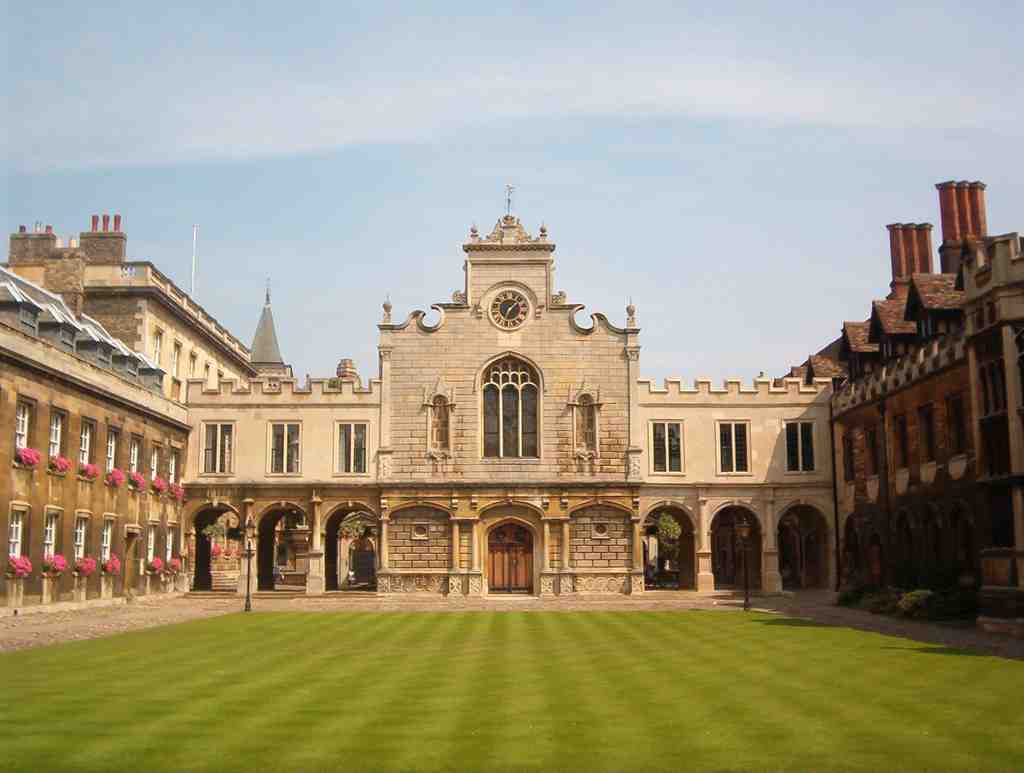
Abrir página dedicada →In front of you is Peterhouse, the oldest college in Cambridge. To spot it, look ahead for a striking stone building with a clock right in the center above the main entrance. The…Leer másMostrar menos
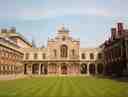
In front of you is Peterhouse, the oldest college in Cambridge. To spot it, look ahead for a striking stone building with a clock right in the center above the main entrance. The building forms a square around a neatly trimmed lawn, flanked by tall windows and decorated with hanging baskets of bright pink flowers during the warmer months. The sturdy wooden doors and the small, pointed spires along the rooftop give it a timeless, almost storybook appearance. Now, imagine yourself standing here in the 13th century, when Peterhouse first opened its doors in 1284. The world outside was rough and bustling, but within these walls, a small group of young scholars huddled close to flickering candlelight, dreaming of understanding the world. Peterhouse started with just a Master and fourteen fellows. Its founder, Hugh de Balsham, wanted to give "worthy but impoverished" students a home. Over time, these halls have echoed with the footsteps of some of history's greatest minds: Lord Kelvin, Henry Cavendish, Charles Babbage, inventors, poets, prime ministers, and more. Even a future Archbishop of Canterbury, John Whitgift, once hurried across this lawn. Listen for the sharp ring of a gong at nightfall, calling students into Hall for dinner. Here at Peterhouse, the tradition is alive-you can almost hear the shuffle of gowns and the murmur of Latin graces as the fellows arrive. During special times, like May Week, this quiet square transforms for a white-tie ball, lit by lanterns and music drifting over the lawn. But it wasn’t always candlelight and celebration. In the past, the college weathered poverty, power struggles, and even royal interference. There’s an old joke that the weathervane here-marked with the initials "AP"-could mean "Andrew Perne, Papist" or "Andrew Perne, Protestant," depending on which way the wind was blowing. Peterhouse may be small, but it has always stood its ground, rising to become one of the wealthiest and most successful colleges at Cambridge. As you stand here, take a moment-close your eyes, and let the quiet strength of centuries settle around you. The past truly lingers in the air. For further insights on the buildings and grounds, arms or the grace, feel free to navigate to the chat section below and inquire.
Abrir página dedicada →







Reseñas
Preguntas frecuentes
¿Cómo empiezo el tour?
Después de la compra, descarga la app AudaTours e ingresa tu código de canje. El tour estará listo para comenzar de inmediato - solo toca play y sigue la ruta guiada por GPS.
¿Necesito internet durante el tour?
¡No! Descarga el tour antes de empezar y disfrútalo completamente sin conexión. Solo la función de chat requiere internet. Recomendamos descargar en WiFi para ahorrar datos móviles.
¿Es un tour guiado en grupo?
No - esta es una audioguía autoguiada. Exploras de forma independiente a tu propio ritmo, con narración de audio reproduciéndose en tu teléfono. Sin guía, sin grupo, sin horario.
¿Cuánto dura el tour?
La mayoría de los tours toman 60–90 minutos para completar, pero tú controlas el ritmo completamente. Pausa, salta paradas o toma descansos cuando quieras.
¿Qué pasa si no puedo terminar el tour hoy?
¡No hay problema! Los tours tienen acceso de por vida. Pausa y continúa cuando quieras - mañana, la próxima semana o el próximo año. Tu progreso se guarda.
¿Qué idiomas están disponibles?
Todos los tours están disponibles en más de 50 idiomas. Selecciona tu idioma preferido al canjear tu código. Nota: el idioma no se puede cambiar después de generar el tour.
¿Dónde accedo al tour después de comprarlo?
Descarga la app gratuita AudaTours desde App Store o Google Play. Ingresa tu código de canje (enviado por email) y el tour aparecerá en tu biblioteca, listo para descargar y comenzar.
Si no disfrutas el tour, te reembolsamos tu compra. Contáctanos en [email protected]
Paga de forma segura con 


