Audioguía de Estambul: Tour por el Tapiz Atemporal de Estambul
La sangre una vez tiñó estas piedras y los emperadores moldearon el mundo en las sombras detrás de puertas doradas. Estambul es una ciudad con capas de secretos y ecos de imperios desvanecidos, mucho más profunda de lo que cualquier postal promete. Descubre este mundo por ti mismo con una audioguía autoguiada que se desliza entre las multitudes para encontrar rincones olvidados e historias asombrosas. Cada parada revela misterios y juegos de poder perdidos en el tiempo. ¿Quién desató la furia que derribó una catedral durante los disturbios de Nika? ¿Qué secretos imperiales están encerrados en los salones resonantes del harén de Topkapı? ¿Por qué Santa Irene se convirtió en un arsenal en lugar de una mezquita, vigilada por jenízaros silenciosos? Sigue caminos sinuosos desde los mosaicos dorados de Santa Sofía hasta los patios del palacio donde se susurraban golpes políticos y se desvelaban grandes ambiciones. Deja que la historia se mueva a tu alrededor mientras la intriga, la fe y el escándalo te arrastran a través de los siglos. Comienza a explorar ahora: adéntrate en las profundidades de Estambul, donde cada piedra recuerda.
Vista previa del tour
Sobre este tour
- scheduleDuración 30–50 minsVe a tu propio ritmo
- straighten4.6 km de ruta a pieSigue el camino guiado
- location_on
- wifi_offFunciona sin conexiónDescarga una vez, úsalo en cualquier lugar
- all_inclusiveAcceso de por vidaReprodúcelo en cualquier momento, para siempre
- location_onComienza en Santa Sofía
Paradas en este tour
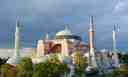
Hagia Sophia, also known as the Holy Wisdom in Greek and Ayasofya in Turkish, is a significant cultural and historical site located in Istanbul, Turkey. Originally built during…Leer másMostrar menos
Hagia Sophia, also known as the Holy Wisdom in Greek and Ayasofya in Turkish, is a significant cultural and historical site located in Istanbul, Turkey. Originally built during the Byzantine Empire, it is the last of three church buildings constructed on the same site. Completed in 537 AD, Hagia Sophia served as an Orthodox church until the Ottoman conquest of Constantinople in 1453. Following that, it was converted into a mosque until 1935, when it became a museum. However, in 2020, it was once again turned into a mosque. The current structure of Hagia Sophia was commissioned by the Byzantine emperor Justinian I and designed by the Greek geometers Isidore of Miletus and Anthemius of Tralles. It was initially known as the Church of the Holy Wisdom and is acclaimed for its architectural achievements. Notably, it was the world's largest interior space at the time of its completion and was among the first structures to employ a fully pendentive dome. Its construction marked a pivotal moment in architectural history. Hagia Sophia holds great importance in Byzantine architecture and is credited with revolutionizing the field. It is said to have made a lasting impact and "changed the history of architecture." This current building represents the third church with the same name on the site, as the previous one was destroyed during the Nika riots. As the seat of the ecumenical patriarch of Constantinople, it held the title of the world's largest cathedral for nearly a thousand years, until the completion of Seville Cathedral in 1520. The architectural style and layout of Hagia Sophia became a model for subsequent Byzantine structures, while its influence extended even further. Ottoman mosques, built a thousand years later, drew inspiration from its design. This unique position in both the Christian world and architectural history has cemented Hagia Sophia as an iconic symbol of Byzantine and Eastern Orthodox civilization.
Abrir página dedicada →The Topkapı Palace, also known as the Seraglio, is a significant historical site located in Istanbul, Turkey. It served as the administrative center of the Ottoman Empire from the…Leer másMostrar menos
The Topkapı Palace, also known as the Seraglio, is a significant historical site located in Istanbul, Turkey. It served as the administrative center of the Ottoman Empire from the 1460s until the completion of Dolmabahçe Palace in 1856, and was the primary residence of the sultans during that time. Construction of the palace was commissioned by Sultan Mehmed the Conqueror in 1459, just six years after the conquest of Constantinople. Originally called the "New Palace," it was intended to differentiate it from the Old Palace in Beyazıt Square. It acquired the name "Topkapı," meaning Cannon Gate, in the 19th century. Over the centuries, the complex has undergone significant expansion and renovation, including reconstruction after the 1509 earthquake and the 1665 fire. Today, it encompasses four main courtyards and numerous smaller buildings. Within the palace, the harem housed female members of the Sultan's family, while the Imperial Council building served as a meeting place for important state officials, including the Grand Vizier. However, following the 17th century, Topkapı gradually lost its significance as the sultans preferred to spend more time in their newly constructed palaces along the Bosphorus. Eventually, in 1856, Sultan Abdulmejid I decided to relocate the court to the newly built Dolmabahçe Palace. Nevertheless, Topkapı continued to fulfill certain functions, such as housing the imperial treasury, library, and mint. After the dissolution of the Ottoman Empire in 1923, Topkapı Palace was transformed into a museum through a government decree dated April 3, 1924. Presently, the Topkapı Palace Museum is under the administration of Turkey's Ministry of Culture and Tourism. While the palace complex boasts hundreds of rooms and chambers, only the most important ones are open to the public as of the year 2020. These include the Ottoman Imperial Harem and the treasury, known as the hazine, where visitors can view notable artifacts like the Spoonmaker's Diamond and the Topkapi Dagger. Additionally, the museum collection features a variety of Ottoman clothing, weapons, and other historical objects.
Abrir página dedicada →Hagia Irene, also known as Saint Irene, is a significant Eastern Orthodox church situated in the outer courtyard of Topkapı Palace in Istanbul. It holds the distinction of being…Leer másMostrar menos
Hagia Irene, also known as Saint Irene, is a significant Eastern Orthodox church situated in the outer courtyard of Topkapı Palace in Istanbul. It holds the distinction of being the oldest known church in the city and the only Byzantine church that was never converted into a mosque. Instead, it served as an arsenal for storing weapons until the 19th century. Today, the Hagia Irene functions as a museum and concert hall. The name "Hagia Irene" translates to "Holy Peace" in Greek, while its alternative name "Aya İrini" is the Turkish equivalent. The church was dedicated to the peace of God and is one of the three shrines that emperors devoted to different attributes of God, alongside Hagia Sophia, representing wisdom, and Hagia Dynamis. According to historical accounts, the church is said to have been constructed on the site of a pre-Christian temple. It was the first church completed in Constantinople, preceding the famous Hagia Sophia. The building process began during the reign of the Roman emperor Constantine I in the 4th century and was finished before his death in 337. Originally, it served as the church of the Patriarchate until the completion of Hagia Sophia in 360 under Constantius II. Unfortunately, the church suffered severe damage during the Nika revolt in 532 and was subsequently rebuilt by Emperor Justinian I in 548. Another setback occurred in 740 when it was damaged by an earthquake, leading to restorations ordered by Emperor Constantine V. Some of the mosaics and frescoes from that time have survived until today. After the fall of Constantinople to Mehmed II in 1453, the Hagia Irene was encompassed within the walls of Topkapi palace. During this period, it served as an arsenal or storage facility for the Janissaries, a well-known Ottoman infantry corps. It was utilized to house military equipment and act as a repository for trophies of arms. This arrangement persisted until 1826. In its current state, the Hagia Irene stands as a testament to the rich history of Constantinople and remains an important cultural landmark. Visitors can explore its architectural marvels while appreciating the various exhibits and enjoying concerts held within its hallowed walls.
Abrir página dedicada →
Mostrar 7 paradas másMostrar menos paradasexpand_moreexpand_less
The Sublime Porte, also referred to as the Ottoman Porte or High Porte, held great significance as the central government of the Ottoman Empire in Istanbul. Its name originated…Leer másMostrar menos
The Sublime Porte, also referred to as the Ottoman Porte or High Porte, held great significance as the central government of the Ottoman Empire in Istanbul. Its name originated from the ancient tradition in which the ruler would announce official decisions and judgments at the gate of his palace. This practice was inherited from the Byzantine Empire and was adopted by the Ottoman sultans since the reign of Orhan I. Initially, the name "High Gate" was associated with a palace located in Bursa, Turkey. However, following the conquest of Constantinople, now known as Istanbul, the gate leading to the outermost courtyard of the Topkapı Palace, became known as the "High Gate" or the "Sublime Porte." Notably, during Sultan Suleiman the Magnificent's alliance with King Francis I of France in 1536, French diplomats would pass through the monumental gate, then called Bab-ı Ali (now Bâb-ı Hümâyûn), to reach the seat of the Sultan's government in Constantinople. Consequently, the French translation, Sublime Porte, was adopted in various European languages, including English, as a metonymy for the Ottoman Empire. In the 18th century, a grand office building was constructed west of the Topkapi Palace, on the opposite side of Alemdar Caddesi. This Italian-styled building became the residence of the Grand Vizier and numerous ministries, earning the title of the Sublime Porte (Bab-ı Ali). Additionally, it was colloquially known as the Gate of the Pasha (paşa kapusu). Unfortunately, the building suffered significant damages due to a fire in 1911. Presently, it houses the Istanbul Governor's Office. The Sublime Porte played a pivotal role in diplomacy, as it served as the gateway through which foreign diplomats gained access to the Ottoman Empire. Its historical significance and influence extended beyond its physical structures, leaving a lasting mark on the administrative and diplomatic affairs of the empire.
Abrir página dedicada →Sirkeci railway station, also known as Istanbul railway station, is a significant railway terminal in Istanbul, Turkey. Located in the historic Sirkeci neighborhood, near the…Leer másMostrar menos
Sirkeci railway station, also known as Istanbul railway station, is a significant railway terminal in Istanbul, Turkey. Located in the historic Sirkeci neighborhood, near the Golden Horn and in close proximity to Gülhane Park and the Topkapı Palace, this terminal holds a prominent position on the European side of the city. Together with Haydarpaşa Terminal on the Asian side, Sirkeci Terminal serves as one of Istanbul's principal intercity and commuter railway terminals. Built in 1890 by the Oriental Railway, Sirkeci Terminal was originally designated as the eastern terminus of the renowned Orient Express. This legendary train operated between Paris and Istanbul from 1883 to 2009, and the terminal itself has become an iconic symbol of the city. However, since March 19, 2013, service to Sirkeci Terminal has been temporarily suspended due to the ongoing rehabilitation of the railway line between Kazlıçeşme and Halkalı for the new Marmaray commuter rail line. In October 2013, a new underground station was opened to the public, allowing Marmaray trains to pass beneath the Bosphorus Strait. This new station connects to Sirkeci Terminal, enriching the city's transportation network. Sirkeci Terminal boasts a total of four platforms, with three located above ground and one below. Additionally, there are seven tracks, with five above ground and two underground. Previously, commuter trains bound for Halkalı would depart from tracks 2, 3, and 4, while regional trains heading to Kapıkule, Edirne, and Uzunköprü, along with international trains traveling to Bucharest, Sofia, and Belgrade, would depart from tracks 1 and 5. The history of Sirkeci Terminal dates back to the Ottoman era when the need for a railway connection between Europe and Istanbul was recognized after the Crimean War. Initial attempts to establish this connection through contracts with British and Belgian entrepreneurs faced obstacles due to inadequate investment capital. Eventually, on April 17, 1869, the concession for the "Rumeli Railroad" was awarded to Baron Maurice de Hirsch, a prominent figure in this endeavor.
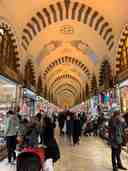
Abrir página dedicada →The Spice Bazaar, known as the Egyptian Bazaar in Turkish, is a prominent marketplace in Istanbul, Turkey. Situated in the Eminönü quarter of the Fatih district, it stands as one…Leer másMostrar menos
The Spice Bazaar, known as the Egyptian Bazaar in Turkish, is a prominent marketplace in Istanbul, Turkey. Situated in the Eminönü quarter of the Fatih district, it stands as one of the largest covered shopping complexes in the city, second only to the renowned Grand Bazaar. The history of the bazaar unveils its original name as the "New Bazaar" before gaining the title "Egyptian Bazaar." This name was given due to its construction being funded by the revenues from the Ottoman eyalet of Egypt in the year 1660. Interestingly, the Turkish word "mısır" holds a dual meaning, referring to both "Egypt" and "maize." As a result, there is occasionally a misconception that the bazaar should be translated as the "Corn Bazaar." Notably, the bazaar has long served as the heart of spice trade within Istanbul. However, in recent times, the shops have gradually diversified to encompass other goods, replacing some of the spice sellers. Architecturally, the bazaar is an integral part of the külliye, or complex, of the New Mosque. The income generated from the rented spaces within the bazaar building has traditionally contributed towards the maintenance of the mosque itself. Koca Kasım Ağa, the court architect, initially designed the structure. Nevertheless, construction commenced under the guidance of another court architect, Mustafa Ağa, in the final months of 1660. This period coincided with the aftermath of the devastating Great Fire of Istanbul, which started on July 24th, 1660 and ravaged many neighborhoods over approximately two days. As part of the city's extensive rebuilding efforts following the fire, the construction of the New Mosque resumed and was eventually completed between 1660 and 1665. Simultaneously, the Spice Bazaar's construction commenced in 1660, with both projects commissioned by Sultana Turhan Hatice, the Valide Sultan (Queen Mother) of Sultan Mehmed IV. In its present form, the Egyptian Bazaar boasts 85 shops, each dedicated to the sale of aromatic spices, traditional Turkish delicacies, herbs, and other culinary treasures. Visitors can immerse themselves in the enchanting scents and flavors that have tantalized palates for centuries. The bazaar's unique ambiance and rich history make it an essential destination for those seeking to experience the vibrant culture of Istanbul.
Abrir página dedicada →completed around 1563. The precise dating of the Rüstem Pasha Mosque remains a subject of debate among historians and experts due to the absence of a foundation document. However,…Leer másMostrar menos
completed around 1563. The precise dating of the Rüstem Pasha Mosque remains a subject of debate among historians and experts due to the absence of a foundation document. However, based on analysis of its İznik tiles and other primary sources, it is generally believed that the construction of the mosque was authorized by Sultan Suleiman I after the death of Rüstem Pasha and entrusted to the renowned Ottoman architect, Mimar Sinan. Rüstem Pasha, who served as the Grand Vizier of the Ottoman Empire, had a significant influence on the architecture of Istanbul. He commissioned various important structures, including religious schools and mosques. In an effort to leave a lasting legacy and repair his reputation, Rüstem Pasha desired to construct a final mosque of his own. It is unclear how much he had planned for the mosque before his death, but Sultan Suleiman I granted authorization for the project as a tribute to Rüstem Pasha. Mimar Sinan, the esteemed Ottoman imperial architect, was tasked with designing the Rüstem Pasha Mosque. Notable for its opulent interior adorned with exquisite İznik tiles, this mosque stands out as one of Sinan's masterpieces. It is speculated that Rüstem Pasha may have specifically requested the İznik tiles to support the work of court designer Kara Memi, known for his elegant floral designs. While scholars continue to gather evidence to precisely date the mosque, it is widely accepted that the construction was completed around 1563. The Rüstem Pasha Mosque stands as a testament to the architectural brilliance of Mimar Sinan and the cultural significance of Rüstem Pasha in the Ottoman Empire. Situated near the Spice Bazaar in the Fatih district of Istanbul, it remains an important historical and religious landmark in the city.
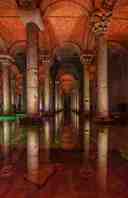
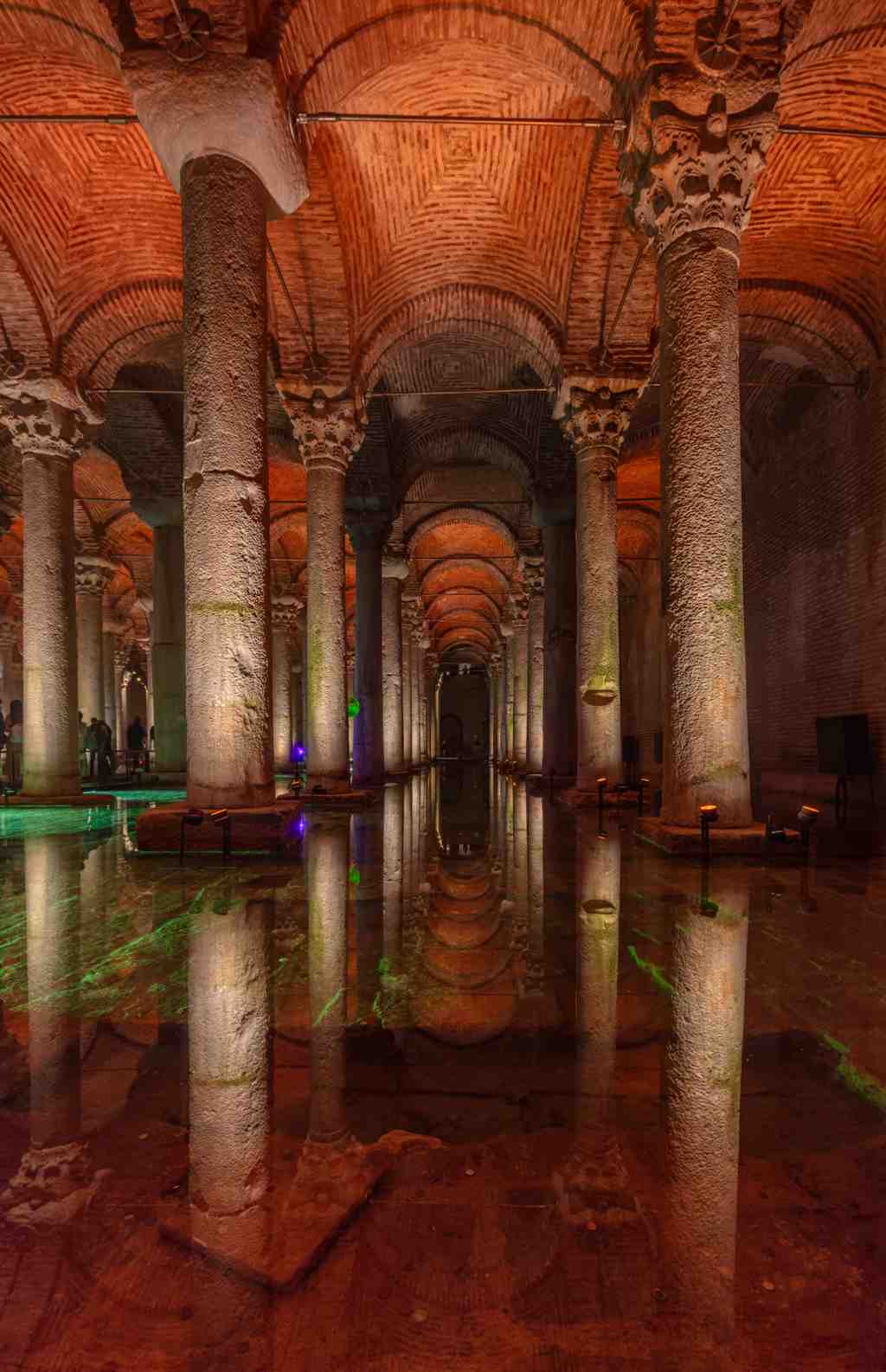
Abrir página dedicada →The Basilica Cistern, also known as the Cisterna Basilica, is a significant underground structure located beneath Istanbul, Turkey. It is the largest among numerous ancient…Leer másMostrar menos
The Basilica Cistern, also known as the Cisterna Basilica, is a significant underground structure located beneath Istanbul, Turkey. It is the largest among numerous ancient cisterns found in the city. Situated about 150 meters southwest of the Hagia Sophia on the historical peninsula of Sarayburnu, it was originally constructed during the 6th century under the rule of Byzantine Emperor Justinian I. The name "Basilica" was derived from the fact that this subterranean cistern existed underneath a vast public square known as the Stoa Basilica, situated on the First Hill of Constantinople. Prior to the cistern's creation, a grand basilica stood on the same site. It had been constructed between the 3rd and 4th centuries during the Early Roman Age, serving as an important center for commerce, legal matters, and artistic activities. After a fire in 476, the basilica was rebuilt by Illus. Historical texts describe the basilica as having enclosed gardens surrounded by a colonnade that faced the Hagia Sophia. According to ancient historians, Emperor Constantine laid the foundation for a structure that was later expanded and reconstructed by Emperor Justinian following the devastating Nika riots of 532, which severely damaged the city. Accounts from that time claim that around 7,000 slaves were involved in the construction of the cistern. This enlarged cistern served as a water filtration system for the Great Palace of Constantinople and various other buildings located on the First Hill. Even after the Ottoman conquest in 1453, the cistern continued to provide water to the Topkapı Palace and remained functional up until modern times. Over time, knowledge of the cistern's existence faded, with only local people continuing to draw water from it. It wasn't until 1565 when the French traveler Petrus Gyllius visited the cistern and documented his experience. Gyllius described being rowed in a boat between the numerous columns and witnessing fish swimming in the water beneath. In terms of measurements, this cistern is an immense underground chamber spanning approximately 138 meters by 65 meters.
Abrir página dedicada →The Hippodrome of Constantinople, also known as the Circus Maximus Constantinopolitanus, held great significance as both a sporting and social hub in the Byzantine Empire's…Leer másMostrar menos
The Hippodrome of Constantinople, also known as the Circus Maximus Constantinopolitanus, held great significance as both a sporting and social hub in the Byzantine Empire's capital city of Constantinople, which is present-day Istanbul, Turkey. It now exists as Sultanahmet Square. The term "hippodrome" stems from the Greek words "hippos," meaning horse, and "dromos," meaning path or way. Hence, in Turkish, it is sometimes referred to as Atmeydanı or "Horse Square." Horse racing and chariot racing were immensely popular in ancient times, and hippodromes were common fixtures in Greek cities during the Hellenistic, Roman, and Byzantine periods. In terms of its history and usage, the Hippodrome's origins predate Constantinople's era as an imperial capital. The initial construction of the Hippodrome occurred during the city's Byzantium phase when it was a provincial town of moderate significance. In AD 203, Emperor Septimius Severus rebuilt the city, expanding its walls and endowing it with a hippodrome for chariot races and other entertainment. Later, in AD 324, Emperor Constantine the Great chose to refound the city as Byzantium following his victory at the Battle of Chrysopolis nearby. However, this name failed to leave a lasting impression, leading to the city being renamed Constantinople, the City of Constantine. Under Constantine's reign, the city experienced significant expansion, and one of his notable endeavors was the renovation of the Hippodrome. Estimates suggest that the Hippodrome of Constantine spanned approximately 450 meters in length and 130 meters in width. The starting gates, known as carceres, stood at the northern end, while the southern end featured the sphendone, a curved tribune that remains partially intact. The spina, a central barrier on the racecourse, was adorned with various monuments, including the monolithic obelisk...
Abrir página dedicada →The Blue Mosque, officially known as the Sultan Ahmed Mosque, is a historical imperial mosque located in Istanbul, Turkey. Built between 1609 and 1617 during the reign of Sultan…Leer másMostrar menos
The Blue Mosque, officially known as the Sultan Ahmed Mosque, is a historical imperial mosque located in Istanbul, Turkey. Built between 1609 and 1617 during the reign of Sultan Ahmed I, it continues to be a functioning mosque to this day. With its remarkable beauty, the mosque has become a major attraction for both tourists and locals, proudly representing the iconic Ottoman architecture. The mosque follows a classical Ottoman layout, featuring a central dome surrounded by four semi-domes within the prayer hall. It is complemented by a spacious courtyard and six minarets at its sides. The interior is adorned with thousands of Iznik tiles displaying predominately blue colors, giving the mosque its well-known name. The mosque complex, known as the külliye, includes various structures such as Ahmed's tomb, a madrasa, and several other buildings. Each of these components add to the grandeur and historical significance of the site. Strategically located near the former Hippodrome, the Blue Mosque stands opposite another popular tourist site, the Hagia Sophia. This proximity allows the mosque to command attention and dominate the city's skyline. Recognizing its cultural and historical importance, the Blue Mosque was included in the UNESCO World Heritage Site list in 1985 as part of the "Historic Areas of Istanbul." Now, let us continue our exploration of this magnificent mosque and immerse ourselves in its rich history.
Abrir página dedicada →
Preguntas frecuentes
¿Cómo empiezo el tour?
Después de la compra, descarga la app AudaTours e ingresa tu código de canje. El tour estará listo para comenzar de inmediato - solo toca play y sigue la ruta guiada por GPS.
¿Necesito internet durante el tour?
¡No! Descarga el tour antes de empezar y disfrútalo completamente sin conexión. Solo la función de chat requiere internet. Recomendamos descargar en WiFi para ahorrar datos móviles.
¿Es un tour guiado en grupo?
No - esta es una audioguía autoguiada. Exploras de forma independiente a tu propio ritmo, con narración de audio reproduciéndose en tu teléfono. Sin guía, sin grupo, sin horario.
¿Cuánto dura el tour?
La mayoría de los tours toman 60–90 minutos para completar, pero tú controlas el ritmo completamente. Pausa, salta paradas o toma descansos cuando quieras.
¿Qué pasa si no puedo terminar el tour hoy?
¡No hay problema! Los tours tienen acceso de por vida. Pausa y continúa cuando quieras - mañana, la próxima semana o el próximo año. Tu progreso se guarda.
¿Qué idiomas están disponibles?
Todos los tours están disponibles en más de 50 idiomas. Selecciona tu idioma preferido al canjear tu código. Nota: el idioma no se puede cambiar después de generar el tour.
¿Dónde accedo al tour después de comprarlo?
Descarga la app gratuita AudaTours desde App Store o Google Play. Ingresa tu código de canje (enviado por email) y el tour aparecerá en tu biblioteca, listo para descargar y comenzar.
Si no disfrutas el tour, te reembolsamos tu compra. Contáctanos en [email protected]
Paga de forma segura con