
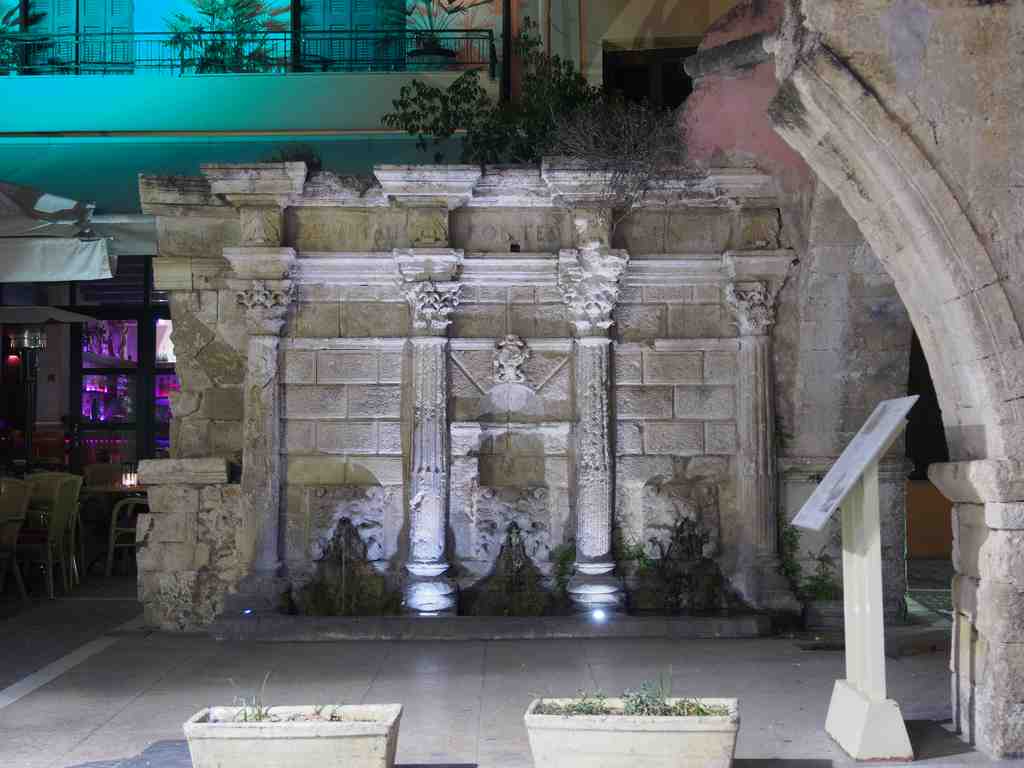
Look for the flat pale stone facade featuring four fluted columns that frame three ornate lion-head spouts pouring water into the basins below. Much like the massive Fortezza we explored earlier, this is a prime piece of Venetian engineering, though its purpose was entirely life saving rather than military.
Back in the sixteenth and seventeenth centuries, Rethymno had a serious problem. The population was booming, and the city was running out of good water. The old wells and cisterns were failing, and the previous water source, the San Zuane fountain, had been heavily damaged by severe rains in 1592. By the time the Venetian commander Alvise Rimondi took charge in 1623, the city water supply was basically a trickle of bad news.
So, he decided to fix it himself. According to his own records, Rimondi did not use a single drop of public funds. He personally paid to repair an aqueduct bringing water from a spring half a mile away, and he funded the construction of this beautiful new fountain, which was likely completed around 1626. Because it is fed directly by that aqueduct pipe, there is no large water tank hidden behind the wall.
Notice how the architecture resembles a classical Roman facade. Those four half-columns are topped with Corinthian capitals, meaning the uppermost sections of the columns are intricately carved to look like stylized leaves. These were crafted from a soft, local stone called Alfa limestone. The columns divide the wall into three neat sections, each featuring a water spout. The spouts are carved as a mascherone, an architectural face or mask. Here, they look like lions, but if you look closely, the manes are actually made of carved leaves and twisting vines. The three stone troughs at the bottom were incredibly practical, serving as the daily watering spot for the city horses and livestock.
Up at the very top center, Rimondi made sure everyone knew who picked up the tab. That carved shield crowning the monument is his family coat of arms.
When the Ottomans later took control of the city, they added a large dome over the fountain, turning it into what they called the Great Fountain. The dome has long since collapsed, but you can still see the single stone pillar standing nearby that used to support it. The area around the fountain also gained a darker reputation during this era, as a nearby plane tree became the grim spot where rebels and criminals were executed.
Thankfully, today it is simply a peaceful landmark that remains open twenty-four hours a day for anyone who wanders by. Enjoy the atmosphere, and when you are ready, we can head to the next stop.




