
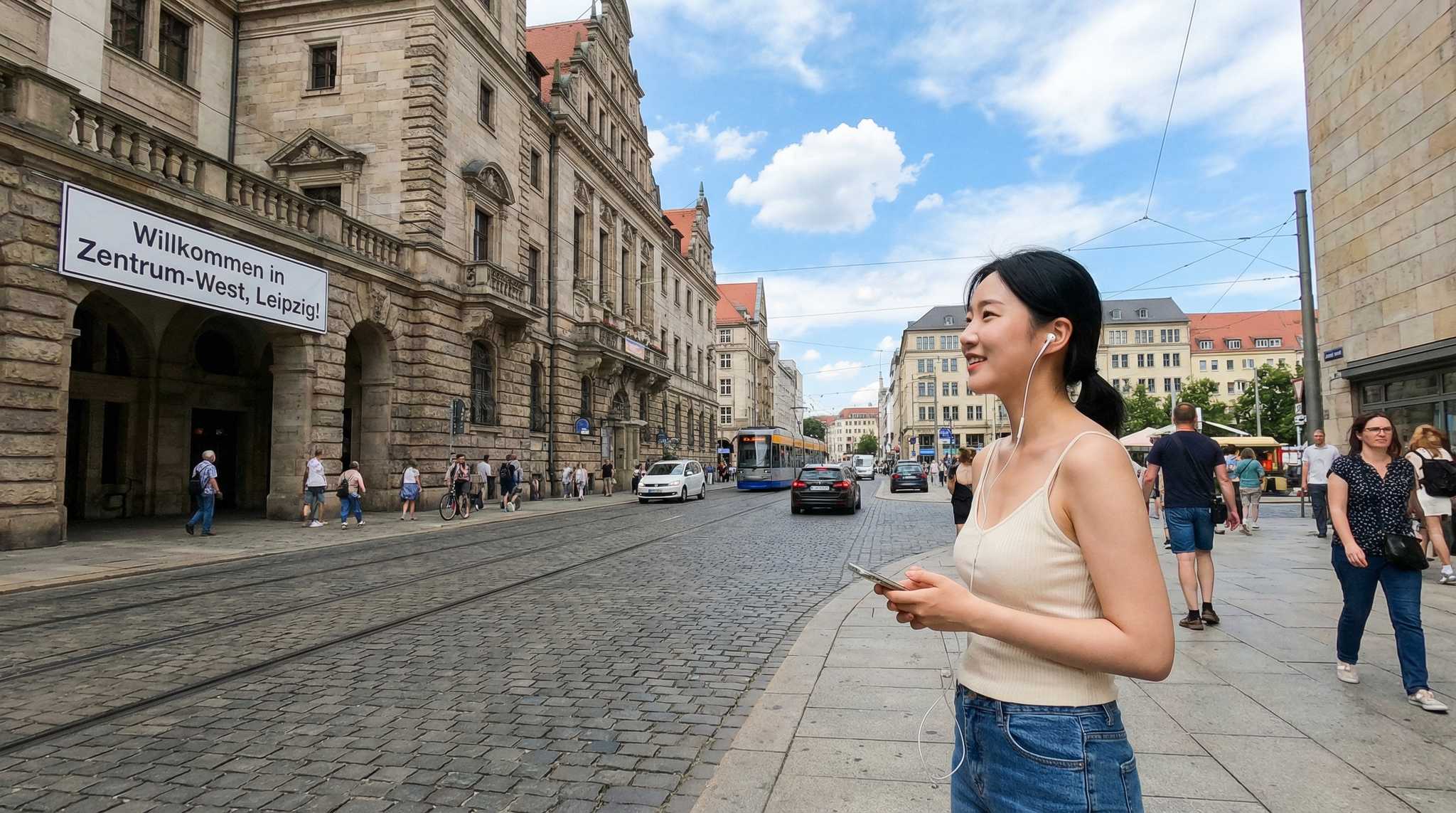
Tour de audio de Leipzig: Jardines Ocultos y Leyendas de Zentrum-West
Descubre el vibrante corazón de Zentrum-West de Leipzig con un cautivador tour que mezcla historia, cultura y espíritu comunitario. Comienza en la Antigua Iglesia de la Trinidad, donde la arquitectura centenaria y el ambiente sereno invitan a la reflexión tranquila. Luego, sumérgete en el dinámico mundo de las artes escénicas en Schauspiel Leipzig, un centro para el teatro innovador y actuaciones inolvidables. Finalmente, experimenta la dedicación y valentía del Departamento de Bomberos de Leipzig, obteniendo una visión de su papel vital en la salvaguardia de la ciudad. Este enriquecedor viaje ofrece una mezcla perfecta de patrimonio, creatividad y orgullo cívico, una invitación a explorar el alma de Leipzig como nunca antes.
Vista previa del tour
Sobre este tour
- scheduleDuración 40–60 minsVe a tu propio ritmo
- straighten3.2 km de ruta a pieSigue el camino guiado
- location_on
- wifi_offFunciona sin conexiónDescarga una vez, úsalo en cualquier lugar
- all_inclusiveAcceso de por vidaReprodúcelo en cualquier momento, para siempre
- location_onComienza en Sala Central
Paradas en este tour
To spot the Central Hall, look for a large, pale rectangular building with multiple arched windows and elegant columns, perched right beside a canal and close to a footbridge,…Leer másMostrar menos
To spot the Central Hall, look for a large, pale rectangular building with multiple arched windows and elegant columns, perched right beside a canal and close to a footbridge, almost directly facing the Thomaskirche. Welcome to the spot where Leipzig’s grand Central Hall once stood-imagine yourself surrounded by the lively chatter of crowds and the echo of footsteps on cobblestones, right beside the gentle flowing waters of the old Pleißemühlgraben! If this building were still standing, you’d be facing a magnificent, multi-story hall, its stately facade decorated with columns, handsome arched windows, and tiny turret-like towers on the corners. But let me tell you, this place was buzzing with more energy than a beehive at a drum circle. Let’s rewind to 1849, just before the first Christmas bazaar threw open the Hall’s enormous doors. Picture wealthy Leipzigers in top hats and fancy dresses, pressing into the newly built hall, the air thrumming with excitement and the scent of gingerbread from the festive stalls. This dream was brought to life thanks to Wenzel Anton Lurgenstein-a man who thought, “Hey! What better use for a lovely garden on a canal than to build the ultimate party space?” And party they did! The Central Hall quickly became the social heartbeat of Leipzig. You should have seen the inside: beneath your feet would be sturdy cellars and storerooms; above, grand spaces stretching across several floors, crowned by the mighty Unionshalle-a hall so grand, it spanned two floors with a balcony and massive, light-flooded windows flanked by columns. The air sparkled during concerts and balls; you could practically hear the clinking of glasses at the 50th anniversary of the Battle of the Nations in 1863 or the laughter leaking from the infamous masquerade ball of 1851, themed “The Battle of Bacchus and Gambrinus.” Yes, you heard right-a face-off between the gods of wine and beer. What could possibly go wrong? I bet those costumes were pretty wild! The Central Hall wasn’t just about revelry. In 1850, the place was jam-packed for the first German Industrial Exhibition. For six weeks, you’d hear the clang of machines and the low hum of conversation as 1,440 companies from around Germany showed off their inventions and handiwork. People roamed from industrial gadgets to paintings, from books to baskets of fruit in the first-floor market hall. If you had a sweet tooth, the aroma of pastries from the on-site café would have set your stomach rumbling, while nearby, workers ladled out fresh milk in the milk and whey spa! Because nothing says “treat yourself” like a glass of milk after a night of dancing. But Leipzig’s brainiest folks also flocked here. The upstairs rooms, divided for comfort, played host to club meetings, scientific lectures, and debates about the city’s future. For a few years, the famous homeopath Willmar Schwabe ran his business there, and even artist Ferdinand Rhode made this hall his home. Imagine living in a place where every day brought a new concert, meeting, or ball right downstairs. Talk about an active social life-he probably never had any peace and quiet! As you stand here, you’re also standing atop layers of history and transformation. In 1898, the Central Hall was torn down so that the Pleißemühlgraben could be covered over, and Leipzig’s promenade could be widened. Its replacement was the fancifully named “Trompeterschlösschen,” a townhouse decked with rooftop figures, and, for a while, home to the much-loved General Heinrich Leo von Treitschke. Rumor even had it that part of the building was called “Commandantur” because of him-so, yes, your next-door neighbor could once have been a general. Today, the pulse of celebration has moved elsewhere, but if you close your eyes here, you might almost catch an echo of the bands, the laughter, and the clink of glasses from Leipzig’s busiest, noisiest, and perhaps most joyful lost landmark.
Abrir página dedicada →To spot the Old Trinitatis Church, look out in front of you for where a grand, tall tower would once have stood above a pointed roof, with long gothic windows running along a…Leer másMostrar menos
To spot the Old Trinitatis Church, look out in front of you for where a grand, tall tower would once have stood above a pointed roof, with long gothic windows running along a rectangular brick building-now, this area is mostly green grass and playgrounds, but once it was the busiest spot in the neighborhood. Now, imagine yourself here in Leipzig in the mid-1800s, right after the age of the Reformation, when there hadn’t been a new Catholic church in the city for centuries. The Old Trinitatis Church was nothing short of a miracle for the local Catholics, who’d been holding their services in borrowed halls-one was even in a place called the Riding Hall of the old castle! Now that’s taking "horsepower" in worship to a new level. In 1847, after years of prayers, fundraising, and generous donations from folks like Franz Dominic Grassi and a helpful industrialist named Karl Heine, this bold, dazzling neo-Gothic church rose up on Rudolphstraße. It stretched 50 meters long, topped with a dramatic tower nearly as tall as five giraffes stacked on each other. If you’d been here on the day it opened, September 19th, 1847, you’d have felt the excitement buzzing-there’d never been anything like it in Leipzig since the Middle Ages. Architect Carl Alexander Heideloff made sure the outside was all red bricks and intricate sandstone decorations, while inside, giant pillars and a "starry sky" painted on the ceiling made it feel bigger than life. There was a wooden Madonna from Tyrol, an impressive organ, and even a very special painting by Lucas Cranach the Elder, showing Christ on the Cross. That painting had quite the journey-at one point, it was hidden away for safekeeping in World War II, lost for decades, and ended up being rediscovered in the art market in the 1980s. Talk about a painting playing hide and seek! But this church didn’t just dazzle on the outside. When its bells rang out across Leipzig-at least, when they weren’t being taken for war efforts-they brought the community together again and again. And let me tell you: those bells had a tougher journey than most of us on a Monday morning. Twice they were melted down for the war, and one even ended up stolen (and recovered, but cut in two!) just in recent decades. The Trinitatis Church faced its biggest trial during World War II. On a freezing morning in 1943, the city shook as bombs fell and fire swept through the neighborhood. The Old Trinitatis Church, once the pride of the Catholic community, was left a shell-walls and the tall tower survived at first, but nothing inside. Yet services went on, sometimes in borrowed churches, always in hope. After the war, there was talk of rebuilding, but the city’s plans kept changing like the weather. By 1954, the ruined church was blown up, and the dream of a grand rebirth right here vanished. Bureaucratic wrangling and changing city priorities made sure nothing new went up on this spot. Eventually, by the late 1950s, this ground was cleared, leveled, and planted with grass. Standing here now, you’d never guess at the drama that unfolded-fundraising campaigns, heroic builders, starry ceilings, and even lost treasures. Look over at those schoolyards and playgrounds; this once was the front row to Leipzig’s history, faith, and resilience. When you step away, remember that beneath your feet, hidden in the earth, are the echoes of generations who struggled, hoped, and built something magnificent, only to see it fade away to memory. So sometimes, the grandest stories lie where we least expect them: in the silent grass, under running feet, carried quietly on the wind. And don’t be surprised if you hear a faint bell ringing in your ears-it just might be Trinitatis saying a last hello.
Abrir página dedicada →To spot Rudolphs Garten, look straight ahead for a patch of greenery and open space near Rudolphstraße-imagine it bustling with elegantly dressed 19th-century visitors relaxing…Leer másMostrar menos
To spot Rudolphs Garten, look straight ahead for a patch of greenery and open space near Rudolphstraße-imagine it bustling with elegantly dressed 19th-century visitors relaxing and chatting under the shade of trees. Now, let’s step into the time machine-ready? Take a deep breath and imagine it’s a crisp spring afternoon in Leipzig, sometime in the early 1800s. Across from the old Pleißenburg, just over a gentle waterway, you’d find yourself at Rudolphs Garten, one of the city’s most beloved coffee gardens. The garden isn’t a grand estate, but its cozy size makes it all the more inviting-a hidden gem where city folks escape the clatter of Leipzig’s busy streets. Picture yourself brushing past the leafy entrance, dresses swirling and top hats bobbing all around. The air is alive, buzzing with laughter and the delicate clinking of coffee cups. Perfumed flowers blend with the rich aroma of freshly brewed coffee. Couples stroll by, arm in arm, while groups of friends gather at wooden tables, sipping and gossiping beneath the trees. Sometimes a gentle breeze causes the ladies’ bonnets to flutter-hopefully none of them blow away, or there might be a lively chase through the bushes! Not just any garden, Rudolphs Garten was a magnet for Leipzig’s high society-a spot where writers, thinkers, and music lovers gathered. Even the great composer Robert Schumann enjoyed leisurely afternoons here. And, believe it or not, Johann Wolfgang von Goethe ended his famous two-week stay in Leipzig with a joyful celebration in this very garden. This place was so special that it sneaked its way into books, too-writer Jean Paul fondly remembered it as a place of good manners and grand company. Eventually, though, the city changed. Carl Heine bought the land, and the garden gave way to a striking new horseshoe-shaped apartment building-a local landmark until it was destroyed in World War II. Today, you’re standing on peaceful green space. If you listen closely, you just might hear echoes of well-dressed laughter drifting through the leaves.
Abrir página dedicada →
Mostrar 12 paradas másMostrar menos paradasexpand_moreexpand_less
To spot the former Sophienbad, look for the Parkhaus Martin-Luther-Ring-imagine yourself standing where a grand glass-roofed swimming hall once stretched back from…Leer másMostrar menos
To spot the former Sophienbad, look for the Parkhaus Martin-Luther-Ring-imagine yourself standing where a grand glass-roofed swimming hall once stretched back from Otto-Schill-Straße, right beside the quiet waters of the Pleißemühlgraben. Now, close your eyes for a moment and picture the scene back in 1863: the air inside the Sophienbad is damp and warm, scented with river water and a hint of steam. Through the large windows, the flickering of gas lamps casts golden reflections on the marble pool, which-if you believe the stories-sometimes shimmered like a melted treasure chest. The place bustles with life: men wrapped in robes chat about business, children giggle nervously along the edge, and ladies glide in for their specially reserved hours, like swimmers sneaking into a secret club. But here’s the real splash-this wasn’t just any ordinary bathhouse. The Sophienbad was Leipzig’s very first indoor swimming pool, and believe it or not, only the fourth of its kind in all of Germany! Legend says the name “Sophienbad” comes from Sophie Christiane Gebhard, a local visionary who wanted everyone to experience the joys of a good soak. Before saunas were trendy and “wellness” was a buzzword, Sophie was dreaming up luxury marble tub bathing right here in Reichels Garten-later called Apels Garten. At first, people came for the hot, steamy Wannenbad, with deep marble or-if you had to pinch pennies-a sturdy zinc tub. Families could snag private cells, and there were baths for medical needs, Russian steam rituals, even “Roman-Irish” vapor rooms. Then, owner Moritz E. Loricke, possibly after one too many chilly dips in the river, decided Leipzig needed a proper heated swimming pool with real waves! A clever steam machine churned up the water, so it rippled just like the Pleißemühlgraben outside. With the pool’s marble lining, two diving boards, and separated spaces for anxious beginners and cocky swimmers, suddenly everyone from dapper gents to giggling schoolkids was paddling away-even in the middle of winter. And ladies, don’t worry-the timetable gave you exclusive hours, though the gentlemen got the lion’s share! The glory days lasted until the roaring 1920s, when the old boilers groaned, and modern tastes demanded more. By 1922, the Sophienbad was just a memory: the swimming hall, bathhouse, and even the proud chimney vanished beneath the hands of builders whose only waves came from moving furniture in. Today, cars park quietly where swimmers once splashed. But if you listen-really closely-you might just hear the echo of laughter, and the faint, magical lap of marble-lined waves. And hey, at least you won’t get splashed unexpectedly by a cannonball-jumping gentleman from the 19th century!
Abrir página dedicada →To spot the Petersbrunnen, look for a large, three-story building with an unusual octagonal shape and a domed, shingled roof, right along the sidewalk and behind a wooden fence,…Leer másMostrar menos
To spot the Petersbrunnen, look for a large, three-story building with an unusual octagonal shape and a domed, shingled roof, right along the sidewalk and behind a wooden fence, almost looking like a giant birdcage dropped down in the middle of Leipzig’s Westvorstadt. Welcome to the legendary Petersbrunnen, where taking a bath was once considered the height of luxury and, perhaps, a risky adventure! Picture the early 1800s here: Leipziger citizens bustling down the road, some with towels draped over their arms, eager for a steamy soak and a dash of city gossip. This wasn’t just your average bathhouse-its octagonal design and curvy, domed roof made it stand out so much, locals started calling it the "birdcage." Seriously, who wouldn’t want to get scrubbed clean in a place that looks like it could house an oversized parrot? Now, just imagine Erdmann Traugott Reichel, a man with a talent for business and a fondness for baths, swooping in after buying up a chunk of what was once Apel’s Garden. He saw opportunity where others just saw gardens. With a twinkle in his eye and maybe a towel around his neck, Reichel had this grand bathhouse built, so people could unwind in hot water and clouds of steam for over a hundred years. If you close your eyes, you might even hear the cheerful chatter of bathers echoing under that slate-tiled dome-especially in winter, when the windows frosted up and the steam kept everyone cozy inside. But the Petersbrunnen had more than just bubbles in its history. As Leipzig grew and the city streets changed, this “birdcage” found new lives. Downstairs, you could once buy your groceries or, if you came a bit later, check out a snazzy new vehicle at the car shop that moved in! By the early 20th century, the sound of splashing baths sometimes mixed with engines and bargaining shopkeepers. So, whether you’re imagining the laughter and steam of old bathers or the clatter of everyday shopping, take a moment to picture all those layers of life swirling around the Petersbrunnen. It’s living proof that even the quirkiest buildings in Leipzig have soaked up quite a few stories-sometimes literally!
Abrir página dedicada →To spot Merve Verlag, look for a light yellow building with red-framed windows and balconies nestled behind golden-leaved trees-right across from you as you walk along the…Leer másMostrar menos
To spot Merve Verlag, look for a light yellow building with red-framed windows and balconies nestled behind golden-leaved trees-right across from you as you walk along the street. Alright, take a look around-doesn’t this building give off just the tiniest whiff of mystery, hidden behind those trees with leaves as yellow as well-thumbed book pages? You’re standing outside the Merve Verlag, one of Germany’s quirkiest, most influential publishers, which finally put down new roots here in Leipzig in 2017 after decades in Berlin. Now, tuck in tight-let’s open up its story. Picture West Berlin in 1970, on a chilly February day. Imagine the air full of excitement, ink, and probably the faintest scent of coffee-because no revolution ever started without caffeine, right? Four eager visionaries-Peter Gente, Merve Lowien, Rüdiger Möllering, and Michael Kwiatkowski-are huddling together, printing a radical new book. It’s Louis Althusser’s “How to Read ‘Das Kapital.’” At the time, the group didn’t even have a name, but mere months later, the so-called “Merve Collective”-named after Merve Lowien-was officially born, blending wild ideas and trailblazing leftist thinking. Back then, they saw themselves as a socialist collective-imagine passionate debates echoing through cramped rooms, with manuscripts and teacups balanced on every surface. They started with works from the fiery Italian left, giving space to groups like Il Manifesto and Lotta Continua and showcasing provocative thinkers like Toni Negri. Even future German politicians, and those destined to become notorious, found their ideas in the pages of Merve books, which smuggled their way into surprising places, like the Stammheim Library of the imprisoned RAF generation-a clandestine whiff of forbidden intellectual fruit. Bit by bit, the Merve Collective’s energy changed. What began with shouts and manifestos slowly transformed. Over the years, more characters entered the scene. Heidi Paris joined both the company and Peter Gente’s life, the collective dissolved, and together, Gente and Paris curated the company’s destiny for over two transformative decades. Through their leadership, Merve Verlag wasn’t just publishing theory-it was shaping how people thought. And visually, their books stood out too: each one bore the “Merve Diamond”-a cool, unmistakable logo designed by Jochen Stankowski, so they’d never get lost on anyone’s bookshelf. By the late ‘70s, the air was crackling with intellectual electricity. After a pivotal Parisian rendezvous with the one and only Michel Foucault-yes, the grand master of French philosophy himself-his works joined the Merve lineup. Soon, Merve brought readers French postmodernist and poststructuralist classics, from Deleuze and Guattari’s wild, root-like “Rhizome,” to Lyotard, Baudrillard, and even the avant-garde film legend Jean-Luc Godard. Can you imagine picking up a freshly delivered box and finding these world-changing texts inside, their crisp pages still smelling faintly of ink? Merve became famous for teasing at the edges of the possible and the futuristic-publishing works on “New Technologies” when the phrase still made people nervously picture brainy robots in wire-rimmed glasses. Over the decades, the publisher championed major names in philosophy, art theory, activism, feminism, architecture, even speculative realism-adding layers of daring to each title released. And the experiment never stopped: in recent years, names like Donna Haraway, Karen Barad, and McKenzie Wark have joined the eclectic family, keeping the intellectual torch burning for the next generation. Through all these years, Merve Verlag has stacked up nearly 500 titles, releasing something fresh and challenging almost every month. Not bad for a publisher that started with just a handful of radicals and a revolutionary spirit! In 2001, their fearless program even earned them the very first Kurt Wolff Prize, and in 2020-official confirmation in the shape of the German Publishing Prize. So, as you stand out front, imagine the tides of thought, argument, laughter, and even rebellion that have echoed in and out of these walls. Maybe, if you listen closely, you can almost hear the flipping of thin, philosophical pages and whispered schemes for changing the world-one fiercely strange book at a time. If that doesn’t make you want to browse their list, well, I’d say you’ve got nerves of steel or a bookshelf already wobbling under the weight of revolutionary ideas!
Abrir página dedicada →To spot Apel's Garden, look ahead for a broad, open space with tree-lined paths fanning out from a central point-picture a giant hand’s fingers spread wide, with elegant garden…Leer másMostrar menos
To spot Apel's Garden, look ahead for a broad, open space with tree-lined paths fanning out from a central point-picture a giant hand’s fingers spread wide, with elegant garden lawns and walkways branching out in several directions. Now, dear walker, imagine you’re standing where once the finest garden in all of Leipzig bloomed-Apel’s Garden! Let’s wind the clock back to the 1700s: there’s a whiff of orange blossoms in the air, the hedges are trimmed higher than your hat, and somewhere a fountain is happily burbling. But this wasn’t your everyday green patch. Oh no, this was the playground of kings, coffee merchants, and clever dreamers. Apel’s Garden was like the Versailles of Leipzig, built by Andreas Dietrich Apel-a man so ambitious, he turned a humble, inherited garden outside the old city walls into a showpiece that dazzled everyone. (He may have thought, “If Louis XIV can have a fancy garden, why not me?” The guy had style, what can I say.) You’d have seen grand avenues lined with towering hedges, secret paths revealing bursts of color from pavilions and orangery trees, and statues watching over all like Roman gods on holiday. In fact, those first statues at the entrance? Sculpted by the famous Paul Heermann and Balthasar Permoser, and if you squint, you can still see two copies standing over at Dorotheenplatz. Visitors long ago would have arrived at the fan-shaped central plaza, right around where you’re standing-this was the garden’s beating heart. From there, three elegant lanes called Elster-, Kolonnaden-, and Reichelstraße stretched out into the city, inviting guests to wander and gossip beneath rustling branches. You could stroll under leafy green corridors, cool off near sparkling water, or visit the “Apels Bad,” an extravagant bathhouse built right by the Pleißemühlgraben. Sadly, the bathhouse didn’t survive the Seven Years’ War, but just imagine the sound of laughter and the splash of gondolas as they glided under flickering torchlight during summer festivals. This garden had a rebellious spirit, too. Unlike the stuffy French gardens, Apel invited everyone-shopkeepers, workers, children, and noblemen alike. He even built homes for his workers inside the garden. Scandalous for the time! Everyone mingled here: the city’s concert series performed in summer, the magical “Kaffeebaum” (coffee tree) flowered from 1723, and the area rang with music and the clink of coffee cups. On one famous May evening in 1714, the garden hosted a crowd to celebrate the 44th birthday of the Elector himself-and for the first time, Venetian fishermen gave a performance of fish spearing, a tradition which became the talk of Leipzig. Now, if you listen hard, can’t you almost hear the faint echoes of those celebrations and the soft chime of a string quartet? Even Goethe was enchanted-and he had very high standards! He raved in a letter that these gardens were the most splendid he’d ever seen. Alas, time is a tough gardener. After Apel’s death, his children managed the estate, but by 1770 it was sold off, then cut up, built over, and faded into fond memory. By the late 1700s, the garden shrank and changed hands, eventually becoming known as Reichel’s Garden, and finally, most of it disappeared beneath modern Leipzig’s feet. But the name “Apels Garten” lives on in a nearby street and a restaurant-so if you get hungry for cake and history, you know where to go. So, while you stand in this peaceful spot, close your eyes and picture a parade of carriages pulling up, courtiers straightening their wigs, the breeze carrying music across a sea of flowers. It was, for a time, a place where Leipzig dreamed big-and let everyone join in on the fun.
Abrir página dedicada →You’re standing now where artists and architects once mingled, music drifted from upstairs windows, and ideas bounced off the Jugendstil walls like colorful paint spatters on a…Leer másMostrar menos
You’re standing now where artists and architects once mingled, music drifted from upstairs windows, and ideas bounced off the Jugendstil walls like colorful paint spatters on a studio floor. Welcome to the Künstlerhaus of Leipzig-or rather, to what remains of it. Close your eyes for a moment and picture this spot back in 1900: the air full of anticipation, hammering and laughter echoing through the unfinished halls. Picture a group of artists in fabulous waistcoats and dramatic hats-because let’s be honest, creatives have never passed up a chance for a good hat-huddling in the dusty corners of Nikischplatz, arguing about where to put the grand staircase and whether the cafe should serve cake or, as I imagine, only the most avant-garde of pretzels. This location was once considered nearly impossible to build on-a plot squeezed so tightly between residential buildings that only 8.5 meters touched the street, and, just to complicate things, a public pathway had to stay open through the entire lot. Basically, if you were an architect, this was the ultimate game of Tetris. In 1899, the Leipzig Artists’ Association, weary from bouncing between locations-a bit like modern artists looking for the next cool co-working space-decided they needed a home of their own. A competition was announced, local architects eagerly sharpened their pencils, and Fritz Drechsler emerged victorious with a design called “Frühling,” or “Spring.” Drechsler’s plans dared to dream big: sweeping forms, brilliant light, and cooperation with a team of Leipzig’s youngest and brightest artists. Here on this spot, Drechsler’s vision rose from the impossible: an L-shaped wonderland, its roofline refusing to play by symmetry’s rules, crowned with robust windows that sparkled like eyes at a masquerade. There was a kidney-shaped window on the top floor, rimmed with brilliantly colored ceramics-imagine something out of a fairy tale, maybe if Hansel and Gretel traded candy for stained glass. Between chunky stone pillars, the front facade glistened with mosaics and playful lines, while sculptor Franz Bender and master ceramicist Adolf Lehnert’s handiwork played tag across the surfaces. Step through the original doors, and you’d have found a world of white walls dappled with color from stained glass, twisting wood, and exuberant murals. Light fixtures curled overhead like dragon tails-this was Jugendstil, or Art Nouveau at its most mischievous. The club room crackled with jokes and schemes, home base for Leipzig’s architects, while the grand music room upstairs was so dazzling that Drechsler won a Grand Prix for its design at the 1904 St. Louis World’s Fair. Just imagine: you’re attending a soirée in 1900 with Max Klinger, Leipzig’s superstar painter and sculptor-and honorary member here. When he celebrated his 50th and 60th birthdays, the Künstlerhaus was transformed into a living masterpiece, filled with laughter, music, and perhaps one too many heartfelt toasts. In true artist fashion, Klinger’s face even worked its way into the building: Adam, in a bronze relief by Carl Seffner, wore his features. Even the sower on a Hartmann relief bore Klinger’s distinguished look. Now that’s what I call leaving your mark! The grand opening on October 27th, 1900, was a festival of art and sound, climaxing with a performance of Goethe’s “Palaeophron und Neoterpe.” The restaurant and café inside buzzed with creative energy-anything could happen, from deep philosophical debates to someone enthusiastically bowling a strike on the downstairs alley. Artists lived and worked here-over 50 at one time-and, across the street in the Märchenhaus, their neighbors kept the neighborhood alive with fresh ideas and, I can only assume, questionable cooking experiments. From 1900 on, this was more than a building-it was the heart of Leipzig’s creative life, home to painters, sculptors, architects, intellectuals. The Jüdischer Theaterverein made it a space for Jewish performance art, concerts filled the evenings, art was everywhere. Yet, during the Nazi era, many artists were labeled “degenerate,” and the community’s vibrant spirit suffered under oppressive rules-imagine the lights fading, the laughter growing fearful. On December 4, 1943, tragedy struck. Air raids tore through the city, flames devouring the streets and, with them, the Künstlerhaus. The grand halls fell silent. For years only ruins remained, except for one resilient piece: the limestone portal by Nikischplatz. In a city that never stopped rebuilding, this survivor was lovingly restored in 2013, complete with its historic “Kuenstler-Haus” sign and a returned commemorative stone-an enduring memory of the dreams, drama, and relentless creativity that once pulsed here. So while only fragments remain, listen closely: you might just catch the echo of a painter’s laughter, the gentle notes of a violin, or the whispered hope that, just around the corner, another impossible dream is about to come true. Yearning to grasp further insights on the competition, architecture or the opening? Dive into the chat section below and ask away.
Abrir página dedicada →Look out for a striking, angular building with tall arched windows, a dome on its corner, and intricate stonework, sitting right at the sharp corner where two streets…Leer másMostrar menos
Look out for a striking, angular building with tall arched windows, a dome on its corner, and intricate stonework, sitting right at the sharp corner where two streets meet. Welcome! Right now, you’re standing where the mighty Große Gemeindesynagoge once stood-Leipzig’s grandest and oldest synagogue. Imagine you’ve stepped onto a street buzzing with life in 1855: the air is thick with anticipation as crowds gather for the opening of this new temple, an extraordinary building with a dramatic silhouette shaped like a dragon’s diamond. If you looked up then, you’d have seen two rows of grand columns dividing the inside, soft light pouring through twin arched windows, and at the sharp Eastern tip, a magnificent semicircular apse with its broad display of windows and horseshoe arches-a real architectural show-off! This synagogue wasn’t shy. Designed by Otto Simonson, a pupil of the famous architect Gottfried Semper, it borrowed a delightful mishmash of styles: Indo-Islamic touches, Spanish flair, and elements that would fit just as well in a fairytale or a blockbuster movie. Even the pattern on its ceiling, with star-like rosettes and geometric knots, would have made a chessboard jealous. Step inside-well, in your imagination!-and you’d glimpse an interior big enough for 1,600 people. The women’s gallery could be reached by spiraling staircases tucked into small turrets, adding a touch of mystery. At the front: a pulpit with delicate stalactites and domed canopy, blending Jewish tradition with the silhouette of a minaret. Behind a sculpted ironwork screen, the Bima and especially the Toraschrein shimmered with reverence. But here’s where the story turns: on a cold November night in 1938, the city was silent… until the stillness was shattered by shouts and crackling flames. During the November pogroms, the synagogue was set ablaze by those who sought only to destroy. By morning, its arches were blackened, the beautiful Ladegast organ-splendid with its moorish design, 20 registers, and over a thousand pipes-was lost forever. Over the next few months, rubble was cleared at the expense of the Jewish community itself, and the site that had once rung with music and prayer was reduced to an empty lot, later used as nothing more than a parking spot and home for a transformer station. But the echoes of what was built here didn’t go silent! Years after the war, in 1966, a small memorial stone was placed on the old northern facade. Then finally, Leipzig reclaimed the land in 1997. Picture a city council scratching their heads-how to honor such a tremendous loss? Artists from around the world competed with ideas. The winning design, unveiled in 2001, took a powerful path: right on this very ground, beneath your feet, lies the synagogue’s footprint, etched into the pavement. Imagine it: a field of 140 empty bronze chairs-each strikingly silent, each a memory, each a missing family. The chairs evoke the empty space left in the community, and the loss of lives and traditions. A concrete wall on the edge bears words in German, English, and Hebrew, echoing the call for memory, justice, and understanding. It’s a place of gravity, but also of imagination. Let yourself listen, just for a second: can you hear the laughter, the soft notes of the old organ, the shuffle of children’s shoes? This is a living reminder-of what can be lost, but also what can be remembered, rebuilt, and cherished. And remember, if you ever feel a chair calling your name… maybe it’s just telling you not to stand around for too long!
Abrir página dedicada →To spot the Kleinbosischer Garten, look ahead for a stretch of green, tree-lined space that was once geometrically divided with decorative paths, fountains, and elegant buildings,…Leer másMostrar menos
To spot the Kleinbosischer Garten, look ahead for a stretch of green, tree-lined space that was once geometrically divided with decorative paths, fountains, and elegant buildings, framed by what is now a mix of streets-imagine a grand Baroque garden opening up before you where city blocks stand today. Alright, take a deep breath and let your imagination unfurl like the carefully clipped hedges that once stood here. Picture yourself in the early 1700s, boots slightly damp from the morning dew, the scents of orange blossoms and fresh grass swirling in the crisp air. Before you, beyond the whispering waters of the Pleißemühlgraben, lies the Kleinbosischer Garten-a veritable green gem tucked just outside the busy old city walls of Leipzig. Built by Georg Bose-no relation to the headphones-the garden was his pride starting from 1692, after he snapped up this land from the heirs of Christian Lorentz von Adlershelm. Back then, this was the edge of wilderness, where marshy meadows of the Pleiße and Elster rivers met carefully drained land, thanks to a labyrinth of ditches and streams. But Bose, with his eye for art and perhaps a bit too much time on his hands, turned this tangle of wetlands into one of Leipzig’s grandest Baroque gardens, just to the west of the old city fortifications. Step across the bridge in your mind’s eye, and you’d find yourself at the gateway: a two-storied garden house, a fragrant orangerie, and the humble gardener’s cottage all standing shoulder to shoulder. Past the gates, the pathways open up-straight, precise, and teased into symmetrical perfection in the French style. At the heart, a sparkling, oval basin glistens, with an island poised in its center as if it were a prize waiting to be claimed by the most daring of ducks. Don’t wander too far into the leafy tunnels, though! The garden wasn’t all ornamental. Attached to the north was the Wiesengarten, a meadow garden of fruit trees and wild paths, less strict, more playful, and full of birdsong. Travelers would enter here through a little gate charmingly called the Barfußpförtchen, which-believe it or not-literally means “barefoot gate.” I suppose shoes weren’t always so stylish back then, or perhaps the owners preferred the feeling of cool grass between their toes after a long council meeting. But for all its beauty, the Kleinbosischer Garten saw its share of turmoil. After Georg Bose’s death in 1700, the property changed hands, each new owner giving their own twist to the space. The garden weathered storms, family feuds, and-of course-the chaos of the famous Battle of the Nations, which swept through Leipzig in 1813 like an unwelcome garden pest. The beautifully laid-out flower beds and carefully clipped topiary didn’t stand much chance against marching boots and cannon wheels. By 1829, the garden fell to Christian Friedrich Lehmann, a piano dealer with, perhaps, less enthusiasm for topiary and more for tuning. He set about building a rather ostentatious manor on the site, as if trying to drown out the delicate chatter of garden spirits with the clamor of piano scales. The garden became Lehmanns Garten. Yet even grand pianos and fancier houses couldn’t keep the weeds at bay, and the garden’s shine faded. Come the mid-1800s, parts of the plot were gobbled up by Leipzig’s growing hunger for residential housing. The so-called “Lange Haus” stretched the length of the property, and the remnants of the splendid Baroque dream split into patchwork rental gardens, each tenant with their own makeshift patch of paradise. The north end, once home to fruit-laden trees, turned into a wild zone of workshops and barracks, so chaotic that locals began calling it “Leipzig’s San Francisco”-no cable cars, though, just plenty of improvisation. By the dawn of the 20th century, the last echoes of the old garden faded beneath the bricks and bustle of city life. Nowadays, the spot where the manor stood is home to the Leipzig University of Music and Theatre, and the only remaining whisper of the garden’s grandeur is through the two dueling fencer statues by Markus Gläser over on Nikischplatz, standing watch like mossy sentinels over memories of lavish promenades and lost loves. So next time you stroll through this part of town, remember-even the busiest city block might once have been a leafy, fragrant paradise, echoing with laughter, secrets, and the swish of petticoats among the hedgerows. And hey, if you find a spot of grass and hear a faint harpsichord, don’t blame the city-maybe it’s just the garden’s ghost calling for one more spring!
Abrir página dedicada →To spot Schauspiel Leipzig, look for a grand, cream-colored, neoclassical building with a red-tiled roof standing proudly at the end of the street, framed between grey apartment…Leer másMostrar menos
To spot Schauspiel Leipzig, look for a grand, cream-colored, neoclassical building with a red-tiled roof standing proudly at the end of the street, framed between grey apartment blocks-its vertical windows and stately presence are unmistakable among the more modern surroundings. Now, as you stand before the majestic Schauspiel Leipzig, let’s peel back the velvet curtain of time and dive into its story-a tale packed with drama, resilience, and even a cameo from Goethe himself! Imagine the year is 1766, and Leipzig is buzzing with excitement. The first permanent theatre in the city, the Comödienhaus, has just opened its doors on the Rannische Bastei. If you listen closely, you might even hear the faint echoes of powdered wigs and clinking glasses as Leipzig’s citizens gather for opening night. Young Johann Wolfgang von Goethe, just a student back then but already dreaming up great adventures, was one of the regulars, soaking in the stage’s flickering candlelight. Over the decades, this theater became a gathering place for everyone from Schiller fans to curious townsfolk. Big moments followed, like 1801’s premiere of Schiller’s “Johanna von Orleans,” when the city seemed to hold its breath at every dramatic pause. As the decades spun on, Leipzig’s theatrical world expanded-by 1902, the Centraltheater popped up on the scene, originally built for operettas, and soon became part of the city’s growing collection of cultural jewels. In 1912, under the sharp eye of Max Martersteig, the city officially took the reins, dividing performances across new venues: opera in one, drama in another, and the Centraltheater evolving further. And don’t think it was all classical stuff-1923 saw the wild premiere of Bertolt Brecht’s “Baal.” The play was so spicy that the city’s leaders banned it after one show, proving that Leipzig’s stages have always loved a good controversy! But drama wasn’t only onstage. In December 1943, war swept over Leipzig, and bombs crushed its theatres-Altes Theater, Neues Theater, and the then-young Schauspielhaus. Not to be defeated, the city quickly patched up the Centraltheater and reopened in 1945 with Shakespeare's “A Midsummer Night’s Dream.” You can almost picture the blitzed city: cold, dark, full of hope, and a whole lot of dust, where theater meant escape, community, and a taste of magic. In the era of the German Democratic Republic, the building in front of you was shaped-and reshaped!-by the hands of architects eager to reflect the style of their times. The 1950s reconstruction gave the Schauspielhaus its closeness to neoclassicism, with those sturdy columns and graceful details you see today. And the inside? Non-stop action! For three decades, it offered an unapologetically people-focused stage-always dramatic, sometimes bold, occasionally experimental, and often just what the audience needed. Of course, every grand old theater deserves a dramatic post-war makeover: The space was modernized for comfort and spectacle, with better acoustics, plush seats, and even improvements for guests with disabilities, from tactile floor guides to wheelchair-friendly entrances. Around 2002, the space you see was refreshed again, regaining its grand scale and fresh-faced facade. The goal? To make sure audiences could feel like royalty, even when the show was a madcap farce or a poetic tragedy. By the way, it’s been under monument protection for years-so those classic vibes are here to stay! And modern Leipzig? The Schauspiel Leipzig is a hive of creativity. The main hall fits 672 curious minds, and smaller stages like the “Diskothek” and “Hinterbühne” offer up-close encounters with daring modern plays, young writers, and performances you’d never expect. There’s even a “Residenz” for experimental theatre out at the old cotton mill! Inclusivity is big here, too. Since 2013, they’ve offered live crowd descriptions for blind and visually-impaired guests, plus sign-language-translated plays for those who are deaf or hearing-impaired-no one misses out on the applause or the drama. So next time you see a crowd gathering, imagine the ghosts of students, playwrights, and rebels all elbowing for a better view. And remember: sometimes, the best shows begin before the curtain even rises. Bravo, Leipzig-your stage is always set for the next act! To expand your understanding of the venues, inclusion at schauspiel leipzig or the awards, feel free to engage with me in the chat section below.
Abrir página dedicada →To spot the Leipzig Fire Department, look for a striking red brick building with arched windows and large doors, just to your right-it stands out with its classic historic…Leer másMostrar menos
To spot the Leipzig Fire Department, look for a striking red brick building with arched windows and large doors, just to your right-it stands out with its classic historic architecture. Right where you’re standing, you’re about to peek into the adrenaline-charged heart of one of Germany’s oldest fire departments! Imagine the year is 1865: Leipzig’s first professional firefighters, with serious moustaches and probably equally serious hats, march out from a newly-formed brigade, born right here from the brave Turner firefighters. Their skills were quickly put to the test, racing through the city’s cobblestone streets, horses thundering, as clouds loom and sirens-okay, maybe more like frantic bell ringing back then-fill the air. Take in the bold yellow-red brickwork in front of you-this is no ordinary building! When it opened its doors on this spot in 1881, it featured must-have gadgets of the era: a steam pump, a tall, shiny ladder, and, for the first time, firepoles for a dramatic drop to emergency action. In 1898, this very firehouse became the Westdepot, charged to protect neighborhoods like Lindenau and Plagwitz-those firefighting horses must have known the way by heart. Now, skip ahead to 1907: What’s that humming sound? It’s Leipzig’s first electric-powered fire engine-state of the art, and the envy of every firefighter for miles. But not everything was sirens and celebrations. On a summer night in 1944, a bomb struck the Nordwache-imagine a roaring explosion followed by the rush of boots and shouted orders. The team rebuilt. Nothing, not even war, could keep Leipzig’s firefighters off duty for long. Peek behind the action, and there’s a finely-tuned network: 6 fire stations, 22 volunteer branches, and more than 300 kids gearing up as tomorrow’s heroes in the city’s youth firefighting clubs. Specialty units train in hazardous materials or water rescues-and for really major callouts, you’ll find volunteer crews and the top pros working shoulder to shoulder. Oh, and if you ever wondered who keeps 1.1 million people safe in Leipzig and surrounding regions, day or night, it’s the control center inside this very fire station. They answer hundreds of thousands of calls each year, dispatching help within seconds. And here’s my favorite modern twist-every now and then, Leipzig’s firefighters fly off to sunny California to train alongside their partners in Orange City. Firefighting with a splash of surfboards, maybe? I say it beats fighting fires in lederhosen!
Abrir página dedicada →Right in front of you, look for a quaint, curved row of old-fashioned houses lining a narrow street, with a small wooden bridge stretching over a glistening waterway-that’s the…Leer másMostrar menos
Right in front of you, look for a quaint, curved row of old-fashioned houses lining a narrow street, with a small wooden bridge stretching over a glistening waterway-that’s the Naundörfchen, tucked into Leipzig’s Zentrum-West like a secret from another time. So, here you are, standing where thousands of footsteps have echoed for centuries-welcome to Naundörfchen! Imagine yourself in a time before bustling cars and bright shop windows, around the year 1100. Close your eyes and you might just smell woodsmoke drifting through the air and hear the gentle splash of water flowing in the nearby Pleißemühlgraben and Elstermühlgraben. Back then, this very spot was a brand new neighborhood, just outside the ancient heart of Leipzig, shaped by the rivers and buzzing with the hopes of German settlers. Try not to trip over any ghosts-they’re very proud of their roots! Naundörfchen has always been a place for outsiders-first, those early settlers, then later, fishermen who hauled silver-scaled treasures from the streams, and gardeners tending little patches just outside the city walls. Can you picture it? Over twenty gardens dotted the area, with five of them right here in Naundörfchen. The air would be heavy with the smell of fresh herbs and earth, while chickens and children probably competed for the title of ‘loudest resident.’ But this paradise wasn’t always peaceful. Because Naundörfchen was outside the city’s sturdy defenses, it was a sitting duck in times of war. Picture the village during the Thirty Years’ War-smoke rising, houses burning, all but flattened by invading armies. Yet, like a stubborn old cat, Naundörfchen always bounced back. It grew again, with its twisting main street lined with houses so jumbled and cozy that people later called it a touch of “leftover romance” from old Leipzig-the city’s own little love letter to its past. The main drag of Naundörfchen was no grand boulevard. In fact, it was a crooked lane, barely wide enough for two oxen to pass, with just a single way in from Ranstädter Steinweg. At the far end, a rickety little bridge-the Hahnreysteg-spanned the water. Try imagining the creak of timber under your feet as you cross that bridge. In 1910, the city decided to double the bridge’s width, but left the little neighborhood quite separate from the fast-growing city around it. Maybe that’s why Naundörfchen became famous for its quirky, close-knit atmosphere, full of handymen and craftspeople. Yet, even this corner of old Leipzig couldn’t escape the world’s storms. In 1943, during a fierce air raid, almost everything was destroyed-except for a sturdy old electric plant from 1907 and its switch house from 1927. Out of the ashes, though, the story wasn’t over. In the 1950s, brand new apartment blocks and shops rose up, bringing life back to these cobbled pathways, with parks and green spaces replacing some of the lost homes. And today, the road called “Naundörfchen” still winds through Leipzig, a reminder of all those generations-fishermen, fighters, gardeners, families-whose laughter and hard work made Leipzig what it is. It’s not just a street; it’s a living, breathing memory. And don’t forget to wave to the spirit of Dr. Carl Gustav Carus-born right at the edge of Naundörfchen-next time you cross the Carusbrücke! If you listen closely, you just might hear him mutter about all the changes… but I promise, he means well!
Abrir página dedicada →Right in front of you, you’ll spot the wide stretch of Jahnallee, marked by a web of overhead tram wires, broad lanes, and stately old buildings lining both sides-look for the…Leer másMostrar menos
Right in front of you, you’ll spot the wide stretch of Jahnallee, marked by a web of overhead tram wires, broad lanes, and stately old buildings lining both sides-look for the open expanse and tracks in the road to orient yourself. Alright, take a deep breath and imagine carriages, clanging tram bells, and the hum of busy Leipzig life-that’s Jahnallee before you, the city’s grand east-west artery! Now, this isn’t just any street; it’s named after Friedrich Ludwig Jahn, known fondly as “Turnvater Jahn”-the original gym teacher who got a whole country moving and, rumor has it, could do more pull-ups than anyone else in 1813. As you stand and gaze toward the west, you’re following in the footsteps of Napoleonic soldiers and medieval traders, because way back, this was part of the old Via Regia, a road that once bustled with horses and merchant wagons rattling by. Jahnallee has seen a few changes-like a hairstyle in a fashion magazine! At first, its sections had different names: the historic Ranstädter Steinweg to the east, and Frankfurter Straße to the west. Fast forward to the 1950s, when Leipzig was ready for a change (and maybe had a bit of a crush on world history). With the building of big, bold apartment blocks and the city’s massive “people’s stadium”-the Zentralstadion with a whopping 100,000 seats-officials gave it a new, proud name: Stalinallee. But, as history can be fickle, Leipzig decided not to keep Stalin’s name on display forever. Instead, in a fit of athletic enthusiasm, they honored Jahn, the hero of German gymnastics and all things revolutionary. The street kept getting new names like an undercover spy, but finally settled on Jahnallee, a title that’s stuck around-short, simple, and with no complicated gymnastics required to remember it. And if you listen closely, you might hear the echoes of cheer from the roaring crowds across the street, especially with the Arena Leipzig next door. Today, bustling trams glide down the center, cars whiz by, and you’re standing where so much history has rolled along. It’s safe to say, if Jahnallee could talk, it would have quite the story to tell (and maybe even a few complaints about all the street name changes). So next time you see a gymnast flip in the park, tip your hat to Turnvater Jahn, whose legacy quite literally paved the way right beneath your feet.
Abrir página dedicada →Picture the year 1887: Leipzig is abuzz, factory whistles echoing across the cobblestones, and workers are just starting to catch the “insurance fever”-no vaccines required, it’s…Leer másMostrar menos
Picture the year 1887: Leipzig is abuzz, factory whistles echoing across the cobblestones, and workers are just starting to catch the “insurance fever”-no vaccines required, it’s just the new law! Back then, if you stubbed your toe in a sausage factory or caught a cold soldering pipes, you’d want some help paying the bills, right? That’s why the city quickly set up 18 different local insurance funds. Trouble was, keeping track of them all? Like herding 18 very stubborn cats. Soon enough, those funds joined forces and the mighty AOK Leipzig was born. Their offices first moved from Weststraße to the old Nikolaischule. Then, in a twist worthy of a property soap opera, Willmar Schwabe-a local pharmacist with more ambition than a shelf of vitamins-bought fancy plots for AOK administration, spending a whopping 750,000 Marks! Schwabe was a man on a mission-by supporting special recovery homes, he made the AOK more independent and, frankly, a local healthcare celebrity. Why all the fuss? Well, Leipzig’s AOK was the biggest fish in the German insurance pond before World War One. They pulled in more members (and offered more help) than anyone else in Germany. Imagine 13 clinics buzzing with doctors, waiting rooms humming with conversation and nervous coughs, hundreds coming in hoping for a miracle cure-or maybe just a doctor’s note for a day off! Even the insurance laws across Germany often blossomed from seeds first planted right here in Leipzig. And if that all sounds a bit dry, don’t worry-there’s more sparkle than an awards show. The AOK Leipzig piled up international medals faster than an Olympic swimmer. Silver at the Leipzig exhibition, gold at the Paris World’s Fair, and even a Grand Prize in St. Louis-yes, they literally put the “sick” in “spectacular.” But it gets cozier: Schwabe also donated picturesque estates, turning them into restful healing homes-imagine convalescing in the Saxon countryside with fresh air and diakonissen (nurses) who probably made great soup. The Augustusbad, their biggest spa, had palatial hotels and healing springs-if there was a Nobel Prize for bubble baths, they would have won that too. Fast forward to the 1920s, and it was time for something bold-cue the dramatic music! The AOK held a competition to build its new headquarters, and the talented Otto Droge whipped up a design both grand and modern. From 1922 to 1925, workers hammered, sawed, and probably argued about blueprints right here, creating over 10,000 square meters of health bureaucracy glory. When you step close to the walls, let your fingers trace the neoclassical façade and imagine the chaotic grand opening: over 8,000 visitors a day hustling across an impressive 117-meter length, streaming through the atrium with its rectangular forecourt-if you listen closely, you might still hear the shuffle of paperwork and the faint sighs of exhausted clerks. Inside, huge switchboard halls under Art Deco ceilings made it feel like the stock exchange-except everyone was trading for doctor’s appointments instead of stocks. And as a feather in its cap, the street beside you here is named after none other than Willmar Schwabe! However, change comes to all things-even monuments. After World War II, the Soviet military administration swept away all the old insurance companies, folding everything into one giant social insurance scheme, meaning the end of the AOK Leipzig and a new life for the building as a university, then a student residence. For a while, it even housed hopeful athletes-maybe to ensure they never faked an injury! But there’s a twist to this tale worthy of a late-night TV soap: after the fall of the Berlin Wall, the AOK sprang back to life in the 1990s, returning to this restored headquarters in its old Art Deco glory. The walls, halls, and echoing staircases were polished back to their original charm and bustle. But by 1997, as insurance funds joined forces, the AOK Leipzig fused with others to become part of AOK Plus-which still calls this grand building home. So, the next time paperwork makes you want to run screaming, remember: you’re standing in the place that made it an art form, wrapped in neoclassical and Art Deco splendor, its history as layered as a doctor’s prescription pad. You survived 15 stops-no insurance claim needed! For a more comprehensive understanding of the founding of the leipzig local health insurance fund, importance of aok leipzig for germany or the dr. willmar schwabe'sche heimstätten-stiftung, engage with me in the chat section below.
Abrir página dedicada →
Preguntas frecuentes
¿Cómo empiezo el tour?
Después de la compra, descarga la app AudaTours e ingresa tu código de canje. El tour estará listo para comenzar de inmediato - solo toca play y sigue la ruta guiada por GPS.
¿Necesito internet durante el tour?
¡No! Descarga el tour antes de empezar y disfrútalo completamente sin conexión. Solo la función de chat requiere internet. Recomendamos descargar en WiFi para ahorrar datos móviles.
¿Es un tour guiado en grupo?
No - esta es una audioguía autoguiada. Exploras de forma independiente a tu propio ritmo, con narración de audio reproduciéndose en tu teléfono. Sin guía, sin grupo, sin horario.
¿Cuánto dura el tour?
La mayoría de los tours toman 60–90 minutos para completar, pero tú controlas el ritmo completamente. Pausa, salta paradas o toma descansos cuando quieras.
¿Qué pasa si no puedo terminar el tour hoy?
¡No hay problema! Los tours tienen acceso de por vida. Pausa y continúa cuando quieras - mañana, la próxima semana o el próximo año. Tu progreso se guarda.
¿Qué idiomas están disponibles?
Todos los tours están disponibles en más de 50 idiomas. Selecciona tu idioma preferido al canjear tu código. Nota: el idioma no se puede cambiar después de generar el tour.
¿Dónde accedo al tour después de comprarlo?
Descarga la app gratuita AudaTours desde App Store o Google Play. Ingresa tu código de canje (enviado por email) y el tour aparecerá en tu biblioteca, listo para descargar y comenzar.
Si no disfrutas el tour, te reembolsamos tu compra. Contáctanos en [email protected]
Paga de forma segura con 


