
Tour de Audio de Toulon: Un Viaje Sonoro
Una ciudad construida sobre secretos y resiliencia, Toulon tienta a los curiosos con su deslumbrante costa y sombras profundas bajo la superficie. Escondido bajo calles concurridas corre el infame Túnel de Toulon, una vez escenario de colapsos catastróficos y batallas de ingeniería estresantes de las que pocos han oído hablar. Esta es tu invitación para explorar Toulon en un tour de audio autoguiado, descubriendo las historias reales detrás de grandes plazas, museos dramáticos y barrios moldeados por luchas de poder y visitantes inesperados. ¿Qué desastre amenazó con tragar un edificio nuevo en un vacío turbulento justo bajo tus pies? ¿Por qué los marineros otomanos obligaron una vez a los lugareños a abandonar sus hogares durante un invierno que cambió el destino de Toulon? ¿Qué artista pasado por alto se esconde a plena vista en la ornamentada fachada de un museo? Pasea por plazas soleadas y bajo muros de fortaleza mientras experimentas la rebelión, la reinvención y los triunfos artísticos tejidos en cada piedra. Deja que los temblores ocultos del drama guíen cada paso. Comienza tu viaje ahora: descubre la ciudad donde lo que yace debajo da forma a todo lo que está arriba.
Vista previa del tour
Sobre este tour
- scheduleDuración 40–60 minsVe a tu propio ritmo
- straighten3.6 km de ruta a pieSigue el camino guiado
- location_on
- wifi_offFunciona sin conexiónDescarga una vez, úsalo en cualquier lugar
- all_inclusiveAcceso de por vidaReprodúcelo en cualquier momento, para siempre
- location_onComienza en Túnel de Toulon
Paradas en este tour
As you’re walking, look ahead for a blend of vibrant city life, grand historic buildings, bustling squares, and a sweep of blue coastline backed by rugged green hills-Toulon…Leer másMostrar menos
As you’re walking, look ahead for a blend of vibrant city life, grand historic buildings, bustling squares, and a sweep of blue coastline backed by rugged green hills-Toulon stretches out before you, busy and sunlit, where the city meets the sea. Welcome to the heart of Toulon! Take a deep breath-can you feel that salty Mediterranean air and hear the buzz of people going about their day? You’re standing in a city that’s been shaped by conquerors, fishermen, artists, and, once upon a time, a whole fleet of Ottoman sailors with some unusual winter vacation plans! Let’s travel through time for a moment. Imagine the coast long before cafes and car horns, when this land was home to ancient Ligurians and even earlier, to the artists who painted deep in the Cosquer Cave. Fast-forward to when brave Greek merchants set up a trading post nearby. But things really got rolling when the Romans arrived in the 2nd century BC. They built a town here called Telo Martius. Why the name? Some say it’s for the god of springs, others for the god of war! This spot became a center of luxury-believe it or not, those elegant purple robes worn by Roman emperors got their color from snails found down by the shore! Now, picture the age of kings and pirates. Pirates were real here-ships would sail in for shelter and then sometimes just not sail out again, thanks to those unwelcome visitors! Toulon’s sweeping harbor, which you might spot glittering in the distance, was crucial for both trade and defense. King Louis XIV wanted France to rule the seas, so he had his genius engineer Vauban build massive fortifications around the city-imagine the sound of hammers, the shouts of soldiers, and the creak of heavy cannons being hauled up the ramparts. But Toulon has also known its share of drama. In 1543, the city became the oddest Airbnb ever when King Francis I invited the Ottoman fleet to park here for the winter. People were kicked out of their homes to make way for sailors from across the Mediterranean-an early lesson in checking your lease agreement before you leave town! Later, during the French Revolution, the city rebelled, tossing out one government for another, only to be besieged by Republican armies. Here’s a twist: a young Napoleon Bonaparte made his name launching cannons at this very port. After the siege, Toulon even got a temporary name-change to Port-la-Montagne-proof that even cities can have identity crises. Move into the 19th century and listen for the clatter of construction. Georges-Eugène Haussmann, of Paris fame, spent a year laying out Toulon’s new boulevards and big squares-making places like the very plaza you’re standing in now. And if you look around, you’ll spot fountains. Toulon has more fountains than a pack of thirsty camels, and each has its own story; most were rebuilt and recently restored, adding sparkle to the old town’s narrow lanes. Swing your gaze up to those hills-Mount Faron towers above the city at almost 600 meters. On top is a memorial to the Allied landings in Provence in 1944, when the city was liberated from the grip of World War II. There’s even a cable car that’ll whisk you up for killer views, if you want to see just how far the city’s heart spreads from the blue bay to the green mountaintops. These days, Toulon is a buzzing city of nearly 180,000, famous for shipbuilding, vineyards, rugby, and an endless rivalry about who has the best socca (here called cade toulonnaise). The port is home to the French navy’s mighty aircraft carrier, Charles de Gaulle-it’s like parking the world’s largest bathtub toy right at your doorstep! Look around at the people. Toulon has inspired writers like Victor Hugo-remember, Jean Valjean did his time in the dreaded prison here. Even the city itself seems a bit like a novel: sometimes lively, sometimes scarred, but always on the move. So whether you’re following the footsteps of Roman traders, sea captains, or rugby fans, know that Toulon is always ready with a story-just as long as the wind isn’t too busy blowing your hat away! Interested in a deeper dive into the main sights, climate or the population? Join me in the chat section for an insightful conversation.
Abrir página dedicada →To spot the Toulon Art Museum, look ahead for a grand U-shaped neoclassical building with tall arched windows, two prominent square towers, and decorative details at the top-it…Leer másMostrar menos
To spot the Toulon Art Museum, look ahead for a grand U-shaped neoclassical building with tall arched windows, two prominent square towers, and decorative details at the top-it stands just across the street, framed by a little fence and a touch of greenery. Welcome to the Toulon Art Museum! Imagine stepping back to the year 1888, when this impressive building first opened its doors. At the time, Toulon’s old art collection was stuffed into a crumbling hospital-so crumbly, in fact, that people worried a particularly loud sneeze might bring the whole place down! That’s when the city decided to build something extraordinary-somewhere art could finally stretch its canvas. The mayor Henri-Armand Dutasta was a man on a mission. Not only did he bring Toulon clean water, new homes, and even a stretch of tramways, but he passionately pushed for this museum-library, right here in the city’s “Haute Ville.” The man liked big projects-no “paint-by-numbers” leadership for him! For the design, architect Stanislas Gaudensi Allar drew inspiration from Marseille’s Palace Longchamp, infusing the plan with showy neo-Renaissance style, polychrome flourishes reminiscent of the Paris Opera, and a pair of dramatic staircases that would make even a grand duchess dizzy. Look at those arcades and loggias! Five big arches at the center, pouring light into the galleries and onto a grand staircase. Picture 19th-century visitors gossiping and posing-this was the place to see and be seen. Not to mention those four carved stone women perched on the flanks-two on the museum side, the other two on the library side-symbolizing Painting, Sculpture, Poetry, and History, like a sort of artistic Mount Rushmore, but with fancier hats. If you peer up, you’ll see vivid ceramic medallions lining the façade, a playful nod to the museum’s dual love affair with art and literature. Sculpted faces peer down: Toulon’s own famous artists and writers. And between those grand towers, tucked just inside the U, are stone busts of creative legends like Pierre Puget-the man responsible for Toulon’s iconic Atlantes-and the astronomer and all-round brainiac Peiresc. Honestly, if walls could talk, theirs would recite poetry and paint watercolors at the same time. The museum’s life wasn’t always a sun-dappled stroll among landscapes and portraits, though. In wartime, precious collections were whisked away for safekeeping, and the building went through rough spells-roof leaks, cracked windows, and even the occasional art rescue operation. But the city refused to give up on its artistic heart. After patch jobs and repairs, the doors opened wide again in 1948, and the collections blossomed. By the 1980s, the museum took a bold leap, embracing contemporary art-even some wild pieces that might make your grandma blink twice-thanks to new acquisitions from artists like Arman, César, and Yves Klein. Exhibit halls echoed with bold colors and a whiff of avant-garde unpredictability. Fast-forward to the 21st century, and the Toulon Art Museum went through a transformation worthy of a reality show makeover-the recent renovations from 2018 to 2021 tripled the exhibition space. Now, you can wander through showrooms dedicated to Provençal landscapes, snap up the magic of photography by legends like Man Ray and Cartier-Bresson, and even snoop inside a restored Cabinet of Curiosities full of objects that had never seen the light of day before. The museum is both a time capsule and a living, breathing celebration of creativity. Old masters, modern firebrands, paintings, sculpture, photographs-nearly 3,000 treasures and counting. If you hear a hushed murmur inside, maybe it’s just a painting whispering, “Move over, Mona Lisa, Toulon’s got a new smile.” So, as you stand here taking in the sunlight bouncing off those grand arches, imagine a city determined to give art-and the people who love it-a home as magnificent as anything found in Paris or Rome. Maybe even a little bit better, if you ask a proud Toulonnais.
Abrir página dedicada →


Mostrar 12 paradas másMostrar menos paradasexpand_moreexpand_less
To spot the Alexander I Garden in front of you, just look for an open, lush green space with neat pathways and a white statue of a seated man surrounded by quaint lamp posts-right…Leer másMostrar menos
To spot the Alexander I Garden in front of you, just look for an open, lush green space with neat pathways and a white statue of a seated man surrounded by quaint lamp posts-right under your nose! Welcome to the Alexander I Garden: a slice of living history right here in the heart of Toulon. Imagine it's the year 1852: Toulon is buzzing, expanding, and in desperate need of a little nature amidst all the city chaos. So what did they do? They grabbed a patch of land from the Navy, rolled up their sleeves, and created a green paradise packed with wide, shady plane tree alleys. Word has it, the original garden was called the “Jardin du Roy” and served as the Navy officers’ playground, complete with fruits and flowers destined for royal tables at Versailles-talk about fancy fruit salad! Fast forward, the garden gets a new royal twist: it’s named after King Alexander I of Yugoslavia, in honor of his visit before his tragic assassination in Marseille. Over the years, the Alexander I Garden grew into a playground for the people-a spot to unwind, gossip, or try to spot one of the fat goldfish in the old stone basin. Picture kids dashing toward the play areas, parents relaxing under the sun, and on a lucky day, music drifting from the grand bandstand, added during the 1989 makeover alongside the beautiful iron gates. But wait, there’s more! Cast your eyes on the majestic gateway salvaged from the distant church of Notre-Dame de Courtine, transported stone by stone and topped with a heroic Hercules. And don’t miss the famous statue by your side, celebrating Toulon’s own Pierre Puget, alongside a proud monument to the local poet Jean Aicard and the war memorial. Each year, locals flock here for the spring Plant Fair or to savor sweet and savory chestnuts at the rollicking November Chestnut Festival. So, take a breath, soak in the scents of fresh grass and blooming flowers. Alexander I Garden isn’t just a park-it’s Toulon’s cheerful and leafy living room!
Abrir página dedicada →Just ahead of you, Strasbourg Boulevard stretches out as a wide avenue lined with tall, elegant buildings-many with classic wrought-iron balconies-and a buzz of traffic and shops…Leer másMostrar menos
Just ahead of you, Strasbourg Boulevard stretches out as a wide avenue lined with tall, elegant buildings-many with classic wrought-iron balconies-and a buzz of traffic and shops on both sides, so look straight ahead for the grand, bustling corridor flanked by stately facades and busy storefronts. Welcome to the heart of Toulon’s daily action-Strasbourg Boulevard! As you stand here, close your eyes for a second and imagine the rhythmic hum of cars passing, bits of conversation from shoppers, and the faint clanging of bus doors opening and closing. This spot is far more than just a busy road-it’s the living, breathing artery of Toulon, and its story is full of drama, dust, and dreams. Long ago, Toulon was a city squeezed tight behind old stone walls-the kind with arrow slits, not shop windows. Imagine those ancient walls, built by the legendary Vauban, packed so close that houses started climbing higher and higher, desperate for a breath of air. In 1852, a grand visitor arrived-the future emperor Louis Napoléon himself, who, while riding horseback up Mont Faron with the mayor, looked down and declared: “This city needs more space!” People started dreaming of light and wide roads instead of gloomy lanes and suffocating crowds. Within a few short years, the crumbling ramparts came down-well, except for a couple of stubborn old gates-and where there was once stone and shadow, the city carved out a brand-new boulevard: 25 meters wide, stately and bold. At first, it was called boulevard Louis-Napoléon (because, of course, the president-turned-emperor couldn’t resist some self-advertising), but in 1870, everything changed. After the city of Strasbourg showed remarkable courage during the Franco-Prussian War, Toulon renamed this grand thoroughfare in its honor. The boulevard became a tribute to resistance and pride-a place that remembers bravery, not just politicians. With space finally freed up, the city sprang to life like a child let loose in a park. Imagine the clatter of carts and horses, the distant echo of hammers, and the dust swirling as buildings shot up along the boulevard. This is where the spirit of Toulon really strutted its stuff: Haussmann-style apartments grew several stories high, with graceful facades and swooping iron balconies. The local café chatter must have been all about modern life-“Did you see the new military warehouse? Have you heard about the grand theater?” Suddenly, there were new schools, the famous Peiresc high school (now a collège), the proud Hôtel des Arts, and even the impressive Bonaparte high school which once served as a military barracks. The south side of the street blossomed with public buildings, while the north once boasted Toulon’s grand casino-alas, now gone, but surely a place of many lost francs and dramatic exits. There was a military club with a vast garden, just right for mustachioed officers to twirl their canes before going back to their duties. Piece by piece, the city’s cultural heart built up along this magnificent boulevard-all the way to today. Through the decades, life on Strasbourg Boulevard was never dull. Perhaps you can imagine it during the stormy days of the Second World War, when bombs fell and flames consumed even the beloved “aux Dames de France” department store, later rebuilt with 1950s optimism. Or maybe see it packed with shoppers and city folk, winding from gate to gate-east to west, Notre-Dame (or Noël Blache now) to the Porte Nationale. For years, the fortunate or unfortunate drivers of Toulon had their own daily adventure here: this was “the highway” right through the city center, a vital link from east (toward Nice) to west (toward Marseille). Try picturing endless lines of cars, honking and crawling, before the tunnel under the city finally opened in 2014 and took away the worst of the boulevard’s traffic headaches. So, whether you’re walking with purpose or merely people-watching, remember: every step you take along Strasbourg Boulevard echoes with stories of revolution, resilience, and reinvention. Watch the light bouncing off those impressive facades, listen to the buzz, and smile-here, you’re wandering right through Toulon's vibrant, ever-evolving memory lane.
Abrir página dedicada →To spot Place Puget, look up ahead for a lively square with a stone fountain covered in green ivy and three dramatic stone dolphins with their tails swirling in the center,…Leer másMostrar menos
To spot Place Puget, look up ahead for a lively square with a stone fountain covered in green ivy and three dramatic stone dolphins with their tails swirling in the center, nestled among some shade-giving trees. Now that you’re here, take a deep breath and listen closely-Place Puget is full of stories! Imagine yourself back in the 1600s when this square first came alive with the old fountain, crafted by the hardworking artist Gaspard Puget. The town was bustling with sailors and merchants, and everyone came to the fountain for news, gossip, and-let’s be honest-a little water fight in the hot sun. Fast forward to 1780, and the big round basin you see now took pride of place, but the real showstoppers are those three dolphins twisting together like they’re playing a never-ending game of tag. Sculptor Jean-Pancrace Chastel brought them to life, tails intertwined, as if frozen mid-leap. Oh, and here’s a fun twist: the square was first called the “Place of Three Dolphins” before getting its current name in 1869. Who could resist naming a place after dolphins, right? This spot has seen it all: celebrations, protests, debates over who had the best baguette in Toulon! Next time you toss a coin in the fountain, wish for a story as wild as theirs. Ready to head to our next stop? There’s always more history (and maybe a few more dolphins) around the corner!
Abrir página dedicada →Right in front of you, you’ll spot the Église Saint-Louis de Toulon by its grand, cream-colored neoclassical façade, topped with a triangular pediment, supported by tall columns,…Leer másMostrar menos
Right in front of you, you’ll spot the Église Saint-Louis de Toulon by its grand, cream-colored neoclassical façade, topped with a triangular pediment, supported by tall columns, and flanked by palm trees behind black iron gates-just look straight ahead, it’s hard to miss that dramatic entrance! Now, let’s step back in time-imagine it’s the early 1700s in Toulon. The air is thick with the smell of the sea, and the city is buzzing with plans for a brand-new church. The ambitious Bishop Chalucet has his eye on the west side, dreaming of building a house of worship so fine it might earn a divine nod-or at least impress the neighbors. In 1709, after winning a piece of land from none other than King Louis XIV himself, construction kicks off with much excitement. The townsfolk whisper and watch the walls rise, reaching three glorious meters. But then, disaster! Suddenly, in 1720, a dreadful hush sweeps over the streets. The great plague arrives, and almost half of Toulon is wiped out. The city’s laughter vanishes overnight, and construction tools are abandoned. Fast forward half a century, and Toulon finally shakes off the dust and misery. Work resumes, and the church nearly stands tall once again. But just when the finish line is in sight, a new “divine setback”-King Louis XVI thinks the church is blocking his soldiers' parade grounds. He calls for its demolition in 1780! The townsfolk are outraged-but wait! There’s a twist worthy of a French farce. The city council, using the ancient art of persuasion (and by that I mean, reportedly delivering 300 bottles of champagne as a bribe), convinces the king to give them another piece of land. Hooray for bubbly diplomacy! From 1782 to 1788, the new church rises, steered by the architect Sigaud, but even then, peace isn’t guaranteed. The Revolution sweeps in, and suddenly this place is dedicated not to saints, but to the god of Reason. For a while, it even becomes a munitions depot and a soldiers’ barracks-talk about an identity crisis! Not until Napoleon himself gives it back in 1803 does the church get to act like a church again, and only in 1858 is it finally consecrated. Today, you stand before a building that survived plague, demolition, revolutions, and even champagne-fueled negotiations-a neoclassical marvel with columns like a Greek temple and a soaring dome above its peaceful sanctuary. Let your footsteps echo where soldiers once marched and the hopeful hearts of Toulon dreamed, rebuilt, and toasted to second chances!
Abrir página dedicada →To spot Toulon at this stop, look ahead for the area marked by heavy ruins and shattered buildings-the remains of a violent struggle are easy to notice here, and the archways and…Leer másMostrar menos
To spot Toulon at this stop, look ahead for the area marked by heavy ruins and shattered buildings-the remains of a violent struggle are easy to notice here, and the archways and fractured walls mark this place as a crucial point in the city’s dramatic history. Alright, let’s imagine you’re standing right here in the middle of Toulon, on a sunny August day-but it’s not peaceful. The air is thick with the smell of dust and the sound of distant gunfire. The ground beneath your feet is still trembling from the recent battle, and everywhere you look, you see battered stone, broken glass, and the echoes of desperate, heroic struggle. Back in August 1944, this was no quiet port city. Toulon was the beating heart of the French Navy-the pride and powerhouse port, a place the locals called, “La Royale.” But during World War II, this pride became both a prize and a battleground. In 1942, German troops stormed the port, greedy for the massive French fleet. The French, refusing to let their ships fall into enemy hands, made a tough call: they scuttled seventy-five warships, sending their own pride to the bottom of the harbor in a defiant splash. Now, fast forward to the summer of 1944. The Allies had landed far up north at Normandy and needed major ports to flood France with troops and hope. Marseille and Toulon became the obvious next targets. The Germans, and before them the Vichy French, had turned the city into a fortress-every hill bristling with artillery, massive cannons, and even gun turrets salvaged from the sunken ships. Imagine the tension in the air! The Allied bombers, the famous Martin B-26 Marauders, launched strike after strike on the defenses. The sky above Toulon was alive with anti-aircraft fire, the thunder of engines, and the sharp crack of shrapnel. These bombers faced a gauntlet of flak that made even the bravest crews sweat bullets-sometimes, quite literally! The battle on the ground was just as fierce and chaotic. On August 15th, the Allied invasion of southern France-called Operation Dragoon-kicked off. Orders flashed through the ranks: Toulon and Marseille must fall. General Patch, the American, pointed at Toulon, and French General de Lattre de Tassigny passed the order to superstar General Edgard de Larminat. Larminat didn’t waste time-there was no poetic waiting here-just a furious push toward the city with what troops they had. Toulon was ringed with soldiers: 16,000 French fighters, their tanks barely more than steel shells, up against the 242nd German Infantry Division clinging to Hitler’s orders to fight to the last man. The Germans even tried to block Toulon’s harbor themselves by scuttling ships, but the Americans saw through the plot and sent the remains of those proud vessels to the sea floor. At one point, German troops turned old French tanks against their former owners, turning streets into mazes of smoke and steel. By August 21, Toulon was surrounded. The city’s narrow lanes became battlegrounds. The French forces crept street by street, sometimes advancing, sometimes ducking as shells tore the rooftops. Imagine bright red, white, and blue flags suddenly appearing over battered buildings, the crowd’s cheers mixing with the distant echo of gunshots. On August 24th, resistance collapsed. Prisoners marched out, dazed and empty-handed. Now, picture the city after the last German strongholds fell: The air thick with the dust of collapsed forts, victorious but weary French soldiers dusting themselves off, and a victory parade threading its way down a battered avenue-while, from afar, stubborn German artillery still barked its last few angry replies. Admiral Ruhfus, the German commander, finally threw in the towel late at night. The next day, his garrison marched out. Toulon, battered but unbeaten, was free once again. Nine days of hell had bought freedom: 2,700 casualties, but over 17,000 prisoners and the recovery of a city whose story stretches far beyond these battered stones. General de Gaulle himself called Toulon’s battle a fight not just for France, but by Frenchmen for France. Today, what was once the battle-scarred home of the fleet is still the heart of the French Navy-now home to modern ships, including the mighty aircraft carrier Charles de Gaulle. So take a moment: listen to the city around you. If these stones could talk, they’d tell you a story of courage, sacrifice, and the wild, unbreakable spirit of Toulon. Wondering about the background, 15 august-13 september 1944 or the aftermath? Feel free to discuss it further in the chat section below.
Abrir página dedicada →To spot the Toulon Sails of Legend 2007, look ahead for the tall, majestic sailing ships with rows of sails and crew members high up on the masts, rising dramatically above the…Leer másMostrar menos
To spot the Toulon Sails of Legend 2007, look ahead for the tall, majestic sailing ships with rows of sails and crew members high up on the masts, rising dramatically above the water’s surface in the harbor. Now, let me whisk you back to July 2007, right here in the heart of Toulon’s harbor. Close your eyes for a second and listen: you’d hear the, the slap of water against ancient wooden hulls, and maybe even a sailor barking orders from high above. It was the first time Toulon hosted a stage of the Mediterranean Tall Ships Regatta, and let me tell you, it was a spectacle that could make even a landlubber dizzy with excitement! Imagine 38 enormous tall ships, their sails puffed with sea breeze, their crews scampering along the rigging like acrobatic ants. The legendary Amerigo Vespucci from Italy, with her square sails catching the Mediterranean sun, stood side by side with vessels from Uruguay, Russia, Argentina, and more. There were schooners and barques, each bringing stories from half the world away. The energy was electric! Every ship creaked at the dock as over 800,000 visitors-yes, you heard that right-strolled along the quays, craning their necks to see the mastheads touch the sky. Imagine the hulls gleaming, paint freshly polished, and flags of all colors fluttering as sailors told tales in a mix of languages, turning Toulon into a floating United Nations. There was an entire village of food stalls, marine exhibits, and nautical games all along the waterfront-a feast for all your senses. These majestic ships weren’t just for show, though. The race started in Barcelona, sailed to Genoa, then rested here before speeding off to Alicante. For a few glorious days, Toulon became the capital of adventure on the sea. But with so many ships, of course, there’s always a little drama: one vessel, the Europe, didn’t finish the race after a run-in with a cabin cruiser. Let’s just say those sailors ended up with a wild story and a dent or two to show for it! And don’t forget the laughter, music, and the as the ships set off on the next leg of their journey, leaving a trail of salt and smiles behind. As you stand here, try to picture the sails billowing against this blue sky and imagine the stir of excitement that swept through Toulon that unforgettable summer. You just might feel a bit like a sailor yourself!
Abrir página dedicada →To spot the Hôtel de Ville, Toulon, just glance up to find a tall, modern tower with blue-tinted windows rising above the palm-lined Avenue de la République-the French flag waving…Leer másMostrar menos
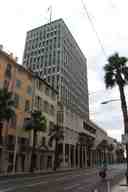
To spot the Hôtel de Ville, Toulon, just glance up to find a tall, modern tower with blue-tinted windows rising above the palm-lined Avenue de la République-the French flag waving proudly at its top makes it hard to miss! As you stand before this impressive tower, imagine yourself stepping into two completely different centuries at once. On one side, you’d see Toulon’s ancient heart, where salty sea air carried the sounds of porters unloading ships, laughter, and city meetings right along the busy quayside. The original town hall was there-a sturdy old building, until one September day in 1653, when the city council decided it was time for something grander. Picture the clamor and dust as stones were pulled down, replaced by a sparkling neoclassical marvel. Finished in 1656, it had a dramatic façade and, front and center, an ornate doorway guarded by two striking male figures-atlanteans, sculpted by the famous Pierre Puget, who used actual port workers as his models. Local legend has it their muscles came from hauling heavy cargo, not from a gym membership! This majestic old town hall was more than just an office: it echoed with music and applause when Franz Liszt, the superstar pianist of his time, wowed townsfolk with a concert in 1844. A few years later, a bold bronze statue was unveiled out front-the “Genius of Navigation”-honoring Toulon’s maritime roots. Locals, ever cheeky, named it the “Cul-vers-ville” after Admiral Jules de Cuverville, because, quite literally, the statue’s backside faced the city hall. When WWII swept through, some treasures needed hiding for their own safety. The famous atlanteans and their ornate balcony were whisked away and stored in the peaceful Thoronet Abbey, far from the dangers of bombing raids. Fast-forward to the hopeful years after the war. Toulon dreamed big-so big, in fact, that for a while, there was talk of building a 25-story skyscraper connected to the old town hall by a dramatic footbridge. Imagine that: a skywalk for city officials! In the end, though, money and common sense prevailed, and a more modest-yet still striking-Hôtel de Ville was built right here in 1970. Designed by Jean de Mailly, this modern city hall has a 15-story tower anchored by a three-story podium. Notice those alternating bands of windows and sharp blue cladding all the way up to the flagpole, soaring 70 meters above you. Inside, it’s a hive of civic activity. The mayor and deputy mayors work below, while the tower buzzes with city staff, all keeping Toulon running smoothly. As for the original town hall on the quay? Its storied doorway still stands-now welcoming visitors to the city’s tourist center. So whether you’re watching the sunlight reflect off those vertical windows or picturing sailors, councilors, and sculptors from centuries past, remember: Hôtel de Ville is where Toulon’s history comes together, layer upon fascinating layer. You might just feel the echoes of the old city council’s debates and melodies floating on the breeze right here!
Abrir página dedicada →Look to your right for a dignified light-stone church with a tall bell tower and statues on its classical facade, standing proudly among pastel-colored buildings. Now imagine…Leer másMostrar menos
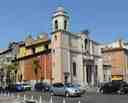
Look to your right for a dignified light-stone church with a tall bell tower and statues on its classical facade, standing proudly among pastel-colored buildings. Now imagine it’s the year 1744; Toulon is a bustling city by the sea, alive with the sounds of merchants and sailors. Suddenly, a hush falls as you step closer to this splendid church, the Église Saint-François-de-Paule. Built and named in honor of Saint Francis of Paola, the founder of the Minimes order, it’s a place where every stone seems to tell a story-perhaps even whispering a secret or two if you listen closely enough! The air is filled with the faint scent of burning incense, and if you peek inside, you might even hear the mystical Latin chanted during Mass, following the ancient Roman rituals, echoing across centuries. In the hands of the Missionaries of Divine Mercy, this church still rings with devotion, guided today by a vision as powerful as the one that shaped it almost three centuries ago. Declared a historic monument in 1942, its bell tower has seen revolutions, celebrations, and maybe a pigeon or two who wouldn’t move out for anyone-including the bishop! So while you stand beneath its watchful statues and rich facade, just imagine all those footsteps before yours, each soul seeking a little grace under this sunny Toulon sky.
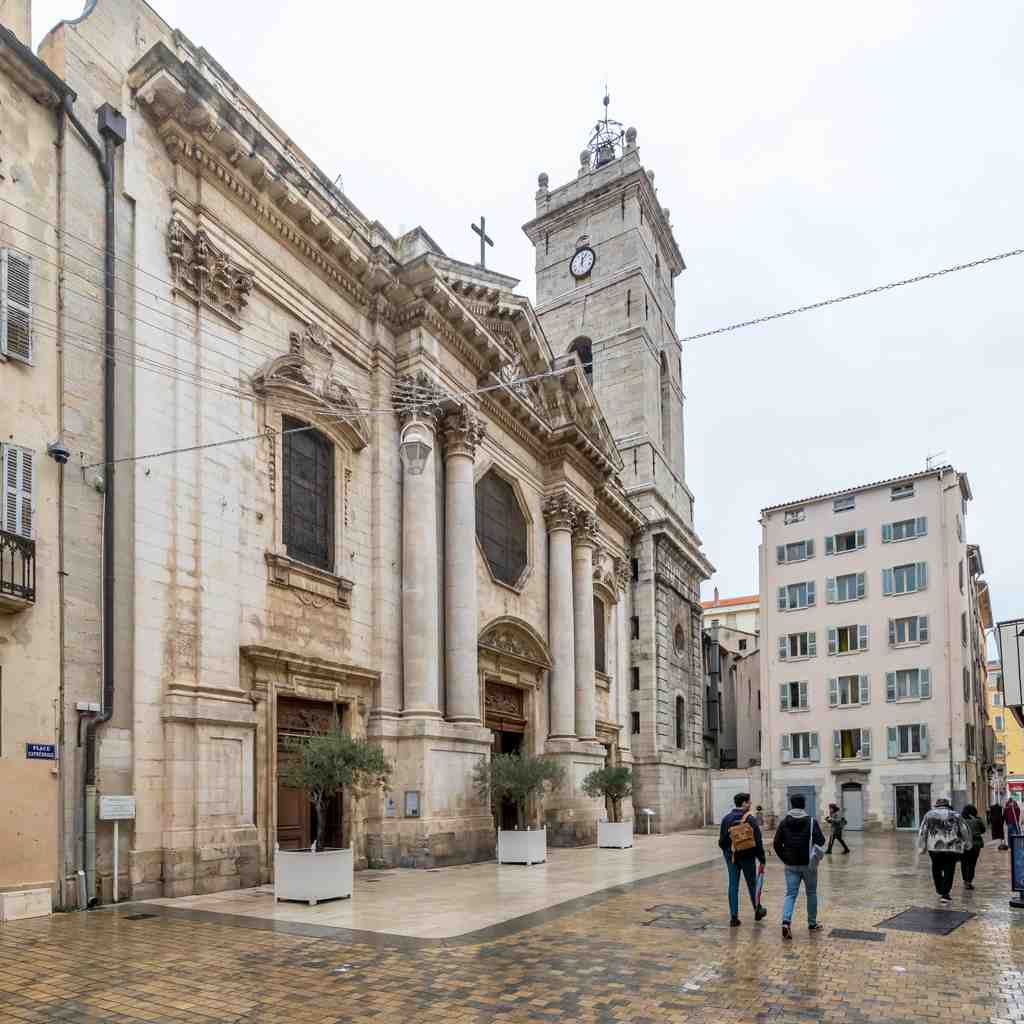
Abrir página dedicada →To spot Toulon Cathedral, look for a grand stone façade with towering Corinthian columns and a tall clock tower topped by an iron campanile, rising above the surrounding buildings…Leer másMostrar menos
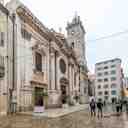
To spot Toulon Cathedral, look for a grand stone façade with towering Corinthian columns and a tall clock tower topped by an iron campanile, rising above the surrounding buildings on your right. Welcome to Toulon Cathedral! Right here, where sunlight spills over its sturdy columns and that tall clock tower stands proudly above the square, you’re at the heart of almost a thousand years of stories. Imagine, if you will, you’re stepping into a time machine-let’s turn the dial all the way back to the 11th century. It was Gilbert, Count of Provence, who began this church, possibly as a big “thank you” for surviving the Crusades. Talk about a homecoming gift! But things didn’t always stay peaceful. In the bitter winter of 1543, this very cathedral transformed-it’s hard to picture, but imagine the nave full of sailors instead of parishioners! That winter, 30,000 Ottoman sailors took over Toulon, and the cathedral was turned into a mosque for their prayers. The city’s own people were sent packing! The noise, the bustling footsteps of sailors-what a ruckus that must have been. And, in the end, it wasn’t a royal decree but a royal bribe that convinced the Ottoman admiral Barbarossa and his fleet to leave! As Toulon grew in importance, so did the cathedral. Henri IV and Louis XIV both made sure it kept up with the city, and by the late 1600s, this stately façade was added, bristling with angels and lined with thick Corinthian columns. Look up-on the tympanum, angels hold the arms of Toulon, a reminder of the city’s proud spirit. Of course, even this grand entrance wasn’t immune to history’s shake-ups-the façade was damaged in the French Revolution, but don’t worry, it got a fresh start in 1816! Towering above you is the clock tower, built with stone so thick you could almost slice it like cake-it’s three meters wide at the base and 36 meters high! On top, the wrought iron campanile has been keeping Toulon on time since 1524, though new bells had to be installed after the originals were melted down in the Revolution. Step inside, and you’ll see art that survived fires and centuries-a baroque marble altarpiece, crafted as a replica after the original burned. The air here is thick with stories echoing from every stone, and if you listen closely, you can almost hear the footsteps of Crusaders, sailors, kings, and locals from generations gone by. Don’t forget to look out for the centuries-old memorial plaques, a reminder that this cathedral really is a memory palace for Toulon.
Abrir página dedicada →



Preguntas frecuentes
¿Cómo empiezo el tour?
Después de la compra, descarga la app AudaTours e ingresa tu código de canje. El tour estará listo para comenzar de inmediato - solo toca play y sigue la ruta guiada por GPS.
¿Necesito internet durante el tour?
¡No! Descarga el tour antes de empezar y disfrútalo completamente sin conexión. Solo la función de chat requiere internet. Recomendamos descargar en WiFi para ahorrar datos móviles.
¿Es un tour guiado en grupo?
No - esta es una audioguía autoguiada. Exploras de forma independiente a tu propio ritmo, con narración de audio reproduciéndose en tu teléfono. Sin guía, sin grupo, sin horario.
¿Cuánto dura el tour?
La mayoría de los tours toman 60–90 minutos para completar, pero tú controlas el ritmo completamente. Pausa, salta paradas o toma descansos cuando quieras.
¿Qué pasa si no puedo terminar el tour hoy?
¡No hay problema! Los tours tienen acceso de por vida. Pausa y continúa cuando quieras - mañana, la próxima semana o el próximo año. Tu progreso se guarda.
¿Qué idiomas están disponibles?
Todos los tours están disponibles en más de 50 idiomas. Selecciona tu idioma preferido al canjear tu código. Nota: el idioma no se puede cambiar después de generar el tour.
¿Dónde accedo al tour después de comprarlo?
Descarga la app gratuita AudaTours desde App Store o Google Play. Ingresa tu código de canje (enviado por email) y el tour aparecerá en tu biblioteca, listo para descargar y comenzar.
Si no disfrutas el tour, te reembolsamos tu compra. Contáctanos en [email protected]
Paga de forma segura con 


