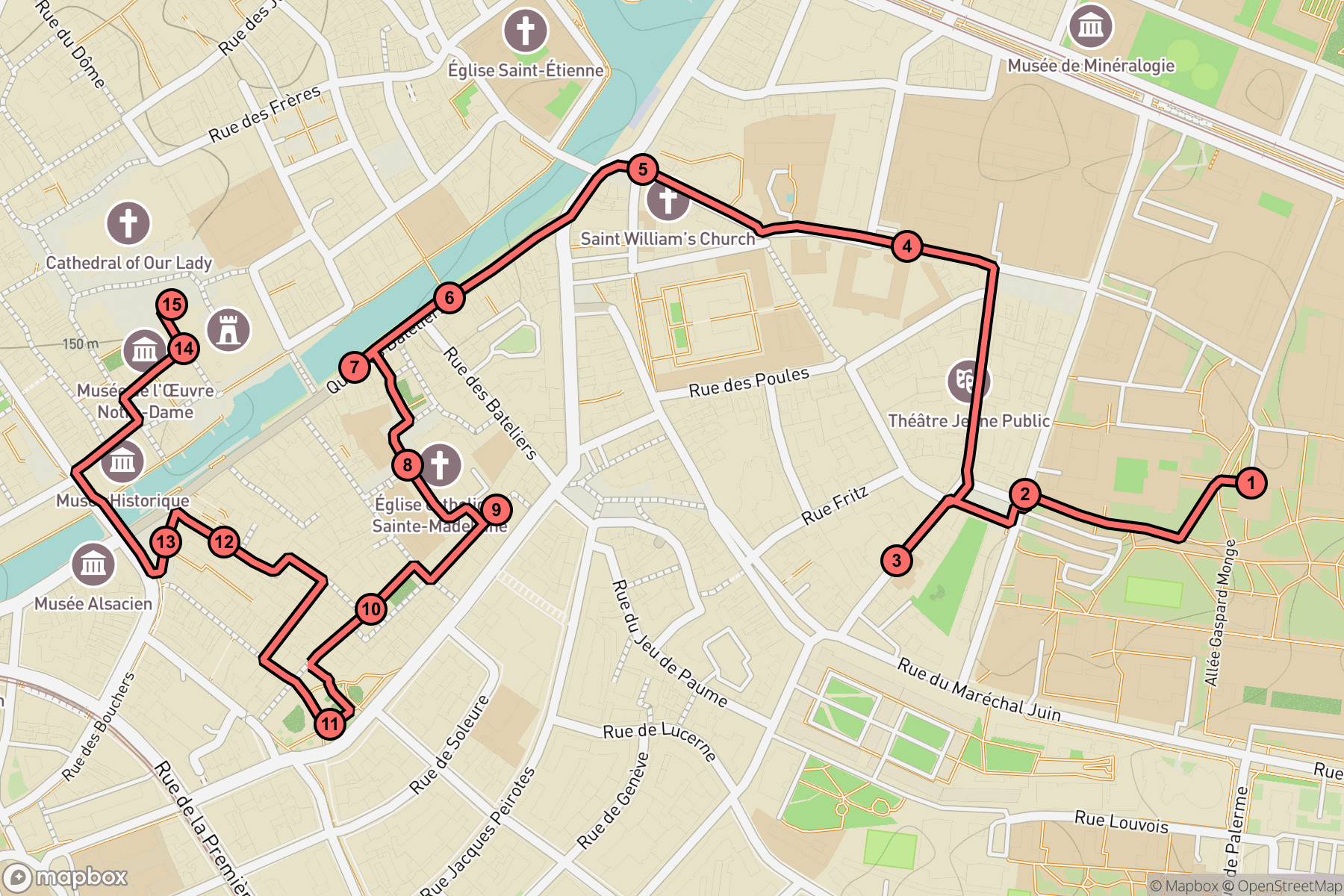
Tour de Audio de Estrasburgo: Una Odisea Estrousiana
Bajo las agujas perfectas de Estrasburgo late el corazón de una ciudad que ha sobrevivido a invasiones, intrigas y fugas nocturnas a lo largo de sus piedras centenarias. Este tour de audio autoguiado desvela la postal para revelar historias y rincones que la mayoría de los viajeros pasan por alto. Siente cómo cada paso profundiza tu sentido del Estrasburgo real: sus secretos se esconden a plena vista. ¿Quién conspiró en las sombrías cámaras del Palacio Rohan mientras la revolución barría las calles? ¿Qué escándalo sagrado resuena detrás de los antiguos muros de Sainte-Madeleine? ¿Por qué un reloj desaparecido en la Place du Château provocó un alboroto en toda la ciudad que ninguna guía menciona? Muévete por callejones donde los espías se escabulleron, a través de grandes plazas donde los destinos chocaron, y a lo largo de aguas tranquilas donde los susurros aún perduran. Ve Estrasburgo con ojos nuevos, donde el drama está grabado en cada fachada y el descubrimiento acecha en cada esquina. Pulsa reproducir ahora y desvela el Estrasburgo que la historia intentó mantener oculto.
Vista previa del tour
Sobre este tour
- scheduleDuración 40–60 minsVe a tu propio ritmo
- straighten3.0 km de ruta a pieSigue el camino guiado
- location_onUbicaciónEstrasburgo, Francia
- wifi_offFunciona sin conexiónDescarga una vez, úsalo en cualquier lugar
- all_inclusiveAcceso de por vidaReprodúcelo en cualquier momento, para siempre
- location_onComienza en Instituto de Biología Molecular y Celular
Paradas en este tour
To spot the Institut de biologie moléculaire et cellulaire, look for a large, boxy building almost completely covered in lush green ivy, with rows of windows peeking through the…Leer másMostrar menos
To spot the Institut de biologie moléculaire et cellulaire, look for a large, boxy building almost completely covered in lush green ivy, with rows of windows peeking through the leaves. Welcome to the mysterious green giant of Strasbourg! You’re standing next to the Institut de biologie moléculaire et cellulaire, fondly known as the IBMC. Imagine scientists from the French National Centre for Scientific Research and the University of Strasbourg, hurrying inside with bubbling flasks and high hopes, all under the watchful eye of swaying ivy-Mother Nature’s best attempt at a laboratory disguise! If you listen closely, you might almost hear the whispers of discoveries past wafting through the vines: stories of untangling life’s tiniest mysteries, battling invisible viruses, and maybe even a few caffeine-fueled debates about the best French pastry. This peaceful exterior hides a buzzing hive where brilliant minds explore what makes cells tick and genes dance. Every time a eureka echoes in these halls, it could one day change how we fight disease or understand our own bodies. So next time you walk past, give the building a nod-who knows, inside these leafy walls, the next scientific breakthrough could be brewing just beyond your sight. And if the ivy starts looking just a little suspicious, don’t worry-that’s just science at work! Shall we head to your next stop?
Abrir página dedicada →To spot the Ecole et Observatoire des Sciences de la Terre, just look ahead for the buildings on the central university campus with a prominent scientific globe on the…Leer másMostrar menos
To spot the Ecole et Observatoire des Sciences de la Terre, just look ahead for the buildings on the central university campus with a prominent scientific globe on the signage-this marks the heart of Strasbourg’s Earth Science hub, so you can’t miss it! Welcome to the beating heart of Strasbourg’s Earth sciences, where mysteries of our planet are unraveled day by day! Picture yourself here, standing in front of an institution buzzing with curiosity and filled with echoes of discovery that span centuries. Now, don’t worry, you won’t need a hard hat-unless you’re afraid of an earthquake of knowledge! Long before smartphones and GPS, the roots of this place stretched back to the days when seismology and meteorology were brand-new scientific fields. Historians would have you believe that the only thing shaking in the 1800s was nervous university students, but around 1880-thanks to an unlikely German spark-the study of what shakes the Earth took on a whole new meaning here in Strasbourg. Geology got its even earlier jump during the first half of the 19th century, when French scholars leapt into the earth’s history as if it were the world’s biggest treasure hunt! When Alsace became part of Germany, the Imperial University decided only the best of the best could join their ranks-a bit like Hogwarts, but with rocks and seismic sensors instead of wizards and wands. Their elite model inspired French Grandes Ecoles, laying the foundation for the exceptional reputation this place enjoys today. Even during the dark days of World War II, when institute records and diplomas had to be relocated to Clermont-Ferrand, the scientists here didn’t miss a beat-well, maybe the odd missed coffee break, but otherwise, uninterrupted research marched bravely on. Flash forward, and in 1997, the School and Observatory as you see it now was formed by fusing the mighty Geology and Physics Institutes, creating a dream team for anyone who likes their mysteries a little bit rocky. Inside these walls today, over 150 dedicated staff analyze earthquakes, probe gravity fields, and investigate landslides-no dramatic movie soundtrack needed, though I can imagine a few rocks tumbling for effect! Now, if you’re curious about who walks these corridors, picture a flock of ambitious engineers and researchers, quick with a clever joke and never too far from a seismic sensor. After two years of whizzing through rigorous prep classes, only a handful of the cleverest in France score places here each year. It’s harder to get into than a secret speakeasy! Students dive deep into every subject from tectonics to magnetism-one minute wrestling equations, the next day hunting for seismic signals in the field. For a truly vivid field experience, every aspiring geophysicist spends time exploring the Alps, where studying rocks comes with breathtaking mountain views (and the occasional mountain goat for company). The campus itself hosts legendary treasures. Hidden inside: a museum of seismology and terrestrial magnetism packed with antique instruments that once quivered while sensing quakes no person could feel. And upstairs, a mineralogy museum gleams with samples from around the world-if rocks could talk, these would have some wild travel tales. But what truly sets this place apart is its global reach. The observatory’s instruments stretch from French mountains to remote corners like Madagascar and even the Antarctic, constantly monitoring Earth’s tremors, gravity shifts, and magnetic mysteries. Imagine scientists here, late at night, glued to their monitors as a tremor miles away becomes lines on a digital seismograph and, just maybe, a midnight snack is dropped in surprise. Beyond surveillance, the School takes charge of environmental health in the Alsace region, leads a geothermal energy laboratory, and manages networks of students and researchers partnering with top universities-think London, Munich, Madrid, Oslo...almost enough air miles to cause turbulence all on their own! This hub is also a center for student life and adventure. The Board of Students plans wild events (think less toga party, more seismometer-and-snack bar mashups), while the Strasbourg University Geophysical Society leads exploratory missions into Alsace, Indiana Jones-style-but with slightly fewer rolling boulders and a lot more data charts. EOST’s alumni list is a who’s-who of science, with names like Voltz, Daubrée, and Le Pichon igniting new fields-one even modelled plate tectonics in the 1960s, causing a scientific stir that, fortunately, didn’t cause the building to shake! So, take a deep breath and imagine the silent underground rumbling, the invisible magnetic fields arching over you, the weight of history (and gravity!) all concentrated right here. Whether working to prevent catastrophe or just making sure their fancy rock collections stay tidy, the EOST remains one of the world’s most respected sentinels watching over our ever-surprising planet. Now, are you ready to shake, rattle, and stroll to the next stop? Wondering about the the school, research unit or the observatories? Feel free to discuss it further in the chat section below.
Abrir página dedicada →Right in front of you, you’ll spot a striking example of Art Nouveau architecture, with large glass windows that let you peek into its open, light-filled hall-just look for the…Leer másMostrar menos
Right in front of you, you’ll spot a striking example of Art Nouveau architecture, with large glass windows that let you peek into its open, light-filled hall-just look for the beautifully curved wrought iron staircase peeking through the doors on the left. Now, stop for a moment and let your imagination run wild. You’re not just standing in front of any modern art center-oh no! The building before you was once a bustling glass and porcelain shop, the legendary Neunreiter, back when hats were tall and artists still squabbled over who got to paint the biggest mustache on the Mona Lisa. The shop’s old Art Nouveau charm still lingers in the ironwork and elegant structure, as if every spiral and swirl is whispering stories about its glamorous past. But in 1995, with a whirl of creative energy, this beautiful relic was transformed into the beating heart of Strasbourg’s contemporary art scene, the European Center for Contemporary Artistic Actions-or as friends call it, the CEAAC. The center had already existed since 1987 with a single mission: to be a champion for contemporary art. Not just showing it off, but nurturing it, promoting artists, and giving locals and visitors alike a front-row seat to the wild, wonderful world of modern creation. Picture those first days: the scent of sawdust mixing with fresh paint, echoes of laughter (and maybe frantic hammering) as artists set up their visions for a brand new audience. Since then, the CEAAC hasn’t slowed down. Like a friendly wizard with a paintbrush, it brings together artists from every corner of Alsace-and, thanks to partnerships as far-flung as Germany, Hungary, Canada, and Korea-from every corner of the world. I like to say if there were passports for art, this building’s would be absolutely packed with stamps. The CEAAC hosts international exchanges and artist residences, where creativity flows back and forth like the River Ill itself. Since 2001, that exchange program has sparked ideas and friendships across borders-who knew art could be such a great travel agent? What’s truly magical about the CEAAC is the sense of adventure inside. Behind those grand windows, exhibitions are anything but ordinary. Sometimes you’ll find rooms filled with the gentle glow of colored light and shadows that dance along the floor; other times, you might come face-to-face with sculptures that look ready to tap you on the shoulder or paintings that seem to argue among themselves. It’s an ever-changing world-one week, ceramic vases from local potteries stand side-by-side with audacious modern installations; the next, you might see students from Strasbourg’s universities turning their wildest ideas into reality, or international artists sharing what inspires them from across the globe. Of course, every place has its secrets, and the CEAAC loves to keep people guessing. Rumor has it, during one contemporary exhibition, someone nearly mistook a very avant-garde chair for part of the coat-check. (The artist was delighted, I’m told-it’s not every day your work is mistaken for comfortable seating!) And don’t be surprised if you catch yourself grinning at a particularly strange sculpture or suddenly feeling moved by something simple, like a piece of colored string that winds its way from floor to ceiling. That’s the joy of this center: it draws you in, makes you look closer, and leaves you just a little changed. But the CEAAC’s influence stretches beyond these lovely walls. Like a garden that sends seeds out on the wind, the center has helped install contemporary sculptures and art pieces all around Strasbourg and across the region-some in city squares, some hidden in parks or perched beside quiet country lanes. Next time you see a mysterious modern form in a nearby public space, you might just have the CEAAC to thank! Today, the center receives the support of plenty of friends-the Region Grand Est, the city of Strasbourg, the European Community of Alsace, and a host of art networks. Altogether, they help keep this magical art engine chugging along, bringing in ever-new ideas and audiences. So my advice? Stay curious as you step inside. Who knows what you’ll discover today? Maybe a future masterpiece, maybe the story of modern art told in a language all its own. At the European Center for Contemporary Artistic Actions, everyone is invited to be inspired, confused, amused-or, at the very least, to wonder why there are so many mysterious empty pedestals. Maybe they’re waiting for your masterpiece? If you're curious about the description, exhibition history or the installation of works of art in public spaces, the chat section below is the perfect place to seek clarification.
Abrir página dedicada →
Mostrar 12 paradas másMostrar menos paradasexpand_moreexpand_less
Take a look just ahead-Academy Street stretches out before you, lined with classic, cream-and-pink stone facades, leafy winter trees, and buildings with charming dormer windows…Leer másMostrar menos
Take a look just ahead-Academy Street stretches out before you, lined with classic, cream-and-pink stone facades, leafy winter trees, and buildings with charming dormer windows and tiled roofs, while a splash of color hints at the Krutenau’s playful spirit in the distance. Now, let me pull you back through time and into the story of Academy Street-a place that’s worn quite a few hats! You’re standing right where the city’s rhythm slowed down a notch: here, cars crawl at a polite 30, and on certain stretches, they’re not even allowed at all. Perfect for time travelers like us, wouldn’t you say? This little street begins at the tangled intersection of Rue Calvin and a few old neighbors, stretching a brief 200 meters east to Place Saint-Nicolas-aux-Ondes, in the heart of the Krutenau district. Krutenau, by the way, has always been Strasbourg’s lively, bohemian quarter-home to students, artists, and the occasional eccentric professor (I’m looking at you, Louis Pasteur!). The street’s name-Academy Street-was chosen for all the buildings from the old University, or “Academy,” that gathered here in the 19th century. But this place wasn’t always about learning! If you had walked down this road in the 1700s, locals would have called it St. Niclausgasse, then Findelhausgasse-“the street of found children”-and during the Revolution, it even became “the street of the Children of the Homeland.” It finally became Rue de l’Académie in 1793, though the Germans switched it back and forth a couple of times, just to keep things interesting. Where you’re standing, let your imagination go wild: close your eyes and hear the echo of footsteps-students from Austria, Poland, the Rhinelands, and Russia. Back in the 1820s, the Academy here was pretty quiet, with classes so small you could practically fit all the students at a single café table. The grand, horseshoe-shaped building at number 4, the old Findelhaus, once housed orphaned children. It was built in 1774, thanks to a city lottery, and filled with the sounds of children-some laughing, some crying, all under the watch of about 20 nuns in starched habits. Sadly, life then was harsh: half the children here wouldn’t make it to their first birthday, mostly victims of the illnesses of the age. Turn back the clock again to the French Revolution, and the street was packed with soldiers-this place was transformed into a military hospital and one of France’s three “Schools of Health.” Later, in tough times, it became a workshop where poor children learned trades, trading desperate street life for a shot at a better future. Kind of heartwarming, isn’t it? In 1825, the Academy moved in for good, filling the big building with faculty after faculty: medicine, law, letters, theology-plus a little something for everyone: museums of anatomy, geology, history, even an observatory where someone, at some odd hour, spied on the heavens instead of grading papers. And here’s where it gets juicy: among the professors was none other than Louis Pasteur, the wizard of microbes, who made his first groundbreaking discoveries right inside one of these buildings. He even married the rector’s daughter! If you spot a plaque along the facade, read it with pride-it’s dedicated to Pasteur, who started his life’s work “for France, for science, and for humanity” right here. This street is bursting with surprises. On one side, there once stood the Jardin Botanique, one of Europe’s oldest, planted with 1,600 varieties by a professor named Mappus in 1619 and expanded to almost 6,000 by the 1830s. Strasbourg’s botanists fussed with their exotic plants, fought the frosts, and eagerly published catalogs-imagine professors with muddy boots ducking in and out of greenhouses! The garden became so woven into the city’s soul that, during the Prussian siege of 1870, it was even used as a burial ground, with a monument commemorating those turbulent days standing nearby. Back to modern times-what you see today is a patchwork of education and memory. There’s the art school at number 1, its striking metal-and-industrial façade a nod to brave new ideas. At number 2, the former pharmacy school, and at number 8, a little wooden kiosk-a humble champion, once used to serve fresh milk to schoolchildren during recess. And on the very spot beneath your feet, you’re sharing ground with a street that’s sheltered orphans, scholars, and explorers in equal measure. So take a deep breath-can you feel the buzz? It’s the magic of generations past whispering through Academy Street, reminding you that there’s always more to learn and always a new twist in the story, just waiting around the next corner. And hey, maybe today’s university students will be the legends of tomorrow-just don’t ask them to wake up for a lecture before 10 am!
Abrir página dedicada →To spot St William’s Church, look for a tall, narrow building with a slightly “wonky” appearance and a sharply pointed steeple with a clock, nestled quietly just off to the side…Leer másMostrar menos
To spot St William’s Church, look for a tall, narrow building with a slightly “wonky” appearance and a sharply pointed steeple with a clock, nestled quietly just off to the side near the river, surrounded by the charm of old Strasbourg streets. Now, step closer and let me bring this scene to life for you! Imagine yourself transported back to the days of knights and monks, with the gentle sound of water from the Ill river just behind you. You’re eyeing the oddly lopsided Gothic church before you-its brick walls looking sturdy (maybe even a little tired), almost as if leaning in for a quiet story. St William’s, or as the locals call it, Wilhelmskirche, may not be the fanciest church in Strasbourg, but it’s definitely among the most characterful. It all began when a local knight, Henri de Müllenheim, came home after a long-and, thankfully, un-sworded-trip to the Crusades. Feeling grateful and maybe a bit muddy, he decided to build a peaceful monastery for the Hermits of Saint William, right in these marshy outskirts, beyond the city walls. Imagine monks gliding silently by, the scent of damp earth and incense filling the air. The building-consecrated in 1301-was simple, with one long nave and very little decoration outside. But step closer (if only in your mind!), and you’d notice the choir at the end, bursting with tall windows that once let in beams of colored light for the monks’ meetings. By 1331, the church was buzzing with new life, thanks to the city’s shipbuilders, who made it their parish, given how close the church sits to the port. But life wasn’t always smooth-centuries later, the monks moved out and the church took on a Lutheran heart. Through fire, faith, and a little French stubbornness, the building survived, celebrated for its wonky charm and, believe it or not, excellent acoustics. Since the late 19th century, it’s been home to glorious concerts-imagine the walls trembling with the sounds of Bach, thanks to the legendary Wilhelmer Choir. Honestly, if this church could hum, it probably would! So take a good look around: you’re standing where knights dreamed, monks sang, and Strasbourg’s heart beat a little stronger.
Abrir página dedicada →To spot Krutenau, just look ahead for the charming half-timbered houses with steep gabled roofs, nestled cozy among lively cafés and hidden behind leafy terrace umbrellas-right…Leer másMostrar menos
To spot Krutenau, just look ahead for the charming half-timbered houses with steep gabled roofs, nestled cozy among lively cafés and hidden behind leafy terrace umbrellas-right where two old narrow streets seem to meet. Welcome to Krutenau! Let me take you on a journey through one of Strasbourg's quirkiest, most colorful neighborhoods. Close your eyes for a moment and imagine: a few centuries ago, right where you’re standing, this ground would have squished and splashed beneath your boots-Krutenau was once a patchwork of rivers, marshes, and muddy meadows. In fact, the name “Krutenau” might come from an old word for obstacles, which is a polite way to say, “good luck planting anything here!” The folks who first settled in Krutenau were brave souls: boatmen, fishermen, and anyone else who didn’t mind a bit of wet chaos. For hundreds of years, water was everywhere here. Imagine boats bobbing along twisting canals, nets cast out for fish, and kids daring each other to cross rickety wooden planks set above the muck. The street names around you-like rue des Bateliers or place Saint-Nicolas-aux-Ondes-still whisper these ancient watery tales. But change was always flowing through Krutenau, just like the streams that shaped it. Over time, people dug canals to drain away the marshes, making space for gardens and later for the homes and businesses you see today. The Rheingiessen Canal, once the lifeblood of the neighborhood, followed a route much like today’s rue de Zurich. Today, the canal has vanished under your feet, but at the heart of place de Zurich, you’ll spot a dry trench-an echo of the watery artery that helped feed and transport this busy quarter. Now, Krutenau wasn’t always the hip, student-filled spot you see today. In the 18th century, things got a bit rowdy when military barracks popped up, and by the next era, tobacco factories were humming. Soldiers, workers, and, ahem, ladies of the evening filled the alleys. Even up into the late 20th century, the neighborhood was like a worn coat-cozy but a bit threadbare. Urban renewal swept through in the 1970s, bringing fresh paint, new apartments, and, most importantly, students hunting for affordable digs. The soldiers vanished, classrooms replaced barracks, and before you knew it, Krutenau became the beating heart of Strasbourg’s nightlife-full of laughter, music, and the soft clatter of café glasses. Every corner here tells a story. Take rue du Renard-Prêchant, for example. Legend says a fisherman, annoyed by a neighbor who pinched his catch under the cover of darkness, decided on some feathery revenge. He “blamed” a fox for the theft-claiming it tricked the ducks with sweet words! That’s Krutenau: clever, mischievous, a bit unpredictable, but impossible not to love. As you wander, let yourself hear the echoes of creaking boats, smell the ancient marsh, and catch the excitement of students mixing with ghosts of fishermen past. This is Krutenau-the wild heart of old Strasbourg, where history is never far below your feet. Wondering about the localization, toponymy or the historical? Feel free to discuss it further in the chat section below.
Abrir página dedicada →To spot Place d’Austerlitz, look ahead for an open square framed by tall, classic Strasbourg apartment buildings and dotted with a few leafless trees rising grandly at its…Leer másMostrar menos
To spot Place d’Austerlitz, look ahead for an open square framed by tall, classic Strasbourg apartment buildings and dotted with a few leafless trees rising grandly at its center. Welcome to Place d’Austerlitz, a spot that’s had more names than a secret agent-“Place Dauphine” in 1771, “Metzgerplatz” if you dropped by during the 1870s, and, of course, back to “Austerlitz” after 1918. As you stand here, picture the clatter of horse-drawn carriages and the buzz of old market traders, because this square has been a busy heart of Strasbourg for centuries. Why “Austerlitz?” Let’s rewind to 1805. Imagine Napoleon himself, striding out through the city gate nearby, off to fight the Russians and Austrians at the legendary Battle of Austerlitz. Spoiler alert: he wins big-so big that Strasbourg named this very square to honor him. Picture rows of cheering townspeople as Napoleon finally marches back home in triumph months later. But Place d’Austerlitz isn’t just about military glory. For decades, it was bustling with tourists being dropped off by bus, until a major makeover in 2012 transformed it into the elegant, people-friendly plaza you see today. It’s a place to stroll, breathe, and enjoy the sun, with the soft shhh of bicycle wheels on the paths and the gentle chatter of folks on benches. Now, don’t miss the playful bronze fountain, “The Girl with the Turtle”-like Strasbourg’s answer to Copenhagen’s Little Mermaid, only with fewer scales and more turtle. And right here on the ground, you’ll find a unique relief map, a “Point of Convergence,” that invites you to feel the city beneath your fingers. So take a deep breath-if these trees could speak, they’d tell you they’ve seen emperors, butchers, and ordinary folks all making history here. Onward to the next adventure!
Abrir página dedicada →To spot Crow Square, look for an open, tree-lined space nestled between rows of historic, multi-story buildings with their classic Strasbourg rooftops, right where the bridge…Leer másMostrar menos
To spot Crow Square, look for an open, tree-lined space nestled between rows of historic, multi-story buildings with their classic Strasbourg rooftops, right where the bridge meets several lively streets. Welcome to Crow Square-don’t worry, today you’re more likely to spot a stray pigeon than a hungry raven! Now, close your eyes for just a moment and listen to the echo of footsteps on old cobblestones, because this square hides some grim secrets. In the Middle Ages, this spot was infamous as a place of punishment. They didn’t just hand out parking fines here-no, folks accused of witchcraft would meet a fate much darker, right at the edge of the bridge. Legend says the crows, with their glossy black feathers, would swoop down to clean up after justice had been served, giving the square its name. Try not to shudder! And though it feels peaceful now, imagine the suspense that once hung as thick as Strasbourg fog, with townsfolk murmuring tales of sorcery and danger. Over centuries, its name changed with the tides of history-German or French-depending on who ruled. After bombings during World War II, some old houses were lost, letting the quai spill right into this very place. But today, instead of fear, Crow Square welcomes laughter, locals, and travelers, all beneath the watchful eye of history. Makes you appreciate modern justice, doesn’t it?
Abrir página dedicada →To spot the Raven Hotel, just look for a tall, narrow timber-framed tower with a spiraling staircase at its base, and wooden galleries running along both sides of a long, charming…Leer másMostrar menos
To spot the Raven Hotel, just look for a tall, narrow timber-framed tower with a spiraling staircase at its base, and wooden galleries running along both sides of a long, charming courtyard-right in front of you! Welcome to the legendary Raven Hotel! Or, as the locals have called it for centuries: l’Hôtel du Corbeau. Now, if you listen closely, you can almost hear the clip-clop of horses’ hooves and the hush of travelers arriving after a long journey, their breaths forming little clouds in the cold Alsatian air. This isn’t just any building-oh no! You’re standing in the heart of one of Strasbourg’s oldest hostelries, with roots so deep they reach all the way back to the year 1306. That means this courtyard has seen more drama than a soap opera marathon! By 1528, the inn was known as “Zum Rabe,” which literally means “At the Raven”-a fitting name for a place where secrets and stories flock together. Step into the past for a second: Imagine entering this medieval courtyard centuries ago, packed with post carriages, stable boys dashing about, and noble travelers bustling through. Legendary guests have graced these crooked balconies-dukes, generals, even royalty! Picture the Duke of Bavaria in 1570, and later, in 1740, Frederick II of Prussia sneaking in under the name ‘Count Dufour,’ probably hoping no one would notice his royal boots. And oh, let’s not forget the emperor of Austria himself, who in 1776 spent two luxurious days here with his entourage, traveling incognito as ‘Count of Falkenstein.’ Apparently, even emperors like a bit of privacy and a cozy bed now and then. But it’s not all grandeur and celebrity guests. The Raven Hotel has lived many lives-sometimes dramatic, sometimes downright smoky. In 1668, fire swept through its wooden beams. Don’t worry, it survived, tougher than ever, ready for the next chapter. By the 18th and 19th centuries, it wasn’t just a place to lay your head; it was Strasbourg’s lively mail-post hub, filled with the energy of postillions, horses, and all sorts of city gossip bouncing off these walls. The whole courtyard was already built to welcome travelers and carriages, so little needed changing-a rare instance of medieval efficiency! However, by 1854 the old inn closed its doors, and suddenly the sound of travelers was replaced with the tinkling and clinking of glass. The Ott family moved in with their grand stained-glass workshops. If stained glass could talk, imagine the stories it could tell from this place: of craftsmen working late by lamplight, pieces of colored glass glittering like jewels in the dusk, the whir of workers weaving ribbons and lace in the small artisan studios peppered throughout. And yet, the Raven Hotel has always danced on the edge of change. In the 20th century, medical labs moved in. In fact, the house at the entrance became a hub of laboratory activity thanks to Dr. Schuh, while the Otts’ glasswork quietly continued further back in the courtyards. The last glassmaker didn’t pack up until 1981! After that, the city itself swooped in to save these remarkable buildings, except for those closest to the street, which still hosted scientists in their white coats. Don’t let the patchwork look fool you: each gallery, stair, and timber beam comes from a different century, brought together through adaptation, survival, and a touch of stubborn Alsatian spirit. Today, after careful restoration, the Raven Hotel once again welcomes guests as an elegant four-star stopover, complete with a gourmet restaurant. Walk through those oak doors and you step into living history-one that’s seen stables, fire, glassworks, laboratories, and now, perhaps the faintest echo of imperial laughter or the swish of a Prussian’s cloak. So, take a moment here. Notice how the old galleries lean in, as if whispering secrets, and the ancient well rests quietly in the shadow of that iconic tower. Maybe, just maybe, the spirit of Strasbourg’s past is perching above you, waiting to share another story at the Raven Hotel.
Abrir página dedicada →Once a year, the city pulses with energy during the famous LGBTQIA+ visibility march. Picture it: the streets fill with music, laughter, and cheers, as folks from all walks of…Leer másMostrar menos
Once a year, the city pulses with energy during the famous LGBTQIA+ visibility march. Picture it: the streets fill with music, laughter, and cheers, as folks from all walks of life dance, wave flags, and celebrate being themselves. But FestiGays isn’t just about parties. This group also rolls up its sleeves all year round, organizing events that are fun, yes, but also meaningful-whether they’re fighting for the rights of trans people to change their status freely, supporting access to fertility care for all women, or taking a stand against discrimination of any kind. Every parade, every event, buzzes with the feeling that change is possible-even inevitable. And if you listen closely, you might catch the secret to FestiGays’ magic: it’s the power of a good cause mixed with a whole lot of glitter. So strike a pose, grab a flag, and remember-here, everyone’s welcome to walk tall and proud.
Abrir página dedicada →To spot Sainte-Madeleine, just look for the tall, pale stone church with a round-topped bell tower rising high above a simple arched entrance, tucked behind leafless tree branches…Leer másMostrar menos
To spot Sainte-Madeleine, just look for the tall, pale stone church with a round-topped bell tower rising high above a simple arched entrance, tucked behind leafless tree branches right in front of you. Welcome to Sainte-Madeleine, the church with a flair for dramatic comebacks! Picture yourself standing here in late afternoon, the stone walls warm beneath your hand, the bell tower soaring above you and echoing centuries of stories. But trust me, this church is like Strasbourg’s ultimate phoenix-no matter how many times fire or war tried to take it down, it rose again (and probably said, “Nice try!”). Our tale begins way back in 1225, when a convent dedicated to Mary Magdalene was built on the city’s edge. Imagine the clang of distant bells and the murmur of prayers, as the city’s “repentant” found sanctuary here. But plot twist-around 1470, Strasbourg got jittery about an invasion from the Duke of Burgundy. What did they do? They tore down the convent as a precaution, like nervous homeowners bracing for a storm. So, they moved to Krutenau, and by 1478, a new Gothic church rose from the chaos. Think vaulted ceilings, somber shadows, colored light streaming through stained glass by the famous Peter Hemmel. The great reformer John Calvin even thundered from the pulpit here, his sermons bouncing around the stones. For centuries, this was the last Gothic church ever finished in Strasbourg. But fire has a wicked sense of humor. In 1904, flames swept through, devouring almost everything-except the choir, which you can still glimpse as a side chapel today, holding fragments of ancient frescoes and a whiff of medieval incense. Oddly, bits of magical stained glass from this time now shine over at the Musée de l’Œuvre Notre-Dame, like puzzle pieces from a lost era. Dealing with disaster seems to be Sainte-Madeleine’s secret hobby. After the fire, a bold new church was built in 1907, thanks to architect Fritz Beblo. Imagine it then: soaring, bright, and full of hope, with a generous barrel vault inspired by Munich’s St. Michael’s. Then came the shrieking of air raid sirens-World War II brought destruction yet again in 1944, as bombs crashed down and shattered Beblo’s creation. But Strasbourg wouldn’t let this church vanish. In 1958, it was rebuilt, true to Beblo’s vision, a little like pressing rewind on a favorite song. Take a peek at the adjacent school-the old cloisters from centuries past still wrap around it, like secret arms hugging history. Step inside, and you’ll hear the mighty Roethinger organ, restored and humming with energy, and maybe catch a glimpse of the small Silbermann organ, dating from 1719, classified as a Monument historique (that’s the VIP status for old organs, by the way). Look for the enormous painting of the Adoration of the Shepherds on the choir’s rear wall, once hung in Strasbourg’s cathedral-a reminder that art, like Sainte-Madeleine itself, is always being rediscovered. So next time you hear church bells echo through Krutenau, remember: this place has outwitted fire, war, and even time itself-proof that you can’t keep a good church down!
Abrir página dedicada →To spot the House at 34, quai des Bateliers, just look for the elegant cream-and-pale-yellow building with blue shutters, an arched entrance in the center, and a beautiful balcony…Leer másMostrar menos
To spot the House at 34, quai des Bateliers, just look for the elegant cream-and-pale-yellow building with blue shutters, an arched entrance in the center, and a beautiful balcony with fancy ironwork directly above the doorway. Now, as you stand outside this historic house, imagine Strasbourg centuries ago when this building was known as "Au Fil de Soie"-the House of Silk Thread. Back then, merchants hurried up and down the quay, chatter filling the air as horses’ hooves echoed off the cobbles. This very spot was the birthplace of Abraham Dürninger in 1706, a clever merchant whose name is woven into the city’s economic history like silk through a loom. But here’s a twist worthy of a detective novel: the Regence-style façade you see wasn’t even there when Abraham was a boy! In fact, it appeared like a glamorous mask in 1748, making the house look even grander. Take a glance at the iron balcony-supported by “horns of plenty”-and you’ll spot the coat of arms of the Fürstenberg brothers, both bishops of Strasbourg. Legends say those arms once watched over secret meetings-imagine late-night whispers drifting from lavish banquets inside. Since 1937, this house has proudly worn the title “Monument Historique,” keeping its secrets and stories safe. If these walls could talk, I reckon they’d ask for a little less attention and maybe a fresh coat of paint!
Abrir página dedicada →To spot Boatmen's Quay, just look across the water for a charming line of tall, colorful, half-timbered houses right along the riverbank-especially that striking orange-and-black…Leer másMostrar menos
To spot Boatmen's Quay, just look across the water for a charming line of tall, colorful, half-timbered houses right along the riverbank-especially that striking orange-and-black timbered house; you can't miss it! Now, let’s imagine ourselves back in time, standing where you are right now-only the year is 1500, and you’d better watch your step because this quay is bustling with tough, river-hardened boatmen and the shouts of merchants echo off the timbered walls. With the Ill flowing beside you, the salty scent of river water swirls in the air, mixing with the earthy aroma of fresh-cut wood. That’s fitting, because for centuries, this very spot was where boatmen unloaded vital wood supplies to keep Strasbourg’s stoves crackling all winter and its bakers busy all year round. Back then, the Boatmen’s Quay was known as Der Nidere Staden, or the “lower quay”-not exactly a name to make you want to throw a wild party, but it did the job. The street stretched right up to Place du Corbeau, and its identity evolved as the years ticked by. At one point, after the French Revolution, you would have found yourself walking along the Quay of 23 Thermidor-imagine having to remember that when telling your friends where to meet for drinks! Later, it even became the Quay of Wood, because everyone knew this was the place for buying your firewood, as well as the latest neighborhood gossip. The buildings you see along the quay range from the 16th to 18th centuries, with beautiful overhanging windows and creaking beams, some of which are so well-loved that they’ve been declared historical treasures. Take a good look at the old facades; if only walls could talk! If you pass number 11, picture artist Lucien Blumer painting away inside or the politician Charles Frey plotting his next lively speech. At number 13, you would’ve found historian Philippe Jacques Fargès-Méricourt, penning long-winded stories about the city-most likely with river sounds inspiring his words. Oh, and if you stumble on a plaque at number 34, tip your hat to Abraham Dürninger, the entrepreneur who made his mark on the world, though probably not with the wild boatman’s beard you might expect. For a pinch of mystery, you can imagine the quiet footsteps of a young jeweler’s apprentice, Georges Frédéric Strass, learning the glittering trade that would one day make his name sparkle across Europe. Today, cars are rare and people stroll freely-so take your time soaking up the lapping of the river, the crunch of gravel under your feet, and the echo of a thousand years of comings and goings. The Boatmen’s Quay holds the stories of old sailors, firewood sellers, artists, and more-and today, it gets to add your steps to its ever-growing legend.
Abrir página dedicada →Look for a grand, pale yellow sandstone palace with curving Baroque facades, tall windows, and ornate decorations, which stands just beside the cathedral-if you see elaborate…Leer másMostrar menos
Look for a grand, pale yellow sandstone palace with curving Baroque facades, tall windows, and ornate decorations, which stands just beside the cathedral-if you see elaborate wrought-iron gates and decorative statues on the roof, you’ve found the Palais Rohan! Imagine the year is 1732. The smell of fresh-cut stone fills the air, and you hear the distant as workers hurry about, piecing together what will soon be one of Strasbourg’s greatest treasures-the Palais Rohan. This palace, set right beside the mighty cathedral, wasn’t built for just anybody. Oh no, only the most powerful bishop, Armand Gaston de Rohan, and his family of prince-bishops and cardinals would be living in such splendor! Designed by the royal architect Robert de Cotte-the same genius who worked for French kings-the palace was meant to shout, “The Catholic Church is back!” to the city after two centuries of Protestant rule. The apartments of the bishops face the cathedral, creating an elegant standoff: spiritual power on one side, noble luxury on the other. Inside, you would have found rooms draped in tapestries, busts of Roman emperors watching over guests, and the glitter of gold-painted ceilings. The extravagance didn’t come cheap. The palace swallowed a budget of 344,000 livres at first-possibly a few coins more than de Rohan had in his piggy bank. By the end, it cost nearly a million! Maybe they threw a few extra statues in for good luck. The palace, built mostly from yellow sandstone, only used pink stone for places most people wouldn’t notice-a centuries-old version of “only clean where the mother-in-law checks!” During its long life, the Palais Rohan has played musical chairs with its owners: bishops, city officials, French kings, German administrators, universities, and back again-everyone wanted a turn. When the French Revolution stormed in, the House of Rohan was shown the door, many treasures were sold, and the city turned the palace into the new town hall. There were some redecorating accidents: imagine portrait after portrait of bishops being replaced by paintings of, well, “civic virtues.” Because nothing says “power” like a painting of a well-behaved allegory! The palace dazzled some of the most famous visitors in history. Louis XV, Marie Antoinette, Napoleon Bonaparte, and even American President Ronald Reagan have slept under its roof-although, don't ask what was on the breakfast menu when Napoleon stayed. And if these walls could talk, they might reveal hints of secret parties, lavish balls, or the nervous whispers before battles that shaped all of Europe. In 1805, the city traded the palace to Napoleon in exchange for a less costly address, and suddenly the halls echoed with imperial grandeur-at least until the owner kept changing again! Palais Rohan didn’t always have it easy: it survived German rule, saw war and bombings in World War II, and even a fire started by a little too much enthusiasm with a welding torch. If you sniff the air, now it carries more of a whiff of history than any threat of smoke. Step inside today, and you’ll discover three museums tucked behind these golden walls: an archaeological museum in the basement-filled with treasures buried even before the bishops arrived; a decorative arts museum on the ground floor-with shimmering porcelain and clockwork wonders; and a fine arts museum soaring above, boasting masterpieces by Giotto, Botticelli, van Dyck and more. Every room, every corridor, bursts with stories. As you gaze up at the elaborate facades, look for masks carved into the stone-faces of the seasons, or swirling shapes representing continents and elements-little reminders that someone was always watching, even back in the 18th century! And if you catch the faint rustle of silk gowns, or the echo of a coach rolling over cobblestones, don’t worry: it’s just the spirits of the past, having one last whirl before night falls. So, as you stand here, take it all in-where bishops schemed and kings danced, where fire crackled and art survived, and where the palaces of Strasbourg still whisper their royal secrets into the evening air. Exploring the realm of the structure, apartments or the museums? Feel free to consult the chat section for additional information.
Abrir página dedicada →Straight ahead, you’ll spot the Place du Château as a wide, open stone plaza surrounded by elegant historic buildings-just look for the sweeping space nestled between ornate…Leer másMostrar menos
Straight ahead, you’ll spot the Place du Château as a wide, open stone plaza surrounded by elegant historic buildings-just look for the sweeping space nestled between ornate sandstone and pale yellow facades, with some trees dotted around and locals strolling across. Welcome to Place du Château, a square where stories are piled higher than the roofs around you! Imagine standing here in 1215, when horse hooves echoed across the cobblestones and the place was known as the Bishop’s Court. Over centuries, the names changed almost as often as Strasbourg changed hats-“Place de la Responsabilité,” “Château Royal,” even “Schlossplatz” during German rule. I think this square had more identity crises than a teenager! Gaze around: you’re in the company of architectural royalty-the mighty Notre-Dame Cathedral looming on one side, the grand Palais Rohan straight ahead, and the quirky stepped gables of old Alsatian houses. On a quiet morning, you can almost hear whispers of their builders and bishops brushing past you, their footsteps lost in the hum of the city. Peek in the windows and imagine courtly intrigues and grand events, with fancy carriages and the clatter of swords. Now, don’t be fooled by its clean, modern look. Not so long ago, the place doubled as a parking lot-cars everywhere, honking, maybe even a duck or two dodging tires! But in 2010, the city said “enough!” and gave the square back to the people. After a public vote, Strasbourg presented a bold new plan: out went the cars, in came beautiful pink sandstone benches and thirty-year-old linden trees, replacing the old, sickly chestnuts. Fountains were set in the middle, perfect for a quick splash during sweltering summers or for dramatic Shakespearean monologues in the mist! But here’s the real twist: when workers began to dig up the old asphalt in 2012, guess what they found? Secret treasures from the past! Two fragments of painted Roman fresco popped up-like finding a dusty old treasure map in your attic. Those pieces are now lovingly restored and displayed at Strasbourg’s archaeological museum, which, by the way, is just behind you! So as you stand in Place du Château, surrounded by the ghosts of bishops, artists, revolutionaries, and the odd German officer, breathe in the living history. This square is Strasbourg’s memory box-generations of footsteps, laughter, and secrets swirling around you. Take a moment, maybe take a silly picture, and smile: you’re standing where eight centuries of stories come together in the open air. And if you hear the fountains giggling or the stones whispering...well, that’s just Place du Château doing what it does best!
Abrir página dedicada →
Preguntas frecuentes
¿Cómo empiezo el tour?
Después de la compra, descarga la app AudaTours e ingresa tu código de canje. El tour estará listo para comenzar de inmediato - solo toca play y sigue la ruta guiada por GPS.
¿Necesito internet durante el tour?
¡No! Descarga el tour antes de empezar y disfrútalo completamente sin conexión. Solo la función de chat requiere internet. Recomendamos descargar en WiFi para ahorrar datos móviles.
¿Es un tour guiado en grupo?
No - esta es una audioguía autoguiada. Exploras de forma independiente a tu propio ritmo, con narración de audio reproduciéndose en tu teléfono. Sin guía, sin grupo, sin horario.
¿Cuánto dura el tour?
La mayoría de los tours toman 60–90 minutos para completar, pero tú controlas el ritmo completamente. Pausa, salta paradas o toma descansos cuando quieras.
¿Qué pasa si no puedo terminar el tour hoy?
¡No hay problema! Los tours tienen acceso de por vida. Pausa y continúa cuando quieras - mañana, la próxima semana o el próximo año. Tu progreso se guarda.
¿Qué idiomas están disponibles?
Todos los tours están disponibles en más de 50 idiomas. Selecciona tu idioma preferido al canjear tu código. Nota: el idioma no se puede cambiar después de generar el tour.
¿Dónde accedo al tour después de comprarlo?
Descarga la app gratuita AudaTours desde App Store o Google Play. Ingresa tu código de canje (enviado por email) y el tour aparecerá en tu biblioteca, listo para descargar y comenzar.
Si no disfrutas el tour, te reembolsamos tu compra. Contáctanos en [email protected]
Paga de forma segura con 



